Data Access Speed ,
Scalability
Snowflake uses automatic parallel execution to fasten data loading for
example it involves breaking up the single 10Gb file into 100 x 100Mb.
Databricks provides fast performance when working with large datasets and
tables as it uses Spark architecture underneath to parallelize and partition
the data.
Scalability :
• Snowflake automatically adds or resumes additional clusters (up
to the maximum number defined by user) as soon
as the workload increases.
• Databricks clusters spin-up and scale for processing massive
amounts of data when needed and spin down when
not in use.
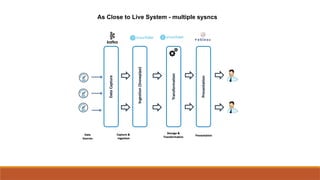
As Close to Live System - multiple sysncs
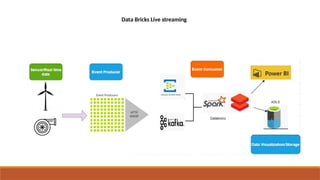
Data Bricks Live streaming
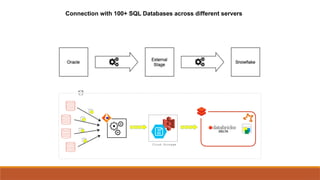
Connection with 100+ SQL Databases across different servers
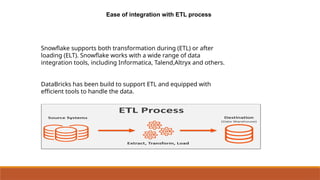
Ease of integration with ETL process
Snowflake supports both transformation during (ETL) or after
loading (ELT). Snowflake works with a wide range of data
integration tools, including Informatica, Talend,Altryx and others.
DataBricks has been build to support ETL and equipped with
efficient tools to handle the data.
EASE OF EXPANDABILITY - AFTER INITIAL SETUP, SCHEMA CHANGE
IN SOURCE? HOW HARD IS TO UPDATE THE SETUP.
Snow flake : A warehouse provides the required resources, such as CPU, memory, and
temporary storage, to perform the following operations in a Snowflake session , It
automatically scales its nodes and performance.
Data Bricks: Databricks cluster is a set of computation resources and configurations on
which you run data engineering and data analytics workloads. Where nodes and workers
are manually assigned for different sizes of data.
CI/CD
A CI/CD pipeline combines code building, testing, and deployment into one
continuous process ensuring that all changes to the main branch code are
releasable to production. An automated CI/CD pipeline prevents manual errors,
provides standardized feedback loops to developers, and enables quick software
iterations.
Snow Flake : It uses Jenkins or other thierd party tools to create CI/CD pipelines for
source code
Databricks: It uses Azure Devops to create CI/CD pipelines.
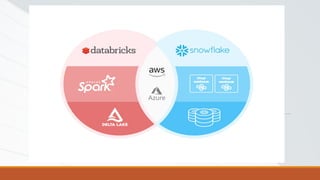
snowflake_databricks hoe to integrate snowflake with databricks

  • 2.
    Data Access Speed, Scalability Snowflake uses automatic parallel execution to fasten data loading for example it involves breaking up the single 10Gb file into 100 x 100Mb. Databricks provides fast performance when working with large datasets and tables as it uses Spark architecture underneath to parallelize and partition the data. Scalability : • Snowflake automatically adds or resumes additional clusters (up to the maximum number defined by user) as soon as the workload increases. • Databricks clusters spin-up and scale for processing massive amounts of data when needed and spin down when not in use.
  • 3.
    As Close toLive System - multiple sysncs
  • 4.
  • 5.
    Connection with 100+SQL Databases across different servers
  • 6.
    Ease of integrationwith ETL process Snowflake supports both transformation during (ETL) or after loading (ELT). Snowflake works with a wide range of data integration tools, including Informatica, Talend,Altryx and others. DataBricks has been build to support ETL and equipped with efficient tools to handle the data.
  • 7.
    EASE OF EXPANDABILITY- AFTER INITIAL SETUP, SCHEMA CHANGE IN SOURCE? HOW HARD IS TO UPDATE THE SETUP. Snow flake : A warehouse provides the required resources, such as CPU, memory, and temporary storage, to perform the following operations in a Snowflake session , It automatically scales its nodes and performance. Data Bricks: Databricks cluster is a set of computation resources and configurations on which you run data engineering and data analytics workloads. Where nodes and workers are manually assigned for different sizes of data.
  • 8.
    CI/CD A CI/CD pipelinecombines code building, testing, and deployment into one continuous process ensuring that all changes to the main branch code are releasable to production. An automated CI/CD pipeline prevents manual errors, provides standardized feedback loops to developers, and enables quick software iterations. Snow Flake : It uses Jenkins or other thierd party tools to create CI/CD pipelines for source code Databricks: It uses Azure Devops to create CI/CD pipelines.