Introduction to Snowflake & Cloud
Data Warehousing
What is Snowflake?
Snowflake is a cloud-based data warehousing platform.
Provides scalability, elasticity, and high performance for data storage &
analytics.
Decouples compute & storage for optimized resource utilization.
Supports structured, semi-structured, and unstructured data.
Fully managed SaaS solution—no infrastructure maintenance required.
Why Cloud Data Warehousing?
✅Scalability – Scale up/down compute power as needed.
✅Cost Efficiency – Pay only for what you use.
✅Performance – Handles massive workloads with parallel processing.
✅Security & Compliance – Built-in encryption and governance.
✅Multi-Cloud Support – Works across AWS, Azure, and Google Cloud.
Snowflake Architecture Overview
Multi-Cluster Shared Data Architecture (separates compute & storage).
Three Layers:
Storage Layer – Stores structured & semi-structured data.
a.
Compute Layer (Virtual Warehouses) – Executes queries independently.
b.
Cloud Services Layer – Manages security, metadata, and optimization.
c.
Automatic scaling & workload isolation ensure high availability.
Key Features of Snowflake
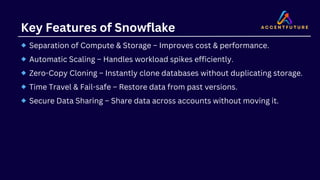
🔹Separation of Compute & Storage – Improves cost & performance.
🔹Automatic Scaling – Handles workload spikes efficiently.
🔹Zero-Copy Cloning – Instantly clone databases without duplicating storage.
🔹Time Travel & Fail-safe – Restore data from past versions.
🔹Secure Data Sharing – Share data across accounts without moving it.
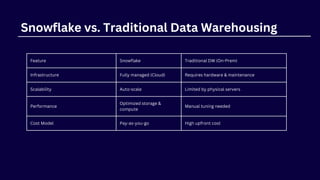
Feature Snowflake Traditional DW (On-Prem)
Infrastructure Fully managed (Cloud) Requires hardware & maintenance
Scalability Auto-scale Limited by physical servers
Performance
Optimized storage &
compute
Manual tuning needed
Cost Model Pay-as-you-go High upfront cost
Snowflake vs. Traditional Data Warehousing
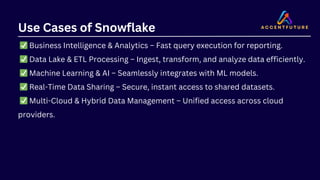
Use Cases of Snowflake
✅Business Intelligence & Analytics – Fast query execution for reporting.
✅Data Lake & ETL Processing – Ingest, transform, and analyze data efficiently.
✅Machine Learning & AI – Seamlessly integrates with ML models.
✅Real-Time Data Sharing – Secure, instant access to shared datasets.
✅Multi-Cloud & Hybrid Data Management – Unified access across cloud
providers.
Conclusion
Snowflake revolutionizes cloud data warehousing with scalability, simplicity,
and performance.
Decoupled compute & storage enables cost-effective processing.
Ideal for enterprises looking for real-time analytics, AI, and big data
workloads.

Introduction to Snowflake & Cloud Data Warehousing | Best Snowflake Online Training

  • 1.
    Introduction to Snowflake& Cloud Data Warehousing
  • 2.
    What is Snowflake? Snowflakeis a cloud-based data warehousing platform. Provides scalability, elasticity, and high performance for data storage & analytics. Decouples compute & storage for optimized resource utilization. Supports structured, semi-structured, and unstructured data. Fully managed SaaS solution—no infrastructure maintenance required.
  • 3.
    Why Cloud DataWarehousing? ✅Scalability – Scale up/down compute power as needed. ✅Cost Efficiency – Pay only for what you use. ✅Performance – Handles massive workloads with parallel processing. ✅Security & Compliance – Built-in encryption and governance. ✅Multi-Cloud Support – Works across AWS, Azure, and Google Cloud.
  • 4.
    Snowflake Architecture Overview Multi-ClusterShared Data Architecture (separates compute & storage). Three Layers: Storage Layer – Stores structured & semi-structured data. a. Compute Layer (Virtual Warehouses) – Executes queries independently. b. Cloud Services Layer – Manages security, metadata, and optimization. c. Automatic scaling & workload isolation ensure high availability.
  • 5.
    Key Features ofSnowflake 🔹Separation of Compute & Storage – Improves cost & performance. 🔹Automatic Scaling – Handles workload spikes efficiently. 🔹Zero-Copy Cloning – Instantly clone databases without duplicating storage. 🔹Time Travel & Fail-safe – Restore data from past versions. 🔹Secure Data Sharing – Share data across accounts without moving it.
  • 6.
    Feature Snowflake TraditionalDW (On-Prem) Infrastructure Fully managed (Cloud) Requires hardware & maintenance Scalability Auto-scale Limited by physical servers Performance Optimized storage & compute Manual tuning needed Cost Model Pay-as-you-go High upfront cost Snowflake vs. Traditional Data Warehousing
  • 7.
    Use Cases ofSnowflake ✅Business Intelligence & Analytics – Fast query execution for reporting. ✅Data Lake & ETL Processing – Ingest, transform, and analyze data efficiently. ✅Machine Learning & AI – Seamlessly integrates with ML models. ✅Real-Time Data Sharing – Secure, instant access to shared datasets. ✅Multi-Cloud & Hybrid Data Management – Unified access across cloud providers.
  • 8.
    Conclusion Snowflake revolutionizes clouddata warehousing with scalability, simplicity, and performance. Decoupled compute & storage enables cost-effective processing. Ideal for enterprises looking for real-time analytics, AI, and big data workloads.