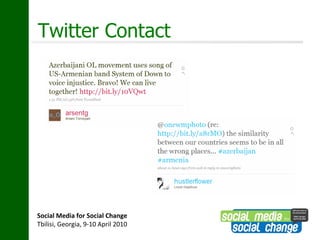
The document discusses the impact of media and digital technologies on the conflicts between Armenia and Azerbaijan, highlighting issues of self-censorship, stereotype perpetuation, and the role of social media in facilitating dialogue. Despite historical animosities, there are calls for increased communication and cooperation through online platforms to foster understanding and conflict resolution. The document emphasizes the dual-edged nature of social media, capable of both reaffirming biases and promoting positive interactions among the conflicting parties.
![Onnik Krikorian Caucasus Regional Editor, Global Voices Online http://www.globalvoicesonline.org [email_address] [email_address] Arzu Geybullayeva Regional Analyst http://www.flyingcarpetsandbrokenpipelines.com [email_address]](https://image.slidesharecdn.com/smscpresentation-100307061931-phpapp01/85/Social-Media-for-Social-Change-Tbilisi-Presentation-1-320.jpg)
![Onnik Krikorian Caucasus Regional Editor, Global Voices Online http://www.globalvoicesonline.org [email_address] [email_address] Arzu Geybullayeva Regional Analyst http://www.flyingcarpetsandbrokenpipelines.com [email_address]](https://image.slidesharecdn.com/smscpresentation-100307061931-phpapp01/75/Social-Media-for-Social-Change-Tbilisi-Presentation-1-2048.jpg)
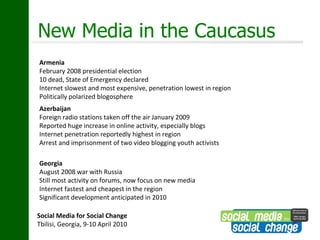
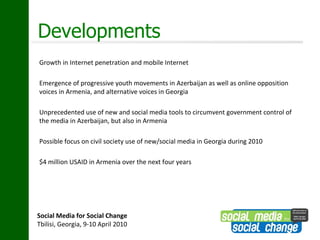
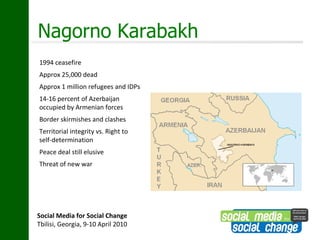
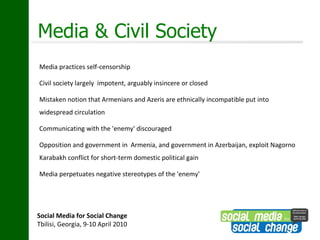
![Stereotyping the 'enemy' [A] negative context [is set] in the public consciousness, which hinders dialogue and mutual understanding […] Without more accurate and unbiased information […] free of negative rhetoric and stereotypes, Armenians and Azerbaijanis will continue to see themselves as enemies without any common ground. Report on media in Armenia and Azerbaijan , Caucasus Resource Research Center](https://image.slidesharecdn.com/smscpresentation-100307061931-phpapp01/85/Social-Media-for-Social-Change-Tbilisi-Presentation-19-320.jpg)
![Another View Nowhere in the world can you find two groups of people closer to each other. That is why we often have these stupid disputes between Armenians and Azeris. "This house is Armenian" or "this house is Azeri." Or "this music is Armenian or Azeri." This is exactly because the two have so much in common. [...] I normally say, and people don't like this, that Armenians are just Christian Azeris and Azeris are just Muslim Armenians . That is how much they are alike. Azerbaijani journalist , Re-arming the Caucasus, Al Jazeera English](https://image.slidesharecdn.com/smscpresentation-100307061931-phpapp01/85/Social-Media-for-Social-Change-Tbilisi-Presentation-20-320.jpg)
![Digital media and conflict Throughout history, war has affected media, with conflict often creating an information void. In the 21st century, media has begun to affect war more than ever before. Digital media technologies [...] have increased communication and information dissemination in conflict settings [...]. These new tools can be used to foment violence or to foster peace , and it is possible to build communication systems that encourage dialogue and nonviolent political solutions. Ivan Sigal, Global Voices Online Executive Director, Digital media in conflict-prone societies, Center for International Media Assistance (CIMA)](https://image.slidesharecdn.com/smscpresentation-100307061931-phpapp01/85/Social-Media-for-Social-Change-Tbilisi-Presentation-21-320.jpg)


