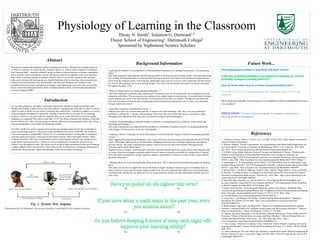
1. "Headsets Archives - Emotiv." Emotiv. N.p., n.d. Web. 23 May 2016. <http://emotiv.com/product-
category/mobile-eeg-headsets/>.
2. Adelson, Michael. "Emotiv Experimenter: An Experimentation and Mind-reading Application for
the Emotiv EPOC." Dictionary of Statistics & Methodology (2011): 1-83. Unknown., 2011. Web.
Apr. 2016. <http://compmem.princeton.edu/experimenter/ExperimenterReport.pdf>
3. Al-Wabil, Areej, Hebah Elgibreen, Remya P. George, and Buthainah Al-Dosary. "Exploring the
Validity of Learning Styles as Personalization Parameters in ELearning Environments: An
Eyetracking Study." 2010 2nd International Conference on Computer Technology and Development
(2010): n. pag. Web. <http://ieeexplore.ieee.org/stamp/stamp.jsp?tp=&arnumber=5646127&tag=1>.
4. Amarasinghe, K., D. Wijayasekara, and M. Manic. "EEG Based Brain Activity Monitoring Using
Artificial Neural Networks." 2014 7th International Conference on Human System Interactions (HSI)
(2014): n. pag. Web. <http://ieeexplore.ieee.org/stamp/stamp.jsp?tp=&arnumber=6860449>.
5. Brunyé, Tad T., Caroline R. Mahoney, Grace E. Giles, David N. Rapp, Holly A. Taylor, and Robin
B. Kanarek. "Learning to Relax: Evaluating Four Brief Interventions for Overcoming the Negative
Emotions Accompanying Math Anxiety." Elsevier Inc., 2016. Web. <http://www.sciencedirect.com/
science/article/pii/S1041608013000836>.
6. Jang, Won Ang, Sang Min Lee, and Do Hoon Lee. "Development BCI for Individuals with
Severely Disability Using EMOTIV EEG Headset and Robot." 2014 International Winter Workshop
on Brain-Computer Interface (BCI) (2014): n. pag. Web.
7. Kamal, Nurul Fazrena, Nasrul Humaimi Mahmood, and Nor Aini Zakaria. "Modeling Brain
Activities during Reading Working Memory Task: Comparison between Reciting Quran and Reading
Book." Procedia - Social and Behavioral Sciences 97 (2013): 83-89. Web. <http://
www.sciencedirect.com/science/article/pii/S1877042813036525>.
8. Lang, Peter J., and Margaret M. Bradley. "Emotion and the Motivational Brain." Biological
Psychology 84.3 (2010): 437-50. Web. <http://www.sciencedirect.com/science/article/pii/
S0301051109002257>.
9. Matuliauskaitė, Agnė, and Lina Žemeckytė. "Analysis of Interdependencies Between Students’
Emotions, Learning Productivity, Academic Achievements and Physiological Parameters." Mokslas -
Lietuvos Ateitis Science - Future of Lithuania 3.2 (2011): 51-56. Web.
10. Murata, Jun, Kanji Matsukawa, Jun-ichi Shimizu, Mutsuko Matsumoto, Tetsuya Wada, and Ishio
Ninomiya. "Effects of Mental Stress on Cardiac and Motor Rhythms." Effects of Mental Stress on
Cardiac and Motor Rhythms. Elsevier Inc., Jan. 1999. Web. May 2016. <http://
www.sciencedirect.com/science/article/pii/S0165183898001714>.
11. Shen, Liping. "Affective E-Learning: Using “Emotional” Data to Improve Learning in Pervasive
Learning Environment." Journal of Educational Technology & Society 12.2 (2009): 176-89. JSTOR.
Web. 2016.
12. Vesna Vuksanović, Vera Gal, Heart rate variability in mental stress aloud, Medical Engineering &
Physics, Volume 29, Issue 3, April 2007, Pages 344-349, ISSN 1350-4533, http://dx.doi.org/10.1016/
j.medengphy.2006.05.011.
"Exploring the Validity of Learning Styles as Personalization Parameters in ELearning Environments: An Eyetracking
Study.” 3
This study examined visual attention and the learning behavior of the user in an eLearning system. Each participant took
the Learning Style Questionnaire for assessing their learning styles (10). Participants were positioned at approximately
65cm from the computer screen. Following that, participants were given an overview of the experiment and then started
the session with a practice test on an eLearning module. The Tobii x120 eye-tracker was used to record eye movement
throughout the study. (175)
"Effects of Mental Stress on Cardiac and Motor Rhythms.” 10
This study displayed 3 arithmetic tasks, consisting of 10 questions each, for 40 seconds each, on a computer and asked
subjects to solve them. The next question was displayed once subject entered correct answer. 30 seconds before the tasks
began, subjects were given a tap order and then were allowed to tap at their own rhythm. Throughout experiment, the
heart rate was measured using an electrocardiograph and the fluctuations in tap pattern, due to stress, were measured
using an electric key switch.
“Heart Rate Variability in Mental Stress Aloud.” 12
Subjects were told to lie on their backs and rest, in order to slow their breathing. Then, they were given arithmetic
problems to evaluate for 5 minutes without talking. Once done, they were told if their answer was wrong or right.
Throughout the experiment, their heart rate was measured using an electrocardiogram.
"Analysis of Interdependencies Between Students’ Emotions, Learning Productivity, Academic Achievements and
Physiological Parameters.” 9
This study analysed previous experiments that resulted in a correlation of academic success, or learning productivity,
with changes in blood pressure, heart rate, skin humidity.
"Learning to Relax: Evaluating Four Brief Interventions for Overcoming the Negative Emotions Accompanying Math
Anxiety.” 5
Study suggested that identifying therapeutic ways to cope with stress would increase and sustain the amount of STEM
majors. Participants had some level of math anxiety. Breathing techniques and L-theanine supplements attempted to
alleviate anxiety. This study concluded that students with low-anxiety do better than students with high anxiety.
"Emotion and the Motivational Brain.” 8
Displayed series of images, neutral (people, computer), and motivational significance (gun, money) then changed color
on screen. Then the investigator asked the subject to press a button as quickly as possible for a certain time. Using the
EEG, this study found that how people respond to danger is representative in brain as an active limbic system and has
ancestral connections.
"Modeling Brain Activities during Reading Working Memory Task: Comparison between Reciting Quran and Reading
Book.” 7
This study uses the EEG to support the notion that Islamic religion (reading of Qu'ran) is good for handling stress. It
leads to state of a calm mind more than reading another book. The EEG depicted more alpha waves in the participants
instructed to the read the Qu’ran. Brain activity was measured before, during, and after participants read the Qu'ran or
other book.
Is it true that pulling an ‘all-nighter’ can prepare Dartmouth students for midterm and final exam?
Would some students would even say they learn better by staying up late with little to 4 hours of sleep a
night? In order to falsify this perception of learning that students have, I decided to embark on a journey
of questioning the foundation of human life: learning. From the time we are born, we are learning.
However, I believe as we grow older we forget the days of our youth. How did we learn the english
language as a young kid? How did we learn that 2+2=4? One thing consistent with children, is that they
are not afraid to fail. They will keep trying to build the tallest tower using spaghetti sticks, tape, string,
and one marshmallow, even if their first prototypes tumble.
The EEG and BCI are used to measure brain activity and translate neural activity into commands to
power a technological device.6 The most recently developed EEG Emotiv (EMOTIV, San Francisco,
CA) is not expensive, costing $800.1 However, it is somewhat defective in being able to distinguish
neuronal signals and muscle contractions in the face(cite article). More thoroughly defined, "Brain
Computer Interfaces (BCI) are communication systems where humans interact with external devices
using merely their brain activity”.4 Moreover, the eye-tracking device tracks the movement of a
subject’s eyes throughout a study. This device can be useful to make predictions on the type of learning
a subject affiliates him or herself with.3 Each of these tools, by themselves or alongside measurements
of heart rate, blood pressure, and/or skin humidity, were used in studies of learning.2-12
This project examines physiological studies on learning and anxiety. Moving from a broader question
of ‘What is Learning?’ to a more specific, scientific inquiry of ‘Anxiety and its Negative Correlations
with Learning Math’, I analyzed scholarly articles in hopes of discovering how to produce quantitative
data to measure stress and academic success. During my research investigation, many more questions
were raised: Is learning equated to academic success? There is a scientific consensus that increased
math anxiety distracts the learning process, thereby hindering effective learning. Some measurements
of anxiety are increased heart rate, skin humidity, and increased blood pressure. Studies to find
correlations between anxiety and behavioral changes, used engineering tools such as the eye-tracking
device, electroencephalograph (EEG), Brain Computer Interface (BCI), and the functional magnetic
resonance imaging (fMRI) .
Physiology of Learning in the Classroom
Ebony N. Smith2, Solomon G. Diamond1-2
Thayer School of Engineering1, Dartmouth College2
Sponsored by Sophomore Science Scholars
Introduction
Abstract
Background Information Future Work...
References
"Development BCI for Individuals with Severely Disability Using EMOTIV EEG Headset and Robot."
Yes No
Yes No
Yes No

Smith_Symposium

  • 1.
    1. "Headsets Archives- Emotiv." Emotiv. N.p., n.d. Web. 23 May 2016. <http://emotiv.com/product- category/mobile-eeg-headsets/>. 2. Adelson, Michael. "Emotiv Experimenter: An Experimentation and Mind-reading Application for the Emotiv EPOC." Dictionary of Statistics & Methodology (2011): 1-83. Unknown., 2011. Web. Apr. 2016. <http://compmem.princeton.edu/experimenter/ExperimenterReport.pdf> 3. Al-Wabil, Areej, Hebah Elgibreen, Remya P. George, and Buthainah Al-Dosary. "Exploring the Validity of Learning Styles as Personalization Parameters in ELearning Environments: An Eyetracking Study." 2010 2nd International Conference on Computer Technology and Development (2010): n. pag. Web. <http://ieeexplore.ieee.org/stamp/stamp.jsp?tp=&arnumber=5646127&tag=1>. 4. Amarasinghe, K., D. Wijayasekara, and M. Manic. "EEG Based Brain Activity Monitoring Using Artificial Neural Networks." 2014 7th International Conference on Human System Interactions (HSI) (2014): n. pag. Web. <http://ieeexplore.ieee.org/stamp/stamp.jsp?tp=&arnumber=6860449>. 5. Brunyé, Tad T., Caroline R. Mahoney, Grace E. Giles, David N. Rapp, Holly A. Taylor, and Robin B. Kanarek. "Learning to Relax: Evaluating Four Brief Interventions for Overcoming the Negative Emotions Accompanying Math Anxiety." Elsevier Inc., 2016. Web. <http://www.sciencedirect.com/ science/article/pii/S1041608013000836>. 6. Jang, Won Ang, Sang Min Lee, and Do Hoon Lee. "Development BCI for Individuals with Severely Disability Using EMOTIV EEG Headset and Robot." 2014 International Winter Workshop on Brain-Computer Interface (BCI) (2014): n. pag. Web. 7. Kamal, Nurul Fazrena, Nasrul Humaimi Mahmood, and Nor Aini Zakaria. "Modeling Brain Activities during Reading Working Memory Task: Comparison between Reciting Quran and Reading Book." Procedia - Social and Behavioral Sciences 97 (2013): 83-89. Web. <http:// www.sciencedirect.com/science/article/pii/S1877042813036525>. 8. Lang, Peter J., and Margaret M. Bradley. "Emotion and the Motivational Brain." Biological Psychology 84.3 (2010): 437-50. Web. <http://www.sciencedirect.com/science/article/pii/ S0301051109002257>. 9. Matuliauskaitė, Agnė, and Lina Žemeckytė. "Analysis of Interdependencies Between Students’ Emotions, Learning Productivity, Academic Achievements and Physiological Parameters." Mokslas - Lietuvos Ateitis Science - Future of Lithuania 3.2 (2011): 51-56. Web. 10. Murata, Jun, Kanji Matsukawa, Jun-ichi Shimizu, Mutsuko Matsumoto, Tetsuya Wada, and Ishio Ninomiya. "Effects of Mental Stress on Cardiac and Motor Rhythms." Effects of Mental Stress on Cardiac and Motor Rhythms. Elsevier Inc., Jan. 1999. Web. May 2016. <http:// www.sciencedirect.com/science/article/pii/S0165183898001714>. 11. Shen, Liping. "Affective E-Learning: Using “Emotional” Data to Improve Learning in Pervasive Learning Environment." Journal of Educational Technology & Society 12.2 (2009): 176-89. JSTOR. Web. 2016. 12. Vesna Vuksanović, Vera Gal, Heart rate variability in mental stress aloud, Medical Engineering & Physics, Volume 29, Issue 3, April 2007, Pages 344-349, ISSN 1350-4533, http://dx.doi.org/10.1016/ j.medengphy.2006.05.011. "Exploring the Validity of Learning Styles as Personalization Parameters in ELearning Environments: An Eyetracking Study.” 3 This study examined visual attention and the learning behavior of the user in an eLearning system. Each participant took the Learning Style Questionnaire for assessing their learning styles (10). Participants were positioned at approximately 65cm from the computer screen. Following that, participants were given an overview of the experiment and then started the session with a practice test on an eLearning module. The Tobii x120 eye-tracker was used to record eye movement throughout the study. (175) "Effects of Mental Stress on Cardiac and Motor Rhythms.” 10 This study displayed 3 arithmetic tasks, consisting of 10 questions each, for 40 seconds each, on a computer and asked subjects to solve them. The next question was displayed once subject entered correct answer. 30 seconds before the tasks began, subjects were given a tap order and then were allowed to tap at their own rhythm. Throughout experiment, the heart rate was measured using an electrocardiograph and the fluctuations in tap pattern, due to stress, were measured using an electric key switch. “Heart Rate Variability in Mental Stress Aloud.” 12 Subjects were told to lie on their backs and rest, in order to slow their breathing. Then, they were given arithmetic problems to evaluate for 5 minutes without talking. Once done, they were told if their answer was wrong or right. Throughout the experiment, their heart rate was measured using an electrocardiogram. "Analysis of Interdependencies Between Students’ Emotions, Learning Productivity, Academic Achievements and Physiological Parameters.” 9 This study analysed previous experiments that resulted in a correlation of academic success, or learning productivity, with changes in blood pressure, heart rate, skin humidity. "Learning to Relax: Evaluating Four Brief Interventions for Overcoming the Negative Emotions Accompanying Math Anxiety.” 5 Study suggested that identifying therapeutic ways to cope with stress would increase and sustain the amount of STEM majors. Participants had some level of math anxiety. Breathing techniques and L-theanine supplements attempted to alleviate anxiety. This study concluded that students with low-anxiety do better than students with high anxiety. "Emotion and the Motivational Brain.” 8 Displayed series of images, neutral (people, computer), and motivational significance (gun, money) then changed color on screen. Then the investigator asked the subject to press a button as quickly as possible for a certain time. Using the EEG, this study found that how people respond to danger is representative in brain as an active limbic system and has ancestral connections. "Modeling Brain Activities during Reading Working Memory Task: Comparison between Reciting Quran and Reading Book.” 7 This study uses the EEG to support the notion that Islamic religion (reading of Qu'ran) is good for handling stress. It leads to state of a calm mind more than reading another book. The EEG depicted more alpha waves in the participants instructed to the read the Qu’ran. Brain activity was measured before, during, and after participants read the Qu'ran or other book. Is it true that pulling an ‘all-nighter’ can prepare Dartmouth students for midterm and final exam? Would some students would even say they learn better by staying up late with little to 4 hours of sleep a night? In order to falsify this perception of learning that students have, I decided to embark on a journey of questioning the foundation of human life: learning. From the time we are born, we are learning. However, I believe as we grow older we forget the days of our youth. How did we learn the english language as a young kid? How did we learn that 2+2=4? One thing consistent with children, is that they are not afraid to fail. They will keep trying to build the tallest tower using spaghetti sticks, tape, string, and one marshmallow, even if their first prototypes tumble. The EEG and BCI are used to measure brain activity and translate neural activity into commands to power a technological device.6 The most recently developed EEG Emotiv (EMOTIV, San Francisco, CA) is not expensive, costing $800.1 However, it is somewhat defective in being able to distinguish neuronal signals and muscle contractions in the face(cite article). More thoroughly defined, "Brain Computer Interfaces (BCI) are communication systems where humans interact with external devices using merely their brain activity”.4 Moreover, the eye-tracking device tracks the movement of a subject’s eyes throughout a study. This device can be useful to make predictions on the type of learning a subject affiliates him or herself with.3 Each of these tools, by themselves or alongside measurements of heart rate, blood pressure, and/or skin humidity, were used in studies of learning.2-12 This project examines physiological studies on learning and anxiety. Moving from a broader question of ‘What is Learning?’ to a more specific, scientific inquiry of ‘Anxiety and its Negative Correlations with Learning Math’, I analyzed scholarly articles in hopes of discovering how to produce quantitative data to measure stress and academic success. During my research investigation, many more questions were raised: Is learning equated to academic success? There is a scientific consensus that increased math anxiety distracts the learning process, thereby hindering effective learning. Some measurements of anxiety are increased heart rate, skin humidity, and increased blood pressure. Studies to find correlations between anxiety and behavioral changes, used engineering tools such as the eye-tracking device, electroencephalograph (EEG), Brain Computer Interface (BCI), and the functional magnetic resonance imaging (fMRI) . Physiology of Learning in the Classroom Ebony N. Smith2, Solomon G. Diamond1-2 Thayer School of Engineering1, Dartmouth College2 Sponsored by Sophomore Science Scholars Introduction Abstract Background Information Future Work... References "Development BCI for Individuals with Severely Disability Using EMOTIV EEG Headset and Robot." Yes No Yes No Yes No