1
Smart Google Teddy Bear
Contents
 Google’s Unique Patent
 How does the Google Smart Teddy
function ?
 Connecting the Smart Teddy with other
devices
 Humanity Factor
 Nightmare or Dream Remote?
 Google Toy Controversy
 Conclusion
Google’s Unique Patent
 Google has filed a patent for a smart internet-
connected stuffed animal
 The toy would be able to wirelessly
communicate using Bluetooth, Wi-Fi or other
cloud-based computers
 The patent describes devices that would turn
their heads towards users & listen to what
they are saying, before sending commands to
remote computer servers

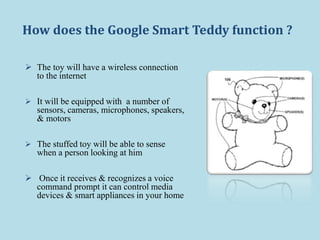
How does the Google Smart Teddy function ?
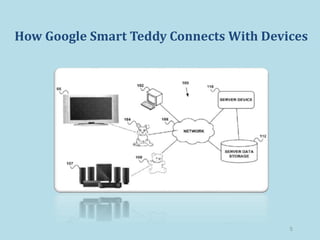
 The toy will have a wireless connection
to the internet
 It will be equipped with a number of
sensors, cameras, microphones, speakers,
& motors
 The stuffed toy will be able to sense
when a person looking at him
 Once it receives & recognizes a voice
command prompt it can control media
devices & smart appliances in your home
How Google Smart Teddy Connects With Devices
5
Humanity Factor
 The device could respond both by speaking
back & by expressing "human-like" expressions
of interest, curiosity, boredom &/or surprise
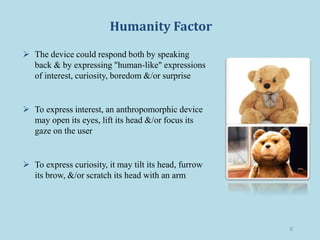
 To express interest, an anthropomorphic device
may open its eyes, lift its head &/or focus its
gaze on the user
 To express curiosity, it may tilt its head, furrow
its brow, &/or scratch its head with an arm
6
Dream remote or Nightmare?
 The patent adds that making the device look "cute"
should encourage even the youngest members of a
family to interact with it
 Young children might find these forms to be
attractive
 Individuals of all ages may find interacting with
these anthropomorphic devices to be more natural
than interacting with traditional types of user
interfaces
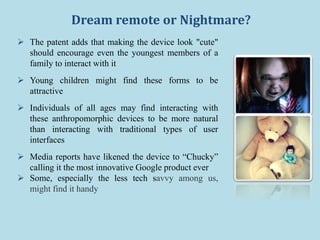
 Media reports have likened the device to “Chucky”
calling it the most innovative Google product ever
 Some, especially the less tech savvy among us,
might find it handy
Google Toy Controversy
 Devices similar to Google’s have recently
garnered a lot of controversy among parents
& child advocacy groups
 Concerns about privacy
 Eavesdrop on anything we say
 Possibility of unfair marketing to children
Conclusion
 It may be desirable to be able to simplify the management &
control of a variety of media devices
 The toy-like robots’ abilities seem to go far beyond functional &
into artificial intelligence, potentially standing in for human
companions
 Google says the patent application isn’t an indication the company
will actually make or sell this connected toy
10
Thank You

Smart Google Teddy Bear

  • 1.
  • 2.
    Contents  Google’s UniquePatent  How does the Google Smart Teddy function ?  Connecting the Smart Teddy with other devices  Humanity Factor  Nightmare or Dream Remote?  Google Toy Controversy  Conclusion
  • 3.
    Google’s Unique Patent Google has filed a patent for a smart internet- connected stuffed animal  The toy would be able to wirelessly communicate using Bluetooth, Wi-Fi or other cloud-based computers  The patent describes devices that would turn their heads towards users & listen to what they are saying, before sending commands to remote computer servers 
  • 4.
    How does theGoogle Smart Teddy function ?  The toy will have a wireless connection to the internet  It will be equipped with a number of sensors, cameras, microphones, speakers, & motors  The stuffed toy will be able to sense when a person looking at him  Once it receives & recognizes a voice command prompt it can control media devices & smart appliances in your home
  • 5.
    How Google SmartTeddy Connects With Devices 5
  • 6.
    Humanity Factor  Thedevice could respond both by speaking back & by expressing "human-like" expressions of interest, curiosity, boredom &/or surprise  To express interest, an anthropomorphic device may open its eyes, lift its head &/or focus its gaze on the user  To express curiosity, it may tilt its head, furrow its brow, &/or scratch its head with an arm 6
  • 7.
    Dream remote orNightmare?  The patent adds that making the device look "cute" should encourage even the youngest members of a family to interact with it  Young children might find these forms to be attractive  Individuals of all ages may find interacting with these anthropomorphic devices to be more natural than interacting with traditional types of user interfaces  Media reports have likened the device to “Chucky” calling it the most innovative Google product ever  Some, especially the less tech savvy among us, might find it handy
  • 8.
    Google Toy Controversy Devices similar to Google’s have recently garnered a lot of controversy among parents & child advocacy groups  Concerns about privacy  Eavesdrop on anything we say  Possibility of unfair marketing to children
  • 9.
    Conclusion  It maybe desirable to be able to simplify the management & control of a variety of media devices  The toy-like robots’ abilities seem to go far beyond functional & into artificial intelligence, potentially standing in for human companions  Google says the patent application isn’t an indication the company will actually make or sell this connected toy
  • 10.