www.luxoft.co
m
Smart Device Link
Integration into Linux systems
June 2017
Author: Jeremiah Foster
Open Source Technologist
www.luxoft.co
m
Who am I?
• Jeremiah C. Foster, proud father of
Hannah and husband of Annika
• Huge FOSS fanboi and Debian user
• Open Source Technologist for Luxoft
• GENIVI Community Manager
www.luxoft.com
Purpose of this talk
• To let everyone know that it is possible to
integrate iOS and Android smart devices
into Linux based automotive systems
• To provide a route to collaboration and a
justification of why collaboration is so
important in the SDL case
www.luxoft.co
m
What are we talking about?
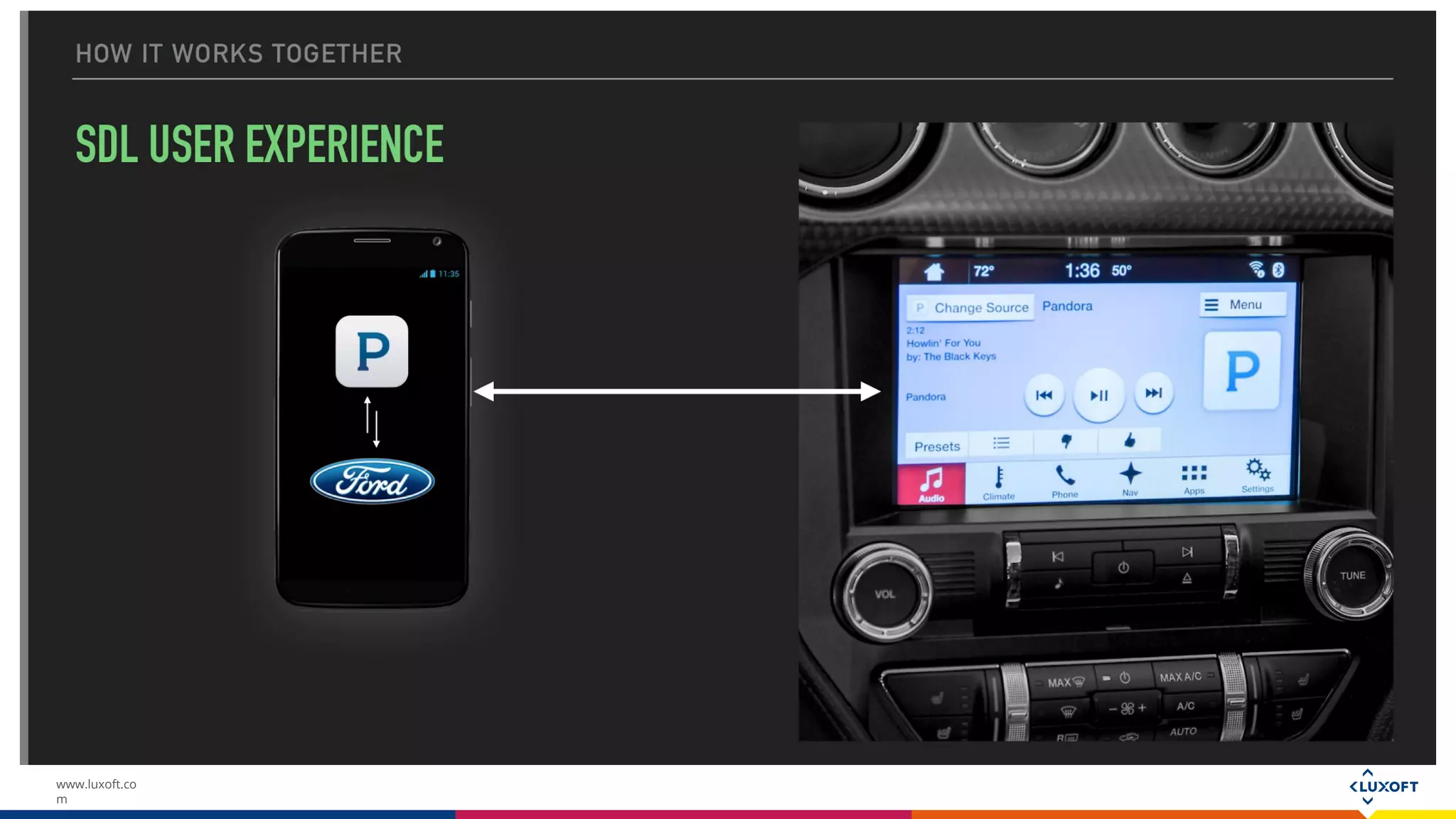
● A standardized way to connect
‘smartphone’ devices, namely iOS and
Android devices, to an in-vehicle
infotainment system running Linux via
‘Smart Device Link’
● This requires software libraries on both
the infotainment system and the
smartphone
www.luxoft.co
m
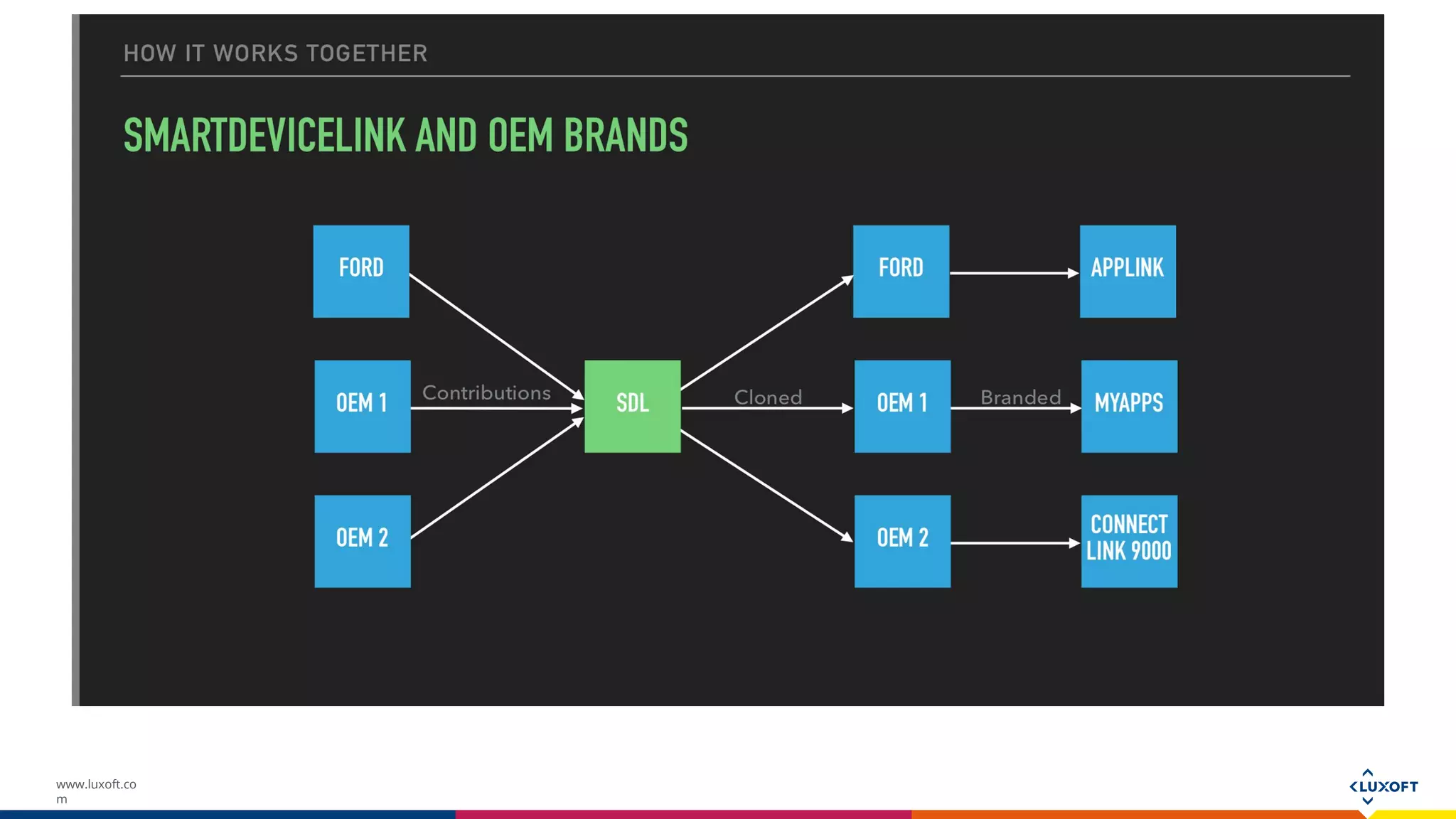
Smart Device Link is not AppLink
● “AppLink was originally a proprietary API
created by Ford
● Ford announced they were contributing
AppLink to the open-source under the name
SmartDeviceLink in 2013. Purchased Livio
● Livio engineers are the project maintainers
● AppLink is now the branded version of SDL
based off the open-source project”
www.luxoft.co
m
SDL consortium
Created by Ford and Toyota
the “SmartDeviceLink
Consortium, is a nonprofit
organization working to
manage an open source
software platform with the goal
of giving consumers more
choice in how they connect
and control their smartphone
apps on the road.”
www.luxoft.co
m
www.luxoft.co
m
SDL contribution model
• The consortium appears to be using a standard open source model using
permissive licenses: “smartdevicelink/sdl_core is licensed under the
BSD 3-clause "New" or "Revised" License
A permissive license similar to the BSD 2-Clause License, but with a 3rd clause
that prohibits others from using the name of the project or its contributors to
promote derived products without written consent.”
• All SDL Code is on GitHub, all documentation is open
• Project evolution is based on Apple’s Swift Evolution and offers a high degree
of transparency regarding decisions on what is included and what is rejected
• https://github.com/smartdevicelink/sdl_evolution
www.luxoft.co
m
www.luxoft.co
m
Project status
From the SDL GitHub README:
“We're ramping up our efforts to get SmartDeviceLink developed and maintained directly in
the open. For the Mobile libraries, we're expecting better integration soon, SDL Core is slightly
more complicated. We are currently working on generating documentation, creating a
developer portal, an open forum, Mobile validation, and everything else that we've been asked
for to renew the community's interest in this project. From a technical standpoint, SDL is
stable, and the most work is being put into making it a more robust solution for app
connectivity. We are, however, definitely looking for and interested in other people and
company's contributions to SDL whether it be feature based, bug fixes, healthy conversation,
or even just suggestions for improvement.”
www.luxoft.co
m
Features of SDL
• Provides a Text to Speech (TTS) interface to allow drivers to keep their eyes
on the road. Obviously this is a large safety benefit
• Provides the ability to control apps using SDL via the steering wheel
buttons as well as TTS
• Attempts to be vendor agnostic with regard to device; supports both iOS
devices and Android devices
• Allows for the control of user data on the head unit, including some
analytics functions
• Provide a policy engine for apps using the head unit
• Allow the OEM to use their own interface and preserve their brand
www.luxoft.co
m
Key requirements of SDL
● POSIX compliance for portability
● Transport protocol should be easy
to replace, modifiable
● Well documented APIs
www.luxoft.co
m
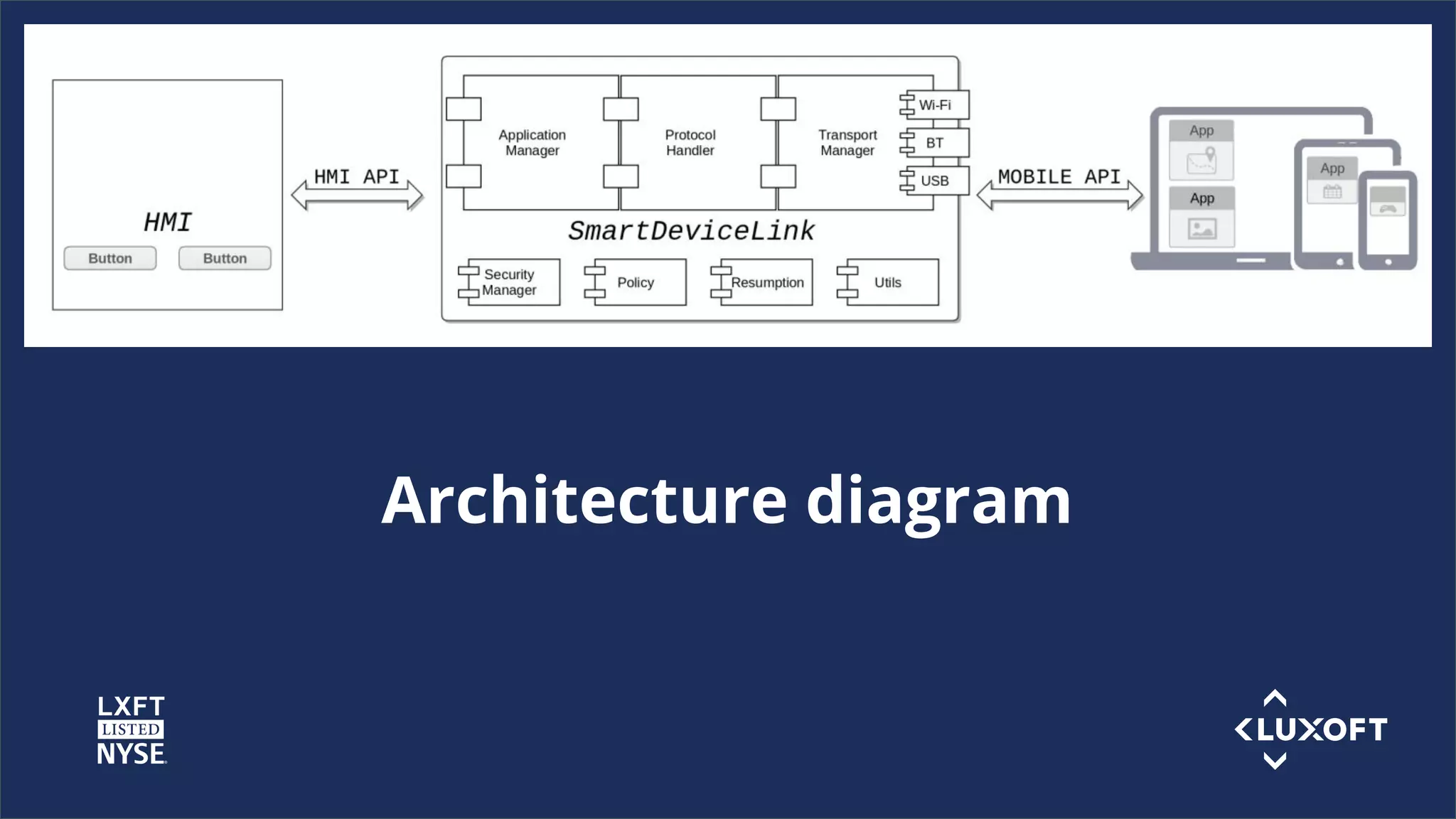
Architecture diagram
www.luxoft.co
m
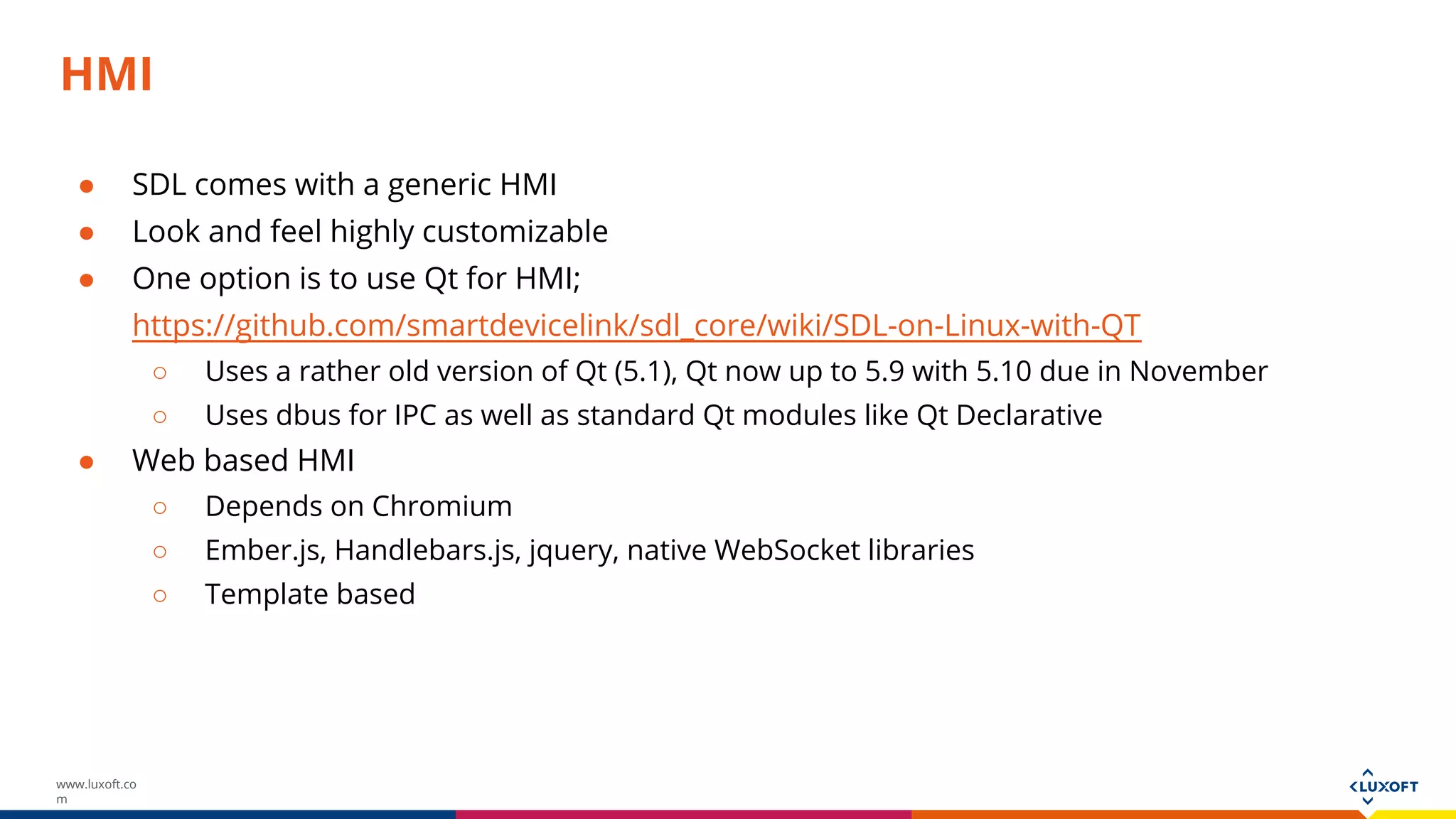
HMI
● SDL comes with a generic HMI
● Look and feel highly customizable
● One option is to use Qt for HMI;
https://github.com/smartdevicelink/sdl_core/wiki/SDL-on-Linux-with-QT
○ Uses a rather old version of Qt (5.1), Qt now up to 5.9 with 5.10 due in November
○ Uses dbus for IPC as well as standard Qt modules like Qt Declarative
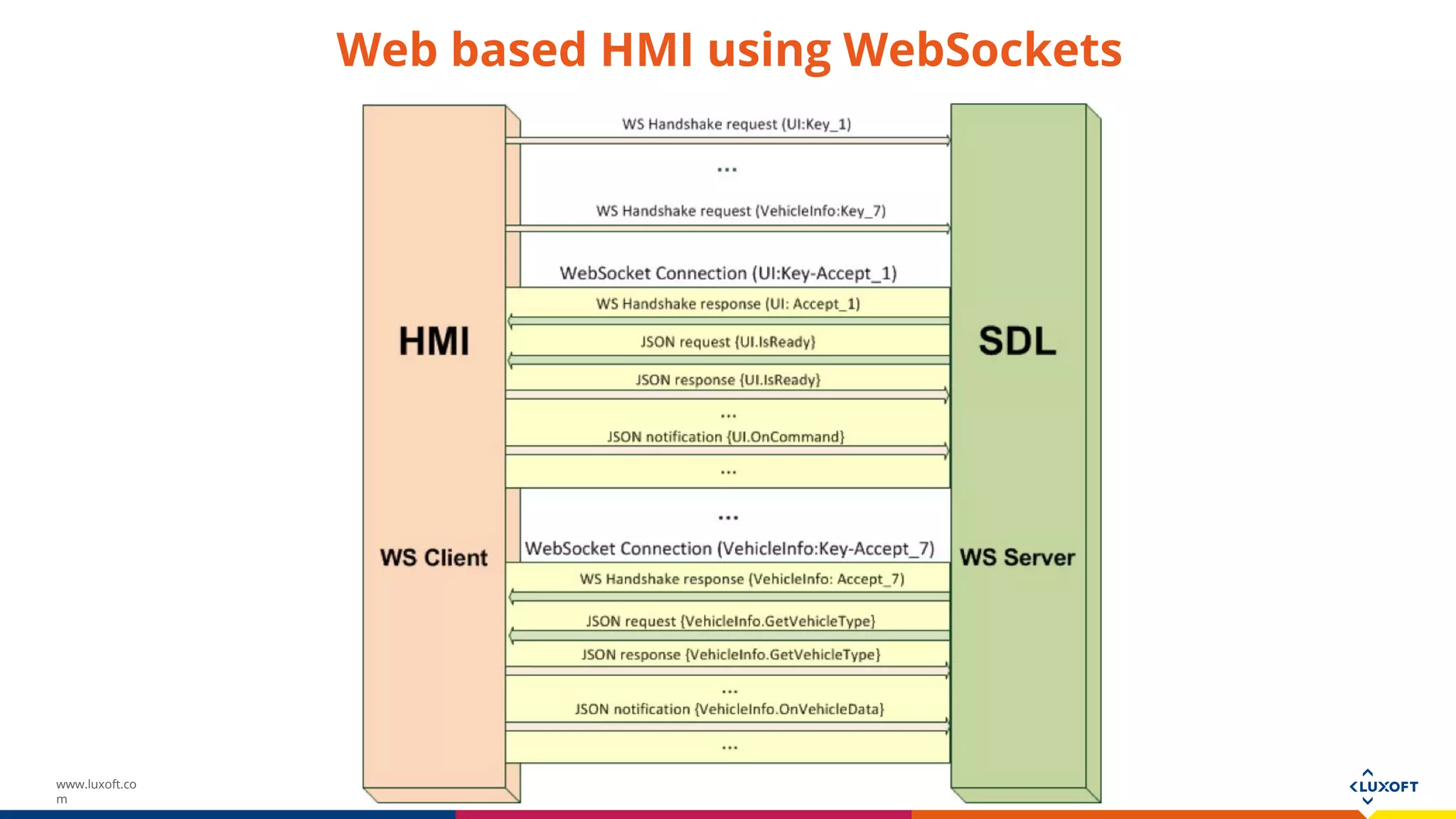
● Web based HMI
○ Depends on Chromium
○ Ember.js, Handlebars.js, jquery, native WebSocket libraries
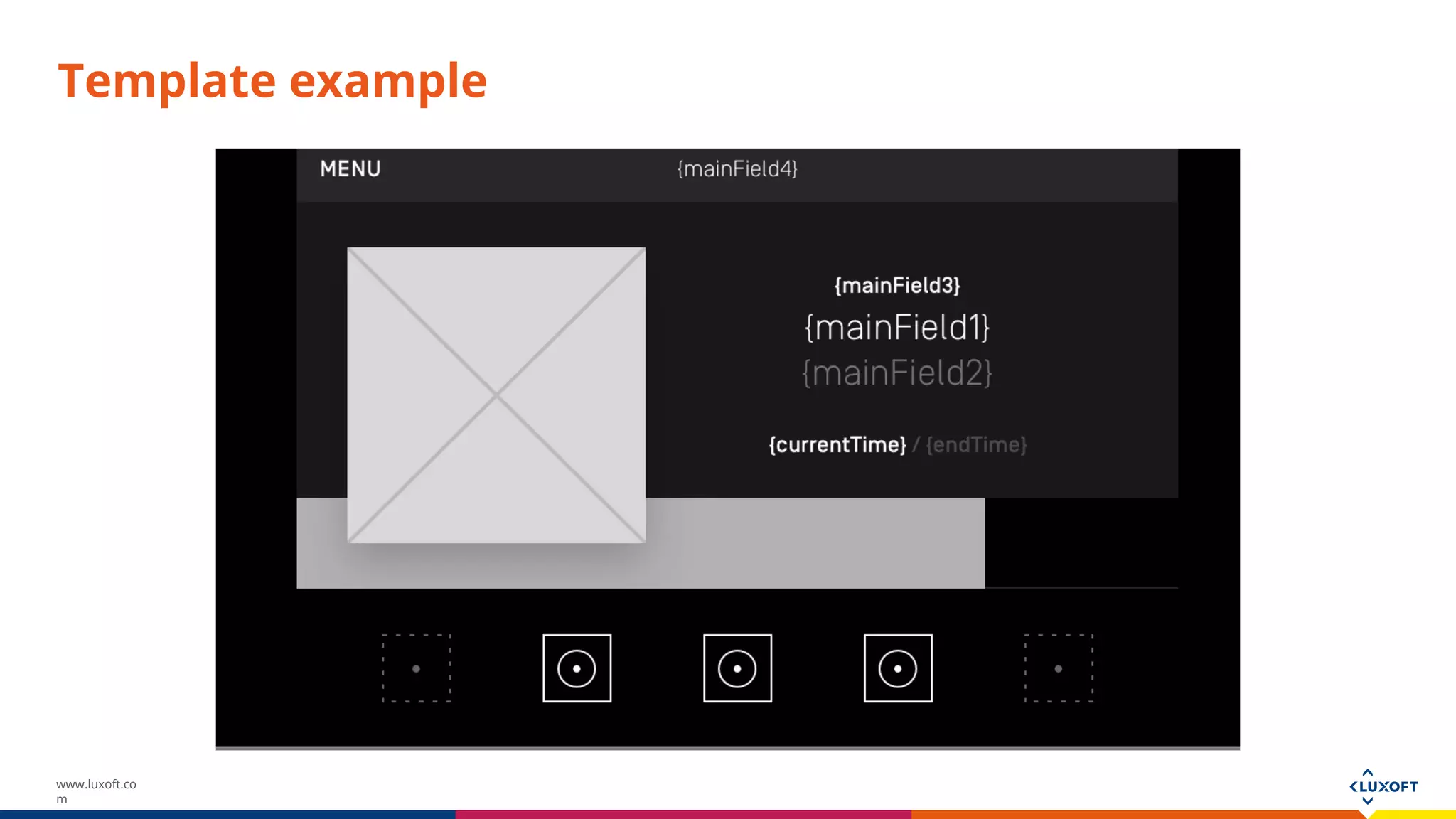
○ Template based
www.luxoft.co
m
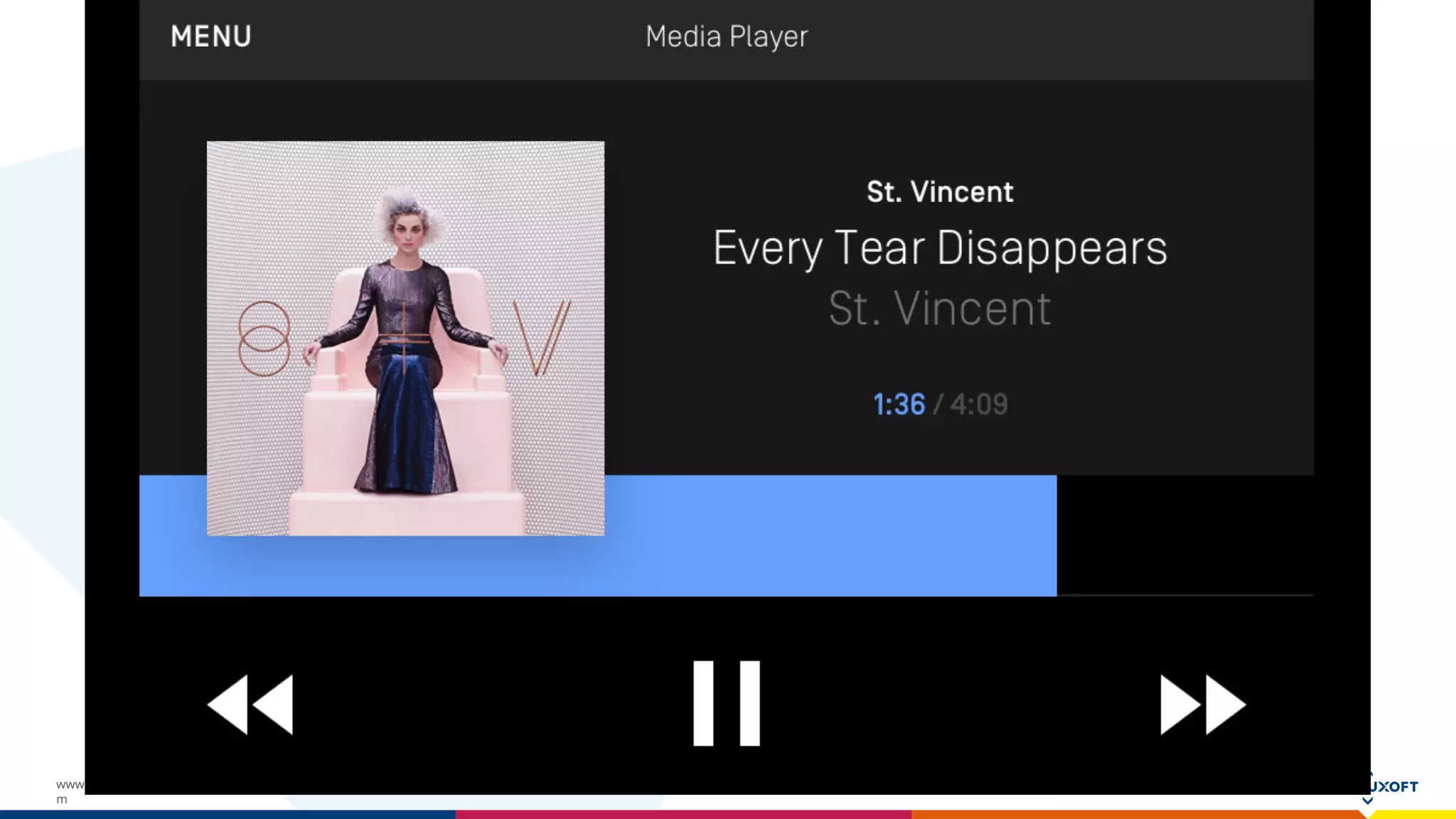
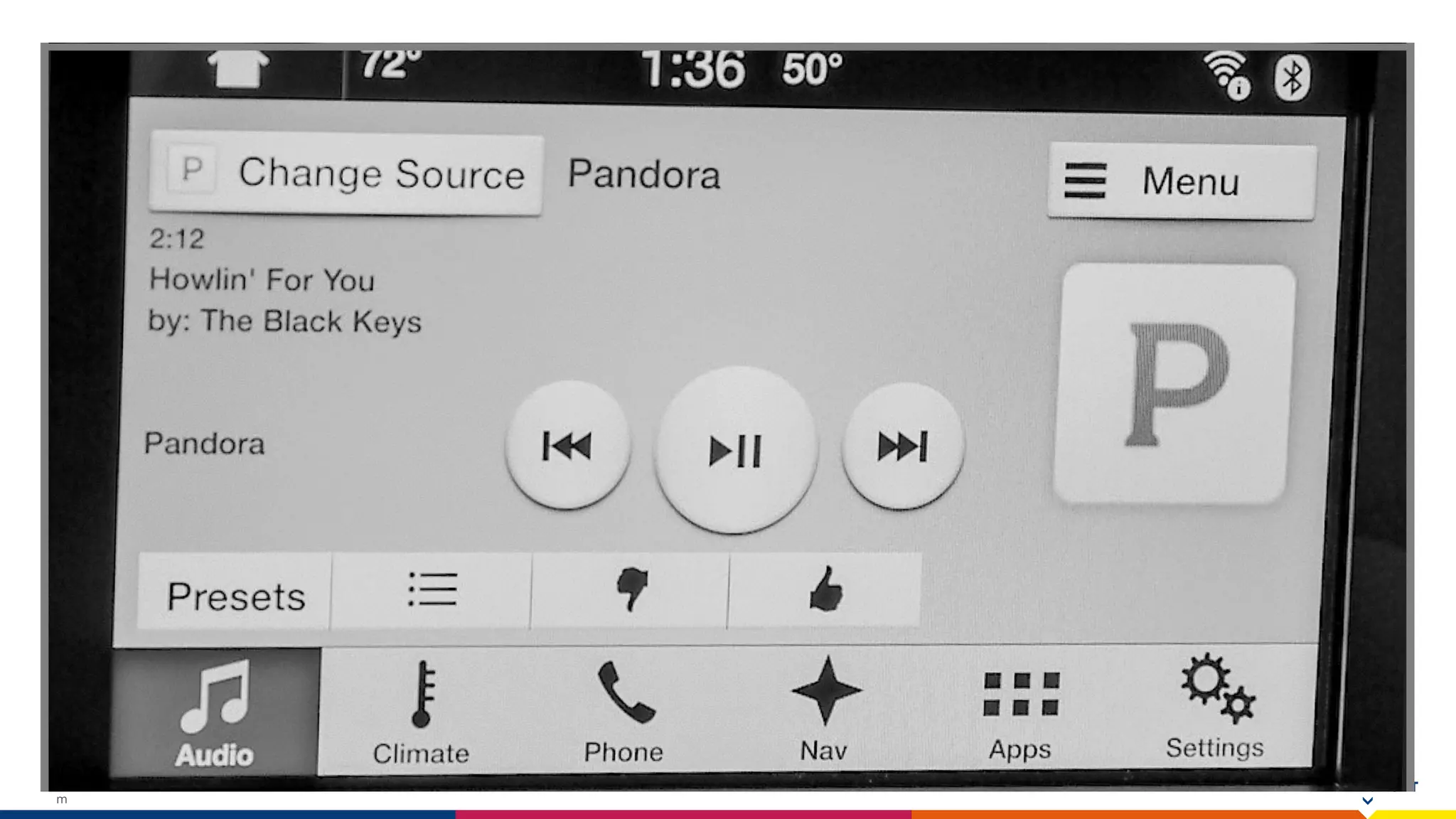
Template example
www.luxoft.co
m
www.luxoft.co
m
www.luxoft.co
m
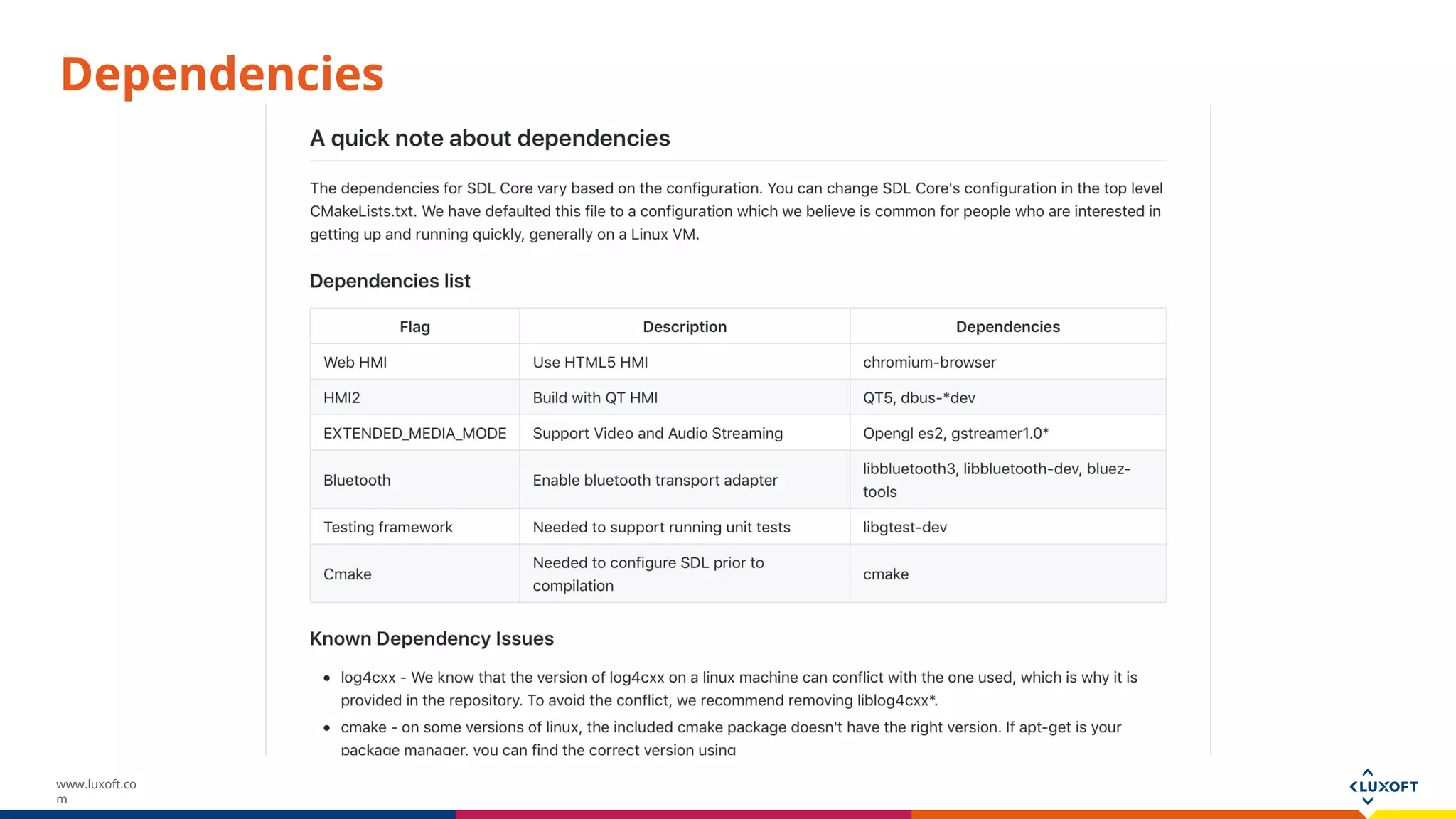
Dependencies
www.luxoft.co
m
Web based HMI using WebSockets
www.luxoft.co
m
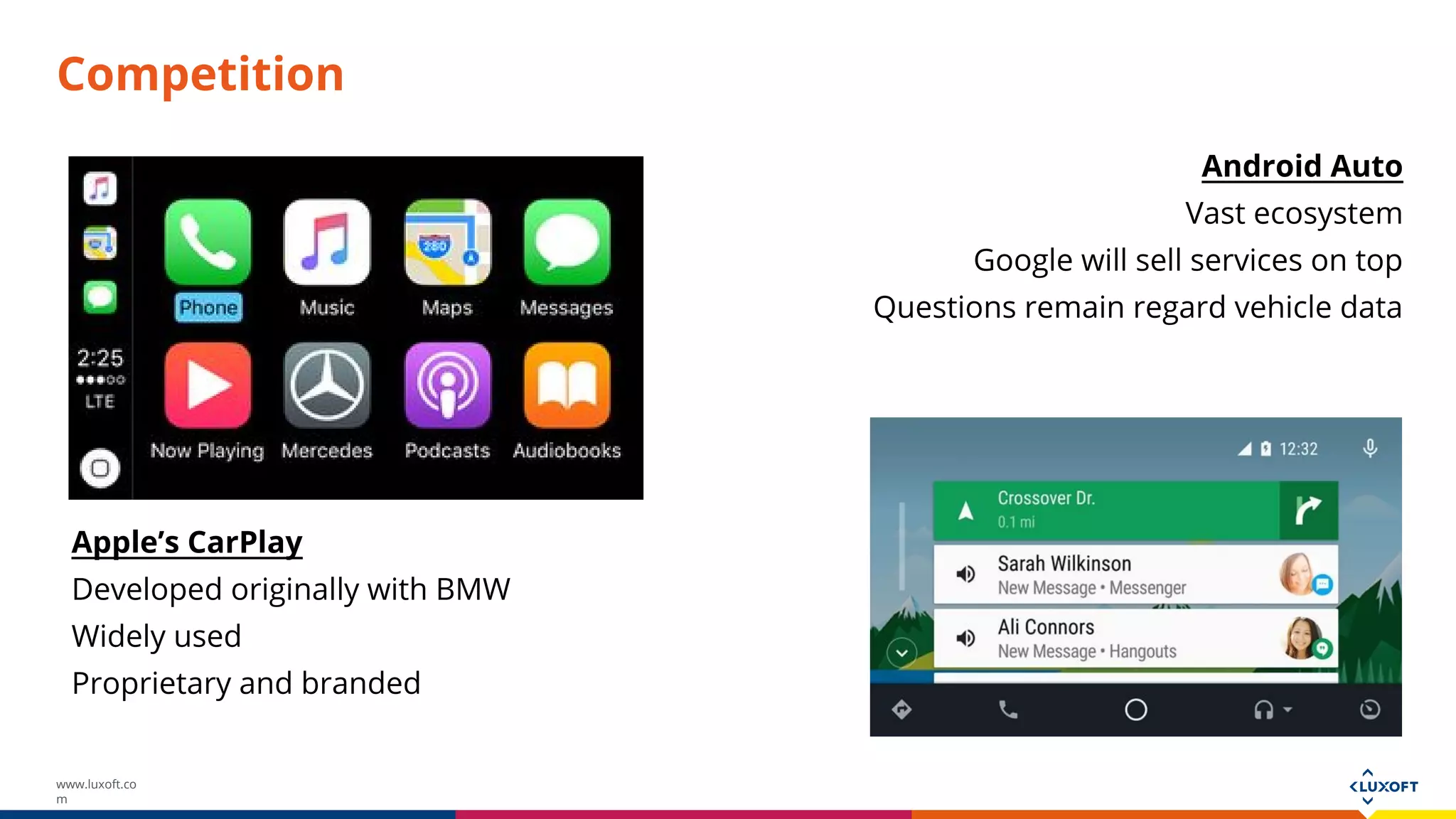
Competition
Apple’s CarPlay
Developed originally with BMW
Widely used
Proprietary and branded
Android Auto
Vast ecosystem
Google will sell services on top
Questions remain regard vehicle data
www.luxoft.co
m
Competition
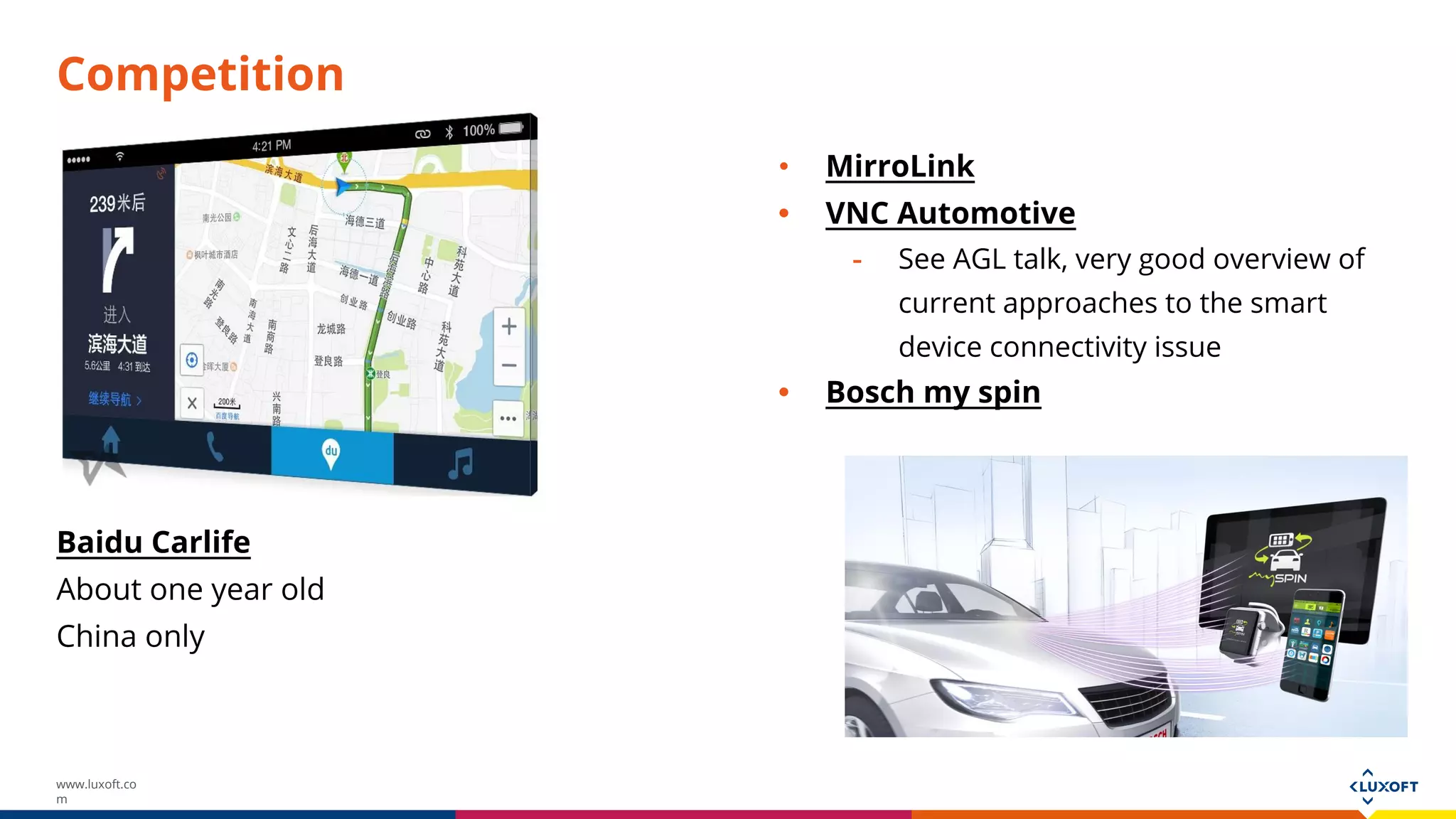
Baidu Carlife
About one year old
China only
• MirroLink
• VNC Automotive
- See AGL talk, very good overview of
current approaches to the smart
device connectivity issue
• Bosch my spin
www.luxoft.co
m
Why collaboration is key
• SDL as a more open source solution is a bit behind in terms of feature
parity and adoption, collaboration will speed adoption
and improve quality
• Large complex projects can only work with broad and deep collaboration
• This is non-differentiating ‘middle-ware’ or plumbing
• If users and OEMs don’t control access to their data they miss out on the
opportunities that the data provides. This includes regulatory control, new
business models, personalization, policy, etc.
www.luxoft.co
m
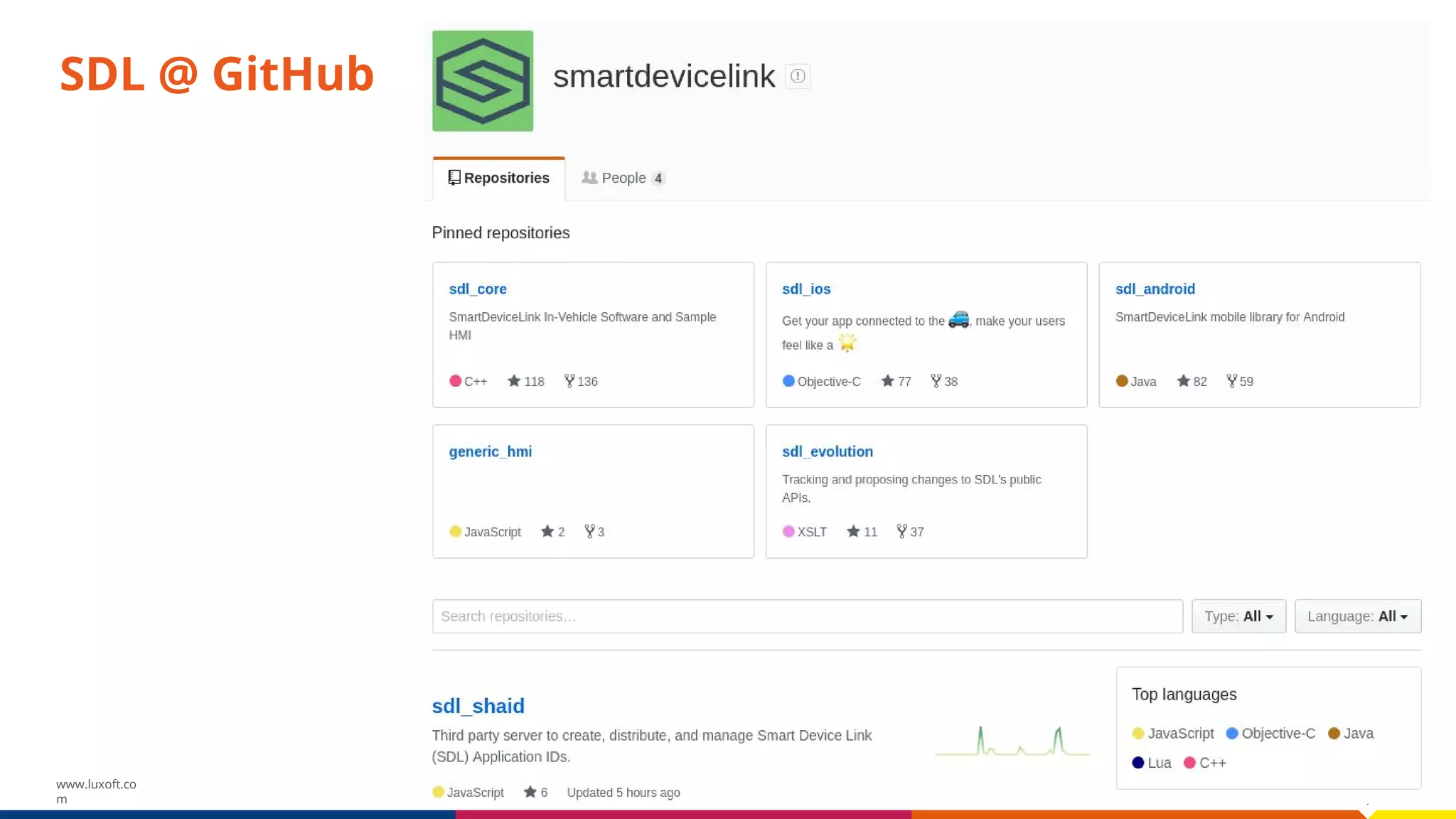
SDL @ GitHub
www.luxoft.co
m
Existing work
• There is an OpenEmbedded meta layer for integration called meta-sdl
maintainer by Phong Tran.
- Phong has contributed to GENIVI and the GDP
- Code hosted at GitHub
- Brings in changes to log4cxx, bluez-tools, sdl-core
- Provides a systemd service file
• Adds a number of patches to sdl-core:
https://github.com/phongt/meta-sdl/blob/release/4.1.0/recipes-automotive/sdl-core/sdl-core_4.1.0.bb
www.luxoft.co
m
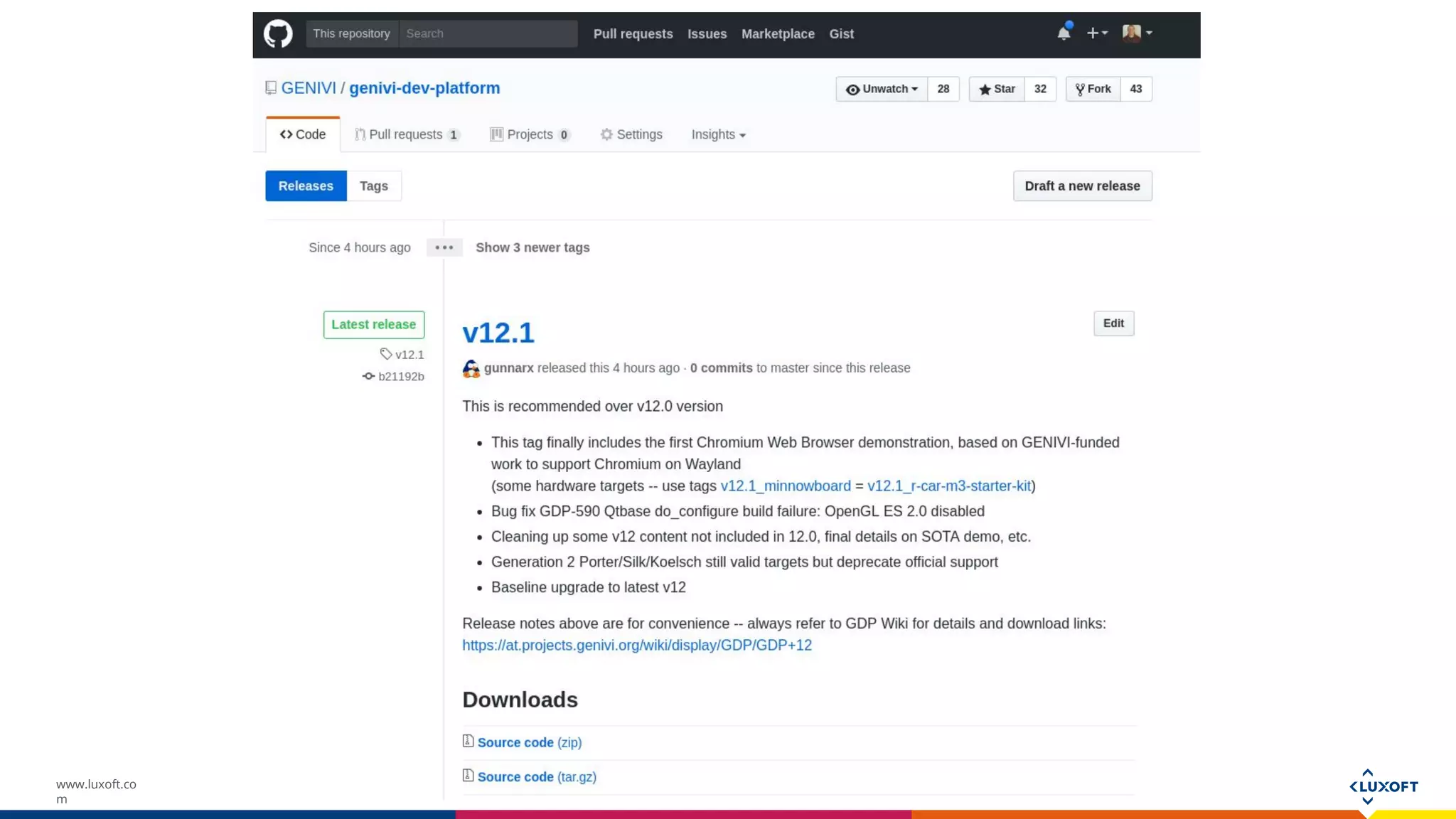
Chromium
• SDL’s web HMI has a dependency on Chromium
• Chromium is coming into GENIVI’s GDP and is largely complete. Igalia is responsible for
this work and has done a lot of work on Chromium. [See their slides from their talk on
porting Chromium to Wayland yesterday at ALS]
• Large project, huge code base
• https://github.com/OSSystems/meta-browser
- Yocto layers for browsers
• Still relies on X11 to a large extent (again, see the Igalia slides)
www.luxoft.co
m
www.luxoft.co
m
Summary for integrations
• Since both GENIVI and AGL are building Yocto based images an SDL recipe would have
greatest code re-use
• To address the largest possible user base, the proposal would be to put the SDL recipe in
meta-ivi-common which can feed into both AGL and GENIVI and even, potentially,
AUTOSAR. Any Yocto or OE based source build
www.luxoft.co
m
Thank you!

Smart Device Link Integration into Linux systems by Jeremiah Foster

  • 1.
    www.luxoft.co m Smart Device Link Integrationinto Linux systems June 2017 Author: Jeremiah Foster Open Source Technologist
  • 2.
    www.luxoft.co m Who am I? •Jeremiah C. Foster, proud father of Hannah and husband of Annika • Huge FOSS fanboi and Debian user • Open Source Technologist for Luxoft • GENIVI Community Manager
  • 3.
    www.luxoft.com Purpose of thistalk • To let everyone know that it is possible to integrate iOS and Android smart devices into Linux based automotive systems • To provide a route to collaboration and a justification of why collaboration is so important in the SDL case
  • 4.
    www.luxoft.co m What are wetalking about? ● A standardized way to connect ‘smartphone’ devices, namely iOS and Android devices, to an in-vehicle infotainment system running Linux via ‘Smart Device Link’ ● This requires software libraries on both the infotainment system and the smartphone
  • 5.
    www.luxoft.co m Smart Device Linkis not AppLink ● “AppLink was originally a proprietary API created by Ford ● Ford announced they were contributing AppLink to the open-source under the name SmartDeviceLink in 2013. Purchased Livio ● Livio engineers are the project maintainers ● AppLink is now the branded version of SDL based off the open-source project”
  • 6.
    www.luxoft.co m SDL consortium Created byFord and Toyota the “SmartDeviceLink Consortium, is a nonprofit organization working to manage an open source software platform with the goal of giving consumers more choice in how they connect and control their smartphone apps on the road.”
  • 7.
  • 8.
    www.luxoft.co m SDL contribution model •The consortium appears to be using a standard open source model using permissive licenses: “smartdevicelink/sdl_core is licensed under the BSD 3-clause "New" or "Revised" License A permissive license similar to the BSD 2-Clause License, but with a 3rd clause that prohibits others from using the name of the project or its contributors to promote derived products without written consent.” • All SDL Code is on GitHub, all documentation is open • Project evolution is based on Apple’s Swift Evolution and offers a high degree of transparency regarding decisions on what is included and what is rejected • https://github.com/smartdevicelink/sdl_evolution
  • 9.
  • 10.
    www.luxoft.co m Project status From theSDL GitHub README: “We're ramping up our efforts to get SmartDeviceLink developed and maintained directly in the open. For the Mobile libraries, we're expecting better integration soon, SDL Core is slightly more complicated. We are currently working on generating documentation, creating a developer portal, an open forum, Mobile validation, and everything else that we've been asked for to renew the community's interest in this project. From a technical standpoint, SDL is stable, and the most work is being put into making it a more robust solution for app connectivity. We are, however, definitely looking for and interested in other people and company's contributions to SDL whether it be feature based, bug fixes, healthy conversation, or even just suggestions for improvement.”
  • 11.
    www.luxoft.co m Features of SDL •Provides a Text to Speech (TTS) interface to allow drivers to keep their eyes on the road. Obviously this is a large safety benefit • Provides the ability to control apps using SDL via the steering wheel buttons as well as TTS • Attempts to be vendor agnostic with regard to device; supports both iOS devices and Android devices • Allows for the control of user data on the head unit, including some analytics functions • Provide a policy engine for apps using the head unit • Allow the OEM to use their own interface and preserve their brand
  • 12.
    www.luxoft.co m Key requirements ofSDL ● POSIX compliance for portability ● Transport protocol should be easy to replace, modifiable ● Well documented APIs
  • 13.
  • 14.
    www.luxoft.co m HMI ● SDL comeswith a generic HMI ● Look and feel highly customizable ● One option is to use Qt for HMI; https://github.com/smartdevicelink/sdl_core/wiki/SDL-on-Linux-with-QT ○ Uses a rather old version of Qt (5.1), Qt now up to 5.9 with 5.10 due in November ○ Uses dbus for IPC as well as standard Qt modules like Qt Declarative ● Web based HMI ○ Depends on Chromium ○ Ember.js, Handlebars.js, jquery, native WebSocket libraries ○ Template based
  • 15.
  • 16.
  • 17.
  • 18.
  • 19.
  • 20.
    www.luxoft.co m Competition Apple’s CarPlay Developed originallywith BMW Widely used Proprietary and branded Android Auto Vast ecosystem Google will sell services on top Questions remain regard vehicle data
  • 21.
    www.luxoft.co m Competition Baidu Carlife About oneyear old China only • MirroLink • VNC Automotive - See AGL talk, very good overview of current approaches to the smart device connectivity issue • Bosch my spin
  • 22.
    www.luxoft.co m Why collaboration iskey • SDL as a more open source solution is a bit behind in terms of feature parity and adoption, collaboration will speed adoption and improve quality • Large complex projects can only work with broad and deep collaboration • This is non-differentiating ‘middle-ware’ or plumbing • If users and OEMs don’t control access to their data they miss out on the opportunities that the data provides. This includes regulatory control, new business models, personalization, policy, etc.
  • 23.
  • 24.
    www.luxoft.co m Existing work • Thereis an OpenEmbedded meta layer for integration called meta-sdl maintainer by Phong Tran. - Phong has contributed to GENIVI and the GDP - Code hosted at GitHub - Brings in changes to log4cxx, bluez-tools, sdl-core - Provides a systemd service file • Adds a number of patches to sdl-core: https://github.com/phongt/meta-sdl/blob/release/4.1.0/recipes-automotive/sdl-core/sdl-core_4.1.0.bb
  • 25.
    www.luxoft.co m Chromium • SDL’s webHMI has a dependency on Chromium • Chromium is coming into GENIVI’s GDP and is largely complete. Igalia is responsible for this work and has done a lot of work on Chromium. [See their slides from their talk on porting Chromium to Wayland yesterday at ALS] • Large project, huge code base • https://github.com/OSSystems/meta-browser - Yocto layers for browsers • Still relies on X11 to a large extent (again, see the Igalia slides)
  • 26.
  • 27.
    www.luxoft.co m Summary for integrations •Since both GENIVI and AGL are building Yocto based images an SDL recipe would have greatest code re-use • To address the largest possible user base, the proposal would be to put the SDL recipe in meta-ivi-common which can feed into both AGL and GENIVI and even, potentially, AUTOSAR. Any Yocto or OE based source build
  • 28.