SMART ANTENNA
ELECTRONICS AND COMMUNICATION
DEPARTMENT
PRESENTED BY-
RAVI VERMA
CONTENTS:-
INTRODUCTION
WHAT IS ANTENNA
WHAT IS SMART ANTENNA
TYPES OF SMART ANTENNA
TECHNIQUE USED IN SMART ANTENNA
ADVANTAGES
APPLICATION
CONCLUSION
REFERENCES
INTRODUCTION OF ANTENNA
•An antenna is a transducer that converts radio frequency electric
current to electromagnetic waves that are then radiated into space.
• An antenna is usually a metallic device (as a rod or wire) for
radiating or receiving radio waves.
• In other words, antennas convert electromagnetic radiation
into electrical current.
•Transmission line is used to transport electromagnetic energy from
transmitting source to the antenna (load).
EQUIVALENT CIRCUIT OF ANTENNA
SMART ANTENNA
HISTORY OF SMART ANTENNA
The upgrade to digital radio technology in the mobile phone, indoor
wireless network, and satellite broadcasting industries created new
opportunities for smart antennas in the 1990s, culminating in the
development of the MIMO (multiple input multiple output)
technology.
Richard Roy and French entrepreneur Arnaud Saffari founded Array-
-Comm in 1992.
Array-Comm’s smart antennas were designed to increase the
capacity of wireless networks Array-Comm’s smart antennas were
designed to increase the capacity of wireless networks.
WHAT IS SMART ANTENNA ?
A smart antenna consists of an antenna array, that changes the array
pattern in response to signal environment to improve the performance
of a communication system.
TYPES OF SMART ANTENNA
SMART
ANTENNA
SWITCHED
BEAM
SYSTEM
ADAPTIVE
ARRAY
SYSTEM
SINGLE
BEAM
DIRECTION
AL
ANTENNA
MULTI
BEAM
DIRECTION
AL
ANTENNA
SINGLE
USER
BEAM
FORMING
MULTI
USER
BEAM
FORMING
SWITCHED BEAM ANTENNAS
This systems form multiple fixed beams with heightened sensitivity
in particular directions.
When incoming signal detected it determines the beam which is best
aligned based on SOI and switches to that beam to communicate with
user.
As the mobile unit moves throughout the cell, the switched-beam
system detects the signal strength and continually switches the beams
as necessary.
ADAPTIVE ARRAY ANTENNAS
 Systems are really smart because they are able to dynamically
react to the changing RF environment with its infinite scenario
based patterns.
 They can direct the main beam toward the SOI(Signal Of Interest)
while suppressing the antenna pattern in the direction of the
interferers.
 It can customize an appropriate radiation pattern for each
individual user.
 Dynamically adjust the antenna pattern to enhance reception while
minimizing or fully rejecting interference.
This provides optimal gain while simultaneously identifying, tracking,
and minimizing interfering signals.
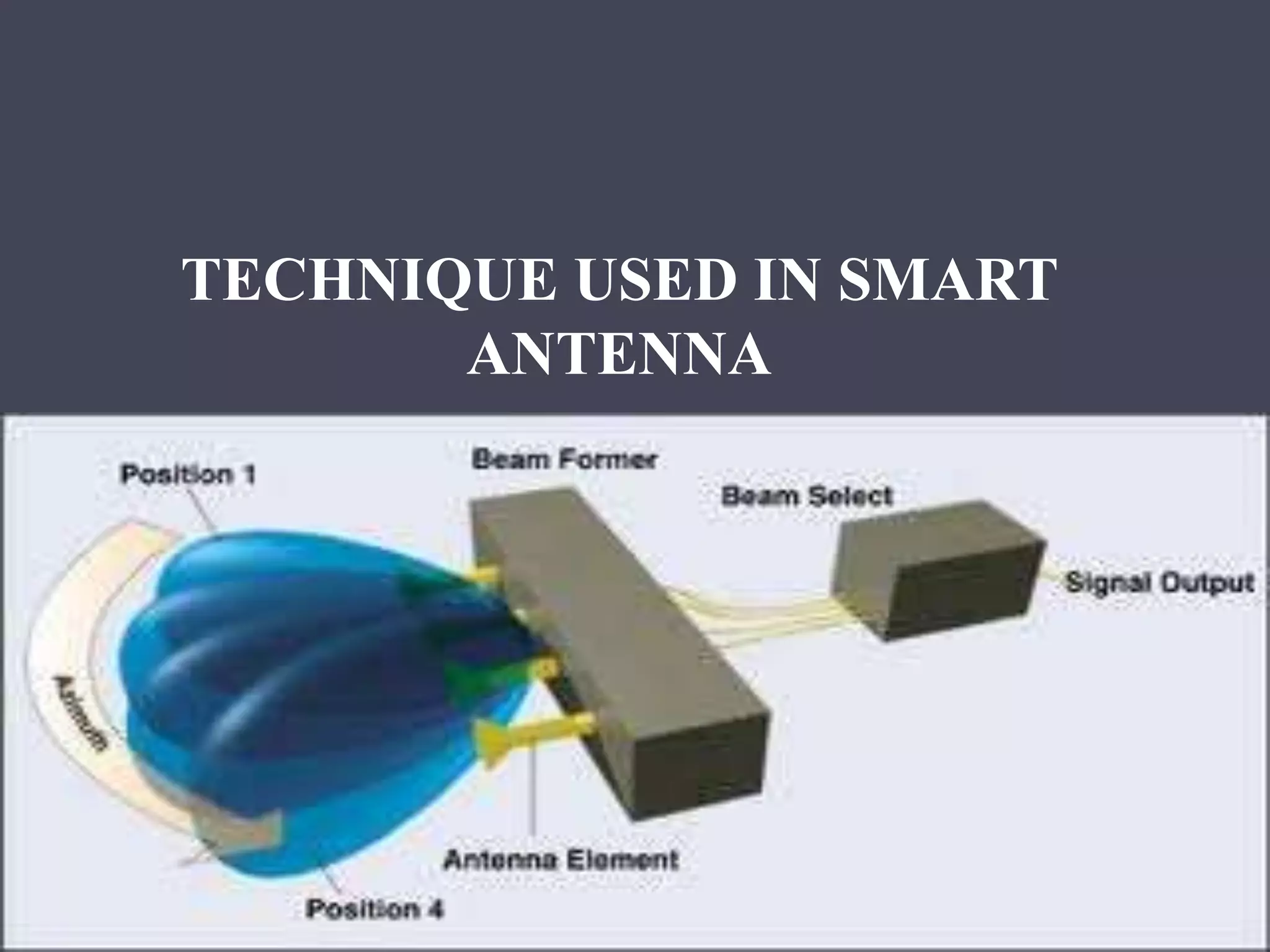
TECHNIQUE USED IN SMART
ANTENNA
ANTENNA ARRAY
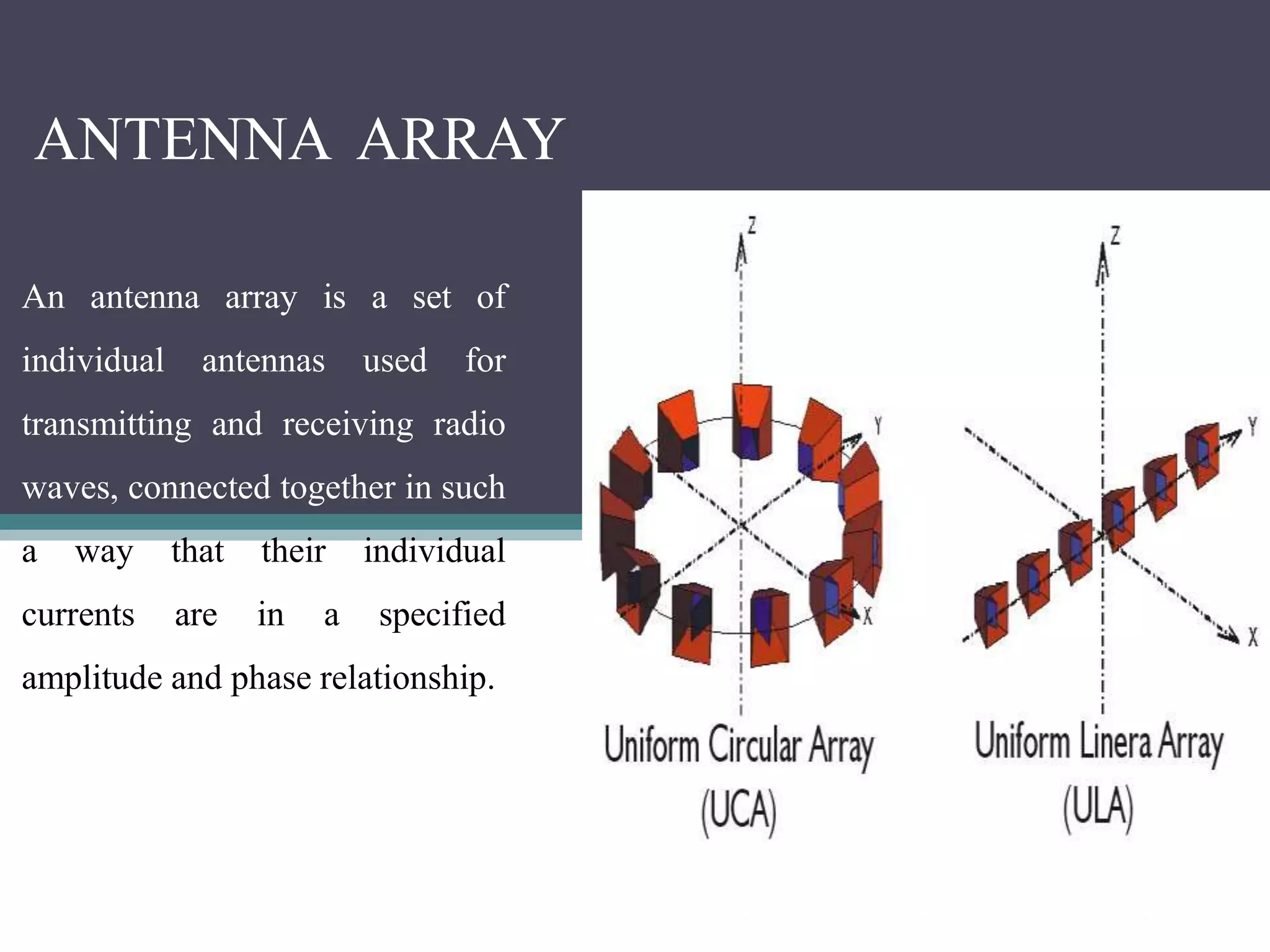
An antenna array is a set of
individual antennas used for
transmitting and receiving radio
waves, connected together in such
a way that their individual
currents are in a specified
amplitude and phase relationship.
Antenna array - a configuration of multiple antennas (elements)
arranged to achieve a given radiation pattern.
Antennas with a given radiation pattern may be arranged in a pattern
(line, circle, plane, etc.) to yield a different radiation pattern.
Linear array - antenna elements arranged along a straight line.
 Circular array - antenna elements arranged around a circular ring.
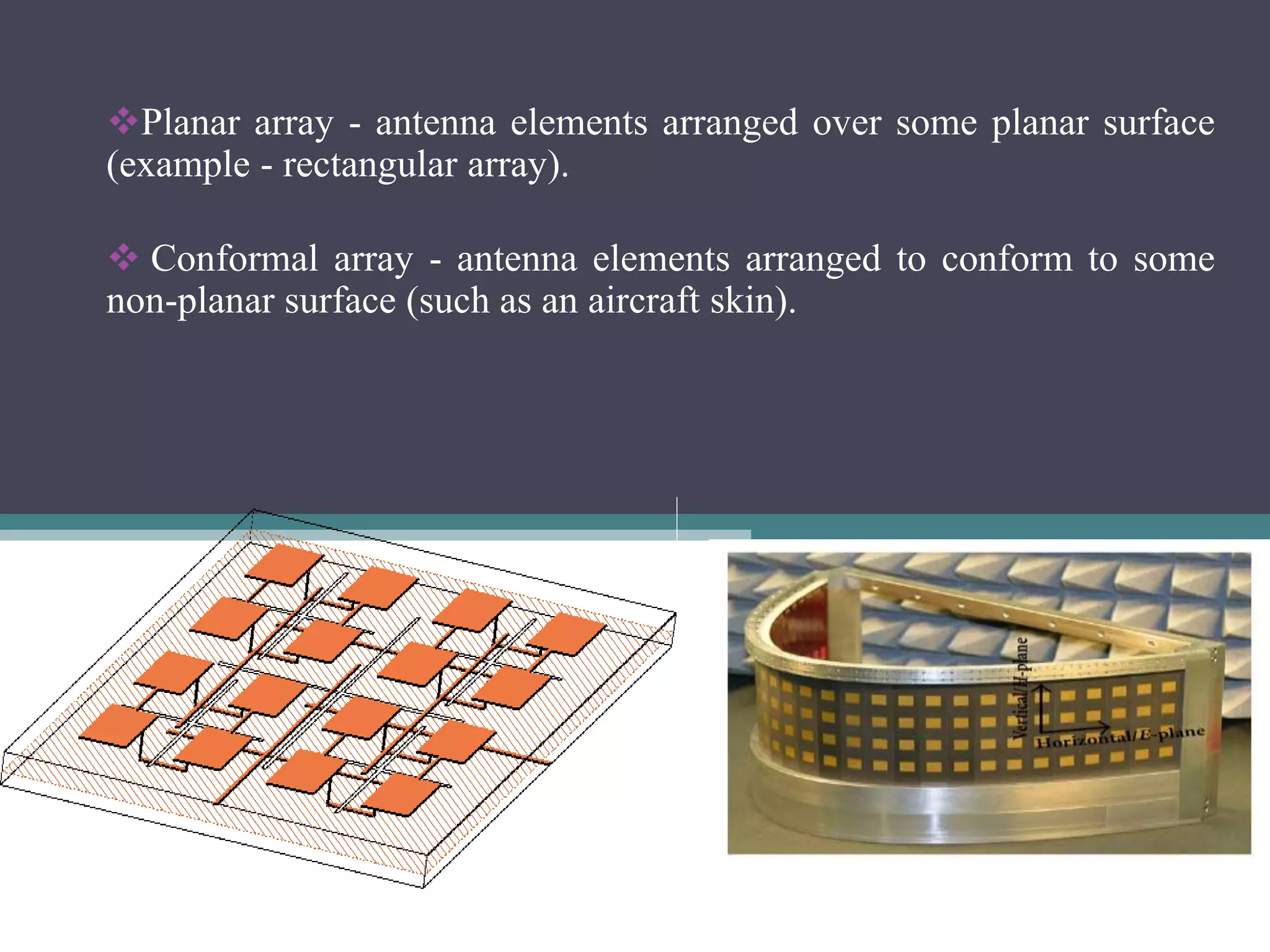
Planar array - antenna elements arranged over some planar surface
(example - rectangular array).
 Conformal array - antenna elements arranged to conform to some
non-planar surface (such as an aircraft skin).
Phased array - an array of identical elements which achieves a
given pattern through the control of the element excitation phasing.
Phased arrays can be used to steer the main beam of the antenna
without physically moving the antenna.
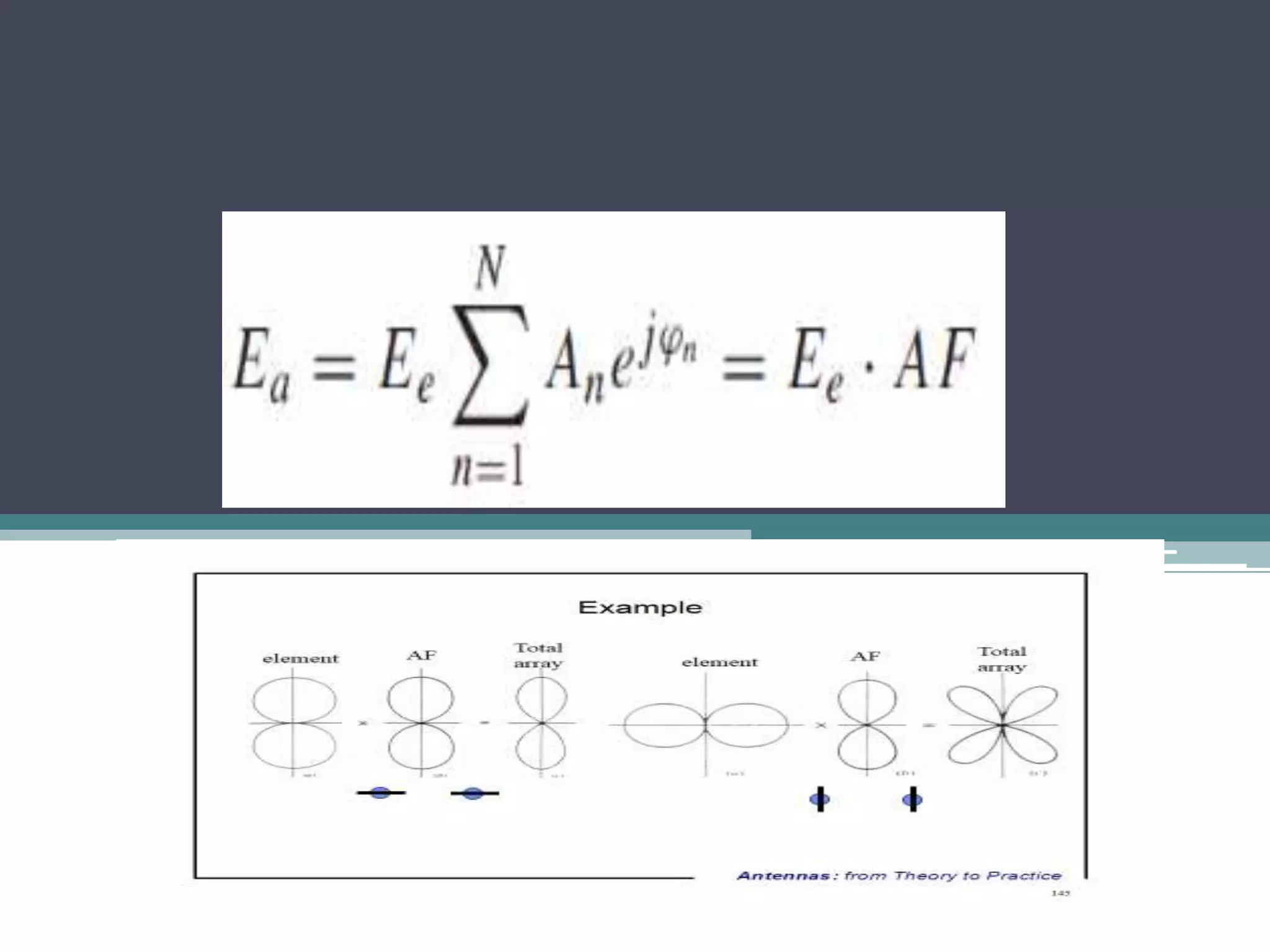
PATTERN MULTIPLICATION THEOREM-:-
The radiation pattern of an array is the product of the pattern of the
individual antenna with the array pattern. The array pattern is a
function of the location of the antennas in the array and their relative
complex excitation amplitudes.
As per theorem that beam pattern of any array is the product of two
parts ----
Individual Element Pattern.
Array Factor Pattern.
Array Pattern = Individual Element Pattern *Array factor
 Individual Element Pattern:- The pattern of the individual array
element.
Array Factor:- a function dependent only on the geometry of the
array and the excitation (amplitude, phase) of the elements.
ADVANTAGES OF ANTENNAARRAY
•Increase the overall gain.
•Provide diversity reception.
•Cancel out interference from a particular set of directions
•“Steer" the array so that it is most sensitive in a particular direction
•Determine the direction of arrival of the incoming signals
•To maximize the Signal to Interference Plus Noise Ratio (SINR)
DIRECTION OF ARRIVAL ESTIMATION
The smart antenna system estimates the direction of arrival of the
signal, using techniques such as Multiple Signal Classification (MUSIC),
estimation of signal parameters via rotational invariance techniques
(ESPRIT) algorithms, Matrix Pencil method or one of their derivatives.
They involve findings of a spatial spectrum of the antenna/sensor array
and calculating the DOA from the peaks of this spectrum.
Matrix Pencil is very efficient in case of real time systems and under
the correlated sources.
BASICS OF BEAM-FORMING
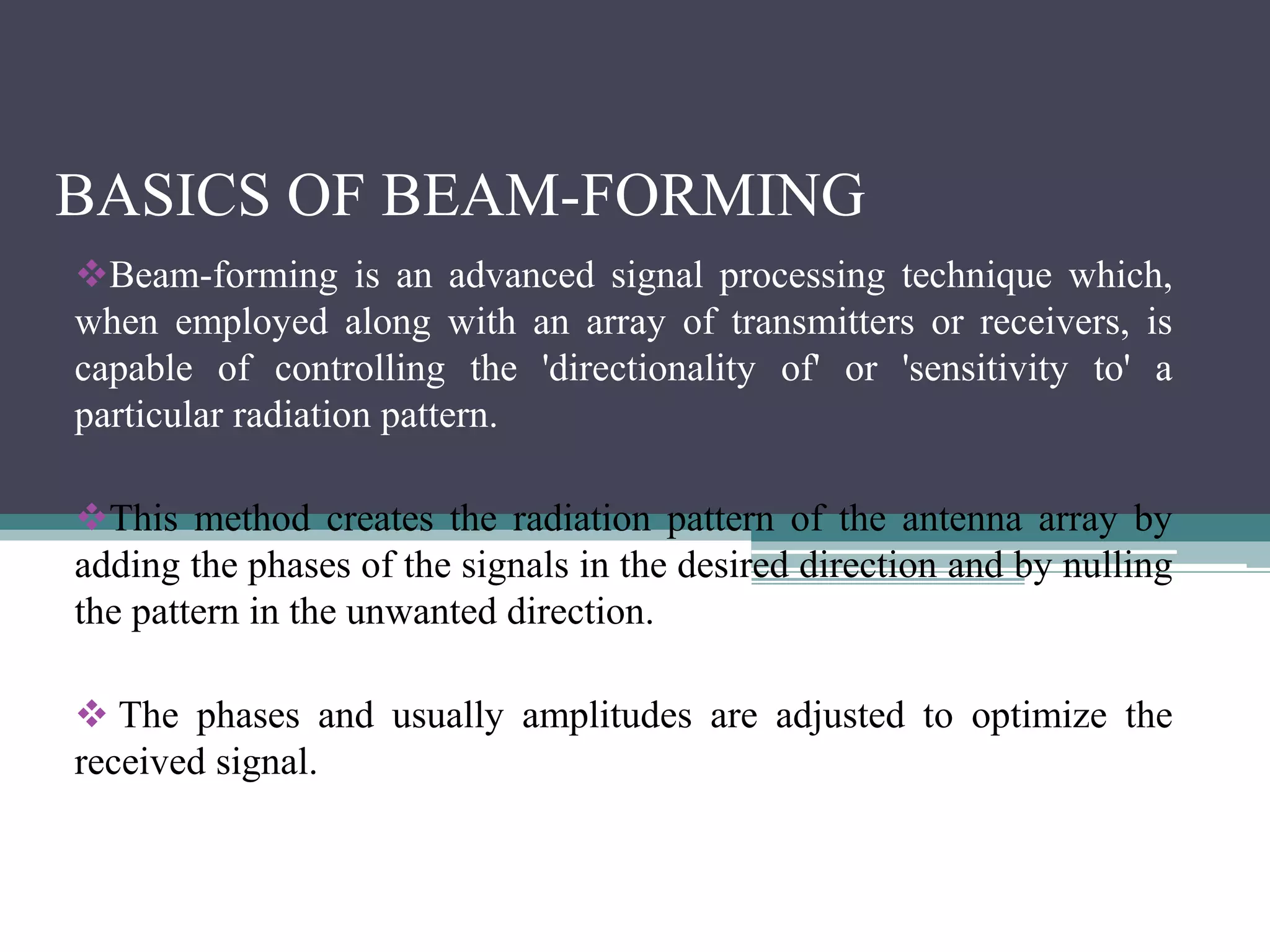
Beam-forming is an advanced signal processing technique which,
when employed along with an array of transmitters or receivers, is
capable of controlling the 'directionality of' or 'sensitivity to' a
particular radiation pattern.
This method creates the radiation pattern of the antenna array by
adding the phases of the signals in the desired direction and by nulling
the pattern in the unwanted direction.
 The phases and usually amplitudes are adjusted to optimize the
received signal.
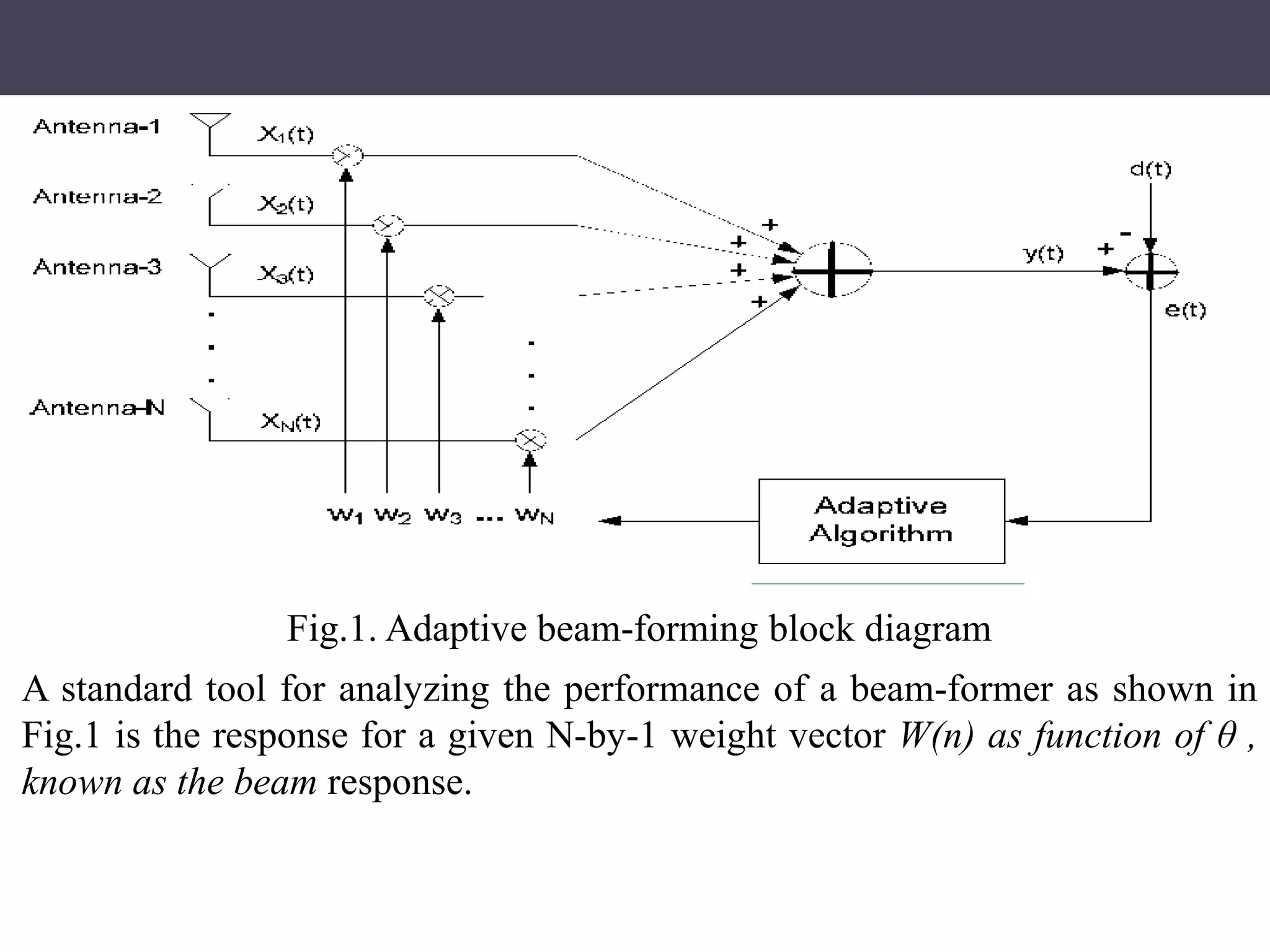
Fig.1. Adaptive beam-forming block diagram
A standard tool for analyzing the performance of a beam-former as shown in
Fig.1 is the response for a given N-by-1 weight vector W(n) as function of θ ,
known as the beam response.
BEAM STEERING
In the beam steering approach, phase angles of the weights are
selected to steer the main beam of the array in a particular direction,
while magnitude of the weights are unchanged.
 In other words, the array main beam is steered toward the DOA of
the desired source.
Multiple Signal Classification (MUSIC)
 MUltiple SIgnal Classification (MUSIC) is the most popular
technique used in Direction of arrival estimation. We can summarize
DOA estimation as the work of estimating the direction of an
unknown incoming signal to a receiver antenna by some processing
techniques.
 MUltiple SIgnal Classification (MUSIC) method can be applied to
Direction Of Arrival (DOA) estimations. Method gives best results
when there is only one signals incoming to sensor array that is
composed of different numbers of antennas positioned in many
different configurations.
Estimation of Signal Parameters via
Rotational. Invariant Techniques (ESPRIT)
 ESPRIT is similar to MUSIC in that it exploits the underlying data
model and generates estimates that are asymptotically unbiased and
efficient.
 In addition, the algorithm does not require knowledge of the array
geometry and element characteristics; thus array calibration is not
required.
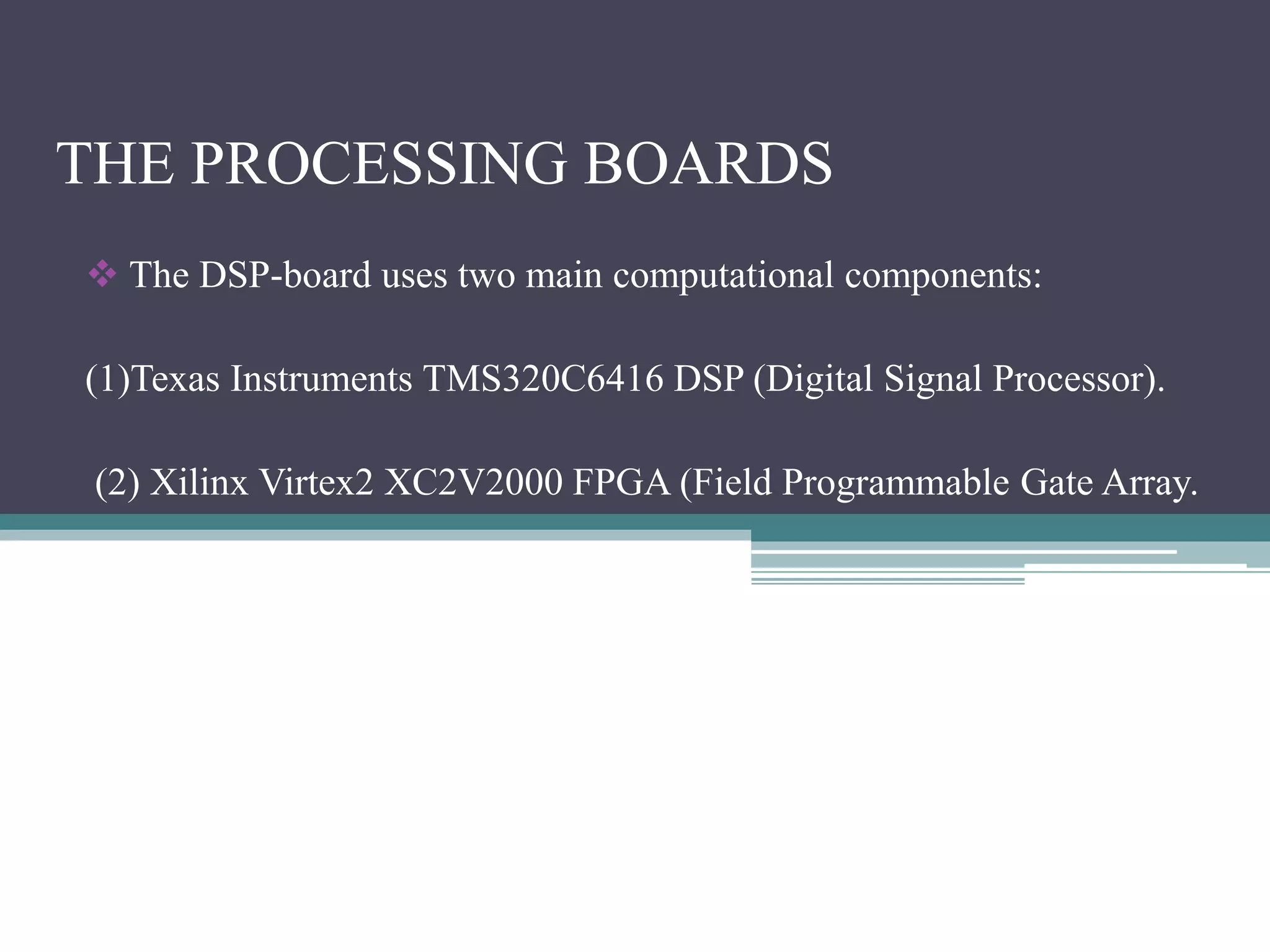
THE PROCESSING BOARDS
 The DSP-board uses two main computational components:
(1)Texas Instruments TMS320C6416 DSP (Digital Signal Processor).
(2) Xilinx Virtex2 XC2V2000 FPGA (Field Programmable Gate Array.
DSP (DIGITAL SIGNAL PROCESSOR)
The DSP uses 4 MByte Flash-ROM to store its own applications and
the configuration files of the FPGA.
 In addition to its internal 1 MByte Cache/RAM it is equipped with
32 MByte external RAM.
 Clocked at 600 MHz it is capable of executing up to 4800 MIPS and
offers hardware-support for problems commonly found in signal
processing.
FPGA (FIELD PROGRAMMABLE GATE
ARRAY
 The FGPA contains 2 million system gates and 56 dedicated 18-bit x
18-bit multipliers that provide computing power roughly equivalent to
3200 MIPS.
 It also features a total of 624 I/O pins, that can be configured to
comply to different interface standards, and can be used in pairs for
LVDS (Low Voltage Differential Signaling) at up to 400 Mbit/sec/pair,
or as general, high speed I/O pins.
ADAPTIVE ARRAY ANTENNAS
• Systems are really smart because they
are able to dynamically react to the
changing RF environment with its
infinite scenario based patterns.
• It can customize an appropriate radiation
pattern for each individual user.
• Dynamically adjust the antenna pattern
to enhance reception while minimizing
or fully rejecting interference
BLOCK DIAGRAM OF SMART ANTENNA
This provides optimal gain while simultaneously identifying, tracking, and
minimizing interfering signals.
Figure- Adaptive Array System Coverage Pattern
SMART ANTENNAAS A TRANSMITTER
SMART ANTENNAAS A RECEIVER
ADVANTAGES OF SMART ANTENNA
• Enhance coverage through Range extension.
• Fully controllable by software so less manual operations.
• Reduction in transmitted power.
• Reduce co-channel interference (CCI) and multipath interference.
•Provides high security.
•Improve system capacity.
•Compatibility, it can be applied to various multiple access techniques
such as TDMA,FDMA ,and CDMA.
SMART ANTENNA’S DRAWBACKS
•Their transceivers are much more complex than traditional
base station transceivers.
•Expensive.
APPLICATIONS
• Cellular and wireless networks.
• Electronic warfare (EWF) as a countermeasure to electronic
jamming.
• Satellite systems.
CONCLUSION
• Smart antennas are the intelligent antenna systems that vastly improve
the efficiency of wireless transmission.
• SAS can achieve high transmission data rate and coverage area by
effectively reducing multipath and co channel interference.
• Smart antenna systems are software-controllable, remotely configurable.
• Promising technology to resolve the traffic capacity.
REFERENCES
[1].R. H .Roy, “An overview of smart antenna technology and its application
on wireless communication systems,” Proc .IEEE conf.personal wireless
comm.,2012, pp. 234 – 238
[2].Chryssomallis, M., 2008. Smart antennas , IEEE Antennas and
Propogation Magazine, 42(3): 129 -136
[3].S. F. Shaukat , Mukhtar ul Hassan, R. Farooq, H. U. Saeed and Z. Saleem,
“Sequential studies of beam forming algorithms for smart antenna
systems”, world applied sciences journal , vol .6, no. 6, pp 754-758,2014.
[4].Smart Antenna by Thomas Kaiser.
[5].Smart Antenna by Lal Chand Godara.
[6].G. V. Subba Reddy and V. Ayyem Pillai,’A Study of Sample Matrix
Inversion Algorithm for Smart Antenna Applications’ Indian Journal of
Science and Technology, Vol 9(15), DOI:
10.17485/ijst/2016/v9i15/88180, April 2016.
[7]. Chao Gu, Steven Gao ‘Compact Smart Antenna With Electronic
Beam-Switching’. IEEE TRANSACTIONS ON ANTENNAS AND
PROPAGATION, VOL. 63, NO. 12, DECEMBER 2015.
[8]. Alpesh U. Bhobe ‘An Overview of Smart Antenna Technology for
Wireless Communication’.
[9].Shunita Das, ‘Smart Antenna Design for Wireless Communication
using Adaptive Beam-forming Approach’.
[10].Frank Gross, “Smart Antenna For Wireless Communication”
Mcgraw-hill, September 14, 2005
SMART ANTENNA

SMART ANTENNA

  • 1.
    SMART ANTENNA ELECTRONICS ANDCOMMUNICATION DEPARTMENT PRESENTED BY- RAVI VERMA
  • 2.
    CONTENTS:- INTRODUCTION WHAT IS ANTENNA WHATIS SMART ANTENNA TYPES OF SMART ANTENNA TECHNIQUE USED IN SMART ANTENNA ADVANTAGES APPLICATION CONCLUSION REFERENCES
  • 3.
    INTRODUCTION OF ANTENNA •Anantenna is a transducer that converts radio frequency electric current to electromagnetic waves that are then radiated into space. • An antenna is usually a metallic device (as a rod or wire) for radiating or receiving radio waves. • In other words, antennas convert electromagnetic radiation into electrical current. •Transmission line is used to transport electromagnetic energy from transmitting source to the antenna (load).
  • 4.
  • 5.
  • 6.
    HISTORY OF SMARTANTENNA The upgrade to digital radio technology in the mobile phone, indoor wireless network, and satellite broadcasting industries created new opportunities for smart antennas in the 1990s, culminating in the development of the MIMO (multiple input multiple output) technology. Richard Roy and French entrepreneur Arnaud Saffari founded Array- -Comm in 1992. Array-Comm’s smart antennas were designed to increase the capacity of wireless networks Array-Comm’s smart antennas were designed to increase the capacity of wireless networks.
  • 7.
    WHAT IS SMARTANTENNA ? A smart antenna consists of an antenna array, that changes the array pattern in response to signal environment to improve the performance of a communication system.
  • 8.
    TYPES OF SMARTANTENNA SMART ANTENNA SWITCHED BEAM SYSTEM ADAPTIVE ARRAY SYSTEM SINGLE BEAM DIRECTION AL ANTENNA MULTI BEAM DIRECTION AL ANTENNA SINGLE USER BEAM FORMING MULTI USER BEAM FORMING
  • 9.
    SWITCHED BEAM ANTENNAS Thissystems form multiple fixed beams with heightened sensitivity in particular directions. When incoming signal detected it determines the beam which is best aligned based on SOI and switches to that beam to communicate with user. As the mobile unit moves throughout the cell, the switched-beam system detects the signal strength and continually switches the beams as necessary.
  • 10.
    ADAPTIVE ARRAY ANTENNAS Systems are really smart because they are able to dynamically react to the changing RF environment with its infinite scenario based patterns.  They can direct the main beam toward the SOI(Signal Of Interest) while suppressing the antenna pattern in the direction of the interferers.  It can customize an appropriate radiation pattern for each individual user.  Dynamically adjust the antenna pattern to enhance reception while minimizing or fully rejecting interference.
  • 11.
    This provides optimalgain while simultaneously identifying, tracking, and minimizing interfering signals.
  • 12.
    TECHNIQUE USED INSMART ANTENNA
  • 13.
    ANTENNA ARRAY An antennaarray is a set of individual antennas used for transmitting and receiving radio waves, connected together in such a way that their individual currents are in a specified amplitude and phase relationship.
  • 14.
    Antenna array -a configuration of multiple antennas (elements) arranged to achieve a given radiation pattern. Antennas with a given radiation pattern may be arranged in a pattern (line, circle, plane, etc.) to yield a different radiation pattern. Linear array - antenna elements arranged along a straight line.  Circular array - antenna elements arranged around a circular ring.
  • 15.
    Planar array -antenna elements arranged over some planar surface (example - rectangular array).  Conformal array - antenna elements arranged to conform to some non-planar surface (such as an aircraft skin).
  • 16.
    Phased array -an array of identical elements which achieves a given pattern through the control of the element excitation phasing. Phased arrays can be used to steer the main beam of the antenna without physically moving the antenna. PATTERN MULTIPLICATION THEOREM-:- The radiation pattern of an array is the product of the pattern of the individual antenna with the array pattern. The array pattern is a function of the location of the antennas in the array and their relative complex excitation amplitudes.
  • 17.
    As per theoremthat beam pattern of any array is the product of two parts ---- Individual Element Pattern. Array Factor Pattern. Array Pattern = Individual Element Pattern *Array factor  Individual Element Pattern:- The pattern of the individual array element. Array Factor:- a function dependent only on the geometry of the array and the excitation (amplitude, phase) of the elements.
  • 19.
    ADVANTAGES OF ANTENNAARRAY •Increasethe overall gain. •Provide diversity reception. •Cancel out interference from a particular set of directions •“Steer" the array so that it is most sensitive in a particular direction •Determine the direction of arrival of the incoming signals •To maximize the Signal to Interference Plus Noise Ratio (SINR)
  • 20.
    DIRECTION OF ARRIVALESTIMATION The smart antenna system estimates the direction of arrival of the signal, using techniques such as Multiple Signal Classification (MUSIC), estimation of signal parameters via rotational invariance techniques (ESPRIT) algorithms, Matrix Pencil method or one of their derivatives. They involve findings of a spatial spectrum of the antenna/sensor array and calculating the DOA from the peaks of this spectrum. Matrix Pencil is very efficient in case of real time systems and under the correlated sources.
  • 21.
    BASICS OF BEAM-FORMING Beam-formingis an advanced signal processing technique which, when employed along with an array of transmitters or receivers, is capable of controlling the 'directionality of' or 'sensitivity to' a particular radiation pattern. This method creates the radiation pattern of the antenna array by adding the phases of the signals in the desired direction and by nulling the pattern in the unwanted direction.  The phases and usually amplitudes are adjusted to optimize the received signal.
  • 22.
    Fig.1. Adaptive beam-formingblock diagram A standard tool for analyzing the performance of a beam-former as shown in Fig.1 is the response for a given N-by-1 weight vector W(n) as function of θ , known as the beam response.
  • 23.
    BEAM STEERING In thebeam steering approach, phase angles of the weights are selected to steer the main beam of the array in a particular direction, while magnitude of the weights are unchanged.  In other words, the array main beam is steered toward the DOA of the desired source.
  • 24.
    Multiple Signal Classification(MUSIC)  MUltiple SIgnal Classification (MUSIC) is the most popular technique used in Direction of arrival estimation. We can summarize DOA estimation as the work of estimating the direction of an unknown incoming signal to a receiver antenna by some processing techniques.  MUltiple SIgnal Classification (MUSIC) method can be applied to Direction Of Arrival (DOA) estimations. Method gives best results when there is only one signals incoming to sensor array that is composed of different numbers of antennas positioned in many different configurations.
  • 25.
    Estimation of SignalParameters via Rotational. Invariant Techniques (ESPRIT)  ESPRIT is similar to MUSIC in that it exploits the underlying data model and generates estimates that are asymptotically unbiased and efficient.  In addition, the algorithm does not require knowledge of the array geometry and element characteristics; thus array calibration is not required.
  • 26.
    THE PROCESSING BOARDS The DSP-board uses two main computational components: (1)Texas Instruments TMS320C6416 DSP (Digital Signal Processor). (2) Xilinx Virtex2 XC2V2000 FPGA (Field Programmable Gate Array.
  • 27.
    DSP (DIGITAL SIGNALPROCESSOR) The DSP uses 4 MByte Flash-ROM to store its own applications and the configuration files of the FPGA.  In addition to its internal 1 MByte Cache/RAM it is equipped with 32 MByte external RAM.  Clocked at 600 MHz it is capable of executing up to 4800 MIPS and offers hardware-support for problems commonly found in signal processing.
  • 28.
    FPGA (FIELD PROGRAMMABLEGATE ARRAY  The FGPA contains 2 million system gates and 56 dedicated 18-bit x 18-bit multipliers that provide computing power roughly equivalent to 3200 MIPS.  It also features a total of 624 I/O pins, that can be configured to comply to different interface standards, and can be used in pairs for LVDS (Low Voltage Differential Signaling) at up to 400 Mbit/sec/pair, or as general, high speed I/O pins.
  • 29.
    ADAPTIVE ARRAY ANTENNAS •Systems are really smart because they are able to dynamically react to the changing RF environment with its infinite scenario based patterns. • It can customize an appropriate radiation pattern for each individual user. • Dynamically adjust the antenna pattern to enhance reception while minimizing or fully rejecting interference
  • 30.
    BLOCK DIAGRAM OFSMART ANTENNA
  • 31.
    This provides optimalgain while simultaneously identifying, tracking, and minimizing interfering signals. Figure- Adaptive Array System Coverage Pattern
  • 32.
    SMART ANTENNAAS ATRANSMITTER
  • 33.
  • 34.
    ADVANTAGES OF SMARTANTENNA • Enhance coverage through Range extension. • Fully controllable by software so less manual operations. • Reduction in transmitted power. • Reduce co-channel interference (CCI) and multipath interference. •Provides high security. •Improve system capacity. •Compatibility, it can be applied to various multiple access techniques such as TDMA,FDMA ,and CDMA.
  • 35.
    SMART ANTENNA’S DRAWBACKS •Theirtransceivers are much more complex than traditional base station transceivers. •Expensive.
  • 36.
    APPLICATIONS • Cellular andwireless networks. • Electronic warfare (EWF) as a countermeasure to electronic jamming. • Satellite systems.
  • 37.
    CONCLUSION • Smart antennasare the intelligent antenna systems that vastly improve the efficiency of wireless transmission. • SAS can achieve high transmission data rate and coverage area by effectively reducing multipath and co channel interference. • Smart antenna systems are software-controllable, remotely configurable. • Promising technology to resolve the traffic capacity.
  • 38.
    REFERENCES [1].R. H .Roy,“An overview of smart antenna technology and its application on wireless communication systems,” Proc .IEEE conf.personal wireless comm.,2012, pp. 234 – 238 [2].Chryssomallis, M., 2008. Smart antennas , IEEE Antennas and Propogation Magazine, 42(3): 129 -136 [3].S. F. Shaukat , Mukhtar ul Hassan, R. Farooq, H. U. Saeed and Z. Saleem, “Sequential studies of beam forming algorithms for smart antenna systems”, world applied sciences journal , vol .6, no. 6, pp 754-758,2014. [4].Smart Antenna by Thomas Kaiser. [5].Smart Antenna by Lal Chand Godara. [6].G. V. Subba Reddy and V. Ayyem Pillai,’A Study of Sample Matrix Inversion Algorithm for Smart Antenna Applications’ Indian Journal of Science and Technology, Vol 9(15), DOI: 10.17485/ijst/2016/v9i15/88180, April 2016.
  • 39.
    [7]. Chao Gu,Steven Gao ‘Compact Smart Antenna With Electronic Beam-Switching’. IEEE TRANSACTIONS ON ANTENNAS AND PROPAGATION, VOL. 63, NO. 12, DECEMBER 2015. [8]. Alpesh U. Bhobe ‘An Overview of Smart Antenna Technology for Wireless Communication’. [9].Shunita Das, ‘Smart Antenna Design for Wireless Communication using Adaptive Beam-forming Approach’. [10].Frank Gross, “Smart Antenna For Wireless Communication” Mcgraw-hill, September 14, 2005