SMART ANTENNAS
DHARAMSOTH SANTHOSH
B090652EC
SMART ANTENNAS
PRESENTED BY
DHARAMSOTH SANTHOSH
B090652EC
Agenda
 History
 Introduction
 What is smart antenna?
 Functioning of smart antenna.
 Types of smart antenna.
 Digital beam forming
 DOA estimation
 Advantages
 Application and conclusion
 References
History
 The Smart Antenna was developed for “Military Communications” and
“Intelligence gathering”.
 New opportunities were created for smart antenna in the year 1990 by
satellite broadcasting industries.
Introduction
 Antenna is electrical device which converted electric power into
electromagnetic waves.
 A smart Antenna consist of an antenna array, that changes the array
pattern in response to signal environment to improve the performance of
a communication channel.
 Smart antenna is not smart, it is the digital signal processing, along with the
antennas, which makes the system smart.
What is Smart Antenna?
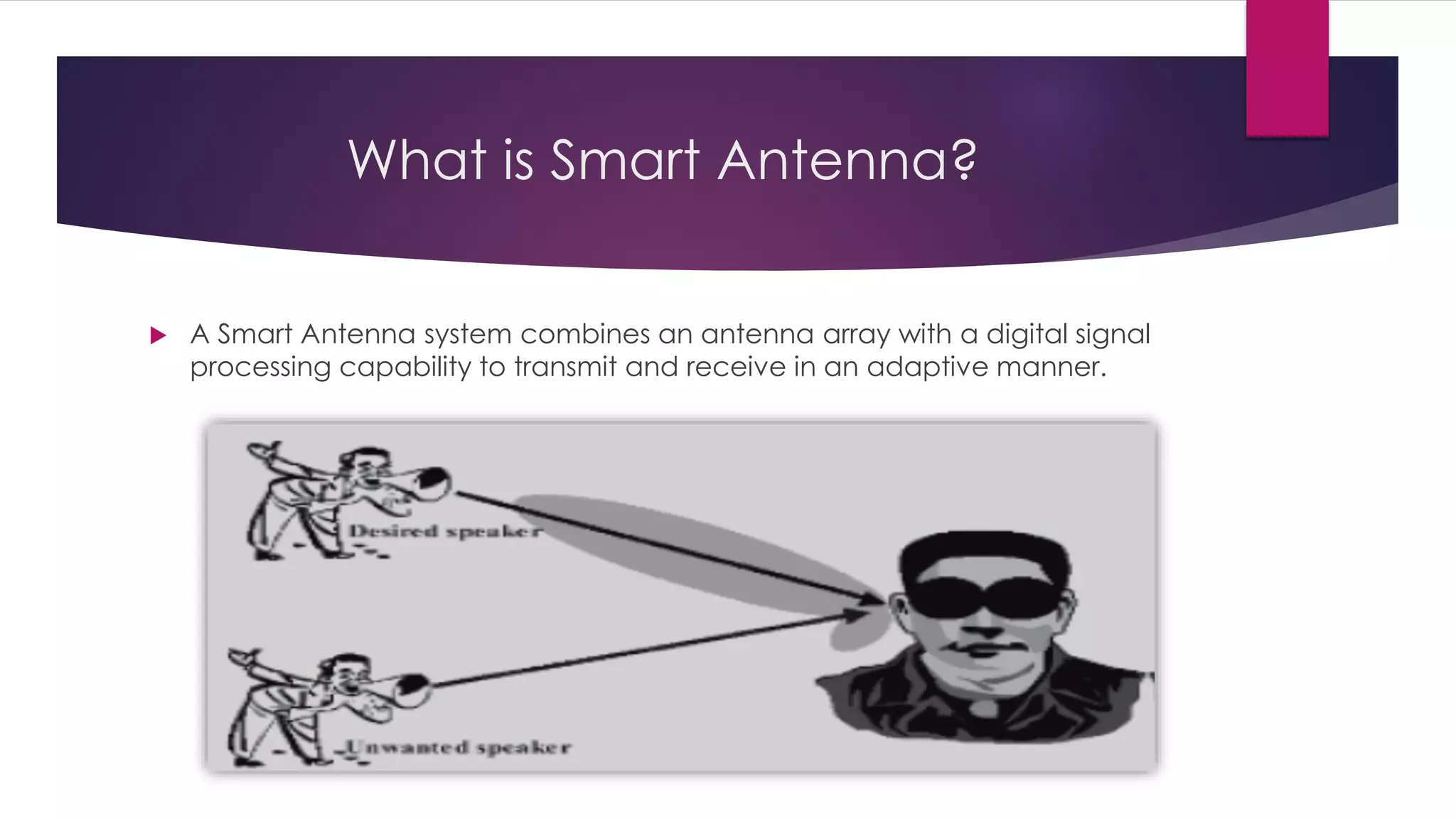
 A Smart Antenna system combines an antenna array with a digital signal
processing capability to transmit and receive in an adaptive manner.
Difference between regular antenna
and smart antenna?
 Regular antenna(omnidirectional): generates beams in all directions.
 Having directional pattern in orthogonal plane and non-directional
pattern in given plane.
 Smart antenna: adaptive antenna utilizes adaptive DSP based techniques
and digital technology.
Co-channel interference
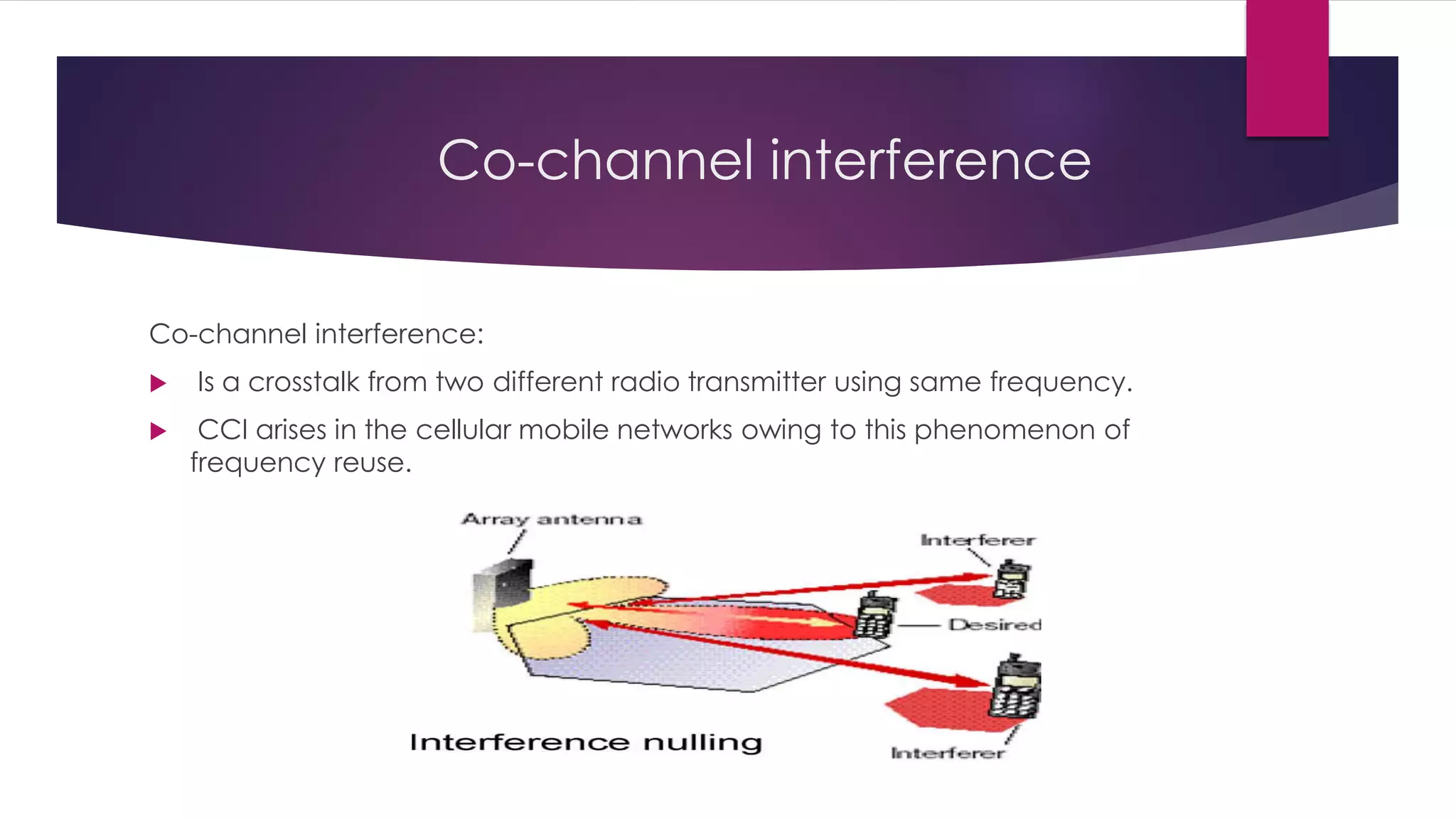
Co-channel interference:
 Is a crosstalk from two different radio transmitter using same frequency.
 CCI arises in the cellular mobile networks owing to this phenomenon of
frequency reuse.
Functioning of Smart Antennas
 The functioning of smart antennas is still far from being well defined, and
many concepts are subject to thorough studies.
 Technical aspects involve number of elements, fed with signals which are
adaptively processed by space or space-time filtering.
Functioning of SA cont…….
 Potential demands (generally hard to fulfil) are put on the functioning of
smart antennas:
1. Increased number of subscribers(higher system capacity)
2. Higher data transmission rate.
3. Better spectral efficiency
4. Extended range
5. Processing of multipath propagated signals
6. Flexibility of channel transfer
Types of Smart antennas
 There are three types of smart antennas are there:
1. Adaptive array antenna
2. Switched beam array antenna
Adaptive array antennas
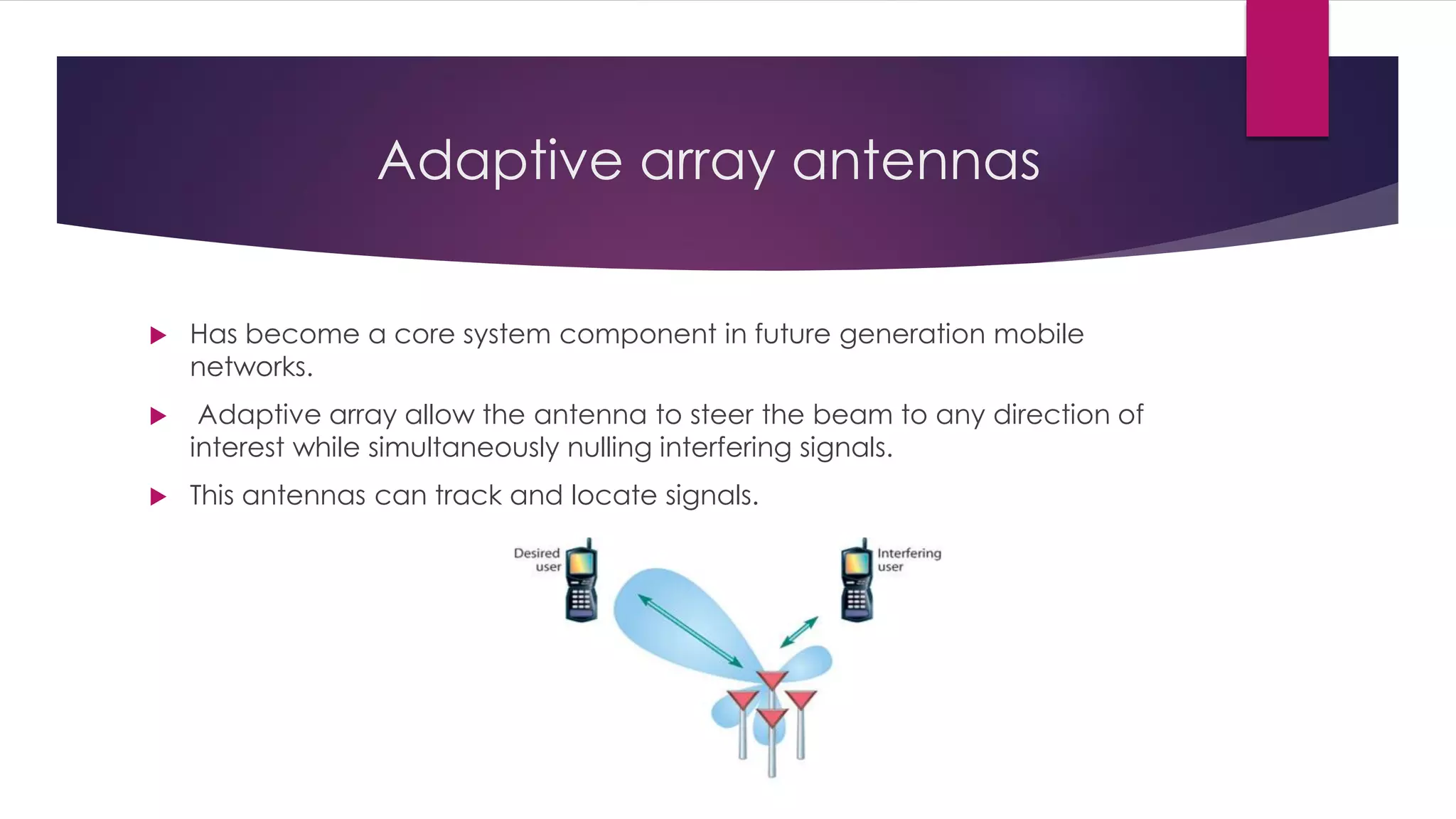
 Has become a core system component in future generation mobile
networks.
 Adaptive array allow the antenna to steer the beam to any direction of
interest while simultaneously nulling interfering signals.
 This antennas can track and locate signals.
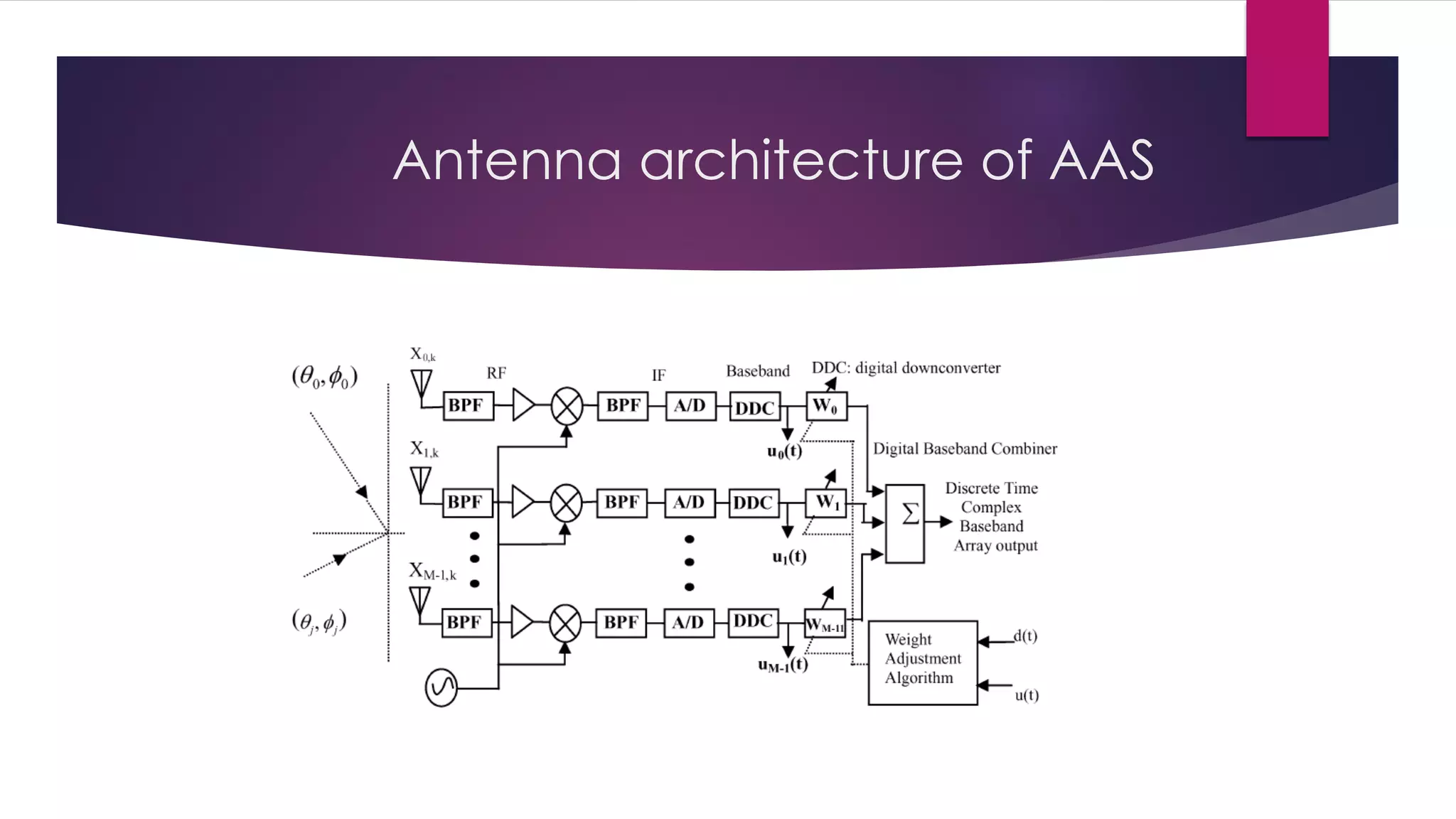
Antenna architecture of AAS
Switched beam array antennas
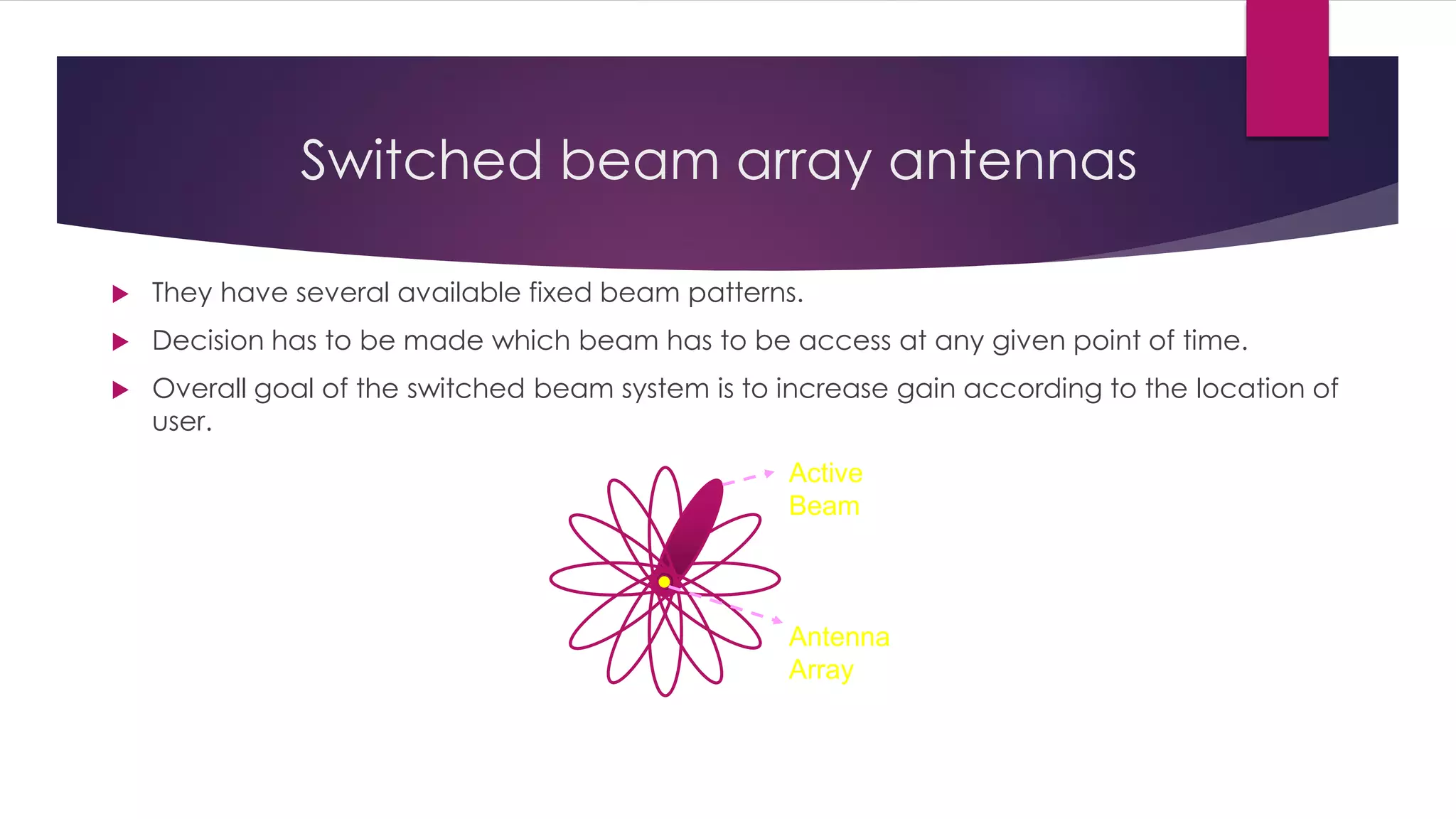
 They have several available fixed beam patterns.
 Decision has to be made which beam has to be access at any given point of time.
 Overall goal of the switched beam system is to increase gain according to the location of
user.
Antenna
Array
Active
Beam
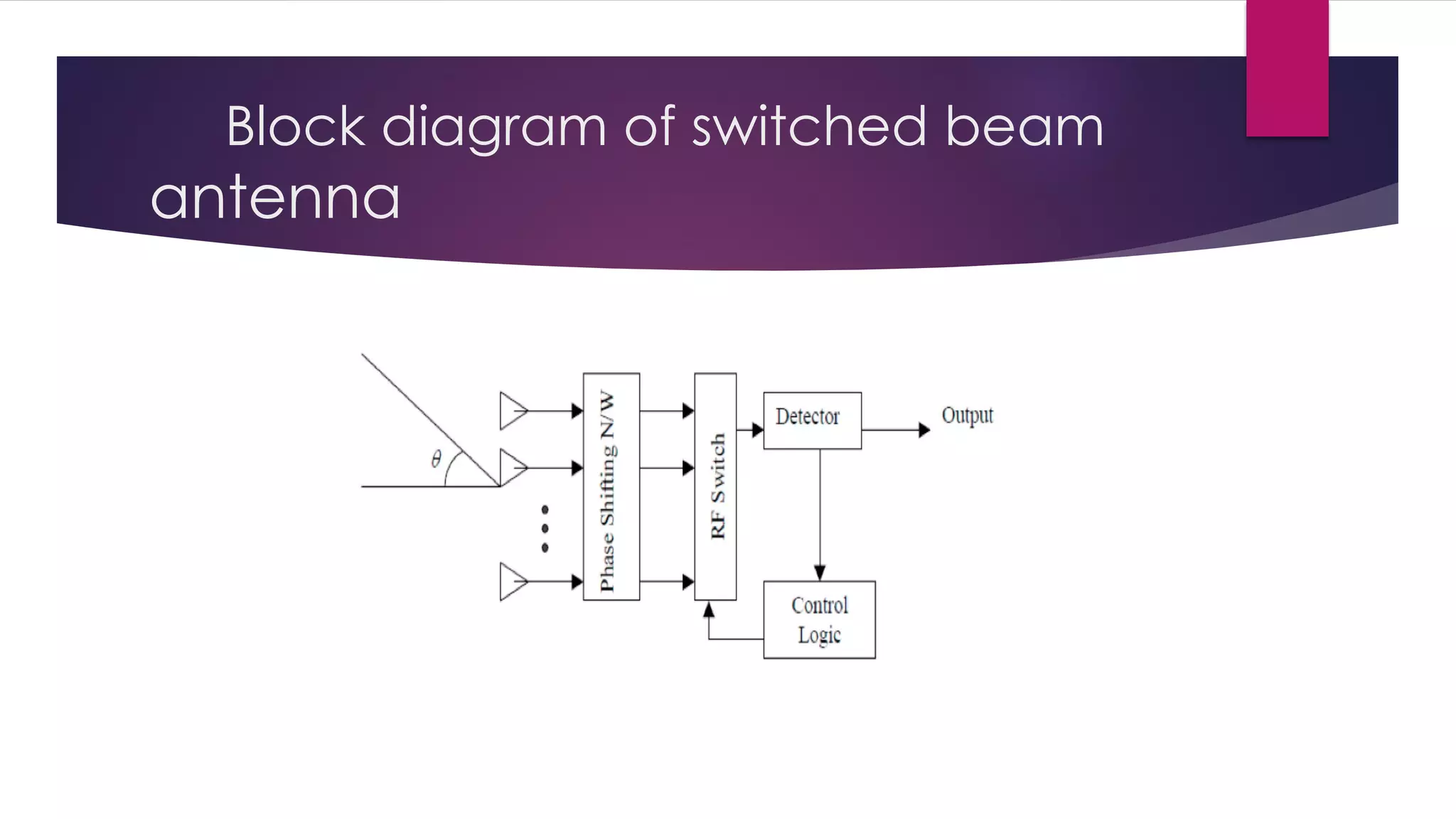
Block diagram of switched beam
antenna
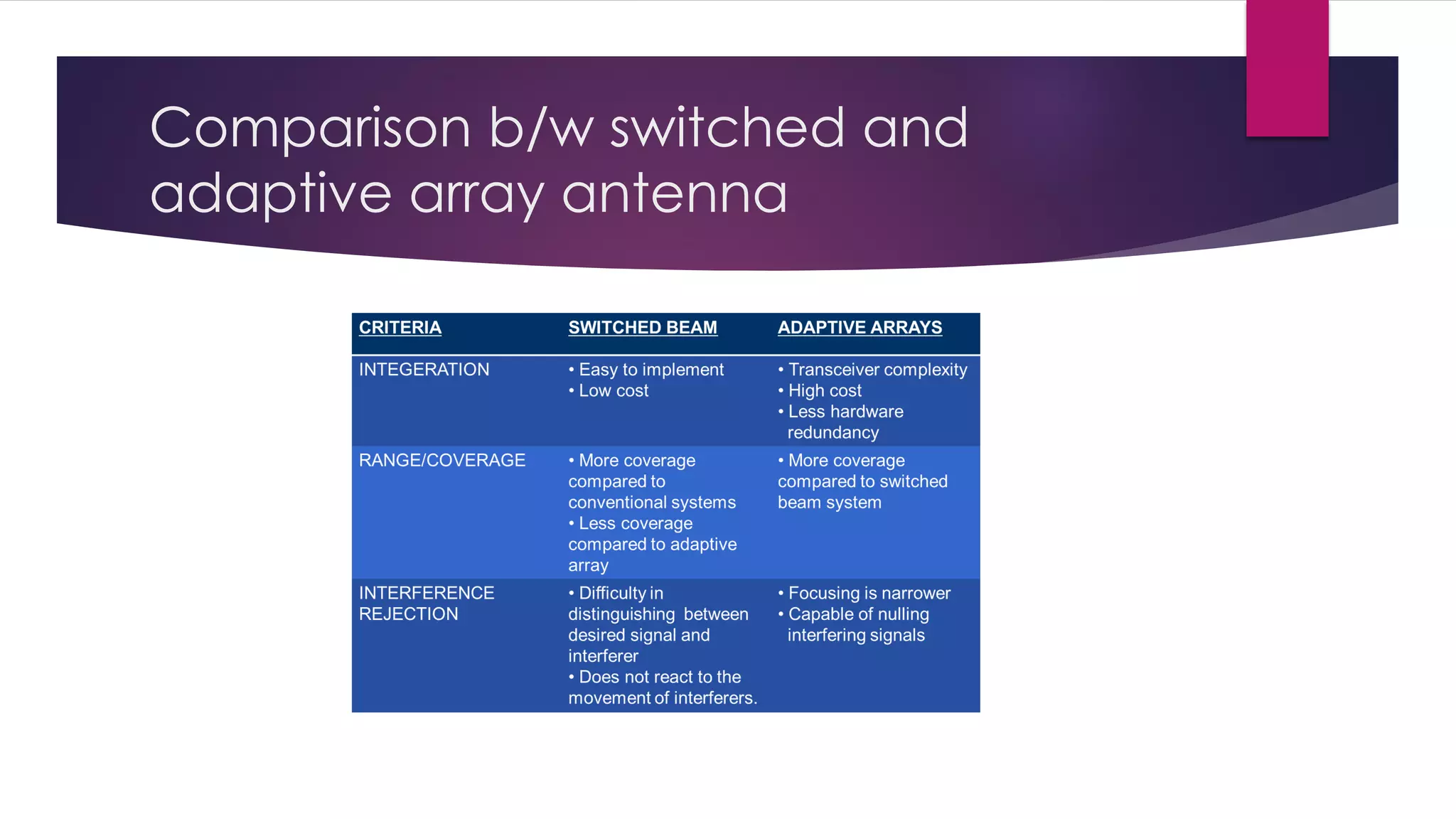
Comparison b/w switched and
adaptive array antenna
Digital Beam Forming
 The digital beam forming segment of the smart antenna comprises two
modules:
1. communication and calibration signal processing.
2. Beam forming processors.
DBF cont…..
 In communication and calibration signal processing needs a very high
data rate and calls for a large computational power.
 In the beam forming processor needs a lower rate of weight update which
usually ranges up to a few kHz.
DOA(Direction Of Arrival)
estimation
 It is direction of arrival
 The smart antenna estimates the direction of arrival of the signal, using
technique such as MUSIC(Multiple Signal Classification) estimation of signal
parameters via Matrix pencil method or one of their derivatives.
 They involve finding a spatial spectrum of the antenna and calculating the
DOA from the peaks of this spectrum.
Advantages of smart antennas
 Reduction in co-channel interference.
 Range improvement
 Increase in capacity
 Reduction in transmitted power.
 Reduction in handoff.
Applications
 Mobile communications
 Cellular and wireless network.
 Satellite communication.
 Wireless sensor network.
 Military.
 Electronic warfare
Future scope
 In mobile handsets to achieve much better performance.
 4G system with 1 Gbit/s data rate and frequency 20-100Mhz.
 Detect malignant tumours
conclusion
 Smart antenna are the intelligent antenna systems that improve the
efficiency of wireless transmission.
 Promising technology to resolve the traffic capacity.
 Efficient utilization of the scarcest resource of todays wireless
communication.
References
[1] Dau-Chyrh Chang and Cheng-Nan Hu, “Smart Antennas for Advanced
Communication Systems”-vol.100,no.7, July 2012.
[2] Daniel J Bern, Pawel Kabacik,-”Smart Antennas for Mobile Communication
Systems”.
[3]Nihad A. A. Elhag, Islam M Osman, Alaa A Yassin, Tsneem B Ahmed,”Angle
of Arrival Estimation in Smart Antenna Using MUSIC method for Wideband
Wireless Communication” IEEE 2013.
[4]T. Nageswara Rao, V. Srinivasa Rao, “Evaluation of MUSIC algorithm for a
Smart Antenna system for Mobile Communications”.
Thank you

smart antennas ppt

  • 1.
    SMART ANTENNAS DHARAMSOTH SANTHOSH B090652EC SMARTANTENNAS PRESENTED BY DHARAMSOTH SANTHOSH B090652EC
  • 2.
    Agenda  History  Introduction What is smart antenna?  Functioning of smart antenna.  Types of smart antenna.  Digital beam forming  DOA estimation  Advantages  Application and conclusion  References
  • 3.
    History  The SmartAntenna was developed for “Military Communications” and “Intelligence gathering”.  New opportunities were created for smart antenna in the year 1990 by satellite broadcasting industries.
  • 4.
    Introduction  Antenna iselectrical device which converted electric power into electromagnetic waves.  A smart Antenna consist of an antenna array, that changes the array pattern in response to signal environment to improve the performance of a communication channel.  Smart antenna is not smart, it is the digital signal processing, along with the antennas, which makes the system smart.
  • 5.
    What is SmartAntenna?  A Smart Antenna system combines an antenna array with a digital signal processing capability to transmit and receive in an adaptive manner.
  • 6.
    Difference between regularantenna and smart antenna?  Regular antenna(omnidirectional): generates beams in all directions.  Having directional pattern in orthogonal plane and non-directional pattern in given plane.  Smart antenna: adaptive antenna utilizes adaptive DSP based techniques and digital technology.
  • 7.
    Co-channel interference Co-channel interference: Is a crosstalk from two different radio transmitter using same frequency.  CCI arises in the cellular mobile networks owing to this phenomenon of frequency reuse.
  • 8.
    Functioning of SmartAntennas  The functioning of smart antennas is still far from being well defined, and many concepts are subject to thorough studies.  Technical aspects involve number of elements, fed with signals which are adaptively processed by space or space-time filtering.
  • 9.
    Functioning of SAcont…….  Potential demands (generally hard to fulfil) are put on the functioning of smart antennas: 1. Increased number of subscribers(higher system capacity) 2. Higher data transmission rate. 3. Better spectral efficiency 4. Extended range 5. Processing of multipath propagated signals 6. Flexibility of channel transfer
  • 10.
    Types of Smartantennas  There are three types of smart antennas are there: 1. Adaptive array antenna 2. Switched beam array antenna
  • 11.
    Adaptive array antennas Has become a core system component in future generation mobile networks.  Adaptive array allow the antenna to steer the beam to any direction of interest while simultaneously nulling interfering signals.  This antennas can track and locate signals.
  • 12.
  • 13.
    Switched beam arrayantennas  They have several available fixed beam patterns.  Decision has to be made which beam has to be access at any given point of time.  Overall goal of the switched beam system is to increase gain according to the location of user. Antenna Array Active Beam
  • 14.
    Block diagram ofswitched beam antenna
  • 15.
    Comparison b/w switchedand adaptive array antenna
  • 16.
    Digital Beam Forming The digital beam forming segment of the smart antenna comprises two modules: 1. communication and calibration signal processing. 2. Beam forming processors.
  • 17.
    DBF cont…..  Incommunication and calibration signal processing needs a very high data rate and calls for a large computational power.  In the beam forming processor needs a lower rate of weight update which usually ranges up to a few kHz.
  • 18.
    DOA(Direction Of Arrival) estimation It is direction of arrival  The smart antenna estimates the direction of arrival of the signal, using technique such as MUSIC(Multiple Signal Classification) estimation of signal parameters via Matrix pencil method or one of their derivatives.  They involve finding a spatial spectrum of the antenna and calculating the DOA from the peaks of this spectrum.
  • 19.
    Advantages of smartantennas  Reduction in co-channel interference.  Range improvement  Increase in capacity  Reduction in transmitted power.  Reduction in handoff.
  • 20.
    Applications  Mobile communications Cellular and wireless network.  Satellite communication.  Wireless sensor network.  Military.  Electronic warfare
  • 21.
    Future scope  Inmobile handsets to achieve much better performance.  4G system with 1 Gbit/s data rate and frequency 20-100Mhz.  Detect malignant tumours
  • 22.
    conclusion  Smart antennaare the intelligent antenna systems that improve the efficiency of wireless transmission.  Promising technology to resolve the traffic capacity.  Efficient utilization of the scarcest resource of todays wireless communication.
  • 23.
    References [1] Dau-Chyrh Changand Cheng-Nan Hu, “Smart Antennas for Advanced Communication Systems”-vol.100,no.7, July 2012. [2] Daniel J Bern, Pawel Kabacik,-”Smart Antennas for Mobile Communication Systems”. [3]Nihad A. A. Elhag, Islam M Osman, Alaa A Yassin, Tsneem B Ahmed,”Angle of Arrival Estimation in Smart Antenna Using MUSIC method for Wideband Wireless Communication” IEEE 2013. [4]T. Nageswara Rao, V. Srinivasa Rao, “Evaluation of MUSIC algorithm for a Smart Antenna system for Mobile Communications”.
  • 24.