Loïc Bellet
P O Box 423 , Johannesburg , 2000 , RSA
Tel:+27 83 764 6149
E-mail : loicmba@hotmail.com
COURSE : OBU OPEN LEARNING MBA
MODULE : SMALL & MEDIUM BUSINESS MANAGEMENT – elective 2
STUDENT NUMBER : 98046671
COHORT : 10/99
TUTOR : HERMAN COETZEE
ASSIGNMENT : African Capital Network, strategic business plan
DATE : 20000730 :
Index
Page Content
1 Executive summary
• Salient financial information
• Group Structure
• The application
2 The business
• Description, nature of business and management
• Industry analysis
• Internal review
8 Direction
• Vision
• Mission
• Objective
• Functional strategies
3 Financial Statements and future projections
• Income statements
• Balance sheet
• Notes to the financial statements
• Forecasted business performance
5 Appendix 1 : Important dates and times
6 Appendix 2 : Corporate & general information
7 Appendix 3 : Reference section
1
OFFER TO BUY
Executive Summary
The information set out in this section is an overview only and is not intended to be comprehensive. It should be read in conjunction with the information contained in the historical and
forecasted financial statements as well as the adjoining analyses.
The purpose of this document is two-fold. Firstly, it is the strategic plan for the business of Hi-Tech Kids (Pty) Ltd
as it continues operating under new ownership after purchase by African Capital Network (Pty) Ltd. Secondly; it is
an application to raise the necessary finance to complete the acquisition of Hi-Tech Kids from its current owners.
Since its inception in 1995, Hi-Tech Kids has developed a reputation for quality tuition resulting in the improved
skills of school-leavers to begin a career in the Information Technology field. An important aspect of the change in
ownership is that it will not affect the quality of tuition as the teaching is effected by current employees of the school
who retain 20% of issued share capital and express no desire to leave the firm should ownership change. The
majority share of 80% is the amount required to transfer ownership.
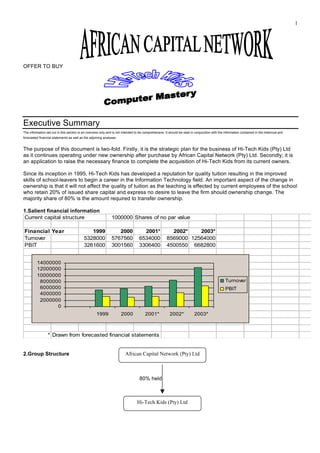
1.Salient financial information
Current capital structure 1000000 Shares of no par value
Financial Year 1999 2000 2001* 2002* 2003*
Turnover 5328000 5767560 6534000 8569000 12564000
PBIT 3261600 3001560 3306400 4500550 6682800
* Drawn from forecasted financial statements
0
2000000
4000000
6000000
8000000
10000000
12000000
14000000
1999 2000 2001* 2002* 2003*
Turnover
PBIT
2.Group Structure
80% held
African Capital Network (Pty) Ltd
Hi-Tech Kids (Pty) Ltd
2
3. The application
3.1 Purpose of the application
The purpose of this application is to fund the acquisition of Hi-Tech Kids from its current owners and raise loan
finance of a short term nature for replacement of dated computer terminals and furniture.
3.2 Details of the application
800 000 shares are being offered for sale at a price of 218.75 cents per share. This excludes additional costs of
updating existing computer terminals and furniture.
3.3 Minimum amount required
The minimum capital requirement, which must be raised in terms of this application, is R 340 000 in order to
provide the sums required in respect of the following matters:
Detail Amount (R ‘000)
To acquire the owner’s equity (80% thereof) of Hi-Tech Kids 1 750
To replace dated furniture 40
To replace dated computer equipment 50
Subtotal 1 840
Less cash available for investment by A.C.N. 1 500
Total required 340
The above amount to be available as:
• Bank overdraft facility of R90 000 to finance cost of furniture and computer equipment replacements
• Long term loan of R250 000 sought for the acquisition of the business. Security in the form of the land and
buildings is available to the value of R850 000 as per the latest independent valuation. Valuation certificate
is available on request.
3.4 Dividend policy
Dividends have been held historically at 10% of attributable income per annum, this policy will not change in the
foreseeable future.
The business
4.Description, nature of business and management
4.1 The buyer
African Capital Network (Pty) Ltd, (A.C.N.) is the trading name of the company in its current structure. It is owned
and managed jointly by the following directors:
Loic Bellet;
Joseph Maponyane;
Vanessa Reddy.
As a member of the Micro Lenders Association of South Africa since its inception in 1992, A.C.N. established its
first money-lending operation in Randburg. Business ran with a turnover of R5000 for the first year of operation and
each doubling this amount each year resulting in the recent sale of the business for the sum of R1, 500,000 to a
larger finance group listed on the Johannesburg Stock Exchange. In its final year of operation under current
management A.C.N. consisted of three branches operated by the directors.
Structured as a cash shell, A.C.N. embarked on a six-month search for opportunities in the fast-growing computer-
training field of tertiary industry resulting in the discovery of Hi-Tech Kids (Pty) Ltd in Roodepoort.
4.2 The training business
3
Hi-Tech Kids (Pty) Ltd offers training courses in hardware and software operation of computers to children of all
ages up to a secondary level preparing children for higher level qualifications both in the technical and
administrative fields of IT (information technology).
Established in 1995 as a small community-learning center in Roodepoort, Hi-Tech Kids has grown exponentially to
be the most prestigious provider of computer training for children on the West Rand. In an industry characterized
by firms formed to quickly reap the rewards of fulfilling pressing business needs and without established track
records, Hi-Tech Kids has earned the respect of parents and the business community for its staying power and
proven teaching methods.
The Hi-Tech Kids operation will retain its branding and trade name but will be registered as African Capital Network
(Pty) Ltd, (A.C.N.). The merger of the firm retains its current employees, who have indicated no desire to resign
should majority ownership of the firm change. Believing in the benefits of empowerment, the current owners of the
business have retained only 80% of the issued share capital of the firm leaving 20% in the hands of key lecturers.
4.3 Prospects
A.C.N. earns revenue from its 80% interest in the Hi-Tech Kids operation. The latter derives its income from the
provision of IT training services to children of school and pre-school ages. It is a leader in its field, income is made
up of fees payable in advance of tuition in cash or equivalents. The fee structure and related details can be found in
the internal review section.
The school has been operating at 75% of maximum capacity without advertising. Management has reacted to
growth by increasing the number of classrooms to 4 able to cater for 10 people each. More aggressive marketing
tactics undertaken by the new owners will result in an increase to 90% of current capacity within the next financial
year. The strategies and tactics presented in this document will be implemented following the acquisition of the
business. Expenses to this end have computed in the forecasted financial statements.
The effect of growth in attributable income will result in more funds being available for the establishment of
branches in Soweto and Randburg in the next 5 years.
4.4 Group policy and corporate governance
The directors of A.C.N. set overall group policy and, in conjunction with lecturers, provide input on matters of
strategic and financial importance. A.C.N. will manage implementation of group policy and strategic decisions, as
well as monitor the performance of operational management. Daily management vests in the lecturers who report
directly to the Operations Director. Employees and management of Hi-Tech Kids are assured of the continuing
support of management in their endeavours.
4.5 Management of Hi-Tech Kids
Capacity, age and qualifications Name Responsibilities
Managing Director, (24)
Dip. Bus. Man. (ICM), PSAF, SASA
Loic Bellet Corporate sales, general management
Finance Director, (32)
CA (SA), B.Com
Vanessa Reddy Financial and administrative
management
Operations Director, (45)
Dip. HRM (DMS)
Joseph Maponyane Daily operations, managing human
resources
Head of training school, (30)
MCSE, B.Com
Barend De Villiers Lecturing to children in grades 8-12,
responsible for sales in grades 1-12
School Lecturer, (27)
A++, COBOL
Desmond Norton Lecturing to children in grades 1-7
Head of training pre-school, (34)
MCSE, A++, Dip. Mktg (ICM)
Joss Jackson Lecturing to children aged 4-7
Pre-school Lecturer, (32)
B.PrimEd (UPE), MCSE
Victoria Coetzee Lecturing to children aged 4-7
Company secretary, (28)
Dip. OffPrac. (DMS)
Dip. PubRel (DMS)
Kelly Jones Handling enquiries, providing
administrative support to lecturers and
management, first-aid responsibilities
Internal maintenance, (39) Grace Ndlovu Cleaning inside buildings, preparation of
meals and snacks
External maintenance, (42) Elton Malabane Maintenance of exterior of buildings and
landscape, errand-running
4
5. Industry analysis
A major determinant of A.C.N. decision to enter the competitive IT field is its attractiveness. Roodepoort has always
been considered a quiet part of Johannesburg, a predominantly residential area with little commercial potential. In
recent years this preconception has been changed and this region has actively embarked on an attractiveness
policy led by local government initiatives.
The result is that, increasingly, people are finding employment opportunities in local businesses and local
education providers have seen an increase in enrolments from the local community. Roodepoort has been slow to
embrace the rush to IT training and this has been the source of an advantage for Hi-Tech Kids.
Most potential competitors have concentrated on developing the established, avant-garde northern northern
suburbs and recognized affluent suburbs to the East of Johannesburg. It is expected that soon, there will be a
migration of similar colleges and tertiary institutions offering similar programs into Roodepoort. There is thus a
pressing need to retain and improve market position ahead of the advancement of competition. Porter’s 5-forces
model is a recognized method of gauging industry attractiveness and determining the firm’s ability to continually
generate returns exceeding the cost of the capital used. In short it is becoming more important now than ever to
guarantee the firm’s ability to make more money now and in the future.
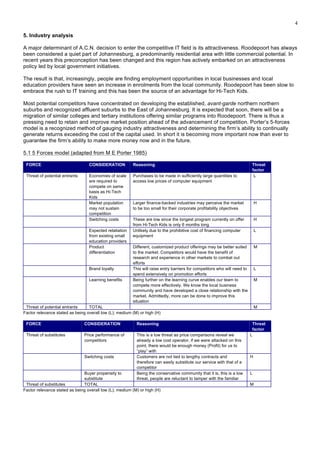
5.1 5 Forces model (adapted from M E Porter 1985)
FORCE CONSIDERATION Reasoning Threat
factor
Threat of potential entrants Economies of scale
are required to
compete on same
basis as Hi-Tech
Kids
Purchases to be made in sufficiently large quantities to
access low prices of computer equipment
L
Market population
may not sustain
competition
Larger finance-backed industries may perceive the market
to be too small for their corporate profitability objectives
H
Switching costs These are low since the longest program currently on offer
from Hi-Tech Kids is only 6 months long
H
Expected retaliation
from existing small
education providers
Unlikely due to the prohibitive cost of financing computer
equipment
L
Product
differentiation
Different, customized product offerings may be better suited
to the market. Competitors would have the benefit of
research and experience in other markets to combat out
efforts
M
Brand loyalty This will raise entry barriers for competitors who will need to
spend extensively on promotion efforts
L
Learning benefits Being further on the learning curve enables our team to
compete more effectively. We know the local business
community and have developed a close relationship with the
market. Admittedly, more can be done to improve this
situation
M
Threat of potential entrants TOTAL M
Factor relevance stated as being overall low (L); medium (M) or high (H)
FORCE CONSIDERATION Reasoning Threat
factor
Threat of substitutes Price performance of
competitors
This is a low threat as price comparisons reveal we
already a low cost operator, if we were attacked on this
point, there would be enough money (Profit) for us to
“play” with
L
Switching costs Customers are not tied to lengthy contracts and
therefore can easily substitute our service with that of a
competitor
H
Buyer propensity to
substitute
Being the conservative community that it is, this is a low
threat, people are reluctant to tamper with the familiar
L
Threat of substitutes TOTAL M
Factor relevance stated as being overall low (L); medium (M) or high (H)
5
FORCE CONSIDERATION Reasoning Threat
factor
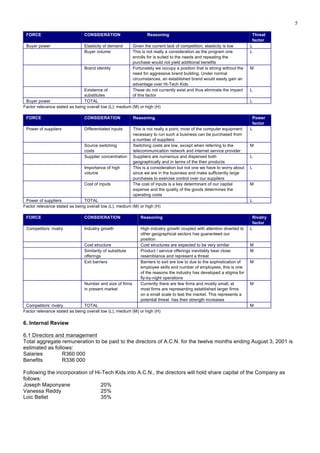
Buyer power Elasticity of demand Given the current lack of competition, elasticity is low L
Buyer volume This is not really a consideration as the program one
enrolls for is suited to the needs and repeating the
purchase would not yield additional benefits
L
Brand identity Fortunately we occupy a position that is strong without the
need for aggressive brand building. Under normal
circumstances, an established brand would easily gain an
advantage over Hi-Tech Kids
M
Existence of
substitutes
These do not currently exist and thus eliminate the impact
of this factor
L
Buyer power TOTAL L
Factor relevance stated as being overall low (L); medium (M) or high (H)
FORCE CONSIDERATION Reasoning Power
factor
Power of suppliers Differentiated inputs This is not really a point, most of the computer equipment
necessary to run such a business can be purchased from
a number of suppliers
L
Source switching
costs
Switching costs are low, except when referring to the
telecommunication network and internet service provider
M
Supplier concentration Suppliers are numerous and dispersed both
geographically and in terms of the their products
L
Importance of high
volume
This is a consideration but not one we have to worry about
since we are in the business and make sufficiently large
purchases to exercise control over our suppliers
L
Cost of inputs The cost of inputs is a key determinant of our capital
expense and the quality of the goods determines the
operating costs
M
Power of suppliers TOTAL L
Factor relevance stated as being overall low (L); medium (M) or high (H)
FORCE CONSIDERATION Reasoning Rivalry
factor
Competitors’ rivalry Industry growth High industry growth coupled with attention diverted to
other geographical sectors has guaranteed our
position
L
Cost structure Cost structures are expected to be very similar M
Similarity of substitute
offerings
Product / service offerings inevitably bear close
resemblance and represent a threat
M
Exit barriers Barriers to exit are low to due to the sophistication of
employee skills and number of employees, this is one
of the reasons the industry has developed a stigma for
fly-by-night operations
M
Number and size of firms
in present market
Currently there are few firms and mostly small, at
most firms are representing established larger firms
on a small scale to test the market. This represents a
potential threat has their strength increases
M
Competitors’ rivalry TOTAL M
Factor relevance stated as being overall low (L); medium (M) or high (H)
6. Internal Review
6.1 Directors and management
Total aggregate remuneration to be paid to the directors of A.C.N. for the twelve months ending August 3, 2001 is
estimated as follows:
Salaries R360 000
Benefits R336 000
Following the incorporation of Hi-Tech Kids into A.C.N., the directors will hold share capital of the Company as
follows:
Joseph Maponyane 20%
Vanessa Reddy 25%
Loic Bellet 35%
6
Other than as set out in this document, there is no other person who may be in a position to exercise control over
the Company.
The Company will make no loans available to the directors or managers and the Company on behalf of any of the
directors or managers will furnish no security.
Employed by the company are 4 lecturers who each hold 5% of issued share capital and are remunerated by a
fixed salary of R17 000/month, They are required to assume responsibility for the performance of their respective
areas of influence (age/grade categories).
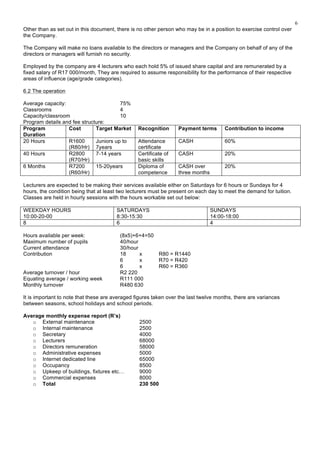
6.2 The operation
Average capacity: 75%
Classrooms 4
Capacity/classroom 10
Program details and fee structure:
Program
Duration
Cost Target Market Recognition Payment terms Contribution to income
20 Hours R1600
(R80/Hr)
Juniors up to
7years
Attendance
certificate
CASH 60%
40 Hours R2800
(R70/Hr)
7-14 years Certificate of
basic skills
CASH 20%
6 Months R7200
(R60/Hr)
15-20years Diploma of
competence
CASH over
three months
20%
Lecturers are expected to be making their services available either on Saturdays for 6 hours or Sundays for 4
hours, the condition being that at least two lecturers must be present on each day to meet the demand for tuition.
Classes are held in hourly sessions with the hours workable set out below:
WEEKDAY HOURS
10:00-20-00
SATURDAYS
8:30-15:30
SUNDAYS
14:00-18:00
8 6 4
Hours available per week: (8x5)+6+4=50
Maximum number of pupils 40/hour
Current attendance 30/hour
Contribution 18 x R80 = R1440
6 x R70 = R420
6 x R60 = R360
Average turnover / hour R2 220
Equating average / working week R111 000
Monthly turnover R480 630
It is important to note that these are averaged figures taken over the last twelve months, there are variances
between seasons, school holidays and school periods.
Average monthly expense report (R’s)
o External maintenance 2500
o Internal maintenance 2500
o Secretary 4000
o Lecturers 68000
o Directors remuneration 58000
o Administrative expenses 5000
o Internet dedicated line 65000
o Occupancy 8500
o Upkeep of buildings, fixtures etc… 9000
o Commercial expenses 8000
o Total 230 500
7
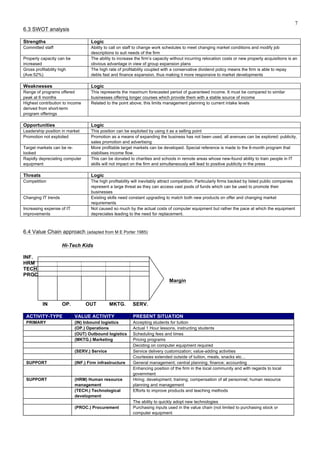
6.3 SWOT analysis
Strengths Logic
Committed staff Ability to call on staff to change work schedules to meet changing market conditions and modify job
descriptions to suit needs of the firm
Property capacity can be
increased
The ability to increase the firm’s capacity without incurring relocation costs or new property acquisitions is an
obvious advantage in view of group expansion plans
Gross profitability high
(Ave:52%)
The high rate of profitability coupled with a conservative dividend policy means the firm is able to repay
debts fast and finance expansion, thus making it more responsive to market developments
Weaknesses Logic
Range of programs offered
peak at 6 months
This represents the maximum forecasted period of guaranteed income. It must be compared to similar
businesses offering longer courses which provide them with a stable source of income
Highest contribution to income
derived from short-term
program offerings
Related to the point above, this limits management planning to current intake levels
Opportunities Logic
Leadership position in market This position can be exploited by using it as a selling point
Promotion not exploited Promotion as a means of expanding the business has not been used, all avenues can be explored: publicity,
sales promotion and advertising
Target markets can be re-
looked
More profitable target markets can be developed. Special reference is made to the 6-month program that
stabilises income flow.
Rapidly depreciating computer
equipment
This can be donated to charities and schools in remote areas whose new-found ability to train people in IT
skills will not impact on the firm and simultaneously will lead to positive publicity in the press
Threats Logic
Competition The high profitability will inevitably attract competition. Particularly firms backed by listed public companies
represent a large threat as they can access vast pools of funds which can be used to promote their
businesses
Changing IT trends Existing skills need constant upgrading to match both new products on offer and changing market
requirements
Increasing expense of IT
improvements
Not caused so much by the actual costs of computer equipment but rather the pace at which the equipment
depreciates leading to the need for replacement.
6.4 Value Chain approach (adapted from M E Porter 1985)
Hi-Tech Kids
INF.
HRM
TECH
PROC
Margin
IN OP. OUT MKTG. SERV.
ACTIVITY-TYPE VALUE ACTIVITY PRESENT SITUATION
PRIMARY (IN) Inbound logistics Accepting students for tuition
(OP.) Operations Actual 1 Hour lessons, instructing students
(OUT) Outbound logistics Scheduling fees and times
(MKTG.) Marketing Pricing programs
Deciding on computer equipment required
(SERV.) Service Service delivery customization; value-adding activities
Courtesies extended outside of tuition, meals, snacks etc…
SUPPORT (INF.) Firm infrastructure General management; central planning; finance; accounting
Enhancing position of the firm in the local community and with regards to local
government
SUPPORT (HRM) Human resource
management
Hiring; development; training; compensation of all personnel; human resource
planning and management
(TECH.) Technological
development
Efforts to improve products and teaching methods
The ability to quickly adopt new technologies
(PROC.) Procurement Purchasing inputs used in the value chain (not limited to purchasing stock or
computer equipment
8
Direction
7. Vision
We envision a future where the obvious choice for parents to send their children for skill development in IT is Hi-
Tech Kids. There should be an easily accessible branch near every home, where they can affordably send their
children. Money spent for this purpose must be seen as the investment that it is.
8. Mission
We will try at all times to present the latest developments in technology, in a format which is easily understood by
children of all ages. This service to society will be provided at a price which is perceived to be lower than the
benefits obtained by attending classes at Hi-Tech Kids.
Not wanting to constrain managerial creativity, what follows is the proposed strategy. We retain the right to fix the
core objectives, vision and mission whilst always being open to re-negotiation. The strategies are flexible and we
welcome efforts to make improvements on these, this company is here to benefit our clients and ourselves as well
as add to existing knowledge. If any party is in a losing position vis-à-vis this benefit we have not done our jobs
properly.
9. Objective
Ultimately we aim to make more money now and in the future. Money being defined as the net profit attributable to
shareholders. This money must be generated within the constraints of the ruling vision and mission stated above.
All actions are measured in terms of whether they get us closer to the ultimate aim or not. We will allow any
employee the freedom to make proposals and implement changes which fulfill this requirement.
10. Functional strategies
10.1 Marketing strategy
At present, we derive 60% of our income from the junior market. Here the study program is limited and therefore,
we are finding ourselves constantly in need to replenish enrolments. We need to have clients commit to us for
longer periods of time this can be achieved either by adding to the current product mix or creating a perception in
the client’s mind (both the parents and children) that the programs follow on from each other. The latter option is
the most feasible at present. Courses must convey the same material content but be modified at some point where
a commitment can be secured from the client regarding future study. We expect a research period to put together
this strategy of around 5 months, this means that by the start of 2001 we should have perfected a method whereby
we can make more accurate forecasts of future income trends.
The above recommendation can be backed up by promotion aimed at current parents and clients who have used
us in the past and did not follow up their studies through to the 6 month Diploma.
As mentioned in the SWOT analysis, there is an opportunity to create a favourable image in the market and with
local government by channeling our used equipment to needy institutions who will not represent a threat to our
business. It will increase our replacement costs as the systems and equipment will have to be donated in complete
usable forms which means we will not be able to retain certain equipment, countering this is the positive publicity
created which will be created at a much lower cost than pure advertising. This is expected to occur within the next
6 months as new systems are acquired.
We currently face a situation where our facilities are under-utilised in the weekday afternoons, this is because of
the low penetration into the more mature 15-20 year olds market. By focusing a particular promotion effort at this
market we can increase awareness to the benefits of acquiring IT skills before leaving school. At present, from
informal discussions with this group we understand that they feel it isn’t necessary to be more than familiar with
the computer, they therefore limit their knowledge to basic operation and usage of programs leaving hardware and
advanced software packages to later tertiary study. By increasing our penetration into this market, we will secure a
more regular flow of income on which to base expansion plans.
9
Aggressive expansion into Randburg and Soweto will be undertaken next year. This will require efforts on
promotion and product / service modifications. We have only the balance of this year to learn as much as possible
about competition localized in those areas. Each lecturer will be assigned different responsibilities regarding their
role in the information-gathering stage. This will be discussed in the next meeting to finalise action plans with
timings and responsibilities.
10.2 Finance strategy
Our primary aim is to reduce the current exposure to loan capital. By the end of the year we aim to have cleared
our debts and accumulated sufficient reserves to finance the geographical expansion of Hi-Tech Kids. This gradual
approach will reduce taxable income and thus the cost of capital will be reduced. By next year we will be ready to
launch the expansion program and take on additional debt, this together with reserves will prove sufficient to
properly move into other areas.
We expect to set up a national training grid within the next 5 years. This entails securing long-term loans from the
end of next year to finance growth. Mostly, we expect to raise this finance through our current finance partners.
By the end of the 5 year period we hope to have sufficient reserves and capital requirements to justify a listing on
the Johannesburg Stock Exchange, it must be borne in mind that such a move (with all its benefits) brings with it
additional administrative expenses not directly linked to on-going operations. This is why a listing is not our first
choice for raising finance in the immediate future.
We do not expect to alter the current policy on dividends and aim to increase gross profitability from 52% to 55% in
the next 2 years.
10.3 Human resources strategy
In line with expansion plans discussed thus far, there will be a need to bring on-board, qualified staff capable of
managing the branches and staff to provide lectures.
Initially, the current directors of the company will oversee the branches but once national expansion gets under way
we will have to recruit branch managers and operating staff. Of course the first option is to have our own lecturers
launch the expansion and proposals will be considered closer to the time as action plans are drawn up.
For recruitment we will rely heavily on our operations director. He needs to have the support and advice of lecturing
staff and will hold meetings regularly in the future to ensure that he is able to optimally select staff both for lecturing
and support.
Remuneration will be by salary with a commission element being considered. Issuing further shares at this stage to
both raise finance and bring in new staff is not considered wise and a share incentive scheme will be re-considered
at the end of our 5 year expansion program, possibly linked to a listing on the Johannesburg Stock Exchange.
10.4 Operating strategy
Our operations consist of converting people, using our people. We receive people who know little about computers
and programs, we instruct them and release them more knowledgeable and able to learn additional computer skills
faster. We do this in our training center.
Expansion of facilities will be via the introduction of additional training centers in the 2 other areas of
Johannesburg. Soweto has been chosen because of its proximity to the existing center whilst having the properties
of a rural center. This will yield valuable working knowledge which can later be applied to expansion in the rest of
South Africa. The move into Randburg will prepare us for dealing with competition, in line with the belief in attack
being the best form of defense, we see this move as key in preparing us to deal with competition which inevitably
will appear on our “home-front”.
The new facilities will be modeled on the existing school as this has a proven success record. In the next 5 months,
appropriate facilities will be sought to accommodate us. Only if the search should prove unsuccessful will we
consider building our own premises.
10
10.5 Technology development strategy
With a view on the future, there is obviously a need to limit our product usage to a system which is compatible with
the widest variety of computer hardware. This will become increasingly valid as expansion gets under way and
information management systems will be developed from existing structures.
Within the next 6 months we expect to have developed the interactive web-sites to facilitate transfer of information
from the branches. This will prove economical given the ability to launch the links on dedicated telecommunication
lines as per our current set-up. Staff responsible for this development will be decided in the coming weeks as
action plans in this field are drawn up.
Ongoing acquisition of IT skills will be necessary to maintain our mission promise of being able to present the latest
developments in technology. Because of the pressures of expansion plans on everybody’s schedule, we will
arrange to have one member of the firm to update skills at a time, skills acquired will be shared with other staff thus
reducing the expense of having each member learning the same programs and techniques, rather by instituting
regular skill dissemination we will be able to generate a larger variety of skills at a lower cost.
Financial Statements and future projections
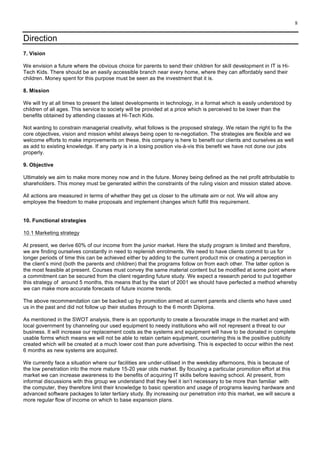
11. Income statements (*forecasted)
NB: No attempt has been made to assume any particular interest rate, the directors are confident that the Company will be able to meet any
reasonable market related interest rate whilst maintaining both dividend and profit objectives. For this reason the income statements end at
profit before interest and tax. Tax under current legislation is incurred at 35%.
Financial year 1998 1999 2000 Note 2001* 2002* 2003*
Turnover R 4,440,000 R 5,328,000 R 5,767,560 R 6,534,000 R 8,569,000 R 12,564,000
Cost of sales R 222,000 R 266,400 R 288,378 1 R 326,700 R 428,450 R 628,200
Gross profit / loss R 4,218,000 R 5,061,600 R 5,479,182 R 6,207,300 R 8,140,550 R 11,935,800
Operating expenses R 1,218,000 R 1,800,000 R 2,477,622 2 R 2,900,900 R 3,640,000 R 5,253,000
PBIT R 3,000,000 R 3,261,600 R 3,001,560 R 3,306,400 R 4,500,550 R 6,682,800
Interest R 360,000 R 360,000 R 360,000 3
Profit before tax R 2,640,000 R 2,901,600 R 2,641,560 R 3,306,400 R 4,500,550 R 6,682,800
Taxation R 1,056,000 R 1,015,560 R 924,546 R 1,157,240 R 1,575,193 R 2,338,980
Attributable profit R 1,584,000 R 1,886,040 R 1,717,014 R 2,149,160 R 2,925,358 R 4,343,820
Dividends R 158,400 R 188,604 R 4,840,050 4 R 214,916 R 292,536 R 434,382
Retained earnings R 1,425,600 R 3,123,036 R 0 R 1,934,244 R 4,567,066 R 8,476,504
PBIT % 67.6 61.2 52.0 50.6 52.5 53.2
0
1000000
2000000
3000000
4000000
5000000
6000000
Dividends
0
1000000
2000000
3000000
4000000
5000000
6000000
7000000
8000000
9000000
Retained
earnings
11
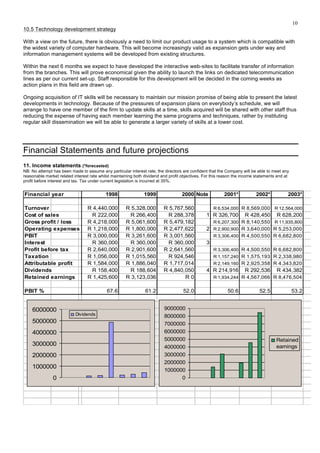
12. Balance sheet
2000 notes after purchase notes
CAPITAL EMPLOYED
Retained earnings 4840050 5 5.2
Ordinary share capital 1750000 6 1500000 6.2
Long term loan 2000000 250000 7
Total capital employed 8590050 1750000
EMPLOYMENT OF CAPITAL
Fixed assets 1000000 8 1000000
Intangible assets 1163800 9 544200 9.2
Current assets 6007500 7500
Bank balances and cash 400450 10 10.2
Misc. 7500 7500
Current liabilities 5400 95400
Creditors 5400 11 5400
Bank overdraft 90000 12
Total employment of capital 8590050 1750000
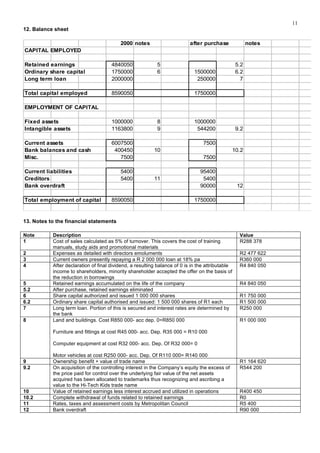
13. Notes to the financial statements
Note Description Value
1 Cost of sales calculated as 5% of turnover. This covers the cost of training
manuals, study aids and promotional materials
R288 378
2 Expenses as detailed with directors emoluments R2 477 622
3 Current owners presently repaying a R 2 000 000 loan at 18% pa R360 000
4 After declaration of final dividend, a resulting balance of 0 is in the attributable
income to shareholders, minority shareholder accepted the offer on the basis of
the reduction in borrowings
R4 840 050
5 Retained earnings accumulated on the life of the company R4 840 050
5.2 After purchase, retained earnings eliminated
6 Share capital authorized and issued 1 000 000 shares R1 750 000
6.2 Ordinary share capital authorised and issued: 1 500 000 shares of R1 each R1 500 000
7 Long term loan. Portion of this is secured and interest rates are determined by
the bank
R250 000
8 Land and buildings. Cost R850 000- acc dep. 0=R850 000
Furniture and fittings at cost R45 000- acc. Dep. R35 000 = R10 000
Computer equipment at cost R32 000- acc. Dep. Of R32 000= 0
Motor vehicles at cost R250 000- acc. Dep. Of R110 000= R140 000
R1 000 000
9 Ownership benefit + value of trade name R1 164 620
9.2 On acquisition of the controlling interest in the Company’s equity the excess of
the price paid for control over the underlying fair value of the net assets
acquired has been allocated to trademarks thus recognizing and ascribing a
value to the Hi-Tech Kids trade name
R544 200
10 Value of retained earnings less interest accrued and utilized in operations R400 450
10.2 Complete withdrawal of funds related to retained earnings R0
11 Rates, taxes and assessment costs by Metropolitan Council R5 400
12 Bank overdraft R90 000
12
Appendix 1. Important dates and times
Initial application to financial institution 2000: Monday, July 31
Final review of terms of purchase 2000: Wednesday, August 2
Transfer of ownership 2000: Thursday, August 3
Change of ownership, public notification 2000: Thursday, August 9
Notes:
• The above dates may be subject to amendment. Any such amendment will be notified to appropriate
parties.
13
Appendix 2. Corporate & general information
Secretary and registered office
K Jones
331 Ontdekkers Rd
Roodepoort, 2156
Commercial Bank
ABSA Bank Limited
3
rd
Floor
ABSA Bank Towers East
170 Main Street
Johannesburg, 2001
Attorneys
Holloway & Co.
2
nd
Floor
235 Main Street
Johannesburg, 2001
Auditors
PriceWaterHouseCoopers Inc.
2 Eglin Road
Sunninghill, 2157
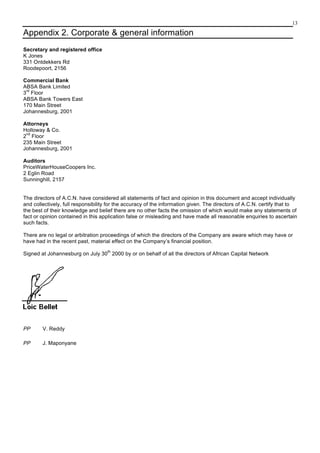
The directors of A.C.N. have considered all statements of fact and opinion in this document and accept individually
and collectively, full responsibility for the accuracy of the information given. The directors of A.C.N. certify that to
the best of their knowledge and belief there are no other facts the omission of which would make any statements of
fact or opinion contained in this application false or misleading and have made all reasonable enquiries to ascertain
such facts.
There are no legal or arbitration proceedings of which the directors of the Company are aware which may have or
have had in the recent past, material effect on the Company’s financial position.
Signed at Johannesburg on July 30
th
2000 by or on behalf of all the directors of African Capital Network
PP V. Reddy
PP J. Maponyane
14
Appendix 3. Reference Section
Hodgetts, R.M. and Kuratko, D.F., Effective Small Business Management, The Dryden Press, 1998

SmallBusAss

  • 1.
    Loïc Bellet P OBox 423 , Johannesburg , 2000 , RSA Tel:+27 83 764 6149 E-mail : loicmba@hotmail.com COURSE : OBU OPEN LEARNING MBA MODULE : SMALL & MEDIUM BUSINESS MANAGEMENT – elective 2 STUDENT NUMBER : 98046671 COHORT : 10/99 TUTOR : HERMAN COETZEE ASSIGNMENT : African Capital Network, strategic business plan DATE : 20000730 : Index Page Content 1 Executive summary • Salient financial information • Group Structure • The application 2 The business • Description, nature of business and management • Industry analysis • Internal review 8 Direction • Vision • Mission • Objective • Functional strategies 3 Financial Statements and future projections • Income statements • Balance sheet • Notes to the financial statements • Forecasted business performance 5 Appendix 1 : Important dates and times 6 Appendix 2 : Corporate & general information 7 Appendix 3 : Reference section
  • 2.
    1 OFFER TO BUY ExecutiveSummary The information set out in this section is an overview only and is not intended to be comprehensive. It should be read in conjunction with the information contained in the historical and forecasted financial statements as well as the adjoining analyses. The purpose of this document is two-fold. Firstly, it is the strategic plan for the business of Hi-Tech Kids (Pty) Ltd as it continues operating under new ownership after purchase by African Capital Network (Pty) Ltd. Secondly; it is an application to raise the necessary finance to complete the acquisition of Hi-Tech Kids from its current owners. Since its inception in 1995, Hi-Tech Kids has developed a reputation for quality tuition resulting in the improved skills of school-leavers to begin a career in the Information Technology field. An important aspect of the change in ownership is that it will not affect the quality of tuition as the teaching is effected by current employees of the school who retain 20% of issued share capital and express no desire to leave the firm should ownership change. The majority share of 80% is the amount required to transfer ownership. 1.Salient financial information Current capital structure 1000000 Shares of no par value Financial Year 1999 2000 2001* 2002* 2003* Turnover 5328000 5767560 6534000 8569000 12564000 PBIT 3261600 3001560 3306400 4500550 6682800 * Drawn from forecasted financial statements 0 2000000 4000000 6000000 8000000 10000000 12000000 14000000 1999 2000 2001* 2002* 2003* Turnover PBIT 2.Group Structure 80% held African Capital Network (Pty) Ltd Hi-Tech Kids (Pty) Ltd
  • 3.
    2 3. The application 3.1Purpose of the application The purpose of this application is to fund the acquisition of Hi-Tech Kids from its current owners and raise loan finance of a short term nature for replacement of dated computer terminals and furniture. 3.2 Details of the application 800 000 shares are being offered for sale at a price of 218.75 cents per share. This excludes additional costs of updating existing computer terminals and furniture. 3.3 Minimum amount required The minimum capital requirement, which must be raised in terms of this application, is R 340 000 in order to provide the sums required in respect of the following matters: Detail Amount (R ‘000) To acquire the owner’s equity (80% thereof) of Hi-Tech Kids 1 750 To replace dated furniture 40 To replace dated computer equipment 50 Subtotal 1 840 Less cash available for investment by A.C.N. 1 500 Total required 340 The above amount to be available as: • Bank overdraft facility of R90 000 to finance cost of furniture and computer equipment replacements • Long term loan of R250 000 sought for the acquisition of the business. Security in the form of the land and buildings is available to the value of R850 000 as per the latest independent valuation. Valuation certificate is available on request. 3.4 Dividend policy Dividends have been held historically at 10% of attributable income per annum, this policy will not change in the foreseeable future. The business 4.Description, nature of business and management 4.1 The buyer African Capital Network (Pty) Ltd, (A.C.N.) is the trading name of the company in its current structure. It is owned and managed jointly by the following directors: Loic Bellet; Joseph Maponyane; Vanessa Reddy. As a member of the Micro Lenders Association of South Africa since its inception in 1992, A.C.N. established its first money-lending operation in Randburg. Business ran with a turnover of R5000 for the first year of operation and each doubling this amount each year resulting in the recent sale of the business for the sum of R1, 500,000 to a larger finance group listed on the Johannesburg Stock Exchange. In its final year of operation under current management A.C.N. consisted of three branches operated by the directors. Structured as a cash shell, A.C.N. embarked on a six-month search for opportunities in the fast-growing computer- training field of tertiary industry resulting in the discovery of Hi-Tech Kids (Pty) Ltd in Roodepoort. 4.2 The training business
  • 4.
    3 Hi-Tech Kids (Pty)Ltd offers training courses in hardware and software operation of computers to children of all ages up to a secondary level preparing children for higher level qualifications both in the technical and administrative fields of IT (information technology). Established in 1995 as a small community-learning center in Roodepoort, Hi-Tech Kids has grown exponentially to be the most prestigious provider of computer training for children on the West Rand. In an industry characterized by firms formed to quickly reap the rewards of fulfilling pressing business needs and without established track records, Hi-Tech Kids has earned the respect of parents and the business community for its staying power and proven teaching methods. The Hi-Tech Kids operation will retain its branding and trade name but will be registered as African Capital Network (Pty) Ltd, (A.C.N.). The merger of the firm retains its current employees, who have indicated no desire to resign should majority ownership of the firm change. Believing in the benefits of empowerment, the current owners of the business have retained only 80% of the issued share capital of the firm leaving 20% in the hands of key lecturers. 4.3 Prospects A.C.N. earns revenue from its 80% interest in the Hi-Tech Kids operation. The latter derives its income from the provision of IT training services to children of school and pre-school ages. It is a leader in its field, income is made up of fees payable in advance of tuition in cash or equivalents. The fee structure and related details can be found in the internal review section. The school has been operating at 75% of maximum capacity without advertising. Management has reacted to growth by increasing the number of classrooms to 4 able to cater for 10 people each. More aggressive marketing tactics undertaken by the new owners will result in an increase to 90% of current capacity within the next financial year. The strategies and tactics presented in this document will be implemented following the acquisition of the business. Expenses to this end have computed in the forecasted financial statements. The effect of growth in attributable income will result in more funds being available for the establishment of branches in Soweto and Randburg in the next 5 years. 4.4 Group policy and corporate governance The directors of A.C.N. set overall group policy and, in conjunction with lecturers, provide input on matters of strategic and financial importance. A.C.N. will manage implementation of group policy and strategic decisions, as well as monitor the performance of operational management. Daily management vests in the lecturers who report directly to the Operations Director. Employees and management of Hi-Tech Kids are assured of the continuing support of management in their endeavours. 4.5 Management of Hi-Tech Kids Capacity, age and qualifications Name Responsibilities Managing Director, (24) Dip. Bus. Man. (ICM), PSAF, SASA Loic Bellet Corporate sales, general management Finance Director, (32) CA (SA), B.Com Vanessa Reddy Financial and administrative management Operations Director, (45) Dip. HRM (DMS) Joseph Maponyane Daily operations, managing human resources Head of training school, (30) MCSE, B.Com Barend De Villiers Lecturing to children in grades 8-12, responsible for sales in grades 1-12 School Lecturer, (27) A++, COBOL Desmond Norton Lecturing to children in grades 1-7 Head of training pre-school, (34) MCSE, A++, Dip. Mktg (ICM) Joss Jackson Lecturing to children aged 4-7 Pre-school Lecturer, (32) B.PrimEd (UPE), MCSE Victoria Coetzee Lecturing to children aged 4-7 Company secretary, (28) Dip. OffPrac. (DMS) Dip. PubRel (DMS) Kelly Jones Handling enquiries, providing administrative support to lecturers and management, first-aid responsibilities Internal maintenance, (39) Grace Ndlovu Cleaning inside buildings, preparation of meals and snacks External maintenance, (42) Elton Malabane Maintenance of exterior of buildings and landscape, errand-running
  • 5.
    4 5. Industry analysis Amajor determinant of A.C.N. decision to enter the competitive IT field is its attractiveness. Roodepoort has always been considered a quiet part of Johannesburg, a predominantly residential area with little commercial potential. In recent years this preconception has been changed and this region has actively embarked on an attractiveness policy led by local government initiatives. The result is that, increasingly, people are finding employment opportunities in local businesses and local education providers have seen an increase in enrolments from the local community. Roodepoort has been slow to embrace the rush to IT training and this has been the source of an advantage for Hi-Tech Kids. Most potential competitors have concentrated on developing the established, avant-garde northern northern suburbs and recognized affluent suburbs to the East of Johannesburg. It is expected that soon, there will be a migration of similar colleges and tertiary institutions offering similar programs into Roodepoort. There is thus a pressing need to retain and improve market position ahead of the advancement of competition. Porter’s 5-forces model is a recognized method of gauging industry attractiveness and determining the firm’s ability to continually generate returns exceeding the cost of the capital used. In short it is becoming more important now than ever to guarantee the firm’s ability to make more money now and in the future. 5.1 5 Forces model (adapted from M E Porter 1985) FORCE CONSIDERATION Reasoning Threat factor Threat of potential entrants Economies of scale are required to compete on same basis as Hi-Tech Kids Purchases to be made in sufficiently large quantities to access low prices of computer equipment L Market population may not sustain competition Larger finance-backed industries may perceive the market to be too small for their corporate profitability objectives H Switching costs These are low since the longest program currently on offer from Hi-Tech Kids is only 6 months long H Expected retaliation from existing small education providers Unlikely due to the prohibitive cost of financing computer equipment L Product differentiation Different, customized product offerings may be better suited to the market. Competitors would have the benefit of research and experience in other markets to combat out efforts M Brand loyalty This will raise entry barriers for competitors who will need to spend extensively on promotion efforts L Learning benefits Being further on the learning curve enables our team to compete more effectively. We know the local business community and have developed a close relationship with the market. Admittedly, more can be done to improve this situation M Threat of potential entrants TOTAL M Factor relevance stated as being overall low (L); medium (M) or high (H) FORCE CONSIDERATION Reasoning Threat factor Threat of substitutes Price performance of competitors This is a low threat as price comparisons reveal we already a low cost operator, if we were attacked on this point, there would be enough money (Profit) for us to “play” with L Switching costs Customers are not tied to lengthy contracts and therefore can easily substitute our service with that of a competitor H Buyer propensity to substitute Being the conservative community that it is, this is a low threat, people are reluctant to tamper with the familiar L Threat of substitutes TOTAL M Factor relevance stated as being overall low (L); medium (M) or high (H)
  • 6.
    5 FORCE CONSIDERATION ReasoningThreat factor Buyer power Elasticity of demand Given the current lack of competition, elasticity is low L Buyer volume This is not really a consideration as the program one enrolls for is suited to the needs and repeating the purchase would not yield additional benefits L Brand identity Fortunately we occupy a position that is strong without the need for aggressive brand building. Under normal circumstances, an established brand would easily gain an advantage over Hi-Tech Kids M Existence of substitutes These do not currently exist and thus eliminate the impact of this factor L Buyer power TOTAL L Factor relevance stated as being overall low (L); medium (M) or high (H) FORCE CONSIDERATION Reasoning Power factor Power of suppliers Differentiated inputs This is not really a point, most of the computer equipment necessary to run such a business can be purchased from a number of suppliers L Source switching costs Switching costs are low, except when referring to the telecommunication network and internet service provider M Supplier concentration Suppliers are numerous and dispersed both geographically and in terms of the their products L Importance of high volume This is a consideration but not one we have to worry about since we are in the business and make sufficiently large purchases to exercise control over our suppliers L Cost of inputs The cost of inputs is a key determinant of our capital expense and the quality of the goods determines the operating costs M Power of suppliers TOTAL L Factor relevance stated as being overall low (L); medium (M) or high (H) FORCE CONSIDERATION Reasoning Rivalry factor Competitors’ rivalry Industry growth High industry growth coupled with attention diverted to other geographical sectors has guaranteed our position L Cost structure Cost structures are expected to be very similar M Similarity of substitute offerings Product / service offerings inevitably bear close resemblance and represent a threat M Exit barriers Barriers to exit are low to due to the sophistication of employee skills and number of employees, this is one of the reasons the industry has developed a stigma for fly-by-night operations M Number and size of firms in present market Currently there are few firms and mostly small, at most firms are representing established larger firms on a small scale to test the market. This represents a potential threat has their strength increases M Competitors’ rivalry TOTAL M Factor relevance stated as being overall low (L); medium (M) or high (H) 6. Internal Review 6.1 Directors and management Total aggregate remuneration to be paid to the directors of A.C.N. for the twelve months ending August 3, 2001 is estimated as follows: Salaries R360 000 Benefits R336 000 Following the incorporation of Hi-Tech Kids into A.C.N., the directors will hold share capital of the Company as follows: Joseph Maponyane 20% Vanessa Reddy 25% Loic Bellet 35%
  • 7.
    6 Other than asset out in this document, there is no other person who may be in a position to exercise control over the Company. The Company will make no loans available to the directors or managers and the Company on behalf of any of the directors or managers will furnish no security. Employed by the company are 4 lecturers who each hold 5% of issued share capital and are remunerated by a fixed salary of R17 000/month, They are required to assume responsibility for the performance of their respective areas of influence (age/grade categories). 6.2 The operation Average capacity: 75% Classrooms 4 Capacity/classroom 10 Program details and fee structure: Program Duration Cost Target Market Recognition Payment terms Contribution to income 20 Hours R1600 (R80/Hr) Juniors up to 7years Attendance certificate CASH 60% 40 Hours R2800 (R70/Hr) 7-14 years Certificate of basic skills CASH 20% 6 Months R7200 (R60/Hr) 15-20years Diploma of competence CASH over three months 20% Lecturers are expected to be making their services available either on Saturdays for 6 hours or Sundays for 4 hours, the condition being that at least two lecturers must be present on each day to meet the demand for tuition. Classes are held in hourly sessions with the hours workable set out below: WEEKDAY HOURS 10:00-20-00 SATURDAYS 8:30-15:30 SUNDAYS 14:00-18:00 8 6 4 Hours available per week: (8x5)+6+4=50 Maximum number of pupils 40/hour Current attendance 30/hour Contribution 18 x R80 = R1440 6 x R70 = R420 6 x R60 = R360 Average turnover / hour R2 220 Equating average / working week R111 000 Monthly turnover R480 630 It is important to note that these are averaged figures taken over the last twelve months, there are variances between seasons, school holidays and school periods. Average monthly expense report (R’s) o External maintenance 2500 o Internal maintenance 2500 o Secretary 4000 o Lecturers 68000 o Directors remuneration 58000 o Administrative expenses 5000 o Internet dedicated line 65000 o Occupancy 8500 o Upkeep of buildings, fixtures etc… 9000 o Commercial expenses 8000 o Total 230 500
  • 8.
    7 6.3 SWOT analysis StrengthsLogic Committed staff Ability to call on staff to change work schedules to meet changing market conditions and modify job descriptions to suit needs of the firm Property capacity can be increased The ability to increase the firm’s capacity without incurring relocation costs or new property acquisitions is an obvious advantage in view of group expansion plans Gross profitability high (Ave:52%) The high rate of profitability coupled with a conservative dividend policy means the firm is able to repay debts fast and finance expansion, thus making it more responsive to market developments Weaknesses Logic Range of programs offered peak at 6 months This represents the maximum forecasted period of guaranteed income. It must be compared to similar businesses offering longer courses which provide them with a stable source of income Highest contribution to income derived from short-term program offerings Related to the point above, this limits management planning to current intake levels Opportunities Logic Leadership position in market This position can be exploited by using it as a selling point Promotion not exploited Promotion as a means of expanding the business has not been used, all avenues can be explored: publicity, sales promotion and advertising Target markets can be re- looked More profitable target markets can be developed. Special reference is made to the 6-month program that stabilises income flow. Rapidly depreciating computer equipment This can be donated to charities and schools in remote areas whose new-found ability to train people in IT skills will not impact on the firm and simultaneously will lead to positive publicity in the press Threats Logic Competition The high profitability will inevitably attract competition. Particularly firms backed by listed public companies represent a large threat as they can access vast pools of funds which can be used to promote their businesses Changing IT trends Existing skills need constant upgrading to match both new products on offer and changing market requirements Increasing expense of IT improvements Not caused so much by the actual costs of computer equipment but rather the pace at which the equipment depreciates leading to the need for replacement. 6.4 Value Chain approach (adapted from M E Porter 1985) Hi-Tech Kids INF. HRM TECH PROC Margin IN OP. OUT MKTG. SERV. ACTIVITY-TYPE VALUE ACTIVITY PRESENT SITUATION PRIMARY (IN) Inbound logistics Accepting students for tuition (OP.) Operations Actual 1 Hour lessons, instructing students (OUT) Outbound logistics Scheduling fees and times (MKTG.) Marketing Pricing programs Deciding on computer equipment required (SERV.) Service Service delivery customization; value-adding activities Courtesies extended outside of tuition, meals, snacks etc… SUPPORT (INF.) Firm infrastructure General management; central planning; finance; accounting Enhancing position of the firm in the local community and with regards to local government SUPPORT (HRM) Human resource management Hiring; development; training; compensation of all personnel; human resource planning and management (TECH.) Technological development Efforts to improve products and teaching methods The ability to quickly adopt new technologies (PROC.) Procurement Purchasing inputs used in the value chain (not limited to purchasing stock or computer equipment
  • 9.
    8 Direction 7. Vision We envisiona future where the obvious choice for parents to send their children for skill development in IT is Hi- Tech Kids. There should be an easily accessible branch near every home, where they can affordably send their children. Money spent for this purpose must be seen as the investment that it is. 8. Mission We will try at all times to present the latest developments in technology, in a format which is easily understood by children of all ages. This service to society will be provided at a price which is perceived to be lower than the benefits obtained by attending classes at Hi-Tech Kids. Not wanting to constrain managerial creativity, what follows is the proposed strategy. We retain the right to fix the core objectives, vision and mission whilst always being open to re-negotiation. The strategies are flexible and we welcome efforts to make improvements on these, this company is here to benefit our clients and ourselves as well as add to existing knowledge. If any party is in a losing position vis-à-vis this benefit we have not done our jobs properly. 9. Objective Ultimately we aim to make more money now and in the future. Money being defined as the net profit attributable to shareholders. This money must be generated within the constraints of the ruling vision and mission stated above. All actions are measured in terms of whether they get us closer to the ultimate aim or not. We will allow any employee the freedom to make proposals and implement changes which fulfill this requirement. 10. Functional strategies 10.1 Marketing strategy At present, we derive 60% of our income from the junior market. Here the study program is limited and therefore, we are finding ourselves constantly in need to replenish enrolments. We need to have clients commit to us for longer periods of time this can be achieved either by adding to the current product mix or creating a perception in the client’s mind (both the parents and children) that the programs follow on from each other. The latter option is the most feasible at present. Courses must convey the same material content but be modified at some point where a commitment can be secured from the client regarding future study. We expect a research period to put together this strategy of around 5 months, this means that by the start of 2001 we should have perfected a method whereby we can make more accurate forecasts of future income trends. The above recommendation can be backed up by promotion aimed at current parents and clients who have used us in the past and did not follow up their studies through to the 6 month Diploma. As mentioned in the SWOT analysis, there is an opportunity to create a favourable image in the market and with local government by channeling our used equipment to needy institutions who will not represent a threat to our business. It will increase our replacement costs as the systems and equipment will have to be donated in complete usable forms which means we will not be able to retain certain equipment, countering this is the positive publicity created which will be created at a much lower cost than pure advertising. This is expected to occur within the next 6 months as new systems are acquired. We currently face a situation where our facilities are under-utilised in the weekday afternoons, this is because of the low penetration into the more mature 15-20 year olds market. By focusing a particular promotion effort at this market we can increase awareness to the benefits of acquiring IT skills before leaving school. At present, from informal discussions with this group we understand that they feel it isn’t necessary to be more than familiar with the computer, they therefore limit their knowledge to basic operation and usage of programs leaving hardware and advanced software packages to later tertiary study. By increasing our penetration into this market, we will secure a more regular flow of income on which to base expansion plans.
  • 10.
    9 Aggressive expansion intoRandburg and Soweto will be undertaken next year. This will require efforts on promotion and product / service modifications. We have only the balance of this year to learn as much as possible about competition localized in those areas. Each lecturer will be assigned different responsibilities regarding their role in the information-gathering stage. This will be discussed in the next meeting to finalise action plans with timings and responsibilities. 10.2 Finance strategy Our primary aim is to reduce the current exposure to loan capital. By the end of the year we aim to have cleared our debts and accumulated sufficient reserves to finance the geographical expansion of Hi-Tech Kids. This gradual approach will reduce taxable income and thus the cost of capital will be reduced. By next year we will be ready to launch the expansion program and take on additional debt, this together with reserves will prove sufficient to properly move into other areas. We expect to set up a national training grid within the next 5 years. This entails securing long-term loans from the end of next year to finance growth. Mostly, we expect to raise this finance through our current finance partners. By the end of the 5 year period we hope to have sufficient reserves and capital requirements to justify a listing on the Johannesburg Stock Exchange, it must be borne in mind that such a move (with all its benefits) brings with it additional administrative expenses not directly linked to on-going operations. This is why a listing is not our first choice for raising finance in the immediate future. We do not expect to alter the current policy on dividends and aim to increase gross profitability from 52% to 55% in the next 2 years. 10.3 Human resources strategy In line with expansion plans discussed thus far, there will be a need to bring on-board, qualified staff capable of managing the branches and staff to provide lectures. Initially, the current directors of the company will oversee the branches but once national expansion gets under way we will have to recruit branch managers and operating staff. Of course the first option is to have our own lecturers launch the expansion and proposals will be considered closer to the time as action plans are drawn up. For recruitment we will rely heavily on our operations director. He needs to have the support and advice of lecturing staff and will hold meetings regularly in the future to ensure that he is able to optimally select staff both for lecturing and support. Remuneration will be by salary with a commission element being considered. Issuing further shares at this stage to both raise finance and bring in new staff is not considered wise and a share incentive scheme will be re-considered at the end of our 5 year expansion program, possibly linked to a listing on the Johannesburg Stock Exchange. 10.4 Operating strategy Our operations consist of converting people, using our people. We receive people who know little about computers and programs, we instruct them and release them more knowledgeable and able to learn additional computer skills faster. We do this in our training center. Expansion of facilities will be via the introduction of additional training centers in the 2 other areas of Johannesburg. Soweto has been chosen because of its proximity to the existing center whilst having the properties of a rural center. This will yield valuable working knowledge which can later be applied to expansion in the rest of South Africa. The move into Randburg will prepare us for dealing with competition, in line with the belief in attack being the best form of defense, we see this move as key in preparing us to deal with competition which inevitably will appear on our “home-front”. The new facilities will be modeled on the existing school as this has a proven success record. In the next 5 months, appropriate facilities will be sought to accommodate us. Only if the search should prove unsuccessful will we consider building our own premises.
  • 11.
    10 10.5 Technology developmentstrategy With a view on the future, there is obviously a need to limit our product usage to a system which is compatible with the widest variety of computer hardware. This will become increasingly valid as expansion gets under way and information management systems will be developed from existing structures. Within the next 6 months we expect to have developed the interactive web-sites to facilitate transfer of information from the branches. This will prove economical given the ability to launch the links on dedicated telecommunication lines as per our current set-up. Staff responsible for this development will be decided in the coming weeks as action plans in this field are drawn up. Ongoing acquisition of IT skills will be necessary to maintain our mission promise of being able to present the latest developments in technology. Because of the pressures of expansion plans on everybody’s schedule, we will arrange to have one member of the firm to update skills at a time, skills acquired will be shared with other staff thus reducing the expense of having each member learning the same programs and techniques, rather by instituting regular skill dissemination we will be able to generate a larger variety of skills at a lower cost. Financial Statements and future projections 11. Income statements (*forecasted) NB: No attempt has been made to assume any particular interest rate, the directors are confident that the Company will be able to meet any reasonable market related interest rate whilst maintaining both dividend and profit objectives. For this reason the income statements end at profit before interest and tax. Tax under current legislation is incurred at 35%. Financial year 1998 1999 2000 Note 2001* 2002* 2003* Turnover R 4,440,000 R 5,328,000 R 5,767,560 R 6,534,000 R 8,569,000 R 12,564,000 Cost of sales R 222,000 R 266,400 R 288,378 1 R 326,700 R 428,450 R 628,200 Gross profit / loss R 4,218,000 R 5,061,600 R 5,479,182 R 6,207,300 R 8,140,550 R 11,935,800 Operating expenses R 1,218,000 R 1,800,000 R 2,477,622 2 R 2,900,900 R 3,640,000 R 5,253,000 PBIT R 3,000,000 R 3,261,600 R 3,001,560 R 3,306,400 R 4,500,550 R 6,682,800 Interest R 360,000 R 360,000 R 360,000 3 Profit before tax R 2,640,000 R 2,901,600 R 2,641,560 R 3,306,400 R 4,500,550 R 6,682,800 Taxation R 1,056,000 R 1,015,560 R 924,546 R 1,157,240 R 1,575,193 R 2,338,980 Attributable profit R 1,584,000 R 1,886,040 R 1,717,014 R 2,149,160 R 2,925,358 R 4,343,820 Dividends R 158,400 R 188,604 R 4,840,050 4 R 214,916 R 292,536 R 434,382 Retained earnings R 1,425,600 R 3,123,036 R 0 R 1,934,244 R 4,567,066 R 8,476,504 PBIT % 67.6 61.2 52.0 50.6 52.5 53.2 0 1000000 2000000 3000000 4000000 5000000 6000000 Dividends 0 1000000 2000000 3000000 4000000 5000000 6000000 7000000 8000000 9000000 Retained earnings
  • 12.
    11 12. Balance sheet 2000notes after purchase notes CAPITAL EMPLOYED Retained earnings 4840050 5 5.2 Ordinary share capital 1750000 6 1500000 6.2 Long term loan 2000000 250000 7 Total capital employed 8590050 1750000 EMPLOYMENT OF CAPITAL Fixed assets 1000000 8 1000000 Intangible assets 1163800 9 544200 9.2 Current assets 6007500 7500 Bank balances and cash 400450 10 10.2 Misc. 7500 7500 Current liabilities 5400 95400 Creditors 5400 11 5400 Bank overdraft 90000 12 Total employment of capital 8590050 1750000 13. Notes to the financial statements Note Description Value 1 Cost of sales calculated as 5% of turnover. This covers the cost of training manuals, study aids and promotional materials R288 378 2 Expenses as detailed with directors emoluments R2 477 622 3 Current owners presently repaying a R 2 000 000 loan at 18% pa R360 000 4 After declaration of final dividend, a resulting balance of 0 is in the attributable income to shareholders, minority shareholder accepted the offer on the basis of the reduction in borrowings R4 840 050 5 Retained earnings accumulated on the life of the company R4 840 050 5.2 After purchase, retained earnings eliminated 6 Share capital authorized and issued 1 000 000 shares R1 750 000 6.2 Ordinary share capital authorised and issued: 1 500 000 shares of R1 each R1 500 000 7 Long term loan. Portion of this is secured and interest rates are determined by the bank R250 000 8 Land and buildings. Cost R850 000- acc dep. 0=R850 000 Furniture and fittings at cost R45 000- acc. Dep. R35 000 = R10 000 Computer equipment at cost R32 000- acc. Dep. Of R32 000= 0 Motor vehicles at cost R250 000- acc. Dep. Of R110 000= R140 000 R1 000 000 9 Ownership benefit + value of trade name R1 164 620 9.2 On acquisition of the controlling interest in the Company’s equity the excess of the price paid for control over the underlying fair value of the net assets acquired has been allocated to trademarks thus recognizing and ascribing a value to the Hi-Tech Kids trade name R544 200 10 Value of retained earnings less interest accrued and utilized in operations R400 450 10.2 Complete withdrawal of funds related to retained earnings R0 11 Rates, taxes and assessment costs by Metropolitan Council R5 400 12 Bank overdraft R90 000
  • 13.
    12 Appendix 1. Importantdates and times Initial application to financial institution 2000: Monday, July 31 Final review of terms of purchase 2000: Wednesday, August 2 Transfer of ownership 2000: Thursday, August 3 Change of ownership, public notification 2000: Thursday, August 9 Notes: • The above dates may be subject to amendment. Any such amendment will be notified to appropriate parties.
  • 14.
    13 Appendix 2. Corporate& general information Secretary and registered office K Jones 331 Ontdekkers Rd Roodepoort, 2156 Commercial Bank ABSA Bank Limited 3 rd Floor ABSA Bank Towers East 170 Main Street Johannesburg, 2001 Attorneys Holloway & Co. 2 nd Floor 235 Main Street Johannesburg, 2001 Auditors PriceWaterHouseCoopers Inc. 2 Eglin Road Sunninghill, 2157 The directors of A.C.N. have considered all statements of fact and opinion in this document and accept individually and collectively, full responsibility for the accuracy of the information given. The directors of A.C.N. certify that to the best of their knowledge and belief there are no other facts the omission of which would make any statements of fact or opinion contained in this application false or misleading and have made all reasonable enquiries to ascertain such facts. There are no legal or arbitration proceedings of which the directors of the Company are aware which may have or have had in the recent past, material effect on the Company’s financial position. Signed at Johannesburg on July 30 th 2000 by or on behalf of all the directors of African Capital Network PP V. Reddy PP J. Maponyane
  • 15.
    14 Appendix 3. ReferenceSection Hodgetts, R.M. and Kuratko, D.F., Effective Small Business Management, The Dryden Press, 1998