SMALL BUSINESS MANAGEMENT
SENDAWULA KASIMU
BESBM (MAK), PGDBE (MUBS) MS.Ent (MAK)
CONTENT
• Intrapreneuship: Meaning, Key aspects and it’s
culture
• Ensuring business survival
• How to revive a failed business
• Managing business finance and debt
• How to involve the family
INTRAPRENEURSHIP
• An Intrapreneur is an entrepreneur within an already
established organization (Pinchot, 1983).
• An Intrapreneur is an entrepreneur who does not own
a business but uses the entrepreneurial skills in an
existing business i.e. he/she identifies opportunities
within an existing business and creates profits from
the opportunity.
CHARACTERISTICS OF AN INTRAPRENEUR
• Works in an existing business.
• Is hired to manage the business.
• Identifies new opportunities for an existing business.
• Is creative.
• Organizes and control resources to ensure a profit for
the existing business.
• Prefers benefits of an existing business such as salary.
IMPORTANCE OF INTRAPRENEURSHIP
• Maintenance of a salaried position provides security in
case of failure
• Opportunity to gain valuable experience
• Opportunity to cooperate with other employees on the
project
• Advice and additional expertise from the peers and
coworkers
• Opportunity to test an idea before executing in a live
business environment
• Possibility to bring change faster
• Increases revenues and raises profits
• Improves the corporate image for recruiting purposes.
FACTORS ENCOURAGING INTRAPRENEURSHIP IN
ORGANIZATIONS
• Use of internal resources is allowed
• Intrapreneurship employees are granted some ownership
rights in the internal enterprise they create
• Involvement of employees
• Encourage employees to develop through Training employees
• Effective reward of employees
• Promotion of team work
• Creation of some free time for employees
ENSURING BUSINESS SURVIVAL
• Reinvent your business
• Sell on the Internet
• Get Involved in Social
Media
• Be mobile friendly
• Contact former customers
• Call former prospects
• Contact competitors of
present or former
customers
• Sell additional products and
services to existing
customers
• Develop multiple revenue
streams
HOW TO REVIVE A FAILED BUSINESS
• You must first identify the real problem(s) and realize
there are issues that need addressing with a high
sense of urgency.
• Assessment areas; product, market, production
process, people, finance
STRATEGIES OF BUSINESS REVIVAL
• Re-Engage People; get the
right people on board and
get the wrong people off.
• Innovate; introduce new or
improved products.
• Branding and Marketing;
change the name of the
product or business.
• Finance and Cash Flow;
focus on the internal
sources of funding
compared to the external.
• Execution and Tough
Decisions; implement the
decision of business revive.
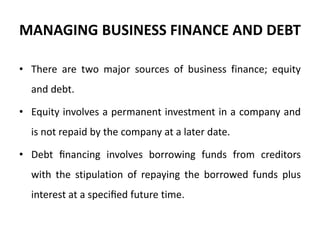
MANAGING BUSINESS FINANCE AND DEBT
• There are two major sources of business finance; equity
and debt.
• Equity involves a permanent investment in a company and
is not repaid by the company at a later date.
• Debt financing involves borrowing funds from creditors
with the stipulation of repaying the borrowed funds plus
interest at a specified future time.
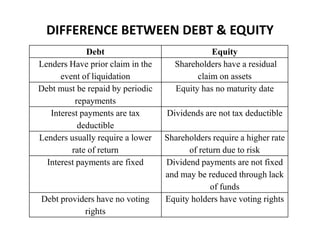
DIFFERENCE BETWEEN DEBT & EQUITY
Debt Equity
Lenders Have prior claim in the
event of liquidation
Shareholders have a residual
claim on assets
Debt must be repaid by periodic
repayments
Equity has no maturity date
Interest payments are tax
deductible
Dividends are not tax deductible
Lenders usually require a lower
rate of return
Shareholders require a higher rate
of return due to risk
Interest payments are fixed Dividend payments are not fixed
and may be reduced through lack
of funds
Debt providers have no voting
rights
Equity holders have voting rights
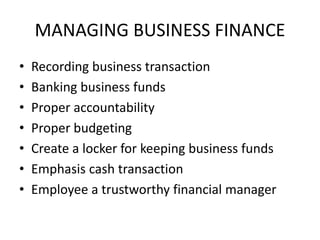
MANAGING BUSINESS FINANCE
• Recording business transaction
• Banking business funds
• Proper accountability
• Proper budgeting
• Create a locker for keeping business funds
• Emphasis cash transaction
• Employee a trustworthy financial manager
HOW TO MANAGE DEBT
• Before borrowing money for your business, develop a
business plan to help determine whether your business can
afford a loan.
• If you need to borrow money, take time to comparison-shop
for the best loan option.
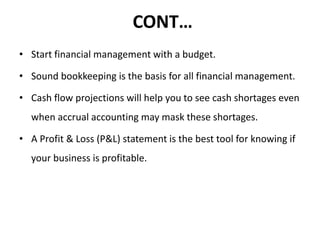
CONT…
• Start financial management with a budget.
• Sound bookkeeping is the basis for all financial management.
• Cash flow projections will help you to see cash shortages even
when accrual accounting may mask these shortages.
• A Profit & Loss (P&L) statement is the best tool for knowing if
your business is profitable.
HOW TO INVOLVE THE FAMILY
• It involves working with family members in establishing,
managing and controlling a business enterprise.
• This can be done by family members for example husband,
wife and other relatives.
• Examples of family businesses include; Uga chick by
Sekalala, Madhvan, Mukwano, Nina Interiors Etc.
CONT…
• How to involve family members;
 Contributing capital
 Managing the business
 Providing labour
 Networking business activity
 etc
IMPORTANCE OF INVOLVING FAMILY
• Creation of employment opportunities to family members
• Source of living to family members
• Maximizing profits
• High commitment and dedication of family members as business
owners and thus success.
• Family members are willing to work hard and re-invest.
• Willingness to pass on knowledge from one family member to
another which contributes to business sustainability.
Assignment
• Environmental impact assessment
• Gender in business
• ICT in business
• Green entrepreneurship
• Social entrepreneurship

SMALL BUSINESS MANAGEMENT.ppt

  • 1.
    SMALL BUSINESS MANAGEMENT SENDAWULAKASIMU BESBM (MAK), PGDBE (MUBS) MS.Ent (MAK)
  • 2.
    CONTENT • Intrapreneuship: Meaning,Key aspects and it’s culture • Ensuring business survival • How to revive a failed business • Managing business finance and debt • How to involve the family
  • 3.
    INTRAPRENEURSHIP • An Intrapreneuris an entrepreneur within an already established organization (Pinchot, 1983). • An Intrapreneur is an entrepreneur who does not own a business but uses the entrepreneurial skills in an existing business i.e. he/she identifies opportunities within an existing business and creates profits from the opportunity.
  • 4.
    CHARACTERISTICS OF ANINTRAPRENEUR • Works in an existing business. • Is hired to manage the business. • Identifies new opportunities for an existing business. • Is creative. • Organizes and control resources to ensure a profit for the existing business. • Prefers benefits of an existing business such as salary.
  • 5.
    IMPORTANCE OF INTRAPRENEURSHIP •Maintenance of a salaried position provides security in case of failure • Opportunity to gain valuable experience • Opportunity to cooperate with other employees on the project • Advice and additional expertise from the peers and coworkers • Opportunity to test an idea before executing in a live business environment • Possibility to bring change faster • Increases revenues and raises profits • Improves the corporate image for recruiting purposes.
  • 6.
    FACTORS ENCOURAGING INTRAPRENEURSHIPIN ORGANIZATIONS • Use of internal resources is allowed • Intrapreneurship employees are granted some ownership rights in the internal enterprise they create • Involvement of employees • Encourage employees to develop through Training employees • Effective reward of employees • Promotion of team work • Creation of some free time for employees
  • 7.
    ENSURING BUSINESS SURVIVAL •Reinvent your business • Sell on the Internet • Get Involved in Social Media • Be mobile friendly • Contact former customers • Call former prospects • Contact competitors of present or former customers • Sell additional products and services to existing customers • Develop multiple revenue streams
  • 8.
    HOW TO REVIVEA FAILED BUSINESS • You must first identify the real problem(s) and realize there are issues that need addressing with a high sense of urgency. • Assessment areas; product, market, production process, people, finance
  • 9.
    STRATEGIES OF BUSINESSREVIVAL • Re-Engage People; get the right people on board and get the wrong people off. • Innovate; introduce new or improved products. • Branding and Marketing; change the name of the product or business. • Finance and Cash Flow; focus on the internal sources of funding compared to the external. • Execution and Tough Decisions; implement the decision of business revive.
  • 10.
    MANAGING BUSINESS FINANCEAND DEBT • There are two major sources of business finance; equity and debt. • Equity involves a permanent investment in a company and is not repaid by the company at a later date. • Debt financing involves borrowing funds from creditors with the stipulation of repaying the borrowed funds plus interest at a specified future time.
  • 11.
    DIFFERENCE BETWEEN DEBT& EQUITY Debt Equity Lenders Have prior claim in the event of liquidation Shareholders have a residual claim on assets Debt must be repaid by periodic repayments Equity has no maturity date Interest payments are tax deductible Dividends are not tax deductible Lenders usually require a lower rate of return Shareholders require a higher rate of return due to risk Interest payments are fixed Dividend payments are not fixed and may be reduced through lack of funds Debt providers have no voting rights Equity holders have voting rights
  • 12.
    MANAGING BUSINESS FINANCE •Recording business transaction • Banking business funds • Proper accountability • Proper budgeting • Create a locker for keeping business funds • Emphasis cash transaction • Employee a trustworthy financial manager
  • 13.
    HOW TO MANAGEDEBT • Before borrowing money for your business, develop a business plan to help determine whether your business can afford a loan. • If you need to borrow money, take time to comparison-shop for the best loan option.
  • 14.
    CONT… • Start financialmanagement with a budget. • Sound bookkeeping is the basis for all financial management. • Cash flow projections will help you to see cash shortages even when accrual accounting may mask these shortages. • A Profit & Loss (P&L) statement is the best tool for knowing if your business is profitable.
  • 15.
    HOW TO INVOLVETHE FAMILY • It involves working with family members in establishing, managing and controlling a business enterprise. • This can be done by family members for example husband, wife and other relatives. • Examples of family businesses include; Uga chick by Sekalala, Madhvan, Mukwano, Nina Interiors Etc.
  • 16.
    CONT… • How toinvolve family members;  Contributing capital  Managing the business  Providing labour  Networking business activity  etc
  • 17.
    IMPORTANCE OF INVOLVINGFAMILY • Creation of employment opportunities to family members • Source of living to family members • Maximizing profits • High commitment and dedication of family members as business owners and thus success. • Family members are willing to work hard and re-invest. • Willingness to pass on knowledge from one family member to another which contributes to business sustainability.
  • 18.
    Assignment • Environmental impactassessment • Gender in business • ICT in business • Green entrepreneurship • Social entrepreneurship