EEM
       PRESENTATION
             ON
INDUCTION TYPE ENERGY METER


                 PRESENTED BY -
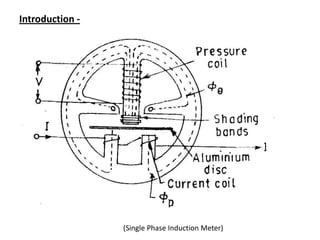
Introduction -


                 (Single Phase Induction Meter)
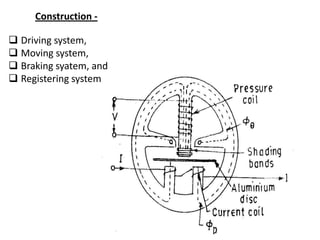
Construction -

 Driving system,
 Moving system,
 Braking syatem, and
 Registering system
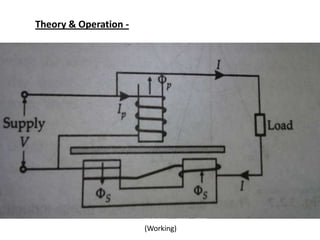
Theory & Operation -


                       (Working)
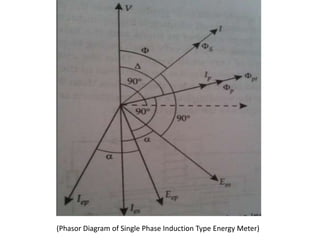
(Phasor Diagram of Single Phase Induction Type Energy Meter)
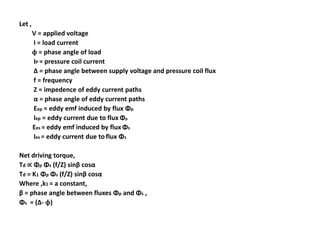
Let ,
        V = applied voltage
        I = load current
        ϕ = phase angle of load
        IP = pressure coil current
        Δ = phase angle between supply voltage and pressure coil flux
        f = frequency
        Z = impedence of eddy current paths
        α = phase angle of eddy current paths
        Eep = eddy emf induced by flux Φp
        Iep = eddy current due to flux Φp
        Ees = eddy emf induced by flux Φs
        Ies = eddy current due to flux Φs

Net driving torque,
Td ∝ Φp Φs (f/Z) sinβ cosα
Td = K1 Φp Φs (f/Z) sinβ cosα
Where ,k1 = a constant,
β = phase angle between fluxes Φp and Φs ,
Φs = (Δ- ϕ)
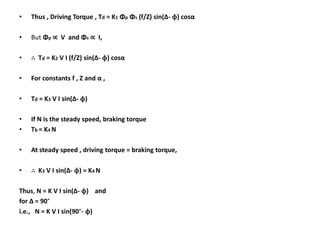
•   Thus , Driving Torque , Td = K1 Φp Φs (f/Z) sin(Δ- ϕ) cosα

•   But Φp ∝ V and Φs ∝ I,

•   ∴ Td = K2 V I (f/Z) sin(Δ- ϕ) cosα

•   For constants f , Z and α ,

•   Td = K3 V I sin(Δ- ϕ)

•   If N is the steady speed, braking torque
•   Tb = K 4 N

•   At steady speed , driving torque = braking torque,

•   ∴ K3 V I sin(Δ- ϕ) = K4 N

Thus, N = K V I sin(Δ- ϕ) and
for Δ = 90°
i.e., N = K V I sin(90°- ϕ)
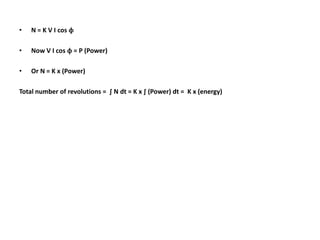
•   N = K V I cos ϕ

•   Now V I cos ϕ = P (Power)

•   Or N = K x (Power)

Total number of revolutions = ∫ N dt = K x ∫ (Power) dt = K x (energy)
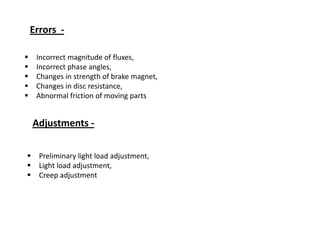
Errors -

    Incorrect magnitude of fluxes,
    Incorrect phase angles,
    Changes in strength of brake magnet,
    Changes in disc resistance,
    Abnormal friction of moving parts


    Adjustments -


     Preliminary light load adjustment,
     Light load adjustment,
     Creep adjustment

Single Phase Induction Type Energy Meter

  • 1.
    EEM PRESENTATION ON INDUCTION TYPE ENERGY METER PRESENTED BY -
  • 2.
    Introduction - (Single Phase Induction Meter)
  • 3.
    Construction -  Drivingsystem,  Moving system,  Braking syatem, and  Registering system
  • 4.
    Theory & Operation- (Working)
  • 5.
    (Phasor Diagram ofSingle Phase Induction Type Energy Meter)
  • 6.
    Let , V = applied voltage I = load current ϕ = phase angle of load IP = pressure coil current Δ = phase angle between supply voltage and pressure coil flux f = frequency Z = impedence of eddy current paths α = phase angle of eddy current paths Eep = eddy emf induced by flux Φp Iep = eddy current due to flux Φp Ees = eddy emf induced by flux Φs Ies = eddy current due to flux Φs Net driving torque, Td ∝ Φp Φs (f/Z) sinβ cosα Td = K1 Φp Φs (f/Z) sinβ cosα Where ,k1 = a constant, β = phase angle between fluxes Φp and Φs , Φs = (Δ- ϕ)
  • 7.
    Thus , Driving Torque , Td = K1 Φp Φs (f/Z) sin(Δ- ϕ) cosα • But Φp ∝ V and Φs ∝ I, • ∴ Td = K2 V I (f/Z) sin(Δ- ϕ) cosα • For constants f , Z and α , • Td = K3 V I sin(Δ- ϕ) • If N is the steady speed, braking torque • Tb = K 4 N • At steady speed , driving torque = braking torque, • ∴ K3 V I sin(Δ- ϕ) = K4 N Thus, N = K V I sin(Δ- ϕ) and for Δ = 90° i.e., N = K V I sin(90°- ϕ)
  • 8.
    N = K V I cos ϕ • Now V I cos ϕ = P (Power) • Or N = K x (Power) Total number of revolutions = ∫ N dt = K x ∫ (Power) dt = K x (energy)
  • 9.
    Errors -  Incorrect magnitude of fluxes,  Incorrect phase angles,  Changes in strength of brake magnet,  Changes in disc resistance,  Abnormal friction of moving parts Adjustments -  Preliminary light load adjustment,  Light load adjustment,  Creep adjustment