Turbulence generation by planar detonations in
heterogeneous mixtures
Workshop on Fluid Dynamics 2019
A- Cuadra-Lara*
, C. Huete & M. Vera
*acuadra@ing.uc3m.es
Group of Fluid Mechanics
Universidad Carlos III de Madrid
Granada, Spain | July 23, 2019
17
Turbulence generation
by planar detonations
in heterogeneous
mixtures
A. Cuadra-Lara,
C. Huete & M. Vera
Detonation Turbulence
Phenomena
Description of the
problem
1D Reactive
Rankine-Hugoniot relation
Effect of local perturbations
in the fuel mass fraction
Qualitative analysis
Mathematical model
Non-dimensional governing
equations
Linearized Reactive
Rankine-Hugoniot
Equations
Problem domain and
boundary conditions
Ongoing & Parallel
work
References
Useful stuff
Group of Fluid Mechanics
Universidad Carlos III de
Madrid
Outline
Detonation Turbulence Phenomena
Description of the problem
1D Reactive Rankine-Hugoniot relation
Effect of local perturbations in the fuel mass fraction
Qualitative analysis
Mathematical model
Non-dimensional governing equations
Linearized Reactive Rankine-Hugoniot Equations
Problem domain and boundary conditions
Ongoing & Parallel work
References
Useful stuff
17
Turbulence generation
by planar detonations
in heterogeneous
mixtures
A. Cuadra-Lara,
C. Huete & M. Vera
2 Detonation Turbulence
Phenomena
Description of the
problem
1D Reactive
Rankine-Hugoniot relation
Effect of local perturbations
in the fuel mass fraction
Qualitative analysis
Mathematical model
Non-dimensional governing
equations
Linearized Reactive
Rankine-Hugoniot
Equations
Problem domain and
boundary conditions
Ongoing & Parallel
work
References
Useful stuff
Group of Fluid Mechanics
Universidad Carlos III de
Madrid
Detonation Turbulence Phenomena
Here we are dealing with two diferent
phenomena which are, independently,
very complex to model: Detonations
& Turbulence.
Therefore, strong simplifications must
be done in order to get an analytically
tractable problem
Detonation: planar and stable.
Turbulence: weak,
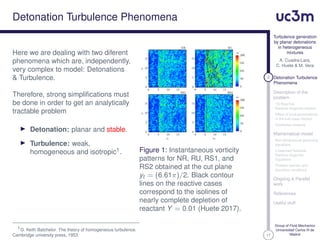
homogeneous and isotropic1. Figure 1: Instantaneous vorticity
patterns for NR, RU, RS1, and
RS2 obtained at the cut plane
yt = (6.61π)/2. Black contour
lines on the reactive cases
correspond to the isolines of
nearly complete depletion of
reactant Y = 0.01 (Huete 2017).
1G. Keith Batchelor. The theory of homogeneous turbulence.
Cambridge university press, 1953.
17
Turbulence generation
by planar detonations
in heterogeneous
mixtures
A. Cuadra-Lara,
C. Huete & M. Vera
Detonation Turbulence
Phenomena
3 Description of the
problem
1D Reactive
Rankine-Hugoniot relation
Effect of local perturbations
in the fuel mass fraction
Qualitative analysis
Mathematical model
Non-dimensional governing
equations
Linearized Reactive
Rankine-Hugoniot
Equations
Problem domain and
boundary conditions
Ongoing & Parallel
work
References
Useful stuff
Group of Fluid Mechanics
Universidad Carlos III de
Madrid
Description of the problem
Definitions
density:
ρ = ρo 1 + W ˆY , (1)
heat release:
q = qo 1 + H ˆY , (2)
mixture ratio:
W =
1 −
Wair
Wfuel
Yfuel +
Wair
Wfuel
(1 − Yfuel )
. (3)
constructive desctructive non-effect
ρ
δρ
δρ ≈ 0
Heavy fuels
Light fuels
Yfuel
(a)
Yst
q Lean
δq
Rich
Yfuel
(b)
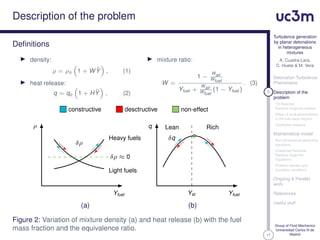
Figure 2: Variation of mixture density (a) and heat release (b) with the fuel
mass fraction and the equivalence ratio.
17
Turbulence generation
by planar detonations
in heterogeneous
mixtures
A. Cuadra-Lara,
C. Huete & M. Vera
Detonation Turbulence
Phenomena
4 Description of the
problem
1D Reactive
Rankine-Hugoniot relation
Effect of local perturbations
in the fuel mass fraction
Qualitative analysis
Mathematical model
Non-dimensional governing
equations
Linearized Reactive
Rankine-Hugoniot
Equations
Problem domain and
boundary conditions
Ongoing & Parallel
work
References
Useful stuff
Group of Fluid Mechanics
Universidad Carlos III de
Madrid
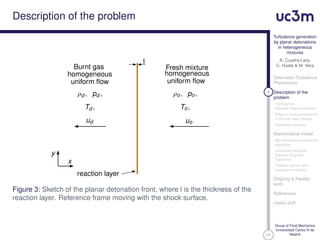
Description of the problem
Burnt gas
homogeneous
uniform flow
Fresh mixture
homogeneous
uniform flow
l
reaction layer
y
x
ρd , pd ,
Td ,
ud
ρo, po,
To,
uo
Figure 3: Sketch of the planar detonation front, where l is the thickness of the
reaction layer. Reference frame moving with the shock surface.
17
Turbulence generation
by planar detonations
in heterogeneous
mixtures
A. Cuadra-Lara,
C. Huete & M. Vera
Detonation Turbulence
Phenomena
Description of the
problem
5 1D Reactive
Rankine-Hugoniot relation
Effect of local perturbations
in the fuel mass fraction
Qualitative analysis
Mathematical model
Non-dimensional governing
equations
Linearized Reactive
Rankine-Hugoniot
Equations
Problem domain and
boundary conditions
Ongoing & Parallel
work
References
Useful stuff
Group of Fluid Mechanics
Universidad Carlos III de
Madrid
Description of the problem
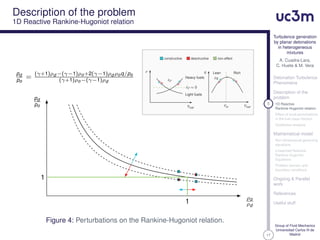
1D Reactive Rankine-Hugoniot relation
ρ
δρ
δρ ≈ 0
Heavy fuels
Light fuels
Yfuel
Yst
q Lean
δq
Rich
Yfuel
constructive desctructive non-effect
1
1
pd
po
=
(γ+1)ρd −(γ−1)ρo+2(γ−1)ρd ρoq/po
(γ+1)ρo−(γ−1)ρd
ρo
ρd
pd
po
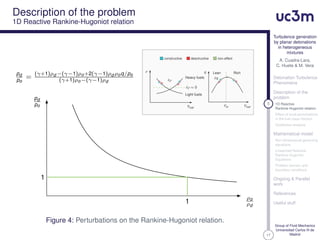
Figure 4: Perturbations on the Rankine-Hugoniot relation.
17
Turbulence generation
by planar detonations
in heterogeneous
mixtures
A. Cuadra-Lara,
C. Huete & M. Vera
Detonation Turbulence
Phenomena
Description of the
problem
5 1D Reactive
Rankine-Hugoniot relation
Effect of local perturbations
in the fuel mass fraction
Qualitative analysis
Mathematical model
Non-dimensional governing
equations
Linearized Reactive
Rankine-Hugoniot
Equations
Problem domain and
boundary conditions
Ongoing & Parallel
work
References
Useful stuff
Group of Fluid Mechanics
Universidad Carlos III de
Madrid
Description of the problem
1D Reactive Rankine-Hugoniot relation
ρ
δρ
δρ ≈ 0
Heavy fuels
Light fuels
Yfuel
Yst
q Lean
δq
Rich
Yfuel
constructive desctructive non-effect
1
1
pd
po
=
(γ+1)ρd −(γ−1)ρo+2(γ−1)ρd ρoq/po
(γ+1)ρo−(γ−1)ρd
ρo
ρd
pd
po
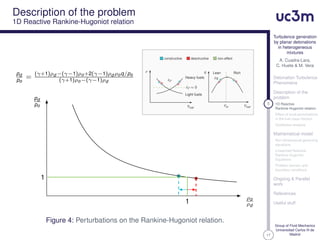
Figure 4: Perturbations on the Rankine-Hugoniot relation.
17
Turbulence generation
by planar detonations
in heterogeneous
mixtures
A. Cuadra-Lara,
C. Huete & M. Vera
Detonation Turbulence
Phenomena
Description of the
problem
5 1D Reactive
Rankine-Hugoniot relation
Effect of local perturbations
in the fuel mass fraction
Qualitative analysis
Mathematical model
Non-dimensional governing
equations
Linearized Reactive
Rankine-Hugoniot
Equations
Problem domain and
boundary conditions
Ongoing & Parallel
work
References
Useful stuff
Group of Fluid Mechanics
Universidad Carlos III de
Madrid
Description of the problem
1D Reactive Rankine-Hugoniot relation
ρ
δρ
δρ ≈ 0
Heavy fuels
Light fuels
Yfuel
Yst
q Lean
δq
Rich
Yfuel
constructive desctructive non-effect
1
1
pd
po
=
(γ+1)ρd −(γ−1)ρo+2(γ−1)ρd ρoq/po
(γ+1)ρo−(γ−1)ρd
ρo
ρd
pd
po
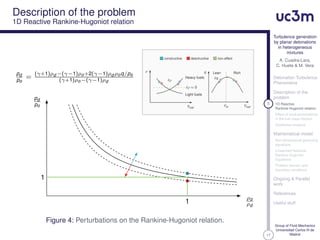
Figure 4: Perturbations on the Rankine-Hugoniot relation.
17
Turbulence generation
by planar detonations
in heterogeneous
mixtures
A. Cuadra-Lara,
C. Huete & M. Vera
Detonation Turbulence
Phenomena
Description of the
problem
5 1D Reactive
Rankine-Hugoniot relation
Effect of local perturbations
in the fuel mass fraction
Qualitative analysis
Mathematical model
Non-dimensional governing
equations
Linearized Reactive
Rankine-Hugoniot
Equations
Problem domain and
boundary conditions
Ongoing & Parallel
work
References
Useful stuff
Group of Fluid Mechanics
Universidad Carlos III de
Madrid
Description of the problem
1D Reactive Rankine-Hugoniot relation
ρ
δρ
δρ ≈ 0
Heavy fuels
Light fuels
Yfuel
Yst
q Lean
δq
Rich
Yfuel
constructive desctructive non-effect
1
1
pd
po
=
(γ+1)ρd −(γ−1)ρo+2(γ−1)ρd ρoq/po
(γ+1)ρo−(γ−1)ρd
ρo
ρd
pd
po
Figure 4: Perturbations on the Rankine-Hugoniot relation.
17
Turbulence generation
by planar detonations
in heterogeneous
mixtures
A. Cuadra-Lara,
C. Huete & M. Vera
Detonation Turbulence
Phenomena
Description of the
problem
1D Reactive
Rankine-Hugoniot relation
6 Effect of local perturbations
in the fuel mass fraction
Qualitative analysis
Mathematical model
Non-dimensional governing
equations
Linearized Reactive
Rankine-Hugoniot
Equations
Problem domain and
boundary conditions
Ongoing & Parallel
work
References
Useful stuff
Group of Fluid Mechanics
Universidad Carlos III de
Madrid
Description of the problem
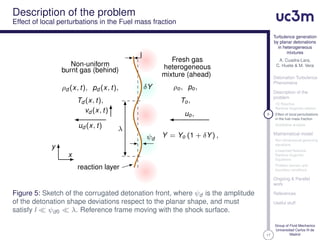
Effect of local perturbations in the Fuel mass fraction
Non-uniform
burnt gas (behind)
Fresh gas
heterogeneous
mixture (ahead)
δY
ψd
l
reaction layer
y
x
ρd (x, t), pd (x, t),
Td (x, t),
ud (x, t)
vd (x, t)
ρo, po,
To,
uo,
Y = Yo (1 + δY) ,
λ
Figure 5: Sketch of the corrugated detonation front, where ψd is the amplitude
of the detonation shape deviations respect to the planar shape, and must
satisfy l ψd0 λ. Reference frame moving with the shock surface.
17
Turbulence generation
by planar detonations
in heterogeneous
mixtures
A. Cuadra-Lara,
C. Huete & M. Vera
Detonation Turbulence
Phenomena
Description of the
problem
1D Reactive
Rankine-Hugoniot relation
Effect of local perturbations
in the fuel mass fraction
7 Qualitative analysis
Mathematical model
Non-dimensional governing
equations
Linearized Reactive
Rankine-Hugoniot
Equations
Problem domain and
boundary conditions
Ongoing & Parallel
work
References
Useful stuff
Group of Fluid Mechanics
Universidad Carlos III de
Madrid
Description of the problem
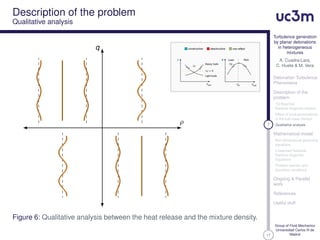
Qualitative analysis
ρ
q
ρ
δρ
δρ ≈ 0
Heavy fuels
Light fuels
Yfuel Yst
q Lean
δq
Rich
Yfuel
constructive desctructive non-effect
Figure 6: Qualitative analysis between the heat release and the mixture density.
17
Turbulence generation
by planar detonations
in heterogeneous
mixtures
A. Cuadra-Lara,
C. Huete & M. Vera
Detonation Turbulence
Phenomena
Description of the
problem
1D Reactive
Rankine-Hugoniot relation
Effect of local perturbations
in the fuel mass fraction
Qualitative analysis
8 Mathematical model
Non-dimensional governing
equations
Linearized Reactive
Rankine-Hugoniot
Equations
Problem domain and
boundary conditions
Ongoing & Parallel
work
References
Useful stuff
Group of Fluid Mechanics
Universidad Carlos III de
Madrid
Mathematical model
Assumptions
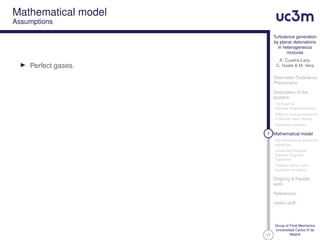
Perfect gases.
17
Turbulence generation
by planar detonations
in heterogeneous
mixtures
A. Cuadra-Lara,
C. Huete & M. Vera
Detonation Turbulence
Phenomena
Description of the
problem
1D Reactive
Rankine-Hugoniot relation
Effect of local perturbations
in the fuel mass fraction
Qualitative analysis
8 Mathematical model
Non-dimensional governing
equations
Linearized Reactive
Rankine-Hugoniot
Equations
Problem domain and
boundary conditions
Ongoing & Parallel
work
References
Useful stuff
Group of Fluid Mechanics
Universidad Carlos III de
Madrid
Mathematical model
Assumptions
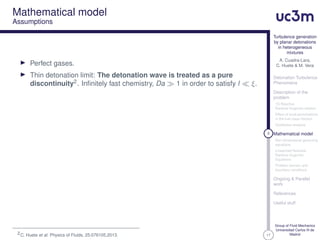
Perfect gases.
Thin detonation limit: The detonation wave is treated as a pure
discontinuity2. Infinitely fast chemistry, Da 1 in order to satisfy l ξ.
2C. Huete et al. Physics of Fluids, 25:076105,2013.
17
Turbulence generation
by planar detonations
in heterogeneous
mixtures
A. Cuadra-Lara,
C. Huete & M. Vera
Detonation Turbulence
Phenomena
Description of the
problem
1D Reactive
Rankine-Hugoniot relation
Effect of local perturbations
in the fuel mass fraction
Qualitative analysis
8 Mathematical model
Non-dimensional governing
equations
Linearized Reactive
Rankine-Hugoniot
Equations
Problem domain and
boundary conditions
Ongoing & Parallel
work
References
Useful stuff
Group of Fluid Mechanics
Universidad Carlos III de
Madrid
Mathematical model
Assumptions
Perfect gases.
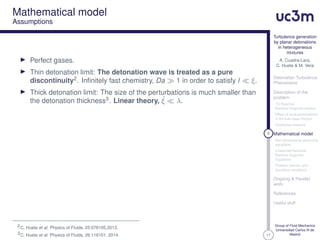
Thin detonation limit: The detonation wave is treated as a pure
discontinuity2. Infinitely fast chemistry, Da 1 in order to satisfy l ξ.
Thick detonation limit: The size of the perturbations is much smaller than
the detonation thickness3. Linear theory, ˙ξ λ.
2C. Huete et al. Physics of Fluids, 25:076105,2013.
3C. Huete et al. Physics of Fluids, 26:116101, 2014.
17
Turbulence generation
by planar detonations
in heterogeneous
mixtures
A. Cuadra-Lara,
C. Huete & M. Vera
Detonation Turbulence
Phenomena
Description of the
problem
1D Reactive
Rankine-Hugoniot relation
Effect of local perturbations
in the fuel mass fraction
Qualitative analysis
8 Mathematical model
Non-dimensional governing
equations
Linearized Reactive
Rankine-Hugoniot
Equations
Problem domain and
boundary conditions
Ongoing & Parallel
work
References
Useful stuff
Group of Fluid Mechanics
Universidad Carlos III de
Madrid
Mathematical model
Assumptions
Perfect gases.
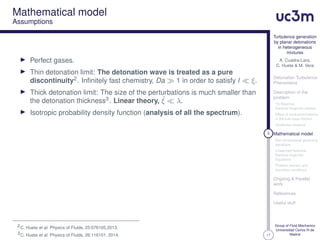
Thin detonation limit: The detonation wave is treated as a pure
discontinuity2. Infinitely fast chemistry, Da 1 in order to satisfy l ξ.
Thick detonation limit: The size of the perturbations is much smaller than
the detonation thickness3. Linear theory, ˙ξ λ.
Isotropic probability density function (analysis of all the spectrum).
2C. Huete et al. Physics of Fluids, 25:076105,2013.
3C. Huete et al. Physics of Fluids, 26:116101, 2014.
17
Turbulence generation
by planar detonations
in heterogeneous
mixtures
A. Cuadra-Lara,
C. Huete & M. Vera
Detonation Turbulence
Phenomena
Description of the
problem
1D Reactive
Rankine-Hugoniot relation
Effect of local perturbations
in the fuel mass fraction
Qualitative analysis
8 Mathematical model
Non-dimensional governing
equations
Linearized Reactive
Rankine-Hugoniot
Equations
Problem domain and
boundary conditions
Ongoing & Parallel
work
References
Useful stuff
Group of Fluid Mechanics
Universidad Carlos III de
Madrid
Mathematical model
Assumptions
Perfect gases.
Thin detonation limit: The detonation wave is treated as a pure
discontinuity2. Infinitely fast chemistry, Da 1 in order to satisfy l ξ.
Thick detonation limit: The size of the perturbations is much smaller than
the detonation thickness3. Linear theory, ˙ξ λ.
Isotropic probability density function (analysis of all the spectrum).
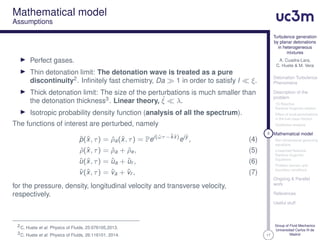
The functions of interest are perturbed, namely
ˆp(ˆx, τ) = ˆρa(ˆx, τ) = Pei(ˆωτ−ˆkˆx)
eiˆy
, (4)
ˆρ(ˆx, τ) = ˆρa + ˆρe, (5)
ˆu(ˆx, τ) = ˆua + ˆur , (6)
ˆv(ˆx, τ) = ˆva + ˆvr , (7)
for the pressure, density, longitudinal velocity and transverse velocity,
respectively.
2C. Huete et al. Physics of Fluids, 25:076105,2013.
3C. Huete et al. Physics of Fluids, 26:116101, 2014.
17
Turbulence generation
by planar detonations
in heterogeneous
mixtures
A. Cuadra-Lara,
C. Huete & M. Vera
Detonation Turbulence
Phenomena
Description of the
problem
1D Reactive
Rankine-Hugoniot relation
Effect of local perturbations
in the fuel mass fraction
Qualitative analysis
Mathematical model
9 Non-dimensional governing
equations
Linearized Reactive
Rankine-Hugoniot
Equations
Problem domain and
boundary conditions
Ongoing & Parallel
work
References
Useful stuff
Group of Fluid Mechanics
Universidad Carlos III de
Madrid
Mathematical model
Non-dimensional governing equations
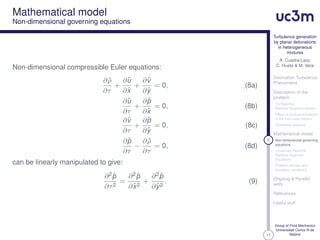
Non-dimensional compressible Euler equations:
∂ ˆρ
∂τ
+
∂ˆu
∂ˆx
+
∂ˆv
∂ˆy
= 0, (8a)
∂ˆu
∂τ
+
∂ˆp
∂ˆx
= 0, (8b)
∂ˆv
∂τ
+
∂ˆp
∂ˆy
= 0, (8c)
∂ˆp
∂τ
−
∂ ˆρ
∂τ
= 0, (8d)
can be linearly manipulated to give:
∂2ˆp
∂τ2
=
∂2ˆp
∂ˆx2
+
∂2ˆp
∂ˆy2
. (9)
17
Turbulence generation
by planar detonations
in heterogeneous
mixtures
A. Cuadra-Lara,
C. Huete & M. Vera
Detonation Turbulence
Phenomena
Description of the
problem
1D Reactive
Rankine-Hugoniot relation
Effect of local perturbations
in the fuel mass fraction
Qualitative analysis
Mathematical model
9 Non-dimensional governing
equations
Linearized Reactive
Rankine-Hugoniot
Equations
Problem domain and
boundary conditions
Ongoing & Parallel
work
References
Useful stuff
Group of Fluid Mechanics
Universidad Carlos III de
Madrid
Mathematical model
Non-dimensional governing equations
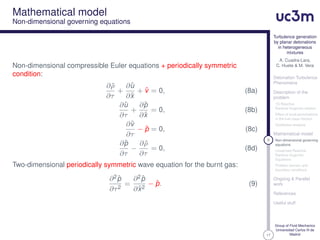
Non-dimensional compressible Euler equations + periodically symmetric
condition:
∂ ˆρ
∂τ
+
∂ˆu
∂ˆx
+ ˆv = 0, (8a)
∂ˆu
∂τ
+
∂ˆp
∂ˆx
= 0, (8b)
∂ˆv
∂τ
− ˆp = 0, (8c)
∂ˆp
∂τ
−
∂ ˆρ
∂τ
= 0, (8d)
Two-dimensional periodically symmetric wave equation for the burnt gas:
∂2ˆp
∂τ2
=
∂2ˆp
∂ˆx2
− ˆp. (9)
17
Turbulence generation
by planar detonations
in heterogeneous
mixtures
A. Cuadra-Lara,
C. Huete & M. Vera
Detonation Turbulence
Phenomena
Description of the
problem
1D Reactive
Rankine-Hugoniot relation
Effect of local perturbations
in the fuel mass fraction
Qualitative analysis
Mathematical model
Non-dimensional governing
equations
10 Linearized Reactive
Rankine-Hugoniot
Equations
Problem domain and
boundary conditions
Ongoing & Parallel
work
References
Useful stuff
Group of Fluid Mechanics
Universidad Carlos III de
Madrid
Mathematical model
Linearized Rankine-Hugoniot Equations
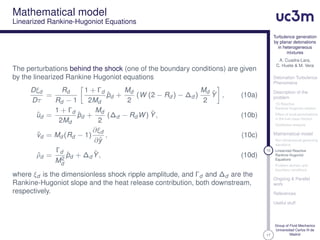
The perturbations behind the shock (one of the boundary conditions) are given
by the linearized Rankine Hugoniot equations
Dξd
Dτ
=
Rd
Rd − 1
1 + Γd
2Md
ˆpd +
Md
2
(W (2 − Rd ) − ∆d )
Md
2
ˆY , (10a)
ˆud =
1 + Γd
2Md
ˆpd +
Md
2
(∆d − Rd W) ˆY, (10b)
ˆvd = Md (Rd − 1)
∂ξd
∂ˆy
, (10c)
ˆρd =
Γd
M2
d
ˆpd + ∆d
ˆY, (10d)
where ξd is the dimensionless shock ripple amplitude, and Γd and ∆d are the
Rankine-Hugoniot slope and the heat release contribution, both downstream,
respectively.
17
Turbulence generation
by planar detonations
in heterogeneous
mixtures
A. Cuadra-Lara,
C. Huete & M. Vera
Detonation Turbulence
Phenomena
Description of the
problem
1D Reactive
Rankine-Hugoniot relation
Effect of local perturbations
in the fuel mass fraction
Qualitative analysis
Mathematical model
Non-dimensional governing
equations
11 Linearized Reactive
Rankine-Hugoniot
Equations
Problem domain and
boundary conditions
Ongoing & Parallel
work
References
Useful stuff
Group of Fluid Mechanics
Universidad Carlos III de
Madrid
Mathematical model
Linearized Rankine-Hugoniot Equations
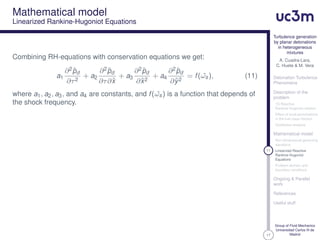
Combining RH-equations with conservation equations we get:
a1
∂2ˆpd
∂τ2
+ a2
∂2ˆpd
∂τ∂ˆx
+ a3
∂2ˆpd
∂ˆx2
+ a4
∂2ˆpd
∂ˆy2
= f( ˆωs), (11)
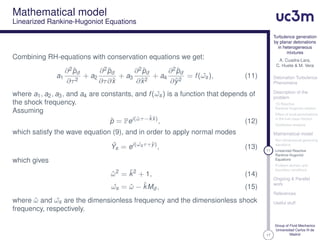
where a1, a2, a3, and a4 are constants, and f( ˆωs) is a function that depends of
the shock frequency.
17
Turbulence generation
by planar detonations
in heterogeneous
mixtures
A. Cuadra-Lara,
C. Huete & M. Vera
Detonation Turbulence
Phenomena
Description of the
problem
1D Reactive
Rankine-Hugoniot relation
Effect of local perturbations
in the fuel mass fraction
Qualitative analysis
Mathematical model
Non-dimensional governing
equations
11 Linearized Reactive
Rankine-Hugoniot
Equations
Problem domain and
boundary conditions
Ongoing & Parallel
work
References
Useful stuff
Group of Fluid Mechanics
Universidad Carlos III de
Madrid
Mathematical model
Linearized Rankine-Hugoniot Equations
Combining RH-equations with conservation equations we get:
a1
∂2ˆpd
∂τ2
+ a2
∂2ˆpd
∂τ∂ˆx
+ a3
∂2ˆpd
∂ˆx2
+ a4
∂2ˆpd
∂ˆy2
= f( ˆωs), (11)
where a1, a2, a3, and a4 are constants, and f( ˆωs) is a function that depends of
the shock frequency.
Assuming
ˆp = Pei(ˆωτ−ˆkˆx)
, (12)
which satisfy the wave equation (9), and in order to apply normal modes
ˆYs = ei( ˆωsτ+ˆy)
, (13)
which gives
ˆω2
= ˆk2
+ 1, (14)
ˆωs = ˆω − ˆkMd , (15)
where ˆω and ˆωs are the dimensionless frequency and the dimensionless shock
frequency, respectively.
17
Turbulence generation
by planar detonations
in heterogeneous
mixtures
A. Cuadra-Lara,
C. Huete & M. Vera
Detonation Turbulence
Phenomena
Description of the
problem
1D Reactive
Rankine-Hugoniot relation
Effect of local perturbations
in the fuel mass fraction
Qualitative analysis
Mathematical model
Non-dimensional governing
equations
12 Linearized Reactive
Rankine-Hugoniot
Equations
Problem domain and
boundary conditions
Ongoing & Parallel
work
References
Useful stuff
Group of Fluid Mechanics
Universidad Carlos III de
Madrid
Mathematical model
Linearized Rankine-Hugoniot Equations
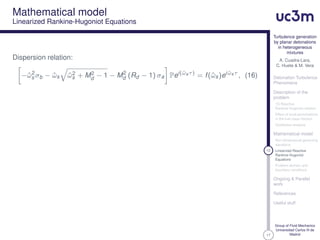
Dispersion relation:
−ˆω2
s σb − ˆωs ˆω2
s + M2
d − 1 − M2
d (Rd − 1) σa Pei(ˆωsτ)
= f(ˆωs)ei ˆωsτ
, (16)
17
Turbulence generation
by planar detonations
in heterogeneous
mixtures
A. Cuadra-Lara,
C. Huete & M. Vera
Detonation Turbulence
Phenomena
Description of the
problem
1D Reactive
Rankine-Hugoniot relation
Effect of local perturbations
in the fuel mass fraction
Qualitative analysis
Mathematical model
Non-dimensional governing
equations
12 Linearized Reactive
Rankine-Hugoniot
Equations
Problem domain and
boundary conditions
Ongoing & Parallel
work
References
Useful stuff
Group of Fluid Mechanics
Universidad Carlos III de
Madrid
Mathematical model
Linearized Rankine-Hugoniot Equations
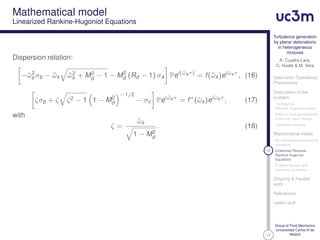
Dispersion relation:
−ˆω2
s σb − ˆωs ˆω2
s + M2
d − 1 − M2
d (Rd − 1) σa Pei(ˆωsτ)
= f(ˆωs)ei ˆωsτ
, (16)
ζσb + ζ ζ2 − 1 1 − M2
d
−1/2
− σc Pei ˆωsτ
= f∗
(ˆωs)ei ˆωsτ
, (17)
with
ζ =
ˆωs
1 − M2
d
. (18)
17
Turbulence generation
by planar detonations
in heterogeneous
mixtures
A. Cuadra-Lara,
C. Huete & M. Vera
Detonation Turbulence
Phenomena
Description of the
problem
1D Reactive
Rankine-Hugoniot relation
Effect of local perturbations
in the fuel mass fraction
Qualitative analysis
Mathematical model
Non-dimensional governing
equations
12 Linearized Reactive
Rankine-Hugoniot
Equations
Problem domain and
boundary conditions
Ongoing & Parallel
work
References
Useful stuff
Group of Fluid Mechanics
Universidad Carlos III de
Madrid
Mathematical model
Linearized Rankine-Hugoniot Equations
Dispersion relation:
−ˆω2
s σb − ˆωs ˆω2
s + M2
d − 1 − M2
d (Rd − 1) σa Pei(ˆωsτ)
= f(ˆωs)ei ˆωsτ
, (16)
ζσb + ζ ζ2 − 1 1 − M2
d
−1/2
− σc Pei ˆωsτ
= f∗
(ˆωs)ei ˆωsτ
, (17)
with
ζ =
ˆωs
1 − M2
d
. (18)
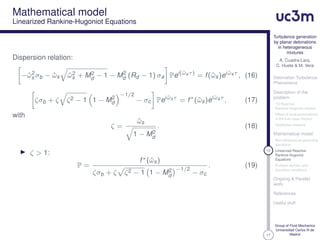
ζ > 1:
P =
f∗(ˆωs)
ζσb + ζ ζ2 − 1 1 − M2
d
−1/2
− σc
. (19)
17
Turbulence generation
by planar detonations
in heterogeneous
mixtures
A. Cuadra-Lara,
C. Huete & M. Vera
Detonation Turbulence
Phenomena
Description of the
problem
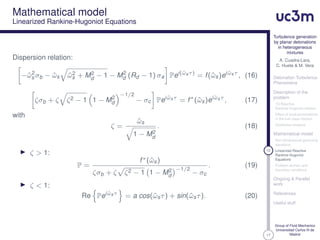
1D Reactive
Rankine-Hugoniot relation
Effect of local perturbations
in the fuel mass fraction
Qualitative analysis
Mathematical model
Non-dimensional governing
equations
12 Linearized Reactive
Rankine-Hugoniot
Equations
Problem domain and
boundary conditions
Ongoing & Parallel
work
References
Useful stuff
Group of Fluid Mechanics
Universidad Carlos III de
Madrid
Mathematical model
Linearized Rankine-Hugoniot Equations
Dispersion relation:
−ˆω2
s σb − ˆωs ˆω2
s + M2
d − 1 − M2
d (Rd − 1) σa Pei(ˆωsτ)
= f(ˆωs)ei ˆωsτ
, (16)
ζσb + ζ ζ2 − 1 1 − M2
d
−1/2
− σc Pei ˆωsτ
= f∗
(ˆωs)ei ˆωsτ
, (17)
with
ζ =
ˆωs
1 − M2
d
. (18)
ζ > 1:
P =
f∗(ˆωs)
ζσb + ζ ζ2 − 1 1 − M2
d
−1/2
− σc
. (19)
ζ < 1:
Re Pei ˆωsτ
= a cos(ˆωsτ) + sin(ˆωsτ). (20)
17
Turbulence generation
by planar detonations
in heterogeneous
mixtures
A. Cuadra-Lara,
C. Huete & M. Vera
Detonation Turbulence
Phenomena
Description of the
problem
1D Reactive
Rankine-Hugoniot relation
Effect of local perturbations
in the fuel mass fraction
Qualitative analysis
Mathematical model
Non-dimensional governing
equations
Linearized Reactive
Rankine-Hugoniot
Equations
13 Problem domain and
boundary conditions
Ongoing & Parallel
work
References
Useful stuff
Group of Fluid Mechanics
Universidad Carlos III de
Madrid
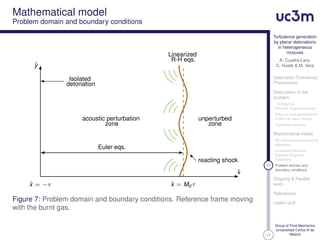
Mathematical model
Problem domain and boundary conditions
ˆx = Md τˆx = −τ
Linearized
R-H eqs.
Isolated
detonation
unperturbed
zone
acoustic perturbation
zone
Euler eqs.
reacting shock
ˆy
ˆx
Figure 7: Problem domain and boundary conditions. Reference frame moving
with the burnt gas.
17
Turbulence generation
by planar detonations
in heterogeneous
mixtures
A. Cuadra-Lara,
C. Huete & M. Vera
Detonation Turbulence
Phenomena
Description of the
problem
1D Reactive
Rankine-Hugoniot relation
Effect of local perturbations
in the fuel mass fraction
Qualitative analysis
Mathematical model
Non-dimensional governing
equations
Linearized Reactive
Rankine-Hugoniot
Equations
Problem domain and
boundary conditions
14 Ongoing & Parallel
work
References
Useful stuff
Group of Fluid Mechanics
Universidad Carlos III de
Madrid
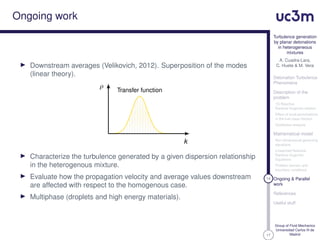
Ongoing work
Downstream averages (Velikovich, 2012). Superposition of the modes
(linear theory).
Transfer function
ρ
k
Characterize the turbulence generated by a given dispersion relationship
in the heterogenous mixture.
Evaluate how the propagation velocity and average values downstream
are affected with respect to the homogenous case.
Multiphase (droplets and high energy materials).
17
Turbulence generation
by planar detonations
in heterogeneous
mixtures
A. Cuadra-Lara,
C. Huete & M. Vera
Detonation Turbulence
Phenomena
Description of the
problem
1D Reactive
Rankine-Hugoniot relation
Effect of local perturbations
in the fuel mass fraction
Qualitative analysis
Mathematical model
Non-dimensional governing
equations
Linearized Reactive
Rankine-Hugoniot
Equations
Problem domain and
boundary conditions
15 Ongoing & Parallel
work
References
Useful stuff
Group of Fluid Mechanics
Universidad Carlos III de
Madrid
Parallel work
Development and validation of a new
MATLAB R
/GUI based thermochemi-
cal code, A. Cuadra-Lara & M. Vera.
Figure 8: Current state of the GUI
Combustion-Toolbox developed.
0.5 1 1.5 2 2.5 3 3.5 4 4.5
10
-15
10
-10
10
-5
10
0
Figure 4: Variation of molar fraction with equivalence ra-
tio for lean to rich acetylene-air mixtures. Combustion-
Toolbox (line) and CEA (diamond).
Development and validation of a new
MATLAB/GUI based thermochemical code
Alberto Cuadra-Lara & Marcos Vera
Department of Thermal and Fluids Engineering, University Carlos III of Madrid
acuadra@ing.uc3m.es (ACL), marcos.vera@uc3m.es (MV)
MSC11, 11th Mediterranean Combustion Symposium
Tenerife, Spain | Jun 16-20 2019
Motivation
In a wide range of applications involving chemically reacting flows, thermochemical
calculations involving overall mass and energy balances with chemical equilibrium
are enough to estimate the overall performance of the system. This is often deter-
mined by magnitudes such as the adiabatic flame temperature or the equilibrium
composition of the products. Thermochemical codes have been developed for this
purpose dating back to the late 1940’s at the NACA Lewis Flight Propulsion Labo-
ratory, with the initial aim of evaluating rocket performance of various potential pro-
pellants. The use of thermochemical codes has been growing ever since, and today
they are basic research tools both for combustion applications and in the analysis of
the thermal decomposition of high-energy materials (HEMs), including deflagration
and detonation conditions.
Introduction
As a first step towards the development of a wider-scope thermochemical tool, in this
work we present a thermochemical code with application to gaseous combustion
problems recently implemented by the authors in MATLAB R
. The code solves six
chemical equilibrium problems (TP, HP, SP, TV, EV and SV transformations; where
T denotes temperature, P pressure, H enthalpy, S entropy, E internal energy and
V volume), incident and reflected planar shock waves, as well as ideal detonations
according to Chapman-Jouguet theory, assuming always ideal gases in all cases.
The code computes the equilibrium composition using equilibrium constants rather
than by minimization of the Gibbs–Helmholtz free energy, and employs NASA’s
9-coefficient polynomial fits to evaluate the thermodynamic properties. Along with
the plain code, the new tool has been equipped with a Graphical User Interface
(hereafter Combustion-Toolbox) developed in MATLAB R
2018 under AppDe-
signer.
Results computed with Combustion-Toolbox have been validated against, and are
in good agreement with, NASA’s Chemical Equilibrium with Applications (CEA) pro-
gram [1], CANTERA, and Caltech’s Shock and Detonation Toolbox [2]. Moreover,
the time required for the computations is comparable to that of other existing codes.
Combustion-Toolbox has teaching and research aspirations and will be distributed
as open source package as soon as it has been fully tested.
Combustion-Toolbox
Available thermochemical transformations
1. TP: equilibrium composition at defined temperature and pressure.
2. HP: adiabatic temperature and composition at constant pressure.
3. SP: isentropic compression/expansion to a specified pressure.
4. TV: equilibrium composition at defined temperature and constant volume.
5. EV: adiabatic temperature and composition at constant volume.
6. SV: isentropic compression/expansion to a specified volume.
7. SHOCK I: planar incident shock wave at normal incidence.
8. SHOCK R: planar reflected shock wave at normal incidence.
9. DET: Chapman-Jouget detonation (CJ upper state).
Database
• Employs 9-coefficient polynomial fits to evaluate the thermodynamic properties
from NASA’s thermodynamic database (2075 species) [3].
Features
• The reactant mixture is specified by fuel-air mixture, equivalence ratio, and/or the
number of moles (or mole fraction) of the different species, which can also have
different temperature.
• Parametric sweeps for different input parameters, such as the equivalence ratio φ.
• Solves both complete and incomplete (i.e., dissociation) combustion problems.
For incomplete combustion, the minor species present in the final equilibrium can
be selected at will, with some preselected subsets already defined.
• The equilibrium composition can be solved considering condensed species
(graphite so far).
• Can estimate thermal NOx for a given residence time.
• Automatic plots of the product composition and thermodynamic properties as a
function of the equivalence ratio φ.
• Detailed results reported via the MATLAB R
command window or an Excel file.
• Personalized use and modification of the plain code and routines.
• Easy access to all the results of a working session through an editable tree dia-
gram.
Algorithms
• The equilibrium composition is computed using an iterative segregated solver that
estimates first the minor species from suitable (nonlinear) equilibrium conditions
and then corrects the major species to guarantee (linear) atom conservation.
• The thermochemical transformations HP, SP, EV, and SV are computed using a
Steffensen-Aitken root-finding algorithm which employs the iterative segregated
solver.
• Incident and reflected planar shock waves, as well as ideal detonations according
to Chapman-Jouget theory, are computed using a Newton-Raphson root-finding
algorithm as [4]. It also employs the iterative segregated solver.
Figure 2: Current state of the GUI Combustion-Toolbox developed.
Results
In order to validate the model, Figure 3 shows the adiabatic
flame temperature for different fuel-air mixtures initially at
room temperature and pressure. Figure 4 shows the vari-
ation of the molar fraction of the product species with the
equivalence ratio for lean to rich acetylene-air mixtures, with
φgr =
2
x − z
x +
y
4
−
z
2
, (1)
the theoretical starting value for soot formation, and x, y, z
the number of moles of carbon, hydrogen and oxygen in the
fuel molecule, respectively. Figure 5 shows some results
(density, detonation velocity, temperature and pressure), ob-
tained from a Chapman-Jouget detonation of a ethylene-air
mixture.
All the results are in good agreement with NASA’s Chemi-
cal Equilibrium with Applications (CEA) program, CANTERA,
and Caltech’s Shock and Detonation Toolbox.
0.5 1 1.5 2 2.5 3 3.5 4 4.5
1400
1600
1800
2000
2200
2400
2600
2800
C2H2
C6H6
Lean Rich Rich-Sooting
Figure 3: Adiabatic flame temperature as a function of the
equivalence ratio for different fuel-air mixtures: acetylene
(C2H2), and benzene (C6H6). Combustion-Toolbox (line) and
CEA (diamond).
0.6 0.8 1 1.2 1.4 1.6 1.8
2
2.05
2.1
0.6 0.8 1 1.2 1.4 1.6 1.8
2
2.02
2.04
2.06
2.08
2.1
(a)
0.5 1 1.5
1500
1600
1700
1800
1900
(b)
0.5 1 1.5
2000
2200
2400
2600
2800
3000
(c)
0.6 0.8 1 1.2 1.4 1.6 1.8
12
14
16
18
20
(d)
Figure 5: Chapman-Jouget det-
onation properties for an ethylene-
air mixture initially at room tempera-
ture and pressure as a function of
the equivalence ratio: (a) density,
(b) detonation velocity, (c) tempera-
ture, (d) pressure. Results validated
with CEA (NASA) and CANTERA
with Caltech’s Shock and Detona-
tion Toolbox.
References
[1] F. J. Zeleznik and S. Gordon. Calculation of complex chemical equilibria. Industrial & Engineering Chemistry,
60 (6):27–57, 1968.
[2] S. Browne, J. Ziegler and J. E. Shepherd Shock and Detonation Toolbox. GALCIT-Explosion Dynamics
Laboratory, Pasadena, CA, 2008.
[3] B. J. McBride, M. J. Zehe and S. Gordon. NASA Glenn coefficients for calculating thermodynamic properties
of individual species, 2002.
[4] S. Browne, J. Ziegler and J. E. Shepherd. Numerical solution methods for shock and detonation jump
conditions. Energy Conservation, 1 (w2), 2004.
17
Turbulence generation
by planar detonations
in heterogeneous
mixtures
A. Cuadra-Lara,
C. Huete & M. Vera
Detonation Turbulence
Phenomena
Description of the
problem
1D Reactive
Rankine-Hugoniot relation
Effect of local perturbations
in the fuel mass fraction
Qualitative analysis
Mathematical model
Non-dimensional governing
equations
Linearized Reactive
Rankine-Hugoniot
Equations
Problem domain and
boundary conditions
Ongoing & Parallel
work
16 References
Useful stuff
Group of Fluid Mechanics
Universidad Carlos III de
Madrid
References
[1] Lee, J. The Detonation Phenomenon. Cambridge University Press (2008).
[2] Kailasanath, K. Review of propulsion applications of detonation waves.
AIAA journal 38.9 (2000): 1698-1708.
[3] Veyssiere, B., and B. A. Khasainov. Structure and multiplicity of detonation
regimes in heterogeneous hybrid mixtures. Shock Waves 4.4 (1995):
171-186.
[4] Kailasanath, K. Liquid-fueled detonations in tubes. Journal of Propulsion
and Power 22.6 (2006): 1261-1268.
[5] Watanabe, Hiroaki, et al. Numerical investigation on propagation behavior
of gaseous detonation in water spray. Proceedings of the Combustion
Institute 37.3 (2019): 3617-3626.
[6] Velikovich, A. L., C. Huete, and J. G. Wouchuk. Effect of shock-generated
turbulence on the Hugoniot jump conditions. Physical Review E 85.1
(2012): 016301.
[7] Huete, César and Jin, Tai and Martínez-Ruiz, Daniel and Luo, Kun.
Interaction of a planar reacting shock wave with an isotropic turbulent
vorticity field. Physical Review E, 96.5 (2017): 053104.
Thank you for your attention!
17
Turbulence generation
by planar detonations
in heterogeneous
mixtures
A. Cuadra-Lara,
C. Huete & M. Vera
Detonation Turbulence
Phenomena
Description of the
problem
1D Reactive
Rankine-Hugoniot relation
Effect of local perturbations
in the fuel mass fraction
Qualitative analysis
Mathematical model
Non-dimensional governing
equations
Linearized Reactive
Rankine-Hugoniot
Equations
Problem domain and
boundary conditions
Ongoing & Parallel
work
References
17 Useful stuff
Group of Fluid Mechanics
Universidad Carlos III de
Madrid
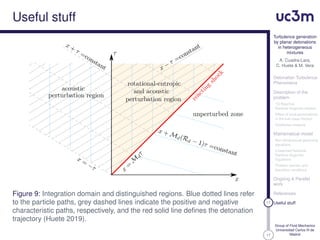
Useful stuff
Figure 9: Integration domain and distinguished regions. Blue dotted lines refer
to the particle paths, grey dashed lines indicate the positive and negative
characteristic paths, respectively, and the red solid line defines the detonation
trajectory (Huete 2019).

Slides Workshop on Fluid Dynamics 2019

  • 1.
    Turbulence generation byplanar detonations in heterogeneous mixtures Workshop on Fluid Dynamics 2019 A- Cuadra-Lara* , C. Huete & M. Vera *acuadra@ing.uc3m.es Group of Fluid Mechanics Universidad Carlos III de Madrid Granada, Spain | July 23, 2019
  • 2.
    17 Turbulence generation by planardetonations in heterogeneous mixtures A. Cuadra-Lara, C. Huete & M. Vera Detonation Turbulence Phenomena Description of the problem 1D Reactive Rankine-Hugoniot relation Effect of local perturbations in the fuel mass fraction Qualitative analysis Mathematical model Non-dimensional governing equations Linearized Reactive Rankine-Hugoniot Equations Problem domain and boundary conditions Ongoing & Parallel work References Useful stuff Group of Fluid Mechanics Universidad Carlos III de Madrid Outline Detonation Turbulence Phenomena Description of the problem 1D Reactive Rankine-Hugoniot relation Effect of local perturbations in the fuel mass fraction Qualitative analysis Mathematical model Non-dimensional governing equations Linearized Reactive Rankine-Hugoniot Equations Problem domain and boundary conditions Ongoing & Parallel work References Useful stuff
  • 3.
    17 Turbulence generation by planardetonations in heterogeneous mixtures A. Cuadra-Lara, C. Huete & M. Vera 2 Detonation Turbulence Phenomena Description of the problem 1D Reactive Rankine-Hugoniot relation Effect of local perturbations in the fuel mass fraction Qualitative analysis Mathematical model Non-dimensional governing equations Linearized Reactive Rankine-Hugoniot Equations Problem domain and boundary conditions Ongoing & Parallel work References Useful stuff Group of Fluid Mechanics Universidad Carlos III de Madrid Detonation Turbulence Phenomena Here we are dealing with two diferent phenomena which are, independently, very complex to model: Detonations & Turbulence. Therefore, strong simplifications must be done in order to get an analytically tractable problem Detonation: planar and stable. Turbulence: weak, homogeneous and isotropic1. Figure 1: Instantaneous vorticity patterns for NR, RU, RS1, and RS2 obtained at the cut plane yt = (6.61π)/2. Black contour lines on the reactive cases correspond to the isolines of nearly complete depletion of reactant Y = 0.01 (Huete 2017). 1G. Keith Batchelor. The theory of homogeneous turbulence. Cambridge university press, 1953.
  • 4.
    17 Turbulence generation by planardetonations in heterogeneous mixtures A. Cuadra-Lara, C. Huete & M. Vera Detonation Turbulence Phenomena 3 Description of the problem 1D Reactive Rankine-Hugoniot relation Effect of local perturbations in the fuel mass fraction Qualitative analysis Mathematical model Non-dimensional governing equations Linearized Reactive Rankine-Hugoniot Equations Problem domain and boundary conditions Ongoing & Parallel work References Useful stuff Group of Fluid Mechanics Universidad Carlos III de Madrid Description of the problem Definitions density: ρ = ρo 1 + W ˆY , (1) heat release: q = qo 1 + H ˆY , (2) mixture ratio: W = 1 − Wair Wfuel Yfuel + Wair Wfuel (1 − Yfuel ) . (3) constructive desctructive non-effect ρ δρ δρ ≈ 0 Heavy fuels Light fuels Yfuel (a) Yst q Lean δq Rich Yfuel (b) Figure 2: Variation of mixture density (a) and heat release (b) with the fuel mass fraction and the equivalence ratio.
  • 5.
    17 Turbulence generation by planardetonations in heterogeneous mixtures A. Cuadra-Lara, C. Huete & M. Vera Detonation Turbulence Phenomena 4 Description of the problem 1D Reactive Rankine-Hugoniot relation Effect of local perturbations in the fuel mass fraction Qualitative analysis Mathematical model Non-dimensional governing equations Linearized Reactive Rankine-Hugoniot Equations Problem domain and boundary conditions Ongoing & Parallel work References Useful stuff Group of Fluid Mechanics Universidad Carlos III de Madrid Description of the problem Burnt gas homogeneous uniform flow Fresh mixture homogeneous uniform flow l reaction layer y x ρd , pd , Td , ud ρo, po, To, uo Figure 3: Sketch of the planar detonation front, where l is the thickness of the reaction layer. Reference frame moving with the shock surface.
  • 6.
    17 Turbulence generation by planardetonations in heterogeneous mixtures A. Cuadra-Lara, C. Huete & M. Vera Detonation Turbulence Phenomena Description of the problem 5 1D Reactive Rankine-Hugoniot relation Effect of local perturbations in the fuel mass fraction Qualitative analysis Mathematical model Non-dimensional governing equations Linearized Reactive Rankine-Hugoniot Equations Problem domain and boundary conditions Ongoing & Parallel work References Useful stuff Group of Fluid Mechanics Universidad Carlos III de Madrid Description of the problem 1D Reactive Rankine-Hugoniot relation ρ δρ δρ ≈ 0 Heavy fuels Light fuels Yfuel Yst q Lean δq Rich Yfuel constructive desctructive non-effect 1 1 pd po = (γ+1)ρd −(γ−1)ρo+2(γ−1)ρd ρoq/po (γ+1)ρo−(γ−1)ρd ρo ρd pd po Figure 4: Perturbations on the Rankine-Hugoniot relation.
  • 7.
    17 Turbulence generation by planardetonations in heterogeneous mixtures A. Cuadra-Lara, C. Huete & M. Vera Detonation Turbulence Phenomena Description of the problem 5 1D Reactive Rankine-Hugoniot relation Effect of local perturbations in the fuel mass fraction Qualitative analysis Mathematical model Non-dimensional governing equations Linearized Reactive Rankine-Hugoniot Equations Problem domain and boundary conditions Ongoing & Parallel work References Useful stuff Group of Fluid Mechanics Universidad Carlos III de Madrid Description of the problem 1D Reactive Rankine-Hugoniot relation ρ δρ δρ ≈ 0 Heavy fuels Light fuels Yfuel Yst q Lean δq Rich Yfuel constructive desctructive non-effect 1 1 pd po = (γ+1)ρd −(γ−1)ρo+2(γ−1)ρd ρoq/po (γ+1)ρo−(γ−1)ρd ρo ρd pd po Figure 4: Perturbations on the Rankine-Hugoniot relation.
  • 8.
    17 Turbulence generation by planardetonations in heterogeneous mixtures A. Cuadra-Lara, C. Huete & M. Vera Detonation Turbulence Phenomena Description of the problem 5 1D Reactive Rankine-Hugoniot relation Effect of local perturbations in the fuel mass fraction Qualitative analysis Mathematical model Non-dimensional governing equations Linearized Reactive Rankine-Hugoniot Equations Problem domain and boundary conditions Ongoing & Parallel work References Useful stuff Group of Fluid Mechanics Universidad Carlos III de Madrid Description of the problem 1D Reactive Rankine-Hugoniot relation ρ δρ δρ ≈ 0 Heavy fuels Light fuels Yfuel Yst q Lean δq Rich Yfuel constructive desctructive non-effect 1 1 pd po = (γ+1)ρd −(γ−1)ρo+2(γ−1)ρd ρoq/po (γ+1)ρo−(γ−1)ρd ρo ρd pd po Figure 4: Perturbations on the Rankine-Hugoniot relation.
  • 9.
    17 Turbulence generation by planardetonations in heterogeneous mixtures A. Cuadra-Lara, C. Huete & M. Vera Detonation Turbulence Phenomena Description of the problem 5 1D Reactive Rankine-Hugoniot relation Effect of local perturbations in the fuel mass fraction Qualitative analysis Mathematical model Non-dimensional governing equations Linearized Reactive Rankine-Hugoniot Equations Problem domain and boundary conditions Ongoing & Parallel work References Useful stuff Group of Fluid Mechanics Universidad Carlos III de Madrid Description of the problem 1D Reactive Rankine-Hugoniot relation ρ δρ δρ ≈ 0 Heavy fuels Light fuels Yfuel Yst q Lean δq Rich Yfuel constructive desctructive non-effect 1 1 pd po = (γ+1)ρd −(γ−1)ρo+2(γ−1)ρd ρoq/po (γ+1)ρo−(γ−1)ρd ρo ρd pd po Figure 4: Perturbations on the Rankine-Hugoniot relation.
  • 10.
    17 Turbulence generation by planardetonations in heterogeneous mixtures A. Cuadra-Lara, C. Huete & M. Vera Detonation Turbulence Phenomena Description of the problem 1D Reactive Rankine-Hugoniot relation 6 Effect of local perturbations in the fuel mass fraction Qualitative analysis Mathematical model Non-dimensional governing equations Linearized Reactive Rankine-Hugoniot Equations Problem domain and boundary conditions Ongoing & Parallel work References Useful stuff Group of Fluid Mechanics Universidad Carlos III de Madrid Description of the problem Effect of local perturbations in the Fuel mass fraction Non-uniform burnt gas (behind) Fresh gas heterogeneous mixture (ahead) δY ψd l reaction layer y x ρd (x, t), pd (x, t), Td (x, t), ud (x, t) vd (x, t) ρo, po, To, uo, Y = Yo (1 + δY) , λ Figure 5: Sketch of the corrugated detonation front, where ψd is the amplitude of the detonation shape deviations respect to the planar shape, and must satisfy l ψd0 λ. Reference frame moving with the shock surface.
  • 11.
    17 Turbulence generation by planardetonations in heterogeneous mixtures A. Cuadra-Lara, C. Huete & M. Vera Detonation Turbulence Phenomena Description of the problem 1D Reactive Rankine-Hugoniot relation Effect of local perturbations in the fuel mass fraction 7 Qualitative analysis Mathematical model Non-dimensional governing equations Linearized Reactive Rankine-Hugoniot Equations Problem domain and boundary conditions Ongoing & Parallel work References Useful stuff Group of Fluid Mechanics Universidad Carlos III de Madrid Description of the problem Qualitative analysis ρ q ρ δρ δρ ≈ 0 Heavy fuels Light fuels Yfuel Yst q Lean δq Rich Yfuel constructive desctructive non-effect Figure 6: Qualitative analysis between the heat release and the mixture density.
  • 12.
    17 Turbulence generation by planardetonations in heterogeneous mixtures A. Cuadra-Lara, C. Huete & M. Vera Detonation Turbulence Phenomena Description of the problem 1D Reactive Rankine-Hugoniot relation Effect of local perturbations in the fuel mass fraction Qualitative analysis 8 Mathematical model Non-dimensional governing equations Linearized Reactive Rankine-Hugoniot Equations Problem domain and boundary conditions Ongoing & Parallel work References Useful stuff Group of Fluid Mechanics Universidad Carlos III de Madrid Mathematical model Assumptions Perfect gases.
  • 13.
    17 Turbulence generation by planardetonations in heterogeneous mixtures A. Cuadra-Lara, C. Huete & M. Vera Detonation Turbulence Phenomena Description of the problem 1D Reactive Rankine-Hugoniot relation Effect of local perturbations in the fuel mass fraction Qualitative analysis 8 Mathematical model Non-dimensional governing equations Linearized Reactive Rankine-Hugoniot Equations Problem domain and boundary conditions Ongoing & Parallel work References Useful stuff Group of Fluid Mechanics Universidad Carlos III de Madrid Mathematical model Assumptions Perfect gases. Thin detonation limit: The detonation wave is treated as a pure discontinuity2. Infinitely fast chemistry, Da 1 in order to satisfy l ξ. 2C. Huete et al. Physics of Fluids, 25:076105,2013.
  • 14.
    17 Turbulence generation by planardetonations in heterogeneous mixtures A. Cuadra-Lara, C. Huete & M. Vera Detonation Turbulence Phenomena Description of the problem 1D Reactive Rankine-Hugoniot relation Effect of local perturbations in the fuel mass fraction Qualitative analysis 8 Mathematical model Non-dimensional governing equations Linearized Reactive Rankine-Hugoniot Equations Problem domain and boundary conditions Ongoing & Parallel work References Useful stuff Group of Fluid Mechanics Universidad Carlos III de Madrid Mathematical model Assumptions Perfect gases. Thin detonation limit: The detonation wave is treated as a pure discontinuity2. Infinitely fast chemistry, Da 1 in order to satisfy l ξ. Thick detonation limit: The size of the perturbations is much smaller than the detonation thickness3. Linear theory, ˙ξ λ. 2C. Huete et al. Physics of Fluids, 25:076105,2013. 3C. Huete et al. Physics of Fluids, 26:116101, 2014.
  • 15.
    17 Turbulence generation by planardetonations in heterogeneous mixtures A. Cuadra-Lara, C. Huete & M. Vera Detonation Turbulence Phenomena Description of the problem 1D Reactive Rankine-Hugoniot relation Effect of local perturbations in the fuel mass fraction Qualitative analysis 8 Mathematical model Non-dimensional governing equations Linearized Reactive Rankine-Hugoniot Equations Problem domain and boundary conditions Ongoing & Parallel work References Useful stuff Group of Fluid Mechanics Universidad Carlos III de Madrid Mathematical model Assumptions Perfect gases. Thin detonation limit: The detonation wave is treated as a pure discontinuity2. Infinitely fast chemistry, Da 1 in order to satisfy l ξ. Thick detonation limit: The size of the perturbations is much smaller than the detonation thickness3. Linear theory, ˙ξ λ. Isotropic probability density function (analysis of all the spectrum). 2C. Huete et al. Physics of Fluids, 25:076105,2013. 3C. Huete et al. Physics of Fluids, 26:116101, 2014.
  • 16.
    17 Turbulence generation by planardetonations in heterogeneous mixtures A. Cuadra-Lara, C. Huete & M. Vera Detonation Turbulence Phenomena Description of the problem 1D Reactive Rankine-Hugoniot relation Effect of local perturbations in the fuel mass fraction Qualitative analysis 8 Mathematical model Non-dimensional governing equations Linearized Reactive Rankine-Hugoniot Equations Problem domain and boundary conditions Ongoing & Parallel work References Useful stuff Group of Fluid Mechanics Universidad Carlos III de Madrid Mathematical model Assumptions Perfect gases. Thin detonation limit: The detonation wave is treated as a pure discontinuity2. Infinitely fast chemistry, Da 1 in order to satisfy l ξ. Thick detonation limit: The size of the perturbations is much smaller than the detonation thickness3. Linear theory, ˙ξ λ. Isotropic probability density function (analysis of all the spectrum). The functions of interest are perturbed, namely ˆp(ˆx, τ) = ˆρa(ˆx, τ) = Pei(ˆωτ−ˆkˆx) eiˆy , (4) ˆρ(ˆx, τ) = ˆρa + ˆρe, (5) ˆu(ˆx, τ) = ˆua + ˆur , (6) ˆv(ˆx, τ) = ˆva + ˆvr , (7) for the pressure, density, longitudinal velocity and transverse velocity, respectively. 2C. Huete et al. Physics of Fluids, 25:076105,2013. 3C. Huete et al. Physics of Fluids, 26:116101, 2014.
  • 17.
    17 Turbulence generation by planardetonations in heterogeneous mixtures A. Cuadra-Lara, C. Huete & M. Vera Detonation Turbulence Phenomena Description of the problem 1D Reactive Rankine-Hugoniot relation Effect of local perturbations in the fuel mass fraction Qualitative analysis Mathematical model 9 Non-dimensional governing equations Linearized Reactive Rankine-Hugoniot Equations Problem domain and boundary conditions Ongoing & Parallel work References Useful stuff Group of Fluid Mechanics Universidad Carlos III de Madrid Mathematical model Non-dimensional governing equations Non-dimensional compressible Euler equations: ∂ ˆρ ∂τ + ∂ˆu ∂ˆx + ∂ˆv ∂ˆy = 0, (8a) ∂ˆu ∂τ + ∂ˆp ∂ˆx = 0, (8b) ∂ˆv ∂τ + ∂ˆp ∂ˆy = 0, (8c) ∂ˆp ∂τ − ∂ ˆρ ∂τ = 0, (8d) can be linearly manipulated to give: ∂2ˆp ∂τ2 = ∂2ˆp ∂ˆx2 + ∂2ˆp ∂ˆy2 . (9)
  • 18.
    17 Turbulence generation by planardetonations in heterogeneous mixtures A. Cuadra-Lara, C. Huete & M. Vera Detonation Turbulence Phenomena Description of the problem 1D Reactive Rankine-Hugoniot relation Effect of local perturbations in the fuel mass fraction Qualitative analysis Mathematical model 9 Non-dimensional governing equations Linearized Reactive Rankine-Hugoniot Equations Problem domain and boundary conditions Ongoing & Parallel work References Useful stuff Group of Fluid Mechanics Universidad Carlos III de Madrid Mathematical model Non-dimensional governing equations Non-dimensional compressible Euler equations + periodically symmetric condition: ∂ ˆρ ∂τ + ∂ˆu ∂ˆx + ˆv = 0, (8a) ∂ˆu ∂τ + ∂ˆp ∂ˆx = 0, (8b) ∂ˆv ∂τ − ˆp = 0, (8c) ∂ˆp ∂τ − ∂ ˆρ ∂τ = 0, (8d) Two-dimensional periodically symmetric wave equation for the burnt gas: ∂2ˆp ∂τ2 = ∂2ˆp ∂ˆx2 − ˆp. (9)
  • 19.
    17 Turbulence generation by planardetonations in heterogeneous mixtures A. Cuadra-Lara, C. Huete & M. Vera Detonation Turbulence Phenomena Description of the problem 1D Reactive Rankine-Hugoniot relation Effect of local perturbations in the fuel mass fraction Qualitative analysis Mathematical model Non-dimensional governing equations 10 Linearized Reactive Rankine-Hugoniot Equations Problem domain and boundary conditions Ongoing & Parallel work References Useful stuff Group of Fluid Mechanics Universidad Carlos III de Madrid Mathematical model Linearized Rankine-Hugoniot Equations The perturbations behind the shock (one of the boundary conditions) are given by the linearized Rankine Hugoniot equations Dξd Dτ = Rd Rd − 1 1 + Γd 2Md ˆpd + Md 2 (W (2 − Rd ) − ∆d ) Md 2 ˆY , (10a) ˆud = 1 + Γd 2Md ˆpd + Md 2 (∆d − Rd W) ˆY, (10b) ˆvd = Md (Rd − 1) ∂ξd ∂ˆy , (10c) ˆρd = Γd M2 d ˆpd + ∆d ˆY, (10d) where ξd is the dimensionless shock ripple amplitude, and Γd and ∆d are the Rankine-Hugoniot slope and the heat release contribution, both downstream, respectively.
  • 20.
    17 Turbulence generation by planardetonations in heterogeneous mixtures A. Cuadra-Lara, C. Huete & M. Vera Detonation Turbulence Phenomena Description of the problem 1D Reactive Rankine-Hugoniot relation Effect of local perturbations in the fuel mass fraction Qualitative analysis Mathematical model Non-dimensional governing equations 11 Linearized Reactive Rankine-Hugoniot Equations Problem domain and boundary conditions Ongoing & Parallel work References Useful stuff Group of Fluid Mechanics Universidad Carlos III de Madrid Mathematical model Linearized Rankine-Hugoniot Equations Combining RH-equations with conservation equations we get: a1 ∂2ˆpd ∂τ2 + a2 ∂2ˆpd ∂τ∂ˆx + a3 ∂2ˆpd ∂ˆx2 + a4 ∂2ˆpd ∂ˆy2 = f( ˆωs), (11) where a1, a2, a3, and a4 are constants, and f( ˆωs) is a function that depends of the shock frequency.
  • 21.
    17 Turbulence generation by planardetonations in heterogeneous mixtures A. Cuadra-Lara, C. Huete & M. Vera Detonation Turbulence Phenomena Description of the problem 1D Reactive Rankine-Hugoniot relation Effect of local perturbations in the fuel mass fraction Qualitative analysis Mathematical model Non-dimensional governing equations 11 Linearized Reactive Rankine-Hugoniot Equations Problem domain and boundary conditions Ongoing & Parallel work References Useful stuff Group of Fluid Mechanics Universidad Carlos III de Madrid Mathematical model Linearized Rankine-Hugoniot Equations Combining RH-equations with conservation equations we get: a1 ∂2ˆpd ∂τ2 + a2 ∂2ˆpd ∂τ∂ˆx + a3 ∂2ˆpd ∂ˆx2 + a4 ∂2ˆpd ∂ˆy2 = f( ˆωs), (11) where a1, a2, a3, and a4 are constants, and f( ˆωs) is a function that depends of the shock frequency. Assuming ˆp = Pei(ˆωτ−ˆkˆx) , (12) which satisfy the wave equation (9), and in order to apply normal modes ˆYs = ei( ˆωsτ+ˆy) , (13) which gives ˆω2 = ˆk2 + 1, (14) ˆωs = ˆω − ˆkMd , (15) where ˆω and ˆωs are the dimensionless frequency and the dimensionless shock frequency, respectively.
  • 22.
    17 Turbulence generation by planardetonations in heterogeneous mixtures A. Cuadra-Lara, C. Huete & M. Vera Detonation Turbulence Phenomena Description of the problem 1D Reactive Rankine-Hugoniot relation Effect of local perturbations in the fuel mass fraction Qualitative analysis Mathematical model Non-dimensional governing equations 12 Linearized Reactive Rankine-Hugoniot Equations Problem domain and boundary conditions Ongoing & Parallel work References Useful stuff Group of Fluid Mechanics Universidad Carlos III de Madrid Mathematical model Linearized Rankine-Hugoniot Equations Dispersion relation: −ˆω2 s σb − ˆωs ˆω2 s + M2 d − 1 − M2 d (Rd − 1) σa Pei(ˆωsτ) = f(ˆωs)ei ˆωsτ , (16)
  • 23.
    17 Turbulence generation by planardetonations in heterogeneous mixtures A. Cuadra-Lara, C. Huete & M. Vera Detonation Turbulence Phenomena Description of the problem 1D Reactive Rankine-Hugoniot relation Effect of local perturbations in the fuel mass fraction Qualitative analysis Mathematical model Non-dimensional governing equations 12 Linearized Reactive Rankine-Hugoniot Equations Problem domain and boundary conditions Ongoing & Parallel work References Useful stuff Group of Fluid Mechanics Universidad Carlos III de Madrid Mathematical model Linearized Rankine-Hugoniot Equations Dispersion relation: −ˆω2 s σb − ˆωs ˆω2 s + M2 d − 1 − M2 d (Rd − 1) σa Pei(ˆωsτ) = f(ˆωs)ei ˆωsτ , (16) ζσb + ζ ζ2 − 1 1 − M2 d −1/2 − σc Pei ˆωsτ = f∗ (ˆωs)ei ˆωsτ , (17) with ζ = ˆωs 1 − M2 d . (18)
  • 24.
    17 Turbulence generation by planardetonations in heterogeneous mixtures A. Cuadra-Lara, C. Huete & M. Vera Detonation Turbulence Phenomena Description of the problem 1D Reactive Rankine-Hugoniot relation Effect of local perturbations in the fuel mass fraction Qualitative analysis Mathematical model Non-dimensional governing equations 12 Linearized Reactive Rankine-Hugoniot Equations Problem domain and boundary conditions Ongoing & Parallel work References Useful stuff Group of Fluid Mechanics Universidad Carlos III de Madrid Mathematical model Linearized Rankine-Hugoniot Equations Dispersion relation: −ˆω2 s σb − ˆωs ˆω2 s + M2 d − 1 − M2 d (Rd − 1) σa Pei(ˆωsτ) = f(ˆωs)ei ˆωsτ , (16) ζσb + ζ ζ2 − 1 1 − M2 d −1/2 − σc Pei ˆωsτ = f∗ (ˆωs)ei ˆωsτ , (17) with ζ = ˆωs 1 − M2 d . (18) ζ > 1: P = f∗(ˆωs) ζσb + ζ ζ2 − 1 1 − M2 d −1/2 − σc . (19)
  • 25.
    17 Turbulence generation by planardetonations in heterogeneous mixtures A. Cuadra-Lara, C. Huete & M. Vera Detonation Turbulence Phenomena Description of the problem 1D Reactive Rankine-Hugoniot relation Effect of local perturbations in the fuel mass fraction Qualitative analysis Mathematical model Non-dimensional governing equations 12 Linearized Reactive Rankine-Hugoniot Equations Problem domain and boundary conditions Ongoing & Parallel work References Useful stuff Group of Fluid Mechanics Universidad Carlos III de Madrid Mathematical model Linearized Rankine-Hugoniot Equations Dispersion relation: −ˆω2 s σb − ˆωs ˆω2 s + M2 d − 1 − M2 d (Rd − 1) σa Pei(ˆωsτ) = f(ˆωs)ei ˆωsτ , (16) ζσb + ζ ζ2 − 1 1 − M2 d −1/2 − σc Pei ˆωsτ = f∗ (ˆωs)ei ˆωsτ , (17) with ζ = ˆωs 1 − M2 d . (18) ζ > 1: P = f∗(ˆωs) ζσb + ζ ζ2 − 1 1 − M2 d −1/2 − σc . (19) ζ < 1: Re Pei ˆωsτ = a cos(ˆωsτ) + sin(ˆωsτ). (20)
  • 26.
    17 Turbulence generation by planardetonations in heterogeneous mixtures A. Cuadra-Lara, C. Huete & M. Vera Detonation Turbulence Phenomena Description of the problem 1D Reactive Rankine-Hugoniot relation Effect of local perturbations in the fuel mass fraction Qualitative analysis Mathematical model Non-dimensional governing equations Linearized Reactive Rankine-Hugoniot Equations 13 Problem domain and boundary conditions Ongoing & Parallel work References Useful stuff Group of Fluid Mechanics Universidad Carlos III de Madrid Mathematical model Problem domain and boundary conditions ˆx = Md τˆx = −τ Linearized R-H eqs. Isolated detonation unperturbed zone acoustic perturbation zone Euler eqs. reacting shock ˆy ˆx Figure 7: Problem domain and boundary conditions. Reference frame moving with the burnt gas.
  • 27.
    17 Turbulence generation by planardetonations in heterogeneous mixtures A. Cuadra-Lara, C. Huete & M. Vera Detonation Turbulence Phenomena Description of the problem 1D Reactive Rankine-Hugoniot relation Effect of local perturbations in the fuel mass fraction Qualitative analysis Mathematical model Non-dimensional governing equations Linearized Reactive Rankine-Hugoniot Equations Problem domain and boundary conditions 14 Ongoing & Parallel work References Useful stuff Group of Fluid Mechanics Universidad Carlos III de Madrid Ongoing work Downstream averages (Velikovich, 2012). Superposition of the modes (linear theory). Transfer function ρ k Characterize the turbulence generated by a given dispersion relationship in the heterogenous mixture. Evaluate how the propagation velocity and average values downstream are affected with respect to the homogenous case. Multiphase (droplets and high energy materials).
  • 28.
    17 Turbulence generation by planardetonations in heterogeneous mixtures A. Cuadra-Lara, C. Huete & M. Vera Detonation Turbulence Phenomena Description of the problem 1D Reactive Rankine-Hugoniot relation Effect of local perturbations in the fuel mass fraction Qualitative analysis Mathematical model Non-dimensional governing equations Linearized Reactive Rankine-Hugoniot Equations Problem domain and boundary conditions 15 Ongoing & Parallel work References Useful stuff Group of Fluid Mechanics Universidad Carlos III de Madrid Parallel work Development and validation of a new MATLAB R /GUI based thermochemi- cal code, A. Cuadra-Lara & M. Vera. Figure 8: Current state of the GUI Combustion-Toolbox developed. 0.5 1 1.5 2 2.5 3 3.5 4 4.5 10 -15 10 -10 10 -5 10 0 Figure 4: Variation of molar fraction with equivalence ra- tio for lean to rich acetylene-air mixtures. Combustion- Toolbox (line) and CEA (diamond). Development and validation of a new MATLAB/GUI based thermochemical code Alberto Cuadra-Lara & Marcos Vera Department of Thermal and Fluids Engineering, University Carlos III of Madrid acuadra@ing.uc3m.es (ACL), marcos.vera@uc3m.es (MV) MSC11, 11th Mediterranean Combustion Symposium Tenerife, Spain | Jun 16-20 2019 Motivation In a wide range of applications involving chemically reacting flows, thermochemical calculations involving overall mass and energy balances with chemical equilibrium are enough to estimate the overall performance of the system. This is often deter- mined by magnitudes such as the adiabatic flame temperature or the equilibrium composition of the products. Thermochemical codes have been developed for this purpose dating back to the late 1940’s at the NACA Lewis Flight Propulsion Labo- ratory, with the initial aim of evaluating rocket performance of various potential pro- pellants. The use of thermochemical codes has been growing ever since, and today they are basic research tools both for combustion applications and in the analysis of the thermal decomposition of high-energy materials (HEMs), including deflagration and detonation conditions. Introduction As a first step towards the development of a wider-scope thermochemical tool, in this work we present a thermochemical code with application to gaseous combustion problems recently implemented by the authors in MATLAB R . The code solves six chemical equilibrium problems (TP, HP, SP, TV, EV and SV transformations; where T denotes temperature, P pressure, H enthalpy, S entropy, E internal energy and V volume), incident and reflected planar shock waves, as well as ideal detonations according to Chapman-Jouguet theory, assuming always ideal gases in all cases. The code computes the equilibrium composition using equilibrium constants rather than by minimization of the Gibbs–Helmholtz free energy, and employs NASA’s 9-coefficient polynomial fits to evaluate the thermodynamic properties. Along with the plain code, the new tool has been equipped with a Graphical User Interface (hereafter Combustion-Toolbox) developed in MATLAB R 2018 under AppDe- signer. Results computed with Combustion-Toolbox have been validated against, and are in good agreement with, NASA’s Chemical Equilibrium with Applications (CEA) pro- gram [1], CANTERA, and Caltech’s Shock and Detonation Toolbox [2]. Moreover, the time required for the computations is comparable to that of other existing codes. Combustion-Toolbox has teaching and research aspirations and will be distributed as open source package as soon as it has been fully tested. Combustion-Toolbox Available thermochemical transformations 1. TP: equilibrium composition at defined temperature and pressure. 2. HP: adiabatic temperature and composition at constant pressure. 3. SP: isentropic compression/expansion to a specified pressure. 4. TV: equilibrium composition at defined temperature and constant volume. 5. EV: adiabatic temperature and composition at constant volume. 6. SV: isentropic compression/expansion to a specified volume. 7. SHOCK I: planar incident shock wave at normal incidence. 8. SHOCK R: planar reflected shock wave at normal incidence. 9. DET: Chapman-Jouget detonation (CJ upper state). Database • Employs 9-coefficient polynomial fits to evaluate the thermodynamic properties from NASA’s thermodynamic database (2075 species) [3]. Features • The reactant mixture is specified by fuel-air mixture, equivalence ratio, and/or the number of moles (or mole fraction) of the different species, which can also have different temperature. • Parametric sweeps for different input parameters, such as the equivalence ratio φ. • Solves both complete and incomplete (i.e., dissociation) combustion problems. For incomplete combustion, the minor species present in the final equilibrium can be selected at will, with some preselected subsets already defined. • The equilibrium composition can be solved considering condensed species (graphite so far). • Can estimate thermal NOx for a given residence time. • Automatic plots of the product composition and thermodynamic properties as a function of the equivalence ratio φ. • Detailed results reported via the MATLAB R command window or an Excel file. • Personalized use and modification of the plain code and routines. • Easy access to all the results of a working session through an editable tree dia- gram. Algorithms • The equilibrium composition is computed using an iterative segregated solver that estimates first the minor species from suitable (nonlinear) equilibrium conditions and then corrects the major species to guarantee (linear) atom conservation. • The thermochemical transformations HP, SP, EV, and SV are computed using a Steffensen-Aitken root-finding algorithm which employs the iterative segregated solver. • Incident and reflected planar shock waves, as well as ideal detonations according to Chapman-Jouget theory, are computed using a Newton-Raphson root-finding algorithm as [4]. It also employs the iterative segregated solver. Figure 2: Current state of the GUI Combustion-Toolbox developed. Results In order to validate the model, Figure 3 shows the adiabatic flame temperature for different fuel-air mixtures initially at room temperature and pressure. Figure 4 shows the vari- ation of the molar fraction of the product species with the equivalence ratio for lean to rich acetylene-air mixtures, with φgr = 2 x − z x + y 4 − z 2 , (1) the theoretical starting value for soot formation, and x, y, z the number of moles of carbon, hydrogen and oxygen in the fuel molecule, respectively. Figure 5 shows some results (density, detonation velocity, temperature and pressure), ob- tained from a Chapman-Jouget detonation of a ethylene-air mixture. All the results are in good agreement with NASA’s Chemi- cal Equilibrium with Applications (CEA) program, CANTERA, and Caltech’s Shock and Detonation Toolbox. 0.5 1 1.5 2 2.5 3 3.5 4 4.5 1400 1600 1800 2000 2200 2400 2600 2800 C2H2 C6H6 Lean Rich Rich-Sooting Figure 3: Adiabatic flame temperature as a function of the equivalence ratio for different fuel-air mixtures: acetylene (C2H2), and benzene (C6H6). Combustion-Toolbox (line) and CEA (diamond). 0.6 0.8 1 1.2 1.4 1.6 1.8 2 2.05 2.1 0.6 0.8 1 1.2 1.4 1.6 1.8 2 2.02 2.04 2.06 2.08 2.1 (a) 0.5 1 1.5 1500 1600 1700 1800 1900 (b) 0.5 1 1.5 2000 2200 2400 2600 2800 3000 (c) 0.6 0.8 1 1.2 1.4 1.6 1.8 12 14 16 18 20 (d) Figure 5: Chapman-Jouget det- onation properties for an ethylene- air mixture initially at room tempera- ture and pressure as a function of the equivalence ratio: (a) density, (b) detonation velocity, (c) tempera- ture, (d) pressure. Results validated with CEA (NASA) and CANTERA with Caltech’s Shock and Detona- tion Toolbox. References [1] F. J. Zeleznik and S. Gordon. Calculation of complex chemical equilibria. Industrial & Engineering Chemistry, 60 (6):27–57, 1968. [2] S. Browne, J. Ziegler and J. E. Shepherd Shock and Detonation Toolbox. GALCIT-Explosion Dynamics Laboratory, Pasadena, CA, 2008. [3] B. J. McBride, M. J. Zehe and S. Gordon. NASA Glenn coefficients for calculating thermodynamic properties of individual species, 2002. [4] S. Browne, J. Ziegler and J. E. Shepherd. Numerical solution methods for shock and detonation jump conditions. Energy Conservation, 1 (w2), 2004.
  • 29.
    17 Turbulence generation by planardetonations in heterogeneous mixtures A. Cuadra-Lara, C. Huete & M. Vera Detonation Turbulence Phenomena Description of the problem 1D Reactive Rankine-Hugoniot relation Effect of local perturbations in the fuel mass fraction Qualitative analysis Mathematical model Non-dimensional governing equations Linearized Reactive Rankine-Hugoniot Equations Problem domain and boundary conditions Ongoing & Parallel work 16 References Useful stuff Group of Fluid Mechanics Universidad Carlos III de Madrid References [1] Lee, J. The Detonation Phenomenon. Cambridge University Press (2008). [2] Kailasanath, K. Review of propulsion applications of detonation waves. AIAA journal 38.9 (2000): 1698-1708. [3] Veyssiere, B., and B. A. Khasainov. Structure and multiplicity of detonation regimes in heterogeneous hybrid mixtures. Shock Waves 4.4 (1995): 171-186. [4] Kailasanath, K. Liquid-fueled detonations in tubes. Journal of Propulsion and Power 22.6 (2006): 1261-1268. [5] Watanabe, Hiroaki, et al. Numerical investigation on propagation behavior of gaseous detonation in water spray. Proceedings of the Combustion Institute 37.3 (2019): 3617-3626. [6] Velikovich, A. L., C. Huete, and J. G. Wouchuk. Effect of shock-generated turbulence on the Hugoniot jump conditions. Physical Review E 85.1 (2012): 016301. [7] Huete, César and Jin, Tai and Martínez-Ruiz, Daniel and Luo, Kun. Interaction of a planar reacting shock wave with an isotropic turbulent vorticity field. Physical Review E, 96.5 (2017): 053104.
  • 30.
    Thank you foryour attention!
  • 31.
    17 Turbulence generation by planardetonations in heterogeneous mixtures A. Cuadra-Lara, C. Huete & M. Vera Detonation Turbulence Phenomena Description of the problem 1D Reactive Rankine-Hugoniot relation Effect of local perturbations in the fuel mass fraction Qualitative analysis Mathematical model Non-dimensional governing equations Linearized Reactive Rankine-Hugoniot Equations Problem domain and boundary conditions Ongoing & Parallel work References 17 Useful stuff Group of Fluid Mechanics Universidad Carlos III de Madrid Useful stuff Figure 9: Integration domain and distinguished regions. Blue dotted lines refer to the particle paths, grey dashed lines indicate the positive and negative characteristic paths, respectively, and the red solid line defines the detonation trajectory (Huete 2019).