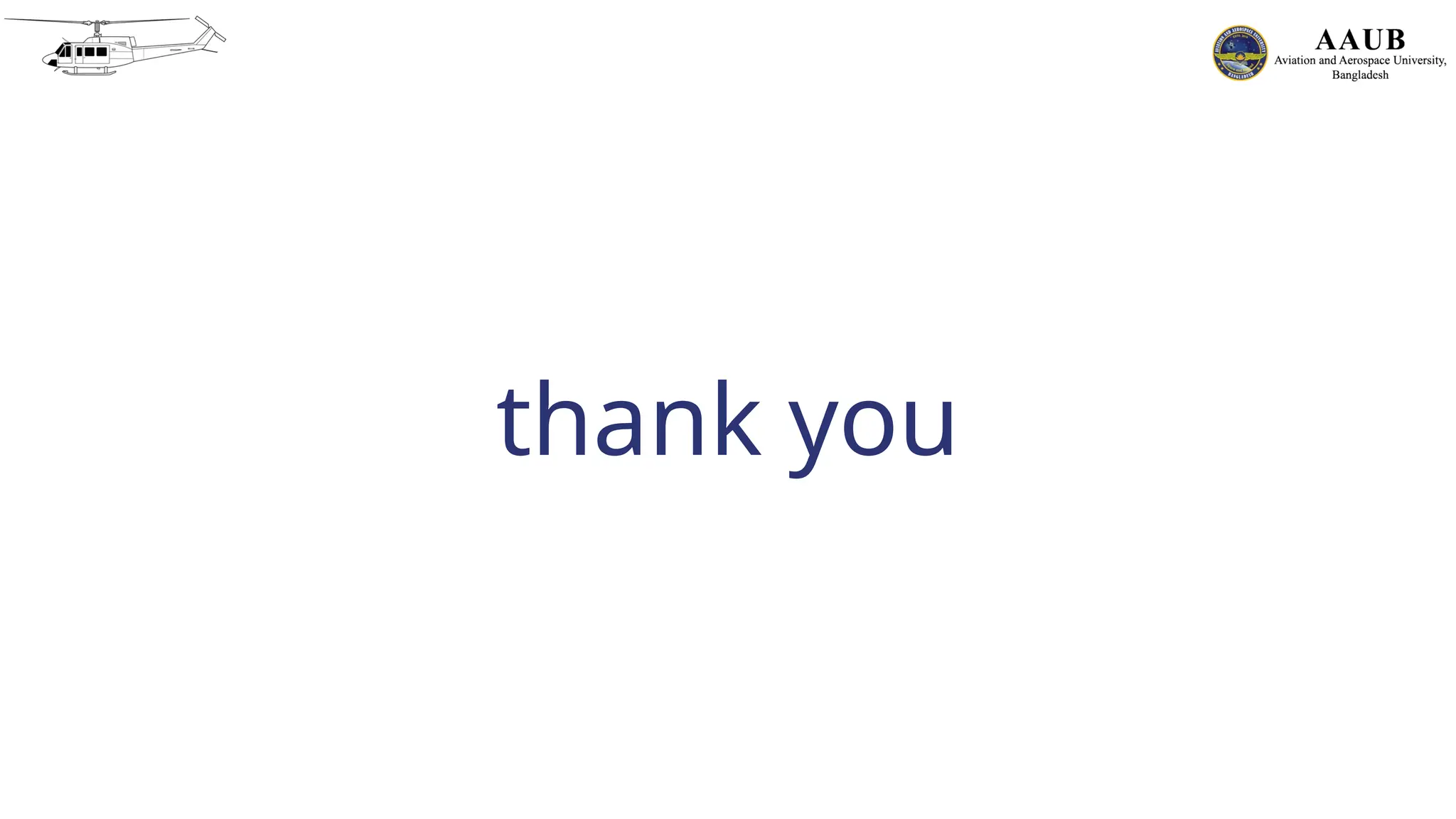
INDUSTRIAL TRAINING
BAF 208 & 216 MROU
1.Abu Salehin Ahmed (22014025)
2.Md. Samiullah Prodhan
(22014026)
3.Kawser Miah (22014028)
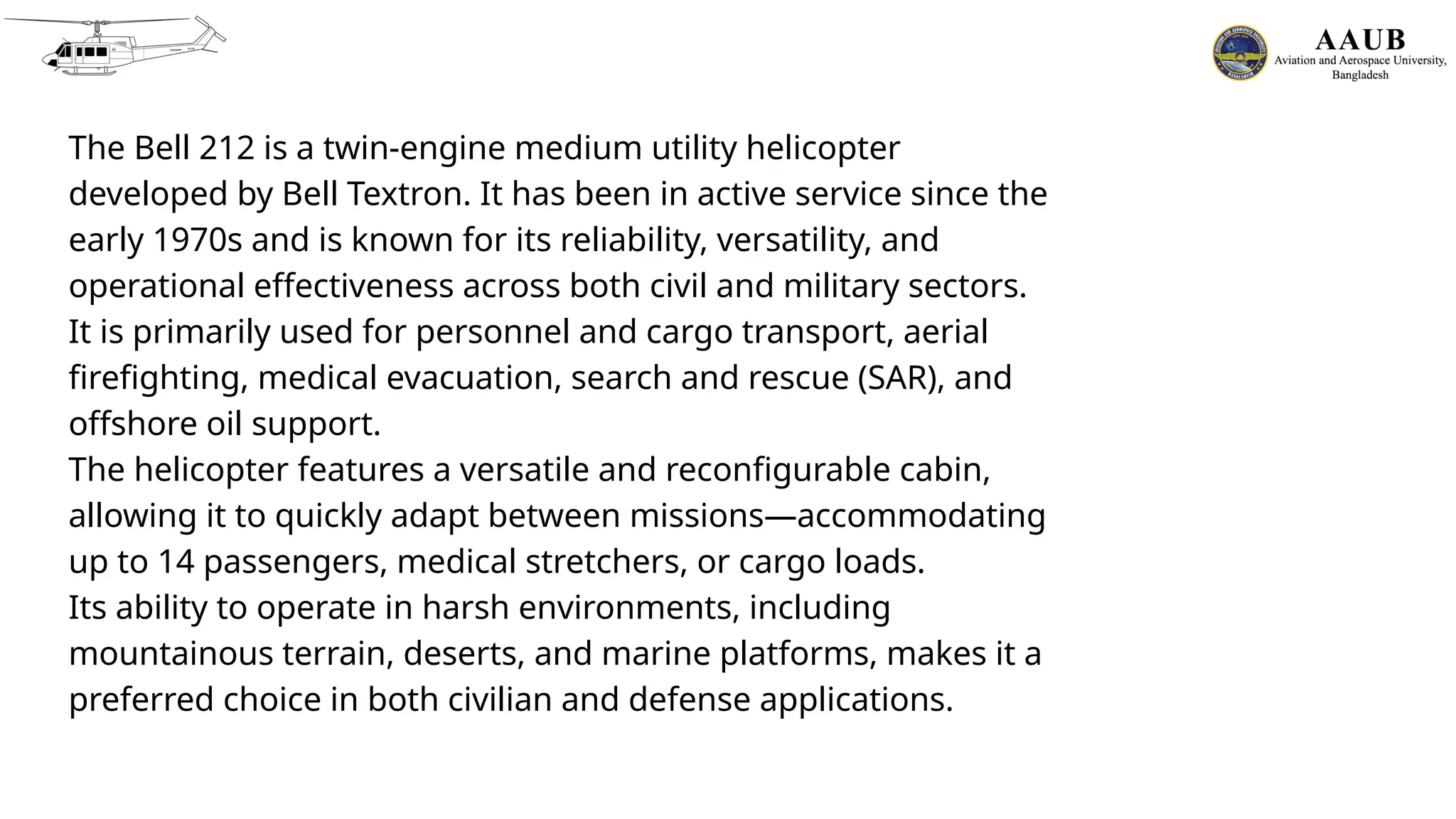
The Bell 212 is a twin-engine medium utility helicopter
developed by Bell Textron. It has been in active service since the
early 1970s and is known for its reliability, versatility, and
operational effectiveness across both civil and military sectors.
It is primarily used for personnel and cargo transport, aerial
firefighting, medical evacuation, search and rescue (SAR), and
offshore oil support.
The helicopter features a versatile and reconfigurable cabin,
allowing it to quickly adapt between missions—accommodating
up to 14 passengers, medical stretchers, or cargo loads.
Its ability to operate in harsh environments, including
mountainous terrain, deserts, and marine platforms, makes it a
preferred choice in both civilian and defense applications.
The airframe of the Bell 212 utilizes a semi-monocoque aluminum alloy fuselage,
offering strength with reduced structural weight. The structure incorporates two main
longitudinal I-beam spars, which efficiently carry the primary loads across the body.
The helicopter features a two-blade, semi-rigid main rotor system, mounted with
elastomeric bearings, minimizing maintenance requirements and enhancing reliability. A
two-blade tail rotor provides directional stability and anti-torque control.
Fixed skid-type landing gear is used for durability and quick deployment on unprepared
terrain. The twin turboshaft engines are mounted side-by-side above the cabin, driving a
single main transmission system that powers both the main and tail rotors.
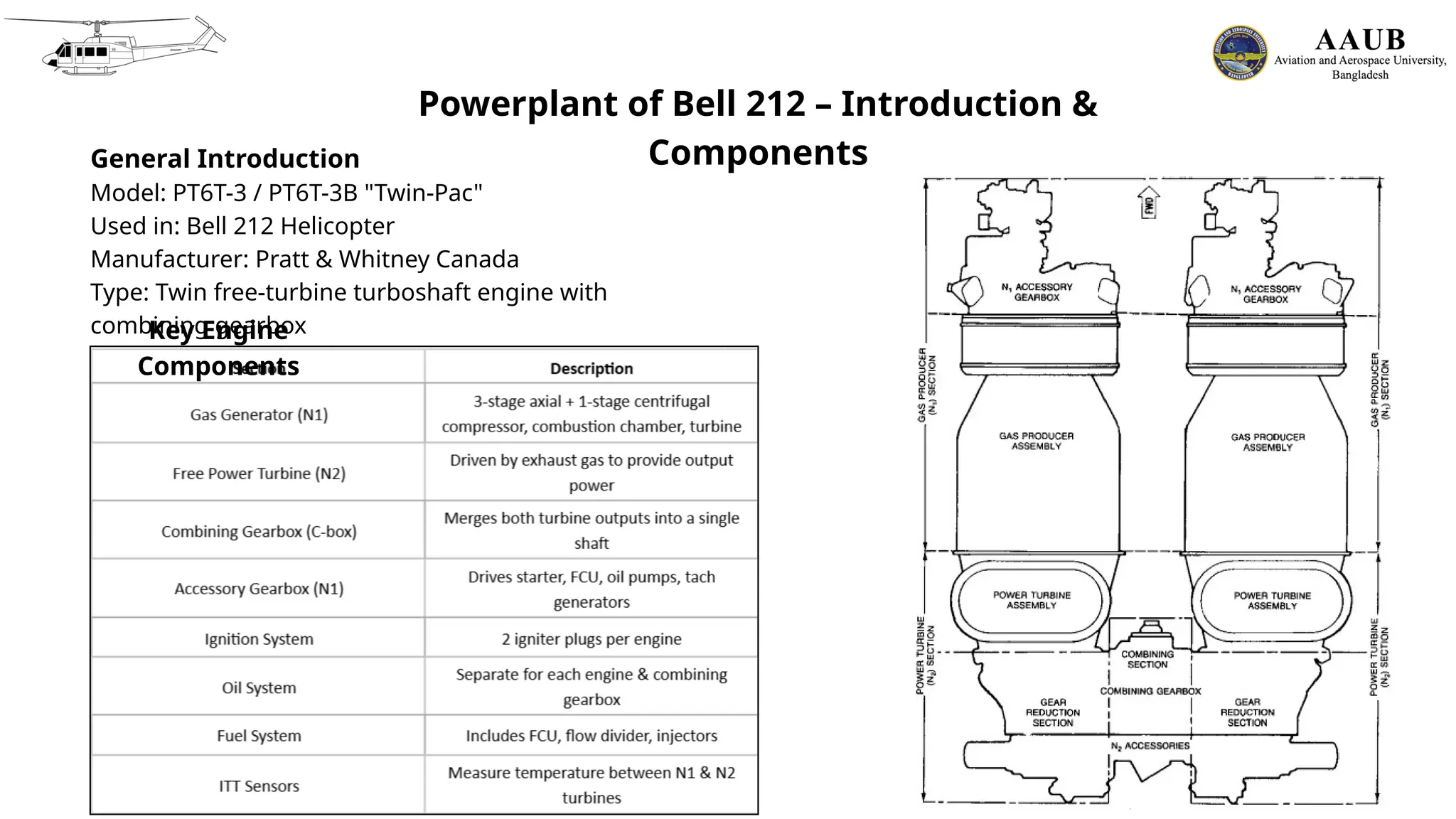
Powerplant of Bell 212 – Introduction &
Components
General Introduction
Model: PT6T-3 / PT6T-3B "Twin-Pac"
Used in: Bell 212 Helicopter
Manufacturer: Pratt & Whitney Canada
Type: Twin free-turbine turboshaft engine with
combining gearbox
Key Engine
Components
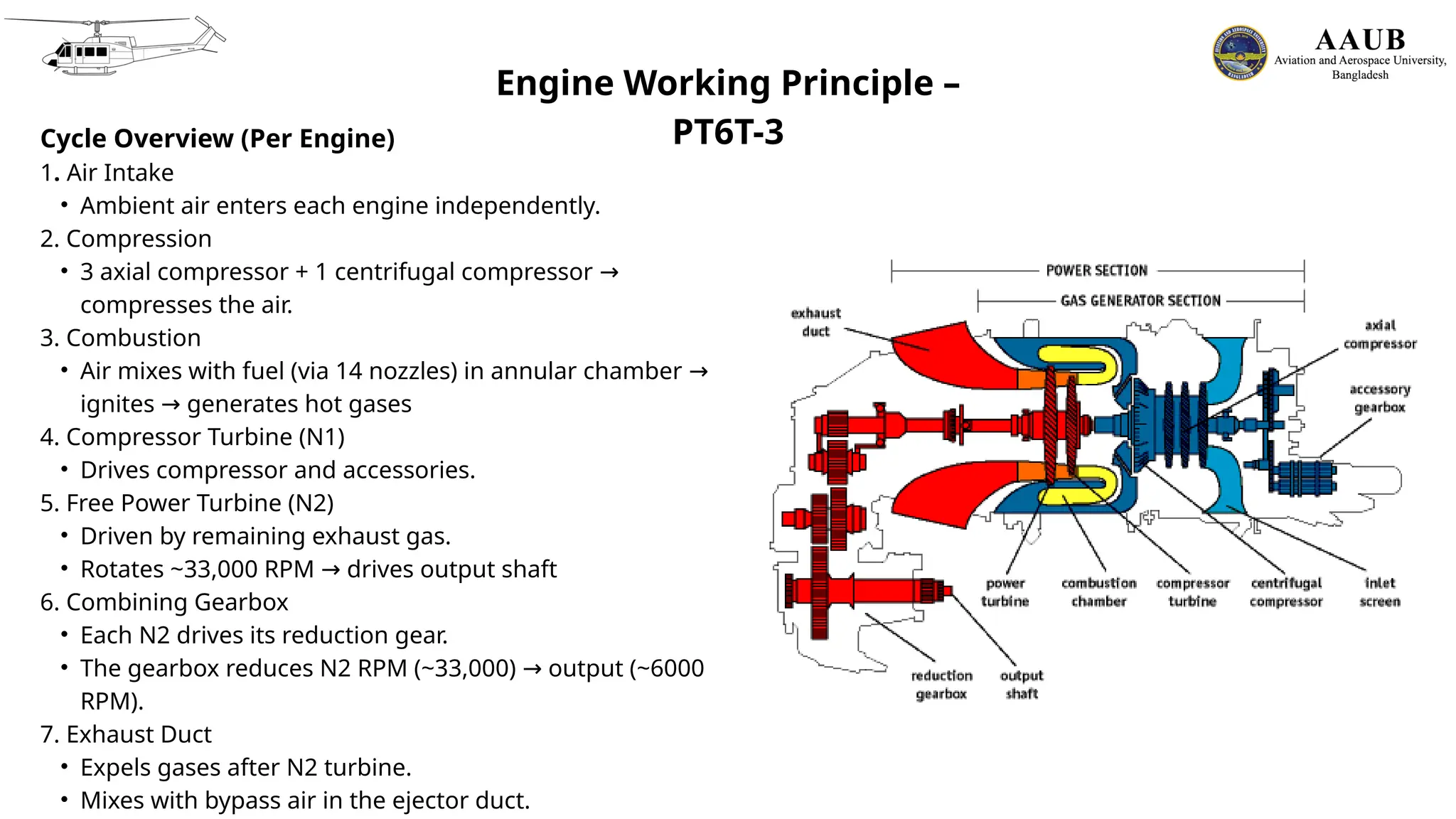
Engine Working Principle –
PT6T-3
Cycle Overview (Per Engine)
1. Air Intake
• Ambient air enters each engine independently.
2. Compression
• 3 axial compressor + 1 centrifugal compressor →
compresses the air.
3. Combustion
• Air mixes with fuel (via 14 nozzles) in annular chamber →
ignites generates hot gases
→
4. Compressor Turbine (N1)
• Drives compressor and accessories.
5. Free Power Turbine (N2)
• Driven by remaining exhaust gas.
• Rotates ~33,000 RPM drives output shaft
→
6. Combining Gearbox
• Each N2 drives its reduction gear.
• The gearbox reduces N2 RPM (~33,000) output (~6000
→
RPM).
7. Exhaust Duct
• Expels gases after N2 turbine.
• Mixes with bypass air in the ejector duct.
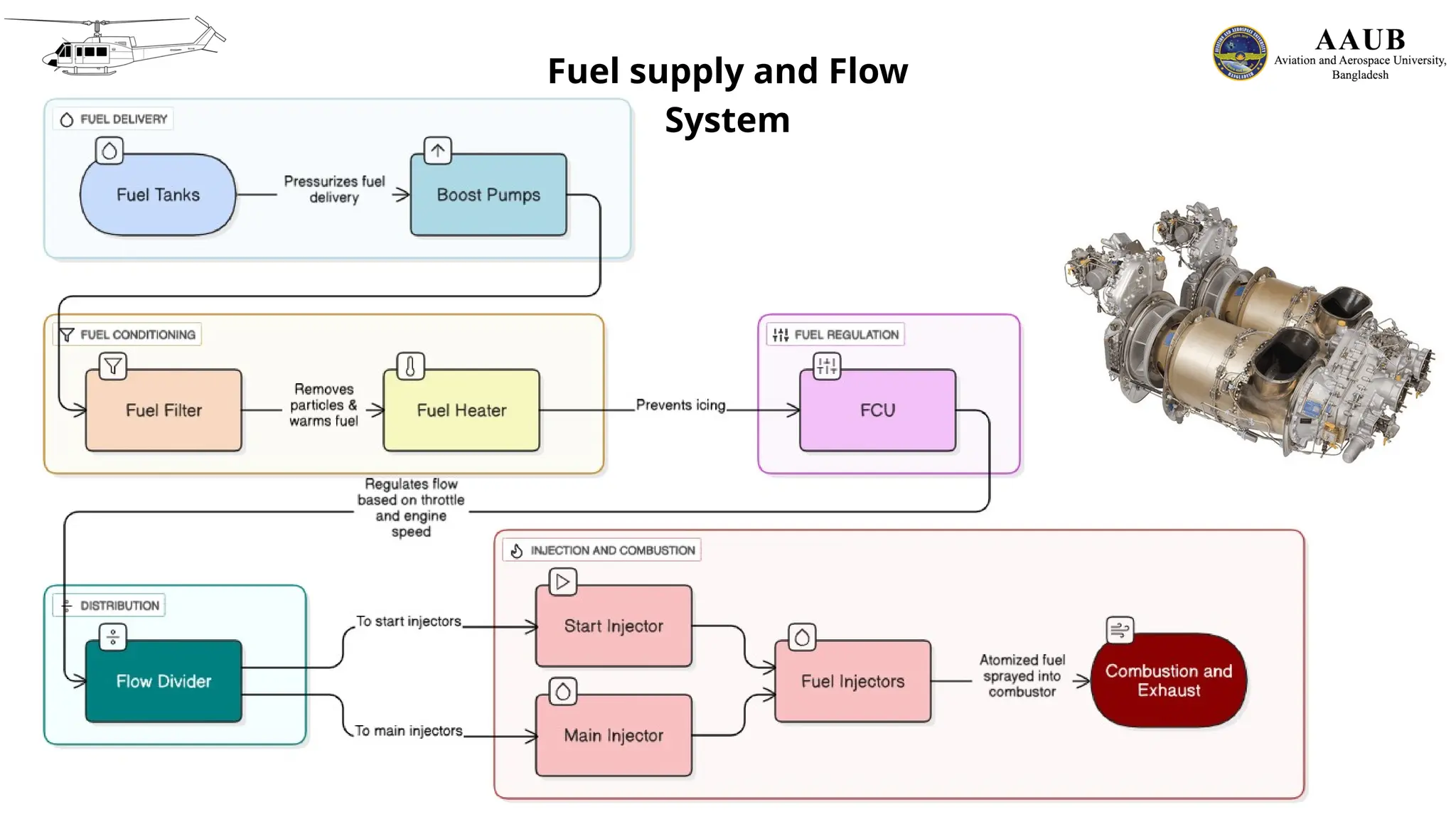
Fuel supply and Flow
System
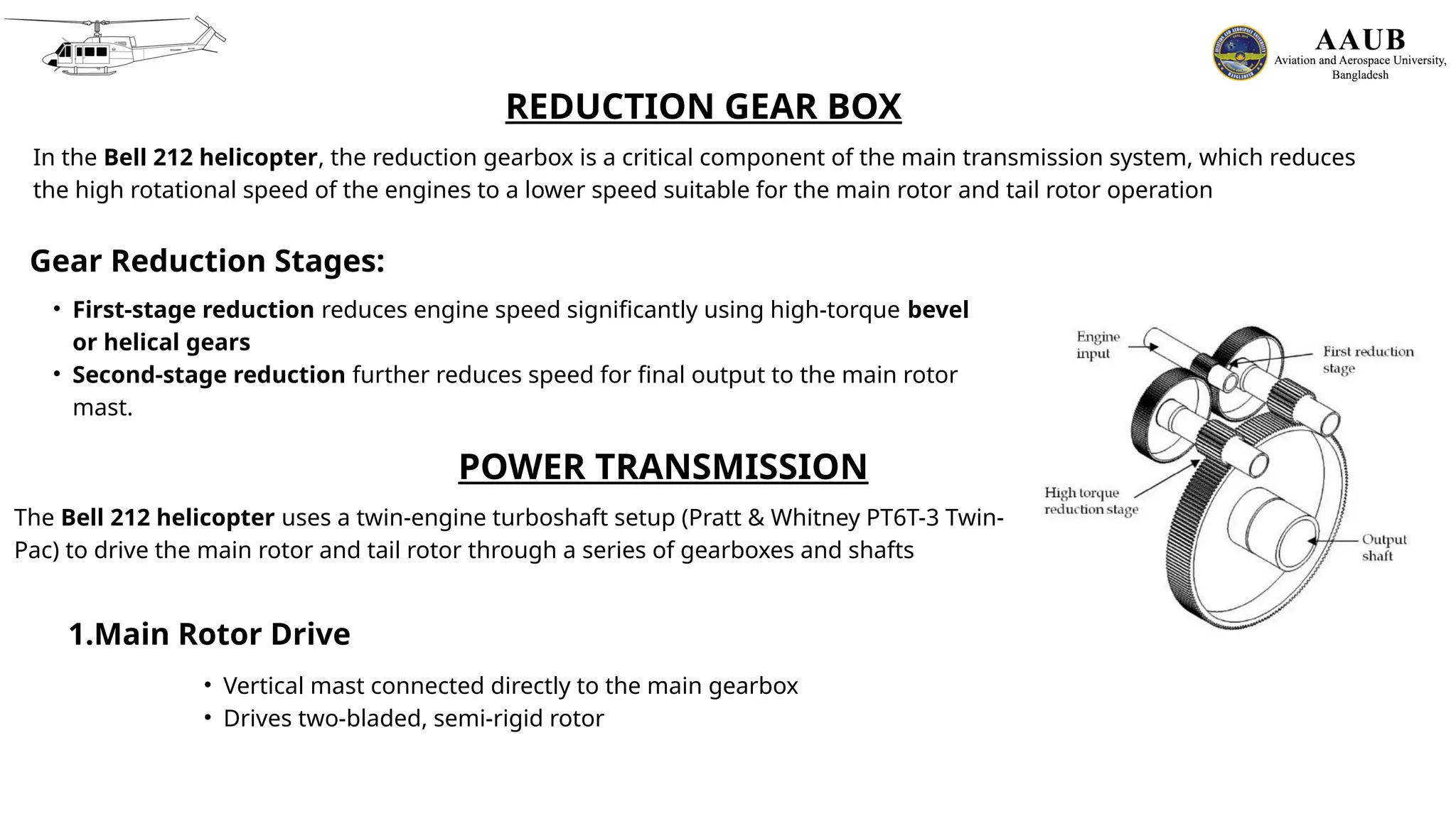
REDUCTION GEAR BOX
In the Bell 212 helicopter, the reduction gearbox is a critical component of the main transmission system, which reduces
the high rotational speed of the engines to a lower speed suitable for the main rotor and tail rotor operation
Gear Reduction Stages:
• First-stage reduction reduces engine speed significantly using high-torque bevel
or helical gears
• Second-stage reduction further reduces speed for final output to the main rotor
mast.
POWER TRANSMISSION
The Bell 212 helicopter uses a twin-engine turboshaft setup (Pratt & Whitney PT6T-3 Twin-
Pac) to drive the main rotor and tail rotor through a series of gearboxes and shafts
1.Main Rotor Drive
• Vertical mast connected directly to the main gearbox
• Drives two-bladed, semi-rigid rotor
2.Tail Rotor Drive System
Power split from the main gearbox is transmitted rearward via a long tail rotor
drive shaft. Transmit through:
• Intermediate Gearbox : changes direction upward
• Tail Rotor Gearbox : Direction change to 90 degree and final speed
reduction
STABILITY COMPONENTS OF BELL 212
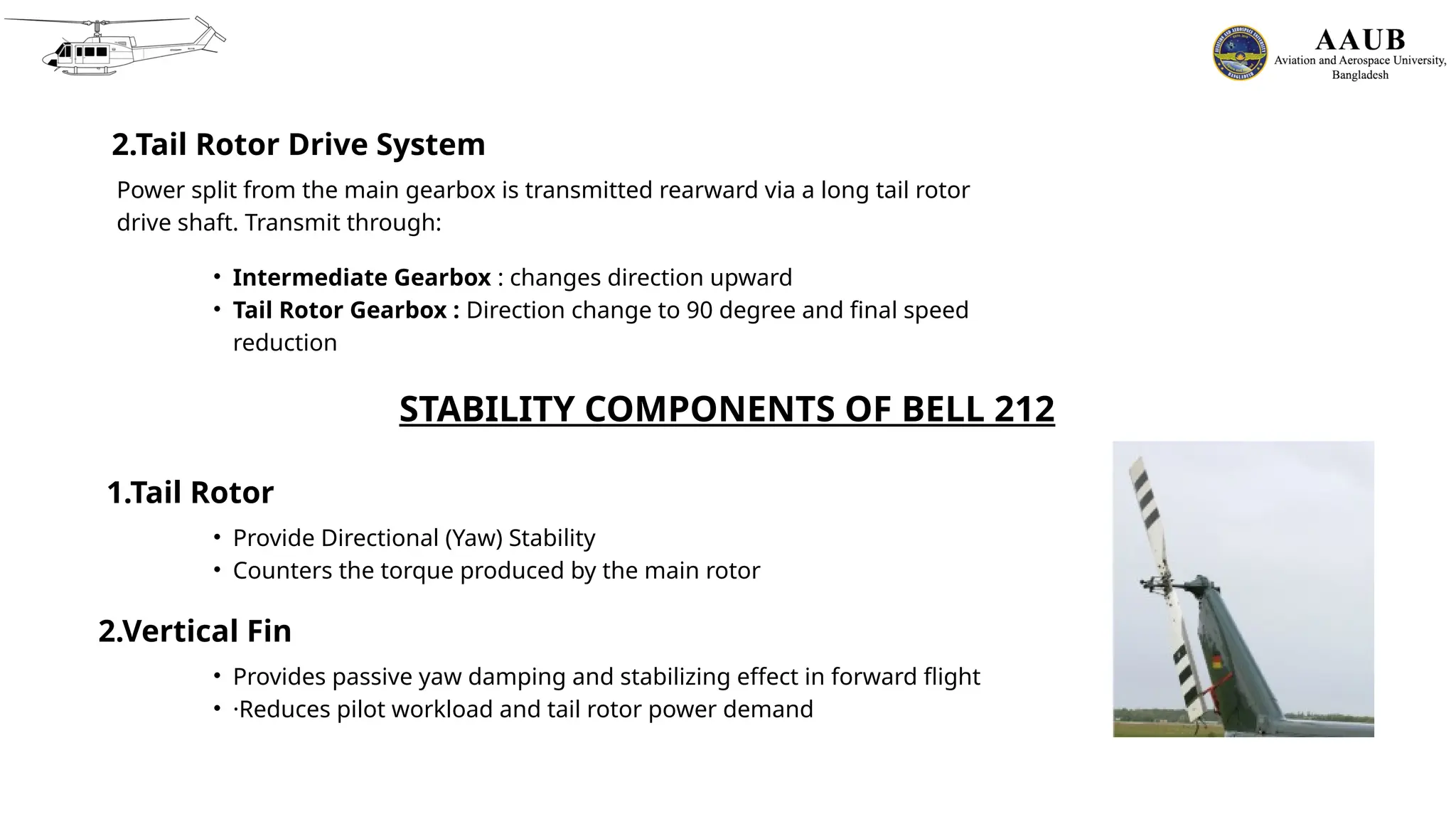
1.Tail Rotor
• Provide Directional (Yaw) Stability
• Counters the torque produced by the main rotor
2.Vertical Fin
• Provides passive yaw damping and stabilizing effect in forward flight
• ·Reduces pilot workload and tail rotor power demand
3.Horizontal Stabilizer
• Provides longitudinal (pitch) stability in forward flight.
• Generates downforce as airspeed increases
• Helps maintain level attitude and reduce nose tuck at high
speeds.
ELETRICITY GENERATION
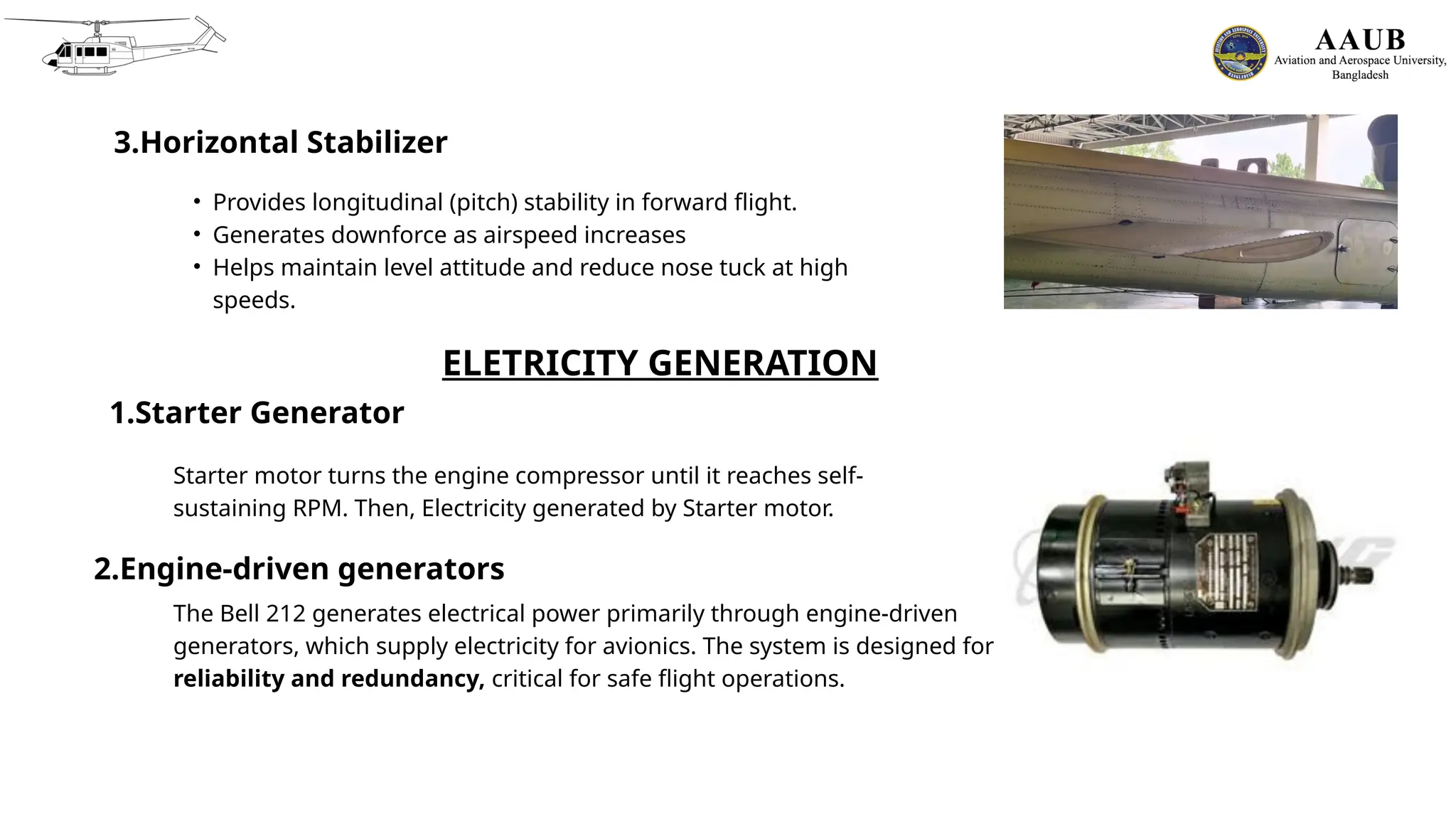
1.Starter Generator
Starter motor turns the engine compressor until it reaches self-
sustaining RPM. Then, Electricity generated by Starter motor.
2.Engine-driven generators
The Bell 212 generates electrical power primarily through engine-driven
generators, which supply electricity for avionics. The system is designed for
reliability and redundancy, critical for safe flight operations.
thank you

Slides that doesn't require human to operate

  • 1.
    INDUSTRIAL TRAINING BAF 208& 216 MROU 1.Abu Salehin Ahmed (22014025) 2.Md. Samiullah Prodhan (22014026) 3.Kawser Miah (22014028)
  • 2.
    The Bell 212is a twin-engine medium utility helicopter developed by Bell Textron. It has been in active service since the early 1970s and is known for its reliability, versatility, and operational effectiveness across both civil and military sectors. It is primarily used for personnel and cargo transport, aerial firefighting, medical evacuation, search and rescue (SAR), and offshore oil support. The helicopter features a versatile and reconfigurable cabin, allowing it to quickly adapt between missions—accommodating up to 14 passengers, medical stretchers, or cargo loads. Its ability to operate in harsh environments, including mountainous terrain, deserts, and marine platforms, makes it a preferred choice in both civilian and defense applications.
  • 3.
    The airframe ofthe Bell 212 utilizes a semi-monocoque aluminum alloy fuselage, offering strength with reduced structural weight. The structure incorporates two main longitudinal I-beam spars, which efficiently carry the primary loads across the body. The helicopter features a two-blade, semi-rigid main rotor system, mounted with elastomeric bearings, minimizing maintenance requirements and enhancing reliability. A two-blade tail rotor provides directional stability and anti-torque control. Fixed skid-type landing gear is used for durability and quick deployment on unprepared terrain. The twin turboshaft engines are mounted side-by-side above the cabin, driving a single main transmission system that powers both the main and tail rotors.
  • 5.
    Powerplant of Bell212 – Introduction & Components General Introduction Model: PT6T-3 / PT6T-3B "Twin-Pac" Used in: Bell 212 Helicopter Manufacturer: Pratt & Whitney Canada Type: Twin free-turbine turboshaft engine with combining gearbox Key Engine Components
  • 6.
    Engine Working Principle– PT6T-3 Cycle Overview (Per Engine) 1. Air Intake • Ambient air enters each engine independently. 2. Compression • 3 axial compressor + 1 centrifugal compressor → compresses the air. 3. Combustion • Air mixes with fuel (via 14 nozzles) in annular chamber → ignites generates hot gases → 4. Compressor Turbine (N1) • Drives compressor and accessories. 5. Free Power Turbine (N2) • Driven by remaining exhaust gas. • Rotates ~33,000 RPM drives output shaft → 6. Combining Gearbox • Each N2 drives its reduction gear. • The gearbox reduces N2 RPM (~33,000) output (~6000 → RPM). 7. Exhaust Duct • Expels gases after N2 turbine. • Mixes with bypass air in the ejector duct.
  • 7.
    Fuel supply andFlow System
  • 8.
    REDUCTION GEAR BOX Inthe Bell 212 helicopter, the reduction gearbox is a critical component of the main transmission system, which reduces the high rotational speed of the engines to a lower speed suitable for the main rotor and tail rotor operation Gear Reduction Stages: • First-stage reduction reduces engine speed significantly using high-torque bevel or helical gears • Second-stage reduction further reduces speed for final output to the main rotor mast. POWER TRANSMISSION The Bell 212 helicopter uses a twin-engine turboshaft setup (Pratt & Whitney PT6T-3 Twin- Pac) to drive the main rotor and tail rotor through a series of gearboxes and shafts 1.Main Rotor Drive • Vertical mast connected directly to the main gearbox • Drives two-bladed, semi-rigid rotor
  • 9.
    2.Tail Rotor DriveSystem Power split from the main gearbox is transmitted rearward via a long tail rotor drive shaft. Transmit through: • Intermediate Gearbox : changes direction upward • Tail Rotor Gearbox : Direction change to 90 degree and final speed reduction STABILITY COMPONENTS OF BELL 212 1.Tail Rotor • Provide Directional (Yaw) Stability • Counters the torque produced by the main rotor 2.Vertical Fin • Provides passive yaw damping and stabilizing effect in forward flight • ·Reduces pilot workload and tail rotor power demand
  • 10.
    3.Horizontal Stabilizer • Provideslongitudinal (pitch) stability in forward flight. • Generates downforce as airspeed increases • Helps maintain level attitude and reduce nose tuck at high speeds. ELETRICITY GENERATION 1.Starter Generator Starter motor turns the engine compressor until it reaches self- sustaining RPM. Then, Electricity generated by Starter motor. 2.Engine-driven generators The Bell 212 generates electrical power primarily through engine-driven generators, which supply electricity for avionics. The system is designed for reliability and redundancy, critical for safe flight operations.
  • 11.