What You Need
to Know About
Learn from Some Experts
Why is Sleep So Important?
Getting enough quality sleep at the right times can
help protect your
• mental health,
• physical health,
• quality of life, and
• safety.
National Heart, Lung and Blood Institute of NIH
(2012)
• Adequate and appropriately-timed sleep
is as important as nutrition and exercise.
• The only thing that replaces sleep is
sleep.
The Importance of Sleep
Mental Health
oInsufficient sleep linked to…
o Irritability / Behavior problems
(Baum et al., 2014; Beebe, 2011; Sadeh et al.,
2002; Stein et al., 2001)
o Depression / Suicide Ideation
(Buysse et al., 2008; Clarke et al., 2015; Liu, 2004;
Roberts & Duong, 2014; Siversten et al., 2013)
o Substance Use (Bootzin & Stevens, 2005)
Physical Health
 Sleep duration and timing affect:
 Food intake: increased amount,
more calories, more fat
 Eating patterns (skipping breakfast,
increased night eating)
 Physical activity
 Cardiovascular function
 Insulin metabolism and increased
diabetes risk
Physical Health
Sleep Deprivation and Obesity
•Multiple studies suggest shorter sleep
amounts associated with increased
risk of obesity
• Sleep apnea more common in obese
children, further compromising
cardiovascular and metabolic health
Quality of Life
 Sufficient sleep in youth linked to:
 Better grades, higher test scores, better
attendance
 Less tardiness & drop-outs
 Less “moodiness”
 Improved financial
prospects (Brookings
Institute, 2011)
Other Benefits
Sufficient sleep in youth also linked to:
• Less substance abuse
• Less depression
• Less impulsivity & self-destructive
behaviors
• Teens that are “more easy to
live with,” per parents
Safety – Drowsy Driving
• Drivers 16-25 years are involved in
more than 50% of the 100,000 police-
reported fatigue-related traffic crashes
each year
• National poll: 68% of HS seniors have
driven while drowsy; 15% at least
once each week
• Sleep loss impairments are equal or
greater than those due to alcohol
intoxication (i.e. 3-4 beers)
Safety
Accidental Injuries
•Sleep loss is associated with an
increased risk of pedestrian injuries
in children
•Sleep loss is associated with
increased sports-related injuries in
high school students
What is the Problem?
• American Medical Association (AMA)
identifies adolescent insufficient sleep and
sleepiness as a public health issue. (2016)
• Center for Disease Control (CDC) (2015)
Insufficient sleep is associated with a
number of chronic diseases and
conditions. Sufficient sleep is a necessity
and a “vital sign” of good health.
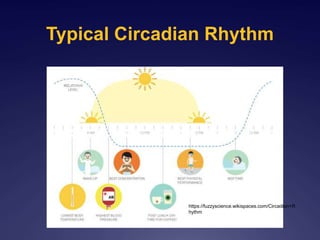
Circadian Rhythms – Body Clocks
• 24-hour cycle (roughly) or
internal body clock
• regulates sleep and other
physiological
• affected by environmental cues,
like sunlight and temperature.
Typical Circadian Rhythm
https://fuzzyscience.wikispaces.com/Circadian+R
hythm
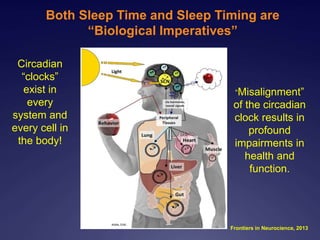
Both Sleep Time and Sleep Timing are
“Biological Imperatives”
Frontiers in Neurocience, 2013
Circadian
“clocks”
exist in
every
system and
every cell in
the body!
“Misalignment”
of the circadian
clock results in
profound
impairments in
health and
function.
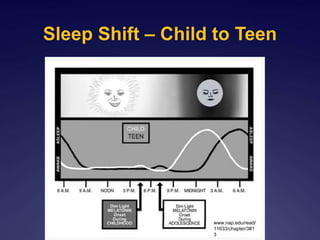
Sleep in Adolescents
 All teens experience changes in
circadian rhythms (the body’s sleep-
wake “clock”) with onset of puberty.
 This results in a biologically-based
shift (delay) of up to several hours
in both the natural fall sleep and
morning wake times.
Sleep Shift – Child to Teen
www.nap.edu/read/
11633/chapter/3#1
3
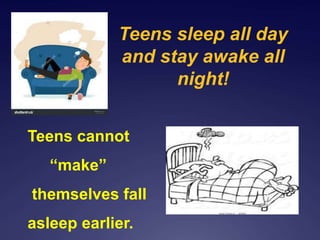
Teens sleep all day
and stay awake all
night!
Teens cannot
“make”
themselves fall
asleep earlier.
“Making Up” Sleep Myth
“ Sleeping in” over the weekend does NOT
• improve daytime functioning
• Alter Circadian Sleep Rhythm
• Remediate permanent “ social jet lag”
- daytime sleepiness
- poor academic performance
- depressed mood
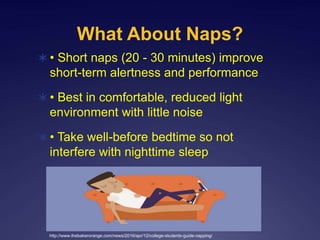
What About Naps?
 • Short naps (20 - 30 minutes) improve
short-term alertness and performance
 • Best in comfortable, reduced light
environment with little noise
 • Take well-before bedtime so not
interfere with nighttime sleep
http://www.thebakerorange.com/news/2016/apr/12/college-students-guide-napping/
What About Caffeine?
It’s a stimulant that, in moderate doses,
can
• Increase alertness
• Reduce fine motor coordination
• Cause insomnia
• Cause headaches, nervousness and
dizziness
Bottom Line
Adolescents need 8.5 to 9.5 hours of sleep
each day to function well.
Results from 40,000+ H.S. students show:
6% of 10th graders and 3% of 11th graders get
more than 9 hours of sleep.
42% of 10th graders and 56% of 12th graders
get less than 6 hours of sleep.
(2012 study in 10th largest school district)
What Can You Do?
TURN OFF Electronics Before Tuck
In!
* 60 minutes before bedtime
Why?
- stimulate brain
- create stress
- produce light that disrupts
sleep cyclehttps://sleepfoundation.org/ask-the-expert/electronics-the-bedroom
What Challenges Exist?
 Lure of social media
 Need to do Homework
 Enjoyment of Video Games
 Enjoyment of on-line Entertainment
 Pleasure of Reading e-books
What Can Schools Do?
• • Teach about Sleep and its Importance
(K-12)
• • Change staff development/ exam days
to late openings
• •Allow first-period cuts/study halls for
older students (flexible schedules)
• Alter athletic schedules
What Can Communities Do?
Adjust School Start Times (SST)
The American Academy of Pediatrics
recommends all middle and high
schools start at 8:30 a.m. or later.
(2014)
Why Start School Later?
• Biological needs in direct conflict with earlier
high school start times (before 8:30 a.m.)
• Students required to wake-up and function
when their bodies and brains are
programmed to be asleep
• Early wake times rob teens of needed sleep
time
• Early morning sleep stages (REM) critical for
learning, memory, attention, and emotional
regulation
Benefits of Later School Start Times
• Fewer Health Center Visits
• Fewer Accidents
Crash rates reduced in 16 – 18 year
olds by 65 -70% in some communities
(CDC study, 2014)
Results vary by school districts, but
show fewer teens involved in car
incidents with secondary schools
starting after 8:30 a.m.
Challenges to Later SST
Transportation (bussing) costs
Athletic schedules
Babysitting needs of for
younger children
Afterschool employment
Teacher constraints/schedules
Where Can You Go to
Get More Information?
National Sleep Foundation
• https://sleepfoundation.org
Centers for Disease Control and Prevention
• http://www.cdc.gov/features/dssleep/
Start School Later
http://www.startschoollater.net
This program was sponsored by
 Parent-Teacher Organizations (PTO’s) of Radnor Schools
 Ithan Elementary School
 Radnor Elementary School
 Wayne Elementary School
 Radnor Middle School
 Parent-Teacher- Student-Association (PTSA)
 Radnor High School
 Parent Teacher Organizations (PTO’s) of Tredyffrin-Easttown Schools
 New Eagle Elementary School
 Valley Forge Middle School
Sponsored by (cont.)
 Radnor Township School District
 Lower Merion School District
Leagues of Women Voters of
 Radnor Township
• Haverford Township
 Central Delaware County
WITH SPECIAL THANKS TO:
Richard Sayer, Videographer
Sweet Dreams!

Sleep and the Adolescent Brain (2)

  • 1.
    What You Need toKnow About
  • 2.
  • 3.
    Why is SleepSo Important? Getting enough quality sleep at the right times can help protect your • mental health, • physical health, • quality of life, and • safety. National Heart, Lung and Blood Institute of NIH (2012)
  • 4.
    • Adequate andappropriately-timed sleep is as important as nutrition and exercise. • The only thing that replaces sleep is sleep. The Importance of Sleep
  • 5.
    Mental Health oInsufficient sleeplinked to… o Irritability / Behavior problems (Baum et al., 2014; Beebe, 2011; Sadeh et al., 2002; Stein et al., 2001) o Depression / Suicide Ideation (Buysse et al., 2008; Clarke et al., 2015; Liu, 2004; Roberts & Duong, 2014; Siversten et al., 2013) o Substance Use (Bootzin & Stevens, 2005)
  • 6.
    Physical Health  Sleepduration and timing affect:  Food intake: increased amount, more calories, more fat  Eating patterns (skipping breakfast, increased night eating)  Physical activity  Cardiovascular function  Insulin metabolism and increased diabetes risk
  • 7.
    Physical Health Sleep Deprivationand Obesity •Multiple studies suggest shorter sleep amounts associated with increased risk of obesity • Sleep apnea more common in obese children, further compromising cardiovascular and metabolic health
  • 8.
    Quality of Life Sufficient sleep in youth linked to:  Better grades, higher test scores, better attendance  Less tardiness & drop-outs  Less “moodiness”  Improved financial prospects (Brookings Institute, 2011)
  • 9.
    Other Benefits Sufficient sleepin youth also linked to: • Less substance abuse • Less depression • Less impulsivity & self-destructive behaviors • Teens that are “more easy to live with,” per parents
  • 10.
    Safety – DrowsyDriving • Drivers 16-25 years are involved in more than 50% of the 100,000 police- reported fatigue-related traffic crashes each year • National poll: 68% of HS seniors have driven while drowsy; 15% at least once each week • Sleep loss impairments are equal or greater than those due to alcohol intoxication (i.e. 3-4 beers)
  • 11.
    Safety Accidental Injuries •Sleep lossis associated with an increased risk of pedestrian injuries in children •Sleep loss is associated with increased sports-related injuries in high school students
  • 12.
    What is theProblem? • American Medical Association (AMA) identifies adolescent insufficient sleep and sleepiness as a public health issue. (2016) • Center for Disease Control (CDC) (2015) Insufficient sleep is associated with a number of chronic diseases and conditions. Sufficient sleep is a necessity and a “vital sign” of good health.
  • 13.
    Circadian Rhythms –Body Clocks • 24-hour cycle (roughly) or internal body clock • regulates sleep and other physiological • affected by environmental cues, like sunlight and temperature.
  • 14.
  • 15.
    Both Sleep Timeand Sleep Timing are “Biological Imperatives” Frontiers in Neurocience, 2013 Circadian “clocks” exist in every system and every cell in the body! “Misalignment” of the circadian clock results in profound impairments in health and function.
  • 16.
    Sleep in Adolescents All teens experience changes in circadian rhythms (the body’s sleep- wake “clock”) with onset of puberty.  This results in a biologically-based shift (delay) of up to several hours in both the natural fall sleep and morning wake times.
  • 17.
    Sleep Shift –Child to Teen www.nap.edu/read/ 11633/chapter/3#1 3
  • 18.
    Teens sleep allday and stay awake all night! Teens cannot “make” themselves fall asleep earlier.
  • 19.
    “Making Up” SleepMyth “ Sleeping in” over the weekend does NOT • improve daytime functioning • Alter Circadian Sleep Rhythm • Remediate permanent “ social jet lag” - daytime sleepiness - poor academic performance - depressed mood
  • 20.
    What About Naps? • Short naps (20 - 30 minutes) improve short-term alertness and performance  • Best in comfortable, reduced light environment with little noise  • Take well-before bedtime so not interfere with nighttime sleep http://www.thebakerorange.com/news/2016/apr/12/college-students-guide-napping/
  • 21.
    What About Caffeine? It’sa stimulant that, in moderate doses, can • Increase alertness • Reduce fine motor coordination • Cause insomnia • Cause headaches, nervousness and dizziness
  • 22.
    Bottom Line Adolescents need8.5 to 9.5 hours of sleep each day to function well. Results from 40,000+ H.S. students show: 6% of 10th graders and 3% of 11th graders get more than 9 hours of sleep. 42% of 10th graders and 56% of 12th graders get less than 6 hours of sleep. (2012 study in 10th largest school district)
  • 23.
    What Can YouDo? TURN OFF Electronics Before Tuck In! * 60 minutes before bedtime Why? - stimulate brain - create stress - produce light that disrupts sleep cyclehttps://sleepfoundation.org/ask-the-expert/electronics-the-bedroom
  • 24.
    What Challenges Exist? Lure of social media  Need to do Homework  Enjoyment of Video Games  Enjoyment of on-line Entertainment  Pleasure of Reading e-books
  • 25.
    What Can SchoolsDo? • • Teach about Sleep and its Importance (K-12) • • Change staff development/ exam days to late openings • •Allow first-period cuts/study halls for older students (flexible schedules) • Alter athletic schedules
  • 26.
    What Can CommunitiesDo? Adjust School Start Times (SST) The American Academy of Pediatrics recommends all middle and high schools start at 8:30 a.m. or later. (2014)
  • 27.
    Why Start SchoolLater? • Biological needs in direct conflict with earlier high school start times (before 8:30 a.m.) • Students required to wake-up and function when their bodies and brains are programmed to be asleep • Early wake times rob teens of needed sleep time • Early morning sleep stages (REM) critical for learning, memory, attention, and emotional regulation
  • 28.
    Benefits of LaterSchool Start Times • Fewer Health Center Visits • Fewer Accidents Crash rates reduced in 16 – 18 year olds by 65 -70% in some communities (CDC study, 2014) Results vary by school districts, but show fewer teens involved in car incidents with secondary schools starting after 8:30 a.m.
  • 29.
    Challenges to LaterSST Transportation (bussing) costs Athletic schedules Babysitting needs of for younger children Afterschool employment Teacher constraints/schedules
  • 30.
    Where Can YouGo to Get More Information? National Sleep Foundation • https://sleepfoundation.org Centers for Disease Control and Prevention • http://www.cdc.gov/features/dssleep/ Start School Later http://www.startschoollater.net
  • 31.
    This program wassponsored by  Parent-Teacher Organizations (PTO’s) of Radnor Schools  Ithan Elementary School  Radnor Elementary School  Wayne Elementary School  Radnor Middle School  Parent-Teacher- Student-Association (PTSA)  Radnor High School  Parent Teacher Organizations (PTO’s) of Tredyffrin-Easttown Schools  New Eagle Elementary School  Valley Forge Middle School
  • 32.
    Sponsored by (cont.) Radnor Township School District  Lower Merion School District Leagues of Women Voters of  Radnor Township • Haverford Township  Central Delaware County WITH SPECIAL THANKS TO: Richard Sayer, Videographer
  • 33.