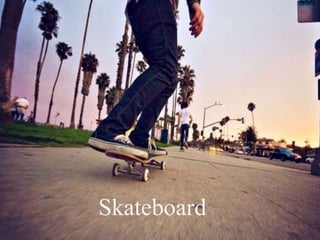
Skateboard
• Skateboarding is an action sport which 
involves riding and performing tricks using 
a skateboard. Skateboarding can also be 
considered a recreational activity, an art form, 
a job, or a method of transportation. 
• Skateboarding has been shaped and 
influenced by many skateboarders throughout 
the years. A 2002 report found that there 
were 18.5 million skateboarders in the world. 
85 percent of skateboarders polled who had 
used a board in the last year were under the 
age of 18, and 74 percent were male.
• Since the 1970s, skateparks have been 
constructed specifically for use by 
skateboarders, Freestyle 
BMXers, aggressive skaters, and very 
recently, scooters.
• Skateboarding was probably born sometime in 
the late 1940s or early 1950s when surfers 
in California wanted something to surf when 
the waves were flat. No one knows who made 
the first board; it seems that several people 
came up with similar ideas at around the 
same time. These first skateboarders started 
with wooden boxes or boards with roller skate 
wheels attached to the bottom.
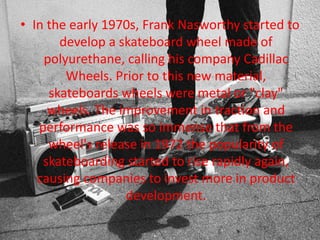
• In the early 1970s, Frank Nasworthy started to 
develop a skateboard wheel made of 
polyurethane, calling his company Cadillac 
Wheels. Prior to this new material, 
skateboards wheels were metal or "clay" 
wheels. The improvement in traction and 
performance was so immense that from the 
wheel's release in 1972 the popularity of 
skateboarding started to rise rapidly again, 
causing companies to invest more in product 
development.
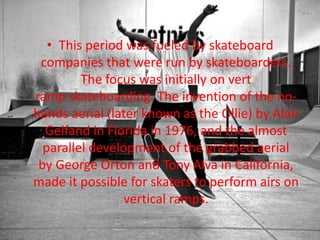
• This period was fueled by skateboard 
companies that were run by skateboarders. 
The focus was initially on vert 
ramp skateboarding. The invention of the no-hands 
aerial (later known as the Ollie) by Alan 
Gelfand in Florida in 1976, and the almost 
parallel development of the grabbed aerial 
by George Orton and Tony Alva in California, 
made it possible for skaters to perform airs on 
vertical ramps.
• Skateboarding during the 1990s became 
dominated by street skateboarding. Most 
boards are about 7 1⁄4 to 8 inches (180 to 
200 mm) wide and 30 to 32 inches (760 to 
810 mm) long. The wheels are made of an 
extremely hard polyurethane, with hardness 
(durometer) approximately 99A. The wheel 
sizes are relatively small so that the boards are 
lighter, and the wheels' inertia is overcome 
quicker, thus making tricks more manageable.
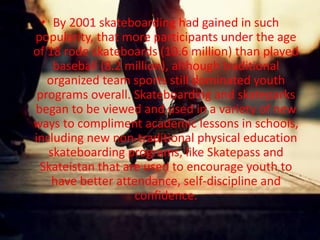
• By 2001 skateboarding had gained in such 
popularity, that more participants under the age 
of 18 rode skateboards (10.6 million) than played 
baseball (8.2 million), although traditional 
organized team sports still dominated youth 
programs overall. Skateboarding and skateparks 
began to be viewed and used in a variety of new 
ways to compliment academic lessons in schools, 
including new non-traditional physical education 
skateboarding programs, like Skatepass and 
Skateistan that are used to encourage youth to 
have better attendance, self-discipline and 
confidence.
• With the evolution of skateparks and ramp 
skating, the skateboard began to change. Early 
skate tricks had consisted mainly of two-dimensional 
freestyle manoeuvres like riding 
on only two wheels ("wheelie" or "manual"), 
spinning only on the back wheels (a "pivot"), 
high jumping over a bar and landing on the 
board again, also known as a "hippie jump", 
long jumping from one board to another, 
(often over small barrels or fearless 
teenagers), or slalom. Another popular trick 
was the Bertlemann slide, named after Larry 
Bertelemann's surfing manoeuvres.
• Skateboarding was popularized by the 1986 
skateboarding cult classic Thrashin'. Directed 
by David Winters and starring Josh Brolin, it 
features appearances from many famous skaters 
such as Tony Alva, Tony Hawk, Christian 
Hosoi and Steve Caballero. Thrashin' also had a 
direct impact on Lords of Dogtown, as Catherine 
Hardwicke, who directed Lords of Dogtown, was 
hired by Winters to work on Thrashin' as 
a production designer where she met, worked with 
and befriended many famous skaters including the 
real Tony Alva, Tony Hawk, Christian 
Hosoi and Steve Caballero.
• Skateboarding was, at first, tied to the culture 
of surfing. As skateboarding spread across 
the United States to places unfamiliar with 
surfing or surfing culture, it developed an 
image of its own. For example, the classic film 
short Video Days(1991) portrayed 
skateboarders as reckless rebels.
• One of the early leading trends associated 
with the sub-culture of skateboarding itself, 
was the sticky sole "Slip-On" Skate shoe, most 
popularized by Sean Penn's skateboarding 
character from the film Fast Times at 
Ridgemont High. Because early skateboarders 
were actually surfers trying to emulate the 
sport of surfing, at the time when skateboards 
first came out on the market, many 
skateboarded barefoot.
• But skaters often lacked traction, which led to 
foot injuries. This necessitated the need for a 
shoe that was specifically designed and 
marketed for skateboarding, such as the 
Randy "720", manufactured by the Randolph 
Rubber Company, and Vans sneakers, which 
eventually became cultural iconic signifiers for 
skateboarders during the 70s & 80's as 
skateboarding became more widespread.
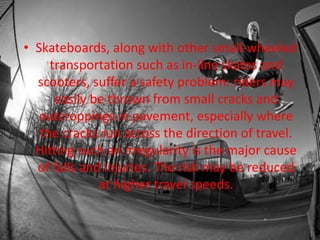
• Skateboards, along with other small-wheeled 
transportation such as in-line skates and 
scooters, suffer a safety problem: riders may 
easily be thrown from small cracks and 
outcroppings in pavement, especially where 
the cracks run across the direction of travel. 
Hitting such an irregularity is the major cause 
of falls and injuries. The risk may be reduced 
at higher travel speeds.
• Transportation 
• The use of skateboards solely as a form of 
transportation is often associated with 
the longboard. Depending on local laws, using 
skateboards as a form of transportation 
outside residential areas may or may not be 
legal. Backers cite portability, exercise, and 
environmental friendliness as some of the 
benefits of skateboarding as an alternative to 
automobiles.
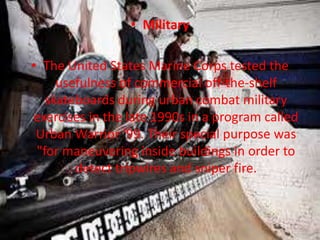
• Military 
• The United States Marine Corps tested the 
usefulness of commercial off-the-shelf 
skateboards during urban combat military 
exercises in the late 1990s in a program called 
Urban Warrior '99. Their special purpose was 
"for maneuvering inside buildings in order to 
detect tripwires and sniper fire.
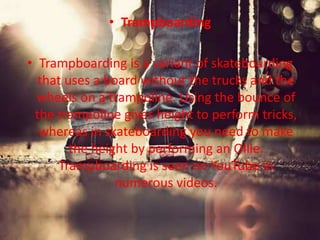
• Trampboarding 
• Trampboarding is a variant of skateboarding 
that uses a board without the trucks and the 
wheels on a trampoline. Using the bounce of 
the trampoline gives height to perform tricks, 
whereas in skateboarding you need to make 
the height by performing an Ollie. 
Trampboarding is seen on YouTube in 
numerous videos.
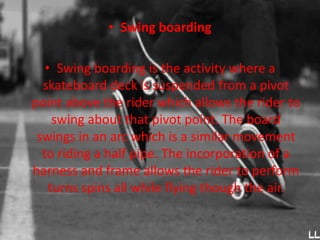
• Swing boarding 
• Swing boarding is the activity where a 
skateboard deck is suspended from a pivot 
point above the rider which allows the rider to 
swing about that pivot point. The board 
swings in an arc which is a similar movement 
to riding a half pipe. The incorporation of a 
harness and frame allows the rider to perform 
turns spins all while flying though the air.
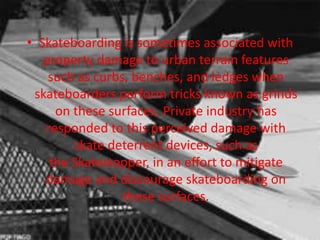
• Skateboarding is sometimes associated with 
property damage to urban terrain features 
such as curbs, benches, and ledges when 
skateboarders perform tricks known as grinds 
on these surfaces. Private industry has 
responded to this perceived damage with 
skate deterrent devices, such as 
the Skatestopper, in an effort to mitigate 
damage and discourage skateboarding on 
these surfaces.

Skateboard

  • 1.
  • 2.
    • Skateboarding isan action sport which involves riding and performing tricks using a skateboard. Skateboarding can also be considered a recreational activity, an art form, a job, or a method of transportation. • Skateboarding has been shaped and influenced by many skateboarders throughout the years. A 2002 report found that there were 18.5 million skateboarders in the world. 85 percent of skateboarders polled who had used a board in the last year were under the age of 18, and 74 percent were male.
  • 3.
    • Since the1970s, skateparks have been constructed specifically for use by skateboarders, Freestyle BMXers, aggressive skaters, and very recently, scooters.
  • 4.
    • Skateboarding wasprobably born sometime in the late 1940s or early 1950s when surfers in California wanted something to surf when the waves were flat. No one knows who made the first board; it seems that several people came up with similar ideas at around the same time. These first skateboarders started with wooden boxes or boards with roller skate wheels attached to the bottom.
  • 5.
    • In theearly 1970s, Frank Nasworthy started to develop a skateboard wheel made of polyurethane, calling his company Cadillac Wheels. Prior to this new material, skateboards wheels were metal or "clay" wheels. The improvement in traction and performance was so immense that from the wheel's release in 1972 the popularity of skateboarding started to rise rapidly again, causing companies to invest more in product development.
  • 6.
    • This periodwas fueled by skateboard companies that were run by skateboarders. The focus was initially on vert ramp skateboarding. The invention of the no-hands aerial (later known as the Ollie) by Alan Gelfand in Florida in 1976, and the almost parallel development of the grabbed aerial by George Orton and Tony Alva in California, made it possible for skaters to perform airs on vertical ramps.
  • 7.
    • Skateboarding duringthe 1990s became dominated by street skateboarding. Most boards are about 7 1⁄4 to 8 inches (180 to 200 mm) wide and 30 to 32 inches (760 to 810 mm) long. The wheels are made of an extremely hard polyurethane, with hardness (durometer) approximately 99A. The wheel sizes are relatively small so that the boards are lighter, and the wheels' inertia is overcome quicker, thus making tricks more manageable.
  • 8.
    • By 2001skateboarding had gained in such popularity, that more participants under the age of 18 rode skateboards (10.6 million) than played baseball (8.2 million), although traditional organized team sports still dominated youth programs overall. Skateboarding and skateparks began to be viewed and used in a variety of new ways to compliment academic lessons in schools, including new non-traditional physical education skateboarding programs, like Skatepass and Skateistan that are used to encourage youth to have better attendance, self-discipline and confidence.
  • 9.
    • With theevolution of skateparks and ramp skating, the skateboard began to change. Early skate tricks had consisted mainly of two-dimensional freestyle manoeuvres like riding on only two wheels ("wheelie" or "manual"), spinning only on the back wheels (a "pivot"), high jumping over a bar and landing on the board again, also known as a "hippie jump", long jumping from one board to another, (often over small barrels or fearless teenagers), or slalom. Another popular trick was the Bertlemann slide, named after Larry Bertelemann's surfing manoeuvres.
  • 10.
    • Skateboarding waspopularized by the 1986 skateboarding cult classic Thrashin'. Directed by David Winters and starring Josh Brolin, it features appearances from many famous skaters such as Tony Alva, Tony Hawk, Christian Hosoi and Steve Caballero. Thrashin' also had a direct impact on Lords of Dogtown, as Catherine Hardwicke, who directed Lords of Dogtown, was hired by Winters to work on Thrashin' as a production designer where she met, worked with and befriended many famous skaters including the real Tony Alva, Tony Hawk, Christian Hosoi and Steve Caballero.
  • 11.
    • Skateboarding was,at first, tied to the culture of surfing. As skateboarding spread across the United States to places unfamiliar with surfing or surfing culture, it developed an image of its own. For example, the classic film short Video Days(1991) portrayed skateboarders as reckless rebels.
  • 12.
    • One ofthe early leading trends associated with the sub-culture of skateboarding itself, was the sticky sole "Slip-On" Skate shoe, most popularized by Sean Penn's skateboarding character from the film Fast Times at Ridgemont High. Because early skateboarders were actually surfers trying to emulate the sport of surfing, at the time when skateboards first came out on the market, many skateboarded barefoot.
  • 13.
    • But skatersoften lacked traction, which led to foot injuries. This necessitated the need for a shoe that was specifically designed and marketed for skateboarding, such as the Randy "720", manufactured by the Randolph Rubber Company, and Vans sneakers, which eventually became cultural iconic signifiers for skateboarders during the 70s & 80's as skateboarding became more widespread.
  • 14.
    • Skateboards, alongwith other small-wheeled transportation such as in-line skates and scooters, suffer a safety problem: riders may easily be thrown from small cracks and outcroppings in pavement, especially where the cracks run across the direction of travel. Hitting such an irregularity is the major cause of falls and injuries. The risk may be reduced at higher travel speeds.
  • 15.
    • Transportation •The use of skateboards solely as a form of transportation is often associated with the longboard. Depending on local laws, using skateboards as a form of transportation outside residential areas may or may not be legal. Backers cite portability, exercise, and environmental friendliness as some of the benefits of skateboarding as an alternative to automobiles.
  • 16.
    • Military •The United States Marine Corps tested the usefulness of commercial off-the-shelf skateboards during urban combat military exercises in the late 1990s in a program called Urban Warrior '99. Their special purpose was "for maneuvering inside buildings in order to detect tripwires and sniper fire.
  • 17.
    • Trampboarding •Trampboarding is a variant of skateboarding that uses a board without the trucks and the wheels on a trampoline. Using the bounce of the trampoline gives height to perform tricks, whereas in skateboarding you need to make the height by performing an Ollie. Trampboarding is seen on YouTube in numerous videos.
  • 18.
    • Swing boarding • Swing boarding is the activity where a skateboard deck is suspended from a pivot point above the rider which allows the rider to swing about that pivot point. The board swings in an arc which is a similar movement to riding a half pipe. The incorporation of a harness and frame allows the rider to perform turns spins all while flying though the air.
  • 19.
    • Skateboarding issometimes associated with property damage to urban terrain features such as curbs, benches, and ledges when skateboarders perform tricks known as grinds on these surfaces. Private industry has responded to this perceived damage with skate deterrent devices, such as the Skatestopper, in an effort to mitigate damage and discourage skateboarding on these surfaces.