P R E S T O N C I T Y C O U N C I L
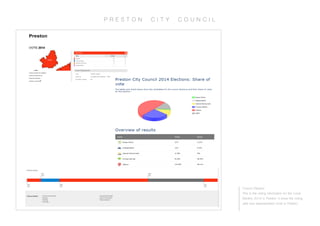
Council Election
This is the voting information for the Local
Election 2014 in Preston. It show the voting
data and representation local to Preston.
Council Election
This is the voting information for the Lo-
cal Election 2014 in England. It show the
voting data and representation throughout
England.
E N G L A N D C O U N C I L
European Election
This is the voting information for the Eu-
ropean Election 2014 in the North West. It
show the area of that represents Preston
and the voting data for the North West.
E U R O P E A N E L E C T I O N
This is the results for the European Elec-
tion 2014. It show the number of MEPs by
party and representative of country.
E U R O P E A N E L E C T I O N
This is the voting information for the Gen-
eral Election 2015 in the United Kingdom. It
show the results and the errors in popula-
tion representation.
G E N E R A L E L E C T I O N - U K
This is the voting information for the Gen-
eral Election 2015 in Preston. It show the
voting data for the area as well as history
and demographics.
G E N E R A L E L E C T I O N - P R E S T O N
A Labour seat since 1983, Preston is an
old cotton town at the heart of Lancashire
which was granted city status in 2002. It
has a traditional manufacturing base in
textiles and engineering - BAE Systems is
a big employer - but sectors such as busi-
ness services have also grown. Many work
in sales and customer services jobs. The
University of Central Lancashire is based
here and continuing regeneration in the city
- a regional shopping centre - including
moves to develop a new central business
district.
The seat has a big student population and
fewer family households than average, ac-
cording to the 2011 Census. Home own-
ership is low and the private rental sector
is large. There is also more social housing
and higher unemployment than average.
Labour’s Mark Hendrick held the seat in
2010 with a majority of 7,733 votes. The
Lib Dems came second.
C O N S I T I T U E N C Y P R O F I L E - P R E S T O N
TECHNOLOGY
P O L L U T I O N C O N T R O L
Effects * asthma, allergies, respiratory ill-
nesses
Exhaust
Burn of fossil fuels
Paint production/ plastic
Radiation spills/ nuclear accidents
Control Method :
Preventing emissions to begin with
Pollution control equipment
Plant trees
Conserve energy (lights etc)
Light Sensitive structure which acts like a
photo catalyst (For more info look at Light-
2Cat)
Use Eco- Friendly Materials
Recycling & bio-fuels
Resourcing Local Materials & Using them
into your building
Waste minimisation & recycling within the
building
1.
2.
A I R P O L L U T I O N
1.
2.
1.
2.
destroys natural habitats, resources &
communities
Litter
Oil Spills
Pesticides &farming chemicals
Illegal dumping/unsustainable logging
practices
Control Method:
Organic Farming
Recycling
Green energy resources
Bio-degradable material use
Little packaging
L A N D P O L L U T I O N
1.
2.
Uses energy and disturbs sleep patterns.
This also makes the beauty of the sky to
be unable to be seen unless in country
side
Street lamps
Unnecessary lights around and inside
buildings
Interferes with wild life
Control Method :
Green energy & light bulbs
Intelligent outdoor lighting
1.
2.
L I G H T P O L L U T I O N
1.
2.
1.
2.
harmful to unborns, hightens stress levels,
causes nervousness.
Aeroplanes, helicopters, motored vehicles
Construction& demolition noise
Sporting events, concerts
Control Method:
Plant Trees – noise buffer
Use soft furnishings/ surfaces that reflect
sound
Avoid use of :hand toold, power tools, plant
equipment, scaffolding, partition walls.
Install noisy machines in soundproof cham-
bers or using damping layers around and
beneath them
N O I S E P O L L U T I O N
1.
2.
T H E R M A L P O L L U T I O N
1.
increase of temperature by human activity
Hydro-electric power
Nuclear power plants & coal fired plants
Domestic sewage
Masses of concrete absorb sun and
change the climate of the area.
Control Method:
Cooling towers
Artificial lakes
1.
1.
2.
A subjective topic- unattractive or damag-
ing to landscape
Graffiti
Billboards
Antennas & wires
Junkyards & unlawful disposal of waste
Control Method- Visual Pollution is a high-
ly subjective area, it is up to the designer
whether they want to control it or not.
Clear graffiti
Restrict the hours of billboards being dis-
played
Hide the antennas and wires
Promote awareness in community for waste
disposal
Linked to health issues in humans& animals
Raw sewage contaminating lakes &
streams
Industrial waste spills
Biological contamination such as bacteria
Farm runoff into nearby waters
Control Method:
Sewage treatment
Proper sewage treatments
Reduce or use of different farming chemi-
cals
V I S U A L P O L L U T I O N & W A T E R P O L L U T I O N
1.
2.
N A T U R E R E S E R V A T I O N
G R E E N S P A C E A R O U N D P R E S T O N
Local Nature Reserves are designated be-
cause of their high wildlife, community and
educational value and provide places for
people to enjoy nature on their doorstep.
• Fishwick
• Grange Valley
• Haslam Park
• Hills and Hollows
• Pope Lane Field
• Boilton Wood
Preston has been praised for its many
designated Local Nature Reserves. These
green spaces are designated for their di-
verse wildlife, community and educational
value, making them a fascinating place to
visit if you’re interested in nature and the
outdoors.
Avenham and Miller Parks
Avenham and Miller Parks are adjoining
Parks that lie in the picturesque Avenham
valley close to Preston city centre. Even
though the parks are close to Preston’s
main shopping and business area, their
tranquil setting on the banks of the River
Ribble offers a pleasant retreat from the
hustle and bustle of city life.
H A B I T A T S
Bramble- The Fruits are tasty to birds and
people.
Rosebay Willow Herb-The leaves can be
dried and mixed with blackberry and
raspberry to make a herb tea.
Nettle-The leaves are a good food plant .
Silver Birch-The leaves also yield green
and yellow dyes.
Red Clover-The flowers and leaves can be
cooked as a vegetable.
Hawthorn-the younbg leaves are good in
salad
Water
Energy
Air and Climate
Biodiversity
Land, Forests, and Ecosystems
Building Sustainability
P R E S E R V A T I O N
E N E R G Y S U S T A I N A B I L I T Y
1.
2.
- Energy (human need)
- Energy sources
- New energy sources and technology
Energy (human need)
Engage the whole supply chain from:
• designers
• subcontractors
• materials suppliers
To reduce the production of waste at
source through better design, improved
packaging and better control of materials
on site.
In order to save more energy, where waste
is produced, the quantities should be mon-
itored and rather than sending it to landfill,
divert it to waste centres to:
•Re-use
•Recycle
•Recover energy from waste materials
The closest heavy materials recycle waste
center is located close to Bury
The closest light materials reycle waste
centre is located outside of Preston
E N E R GY S U S T A I N A B I L I T Y O F S I T E
1.
2.
E N E R G Y S U S T A I N A B I L I T Y OF S I T E
1.
2.
- Energy (human need)
- Energy sources
- New energy sources and technology
Use of and finishes such us various types
of agriboard
sheathing and or insulation board made
from:
• Agricultural waste
• By-products
• Straw
• Wheat
• Barley
• Soy
Sourcing landscape materials from appro-
priate distances and origin; and sustainably
managing the project’s waste stream.
Transportation becomes part of a product
or building materials embodied energy.
• Specify and use locally harvested, mined
and manufactured materials and prod-
ucts to support the regional economy and
to reduce transportation, energy use and
emissions.
• Give preference to products and systems
that facilitate easy, non-energy
• Use of prefabricated componentsSand
and Gravel
1.
2.
- Energy (human need)
- Energy sources
- New energy sources and technology
Evaluate the site in terms of the location
and orientation of buildings and improve-
ments in order to:
• Optimize the use of solar energy
• Natural daylighting
• Natural breezes and ventilation
Help reduce the urban heat island effect by
reducing the building and site development
footprint should:
• Maximizing the use of pervious surfaces
• Using light coloured roofs, paving, and
walkways.
• Provide natural shading of buildings and
paved areas with trees and other landscape
features
Consider site security concurrently with
sustainable site issues. Location of access
roads, parking, vehicle barriers, and perim-
eter lighting, among others are key issues
that must be addressed.
Help reduce night-time light pollution by
avoiding over-illumination of the site and
use low cut-off exterior lighting fixtures
which direct light downward
E N E R G Y S O U R C E S
1.
N E W E N E R G Y S O U R C E S A N D T E C H O L O G Y
- Energy (human need)
- Energy sources
- New energy sources and technology
Minimize adverse impacts on the environ-
ment
• Use high performance low-e glazing,
which can result in significant year round
energy savings.
• Consider insulated double glazing, triple
glazing or double pane glazing with a sus-
pended low-e film.
• Window frames, sashes and curtain wall
systems should also be designed for opti-
mum energy performance including the use
of multiple thermal breaks
• Optimize the value of exterior insulation
and the overall thermal performance of the
exterior envelope assembly
• Structural insulated panel systems (SIPS)
• Insulated concrete form systems (ICF’s)
1.
M A T E R I A L S S U S T A I N A B I L I T Y
L O C A L M I N E R A L S L A N C A S H I R E
Bradley Sandpit near Fulwood, Lancashire.
Working Glaciofluvial sand and gravel.
A variety of hard rocks are, when crushed,
suitable for use as aggregates. Their tech-
nical suitability for resistance to impact and
abrasion. higher quality aggregates are
required for coating with bitumen for road
surfacing, or for mixing with cement to pro-
duce concrete.
A view of Lanehead Quarry and the Rib-
blesdale Cement works, from the nearby
village of Chatburn. Quarry is working the
carboniferous chatburn limestone.
The Red areas represent commercial de-
cison to work mineral has been made. A
successful application has been dealt with
through the provisions of the Town and
Country Planning legislation and the per-
mitted reserve will have been deplete to a
greater or lesser extent.
The red spot North East of Preston is
where most of the stone used for the tra-
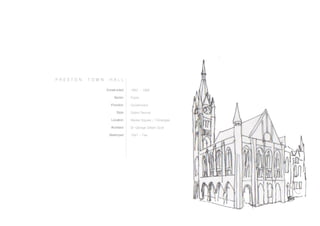
dition buildings in Preston like the town hall
were obtained.
1.
2.
3.
1.
3.
L O C A L M I N E R A L S I N L A N C A S H I R E
Historically, Lancashire has a very long tradition of using local-
ly quarried stone for building purposes. The oldest rocks of the
country are limestone of the lower carboniferous succession and
these have been quarried locally along much of their outcrop,
notably around Carnforth and Clitheroe.
The sandstone of the Pendle Grit Formation was extensively quar-
ried for building around Preston for example at Longridge Fell
and Mellor. The town hall at Preston is Built of Longridge Stone.
1. Sand and Gravel
River sand and gravel (terrace and sub-alluvial deposites)
Glaciofluvial sand and gravel
Blown sand
2. Crushed rock aggregates
Limestone
Sandstone
3. Brick Clay
4. Building Stone
5. Silica Sand
6. Salt
7. Metallic Mineralisation
8. Peat
Types of Building Stone
Granite, sandstone and limestone can all be used for building
walls, but slate is only suitable for roofs and floors. Some types
of granite can contain mineral salts that cause spalling, where
the outer face of stone falls off; slate can contain harmful min-
erals that break down on exposure to the atmosphere causing
stone damage; and sandstone can be too porous and fragile for
load-bearing structures. An understanding of how the rock ma-
terial was formed will reveal how it can be used in a building,
what its limitations are, and how it will weather over time.
Dry Stone Stacking
The earliest form of stone construction is known as dry stone,
or dry stacking. These are freestanding structures such as field
walls, bridges and buildings that use irregularly shaped stones
carefully selected and placed so that they fit closely together
without slipping. Structures are typically wider at the base and
taper in as height increases. The weight of the stone pushes
inwards to support the structure, and any settling or disturbance
makes the structure lock together and become even stronger.
Dry stone structures are highly durable and easily repaired. They
allow water to drain through them, without causing damage to the
stones.
Stone Masonry
Traditional stone masonry is rarely used today, because stone is
expensive to quarry, cut and transport, and the building process
is labour and skill-intensive. Instead, most modern stonework
utilises a veneer of stone (thin, flat pieces) glued against a wall of
concrete blocks. This is known as veneered stone or stone clad-
ding.
Sustainable Stone
Stone is a highly durable, low maintenance building material with
high thermal mass. It is versatile, available in many shapes, sizes,
colours and textures, and can be used for floors, walls, arches
and roofs. Stone blends well with the natural landscape, and can
easily be recycled for other building purposes. But is stone a
sustainable building solution? There are currently over 400 build-
ing stone quarries in the UK, more than enough to meet current
demand, but with a growing influx of cheap, imported stone and
synthetic imitations, the industry is under threat. To meet sustain-
ability standards, steps must be taken to ensure that the stone
is found on site, reclaimed from nearby demolished buildings or
sourced from a local stone quarry. Only then can stone be con-
sidered a true example of a sustainable building material.
L O C A L M I N E R A S L A N C A S H I R E
1.
2.
Production of sand and gravel in Lan-
cashire, 1979-2004
Between 1998 and 2004 annual produc-
tion of sand gravel in Lancashire has varied
roughly between 350,000 and 1 million
tonnes.
1 Tonnes = 1.10231 tons
Lancashire is an important source of lime-
stone and in 2004 4.68 million tonnes
were quarried in the country. Most (about
3 million tonnes) is consumed in the con-
struction industry as aggregate or fill for lo-
cal and regional needs. Significant amounts
of limestone are also produced for cement
manufacture at Clitheroe.
1.
2.
L O C A L M I N E R A L L A N C A S H I R E
1.
2.
Thermal insulation breaks are important to
stop energy loss through heat and cold
bridging
Example of a new add-on to an old stone
building: National Museum of Scotland
1.
2.
W A T E R S U S T A I N A B I L I T Y
1.
2.
3.
4.
• Consider as unlimited resource
• Able to sustain two years of drought in
the South East (Summer 2006)
• Though, a thrid dry winter could have
caused serious problems.
Reservoirs
•21 Reservoirs in Lancashire
Rivers
Underground aquifers
Map of Underground water in Chorley
T Y P E S O F W A T E R S O U R C E S
Central Lancashire Strategic Flood Risk Assessment
Level 1 SFRA
Central Lancashire Level 1 SFRA
Chorley Groundwater Vulnerability
Features of this map are based upon
information provided by the Environment
Agency. ¬ Copyright Environment Agency,
2007
E7Scott Wilson – December 2007
1. 2.
4.3.
1.
2.
3.
• A trace of Cryptosporidium – which can
cause diarrhea – was found in the water
network
• More than 2,500 miles of pipework and
several large reservoirs have to clear before
officials will be satisfied there are no traces
of the bug in the water supply.
• About half the 300,000 households hit by
the outbreak
• Takes more than two weeks of time to
clean out the pipe network.
Sustainability consideration
• United Utilities- the water supplier for
Lancashire- guarantee to have an “ex-
tremely high standards” of water supply.
• And so there is no worries in long term
usage of water.
Area of affection, and Preston being part of
it (7th August, 2015)
Image of Cryptosporidium
Inside the Franklaw water treatment works
W A T E R C O M T A M I N A T I O N & D R I N K A B I L I T Y
1.
2.
3.
1.
2.
• Interrupt water supplies to homes and
environment.
• Unsurvival of plants and animal in water.
• Dryout and destroy wetlands
• Flooding
• Preston will have good water supply for
the following century.
Preston has low level of water stress, and
supplied by United Utilities.
Lancashire used 75% of the water coming
from surface water;
25% from underground
W H A T C O U L D H A P P E N I F T H E W A T E R S T R E S S O U T
Preston
1.
2.
T E C H N O L O G Y C O N S I D E R A T I O N
Coniferous trees on the wind sides to help
against the wind
Deciduous trees on the south – allow the
sun in winter but provide shade in summer
Rain water collection system
Use of gravel instead of asphalt/concrete-
acts as a natural filter and allows rain water
to be absorbed
Create and designate a compost zone –
keeps trash from landfill, brings life to the
soil and reduces irrigation needs
Other points to consider whilst designing a
sustainable building:
• Insulation
• Air tightness
• Thermal mass
• Natural light
• Materials- consider use of nearby re-
sources – wood etc
• Different structural systems:
Heat exchange unit
Combined Heat and Power design
Photovoltaic module
Solar boiler
1.
2.
3.
4.
H O W T O B U I L D G R E E N & S U S T A I N A B L E L A N D S C A P E
1. 2.
4.
3.
C A S E S T U D Y
1. Marlene Imurzian & Associates Architects,
Phoenix
• Trex’s Transcend composite decking
• Used as rainscreen
• 38,600 linear feet
• Mounted horizontally to vertical hat chan-
nels with flashing tape
• Vapor-permeable air barrier
• Rigid insulation
•Affixed to the exterior sheathing and metal
stud wall
• Reduces heat loss
1.
• Excellent Thermal Performance – mini-
mal thermal bridges with the elimination of
traditional wood 2×6 framing at 16 o.c.
• Integral Insulation – solid core is expand-
ed polystyrene (EPS) which has an R value
of 3.8/inch
• Low Waste (Factory Built) – panels are
pre-engineered and produced in a con-
trolled environment
• Fast Construction Method – erection of
the panels is estimated to be as much as 3
times faster than traditional framing
• Air-Tightness – fewer joints and OSB
sheathing on two sides allow for a much
tighter building assembly
S T R U C T U R A L I N S U L A T E D P A N E L S
• Architen Landrell has developed a tensile
roof system that is capable of meeting the
very high thermal values of an insulated
conventional roof
• Retains the virtues of sculptural form
• Clear structural span
• Sandwich system
• Technology to pattern and join panels
• Extremely versatile approach to insulating
membrane roofs
I N S U L A T E D T E N S I L E F A B R I C R O O F

Site analysis

  • 59.
    P R ES T O N C I T Y C O U N C I L Council Election This is the voting information for the Local Election 2014 in Preston. It show the voting data and representation local to Preston.
  • 60.
    Council Election This isthe voting information for the Lo- cal Election 2014 in England. It show the voting data and representation throughout England. E N G L A N D C O U N C I L
  • 61.
    European Election This isthe voting information for the Eu- ropean Election 2014 in the North West. It show the area of that represents Preston and the voting data for the North West. E U R O P E A N E L E C T I O N
  • 62.
    This is theresults for the European Elec- tion 2014. It show the number of MEPs by party and representative of country. E U R O P E A N E L E C T I O N
  • 63.
    This is thevoting information for the Gen- eral Election 2015 in the United Kingdom. It show the results and the errors in popula- tion representation. G E N E R A L E L E C T I O N - U K
  • 64.
    This is thevoting information for the Gen- eral Election 2015 in Preston. It show the voting data for the area as well as history and demographics. G E N E R A L E L E C T I O N - P R E S T O N
  • 65.
    A Labour seatsince 1983, Preston is an old cotton town at the heart of Lancashire which was granted city status in 2002. It has a traditional manufacturing base in textiles and engineering - BAE Systems is a big employer - but sectors such as busi- ness services have also grown. Many work in sales and customer services jobs. The University of Central Lancashire is based here and continuing regeneration in the city - a regional shopping centre - including moves to develop a new central business district. The seat has a big student population and fewer family households than average, ac- cording to the 2011 Census. Home own- ership is low and the private rental sector is large. There is also more social housing and higher unemployment than average. Labour’s Mark Hendrick held the seat in 2010 with a majority of 7,733 votes. The Lib Dems came second. C O N S I T I T U E N C Y P R O F I L E - P R E S T O N
  • 96.
  • 97.
    P O LL U T I O N C O N T R O L
  • 98.
    Effects * asthma,allergies, respiratory ill- nesses Exhaust Burn of fossil fuels Paint production/ plastic Radiation spills/ nuclear accidents Control Method : Preventing emissions to begin with Pollution control equipment Plant trees Conserve energy (lights etc) Light Sensitive structure which acts like a photo catalyst (For more info look at Light- 2Cat) Use Eco- Friendly Materials Recycling & bio-fuels Resourcing Local Materials & Using them into your building Waste minimisation & recycling within the building 1. 2. A I R P O L L U T I O N 1. 2.
  • 99.
    1. 2. destroys natural habitats,resources & communities Litter Oil Spills Pesticides &farming chemicals Illegal dumping/unsustainable logging practices Control Method: Organic Farming Recycling Green energy resources Bio-degradable material use Little packaging L A N D P O L L U T I O N 1. 2.
  • 100.
    Uses energy anddisturbs sleep patterns. This also makes the beauty of the sky to be unable to be seen unless in country side Street lamps Unnecessary lights around and inside buildings Interferes with wild life Control Method : Green energy & light bulbs Intelligent outdoor lighting 1. 2. L I G H T P O L L U T I O N 1. 2.
  • 101.
    1. 2. harmful to unborns,hightens stress levels, causes nervousness. Aeroplanes, helicopters, motored vehicles Construction& demolition noise Sporting events, concerts Control Method: Plant Trees – noise buffer Use soft furnishings/ surfaces that reflect sound Avoid use of :hand toold, power tools, plant equipment, scaffolding, partition walls. Install noisy machines in soundproof cham- bers or using damping layers around and beneath them N O I S E P O L L U T I O N 1. 2.
  • 102.
    T H ER M A L P O L L U T I O N 1. increase of temperature by human activity Hydro-electric power Nuclear power plants & coal fired plants Domestic sewage Masses of concrete absorb sun and change the climate of the area. Control Method: Cooling towers Artificial lakes 1.
  • 103.
    1. 2. A subjective topic-unattractive or damag- ing to landscape Graffiti Billboards Antennas & wires Junkyards & unlawful disposal of waste Control Method- Visual Pollution is a high- ly subjective area, it is up to the designer whether they want to control it or not. Clear graffiti Restrict the hours of billboards being dis- played Hide the antennas and wires Promote awareness in community for waste disposal Linked to health issues in humans& animals Raw sewage contaminating lakes & streams Industrial waste spills Biological contamination such as bacteria Farm runoff into nearby waters Control Method: Sewage treatment Proper sewage treatments Reduce or use of different farming chemi- cals V I S U A L P O L L U T I O N & W A T E R P O L L U T I O N 1. 2.
  • 104.
    N A TU R E R E S E R V A T I O N
  • 105.
    G R EE N S P A C E A R O U N D P R E S T O N Local Nature Reserves are designated be- cause of their high wildlife, community and educational value and provide places for people to enjoy nature on their doorstep. • Fishwick • Grange Valley • Haslam Park • Hills and Hollows • Pope Lane Field • Boilton Wood Preston has been praised for its many designated Local Nature Reserves. These green spaces are designated for their di- verse wildlife, community and educational value, making them a fascinating place to visit if you’re interested in nature and the outdoors. Avenham and Miller Parks Avenham and Miller Parks are adjoining Parks that lie in the picturesque Avenham valley close to Preston city centre. Even though the parks are close to Preston’s main shopping and business area, their tranquil setting on the banks of the River Ribble offers a pleasant retreat from the hustle and bustle of city life.
  • 106.
    H A BI T A T S Bramble- The Fruits are tasty to birds and people. Rosebay Willow Herb-The leaves can be dried and mixed with blackberry and raspberry to make a herb tea. Nettle-The leaves are a good food plant . Silver Birch-The leaves also yield green and yellow dyes. Red Clover-The flowers and leaves can be cooked as a vegetable. Hawthorn-the younbg leaves are good in salad
  • 107.
    Water Energy Air and Climate Biodiversity Land,Forests, and Ecosystems Building Sustainability P R E S E R V A T I O N
  • 108.
    E N ER G Y S U S T A I N A B I L I T Y
  • 109.
    1. 2. - Energy (humanneed) - Energy sources - New energy sources and technology Energy (human need) Engage the whole supply chain from: • designers • subcontractors • materials suppliers To reduce the production of waste at source through better design, improved packaging and better control of materials on site. In order to save more energy, where waste is produced, the quantities should be mon- itored and rather than sending it to landfill, divert it to waste centres to: •Re-use •Recycle •Recover energy from waste materials The closest heavy materials recycle waste center is located close to Bury The closest light materials reycle waste centre is located outside of Preston E N E R GY S U S T A I N A B I L I T Y O F S I T E 1. 2.
  • 110.
    E N ER G Y S U S T A I N A B I L I T Y OF S I T E 1. 2. - Energy (human need) - Energy sources - New energy sources and technology Use of and finishes such us various types of agriboard sheathing and or insulation board made from: • Agricultural waste • By-products • Straw • Wheat • Barley • Soy Sourcing landscape materials from appro- priate distances and origin; and sustainably managing the project’s waste stream. Transportation becomes part of a product or building materials embodied energy. • Specify and use locally harvested, mined and manufactured materials and prod- ucts to support the regional economy and to reduce transportation, energy use and emissions. • Give preference to products and systems that facilitate easy, non-energy • Use of prefabricated componentsSand and Gravel 1. 2.
  • 111.
    - Energy (humanneed) - Energy sources - New energy sources and technology Evaluate the site in terms of the location and orientation of buildings and improve- ments in order to: • Optimize the use of solar energy • Natural daylighting • Natural breezes and ventilation Help reduce the urban heat island effect by reducing the building and site development footprint should: • Maximizing the use of pervious surfaces • Using light coloured roofs, paving, and walkways. • Provide natural shading of buildings and paved areas with trees and other landscape features Consider site security concurrently with sustainable site issues. Location of access roads, parking, vehicle barriers, and perim- eter lighting, among others are key issues that must be addressed. Help reduce night-time light pollution by avoiding over-illumination of the site and use low cut-off exterior lighting fixtures which direct light downward E N E R G Y S O U R C E S
  • 112.
    1. N E WE N E R G Y S O U R C E S A N D T E C H O L O G Y - Energy (human need) - Energy sources - New energy sources and technology Minimize adverse impacts on the environ- ment • Use high performance low-e glazing, which can result in significant year round energy savings. • Consider insulated double glazing, triple glazing or double pane glazing with a sus- pended low-e film. • Window frames, sashes and curtain wall systems should also be designed for opti- mum energy performance including the use of multiple thermal breaks • Optimize the value of exterior insulation and the overall thermal performance of the exterior envelope assembly • Structural insulated panel systems (SIPS) • Insulated concrete form systems (ICF’s) 1.
  • 113.
    M A TE R I A L S S U S T A I N A B I L I T Y
  • 114.
    L O CA L M I N E R A L S L A N C A S H I R E Bradley Sandpit near Fulwood, Lancashire. Working Glaciofluvial sand and gravel. A variety of hard rocks are, when crushed, suitable for use as aggregates. Their tech- nical suitability for resistance to impact and abrasion. higher quality aggregates are required for coating with bitumen for road surfacing, or for mixing with cement to pro- duce concrete. A view of Lanehead Quarry and the Rib- blesdale Cement works, from the nearby village of Chatburn. Quarry is working the carboniferous chatburn limestone. The Red areas represent commercial de- cison to work mineral has been made. A successful application has been dealt with through the provisions of the Town and Country Planning legislation and the per- mitted reserve will have been deplete to a greater or lesser extent. The red spot North East of Preston is where most of the stone used for the tra- dition buildings in Preston like the town hall were obtained. 1. 2. 3. 1. 3.
  • 115.
    L O CA L M I N E R A L S I N L A N C A S H I R E Historically, Lancashire has a very long tradition of using local- ly quarried stone for building purposes. The oldest rocks of the country are limestone of the lower carboniferous succession and these have been quarried locally along much of their outcrop, notably around Carnforth and Clitheroe. The sandstone of the Pendle Grit Formation was extensively quar- ried for building around Preston for example at Longridge Fell and Mellor. The town hall at Preston is Built of Longridge Stone. 1. Sand and Gravel River sand and gravel (terrace and sub-alluvial deposites) Glaciofluvial sand and gravel Blown sand 2. Crushed rock aggregates Limestone Sandstone 3. Brick Clay 4. Building Stone 5. Silica Sand 6. Salt 7. Metallic Mineralisation 8. Peat Types of Building Stone Granite, sandstone and limestone can all be used for building walls, but slate is only suitable for roofs and floors. Some types of granite can contain mineral salts that cause spalling, where the outer face of stone falls off; slate can contain harmful min- erals that break down on exposure to the atmosphere causing stone damage; and sandstone can be too porous and fragile for load-bearing structures. An understanding of how the rock ma- terial was formed will reveal how it can be used in a building, what its limitations are, and how it will weather over time. Dry Stone Stacking The earliest form of stone construction is known as dry stone, or dry stacking. These are freestanding structures such as field walls, bridges and buildings that use irregularly shaped stones carefully selected and placed so that they fit closely together without slipping. Structures are typically wider at the base and taper in as height increases. The weight of the stone pushes inwards to support the structure, and any settling or disturbance makes the structure lock together and become even stronger. Dry stone structures are highly durable and easily repaired. They allow water to drain through them, without causing damage to the stones. Stone Masonry Traditional stone masonry is rarely used today, because stone is expensive to quarry, cut and transport, and the building process is labour and skill-intensive. Instead, most modern stonework utilises a veneer of stone (thin, flat pieces) glued against a wall of concrete blocks. This is known as veneered stone or stone clad- ding. Sustainable Stone Stone is a highly durable, low maintenance building material with high thermal mass. It is versatile, available in many shapes, sizes, colours and textures, and can be used for floors, walls, arches and roofs. Stone blends well with the natural landscape, and can easily be recycled for other building purposes. But is stone a sustainable building solution? There are currently over 400 build- ing stone quarries in the UK, more than enough to meet current demand, but with a growing influx of cheap, imported stone and synthetic imitations, the industry is under threat. To meet sustain- ability standards, steps must be taken to ensure that the stone is found on site, reclaimed from nearby demolished buildings or sourced from a local stone quarry. Only then can stone be con- sidered a true example of a sustainable building material.
  • 116.
    L O CA L M I N E R A S L A N C A S H I R E 1. 2. Production of sand and gravel in Lan- cashire, 1979-2004 Between 1998 and 2004 annual produc- tion of sand gravel in Lancashire has varied roughly between 350,000 and 1 million tonnes. 1 Tonnes = 1.10231 tons Lancashire is an important source of lime- stone and in 2004 4.68 million tonnes were quarried in the country. Most (about 3 million tonnes) is consumed in the con- struction industry as aggregate or fill for lo- cal and regional needs. Significant amounts of limestone are also produced for cement manufacture at Clitheroe. 1. 2.
  • 117.
    L O CA L M I N E R A L L A N C A S H I R E 1. 2. Thermal insulation breaks are important to stop energy loss through heat and cold bridging Example of a new add-on to an old stone building: National Museum of Scotland 1. 2.
  • 118.
    W A TE R S U S T A I N A B I L I T Y
  • 119.
    1. 2. 3. 4. • Consider asunlimited resource • Able to sustain two years of drought in the South East (Summer 2006) • Though, a thrid dry winter could have caused serious problems. Reservoirs •21 Reservoirs in Lancashire Rivers Underground aquifers Map of Underground water in Chorley T Y P E S O F W A T E R S O U R C E S Central Lancashire Strategic Flood Risk Assessment Level 1 SFRA Central Lancashire Level 1 SFRA Chorley Groundwater Vulnerability Features of this map are based upon information provided by the Environment Agency. ¬ Copyright Environment Agency, 2007 E7Scott Wilson – December 2007 1. 2. 4.3.
  • 120.
    1. 2. 3. • A traceof Cryptosporidium – which can cause diarrhea – was found in the water network • More than 2,500 miles of pipework and several large reservoirs have to clear before officials will be satisfied there are no traces of the bug in the water supply. • About half the 300,000 households hit by the outbreak • Takes more than two weeks of time to clean out the pipe network. Sustainability consideration • United Utilities- the water supplier for Lancashire- guarantee to have an “ex- tremely high standards” of water supply. • And so there is no worries in long term usage of water. Area of affection, and Preston being part of it (7th August, 2015) Image of Cryptosporidium Inside the Franklaw water treatment works W A T E R C O M T A M I N A T I O N & D R I N K A B I L I T Y 1. 2. 3.
  • 121.
    1. 2. • Interrupt watersupplies to homes and environment. • Unsurvival of plants and animal in water. • Dryout and destroy wetlands • Flooding • Preston will have good water supply for the following century. Preston has low level of water stress, and supplied by United Utilities. Lancashire used 75% of the water coming from surface water; 25% from underground W H A T C O U L D H A P P E N I F T H E W A T E R S T R E S S O U T Preston 1. 2.
  • 122.
    T E CH N O L O G Y C O N S I D E R A T I O N
  • 123.
    Coniferous trees onthe wind sides to help against the wind Deciduous trees on the south – allow the sun in winter but provide shade in summer Rain water collection system Use of gravel instead of asphalt/concrete- acts as a natural filter and allows rain water to be absorbed Create and designate a compost zone – keeps trash from landfill, brings life to the soil and reduces irrigation needs Other points to consider whilst designing a sustainable building: • Insulation • Air tightness • Thermal mass • Natural light • Materials- consider use of nearby re- sources – wood etc • Different structural systems: Heat exchange unit Combined Heat and Power design Photovoltaic module Solar boiler 1. 2. 3. 4. H O W T O B U I L D G R E E N & S U S T A I N A B L E L A N D S C A P E 1. 2. 4. 3.
  • 124.
    C A SE S T U D Y 1. Marlene Imurzian & Associates Architects, Phoenix • Trex’s Transcend composite decking • Used as rainscreen • 38,600 linear feet • Mounted horizontally to vertical hat chan- nels with flashing tape • Vapor-permeable air barrier • Rigid insulation •Affixed to the exterior sheathing and metal stud wall • Reduces heat loss 1.
  • 125.
    • Excellent ThermalPerformance – mini- mal thermal bridges with the elimination of traditional wood 2×6 framing at 16 o.c. • Integral Insulation – solid core is expand- ed polystyrene (EPS) which has an R value of 3.8/inch • Low Waste (Factory Built) – panels are pre-engineered and produced in a con- trolled environment • Fast Construction Method – erection of the panels is estimated to be as much as 3 times faster than traditional framing • Air-Tightness – fewer joints and OSB sheathing on two sides allow for a much tighter building assembly S T R U C T U R A L I N S U L A T E D P A N E L S
  • 126.
    • Architen Landrellhas developed a tensile roof system that is capable of meeting the very high thermal values of an insulated conventional roof • Retains the virtues of sculptural form • Clear structural span • Sandwich system • Technology to pattern and join panels • Extremely versatile approach to insulating membrane roofs I N S U L A T E D T E N S I L E F A B R I C R O O F