The Query-Cycle Simulator for Simulating P2P Networks Mario T. Schlosser Tyson E. Condie Sepandar D. Kamvar Stanford University
Problem:   Accurately Simulate Real-World P2P Networks. Motivation: Testing P2P Algorithms. Problem For each peer  i  { -Repeat until convergence { - Compute . . .  - Send  . . . } }
Goals P2P Simulator Descriptive Simple Easily Extensible Make it available on the web so that people can test and compare their algorithms on a standard platform.
Query Cycle Model Query Cycle 1
Query Cycle Model Query Cycle 2
Query Cycle Model Query Cycle 3
Properties to Model Peer Content Network Parameters Peer Behavior
Properties to Model Peer Content How Much? What Type? Network Parameters Peer Behavior
Data Volume Observations Model Simulator assigns # of files owned by peer i according to distribution. Saroiu,Gummandi,and Gribble. A Measurement Study of Peer-to-Peer File Sharing Systems, 2002.
Content Type: Observations Content Categories Zipf distribution on file popularity Crespo and Garcia-Molina. Semantic Overlay Networks, 2002. Korfhage,  Information Storage and Retrieval,  1997. Punk Rock Hip-Hop Jazz
Content Type: Model Modeling Content Categories: Assume n content categories. C={c 1 ,c 2 ,…,c n } A peer  i  is assigned content categories according to the Zipf distribution: It is then assigned an interest level  p(c|i)  to each of the assigned content categories by a uniform random distribution.
Content Type: Model Modeling Files: Each distinct file f may be uniquely identified by {c,r} A peer is assigned files by:
Recap on Content Assignment
Recap on Content Assignment Assign Data Volume
Recap on Content Assignment {c1, c3, c4} Assign Content Categories
Recap on Content Assignment {c1=.5, c3=.3, c4=.2} Assign Interest Level to Content Categories
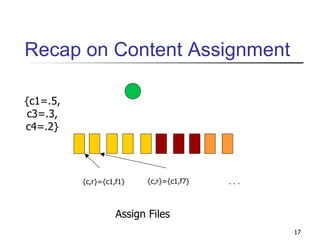
Recap on Content Assignment {c1=.5, c3=.3, c4=.2} Assign Files {c,r}={c1,f1} {c,r}={c1,f7} . . .
Properties to Model Peer Content Network Parameters Topology Bandwidth Peer Behavior
Network Parameters Topology: Observation: Power Law Topology Model: probability of connecting to a peer is proportional to the degree of that peer. Bandwidth Simple Bandwidth Model Can be easily extended.
Properties to Model Peer Content Network Parameters Peer Behavior
Query-Cycle Model At each cycle, peer i may be: active inactive or down
At each cycle, peer i may be: active inactive or down Query-Cycle Model Issues a single query. Waits for incoming responses. Selects a source and downloads file. Also: Responds to queries. Forwards query messages.
At each cycle, peer i may be: active inactive or down Query-Cycle Model Responds to queries. Forwards Query Messages.
At each cycle, peer i may be: active inactive or down Query-Cycle Model Does nothing.
Properties to Model Peer Content Network Parameters Peer Behavior Uptime and Session Duration Query Activity Queries Query Responses Downloads
Uptime Observations Model At each query cycle, probability of being up is drawn from distribution in Saroiu et al. Saroiu,Gummandi,and Gribble. A Measurement Study of Peer-to-Peer File Sharing Systems, 2002.
Queries Observations None Model Based on the idea that peers query for files in the same categories that they own.
Responses and Downloads Responses If a peer receives a query for which it owns the file, it responds. Source Selection Random
Extensions Different Types of Peers i.e., Malicious Peers Different Models for Different Situations Reputation-based source selection. Edutella: model distribution over markups rather than content categories. Web Services: Change models for content distribution, query activity, etc.  However, parameters are the same.
Samples
Future Work Test predictions against observations in P2P networks “in the wild”. Observations, observations, observations. Model other networks.
The End Code, demos will be available at  http://www.stanford.edu/~sdkamvar/research.html  next monday.
Motivation Network or peer property Affected algorithms Topology Content distribution Bandwidth, uptime of peers Structuring algorithms Whatever Stability of trust algorithms
Query Activity Observations Model At each query cycle, . . .  Saroiu,Gummandi,and Gribble. A Measurement Study of Peer-to-Peer File Sharing Systems, 2002.

Simulator

  • 1.
    The Query-Cycle Simulatorfor Simulating P2P Networks Mario T. Schlosser Tyson E. Condie Sepandar D. Kamvar Stanford University
  • 2.
    Problem: Accurately Simulate Real-World P2P Networks. Motivation: Testing P2P Algorithms. Problem For each peer i { -Repeat until convergence { - Compute . . . - Send . . . } }
  • 3.
    Goals P2P SimulatorDescriptive Simple Easily Extensible Make it available on the web so that people can test and compare their algorithms on a standard platform.
  • 4.
    Query Cycle ModelQuery Cycle 1
  • 5.
    Query Cycle ModelQuery Cycle 2
  • 6.
    Query Cycle ModelQuery Cycle 3
  • 7.
    Properties to ModelPeer Content Network Parameters Peer Behavior
  • 8.
    Properties to ModelPeer Content How Much? What Type? Network Parameters Peer Behavior
  • 9.
    Data Volume ObservationsModel Simulator assigns # of files owned by peer i according to distribution. Saroiu,Gummandi,and Gribble. A Measurement Study of Peer-to-Peer File Sharing Systems, 2002.
  • 10.
    Content Type: ObservationsContent Categories Zipf distribution on file popularity Crespo and Garcia-Molina. Semantic Overlay Networks, 2002. Korfhage, Information Storage and Retrieval, 1997. Punk Rock Hip-Hop Jazz
  • 11.
    Content Type: ModelModeling Content Categories: Assume n content categories. C={c 1 ,c 2 ,…,c n } A peer i is assigned content categories according to the Zipf distribution: It is then assigned an interest level p(c|i) to each of the assigned content categories by a uniform random distribution.
  • 12.
    Content Type: ModelModeling Files: Each distinct file f may be uniquely identified by {c,r} A peer is assigned files by:
  • 13.
    Recap on ContentAssignment
  • 14.
    Recap on ContentAssignment Assign Data Volume
  • 15.
    Recap on ContentAssignment {c1, c3, c4} Assign Content Categories
  • 16.
    Recap on ContentAssignment {c1=.5, c3=.3, c4=.2} Assign Interest Level to Content Categories
  • 17.
    Recap on ContentAssignment {c1=.5, c3=.3, c4=.2} Assign Files {c,r}={c1,f1} {c,r}={c1,f7} . . .
  • 18.
    Properties to ModelPeer Content Network Parameters Topology Bandwidth Peer Behavior
  • 19.
    Network Parameters Topology:Observation: Power Law Topology Model: probability of connecting to a peer is proportional to the degree of that peer. Bandwidth Simple Bandwidth Model Can be easily extended.
  • 20.
    Properties to ModelPeer Content Network Parameters Peer Behavior
  • 21.
    Query-Cycle Model Ateach cycle, peer i may be: active inactive or down
  • 22.
    At each cycle,peer i may be: active inactive or down Query-Cycle Model Issues a single query. Waits for incoming responses. Selects a source and downloads file. Also: Responds to queries. Forwards query messages.
  • 23.
    At each cycle,peer i may be: active inactive or down Query-Cycle Model Responds to queries. Forwards Query Messages.
  • 24.
    At each cycle,peer i may be: active inactive or down Query-Cycle Model Does nothing.
  • 25.
    Properties to ModelPeer Content Network Parameters Peer Behavior Uptime and Session Duration Query Activity Queries Query Responses Downloads
  • 26.
    Uptime Observations ModelAt each query cycle, probability of being up is drawn from distribution in Saroiu et al. Saroiu,Gummandi,and Gribble. A Measurement Study of Peer-to-Peer File Sharing Systems, 2002.
  • 27.
    Queries Observations NoneModel Based on the idea that peers query for files in the same categories that they own.
  • 28.
    Responses and DownloadsResponses If a peer receives a query for which it owns the file, it responds. Source Selection Random
  • 29.
    Extensions Different Typesof Peers i.e., Malicious Peers Different Models for Different Situations Reputation-based source selection. Edutella: model distribution over markups rather than content categories. Web Services: Change models for content distribution, query activity, etc. However, parameters are the same.
  • 30.
  • 31.
    Future Work Testpredictions against observations in P2P networks “in the wild”. Observations, observations, observations. Model other networks.
  • 32.
    The End Code,demos will be available at http://www.stanford.edu/~sdkamvar/research.html next monday.
  • 33.
    Motivation Network orpeer property Affected algorithms Topology Content distribution Bandwidth, uptime of peers Structuring algorithms Whatever Stability of trust algorithms
  • 34.
    Query Activity ObservationsModel At each query cycle, . . . Saroiu,Gummandi,and Gribble. A Measurement Study of Peer-to-Peer File Sharing Systems, 2002.