Simulating dynamics of rare events 
using discretised relaxation path 
sampling 
Boris Fačkovec 
Wales group 
Department of Chemistry 
University of Cambridge 
Energy landscapes workshop 
Durham, 18th August 2014 
Discretised relaxation path sampling (DRPS) 1 /19 bf269@cam.ac.uk
Rare events in nature 
 
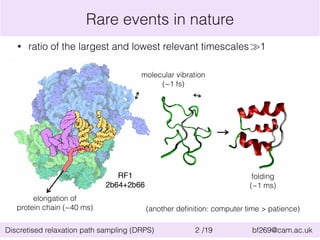
• ratio of the largest and lowest relevant timescales 1 
molecular vibration 
(~1 fs) 
elongation of 
protein chain (~40 ms) 
folding 
(~1 ms) 
(another definition: computer time  patience) 
Discretised relaxation path sampling (DRPS) 2 /19 bf269@cam.ac.uk
Towards dynamics of rare events 
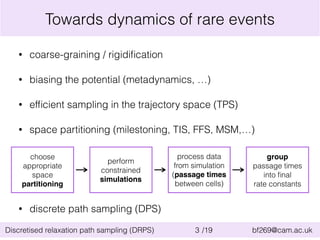
• coarse-graining / rigidification 
• biasing the potential (metadynamics, …) 
• efficient sampling in the trajectory space (TPS) 
• space partitioning (milestoning, TIS, FFS, MSM,…) 
choose 
appropriate 
space 
partitioning 
perform 
constrained 
simulations 
group! 
passage times 
into final 
rate constants 
process data 
from simulation 
(passage times 
between cells) 
• discrete path sampling (DPS) 
Discretised relaxation path sampling (DRPS) 3 /19 bf269@cam.ac.uk
Cell-to-cell rate constant 
A 
B 
C 
D A 
B 
C 
AC 
D AB BC 
BD 
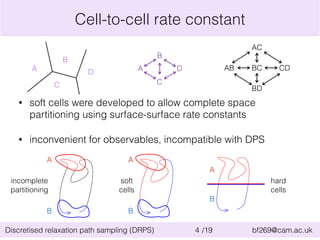
• soft cells were developed to allow complete space 
partitioning using surface-surface rate constants 
• inconvenient for observables, incompatible with DPS 
A A 
incomplete 
partitioning 
soft 
cells 
CD 
hard 
cells 
A 
B 
B B 
Discretised relaxation path sampling (DRPS) 4 /19 bf269@cam.ac.uk
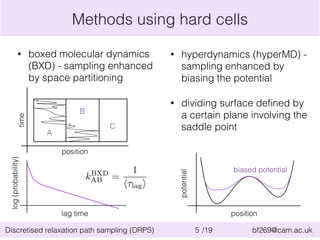
Methods using hard cells 
• boxed molecular dynamics 
(BXD) - sampling enhanced 
by space partitioning 
B 
position 
kBXD 
AB = 
lag time 
time 
log (probability) 
• hyperdynamics (hyperMD) - 
sampling enhanced by 
biasing the potential 
• dividing surface defined by 
a certain plane involving the 
saddle point 
biased potential 
position 
potential 
A 
C 
1 
h⌧lagi 
Discretised relaxation path sampling (DRPS) 5 /19 bf269@cam.ac.uk
Limits of TST 
• transition state theory - rate constant = equilibrium flux / 
equilibrium population 
kTST 
AB = 
flux 
population 
= hP(x) [n(x) · v]i@A 
hP(x)iA 
= 
@tpA(0) 
pA(0) 
• the rate constant is very sensitive to definition of the dividing 
time 
population in A 
A A 
time 
population in A 
surface 
Discretised relaxation path sampling (DRPS) 6 /19 bf269@cam.ac.uk
Rate constants from trajectories 
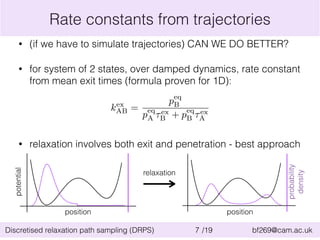
• (if we have to simulate trajectories) CAN WE DO BETTER? 
• for system of 2 states, over damped dynamics, rate constant 
from mean exit times (formula proven for 1D): 
• relaxation involves both exit and penetration - best approach 
Discretised relaxation path sampling (DRPS) 7 
/19 bf269@cam.ac.uk 
position 
potential 
probability 
density 
position 
relaxation 
kex 
AB = 
peq 
B 
peq 
A ⌧ ex 
B + peq 
B ⌧ ex 
A
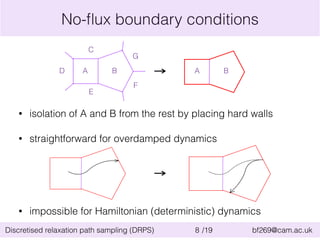
No-flux boundary conditions 
C 
A B 
D 
E 
G 
F 
A B 
• isolation of A and B from the rest by placing hard walls 
• straightforward for overdamped dynamics 
• impossible for Hamiltonian (deterministic) dynamics 
Discretised relaxation path sampling (DRPS) 8 /19 bf269@cam.ac.uk
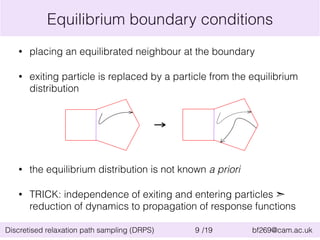
Equilibrium boundary conditions 
• placing an equilibrated neighbour at the boundary 
• exiting particle is replaced by a particle from the equilibrium 
distribution 
• the equilibrium distribution is not known a priori 
• TRICK: independence of exiting and entering particles ➣ 
reduction of dynamics to propagation of response functions 
Discretised relaxation path sampling (DRPS) 9 /19 bf269@cam.ac.uk
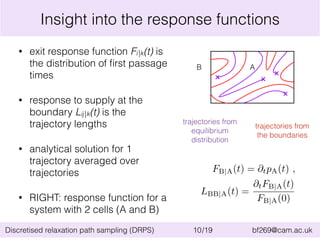
Insight into the response functions 
• exit response function Fi|k(t) is 
the distribution of first passage 
times 
• response to supply at the 
boundary Lij|k(t) is the 
trajectory lengths 
• analytical solution for 1 
trajectory averaged over 
trajectories 
• RIGHT: response function for a 
system with 2 cells (A and B) 
B A 
trajectories from 
equilibrium 
distribution 
trajectories from 
the boundaries 
FB|A(t) = @tpA(t) , 
LBB|A(t) = 
@tFB|A(t) 
FB|A(0) 
Discretised relaxation path sampling (DRPS) 10/19 bf269@cam.ac.uk
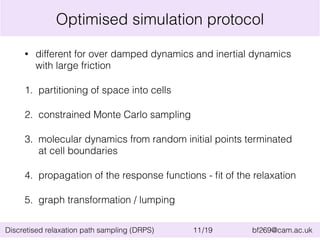
Optimised simulation protocol 
• different for over damped dynamics and inertial dynamics 
with large friction 
1. partitioning of space into cells 
2. constrained Monte Carlo sampling 
3. molecular dynamics from random initial points terminated 
at cell boundaries 
4. propagation of the response functions - fit of the relaxation 
5. graph transformation / lumping 
Discretised relaxation path sampling (DRPS) 11/19 bf269@cam.ac.uk
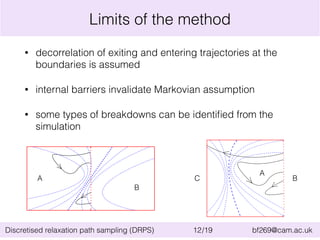
Limits of the method 
• decorrelation of exiting and entering trajectories at the 
boundaries is assumed 
• internal barriers invalidate Markovian assumption 
• some types of breakdowns can be identified from the 
simulation 
A 
B 
A 
C B 
Discretised relaxation path sampling (DRPS) 12/19 bf269@cam.ac.uk
Application of estimator: 
Sinai billiards 
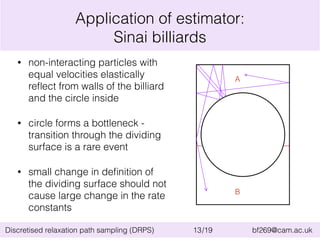
• non-interacting particles with 
equal velocities elastically 
reflect from walls of the billiard 
and the circle inside 
• circle forms a bottleneck - 
transition through the dividing 
surface is a rare event 
• small change in definition of 
the dividing surface should not 
cause large change in the rate 
constants 
A 
B 
Discretised relaxation path sampling (DRPS) 13/19 bf269@cam.ac.uk
Application of estimator: 
Sinai billiards 
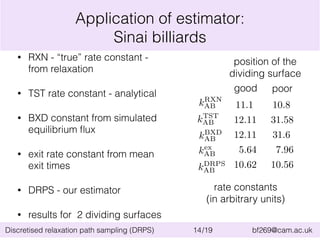
• RXN - “true” rate constant - 
from relaxation 
• TST rate constant - analytical 
• BXD constant from simulated 
equilibrium flux 
• exit rate constant from mean 
exit times 
• DRPS - our estimator 
• results for 2 dividing surfaces 
kRXN 
AB 
kTST 
AB 
kBXD 
AB 
kex 
AB 
kDRPS 
AB 
position of the 
dividing surface 
good poor 
11.1 
12.11 
12.11 
5.64 
10.62 
10.8 
31.58 
31.6 
7.96 
10.56 
rate constants 
(in arbitrary units) 
Discretised relaxation path sampling (DRPS) 14/19 bf269@cam.ac.uk
Application of DRPS: 
Cluster of Lennard-Jones disks 
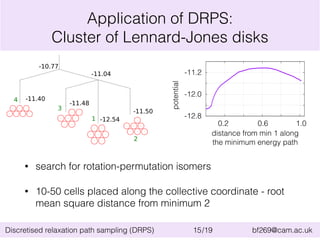
-10.77 
-11.40 -11.48 
-11.04 
-12.54 
-11.50 
4 
3 
2 
1 
0.2 0.6 1.0 
distance from min 1 along 
the minimum energy path 
potential 
-11.2 
-12.0 
-12.8 
• search for rotation-permutation isomers 
• 10-50 cells placed along the collective coordinate - root 
mean square distance from minimum 2 
Discretised relaxation path sampling (DRPS) 15/19 bf269@cam.ac.uk
Application of DRPS: 
Cluster of Lennard-Jones disks 
0.6 
simul 
0.2 
k fit 
k equil 
-0.6 
1.00 
0.95 
0.90 
0.85 
0.80 
0.75 
0.70 
-1.0 
0.9 
0.8 
0.0 0.4 0.8 0.2 0.6 
0.65 
in A 
free energy 
Discretised relaxation path sampling (DRPS) 16 
/19 bf269@cam.ac.uk 
Rate constants 
box 2 box 5 box 10 TPS DPS 
ln(k12/⌧0) -28.9 ± 0.3 -29.6 ± 0.5 -30.5 ± 1.0 -28.7 -26.9 
ln(k21/⌧0) -9.3 ± 0.2 -9.4 ± 0.3 -9.7 ± 0.7 -7.2 -9.2 
0.60 
0.0 0.2 0.4 0.6 0.8 1.0 
population 
time / [τ0] 
population time distance from min 2 
1.0 
0.7 
-0.2 
0.2 0.6 1.0 0.4 0.8 1.0 
fit 
propagation 
equilibrium value 
TST 
MC 
DRPS small cell 
DRPS large cell
New application: 
Polymer reversal in a narrow pore 
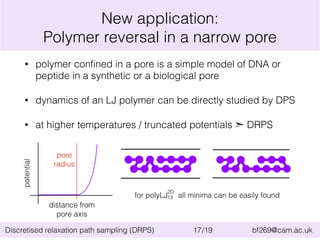
• polymer confined in a pore is a simple model of DNA or 
peptide in a synthetic or a biological pore 
• dynamics of an LJ polymer can be directly studied by DPS 
• at higher temperatures / truncated potentials ➣ DRPS 
for polyLJ all minima can be easily found 2D 
13 
Discretised relaxation path sampling (DRPS) 17 
/19 bf269@cam.ac.uk 
distance from 
pore axis 
potential 
pore 
radius
Future applications 
polymer reversal polymer translocation peptide dynamics 
1#FIG. where the unnecessary constant terms are ignored. kB is the 
Boltzmann constant and T is the absolute temperature. ! 1! 
and ! 2! are the values of !! in regions I and II, respectively. 
Fm exhibits a free energy barrier as a function of m. The 
nature of the free energy barrier depends on i# conforma-tional 
statistics on both regions, and ii# value of the chemi-cal 
potential mismatch $% relative to the entropic part first 
two terms on the right-hand side of Eq. 2#'. The results are 
illustrated in Figs. 2 and 3. When $%!0, the barrier is sym-metric 
Native 
10 20 30 40 50 
in f!m/N if the size exponent is the same in both 
Stationary Point 
regions. For ( 1)( 2 , the barrier becomes asymmetric. The 
free energy minima are downhill from I to II if the chain is 
more compact in II than in I. This is illustrated in Fig. 2 by 
taking ! 1!!0.9, ! 2!!0.5, and N$%/kBT!3.0. On the 
other hand, the free energy minima are uphill if the chain is 
* 
* t 
Wm t #!km1Wm1 t ##km#1 ! Wm#1 where Wm is the probability in region II. km is the of a nucleus with m#1 segments segments. km ! 
is the rate constant with m segments into a nucleus detailed balance to express km! m to be a continuous variable, * 
30 
20 
10 
Discretised relaxation path sampling (DRPS) 18/19 bf269@cam.ac.uk 
 #!! 
* 
1. Polymer escape in transition. 
FIG. 3. Plot of Fm in units of kBT represent: solid line, N$%/kBT!0; dashed line, N$%/kBT!1. 
biomolecular folding 
0 
Energy Difference (kcal/mol) 
Unfolded 
Unfolded 
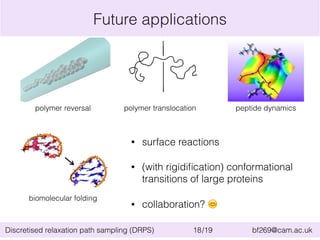
• surface reactions 
• (with rigidification) conformational 
transitions of large proteins 
• collaboration? 
Acknowledgements 
Discretised relaxation path sampling (DRPS) 19/19 bf269@cam.ac.uk
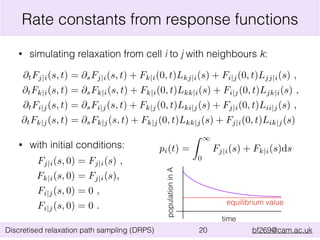
Rate constants from response functions 
• simulating relaxation from cell i to j with neighbours k: 
@tFj|i(s, t) = @sFj|i(s, t) + Fk|i(0, t)Lkj|i(s) + Fi|j(0, t)Ljj|i(s) , 
@tFk|i(s, t) = @sFk|i(s, t) + Fk|i(0, t)Lkk|i(s) + Fi|j(0, t)Ljk|i(s) , 
@tFi|j(s, t) = @sFi|j(s, t) + Fk|j(0, t)Lki|j(s) + Fj|i(0, t)Lii|j(s) , 
@tFk|j(s, t) = @sFk|j(s, t) + Fk|j(0, t)Lkk|j(s) + Fj|i(0, t)Lik|j(s) 
pi(t) = 
population in A 
Fj|i(s) + Fk|i(s)ds 
equilibrium value 
time 
• with initial conditions: 
Fj|i(s, 0) = Fj|i(s) , 
Fk|i(s, 0) = Fj|i(s), 
Fi|j(s, 0) = 0 , 
Fi|j(s, 0) = 0 . 
Z 
1 
0 
Discretised relaxation path sampling (DRPS) 20 bf269@cam.ac.uk

Simulating dynamics of rare events using discretised relaxation path sampling

  • 1.
    Simulating dynamics ofrare events using discretised relaxation path sampling Boris Fačkovec Wales group Department of Chemistry University of Cambridge Energy landscapes workshop Durham, 18th August 2014 Discretised relaxation path sampling (DRPS) 1 /19 bf269@cam.ac.uk
  • 2.
    Rare events innature • ratio of the largest and lowest relevant timescales 1 molecular vibration (~1 fs) elongation of protein chain (~40 ms) folding (~1 ms) (another definition: computer time patience) Discretised relaxation path sampling (DRPS) 2 /19 bf269@cam.ac.uk
  • 3.
    Towards dynamics ofrare events • coarse-graining / rigidification • biasing the potential (metadynamics, …) • efficient sampling in the trajectory space (TPS) • space partitioning (milestoning, TIS, FFS, MSM,…) choose appropriate space partitioning perform constrained simulations group! passage times into final rate constants process data from simulation (passage times between cells) • discrete path sampling (DPS) Discretised relaxation path sampling (DRPS) 3 /19 bf269@cam.ac.uk
  • 4.
    Cell-to-cell rate constant A B C D A B C AC D AB BC BD • soft cells were developed to allow complete space partitioning using surface-surface rate constants • inconvenient for observables, incompatible with DPS A A incomplete partitioning soft cells CD hard cells A B B B Discretised relaxation path sampling (DRPS) 4 /19 bf269@cam.ac.uk
  • 5.
    Methods using hardcells • boxed molecular dynamics (BXD) - sampling enhanced by space partitioning B position kBXD AB = lag time time log (probability) • hyperdynamics (hyperMD) - sampling enhanced by biasing the potential • dividing surface defined by a certain plane involving the saddle point biased potential position potential A C 1 h⌧lagi Discretised relaxation path sampling (DRPS) 5 /19 bf269@cam.ac.uk
  • 6.
    Limits of TST • transition state theory - rate constant = equilibrium flux / equilibrium population kTST AB = flux population = hP(x) [n(x) · v]i@A hP(x)iA = @tpA(0) pA(0) • the rate constant is very sensitive to definition of the dividing time population in A A A time population in A surface Discretised relaxation path sampling (DRPS) 6 /19 bf269@cam.ac.uk
  • 7.
    Rate constants fromtrajectories • (if we have to simulate trajectories) CAN WE DO BETTER? • for system of 2 states, over damped dynamics, rate constant from mean exit times (formula proven for 1D): • relaxation involves both exit and penetration - best approach Discretised relaxation path sampling (DRPS) 7 /19 bf269@cam.ac.uk position potential probability density position relaxation kex AB = peq B peq A ⌧ ex B + peq B ⌧ ex A
  • 8.
    No-flux boundary conditions C A B D E G F A B • isolation of A and B from the rest by placing hard walls • straightforward for overdamped dynamics • impossible for Hamiltonian (deterministic) dynamics Discretised relaxation path sampling (DRPS) 8 /19 bf269@cam.ac.uk
  • 9.
    Equilibrium boundary conditions • placing an equilibrated neighbour at the boundary • exiting particle is replaced by a particle from the equilibrium distribution • the equilibrium distribution is not known a priori • TRICK: independence of exiting and entering particles ➣ reduction of dynamics to propagation of response functions Discretised relaxation path sampling (DRPS) 9 /19 bf269@cam.ac.uk
  • 10.
    Insight into theresponse functions • exit response function Fi|k(t) is the distribution of first passage times • response to supply at the boundary Lij|k(t) is the trajectory lengths • analytical solution for 1 trajectory averaged over trajectories • RIGHT: response function for a system with 2 cells (A and B) B A trajectories from equilibrium distribution trajectories from the boundaries FB|A(t) = @tpA(t) , LBB|A(t) = @tFB|A(t) FB|A(0) Discretised relaxation path sampling (DRPS) 10/19 bf269@cam.ac.uk
  • 11.
    Optimised simulation protocol • different for over damped dynamics and inertial dynamics with large friction 1. partitioning of space into cells 2. constrained Monte Carlo sampling 3. molecular dynamics from random initial points terminated at cell boundaries 4. propagation of the response functions - fit of the relaxation 5. graph transformation / lumping Discretised relaxation path sampling (DRPS) 11/19 bf269@cam.ac.uk
  • 12.
    Limits of themethod • decorrelation of exiting and entering trajectories at the boundaries is assumed • internal barriers invalidate Markovian assumption • some types of breakdowns can be identified from the simulation A B A C B Discretised relaxation path sampling (DRPS) 12/19 bf269@cam.ac.uk
  • 13.
    Application of estimator: Sinai billiards • non-interacting particles with equal velocities elastically reflect from walls of the billiard and the circle inside • circle forms a bottleneck - transition through the dividing surface is a rare event • small change in definition of the dividing surface should not cause large change in the rate constants A B Discretised relaxation path sampling (DRPS) 13/19 bf269@cam.ac.uk
  • 14.
    Application of estimator: Sinai billiards • RXN - “true” rate constant - from relaxation • TST rate constant - analytical • BXD constant from simulated equilibrium flux • exit rate constant from mean exit times • DRPS - our estimator • results for 2 dividing surfaces kRXN AB kTST AB kBXD AB kex AB kDRPS AB position of the dividing surface good poor 11.1 12.11 12.11 5.64 10.62 10.8 31.58 31.6 7.96 10.56 rate constants (in arbitrary units) Discretised relaxation path sampling (DRPS) 14/19 bf269@cam.ac.uk
  • 15.
    Application of DRPS: Cluster of Lennard-Jones disks -10.77 -11.40 -11.48 -11.04 -12.54 -11.50 4 3 2 1 0.2 0.6 1.0 distance from min 1 along the minimum energy path potential -11.2 -12.0 -12.8 • search for rotation-permutation isomers • 10-50 cells placed along the collective coordinate - root mean square distance from minimum 2 Discretised relaxation path sampling (DRPS) 15/19 bf269@cam.ac.uk
  • 16.
    Application of DRPS: Cluster of Lennard-Jones disks 0.6 simul 0.2 k fit k equil -0.6 1.00 0.95 0.90 0.85 0.80 0.75 0.70 -1.0 0.9 0.8 0.0 0.4 0.8 0.2 0.6 0.65 in A free energy Discretised relaxation path sampling (DRPS) 16 /19 bf269@cam.ac.uk Rate constants box 2 box 5 box 10 TPS DPS ln(k12/⌧0) -28.9 ± 0.3 -29.6 ± 0.5 -30.5 ± 1.0 -28.7 -26.9 ln(k21/⌧0) -9.3 ± 0.2 -9.4 ± 0.3 -9.7 ± 0.7 -7.2 -9.2 0.60 0.0 0.2 0.4 0.6 0.8 1.0 population time / [τ0] population time distance from min 2 1.0 0.7 -0.2 0.2 0.6 1.0 0.4 0.8 1.0 fit propagation equilibrium value TST MC DRPS small cell DRPS large cell
  • 17.
    New application: Polymerreversal in a narrow pore • polymer confined in a pore is a simple model of DNA or peptide in a synthetic or a biological pore • dynamics of an LJ polymer can be directly studied by DPS • at higher temperatures / truncated potentials ➣ DRPS for polyLJ all minima can be easily found 2D 13 Discretised relaxation path sampling (DRPS) 17 /19 bf269@cam.ac.uk distance from pore axis potential pore radius
  • 18.
    Future applications polymerreversal polymer translocation peptide dynamics 1#FIG. where the unnecessary constant terms are ignored. kB is the Boltzmann constant and T is the absolute temperature. ! 1! and ! 2! are the values of !! in regions I and II, respectively. Fm exhibits a free energy barrier as a function of m. The nature of the free energy barrier depends on i# conforma-tional statistics on both regions, and ii# value of the chemi-cal potential mismatch $% relative to the entropic part first two terms on the right-hand side of Eq. 2#'. The results are illustrated in Figs. 2 and 3. When $%!0, the barrier is sym-metric Native 10 20 30 40 50 in f!m/N if the size exponent is the same in both Stationary Point regions. For ( 1)( 2 , the barrier becomes asymmetric. The free energy minima are downhill from I to II if the chain is more compact in II than in I. This is illustrated in Fig. 2 by taking ! 1!!0.9, ! 2!!0.5, and N$%/kBT!3.0. On the other hand, the free energy minima are uphill if the chain is * * t Wm t #!km1Wm1 t ##km#1 ! Wm#1 where Wm is the probability in region II. km is the of a nucleus with m#1 segments segments. km ! is the rate constant with m segments into a nucleus detailed balance to express km! m to be a continuous variable, * 30 20 10 Discretised relaxation path sampling (DRPS) 18/19 bf269@cam.ac.uk #!! * 1. Polymer escape in transition. FIG. 3. Plot of Fm in units of kBT represent: solid line, N$%/kBT!0; dashed line, N$%/kBT!1. biomolecular folding 0 Energy Difference (kcal/mol) Unfolded Unfolded • surface reactions • (with rigidification) conformational transitions of large proteins • collaboration? 
  • 19.
    Acknowledgements Discretised relaxationpath sampling (DRPS) 19/19 bf269@cam.ac.uk
  • 20.
    Rate constants fromresponse functions • simulating relaxation from cell i to j with neighbours k: @tFj|i(s, t) = @sFj|i(s, t) + Fk|i(0, t)Lkj|i(s) + Fi|j(0, t)Ljj|i(s) , @tFk|i(s, t) = @sFk|i(s, t) + Fk|i(0, t)Lkk|i(s) + Fi|j(0, t)Ljk|i(s) , @tFi|j(s, t) = @sFi|j(s, t) + Fk|j(0, t)Lki|j(s) + Fj|i(0, t)Lii|j(s) , @tFk|j(s, t) = @sFk|j(s, t) + Fk|j(0, t)Lkk|j(s) + Fj|i(0, t)Lik|j(s) pi(t) = population in A Fj|i(s) + Fk|i(s)ds equilibrium value time • with initial conditions: Fj|i(s, 0) = Fj|i(s) , Fk|i(s, 0) = Fj|i(s), Fi|j(s, 0) = 0 , Fi|j(s, 0) = 0 . Z 1 0 Discretised relaxation path sampling (DRPS) 20 bf269@cam.ac.uk