Simple present
tense
Simple present tense
 Simple present tense adalah tenses yang digunakan
ketika suatu kejadian sedang berlangsung saat ini atau
kejadian yang berlangsung berulang kali (kebiasaan).
Tenses ini merupakan tenses yang paling sering
digunakan dalam Bahasa Inggris
Rumus
 Untuk membentuk kalimat tense ini, biasanya digunakan kata kerja bentuk
dasar atau Verb 1. Kecuali untuk kata ganti orang ketiga, menggunakan Verb
1 + s/es. Contoh:
Subject Verb The Rest of the Sentence
I / You / They / We go to the school by bus
She / He / It goes to the school by bus
note
Untuk kata kerja yang berakhiran -O, -CH, -SH, -X, atau -Z, tambahkan -ES.
 go – goes
 catch – catches
 wash – washes
 kiss – kisses
 box – boxes
 fix – fixes
 Have - has
Untuk kata kerja (Verb) yang berakhiran konsonan + Y, hilangkan Y, dan
tambahkan -IES.
 carry – carries
 study – studies
 worry – worries
 marry – marries
Sedangkan, untuk kata kerja yang berakhiran vokal + Y, cukup tambahkan -S.
 play – plays
 say – says
 enjoy – enjoys
Penggunaan simple present tense
1. kejadian berulang yang berlangsung saat ini.
 I go to campus by motorcycle every day
 The train to Bekasi leaves every hour.
 Tedy sleeps seven hours every night during the week.
2. Untuk menunjukkan suatu fakta/ kejadian secara umum
 The President of Indonesia is Joko Widodo.
 A snake has no legs.
 Indonesia has thirty-four provinces, from Sabang to Merauke.
3. menunjukkan suatu kebiasaan (habit).
 Doni gets up early at 5 o’clock every day.
 John takes a bath twice a day.
 Every year on Lebaran, most people travel to
their hometown.
 I always have breakfast in the morning
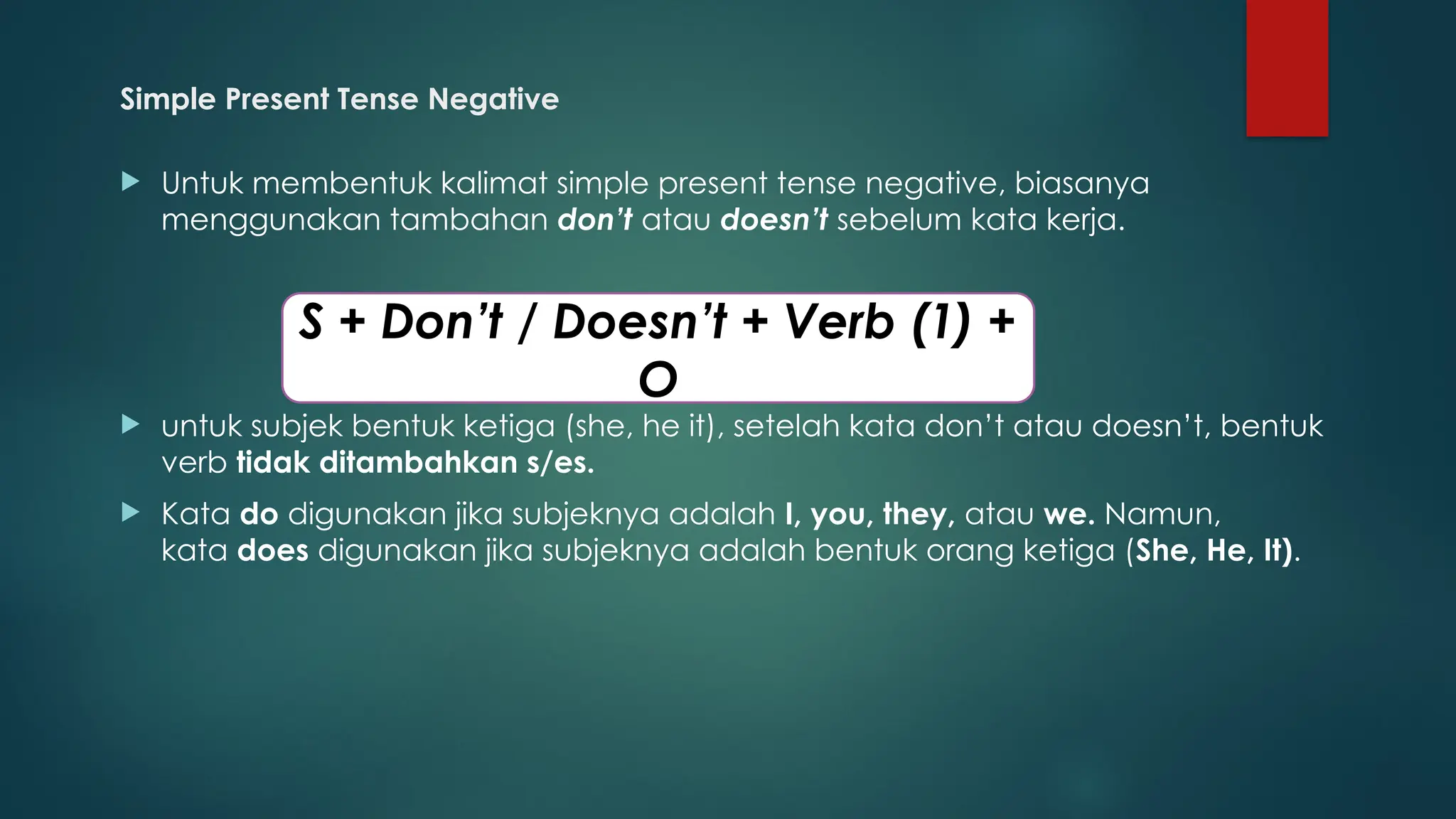
Simple Present Tense Negative
 Untuk membentuk kalimat simple present tense negative, biasanya
menggunakan tambahan don’t atau doesn’t sebelum kata kerja.
 untuk subjek bentuk ketiga (she, he it), setelah kata don’t atau doesn’t, bentuk
verb tidak ditambahkan s/es.
 Kata do digunakan jika subjeknya adalah I, you, they, atau we. Namun,
kata does digunakan jika subjeknya adalah bentuk orang ketiga (She, He, It).
S + Don’t / Doesn’t + Verb (1) +
O
Simple Present Tense Interrogative
 Untuk membentuk kalimat interogative / kalimat pertanyaaan, biasanya
menggunakan tambahan do atau does di depan kalimat.
 untuk subjek bentuk ketiga (she, he it), setelah kata don’t atau doesn’t, bentuk
verb tidak ditambahkan s/es.
 Kata do digunakan jika subjeknya adalah I, you, they, atau we. Namun,
kata does digunakan jika subjeknya adalah bentuk orang ketiga (She, He, It).
Do / Does + S + Verb 1 +
O
Contoh:
1. (+) I go to campus by motorcycle everyday
(-) I do not go to campus by motor cycle everday
(?) do I go to campus by motorcycle everyday?
2. (+) tedy goes to campus by motorcycle everyday
(-) tedy does not go to campus by motor cycle everday
(?) does tedy go to campus by motorcycle everyday?
Simple Present tense
with out verb
 Rumus: To be
 I  am
 You, they, we  are
 He, she, it  is
Contoh:
(+) I am a student
(-) I am not a students
(?) am I a student?
S + to be (is, am, are) + O
S + to be (is, am, are) + not
+ O
To be (is, am, are) + S +
O ?
 Where are you from?
 Where do you come
from?
• I AM FROM …
• I COME FROM …
Simple present tense penjelasan lengkap.pptx

  • 1.
  • 2.
    Simple present tense Simple present tense adalah tenses yang digunakan ketika suatu kejadian sedang berlangsung saat ini atau kejadian yang berlangsung berulang kali (kebiasaan). Tenses ini merupakan tenses yang paling sering digunakan dalam Bahasa Inggris
  • 3.
    Rumus  Untuk membentukkalimat tense ini, biasanya digunakan kata kerja bentuk dasar atau Verb 1. Kecuali untuk kata ganti orang ketiga, menggunakan Verb 1 + s/es. Contoh: Subject Verb The Rest of the Sentence I / You / They / We go to the school by bus She / He / It goes to the school by bus
  • 4.
    note Untuk kata kerjayang berakhiran -O, -CH, -SH, -X, atau -Z, tambahkan -ES.  go – goes  catch – catches  wash – washes  kiss – kisses  box – boxes  fix – fixes  Have - has
  • 5.
    Untuk kata kerja(Verb) yang berakhiran konsonan + Y, hilangkan Y, dan tambahkan -IES.  carry – carries  study – studies  worry – worries  marry – marries Sedangkan, untuk kata kerja yang berakhiran vokal + Y, cukup tambahkan -S.  play – plays  say – says  enjoy – enjoys
  • 6.
    Penggunaan simple presenttense 1. kejadian berulang yang berlangsung saat ini.  I go to campus by motorcycle every day  The train to Bekasi leaves every hour.  Tedy sleeps seven hours every night during the week. 2. Untuk menunjukkan suatu fakta/ kejadian secara umum  The President of Indonesia is Joko Widodo.  A snake has no legs.  Indonesia has thirty-four provinces, from Sabang to Merauke.
  • 7.
    3. menunjukkan suatukebiasaan (habit).  Doni gets up early at 5 o’clock every day.  John takes a bath twice a day.  Every year on Lebaran, most people travel to their hometown.  I always have breakfast in the morning
  • 8.
    Simple Present TenseNegative  Untuk membentuk kalimat simple present tense negative, biasanya menggunakan tambahan don’t atau doesn’t sebelum kata kerja.  untuk subjek bentuk ketiga (she, he it), setelah kata don’t atau doesn’t, bentuk verb tidak ditambahkan s/es.  Kata do digunakan jika subjeknya adalah I, you, they, atau we. Namun, kata does digunakan jika subjeknya adalah bentuk orang ketiga (She, He, It). S + Don’t / Doesn’t + Verb (1) + O
  • 9.
    Simple Present TenseInterrogative  Untuk membentuk kalimat interogative / kalimat pertanyaaan, biasanya menggunakan tambahan do atau does di depan kalimat.  untuk subjek bentuk ketiga (she, he it), setelah kata don’t atau doesn’t, bentuk verb tidak ditambahkan s/es.  Kata do digunakan jika subjeknya adalah I, you, they, atau we. Namun, kata does digunakan jika subjeknya adalah bentuk orang ketiga (She, He, It). Do / Does + S + Verb 1 + O
  • 10.
    Contoh: 1. (+) Igo to campus by motorcycle everyday (-) I do not go to campus by motor cycle everday (?) do I go to campus by motorcycle everyday? 2. (+) tedy goes to campus by motorcycle everyday (-) tedy does not go to campus by motor cycle everday (?) does tedy go to campus by motorcycle everyday?
  • 11.
    Simple Present tense without verb  Rumus: To be  I  am  You, they, we  are  He, she, it  is Contoh: (+) I am a student (-) I am not a students (?) am I a student? S + to be (is, am, are) + O S + to be (is, am, are) + not + O To be (is, am, are) + S + O ?
  • 12.
     Where areyou from?  Where do you come from? • I AM FROM … • I COME FROM …