CONTINUATION…
Assumptions of Simple linear
Regression
Simple linear regression is a
parametric test, meaning that it
makes certain assumptions about
the data. These assumptions are:
Homogeneity of Variance
(Homoscedasticity)
The size of the error in our
prediction doesn’t change
significantly across the values of
the independent variable.
Independence of Observations
The observations in the dataset were
collected using statistically valid
sampling methods, and there are no
hidden relationships among
observations.
Normality
The data follows a normal
distribution.
The Relationship Between the
Independent and Dependent
Variable is Linear
The line of best fit through the data
points is a straight line (rather than a
curve or some sort of grouping
factor).
Water Management Practices and Environmental
Attitudes of Riparian Communities in Sapangdaku
River, Cebu Island, Philippines by Sanchez et. Al.
(2022)
DOI:http://dx.doi.org/10.15294/biosaintifika.v14i2.3
6185
Objectives of the Study:
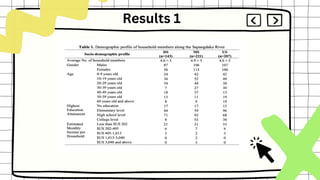
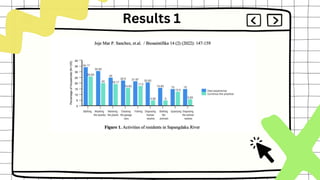
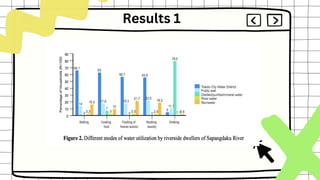
1. To determine the socio-demographic profile,
anthropogenic activities, water utilization of the
residents, and waste disposal practices along the
Sapangdaku River.
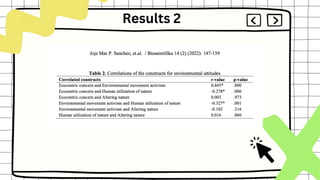
2. To determine the correlation of the
environmental attitude between its four
constructs.
Respondents:
Riverside dwellers along the
Sapangdaku River participated in the
study. Through random sampling, 120
residents were selected as
respondents of the study.
Data:
1. Survey Questionnaire
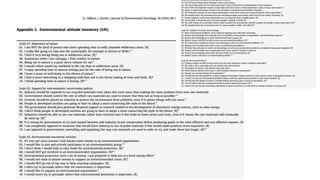
2. Environmental Attitude Survey (EAS) extracted
from the Environmental Attitude Inventory (EAI)
Statistical Measures Used:
1. Descriptive Statistics (Frequency Count)
2. Pearson r Correlation
Results 1
Results 1
Results 1
Results 2
Limitations of the Methodology
The use of Pearson r to treat the
data on Environmental Attitude is
not appropriate.
Why?
Limitations of the Methodology
The data collected from EAI are
discrete because the statements
are answerable through a Likert
scale.
Limitations of the Methodology
Another limitation is the use of only
four constructs out of 12 constructs
from the original Environmental
Attitude Inventory.
Conclusion
When using simple linear
regression, two continuous
variables must be involved.
THANK YOU FOR
LISTENING

SIMPLE LINEAR REGRESSION - QUANTITATIVE RESEARCH.pptx

  • 1.
  • 2.
    Assumptions of Simplelinear Regression Simple linear regression is a parametric test, meaning that it makes certain assumptions about the data. These assumptions are:
  • 3.
    Homogeneity of Variance (Homoscedasticity) Thesize of the error in our prediction doesn’t change significantly across the values of the independent variable.
  • 4.
    Independence of Observations Theobservations in the dataset were collected using statistically valid sampling methods, and there are no hidden relationships among observations.
  • 5.
    Normality The data followsa normal distribution.
  • 6.
    The Relationship Betweenthe Independent and Dependent Variable is Linear The line of best fit through the data points is a straight line (rather than a curve or some sort of grouping factor).
  • 7.
    Water Management Practicesand Environmental Attitudes of Riparian Communities in Sapangdaku River, Cebu Island, Philippines by Sanchez et. Al. (2022) DOI:http://dx.doi.org/10.15294/biosaintifika.v14i2.3 6185
  • 8.
    Objectives of theStudy: 1. To determine the socio-demographic profile, anthropogenic activities, water utilization of the residents, and waste disposal practices along the Sapangdaku River. 2. To determine the correlation of the environmental attitude between its four constructs.
  • 9.
    Respondents: Riverside dwellers alongthe Sapangdaku River participated in the study. Through random sampling, 120 residents were selected as respondents of the study.
  • 10.
    Data: 1. Survey Questionnaire 2.Environmental Attitude Survey (EAS) extracted from the Environmental Attitude Inventory (EAI)
  • 11.
    Statistical Measures Used: 1.Descriptive Statistics (Frequency Count) 2. Pearson r Correlation
  • 12.
  • 13.
  • 14.
  • 15.
  • 16.
    Limitations of theMethodology The use of Pearson r to treat the data on Environmental Attitude is not appropriate. Why?
  • 18.
    Limitations of theMethodology The data collected from EAI are discrete because the statements are answerable through a Likert scale.
  • 19.
    Limitations of theMethodology Another limitation is the use of only four constructs out of 12 constructs from the original Environmental Attitude Inventory.
  • 20.
    Conclusion When using simplelinear regression, two continuous variables must be involved.
  • 21.