www.mmaworldwide.com 77
Zefri Gusrianaldi, a lean, dark Indonesian in his mid twenties,
leads the way down a rain-soaked, black alley to his motorbike.
We are deep in the festering chaos of Padang, the capitol city of
West Sumatra, the largest island of the world’s largest archipel-
ago. Sumatra’s West Coast is the ancestral land of the warrior
Menangkabau tribe, who have developed and handed down a
fighting system, sometimes under aggressive prohibition, called
Pencak Silat.
Silat has gained historic infamy in the region of these equatori-
al islands for its use by pirates, headhunters and wandering war-
riors. Among the martial arts’ most feared aspects are its prolif-
ic assortment of weapons, ambush tactics and use of a black
magic form called “Debuih.” Pencak Silat has been used by the
Menangkabau to defend themselves from Chinese, Indian,
Javanese and European invaders over the centuries.
After frustrating weeks of sifting through the jungle-clad back-
country of Sumatra, revealing very little along the way, Zefri, a
Pendekar (meaning Silat student), has finally agreed to show me
where and how Silat practice takes place.
"I'm taking you to see Silat Pau,” Zefri says as he revs up his
bike. "Their movements are short, they train for war…they train
for killing."
Choked with the wreckage of urban decay, Padang is a mixture
of sensory input to the newly arrived. Colorful minivan taxis
Finding
Silat
Story Photos by
Tate Zandstra
(Definitions for words in bold
at the end of the story)
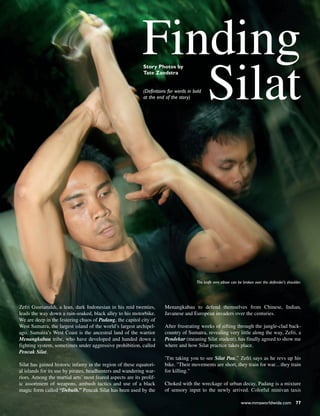
The knife arm elbow can be broken over the defender's shoulder.
78 The World-famous
blare by on the street, their open pipes screaming to compete
with curbside blasting of Indo pop hits, while beggars sift
through garbage freights soaked by a downpour of equatorial
rain.
As the city sights and sounds drift away down a country road,
the true nature of Sumatran countryside emerges: coconut palms
sway in the cool nighttime breeze, stars reflect in rice paddies,
and water buffalo graze outside thatch-roofed huts. Climbing the
hills of Padang, Zefri dodges horse carts, bicycles and other
motorcycles on the way to Pau, a small village outlying
Padang’s atrophied city infrastructure.
"Sumatra is the place for you to know about it," Tobias says in
a British accent at his Kuala Lumpur guesthouse. "Then, if
someone doesn't want you to know, it's also the best place for
you not to know, you know?" I was preparing to cross the
Melaka straits from Malaysia into Sumatran Indonesia.
Headhunting does occasionally flare up, perhaps more than any-
one can know deep in the jungle, but surely asking some ques-
tions about Silat will not provoke a feast. "Just don't go meet
anyone after dark on the garden path,” explains the guesthouse
owner.
I make my way to the mountainous town of Bukittinggi, where
the echo can be heard from another loudspeaker imam calling
the faithful of Islam to prayer. I’m getting used to Sumatra, rich
coffee, boiled with the grounds and served amid the petrol fumes
and burning garbage stench of another hazy morning. The prob-
lem with looking for a secret martial art is becoming obvious to
me now…no one wants to talk about Silat, even to acknowledge
its existence.
The Menangkabau are a matrilineal tribe credited with the
invention of Silat Pau, a deadly form which was used by the
Jago, a semi mythic figure who would appear for assassinations
and generally to make havoc for occupiers of Menang lands.
Sumatra, part of the Indonesian archipelago called “The Ring of
Fire” for its intense volcanic activity, orangutan, tiger, elephant
and even rhino, as well as various unique cultures, lends itself to
a sense of mysticism, which may be why Sufi Islam, something
like a Hindu/Islam hybrid, blended so well with the ancestor
worship and animist beliefs of the indigenous people.
Back on the trail, knowledge is a commodity, and the purchase
price seems to be some admixture of time, coffee, and cigarettes.
Talk to someone who knows someone who knows something;
and know that no one ever tells everything.
Following a twisting, turning trail through the close-knit, social
fabric of Bukittinggi, a colorful mix of cityscape hacked out of
the pristine high-country jungle, set on the smoking slopes of
volcanic Mt. Maninjau, I ventured to a Silat competition and met
24-year-old Zefri, a practitioner of the Harimau, tiger style.
Harimau is an aggressive form of Silat germane to Bukittinggi
which uses finger strength to rip and tear skin and muscle, and
as Zefri explains, a system of ground fighting to compensate for
the often slick rainforest footing of the region. Then, as so often
happens, as soon as I have met him, Zefri disappears. Merdeka,
freedom day, is approaching; he must withdraw again behind the
curtain of secrecy draped over the art to practice, for he will per-
form Silat for the president in Jakarta.
"These are for hunting pig," says Ponze, my chain-smoking
guide/translator, with a smile. He has a handful of vicious-look-
ing, newly-forged blades, the likes of which abound on Sumatra
like nowhere else. Beside him stands an ancient man, toothless,
in a turban and sarong; the blacksmith of Batusangkar, a rice
producing village set in the beautiful mountains around
Bukittinggi. The smith is a man versed in the ancient mysticism
of the country side. He has seen the brutality of Japanese occu-
pation drive out the Dutch overlords in World War II, only to be
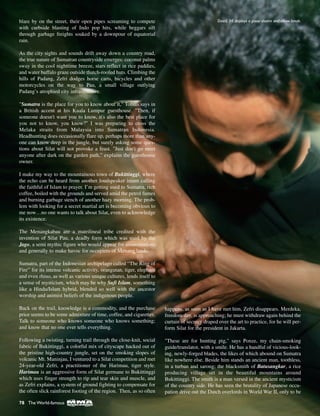
Dasril, 34, displays a pisau disarm and elbow break.
www.mmaworldwide.com 79
replaced by the Dutch once again in a new wave of violence
which only ended in 1949, when Indonesia finally gained its
independence.
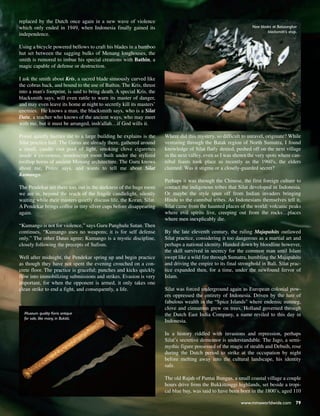
Using a bicycle powered bellows to craft his blades in a bamboo
hut set between the sagging bulks of Menang longhouses, the
smith is rumored to imbue his special creations with Bathin, a
magic capable of defense or destruction.
I ask the smith about Kris, a sacred blade sinuously curved like
the cobras back, and bound to the use of Bathin. The Kris, thrust
into a man's footprint, is said to bring death. A special Kris, the
blacksmith says, will even rattle to warn its master of danger,
and may even leave its home at night to secretly kill its masters’
enemies. He knows a man, the blacksmith says, who is a Silat
Datu, a teacher who knows of the ancient ways, who may meet
with me, but it must be arranged, insh'allah…if God wills it.
Ponze quietly hurries me to a large building he explains is the
Silat practice hall. The Gurus are already there, gathered around
a small, candle cast pool of light, smoking clove cigarettes
inside a cavernous, nondescript room built under the stylized
rooftop horns of ancient Menang architecture. The Guru knows
about me, Ponze says, and wants to tell me about Silat
Kumango.
The Pendekar are there too, out in the darkness of the huge room
we are in, beyond the reach of the fragile candlelight, silently
waiting while their masters quietly discuss life, the Koran, Silat.
A Pendekar brings coffee in tiny silver cups before disappearing
again.
“Kumango is not for violence,” says Guru Panghulu Sutan. Then
continues, “Kumango uses no weapons; it is for self defense
only.” The other Datus agree; Kumango is a mystic discipline,
closely following the precepts of Sufism.
Well after midnight, the Pendekar spring up and begin practice
as though they have not spent the evening crouched on a con-
crete floor. The practice is graceful; punches and kicks quickly
flow into immobilizing submissions and strikes. Evasion is very
important, for when the opponent is armed, it only takes one
clean strike to end a fight, and consequently, a life.
Where did this mystery, so difficult to unravel, originate? While
venturing through the Batak region of North Sumatra, I found
knowledge of Silat flatly denied, pushed off on the next village
in the next valley, even as I was shown the very spots where can-
nibal feasts took place as recently as the 1960's, the elders
claimed. Was it stigma or a closely-guarded secret?
Perhaps it was through the Chinese, the first foreign culture to
contact the indigenous tribes that Silat developed in Indonesia.
Or maybe the style spun off from Indian invaders bringing
Hindu to the cannibal tribes. As Indonesians themselves tell it,
Silat came from the haunted places of the world: volcanic peaks
where evil spirits live, creeping out from the rocks…places
where men inexplicably die.
By the late eleventh century, the ruling Majapahits outlawed
Silat practice, considering it too dangerous as a martial art and
perhaps a national identity. Handed down by bloodline however,
the skill survived in secrecy for the common man until Islam
swept like a wild fire through Sumatra, humbling the Majapahits
and driving the empire to its final stronghold in Bali. Silat prac-
tice expanded then, for a time, under the newfound fervor of
Islam.
Silat was forced underground again as European colonial pow-
ers oppressed the entirety of Indonesia. Driven by the lure of
fabulous wealth in the “Spice Islands" where endemic nutmeg,
clove and cinnamon grew on trees, Holland governed through
the Dutch East India Company, a name reviled to this day in
Indonesia.
In a history riddled with invasions and repression, perhaps
Silat’s secretive demeanor is understandable. The Jago, a semi-
mythic figure possessed of the magic of stealth and Debuih, rose
during the Dutch period to strike at the occupation by night
before melting away into the cultural landscape, his identity
safe.
The old Rajah of Pantai Bungus, a small coastal village a couple
hours drive from the Bukkittinggi highlands, set beside a tropi-
cal blue bay, was said to have been born in the 1800’s, aged 110
New blades at Batusangkar
blacksmith's shop.
Museum quality Keris antique
for sale, like many, in Bukitti.
80 The World-famous
at his death, and a Jago with great magical power. His grave site
is a simple pile of stones in a clearing of cacao and bamboo.
Here, the Pendekar used to practice for three straight nights fol-
lowing Ramadan, the Muslim month of fasting. "They like to
hide," says Carlos, the Rajah's grandson. "They would call
Harimau, the tiger, to come fight with them, and Harimau liked
to see what they did."
The desperate noise of the city fades as Zefri's motorcycle
ascends the cooler heights of Pau village. "This is where Si Patai
lived," Zefri tells me. Si Patai, the legendary Jago of Pau, called
by some 'The Menang Robin Hood' slipped in and out of Dutch
fingers to steal and kill in his lifelong fight for Indonesian liber-
ty. In testament to his skill, Si Patai died of old age reportedly in
the 1930s.
Datu Umar began his training shortly after the death of Si Patai.
He watches impassively as his son, Dasril, wields the Kerambit,
a wicked, crescent-shaped knife with a ring around the finger
which makes it difficult to see or disarm, used to rip into flesh
like a tiger’s claw. Opposite Dasril, Hendri Yusuf is armed with
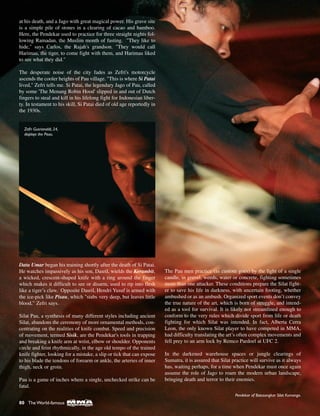
the ice-pick like Pisau, which "stabs very deep, but leaves little
blood,” Zefri says.
Silat Pau, a synthesis of many different styles including ancient
Silat, abandons the ceremony of more ornamental methods, con-
centrating on the realities of knife combat. Speed and precision
of movement, termed Sisik, are the Pendekar's tools in trapping
and breaking a knife arm at wrist, elbow or shoulder. Opponents
circle and feint rhythmically, in the age old tempo of the trained
knife fighter, looking for a mistake, a slip or tick that can expose
to his blade the tendons of forearm or ankle, the arteries of inner
thigh, neck or groin.
Pau is a game of inches where a single, unchecked strike can be
fatal.
The Pau men practice (as custom goes) by the light of a single
candle, in gravel, weeds, water or concrete, fighting sometimes
more than one attacker. These conditions prepare the Silat fight-
er to save his life in darkness, with uncertain footing, whether
ambushed or as an ambush. Organized sport events don’t convey
the true nature of the art, which is born of struggle, and intend-
ed as a tool for survival. It is likely not streamlined enough to
conform to the very rules which divide sport from life or death
fighting for which Silat was intended. In fact, Alberta Cerra
Leon, the only known Silat player to have competed in MMA,
had difficulty translating the art’s often complex movements and
fell prey to an arm lock by Remco Pardoel at UFC 2.
In the darkened warehouse spaces or jungle clearings of
Sumatra, it is assured that Silat practice will survive as it always
has, waiting perhaps, for a time when Pendekar must once again
assume the role of Jago to roam the modern urban landscape,
bringing death and terror to their enemies.
Pendekar of Batusangkar Silat Kumango.
Zefri Gusrianaldi, 24,
displays the Pisau.
www.mmaworldwide.com 81
Pencak Silat: Literally means “self defense” in the Indonesian
language, but refers to a specific form of martial art indigenous
to Indonesia and Malaysia.
Padang: The capitol of West Sumatra and an historically impor-
tant city for its maritime trading role.
Menangkabau: The tribe of people indigenous to West
Sumatra often credited with developing Silat as a martial art and
spreading it throughout Indonesia.
Debuih: A form of magic which Silat practice is said to confer
to the student.Debuih most often refers to the invulnerability to
being pierced by knives.
Pendekar: A student of Pencak Silat.
Silat Pau: Silat from Pau village, near Padang. Pau played an
important role in resistance against Dutch occupation and Silat
Pau is known as an unceremonious style, especially devoted to
armed fighting and stealth.
Sumatra: The largest island in Indonesia, sixth largest in the
world. Sumatra used to be feared for piracy (still present in the
Malacca straits) and headhunting.
Bukittingi: A small city in West Sumatra, located in the high-
lands, Bukittingi is known to have a high concentration of Silat
players. Historically an important meeting point for the Menang
tribe.
Jago: An historic figure who used his Silat knowledge to engage
in single-handed guerrilla warfare against occupiers in Menang
tribal areas.
Sufi Islam: A mystic branch of Islam whose devotees engage in
dance, poetry and music as prayer.
Harimau: Literally means “tiger” in Menagkabau language. Silat
Harimau is a form which uses clawing and grabbing to tear skin
and attack sensitive areas like eyes or groin.
Batusangkar: A small village where a blacksmith lives rumored
to create blades imbued with magic qualities called Bathin.
Kris:An heirloom knife thought to have special magical qualities.
Datu: Teacher, master.
Silat Kumango: A branch of Silat practice emphasizing non
aggression, stressing defense. Kumango is thought to be a study
which can bring a student closer to Allah.
Majapahit: An Indian dynasty which ruled Java and parts of
Sumatra. Java is the island neighboring Sumatra.
Si Patai:Was a Jago who fought against Dutch occupation in the
late 19th and early 20th centuries.
Datu Umar: The master of the Silat Pau group in Pau village.
Umar comes from the same school as Si Patai.
Kerambit: A crescent-shaped knife, the handle of which fits
around the middle finger. It is easy to hide and difficult to take
away.
Pisau: A popular blade because it is cheap; the Pisau is very long
and thin.
Sisik: The Menang word for very quick, precisely-timed move-
ments dependent on reaction speed, used mainly in defense.
D E F I N I T I O N S

Silat Article

  • 2.
    www.mmaworldwide.com 77 Zefri Gusrianaldi,a lean, dark Indonesian in his mid twenties, leads the way down a rain-soaked, black alley to his motorbike. We are deep in the festering chaos of Padang, the capitol city of West Sumatra, the largest island of the world’s largest archipel- ago. Sumatra’s West Coast is the ancestral land of the warrior Menangkabau tribe, who have developed and handed down a fighting system, sometimes under aggressive prohibition, called Pencak Silat. Silat has gained historic infamy in the region of these equatori- al islands for its use by pirates, headhunters and wandering war- riors. Among the martial arts’ most feared aspects are its prolif- ic assortment of weapons, ambush tactics and use of a black magic form called “Debuih.” Pencak Silat has been used by the Menangkabau to defend themselves from Chinese, Indian, Javanese and European invaders over the centuries. After frustrating weeks of sifting through the jungle-clad back- country of Sumatra, revealing very little along the way, Zefri, a Pendekar (meaning Silat student), has finally agreed to show me where and how Silat practice takes place. "I'm taking you to see Silat Pau,” Zefri says as he revs up his bike. "Their movements are short, they train for war…they train for killing." Choked with the wreckage of urban decay, Padang is a mixture of sensory input to the newly arrived. Colorful minivan taxis Finding Silat Story Photos by Tate Zandstra (Definitions for words in bold at the end of the story) The knife arm elbow can be broken over the defender's shoulder.
  • 3.
    78 The World-famous blareby on the street, their open pipes screaming to compete with curbside blasting of Indo pop hits, while beggars sift through garbage freights soaked by a downpour of equatorial rain. As the city sights and sounds drift away down a country road, the true nature of Sumatran countryside emerges: coconut palms sway in the cool nighttime breeze, stars reflect in rice paddies, and water buffalo graze outside thatch-roofed huts. Climbing the hills of Padang, Zefri dodges horse carts, bicycles and other motorcycles on the way to Pau, a small village outlying Padang’s atrophied city infrastructure. "Sumatra is the place for you to know about it," Tobias says in a British accent at his Kuala Lumpur guesthouse. "Then, if someone doesn't want you to know, it's also the best place for you not to know, you know?" I was preparing to cross the Melaka straits from Malaysia into Sumatran Indonesia. Headhunting does occasionally flare up, perhaps more than any- one can know deep in the jungle, but surely asking some ques- tions about Silat will not provoke a feast. "Just don't go meet anyone after dark on the garden path,” explains the guesthouse owner. I make my way to the mountainous town of Bukittinggi, where the echo can be heard from another loudspeaker imam calling the faithful of Islam to prayer. I’m getting used to Sumatra, rich coffee, boiled with the grounds and served amid the petrol fumes and burning garbage stench of another hazy morning. The prob- lem with looking for a secret martial art is becoming obvious to me now…no one wants to talk about Silat, even to acknowledge its existence. The Menangkabau are a matrilineal tribe credited with the invention of Silat Pau, a deadly form which was used by the Jago, a semi mythic figure who would appear for assassinations and generally to make havoc for occupiers of Menang lands. Sumatra, part of the Indonesian archipelago called “The Ring of Fire” for its intense volcanic activity, orangutan, tiger, elephant and even rhino, as well as various unique cultures, lends itself to a sense of mysticism, which may be why Sufi Islam, something like a Hindu/Islam hybrid, blended so well with the ancestor worship and animist beliefs of the indigenous people. Back on the trail, knowledge is a commodity, and the purchase price seems to be some admixture of time, coffee, and cigarettes. Talk to someone who knows someone who knows something; and know that no one ever tells everything. Following a twisting, turning trail through the close-knit, social fabric of Bukittinggi, a colorful mix of cityscape hacked out of the pristine high-country jungle, set on the smoking slopes of volcanic Mt. Maninjau, I ventured to a Silat competition and met 24-year-old Zefri, a practitioner of the Harimau, tiger style. Harimau is an aggressive form of Silat germane to Bukittinggi which uses finger strength to rip and tear skin and muscle, and as Zefri explains, a system of ground fighting to compensate for the often slick rainforest footing of the region. Then, as so often happens, as soon as I have met him, Zefri disappears. Merdeka, freedom day, is approaching; he must withdraw again behind the curtain of secrecy draped over the art to practice, for he will per- form Silat for the president in Jakarta. "These are for hunting pig," says Ponze, my chain-smoking guide/translator, with a smile. He has a handful of vicious-look- ing, newly-forged blades, the likes of which abound on Sumatra like nowhere else. Beside him stands an ancient man, toothless, in a turban and sarong; the blacksmith of Batusangkar, a rice producing village set in the beautiful mountains around Bukittinggi. The smith is a man versed in the ancient mysticism of the country side. He has seen the brutality of Japanese occu- pation drive out the Dutch overlords in World War II, only to be Dasril, 34, displays a pisau disarm and elbow break.
  • 4.
    www.mmaworldwide.com 79 replaced bythe Dutch once again in a new wave of violence which only ended in 1949, when Indonesia finally gained its independence. Using a bicycle powered bellows to craft his blades in a bamboo hut set between the sagging bulks of Menang longhouses, the smith is rumored to imbue his special creations with Bathin, a magic capable of defense or destruction. I ask the smith about Kris, a sacred blade sinuously curved like the cobras back, and bound to the use of Bathin. The Kris, thrust into a man's footprint, is said to bring death. A special Kris, the blacksmith says, will even rattle to warn its master of danger, and may even leave its home at night to secretly kill its masters’ enemies. He knows a man, the blacksmith says, who is a Silat Datu, a teacher who knows of the ancient ways, who may meet with me, but it must be arranged, insh'allah…if God wills it. Ponze quietly hurries me to a large building he explains is the Silat practice hall. The Gurus are already there, gathered around a small, candle cast pool of light, smoking clove cigarettes inside a cavernous, nondescript room built under the stylized rooftop horns of ancient Menang architecture. The Guru knows about me, Ponze says, and wants to tell me about Silat Kumango. The Pendekar are there too, out in the darkness of the huge room we are in, beyond the reach of the fragile candlelight, silently waiting while their masters quietly discuss life, the Koran, Silat. A Pendekar brings coffee in tiny silver cups before disappearing again. “Kumango is not for violence,” says Guru Panghulu Sutan. Then continues, “Kumango uses no weapons; it is for self defense only.” The other Datus agree; Kumango is a mystic discipline, closely following the precepts of Sufism. Well after midnight, the Pendekar spring up and begin practice as though they have not spent the evening crouched on a con- crete floor. The practice is graceful; punches and kicks quickly flow into immobilizing submissions and strikes. Evasion is very important, for when the opponent is armed, it only takes one clean strike to end a fight, and consequently, a life. Where did this mystery, so difficult to unravel, originate? While venturing through the Batak region of North Sumatra, I found knowledge of Silat flatly denied, pushed off on the next village in the next valley, even as I was shown the very spots where can- nibal feasts took place as recently as the 1960's, the elders claimed. Was it stigma or a closely-guarded secret? Perhaps it was through the Chinese, the first foreign culture to contact the indigenous tribes that Silat developed in Indonesia. Or maybe the style spun off from Indian invaders bringing Hindu to the cannibal tribes. As Indonesians themselves tell it, Silat came from the haunted places of the world: volcanic peaks where evil spirits live, creeping out from the rocks…places where men inexplicably die. By the late eleventh century, the ruling Majapahits outlawed Silat practice, considering it too dangerous as a martial art and perhaps a national identity. Handed down by bloodline however, the skill survived in secrecy for the common man until Islam swept like a wild fire through Sumatra, humbling the Majapahits and driving the empire to its final stronghold in Bali. Silat prac- tice expanded then, for a time, under the newfound fervor of Islam. Silat was forced underground again as European colonial pow- ers oppressed the entirety of Indonesia. Driven by the lure of fabulous wealth in the “Spice Islands" where endemic nutmeg, clove and cinnamon grew on trees, Holland governed through the Dutch East India Company, a name reviled to this day in Indonesia. In a history riddled with invasions and repression, perhaps Silat’s secretive demeanor is understandable. The Jago, a semi- mythic figure possessed of the magic of stealth and Debuih, rose during the Dutch period to strike at the occupation by night before melting away into the cultural landscape, his identity safe. The old Rajah of Pantai Bungus, a small coastal village a couple hours drive from the Bukkittinggi highlands, set beside a tropi- cal blue bay, was said to have been born in the 1800’s, aged 110 New blades at Batusangkar blacksmith's shop. Museum quality Keris antique for sale, like many, in Bukitti.
  • 5.
    80 The World-famous athis death, and a Jago with great magical power. His grave site is a simple pile of stones in a clearing of cacao and bamboo. Here, the Pendekar used to practice for three straight nights fol- lowing Ramadan, the Muslim month of fasting. "They like to hide," says Carlos, the Rajah's grandson. "They would call Harimau, the tiger, to come fight with them, and Harimau liked to see what they did." The desperate noise of the city fades as Zefri's motorcycle ascends the cooler heights of Pau village. "This is where Si Patai lived," Zefri tells me. Si Patai, the legendary Jago of Pau, called by some 'The Menang Robin Hood' slipped in and out of Dutch fingers to steal and kill in his lifelong fight for Indonesian liber- ty. In testament to his skill, Si Patai died of old age reportedly in the 1930s. Datu Umar began his training shortly after the death of Si Patai. He watches impassively as his son, Dasril, wields the Kerambit, a wicked, crescent-shaped knife with a ring around the finger which makes it difficult to see or disarm, used to rip into flesh like a tiger’s claw. Opposite Dasril, Hendri Yusuf is armed with the ice-pick like Pisau, which "stabs very deep, but leaves little blood,” Zefri says. Silat Pau, a synthesis of many different styles including ancient Silat, abandons the ceremony of more ornamental methods, con- centrating on the realities of knife combat. Speed and precision of movement, termed Sisik, are the Pendekar's tools in trapping and breaking a knife arm at wrist, elbow or shoulder. Opponents circle and feint rhythmically, in the age old tempo of the trained knife fighter, looking for a mistake, a slip or tick that can expose to his blade the tendons of forearm or ankle, the arteries of inner thigh, neck or groin. Pau is a game of inches where a single, unchecked strike can be fatal. The Pau men practice (as custom goes) by the light of a single candle, in gravel, weeds, water or concrete, fighting sometimes more than one attacker. These conditions prepare the Silat fight- er to save his life in darkness, with uncertain footing, whether ambushed or as an ambush. Organized sport events don’t convey the true nature of the art, which is born of struggle, and intend- ed as a tool for survival. It is likely not streamlined enough to conform to the very rules which divide sport from life or death fighting for which Silat was intended. In fact, Alberta Cerra Leon, the only known Silat player to have competed in MMA, had difficulty translating the art’s often complex movements and fell prey to an arm lock by Remco Pardoel at UFC 2. In the darkened warehouse spaces or jungle clearings of Sumatra, it is assured that Silat practice will survive as it always has, waiting perhaps, for a time when Pendekar must once again assume the role of Jago to roam the modern urban landscape, bringing death and terror to their enemies. Pendekar of Batusangkar Silat Kumango. Zefri Gusrianaldi, 24, displays the Pisau.
  • 6.
    www.mmaworldwide.com 81 Pencak Silat:Literally means “self defense” in the Indonesian language, but refers to a specific form of martial art indigenous to Indonesia and Malaysia. Padang: The capitol of West Sumatra and an historically impor- tant city for its maritime trading role. Menangkabau: The tribe of people indigenous to West Sumatra often credited with developing Silat as a martial art and spreading it throughout Indonesia. Debuih: A form of magic which Silat practice is said to confer to the student.Debuih most often refers to the invulnerability to being pierced by knives. Pendekar: A student of Pencak Silat. Silat Pau: Silat from Pau village, near Padang. Pau played an important role in resistance against Dutch occupation and Silat Pau is known as an unceremonious style, especially devoted to armed fighting and stealth. Sumatra: The largest island in Indonesia, sixth largest in the world. Sumatra used to be feared for piracy (still present in the Malacca straits) and headhunting. Bukittingi: A small city in West Sumatra, located in the high- lands, Bukittingi is known to have a high concentration of Silat players. Historically an important meeting point for the Menang tribe. Jago: An historic figure who used his Silat knowledge to engage in single-handed guerrilla warfare against occupiers in Menang tribal areas. Sufi Islam: A mystic branch of Islam whose devotees engage in dance, poetry and music as prayer. Harimau: Literally means “tiger” in Menagkabau language. Silat Harimau is a form which uses clawing and grabbing to tear skin and attack sensitive areas like eyes or groin. Batusangkar: A small village where a blacksmith lives rumored to create blades imbued with magic qualities called Bathin. Kris:An heirloom knife thought to have special magical qualities. Datu: Teacher, master. Silat Kumango: A branch of Silat practice emphasizing non aggression, stressing defense. Kumango is thought to be a study which can bring a student closer to Allah. Majapahit: An Indian dynasty which ruled Java and parts of Sumatra. Java is the island neighboring Sumatra. Si Patai:Was a Jago who fought against Dutch occupation in the late 19th and early 20th centuries. Datu Umar: The master of the Silat Pau group in Pau village. Umar comes from the same school as Si Patai. Kerambit: A crescent-shaped knife, the handle of which fits around the middle finger. It is easy to hide and difficult to take away. Pisau: A popular blade because it is cheap; the Pisau is very long and thin. Sisik: The Menang word for very quick, precisely-timed move- ments dependent on reaction speed, used mainly in defense. D E F I N I T I O N S