Download free for 30 days
Sign in
Upload
Language (EN)
Support
Business
Mobile
Social Media
Marketing
Technology
Art & Photos
Career
Design
Education
Presentations & Public Speaking
Government & Nonprofit
Healthcare
Internet
Law
Leadership & Management
Automotive
Engineering
Software
Recruiting & HR
Retail
Sales
Services
Science
Small Business & Entrepreneurship
Food
Environment
Economy & Finance
Data & Analytics
Investor Relations
Sports
Spiritual
News & Politics
Travel
Self Improvement
Real Estate
Entertainment & Humor
Health & Medicine
Devices & Hardware
Lifestyle
Change Language
Language
English
Español
Português
Français
Deutsche
Cancel
Save
Submit search
EN
Uploaded by
IRJET Journal
9 views
Signature Forgery Detection Using Convolutional Neural Network
https://www.irjet.net/archives/V9/i5/IRJET-V9I5215.pdf
Engineering
◦
Read more
0
Save
Share
Embed
Embed presentation
Download
Download to read offline
1
/ 3
2
/ 3
3
/ 3
More Related Content
PDF
Kiona – A Smart Society Automation Project
by
IRJET Journal
PDF
Invest in Innovation: Empowering Ideas through Blockchain Based Crowdfunding
by
IRJET Journal
PDF
Wireless Arduino Control via Mobile: Eliminating the Need for a Dedicated Wir...
by
IRJET Journal
PDF
Enhanced heart disease prediction using SKNDGR ensemble Machine Learning Model
by
IRJET Journal
PDF
SPACE WATCH YOUR REAL-TIME SPACE INFORMATION HUB
by
IRJET Journal
PDF
DESIGN AND DEVELOPMENT OF BATTERY THERMAL MANAGEMENT SYSTEM USING PHASE CHANG...
by
IRJET Journal
PDF
Utilizing Biomedical Waste for Sustainable Brick Manufacturing: A Novel Appro...
by
IRJET Journal
PDF
A Review on Influence of Fluid Viscous Damper on The Behaviour of Multi-store...
by
IRJET Journal
Kiona – A Smart Society Automation Project
by
IRJET Journal
Invest in Innovation: Empowering Ideas through Blockchain Based Crowdfunding
by
IRJET Journal
Wireless Arduino Control via Mobile: Eliminating the Need for a Dedicated Wir...
by
IRJET Journal
Enhanced heart disease prediction using SKNDGR ensemble Machine Learning Model
by
IRJET Journal
SPACE WATCH YOUR REAL-TIME SPACE INFORMATION HUB
by
IRJET Journal
DESIGN AND DEVELOPMENT OF BATTERY THERMAL MANAGEMENT SYSTEM USING PHASE CHANG...
by
IRJET Journal
Utilizing Biomedical Waste for Sustainable Brick Manufacturing: A Novel Appro...
by
IRJET Journal
A Review on Influence of Fluid Viscous Damper on The Behaviour of Multi-store...
by
IRJET Journal
More from IRJET Journal
PDF
Explainable AI(XAI) using LIME and Disease Detection in Mango Leaf by Transfe...
by
IRJET Journal
PDF
Breast Cancer Detection using Computer Vision
by
IRJET Journal
PDF
BRAIN TUMOUR DETECTION AND CLASSIFICATION
by
IRJET Journal
PDF
Kiona – A Smart Society Automation Project
by
IRJET Journal
PDF
The Project Manager as an ambassador of the contract. The case of NEC4 ECC co...
by
IRJET Journal
PDF
Wireless Arduino Control via Mobile: Eliminating the Need for a Dedicated Wir...
by
IRJET Journal
PDF
A Novel System for Recommending Agricultural Crops Using Machine Learning App...
by
IRJET Journal
PDF
Analysis of high energy charge particle in the Heliosphere
by
IRJET Journal
PDF
Advancements in CFD Analysis of Shell and Tube Heat Exchangers with Nanofluid...
by
IRJET Journal
PDF
Auto-Charging E-Vehicle with its battery Management.
by
IRJET Journal
PDF
Auto-Charging E-Vehicle with its battery Management.
by
IRJET Journal
PDF
DESIGN AND DEVELOPMENT OF BATTERY THERMAL MANAGEMENT SYSTEM USING PHASE CHANG...
by
IRJET Journal
PDF
Utilizing Biomedical Waste for Sustainable Brick Manufacturing: A Novel Appro...
by
IRJET Journal
PDF
AR Application: Homewise VisionMs. Vaishali Rane, Om Awadhoot, Bhargav Gajare...
by
IRJET Journal
PDF
Invest in Innovation: Empowering Ideas through Blockchain Based Crowdfunding
by
IRJET Journal
PDF
FIR filter-based Sample Rate Convertors and its use in NR PRACH
by
IRJET Journal
PDF
SPACE WATCH YOUR REAL-TIME SPACE INFORMATION HUB
by
IRJET Journal
PDF
A Review on Influence of Fluid Viscous Damper on The Behaviour of Multi-store...
by
IRJET Journal
PDF
"Enhanced Heat Transfer Performance in Shell and Tube Heat Exchangers: A CFD ...
by
IRJET Journal
PDF
Analysis of high energy charge particle in the Heliosphere
by
IRJET Journal
Explainable AI(XAI) using LIME and Disease Detection in Mango Leaf by Transfe...
by
IRJET Journal
Breast Cancer Detection using Computer Vision
by
IRJET Journal
BRAIN TUMOUR DETECTION AND CLASSIFICATION
by
IRJET Journal
Kiona – A Smart Society Automation Project
by
IRJET Journal
The Project Manager as an ambassador of the contract. The case of NEC4 ECC co...
by
IRJET Journal
Wireless Arduino Control via Mobile: Eliminating the Need for a Dedicated Wir...
by
IRJET Journal
A Novel System for Recommending Agricultural Crops Using Machine Learning App...
by
IRJET Journal
Analysis of high energy charge particle in the Heliosphere
by
IRJET Journal
Advancements in CFD Analysis of Shell and Tube Heat Exchangers with Nanofluid...
by
IRJET Journal
Auto-Charging E-Vehicle with its battery Management.
by
IRJET Journal
Auto-Charging E-Vehicle with its battery Management.
by
IRJET Journal
DESIGN AND DEVELOPMENT OF BATTERY THERMAL MANAGEMENT SYSTEM USING PHASE CHANG...
by
IRJET Journal
Utilizing Biomedical Waste for Sustainable Brick Manufacturing: A Novel Appro...
by
IRJET Journal
AR Application: Homewise VisionMs. Vaishali Rane, Om Awadhoot, Bhargav Gajare...
by
IRJET Journal
Invest in Innovation: Empowering Ideas through Blockchain Based Crowdfunding
by
IRJET Journal
FIR filter-based Sample Rate Convertors and its use in NR PRACH
by
IRJET Journal
SPACE WATCH YOUR REAL-TIME SPACE INFORMATION HUB
by
IRJET Journal
A Review on Influence of Fluid Viscous Damper on The Behaviour of Multi-store...
by
IRJET Journal
"Enhanced Heat Transfer Performance in Shell and Tube Heat Exchangers: A CFD ...
by
IRJET Journal
Analysis of high energy charge particle in the Heliosphere
by
IRJET Journal
Signature Forgery Detection Using Convolutional Neural Network
1.
International Research Journal
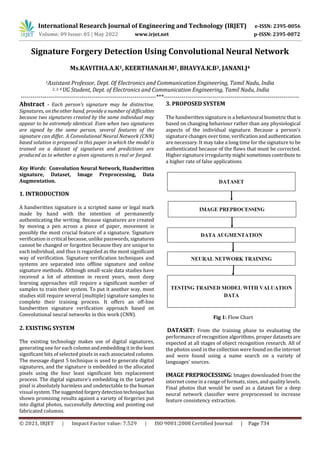
of Engineering and Technology (IRJET) e-ISSN: 2395-0056 Volume: 09 Issue: 05 | May 2022 www.irjet.net p-ISSN: 2395-0072 © 2021, IRJET | Impact Factor value: 7.529 | ISO 9001:2008 Certified Journal | Page 734 Signature Forgery Detection Using Convolutional Neural Network Ms.KAVITHA.A.K1, KEERTHANAH.M2, BHAVYA.K.B3, JANANI.J4 1Assistant Professor, Dept. Of Electronics and Communication Engineering, Tamil Nadu, India 2, 3, 4 UG Student, Dept. of Electronics and Communication Engineering, Tamil Nadu, India ---------------------------------------------------------------------***--------------------------------------------------------------------- Abstract - Each person’s signature may be distinctive. Signatures, on the other hand, provide a number of difficulties because two signatures created by the same individual may appear to be extremely identical. Even when two signatures are signed by the same person, several features of the signature can differ. A Convolutional Neural Network (CNN) based solution is proposed in this paper in which the model is trained on a dataset of signatures and predictions are produced as to whether a given signatures is real or forged. Key Words: Convolution Neural Network, Handwritten signature, Dataset, Image Preprocessing, Data Augmentation. 1. INTRODUCTION A handwritten signature is a scripted name or legal mark made by hand with the intention of permanently authenticating the writing. Because signatures are created by moving a pen across a piece of paper, movement is possibly the most crucial feature of a signature. Signature verification is critical because, unlike passwords, signatures cannot be changed or forgotten because they are unique to each individual, and thus is regarded as the most significant way of verification. Signature verification techniques and systems are separated into offline signature and online signature methods. Although small-scale data studies have received a lot of attention in recent years, most deep learning approaches still require a significant number of samples to train their system. To put it another way, most studies still require several (multiple) signature samples to complete their training process. It offers an off-line handwritten signature verification approach based on Convolutional neural networks in this work (CNN). 2. EXISTING SYSTEM The existing technology makes use of digital signatures, generating one for each columnandembeddingitintheleast significant bits of selected pixels in each associated column. The message digest 5 technique is used to generate digital signatures, and the signature is embedded in the allocated pixels using the four least significant bits replacement process. The digital signature's embedding in the targeted pixel is absolutely harmless and undetectable to the human visual system.Thesuggested forgerydetectiontechniquehas shown promising results against a variety of forgeries put into digital photos, successfully detecting and pointing out fabricated columns. 3. PROPOSED SYSTEM The handwritten signature is a behavioural biometricthat is based on changing behaviour rather than any physiological aspects of the individual signature. Because a person's signature changes over time, verification andauthentication are necessary. It may take a long time for the signature to be authenticated because of the flaws that must be corrected. Higher signature irregularity might sometimescontribute to a higher rate of false applications. Fig 1: Flow Chart DATASET: From the training phase to evaluating the performance of recognition algorithms, proper datasets are expected at all stages of object recognition research. All of the photos used in the collection were found on the internet and were found using a name search on a variety of languages' sources. IMAGE PREPROCESSING: Images downloaded from the internet come in a range of formats, sizes, and quality levels. Final photos that would be used as a dataset for a deep neural network classifier were preprocessed to increase feature consistency extraction.
2.
International Research Journal
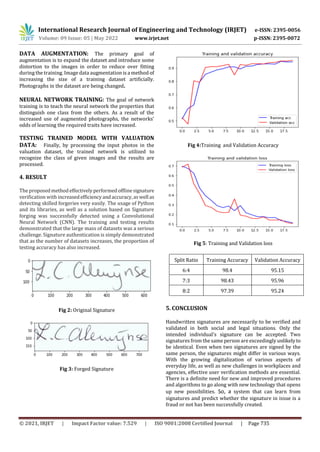
of Engineering and Technology (IRJET) e-ISSN: 2395-0056 Volume: 09 Issue: 05 | May 2022 www.irjet.net p-ISSN: 2395-0072 © 2021, IRJET | Impact Factor value: 7.529 | ISO 9001:2008 Certified Journal | Page 735 DATA AUGMENTATION: The primary goal of augmentation is to expand the dataset and introduce some distortion to the images in order to reduce over fitting during the training. Image data augmentation is a method of increasing the size of a training dataset artificially. Photographs in the dataset are being changed. NEURAL NETWORK TRAINING: The goal of network training is to teach the neural network the properties that distinguish one class from the others. As a result of the increased use of augmented photographs, the networks' odds of learning the required traits have increased. TESTING TRAINED MODEL WITH VALUATION DATA: Finally, by processing the input photos in the valuation dataset, the trained network is utilized to recognize the class of given images and the results are processed. 4. RESULT The proposedmethodeffectivelyperformedofflinesignature verification with increasedefficiencyandaccuracy, aswell as detecting skilled forgeries very easily. The usage of Python and its libraries, as well as a solution based on Signature forging was successfully detected using a Convolutional Neural Network (CNN). The training and testing results demonstrated that the large mass of datasets was a serious challenge. Signature authentication is simply demonstrated that as the number of datasets increases, the proportion of testing accuracy has also increased. Fig 2: Original Signature Fig 3: Forged Signature Fig 4:Training and Validation Accuracy Fig 5: Training and Validation loss 5. CONCLUSION Handwritten signatures are necessarily to be verified and validated in both social and legal situations. Only the intended individual's signature can be accepted. Two signatures from the same person are exceedingly unlikelyto be identical. Even when two signatures are signed by the same person, the signatures might differ in various ways. With the growing digitalization of various aspects of everyday life, as well as new challenges in workplaces and agencies, effective user verification methods are essential. There is a definite need for new and improved procedures and algorithms to go along with new technology that opens up new possibilities. So, a system that can learn from signatures and predict whether the signature in issue is a fraud or not has been successfully created. Split Ratio Training Accuracy Validation Accuracy 6:4 98.4 95.15 7:3 98.43 95.96 8:2 97.39 95.24
3.
International Research Journal
of Engineering and Technology (IRJET) e-ISSN: 2395-0056 Volume: 09 Issue: 05 | May 2022 www.irjet.net p-ISSN: 2395-0072 © 2021, IRJET | Impact Factor value: 7.529 | ISO 9001:2008 Certified Journal | Page 736 REFERENCE [1]Sarvesh Tanwar, Sumit Badotra, Medicine Gupta, Ajay Rana, “Efficient and secure multipledigitalsignature to prevent forgery based on ECC”, International Journal of Applied Science and Engineering, vol 18, no.5, 2021. [2] Nura Musa Tahir, Adam N Ausat, Usam Bature, Kamal Abubakar, “Handwritten signature verification system: Using Artificial Neural Networks Approach”, International Journal of Intelligent Systems and Applications (ISA), 2021. [3] Jivesh Poddar , Vinanti Parikh , Santhosh Kumar Bharti , “Offline Signature Recognition and Forgery Detection using Deep Learning”, International Conference on Emerging Data and Industry(EDI), 2020. [4] Prarthana Parmer ,Jahni Mehta, Saakshi Sharma, Krupa Patel, Parth Singh, “A Survey of Handwritten Signature Verification System Methodologies” , JETIR Volume 6 , May 2019. [5] Gopichand G, Shailaja G, Venkata Vinod Kumar, T. Samatha, “Digital Signature verification Using Artificial Neural Networks”, International Journal of Recent Technology and engineering(IJRTE)Volume-7Issue-5S2, January 2019. [6] K. Tamilarasi, Dr.S. Nithya Kalyani, D. Abirami, R. Sakthi Rekha and T. Dhanalakshmi , “Offline Signature Verification Method based on Matlab Representation” , Journal on Science Engineering and Technology (JSET) Vo1ume 5, No. 02, April 2018. [7] Kaushik Ravi, S.S.Shylaja, and Nypunya Devraj, “A new approach to detect paste forgeries in an image”, International Conference on Image Information Processing (ICIIP), IEEE 2017. [8] Nasir N. Hurrah, Shabir A. Parah, Javaid A. Sheikh, “INDFORG: Industrial ForgeryDetectionUsingAutomatic Rotation Angle Detection and Correction”, IEEE vol 17, issue 5, 2017.
Download
![International Research Journal of Engineering and Technology (IRJET) e-ISSN: 2395-0056
Volume: 09 Issue: 05 | May 2022 www.irjet.net p-ISSN: 2395-0072
© 2021, IRJET | Impact Factor value: 7.529 | ISO 9001:2008 Certified Journal | Page 736
REFERENCE
[1]Sarvesh Tanwar, Sumit Badotra, Medicine Gupta, Ajay
Rana, “Efficient and secure multipledigitalsignature
to prevent forgery based on ECC”, International
Journal of Applied Science and Engineering, vol 18, no.5,
2021.
[2] Nura Musa Tahir, Adam N Ausat, Usam Bature, Kamal
Abubakar, “Handwritten signature verification system:
Using Artificial Neural Networks Approach”,
International Journal of Intelligent Systems and
Applications (ISA), 2021.
[3] Jivesh Poddar , Vinanti Parikh , Santhosh Kumar Bharti ,
“Offline Signature Recognition and Forgery Detection
using Deep Learning”, International Conference on
Emerging Data and Industry(EDI), 2020.
[4] Prarthana Parmer ,Jahni Mehta, Saakshi Sharma, Krupa
Patel, Parth Singh, “A Survey of Handwritten Signature
Verification System Methodologies” , JETIR Volume 6 ,
May 2019.
[5] Gopichand G, Shailaja G, Venkata Vinod Kumar, T.
Samatha, “Digital Signature verification Using Artificial
Neural Networks”, International Journal of Recent
Technology and engineering(IJRTE)Volume-7Issue-5S2,
January 2019.
[6] K. Tamilarasi, Dr.S. Nithya Kalyani, D. Abirami, R. Sakthi
Rekha and T. Dhanalakshmi , “Offline Signature
Verification Method based on Matlab Representation” ,
Journal on Science Engineering and Technology (JSET)
Vo1ume 5, No. 02, April 2018.
[7] Kaushik Ravi, S.S.Shylaja, and Nypunya Devraj, “A new
approach to detect paste forgeries in an image”,
International Conference on Image Information
Processing (ICIIP), IEEE 2017.
[8] Nasir N. Hurrah, Shabir A. Parah, Javaid A. Sheikh,
“INDFORG: Industrial ForgeryDetectionUsingAutomatic
Rotation Angle Detection and Correction”, IEEE vol 17,
issue 5, 2017.](https://image.slidesharecdn.com/irjet-v9i5215-220929090412-cb425a29/85/Signature-Forgery-Detection-Using-Convolutional-Neural-Network-3-320.jpg)


