DEPARTMENT OF BIOCHEMISTRY
FACULTYOF BASIC MEDICAL SCIENCES
BAYERO UNIVERSITY, KANO
COURSE CODE AND TITLE
ENDOCRINOLOGY AND SIGNAL TRANSDUCTION
(BCH 8214)
TOPIC: BIOCHEMISTRY OF HEARING
PRESENTED BY
HARUNA TSOHO BALA SPS/23/MBC/00016
HASHIM IBRAHIM SPS/23/MBC/00014
WHAT IS HEARING
GenerallyHearing is the sensation of sound.
Hearing or the auditory perception is the
ability to perceive sounds by detecting
vibrations, changes in the pressure of the
surrounding medium through time, through
an organ such as the ear (Tortora, 2009).
4.
Introduction:
Ear isthe main organ for hearing. sound wave enters
the outer ear and cause the ear drum to vibrate.
These vibrations pass along the middle ear via three
small bones known as the ossicles.
The ossicles amplify the vibrations and transmit them
on to cochlea in the inner ear.
Hair cells in the cochlea moves in response to the
vibrations and send electrical signals along the auditory
nerve to the brain which converts the vibrations into
sound we can understand (Tortora, 2009).
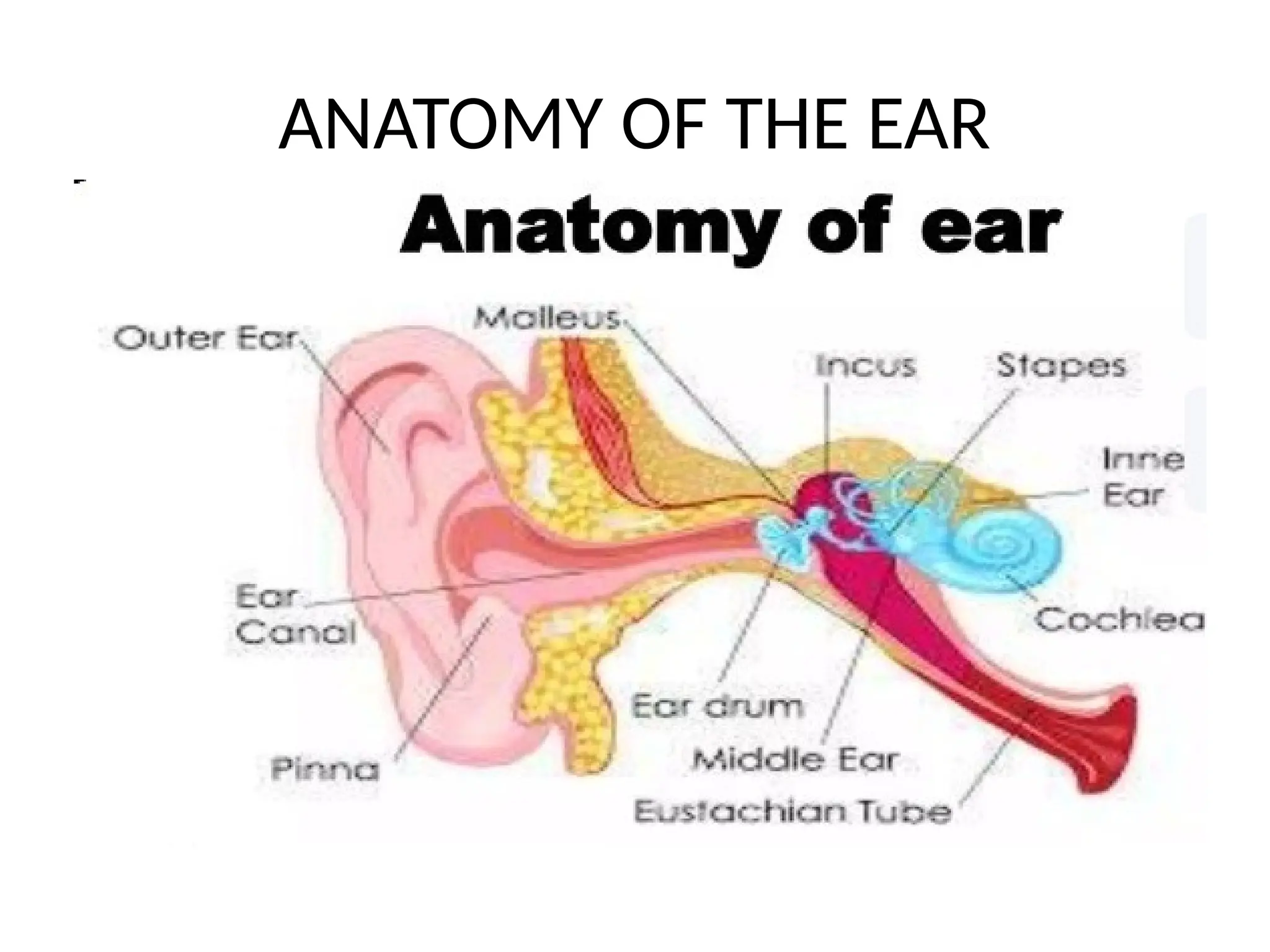
EAR
• The earis the organ of hearing as well as balancing
anatomically
• The ear is divided into three parts.
• The external ear
• The middle ear
• The inner ear.
• The external ear
• the external ear consist of three component
• Pinna (Auricle) the visible, outer part of the ear that helps
capture sound waves and direct them into the ear canal. it is
made of cartilage and soft tissue.
7.
Cont.
2. External AcousticMeatus (ear canal)
The tube-like structure that channels sound
waves from the pinna to the ear drum(tympanic
membrane).it is approximately 2.5 cm long in
adults.
3.Tympanic Membrane (Eardrum): the thin,
vibratory membrane that separates the external
ear from the middle ear.it convert sound waves
into mechanical vibrations.
8.
Cont.
These componentswork togather to direct, and
transmit sound to the inner ear
INNER EAR
The inner ear is made up of several important
components that play key roles in hearing and
balance. These components include
cochlea A spiral-shaped, fluid –filled structure
responsible for converting sound vibration into
neutral signals. It contains hair cells that detect sound
waves and send electrical signals to the brain.
9.
Inner Ear(Cochlea): Sensory Transduction
Endolymph and Perilymph
Endolymph: Rich in K⁺ (potassium), low in Na⁺—
produced by the stria vascularis.
Perilymph: Opposite composition—high Na⁺, low K⁺.
This ionic gradient is essential for electrochemical
transduction.
10.
Hair Cells
Located inthe Organ of Corti on the basilar membrane.
Stereocilia on hair cells bend in response to fluid movement
caused by sound.
Bending opens mechanotransduction channels (mainly
involving tip links between stereocilia), allowing K⁺ and
Ca²⁺ to enter the cell from endolymph.
11.
Signal Transduction
Influx ofK⁺ and Ca²⁺ depolarizes the hair cell.
This leads to the release of neurotransmitter
lutamate at the base of the hair cell.
Glutamate activates AMPA receptors on the
auditory nerve fibers.
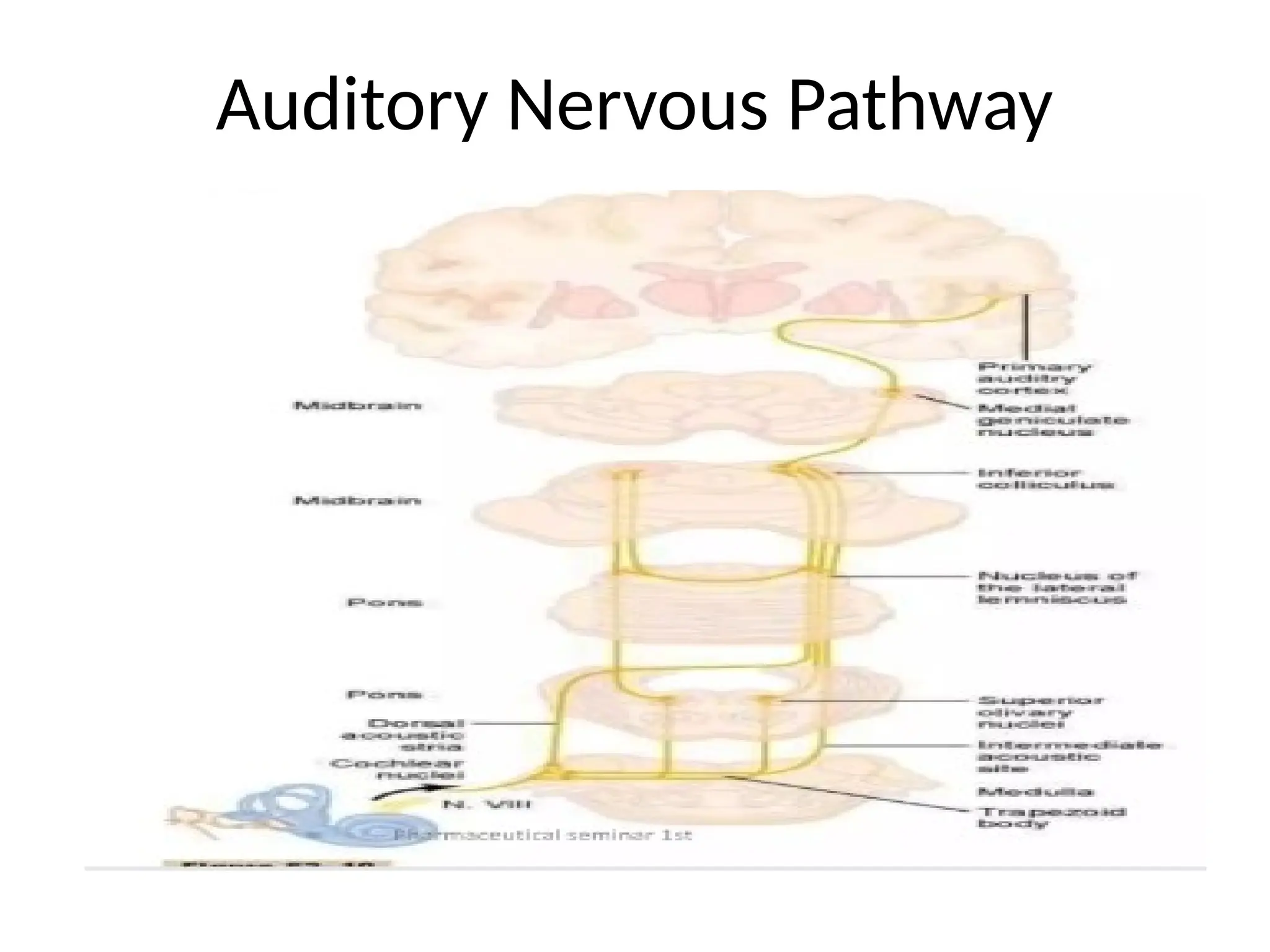
Auditory nerve (cranial nerve VIII) carries the signal
to the brainstem.
12.
Neurotransmitters
Neurotransmitters play acrucial role in the hearing
process by transmitting signals from the ear to the brain.
Sound Detection in the Cochlea
Sound waves enter the ear and are transformed into
mechanical vibrations, which are transmitted to the
cochlea in the inner ear.
Inside the cochlea, hair cells (sensory cells) detect
these vibrations and convert them into electrical
signals.
13.
Neurotransmitter Release
When haircells are stimulated by sound, they release
glutamate, the primary neurotransmitter in the auditory
system.
Glutamate is released into the synapse between hair
cells and the auditory nerve fibers (spiral ganglion
neurons).
14.
Signal Transmission tothe Brain
The glutamate activates AMPA and NMDA receptors on
the auditory nerve fibers.
This triggers action potentials (nerve impulses) that
travel along the auditory nerve to the brainstem,
then through various brain regions (e.g., inferior
colliculus, thalamus, and finally the auditory
cortex).
15.
Other Neurotransmitters Involved
Acetylcholine(ACh): Used by efferent fibers (from brain
to ear) to modulate hair cell sensitivity.
GABA & Glycine: Inhibitory neurotransmitters used in
auditory brainstem circuits to help process sound
localization and timing.
Dopamine & Serotonin: Also modulate auditory
processing, though their exact roles are still being
studied.
Conclusion
• Hearing involvesmechanical vibrational, fluid
dynamics, ions channel function,
neurotransmitters release, and electrical
signaling all working in correct to allow us to
perceive sound. The precise biochemistry of
these processes is crucial for normal hearing,
and disruptions at any stage can lead to
hearing impairments.
18.
REFERENCES
1. Tortora GJand Derrickson BH (2009),
principle of Anatomy and physiology (12th
ed.), Danvers and wild indiapvt. Ltd, 332-336.
2. KC T and Gautam R(2014), essentialtext book
of Anatomy and physiology (1st
ed.),Samiksha
publication pvt.Ltd,191-194.
3. URL: http://drfasih.com/mechanism-of-
hearing/(Assessed on july 09,2018).