ANNUAL REPORT AND FINANCIAL STATEMENTS
Invest, Improve
and Integrate
2019
3Invest, Improve and Integrate
Registered number: 05204176
Registered address: 7-9 Swallow Street, London, W1B 4DE
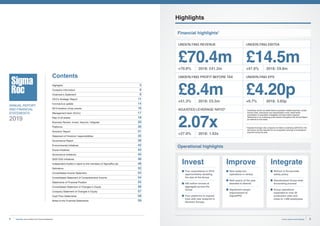
Financial highlights1
Operational highlights
1
Underlying results are stated before acquisition related expenses, certain
finance costs, redundancy and reorganisation costs, impairments,
amortisation of acquisition intangibles and share option expense.
References to an underlying profit measure throughout this Annual Report
are defined on this basis.
2
Adjusted leverage ratio compares net debt to underlying EBITDA for the
last twelve months adjusted for pre-acquisition earnings of subsidiaries
acquired during the year.
Highlights
Invest
	Four acquisitions in 2019
approximately doubling
the size of the Group
	400 million tonnes of
aggregate across the
Group
	Four platforms to expand
from with new footprint in
Northern Europe
Improve
	New ready-mix
operations in Jersey
	BAA quarry of the year
awarded to Aberdo
	 Significant margin
improvement at
SigmaPPG
Integrate
	Rollout of Group-wide
safety policy
	Standardised Group-wide
accounting process
	Group operations
expanded to over 30
production sites and
close to 1,000 employees
ANNUAL REPORT
AND FINANCIAL
STATEMENTS
2019
Contents
Highlights	 5
Company information	 6
Chairman’s Statement	 8
CEO’s Strategic Report	 11
Coronavirus update	 14
2019 timeline of key events	 16
Management team (ExCo)	 17
Map of all assets	 18
Business Review: Invest, Improve, Integrate	 20
Platforms	 26
Directors’ Report	 31
Statement of Directors’ responsibilities	 35
Governance Report	 36
Environmental Initiatives	 42
Social Initiatives	 44
Governance Initiatives	 45
2020 ESG Initiatives	 46
Independent Auditor’s report to the members of SigmaRoc plc	 48
Definitions	 52
Consolidated Income Statement	 53
Consolidated Statement of Comprehensive Income	 54
Statements of Financial Position	 55
Consolidated Statement of Changes in Equity	 56
Company Statement of Changes in Equity	 57
Cash Flow Statements	 58
Notes to the Financial Statements	 59
UNDERLYING REVENUE
£70.4m+70.6% 2018: £41.2m
UNDERLYING PROFIT BEFORE TAX
£8.4m+51.3% 2018: £5.5m
ADJUSTED LEVERAGE RATIO2
2.07x+27.0% 2018: 1.63x
UNDERLYING EBITDA
£14.5m+47.6% 2018: £9.8m
UNDERLYING EPS
£4.20p+9.7% 2018: 3.83p
5Invest, Improve and IntegrateSigmaRoc Annual Report and Financial Statements4 SigmaRoc Annual Report and Financial Statements4
Company information
Directors
David Barrett (Executive Chairman)
Max Vermorken (Chief Executive Officer)
Garth Palmer (Chief Financial Officer)
Dominic Traynor (Non-Executive Director)
Patrick Dolberg (Non-Executive Director)
Tim Hall (Non-Executive Director)
Company Secretary
Heytesbury Corporate LLP
Registered Office
7-9 Swallow Street
London
W1B 4DE
Company Number
05204176
Bankers
Santander UK plc
2 Triton Square
Regent's Place
London
NW1 3AN
Nominated  Financial Adviser
Strand Hanson Limited
26 Mount Row
London
W1K 3SQ
Joint Broker
Liberum Capital Limited
25 Ropemaker Street
London
EC2Y 9LY
Joint Broker
Peel Hunt LLP
120 London Wall
London
EC2Y 5ET
Independent Auditor
PKF Littlejohn LLP
15 Westferry Circus
Canary Wharf
London
E14 4HD
Solicitors
Fieldfisher
Riverbank House
2 Swan Lane
London
EC4R 3TT
Financial PR Adviser
Rubik Communications Limited
7-9 Swallow Street
London
W1B 4DE
Registrars
Share Registrars Limited
The Courtyard
17 West Street
Farnham
Surrey
GU9 7DR
David
Barrett
Executive Chairman
7Invest, Improve and IntegrateSigmaRoc Annual Report and Financial Statements6
9Invest, Improve and Integrate
Dear Shareholders, SigmaRoc has completed a very
successful 2019. Our revenue reached £70 million,
our underlying EBITDA grew by 47.6%, to £14.5 million with our
underlying earnings per share growing further to 4.20 pence.
Underlying EBITDA margins remained strong at 20.7%
when taking into account the incorporation of a lower
margin and higher volume business with the acquisition of
CCP. Our remaining business recorded EBITDA margins of
24.6%, which is in-line with our 2018 performance.
As a result of these strong financial results the business was
able to continue its growth by starting two new platforms in
South Wales and Belgium respectively. The business now
operates over 30 production sites, including 15 quarries,
with over 400 million tonnes of mineral reserves and
resources across the Group, with the potential to further
expand each platform.
A year of substantial growth
2019 was characterised by significant growth, both
organically and through acquisition. We completed a total of
four acquisitions during the year, complementing our PPG
Platform, substantially growing our South Wales platform
and creating a new platform, in Belgium.
Additionally, we have invested in our existing businesses in
order to expand the offering and production capacity, thereby
organically growing our footprint. In 2019, we invested
significantly in our ready-mix concrete offering at Ronez Jersey
and expanded our production capacities at both Poundfield
and CCP. We also upgraded our plant and machinery across
the business to further solidify our operating base.
The most substantial acquisition saw our move into Belgium
through the acquisitions of Carrieres du Hainaut, the leading
producer of the world-famous Belgian Bluestone, as well as
significant volumes of construction aggregates, and Stone
Holdings, which specialises in armour rock for sea and river
defence work. The potential for the business to now expand
into the Benelux area is significant as we build out a quarrying
platform that already includes three quarries in Belgium.
Safety
The safety and the wellbeing of our colleagues is paramount
to our activity and to a well-run business. We have invested
substantially to ensure that workplaces across the Group
continuously improves and accidents are avoided. In
November 2019, we implemented a new Group-wide safety
policy to ensure uniform safety standards across the Group.
The impact of the policy has already been visible. Our
Belgian platform recorded its longest period without incident
on record, between the time of our acquisition and earlier this
year. Our safety record in the other parts of the business also
improved, with a net drop in LTIFR of 36% on the previous
year. Total incident reporting increased across the Group,
showing improved quality of information flow.
Governance and sustainability
As part of the continued transformation of the business,
we have placed further emphasis on governance and
sustainability. In September 2019, we announced the
proposed appointment of Jacques Emsens, a renowned
industrialist and expert in specialist minerals, to our Board
as an independent Non-Executive Director.
Immediately following the release of these Accounts, the
Company intends to formally appoint Jacques Emsens to the
Board, together with Simon Chisholm, who brings detailed
knowledge of equity markets, fund management and market
regulation. Simon qualified as a Chartered Accountant and
has over 20 years of experience working in the investment
arena. He is currently founder and managing director of
Feros Advisers Limited and has previously worked as a
fund manager investing in European equities at Singer 
Friedlander, Henderson Global Investors and other large
institutions. Simon will join the Board as a senior independent
Non-Executive Director and will chair the Audit Committee.
Chairman’s Statement
In addition, we have created an advisory board with the
aim of guiding our business through a number of exciting
projects in the Benelux region. It is a privilege to have
private equity investor, Count Christophe de Limburg Stirum,
and former Heidelberg Benelux CEO Pascal Lesoinne, join
our Benelux advisory board.
With these changes, we have put in place a solid
supervisory body of high calibre individuals with significant
experience in the industry, listed businesses and the fast-
changing regulatory environment, to help us to guide the
business forward.
From a sustainability perspective, we also made significant
progress throughout the year. A separate section of this
report is dedicated to our specific efforts in this area, which
include renewal programmes for our mobile and delivery
fleet for lower emission vehicles, to product ranges aimed at
assisting with the challenges faced by the effects of climate
change, and the participation in breeding programmes for
certain animal species near our sites.
Looking forward
The first important announcement at this stage is that we
see our CFO, Garth Palmer, step down from the role he has
held since we founded the business. Garth, who has served
as our CFO on a part-time basis and is also a partner in
accounting firm, Heytesbury Corporate LLP, has been
an exceptional CFO to our business. Guiding us through
sometimes challenging and always very intense times, his
skill and dedication has been a significant contributing factor
to our success to date. Garth has indicated, however, he will
remain on our Board as a Non-Executive Director, for which
we are extremely grateful.
We are also very pleased to announce our new fulltime
CFO, Dean Masefield, who will also join the Board
immediately following the release of these Accounts. Dean
joined SigmaRoc in 2017 taking on the roles of Financial
Director for the Ronez Platform and then Deputy CFO to the
Group in 2019. Prior to joining SigmaRoc Dean served as
Head of Finance of BNP Paribas and later Equiom Channel
Islands overseeing all accounting, reporting, regulatory
and systems aspects for tens of billions of USD in assets
under management. Dean is a Chartered Accountant having
qualified with BDO in 1997 and is presently an FCA, having
qualified with the Institute of Chartered Accountants of
England and Wales.
In order to maintain an appropriately sized Board relative to
the size and stage of development of the Group, Dominic
Traynor and Patrick Dolberg have both agreed to step down
from their current positions as Non-Executive Directors of
the Company, following completion of the Annual General
Meeting to be held on 18 May 2020.
Dominic has been with us on this journey from the very
beginning and we are extremely thankful to him for his
contributions toward our success to date, which have
culminated in the Group exceeding forecast annual turnover
of £100 million. We are pleased that Dominic will be taking
up a position on one of the subsidiary boards and will
therefore remain involved with the Group in an advisory
capacity.
Patrick has been with us since we completed the reverse
takeover of Ronez in early January 2017 and has been
instrumental in guiding the Group through its early growth
phase, for which we are extremely grateful. Patrick is
a Belgian national and formerly ran Holcim’s European
operations. Given our European growth aspirations we are
pleased to report that Patrick will join our Benelux advisory
committee and, therefore, will continue to provide guidance
as we grow the Group.
With these Board changes we have positioned the
business well for the future. With significant potential for
further development. In the Benelux region, we have a
well-balanced business that can capitalise on growth
opportunities as and when they arise. Our position in South
Wales is promising and can be expanded. Our precast
group, SigmaPPG, is in great shape and fully integrated.
We started 2020 well with a strong first quarter, however,
at the time of writing, the outbreak of the Coronavirus
pandemic and its economic consequences create
uncertainty. We continue to actively monitor the situation
and implement required contingency plans as and when
appropriate. We remain confident that we have a solid
business with fantastic assets and that once the economy
rebounds, we will be well positioned to resume delivering
further shareholder value.
David Barrett
Executive Chairman
17 April 2020
SigmaRoc Annual Report and Financial Statements8
11Invest, Improve and Integrate
Max
Vermorken
Chief Executive Officer
2019 was a significant year for SigmaRoc. Nearly
every month of the year, the business made a major
step forward, whether it was through organic growth, acquisition,
financial and operational improvement and/or a review of our
safety, governance, reporting systems and environmental impact.
As a result, where we started 2019 as a business with two
platforms, we finished the year with four platforms across
four regions, nearly 1,000 colleagues and ample opportunity
to further expand and develop.
Financial performance
Focussing first on the financial performance of the Group,
where we have delivered excellent results. Revenue
increased to £70.4 million, with underlying EBITDA
increasing to £14.5 million, a growth of 47.6% year-on-year.
Underlying earnings per share increased to 4.20 pence.
Underlying EBITDA margins continued to be strong at
20.7% when taking into account the integration of CCP, a
quality business specialising in concrete blocks that typically
attract a lower margin. As we further integrate and grow
the Group, these margins are expected to continue to grow
above 20%, assuming 2019 activity levels.
Our balance sheet has also continued to improve, with the
refinancing of the £10 million, 6% convertible loan notes and
the simultaneous extension of the Santander credit facilities
from £20 million to £34 million. With the acquisition of CCP
in the North West, our joint venture with G.D. Harries in
South Wales and our acquisition of CDH in the Benelux, we
have extended our mineral reserves and resources to over
400 million tonnes across the Group, at 15 quarries. The
asset backing in the Group is therefore solid and is further
complemented by land, plant and machinery at the various
production sites.
Trading Summary
Throughout 2019, we have continued to press on with
improvement programmes launched across the various
businesses. A dedicated section in this report on our business
model gives further detail of the progress made. As a result
of these programmes, each business we own is performing
better than it had prior to acquisition.
Ronez had another strong year of continued increased
performance recording over £29 million in sales, biased to
the first half. The markets in Jersey remained strong, while
Guernsey has unfortunately not yet seen the higher volume
months it witnessed five years ago. In particular, our new
concrete offering in Jersey has helped solidify our position
as the concrete supplier of choice, demonstrating that the
investment case for the new plant was a robust one. The
contracting division also did an outstanding job in both
islands, delivering challenging jobs in sometimes difficult
circumstances as both the weather and the structure of the
sites can be tricky in the islands.
Our second platform, SigmaPPG, recorded a solid year all
round after a slower start than expected. CCP, acquired
in February 2019, showed slower trading in the initial few
months of ownership, both in its block and aggregates
businesses. However, the block business saw volumes
increase rapidly across the year, with nightshifts being
introduced for the first time to follow demand. The Aberdo
quarry was restructured extensively making it an exemplary
turn-around case and won the British Aggregate Association
Quarry of the Year award.
Allen Concrete and Poundfield Products continued their
strong performance with an expanded product range. After
further investment to reorganise the Poundfield site as a
result of increasing levels of demand, it has now captured
a leading position in the UK as a supplier of choice for
technically challenging bespoke precast concrete projects
and retaining walls.
Across the second and third quarters of 2019, production
levels hit record all-time highs propelling Poundfield’s
revenues to over £9m. Large sea defence projects were
delivered in the UK, protecting the British coastlines. The
retaining wall business continued to diversify its offering to
include new applications of the product and selling to, for
example, nuclear facilities. The flooring business grew further
with its end-to-end design solution and short lead times.
Growth
While we continued to focus on performance improvements,
we did not lose focus on our acquisition growth strategy. We
expanded into South Wales through a joint venture partnership
with G.D. Harries, a leading construction materials supplier led
by Ian Harries and assisted by our MD for the region, David
McClelland. The business recorded an excellent year, well
ahead of its performance in 2018 with an underlying EBITDA of
£3.2 million, a year-on-year growth of 24.8%.
CEO’s Strategic Report
11Invest, Improve and IntegrateSigmaRoc Annual Report and Financial Statements10
In the third quarter, we commenced our expansion into
Belgium, following many months of planning, initially appointing
Emmanuel Maes as MD of Europe, a highly experienced
former CEO of dredging and aggregates supplier, Group De
Cloedt, followed by the acquisition of Stone Holdings and
subsequently and more significantly, Carrieres du Hainaut.
Carrieres du Hainaut is globally the leading supplier of
Belgian Blue Stone, a highly sought-after decorative stone
with applications in infrastructure, housing and public spaces.
It recorded sales of €51.4 million and an underlying EBITDA
of €13.6 million in 2019. Extension projects are ongoing to
extend the site to over 300 hectares. Additionally, CDH is a
major producer of construction aggregates with volumes of
nearly 2 million tonnes per year, one of the largest operations
of its kind in Belgium. Combined, CDH has approximately 200
million tonnes of aggregate and over 27 million cubic metres
of dimension stone, enough for over 100 years of production
at the current rate.
The potential with this acquisition lies in the fact that the
business offers a real platform for growth. Belgian Blue Stone
remains undiscovered in many markets including the UK, yet
we believe that we have the required commercial teams in
place within our PPG Platform to change this. The partnership
on the production of construction aggregates comes to an end
in three years giving us full flexibility to consider all options
to produce and even commercialise this valuable material
ourselves, or in continued collaboration with a quality partner.
Safety
Major progress was made in the field of safety and the
wellbeing of our colleagues. As an executive committee we
designed and implemented a Group-wide safety policy in
line with the highest standards in the industry. We appointed
Clinton White as Safety and Estates Director and he
coordinates with line managers in each business to ensure
safety is an output of best practice operations. We continue
to use external auditors to review our safety performance
independently, to ensure we constantly improve.
Year-on-year the results are visible. The total number of
incidents has declined while the business grew. Our Group-
wide LTIFR reduced by 36%. Total reported near misses
increased indicating better reporting. The culture in each
platform is changing to embrace our best practice safety
policy. A key example would be our Belgian platform which
saw the longest period without incident on record subsequent
to our take-over of the business.
Environment, Social and Governance (ESG)
Over the course of 2019 we made significant progress on all
aspects of our ESG focus. A dedicated section of this report
provides full details, however, some aspects we can highlight
here. During the course of 2019, we started the search to
extend our Board with further independent Non-Executive
Directors, with a view to ensuring robust governance of the
business. With the proposed appointments of industrialist,
Jacques Emsens, and former fund manager and Chartered
Accountant, Simon Chisholm, we will add solid experience to
our Board in the management of large listed industrial groups
as well as the regulatory aspects of publicly listed companies.
At an operational level, in May 2020, we are very pleased to be
appointing Anthony Brockbank, Equity Capital Markets (ECM)
partner with law firm, Fieldfisher LLP, as our General Council,
on a part time basis. We consider Anthony to be amongst the
most experienced ECM lawyers in the UK and he will further
assure compliance with the market rules and regulations.
On a social and environmental front, we continued to reinforce
our existing initiatives to reduce our environmental impact,
protect our operational sites from pollution, care for indigenous
species of wildlife and actively seek to produce products which
help with the mitigation of some of the impacts of climate
change. Further details on these initiatives are provided in the
dedicated section further into this report.
Promotion of the Company for the benefit
of members as a whole
The Director’s believe they have acted in the way most likely
to promote the success of the Group for the benefit of its
members as a whole, as required by s712 of the Companies
Act 2006. The requirements of s172 are for the Directors to:
•	Consider the likely consequences of any
decision in the long term;
•	 Act fairly between the members of the Company;
•	Maintain a reputation for high standards of
business conduct;
•	 Consider the interests of the Group’s employees;
•	Foster the Group’s relationships with suppliers,
customers and others; and
•	Consider the impact of the Group’s operations
on the community and environment.
The application of the s172 requirements are demonstrated
throughout this report and the Accounts as a whole, with the
following examples representing some of the key decisions
made in 2019 and up to the date of these Accounts:
•	Response to the Coronavirus pandemic: as detailed
in the Coronavirus update on page 14, the Group has
taken various measures to protect the wellbeing of its
employees, maintain good working relationships with its
customers and suppliers, and ensure the commercial
viability of its business.
•	Continued pursuit of buy and build growth strategy: the
Group has aggressively continued its buy and build growth
strategy, completing four acquisitions during 2019, which
expanded the SigmaPPG and South Wales platforms and
created a new platform in Belgium.
•	Safety initiatives: safety and wellbeing of our colleagues
is one of our top priorities and the Group continued to
improve its health and safety standards, including adopting
a Group-wide safety policy to ensure uniform safety
standards across the Group.
Strategic approach and outlook
Our strategic approach is to build clusters of local and
complementary businesses to deliver shareholder value
from synergies, operational improvement and competitive
advantage. We target assets that deliver a value proposition
to customers, have a strong local market presence and
hard asset backing, resulting in improved margins. We
seek income streams that are diversified and supported by
quality assets producing aggregates, concrete, precast and
prestressed concrete and related products and services.
At the time of writing the outlook is complex. The underlying
business is sound, filled with significant potential and the
capacity to expand both organically and through acquisition.
The teams are skilled and the operational structure is
efficient, following several improvement initiatives. The project
pipeline remains filled with exciting projects, both in terms of
product development and potential acquisition targets that
could strongly complement our existing footprint.
We started the year well with solid performance in all parts of
the business. While Ronez had some inclement weather to
deal with, in the shape of several storms passing through the
Channel Islands, its underlying demand and project pipeline
remains solid. The Benelux platform recorded robust sales
in both aggregates and dimension stone, indicating a good
pipeline overall. Our discussions with Santander and four
banks in Belgium to put in place a Group-wide credit facility,
which would provide further financial flexibility to support our
growth, are far advanced and we look forward to providing
further updates as and when appropriate.
In consideration of the above, I believe it is only fitting to
close this report with three facts: firstly, our business made
excellent progress in 2019 and Q1 2020; secondly, as
a management team we have, since early March 2020,
made preparations to mitigate the impact of COVID-19 on
our business through several action plans and mitigation
strategies; and thirdly, the underlying business, its asset
backing and strength of its senior management team position
the Group well to deliver shareholder value.
This report was approved by the Board on 17 April 2020.
Max Vermorken
Chief Executive Officer
Our
response to
COVID-19
13Invest, Improve and IntegrateSigmaRoc Annual Report and Financial Statements12
15Invest, Improve and Integrate
Since the end of February 2020, we have been
working to prepare our business for scenarios that
I do not think anyone could have anticipated, namely, those
brought about by the impact of the Coronavirus pandemic.
Fortunately, as a team, we believe we’re ahead of most and
found ourselves in a good position to help protect our staff and
our business from the potential consequences of COVID-19.
With this message, I intend to give you some insight into how we
are approaching this challenge.
Preparation and uniform approach
In early March 2020, it became apparent that the
Coronavirus would pose a serious challenge to all of us.
To prepare for this challenge, we instructed our Health
and Safety Director, Clint White, and the Group MDs to
immediately start coordinating our response across the
entire business. A Group-wide campaign on how to prevent
contracting the virus, based on scientific and Government
advice, was started. At the time of writing, this has been
successful, with all our operations remaining free of
confirmed or probable Coronavirus cases.
Increasing our readiness
As time passed, it quickly became apparent that basic
hygiene rules would not be enough and that we needed to
do more; we needed strict social distancing. As a business,
we are fortunate in that we mostly work in the open air, on
sites with plenty of space and carry out jobs that can be
reconfigured to be performed alone, indicating a relatively
lower risk profile.
However, across the Group we also have administrative
offices, portacabins, breakrooms and toilets. We have
made sure to ventilate these spaces well where possible,
otherwise deciding to limit access or closing them
completely. We have also enhanced cleaning routines and
surfaces touched by staff are now cleaned more frequently.
Those who could work from home were instructed to do
so, in order to respect the social distancing instructions.
In addition, a programme was put in place to ensure
those working from home did so in the right setup and
environment.
Financial preparation
As a team, we also looked carefully at the possible financial
implications to our business resulting from Coronavirus. I
am happy to report that, at an early stage of pandemic, we
developed contingency plans that prepared our business
well for the possible consequences of this virus. Simulations
were run to understand how long we could survive with zero
revenue, how much revenue loss we could stand to remain
cash positive, how much revenue could be lost before
banking covenants were breached and what would need to
be done to make our financial position as secure as possible.
The plans we developed were reassuring. Our cash balance
was robust and would allow us to operate for over six months
with zero revenue and without drawing any further debt. We
have access to further bank facilities if required. Even more
encouraging is the fact that these plans were prepared,
finalised and presented to the Board well before the UK and
Belgium governments announced the various financial support
packages. When it became clear how such financial support
could help us if required, we felt we were in an excellent
position as a Group to deal with the challenges ahead.
Brace for impact
As Coronavirus started to spread and Belgium, the UK and
the Channel Islands started reporting a significant number of
cases, the implementation of our contingency plans became
the priority. Several additional steps were taken:
-	Daily calls: To coordinate activity across all businesses
and facilitate a uniform approach across the Group,
daily calls with all managers were set up to report on the
situation in each business.
Coronavirus update
-	Continuing to operate: The next dilemma became
whether to stay open or shut our sites. Government
regulations in the UK and Belgium indicated our activities
could continue, as long as all health recommendations
were followed. In the Channel Islands the indications
changed over time. As a management team, we debated
the matter extensively, to conclude that if we could
guarantee correct social distancing and hygiene measures,
staying open where permitted was the right answer. While
keeping our staff out of harm was our key focus, our
second priority had to be supporting our local economies
and communities by paying our bills and supplying
materials required for projects such as hospitals and road
infrastructure. If we could continue to operate and trade, we
were not a burden to the economy, but in fact, contributing
to it. This ultimately felt like the right approach.
	As a result, the Group had to close all but essential
infrastructure maintenance operations, in both Guernsey
and Jersey, for a period of 14 days commencing effective
from 26 March 2020 and 4 April 2020 respectively.
Guernsey has remained closed up until the publication of
these Accounts, however, there is an expectation of an
easing of restrictions and a controlled restart of business
activity during the week commencing 20 April 2020. The
Jersey Government has implemented a permitting system
that is progressively facilitating the reopening of accredited
construction sites and small works. At the time of writing
modest supplies have commenced, with an acceleration
in the Group’s operations expected to commence from 20
April 2020.
	In the UK, the Group remains active across all sites, albeit
at reduced volume levels, supplying product where doing
so is an economically viable proposition for its customers.
In this context, the Group has decided to suspend some
of its production capacity and supply from stock. In Wales,
G.D. Harries remains active across a number of civil
engineering and road maintenance contracts, having
reduced production and haulage capacity in-line with
current local demand.
	The Group’s Belgian businesses also remain operational
with the support of staff and unions, supplying bluestone
to a reduced number of active customers. The Group’s
partner in the sale of aggregates from its Soignies quarry
has decided to close its production entirely until further
notice. However, the Group continues to supply customers
from its other aggregate quarries near the town of Huy.
-	Consultation with unions and staff: In order to ensure
our operations could continue, a dialogue with staff
commenced at each production site. Those who were
considered to potentially be at risk (for example those
that had a pre-existing medical condition), those who had
any symptoms similar to those experienced by people
suffering from COVID-19, or those who were in contact with
COVID-19 patients, were instructed to go home and isolate.
Surveys were conducted to understand requirements to
stay home with children, providing management with a
good understanding of the pressures on our staff.
	In Belgium and in Jersey, where the workforces are
unionised, a dialogue was started with the unions, who in
every case were proactive, supportive and understanding
that, as long as staff could be kept safe, there was a
local community and economy to consider, as well as the
future of the business. The union representatives showed
true leadership and vision during those discussions.
-	Face masks: A topic that followed from our staff
consultations was the need for face masks. After failing
to secure the required number we decided to hire a
team of seamstresses and make them ourselves. 2,000
face masks have been ordered of which 1,000 have
been received and distributed to members of staff. The
remaining 1,000 are planned to be donated to local
hospitals. Appropriate instructions were given to each
staff member to ensure proper use of the masks.
-	Paying our bills and helping the community: The
next challenge became the management of our cash
in a climate where more and more customers were
signalling that they would not be making timely payment
of their outstanding liabilities. Daily cash monitoring and
bi-weekly calls were set up between all accounting and
credit control teams to ensure we managed our cash
prudently. Through discussions with our customers and
suppliers, we were able to continue to pay our bills and
maintain our cash position without significant erosion.
In the end, our mission has been to be a supportive
business, helping its local communities where it could
while not endangering its own liquidity position.
At the time of writing, the above summary provides a
detailed perspective of our position and our approach to
dealing with the Coronavirus. We firmly believe that the
Group is in a strong position. We have remained operational
where permitted and where deemed safe, selling product,
collecting cash and paying suppliers. We are supplying
products to those who needed them for their activities,
including hospitals and for the maintenance of roads.
Wherever possible we have helped our local communities
without forgetting our mandate to our shareholders.
To conclude this additional update, I want to make it very
clear that none of the above could have been achieved
without the tireless support of a phenomenal team of
individuals who collectively make up the SigmaRoc group.
In the face of this crisis, they remained humble, disciplined,
understanding and a true team. They understood how
little we could do as individuals but how much we could
accomplish as a team, as a business, as a society.
Max Vermorken
CEO
SigmaRoc plc
SigmaRoc Annual Report and Financial Statements14
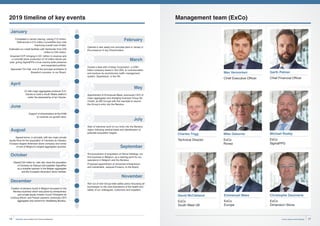
2019 timeline of key events
February
Opened a new ready-mix concrete plant in Jersey in
the presence of key Shareholders.
January
Completed a vendor placing, raising £12 million.
Refinanced a £10 million convertible loan note
improving overall cost of debt.
Extended our credit facilities with Santander from £20
million to £34 million.
Acquired CCP, bringing in £21 million in revenue and
a concrete block production of 18 million blocks per
year, giving SigmaPPG a true country-wide presence
and expanded portfolio.
Appointed Tim Hall, one of the principal architects of
Breedon’s success, to our Board.
April
JV with major aggregates producer G.D.
Harries to build a South Wales platform
under the stewardship of Ian Harries.
June
Support of shareholders at the AGM
to continue our growth story.
August
Agreed terms, in principle, with two major private
equity firms for the acquisition of Carrieres du Hainaut,
Europe’s largest dimension stone company and owner
of one of Belgium’s largest aggregates quarries.
October
Raised £33 million to, inter alia, close the acquisition
of Carrieres du Hainaut and establish SigmaRoc
as a sizeable operator in the Belgian aggregates
and the European dimension stone markets.
December
Creation of advisory board in Belgium focussed on the
Benelux business which was joined by entrepreneur
and private equity investor Count Christophe de
Limburg Stirum, and Pascal Lesoinne, previously CEO
aggregates and cement for Heidelberg Benelux.
March
Closed a deal with Lindsay Corporation, a US$1
billion company based in the USA, to commercialise
and produce its revolutionary traffic management
system, Zipperblock, in the UK.
May
Appointment of Emmanuel Maes, previously CEO of
major aggregates and dredging business Group De
Cloedt, as MD Europe with the mandate to secure
the Group’s entry into the Benelux.
July
Start of intensive work on our entry into the Benelux
region following several leads and identification of
potential acquisition targets.
September
Announcement of acquisition of Stone Holdings, our
first business in Belgium, as a starting point for our
operations in Belgium and the Benelux.
Proposed appointment of renowned entrepreneur
and industrialist, Jacques Emsens, to the Board.
November
Roll out of new Group-wide safety policy focussing all
businesses on the vital importance of the health and
safety of our colleagues, customers and suppliers.
Management team (ExCo)
Garth Palmer
Chief Financial Officer
Max Vermorken
Chief Executive Officer
Emmanuel Maes
ExCo
Europe
Christophe Daulmerie
ExCo
Dimension Stone
Charles Trigg
Technical Director
David McClelland
ExCo
South West UK
Michael Roddy
ExCo
SigmaPPG
Mike Osborne
ExCo
Ronez
17Invest, Improve and IntegrateSigmaRoc Annual Report and Financial Statements16
19Invest, Improve and Integrate
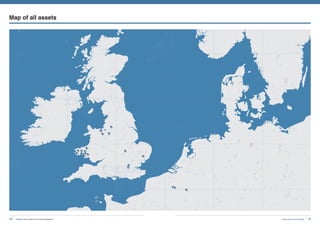
Map of all assets
SigmaRoc Annual Report and Financial Statements18
21Invest, Improve and Integrate
Our business model
SigmaRoc was set up with the vision to build a competitive
construction materials group, focussed on the long term
benefits our industry has to offer. Our business model
was conceived out of the experiences of many high level
executives and entrepreneurs in the sector, allowing several
important conclusions to be drawn.
Construction materials are a local product, consumed and
produced locally, and, due to their high mass to price ratio,
they tend to travel shorter distances to end customers
than other commodities, such as oil or metals. This brings
a particular dynamic to the sector, focussed on local and
fragmented markets.
Our business model starts from the understanding that
each local market is different, with its own particularities,
competitive pressures and local history. Understanding
that structure, preserving its history and local dynamics,
while applying best-in-class operational and financial
management, will ultimately, all things being equal, lead to
a better offering, for investors, customers, employees and
local communities.
A particular ingredient in that structure is empowering local
managers and operators to take full responsibility for their
business or division. Only local managers fully understand
the requirements of the local market. Product innovation,
customer engagement and Capex decisions are all driven by
local requirements and not by a group agenda, which may or
may not be adequate for what is required on the ground.
At a group level, we utilise this decentralised approach to
focus on what we are best at; finding appealing investment
opportunities, helping the acquired businesses reach a
best-in-class status operationally and financially, and lock in
synergies available to us through scale and expertise.
Implementing our strategy
In practice, the implementation of the vision expressed
above can be achieved through three core principles:
We invest in businesses. This is not the same as acquiring
them. We aim to keep and improve those aspects which
made them worth acquiring, whether that is their independent
mind-set, their entrepreneurial nature or their founder.
We improve the businesses we have bought by targeting
those aspects which were less efficient than they could be.
This can vary widely from inefficient sales efforts, poor cash
management to operational difficulties.
Lastly, we integrate the businesses we buy into clusters
where compatibility secures synergies and where scale
helps to generate local buying power. We also integrate
acquired businesses into the infrastructure of the Group,
providing centralised technical, financial and managerial
support, allowing the newly integrated business to capture
efficiencies and economies of scale.
Invest
	Only in businesses with
solid intrinsic value;
	Only in businesses
with the potential to be
improved and grown;
	Only in businesses which
can be bought at an
attractive valuation.
Improve
	 The operational and financial
performance of the business;
	The motivation of management
to drive growth;
	The ultimate offering to the
local market and community.
Integrate
	By building platforms of
compatible businesses;
	By unlocking those
synergies which do not
come at a significant cost;
	By recognising the value of
what previous owners built.
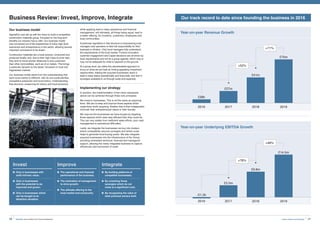
Business Review: Invest, Improve, Integrate
Year-on-year Revenue Growth
Year-on-year Underlying EBITDA Growth
£36k
£27m
£41m
£70m
2017 2018 2019
+52%
+71%
-£1.2k
£5.5m
£9.8m
£14.5m
2016 2017 2019
+78%
+48%
2018
2016
Our track record to date since founding the business in 2016
SigmaRoc Annual Report and Financial Statements20
23Invest, Improve and Integrate
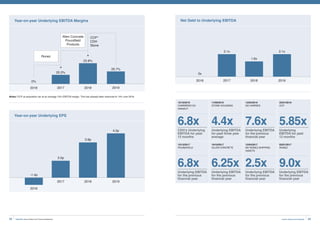
Year-on-year Underlying EBITDA Margins
Year-on-year Underlying EPS
0%
20.3%
23.8%
20.7%
4.2p
3.8p
2.0p
-1.4p
CCP*
CDH
Stone
Allen Concrete
Poundfield
Products
Ronez
Notes:*CCP at acquisition ran at an average 10% EBITDA margin. This has already been improved to 14% over 2019.
2017 2019
2018
2016
2016
20192017
2018
Net Debt to Underlying EBITDA
2.1x
1.6x
2.1x
0x
2016 2017 20192018
15/10/2019
CARRIÈRES DU
HAINAUT
6.8x
CDH’s Underlying
EBITDA for past
12 months
13/12/2017
POUNDFIELD
6.8x
Underlying EBITDA
for the previous
financial year
15/04/2019
GD HARRIES
7.6x
Underlying EBITDA
for the previous
financial year
15/04/2017
MV RONEZ SHIPPING
ASSETS
2.5x
Underlying EBITDA
for the previous
financial year
11/09/2019
STONE HOLDINGS
4.4x
Underlying EBITDA
for past three year
average
19/10/2017
ALLEN CONCRETE
6.25x
Underlying EBITDA
for the previous
financial year
25/01/2019
CCP
5.85x
Underlying
EBITDA for past
12 months
05/01/2017
RONEZ
9.0x
Underlying EBITDA
for the previous
financial year
SigmaRoc Annual Report and Financial Statements22
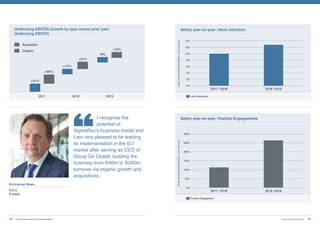
Underlying EBITDA Growth by type versus prior year
Underlying EBITDA
+10%
+9%
+21%
+17%
+60%
+31%
Acquisition
Organic
2018 20192017
I recognise the
potential of
SigmaRoc's business model and
I am very pleased to be leading
its implementation in the EU
market after serving as CEO of
Group De Cloedt, building the
business from €40m to €240m
turnover via organic growth and
acquisitions.
Emmanuel Maes
ExCo
Europe
2017 / 2018
2017 / 2018
2018 / 2019
2018 / 2019
Safety year-on-year: Harm reduction
Safety year-on-year: Positive Engagements
YEARONYEARIMPROVEMENT–LIKEFORLIKEYEARONYEARIMPROVEMENT–LIKEFORLIKE
Harm Reduction
Positive Engagement
0%
0%
2%
50%
4%
100%
6%
150%
8%
200%
10%
250%
12%
300%
14%
25Invest, Improve and IntegrateSigmaRoc Annual Report and Financial Statements24 SigmaRoc Annual Report and Financial Statements24
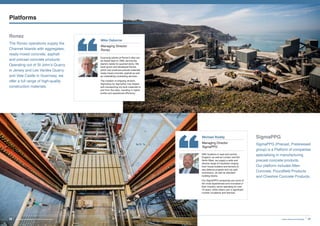
Ronez
The Ronez operations supply the
Channel Islands with aggregates,
ready-mixed concrete, asphalt
and precast concrete products.
Operating out of St John’s Quarry
in Jersey and Les Vardes Quarry
and Vale Castle in Guernsey, we
offer a full range of high-quality
construction materials.
SigmaPPG
SigmaPPG (Precast, Prestressed
group) is a Platform of companies
specialising in manufacturing
precast concrete products.
Our platform includes Allen
Concrete, Poundfield Products
and Cheshire Concrete Products.
Michael Roddy
Managing Director
SigmaPPG
With locations in east and central
England, as well as London and the
North West, we supply a wide and
diverse range of industries ranging
from house builders and farmers to
sea defence projects and car park
contractors, as well as standard
building blocks.
Our SigmaPPG companies are some of
the most experienced and innovative in
their industry; some operating for over
70 years, while others own a significant
number of patents and licences.
Mike Osborne
Managing Director
Ronez
Quarrying activity at Ronez’s sites can
be traced back to 1869, serving the
island’s needs for quarried stone. We
have grown and developed Ronez,
which now produces precast materials,
ready-mixed concrete, asphalt as well
as undertaking contracting services.
The creation of shipping division,
SigmaGsy by SigmaRoc has helped
with transporting dry-bulk materials to
and from the sites, resulting in higher
profits and operational efficiency.
Platforms
27Invest, Improve and IntegrateSigmaRoc Annual Report and Financial Statements26
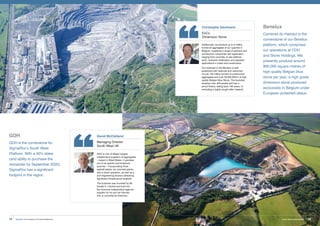
GDH
GDH is the cornerstone for
SigmaRoc’s South West
Platform. With a 40% stake
(and ability to purchase the
remainder by September 2020),
SigmaRoc has a significant
footprint in the region.
Benelux
Carrieres du Hainaut is the
cornerstone of our Benelux
platform, which comprises
our operations at CDH
and Stone Holdings. We
presently produce around
900,000 square metres of
high quality Belgian blue
stone per year, a high grade
dimension stone produced
exclusively in Belgium under
European protected status.
Christophe Daulmerie
ExCo
Dimension Stone
Additionally, we produce up to 2 million
tonnes of aggregates at our quarries in
Belgium, supplying a range of partners and
construction companies with application
ranging from concrete, to sea defence
work, riverbank fortification and standard
applications in roads and construction.
Our business in the Benelux is well
positioned with reserves and resources
of over 150 million tonnes of construction
aggregates and over 28,000,000m3
of high
quality Belgian Blue Stone. The business
employs over 430 people and has a
proud history, dating back 130 years, of
extracting a highly sought after material.
David McClelland
Managing Director
South West UK
GDH is one of Wales’ largest
independent suppliers of aggregates
– based in West Wales, it operates
out of six granite and limestone
quarries – incorporating three
asphalt plants, six concrete plants,
and a wharf operation, as well as a
civil engineering division delivering
significant infrastructure projects.
The business was founded by Mr.
Gerald D. Harries and built into
the foremost independent regional
supplier by his son Ian Harries,
who is currently its chairman.
SigmaRoc Annual Report and Financial Statements 29Invest, Improve and Integrate28
Garth
Palmer
Chief Financial Officer
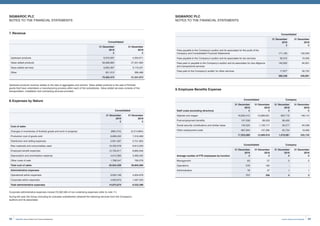
Cash generated from operations was £2.1 million (2018:
£5.5 million) with a net increase in cash of £6.1 million
(2018: net decrease of £3.2 million). In October 2019, the
Group raised in aggregate, £33 million in relation to the
acquisition of CDH, which resulted in a net cash surplus of
£5 million after paying cash consideration and associated
transaction costs.
Revenue and underlying EBITDA is in line with expectations
and management forecasts.
Capital expenditure relates to purchase of new plant and
machinery and improvements to existing infrastructure
across the Group.
PPA
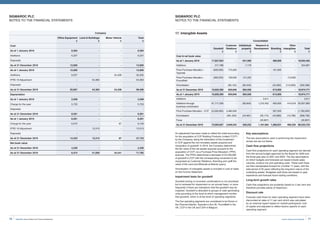
BDO UK undertook the PPA exercise required under IFRS 3
to allocate a fair value to the acquired assets of CCP.
The PPA process resulted in a reduction of goodwill
recorded on the Statement of Financial Position of the
Group for CCP from £13.5 million to £7.9 million. The
reduction was to transfer the value of goodwill to intangible
assets for land and mineral reserves, trade name, workforce
and customer relations.
Non-underlying items
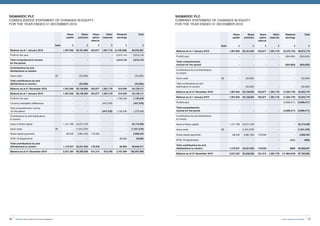
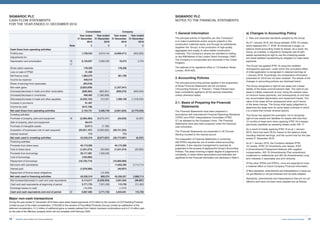
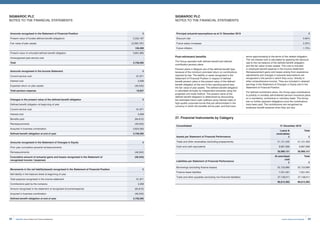
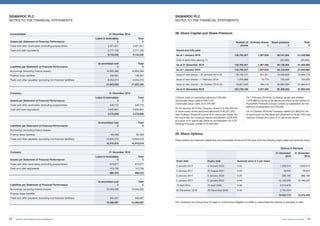
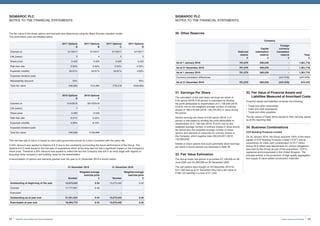
The Company’s loss after taxation for 2019 amounts to £4.7
million, of which £3.6 million relates to non-underlying items,
while the Group’s non-underlying items totaled £6.2 million
for the year. These items relate to seven categories:
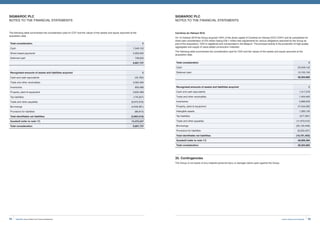
1.	£2.6 million in exclusivity, introducer, consulting, legal fees
and other direct costs relating to prospective acquisitions.
During the year the Group acquired four businesses, being
CCP, GDH, Stone and CDH for a combined enterprise
value of approximately £112 million and proforma EBITDA
of approximately £17 million.
2.	£0.8 million legal and restructuring expenses relating to the
rebranding and alignment of all subsidiaries across the Group.
3.	£1.2 million amortisation of acquired assets.
4.	£0.7 million in relation to the convertible loan note
redemption premium and associated advisor fees.
5.	 £0.5 million loss on discontinued operations at its Bury site.
6.	£0.2 million in share based payments relating to grants
of options.
7.	£0.2 million in other exceptional costs which primarily
relate to non-cash balance sheet adjustments.
Interest and tax
Net finance costs in the year totaled £2 million (2018: £1
million) and included £0.5 million redemption premium
on the Group’s convertible loan notes plus associated
interest, bank finance facilities, as well as interest on finance
leases (including IFRS 16 adjustments) and hire purchase
agreements.
A tax charge of £0.5 million (2018: £0.3 million) was
recognised in the year, resulting in a tax charge on profitability
generated from mineral extraction in the Channel Islands and
profits generated through the Group’s UK and Belgium based
operations.
2019 2018
Cash and cash equivalents £9,867,696 £3,771,735
Revenue £70,362,472 £41,241,673
Underlying EBITDA £14,534,647 £9,823,080
Capital expenditure £3,384,363 £6,670,447
Directors’ Report
As I will be stepping down from my role as an executive
Board member and Chief Financial Officer following
publication of these Accounts, I would like to begin this report
by thanking the Board and shareholders for the opportunities
afforded to me over the better part of four years. Due to other
business interests, I have occupied my role in a part time
capacity, and it was always envisioned I would step aside
when the time was right. Now more than ever the Group
needs a fulltime CFO and we are extremely pleased to have
Dean Masefield taking over. I have immensely enjoyed
my time to date with SigmaRoc, am extremely proud of
everything we have achieved together and look forward to
continuing the journey as a Non-Executive Director.
I am very pleased to report a strong year financially for the
Group, during which we exceeded our ambitious financial
targets, while continuing to expand our business. We
completed four acquisitions during the year, with CCP in
January, GDH in April, Stone in September and then CDH in
October.
In our full 2019 financial year, the Group generated revenue
of £70.4 million (2018: £41.2 million) and underlying
EBITDA of £14.5 million (2018: £9.8 million). The underlying
profit before taxation for the Group for the year ended 31
December 2019 was £8.4 million (2017: £5.5 million).
The loss for the Company for the year ended 31 December
2019 before taxation amounts to £4.7 million (2018: loss £0.9
million), which includes £3.6 million of non-underlying expenses.
The Board monitors the activities and performance of the
Group on a regular basis. The Board uses financial indicators
based on budget versus actual to assess the performance
of the Group. The indicators set out below will continue to be
used by the Board to assess performance over the period to
31 December 2020.
31Invest, Improve and IntegrateSigmaRoc Annual Report and Financial Statements30
33Invest, Improve and Integrate
Earnings per share
Basic EPS for the year was 0.92 pence (2018: 2.65 pence),
adjusted for the non-underlying items mentioned above.
Underlying basic EPS for the year totaled 4.20 pence (2018:
3.83 pence).
Statement of financial position
Net assets at 31 December 2019 were £102 million (2018: £54
million). Net assets are underpinned by mineral resources, land
and buildings and plant and machinery assets of the Group.
Cash flow
Cash generated by operations was £2.1 million (2018: £5.5
million). The Group spent £35.9 million on acquisitions net of
cash acquired and £3.4 million on capital projects. The Group
raised £44 million net of fees through the issue of equity and
drew down net borrowings of £1.2 million which included
repayment of the £10 million convertible loan notes, £16.3
million drawdown from the Santander credit facility and £5.1
million of debt repayments in acquired subsidiaries. The net
result was a cash inflow for the year of £6.1 million. Net debt
at 31 December 2019 was £49.8 million (2018: £16.0 million),
£32.0 million arising from the recent acquisition of CDH and is
in the process of being refinanced.
Bank facilities
In 2017 the Group secured debt facilities with Santander
consisting of a £2 million RCF, an £18 million term facility and
a further “accordion” facility of £10 million. In December 2018
the Group received credit approval from Santander to increase
the RCF to £4 million and the term facility to £30 million,
bringing the total debt facilities available with Santander to £34
million (the ‘Existing Debt Facilities’).
The Group is currently in the final stages of agreeing a new
club financing facility agreement with Santander and several
Belgian banks for an RCF of £15 million, term facility of £45
million and an acquisition and Capex facility of £20 million
(the ‘Club Refinance’). Successful negotiation of the Club
Refinance, which is at an advanced stage, will result in total
debt facilities being made available to the Group of £80 million,
with a further £40 million accordion facility on materially the
same terms as the Existing Debt Facilities. As a result of the
Coronavirus pandemic, it has been mutually agreed to extend
the existing Belgian debt facilities to 31 December 2020 and
it is expected that the Club Refinance will be formalised on or
before this date.
The Group’s Existing Debt Facilities have a maturity date of 29
August 2022 and are subject to a variable interest rate based
on LIBOR plus a margin depending on EBITDA. As at 31
December 2019, total undrawn facilities available to the Group
via the Existing Debt Facilities amounted to £7.7 million.
The Group’s Existing Debt Facilities are subject to covenants
which are tested monthly and certified quarterly. These
covenants are: Group interest cover ratio set at a minimum of
3.5 times EBITDA; a maximum adjusted leverage ratio, which
is the ratio of total net debt, including further borrowings such
as the convertible loan notes, to adjusted EBITDA, of 3.25x in
2019. At 31 December 2019, the Group comfortably complied
with its bank facility covenants.
Dividends
Subject to availability of distributable reserves, dividends
will be paid to shareholders when the Directors believe it is
appropriate and prudent to do so. The focus of the Group
at this stage of its development will be on delivering capital
growth for shareholders. The Directors therefore do not
recommend the payment of a dividend for the year (31
December 2018: nil).
Principal risks and uncertainties
The management of the business and the execution of the
Group’s strategy are subject to a number of risks. The key
business risks affecting the Group are set out below.
Risks are formally reviewed by the Board and appropriate
processes are put in place to monitor and mitigate them.
If more than one risk event occurs, it is possible that the
overall effect of such events would compound the possible
adverse effects on the Group.
Operational risk
Since the period under review, the Coronavirus pandemic has
become a significant emerging risk to the global economy.
Due to inherent uncertainty, the Group cannot reasonably
estimate the potential impact on the Group’s financial position,
results of operations or cash flows in the future, however
the Board continues to actively monitor the situation as
more information about the Virus emerges and responds
accordingly, taking into consideration the various contingency
and mitigation plans it implemented from the early outset of
the Coronavirus outbreak.
Reserve and resource estimates
The Group’s reporting of reserves and resources are
estimates, and so there is potential uncertainty over the
amount of such reserves and resources held at the year-end.
These may require revision based on future actual production.
In addition, there is risk of new leases (in particular Chouet
phase 2 and the West extension at St John’s) not being
approved and, as such, leading to revised valuation and future
income streams for the operations at Ronez.
Dependence on key personnel
The Group is dependent upon its executive management
team. Whilst it has entered into contractual agreements
with the aim of securing the services of these personnel,
the retention of their services cannot be guaranteed. The
development and success of the Group depends on its
ability to recruit and retain high quality and experienced
staff. The loss of the service of key personnel or the inability
to attract additional qualified personnel as the Group
grows could have an adverse effect on future business and
financial conditions.
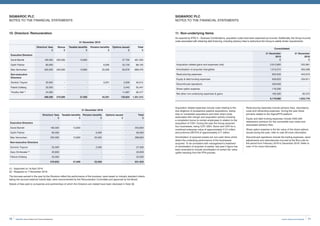
31 December 2019 31 December 2018
Ordinary Shares Options Ordinary Shares Options
Max Vermorken 447,511 11,807,349 210,032 4,368,188
David Barrett 2,175,640 5,638,674 760,032 1,879,513
Garth Palmer 256,186 3,326,014 114,594 488,136
Dominic Traynor - 791,511 - 26,014
Patrick Dolberg 184,756 765,497 75,000 304,580
Tim Hall1
300,000 750,000 - -
(1) Appointed on 18 April 2019
Further details on options can be found in Note 29 to the Financial Statements.
Details on the remuneration of the Director’s can be found in Note 10 to the Financial Statements.
Uninsured risk
The Group may become subject to liability for hazards that
cannot be insured against or third-party claims that exceed
the insurance cover. The Group may also be disrupted by
a variety of risks and hazards that are beyond its control,
including geological, geotechnical and seismic factors,
environmental hazards, industrial accidents, occupation and
health hazards and weather conditions or other acts of God.
Funding risk
The only sources of funding currently available to the Group
are through the issue of additional equity capital in the
Company or through debt financing. The Company’s ability to
raise further funds will depend on the success of the Group’s
activities and its investment strategy. The Group may not be
successful in procuring funds on terms that are attractive and,
if such funding is unavailable, the Group may be required to
reduce the scope of its investment activities.
Financial risks
The Group’s operations expose it to a variety of financial
risks that can include market risk (including foreign currency,
price and interest rate risk), credit risk, and liquidity risk.
The Group has a risk management programme in place
that seeks to limit the adverse effects on the financial
performance of the Group by monitoring levels of debt
finance and the related finance costs. The Group does not
use derivative financial instruments to manage interest rate
costs and, as such, no hedge accounting is applied.
Details of the Group’s financial risk management policies are
set out in Note 3 to the Financial Statements.
Principal activity
The principal activity of the Company is to make
investments and/or acquire businesses and assets in the
construction materials sector. The principal activity of the
Group is the production of high quality aggregates and
supply of value-added construction materials.
Board composition and head office
The Board comprises three Executive Directors and three
Non-Executive Directors. The Corporate Head Office of the
Company is located in London, UK.
Directors  Directors’ interests
The Directors who served during the year ended 31
December 2019 are shown below and had, at that time, the
following beneficial interests in the shares of the Company:
SigmaRoc Annual Report and Financial Statements32
Corporate responsibility
Environmental
SigmaRoc undertakes its activities in a manner that
minimises or eliminates negative environmental impacts and
maximises positive impacts of an environmental nature.
Health and safety
SigmaRoc operates a comprehensive health and safety
programme to ensure the wellness and security of its
employees. The control and eventual elimination of all work
related hazards requires a dedicated team effort involving
the active participation of all employees. A comprehensive
health and safety programme is the primary means for
delivering best practices in health and safety management.
This programme is regularly updated to incorporate
employee suggestions, lessons learned from past incidents
and new guidelines related to new projects with the aim of
identifying areas for further improvement of health and safety
management. This results in continuous improvement of
the health and safety programme. Employee involvement is
regarded as fundamental in recognising and reporting unsafe
conditions and avoiding events that may result in injuries and
accidents.
Internal controls
The Board recognises the importance of both financial and
non-financial controls and has reviewed the Group’s control
environment and any related shortfalls during the year. Since
the Group was established, the Directors are satisfied that,
given the current size and activities of the Group, adequate
internal controls have been implemented. Whilst they are
aware that no system can provide absolute assurance
against material misstatement or loss, in light of the current
activity and proposed future development of the Group,
continuing reviews of internal controls will be undertaken to
ensure that they are adequate and effective.
Further details of corporate governance can be found in the
Corporate Governance Report on page 36.
Going concern
As documented extensively in these Accounts, the impact of
the COVID-19 pandemic on the Group’s business, revenues
and cash flow creates significant uncertainty. However, given
the Group’s robust balance sheet and in conjunction with
forecast projections based on, what are considered to be
as at the date of these Accounts, worst case scenarios, the
Directors have a reasonable expectation that the Group has
adequate resources to continue in operational existence for the
foreseeable future and, therefore, continue to adopt the going
concern basis in preparing the Annual Report and Financial
Statements. Further details on their assumptions and their
conclusion thereon are included in the statement on going
concern included in Note 2.3 to the Financial Statements.
Directors’ and officers’ indemnity insurance
The Company has made qualifying third-party indemnity
provisions for the benefit of its Directors and officers. These
were made during the year and remain in force at the date
of this report.
Events after the reporting period
Events after the reporting period are set out in Note 38 to
the Financial Statements.
Policy and practice on payment of creditors
The Group agrees terms and conditions for its business
transactions with suppliers. Payment is then made in
accordance with these terms, subject to the terms and
conditions being met by the supplier. As at 31 December
2019, the Company had an average of 82 days (2018: 26
days) purchases outstanding in trade payables and the
Group had an average of 51 days (2018: 43 days).
Future developments
Details of future developments for the Group are disclosed
in the Chairman’s Statement on page 8 and the CEO’s
Strategic Report on page 11.
Provision of information to Auditor
So far as each of the Directors is aware at the time this
report is approved:
•	there is no relevant audit information of which
the Group’s auditor is unaware; and
•	the Directors have taken all steps that they ought to
have taken to make themselves aware of any relevant
audit information and to establish that the auditor is
aware of that information.
Auditor
PKF Littlejohn LLP has signified its willingness to continue in
office as auditor. This report was approved by the Board on
17 April 2020 and signed on its behalf.
Garth Palmer
Chief Financial Officer
Statement of Directors’ responsibilities
The Directors are responsible for preparing the Annual Report
and the Financial Statements in accordance with applicable
law and regulations, including the AIM Rules for Companies.
Company law requires the Directors to prepare financial
statements for each financial year. Under that law the
Directors have elected to prepare the Group and Company
Financial Statements in accordance with International
Financial Reporting Standards (IFRSs) as adopted by the
European Union. Under company law the Directors must not
approve the Financial Statements unless they are satisfied
that they give a true and fair view of the state of affairs of the
Group and Company, and of the profit or loss of the Group
for that period. In preparing these Financial Statements, the
Directors are required to:
•	select suitable accounting policies and
then apply them consistently;
•	make judgments and accounting estimates
that are reasonable and prudent; and
•	state whether applicable IFRSs as adopted by the
European Union have been followed, subject to any
material departures disclosed and explained in the
financial statements; and
•	prepare the financial statements on the going concern
basis unless it is inappropriate to presume that the Group
will continue in business.
The Directors are responsible for keeping adequate
accounting records that are sufficient to show and explain
the Group’s and Company’s transactions and disclose with
reasonable accuracy at any time the financial position of the
Group and Company, and enable them to ensure that the
Financial Statements comply with the Companies Act 2006.
They are also responsible for safeguarding the assets of
the Group and Company, and hence for taking reasonable
steps for the prevention and detection of fraud and other
irregularities.
The Directors are responsible for the maintenance and
integrity of the corporate and financial information included
on the Company’s website, www.sigmaroc.com. Legislation
in the United Kingdom governing the preparation and
dissemination of the Financial Statements may differ from
legislation in other jurisdictions.
The Company is compliant with AIM Rule 26 regarding the
Company’s website. The Directors confirm that they have
complied with the above requirements in preparing the
Financial Statements.
SigmaRoc Annual Report and Financial Statements 35Invest, Improve and Integrate34
37Invest, Improve and Integrate
Governance Report
Board members
Max Vermorken
Chief Executive Officer
Patrick Dolberg
Non-Executive Director
David Barrett
Executive Chairman
Dominic Traynor
Non-Executive Director
Garth Palmer
Chief Financial Officer
Tim Hall
Non-Executive Director
Corporate Governance Report
The Directors recognise the importance of sound corporate
governance. As a company whose shares are traded on
AIM, the Board has decided to comply with the QCA Code.
In addition, the Directors have adopted a code of conduct
for dealings in the shares of the Company by directors and
employees and are committed to maintaining the highest
standards of corporate governance. Garth Palmer, in his
capacity as CFO, has assumed responsibility for ensuring
that the Company has appropriate corporate governance
standards in place and that these requirements are followed
and applied within the Company as a whole.
The corporate governance arrangements that the Board has
adopted are designed to ensure that the Company delivers
long term value to its shareholders and that shareholders
have the opportunity to express their views and expectations
for the Company in a manner that encourages open
dialogue with the Board.
The Board recognises that its decisions regarding strategy
and risk will impact the corporate culture of the Company
as a whole and that this will impact the performance of
the Company. The Board is very aware that the tone and
culture set by the Board will greatly impact all aspects of
the Company as a whole and the way that employees
behave. A large part of the Company’s activities is centred
upon what needs to be an open and respectful dialogue
with employees, clients and other stakeholders. Therefore,
the importance of sound ethical values and behaviours is
crucial to the ability of the Company to successfully achieve
its corporate objectives. The Board places great importance
on this aspect of corporate life and seeks to ensure that this
flows through all that the Company does.
The key governance related matter that occurred during
the financial year ended 31 December 2019 was the
establishment of a Group-wide health and safety policy.
Corporate Governance Report
The QCA Code sets out 10 principles that should be applied.
These are listed below together with a short explanation of
how the Company applies each of the principles:
Principle One
Business Model and Strategy
The Board has concluded that the highest medium and
long term value can be delivered to its shareholders by
the adoption of a single strategy for the Company. The
principal activity of the Group is the production of high-quality
aggregates and supply of value-added construction materials
and the aim is to create value for shareholders through the
successful execution of its ‘buy and build’ strategy in the
construction materials sector.
The Board implements this strategy by focusing investment
into high quality and well managed construction material
assets, establishing a strict criteria for project evaluation and
selection, utilising industry recognised methods of operation,
developing a results-driven exploration approach, actively
monitoring operational and financial performance measured
against deliverable targets and budgets and considering
alternative commercial options for projects which no longer
meet the established criteria of the Group.
Principle Two
Understanding Shareholder Needs and Expectations
The Board is committed to maintaining good communication
and having constructive dialogue with its shareholders. The
Company has close ongoing relationships with its private
shareholders. Institutional shareholders and analysts have
the opportunity to discuss issues and provide feedback at
meetings with the Company. In addition, all shareholders
are encouraged to attend the Company’s Annual General
Meeting. Investors also have access to current information
on the Company though its regulatory announcements,
website, www.sigmaroc.com, and via Andrea Mora of Rubik
Communications Limited, the Company’s financial PR adviser,
who is available to answer investor relations enquiries.
Principle Three
Considering Wider Stakeholder
and Social Responsibilities
The Board recognises that the long term success of the
Company is reliant upon the efforts of the employees of
the Company and its contractors, suppliers, regulators and
other stakeholders. The Board has put in place a range of
processes and systems to ensure that there is close oversight
and contact with its key resources and relationships. For
example, all employees of the Company participate in a
structured Company-wide annual assessment process which
is designed to ensure that there is an open and confidential
dialogue with each person in the Company to help ensure
successful two way communication with agreement on goals,
targets and aspirations of the employee and the Company.
These feedback processes help to ensure that the Company
can respond to new issues and opportunities that arise to
further the success of employees and the Company. The
Company has close ongoing relationships with a broad range
of its stakeholders and provides them with the opportunity to
raise issues and provide feedback to the Company.
The Group has supported and given back to the community
by participating in a selection of projects in recent years,
further details of the Group’s environmental, social and
governance related initiatives are provided on page 42.
Principle Four
Risk Management
In addition to its other roles and responsibilities, the Audit
Committee is responsible to the Board for ensuring that
procedures are in place and are being implemented effectively
to identify, evaluate and manage the significant risks faced
by the Company. The risk assessment matrix below sets out
those risks and identifies the controls that are in place. This
matrix is updated as changes arise in the nature of risks or
the controls that are implemented to mitigate them. The Audit
Committee reviews the risk matrix and the effectiveness of
scenario testing on a regular basis. The following principal
risks and controls to mitigate them, have been identified:
SigmaRoc Annual Report and Financial Statements36
Jacques Emsens
Non-Executive Director
Simon Chisholm
Non-Executive Director
Dean Masefield
Chief Finance Officer
New Appointments
39Invest, Improve and Integrate
The Directors have established procedures, as represented
by this statement, for the purpose of providing a system of
internal control. An internal audit function is not considered
necessary or practical due to the size of the Company and
the close day to day control exercised by the executive
directors. However, the Board will continue to monitor
the need for an internal audit function. The Board works
closely with and has regular ongoing dialogue with the
CFO and has established appropriate reporting and control
mechanisms to ensure the effectiveness of its control
systems.
Principle Five
A Well-Functioning Board of Directors
As at the date hereof the Board comprised, the CEO Max
Vermorken, the Chairman David Barrett, the CFO Garth
Palmer and three Non-Executive Directors, Dominic Traynor,
Patrick Dolberg and Tim Hall. Immediately following the
publication of these Accounts, the Board will comprise the
CEO, Max Vermorken, the Chairman, David Barrett, the
CFO, Dean Masefield and six Non-Executive Directors,
Dominic Traynor, Patrick Dolberg, Garth Palmer, Tim Hall,
Jacques Emsens and Simon Chisholm; Mr Emsens and Mr
Chisholm are considered to be independent. Biographical
details of the current and proposed Directors are set out
within Principle Six below. Executive and Non-Executive
Directors are subject to re-election at intervals of no more
than three years. The service contracts and letters of
appointment (as applicable) of all Directors are available for
inspection at the Company’s registered office during normal
business hours.
The Board meets at least four times per annum. It has
established an Audit Committee, Remuneration Committee
and an AIM Rules and MAR Compliance Committee,
particulars of which appear hereafter. The Board has agreed
that appointments to the Board are made by the Board as
a whole and so has not created a Nominations Committee.
The Non-Executive Directors are considered to be part time
but are expected to provide as much time to the Company
as is required.
Activity Risk Impact Control(s)
Operation Recruitment and retention of
key staff
Depletion of mineral
resources and inability to
secure additional reserves
Reduction in operating
capability
Operations are dependent
on a quality source of
aggregate
Stimulating and safe
working environment,
balancing salary with longer
term incentive plans
Resource expansion plans
developed at all sites
Regulatory adherence Breach of rules Censure or withdrawal
of authorisation
Strong compliance regime
instilled at all levels of the
Company
Strategic Market downturn
Competition
Macroeconomic conditions
adversely affecting
Group’s prospects.
Expansion in the UK and
Belgium affect Group’s risk
Contingency ‘disaster’
budgets and regular
assessment of
materials market.
Strong relationships
with government and
community and experienced
senior management
Financial Misappropriation of Funds
IT Security
Fraudulent activity
and loss of funds
Loss of critical financial data
Robust financial controls
and split of duties
Regular back up of data
online and locally
In order to be efficient, the Directors meet formally and
informally both in person and by telephone. To date there
have been quarterly formal meetings of the Board held
in person, plus additional ad-hoc meetings of the Board
where appropriate, and the volume and frequency of such
meetings is expected to continue at this rate.
At a general meeting of the Company held on 27 September
2019, Shareholders voted to approve amending the
Articles removing the restriction on the Board from making
any resolutions in the United Kingdom. The Board meet
collectively prior to any matters being resolved, however in
order to comply with the Articles prior to their amendment,
two members of the Board were required to hold a meeting
offshore to pass the resolutions. There were eight such
meetings in 2019 in addition to the quarterly meetings which
all Board members attended, plus two ad-hoc meetings.
In addition to Board meetings, the executive Directors attend
monthly executive committee meetings with the managing
directors of the subsidiary operations.
Principle Six
Appropriate Skills and Experience of the Directors
The Board currently consists of six Directors and, in addition,
the Company has employed the outsourced services of
Heytesbury Corporate LLP to act as the Company Secretary.
The Company intends to appoint two new independent non-
executive directors immediately following the release of the
Accounts, following which it is satisfied that given its size and
stage of development, between the Directors, it will have an
effective and appropriate balance of skills and experience
across technical, commercial and financial disciplines.
The Board shall review annually the appropriateness and
opportunity for continuing professional development whether
formal or informal. The respective roles of the Board members
following the proposed appointments will be as follows:
David Barrett
Chairman and Executive Director
Member of the Remuneration Committee
Max Vermorken
Chief Executive Officer and Executive Director
Dean Masefield
Chief Financial Officer and Executive Director
Garth Palmer
Non-Executive Director
Member of the AIM Rules and MAR Compliance Committee
Jacques Emsens
Independent Non-Executive Director
Simon Chisholm
Chairman of the Audit Committee and member of the AIM
Rules and MAR Compliance Committee
Dominic Traynor
Non-Executive Director
Chairman of the Remuneration Committee and the AIM
Rules and MAR Compliance Committee
Patrick Dolberg
Non-Executive Director
Member of the Audit Committee and AIM Rules and MAR
Compliance Committee
Tim Hall
Non-Executive Director
Director
Formal quarterly meetings and
meetings post change to Articles Offshore meetings to comply with Articles
Attended Eligible to attend Meetings attended Eligible to attend
Max Vermorken 6 6 4 4
David Barrett 6 6 6 6
Garth Palmer 6 6 1 1
Dominic Traynor 6 6 1 1
Patrick Dolberg 5 6 4 4
Tim Hall 3 4 - -
The Company shall report annually on the number of Board and Committee meetings held during the year and the attendance
record of individual Directors. Details of the directors’ attendance at the Board meetings are set out below:
SigmaRoc Annual Report and Financial Statements38
41Invest, Improve and Integrate
Principle Seven
Evaluation of Board Performance
Internal evaluation of the Board, the Committees and
individual Directors is to be undertaken on an annual
basis in the form of peer appraisal and discussions to
determine the effectiveness and performance of the various
governance components, as well as the Directors’ continued
independence.
The results and recommendations that come out of the
appraisals for the Directors shall identify the key corporate
and financial targets that are relevant to each Director and
their personal targets in terms of career development and
training. Progress against previous targets shall also be
assessed where relevant.
Principle Eight
Corporate Culture
The Board recognises that its decisions regarding strategy
and risk will impact the corporate culture of the Company
as a whole and that this will impact the performance of
the Company. The Board is very aware that the tone and
culture set by the Board will greatly impact all aspects of the
Company as a whole and the way that employees behave.
The Corporate Governance principles that the Board has
adopted is designed to ensure that the Company delivers
long term value to its shareholders and that shareholders
have the opportunity to express their views and expectations
for the Company in a manner that encourages open
dialogue with the Board. A large part of the Company’s
activities are centred upon what needs to be an open
and respectful dialogue with employees, clients and other
stakeholders.
Therefore, the importance of sound ethical values and
behaviours is crucial to the ability of the Company to
successfully achieve its corporate objectives. The Board
places great importance on this aspect of corporate life and
seeks to ensure that this flows through all that the Company
does. The Directors consider that at present the Company
has an open culture facilitating comprehensive dialogue and
feedback and enabling positive and constructive challenge.
The Company has adopted, with effect from the date on
which its shares were admitted to AIM, a code for Directors’
and employees’ dealings in securities which is appropriate
for a company whose securities are traded on AIM and is
in accordance with the requirements of the Market Abuse
Regulation, which came into effect in 2016.
Principle Nine
Maintenance of Governance Structures and Processes
Ultimate authority for all aspects of the Company’s activities
rests with the Board, the respective responsibilities of
the Chairman and Chief Executive Officer arising as a
consequence of delegation by the Board. The Board has
adopted appropriate delegations of authority that set out
matters which are reserved to the Board. The Chairman
is responsible for the effectiveness of the Board, while
management of the Company’s business and primary
contact with shareholders has been delegated by the Board
to the Chief Executive Officer.
Audit Committee
As at the date of the Accounts, the Audit Committee
comprises Dominic Traynor and Patrick Dolberg, and
Dominic Traynor chairs this committee. Immediately
following publication of the Accounts, the Audit Committee
will comprise Simon Chisholm, Dominic Traynor and Patrick
Dolberg, and Simon Chisholm will chair this committee. This
Committee has primary responsibility for monitoring the
quality of internal controls and ensuring that the financial
performance of the Company is properly measured and
reported. It receives reports from the executive management
and auditors relating to the interim and annual accounts
and the accounting and internal control systems in use
throughout the Company. The Audit Committee shall
meet not less than twice in each financial year and it has
unrestricted access to the Company’s auditors.
Remuneration Committee
The Remuneration Committee comprises David Barrett
and Dominic Traynor, and Dominic Traynor chairs this
Committee. The Remuneration Committee reviews the
performance of the executive Directors and employees
and makes recommendations to the Board on matters
relating to their remuneration and terms of employment. The
Remuneration Committee will meet as and when necessary.
The Remuneration Committee also considers and approves
the granting of share options pursuant to the share option
plan and the award of shares in lieu of bonuses pursuant to
the Company’s Remuneration Policy.
AIM and MAR Compliance Committee
As at the date of the Accounts, the AIM Compliance
Committee comprises Dominic Traynor and Patrick Dolberg,
and Dominic Traynor chairs this committee. Immediately
following publication of the Accounts, the AIM Compliance
Committee will comprise Dominic Traynor, Patrick Dolberg
and Garth Palmer, and Dominic Traynor will continue to
chair this committee. The AIM Compliance Committee
is responsible for the coordinating and monitoring the
Company’s regulatory responsibilities including liaising
with the Nomad and the London Stock Exchange as
necessary. The purpose of the AIM Compliance Committee
is to designate responsibility of ensuring best practice and
application of the defined corporate governance procedures.
Nominations Committee
The Board has agreed that appointments to the Board will
be made by the Board as a whole and so has not created a
Nominations Committee.
In accordance with the Companies Act 2006, the Board
complies with: a duty to act within their powers; a duty to
promote the success of the Company; a duty to exercise
independent judgement; a duty to exercise reasonable care,
skill and diligence; a duty to avoid conflicts of interest; a duty
not to accept benefits from third parties and a duty to declare
any interest in a proposed transaction or arrangement.
Principle Ten
Shareholder Communication
The Board is committed to maintaining good communication
and having constructive dialogue with its shareholders. The
Company has close ongoing relationships with its private
shareholders. Institutional shareholders and analysts have
the opportunity to discuss issues and provide feedback at
meetings with the Company. In addition, all shareholders are
encouraged to attend the Company’s Annual General Meeting.
Investors also have access to current information on
the Company through its regulatory announcements,
website, www.sigmaroc.com, and via Andrea Mora of
Rubik Communications Limited, the Company’s financial
PR adviser, who is available to answer investor relations
enquiries. The Company shall include, when relevant, in its
annual report, any matters of note arising from the Audit or
Remuneration committees.
SigmaRoc Annual Report and Financial Statements40
43Invest, Improve and Integrate
Environmental
Initiatives
Energy Efficiency
We are quadrupling the energy
generated from solar panels at
our Belgian business CDH from
950MWh to around 3,800MWh
representing around one third of
the energy consumption of the site.
We expect this third photovoltaic
park to be up and running in 2020.
We are progressing through a
programme to replace all sodium-
based factory lights with LED lights
which consume on average around
25% of the energy consumed by
their sodium-based equivalent
We are progressing through
a programme to upgrade our
delivery fleet to EURO-6 engines
where possible and EURO 5 in
the Channel Island as imposed
by axle width restrictions.
Recycling
We continue to pump over 2.5 million
m3
per year of water from the quarry
at Soignies, and treating the water
for domestic use to serve the needs
of around 30,000 households.
Through a partnership with UK
start-up, MacRebur, we have
used over 40,000 plastic bottles
as a replacement for bitumen
in the construction of roads.
We continue to monitor, improve
and optimise our use of recycled
materials as a replacement for
polluting compounds. This includes
the use of granulated blast furnace
slag as a cement replacer, the
reduction of steel reinforcement
bars in our precast products and
the reduction of water use in our
concrete and ready-mix products.
We have started to capture rainwater
from the roofs of our factories
to be utilised in our production
process already capturing over
5,000 litres since the start of the
initiative earlier this year in 2020.
We are making active use of
returned materials and recycle
on average 3,000 tonnes of
aggregates at Poundfield Products
alone into new production
Wildlife
Having won the 2018 Insurance
Corporation Environmental award for
Best Conservation Project, Ronez’s
engagement with the Birds On The
Edge programme, to re-introduce
the Red Billed Chough to Jersey,
continued to progress positively.
The number of breeding birds in
the quarry grew once gain and
the facilities provided by Ronez
for monitoring the breeding pairs
were improved further with better
access for conservation staff and
new nest boxes being installed.
We are part of the European
initiative “Life in quarries” in Belgium
promoting the reintroduction of wildlife
near our quarrying operations
We have started a nesting and
breeding programme near and
at our precast production sites
to stimulate birdlife following the
success of the Ronez programme.
SigmaRoc Annual Report and Financial Statements42
Social Initiatives
Local communities
Through the “Convention PFI (Plan Formation-
Insertion)” and the associated certification via the
“CEFOMEPI (Centre de Formation aux Métiers de
la Pierre)”, CDH has over the years trained over
100 young unskilled colleagues to give them the
required certification to work in the ornamental
stone sector. The programme is considered a
success with a high retention rate of over 80%.
Across 2019, we have supported the Durrell
Wildlife Trust initiative of creating, displaying
and subsequently selling at auction life-sized
gorillas sculptures, raising £1 million for the Trust
and engaging a large part of the Channel Island
community.
G.D. Harries sponsored and organised a series of
fundraising and sponsoring events to support the
local community including fundraising for Prostate
Cymru, sponsoring the Narberth Rugby club, the
Grassland Society, the Young Farmers and the
Royal Welsh Agricultural Show.
Since the founding of SigmaRoc we have
actively engaged with universities in the UK
and in the USA to interest young graduates,
in particular female students, in the quarrying
and construction materials sectors, which are
typically dominated by men.
Governance Initiatives
QCA Corporate Governance Code
We adhere to the QCA Corporate
Governance code and its ten
key principles as detailed in our
Corporate Governance Report.
Board appointments
In line with the QCA Code,
during 2019 reviewed our board
composition to increase both its
skill and its composition. Following
the publication of these Accounts,
Jacques Emsens, an industrialist
with a long successful career serving
on boards of large quoted industrial
groups and investment funds, will be
appointed to the Board.
In addition, following the publication
of these Accounts, the board
looks forward to welcoming Simon
Chisholm to the Board, adding
significant skill to the board in terms
of knowledge of the investment
community and their requirements.
Simon qualified as a Chartered
Accountant and will take up the role
of Chairman of the Audit Committee
thereby giving it the required skill.
General Counsel appointment
We were extremely pleased to be
appointing Anthony Brockbank as
our General Counsel on a part time
basis effective from May 2020, which
will greatly assist with our internal
competencies in terms of corporate
governance, compliance with
applicable regulations and directives
and general ability to handle legal
matters internally. Anthony is a
partner at city law firm, Fieldfisher.
45Invest, Improve and IntegrateSigmaRoc Annual Report and Financial Statements44
47Invest, Improve and Integrate
2020
ESG Initiatives
Ronez Platform
Gain 3rd Party accreditation for ISO
45001 Occupational Health and
Safety Management Systems across
the Ronez Platform and complement
our ISO 14001 accreditation for
Environmental management with
the Guernsey ESIM Environmental
Business Operations Award. This
will complete a full suite of external
accreditations for HS, Quality and
Environmental Management.
Develop a Sustainability Framework
for the business that quantifies
Scope 1 Carbon Dioxide emissions
from Ronez’s operations and
quantifies the opportunities, with
costs and time-frame, for offsetting
these Scope 1 emissions. In addition
to the 1,000 trees planted through
a volunteer initiative lead by Ronez
during February 2020, further targets
include installation of charging points
on site for electric vehicles and the
installation of photo-voltaic cells on
selected roofs.
Whilst supporting government
objectives to achieve carbon
neutrality by exploiting opportunities
for carbon offset, Ronez’s targets for
2020 will also include development
of products that reduce Scope 1
emissions. A cement free concrete,
which employs the addition of an
activating chemical to recycled
ground granulated blast furnace slag,
is expected to be developed, trialled
and offered to the market in pursuit
of this objective.
PPG Platform
Move from the trial phase into the
implementation phase of a “greener”
range of products with the ultimate
goal to have a cement free range of
block and retaining walls.
Finish a programme of further
enhancing the main nine ovens at
our Middlewich site by replacing the
ovens insulation. For many years
this was poorly designed and, with
the introduction of more modern
bonded insulation products, we
have been able to replace old and
inefficient insulation with a more
modern alternative, increasing
insulation depth by 100mm. This has
removed the need to use energy for
heating during winter nights and we
have also been able to cease adding
an extra 10kg to 20kg of cement
during winter months in order to
aid curing, collectively reducing our
carbon footprint and overheads.
Continue to work with the HR
director of a recently closed plant
in the area of one of our operations
to find employment for c.45 of the
nearly 100 staff made redundant.
South Wales Platform
Continue to improve workplace
conditions for the benefit of
all our employees, visitors
and local community.
Working with local communities
to further develop local liaison
committees, which will highlight
key opportunities for community
partnership and interaction.
A focus on sustainability across
our sites, with improvements
targeted on recycling, electricity
and liquid fuel utilisation, together
with water management.
Benelux Platform
Phase 3 of our solar panel
development plan: 3 MWh will be
installed to increase solar-powered
electricity to 30% of our annual usage;
Install electricity charging station
at our on-site parking facilities to
encourage the usage of electrical
vehicles going forward;
Finalise permit for an extension zone,
in cooperation with the Soignies
liaison committee, in order to develop
a new site that will be well integrated
into its surrounding environment.
David Barrett
Chairman
17 April 2020
SigmaRoc Annual Report and Financial Statements46
49Invest, Improve and Integrate
Independent Auditor’s report to the
members of SigmaRoc plc
Opinion
We have audited the financial statements of SigmaRoc plc
(the ‘parent company’) and its subsidiaries (the ‘group’)
for the year ended 31 December 2019 which comprise:
the Consolidated Statement of Comprehensive Income,
the Consolidated and Parent Company Statement of
Financial Position, the Consolidated and Parent Company
Statements of Changes in Equity, the Consolidated and
Parent Company Statements of Cash Flows and notes to
the financial statements, including a summary of significant
accounting policies. The financial reporting framework that
has been applied in their preparation is applicable law and
International Financial Reporting Standards (IFRSs) as
adopted by the European Union and as regards the parent
company financial statements, as applied in accordance
with the provisions of the Companies Act 2006.
In our opinion:
•	the financial statements give a true and fair view of the
state of the group’s and of the parent company’s affairs
as at 31 December 2019 and of the group’s and parent
company’s profit for the year then ended;
•	the group financial statements have been properly
prepared in accordance with IFRSs as adopted by the
European Union;
•	the parent company financial statements have been
properly prepared in accordance with IFRSs as adopted
by the European Union and as applied in accordance
with the provisions of the Companies Act 2006; and
•	the financial statements have been prepared in accordance
with the requirements of the Companies Act 2006.
Basis for opinion
We conducted our audit in accordance with International
Standards on Auditing (UK) (ISAs (UK)) and applicable
law. Our responsibilities under those standards are further
described in the Auditor’s responsibilities for the audit
of the financial statements section of our report. We are
independent of the group and parent company in accordance
with the ethical requirements that are relevant to our audit of
the financial statements in the UK, including the FRC’s Ethical
Standard as applied to listed entities, and we have fulfilled
our other ethical responsibilities in accordance with these
requirements. We believe that the audit evidence we have
obtained is sufficient and appropriate to provide a basis for
our opinion.
Material uncertainty related to going concern
In forming our opinion on the financial statements, which is not
modified, we have considered the adequacy of the disclosure
made in note 2 to the financial statements concerning the
Group’s and Company’s ability to continue as a going concern.
With the current outbreak of COVID-19 in the UK and Europe
there continues to be far reaching uncertainty over the effect
this may have on the wider construction industry and therefore
on the revenues and cashflows of the Group and Company.
As noted in the Group’s Coronavirus update within the Annual
Report and in note 2, these events or conditions indicate that a
material uncertainty exists that casts doubt on the Group’s and
Company’s ability to continue as a going concern.
In response to this, the scope of our audit work on going
concern was increased. We carried out the following
additional audit procedures:
•	We obtained management’s forecast cash flows and
covenant calculations covering the period from the date of
signing to 30 June 2021. We assessed the assumptions
within the forecast with regards to revenue generation,
margins and cash flows.
•	We challenged the Board of Directors in respect of the
assumptions used in their going concern assessment
and stress tested the potential impact of COVID-19
to determine the magnitude of decline in revenue and
cash flow that would give rise to the elimination of the
cash headroom, use of the additional borrowing facilities
available and the possible breach of financial covenants.
•	We reviewed and challenged the Board’s controllable
mitigation plans and their forecast impact on the ability
of the business to continue to operate. We obtained
supporting documentation to evaluate the plausibility and
achievability of management’s mitigation plans, including
sensitised scenario forecasts.
•	We performed sensitivity analysis on management’s
forecast cash flows.
•	We agreed available borrowing facilities to underlying
agreements and the extent to which additional facilities
could be utilised.
•	We have assessed the adequacy of COVID-19 disclosures
within the Annual Report and Accounts.
We draw attention to the COVID-19 update provided by
the directors, on page 14, which lays out the Group’s and
Company’s plans to both prepare for and mitigate the effect of
the current outbreak. Our opinion is not modified in respect of
this matter.
Our application of materiality
Materiality applied to the Group financial statements
was £700,000. This amount has been calculated taking
into consideration a percentage of Profit before Tax and
Turnover. Our application was considered appropriate
based upon where the areas of significant audit risk arose.
We apply the concept of materiality both in planning
and performing our audit, and in evaluating the effect of
misstatement. At the planning stage materiality is used to
determine the financial statement areas that are included
within the scope of our audit.
Component materiality was applied and ranged from
£550,000 to £125,000 having regard to the mix of size and
risk profile of the Group across the components.
We agreed with the audit committee that we would report
all individual audit differences identified during the course of
our audit in excess of £35,000.
Materiality applied to the Company’s financial statements
was £350,000. We agreed with the audit committee that we
would report all individual audit differences identified during
the course of our audit in excess of £17,500.
An overview of the scope of our audit
In designing our audit, we determined materiality, as
above, and assessed the risk of material misstatement in
the financial statements. In particular, we looked at areas
involving significant accounting estimates and judgement by
the directors and considered future events that are inherently
uncertain. We also addressed the risk of management override
of internal controls, including evaluating whether there was
evidence of bias by the directors that represented a risk of
material misstatement due to fraud.
The head office in the United Kingdom oversees the
accounting function of the Group and its subsidiaries,
however, each regional grouping of subsidiaries maintains
the accounting records for the subsidiaries within it. During
the year ended 31 December 2019, the Group expanded
operations into the Benelux region where it acquired five
companies including one parent company and its four
subsidiaries. Given the nature of the location and language
of the subsidiaries in the Benelux region, our audit of those
subsidiaries was conducted by local component auditors.
The subsidiaries audited by component auditors was limited
to CDH Développement SA and its subsidiary undertakings,
including Carrières du Hainaut SCA.
The audit was overseen and concluded in London where we
acted as Group auditor. As Group auditors we maintained
regular contact with the component auditors throughout all
stages of the audit and we were responsible for the scope and
direction of their work. We ensured that we challenged their
findings in order to form an opinion on the Group.
Key audit matters
Key audit matters are those matters that, in our professional
judgment, were of most significance in our audit of the
financial statements of the current period and include the
most significant assessed risks of material misstatement
(whether or not due to fraud) we identified, including those
which had the greatest effect on: the overall audit strategy,
the allocation of resources in the audit; and directing the
efforts of the engagement team. These matters were
addressed in the context of our audit of the financial
statements as a whole, and in forming our opinion thereon,
and we do not provide a separate opinion on these matters.
In addition to the matter described in the material
uncertainty related to going concern section, we have
determined the matters described below to be the key
matters to be communicated in our report.
Key audit matter How the scope of our audit responded to the key audit matter
Carrying value of investments, goodwill
and intangible assets
The Group carries a material amount of separately
identifiable goodwill, tangible fixed assets and intangible
assets relating to the subsidiary undertakings previously
acquired: Ronez Limited, Topcrete Limited, Poundfield
Products (Group) Limited,CCP Building Products Limited
and Carrières du Hainaut (refer to note 17).
There is a risk that these balances may not be fully
recoverable or that incorrect assumptions and estimates
could lead to misallocation of balances.
The Company carries a material amount of investments
in its Statement of Financial Position related to these
subsidiaries (refer to note 18).
There is a risk that the carrying value of these
investments could be overstated.
•	We corroborated accounting entries in respect of acquired and
revalued assets and liabilities to Purchase Price Allocation
(“PPA”) work performed by independent and competent
experts. We also assessed the independence, objectivity, and
competence of these experts.
•	We reviewed the key PPA assumptions and critically assessed
the methodology applied and estimates contained.
•	We analysed accounting policies in place within each
subsidiary to ensure that they were materially consistent with
the Group accounting policies.
•	We reviewed the Group’s forecast cash flows to assess
the expected performance of each of the subsidiaries.
We assessed the appropriateness of the forecasts having
regard to post year end management information and our
understanding of each business.
SigmaRoc Annual Report and Financial Statements48
51Invest, Improve and Integrate
Other information
The other information comprises the information included in
the annual report, other than the financial statements and
our auditor’s report thereon. The directors are responsible
for the other information. Our opinion on the group and
parent company financial statements does not cover the
other information and, except to the extent otherwise
explicitly stated in our report, we do not express any form
of assurance conclusion thereon. In connection with our
audit of the financial statements, our responsibility is to read
the other information and, in doing so, consider whether
the other information is materially inconsistent with the
financial statements or our knowledge obtained in the
audit or otherwise appears to be materially misstated. If we
identify such material inconsistencies or apparent material
misstatements, we are required to determine whether there
is a material misstatement in the financial statements or a
material misstatement of the other information. If, based
on the work we have performed, we conclude that there is
a material misstatement of this other information, we are
required to report that fact.
We have nothing to report in this regard.
Opinions on other matters prescribed
by the Companies Act 2006
In our opinion, based on the work undertaken in the
course of the audit:
•	the information given in the strategic report and the
directors’ report for the financial year for which the
financial statements are prepared is consistent with the
financial statements; and
•	the strategic report and the directors’ report have been
prepared in accordance with applicable legal requirements.
Matters on which we are required
to report by exception
In the light of the knowledge and understanding of the
group and the parent company and their environment
obtained in the course of the audit, we have not identified
material misstatements in the CEO’s strategic report or
the directors’ report.
We have nothing to report in respect of the following matters
in relation to which the Companies Act 2006 requires us to
report to you if, in our opinion:
•	adequate accounting records have not been kept by the
parent company, or returns adequate for our audit have
not been received from branches not visited by us; or
•	the parent company financial statements are not in
agreement with the accounting records and returns; or
•	certain disclosures of directors’ remuneration
specified by law are not made; or
•	we have not received all the information and
explanations we require for our audit.
Key audit matter How the scope of our audit responded to the key audit matter
•	We considered management’s impairment assessment of the
Group’s investments and associated assets as at the year-
end. We carried out discounted cash flow analysis, including
sensitivities, for each CGU on the forecasts prepared by
management.
•	Depreciation and amortisation calculation base costs were
compared to those arising in the PPA reports to ensure
that there was not a material error in carrying values or
depreciation charges.
Inventory
The Group holds a material amount of inventory (see
note 21). There is the risk that Inventory is not accounted
for in line with IAS 2 - Inventories, and specifically that:
•	Inventory is not valued with a consistent methodology
across the Group.
•	Inventory has been valued using cost inputs and
allocated overheads which are not wholly attributable
to its production.
•	Inventory has become obsolete, by way of damage or
falling resaleable value.
•	We attended inventory counts performed at each subsidiary
holding a material amount of inventory, ensuring accuracy of
the count and subsequently reconciled the quantities, using
sales and production reports, to the year-end listing.
•	We reviewed and corroborated the cost inputs and allocated
overheads that underpin the inventory valuation.
•	We reviewed the costs calculated for individual products to the
sales price lists to ensure that inventory was valued correctly.
•	We compared carrying values per the year-end inventory
listing to post year-end sales, to ensure that inventory was not
being held at more than its net realisable value.
•	We assessed slow moving and possibly obsolete inventory by
reviewing the post year-end inventory sheets for evidence of
post year end sale or usage.
Responsibilities of directors
As explained more fully in the directors’ responsibilities
statement, the directors are responsible for the preparation
of the group and parent company financial statements and
for being satisfied that they give a true and fair view, and for
such internal control as the directors determine is necessary
to enable the preparation of financial statements that are free
from material misstatement, whether due to fraud or error.
In preparing the group and parent company financial
statements, the directors are responsible for assessing the
group’s and the parent company’s ability to continue as a
going concern, disclosing, as applicable, matters related
to going concern and using the going concern basis of
accounting unless the directors either intend to liquidate the
group or the parent company or to cease operations, or have
no realistic alternative but to do so.
Auditor’s responsibilities for the audit of
the financial statements
Our objectives are to obtain reasonable assurance about
whether the financial statements as a whole are free from
material misstatement, whether due to fraud or error, and to
issue an auditor’s report that includes our opinion. Reasonable
assurance is a high level of assurance, but is not a guarantee
that an audit conducted in accordance with ISAs (UK)
will always detect a material misstatement when it exists.
Misstatements can arise from fraud or error and are considered
material if, individually or in the aggregate, they could
reasonably be expected to influence the economic decisions of
users taken on the basis of these financial statements.
A further description of our responsibilities for the audit
of the financial statements is located on the Financial
Reporting Council’s website at: www.frc.org.uk/
auditorsresponsibilities. This description forms part of our
auditor’s report.
Use of our report
This report is made solely to the company’s members,
as a body, in accordance with Chapter 3 of Part 16 of the
Companies Act 2006. Our audit work has been undertaken
so that we might state to the company’s members those
matters we are required to state to them in an auditor’s
report and for no other purpose. To the fullest extent
permitted by law, we do not accept or assume responsibility
to anyone, other than the company and the company’s
members as a body, for our audit work, for this report, or for
the opinions we have formed.
Alistair Roberts
(Senior statutory auditor)
For and on behalf of PKF Littlejohn LLP
Statutory auditor
17 April 2020	
15 Westferry Circus
Canary Wharf
London E14 4HD
SigmaRoc Annual Report and Financial Statements50
53Invest, Improve and Integrate
Definitions
‘Accounts’ or ‘Annual Report’
the consolidated financial statements
of the Group for the year ended 31
December 2019 together with the
Chairman Statement, CEO’s Strategic
Report, Directors’ Report and
additional reports contained therein
‘Adjusted Leverage Ratio’
the comparison of net debt to
Underlying EBITDA for the last
twelve months adjusted for pre-
acquisition earnings of subsidiaries
acquired during the year
‘Allen’ or ‘Allen Concrete’
Topcrete Limited and its subsidiary
undertakings, including Allen
(Concrete) Limited
‘Articles’
the Company’s Articles of Association
‘Board’ or ‘Directors’
The board directors of the Company,
being the existing Directors (whose
names are set out on page 6 of this
document), proposed Directors or
both, as the context may require
‘Capex’	
capital expenditure on property,
plant and equipment
‘Carriers du Haintaut’ or ‘CDH’
CDH Développement SA and its
subsidiary undertakings, including
Carrières du Hainaut SCA
‘CEO’
Chief Executive Officer of the
Company occupied by Max Vermorken
‘CFO’
Chief Financial Officer of the
Company occupied by Garth Palmer
as at the date of the Accounts and
thereafter by Dean Masefield
‘Cheshire Concrete
Products’ or ‘CCP’
CCP Building Products Limited
and its subsidiary undertakings
‘Company’ or ‘SigmaRoc’	
SigmaRoc plc
‘Coronavirus’ or ‘COVID-19’
coronavirus (COVID-19) infectious
disease and its pandemic outbreak
‘EBITDA’
earnings before interest, tax,
depreciation and amortisation
‘EPS’
earnings per share
‘Financial Statements’
the consolidated income statement,
consolidated statement of
comprehensive income, statements
of financial position, consolidated
statement of changes in equity,
Company statement of changes
in equity, cash flow statements
and the accompanying notes
to the financial statements
‘Foelfach’
Foelfach Stone Limited
‘GDH’ or ‘G.D. Harries’	
GDH (Holdings) Limited and its
subsidiary undertakings including
Gerald D. Harries  Sons Limited
‘JV’
Joint venture
‘Group’
the Company and its
subsidiary undertakings
‘LIBOR’
London Interbank Offered Rate
‘LTIFR’	
lost time injury frequency rate
‘MD’
Managing Director of business
or platform
‘Ordinary Shares’
the ordinary shares of 1 penny each
in the capital of the Company
‘Poundfield’ or
‘Poundfield Products’
Poundfield Products (Group) Limited
and its subsidiary undertakings,
including Poundfield Products Limited
‘PPA’
purchase price allocation
‘QCA Code’
Quoted Companies Alliance’s
Corporate Governance Code
‘RCF’
revolving credit facility
‘Ronez’	
Ronez Limited and its
subsidiary undertakings
‘Ronez Platform’
the Group’s construction
materials platform covering the
Channel Islands market including
Ronez and SigmaGsy
‘Santander’
Santander plc
‘SigmaBE’ or ‘Benelux Platform’
the Group’s construction materials
platform covering the Benelux
market including CDH and Stone
‘SigmaGsy’
SigmaGsy Limited
‘SigmaPPG’ or ‘PPG Platform’
the Group’s precast concrete products
platform covering the UK market
including Allen, Poundfield and CCP
‘South Wales Platform’ or
‘SW Platform’
the Group’s construction materials
platform covering the Southern Welsh
market including GDH and Foelfach
‘Stone’ or ‘Stone Holdings’
Stone Holdings S.A and its
subsidiary Philippe Cuvelier S.A
‘UK’
United Kingdom
‘Underlying’
Underlying results are stated before
acquisition related expenses, certain
finance costs, redundancy and
reorganisation costs, impairments,
amortisation of acquisition intangibles
and share option expense.
References to an underlying profit
measure throughout this Annual
Report are defined on this basis
‘USA’
United States of America
Year ended 31 December 2019 Year ended 31 December 2018
Underlying
£
Non-
Underlying
(Note 11)
£
Total
£
Underlying
£
Non-
underlying*
(Note 11)
£
Total
£Continued operations Note
Revenue 7 70,362,472 - 70,362,472 41,241,673 - 41,241,673
Cost of sales 8 (50,924,209) - (50,924,209) (29,805,080) - (29,805,080)
Profit from operations 19,438,263 - 19,438,263 11,436,593 - 11,436,593
Administrative expenses 8 (9,922,199) (4,953,675) (14,875,874) (4,899,620) (1,622,778) (6,522,398)
Net finance
(expense)/income
12 (1,268,122) (695,457) (1,963,579) (1,047,670) - (1,047,670)
Other net
(losses)/gains
13
14
125,843 (529,948 (404,105) 48,308 - 48,308
Foreign Exchange (19,641) - (19,641) (16,934) - (16,934)
Profit before tax 8,354,144 (6,179,080) 2,175,064 5,520,677 (1,622,778) 3,897,899
Tax expense 15 (448,518) - (448,518) (278,755) - (278,755)
Profit/(loss) 7,905,626 (6,179,080) 1,726,546 5,241,922 (1,622,778) 3,619,144
Profit/(loss) attributable to:
Owners of the parent 7,905,626 (6,179,080) 1,726,546 5,241,922 (1,622,778) 3,619,144
7,905,626 (6,179,080) 1,726,546 5,241,922 (1,622,778) 3,619,144
Basic earnings per share
attributable to owners
of the parent (expressed
in pence per share) 31 4.20 (3.28) 0.92 3.83 (1.18) 2.65
Diluted earnings per share
attributable to owners
of the parent (expressed
in pence per share) 31 3.78 (2.96) 0.82 3.49 (1.08) 2.41
* Non-underlying items represent acquisition related expenses, restructuring costs, certain finance costs, share option
expense and amortisation of acquired intangibles. See Note 11 for more information.
SIGMAROC PLC
CONSOLIDATED INCOME STATEMENT
FOR THE YEAR ENDED 31 DECEMBER 2019
SigmaRoc Annual Report and Financial Statements52
55Invest, Improve and Integrate
SIGMAROC PLC
CONSOLIDATED STATEMENT OF COMPREHENSIVE INCOME
FOR THE YEAR ENDED 31 DECEMBER 2019
Note
Year ended
31 December
2019
£
Year ended
31 December
2018
£
Profit/(loss) for the year 1,726,546 3,619,144
Other comprehensive income:
Items that will or may be reclassified to profit or loss:
Other comprehensive income (447,978) -
(447,978) -
Total comprehensive income 1,278,568 3,619,144
Total comprehensive income attributable to:
Owners of the parent 1,278,568 3,619,144
Total comprehensive income for the period 1,278,568 3,619,144
SIGMAROC PLC
STATEMENTS OF FINANCIAL POSITION
AS AT 31 DECEMBER 2019 COMPANY NUMBER: 05204176
Consolidated Company
31 December
2019
£
31 December
2018
£
31 December
2019
£
31 December
2018
£Note
Non-current assets
Property, plant and equipment 16 78,718,333 49,972,011 71,765 4,339
Intangible assets 17 80,243,724 18,974,771 - -
Investments in subsidiary undertakings 18 - - 94,370,845 55,481,505
Investment in equity-accounted associate 19 5,538,212 - 5,538,212 -
Other receivables 19,996 - - -
164,520,265 68,946,782 99,980,822 55,485,844
Current assets
Trade and other receivables 20 22,232,596 6,467,207 787,825 917,263
Inventories 21 11,160,574 4,844,483 - -
Cash and cash equivalents 22 9,867,696 3,771,735 3,935,831 115,756
43,260,866 15,083,425 4,723,656 1,033,019
Total assets 207,781,131 84,030,207 104,704,478 56,518,863
Current liabilities
Trade and other payables 23 37,158,011 8,054,274 16,844,018 595,087
Current tax payable 884,871 471,531 - -
Borrowings 24 4,461,336 74,581 24,827 -
42,504,218 8,600,386 16,868,845 595,087
Non-current liabilities
Borrowings 24 55,194,015 19,694,405 41,671 10,000,000
Deferred tax liabilities 1,098,148 974,294 - -
Provisions 25 6,936,754 632,011 - -
63,228,917 21,300,710 41,671 10,000,000
Total liabilities 105,733,135 29,901,096 16,910,516 10,595,087
Net assets 102,047,996 54,129,111 87,793,962 45,923,776
Equity attributable to owners of the parent
Share capital 28 2,537,393 1,367,056 2,537,393 1,367,056
Share premium 28 95,358,556 50,136,904 95,358,556 50,136,904
Share option reserve 29 531,213 352,877 531,213 352,877
Other reserves 30 913,740 1,361,718 1,361,718 1,361,718
Retained earnings 2,707,094 910,556 (11,994,918) (7,294,779)
Total equity 102,047,996 54,129,111 87,793,962 45,923,776
The Company has elected to take the exemption under
Section 408 of the Companies Act 2006 from presenting
the Company’s Income Statement and Statement of
Comprehensive Income.
The loss for the Company for the year ended 31 December
2019 was £4,699,471 (year ended 31 December 2018:
£924,003).
The Financial Statements were approved and
authorised for issue by the Board of Directors on
17 April 2020 and were signed on its behalf by:
Garth Palmer
Chief Financial Officer 
SigmaRoc Annual Report and Financial Statements54
57Invest, Improve and Integrate
SIGMAROC PLC
CONSOLIDATED STATEMENT OF CHANGES IN EQUITY
FOR THE YEAR ENDED 31 DECEMBER 2019
Share
capital
Share
premium
Share
option
reserve
Other
reserves
Retained
earnings
Total
Note £ £ £ £ £ £
Balance as at 1 January 2018 1,367,056 50,161,904 352,877 1,361,718 (2,708,588) 50,534,967
Profit for the year - - - - 3,619,144 3,619,144
Total comprehensive income
for the period
- - - - 3,619,144 3,619,144
Contributions by and
distributions to owners
Issue costs 28 - (25,000) - - - (25,000)
Total contributions by and
distributions to owners - (25,000) - - - (25,000)
Balance as at 31 December 2018 1,367,056 50,136,904 352,877 1,361,718 910,556 54,129,111
Balance as at 1 January 2019 1,367,056 50,136,904 352,877 1,361,718 910,556 54,129,111
Profit for the year - - - - 1,726,546 1,726,546
Currency translation differences - - - (447,978) - (447,978)
Total comprehensive income
for the period - - - (447,978) 1,726,546 1,278,568
Contributions by and distributions
to owners
Issue of share capital 1,101,788 44,071,478 - - - 45,173,266
Issue costs 28 - (1,531,276) - - - (1,531,276)
Share based payments 68,549 2,681,450 178,336 - - 2,928,335
IFRS 16 Adjustments - - - - 69,992 69,992
Total contributions by and
distributions to owners 1,170,337 45,221,652 178,336 - 69,992 46,640,317
Balance as at 31 December 2019 2,537,393 95,358,556 531,213 913,740 2,707,094 102,047,996
SIGMAROC PLC
COMPANY STATEMENT OF CHANGES IN EQUITY
FOR THE YEAR ENDED 31 DECEMBER 2019
Share
capital
Share
premium
Share
option
reserve
Other
reserves
Retained
earnings
Total
Note £ £ £ £ £ £
Balance as at 1 January 2018 1,367,056 50,161,904 352,877 1,361,718 (6,370,776) 46,872,779
Profit/(Loss) - - - - (924,003) (924,003)
Total comprehensive
income for the period - - - - (924,003) (924,003)
Contributions by and distributions
to owners
Issue costs 28 - (25,000) - - - (25,000)
Total contributions by and
distributions to owners - (25,000) - - - (25,000)
Balance as at 31 December 2018 1,367,056 50,136,904 352,877 1,361,718 (7,294,779) 45,923,776
Balance as at 1 January 2019 1,367,056 50,136,904 352,877 1,361,718 (7,294,779) 45,923,776
Profit/(Loss) - - - - (4,699,471) (4,699,471)
Total comprehensive
income for the period - - - - (4,699,471) (4,699,471)
Contributions by and distributions
to owners
Issue of share capital 1,101,788 44,071,478 - - - 45,173,266
Issue costs 28 - (1,531,276) - - - (1,531,276)
Share based payments 68,549 2,681,450 178,336 - - 2,928,335
IFRS 16 Adjustments - - - - (668) (668)
Total contributions by and
distributions to owners 1,170,337 45,221,652 178,336 - (668) 46,569,657
Balance as at 31 December 2019 2,537,393 95,358,556 531,213 1,361,718 (11,994,918) 87,793,962
SigmaRoc Annual Report and Financial Statements56
59Invest, Improve and Integrate
SIGMAROC PLC
CASH FLOW STATEMENTS
FOR THE YEAR ENDED 31 DECEMBER 2019
Consolidated Company
Year ended
31 December
2019
Year ended
31 December
2018
Year ended
31 December
2019
Year ended
31 December
2018
Note £ £ £ £
Cash flows from operating activities
Profit/(Loss) 1,726,545 3,619,144 (4,699,471) (924,003)
Adjustments for:
Depreciation and amortisation 16
17
6,125,957 3,560,332 19,472 5,753
Share option expense 178,336 - 178,336 -
Loss on sale of PPE 41,438 - - -
Net finance costs 1,963,579 - 361,796 -
Income tax expense 448,518 - - -
Share of earnings from associates (84,018) - - -
Non-cash gains (2,852,839) - (1,257,541) -
(Increase)/decrease in trade and other receivables (838,384) (820,091) (620,575) (843,053)
(Increase)/decrease in inventories 490,462 (1,385,856) - -
(Decrease)/increase in trade and other payables (4,522,142) 512,201 1,356,158 (1,018,240)
Increase in provisions 91,407 - - -
Income tax paid (615,128) - - -
Net cash flows from operating activities 2,153,731 5,485,730 (4,661,825) (2,779,543)
Investing activities
Purchase of property, plant and equipment 16 (3,384,363) (6,670,447) (32,535) (6,237)
Sale of property, plant and equipment 48,475 - - -
Purchase of intangible assets (3,611) (7,180) - -
Acquisition of businesses (net of cash acquired) (35,931,107) (3,000,000) (36,741,325) -
Interest received 773 - 773 -
Net cash used in investing activities 43,230,319 (9,677,627) (36,773,087) (6,237)
Financing activities
Proceeds from share issue 45,173,266 - 45,173,266 -
Cost of share issue (1,531,274) (25,000) (1,531,274) (25,000)
Proceeds from borrowings 20,171,691 1,000,000 - -
Cost of borrowings (184,000) - - -
Repayment of borrowings (18,720,774) - (10,000,000) -
Net loans with subsidiaries - - 11,655,492 2,714,713
Interest paid (1,678,500) - (40,927) -
Repayment of finance lease obligations - (12,426) - -
Net cash used in financing activities 43,230,319 962,574 45,256,557 2,689,713
Net increase/(decrease) in cash and cash equivalents 6,114,217 (3,229,323) 3,821,645 (96,067)
Cash and cash equivalents at beginning of period 3,771,735 7,001,058 115,756 211,823
Exchange losses on cash (18,256) - (1,570) -
Cash and cash equivalents and end of period 22 9,867,696 3,771,735 3,935,831 115,756
Major non-cash transactions
During the year ended 31 December 2019 there were share based payments of £2 million to the vendors of CCP Building Products
Limited as part of the initial consideration, £750,000 to the vendors of Poundfield Products (Group) Limited as satisfaction of the
deferred consideration, £1.2 million of additional gains on assets realised from historic business combinations and a £1.6 million gain
on the sale of the Mitcham property which did not complete until February 2020.
SIGMAROC PLC
NOTES TO THE FINANCIAL STATEMENTS
1.	General Information
The principal activity of SigmaRoc plc (the ‘Company’)
is to make investments and/or acquire projects in the
construction materials sector and through its subsidiaries
(together the ‘Group’) is the production of high-quality
aggregates and supply of value-added construction
materials. The Company’s shares are admitted to trading
on the AIM Market of the London Stock Exchange (‘AIM’).
The Company is incorporated and domiciled in the United
Kingdom.
The address of its registered office is 7-9 Swallow Street,
London, W1B 4DE.
2.	Accounting Policies
The principal accounting policies applied in the preparation
of these Financial Statements are set out below
(‘Accounting Policies’ or ‘Policies’). These Policies have
been consistently applied to all the periods presented,
unless otherwise stated.
2.1. Basis of Preparing the Financial
Statements
The Financial Statements have been prepared in
accordance with International Financial Reporting Standards
(‘IFRS’) and IFRIC Interpretations Committee (‘IFRIC
IC’) as adopted by the European Union. The Financial
Statements have also been prepared under the historical
cost convention.
The Financial Statements are presented in UK Pounds
Sterling rounded to the nearest pound.
The preparation of Financial Statements in conformity
with IFRS’s requires the use of certain critical accounting
estimates. It also requires management to exercise its
judgement in the process of applying the Group’s Accounting
Policies. The areas involving a higher degree of judgement or
complexity, or areas where assumptions and estimates are
significant to the Financial Information are disclosed in Note 4.
a)	Changes in Accounting Policy
i)	 New and amended standards adopted by the Group
As of 1 January 2019, the Group adopted, IFRS 16 Leases,
which replaced IAS 17. IFRS 16 introduced a single, on-
balance sheet accounting model for leases. As a result, the
Group, as a lessee, is required to recognise use-of-right
assets representing its right to use the underlying assets
and lease liabilities representing its obligation to make lease
payments.
The Group has applied IFRS 16 using the modified
retrospective approach, under which the cumulative effect
of initial application is recognised in retained earnings at
1 January 2019. Accordingly, the comparative information
presented for 2018 has not been restated. The details of the
changes in accounting policies are disclosed below.
The Group recognises a right-of-use asset and a lease
liability at the lease commencement date. The right-of-use
asset is initially measured at cost, being the present value
of minimum lease payments, and subsequently at cost less
any accumulated depreciation and impairment losses. The
value of the lease will be remeasured when and if terms
of the lease change. The Group shall apply judgement to
determine the lease term for some lease contracts in which
it is a lease that include renewal options.
The Group has applied the exemption not to recognise
right-of-use assets and liabilities for leases with less than
12 months of lease term when applying IFRS 16 to leases
previously classified as operating leases under IAS 17.
As a result of initially applying IFRS 16 as at 1 January
2019, there has been £8.5m impact to the balance sheet
including retained earnings, and the current loss for the year
ended 31 December 2019.
As of 1 January 2019, the Company adopted IFRS
16 Leases, IFRIC 23 Uncertainty over leases, IFRS
9 (Amendments) Prepayment features with negative
compensation, IAS 19 (Amendments) Plan amendment,
curtailment or settlements and IAS 28 (Amendments) Long
term interests in associates and joint ventures.
Of the other IFRSs and IFRICs, none are expected to have
a material effect on future Company Financial Information.
ii) New standards, amendments and interpretations in issue but
not yet effective or not yet endorsed and not early adopted.
Standards, amendments and interpretations that are not yet
effective and have not been early adopted are as follows:
SigmaRoc Annual Report and Financial Statements58
61Invest, Improve and Integrate
2.2. Basis of Consolidation
The Consolidated Financial Statements consolidate the
Financial Statements of the Company and the accounts of
all of its subsidiary undertakings for all periods presented.
Subsidiaries are entities over which the Group has control.
The Group controls an entity when the Group is exposed to,
or has rights to, variable returns from its involvement with
the entity and has the ability to affect those returns through
its power over the entity. Subsidiaries are fully consolidated
from the date on which control is transferred to the Group.
They are deconsolidated from the date that control ceases.
The Group applies the acquisition method of accounting
to account for business combinations. The consideration
transferred for the acquisition of a subsidiary is the fair values
of the assets transferred, the liabilities incurred to the former
owners of the acquiree and the equity interests issued by the
Group. The consideration transferred includes the fair value of
any asset or liability resulting from a contingent consideration
arrangement. Identifiable assets acquired and liabilities and
contingent liabilities assumed in a business combination are
measured initially at their fair values at the acquisition date.
Acquisition-related costs are expensed as incurred unless
they result from the issuance of shares, in which case they
are offset against the premium on those shares within equity.
Any contingent consideration to be transferred by the
Group is recognised at fair value at the acquisition date.
Subsequent changes to the fair value of the contingent
consideration that is deemed to be an asset or liability is
recognised in accordance with IAS 39 either in profit or loss
or as a change to other comprehensive income. Contingent
consideration that is classified as equity is not re-measured,
and its subsequent settlement is accounted for within equity.
Investments in subsidiaries are accounted for at cost less
impairment.
Associates are entities over which the Group has significant
influence but not control over the financial and operating
policies. Investments in associates are accounted for using
the equity method of accounting and are initially recognised
at cost. The Group’s share of its associates’ post-acquisition
profits or losses is recognised in profit or loss, and its share
of post-acquisition movements in reserves is recognised
in other comprehensive income. The cumulative post-
acquisition movements are adjusted against the carrying
amount of the investment.
Accounting policies of equity–accounted investees have
been changed where necessary to ensure consistency with
the policies adopted by the Group.
Where considered appropriate, adjustments are made to the
financial information of subsidiaries to bring the accounting
policies used into line with those used by other members
of the Group. All intercompany transactions and balances
between Group enterprises are eliminated on consolidation.
CDH use Belgian GAAP rules to prepare and report their
financial statements. The Group reports using IFRS standards
and in order to comply with the Group’s reporting standards,
management of CDH processed several adjustments to ensure
the financial information included at a Group level complies
with IFRS. CDH will continue to prepare their company
financial statements in line with the Belgian GAAP rules.
2.3. Going Concern
As described in note 38, the Group is managing the impact of
the COVID-19 pandemic on its business and the uncertainty
it creates. The Executive management team have prepared
a range of simulated scenarios based on reductions in
revenues, and from these, they believe that the Group has a
sufficiently robust balance sheet to endure the Coronavirus
pandemic. Further information as to the Group’s plans to both
prepare for and mitigate the effect of the COVID-19 outbreak
is available in the Coronavirus update on page 14.
While the Directors believe the Group is in a strong position
to endure the unforeseen consequences of the COVID-19
pandemic, it creates a material uncertainty over the Group’s
revenues and cash flows and therefore its ability to continue
as a going concern.
2.4. Segment Reporting
Operating segments are reported in a manner consistent
with the internal reporting provided to the chief operating
decision-maker. The chief operating decision-maker, who
is responsible for allocating resources and assessing
performance of the operating segments, has been identified
as the Board of Directors that makes strategic decisions.
SIGMAROC PLC
NOTES TO THE FINANCIAL STATEMENTS
Standard Impact on initial application Effective date
IFRS 3 (Amendments) Definition of a Business *1 January 2020
IAS 1 (Amendments) Definition of material
IAS 8 (Amendments) Definition of material
IFRS 17 Insurance contracts *1 January 2021
IAS 1 Classification of Liabilities as Current or Non-Current. 1 January 2022
* Subject to EU endorsement
The Group is evaluating the impact of the new and amended standards above which are not expected to have a material
impact on the Group’s results or shareholders’ funds
2.5. Foreign Currencies
a)	Functional and Presentation Currency
Items included in the Financial Statements are measured using
the currency of the primary economic environment in which
the entity operates (the ‘functional currency’). The Financial
Statements are presented in Pounds Sterling, rounded to the
nearest pound, which is the Group’s functional currency.
b)	Transactions and Balances
Foreign currency transactions are translated into the functional
currency using the exchange rates prevailing at the dates of the
transactions or valuation where such items are re-measured.
Foreign exchange gains and losses resulting from the
settlement of such transactions and from the translation at
year-end exchange rates of monetary assets and liabilities
denominated in foreign currencies are recognised in the Income
Statement. Foreign exchange gains and losses that relate
to borrowings and cash and cash equivalents are presented
in the Income Statement within ‘finance income or costs. All
other foreign exchange gains and losses are presented in the
Income Statement within ‘Other net gains/(losses)’. Translation
differences on non-monetary financial assets and liabilities
such as equities held at fair value through profit or loss are
recognised in profit or loss as part of the fair value gain or
loss. Translation differences on non-monetary financial assets
measured at fair value, such as equities classified as available
for sale, are included in other comprehensive income.
c)	Group companies
The results and financial position of all the Group entities (none
of which has the currency of a hyperinflationary economy)
that have a functional currency different from the presentation
currency are translated into the presentation currency as follows:
•	assets and liabilities for each period end date presented
are translated at the period-end closing rate;
•	income and expenses for each Income Statement are
translated at average exchange rates (unless this average
is not a reasonable approximation of the cumulative effect of
the rates prevailing on the transaction dates, in which case
income and expenses are translated at the dates of the
transactions); and
•	all resulting exchange differences are recognised in other
comprehensive income.
On consolidation, exchange differences arising from the
translation of the net investment in foreign entities, and of
monetary items receivable from foreign subsidiaries for which
settlement is neither planned nor likely to occur in the foreseeable
future, are taken to other comprehensive income. When a foreign
operation is sold, such exchange differences are recognised in
the Income Statement as part of the gain or loss on sale.
2.6. Intangible Assets
Goodwill arises on the acquisition of subsidiaries and
represents the excess of the consideration transferred and
the acquisition date fair value of any previous equity interest
in the acquire over the fair value of the net identifiable assets,
liabilities and contingent liabilities of the acquire. If the total of
consideration transferred, non-controlling interest recognised
and previously held interest measured at fair value is less than
the fair value of the net assets of the subsidiary acquired, in
the case of a bargain purchase, the difference is recognised
directly in the Income Statement. As reported within the CEO’s
strategic report, a PPA was carried out to assess the fair value
of the assets acquired in CCP Building Products Limited
(‘CCP’) as at the completion date. As a result of this exercise,
goodwill in CCP decreased from £13.5 million to £7.9 million
with the corresponding movement being intangible assets. The
current accounting policies regarding the subsequent treatment
intangible assets will apply to fair value uplift attributable to the
PPA. For the purpose of impairment testing, goodwill acquired
in a business combination is allocated to each of the cash-
generating units, or groups of cash-generating units, that are
expected to benefit from the synergies of the combination.
Each unit or group of units to which the goodwill is allocated
represents the lowest level within the entity at which the goodwill
is monitored for internal management purposes. Goodwill is
monitored at the operating segment level. Goodwill impairment
reviews are undertaken annually, or more frequently if events
or changes in circumstances indicate a potential impairment.
The carrying value of goodwill is compared to the recoverable
amount, which is the higher of value in use and the fair value less
costs to sell. Any impairment is recognised immediately as an
expense and is not subsequently reversed. Other intangibles
consist of an option over gravel in Poundfield and capitalised
development costs for assets produced that assist in the
operations of the Group and incur revenue. The option for
gravel is amortised based on units of production and the
development costs are amortised over the life of the asset.
Impairment reviews are performed annually. Where the
benefit of the intangible ceases or has been superseded,
these are written off the Income Statement.
2.7. Property, Plant and Equipment
Property, plant and equipment is stated at cost, plus any
purchase price allocation uplift, less accumulated depreciation
and any accumulated impairment losses. Subsequent costs
are included in the asset’s carrying amount or recognised as
a separate asset, as appropriate, only when it is probable that
future economic benefits associated with the item will flow to
the Group and the cost of the item can be measured reliably.
The carrying amount of the replaced part is derecognised.
All other repairs and maintenance are charged to the Income
Statement during the financial period in which they are incurred.
Depreciation is provided on all property, plant and
equipment to write off the cost less estimated residual value
of each asset over its expected useful economic life on a
straight-line basis at the following annual rates:
Office equipment	 12.5% – 50%
Land and Buildings	 0 – 2%
Plant and machinery	 5% – 20%
Furniture and vehicles	 7.5% – 33.3%
Construction in progress	 0%
SIGMAROC PLC
NOTES TO THE FINANCIAL STATEMENTS
SigmaRoc Annual Report and Financial Statements60
63Invest, Improve and Integrate
The assets’ residual values and useful lives are reviewed, and
adjusted if appropriate, at the end of each reporting period.
An asset’s carrying amount is written down immediately
to its recoverable amount if the asset’s carrying amount is
greater than its estimated recoverable amount.
Gains and losses on disposal are determined by comparing
the proceeds with the carrying amount and are recognised
within ‘Other net gains/(losses)’ in the Income Statement.
2.8.Land, Mineral Rights and
Restoration Costs
Land, quarry development costs, which include directly
attributable construction overheads and mineral rights
are recorded at cost plus any purchase price allocation
uplift. Land and quarry development are depreciated
and amortised, respectively, using the units of production
method, based on estimated recoverable tonnage.
The depletion of mineral rights and depreciation of restoration
costs are expensed by reference to the quarry activity during
the period and remaining estimated amounts of mineral to be
recovered over the expected life of the operation.
2.9. Financial Assets
Classification
The Group’s financial assets consist of loans and receivables.
The classification depends on the purpose for which the
financial assets were acquired. Management determines the
classification of its financial assets at initial recognition.
(i)	Financial Assets at Fair Value through Profit or Loss
Financial assets at fair value through profit or loss are
financial assets held for trading. A financial asset is classified
in this category if acquired principally for the purpose of
selling in the short term. Derivatives are also categorised as
held for trading unless they are designated as hedges.
Assets in this category are classified as current assets if
expected to be settled within 12 months; otherwise, they
are classified as non-current. The Group holds call options
to cover their exposure relative to fluctuations against the
Euro. They hold call options to purchase €7,100,000 on 29
June 2020 and €4,300,000 on 30 December 2020, such call
options being bought for £211,592. These were purchased
on 20 December 2019 and as the value is deemed to be
immaterial to the Group, hedge accounting is not required.
(ii)	Loans and Receivables
Loans and receivables are non-derivative financial assets
with fixed or determinable payments that are not quoted in
an active market. They are included in current assets, except
for maturities greater than 12 months after the balance sheet
date. These are classified as non-current assets. The Group’s
loans and receivables comprise trade and other receivables
and cash and cash equivalents at the year-end.
Recognition and Measurement
Regular purchases and sales of financial assets are
recognised on the trade date – the date on which the Group
commits to purchasing or selling the asset. Financial assets
carried at fair value through profit or loss is initially recognised
at fair value, and transaction costs are expensed in the
Income Statement. Financial assets are derecognised when
the rights to receive cash flows from the assets have expired
or have been transferred, and the Group has transferred
substantially all of the risks and rewards of ownership.
Loans and receivables are subsequently carried at
amortised cost using the effective interest method.
Gains or losses arising from changes in the fair value
of financial assets at fair value through profit or loss are
presented in the Income Statement within “Other (Losses)/
Gains” in the period in which they arise.
Impairment of Financial Assets
The Group assesses at the end of each reporting period
whether there is objective evidence that a financial asset,
or a group of financial assets, is impaired. A financial asset,
or a group of financial assets, is impaired and impairment
losses are incurred, only if there is objective evidence of
impairment as a result of one or more events that occurred
after the initial recognition of the assets (a “loss event”), and
that loss event (or events) has an impact on the estimated
future cash flows of the financial asset, or group of financial
assets, that can be reliably estimated.
The criteria that the Group uses to determine that there is
objective evidence of an impairment loss include:
•	 significant financial difficulty of the issuer or obligor;
•	a breach of contract, such as a default or delinquency in
interest or principal repayments;
•	the Group, for economic or legal reasons relating to the
borrower’s financial difficulty, granting to the borrower a
concession that the lender would not otherwise consider;
and
•	it becomes probable that the borrower will enter
bankruptcy or another financial reorganisation.
The Group first assesses whether objective evidence of
impairment exists.
The amount of the loss is measured as the difference between
the asset’s carrying amount and the present value of estimated
future cash flows (excluding future credit losses that have not
been incurred), discounted at the financial asset’s original
effective interest rate. The asset’s carrying amount is reduced
and the loss is recognised in the Income Statement.
If, in a subsequent period, the amount of the impairment
loss decreases and the decrease can be related objectively
to an event occurring after the impairment was recognised
(such as an improvement in the debtor’s credit rating), the
reversal of the previously recognised impairment loss is
recognised in the Income Statement.
SIGMAROC PLC
NOTES TO THE FINANCIAL STATEMENTS
2.10. Inventories
Inventories are initially recognised at cost, and subsequently
at the lower of cost and net realisable value. Cost comprises
all costs of purchase, costs of conversion and other costs
incurred in bringing the inventories to their present location
and condition. In the case of manufactured inventories and
work in progress, cost includes an appropriate share of
overheads based on normal operating capacity.
Weighted average cost is used to determine the cost of
ordinarily interchangeable items.
2.11. Trade Receivables
Trade receivables are amounts due from third parties in the
ordinary course of business. If collection is expected in one
year or less, they are classified as current assets. If not,
they are presented as non-current assets.
2.12. Cash and Cash Equivalents
Cash and cash equivalents comprise cash at bank and in
hand and are subject to an insignificant risk of changes in
value.
2.13. Share Capital
Ordinary shares are classified as equity. Incremental costs
directly attributable to the issue of new shares or options
are shown in equity as a deduction, net of tax, from the
proceeds.
2.14. Reserves
Share Premium – the reserve for shares issued
above the nominal value. This also includes the cost
of share issues that occurred during the year.
Retained Earnings – the retained earnings reserve includes
all current and prior periods retained profit and losses.
Share Option Reserve – represents share
options awarded by the Company.
Other Reserves comprise the following:
Capital Redemption Reserve – the capital redemption
reserve is the amount equivalent to the nominal
value of shares redeemed by the Group.
Foreign Currency Translation Reserve – represents
the translation differences arising from translating
the financial statement items from functional
currency to presentational currency.
Deferred Shares – are shares that effectively
do not have any rights or entitlements.
2.15. Trade Payables
Trade payables are obligations to pay for goods or services
that have been acquired in the ordinary course of business
from suppliers. Accounts payable are classified as current
liabilities if payment is due within one year or less. If not,
they are presented as non-current liabilities.
Trade payables are recognised initially at fair value, and
subsequently measured at amortised cost using the
effective interest method.
2.16. Provisions
The Group provides for the costs of restoring a site where a
legal or constructive obligation exists. The estimated future
costs for known restoration requirements are determined on
a site-by-site basis and are calculated based on the present
value of estimated future costs.
The amount recognised as a provision is the best estimate
of the consideration required to settle the present obligation
at the end of the reporting period, taking into account the
risks and uncertainties surrounding the obligation. When
a provision is measured using the cash flows estimated
to settle the present obligation, its carrying amount is the
present value of those cash flows (where the effect of the
time value of money is material). The increase in provisions
due to the passage of time is included in the Consolidated
Statement of Profit or Loss and Comprehensive Loss.
2.17. Borrowings
Bank and Other Borrowings
Interest-bearing bank loans and overdrafts and other
loans are recognised initially at fair value less attributable
transaction costs. All borrowings are subsequently stated
at amortised cost with the difference between initial net
proceeds and redemption value recognised in the Income
Statement over the period to redemption on an effective
interest basis.
2.18. Taxation
Tax is recognised in the Income Statement, except to
the extent that it relates to items recognised in other
comprehensive income or directly in equity. In this case, the
tax is also recognised in other comprehensive income or
directly in equity, respectively.
2.19. Non-Underlying Items
Non-underlying items are a non IFRS measure, but the Group
have disclosed these separately in the financial statements,
where it is necessary to do so to provide further understanding
of the financial performance of the Group. They are items that
are material, not expected to be recurring or do not relate to
the ongoing operations of the Group’s business and non-cash
items which distort the underlying performance of the business.
SIGMAROC PLC
NOTES TO THE FINANCIAL STATEMENTS
SigmaRoc Annual Report and Financial Statements62
65Invest, Improve and Integrate
2.20. Revenue Recognition
Revenue is measured at the fair value of the consideration
received or receivable and represents amounts receivable
for goods or services supplied in course of ordinary business,
stated net of discounts, returns and value added taxes. The
Group recognises revenue in accordance with IFRS 15 at
either a point in time of over time, depending on the nature of
the goods or services and existence of acceptance clauses.
Revenue from the sale of goods is recognised when delivery
has taken place and the performance obligation of delivering
the goods has taken place. The performance obligation
of products sold are transferred according to the specific
delivery terms that have been formally agreed with the
customer, generally upon delivery when the bill of lading
is signed as evidence that they have accepted the product
delivered to them.
Revenue from the provision of services is recognised as
the services are rendered, in accordance with customer
contractual terms.
2.21. Finance Income
Interest income is recognised using the effective
interest method.
2.22. Employee Benefits -
Defined Contribution Plans
The Group maintains defined contribution plans for which
the Group pays fixed contributions to publicly or privately
administered pension insurance plans on a mandatory,
contractual or voluntary basis and will have no legal or
constructive obligation to pay further amounts. The Group’s
contributions to defined contribution plans are charged to the
Income Statement in the period to which the contributions relate.
2.23.	 Share Based Payments
The Group operates a number of equity-settled, share-based
schemes, under which the entity receives services from
employees or third-party suppliers as consideration for equity
instruments (options and warrants) of the Group.
The fair value of the third-party suppliers’ services received
in exchange for the grant of the options is recognised as
an expense in the Statement of Comprehensive Income or
charged to equity depending on the nature of the service
provided. The value of the employee services received is
expensed in the Income Statement and its value is determined
by reference to the fair value of the options granted:
•	 including any market performance conditions;
•	excluding the impact of any service and non-market
performance vesting conditions (for example, profitability
or sales growth targets, or remaining an employee of the
entity over a specified time period); and
•	including the impact of any non-vesting conditions (for
example, the requirement for employees to save).
Non-market vesting conditions are included in assumptions
about the number of options that are expected to vest.
The total expense or charge is recognised over the vesting
period, which is the period over which all of the specified
vesting conditions are to be satisfied. At the end of each
reporting period, the entity revises its estimates of the
number of options that are expected to vest based on the
non-market vesting conditions. It recognises the impact
of the revision to original estimates, if any, in the Income
Statement or equity as appropriate, with a corresponding
adjustment to a separate reserve in equity.
When the options are exercised, the Company issues new
shares. The proceeds received, net of any directly attributable
transaction costs, are credited to share capital (nominal
value) and share premium when the options are exercised.
2.24. Discontinued Operations
A discontinued operation is a component of the Group’s
business, the operations and cash flows of which can be
clearly distinguished from the rest of the Group and which:
•	represents a separate major line of business or
geographic area of operations;
•	is part of a single co-ordinated plan to dispose of a
separate major line of business or geographic area of
operations; or
•	 is a subsidiary acquired exclusively with a view to re-sale.
Classification as a discontinued operation occurs at the
earlier of disposal or when the operation meets the criteria
to be classified as held-for-sale. The Group operates several
business units which are constantly reviewed to ensure
profitability. During the year it was determined that the
flagging and paving division at CCP’s Bury site was loss
making and therefore it was decided that the operations at
this site be discontinued. For further information, refer to
note 14.
2.25. Leases
The Group leases certain plant and equipment. Leases of
plant and equipment where the Group has substantially all
the risks and rewards of ownership are classified as finance
leases under IFRS 16. Finance leases are capitalised on the
lease’s commencement at the lower of the fair value of the
leased assets and the present value of the minimum lease
payments. Other leases are either small in value or cover a
period of less than 12 months.
SIGMAROC PLC
NOTES TO THE FINANCIAL STATEMENTS
Each lease payment is allocated between the liability and
finance charges. The corresponding rental obligations, net
of finance charges, are included in long-term borrowings.
The interest element of the finance cost is charged to the
Income Statement over the lease period so as to produce a
constant periodic rate of interest on the remaining balance
of the liability for each period. Assets obtained under finance
leases are depreciated over their useful lives. The lease
liabilities are shown in note 24.
Rent payable under operating leases on which the short
term exemption has been taken, less any lease incentives
received, is charged to the income statement on a straight-
line basis over the term of the relevant lease except where
another more systematic basis is more representative of
the time pattern in which economic benefits from the lease
asset are consumed.
IFRS 16 Adoption
On 1 January 2019, the Group adopted all of the
requirements of IFRS 16 – Leases. IFRS 16 Leases was
issued in January 2016 and provides a single lessee
accounting model, requiring lessees to recognise assets and
liabilities for all leases unless the lease term is 12 months or
less or the underlying asset has a low value.
At 1 January 2019 the Group had 11 leases with a lease
term greater than 12 months. Consequently, the adoption
of the standard resulted in £69,992 added to the opening
financial statements.
15 new leases were adopted during the financial year
as a result of the acquisition of CDH. In the Statement of
Financial Position the right-of-use asset is recorded in Non-
current assets and the lease liability is split between Current
liabilities for the portion due within 12 months and Non-
current liabilities for the remainder.
To determine the split between principal and interest in
the lease the incremental borrowing rate of the Group was
applied. This method was adopted as the Group was not
able to ascertain the implied interest rate in each lease.
See note 24 for further detail.
3.	Financial Risk Management
3.1. Financial Risk Factors
The Group’s activities expose it to a variety of financial risks:
market risk, credit risk and liquidity risk. The Group’s overall
risk management programme focuses on the unpredictability
of financial markets and seeks to minimise potential adverse
effects on the Group’s financial performance.
Risk management is carried out by the UK based
management team under policies approved by the Board of
Directors.
a)	Market Risk
The Group is exposed to market risk, primarily relating
to interest rate, foreign exchange and commodity prices.
The Group has not sensitised the figures for fluctuations in
interest rates, foreign exchange or commodity prices as the
Directors are of the opinion that these fluctuations would
not have a significant impact on the Financial Statements at
the present time. The Directors will continue to assess the
effect of movements in market risks on the Group’s financial
operations and initiate suitable risk management measures
where necessary.
b)	Credit Risk
Credit risk arises from cash and cash equivalents as well as
exposure to customers including outstanding receivables.
To manage this risk, the Group periodically assesses the
financial reliability of customers and counterparties.
No credit limits were exceeded during the period, and
management does not expect any losses from non-
performance by these counterparties.
c)	Liquidity Risk
The Group’s continued future operations depend on the ability
to raise sufficient working capital through the issue of equity
share capital or debt. The Directors are reasonably confident
that adequate funding will be forthcoming with which to
finance operations. Controls over expenditure are carefully
managed.
SIGMAROC PLC
NOTES TO THE FINANCIAL STATEMENTS
31 December 2019
Less than 1 year
Between
1 and 2 years
Between
2 and 5 years Over 5 years
£ £ £ £
Borrowings 4,461,336 2,782,318 52,411,697 -
Trade and other
payables
27,579,511 9,578,500 - -
32,040,847 12,360,818 52,411,697 -
SigmaRoc Annual Report and Financial Statements64
67Invest, Improve and Integrate
4. Critical Accounting Estimates
The preparation of the Financial Statements in conformity
with IFRSs requires management to make estimates and
assumptions that affect the reported amounts of assets and
liabilities and disclosure of contingent assets and liabilities
at the date of the Financial Statements and the reported
amount of expenses during the year. Actual results may
vary from the estimates used to produce these Financial
Statements.
Estimates and judgements are continually evaluated and
are based on historical experience and other factors,
including expectations of future events that are believed to
be reasonable under the circumstances.
Significant items subject to such estimates and assumptions
include, but are not limited to:
a)	Land and Mineral Reserves
The determination of fair values of land and mineral
reserves are carried out by appropriately qualified persons
in accordance with the Appraisal and Valuation standards
published by the Royal Institution of Chartered Surveyors.
The estimation of recoverable reserves is based upon
factors such as estimates of commodity prices, future capital
requirements and production costs along with geological
assumptions and judgements.
The PPAs included the revaluation of land and minerals
based on the estimated remaining reserves within St
John’s, Les Vardes and Aberdo quarries. These are then
valued based on the estimated remaining life of the mines
and the net present value for the price per tonnage.
b)	Estimated Impairment of Goodwill
The determination of fair values of assets acquired and
liabilities assumed in a business combination involves the use
of estimates and assumptions such as discount rates used
and valuation models applied as well as goodwill allocation.
Goodwill has a carrying value of £73,004,627 as at 31
December 2019 (31 December 2018: £16,826,369). The
Group tests annually whether goodwill has suffered any
impairment, in accordance with the accounting policy stated
in Note 2.6 to the Financial Statements.
Management has concluded that an impairment charge was
not necessary to the carrying value of goodwill for the period
ended 31 December 2019 (31 December 2018: £nil). See
Note 2.6 to the Financial Statements.
SIGMAROC PLC
NOTES TO THE FINANCIAL STATEMENTS
The gearing ratio at 31 December 2019 is as follows:
Consolidated
31 December
2019
£
31 December
2018
£
Total borrowings (Note 24) 59,655,351 19,768,986
Less: Cash and cash equivalents (Note 22) (9,867,696) (3,771,735)
Net debt 49,787,655 15,997,251
Total equity 102,047,994 54,129,111
Total capital 151,835,649 70,126,362
Gearing ratio 0.33 0.23
3.2. Capital Risk Management
The Group’s objectives when managing capital are to
safeguard the Group’s ability to continue as a going
concern, in order to enable the Group to continue its
construction material investment activities, and to maintain
an optimal capital structure to reduce the cost of capital.
In order to maintain or adjust the capital structure, the Group
may adjust the issue of shares or sell assets to reduce debts.
The Group defines capital based on the total equity of the
Company. The Group monitors its level of cash resources
available against future planned operational activities and
the Company may issue new shares in order to raise further
funds from time to time.
c)	Restoration Provision
The Group’s provision for restoration costs has a carrying
value at 31 December 2019 of £718,822 (31 December
2018: £632,011) and relate to the removal of the plant and
equipment held at St John’s, Les Vardes and Aberdo quarries.
The cost of removal was determined by management for the
removal and disposal of the machinery at the point of which
the reserves are no longer available for business use.
The restoration provision is a commitment to restore the
site to a safe and secure environment. The provisions are
reviewed annually.
d)	Fair Value of Share Options
The Group has made awards of options and warrants
over its unissued share capital to certain Directors and
employees as part of their remuneration packages. Certain
warrants have also been issued to suppliers for various
services received.
The valuation of these options and warrants involves making
a number of critical estimates relating to price volatility,
future dividend yields, expected life of the options and
forfeiture rates. These assumptions have been described in
more detail in Note 28 to the Financial Statements.
5. Dividends
No dividend has been declared or paid by the Company
during the year ended 31 December 2019 (2018: nil).
6. Segment Information
Management has determined the operating segments based
on reports reviewed by the Board of Directors that are used
to make strategic decisions. During the periods presented
the Group had interests in three key geographical segments,
being the United Kingdom, Channel Islands and Belgium.
The Belgium segment was included as a key geographical
segment in October 2019 when the Group acquired CDH
Développement SA. Activities in the United Kingdom,
Channel Islands and Belgium relate to the production and
sale of construction material products and services.	
SIGMAROC PLC
NOTES TO THE FINANCIAL STATEMENTS
31 December 2019
United Kingdom
£
Channel Islands
£
Belgium
£
Total
£
Revenue 32,964,660 29,241,597 8,156,215 70,362,472
Profit from operations per reportable segment 8,170,774 9,198,697 2,068,792 19,438,263
Additions to non-current assets 20,908,087 (1,689,474) 76,354,868 95,573,481
Reportable segment assets 72,555,343 49,710,145 85,515,641 207,781,129
Reportable segment liabilities 51,548,505 4,796,404 49,388,226 105,733,135
31 December 2018
United Kingdom
£
Channel Islands
£
Total
£
Revenue 14,202,557 27,039,116 41,241,673
Profit from operations per reportable segment 4,147,759 7,288,834 11,436,593
Additions to non-current assets 3,866,559 (431,477) 3,435,082
Reportable segment assets 33,647,239 50,382,968 84,030,207
Reportable segment liabilities 25,525,191 4,375,905 29,901,096
SigmaRoc Annual Report and Financial Statements66
69Invest, Improve and Integrate
SIGMAROC PLC
NOTES TO THE FINANCIAL STATEMENTS
Upstream products revenue relates to the sale of aggregates and cement. Value added products is the sale of finished
goods that have undertaken a manufacturing process within each of the subsidiaries. Value added services consists of the
transportation, installation and contracting services provided.
7.	Revenue
Consolidated
31 December
2019
£
31 December
2018
£
Upstream products 6,972,097 4,334,071
Value added products 56,086,965 27,501,692
Value added services 6,652,397 9,119,421
Other 651,013 286,489
70,362,472 41,241,673
8.	Expenses by Nature
Consolidated
31 December
2019
£
31 December
2018
£
Cost of sales
Changes in inventories of finished goods and work in progress (680,415) (2,214,864)
Production cost of goods sold 6,869,232 7,218,469
Distribution and selling expenses 5,921,567 2,751,855
Raw materials and consumables used 19,320,078 8,813,263
Employee benefit expenses 12,792,817 8,885,946
Depreciation and amortisation expense 4,912,383 3,560,332
Other costs of sale 1,788,547 790,079
Total cost of sales 50,924,209 29,805,080
Administrative expenses
Operational admin expenses 9,922,199 4,934,878
Corporate admin expenses 4,953,675 1,587,520
Total administrative expenses 14,875,874 6,522,398
Corporate administrative expenses include £3,562,584 of non-underlying expenses (refer to note 11).
During the year the Group (including its overseas subsidiaries) obtained the following services from the Company’s
auditors and its associates:
9.	Employee Benefits Expense
Consolidated Company
Staff costs (excluding directors)
31 December
2019
£
31 December
2018
£
31 December
2019
£
31 December
2018
£
Salaries and wages 16,823,415 10,699,931 902,710 148,112
Post-employment benefits 107,206 99,529 36,430 -
Social security contributions and similar taxes 134,524 1,133,171 59,217 64,538
Other employment costs 867,944 137,285 20,724 19,483
17,933,089 12,069,916 1,019,081 232,133
Consolidated Company
Average number of FTE employees by function
31 December
2019
#
31 December
2018
#
31 December
2019
#
31 December
2018
#
Management 63 27 3 2
Operations 576 192 - -
Administration 78 37 1 1
717 256 4 3
SIGMAROC PLC
NOTES TO THE FINANCIAL STATEMENTS
Consolidated
31 December
2019
£
31 December
2018
£
Fees payable to the Company’s auditor and its associates for the audit of the
Company and Consolidated Financial Statements 171,165 102,000
Fees payable to the Company’s auditor and its associates for tax services 30,572 19,335
Fees paid or payable to the Company’s auditor and its associates for due diligence
and transactional services
140,932 94,931
Fees paid to the Company’s auditor for other services 17,877 30,725
360,546 246,991
SigmaRoc Annual Report and Financial Statements68
71Invest, Improve and Integrate
SIGMAROC PLC
NOTES TO THE FINANCIAL STATEMENTS
10. Directors’ Remuneration
	
31 December 2019
Directors’ fees
£
Bonus
£
Taxable benefits
£
Pension benefits
£
Options issued
£
Total
£
Executive Directors
David Barrett 190,000 230,000 13,800 - 27,700 461,500
Garth Palmer 60,000 - - 6,000 22,100 88,100
Max Vermorken 250,000 340,000 13,800 25,000 60,676 689,476
Non-executive
Directors
Dominic Traynor 32,005 - - 3,201 5,009 40,215
Patrick Dolberg 32,005 - - - 3,442 35,447
Timothy Hall (1)
24,580 - - - 11,897 36,477
588,590 570,000 27,600 34,201 130,824 1,351,215
31 December 2018
Directors’ fees
£
Taxable benefits
£
Pension benefits
£
Options issued
£
Total
£
Executive Directors
David Barrett 190,000 13,800 - - 203,800
Garth Palmer 60,000 - 6,000 - 66,000
Max Vermorken 250,000 13,800 25,000 - 288,800
Non-executive Directors
Dominic Traynor 25,000 - 2,500 - 27,500
Gary Drinkwater (2)
20,833 - - - 20,833
Patrick Dolberg 25,000 - - - 25,000
570,833 27,600 33,500 - 631,933
(1)	 Appointed on 18 April 2019
(2)	 Resigned on 7 November 2018.
The bonuses earned in the year by the Directors reflect the performance of the business, were based on industry standard criteria
taking into account external market data, were recommended by the Remuneration Committee and approved by the Board.
Details of fees paid to companies and partnerships of which the Directors are related have been disclosed in Note 36.
11. Non-underlying Items
As required by IFRS 3 – Business Combinations, acquisition costs have been expensed as incurred. Additionally, the Group incurred
costs associated with obtaining debt financing, including advisory fees to restructure the Group to satisfy lender requirements.
Acquisition related expenses include costs relating to the
due diligence of prospective pipeline acquisitions, stamp
duty on completed acquisitions and other direct costs
associated with merger and acquisition activity including
a completion bonus to certain employees in relation to the
acquisition of CDH. During the year the Group acquired
four businesses, being CCP, GDH, Stone and CDH for a
combined enterprise value of approximately £112 million
and proforma EBITDA of approximately £17 million.
Amortisation of acquired assets are non-cash items which
distort the underlying performance of the businesses
acquired. To be consistent with management’s treatment
of amortisation of acquired of assets, last year’s figure has
been amended to include amortisation of certain fair value
uplifts resulting from the PPA process.
Restructuring expenses include advisory fees, redundancy
costs and rebranding expenses. During the year these
primarily related to the SigmaPPG platform.
Equity and debt funding expenses include £550,000
redemption premium for the convertible loan notes and
associated advisory fees.
Share option expense is the fair value of the share options
issued during the year, refer to note 28 more information.
Discontinued operations include the trading expenses, stock
adjustments and redundancies incurred at the Bury site for
the period from February 2019 to December 2019. Refer to
note 14 for more information.
Consolidated
31 December
2019
£
31 December
2018
£
Acquisition related gains and expenses (net) 2,615,860 552,981
Amortisation of acquired intangibles 1,213,574 305,598
Restructuring expenses 820,949 443,916
Equity  debt funding expenses 659,823 234,911
Discontinued operations 529,948 -
Share option expense 178,336 -
Net other non-underlying expenses  gains 160,590 85,372
6,179,080 1,622,778
SIGMAROC PLC
NOTES TO THE FINANCIAL STATEMENTS
SigmaRoc Annual Report and Financial Statements70
73Invest, Improve and Integrate
SIGMAROC PLC
NOTES TO THE FINANCIAL STATEMENTS
12. Net Finance (Expense)/Income
13. Other Net Gains/(Losses)
Consolidated
31 December
2019
£
31 December
2018
£
Convertible loan redemption interest premium (500,000) -
Convertible loan note interest expense (39,452) (599,094)
Other interest (expense)/income (1,294,666) (358,437)
Other finance (expense)/income (129,461) (90,139)
(1,963,579) (1,047,670)
Consolidated
31 December
2019
£
31 December
2018
£
Gain/(losses) on disposal of property, plant and equipment (14,536) 10,556
Other gain/(loss) 56,361 37,752
Share of earnings from associates 84,018 -
Loss on discontinued operations (529,948)
(404,105) 48,308
For more information on the loss on discontinued operations, please refer to note 14.
SIGMAROC PLC
NOTES TO THE FINANCIAL STATEMENTS
14. Discontinued Operations
From due diligence undertaken as part of the acquisition of CCP in January 2019, doubts existed over the viability of the
flagging  paving division at its site in Bury. After a detailed review it was determined that the business unit was loss making
and it was decided that the operations at this site be discontinued effective from 1 February 2019.
Financial information relating to the discontinued operation for the period is set out below.
31 December 2019
Income statement £
Revenue 811,862
Cost of sales (1,103,550)
Gross profit (291,688)
Administration (146,429)
Other expenses (91,831)
Loss from discontinued operation (529,948)
Basic earnings per share attributable to owners of the parent
(expressed in pence per share) (0.28)
31 December 2019
Cash movement £
Net cash inflow from operating activities (125,846)
Net cash inflow from investing activities (212,465)
Net cash inflow from financing activities -
Net decrease in cash generated by the subsidiary (338,311)
SigmaRoc Annual Report and Financial Statements72
75Invest, Improve and Integrate
SIGMAROC PLC
NOTES TO THE FINANCIAL STATEMENTS
15. Taxation
Consolidated
31 December
2019
£
31 December
2018
£
Current tax (448,518) (471,532)
Deferred tax - 192,777
Total tax charge in the Income Statement (448,518) (278,755)
The tax on the Group’s profit/(loss) before taxation differs from the theoretical amount that would arise using the weighted
average tax rate applicable to the profits/(losses) of the consolidated entities as follows:
Consolidated
31 December
2019
£
31 December
2018
£
Profit/(loss) before tax subject to charge (2,621,437) 3,109,695
Non-taxable profit/(loss) 4,347,983 788,204
Net profit/(loss) before taxation 1,726,545 3,897,899
Apply Group Relief on taxable profit - (2,625,830)
Tax at the applicable rate of 20.81% 359,294 96,289
Effects of:
Expenditure not deductible for tax purposes 639,226 -
Timing differences 237,384 (213,723)
Differences on tax rates attributable to other jurisdictions (1,041,015) (29,991)
Depreciation in excess of/(less than) capital allowances 227,160 426,180
Net tax effect of losses carried forward 26,469 -
Tax charge 448,518 278,755
The weighted average applicable tax rate of 20.81% (2018: 19.9%) used is a combination of the standard rate of corporation
tax rate for entities in the United Kingdom of 19% (2018: 19%), 20% on quarrying of minerals and rental property (2018: 20%)
in Jersey and Guernsey and 33.99% in Belgium.
SIGMAROC PLC
NOTES TO THE FINANCIAL STATEMENTS
16. Property, Plant and Equipment
Consolidated
Office
Equipment
Land and
minerals
Land and
buildings
Plant and
machinery
Furniture
and vehicles
Construction
in progress
Total
£ £ £ £ £ £ £
Cost
As at 1 January 2018 356,745 35,860,567 20,404,547 17,544,307 7,846,370 438,635 82,451,171
Revaluations - (114,034) 13,868 (22,234) (747,027) - (869,427)
Additions 26,695 2,109,015 2,054,095 483,269 503,926 1,493,447 6,670,447
Disposals - - - (35,060) (165,907) - (200,967)
As at 31 December 2018 383,440 37,855,548 22,472,510 17,970,282 7,437,362 1,932,082 88,051,224
As at 1 January 2019 383,440 37,855,548 22,472,510 17,970,282 7,437,362 1,932,082 88,051,224
Acquired through acquisition 3,194,969 14,844,352 13,385,643 57,825,258 9,642,516 - 98,892,738
Transfer between classes (1,149) (4,600,000) 5,760,000 - (14,353) (1,304,466) (144,466)
Fair value adjustment - 1,762,000 - - - - 1,762,000
IFRS 16 Adjustment 22,689 - 584,785 875,388 - - 1,482,862
Additions 139,414 145,140 435,886 1,403,634 869,033 391,256 3,384,363
Disposals (1,173) - (4,105,000) (81,860) (117,000) (172,660) (4,477,693)
Forex (47,800) (243,375) (161,148) (881,369) (154,468) - (1,488,160)
As at 31 December 2019 3,691,539 49,763,665 38,372,676 77,111,333 17,677,443 846,212 187,462,868
Depreciation
As at 1 January 2018 303,195 6,097,372 12,536,431 10,181,059 6,777,085 - 35,895,142
Revaluations - (95,824) 8,875 (35,451) (747,027) - (869,427)
Charge for the year 18,128 949,295 860,187 1,081,800 345,053 - 3,254,463
Disposals - - - (35,060) (165,905) - (200,965)
As at 31 December 2018 321,323 6,950,843 13,405,493 11,192,348 6,209,206 - 38,079,213
As at 1 January 2019 321,323 6,950,843 13,405,493 11,192,348 6,209,206 - 38,079,213
Acquired through acquisition 2,812,176 703,698 8,309,696 49,944,448 4,789,797 - 66,559,815
Transfer between classes - (63,594) 63,594 - - - -
IFRS 16 Adjustment - - 153,779 292,103 - - 445,882
Charge for the year 130,206 1,010,954 1,089,546 2,019,029 820,604 - 5,070,339
Disposals (159) - (200,298) (51,769) (117,000) - (369,226)
Forex (42,585) (11,537) (132,643) (777,290) (77,433) - (1,041,488)
As at 31 December 2019 3,220,961 8,590,364 22,689,167 62,618,869 11,625,174 - 108,744,535
Net book value
As at 31 December 2018 62,117 30,904,705 9,067,017 6,777,934 1,228,156 1,932,082 49,972,011
As at 31 December 2019 470,578 41,173,300 15,683,509 14,492,465 6,052,269 846,212 78,718,333
The depreciation on the right of use assets for the year ended 31 December 2019 was £611,627 and the net book value is £6,969,922.
SigmaRoc Annual Report and Financial Statements74
77Invest, Improve and Integrate
SIGMAROC PLC
NOTES TO THE FINANCIAL STATEMENTS
Company
Office Equipment
£
Land  Buildings
£
Motor Vehicle
£
Total
£
Cost
As at 1 January 2018 6,363 - - 6,363
Additions 6,237 - - 6,237
Disposals - - - -
As at 31 December 2018 12,600 - - 12,600
As at 1 January 2019 12,600 - - 12,600
Additions 8,207 - 24,328 32,535
IFRS 16 Adjustment - 54,363 - 54,363
Disposals - - - -
As at 31 December 2019 20,807 54,363 24,328 99,498
Depreciation
As at 1 January 2018 2,508 - - 2,508
Charge for the year 5,753 - - 5,753
Disposals - - - -
As at 31 December 2018 8,261 - - 8,261
As at 1 January 2019 8,261 - - 8,261
Charge for the year 6,072 - 87 6,159
IFRS 16 Adjustment - 13,313 - 13,313
Disposals - - - -
As at 31 December 2019 14,333 13,313 87 27,733
Net book value
As at 31 December 2018 4,339 - - 4,339
As at 31 December 2019 6,474 41,050 24,241 71,765
SIGMAROC PLC
NOTES TO THE FINANCIAL STATEMENTS
An adjustment has been made to reflect the initial accounting
for the acquisition of CCP Building Products Limited (‘CCP’)
by the Company, being the elimination of the investment
in CCP against the non-monetary assets acquired and
recognition of goodwill. In 2019, the Company determined
the fair value of the net assets acquired pursuant to the
acquisition of CCP, via a Purchase Price Allocation (‘PPA’)
exercise. The PPA’s determined a decrease of £5,539,000
of goodwill in CCP with the corresponding movement to be
recognised as Customer Relations, Branding and uplift the
value of the Land and Minerals at Aberdo quarry.
Amortisation of intangible assets is included in cost of sales
on the Income Statement.
Impairment tests for goodwill
Goodwill arising on business combinations is not amortised
but is reviewed for impairment on an annual basis, or more
frequently if there are indications that the goodwill may be
impaired. Goodwill is allocated to groups of cash generating
units according to the level at which management monitor
that goodwill, which is at the level of operating segments.
The five operating segments are considered to be Ronez in
the Channel Islands, Topcrete in the UK, Poundfield in the
UK, CCP in the UK and CDH in Belgium.
Key assumptions
The key assumptions used in performing the impairment
review are set out below:
Cash flow projections
Cash flow projections for each operating segment are derived
from the annual budget approved by the Board for 2020 and
the three-year plan to 2021 and 2022. The key assumptions
on which budgets and forecasts are based include sales
volumes, product mix and operating costs. These cash flows
are then extrapolated forward for a further 17 years, with the
total period of 20 years reflecting the long-term nature of the
underlying assets. Budgeted cash flows are based on past
experience and forecast future trading conditions.
Long-term growth rates
Cash flow projections are prudently based on 2 per cent and
therefore provides plenty of headroom.
Discount rate
Forecast cash flows for each operating segment have been
discounted at rates of 11 per cent which was calculated
by an external expert based on market participants’ cost
of capital and adjusted to reflect factors specific to each
operating segment.
17. Intangible Assets
Consolidated
Goodwill
£
Customer
Relations
£
Intellectual
property
£
Research 
Development Branding
£
Other
Intangibles
£
Total
£
Cost  net book value
As at 1 January 2018 17,827,833 - 641,569 - 486,000 - 18,955,402
Additions 317,788 - 7,179 - - - 324,967
Price Purchase Allocation -
Topcrete
(926,000) 775,000 - - 151,000 - -
Price Purchase Allocation -
Poundfield
(393,252) 159,000 121,252 - - 113,000 -
Amortisation - (83,154) (85,444) - (24,000) (113,000) (305,598)
As at 31 December 2018 16,826,369 850,846 684,556 - 613,000 - 18,974,771
As at 1 January 2019 16,826,369 850,846 684,556 - 613,000 - 18,974,771
Additions - - - 3,611 - - 3,611
Additions through
business combination
61,717,258 - (83,843) 1,210,452 400,000 414,018 63,657,885
Price Purchase Allocation - CCP (5,539,000) 3,480,000 - - 297,000 - (1,762,000)
Amortisation - (481,324) (44,481) (26,174) (43,969) (13,788) (609,736)
Forex - - - (20,807) - - (20,807)
As at 31 December 2019 73,004,627 3,849,522 556,232 1,167,082 1,266,031 400,230 80,243,724
SigmaRoc Annual Report and Financial Statements76
79Invest, Improve and Integrate
SIGMAROC PLC
NOTES TO THE FINANCIAL STATEMENTS
Sensitivity
The Group has applied sensitivities to assess whether any
reasonable possible changes in assumptions could cause
an impairment that would be material to these consolidated
Financial Statements. This demonstrated that a 1% increase
in the discount rate would not cause an impairment and the
annual growth rate is assumed to be 2%.
The Directors have therefore concluded that no impairment
to goodwill is necessary.
Impact of Brexit
In performing the impairment review, the Directors have
carefully considered the additional uncertainty arising from
Brexit through performing additional sensitivity analysis based
on Brexit specific scenarios. These included changes to the
discount rate and modelling the impact of a significant decline
in short-to-medium term growth caused by an economic
shock following an exit. This additional analysis indicated the
existence of continued headroom for all segments.
18. Investment in Subsidiary Undertakings
Company
31 December
2019
£
31 December
2018
£
Shares in subsidiary undertakings
At beginning of the year 55,481,505 1
Additions 45,723,272 8,094,299
Disposals - -
At period end 101,204,777 8,094,300
Loan to Group undertakings (6,833,932) 47,387,205
Total 94,370,845 55,481,505
Investments in Group undertakings are stated at cost less impairment. During the year the Company acquired 100% of CCP
Building Products Limited, 40% in GDH (Holdings) Limited, 100% of CDH Développement SA and 49% in Stone Holdings.
SIGMAROC PLC
NOTES TO THE FINANCIAL STATEMENTS
Details of subsidiaries at 31 December 2019 are as follows:
Name of subsidiary Country of
incorporation
Share capital
held by Company
Share capital
held by Group
Principal activities
SigmaFin Limited England £1 Holding company
Foelfach Stone Limited England £1 Construction materials
SigmaGsy Limited Guernsey £1 Shipping logistics
Ronez Limited Jersey £2,500,000 Construction materials
Pallot Tarmac (2002) Limited Jersey £2 Road contracting services
Island Aggregates Limited Guernsey £6,500 Waste recycling
Topcrete Limited England £926,828 Pre-cast concrete producer
A. Larkin (Concrete) Limited England £37,660 Dormant
Allen (Concrete) Limited England £100 Holding company
Poundfield Products (Group) Limited England £22,167 Holding company
Poundfield Products (Holdings) Limited England £651 Holding company
Poundfield Innovations Limited England £6,357 Patents  licencing
Poundfield Products Limited England £63,568 Pre-cast concrete producer
Alfabloc Limited England £1 Dormant
CCP Building Products Limited England £50 Construction materials
Cheshire Concrete Products Limited England £1 Dormant
Clwyd Concrete Products Limited England £100 Dormant
Country Concrete Products Limited England £100 Dormant
CCP Trading Limited England £100 Dormant
CCP Aggregates Limited England £100,000 Construction materials
CDH Développement SA Belgium €23,660,763 Holding company
Carrières du Hainaut SCA Belgium €16,316,089 Construction materials
Coordination du Hainaut SCS Belgium €45,184,400 Financing company
CDH International SCA Belgium €62,000 International marketing
SigmaRoc Annual Report and Financial Statements78
81Invest, Improve and Integrate
SIGMAROC PLC
NOTES TO THE FINANCIAL STATEMENTS
Name of subsidiary Registered office address
SigmaFin Limited 7-9 Swallow Street, London, W1B 4DE
Foelfach Stone Limited 7-9 Swallow Street, London, W1B 4DE
SigmaGsy Limited Les Vardes Quarry, Route de Port Grat, St Sampson, Guernsey, GY2 4TF
Ronez Limited Ronez Quarry, La Route Du Nord, St John, Jersey, JE3 4AR
Pallot Tarmac (2002) Limited Ronez Quarry, La Route Du Nord, St John, Jersey, JE3 4AR
Island Aggregates Limited Les Vardes Quarry, Route de Port Grat, St Sampson, Guernsey, GY2 4TF
Topcrete Limited 38 Willow Lane, Mitcham, Surrey, CR4 4NA
A. Larkin (Concrete) Limited 38 Willow Lane, Mitcham, Surrey, CR4 4NA
Allen (Concrete) Limited 38 Willow Lane, Mitcham, Surrey, CR4 4NA
Poundfield Products (Group) Limited The Grove, Creeting St. Peter, Ipswich, England, IP6 8QG
Poundfield Products (Holdings) Limited The Grove, Creeting St. Peter, Ipswich, England, IP6 8QG
Poundfield Innovations Limited The Grove, Creeting St. Peter, Ipswich, England, IP6 8QG
Poundfield Products Limited The Grove, Creeting St. Peter, Ipswich, England, IP6 8QG
Alfabloc Limited The Grove, Creeting St. Peter, Ipswich, England, IP6 8QG
CCP Building Products Limited Llay Road, Llay, Wrexham, Clwyd, LL12 0TL
Cheshire Concrete Products Limited Llay Road, Llay, Wrexham, Clwyd, LL12 0TL
Clwyd Concrete Products Limited Llay Road, Llay, Wrexham, Clwyd, LL12 0TL
Country Concrete Products Limited Llay Road, Llay, Wrexham, Clwyd, LL12 0TL
CCP Trading Limited Llay Road, Llay, Wrexham, Clwyd, LL12 0TL
CCP Aggregates Limited Llay Road, Llay, Wrexham, Clwyd, LL12 0TL
CDH Développement SA Rue de Cognebeau 245, B-7060 Soignies, Belgium
Carrières du Hainaut SCA Rue de Cognebeau 245, B-7060 Soignies, Belgium
Coordination du Hainaut SCS Rue de Cognebeau 245, B-7060 Soignies, Belgium
CDH International SCA Rue de Cognebeau 245, B-7060 Soignies, Belgium
SIGMAROC PLC
NOTES TO THE FINANCIAL STATEMENTS
For the year ended 31 December 2019 the Company was
entitled to exemption from audit under section 479A of the
Companies Act 2006 related to the following subsidiary
companies:
•	 SigmaFin Limited
•	 Foelfach Stone Limited
•	 Topcrete Limited
•	 A. Larkin (Concrete) Limited
•	 Allen (Concrete) Limited
•	 Poundfield Products (Group) Limited
•	 Poundfield Products (Holdings) Limited
•	 Poundfield Innovations Limited
•	 Poundfield Products Limited
•	 Alfabloc Limited
•	 CCP Building Products Limited
•	 Cheshire Concrete Products Limited
•	 Clwyd Concrete Products Limited
•	 Country Concrete Products Limited
•	 CCP Trading Limited
•	 CCP Aggregates Limited
Impairment review
The performance of all companies for the year ended 31
December 2019 are in line with forecasted expectations and
as such there have been no indications of impairment.
19. Investment in Equity
Accounted Associates
On 18 April 2019, the Company acquired a 40% equity interest
in GDH (Holdings) Limited (‘GDH’), a quarrying group located
in South Wales for a cash consideration of £4.89 million. GDH
is based in South Wales and owns six quarries as well as
concrete and tarmac plants and is a provider of aggregates for
commercial and domestic customers.
On 11 September 2019, the Company acquired 49% equity
interest in Stone Holdings SA (‘Stone’) for a cash consideration
of £563k (€658k). Stone is based in Belgium and operates two
quarries and a wharf and contracting business which focusses
on armour rock for river and sea defence work.
GDH and Stone are included in the consolidated financial
statements using the equity method.
Proportion of ownership interest held
Name Country of incorporation
31 December
2019
31 December
2018
GDH (Holdings) Limited United Kingdom 40% -
Stone Holdings SA Belgium 49% -
SigmaRoc Annual Report and Financial Statements80
83Invest, Improve and Integrate
SIGMAROC PLC
NOTES TO THE FINANCIAL STATEMENTS
Summarised financial information
GDH
31 December 2019
£
As at 31 December 2019
Current assets 10,275,551
Non-current assets 26,343,207
Current liabilities (11,234,400)
Non-current liabilities (10,939,312)
For the period 19 April 2019 to 31 December 2019
Revenues 18,982,758
Profit after tax from continuing operations 83,054
Stone Holdings
31 December 2019
£
As 31 December 2019
Current assets 830,404
Non-current assets 3,586,218
Current liabilities (1,716,439)
Non-current liabilities (549,671)
For the period 11 September 2019 to 31 December 2019
Revenues 482,704
Profit after tax from continuing operations 964
SIGMAROC PLC
NOTES TO THE FINANCIAL STATEMENTS
20. Trade and Other Receivables
Consolidated Company
31 December
2019
£
31 December
2018
£
31 December
2019
£
31 December
2018
£
Trade receivables 14,662,423 4,906,459 533,606 116,509
Prepayments 1,111,141 495,396 247,050 43,586
Other receivables 6,459,032 1,065,352 7,169 757,168
22,232,596 6,467,207 787,825 917,263
The carrying value of trade and other receivables classified as loans and receivables approximates fair value.
The carrying amounts of the Group and Company’s trade and other receivables are denominated in the following currencies:
Group Company
31 December
2019
31 December
2018
31 December
2019
31 December
2018
UK Pounds 15,939,755 6,467,207 787,825 917,263
Euros 6,292,841 - - -
22,232,596 6,467,207 787,825 917,263
Other classes of financial assets included within trade and other receivables do not contain impaired assets.
The maximum exposure to credit risk at the reporting date is the carrying value of each class of receivable mentioned above.
The Group does not hold any collateral as security.
21. Inventories
Consolidated
Cost and net book value
31 December
2019
£
31 December
2018
£
Raw materials and consumables 3,695,360 2,525,173
Finished and semi-finished goods 7,416,751 2,157,737
Work in progress 48,463 161,573
11,160,574 4,844,483
The value of inventories recognised as a debit and included in cost of sales was £490,462 (31 December 2018: £5,827,520).
SigmaRoc Annual Report and Financial Statements82
85Invest, Improve and Integrate
SIGMAROC PLC
NOTES TO THE FINANCIAL STATEMENTS
22. Cash and Cash Equivalents
Consolidated Company
31 December
2019
£
31 December
2018
£
31 December
2019
£
31 December
2018
£
Cash at bank and on hand 9,867,696 3,771,735 3,935,831 115,756
9,867,696 3,771,735 3,935,831 115,756
All of the Group’s cash at bank is held with institutions with an AA credit rating.
The carrying amounts of the Group and Company’s cash and cash equivalents are denominated in the following currencies:
Group Company
31 December
2019
31 December
2018
31 December
2019
31 December
2018
UK Pounds 8,410,763 3,771,735 3,935,831 115,756
Euros 1,456,933 - - -
9,867,696 3,771,735 3,935,831 115,756
23. Trade and Other Payables
SIGMAROC PLC
NOTES TO THE FINANCIAL STATEMENTS
24. Borrowings
Consolidated Company
31 December
2019
£
31 December
2018
£
31 December
2019
£
31 December
2018
£
Trade payables 10,306,033 3,939,708 763,808 204,370
Wages payable 4,072,972 907,939 - -
Accruals 4,173,341 1,102,871 1,268,750 424,601
VAT payable / (receivable) 660,033 398,652 (85,508) (46,956)
Deferred consideration payable for acquisitions 16,025,254 1,464,791 14,881,493 -
Other payables 1,920,378 240,313 15,475 13,072
37,158,011 8,054,274 16,844,018 595,087
The carrying amounts of the Group and Company’s trade and other payables are denominated in the following currencies:
Group Company
31 December
2019
31 December
2018
31 December
2019
31 December
2018
UK Pounds 27,130,229 8,054,274 16,844,018 595,087
Euros 10,027,782 - - -
37,158,011 8,054,274 16,844,018 595,087
Consolidated Company
31 December
2019
£
31 December
2018
£
31 December
2019
£
31 December
2018
£
Non-current liabilities
Santander term facility 25,907,847 9,662,389 - -
Convertible loan notes - 10,000,000 - 10,000,000
Bank Loans 26,216,013 - - -
Finance lease liabilities 3,070,155 32,016 41,671 -
55,194,015 19,694,405 41,671 10,000,000
Current liabilities
Finance lease liabilities 4,461,336 74,581 24,827 -
4,461,336 74,581 24,827 -
On 5 January 2017 the Company issued 10,000,000
unsecured convertible loan notes at a par value of £1 per loan
note accruing interest daily at a rate of 6% per annum and
repayable on 5 January 2022 (the ‘Loan Notes’). The Loan
Notes were convertible into Ordinary Shares by the holders
issuing a conversion notice any time prior to the repayment
due date at a fixed price of £0.52 per Ordinary Share.
In April 2017 the Company entered into an £18 million term
facility with Santander (the ‘Facility’); on 18 October 2017
drew down £9 million to satisfy the initial cash consideration
for Topcrete Limited; and, on 21 June 2018 drew down £1
million to assist with the purchase of Foelfach Stone Limited.
In January 2019, the Company amended and restated its
term facility with Santander and increased it to £34 million
(the ‘restated facility’). On 23 January 2019, the Company
drew down £10.8m to satisfy the redemption of the Loan
Notes; on 1 February 2019, drew down £1.5 million to for
working capital in relation to the acquisition of CCP; and on
18 April 2019, drew down £4 million to satisfy the purchase of
40% of GDH (Holdings) Limited.
The restated facility is secured by a floating charge over the
assets of SigmaFin Limited and its subsidiary undertakings.
Interest is charged at a rate between 1.5% and 2.75% above
LIBOR (‘Interest Margin’), based on the calculation of the
adjusted leverage ratio for the relevant period. For the period
ending 31 December 2019 the Interest Margin was 1.75%.
In October 2019, as part of the acquisition of CDH, the
Group agreed to assume its term loan facility with the view
to refinance. CDH has a term loan facility with Belfius Bank,
ING Belgium, BNP Paribas Fortis and KBC Bank (the ‘Term
Loan’). Interest is charged at 3.15% and the Term Loan is
secured via floating charges and assets in CDH.
The carrying amounts and fair value of the non-current
borrowings are:
Carrying amount Fair value
31 December
2019
£
31 December
2018
£
31 December
2019
£
31 December
2018
£
Santander term facility 25,907,847 9,662,389 - -
Belgian bank loans 26,216,013 - - -
Convertible loan notes - 10,000,000 - 10,000,000
Finance lease liabilities 7,531,491 32,016 - -
59,655,351 19,694,405 - 10,000,000
The fair values are based on cash flows discounted using the borrowing rate of 3% (2018: 6%), which represents the cost of
capital of the Group.
SigmaRoc Annual Report and Financial Statements84
87Invest, Improve and Integrate
SIGMAROC PLC
NOTES TO THE FINANCIAL STATEMENTS
Finance Lease Liabilities
Lease liabilities are effectively secured, as the rights to the leased asset revert to the lessor in the event of default.
Consolidated
31 December
2019
£
31 December
2018
£
Not later than one year 4,461,336 74,581
Later than one year and no later than five years 2,902,039 32,016
Later than five years 168,116 -
7,531,491 106,597
Future finance charges on finance lease liabilities 367,910 13,011
Present value of finance lease liabilities 7,899,401 119,608
The present value of finance lease liabilities is as follows:
Consolidated
31 December
2019
£
31 December
2018
£
Not later than one year 4,595,176 79,056
Later than one year and no later than five years 2,989,100 30,204
Later than five years 173,159 -
Present value of finance lease liabilities 7,757,436 109,260
Reconciliation of liabilities arising from financing activities is as follows:
Consolidated
Long-term
borrowings
£
Short-term
borrowings
£
Lease liabilities
£
Liabilities arising
from financing
activities
£
As at 1 January 2019 19,662,389 - 106,597 19,768,986
Increase/(decrease) through financing cash flows 6,300,000 - (1,300,570) 4,999,430
Amortisation of finance arrangement fees (129,461) - - (129,461)
Increase through IFRS 16 - - 8,725,464 8,725,464
Increase through obtaining control of subsidiaries 26,290,932 - - 26,290,932
As at 31 December 2019 52,123,860 - 7,531,491 59,655,351
Consolidated
Long-term
borrowings
£
Short-term
borrowings
£
Lease liabilities
£
Liabilities arising
from financing
activities
£
As at 1 January 2018 18,572,360 - 199,952 18,772,312
Increase/(decrease) through financing cash flows - - (93,355) (93,355)
Amortisation of finance arrangement fees 90,029 - - 90,029
Increase through obtaining control of subsidiaries 1,000,000 - - 1,000,000
As at 31 December 2018 19,662,389 - 106,597 19,768,986
SIGMAROC PLC
NOTES TO THE FINANCIAL STATEMENTS
The provision total is made up of £632,011 as a restoration
provision for the St John’s and Les Vardes sites which is
based on the removal costs of the plant and machinery
at both sites, £86,812 as a restoration provision for the
Aberdo site which is based on the removal costs of the plant
and machinery at the site. Cost estimates in Jersey and
Guernsey are not increased on an annual basis – there is
no legal or planning obligation to enhance the sites through
restoration. The commitment is to restore the site to a safe
environment; thus the provision is reviewed on an annual
basis. St John’s quarry has an estimated expiry of 7 years,
Les Vardes is 5 years and Aberdo is 14 years.
Of the remaining amount £2.1m is to cover the loss on the
Holcim contract in CDH and £3.5m is the provision for early
retirement in Belgium, where salaried workers can qualify
for early retirement based on age and the number of years
of service. The provision for early retirement consists of the
estimated amount that will be paid by the employer to the
“early retired workers” till the age of the full pension.
The future reclamation cost value is discounted by 12%
(2018: 12%) which is the weighted average cost of capital
within the Group.
25. Provisions
Consolidated
31 December
2019
£
31 December
2018
£
As at 1 January 632,011 632,011
Acquired on business combination 6,620,250 -
Deduction (315,507) -
6,936,754 632,011
For the year ended 31 December 2019, the total finance charges were £280,496.
The contracted and planned lease commitments were discounted using a weighted average incremental borrowing rate of 3%.
26. Retirement benefit schemes
The Group sponsors various post-employment benefit
plans. These include both defined contribution and defined
benefit plans as defined by IAS 19 Employee Benefits.
Defined contribution plans
For defined contribution plans outside Belgium, the Group
pays contributions to publicly or privately administered
pension funds or insurance contracts. Once the
contributions have been paid, the Group has no further
payment obligation. The contributions are expensed
in the year in which they are due. For the year ended,
contributions paid into defined contribution plans amounted
to £434k.
Defined benefit plans
The Group has group insurance plans for some of its
Belgian employees funded through defined payments to
insurance companies. The Belgian pension plans are by law
subject to minimum guaranteed rates of return. In the past
the minimum guaranteed rates were 3.25% on employer
contributions and 3.75% on employee contributions. A law
of December 2015 (enforced on 1 January 2016) modifies
the minimum guaranteed rates of return applicable to the
Group’s Belgian pension plans. For insured plans, the rates
of 3.25% on employer contributions and 3.75% on employee
contributions will continue to apply to the contributions
accumulated before 2016. For contributions paid on or after
1 January 2016, a variable minimum guaranteed rate of
return with a floor of 1.75% applies. The Group obtained
actuarial calculations for the periods reported based on the
projected unit credit method.
Employee benefits amounts in the Statement of Financial Position £
Assets -
Liabilities 3,758,285
Net defined benefit liability at end of year 3,758,285
SigmaRoc Annual Report and Financial Statements86
89Invest, Improve and Integrate
Amounts recognised in the Statement of Financial Position £
Present value of funded defined benefit obligations 2,252,187
Fair value of plan assets (2,095,797)
156,390
Present value of unfunded defined benefit obligation 3,601,895
Unrecognised past service cost -
Total 3,758,285
Amounts recognised in the Income Statement £
Current service cost 61,871
Interest cost 3,308
Expected return on plan assets (46,342)
Total pension expense 18,837
Principal actuarial assumptions as at 31 December 2019 £
Discount rate 0.60%
Future salary increases 2.25%
Future inflation 1.75%
Amounts recognised in the Statement of Changes in Equity £
Prior year cumulative actuarial remeasurements -
Remeasurements (46,342)
Cumulative amount of actuarial gains and losses recognised in the Statement of
recognised income / (expense)
(46,342)
Changes in the present value of the defined benefit obligation £
Defined benefit obligation at beginning of year -
Current service cost 61,871
Interest cost 3,308
Benefits paid (84,815)
Remeasurements (46,342)
Acquired in business combination 3,824,263
Defined benefit obligation at end of year 3,758,285
Movements in the net liability/(asset) recognised in the Statement of Financial Position £
Net liability in the balance sheet at beginning of year -
Total expense recognised in the income statement 61,871
Contributions paid by the company 3,308
Amount recognised in the statement of recognised (income)/expense (84,815)
Acquired in business combination (46,342)
Defined benefit obligation at end of year 3,758,285
SIGMAROC PLC
NOTES TO THE FINANCIAL STATEMENTS
SIGMAROC PLC
NOTES TO THE FINANCIAL STATEMENTS
Post-retirement benefits
The Group operates both defined benefit and defined
contribution pension plans.
Pension plans in Belgium are of the defined benefit type
because of the minimum promised return on contributions
required by law. The liability or asset recognised in the
Statement of Financial Position in respect of defined
benefit pension plans is the present value of the defined
benefit obligation at the end of the reporting period less
the fair value of plan assets. The defined benefit obligation
is calculated annually by independent actuaries using the
projected unit credit method. The present value of the
defined benefit obligation is determined by discounting
the estimated future cash outflows using interest rates of
high-quality corporate bonds that are denominated in the
currency in which the benefits will be paid, and that have
terms approximating to the terms of the related obligation.
The net interest cost is calculated by applying the discount
rate to the net balance of the defined benefit obligation
and the fair value of plan assets. This cost is included
in employee benefit expense in the Income Statement.
Remeasurement gains and losses arising from experience
adjustments and changes in actuarial assumptions are
recognised in the period in which they occur, directly in
other comprehensive income. They are included in retained
earnings in the Statement of Changes in Equity and in the
Statement of Financial Position.
For defined contribution plans, the Group pays contributions
to publicly or privately administered pension insurance plans
on a mandatory, contractual or voluntary basis. The Group
has no further payment obligations once the contributions
have been paid. The contributions are recognised as
employee benefit expense when they are due.
27. Financial Instruments by Category
Consolidated 31 December 2019
Assets per Statement of Financial Performance
Loans 
receivables
£
Total
£
Trade and other receivables (excluding prepayments) 21,121,455 21,121,455
Cash and cash equivalents 9,867,696 9,867,696
30,989,151 30,989,151
At amortised
cost
£
Total
£
Liabilities per Statement of Financial Performance
Borrowings (excluding finance leases) 52,123,860 52,123,860
Finance lease liabilities 7,531,491 7,531,491
Trade and other payables (excluding non-financial liabilities) 37,158,011 37,158,011
96,813,362 96,813,362
SigmaRoc Annual Report and Financial Statements88
91Invest, Improve and Integrate
Consolidated 31 December 2018
Assets per Statement of Financial Performance
Loans  receivables
£
Total
£
Trade and other receivables (excluding prepayments) 5,971,811 5,971,811
Cash and cash equivalents 3,771,735 3,771,735
9,743,546 9,743,546
Liabilities per Statement of Financial Performance
At amortised cost
£
Total
£
Borrowings (excluding finance leases) 19,662,389 19,662,389
Finance lease liabilities 106,597 106,597
Trade and other payables (excluding non-financial liabilities) 8,054,274 8,054,274
27,823,260 27,823,260
Company 31 December 2019
Assets per Statement of Financial Performance
Loans  receivables
£
Total
£
Trade and other receivables (excluding prepayments) 540,775 540,775
Cash and cash equivalents 3,935,831 3,935,831
4,476,606 4,476,606
Liabilities per Statement of Financial Performance
At amortised cost
£
Total
£
Borrowings (excluding finance leases) - -
Finance lease liabilities 66,498 66,498
Trade and other payables (excluding non-financial liabilities) 16,844,018 16,844,018
16,910,516 16,910,516
Company 31 December 2018
Assets per Statement of Financial Performance
Loans  receivables
£
Total
£
Trade and other receivables (excluding prepayments) 873,677 873,677
Cash and cash equivalents 115,756 115,756
989,433 989,433
Liabilities per Statement of Financial Performance
At amortised cost
£
Total
£
Borrowings (excluding finance leases) 10,000,000 10,000,000
Finance lease liabilities - -
Trade and other payables (excluding non-financial liabilities) 595,087 595,087
10,595,087 10,595,087
SIGMAROC PLC
NOTES TO THE FINANCIAL STATEMENTS
28. Share Capital and Share Premium
SIGMAROC PLC
NOTES TO THE FINANCIAL STATEMENTS
Number of
shares
Ordinary shares
£
Share premium
£
Total
£
Issued and fully paid
As at 1 January 2018 136,705,557 1,367,056 50,161,904 51,528,960
Cost of secondary placing (1) - - (25,000) (25,000)
As at 31 December 2018 136,705,557 1,367,056 50,136,904 51,503,960
As at 1 January 2019 136,705,557 1,367,056 50,136,904 51,503,960
Issue of new shares – 25 January 2019 (2) 35,135,101 351,351 13,596,828 13,948,179
Issue of new shares – 1 February 2019 1,976,888 19,770 730,230 750,000
Issue of new shares – 15 October 2019 (3) 79,921,640 799,216 30,894,594 31,693,810
As at 31 December 2019 253,739,186 2,537,393 95,358,556 97,895,949
(1)	Issue costs on secondary placing of £25,000
(2)	Includes issue costs of £457,215
(3)	Includes issue costs of £1,074,061
On 25 January 2019 the Company raised £12,405,392 net
of issue costs via the issue and allotment of 30,257,053
new Ordinary Shares at a price of 41 pence per share. On
the same day the Company issued and allotted 4,878,048
at a price of 41 pence per share as consideration for CCP
Building Products Limited of £2,000,000.
On 1 February 2019 the Company issued and allotted
1,976,888 at a price of 39 pence per share to the vendor of
Poundfield Products (Group) Limited as satisfaction for the
deferred consideration of £750,000.
On 15 October 2019 the Company raised £31,693,810 net
of issue costs via the issue and allotment of 79,921,640 new
Ordinary Shares at a price of 41 pence per share.
29. Share Options
Share options and warrants outstanding and exercisable at the end of the year have the following expiry dates and exercise prices:
Options  Warrants
31 December
2019
31 December
2018
Grant date Expiry date Exercise price in £ per share
5 January 2017 4 January 2022 0.44 1,026,014 1,026,014
5 January 2017 22 August 2021 0.25 78,044 78,044
5 January 2017 5 January 2022 0.25 286,160 286,160
5 January 2017 5 January 2022 0.40 12,183,225 12,183,225
15 April 2019 15 April 2026 0.46 3,216,978 -
30 December 2019 30 December 2026 0.46 2,704,353 -
19,494,774 13,573,443
The Company and Group have no legal or constructive obligation to settle or repurchase the options or warrants in cash.
SigmaRoc Annual Report and Financial Statements90
93Invest, Improve and Integrate
SIGMAROC PLC
NOTES TO THE FINANCIAL STATEMENTS
The fair value of the share options and warrants was determined using the Black Scholes valuation model.
The parameters used are detailed below:
31 December 2019 31 December 2018
Number
Weighted average
exercise price
£ Number
Weighted average
exercise price
£
Outstanding at beginning of the year 13,573,443 0.40 13,573,443 0.40
Granted 17,777,991 0.46 - -
Exercised - - - -
Outstanding as at year end 31,351,434 0.44 13,573,443 0.40
Exercisable at year end 19,494,774 0.42 13,573,443 0.40
The risk-free rate of return is based on zero yield government bonds for a term consistent with the option life.
A 50% discount was applied to Options A  D due to the uncertainty surrounding the future performance of the Group. The
Options A  D were issued in the first year of acquisitions which at the time had not had a significant impact on the Company’s
share price. Therefore a 50% discount was applied to reflect the fact the Company was still in an early stage with regards to
acquiring niche company’s and building value for the shareholders.
A reconciliation of options and warrants granted over the year to 31 December 2019 is shown below:
2017 Options
A
2017 Options
B
2017 Options
C
2017 Options
D
Granted on 5/1/2017 5/1/2017 5/1/2017 5/1/2017
Life (years) 5 4 5 5
Share price 0.425 0.425 0.425 0.425
Risk free rate 0.52% 0.52% 0.52% 0.52%
Expected volatility 24.81% 24.81% 24.81% 4.03%
Expected dividend yield - - - -
Marketability discount 50% - - 50%
Total fair value £46,900 £15,083 £76,418 £234,854
2019 Options
E
2019 Options
F
Granted on 15/4/2019 30/12/2019
Life (years) 7 7
Share price 0.465 0.525
Risk free rate 0.31% 0.55%
Expected volatility 4.69% 8.19%
Expected dividend yield - -
Total fair value £49,638 £128,698
31. Earnings Per Share
The calculation of the total basic earnings per share of
0.92 pence (2018: 2.65 pence) is calculated by dividing
the profit attributable to shareholders of £1,726,546 (2018:
£3,619,144) by the weighted average number of ordinary
shares of 188,418,538 (2018: 136,705,557) in issue during
the period.
Diluted earnings per share of 0.82 pence (2018: 2.41
pence) is calculated by dividing the profit attributable to
shareholders of £1,726,546 (2018: £3,619,144) by the
weighted average number of ordinary shares in issue during
the period plus the weighted average number of share
options and warrants to subscribe for ordinary shares in
the Company, which together total 209,045,831 (2018:
150,383,059).
Details of share options that could potentially dilute earnings
per share in future periods are disclosed in Note 28.
32. Fair Value Estimation
The Group holds call options to purchase €7,100,000 on 29
June 2020 and €4,300,000 on 30 December 2020.
The call options were bought on 20 December 2019 for
£211,592 and as at 31 December they had a fair value of
£198,123 resulting in a loss of £11,542.
33. Fair Value of Financial Assets and
Liabilities Measured at Amortised Costs
Financial assets and liabilities comprise the following:
•	 Trade and other receivables
•	 Cash and cash equivalents
•	 Trade and other payables
The fair values of these items equate to their carrying values
as at the reporting date.	
34. Business Combinations
CCP Building Products Limited
On 25 January 2019, the Group acquired 100% of the share
capital of CCP Building Products Limited (‘CCP’) and its
subsidiaries for initial cash consideration of £4.7 million
(being £9.8 million less adjustments for various obligations
assumed by the Group as part of the acquisition). CCP is
registered and incorporated in the United Kingdom. The
principal activity is the production of high quality aggregates
and supply of value-added construction materials.
SIGMAROC PLC
NOTES TO THE FINANCIAL STATEMENTS
30. Other Reserves
Company
Deferred
shares
£
Capital
redemption
reserve
£
Foreign
currency
translation
reserve
£
Total
£
As at 1 January 2018 761,679 600,039 - 1,361,718
As at 31 December 2018 761,679 600,039 - 1,361,718
As at 1 January 2019 761,679 600,039 - 1,361,718
Currency translation differences - - (447,978) (447,978)
As at 31 December 2019 761,679 600,039 (447,978) 913,470
SigmaRoc Annual Report and Financial Statements92
95Invest, Improve and Integrate
The following table summarises the consideration paid for CCP and the values of the assets and equity assumed at the
acquisition date.
SIGMAROC PLC
NOTES TO THE FINANCIAL STATEMENTS
Total consideration £
Cash 7,049,102
Share based payments 2,000,000
Deferred cash 748,635
9,807,737
Recognised amounts of assets and liabilities acquired £
Cash and cash equivalents (42,762)
Trade and other receivables 3,564,595
Inventories 859,486
Property, plant  equipment 3,832,468
Tax liabilities (176,507)
Trade and other payables (6,972,916)
Borrowings (4,642,061)
Provisions for liabilities (86,813)
Total identifiable net liabilities (3,664,510)
Goodwill (refer to note 17) 13,472,247
Total consideration 9,807,737
SIGMAROC PLC
NOTES TO THE FINANCIAL STATEMENTS
Carrières du Hainaut SCA
On 15 October 2019 the Group acquired 100% of the share capital of Carrières du Hainaut SCA (‘CDH’) and its subsidiaries for
initial cash consideration of £25 million (being £26.1 million less adjustments for various obligations assumed by the Group as
part of the acquisition). CDH is registered and incorporated in the Belgium. The principal activity is the production of high-quality
aggregates and supply of value-added construction materials.
The following table summarises the consideration paid for CDH and the values of the assets and equity assumed at the
acquisition date.
Total consideration £
Cash 25,049,142
Deferred cash 13,155,740
38,204,882
Recognised amounts of assets and liabilities acquired £
Cash and cash equivalents 1,317,276
Trade and other receivables 7,404,563
Inventories 5,966,633
Property, plant  equipment 27,244,292
Intangible assets 1,283,135
Tax liabilities (577,397)
Trade and other payables (11,673,010)
Borrowings (35,133,458)
Provisions for liabilities (6,533,437)
Total identifiable net liabilities (10,701,403)
Goodwill (refer to note 17) 48,906,284
Total consideration 38,204,882
35. Contingencies
The Group is not aware of any material personal injury or damage claims open against the Group.
SigmaRoc Annual Report and Financial Statements94
36. Related party transactions
Loans with Group Undertakings
Amounts receivable/(payable) as a result of loans granted to/(from) subsidiary undertakings are as follows:
SIGMAROC PLC
NOTES TO THE FINANCIAL STATEMENTS
Loans granted to or from subsidiaries are unsecured,
interest free and repayable in Pounds Sterling when
sufficient cash resources are available.
All intra Group transactions are eliminated on consolidation.
Other Transactions
Heytesbury Corporate LLP, a limited liability partnership
of which Garth Palmer is a partner, invoiced a total fee of
£370,000 (2018: £85,000) for the provision of corporate
management and consulting services to the Company which
includes £285,000 for services relating to acquisitions of
CCP, GDH, Stone and CDH. A balance of £178,477 was
outstanding at the year-end.
Druces LLP, a limited liability partnership of which Dominic
Traynor is a partner, invoiced a fee of £330,072 (2018:
£177,302) for the provision of legal services for acquisitions.
There was no balance outstanding at year end.
Julia Traynor, the wife of Non-Executive Director Dominic
Traynor, invoiced a fee of £40,000 for the provision of
administrative and legal services to the Company in relation
to prospective acquisitions. No balance was outstanding at
the year-end.
Patrick Dolberg invoiced a fee of £45,000 (2018: £45,000)
for the provision of consulting services to the Company
in relation to prospective acquisitions. No balance was
outstanding at the year-end.
Michael Roddy, a Director of the subsidiary companies was
loaned £6,000 in August 2019 by Allen Concrete Limited.
The loan is for a period of 12 months to be repaid by 12
monthly instalments starting October 2019 and at year end
£4,000 was outstanding.
37. Ultimate Controlling Party
The Directors believe there is no ultimate controlling party.
38. Events After the Reporting Date
On 11 March 2020, the World Health Organisation declared
the Coronavirus outbreak to be a pandemic in recognition
of its rapid spread across the globe, with over 200 countries
now affected. Many governments are taking increasingly
stringent steps to help contain or delay the spread of
the virus and as a result there is a significant increase in
economic uncertainty.
For the Group’s 31 December 2019 financial statements,
the Coronavirus outbreak and the related impacts are
considered non-adjusting events. Consequently, there is no
impact on the recognition and measurement of assets and
liabilities. Due to the uncertainty of the outcome of current
events, the Group cannot reasonably estimate the impact
these events will have on the Group’s financial position,
results of operations or cash flows in the future.
Company
31 December
2019
£
31 December
2018
£
Ronez Limited (9,625,760) (4,995,129)
SigmaGsy Limited (3,014,167) (1,995,066)
SigmaFin Limited (8,756,846) 50,336,445
Topcrete Limited (1,022,931) (850,425)
Poundfield Products (Group) Limited 7,088,761 4,799,580
Foelfach Stone Limited 442,858 91,800
CCP Building Products Limited 6,372,333 -
Carrières du Hainaut SCA 1,681,820 -
(6,833,932) 47,387,205
SigmaRoc Annual Report and Financial Statements96
7 - 9 Swallow Street
London W1B 4DE
United Kingdom
	 +44 20 7129 7828
	 info@sigmaroc.com
	 www.sigmaroc.com
produced by
www.rubikcomms.com

SigmaRoc Annual Report 2019

  • 1.
    ANNUAL REPORT ANDFINANCIAL STATEMENTS Invest, Improve and Integrate 2019
  • 2.
    3Invest, Improve andIntegrate Registered number: 05204176 Registered address: 7-9 Swallow Street, London, W1B 4DE
  • 3.
    Financial highlights1 Operational highlights 1 Underlyingresults are stated before acquisition related expenses, certain finance costs, redundancy and reorganisation costs, impairments, amortisation of acquisition intangibles and share option expense. References to an underlying profit measure throughout this Annual Report are defined on this basis. 2 Adjusted leverage ratio compares net debt to underlying EBITDA for the last twelve months adjusted for pre-acquisition earnings of subsidiaries acquired during the year. Highlights Invest Four acquisitions in 2019 approximately doubling the size of the Group 400 million tonnes of aggregate across the Group Four platforms to expand from with new footprint in Northern Europe Improve New ready-mix operations in Jersey BAA quarry of the year awarded to Aberdo Significant margin improvement at SigmaPPG Integrate Rollout of Group-wide safety policy Standardised Group-wide accounting process Group operations expanded to over 30 production sites and close to 1,000 employees ANNUAL REPORT AND FINANCIAL STATEMENTS 2019 Contents Highlights 5 Company information 6 Chairman’s Statement 8 CEO’s Strategic Report 11 Coronavirus update 14 2019 timeline of key events 16 Management team (ExCo) 17 Map of all assets 18 Business Review: Invest, Improve, Integrate 20 Platforms 26 Directors’ Report 31 Statement of Directors’ responsibilities 35 Governance Report 36 Environmental Initiatives 42 Social Initiatives 44 Governance Initiatives 45 2020 ESG Initiatives 46 Independent Auditor’s report to the members of SigmaRoc plc 48 Definitions 52 Consolidated Income Statement 53 Consolidated Statement of Comprehensive Income 54 Statements of Financial Position 55 Consolidated Statement of Changes in Equity 56 Company Statement of Changes in Equity 57 Cash Flow Statements 58 Notes to the Financial Statements 59 UNDERLYING REVENUE £70.4m+70.6% 2018: £41.2m UNDERLYING PROFIT BEFORE TAX £8.4m+51.3% 2018: £5.5m ADJUSTED LEVERAGE RATIO2 2.07x+27.0% 2018: 1.63x UNDERLYING EBITDA £14.5m+47.6% 2018: £9.8m UNDERLYING EPS £4.20p+9.7% 2018: 3.83p 5Invest, Improve and IntegrateSigmaRoc Annual Report and Financial Statements4 SigmaRoc Annual Report and Financial Statements4
  • 4.
    Company information Directors David Barrett(Executive Chairman) Max Vermorken (Chief Executive Officer) Garth Palmer (Chief Financial Officer) Dominic Traynor (Non-Executive Director) Patrick Dolberg (Non-Executive Director) Tim Hall (Non-Executive Director) Company Secretary Heytesbury Corporate LLP Registered Office 7-9 Swallow Street London W1B 4DE Company Number 05204176 Bankers Santander UK plc 2 Triton Square Regent's Place London NW1 3AN Nominated Financial Adviser Strand Hanson Limited 26 Mount Row London W1K 3SQ Joint Broker Liberum Capital Limited 25 Ropemaker Street London EC2Y 9LY Joint Broker Peel Hunt LLP 120 London Wall London EC2Y 5ET Independent Auditor PKF Littlejohn LLP 15 Westferry Circus Canary Wharf London E14 4HD Solicitors Fieldfisher Riverbank House 2 Swan Lane London EC4R 3TT Financial PR Adviser Rubik Communications Limited 7-9 Swallow Street London W1B 4DE Registrars Share Registrars Limited The Courtyard 17 West Street Farnham Surrey GU9 7DR David Barrett Executive Chairman 7Invest, Improve and IntegrateSigmaRoc Annual Report and Financial Statements6
  • 5.
    9Invest, Improve andIntegrate Dear Shareholders, SigmaRoc has completed a very successful 2019. Our revenue reached £70 million, our underlying EBITDA grew by 47.6%, to £14.5 million with our underlying earnings per share growing further to 4.20 pence. Underlying EBITDA margins remained strong at 20.7% when taking into account the incorporation of a lower margin and higher volume business with the acquisition of CCP. Our remaining business recorded EBITDA margins of 24.6%, which is in-line with our 2018 performance. As a result of these strong financial results the business was able to continue its growth by starting two new platforms in South Wales and Belgium respectively. The business now operates over 30 production sites, including 15 quarries, with over 400 million tonnes of mineral reserves and resources across the Group, with the potential to further expand each platform. A year of substantial growth 2019 was characterised by significant growth, both organically and through acquisition. We completed a total of four acquisitions during the year, complementing our PPG Platform, substantially growing our South Wales platform and creating a new platform, in Belgium. Additionally, we have invested in our existing businesses in order to expand the offering and production capacity, thereby organically growing our footprint. In 2019, we invested significantly in our ready-mix concrete offering at Ronez Jersey and expanded our production capacities at both Poundfield and CCP. We also upgraded our plant and machinery across the business to further solidify our operating base. The most substantial acquisition saw our move into Belgium through the acquisitions of Carrieres du Hainaut, the leading producer of the world-famous Belgian Bluestone, as well as significant volumes of construction aggregates, and Stone Holdings, which specialises in armour rock for sea and river defence work. The potential for the business to now expand into the Benelux area is significant as we build out a quarrying platform that already includes three quarries in Belgium. Safety The safety and the wellbeing of our colleagues is paramount to our activity and to a well-run business. We have invested substantially to ensure that workplaces across the Group continuously improves and accidents are avoided. In November 2019, we implemented a new Group-wide safety policy to ensure uniform safety standards across the Group. The impact of the policy has already been visible. Our Belgian platform recorded its longest period without incident on record, between the time of our acquisition and earlier this year. Our safety record in the other parts of the business also improved, with a net drop in LTIFR of 36% on the previous year. Total incident reporting increased across the Group, showing improved quality of information flow. Governance and sustainability As part of the continued transformation of the business, we have placed further emphasis on governance and sustainability. In September 2019, we announced the proposed appointment of Jacques Emsens, a renowned industrialist and expert in specialist minerals, to our Board as an independent Non-Executive Director. Immediately following the release of these Accounts, the Company intends to formally appoint Jacques Emsens to the Board, together with Simon Chisholm, who brings detailed knowledge of equity markets, fund management and market regulation. Simon qualified as a Chartered Accountant and has over 20 years of experience working in the investment arena. He is currently founder and managing director of Feros Advisers Limited and has previously worked as a fund manager investing in European equities at Singer Friedlander, Henderson Global Investors and other large institutions. Simon will join the Board as a senior independent Non-Executive Director and will chair the Audit Committee. Chairman’s Statement In addition, we have created an advisory board with the aim of guiding our business through a number of exciting projects in the Benelux region. It is a privilege to have private equity investor, Count Christophe de Limburg Stirum, and former Heidelberg Benelux CEO Pascal Lesoinne, join our Benelux advisory board. With these changes, we have put in place a solid supervisory body of high calibre individuals with significant experience in the industry, listed businesses and the fast- changing regulatory environment, to help us to guide the business forward. From a sustainability perspective, we also made significant progress throughout the year. A separate section of this report is dedicated to our specific efforts in this area, which include renewal programmes for our mobile and delivery fleet for lower emission vehicles, to product ranges aimed at assisting with the challenges faced by the effects of climate change, and the participation in breeding programmes for certain animal species near our sites. Looking forward The first important announcement at this stage is that we see our CFO, Garth Palmer, step down from the role he has held since we founded the business. Garth, who has served as our CFO on a part-time basis and is also a partner in accounting firm, Heytesbury Corporate LLP, has been an exceptional CFO to our business. Guiding us through sometimes challenging and always very intense times, his skill and dedication has been a significant contributing factor to our success to date. Garth has indicated, however, he will remain on our Board as a Non-Executive Director, for which we are extremely grateful. We are also very pleased to announce our new fulltime CFO, Dean Masefield, who will also join the Board immediately following the release of these Accounts. Dean joined SigmaRoc in 2017 taking on the roles of Financial Director for the Ronez Platform and then Deputy CFO to the Group in 2019. Prior to joining SigmaRoc Dean served as Head of Finance of BNP Paribas and later Equiom Channel Islands overseeing all accounting, reporting, regulatory and systems aspects for tens of billions of USD in assets under management. Dean is a Chartered Accountant having qualified with BDO in 1997 and is presently an FCA, having qualified with the Institute of Chartered Accountants of England and Wales. In order to maintain an appropriately sized Board relative to the size and stage of development of the Group, Dominic Traynor and Patrick Dolberg have both agreed to step down from their current positions as Non-Executive Directors of the Company, following completion of the Annual General Meeting to be held on 18 May 2020. Dominic has been with us on this journey from the very beginning and we are extremely thankful to him for his contributions toward our success to date, which have culminated in the Group exceeding forecast annual turnover of £100 million. We are pleased that Dominic will be taking up a position on one of the subsidiary boards and will therefore remain involved with the Group in an advisory capacity. Patrick has been with us since we completed the reverse takeover of Ronez in early January 2017 and has been instrumental in guiding the Group through its early growth phase, for which we are extremely grateful. Patrick is a Belgian national and formerly ran Holcim’s European operations. Given our European growth aspirations we are pleased to report that Patrick will join our Benelux advisory committee and, therefore, will continue to provide guidance as we grow the Group. With these Board changes we have positioned the business well for the future. With significant potential for further development. In the Benelux region, we have a well-balanced business that can capitalise on growth opportunities as and when they arise. Our position in South Wales is promising and can be expanded. Our precast group, SigmaPPG, is in great shape and fully integrated. We started 2020 well with a strong first quarter, however, at the time of writing, the outbreak of the Coronavirus pandemic and its economic consequences create uncertainty. We continue to actively monitor the situation and implement required contingency plans as and when appropriate. We remain confident that we have a solid business with fantastic assets and that once the economy rebounds, we will be well positioned to resume delivering further shareholder value. David Barrett Executive Chairman 17 April 2020 SigmaRoc Annual Report and Financial Statements8
  • 6.
    11Invest, Improve andIntegrate Max Vermorken Chief Executive Officer 2019 was a significant year for SigmaRoc. Nearly every month of the year, the business made a major step forward, whether it was through organic growth, acquisition, financial and operational improvement and/or a review of our safety, governance, reporting systems and environmental impact. As a result, where we started 2019 as a business with two platforms, we finished the year with four platforms across four regions, nearly 1,000 colleagues and ample opportunity to further expand and develop. Financial performance Focussing first on the financial performance of the Group, where we have delivered excellent results. Revenue increased to £70.4 million, with underlying EBITDA increasing to £14.5 million, a growth of 47.6% year-on-year. Underlying earnings per share increased to 4.20 pence. Underlying EBITDA margins continued to be strong at 20.7% when taking into account the integration of CCP, a quality business specialising in concrete blocks that typically attract a lower margin. As we further integrate and grow the Group, these margins are expected to continue to grow above 20%, assuming 2019 activity levels. Our balance sheet has also continued to improve, with the refinancing of the £10 million, 6% convertible loan notes and the simultaneous extension of the Santander credit facilities from £20 million to £34 million. With the acquisition of CCP in the North West, our joint venture with G.D. Harries in South Wales and our acquisition of CDH in the Benelux, we have extended our mineral reserves and resources to over 400 million tonnes across the Group, at 15 quarries. The asset backing in the Group is therefore solid and is further complemented by land, plant and machinery at the various production sites. Trading Summary Throughout 2019, we have continued to press on with improvement programmes launched across the various businesses. A dedicated section in this report on our business model gives further detail of the progress made. As a result of these programmes, each business we own is performing better than it had prior to acquisition. Ronez had another strong year of continued increased performance recording over £29 million in sales, biased to the first half. The markets in Jersey remained strong, while Guernsey has unfortunately not yet seen the higher volume months it witnessed five years ago. In particular, our new concrete offering in Jersey has helped solidify our position as the concrete supplier of choice, demonstrating that the investment case for the new plant was a robust one. The contracting division also did an outstanding job in both islands, delivering challenging jobs in sometimes difficult circumstances as both the weather and the structure of the sites can be tricky in the islands. Our second platform, SigmaPPG, recorded a solid year all round after a slower start than expected. CCP, acquired in February 2019, showed slower trading in the initial few months of ownership, both in its block and aggregates businesses. However, the block business saw volumes increase rapidly across the year, with nightshifts being introduced for the first time to follow demand. The Aberdo quarry was restructured extensively making it an exemplary turn-around case and won the British Aggregate Association Quarry of the Year award. Allen Concrete and Poundfield Products continued their strong performance with an expanded product range. After further investment to reorganise the Poundfield site as a result of increasing levels of demand, it has now captured a leading position in the UK as a supplier of choice for technically challenging bespoke precast concrete projects and retaining walls. Across the second and third quarters of 2019, production levels hit record all-time highs propelling Poundfield’s revenues to over £9m. Large sea defence projects were delivered in the UK, protecting the British coastlines. The retaining wall business continued to diversify its offering to include new applications of the product and selling to, for example, nuclear facilities. The flooring business grew further with its end-to-end design solution and short lead times. Growth While we continued to focus on performance improvements, we did not lose focus on our acquisition growth strategy. We expanded into South Wales through a joint venture partnership with G.D. Harries, a leading construction materials supplier led by Ian Harries and assisted by our MD for the region, David McClelland. The business recorded an excellent year, well ahead of its performance in 2018 with an underlying EBITDA of £3.2 million, a year-on-year growth of 24.8%. CEO’s Strategic Report 11Invest, Improve and IntegrateSigmaRoc Annual Report and Financial Statements10
  • 7.
    In the thirdquarter, we commenced our expansion into Belgium, following many months of planning, initially appointing Emmanuel Maes as MD of Europe, a highly experienced former CEO of dredging and aggregates supplier, Group De Cloedt, followed by the acquisition of Stone Holdings and subsequently and more significantly, Carrieres du Hainaut. Carrieres du Hainaut is globally the leading supplier of Belgian Blue Stone, a highly sought-after decorative stone with applications in infrastructure, housing and public spaces. It recorded sales of €51.4 million and an underlying EBITDA of €13.6 million in 2019. Extension projects are ongoing to extend the site to over 300 hectares. Additionally, CDH is a major producer of construction aggregates with volumes of nearly 2 million tonnes per year, one of the largest operations of its kind in Belgium. Combined, CDH has approximately 200 million tonnes of aggregate and over 27 million cubic metres of dimension stone, enough for over 100 years of production at the current rate. The potential with this acquisition lies in the fact that the business offers a real platform for growth. Belgian Blue Stone remains undiscovered in many markets including the UK, yet we believe that we have the required commercial teams in place within our PPG Platform to change this. The partnership on the production of construction aggregates comes to an end in three years giving us full flexibility to consider all options to produce and even commercialise this valuable material ourselves, or in continued collaboration with a quality partner. Safety Major progress was made in the field of safety and the wellbeing of our colleagues. As an executive committee we designed and implemented a Group-wide safety policy in line with the highest standards in the industry. We appointed Clinton White as Safety and Estates Director and he coordinates with line managers in each business to ensure safety is an output of best practice operations. We continue to use external auditors to review our safety performance independently, to ensure we constantly improve. Year-on-year the results are visible. The total number of incidents has declined while the business grew. Our Group- wide LTIFR reduced by 36%. Total reported near misses increased indicating better reporting. The culture in each platform is changing to embrace our best practice safety policy. A key example would be our Belgian platform which saw the longest period without incident on record subsequent to our take-over of the business. Environment, Social and Governance (ESG) Over the course of 2019 we made significant progress on all aspects of our ESG focus. A dedicated section of this report provides full details, however, some aspects we can highlight here. During the course of 2019, we started the search to extend our Board with further independent Non-Executive Directors, with a view to ensuring robust governance of the business. With the proposed appointments of industrialist, Jacques Emsens, and former fund manager and Chartered Accountant, Simon Chisholm, we will add solid experience to our Board in the management of large listed industrial groups as well as the regulatory aspects of publicly listed companies. At an operational level, in May 2020, we are very pleased to be appointing Anthony Brockbank, Equity Capital Markets (ECM) partner with law firm, Fieldfisher LLP, as our General Council, on a part time basis. We consider Anthony to be amongst the most experienced ECM lawyers in the UK and he will further assure compliance with the market rules and regulations. On a social and environmental front, we continued to reinforce our existing initiatives to reduce our environmental impact, protect our operational sites from pollution, care for indigenous species of wildlife and actively seek to produce products which help with the mitigation of some of the impacts of climate change. Further details on these initiatives are provided in the dedicated section further into this report. Promotion of the Company for the benefit of members as a whole The Director’s believe they have acted in the way most likely to promote the success of the Group for the benefit of its members as a whole, as required by s712 of the Companies Act 2006. The requirements of s172 are for the Directors to: • Consider the likely consequences of any decision in the long term; • Act fairly between the members of the Company; • Maintain a reputation for high standards of business conduct; • Consider the interests of the Group’s employees; • Foster the Group’s relationships with suppliers, customers and others; and • Consider the impact of the Group’s operations on the community and environment. The application of the s172 requirements are demonstrated throughout this report and the Accounts as a whole, with the following examples representing some of the key decisions made in 2019 and up to the date of these Accounts: • Response to the Coronavirus pandemic: as detailed in the Coronavirus update on page 14, the Group has taken various measures to protect the wellbeing of its employees, maintain good working relationships with its customers and suppliers, and ensure the commercial viability of its business. • Continued pursuit of buy and build growth strategy: the Group has aggressively continued its buy and build growth strategy, completing four acquisitions during 2019, which expanded the SigmaPPG and South Wales platforms and created a new platform in Belgium. • Safety initiatives: safety and wellbeing of our colleagues is one of our top priorities and the Group continued to improve its health and safety standards, including adopting a Group-wide safety policy to ensure uniform safety standards across the Group. Strategic approach and outlook Our strategic approach is to build clusters of local and complementary businesses to deliver shareholder value from synergies, operational improvement and competitive advantage. We target assets that deliver a value proposition to customers, have a strong local market presence and hard asset backing, resulting in improved margins. We seek income streams that are diversified and supported by quality assets producing aggregates, concrete, precast and prestressed concrete and related products and services. At the time of writing the outlook is complex. The underlying business is sound, filled with significant potential and the capacity to expand both organically and through acquisition. The teams are skilled and the operational structure is efficient, following several improvement initiatives. The project pipeline remains filled with exciting projects, both in terms of product development and potential acquisition targets that could strongly complement our existing footprint. We started the year well with solid performance in all parts of the business. While Ronez had some inclement weather to deal with, in the shape of several storms passing through the Channel Islands, its underlying demand and project pipeline remains solid. The Benelux platform recorded robust sales in both aggregates and dimension stone, indicating a good pipeline overall. Our discussions with Santander and four banks in Belgium to put in place a Group-wide credit facility, which would provide further financial flexibility to support our growth, are far advanced and we look forward to providing further updates as and when appropriate. In consideration of the above, I believe it is only fitting to close this report with three facts: firstly, our business made excellent progress in 2019 and Q1 2020; secondly, as a management team we have, since early March 2020, made preparations to mitigate the impact of COVID-19 on our business through several action plans and mitigation strategies; and thirdly, the underlying business, its asset backing and strength of its senior management team position the Group well to deliver shareholder value. This report was approved by the Board on 17 April 2020. Max Vermorken Chief Executive Officer Our response to COVID-19 13Invest, Improve and IntegrateSigmaRoc Annual Report and Financial Statements12
  • 8.
    15Invest, Improve andIntegrate Since the end of February 2020, we have been working to prepare our business for scenarios that I do not think anyone could have anticipated, namely, those brought about by the impact of the Coronavirus pandemic. Fortunately, as a team, we believe we’re ahead of most and found ourselves in a good position to help protect our staff and our business from the potential consequences of COVID-19. With this message, I intend to give you some insight into how we are approaching this challenge. Preparation and uniform approach In early March 2020, it became apparent that the Coronavirus would pose a serious challenge to all of us. To prepare for this challenge, we instructed our Health and Safety Director, Clint White, and the Group MDs to immediately start coordinating our response across the entire business. A Group-wide campaign on how to prevent contracting the virus, based on scientific and Government advice, was started. At the time of writing, this has been successful, with all our operations remaining free of confirmed or probable Coronavirus cases. Increasing our readiness As time passed, it quickly became apparent that basic hygiene rules would not be enough and that we needed to do more; we needed strict social distancing. As a business, we are fortunate in that we mostly work in the open air, on sites with plenty of space and carry out jobs that can be reconfigured to be performed alone, indicating a relatively lower risk profile. However, across the Group we also have administrative offices, portacabins, breakrooms and toilets. We have made sure to ventilate these spaces well where possible, otherwise deciding to limit access or closing them completely. We have also enhanced cleaning routines and surfaces touched by staff are now cleaned more frequently. Those who could work from home were instructed to do so, in order to respect the social distancing instructions. In addition, a programme was put in place to ensure those working from home did so in the right setup and environment. Financial preparation As a team, we also looked carefully at the possible financial implications to our business resulting from Coronavirus. I am happy to report that, at an early stage of pandemic, we developed contingency plans that prepared our business well for the possible consequences of this virus. Simulations were run to understand how long we could survive with zero revenue, how much revenue loss we could stand to remain cash positive, how much revenue could be lost before banking covenants were breached and what would need to be done to make our financial position as secure as possible. The plans we developed were reassuring. Our cash balance was robust and would allow us to operate for over six months with zero revenue and without drawing any further debt. We have access to further bank facilities if required. Even more encouraging is the fact that these plans were prepared, finalised and presented to the Board well before the UK and Belgium governments announced the various financial support packages. When it became clear how such financial support could help us if required, we felt we were in an excellent position as a Group to deal with the challenges ahead. Brace for impact As Coronavirus started to spread and Belgium, the UK and the Channel Islands started reporting a significant number of cases, the implementation of our contingency plans became the priority. Several additional steps were taken: - Daily calls: To coordinate activity across all businesses and facilitate a uniform approach across the Group, daily calls with all managers were set up to report on the situation in each business. Coronavirus update - Continuing to operate: The next dilemma became whether to stay open or shut our sites. Government regulations in the UK and Belgium indicated our activities could continue, as long as all health recommendations were followed. In the Channel Islands the indications changed over time. As a management team, we debated the matter extensively, to conclude that if we could guarantee correct social distancing and hygiene measures, staying open where permitted was the right answer. While keeping our staff out of harm was our key focus, our second priority had to be supporting our local economies and communities by paying our bills and supplying materials required for projects such as hospitals and road infrastructure. If we could continue to operate and trade, we were not a burden to the economy, but in fact, contributing to it. This ultimately felt like the right approach. As a result, the Group had to close all but essential infrastructure maintenance operations, in both Guernsey and Jersey, for a period of 14 days commencing effective from 26 March 2020 and 4 April 2020 respectively. Guernsey has remained closed up until the publication of these Accounts, however, there is an expectation of an easing of restrictions and a controlled restart of business activity during the week commencing 20 April 2020. The Jersey Government has implemented a permitting system that is progressively facilitating the reopening of accredited construction sites and small works. At the time of writing modest supplies have commenced, with an acceleration in the Group’s operations expected to commence from 20 April 2020. In the UK, the Group remains active across all sites, albeit at reduced volume levels, supplying product where doing so is an economically viable proposition for its customers. In this context, the Group has decided to suspend some of its production capacity and supply from stock. In Wales, G.D. Harries remains active across a number of civil engineering and road maintenance contracts, having reduced production and haulage capacity in-line with current local demand. The Group’s Belgian businesses also remain operational with the support of staff and unions, supplying bluestone to a reduced number of active customers. The Group’s partner in the sale of aggregates from its Soignies quarry has decided to close its production entirely until further notice. However, the Group continues to supply customers from its other aggregate quarries near the town of Huy. - Consultation with unions and staff: In order to ensure our operations could continue, a dialogue with staff commenced at each production site. Those who were considered to potentially be at risk (for example those that had a pre-existing medical condition), those who had any symptoms similar to those experienced by people suffering from COVID-19, or those who were in contact with COVID-19 patients, were instructed to go home and isolate. Surveys were conducted to understand requirements to stay home with children, providing management with a good understanding of the pressures on our staff. In Belgium and in Jersey, where the workforces are unionised, a dialogue was started with the unions, who in every case were proactive, supportive and understanding that, as long as staff could be kept safe, there was a local community and economy to consider, as well as the future of the business. The union representatives showed true leadership and vision during those discussions. - Face masks: A topic that followed from our staff consultations was the need for face masks. After failing to secure the required number we decided to hire a team of seamstresses and make them ourselves. 2,000 face masks have been ordered of which 1,000 have been received and distributed to members of staff. The remaining 1,000 are planned to be donated to local hospitals. Appropriate instructions were given to each staff member to ensure proper use of the masks. - Paying our bills and helping the community: The next challenge became the management of our cash in a climate where more and more customers were signalling that they would not be making timely payment of their outstanding liabilities. Daily cash monitoring and bi-weekly calls were set up between all accounting and credit control teams to ensure we managed our cash prudently. Through discussions with our customers and suppliers, we were able to continue to pay our bills and maintain our cash position without significant erosion. In the end, our mission has been to be a supportive business, helping its local communities where it could while not endangering its own liquidity position. At the time of writing, the above summary provides a detailed perspective of our position and our approach to dealing with the Coronavirus. We firmly believe that the Group is in a strong position. We have remained operational where permitted and where deemed safe, selling product, collecting cash and paying suppliers. We are supplying products to those who needed them for their activities, including hospitals and for the maintenance of roads. Wherever possible we have helped our local communities without forgetting our mandate to our shareholders. To conclude this additional update, I want to make it very clear that none of the above could have been achieved without the tireless support of a phenomenal team of individuals who collectively make up the SigmaRoc group. In the face of this crisis, they remained humble, disciplined, understanding and a true team. They understood how little we could do as individuals but how much we could accomplish as a team, as a business, as a society. Max Vermorken CEO SigmaRoc plc SigmaRoc Annual Report and Financial Statements14
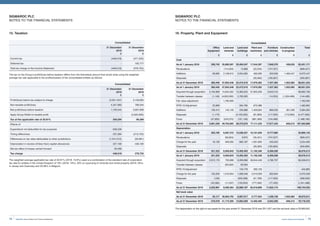
  • 9.
    2019 timeline ofkey events February Opened a new ready-mix concrete plant in Jersey in the presence of key Shareholders. January Completed a vendor placing, raising £12 million. Refinanced a £10 million convertible loan note improving overall cost of debt. Extended our credit facilities with Santander from £20 million to £34 million. Acquired CCP, bringing in £21 million in revenue and a concrete block production of 18 million blocks per year, giving SigmaPPG a true country-wide presence and expanded portfolio. Appointed Tim Hall, one of the principal architects of Breedon’s success, to our Board. April JV with major aggregates producer G.D. Harries to build a South Wales platform under the stewardship of Ian Harries. June Support of shareholders at the AGM to continue our growth story. August Agreed terms, in principle, with two major private equity firms for the acquisition of Carrieres du Hainaut, Europe’s largest dimension stone company and owner of one of Belgium’s largest aggregates quarries. October Raised £33 million to, inter alia, close the acquisition of Carrieres du Hainaut and establish SigmaRoc as a sizeable operator in the Belgian aggregates and the European dimension stone markets. December Creation of advisory board in Belgium focussed on the Benelux business which was joined by entrepreneur and private equity investor Count Christophe de Limburg Stirum, and Pascal Lesoinne, previously CEO aggregates and cement for Heidelberg Benelux. March Closed a deal with Lindsay Corporation, a US$1 billion company based in the USA, to commercialise and produce its revolutionary traffic management system, Zipperblock, in the UK. May Appointment of Emmanuel Maes, previously CEO of major aggregates and dredging business Group De Cloedt, as MD Europe with the mandate to secure the Group’s entry into the Benelux. July Start of intensive work on our entry into the Benelux region following several leads and identification of potential acquisition targets. September Announcement of acquisition of Stone Holdings, our first business in Belgium, as a starting point for our operations in Belgium and the Benelux. Proposed appointment of renowned entrepreneur and industrialist, Jacques Emsens, to the Board. November Roll out of new Group-wide safety policy focussing all businesses on the vital importance of the health and safety of our colleagues, customers and suppliers. Management team (ExCo) Garth Palmer Chief Financial Officer Max Vermorken Chief Executive Officer Emmanuel Maes ExCo Europe Christophe Daulmerie ExCo Dimension Stone Charles Trigg Technical Director David McClelland ExCo South West UK Michael Roddy ExCo SigmaPPG Mike Osborne ExCo Ronez 17Invest, Improve and IntegrateSigmaRoc Annual Report and Financial Statements16
  • 10.
    19Invest, Improve andIntegrate Map of all assets SigmaRoc Annual Report and Financial Statements18
  • 11.
    21Invest, Improve andIntegrate Our business model SigmaRoc was set up with the vision to build a competitive construction materials group, focussed on the long term benefits our industry has to offer. Our business model was conceived out of the experiences of many high level executives and entrepreneurs in the sector, allowing several important conclusions to be drawn. Construction materials are a local product, consumed and produced locally, and, due to their high mass to price ratio, they tend to travel shorter distances to end customers than other commodities, such as oil or metals. This brings a particular dynamic to the sector, focussed on local and fragmented markets. Our business model starts from the understanding that each local market is different, with its own particularities, competitive pressures and local history. Understanding that structure, preserving its history and local dynamics, while applying best-in-class operational and financial management, will ultimately, all things being equal, lead to a better offering, for investors, customers, employees and local communities. A particular ingredient in that structure is empowering local managers and operators to take full responsibility for their business or division. Only local managers fully understand the requirements of the local market. Product innovation, customer engagement and Capex decisions are all driven by local requirements and not by a group agenda, which may or may not be adequate for what is required on the ground. At a group level, we utilise this decentralised approach to focus on what we are best at; finding appealing investment opportunities, helping the acquired businesses reach a best-in-class status operationally and financially, and lock in synergies available to us through scale and expertise. Implementing our strategy In practice, the implementation of the vision expressed above can be achieved through three core principles: We invest in businesses. This is not the same as acquiring them. We aim to keep and improve those aspects which made them worth acquiring, whether that is their independent mind-set, their entrepreneurial nature or their founder. We improve the businesses we have bought by targeting those aspects which were less efficient than they could be. This can vary widely from inefficient sales efforts, poor cash management to operational difficulties. Lastly, we integrate the businesses we buy into clusters where compatibility secures synergies and where scale helps to generate local buying power. We also integrate acquired businesses into the infrastructure of the Group, providing centralised technical, financial and managerial support, allowing the newly integrated business to capture efficiencies and economies of scale. Invest Only in businesses with solid intrinsic value; Only in businesses with the potential to be improved and grown; Only in businesses which can be bought at an attractive valuation. Improve The operational and financial performance of the business; The motivation of management to drive growth; The ultimate offering to the local market and community. Integrate By building platforms of compatible businesses; By unlocking those synergies which do not come at a significant cost; By recognising the value of what previous owners built. Business Review: Invest, Improve, Integrate Year-on-year Revenue Growth Year-on-year Underlying EBITDA Growth £36k £27m £41m £70m 2017 2018 2019 +52% +71% -£1.2k £5.5m £9.8m £14.5m 2016 2017 2019 +78% +48% 2018 2016 Our track record to date since founding the business in 2016 SigmaRoc Annual Report and Financial Statements20
  • 12.
    23Invest, Improve andIntegrate Year-on-year Underlying EBITDA Margins Year-on-year Underlying EPS 0% 20.3% 23.8% 20.7% 4.2p 3.8p 2.0p -1.4p CCP* CDH Stone Allen Concrete Poundfield Products Ronez Notes:*CCP at acquisition ran at an average 10% EBITDA margin. This has already been improved to 14% over 2019. 2017 2019 2018 2016 2016 20192017 2018 Net Debt to Underlying EBITDA 2.1x 1.6x 2.1x 0x 2016 2017 20192018 15/10/2019 CARRIÈRES DU HAINAUT 6.8x CDH’s Underlying EBITDA for past 12 months 13/12/2017 POUNDFIELD 6.8x Underlying EBITDA for the previous financial year 15/04/2019 GD HARRIES 7.6x Underlying EBITDA for the previous financial year 15/04/2017 MV RONEZ SHIPPING ASSETS 2.5x Underlying EBITDA for the previous financial year 11/09/2019 STONE HOLDINGS 4.4x Underlying EBITDA for past three year average 19/10/2017 ALLEN CONCRETE 6.25x Underlying EBITDA for the previous financial year 25/01/2019 CCP 5.85x Underlying EBITDA for past 12 months 05/01/2017 RONEZ 9.0x Underlying EBITDA for the previous financial year SigmaRoc Annual Report and Financial Statements22
  • 13.
    Underlying EBITDA Growthby type versus prior year Underlying EBITDA +10% +9% +21% +17% +60% +31% Acquisition Organic 2018 20192017 I recognise the potential of SigmaRoc's business model and I am very pleased to be leading its implementation in the EU market after serving as CEO of Group De Cloedt, building the business from €40m to €240m turnover via organic growth and acquisitions. Emmanuel Maes ExCo Europe 2017 / 2018 2017 / 2018 2018 / 2019 2018 / 2019 Safety year-on-year: Harm reduction Safety year-on-year: Positive Engagements YEARONYEARIMPROVEMENT–LIKEFORLIKEYEARONYEARIMPROVEMENT–LIKEFORLIKE Harm Reduction Positive Engagement 0% 0% 2% 50% 4% 100% 6% 150% 8% 200% 10% 250% 12% 300% 14% 25Invest, Improve and IntegrateSigmaRoc Annual Report and Financial Statements24 SigmaRoc Annual Report and Financial Statements24
  • 14.
    Ronez The Ronez operationssupply the Channel Islands with aggregates, ready-mixed concrete, asphalt and precast concrete products. Operating out of St John’s Quarry in Jersey and Les Vardes Quarry and Vale Castle in Guernsey, we offer a full range of high-quality construction materials. SigmaPPG SigmaPPG (Precast, Prestressed group) is a Platform of companies specialising in manufacturing precast concrete products. Our platform includes Allen Concrete, Poundfield Products and Cheshire Concrete Products. Michael Roddy Managing Director SigmaPPG With locations in east and central England, as well as London and the North West, we supply a wide and diverse range of industries ranging from house builders and farmers to sea defence projects and car park contractors, as well as standard building blocks. Our SigmaPPG companies are some of the most experienced and innovative in their industry; some operating for over 70 years, while others own a significant number of patents and licences. Mike Osborne Managing Director Ronez Quarrying activity at Ronez’s sites can be traced back to 1869, serving the island’s needs for quarried stone. We have grown and developed Ronez, which now produces precast materials, ready-mixed concrete, asphalt as well as undertaking contracting services. The creation of shipping division, SigmaGsy by SigmaRoc has helped with transporting dry-bulk materials to and from the sites, resulting in higher profits and operational efficiency. Platforms 27Invest, Improve and IntegrateSigmaRoc Annual Report and Financial Statements26
  • 15.
    GDH GDH is thecornerstone for SigmaRoc’s South West Platform. With a 40% stake (and ability to purchase the remainder by September 2020), SigmaRoc has a significant footprint in the region. Benelux Carrieres du Hainaut is the cornerstone of our Benelux platform, which comprises our operations at CDH and Stone Holdings. We presently produce around 900,000 square metres of high quality Belgian blue stone per year, a high grade dimension stone produced exclusively in Belgium under European protected status. Christophe Daulmerie ExCo Dimension Stone Additionally, we produce up to 2 million tonnes of aggregates at our quarries in Belgium, supplying a range of partners and construction companies with application ranging from concrete, to sea defence work, riverbank fortification and standard applications in roads and construction. Our business in the Benelux is well positioned with reserves and resources of over 150 million tonnes of construction aggregates and over 28,000,000m3 of high quality Belgian Blue Stone. The business employs over 430 people and has a proud history, dating back 130 years, of extracting a highly sought after material. David McClelland Managing Director South West UK GDH is one of Wales’ largest independent suppliers of aggregates – based in West Wales, it operates out of six granite and limestone quarries – incorporating three asphalt plants, six concrete plants, and a wharf operation, as well as a civil engineering division delivering significant infrastructure projects. The business was founded by Mr. Gerald D. Harries and built into the foremost independent regional supplier by his son Ian Harries, who is currently its chairman. SigmaRoc Annual Report and Financial Statements 29Invest, Improve and Integrate28
  • 16.
    Garth Palmer Chief Financial Officer Cashgenerated from operations was £2.1 million (2018: £5.5 million) with a net increase in cash of £6.1 million (2018: net decrease of £3.2 million). In October 2019, the Group raised in aggregate, £33 million in relation to the acquisition of CDH, which resulted in a net cash surplus of £5 million after paying cash consideration and associated transaction costs. Revenue and underlying EBITDA is in line with expectations and management forecasts. Capital expenditure relates to purchase of new plant and machinery and improvements to existing infrastructure across the Group. PPA BDO UK undertook the PPA exercise required under IFRS 3 to allocate a fair value to the acquired assets of CCP. The PPA process resulted in a reduction of goodwill recorded on the Statement of Financial Position of the Group for CCP from £13.5 million to £7.9 million. The reduction was to transfer the value of goodwill to intangible assets for land and mineral reserves, trade name, workforce and customer relations. Non-underlying items The Company’s loss after taxation for 2019 amounts to £4.7 million, of which £3.6 million relates to non-underlying items, while the Group’s non-underlying items totaled £6.2 million for the year. These items relate to seven categories: 1. £2.6 million in exclusivity, introducer, consulting, legal fees and other direct costs relating to prospective acquisitions. During the year the Group acquired four businesses, being CCP, GDH, Stone and CDH for a combined enterprise value of approximately £112 million and proforma EBITDA of approximately £17 million. 2. £0.8 million legal and restructuring expenses relating to the rebranding and alignment of all subsidiaries across the Group. 3. £1.2 million amortisation of acquired assets. 4. £0.7 million in relation to the convertible loan note redemption premium and associated advisor fees. 5. £0.5 million loss on discontinued operations at its Bury site. 6. £0.2 million in share based payments relating to grants of options. 7. £0.2 million in other exceptional costs which primarily relate to non-cash balance sheet adjustments. Interest and tax Net finance costs in the year totaled £2 million (2018: £1 million) and included £0.5 million redemption premium on the Group’s convertible loan notes plus associated interest, bank finance facilities, as well as interest on finance leases (including IFRS 16 adjustments) and hire purchase agreements. A tax charge of £0.5 million (2018: £0.3 million) was recognised in the year, resulting in a tax charge on profitability generated from mineral extraction in the Channel Islands and profits generated through the Group’s UK and Belgium based operations. 2019 2018 Cash and cash equivalents £9,867,696 £3,771,735 Revenue £70,362,472 £41,241,673 Underlying EBITDA £14,534,647 £9,823,080 Capital expenditure £3,384,363 £6,670,447 Directors’ Report As I will be stepping down from my role as an executive Board member and Chief Financial Officer following publication of these Accounts, I would like to begin this report by thanking the Board and shareholders for the opportunities afforded to me over the better part of four years. Due to other business interests, I have occupied my role in a part time capacity, and it was always envisioned I would step aside when the time was right. Now more than ever the Group needs a fulltime CFO and we are extremely pleased to have Dean Masefield taking over. I have immensely enjoyed my time to date with SigmaRoc, am extremely proud of everything we have achieved together and look forward to continuing the journey as a Non-Executive Director. I am very pleased to report a strong year financially for the Group, during which we exceeded our ambitious financial targets, while continuing to expand our business. We completed four acquisitions during the year, with CCP in January, GDH in April, Stone in September and then CDH in October. In our full 2019 financial year, the Group generated revenue of £70.4 million (2018: £41.2 million) and underlying EBITDA of £14.5 million (2018: £9.8 million). The underlying profit before taxation for the Group for the year ended 31 December 2019 was £8.4 million (2017: £5.5 million). The loss for the Company for the year ended 31 December 2019 before taxation amounts to £4.7 million (2018: loss £0.9 million), which includes £3.6 million of non-underlying expenses. The Board monitors the activities and performance of the Group on a regular basis. The Board uses financial indicators based on budget versus actual to assess the performance of the Group. The indicators set out below will continue to be used by the Board to assess performance over the period to 31 December 2020. 31Invest, Improve and IntegrateSigmaRoc Annual Report and Financial Statements30
  • 17.
    33Invest, Improve andIntegrate Earnings per share Basic EPS for the year was 0.92 pence (2018: 2.65 pence), adjusted for the non-underlying items mentioned above. Underlying basic EPS for the year totaled 4.20 pence (2018: 3.83 pence). Statement of financial position Net assets at 31 December 2019 were £102 million (2018: £54 million). Net assets are underpinned by mineral resources, land and buildings and plant and machinery assets of the Group. Cash flow Cash generated by operations was £2.1 million (2018: £5.5 million). The Group spent £35.9 million on acquisitions net of cash acquired and £3.4 million on capital projects. The Group raised £44 million net of fees through the issue of equity and drew down net borrowings of £1.2 million which included repayment of the £10 million convertible loan notes, £16.3 million drawdown from the Santander credit facility and £5.1 million of debt repayments in acquired subsidiaries. The net result was a cash inflow for the year of £6.1 million. Net debt at 31 December 2019 was £49.8 million (2018: £16.0 million), £32.0 million arising from the recent acquisition of CDH and is in the process of being refinanced. Bank facilities In 2017 the Group secured debt facilities with Santander consisting of a £2 million RCF, an £18 million term facility and a further “accordion” facility of £10 million. In December 2018 the Group received credit approval from Santander to increase the RCF to £4 million and the term facility to £30 million, bringing the total debt facilities available with Santander to £34 million (the ‘Existing Debt Facilities’). The Group is currently in the final stages of agreeing a new club financing facility agreement with Santander and several Belgian banks for an RCF of £15 million, term facility of £45 million and an acquisition and Capex facility of £20 million (the ‘Club Refinance’). Successful negotiation of the Club Refinance, which is at an advanced stage, will result in total debt facilities being made available to the Group of £80 million, with a further £40 million accordion facility on materially the same terms as the Existing Debt Facilities. As a result of the Coronavirus pandemic, it has been mutually agreed to extend the existing Belgian debt facilities to 31 December 2020 and it is expected that the Club Refinance will be formalised on or before this date. The Group’s Existing Debt Facilities have a maturity date of 29 August 2022 and are subject to a variable interest rate based on LIBOR plus a margin depending on EBITDA. As at 31 December 2019, total undrawn facilities available to the Group via the Existing Debt Facilities amounted to £7.7 million. The Group’s Existing Debt Facilities are subject to covenants which are tested monthly and certified quarterly. These covenants are: Group interest cover ratio set at a minimum of 3.5 times EBITDA; a maximum adjusted leverage ratio, which is the ratio of total net debt, including further borrowings such as the convertible loan notes, to adjusted EBITDA, of 3.25x in 2019. At 31 December 2019, the Group comfortably complied with its bank facility covenants. Dividends Subject to availability of distributable reserves, dividends will be paid to shareholders when the Directors believe it is appropriate and prudent to do so. The focus of the Group at this stage of its development will be on delivering capital growth for shareholders. The Directors therefore do not recommend the payment of a dividend for the year (31 December 2018: nil). Principal risks and uncertainties The management of the business and the execution of the Group’s strategy are subject to a number of risks. The key business risks affecting the Group are set out below. Risks are formally reviewed by the Board and appropriate processes are put in place to monitor and mitigate them. If more than one risk event occurs, it is possible that the overall effect of such events would compound the possible adverse effects on the Group. Operational risk Since the period under review, the Coronavirus pandemic has become a significant emerging risk to the global economy. Due to inherent uncertainty, the Group cannot reasonably estimate the potential impact on the Group’s financial position, results of operations or cash flows in the future, however the Board continues to actively monitor the situation as more information about the Virus emerges and responds accordingly, taking into consideration the various contingency and mitigation plans it implemented from the early outset of the Coronavirus outbreak. Reserve and resource estimates The Group’s reporting of reserves and resources are estimates, and so there is potential uncertainty over the amount of such reserves and resources held at the year-end. These may require revision based on future actual production. In addition, there is risk of new leases (in particular Chouet phase 2 and the West extension at St John’s) not being approved and, as such, leading to revised valuation and future income streams for the operations at Ronez. Dependence on key personnel The Group is dependent upon its executive management team. Whilst it has entered into contractual agreements with the aim of securing the services of these personnel, the retention of their services cannot be guaranteed. The development and success of the Group depends on its ability to recruit and retain high quality and experienced staff. The loss of the service of key personnel or the inability to attract additional qualified personnel as the Group grows could have an adverse effect on future business and financial conditions. 31 December 2019 31 December 2018 Ordinary Shares Options Ordinary Shares Options Max Vermorken 447,511 11,807,349 210,032 4,368,188 David Barrett 2,175,640 5,638,674 760,032 1,879,513 Garth Palmer 256,186 3,326,014 114,594 488,136 Dominic Traynor - 791,511 - 26,014 Patrick Dolberg 184,756 765,497 75,000 304,580 Tim Hall1 300,000 750,000 - - (1) Appointed on 18 April 2019 Further details on options can be found in Note 29 to the Financial Statements. Details on the remuneration of the Director’s can be found in Note 10 to the Financial Statements. Uninsured risk The Group may become subject to liability for hazards that cannot be insured against or third-party claims that exceed the insurance cover. The Group may also be disrupted by a variety of risks and hazards that are beyond its control, including geological, geotechnical and seismic factors, environmental hazards, industrial accidents, occupation and health hazards and weather conditions or other acts of God. Funding risk The only sources of funding currently available to the Group are through the issue of additional equity capital in the Company or through debt financing. The Company’s ability to raise further funds will depend on the success of the Group’s activities and its investment strategy. The Group may not be successful in procuring funds on terms that are attractive and, if such funding is unavailable, the Group may be required to reduce the scope of its investment activities. Financial risks The Group’s operations expose it to a variety of financial risks that can include market risk (including foreign currency, price and interest rate risk), credit risk, and liquidity risk. The Group has a risk management programme in place that seeks to limit the adverse effects on the financial performance of the Group by monitoring levels of debt finance and the related finance costs. The Group does not use derivative financial instruments to manage interest rate costs and, as such, no hedge accounting is applied. Details of the Group’s financial risk management policies are set out in Note 3 to the Financial Statements. Principal activity The principal activity of the Company is to make investments and/or acquire businesses and assets in the construction materials sector. The principal activity of the Group is the production of high quality aggregates and supply of value-added construction materials. Board composition and head office The Board comprises three Executive Directors and three Non-Executive Directors. The Corporate Head Office of the Company is located in London, UK. Directors Directors’ interests The Directors who served during the year ended 31 December 2019 are shown below and had, at that time, the following beneficial interests in the shares of the Company: SigmaRoc Annual Report and Financial Statements32
  • 18.
    Corporate responsibility Environmental SigmaRoc undertakesits activities in a manner that minimises or eliminates negative environmental impacts and maximises positive impacts of an environmental nature. Health and safety SigmaRoc operates a comprehensive health and safety programme to ensure the wellness and security of its employees. The control and eventual elimination of all work related hazards requires a dedicated team effort involving the active participation of all employees. A comprehensive health and safety programme is the primary means for delivering best practices in health and safety management. This programme is regularly updated to incorporate employee suggestions, lessons learned from past incidents and new guidelines related to new projects with the aim of identifying areas for further improvement of health and safety management. This results in continuous improvement of the health and safety programme. Employee involvement is regarded as fundamental in recognising and reporting unsafe conditions and avoiding events that may result in injuries and accidents. Internal controls The Board recognises the importance of both financial and non-financial controls and has reviewed the Group’s control environment and any related shortfalls during the year. Since the Group was established, the Directors are satisfied that, given the current size and activities of the Group, adequate internal controls have been implemented. Whilst they are aware that no system can provide absolute assurance against material misstatement or loss, in light of the current activity and proposed future development of the Group, continuing reviews of internal controls will be undertaken to ensure that they are adequate and effective. Further details of corporate governance can be found in the Corporate Governance Report on page 36. Going concern As documented extensively in these Accounts, the impact of the COVID-19 pandemic on the Group’s business, revenues and cash flow creates significant uncertainty. However, given the Group’s robust balance sheet and in conjunction with forecast projections based on, what are considered to be as at the date of these Accounts, worst case scenarios, the Directors have a reasonable expectation that the Group has adequate resources to continue in operational existence for the foreseeable future and, therefore, continue to adopt the going concern basis in preparing the Annual Report and Financial Statements. Further details on their assumptions and their conclusion thereon are included in the statement on going concern included in Note 2.3 to the Financial Statements. Directors’ and officers’ indemnity insurance The Company has made qualifying third-party indemnity provisions for the benefit of its Directors and officers. These were made during the year and remain in force at the date of this report. Events after the reporting period Events after the reporting period are set out in Note 38 to the Financial Statements. Policy and practice on payment of creditors The Group agrees terms and conditions for its business transactions with suppliers. Payment is then made in accordance with these terms, subject to the terms and conditions being met by the supplier. As at 31 December 2019, the Company had an average of 82 days (2018: 26 days) purchases outstanding in trade payables and the Group had an average of 51 days (2018: 43 days). Future developments Details of future developments for the Group are disclosed in the Chairman’s Statement on page 8 and the CEO’s Strategic Report on page 11. Provision of information to Auditor So far as each of the Directors is aware at the time this report is approved: • there is no relevant audit information of which the Group’s auditor is unaware; and • the Directors have taken all steps that they ought to have taken to make themselves aware of any relevant audit information and to establish that the auditor is aware of that information. Auditor PKF Littlejohn LLP has signified its willingness to continue in office as auditor. This report was approved by the Board on 17 April 2020 and signed on its behalf. Garth Palmer Chief Financial Officer Statement of Directors’ responsibilities The Directors are responsible for preparing the Annual Report and the Financial Statements in accordance with applicable law and regulations, including the AIM Rules for Companies. Company law requires the Directors to prepare financial statements for each financial year. Under that law the Directors have elected to prepare the Group and Company Financial Statements in accordance with International Financial Reporting Standards (IFRSs) as adopted by the European Union. Under company law the Directors must not approve the Financial Statements unless they are satisfied that they give a true and fair view of the state of affairs of the Group and Company, and of the profit or loss of the Group for that period. In preparing these Financial Statements, the Directors are required to: • select suitable accounting policies and then apply them consistently; • make judgments and accounting estimates that are reasonable and prudent; and • state whether applicable IFRSs as adopted by the European Union have been followed, subject to any material departures disclosed and explained in the financial statements; and • prepare the financial statements on the going concern basis unless it is inappropriate to presume that the Group will continue in business. The Directors are responsible for keeping adequate accounting records that are sufficient to show and explain the Group’s and Company’s transactions and disclose with reasonable accuracy at any time the financial position of the Group and Company, and enable them to ensure that the Financial Statements comply with the Companies Act 2006. They are also responsible for safeguarding the assets of the Group and Company, and hence for taking reasonable steps for the prevention and detection of fraud and other irregularities. The Directors are responsible for the maintenance and integrity of the corporate and financial information included on the Company’s website, www.sigmaroc.com. Legislation in the United Kingdom governing the preparation and dissemination of the Financial Statements may differ from legislation in other jurisdictions. The Company is compliant with AIM Rule 26 regarding the Company’s website. The Directors confirm that they have complied with the above requirements in preparing the Financial Statements. SigmaRoc Annual Report and Financial Statements 35Invest, Improve and Integrate34
  • 19.
    37Invest, Improve andIntegrate Governance Report Board members Max Vermorken Chief Executive Officer Patrick Dolberg Non-Executive Director David Barrett Executive Chairman Dominic Traynor Non-Executive Director Garth Palmer Chief Financial Officer Tim Hall Non-Executive Director Corporate Governance Report The Directors recognise the importance of sound corporate governance. As a company whose shares are traded on AIM, the Board has decided to comply with the QCA Code. In addition, the Directors have adopted a code of conduct for dealings in the shares of the Company by directors and employees and are committed to maintaining the highest standards of corporate governance. Garth Palmer, in his capacity as CFO, has assumed responsibility for ensuring that the Company has appropriate corporate governance standards in place and that these requirements are followed and applied within the Company as a whole. The corporate governance arrangements that the Board has adopted are designed to ensure that the Company delivers long term value to its shareholders and that shareholders have the opportunity to express their views and expectations for the Company in a manner that encourages open dialogue with the Board. The Board recognises that its decisions regarding strategy and risk will impact the corporate culture of the Company as a whole and that this will impact the performance of the Company. The Board is very aware that the tone and culture set by the Board will greatly impact all aspects of the Company as a whole and the way that employees behave. A large part of the Company’s activities is centred upon what needs to be an open and respectful dialogue with employees, clients and other stakeholders. Therefore, the importance of sound ethical values and behaviours is crucial to the ability of the Company to successfully achieve its corporate objectives. The Board places great importance on this aspect of corporate life and seeks to ensure that this flows through all that the Company does. The key governance related matter that occurred during the financial year ended 31 December 2019 was the establishment of a Group-wide health and safety policy. Corporate Governance Report The QCA Code sets out 10 principles that should be applied. These are listed below together with a short explanation of how the Company applies each of the principles: Principle One Business Model and Strategy The Board has concluded that the highest medium and long term value can be delivered to its shareholders by the adoption of a single strategy for the Company. The principal activity of the Group is the production of high-quality aggregates and supply of value-added construction materials and the aim is to create value for shareholders through the successful execution of its ‘buy and build’ strategy in the construction materials sector. The Board implements this strategy by focusing investment into high quality and well managed construction material assets, establishing a strict criteria for project evaluation and selection, utilising industry recognised methods of operation, developing a results-driven exploration approach, actively monitoring operational and financial performance measured against deliverable targets and budgets and considering alternative commercial options for projects which no longer meet the established criteria of the Group. Principle Two Understanding Shareholder Needs and Expectations The Board is committed to maintaining good communication and having constructive dialogue with its shareholders. The Company has close ongoing relationships with its private shareholders. Institutional shareholders and analysts have the opportunity to discuss issues and provide feedback at meetings with the Company. In addition, all shareholders are encouraged to attend the Company’s Annual General Meeting. Investors also have access to current information on the Company though its regulatory announcements, website, www.sigmaroc.com, and via Andrea Mora of Rubik Communications Limited, the Company’s financial PR adviser, who is available to answer investor relations enquiries. Principle Three Considering Wider Stakeholder and Social Responsibilities The Board recognises that the long term success of the Company is reliant upon the efforts of the employees of the Company and its contractors, suppliers, regulators and other stakeholders. The Board has put in place a range of processes and systems to ensure that there is close oversight and contact with its key resources and relationships. For example, all employees of the Company participate in a structured Company-wide annual assessment process which is designed to ensure that there is an open and confidential dialogue with each person in the Company to help ensure successful two way communication with agreement on goals, targets and aspirations of the employee and the Company. These feedback processes help to ensure that the Company can respond to new issues and opportunities that arise to further the success of employees and the Company. The Company has close ongoing relationships with a broad range of its stakeholders and provides them with the opportunity to raise issues and provide feedback to the Company. The Group has supported and given back to the community by participating in a selection of projects in recent years, further details of the Group’s environmental, social and governance related initiatives are provided on page 42. Principle Four Risk Management In addition to its other roles and responsibilities, the Audit Committee is responsible to the Board for ensuring that procedures are in place and are being implemented effectively to identify, evaluate and manage the significant risks faced by the Company. The risk assessment matrix below sets out those risks and identifies the controls that are in place. This matrix is updated as changes arise in the nature of risks or the controls that are implemented to mitigate them. The Audit Committee reviews the risk matrix and the effectiveness of scenario testing on a regular basis. The following principal risks and controls to mitigate them, have been identified: SigmaRoc Annual Report and Financial Statements36 Jacques Emsens Non-Executive Director Simon Chisholm Non-Executive Director Dean Masefield Chief Finance Officer New Appointments
  • 20.
    39Invest, Improve andIntegrate The Directors have established procedures, as represented by this statement, for the purpose of providing a system of internal control. An internal audit function is not considered necessary or practical due to the size of the Company and the close day to day control exercised by the executive directors. However, the Board will continue to monitor the need for an internal audit function. The Board works closely with and has regular ongoing dialogue with the CFO and has established appropriate reporting and control mechanisms to ensure the effectiveness of its control systems. Principle Five A Well-Functioning Board of Directors As at the date hereof the Board comprised, the CEO Max Vermorken, the Chairman David Barrett, the CFO Garth Palmer and three Non-Executive Directors, Dominic Traynor, Patrick Dolberg and Tim Hall. Immediately following the publication of these Accounts, the Board will comprise the CEO, Max Vermorken, the Chairman, David Barrett, the CFO, Dean Masefield and six Non-Executive Directors, Dominic Traynor, Patrick Dolberg, Garth Palmer, Tim Hall, Jacques Emsens and Simon Chisholm; Mr Emsens and Mr Chisholm are considered to be independent. Biographical details of the current and proposed Directors are set out within Principle Six below. Executive and Non-Executive Directors are subject to re-election at intervals of no more than three years. The service contracts and letters of appointment (as applicable) of all Directors are available for inspection at the Company’s registered office during normal business hours. The Board meets at least four times per annum. It has established an Audit Committee, Remuneration Committee and an AIM Rules and MAR Compliance Committee, particulars of which appear hereafter. The Board has agreed that appointments to the Board are made by the Board as a whole and so has not created a Nominations Committee. The Non-Executive Directors are considered to be part time but are expected to provide as much time to the Company as is required. Activity Risk Impact Control(s) Operation Recruitment and retention of key staff Depletion of mineral resources and inability to secure additional reserves Reduction in operating capability Operations are dependent on a quality source of aggregate Stimulating and safe working environment, balancing salary with longer term incentive plans Resource expansion plans developed at all sites Regulatory adherence Breach of rules Censure or withdrawal of authorisation Strong compliance regime instilled at all levels of the Company Strategic Market downturn Competition Macroeconomic conditions adversely affecting Group’s prospects. Expansion in the UK and Belgium affect Group’s risk Contingency ‘disaster’ budgets and regular assessment of materials market. Strong relationships with government and community and experienced senior management Financial Misappropriation of Funds IT Security Fraudulent activity and loss of funds Loss of critical financial data Robust financial controls and split of duties Regular back up of data online and locally In order to be efficient, the Directors meet formally and informally both in person and by telephone. To date there have been quarterly formal meetings of the Board held in person, plus additional ad-hoc meetings of the Board where appropriate, and the volume and frequency of such meetings is expected to continue at this rate. At a general meeting of the Company held on 27 September 2019, Shareholders voted to approve amending the Articles removing the restriction on the Board from making any resolutions in the United Kingdom. The Board meet collectively prior to any matters being resolved, however in order to comply with the Articles prior to their amendment, two members of the Board were required to hold a meeting offshore to pass the resolutions. There were eight such meetings in 2019 in addition to the quarterly meetings which all Board members attended, plus two ad-hoc meetings. In addition to Board meetings, the executive Directors attend monthly executive committee meetings with the managing directors of the subsidiary operations. Principle Six Appropriate Skills and Experience of the Directors The Board currently consists of six Directors and, in addition, the Company has employed the outsourced services of Heytesbury Corporate LLP to act as the Company Secretary. The Company intends to appoint two new independent non- executive directors immediately following the release of the Accounts, following which it is satisfied that given its size and stage of development, between the Directors, it will have an effective and appropriate balance of skills and experience across technical, commercial and financial disciplines. The Board shall review annually the appropriateness and opportunity for continuing professional development whether formal or informal. The respective roles of the Board members following the proposed appointments will be as follows: David Barrett Chairman and Executive Director Member of the Remuneration Committee Max Vermorken Chief Executive Officer and Executive Director Dean Masefield Chief Financial Officer and Executive Director Garth Palmer Non-Executive Director Member of the AIM Rules and MAR Compliance Committee Jacques Emsens Independent Non-Executive Director Simon Chisholm Chairman of the Audit Committee and member of the AIM Rules and MAR Compliance Committee Dominic Traynor Non-Executive Director Chairman of the Remuneration Committee and the AIM Rules and MAR Compliance Committee Patrick Dolberg Non-Executive Director Member of the Audit Committee and AIM Rules and MAR Compliance Committee Tim Hall Non-Executive Director Director Formal quarterly meetings and meetings post change to Articles Offshore meetings to comply with Articles Attended Eligible to attend Meetings attended Eligible to attend Max Vermorken 6 6 4 4 David Barrett 6 6 6 6 Garth Palmer 6 6 1 1 Dominic Traynor 6 6 1 1 Patrick Dolberg 5 6 4 4 Tim Hall 3 4 - - The Company shall report annually on the number of Board and Committee meetings held during the year and the attendance record of individual Directors. Details of the directors’ attendance at the Board meetings are set out below: SigmaRoc Annual Report and Financial Statements38
  • 21.
    41Invest, Improve andIntegrate Principle Seven Evaluation of Board Performance Internal evaluation of the Board, the Committees and individual Directors is to be undertaken on an annual basis in the form of peer appraisal and discussions to determine the effectiveness and performance of the various governance components, as well as the Directors’ continued independence. The results and recommendations that come out of the appraisals for the Directors shall identify the key corporate and financial targets that are relevant to each Director and their personal targets in terms of career development and training. Progress against previous targets shall also be assessed where relevant. Principle Eight Corporate Culture The Board recognises that its decisions regarding strategy and risk will impact the corporate culture of the Company as a whole and that this will impact the performance of the Company. The Board is very aware that the tone and culture set by the Board will greatly impact all aspects of the Company as a whole and the way that employees behave. The Corporate Governance principles that the Board has adopted is designed to ensure that the Company delivers long term value to its shareholders and that shareholders have the opportunity to express their views and expectations for the Company in a manner that encourages open dialogue with the Board. A large part of the Company’s activities are centred upon what needs to be an open and respectful dialogue with employees, clients and other stakeholders. Therefore, the importance of sound ethical values and behaviours is crucial to the ability of the Company to successfully achieve its corporate objectives. The Board places great importance on this aspect of corporate life and seeks to ensure that this flows through all that the Company does. The Directors consider that at present the Company has an open culture facilitating comprehensive dialogue and feedback and enabling positive and constructive challenge. The Company has adopted, with effect from the date on which its shares were admitted to AIM, a code for Directors’ and employees’ dealings in securities which is appropriate for a company whose securities are traded on AIM and is in accordance with the requirements of the Market Abuse Regulation, which came into effect in 2016. Principle Nine Maintenance of Governance Structures and Processes Ultimate authority for all aspects of the Company’s activities rests with the Board, the respective responsibilities of the Chairman and Chief Executive Officer arising as a consequence of delegation by the Board. The Board has adopted appropriate delegations of authority that set out matters which are reserved to the Board. The Chairman is responsible for the effectiveness of the Board, while management of the Company’s business and primary contact with shareholders has been delegated by the Board to the Chief Executive Officer. Audit Committee As at the date of the Accounts, the Audit Committee comprises Dominic Traynor and Patrick Dolberg, and Dominic Traynor chairs this committee. Immediately following publication of the Accounts, the Audit Committee will comprise Simon Chisholm, Dominic Traynor and Patrick Dolberg, and Simon Chisholm will chair this committee. This Committee has primary responsibility for monitoring the quality of internal controls and ensuring that the financial performance of the Company is properly measured and reported. It receives reports from the executive management and auditors relating to the interim and annual accounts and the accounting and internal control systems in use throughout the Company. The Audit Committee shall meet not less than twice in each financial year and it has unrestricted access to the Company’s auditors. Remuneration Committee The Remuneration Committee comprises David Barrett and Dominic Traynor, and Dominic Traynor chairs this Committee. The Remuneration Committee reviews the performance of the executive Directors and employees and makes recommendations to the Board on matters relating to their remuneration and terms of employment. The Remuneration Committee will meet as and when necessary. The Remuneration Committee also considers and approves the granting of share options pursuant to the share option plan and the award of shares in lieu of bonuses pursuant to the Company’s Remuneration Policy. AIM and MAR Compliance Committee As at the date of the Accounts, the AIM Compliance Committee comprises Dominic Traynor and Patrick Dolberg, and Dominic Traynor chairs this committee. Immediately following publication of the Accounts, the AIM Compliance Committee will comprise Dominic Traynor, Patrick Dolberg and Garth Palmer, and Dominic Traynor will continue to chair this committee. The AIM Compliance Committee is responsible for the coordinating and monitoring the Company’s regulatory responsibilities including liaising with the Nomad and the London Stock Exchange as necessary. The purpose of the AIM Compliance Committee is to designate responsibility of ensuring best practice and application of the defined corporate governance procedures. Nominations Committee The Board has agreed that appointments to the Board will be made by the Board as a whole and so has not created a Nominations Committee. In accordance with the Companies Act 2006, the Board complies with: a duty to act within their powers; a duty to promote the success of the Company; a duty to exercise independent judgement; a duty to exercise reasonable care, skill and diligence; a duty to avoid conflicts of interest; a duty not to accept benefits from third parties and a duty to declare any interest in a proposed transaction or arrangement. Principle Ten Shareholder Communication The Board is committed to maintaining good communication and having constructive dialogue with its shareholders. The Company has close ongoing relationships with its private shareholders. Institutional shareholders and analysts have the opportunity to discuss issues and provide feedback at meetings with the Company. In addition, all shareholders are encouraged to attend the Company’s Annual General Meeting. Investors also have access to current information on the Company through its regulatory announcements, website, www.sigmaroc.com, and via Andrea Mora of Rubik Communications Limited, the Company’s financial PR adviser, who is available to answer investor relations enquiries. The Company shall include, when relevant, in its annual report, any matters of note arising from the Audit or Remuneration committees. SigmaRoc Annual Report and Financial Statements40
  • 22.
    43Invest, Improve andIntegrate Environmental Initiatives Energy Efficiency We are quadrupling the energy generated from solar panels at our Belgian business CDH from 950MWh to around 3,800MWh representing around one third of the energy consumption of the site. We expect this third photovoltaic park to be up and running in 2020. We are progressing through a programme to replace all sodium- based factory lights with LED lights which consume on average around 25% of the energy consumed by their sodium-based equivalent We are progressing through a programme to upgrade our delivery fleet to EURO-6 engines where possible and EURO 5 in the Channel Island as imposed by axle width restrictions. Recycling We continue to pump over 2.5 million m3 per year of water from the quarry at Soignies, and treating the water for domestic use to serve the needs of around 30,000 households. Through a partnership with UK start-up, MacRebur, we have used over 40,000 plastic bottles as a replacement for bitumen in the construction of roads. We continue to monitor, improve and optimise our use of recycled materials as a replacement for polluting compounds. This includes the use of granulated blast furnace slag as a cement replacer, the reduction of steel reinforcement bars in our precast products and the reduction of water use in our concrete and ready-mix products. We have started to capture rainwater from the roofs of our factories to be utilised in our production process already capturing over 5,000 litres since the start of the initiative earlier this year in 2020. We are making active use of returned materials and recycle on average 3,000 tonnes of aggregates at Poundfield Products alone into new production Wildlife Having won the 2018 Insurance Corporation Environmental award for Best Conservation Project, Ronez’s engagement with the Birds On The Edge programme, to re-introduce the Red Billed Chough to Jersey, continued to progress positively. The number of breeding birds in the quarry grew once gain and the facilities provided by Ronez for monitoring the breeding pairs were improved further with better access for conservation staff and new nest boxes being installed. We are part of the European initiative “Life in quarries” in Belgium promoting the reintroduction of wildlife near our quarrying operations We have started a nesting and breeding programme near and at our precast production sites to stimulate birdlife following the success of the Ronez programme. SigmaRoc Annual Report and Financial Statements42
  • 23.
    Social Initiatives Local communities Throughthe “Convention PFI (Plan Formation- Insertion)” and the associated certification via the “CEFOMEPI (Centre de Formation aux Métiers de la Pierre)”, CDH has over the years trained over 100 young unskilled colleagues to give them the required certification to work in the ornamental stone sector. The programme is considered a success with a high retention rate of over 80%. Across 2019, we have supported the Durrell Wildlife Trust initiative of creating, displaying and subsequently selling at auction life-sized gorillas sculptures, raising £1 million for the Trust and engaging a large part of the Channel Island community. G.D. Harries sponsored and organised a series of fundraising and sponsoring events to support the local community including fundraising for Prostate Cymru, sponsoring the Narberth Rugby club, the Grassland Society, the Young Farmers and the Royal Welsh Agricultural Show. Since the founding of SigmaRoc we have actively engaged with universities in the UK and in the USA to interest young graduates, in particular female students, in the quarrying and construction materials sectors, which are typically dominated by men. Governance Initiatives QCA Corporate Governance Code We adhere to the QCA Corporate Governance code and its ten key principles as detailed in our Corporate Governance Report. Board appointments In line with the QCA Code, during 2019 reviewed our board composition to increase both its skill and its composition. Following the publication of these Accounts, Jacques Emsens, an industrialist with a long successful career serving on boards of large quoted industrial groups and investment funds, will be appointed to the Board. In addition, following the publication of these Accounts, the board looks forward to welcoming Simon Chisholm to the Board, adding significant skill to the board in terms of knowledge of the investment community and their requirements. Simon qualified as a Chartered Accountant and will take up the role of Chairman of the Audit Committee thereby giving it the required skill. General Counsel appointment We were extremely pleased to be appointing Anthony Brockbank as our General Counsel on a part time basis effective from May 2020, which will greatly assist with our internal competencies in terms of corporate governance, compliance with applicable regulations and directives and general ability to handle legal matters internally. Anthony is a partner at city law firm, Fieldfisher. 45Invest, Improve and IntegrateSigmaRoc Annual Report and Financial Statements44
  • 24.
    47Invest, Improve andIntegrate 2020 ESG Initiatives Ronez Platform Gain 3rd Party accreditation for ISO 45001 Occupational Health and Safety Management Systems across the Ronez Platform and complement our ISO 14001 accreditation for Environmental management with the Guernsey ESIM Environmental Business Operations Award. This will complete a full suite of external accreditations for HS, Quality and Environmental Management. Develop a Sustainability Framework for the business that quantifies Scope 1 Carbon Dioxide emissions from Ronez’s operations and quantifies the opportunities, with costs and time-frame, for offsetting these Scope 1 emissions. In addition to the 1,000 trees planted through a volunteer initiative lead by Ronez during February 2020, further targets include installation of charging points on site for electric vehicles and the installation of photo-voltaic cells on selected roofs. Whilst supporting government objectives to achieve carbon neutrality by exploiting opportunities for carbon offset, Ronez’s targets for 2020 will also include development of products that reduce Scope 1 emissions. A cement free concrete, which employs the addition of an activating chemical to recycled ground granulated blast furnace slag, is expected to be developed, trialled and offered to the market in pursuit of this objective. PPG Platform Move from the trial phase into the implementation phase of a “greener” range of products with the ultimate goal to have a cement free range of block and retaining walls. Finish a programme of further enhancing the main nine ovens at our Middlewich site by replacing the ovens insulation. For many years this was poorly designed and, with the introduction of more modern bonded insulation products, we have been able to replace old and inefficient insulation with a more modern alternative, increasing insulation depth by 100mm. This has removed the need to use energy for heating during winter nights and we have also been able to cease adding an extra 10kg to 20kg of cement during winter months in order to aid curing, collectively reducing our carbon footprint and overheads. Continue to work with the HR director of a recently closed plant in the area of one of our operations to find employment for c.45 of the nearly 100 staff made redundant. South Wales Platform Continue to improve workplace conditions for the benefit of all our employees, visitors and local community. Working with local communities to further develop local liaison committees, which will highlight key opportunities for community partnership and interaction. A focus on sustainability across our sites, with improvements targeted on recycling, electricity and liquid fuel utilisation, together with water management. Benelux Platform Phase 3 of our solar panel development plan: 3 MWh will be installed to increase solar-powered electricity to 30% of our annual usage; Install electricity charging station at our on-site parking facilities to encourage the usage of electrical vehicles going forward; Finalise permit for an extension zone, in cooperation with the Soignies liaison committee, in order to develop a new site that will be well integrated into its surrounding environment. David Barrett Chairman 17 April 2020 SigmaRoc Annual Report and Financial Statements46
  • 25.
    49Invest, Improve andIntegrate Independent Auditor’s report to the members of SigmaRoc plc Opinion We have audited the financial statements of SigmaRoc plc (the ‘parent company’) and its subsidiaries (the ‘group’) for the year ended 31 December 2019 which comprise: the Consolidated Statement of Comprehensive Income, the Consolidated and Parent Company Statement of Financial Position, the Consolidated and Parent Company Statements of Changes in Equity, the Consolidated and Parent Company Statements of Cash Flows and notes to the financial statements, including a summary of significant accounting policies. The financial reporting framework that has been applied in their preparation is applicable law and International Financial Reporting Standards (IFRSs) as adopted by the European Union and as regards the parent company financial statements, as applied in accordance with the provisions of the Companies Act 2006. In our opinion: • the financial statements give a true and fair view of the state of the group’s and of the parent company’s affairs as at 31 December 2019 and of the group’s and parent company’s profit for the year then ended; • the group financial statements have been properly prepared in accordance with IFRSs as adopted by the European Union; • the parent company financial statements have been properly prepared in accordance with IFRSs as adopted by the European Union and as applied in accordance with the provisions of the Companies Act 2006; and • the financial statements have been prepared in accordance with the requirements of the Companies Act 2006. Basis for opinion We conducted our audit in accordance with International Standards on Auditing (UK) (ISAs (UK)) and applicable law. Our responsibilities under those standards are further described in the Auditor’s responsibilities for the audit of the financial statements section of our report. We are independent of the group and parent company in accordance with the ethical requirements that are relevant to our audit of the financial statements in the UK, including the FRC’s Ethical Standard as applied to listed entities, and we have fulfilled our other ethical responsibilities in accordance with these requirements. We believe that the audit evidence we have obtained is sufficient and appropriate to provide a basis for our opinion. Material uncertainty related to going concern In forming our opinion on the financial statements, which is not modified, we have considered the adequacy of the disclosure made in note 2 to the financial statements concerning the Group’s and Company’s ability to continue as a going concern. With the current outbreak of COVID-19 in the UK and Europe there continues to be far reaching uncertainty over the effect this may have on the wider construction industry and therefore on the revenues and cashflows of the Group and Company. As noted in the Group’s Coronavirus update within the Annual Report and in note 2, these events or conditions indicate that a material uncertainty exists that casts doubt on the Group’s and Company’s ability to continue as a going concern. In response to this, the scope of our audit work on going concern was increased. We carried out the following additional audit procedures: • We obtained management’s forecast cash flows and covenant calculations covering the period from the date of signing to 30 June 2021. We assessed the assumptions within the forecast with regards to revenue generation, margins and cash flows. • We challenged the Board of Directors in respect of the assumptions used in their going concern assessment and stress tested the potential impact of COVID-19 to determine the magnitude of decline in revenue and cash flow that would give rise to the elimination of the cash headroom, use of the additional borrowing facilities available and the possible breach of financial covenants. • We reviewed and challenged the Board’s controllable mitigation plans and their forecast impact on the ability of the business to continue to operate. We obtained supporting documentation to evaluate the plausibility and achievability of management’s mitigation plans, including sensitised scenario forecasts. • We performed sensitivity analysis on management’s forecast cash flows. • We agreed available borrowing facilities to underlying agreements and the extent to which additional facilities could be utilised. • We have assessed the adequacy of COVID-19 disclosures within the Annual Report and Accounts. We draw attention to the COVID-19 update provided by the directors, on page 14, which lays out the Group’s and Company’s plans to both prepare for and mitigate the effect of the current outbreak. Our opinion is not modified in respect of this matter. Our application of materiality Materiality applied to the Group financial statements was £700,000. This amount has been calculated taking into consideration a percentage of Profit before Tax and Turnover. Our application was considered appropriate based upon where the areas of significant audit risk arose. We apply the concept of materiality both in planning and performing our audit, and in evaluating the effect of misstatement. At the planning stage materiality is used to determine the financial statement areas that are included within the scope of our audit. Component materiality was applied and ranged from £550,000 to £125,000 having regard to the mix of size and risk profile of the Group across the components. We agreed with the audit committee that we would report all individual audit differences identified during the course of our audit in excess of £35,000. Materiality applied to the Company’s financial statements was £350,000. We agreed with the audit committee that we would report all individual audit differences identified during the course of our audit in excess of £17,500. An overview of the scope of our audit In designing our audit, we determined materiality, as above, and assessed the risk of material misstatement in the financial statements. In particular, we looked at areas involving significant accounting estimates and judgement by the directors and considered future events that are inherently uncertain. We also addressed the risk of management override of internal controls, including evaluating whether there was evidence of bias by the directors that represented a risk of material misstatement due to fraud. The head office in the United Kingdom oversees the accounting function of the Group and its subsidiaries, however, each regional grouping of subsidiaries maintains the accounting records for the subsidiaries within it. During the year ended 31 December 2019, the Group expanded operations into the Benelux region where it acquired five companies including one parent company and its four subsidiaries. Given the nature of the location and language of the subsidiaries in the Benelux region, our audit of those subsidiaries was conducted by local component auditors. The subsidiaries audited by component auditors was limited to CDH Développement SA and its subsidiary undertakings, including Carrières du Hainaut SCA. The audit was overseen and concluded in London where we acted as Group auditor. As Group auditors we maintained regular contact with the component auditors throughout all stages of the audit and we were responsible for the scope and direction of their work. We ensured that we challenged their findings in order to form an opinion on the Group. Key audit matters Key audit matters are those matters that, in our professional judgment, were of most significance in our audit of the financial statements of the current period and include the most significant assessed risks of material misstatement (whether or not due to fraud) we identified, including those which had the greatest effect on: the overall audit strategy, the allocation of resources in the audit; and directing the efforts of the engagement team. These matters were addressed in the context of our audit of the financial statements as a whole, and in forming our opinion thereon, and we do not provide a separate opinion on these matters. In addition to the matter described in the material uncertainty related to going concern section, we have determined the matters described below to be the key matters to be communicated in our report. Key audit matter How the scope of our audit responded to the key audit matter Carrying value of investments, goodwill and intangible assets The Group carries a material amount of separately identifiable goodwill, tangible fixed assets and intangible assets relating to the subsidiary undertakings previously acquired: Ronez Limited, Topcrete Limited, Poundfield Products (Group) Limited,CCP Building Products Limited and Carrières du Hainaut (refer to note 17). There is a risk that these balances may not be fully recoverable or that incorrect assumptions and estimates could lead to misallocation of balances. The Company carries a material amount of investments in its Statement of Financial Position related to these subsidiaries (refer to note 18). There is a risk that the carrying value of these investments could be overstated. • We corroborated accounting entries in respect of acquired and revalued assets and liabilities to Purchase Price Allocation (“PPA”) work performed by independent and competent experts. We also assessed the independence, objectivity, and competence of these experts. • We reviewed the key PPA assumptions and critically assessed the methodology applied and estimates contained. • We analysed accounting policies in place within each subsidiary to ensure that they were materially consistent with the Group accounting policies. • We reviewed the Group’s forecast cash flows to assess the expected performance of each of the subsidiaries. We assessed the appropriateness of the forecasts having regard to post year end management information and our understanding of each business. SigmaRoc Annual Report and Financial Statements48
  • 26.
    51Invest, Improve andIntegrate Other information The other information comprises the information included in the annual report, other than the financial statements and our auditor’s report thereon. The directors are responsible for the other information. Our opinion on the group and parent company financial statements does not cover the other information and, except to the extent otherwise explicitly stated in our report, we do not express any form of assurance conclusion thereon. In connection with our audit of the financial statements, our responsibility is to read the other information and, in doing so, consider whether the other information is materially inconsistent with the financial statements or our knowledge obtained in the audit or otherwise appears to be materially misstated. If we identify such material inconsistencies or apparent material misstatements, we are required to determine whether there is a material misstatement in the financial statements or a material misstatement of the other information. If, based on the work we have performed, we conclude that there is a material misstatement of this other information, we are required to report that fact. We have nothing to report in this regard. Opinions on other matters prescribed by the Companies Act 2006 In our opinion, based on the work undertaken in the course of the audit: • the information given in the strategic report and the directors’ report for the financial year for which the financial statements are prepared is consistent with the financial statements; and • the strategic report and the directors’ report have been prepared in accordance with applicable legal requirements. Matters on which we are required to report by exception In the light of the knowledge and understanding of the group and the parent company and their environment obtained in the course of the audit, we have not identified material misstatements in the CEO’s strategic report or the directors’ report. We have nothing to report in respect of the following matters in relation to which the Companies Act 2006 requires us to report to you if, in our opinion: • adequate accounting records have not been kept by the parent company, or returns adequate for our audit have not been received from branches not visited by us; or • the parent company financial statements are not in agreement with the accounting records and returns; or • certain disclosures of directors’ remuneration specified by law are not made; or • we have not received all the information and explanations we require for our audit. Key audit matter How the scope of our audit responded to the key audit matter • We considered management’s impairment assessment of the Group’s investments and associated assets as at the year- end. We carried out discounted cash flow analysis, including sensitivities, for each CGU on the forecasts prepared by management. • Depreciation and amortisation calculation base costs were compared to those arising in the PPA reports to ensure that there was not a material error in carrying values or depreciation charges. Inventory The Group holds a material amount of inventory (see note 21). There is the risk that Inventory is not accounted for in line with IAS 2 - Inventories, and specifically that: • Inventory is not valued with a consistent methodology across the Group. • Inventory has been valued using cost inputs and allocated overheads which are not wholly attributable to its production. • Inventory has become obsolete, by way of damage or falling resaleable value. • We attended inventory counts performed at each subsidiary holding a material amount of inventory, ensuring accuracy of the count and subsequently reconciled the quantities, using sales and production reports, to the year-end listing. • We reviewed and corroborated the cost inputs and allocated overheads that underpin the inventory valuation. • We reviewed the costs calculated for individual products to the sales price lists to ensure that inventory was valued correctly. • We compared carrying values per the year-end inventory listing to post year-end sales, to ensure that inventory was not being held at more than its net realisable value. • We assessed slow moving and possibly obsolete inventory by reviewing the post year-end inventory sheets for evidence of post year end sale or usage. Responsibilities of directors As explained more fully in the directors’ responsibilities statement, the directors are responsible for the preparation of the group and parent company financial statements and for being satisfied that they give a true and fair view, and for such internal control as the directors determine is necessary to enable the preparation of financial statements that are free from material misstatement, whether due to fraud or error. In preparing the group and parent company financial statements, the directors are responsible for assessing the group’s and the parent company’s ability to continue as a going concern, disclosing, as applicable, matters related to going concern and using the going concern basis of accounting unless the directors either intend to liquidate the group or the parent company or to cease operations, or have no realistic alternative but to do so. Auditor’s responsibilities for the audit of the financial statements Our objectives are to obtain reasonable assurance about whether the financial statements as a whole are free from material misstatement, whether due to fraud or error, and to issue an auditor’s report that includes our opinion. Reasonable assurance is a high level of assurance, but is not a guarantee that an audit conducted in accordance with ISAs (UK) will always detect a material misstatement when it exists. Misstatements can arise from fraud or error and are considered material if, individually or in the aggregate, they could reasonably be expected to influence the economic decisions of users taken on the basis of these financial statements. A further description of our responsibilities for the audit of the financial statements is located on the Financial Reporting Council’s website at: www.frc.org.uk/ auditorsresponsibilities. This description forms part of our auditor’s report. Use of our report This report is made solely to the company’s members, as a body, in accordance with Chapter 3 of Part 16 of the Companies Act 2006. Our audit work has been undertaken so that we might state to the company’s members those matters we are required to state to them in an auditor’s report and for no other purpose. To the fullest extent permitted by law, we do not accept or assume responsibility to anyone, other than the company and the company’s members as a body, for our audit work, for this report, or for the opinions we have formed. Alistair Roberts (Senior statutory auditor) For and on behalf of PKF Littlejohn LLP Statutory auditor 17 April 2020 15 Westferry Circus Canary Wharf London E14 4HD SigmaRoc Annual Report and Financial Statements50
  • 27.
    53Invest, Improve andIntegrate Definitions ‘Accounts’ or ‘Annual Report’ the consolidated financial statements of the Group for the year ended 31 December 2019 together with the Chairman Statement, CEO’s Strategic Report, Directors’ Report and additional reports contained therein ‘Adjusted Leverage Ratio’ the comparison of net debt to Underlying EBITDA for the last twelve months adjusted for pre- acquisition earnings of subsidiaries acquired during the year ‘Allen’ or ‘Allen Concrete’ Topcrete Limited and its subsidiary undertakings, including Allen (Concrete) Limited ‘Articles’ the Company’s Articles of Association ‘Board’ or ‘Directors’ The board directors of the Company, being the existing Directors (whose names are set out on page 6 of this document), proposed Directors or both, as the context may require ‘Capex’ capital expenditure on property, plant and equipment ‘Carriers du Haintaut’ or ‘CDH’ CDH Développement SA and its subsidiary undertakings, including Carrières du Hainaut SCA ‘CEO’ Chief Executive Officer of the Company occupied by Max Vermorken ‘CFO’ Chief Financial Officer of the Company occupied by Garth Palmer as at the date of the Accounts and thereafter by Dean Masefield ‘Cheshire Concrete Products’ or ‘CCP’ CCP Building Products Limited and its subsidiary undertakings ‘Company’ or ‘SigmaRoc’ SigmaRoc plc ‘Coronavirus’ or ‘COVID-19’ coronavirus (COVID-19) infectious disease and its pandemic outbreak ‘EBITDA’ earnings before interest, tax, depreciation and amortisation ‘EPS’ earnings per share ‘Financial Statements’ the consolidated income statement, consolidated statement of comprehensive income, statements of financial position, consolidated statement of changes in equity, Company statement of changes in equity, cash flow statements and the accompanying notes to the financial statements ‘Foelfach’ Foelfach Stone Limited ‘GDH’ or ‘G.D. Harries’ GDH (Holdings) Limited and its subsidiary undertakings including Gerald D. Harries Sons Limited ‘JV’ Joint venture ‘Group’ the Company and its subsidiary undertakings ‘LIBOR’ London Interbank Offered Rate ‘LTIFR’ lost time injury frequency rate ‘MD’ Managing Director of business or platform ‘Ordinary Shares’ the ordinary shares of 1 penny each in the capital of the Company ‘Poundfield’ or ‘Poundfield Products’ Poundfield Products (Group) Limited and its subsidiary undertakings, including Poundfield Products Limited ‘PPA’ purchase price allocation ‘QCA Code’ Quoted Companies Alliance’s Corporate Governance Code ‘RCF’ revolving credit facility ‘Ronez’ Ronez Limited and its subsidiary undertakings ‘Ronez Platform’ the Group’s construction materials platform covering the Channel Islands market including Ronez and SigmaGsy ‘Santander’ Santander plc ‘SigmaBE’ or ‘Benelux Platform’ the Group’s construction materials platform covering the Benelux market including CDH and Stone ‘SigmaGsy’ SigmaGsy Limited ‘SigmaPPG’ or ‘PPG Platform’ the Group’s precast concrete products platform covering the UK market including Allen, Poundfield and CCP ‘South Wales Platform’ or ‘SW Platform’ the Group’s construction materials platform covering the Southern Welsh market including GDH and Foelfach ‘Stone’ or ‘Stone Holdings’ Stone Holdings S.A and its subsidiary Philippe Cuvelier S.A ‘UK’ United Kingdom ‘Underlying’ Underlying results are stated before acquisition related expenses, certain finance costs, redundancy and reorganisation costs, impairments, amortisation of acquisition intangibles and share option expense. References to an underlying profit measure throughout this Annual Report are defined on this basis ‘USA’ United States of America Year ended 31 December 2019 Year ended 31 December 2018 Underlying £ Non- Underlying (Note 11) £ Total £ Underlying £ Non- underlying* (Note 11) £ Total £Continued operations Note Revenue 7 70,362,472 - 70,362,472 41,241,673 - 41,241,673 Cost of sales 8 (50,924,209) - (50,924,209) (29,805,080) - (29,805,080) Profit from operations 19,438,263 - 19,438,263 11,436,593 - 11,436,593 Administrative expenses 8 (9,922,199) (4,953,675) (14,875,874) (4,899,620) (1,622,778) (6,522,398) Net finance (expense)/income 12 (1,268,122) (695,457) (1,963,579) (1,047,670) - (1,047,670) Other net (losses)/gains 13 14 125,843 (529,948 (404,105) 48,308 - 48,308 Foreign Exchange (19,641) - (19,641) (16,934) - (16,934) Profit before tax 8,354,144 (6,179,080) 2,175,064 5,520,677 (1,622,778) 3,897,899 Tax expense 15 (448,518) - (448,518) (278,755) - (278,755) Profit/(loss) 7,905,626 (6,179,080) 1,726,546 5,241,922 (1,622,778) 3,619,144 Profit/(loss) attributable to: Owners of the parent 7,905,626 (6,179,080) 1,726,546 5,241,922 (1,622,778) 3,619,144 7,905,626 (6,179,080) 1,726,546 5,241,922 (1,622,778) 3,619,144 Basic earnings per share attributable to owners of the parent (expressed in pence per share) 31 4.20 (3.28) 0.92 3.83 (1.18) 2.65 Diluted earnings per share attributable to owners of the parent (expressed in pence per share) 31 3.78 (2.96) 0.82 3.49 (1.08) 2.41 * Non-underlying items represent acquisition related expenses, restructuring costs, certain finance costs, share option expense and amortisation of acquired intangibles. See Note 11 for more information. SIGMAROC PLC CONSOLIDATED INCOME STATEMENT FOR THE YEAR ENDED 31 DECEMBER 2019 SigmaRoc Annual Report and Financial Statements52
  • 28.
    55Invest, Improve andIntegrate SIGMAROC PLC CONSOLIDATED STATEMENT OF COMPREHENSIVE INCOME FOR THE YEAR ENDED 31 DECEMBER 2019 Note Year ended 31 December 2019 £ Year ended 31 December 2018 £ Profit/(loss) for the year 1,726,546 3,619,144 Other comprehensive income: Items that will or may be reclassified to profit or loss: Other comprehensive income (447,978) - (447,978) - Total comprehensive income 1,278,568 3,619,144 Total comprehensive income attributable to: Owners of the parent 1,278,568 3,619,144 Total comprehensive income for the period 1,278,568 3,619,144 SIGMAROC PLC STATEMENTS OF FINANCIAL POSITION AS AT 31 DECEMBER 2019 COMPANY NUMBER: 05204176 Consolidated Company 31 December 2019 £ 31 December 2018 £ 31 December 2019 £ 31 December 2018 £Note Non-current assets Property, plant and equipment 16 78,718,333 49,972,011 71,765 4,339 Intangible assets 17 80,243,724 18,974,771 - - Investments in subsidiary undertakings 18 - - 94,370,845 55,481,505 Investment in equity-accounted associate 19 5,538,212 - 5,538,212 - Other receivables 19,996 - - - 164,520,265 68,946,782 99,980,822 55,485,844 Current assets Trade and other receivables 20 22,232,596 6,467,207 787,825 917,263 Inventories 21 11,160,574 4,844,483 - - Cash and cash equivalents 22 9,867,696 3,771,735 3,935,831 115,756 43,260,866 15,083,425 4,723,656 1,033,019 Total assets 207,781,131 84,030,207 104,704,478 56,518,863 Current liabilities Trade and other payables 23 37,158,011 8,054,274 16,844,018 595,087 Current tax payable 884,871 471,531 - - Borrowings 24 4,461,336 74,581 24,827 - 42,504,218 8,600,386 16,868,845 595,087 Non-current liabilities Borrowings 24 55,194,015 19,694,405 41,671 10,000,000 Deferred tax liabilities 1,098,148 974,294 - - Provisions 25 6,936,754 632,011 - - 63,228,917 21,300,710 41,671 10,000,000 Total liabilities 105,733,135 29,901,096 16,910,516 10,595,087 Net assets 102,047,996 54,129,111 87,793,962 45,923,776 Equity attributable to owners of the parent Share capital 28 2,537,393 1,367,056 2,537,393 1,367,056 Share premium 28 95,358,556 50,136,904 95,358,556 50,136,904 Share option reserve 29 531,213 352,877 531,213 352,877 Other reserves 30 913,740 1,361,718 1,361,718 1,361,718 Retained earnings 2,707,094 910,556 (11,994,918) (7,294,779) Total equity 102,047,996 54,129,111 87,793,962 45,923,776 The Company has elected to take the exemption under Section 408 of the Companies Act 2006 from presenting the Company’s Income Statement and Statement of Comprehensive Income. The loss for the Company for the year ended 31 December 2019 was £4,699,471 (year ended 31 December 2018: £924,003). The Financial Statements were approved and authorised for issue by the Board of Directors on 17 April 2020 and were signed on its behalf by: Garth Palmer Chief Financial Officer  SigmaRoc Annual Report and Financial Statements54
  • 29.
    57Invest, Improve andIntegrate SIGMAROC PLC CONSOLIDATED STATEMENT OF CHANGES IN EQUITY FOR THE YEAR ENDED 31 DECEMBER 2019 Share capital Share premium Share option reserve Other reserves Retained earnings Total Note £ £ £ £ £ £ Balance as at 1 January 2018 1,367,056 50,161,904 352,877 1,361,718 (2,708,588) 50,534,967 Profit for the year - - - - 3,619,144 3,619,144 Total comprehensive income for the period - - - - 3,619,144 3,619,144 Contributions by and distributions to owners Issue costs 28 - (25,000) - - - (25,000) Total contributions by and distributions to owners - (25,000) - - - (25,000) Balance as at 31 December 2018 1,367,056 50,136,904 352,877 1,361,718 910,556 54,129,111 Balance as at 1 January 2019 1,367,056 50,136,904 352,877 1,361,718 910,556 54,129,111 Profit for the year - - - - 1,726,546 1,726,546 Currency translation differences - - - (447,978) - (447,978) Total comprehensive income for the period - - - (447,978) 1,726,546 1,278,568 Contributions by and distributions to owners Issue of share capital 1,101,788 44,071,478 - - - 45,173,266 Issue costs 28 - (1,531,276) - - - (1,531,276) Share based payments 68,549 2,681,450 178,336 - - 2,928,335 IFRS 16 Adjustments - - - - 69,992 69,992 Total contributions by and distributions to owners 1,170,337 45,221,652 178,336 - 69,992 46,640,317 Balance as at 31 December 2019 2,537,393 95,358,556 531,213 913,740 2,707,094 102,047,996 SIGMAROC PLC COMPANY STATEMENT OF CHANGES IN EQUITY FOR THE YEAR ENDED 31 DECEMBER 2019 Share capital Share premium Share option reserve Other reserves Retained earnings Total Note £ £ £ £ £ £ Balance as at 1 January 2018 1,367,056 50,161,904 352,877 1,361,718 (6,370,776) 46,872,779 Profit/(Loss) - - - - (924,003) (924,003) Total comprehensive income for the period - - - - (924,003) (924,003) Contributions by and distributions to owners Issue costs 28 - (25,000) - - - (25,000) Total contributions by and distributions to owners - (25,000) - - - (25,000) Balance as at 31 December 2018 1,367,056 50,136,904 352,877 1,361,718 (7,294,779) 45,923,776 Balance as at 1 January 2019 1,367,056 50,136,904 352,877 1,361,718 (7,294,779) 45,923,776 Profit/(Loss) - - - - (4,699,471) (4,699,471) Total comprehensive income for the period - - - - (4,699,471) (4,699,471) Contributions by and distributions to owners Issue of share capital 1,101,788 44,071,478 - - - 45,173,266 Issue costs 28 - (1,531,276) - - - (1,531,276) Share based payments 68,549 2,681,450 178,336 - - 2,928,335 IFRS 16 Adjustments - - - - (668) (668) Total contributions by and distributions to owners 1,170,337 45,221,652 178,336 - (668) 46,569,657 Balance as at 31 December 2019 2,537,393 95,358,556 531,213 1,361,718 (11,994,918) 87,793,962 SigmaRoc Annual Report and Financial Statements56
  • 30.
    59Invest, Improve andIntegrate SIGMAROC PLC CASH FLOW STATEMENTS FOR THE YEAR ENDED 31 DECEMBER 2019 Consolidated Company Year ended 31 December 2019 Year ended 31 December 2018 Year ended 31 December 2019 Year ended 31 December 2018 Note £ £ £ £ Cash flows from operating activities Profit/(Loss) 1,726,545 3,619,144 (4,699,471) (924,003) Adjustments for: Depreciation and amortisation 16 17 6,125,957 3,560,332 19,472 5,753 Share option expense 178,336 - 178,336 - Loss on sale of PPE 41,438 - - - Net finance costs 1,963,579 - 361,796 - Income tax expense 448,518 - - - Share of earnings from associates (84,018) - - - Non-cash gains (2,852,839) - (1,257,541) - (Increase)/decrease in trade and other receivables (838,384) (820,091) (620,575) (843,053) (Increase)/decrease in inventories 490,462 (1,385,856) - - (Decrease)/increase in trade and other payables (4,522,142) 512,201 1,356,158 (1,018,240) Increase in provisions 91,407 - - - Income tax paid (615,128) - - - Net cash flows from operating activities 2,153,731 5,485,730 (4,661,825) (2,779,543) Investing activities Purchase of property, plant and equipment 16 (3,384,363) (6,670,447) (32,535) (6,237) Sale of property, plant and equipment 48,475 - - - Purchase of intangible assets (3,611) (7,180) - - Acquisition of businesses (net of cash acquired) (35,931,107) (3,000,000) (36,741,325) - Interest received 773 - 773 - Net cash used in investing activities 43,230,319 (9,677,627) (36,773,087) (6,237) Financing activities Proceeds from share issue 45,173,266 - 45,173,266 - Cost of share issue (1,531,274) (25,000) (1,531,274) (25,000) Proceeds from borrowings 20,171,691 1,000,000 - - Cost of borrowings (184,000) - - - Repayment of borrowings (18,720,774) - (10,000,000) - Net loans with subsidiaries - - 11,655,492 2,714,713 Interest paid (1,678,500) - (40,927) - Repayment of finance lease obligations - (12,426) - - Net cash used in financing activities 43,230,319 962,574 45,256,557 2,689,713 Net increase/(decrease) in cash and cash equivalents 6,114,217 (3,229,323) 3,821,645 (96,067) Cash and cash equivalents at beginning of period 3,771,735 7,001,058 115,756 211,823 Exchange losses on cash (18,256) - (1,570) - Cash and cash equivalents and end of period 22 9,867,696 3,771,735 3,935,831 115,756 Major non-cash transactions During the year ended 31 December 2019 there were share based payments of £2 million to the vendors of CCP Building Products Limited as part of the initial consideration, £750,000 to the vendors of Poundfield Products (Group) Limited as satisfaction of the deferred consideration, £1.2 million of additional gains on assets realised from historic business combinations and a £1.6 million gain on the sale of the Mitcham property which did not complete until February 2020. SIGMAROC PLC NOTES TO THE FINANCIAL STATEMENTS 1. General Information The principal activity of SigmaRoc plc (the ‘Company’) is to make investments and/or acquire projects in the construction materials sector and through its subsidiaries (together the ‘Group’) is the production of high-quality aggregates and supply of value-added construction materials. The Company’s shares are admitted to trading on the AIM Market of the London Stock Exchange (‘AIM’). The Company is incorporated and domiciled in the United Kingdom. The address of its registered office is 7-9 Swallow Street, London, W1B 4DE. 2. Accounting Policies The principal accounting policies applied in the preparation of these Financial Statements are set out below (‘Accounting Policies’ or ‘Policies’). These Policies have been consistently applied to all the periods presented, unless otherwise stated. 2.1. Basis of Preparing the Financial Statements The Financial Statements have been prepared in accordance with International Financial Reporting Standards (‘IFRS’) and IFRIC Interpretations Committee (‘IFRIC IC’) as adopted by the European Union. The Financial Statements have also been prepared under the historical cost convention. The Financial Statements are presented in UK Pounds Sterling rounded to the nearest pound. The preparation of Financial Statements in conformity with IFRS’s requires the use of certain critical accounting estimates. It also requires management to exercise its judgement in the process of applying the Group’s Accounting Policies. The areas involving a higher degree of judgement or complexity, or areas where assumptions and estimates are significant to the Financial Information are disclosed in Note 4. a) Changes in Accounting Policy i) New and amended standards adopted by the Group As of 1 January 2019, the Group adopted, IFRS 16 Leases, which replaced IAS 17. IFRS 16 introduced a single, on- balance sheet accounting model for leases. As a result, the Group, as a lessee, is required to recognise use-of-right assets representing its right to use the underlying assets and lease liabilities representing its obligation to make lease payments. The Group has applied IFRS 16 using the modified retrospective approach, under which the cumulative effect of initial application is recognised in retained earnings at 1 January 2019. Accordingly, the comparative information presented for 2018 has not been restated. The details of the changes in accounting policies are disclosed below. The Group recognises a right-of-use asset and a lease liability at the lease commencement date. The right-of-use asset is initially measured at cost, being the present value of minimum lease payments, and subsequently at cost less any accumulated depreciation and impairment losses. The value of the lease will be remeasured when and if terms of the lease change. The Group shall apply judgement to determine the lease term for some lease contracts in which it is a lease that include renewal options. The Group has applied the exemption not to recognise right-of-use assets and liabilities for leases with less than 12 months of lease term when applying IFRS 16 to leases previously classified as operating leases under IAS 17. As a result of initially applying IFRS 16 as at 1 January 2019, there has been £8.5m impact to the balance sheet including retained earnings, and the current loss for the year ended 31 December 2019. As of 1 January 2019, the Company adopted IFRS 16 Leases, IFRIC 23 Uncertainty over leases, IFRS 9 (Amendments) Prepayment features with negative compensation, IAS 19 (Amendments) Plan amendment, curtailment or settlements and IAS 28 (Amendments) Long term interests in associates and joint ventures. Of the other IFRSs and IFRICs, none are expected to have a material effect on future Company Financial Information. ii) New standards, amendments and interpretations in issue but not yet effective or not yet endorsed and not early adopted. Standards, amendments and interpretations that are not yet effective and have not been early adopted are as follows: SigmaRoc Annual Report and Financial Statements58
  • 31.
    61Invest, Improve andIntegrate 2.2. Basis of Consolidation The Consolidated Financial Statements consolidate the Financial Statements of the Company and the accounts of all of its subsidiary undertakings for all periods presented. Subsidiaries are entities over which the Group has control. The Group controls an entity when the Group is exposed to, or has rights to, variable returns from its involvement with the entity and has the ability to affect those returns through its power over the entity. Subsidiaries are fully consolidated from the date on which control is transferred to the Group. They are deconsolidated from the date that control ceases. The Group applies the acquisition method of accounting to account for business combinations. The consideration transferred for the acquisition of a subsidiary is the fair values of the assets transferred, the liabilities incurred to the former owners of the acquiree and the equity interests issued by the Group. The consideration transferred includes the fair value of any asset or liability resulting from a contingent consideration arrangement. Identifiable assets acquired and liabilities and contingent liabilities assumed in a business combination are measured initially at their fair values at the acquisition date. Acquisition-related costs are expensed as incurred unless they result from the issuance of shares, in which case they are offset against the premium on those shares within equity. Any contingent consideration to be transferred by the Group is recognised at fair value at the acquisition date. Subsequent changes to the fair value of the contingent consideration that is deemed to be an asset or liability is recognised in accordance with IAS 39 either in profit or loss or as a change to other comprehensive income. Contingent consideration that is classified as equity is not re-measured, and its subsequent settlement is accounted for within equity. Investments in subsidiaries are accounted for at cost less impairment. Associates are entities over which the Group has significant influence but not control over the financial and operating policies. Investments in associates are accounted for using the equity method of accounting and are initially recognised at cost. The Group’s share of its associates’ post-acquisition profits or losses is recognised in profit or loss, and its share of post-acquisition movements in reserves is recognised in other comprehensive income. The cumulative post- acquisition movements are adjusted against the carrying amount of the investment. Accounting policies of equity–accounted investees have been changed where necessary to ensure consistency with the policies adopted by the Group. Where considered appropriate, adjustments are made to the financial information of subsidiaries to bring the accounting policies used into line with those used by other members of the Group. All intercompany transactions and balances between Group enterprises are eliminated on consolidation. CDH use Belgian GAAP rules to prepare and report their financial statements. The Group reports using IFRS standards and in order to comply with the Group’s reporting standards, management of CDH processed several adjustments to ensure the financial information included at a Group level complies with IFRS. CDH will continue to prepare their company financial statements in line with the Belgian GAAP rules. 2.3. Going Concern As described in note 38, the Group is managing the impact of the COVID-19 pandemic on its business and the uncertainty it creates. The Executive management team have prepared a range of simulated scenarios based on reductions in revenues, and from these, they believe that the Group has a sufficiently robust balance sheet to endure the Coronavirus pandemic. Further information as to the Group’s plans to both prepare for and mitigate the effect of the COVID-19 outbreak is available in the Coronavirus update on page 14. While the Directors believe the Group is in a strong position to endure the unforeseen consequences of the COVID-19 pandemic, it creates a material uncertainty over the Group’s revenues and cash flows and therefore its ability to continue as a going concern. 2.4. Segment Reporting Operating segments are reported in a manner consistent with the internal reporting provided to the chief operating decision-maker. The chief operating decision-maker, who is responsible for allocating resources and assessing performance of the operating segments, has been identified as the Board of Directors that makes strategic decisions. SIGMAROC PLC NOTES TO THE FINANCIAL STATEMENTS Standard Impact on initial application Effective date IFRS 3 (Amendments) Definition of a Business *1 January 2020 IAS 1 (Amendments) Definition of material IAS 8 (Amendments) Definition of material IFRS 17 Insurance contracts *1 January 2021 IAS 1 Classification of Liabilities as Current or Non-Current. 1 January 2022 * Subject to EU endorsement The Group is evaluating the impact of the new and amended standards above which are not expected to have a material impact on the Group’s results or shareholders’ funds 2.5. Foreign Currencies a) Functional and Presentation Currency Items included in the Financial Statements are measured using the currency of the primary economic environment in which the entity operates (the ‘functional currency’). The Financial Statements are presented in Pounds Sterling, rounded to the nearest pound, which is the Group’s functional currency. b) Transactions and Balances Foreign currency transactions are translated into the functional currency using the exchange rates prevailing at the dates of the transactions or valuation where such items are re-measured. Foreign exchange gains and losses resulting from the settlement of such transactions and from the translation at year-end exchange rates of monetary assets and liabilities denominated in foreign currencies are recognised in the Income Statement. Foreign exchange gains and losses that relate to borrowings and cash and cash equivalents are presented in the Income Statement within ‘finance income or costs. All other foreign exchange gains and losses are presented in the Income Statement within ‘Other net gains/(losses)’. Translation differences on non-monetary financial assets and liabilities such as equities held at fair value through profit or loss are recognised in profit or loss as part of the fair value gain or loss. Translation differences on non-monetary financial assets measured at fair value, such as equities classified as available for sale, are included in other comprehensive income. c) Group companies The results and financial position of all the Group entities (none of which has the currency of a hyperinflationary economy) that have a functional currency different from the presentation currency are translated into the presentation currency as follows: • assets and liabilities for each period end date presented are translated at the period-end closing rate; • income and expenses for each Income Statement are translated at average exchange rates (unless this average is not a reasonable approximation of the cumulative effect of the rates prevailing on the transaction dates, in which case income and expenses are translated at the dates of the transactions); and • all resulting exchange differences are recognised in other comprehensive income. On consolidation, exchange differences arising from the translation of the net investment in foreign entities, and of monetary items receivable from foreign subsidiaries for which settlement is neither planned nor likely to occur in the foreseeable future, are taken to other comprehensive income. When a foreign operation is sold, such exchange differences are recognised in the Income Statement as part of the gain or loss on sale. 2.6. Intangible Assets Goodwill arises on the acquisition of subsidiaries and represents the excess of the consideration transferred and the acquisition date fair value of any previous equity interest in the acquire over the fair value of the net identifiable assets, liabilities and contingent liabilities of the acquire. If the total of consideration transferred, non-controlling interest recognised and previously held interest measured at fair value is less than the fair value of the net assets of the subsidiary acquired, in the case of a bargain purchase, the difference is recognised directly in the Income Statement. As reported within the CEO’s strategic report, a PPA was carried out to assess the fair value of the assets acquired in CCP Building Products Limited (‘CCP’) as at the completion date. As a result of this exercise, goodwill in CCP decreased from £13.5 million to £7.9 million with the corresponding movement being intangible assets. The current accounting policies regarding the subsequent treatment intangible assets will apply to fair value uplift attributable to the PPA. For the purpose of impairment testing, goodwill acquired in a business combination is allocated to each of the cash- generating units, or groups of cash-generating units, that are expected to benefit from the synergies of the combination. Each unit or group of units to which the goodwill is allocated represents the lowest level within the entity at which the goodwill is monitored for internal management purposes. Goodwill is monitored at the operating segment level. Goodwill impairment reviews are undertaken annually, or more frequently if events or changes in circumstances indicate a potential impairment. The carrying value of goodwill is compared to the recoverable amount, which is the higher of value in use and the fair value less costs to sell. Any impairment is recognised immediately as an expense and is not subsequently reversed. Other intangibles consist of an option over gravel in Poundfield and capitalised development costs for assets produced that assist in the operations of the Group and incur revenue. The option for gravel is amortised based on units of production and the development costs are amortised over the life of the asset. Impairment reviews are performed annually. Where the benefit of the intangible ceases or has been superseded, these are written off the Income Statement. 2.7. Property, Plant and Equipment Property, plant and equipment is stated at cost, plus any purchase price allocation uplift, less accumulated depreciation and any accumulated impairment losses. Subsequent costs are included in the asset’s carrying amount or recognised as a separate asset, as appropriate, only when it is probable that future economic benefits associated with the item will flow to the Group and the cost of the item can be measured reliably. The carrying amount of the replaced part is derecognised. All other repairs and maintenance are charged to the Income Statement during the financial period in which they are incurred. Depreciation is provided on all property, plant and equipment to write off the cost less estimated residual value of each asset over its expected useful economic life on a straight-line basis at the following annual rates: Office equipment 12.5% – 50% Land and Buildings 0 – 2% Plant and machinery 5% – 20% Furniture and vehicles 7.5% – 33.3% Construction in progress 0% SIGMAROC PLC NOTES TO THE FINANCIAL STATEMENTS SigmaRoc Annual Report and Financial Statements60
  • 32.
    63Invest, Improve andIntegrate The assets’ residual values and useful lives are reviewed, and adjusted if appropriate, at the end of each reporting period. An asset’s carrying amount is written down immediately to its recoverable amount if the asset’s carrying amount is greater than its estimated recoverable amount. Gains and losses on disposal are determined by comparing the proceeds with the carrying amount and are recognised within ‘Other net gains/(losses)’ in the Income Statement. 2.8.Land, Mineral Rights and Restoration Costs Land, quarry development costs, which include directly attributable construction overheads and mineral rights are recorded at cost plus any purchase price allocation uplift. Land and quarry development are depreciated and amortised, respectively, using the units of production method, based on estimated recoverable tonnage. The depletion of mineral rights and depreciation of restoration costs are expensed by reference to the quarry activity during the period and remaining estimated amounts of mineral to be recovered over the expected life of the operation. 2.9. Financial Assets Classification The Group’s financial assets consist of loans and receivables. The classification depends on the purpose for which the financial assets were acquired. Management determines the classification of its financial assets at initial recognition. (i) Financial Assets at Fair Value through Profit or Loss Financial assets at fair value through profit or loss are financial assets held for trading. A financial asset is classified in this category if acquired principally for the purpose of selling in the short term. Derivatives are also categorised as held for trading unless they are designated as hedges. Assets in this category are classified as current assets if expected to be settled within 12 months; otherwise, they are classified as non-current. The Group holds call options to cover their exposure relative to fluctuations against the Euro. They hold call options to purchase €7,100,000 on 29 June 2020 and €4,300,000 on 30 December 2020, such call options being bought for £211,592. These were purchased on 20 December 2019 and as the value is deemed to be immaterial to the Group, hedge accounting is not required. (ii) Loans and Receivables Loans and receivables are non-derivative financial assets with fixed or determinable payments that are not quoted in an active market. They are included in current assets, except for maturities greater than 12 months after the balance sheet date. These are classified as non-current assets. The Group’s loans and receivables comprise trade and other receivables and cash and cash equivalents at the year-end. Recognition and Measurement Regular purchases and sales of financial assets are recognised on the trade date – the date on which the Group commits to purchasing or selling the asset. Financial assets carried at fair value through profit or loss is initially recognised at fair value, and transaction costs are expensed in the Income Statement. Financial assets are derecognised when the rights to receive cash flows from the assets have expired or have been transferred, and the Group has transferred substantially all of the risks and rewards of ownership. Loans and receivables are subsequently carried at amortised cost using the effective interest method. Gains or losses arising from changes in the fair value of financial assets at fair value through profit or loss are presented in the Income Statement within “Other (Losses)/ Gains” in the period in which they arise. Impairment of Financial Assets The Group assesses at the end of each reporting period whether there is objective evidence that a financial asset, or a group of financial assets, is impaired. A financial asset, or a group of financial assets, is impaired and impairment losses are incurred, only if there is objective evidence of impairment as a result of one or more events that occurred after the initial recognition of the assets (a “loss event”), and that loss event (or events) has an impact on the estimated future cash flows of the financial asset, or group of financial assets, that can be reliably estimated. The criteria that the Group uses to determine that there is objective evidence of an impairment loss include: • significant financial difficulty of the issuer or obligor; • a breach of contract, such as a default or delinquency in interest or principal repayments; • the Group, for economic or legal reasons relating to the borrower’s financial difficulty, granting to the borrower a concession that the lender would not otherwise consider; and • it becomes probable that the borrower will enter bankruptcy or another financial reorganisation. The Group first assesses whether objective evidence of impairment exists. The amount of the loss is measured as the difference between the asset’s carrying amount and the present value of estimated future cash flows (excluding future credit losses that have not been incurred), discounted at the financial asset’s original effective interest rate. The asset’s carrying amount is reduced and the loss is recognised in the Income Statement. If, in a subsequent period, the amount of the impairment loss decreases and the decrease can be related objectively to an event occurring after the impairment was recognised (such as an improvement in the debtor’s credit rating), the reversal of the previously recognised impairment loss is recognised in the Income Statement. SIGMAROC PLC NOTES TO THE FINANCIAL STATEMENTS 2.10. Inventories Inventories are initially recognised at cost, and subsequently at the lower of cost and net realisable value. Cost comprises all costs of purchase, costs of conversion and other costs incurred in bringing the inventories to their present location and condition. In the case of manufactured inventories and work in progress, cost includes an appropriate share of overheads based on normal operating capacity. Weighted average cost is used to determine the cost of ordinarily interchangeable items. 2.11. Trade Receivables Trade receivables are amounts due from third parties in the ordinary course of business. If collection is expected in one year or less, they are classified as current assets. If not, they are presented as non-current assets. 2.12. Cash and Cash Equivalents Cash and cash equivalents comprise cash at bank and in hand and are subject to an insignificant risk of changes in value. 2.13. Share Capital Ordinary shares are classified as equity. Incremental costs directly attributable to the issue of new shares or options are shown in equity as a deduction, net of tax, from the proceeds. 2.14. Reserves Share Premium – the reserve for shares issued above the nominal value. This also includes the cost of share issues that occurred during the year. Retained Earnings – the retained earnings reserve includes all current and prior periods retained profit and losses. Share Option Reserve – represents share options awarded by the Company. Other Reserves comprise the following: Capital Redemption Reserve – the capital redemption reserve is the amount equivalent to the nominal value of shares redeemed by the Group. Foreign Currency Translation Reserve – represents the translation differences arising from translating the financial statement items from functional currency to presentational currency. Deferred Shares – are shares that effectively do not have any rights or entitlements. 2.15. Trade Payables Trade payables are obligations to pay for goods or services that have been acquired in the ordinary course of business from suppliers. Accounts payable are classified as current liabilities if payment is due within one year or less. If not, they are presented as non-current liabilities. Trade payables are recognised initially at fair value, and subsequently measured at amortised cost using the effective interest method. 2.16. Provisions The Group provides for the costs of restoring a site where a legal or constructive obligation exists. The estimated future costs for known restoration requirements are determined on a site-by-site basis and are calculated based on the present value of estimated future costs. The amount recognised as a provision is the best estimate of the consideration required to settle the present obligation at the end of the reporting period, taking into account the risks and uncertainties surrounding the obligation. When a provision is measured using the cash flows estimated to settle the present obligation, its carrying amount is the present value of those cash flows (where the effect of the time value of money is material). The increase in provisions due to the passage of time is included in the Consolidated Statement of Profit or Loss and Comprehensive Loss. 2.17. Borrowings Bank and Other Borrowings Interest-bearing bank loans and overdrafts and other loans are recognised initially at fair value less attributable transaction costs. All borrowings are subsequently stated at amortised cost with the difference between initial net proceeds and redemption value recognised in the Income Statement over the period to redemption on an effective interest basis. 2.18. Taxation Tax is recognised in the Income Statement, except to the extent that it relates to items recognised in other comprehensive income or directly in equity. In this case, the tax is also recognised in other comprehensive income or directly in equity, respectively. 2.19. Non-Underlying Items Non-underlying items are a non IFRS measure, but the Group have disclosed these separately in the financial statements, where it is necessary to do so to provide further understanding of the financial performance of the Group. They are items that are material, not expected to be recurring or do not relate to the ongoing operations of the Group’s business and non-cash items which distort the underlying performance of the business. SIGMAROC PLC NOTES TO THE FINANCIAL STATEMENTS SigmaRoc Annual Report and Financial Statements62
  • 33.
    65Invest, Improve andIntegrate 2.20. Revenue Recognition Revenue is measured at the fair value of the consideration received or receivable and represents amounts receivable for goods or services supplied in course of ordinary business, stated net of discounts, returns and value added taxes. The Group recognises revenue in accordance with IFRS 15 at either a point in time of over time, depending on the nature of the goods or services and existence of acceptance clauses. Revenue from the sale of goods is recognised when delivery has taken place and the performance obligation of delivering the goods has taken place. The performance obligation of products sold are transferred according to the specific delivery terms that have been formally agreed with the customer, generally upon delivery when the bill of lading is signed as evidence that they have accepted the product delivered to them. Revenue from the provision of services is recognised as the services are rendered, in accordance with customer contractual terms. 2.21. Finance Income Interest income is recognised using the effective interest method. 2.22. Employee Benefits - Defined Contribution Plans The Group maintains defined contribution plans for which the Group pays fixed contributions to publicly or privately administered pension insurance plans on a mandatory, contractual or voluntary basis and will have no legal or constructive obligation to pay further amounts. The Group’s contributions to defined contribution plans are charged to the Income Statement in the period to which the contributions relate. 2.23. Share Based Payments The Group operates a number of equity-settled, share-based schemes, under which the entity receives services from employees or third-party suppliers as consideration for equity instruments (options and warrants) of the Group. The fair value of the third-party suppliers’ services received in exchange for the grant of the options is recognised as an expense in the Statement of Comprehensive Income or charged to equity depending on the nature of the service provided. The value of the employee services received is expensed in the Income Statement and its value is determined by reference to the fair value of the options granted: • including any market performance conditions; • excluding the impact of any service and non-market performance vesting conditions (for example, profitability or sales growth targets, or remaining an employee of the entity over a specified time period); and • including the impact of any non-vesting conditions (for example, the requirement for employees to save). Non-market vesting conditions are included in assumptions about the number of options that are expected to vest. The total expense or charge is recognised over the vesting period, which is the period over which all of the specified vesting conditions are to be satisfied. At the end of each reporting period, the entity revises its estimates of the number of options that are expected to vest based on the non-market vesting conditions. It recognises the impact of the revision to original estimates, if any, in the Income Statement or equity as appropriate, with a corresponding adjustment to a separate reserve in equity. When the options are exercised, the Company issues new shares. The proceeds received, net of any directly attributable transaction costs, are credited to share capital (nominal value) and share premium when the options are exercised. 2.24. Discontinued Operations A discontinued operation is a component of the Group’s business, the operations and cash flows of which can be clearly distinguished from the rest of the Group and which: • represents a separate major line of business or geographic area of operations; • is part of a single co-ordinated plan to dispose of a separate major line of business or geographic area of operations; or • is a subsidiary acquired exclusively with a view to re-sale. Classification as a discontinued operation occurs at the earlier of disposal or when the operation meets the criteria to be classified as held-for-sale. The Group operates several business units which are constantly reviewed to ensure profitability. During the year it was determined that the flagging and paving division at CCP’s Bury site was loss making and therefore it was decided that the operations at this site be discontinued. For further information, refer to note 14. 2.25. Leases The Group leases certain plant and equipment. Leases of plant and equipment where the Group has substantially all the risks and rewards of ownership are classified as finance leases under IFRS 16. Finance leases are capitalised on the lease’s commencement at the lower of the fair value of the leased assets and the present value of the minimum lease payments. Other leases are either small in value or cover a period of less than 12 months. SIGMAROC PLC NOTES TO THE FINANCIAL STATEMENTS Each lease payment is allocated between the liability and finance charges. The corresponding rental obligations, net of finance charges, are included in long-term borrowings. The interest element of the finance cost is charged to the Income Statement over the lease period so as to produce a constant periodic rate of interest on the remaining balance of the liability for each period. Assets obtained under finance leases are depreciated over their useful lives. The lease liabilities are shown in note 24. Rent payable under operating leases on which the short term exemption has been taken, less any lease incentives received, is charged to the income statement on a straight- line basis over the term of the relevant lease except where another more systematic basis is more representative of the time pattern in which economic benefits from the lease asset are consumed. IFRS 16 Adoption On 1 January 2019, the Group adopted all of the requirements of IFRS 16 – Leases. IFRS 16 Leases was issued in January 2016 and provides a single lessee accounting model, requiring lessees to recognise assets and liabilities for all leases unless the lease term is 12 months or less or the underlying asset has a low value. At 1 January 2019 the Group had 11 leases with a lease term greater than 12 months. Consequently, the adoption of the standard resulted in £69,992 added to the opening financial statements. 15 new leases were adopted during the financial year as a result of the acquisition of CDH. In the Statement of Financial Position the right-of-use asset is recorded in Non- current assets and the lease liability is split between Current liabilities for the portion due within 12 months and Non- current liabilities for the remainder. To determine the split between principal and interest in the lease the incremental borrowing rate of the Group was applied. This method was adopted as the Group was not able to ascertain the implied interest rate in each lease. See note 24 for further detail. 3. Financial Risk Management 3.1. Financial Risk Factors The Group’s activities expose it to a variety of financial risks: market risk, credit risk and liquidity risk. The Group’s overall risk management programme focuses on the unpredictability of financial markets and seeks to minimise potential adverse effects on the Group’s financial performance. Risk management is carried out by the UK based management team under policies approved by the Board of Directors. a) Market Risk The Group is exposed to market risk, primarily relating to interest rate, foreign exchange and commodity prices. The Group has not sensitised the figures for fluctuations in interest rates, foreign exchange or commodity prices as the Directors are of the opinion that these fluctuations would not have a significant impact on the Financial Statements at the present time. The Directors will continue to assess the effect of movements in market risks on the Group’s financial operations and initiate suitable risk management measures where necessary. b) Credit Risk Credit risk arises from cash and cash equivalents as well as exposure to customers including outstanding receivables. To manage this risk, the Group periodically assesses the financial reliability of customers and counterparties. No credit limits were exceeded during the period, and management does not expect any losses from non- performance by these counterparties. c) Liquidity Risk The Group’s continued future operations depend on the ability to raise sufficient working capital through the issue of equity share capital or debt. The Directors are reasonably confident that adequate funding will be forthcoming with which to finance operations. Controls over expenditure are carefully managed. SIGMAROC PLC NOTES TO THE FINANCIAL STATEMENTS 31 December 2019 Less than 1 year Between 1 and 2 years Between 2 and 5 years Over 5 years £ £ £ £ Borrowings 4,461,336 2,782,318 52,411,697 - Trade and other payables 27,579,511 9,578,500 - - 32,040,847 12,360,818 52,411,697 - SigmaRoc Annual Report and Financial Statements64
  • 34.
    67Invest, Improve andIntegrate 4. Critical Accounting Estimates The preparation of the Financial Statements in conformity with IFRSs requires management to make estimates and assumptions that affect the reported amounts of assets and liabilities and disclosure of contingent assets and liabilities at the date of the Financial Statements and the reported amount of expenses during the year. Actual results may vary from the estimates used to produce these Financial Statements. Estimates and judgements are continually evaluated and are based on historical experience and other factors, including expectations of future events that are believed to be reasonable under the circumstances. Significant items subject to such estimates and assumptions include, but are not limited to: a) Land and Mineral Reserves The determination of fair values of land and mineral reserves are carried out by appropriately qualified persons in accordance with the Appraisal and Valuation standards published by the Royal Institution of Chartered Surveyors. The estimation of recoverable reserves is based upon factors such as estimates of commodity prices, future capital requirements and production costs along with geological assumptions and judgements. The PPAs included the revaluation of land and minerals based on the estimated remaining reserves within St John’s, Les Vardes and Aberdo quarries. These are then valued based on the estimated remaining life of the mines and the net present value for the price per tonnage. b) Estimated Impairment of Goodwill The determination of fair values of assets acquired and liabilities assumed in a business combination involves the use of estimates and assumptions such as discount rates used and valuation models applied as well as goodwill allocation. Goodwill has a carrying value of £73,004,627 as at 31 December 2019 (31 December 2018: £16,826,369). The Group tests annually whether goodwill has suffered any impairment, in accordance with the accounting policy stated in Note 2.6 to the Financial Statements. Management has concluded that an impairment charge was not necessary to the carrying value of goodwill for the period ended 31 December 2019 (31 December 2018: £nil). See Note 2.6 to the Financial Statements. SIGMAROC PLC NOTES TO THE FINANCIAL STATEMENTS The gearing ratio at 31 December 2019 is as follows: Consolidated 31 December 2019 £ 31 December 2018 £ Total borrowings (Note 24) 59,655,351 19,768,986 Less: Cash and cash equivalents (Note 22) (9,867,696) (3,771,735) Net debt 49,787,655 15,997,251 Total equity 102,047,994 54,129,111 Total capital 151,835,649 70,126,362 Gearing ratio 0.33 0.23 3.2. Capital Risk Management The Group’s objectives when managing capital are to safeguard the Group’s ability to continue as a going concern, in order to enable the Group to continue its construction material investment activities, and to maintain an optimal capital structure to reduce the cost of capital. In order to maintain or adjust the capital structure, the Group may adjust the issue of shares or sell assets to reduce debts. The Group defines capital based on the total equity of the Company. The Group monitors its level of cash resources available against future planned operational activities and the Company may issue new shares in order to raise further funds from time to time. c) Restoration Provision The Group’s provision for restoration costs has a carrying value at 31 December 2019 of £718,822 (31 December 2018: £632,011) and relate to the removal of the plant and equipment held at St John’s, Les Vardes and Aberdo quarries. The cost of removal was determined by management for the removal and disposal of the machinery at the point of which the reserves are no longer available for business use. The restoration provision is a commitment to restore the site to a safe and secure environment. The provisions are reviewed annually. d) Fair Value of Share Options The Group has made awards of options and warrants over its unissued share capital to certain Directors and employees as part of their remuneration packages. Certain warrants have also been issued to suppliers for various services received. The valuation of these options and warrants involves making a number of critical estimates relating to price volatility, future dividend yields, expected life of the options and forfeiture rates. These assumptions have been described in more detail in Note 28 to the Financial Statements. 5. Dividends No dividend has been declared or paid by the Company during the year ended 31 December 2019 (2018: nil). 6. Segment Information Management has determined the operating segments based on reports reviewed by the Board of Directors that are used to make strategic decisions. During the periods presented the Group had interests in three key geographical segments, being the United Kingdom, Channel Islands and Belgium. The Belgium segment was included as a key geographical segment in October 2019 when the Group acquired CDH Développement SA. Activities in the United Kingdom, Channel Islands and Belgium relate to the production and sale of construction material products and services. SIGMAROC PLC NOTES TO THE FINANCIAL STATEMENTS 31 December 2019 United Kingdom £ Channel Islands £ Belgium £ Total £ Revenue 32,964,660 29,241,597 8,156,215 70,362,472 Profit from operations per reportable segment 8,170,774 9,198,697 2,068,792 19,438,263 Additions to non-current assets 20,908,087 (1,689,474) 76,354,868 95,573,481 Reportable segment assets 72,555,343 49,710,145 85,515,641 207,781,129 Reportable segment liabilities 51,548,505 4,796,404 49,388,226 105,733,135 31 December 2018 United Kingdom £ Channel Islands £ Total £ Revenue 14,202,557 27,039,116 41,241,673 Profit from operations per reportable segment 4,147,759 7,288,834 11,436,593 Additions to non-current assets 3,866,559 (431,477) 3,435,082 Reportable segment assets 33,647,239 50,382,968 84,030,207 Reportable segment liabilities 25,525,191 4,375,905 29,901,096 SigmaRoc Annual Report and Financial Statements66
  • 35.
    69Invest, Improve andIntegrate SIGMAROC PLC NOTES TO THE FINANCIAL STATEMENTS Upstream products revenue relates to the sale of aggregates and cement. Value added products is the sale of finished goods that have undertaken a manufacturing process within each of the subsidiaries. Value added services consists of the transportation, installation and contracting services provided. 7. Revenue Consolidated 31 December 2019 £ 31 December 2018 £ Upstream products 6,972,097 4,334,071 Value added products 56,086,965 27,501,692 Value added services 6,652,397 9,119,421 Other 651,013 286,489 70,362,472 41,241,673 8. Expenses by Nature Consolidated 31 December 2019 £ 31 December 2018 £ Cost of sales Changes in inventories of finished goods and work in progress (680,415) (2,214,864) Production cost of goods sold 6,869,232 7,218,469 Distribution and selling expenses 5,921,567 2,751,855 Raw materials and consumables used 19,320,078 8,813,263 Employee benefit expenses 12,792,817 8,885,946 Depreciation and amortisation expense 4,912,383 3,560,332 Other costs of sale 1,788,547 790,079 Total cost of sales 50,924,209 29,805,080 Administrative expenses Operational admin expenses 9,922,199 4,934,878 Corporate admin expenses 4,953,675 1,587,520 Total administrative expenses 14,875,874 6,522,398 Corporate administrative expenses include £3,562,584 of non-underlying expenses (refer to note 11). During the year the Group (including its overseas subsidiaries) obtained the following services from the Company’s auditors and its associates: 9. Employee Benefits Expense Consolidated Company Staff costs (excluding directors) 31 December 2019 £ 31 December 2018 £ 31 December 2019 £ 31 December 2018 £ Salaries and wages 16,823,415 10,699,931 902,710 148,112 Post-employment benefits 107,206 99,529 36,430 - Social security contributions and similar taxes 134,524 1,133,171 59,217 64,538 Other employment costs 867,944 137,285 20,724 19,483 17,933,089 12,069,916 1,019,081 232,133 Consolidated Company Average number of FTE employees by function 31 December 2019 # 31 December 2018 # 31 December 2019 # 31 December 2018 # Management 63 27 3 2 Operations 576 192 - - Administration 78 37 1 1 717 256 4 3 SIGMAROC PLC NOTES TO THE FINANCIAL STATEMENTS Consolidated 31 December 2019 £ 31 December 2018 £ Fees payable to the Company’s auditor and its associates for the audit of the Company and Consolidated Financial Statements 171,165 102,000 Fees payable to the Company’s auditor and its associates for tax services 30,572 19,335 Fees paid or payable to the Company’s auditor and its associates for due diligence and transactional services 140,932 94,931 Fees paid to the Company’s auditor for other services 17,877 30,725 360,546 246,991 SigmaRoc Annual Report and Financial Statements68
  • 36.
    71Invest, Improve andIntegrate SIGMAROC PLC NOTES TO THE FINANCIAL STATEMENTS 10. Directors’ Remuneration 31 December 2019 Directors’ fees £ Bonus £ Taxable benefits £ Pension benefits £ Options issued £ Total £ Executive Directors David Barrett 190,000 230,000 13,800 - 27,700 461,500 Garth Palmer 60,000 - - 6,000 22,100 88,100 Max Vermorken 250,000 340,000 13,800 25,000 60,676 689,476 Non-executive Directors Dominic Traynor 32,005 - - 3,201 5,009 40,215 Patrick Dolberg 32,005 - - - 3,442 35,447 Timothy Hall (1) 24,580 - - - 11,897 36,477 588,590 570,000 27,600 34,201 130,824 1,351,215 31 December 2018 Directors’ fees £ Taxable benefits £ Pension benefits £ Options issued £ Total £ Executive Directors David Barrett 190,000 13,800 - - 203,800 Garth Palmer 60,000 - 6,000 - 66,000 Max Vermorken 250,000 13,800 25,000 - 288,800 Non-executive Directors Dominic Traynor 25,000 - 2,500 - 27,500 Gary Drinkwater (2) 20,833 - - - 20,833 Patrick Dolberg 25,000 - - - 25,000 570,833 27,600 33,500 - 631,933 (1) Appointed on 18 April 2019 (2) Resigned on 7 November 2018. The bonuses earned in the year by the Directors reflect the performance of the business, were based on industry standard criteria taking into account external market data, were recommended by the Remuneration Committee and approved by the Board. Details of fees paid to companies and partnerships of which the Directors are related have been disclosed in Note 36. 11. Non-underlying Items As required by IFRS 3 – Business Combinations, acquisition costs have been expensed as incurred. Additionally, the Group incurred costs associated with obtaining debt financing, including advisory fees to restructure the Group to satisfy lender requirements. Acquisition related expenses include costs relating to the due diligence of prospective pipeline acquisitions, stamp duty on completed acquisitions and other direct costs associated with merger and acquisition activity including a completion bonus to certain employees in relation to the acquisition of CDH. During the year the Group acquired four businesses, being CCP, GDH, Stone and CDH for a combined enterprise value of approximately £112 million and proforma EBITDA of approximately £17 million. Amortisation of acquired assets are non-cash items which distort the underlying performance of the businesses acquired. To be consistent with management’s treatment of amortisation of acquired of assets, last year’s figure has been amended to include amortisation of certain fair value uplifts resulting from the PPA process. Restructuring expenses include advisory fees, redundancy costs and rebranding expenses. During the year these primarily related to the SigmaPPG platform. Equity and debt funding expenses include £550,000 redemption premium for the convertible loan notes and associated advisory fees. Share option expense is the fair value of the share options issued during the year, refer to note 28 more information. Discontinued operations include the trading expenses, stock adjustments and redundancies incurred at the Bury site for the period from February 2019 to December 2019. Refer to note 14 for more information. Consolidated 31 December 2019 £ 31 December 2018 £ Acquisition related gains and expenses (net) 2,615,860 552,981 Amortisation of acquired intangibles 1,213,574 305,598 Restructuring expenses 820,949 443,916 Equity debt funding expenses 659,823 234,911 Discontinued operations 529,948 - Share option expense 178,336 - Net other non-underlying expenses gains 160,590 85,372 6,179,080 1,622,778 SIGMAROC PLC NOTES TO THE FINANCIAL STATEMENTS SigmaRoc Annual Report and Financial Statements70
  • 37.
    73Invest, Improve andIntegrate SIGMAROC PLC NOTES TO THE FINANCIAL STATEMENTS 12. Net Finance (Expense)/Income 13. Other Net Gains/(Losses) Consolidated 31 December 2019 £ 31 December 2018 £ Convertible loan redemption interest premium (500,000) - Convertible loan note interest expense (39,452) (599,094) Other interest (expense)/income (1,294,666) (358,437) Other finance (expense)/income (129,461) (90,139) (1,963,579) (1,047,670) Consolidated 31 December 2019 £ 31 December 2018 £ Gain/(losses) on disposal of property, plant and equipment (14,536) 10,556 Other gain/(loss) 56,361 37,752 Share of earnings from associates 84,018 - Loss on discontinued operations (529,948) (404,105) 48,308 For more information on the loss on discontinued operations, please refer to note 14. SIGMAROC PLC NOTES TO THE FINANCIAL STATEMENTS 14. Discontinued Operations From due diligence undertaken as part of the acquisition of CCP in January 2019, doubts existed over the viability of the flagging paving division at its site in Bury. After a detailed review it was determined that the business unit was loss making and it was decided that the operations at this site be discontinued effective from 1 February 2019. Financial information relating to the discontinued operation for the period is set out below. 31 December 2019 Income statement £ Revenue 811,862 Cost of sales (1,103,550) Gross profit (291,688) Administration (146,429) Other expenses (91,831) Loss from discontinued operation (529,948) Basic earnings per share attributable to owners of the parent (expressed in pence per share) (0.28) 31 December 2019 Cash movement £ Net cash inflow from operating activities (125,846) Net cash inflow from investing activities (212,465) Net cash inflow from financing activities - Net decrease in cash generated by the subsidiary (338,311) SigmaRoc Annual Report and Financial Statements72
  • 38.
    75Invest, Improve andIntegrate SIGMAROC PLC NOTES TO THE FINANCIAL STATEMENTS 15. Taxation Consolidated 31 December 2019 £ 31 December 2018 £ Current tax (448,518) (471,532) Deferred tax - 192,777 Total tax charge in the Income Statement (448,518) (278,755) The tax on the Group’s profit/(loss) before taxation differs from the theoretical amount that would arise using the weighted average tax rate applicable to the profits/(losses) of the consolidated entities as follows: Consolidated 31 December 2019 £ 31 December 2018 £ Profit/(loss) before tax subject to charge (2,621,437) 3,109,695 Non-taxable profit/(loss) 4,347,983 788,204 Net profit/(loss) before taxation 1,726,545 3,897,899 Apply Group Relief on taxable profit - (2,625,830) Tax at the applicable rate of 20.81% 359,294 96,289 Effects of: Expenditure not deductible for tax purposes 639,226 - Timing differences 237,384 (213,723) Differences on tax rates attributable to other jurisdictions (1,041,015) (29,991) Depreciation in excess of/(less than) capital allowances 227,160 426,180 Net tax effect of losses carried forward 26,469 - Tax charge 448,518 278,755 The weighted average applicable tax rate of 20.81% (2018: 19.9%) used is a combination of the standard rate of corporation tax rate for entities in the United Kingdom of 19% (2018: 19%), 20% on quarrying of minerals and rental property (2018: 20%) in Jersey and Guernsey and 33.99% in Belgium. SIGMAROC PLC NOTES TO THE FINANCIAL STATEMENTS 16. Property, Plant and Equipment Consolidated Office Equipment Land and minerals Land and buildings Plant and machinery Furniture and vehicles Construction in progress Total £ £ £ £ £ £ £ Cost As at 1 January 2018 356,745 35,860,567 20,404,547 17,544,307 7,846,370 438,635 82,451,171 Revaluations - (114,034) 13,868 (22,234) (747,027) - (869,427) Additions 26,695 2,109,015 2,054,095 483,269 503,926 1,493,447 6,670,447 Disposals - - - (35,060) (165,907) - (200,967) As at 31 December 2018 383,440 37,855,548 22,472,510 17,970,282 7,437,362 1,932,082 88,051,224 As at 1 January 2019 383,440 37,855,548 22,472,510 17,970,282 7,437,362 1,932,082 88,051,224 Acquired through acquisition 3,194,969 14,844,352 13,385,643 57,825,258 9,642,516 - 98,892,738 Transfer between classes (1,149) (4,600,000) 5,760,000 - (14,353) (1,304,466) (144,466) Fair value adjustment - 1,762,000 - - - - 1,762,000 IFRS 16 Adjustment 22,689 - 584,785 875,388 - - 1,482,862 Additions 139,414 145,140 435,886 1,403,634 869,033 391,256 3,384,363 Disposals (1,173) - (4,105,000) (81,860) (117,000) (172,660) (4,477,693) Forex (47,800) (243,375) (161,148) (881,369) (154,468) - (1,488,160) As at 31 December 2019 3,691,539 49,763,665 38,372,676 77,111,333 17,677,443 846,212 187,462,868 Depreciation As at 1 January 2018 303,195 6,097,372 12,536,431 10,181,059 6,777,085 - 35,895,142 Revaluations - (95,824) 8,875 (35,451) (747,027) - (869,427) Charge for the year 18,128 949,295 860,187 1,081,800 345,053 - 3,254,463 Disposals - - - (35,060) (165,905) - (200,965) As at 31 December 2018 321,323 6,950,843 13,405,493 11,192,348 6,209,206 - 38,079,213 As at 1 January 2019 321,323 6,950,843 13,405,493 11,192,348 6,209,206 - 38,079,213 Acquired through acquisition 2,812,176 703,698 8,309,696 49,944,448 4,789,797 - 66,559,815 Transfer between classes - (63,594) 63,594 - - - - IFRS 16 Adjustment - - 153,779 292,103 - - 445,882 Charge for the year 130,206 1,010,954 1,089,546 2,019,029 820,604 - 5,070,339 Disposals (159) - (200,298) (51,769) (117,000) - (369,226) Forex (42,585) (11,537) (132,643) (777,290) (77,433) - (1,041,488) As at 31 December 2019 3,220,961 8,590,364 22,689,167 62,618,869 11,625,174 - 108,744,535 Net book value As at 31 December 2018 62,117 30,904,705 9,067,017 6,777,934 1,228,156 1,932,082 49,972,011 As at 31 December 2019 470,578 41,173,300 15,683,509 14,492,465 6,052,269 846,212 78,718,333 The depreciation on the right of use assets for the year ended 31 December 2019 was £611,627 and the net book value is £6,969,922. SigmaRoc Annual Report and Financial Statements74
  • 39.
    77Invest, Improve andIntegrate SIGMAROC PLC NOTES TO THE FINANCIAL STATEMENTS Company Office Equipment £ Land Buildings £ Motor Vehicle £ Total £ Cost As at 1 January 2018 6,363 - - 6,363 Additions 6,237 - - 6,237 Disposals - - - - As at 31 December 2018 12,600 - - 12,600 As at 1 January 2019 12,600 - - 12,600 Additions 8,207 - 24,328 32,535 IFRS 16 Adjustment - 54,363 - 54,363 Disposals - - - - As at 31 December 2019 20,807 54,363 24,328 99,498 Depreciation As at 1 January 2018 2,508 - - 2,508 Charge for the year 5,753 - - 5,753 Disposals - - - - As at 31 December 2018 8,261 - - 8,261 As at 1 January 2019 8,261 - - 8,261 Charge for the year 6,072 - 87 6,159 IFRS 16 Adjustment - 13,313 - 13,313 Disposals - - - - As at 31 December 2019 14,333 13,313 87 27,733 Net book value As at 31 December 2018 4,339 - - 4,339 As at 31 December 2019 6,474 41,050 24,241 71,765 SIGMAROC PLC NOTES TO THE FINANCIAL STATEMENTS An adjustment has been made to reflect the initial accounting for the acquisition of CCP Building Products Limited (‘CCP’) by the Company, being the elimination of the investment in CCP against the non-monetary assets acquired and recognition of goodwill. In 2019, the Company determined the fair value of the net assets acquired pursuant to the acquisition of CCP, via a Purchase Price Allocation (‘PPA’) exercise. The PPA’s determined a decrease of £5,539,000 of goodwill in CCP with the corresponding movement to be recognised as Customer Relations, Branding and uplift the value of the Land and Minerals at Aberdo quarry. Amortisation of intangible assets is included in cost of sales on the Income Statement. Impairment tests for goodwill Goodwill arising on business combinations is not amortised but is reviewed for impairment on an annual basis, or more frequently if there are indications that the goodwill may be impaired. Goodwill is allocated to groups of cash generating units according to the level at which management monitor that goodwill, which is at the level of operating segments. The five operating segments are considered to be Ronez in the Channel Islands, Topcrete in the UK, Poundfield in the UK, CCP in the UK and CDH in Belgium. Key assumptions The key assumptions used in performing the impairment review are set out below: Cash flow projections Cash flow projections for each operating segment are derived from the annual budget approved by the Board for 2020 and the three-year plan to 2021 and 2022. The key assumptions on which budgets and forecasts are based include sales volumes, product mix and operating costs. These cash flows are then extrapolated forward for a further 17 years, with the total period of 20 years reflecting the long-term nature of the underlying assets. Budgeted cash flows are based on past experience and forecast future trading conditions. Long-term growth rates Cash flow projections are prudently based on 2 per cent and therefore provides plenty of headroom. Discount rate Forecast cash flows for each operating segment have been discounted at rates of 11 per cent which was calculated by an external expert based on market participants’ cost of capital and adjusted to reflect factors specific to each operating segment. 17. Intangible Assets Consolidated Goodwill £ Customer Relations £ Intellectual property £ Research Development Branding £ Other Intangibles £ Total £ Cost net book value As at 1 January 2018 17,827,833 - 641,569 - 486,000 - 18,955,402 Additions 317,788 - 7,179 - - - 324,967 Price Purchase Allocation - Topcrete (926,000) 775,000 - - 151,000 - - Price Purchase Allocation - Poundfield (393,252) 159,000 121,252 - - 113,000 - Amortisation - (83,154) (85,444) - (24,000) (113,000) (305,598) As at 31 December 2018 16,826,369 850,846 684,556 - 613,000 - 18,974,771 As at 1 January 2019 16,826,369 850,846 684,556 - 613,000 - 18,974,771 Additions - - - 3,611 - - 3,611 Additions through business combination 61,717,258 - (83,843) 1,210,452 400,000 414,018 63,657,885 Price Purchase Allocation - CCP (5,539,000) 3,480,000 - - 297,000 - (1,762,000) Amortisation - (481,324) (44,481) (26,174) (43,969) (13,788) (609,736) Forex - - - (20,807) - - (20,807) As at 31 December 2019 73,004,627 3,849,522 556,232 1,167,082 1,266,031 400,230 80,243,724 SigmaRoc Annual Report and Financial Statements76
  • 40.
    79Invest, Improve andIntegrate SIGMAROC PLC NOTES TO THE FINANCIAL STATEMENTS Sensitivity The Group has applied sensitivities to assess whether any reasonable possible changes in assumptions could cause an impairment that would be material to these consolidated Financial Statements. This demonstrated that a 1% increase in the discount rate would not cause an impairment and the annual growth rate is assumed to be 2%. The Directors have therefore concluded that no impairment to goodwill is necessary. Impact of Brexit In performing the impairment review, the Directors have carefully considered the additional uncertainty arising from Brexit through performing additional sensitivity analysis based on Brexit specific scenarios. These included changes to the discount rate and modelling the impact of a significant decline in short-to-medium term growth caused by an economic shock following an exit. This additional analysis indicated the existence of continued headroom for all segments. 18. Investment in Subsidiary Undertakings Company 31 December 2019 £ 31 December 2018 £ Shares in subsidiary undertakings At beginning of the year 55,481,505 1 Additions 45,723,272 8,094,299 Disposals - - At period end 101,204,777 8,094,300 Loan to Group undertakings (6,833,932) 47,387,205 Total 94,370,845 55,481,505 Investments in Group undertakings are stated at cost less impairment. During the year the Company acquired 100% of CCP Building Products Limited, 40% in GDH (Holdings) Limited, 100% of CDH Développement SA and 49% in Stone Holdings. SIGMAROC PLC NOTES TO THE FINANCIAL STATEMENTS Details of subsidiaries at 31 December 2019 are as follows: Name of subsidiary Country of incorporation Share capital held by Company Share capital held by Group Principal activities SigmaFin Limited England £1 Holding company Foelfach Stone Limited England £1 Construction materials SigmaGsy Limited Guernsey £1 Shipping logistics Ronez Limited Jersey £2,500,000 Construction materials Pallot Tarmac (2002) Limited Jersey £2 Road contracting services Island Aggregates Limited Guernsey £6,500 Waste recycling Topcrete Limited England £926,828 Pre-cast concrete producer A. Larkin (Concrete) Limited England £37,660 Dormant Allen (Concrete) Limited England £100 Holding company Poundfield Products (Group) Limited England £22,167 Holding company Poundfield Products (Holdings) Limited England £651 Holding company Poundfield Innovations Limited England £6,357 Patents licencing Poundfield Products Limited England £63,568 Pre-cast concrete producer Alfabloc Limited England £1 Dormant CCP Building Products Limited England £50 Construction materials Cheshire Concrete Products Limited England £1 Dormant Clwyd Concrete Products Limited England £100 Dormant Country Concrete Products Limited England £100 Dormant CCP Trading Limited England £100 Dormant CCP Aggregates Limited England £100,000 Construction materials CDH Développement SA Belgium €23,660,763 Holding company Carrières du Hainaut SCA Belgium €16,316,089 Construction materials Coordination du Hainaut SCS Belgium €45,184,400 Financing company CDH International SCA Belgium €62,000 International marketing SigmaRoc Annual Report and Financial Statements78
  • 41.
    81Invest, Improve andIntegrate SIGMAROC PLC NOTES TO THE FINANCIAL STATEMENTS Name of subsidiary Registered office address SigmaFin Limited 7-9 Swallow Street, London, W1B 4DE Foelfach Stone Limited 7-9 Swallow Street, London, W1B 4DE SigmaGsy Limited Les Vardes Quarry, Route de Port Grat, St Sampson, Guernsey, GY2 4TF Ronez Limited Ronez Quarry, La Route Du Nord, St John, Jersey, JE3 4AR Pallot Tarmac (2002) Limited Ronez Quarry, La Route Du Nord, St John, Jersey, JE3 4AR Island Aggregates Limited Les Vardes Quarry, Route de Port Grat, St Sampson, Guernsey, GY2 4TF Topcrete Limited 38 Willow Lane, Mitcham, Surrey, CR4 4NA A. Larkin (Concrete) Limited 38 Willow Lane, Mitcham, Surrey, CR4 4NA Allen (Concrete) Limited 38 Willow Lane, Mitcham, Surrey, CR4 4NA Poundfield Products (Group) Limited The Grove, Creeting St. Peter, Ipswich, England, IP6 8QG Poundfield Products (Holdings) Limited The Grove, Creeting St. Peter, Ipswich, England, IP6 8QG Poundfield Innovations Limited The Grove, Creeting St. Peter, Ipswich, England, IP6 8QG Poundfield Products Limited The Grove, Creeting St. Peter, Ipswich, England, IP6 8QG Alfabloc Limited The Grove, Creeting St. Peter, Ipswich, England, IP6 8QG CCP Building Products Limited Llay Road, Llay, Wrexham, Clwyd, LL12 0TL Cheshire Concrete Products Limited Llay Road, Llay, Wrexham, Clwyd, LL12 0TL Clwyd Concrete Products Limited Llay Road, Llay, Wrexham, Clwyd, LL12 0TL Country Concrete Products Limited Llay Road, Llay, Wrexham, Clwyd, LL12 0TL CCP Trading Limited Llay Road, Llay, Wrexham, Clwyd, LL12 0TL CCP Aggregates Limited Llay Road, Llay, Wrexham, Clwyd, LL12 0TL CDH Développement SA Rue de Cognebeau 245, B-7060 Soignies, Belgium Carrières du Hainaut SCA Rue de Cognebeau 245, B-7060 Soignies, Belgium Coordination du Hainaut SCS Rue de Cognebeau 245, B-7060 Soignies, Belgium CDH International SCA Rue de Cognebeau 245, B-7060 Soignies, Belgium SIGMAROC PLC NOTES TO THE FINANCIAL STATEMENTS For the year ended 31 December 2019 the Company was entitled to exemption from audit under section 479A of the Companies Act 2006 related to the following subsidiary companies: • SigmaFin Limited • Foelfach Stone Limited • Topcrete Limited • A. Larkin (Concrete) Limited • Allen (Concrete) Limited • Poundfield Products (Group) Limited • Poundfield Products (Holdings) Limited • Poundfield Innovations Limited • Poundfield Products Limited • Alfabloc Limited • CCP Building Products Limited • Cheshire Concrete Products Limited • Clwyd Concrete Products Limited • Country Concrete Products Limited • CCP Trading Limited • CCP Aggregates Limited Impairment review The performance of all companies for the year ended 31 December 2019 are in line with forecasted expectations and as such there have been no indications of impairment. 19. Investment in Equity Accounted Associates On 18 April 2019, the Company acquired a 40% equity interest in GDH (Holdings) Limited (‘GDH’), a quarrying group located in South Wales for a cash consideration of £4.89 million. GDH is based in South Wales and owns six quarries as well as concrete and tarmac plants and is a provider of aggregates for commercial and domestic customers. On 11 September 2019, the Company acquired 49% equity interest in Stone Holdings SA (‘Stone’) for a cash consideration of £563k (€658k). Stone is based in Belgium and operates two quarries and a wharf and contracting business which focusses on armour rock for river and sea defence work. GDH and Stone are included in the consolidated financial statements using the equity method. Proportion of ownership interest held Name Country of incorporation 31 December 2019 31 December 2018 GDH (Holdings) Limited United Kingdom 40% - Stone Holdings SA Belgium 49% - SigmaRoc Annual Report and Financial Statements80
  • 42.
    83Invest, Improve andIntegrate SIGMAROC PLC NOTES TO THE FINANCIAL STATEMENTS Summarised financial information GDH 31 December 2019 £ As at 31 December 2019 Current assets 10,275,551 Non-current assets 26,343,207 Current liabilities (11,234,400) Non-current liabilities (10,939,312) For the period 19 April 2019 to 31 December 2019 Revenues 18,982,758 Profit after tax from continuing operations 83,054 Stone Holdings 31 December 2019 £ As 31 December 2019 Current assets 830,404 Non-current assets 3,586,218 Current liabilities (1,716,439) Non-current liabilities (549,671) For the period 11 September 2019 to 31 December 2019 Revenues 482,704 Profit after tax from continuing operations 964 SIGMAROC PLC NOTES TO THE FINANCIAL STATEMENTS 20. Trade and Other Receivables Consolidated Company 31 December 2019 £ 31 December 2018 £ 31 December 2019 £ 31 December 2018 £ Trade receivables 14,662,423 4,906,459 533,606 116,509 Prepayments 1,111,141 495,396 247,050 43,586 Other receivables 6,459,032 1,065,352 7,169 757,168 22,232,596 6,467,207 787,825 917,263 The carrying value of trade and other receivables classified as loans and receivables approximates fair value. The carrying amounts of the Group and Company’s trade and other receivables are denominated in the following currencies: Group Company 31 December 2019 31 December 2018 31 December 2019 31 December 2018 UK Pounds 15,939,755 6,467,207 787,825 917,263 Euros 6,292,841 - - - 22,232,596 6,467,207 787,825 917,263 Other classes of financial assets included within trade and other receivables do not contain impaired assets. The maximum exposure to credit risk at the reporting date is the carrying value of each class of receivable mentioned above. The Group does not hold any collateral as security. 21. Inventories Consolidated Cost and net book value 31 December 2019 £ 31 December 2018 £ Raw materials and consumables 3,695,360 2,525,173 Finished and semi-finished goods 7,416,751 2,157,737 Work in progress 48,463 161,573 11,160,574 4,844,483 The value of inventories recognised as a debit and included in cost of sales was £490,462 (31 December 2018: £5,827,520). SigmaRoc Annual Report and Financial Statements82
  • 43.
    85Invest, Improve andIntegrate SIGMAROC PLC NOTES TO THE FINANCIAL STATEMENTS 22. Cash and Cash Equivalents Consolidated Company 31 December 2019 £ 31 December 2018 £ 31 December 2019 £ 31 December 2018 £ Cash at bank and on hand 9,867,696 3,771,735 3,935,831 115,756 9,867,696 3,771,735 3,935,831 115,756 All of the Group’s cash at bank is held with institutions with an AA credit rating. The carrying amounts of the Group and Company’s cash and cash equivalents are denominated in the following currencies: Group Company 31 December 2019 31 December 2018 31 December 2019 31 December 2018 UK Pounds 8,410,763 3,771,735 3,935,831 115,756 Euros 1,456,933 - - - 9,867,696 3,771,735 3,935,831 115,756 23. Trade and Other Payables SIGMAROC PLC NOTES TO THE FINANCIAL STATEMENTS 24. Borrowings Consolidated Company 31 December 2019 £ 31 December 2018 £ 31 December 2019 £ 31 December 2018 £ Trade payables 10,306,033 3,939,708 763,808 204,370 Wages payable 4,072,972 907,939 - - Accruals 4,173,341 1,102,871 1,268,750 424,601 VAT payable / (receivable) 660,033 398,652 (85,508) (46,956) Deferred consideration payable for acquisitions 16,025,254 1,464,791 14,881,493 - Other payables 1,920,378 240,313 15,475 13,072 37,158,011 8,054,274 16,844,018 595,087 The carrying amounts of the Group and Company’s trade and other payables are denominated in the following currencies: Group Company 31 December 2019 31 December 2018 31 December 2019 31 December 2018 UK Pounds 27,130,229 8,054,274 16,844,018 595,087 Euros 10,027,782 - - - 37,158,011 8,054,274 16,844,018 595,087 Consolidated Company 31 December 2019 £ 31 December 2018 £ 31 December 2019 £ 31 December 2018 £ Non-current liabilities Santander term facility 25,907,847 9,662,389 - - Convertible loan notes - 10,000,000 - 10,000,000 Bank Loans 26,216,013 - - - Finance lease liabilities 3,070,155 32,016 41,671 - 55,194,015 19,694,405 41,671 10,000,000 Current liabilities Finance lease liabilities 4,461,336 74,581 24,827 - 4,461,336 74,581 24,827 - On 5 January 2017 the Company issued 10,000,000 unsecured convertible loan notes at a par value of £1 per loan note accruing interest daily at a rate of 6% per annum and repayable on 5 January 2022 (the ‘Loan Notes’). The Loan Notes were convertible into Ordinary Shares by the holders issuing a conversion notice any time prior to the repayment due date at a fixed price of £0.52 per Ordinary Share. In April 2017 the Company entered into an £18 million term facility with Santander (the ‘Facility’); on 18 October 2017 drew down £9 million to satisfy the initial cash consideration for Topcrete Limited; and, on 21 June 2018 drew down £1 million to assist with the purchase of Foelfach Stone Limited. In January 2019, the Company amended and restated its term facility with Santander and increased it to £34 million (the ‘restated facility’). On 23 January 2019, the Company drew down £10.8m to satisfy the redemption of the Loan Notes; on 1 February 2019, drew down £1.5 million to for working capital in relation to the acquisition of CCP; and on 18 April 2019, drew down £4 million to satisfy the purchase of 40% of GDH (Holdings) Limited. The restated facility is secured by a floating charge over the assets of SigmaFin Limited and its subsidiary undertakings. Interest is charged at a rate between 1.5% and 2.75% above LIBOR (‘Interest Margin’), based on the calculation of the adjusted leverage ratio for the relevant period. For the period ending 31 December 2019 the Interest Margin was 1.75%. In October 2019, as part of the acquisition of CDH, the Group agreed to assume its term loan facility with the view to refinance. CDH has a term loan facility with Belfius Bank, ING Belgium, BNP Paribas Fortis and KBC Bank (the ‘Term Loan’). Interest is charged at 3.15% and the Term Loan is secured via floating charges and assets in CDH. The carrying amounts and fair value of the non-current borrowings are: Carrying amount Fair value 31 December 2019 £ 31 December 2018 £ 31 December 2019 £ 31 December 2018 £ Santander term facility 25,907,847 9,662,389 - - Belgian bank loans 26,216,013 - - - Convertible loan notes - 10,000,000 - 10,000,000 Finance lease liabilities 7,531,491 32,016 - - 59,655,351 19,694,405 - 10,000,000 The fair values are based on cash flows discounted using the borrowing rate of 3% (2018: 6%), which represents the cost of capital of the Group. SigmaRoc Annual Report and Financial Statements84
  • 44.
    87Invest, Improve andIntegrate SIGMAROC PLC NOTES TO THE FINANCIAL STATEMENTS Finance Lease Liabilities Lease liabilities are effectively secured, as the rights to the leased asset revert to the lessor in the event of default. Consolidated 31 December 2019 £ 31 December 2018 £ Not later than one year 4,461,336 74,581 Later than one year and no later than five years 2,902,039 32,016 Later than five years 168,116 - 7,531,491 106,597 Future finance charges on finance lease liabilities 367,910 13,011 Present value of finance lease liabilities 7,899,401 119,608 The present value of finance lease liabilities is as follows: Consolidated 31 December 2019 £ 31 December 2018 £ Not later than one year 4,595,176 79,056 Later than one year and no later than five years 2,989,100 30,204 Later than five years 173,159 - Present value of finance lease liabilities 7,757,436 109,260 Reconciliation of liabilities arising from financing activities is as follows: Consolidated Long-term borrowings £ Short-term borrowings £ Lease liabilities £ Liabilities arising from financing activities £ As at 1 January 2019 19,662,389 - 106,597 19,768,986 Increase/(decrease) through financing cash flows 6,300,000 - (1,300,570) 4,999,430 Amortisation of finance arrangement fees (129,461) - - (129,461) Increase through IFRS 16 - - 8,725,464 8,725,464 Increase through obtaining control of subsidiaries 26,290,932 - - 26,290,932 As at 31 December 2019 52,123,860 - 7,531,491 59,655,351 Consolidated Long-term borrowings £ Short-term borrowings £ Lease liabilities £ Liabilities arising from financing activities £ As at 1 January 2018 18,572,360 - 199,952 18,772,312 Increase/(decrease) through financing cash flows - - (93,355) (93,355) Amortisation of finance arrangement fees 90,029 - - 90,029 Increase through obtaining control of subsidiaries 1,000,000 - - 1,000,000 As at 31 December 2018 19,662,389 - 106,597 19,768,986 SIGMAROC PLC NOTES TO THE FINANCIAL STATEMENTS The provision total is made up of £632,011 as a restoration provision for the St John’s and Les Vardes sites which is based on the removal costs of the plant and machinery at both sites, £86,812 as a restoration provision for the Aberdo site which is based on the removal costs of the plant and machinery at the site. Cost estimates in Jersey and Guernsey are not increased on an annual basis – there is no legal or planning obligation to enhance the sites through restoration. The commitment is to restore the site to a safe environment; thus the provision is reviewed on an annual basis. St John’s quarry has an estimated expiry of 7 years, Les Vardes is 5 years and Aberdo is 14 years. Of the remaining amount £2.1m is to cover the loss on the Holcim contract in CDH and £3.5m is the provision for early retirement in Belgium, where salaried workers can qualify for early retirement based on age and the number of years of service. The provision for early retirement consists of the estimated amount that will be paid by the employer to the “early retired workers” till the age of the full pension. The future reclamation cost value is discounted by 12% (2018: 12%) which is the weighted average cost of capital within the Group. 25. Provisions Consolidated 31 December 2019 £ 31 December 2018 £ As at 1 January 632,011 632,011 Acquired on business combination 6,620,250 - Deduction (315,507) - 6,936,754 632,011 For the year ended 31 December 2019, the total finance charges were £280,496. The contracted and planned lease commitments were discounted using a weighted average incremental borrowing rate of 3%. 26. Retirement benefit schemes The Group sponsors various post-employment benefit plans. These include both defined contribution and defined benefit plans as defined by IAS 19 Employee Benefits. Defined contribution plans For defined contribution plans outside Belgium, the Group pays contributions to publicly or privately administered pension funds or insurance contracts. Once the contributions have been paid, the Group has no further payment obligation. The contributions are expensed in the year in which they are due. For the year ended, contributions paid into defined contribution plans amounted to £434k. Defined benefit plans The Group has group insurance plans for some of its Belgian employees funded through defined payments to insurance companies. The Belgian pension plans are by law subject to minimum guaranteed rates of return. In the past the minimum guaranteed rates were 3.25% on employer contributions and 3.75% on employee contributions. A law of December 2015 (enforced on 1 January 2016) modifies the minimum guaranteed rates of return applicable to the Group’s Belgian pension plans. For insured plans, the rates of 3.25% on employer contributions and 3.75% on employee contributions will continue to apply to the contributions accumulated before 2016. For contributions paid on or after 1 January 2016, a variable minimum guaranteed rate of return with a floor of 1.75% applies. The Group obtained actuarial calculations for the periods reported based on the projected unit credit method. Employee benefits amounts in the Statement of Financial Position £ Assets - Liabilities 3,758,285 Net defined benefit liability at end of year 3,758,285 SigmaRoc Annual Report and Financial Statements86
  • 45.
    89Invest, Improve andIntegrate Amounts recognised in the Statement of Financial Position £ Present value of funded defined benefit obligations 2,252,187 Fair value of plan assets (2,095,797) 156,390 Present value of unfunded defined benefit obligation 3,601,895 Unrecognised past service cost - Total 3,758,285 Amounts recognised in the Income Statement £ Current service cost 61,871 Interest cost 3,308 Expected return on plan assets (46,342) Total pension expense 18,837 Principal actuarial assumptions as at 31 December 2019 £ Discount rate 0.60% Future salary increases 2.25% Future inflation 1.75% Amounts recognised in the Statement of Changes in Equity £ Prior year cumulative actuarial remeasurements - Remeasurements (46,342) Cumulative amount of actuarial gains and losses recognised in the Statement of recognised income / (expense) (46,342) Changes in the present value of the defined benefit obligation £ Defined benefit obligation at beginning of year - Current service cost 61,871 Interest cost 3,308 Benefits paid (84,815) Remeasurements (46,342) Acquired in business combination 3,824,263 Defined benefit obligation at end of year 3,758,285 Movements in the net liability/(asset) recognised in the Statement of Financial Position £ Net liability in the balance sheet at beginning of year - Total expense recognised in the income statement 61,871 Contributions paid by the company 3,308 Amount recognised in the statement of recognised (income)/expense (84,815) Acquired in business combination (46,342) Defined benefit obligation at end of year 3,758,285 SIGMAROC PLC NOTES TO THE FINANCIAL STATEMENTS SIGMAROC PLC NOTES TO THE FINANCIAL STATEMENTS Post-retirement benefits The Group operates both defined benefit and defined contribution pension plans. Pension plans in Belgium are of the defined benefit type because of the minimum promised return on contributions required by law. The liability or asset recognised in the Statement of Financial Position in respect of defined benefit pension plans is the present value of the defined benefit obligation at the end of the reporting period less the fair value of plan assets. The defined benefit obligation is calculated annually by independent actuaries using the projected unit credit method. The present value of the defined benefit obligation is determined by discounting the estimated future cash outflows using interest rates of high-quality corporate bonds that are denominated in the currency in which the benefits will be paid, and that have terms approximating to the terms of the related obligation. The net interest cost is calculated by applying the discount rate to the net balance of the defined benefit obligation and the fair value of plan assets. This cost is included in employee benefit expense in the Income Statement. Remeasurement gains and losses arising from experience adjustments and changes in actuarial assumptions are recognised in the period in which they occur, directly in other comprehensive income. They are included in retained earnings in the Statement of Changes in Equity and in the Statement of Financial Position. For defined contribution plans, the Group pays contributions to publicly or privately administered pension insurance plans on a mandatory, contractual or voluntary basis. The Group has no further payment obligations once the contributions have been paid. The contributions are recognised as employee benefit expense when they are due. 27. Financial Instruments by Category Consolidated 31 December 2019 Assets per Statement of Financial Performance Loans receivables £ Total £ Trade and other receivables (excluding prepayments) 21,121,455 21,121,455 Cash and cash equivalents 9,867,696 9,867,696 30,989,151 30,989,151 At amortised cost £ Total £ Liabilities per Statement of Financial Performance Borrowings (excluding finance leases) 52,123,860 52,123,860 Finance lease liabilities 7,531,491 7,531,491 Trade and other payables (excluding non-financial liabilities) 37,158,011 37,158,011 96,813,362 96,813,362 SigmaRoc Annual Report and Financial Statements88
  • 46.
    91Invest, Improve andIntegrate Consolidated 31 December 2018 Assets per Statement of Financial Performance Loans receivables £ Total £ Trade and other receivables (excluding prepayments) 5,971,811 5,971,811 Cash and cash equivalents 3,771,735 3,771,735 9,743,546 9,743,546 Liabilities per Statement of Financial Performance At amortised cost £ Total £ Borrowings (excluding finance leases) 19,662,389 19,662,389 Finance lease liabilities 106,597 106,597 Trade and other payables (excluding non-financial liabilities) 8,054,274 8,054,274 27,823,260 27,823,260 Company 31 December 2019 Assets per Statement of Financial Performance Loans receivables £ Total £ Trade and other receivables (excluding prepayments) 540,775 540,775 Cash and cash equivalents 3,935,831 3,935,831 4,476,606 4,476,606 Liabilities per Statement of Financial Performance At amortised cost £ Total £ Borrowings (excluding finance leases) - - Finance lease liabilities 66,498 66,498 Trade and other payables (excluding non-financial liabilities) 16,844,018 16,844,018 16,910,516 16,910,516 Company 31 December 2018 Assets per Statement of Financial Performance Loans receivables £ Total £ Trade and other receivables (excluding prepayments) 873,677 873,677 Cash and cash equivalents 115,756 115,756 989,433 989,433 Liabilities per Statement of Financial Performance At amortised cost £ Total £ Borrowings (excluding finance leases) 10,000,000 10,000,000 Finance lease liabilities - - Trade and other payables (excluding non-financial liabilities) 595,087 595,087 10,595,087 10,595,087 SIGMAROC PLC NOTES TO THE FINANCIAL STATEMENTS 28. Share Capital and Share Premium SIGMAROC PLC NOTES TO THE FINANCIAL STATEMENTS Number of shares Ordinary shares £ Share premium £ Total £ Issued and fully paid As at 1 January 2018 136,705,557 1,367,056 50,161,904 51,528,960 Cost of secondary placing (1) - - (25,000) (25,000) As at 31 December 2018 136,705,557 1,367,056 50,136,904 51,503,960 As at 1 January 2019 136,705,557 1,367,056 50,136,904 51,503,960 Issue of new shares – 25 January 2019 (2) 35,135,101 351,351 13,596,828 13,948,179 Issue of new shares – 1 February 2019 1,976,888 19,770 730,230 750,000 Issue of new shares – 15 October 2019 (3) 79,921,640 799,216 30,894,594 31,693,810 As at 31 December 2019 253,739,186 2,537,393 95,358,556 97,895,949 (1) Issue costs on secondary placing of £25,000 (2) Includes issue costs of £457,215 (3) Includes issue costs of £1,074,061 On 25 January 2019 the Company raised £12,405,392 net of issue costs via the issue and allotment of 30,257,053 new Ordinary Shares at a price of 41 pence per share. On the same day the Company issued and allotted 4,878,048 at a price of 41 pence per share as consideration for CCP Building Products Limited of £2,000,000. On 1 February 2019 the Company issued and allotted 1,976,888 at a price of 39 pence per share to the vendor of Poundfield Products (Group) Limited as satisfaction for the deferred consideration of £750,000. On 15 October 2019 the Company raised £31,693,810 net of issue costs via the issue and allotment of 79,921,640 new Ordinary Shares at a price of 41 pence per share. 29. Share Options Share options and warrants outstanding and exercisable at the end of the year have the following expiry dates and exercise prices: Options Warrants 31 December 2019 31 December 2018 Grant date Expiry date Exercise price in £ per share 5 January 2017 4 January 2022 0.44 1,026,014 1,026,014 5 January 2017 22 August 2021 0.25 78,044 78,044 5 January 2017 5 January 2022 0.25 286,160 286,160 5 January 2017 5 January 2022 0.40 12,183,225 12,183,225 15 April 2019 15 April 2026 0.46 3,216,978 - 30 December 2019 30 December 2026 0.46 2,704,353 - 19,494,774 13,573,443 The Company and Group have no legal or constructive obligation to settle or repurchase the options or warrants in cash. SigmaRoc Annual Report and Financial Statements90
  • 47.
    93Invest, Improve andIntegrate SIGMAROC PLC NOTES TO THE FINANCIAL STATEMENTS The fair value of the share options and warrants was determined using the Black Scholes valuation model. The parameters used are detailed below: 31 December 2019 31 December 2018 Number Weighted average exercise price £ Number Weighted average exercise price £ Outstanding at beginning of the year 13,573,443 0.40 13,573,443 0.40 Granted 17,777,991 0.46 - - Exercised - - - - Outstanding as at year end 31,351,434 0.44 13,573,443 0.40 Exercisable at year end 19,494,774 0.42 13,573,443 0.40 The risk-free rate of return is based on zero yield government bonds for a term consistent with the option life. A 50% discount was applied to Options A D due to the uncertainty surrounding the future performance of the Group. The Options A D were issued in the first year of acquisitions which at the time had not had a significant impact on the Company’s share price. Therefore a 50% discount was applied to reflect the fact the Company was still in an early stage with regards to acquiring niche company’s and building value for the shareholders. A reconciliation of options and warrants granted over the year to 31 December 2019 is shown below: 2017 Options A 2017 Options B 2017 Options C 2017 Options D Granted on 5/1/2017 5/1/2017 5/1/2017 5/1/2017 Life (years) 5 4 5 5 Share price 0.425 0.425 0.425 0.425 Risk free rate 0.52% 0.52% 0.52% 0.52% Expected volatility 24.81% 24.81% 24.81% 4.03% Expected dividend yield - - - - Marketability discount 50% - - 50% Total fair value £46,900 £15,083 £76,418 £234,854 2019 Options E 2019 Options F Granted on 15/4/2019 30/12/2019 Life (years) 7 7 Share price 0.465 0.525 Risk free rate 0.31% 0.55% Expected volatility 4.69% 8.19% Expected dividend yield - - Total fair value £49,638 £128,698 31. Earnings Per Share The calculation of the total basic earnings per share of 0.92 pence (2018: 2.65 pence) is calculated by dividing the profit attributable to shareholders of £1,726,546 (2018: £3,619,144) by the weighted average number of ordinary shares of 188,418,538 (2018: 136,705,557) in issue during the period. Diluted earnings per share of 0.82 pence (2018: 2.41 pence) is calculated by dividing the profit attributable to shareholders of £1,726,546 (2018: £3,619,144) by the weighted average number of ordinary shares in issue during the period plus the weighted average number of share options and warrants to subscribe for ordinary shares in the Company, which together total 209,045,831 (2018: 150,383,059). Details of share options that could potentially dilute earnings per share in future periods are disclosed in Note 28. 32. Fair Value Estimation The Group holds call options to purchase €7,100,000 on 29 June 2020 and €4,300,000 on 30 December 2020. The call options were bought on 20 December 2019 for £211,592 and as at 31 December they had a fair value of £198,123 resulting in a loss of £11,542. 33. Fair Value of Financial Assets and Liabilities Measured at Amortised Costs Financial assets and liabilities comprise the following: • Trade and other receivables • Cash and cash equivalents • Trade and other payables The fair values of these items equate to their carrying values as at the reporting date. 34. Business Combinations CCP Building Products Limited On 25 January 2019, the Group acquired 100% of the share capital of CCP Building Products Limited (‘CCP’) and its subsidiaries for initial cash consideration of £4.7 million (being £9.8 million less adjustments for various obligations assumed by the Group as part of the acquisition). CCP is registered and incorporated in the United Kingdom. The principal activity is the production of high quality aggregates and supply of value-added construction materials. SIGMAROC PLC NOTES TO THE FINANCIAL STATEMENTS 30. Other Reserves Company Deferred shares £ Capital redemption reserve £ Foreign currency translation reserve £ Total £ As at 1 January 2018 761,679 600,039 - 1,361,718 As at 31 December 2018 761,679 600,039 - 1,361,718 As at 1 January 2019 761,679 600,039 - 1,361,718 Currency translation differences - - (447,978) (447,978) As at 31 December 2019 761,679 600,039 (447,978) 913,470 SigmaRoc Annual Report and Financial Statements92
  • 48.
    95Invest, Improve andIntegrate The following table summarises the consideration paid for CCP and the values of the assets and equity assumed at the acquisition date. SIGMAROC PLC NOTES TO THE FINANCIAL STATEMENTS Total consideration £ Cash 7,049,102 Share based payments 2,000,000 Deferred cash 748,635 9,807,737 Recognised amounts of assets and liabilities acquired £ Cash and cash equivalents (42,762) Trade and other receivables 3,564,595 Inventories 859,486 Property, plant equipment 3,832,468 Tax liabilities (176,507) Trade and other payables (6,972,916) Borrowings (4,642,061) Provisions for liabilities (86,813) Total identifiable net liabilities (3,664,510) Goodwill (refer to note 17) 13,472,247 Total consideration 9,807,737 SIGMAROC PLC NOTES TO THE FINANCIAL STATEMENTS Carrières du Hainaut SCA On 15 October 2019 the Group acquired 100% of the share capital of Carrières du Hainaut SCA (‘CDH’) and its subsidiaries for initial cash consideration of £25 million (being £26.1 million less adjustments for various obligations assumed by the Group as part of the acquisition). CDH is registered and incorporated in the Belgium. The principal activity is the production of high-quality aggregates and supply of value-added construction materials. The following table summarises the consideration paid for CDH and the values of the assets and equity assumed at the acquisition date. Total consideration £ Cash 25,049,142 Deferred cash 13,155,740 38,204,882 Recognised amounts of assets and liabilities acquired £ Cash and cash equivalents 1,317,276 Trade and other receivables 7,404,563 Inventories 5,966,633 Property, plant equipment 27,244,292 Intangible assets 1,283,135 Tax liabilities (577,397) Trade and other payables (11,673,010) Borrowings (35,133,458) Provisions for liabilities (6,533,437) Total identifiable net liabilities (10,701,403) Goodwill (refer to note 17) 48,906,284 Total consideration 38,204,882 35. Contingencies The Group is not aware of any material personal injury or damage claims open against the Group. SigmaRoc Annual Report and Financial Statements94
  • 49.
    36. Related partytransactions Loans with Group Undertakings Amounts receivable/(payable) as a result of loans granted to/(from) subsidiary undertakings are as follows: SIGMAROC PLC NOTES TO THE FINANCIAL STATEMENTS Loans granted to or from subsidiaries are unsecured, interest free and repayable in Pounds Sterling when sufficient cash resources are available. All intra Group transactions are eliminated on consolidation. Other Transactions Heytesbury Corporate LLP, a limited liability partnership of which Garth Palmer is a partner, invoiced a total fee of £370,000 (2018: £85,000) for the provision of corporate management and consulting services to the Company which includes £285,000 for services relating to acquisitions of CCP, GDH, Stone and CDH. A balance of £178,477 was outstanding at the year-end. Druces LLP, a limited liability partnership of which Dominic Traynor is a partner, invoiced a fee of £330,072 (2018: £177,302) for the provision of legal services for acquisitions. There was no balance outstanding at year end. Julia Traynor, the wife of Non-Executive Director Dominic Traynor, invoiced a fee of £40,000 for the provision of administrative and legal services to the Company in relation to prospective acquisitions. No balance was outstanding at the year-end. Patrick Dolberg invoiced a fee of £45,000 (2018: £45,000) for the provision of consulting services to the Company in relation to prospective acquisitions. No balance was outstanding at the year-end. Michael Roddy, a Director of the subsidiary companies was loaned £6,000 in August 2019 by Allen Concrete Limited. The loan is for a period of 12 months to be repaid by 12 monthly instalments starting October 2019 and at year end £4,000 was outstanding. 37. Ultimate Controlling Party The Directors believe there is no ultimate controlling party. 38. Events After the Reporting Date On 11 March 2020, the World Health Organisation declared the Coronavirus outbreak to be a pandemic in recognition of its rapid spread across the globe, with over 200 countries now affected. Many governments are taking increasingly stringent steps to help contain or delay the spread of the virus and as a result there is a significant increase in economic uncertainty. For the Group’s 31 December 2019 financial statements, the Coronavirus outbreak and the related impacts are considered non-adjusting events. Consequently, there is no impact on the recognition and measurement of assets and liabilities. Due to the uncertainty of the outcome of current events, the Group cannot reasonably estimate the impact these events will have on the Group’s financial position, results of operations or cash flows in the future. Company 31 December 2019 £ 31 December 2018 £ Ronez Limited (9,625,760) (4,995,129) SigmaGsy Limited (3,014,167) (1,995,066) SigmaFin Limited (8,756,846) 50,336,445 Topcrete Limited (1,022,931) (850,425) Poundfield Products (Group) Limited 7,088,761 4,799,580 Foelfach Stone Limited 442,858 91,800 CCP Building Products Limited 6,372,333 - Carrières du Hainaut SCA 1,681,820 - (6,833,932) 47,387,205 SigmaRoc Annual Report and Financial Statements96
  • 50.
    7 - 9Swallow Street London W1B 4DE United Kingdom +44 20 7129 7828 info@sigmaroc.com www.sigmaroc.com produced by www.rubikcomms.com