GUIDELINES
for
SIDDHA
PRACTITIONERS
for
COVID 19
GUIDELINES
for
SIDDHA
PRACTITIONERS
for
COVID 19
Design:
Kamleshwar
Singh
9810316649
Guidelines for Siddha Practitioners
Current Status of Covid-19 in India
Siddha System & Epidemics / Pandemics
Preventive Care
• Common Advisory
Anti-virals
• Anti-viral Siddha Formulation
• Anti-viral Siddha Herbs
Immunity Enhancers Specific To Respiratory Care
• Details of Siddha Medicines for Boosting Immunity
• Details of Varmam Points Stimulated for Boosting Immunity
Symptom Specific Approach in Covid-19
• Interventions for Preventive Category
• Interventions for Mild And Moderate Symptoms
• Interventions for Comorbid Conditions with Fever and
Respiratory Illness
Rationale Behind Selected Treatments
Other General Measures for the Control of Fever and
Respiratory Illness
Bibliography
Contents
Current Status of Covid-19 in India
th
As on 13 April 2020, in India 9431 confirmed cases are increasing at
the rate of 300 cases per day. Also active in quarantine is 7987 and
confirmed death is 335. More than 3000 confirmed cases are available
mostly in Maharashtra (2064), Tamil Nadu (1075), Delhi (1154),
Rajasthan (847) and Madhya Pradesh (562) these 5 states. Andhra
Pradesh, Uttar Pradesh, Madhya Pradesh, and Karnataka are having
more than 200 cases in each state. It is clearly indicating almost 80% of
cases available in this 9 States. Even among the exposed population,
the growth rate is still moderate due to the initiatives taken by the
government like nationwide lockdown creating awareness among the
public about the social distancing. Also, we cannot ignore the self-
immunity which we need to be boosted through our indigenous
Medical Systems like Siddha.
Day by day the number of cases of COVID-19 infection in India is
increasing. With the Spread over more than 28 states, isolation and
social distancing is the general measures taken up by the public
promoted by the government in the form of lockdown.
Siddha System & Epidemics / Pandemics
In the Siddha system, Epidemics/Pandemics are mentioned as “Uzhi
Noi” or “Kothari Noi”. In general, they are classified under
“KollaiNoikal”(Communicable Diseases) which are most commonly
occurred the time of “Ayana Santhi” months (Means end a month of
Uthara Ayanam & Thatchana Ayanam), fall on Adi and Margazhi month
in Tamil Calendar. It is believed that in those days, the immunity of
human beings will be low based on MukkutramTheory.
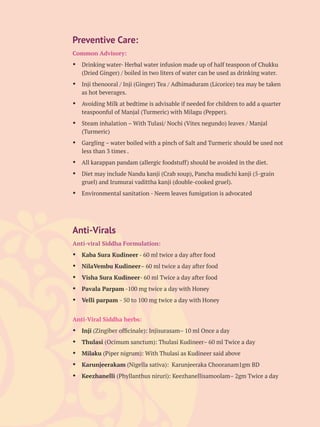
Preventive Care:
Common Advisory:
Ÿ Drinking water- Herbal water infusion made up of half teaspoon of Chukku
(Dried Ginger) / boiled in two liters of water can be used as drinking water.
Ÿ Inji thenooral / Inji (Ginger) Tea / Adhimaduram (Licorice) tea may be taken
as hot beverages.
Ÿ Avoiding Milk at bedtime is advisable if needed for children to add a quarter
teaspoonful of Manjal (Turmeric) with Milagu (Pepper).
Ÿ Steam inhalation – With Tulasi/ Nochi (Vitex negundo) leaves / Manjal
(Turmeric)
Ÿ Gargling – water boiled with a pinch of Salt and Turmeric should be used not
less than 3 times .
Ÿ All karappan pandam (allergic foodstuff) should be avoided in the diet.
Ÿ Diet may include Nandu kanji (Crab soup), Pancha mudichi kanji (5-grain
gruel) and Irumurai vadittha kanji (double-cooked gruel).
Ÿ Environmental sanitation - Neem leaves fumigation is advocated
Anti-Virals
Anti-viral Siddha Formulation:
Ÿ Kaba Sura Kudineer - 60 ml twice a day after food
Ÿ NilaVembu Kudineer– 60 ml twice a day after food
Ÿ Visha Sura Kudineer- 60 ml Twice a day after food
Ÿ Pavala Parpam -100 mg twice a day with Honey
Ÿ Velli parpam - 50 to 100 mg twice a day with Honey
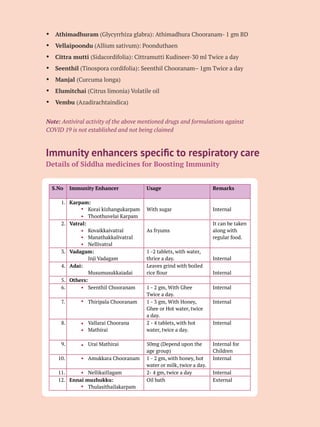
Anti-Viral Siddha herbs:
Ÿ Inji (Zingiber officinale): Injisurasam– 10 ml Once a day
Ÿ Thulasi (Ocimum sanctum): Thulasi Kudineer– 60 ml Twice a day
Ÿ Milaku (Piper nigrum): With Thulasi as Kudineer said above
Ÿ Karunjeerakam (Nigella sativa): Karunjeeraka Chooranam1gm BD
Ÿ Keezhanelli (Phyllanthus niruri): Keezhanellisamoolam– 2gm Twice a day
Ÿ Athimadhuram (Glycyrrhiza glabra): Athimadhura Chooranam- 1 gm BD
Ÿ Vellaipoondu (Allium sativum): Poonduthaen
Ÿ Cittra mutti (Sidacordifolia): Cittramutti Kudineer-30 ml Twice a day
Ÿ Seenthil (Tinospora cordifolia): Seenthil Chooranam– 1gm Twice a day
Ÿ Manjal (Curcuma longa)
Ÿ Elumitchai (Citrus limonia) Volatile oil
Ÿ Vembu (Azadirachtaindica)
Note: Antiviral activity of the above mentioned drugs and formulations against
COVID 19 is not established and not being claimed
Immunity enhancers specific to respiratory care
Details of Siddha medicines for Boosting Immunity
S.No Immunity Enhancer Usage Remarks
1. Karpam:
Korai kizhangukarpam
Thoothuvelai Karpam
With sugar Internal
2. Vatral:
Kovaikkaivatral
Manathakkalivatral
Nellivatral
As fryums
It can be taken
along with
regular food.
3. Vadagam:
Inji Vadagam
1 -2 tablets, with water,
thrice a day. Internal
4. Adai:
Musumusukkaiadai
Leaves grind with boiled
rice flour Internal
5. Others:
6. Seenthil Chooranam 1 - 2 gm, With Ghee
Twice a day.
Internal
7. Thiripala Chooranam 1 - 3 gm, With Honey,
Ghee or Hot water, twice
a day.
Internal
8. Vallarai Choorana
Mathirai
2 - 4 tablets, with hot
water, twice a day.
Internal
9. Urai Mathirai 50mg (Depend upon the
age group)
Internal for
Children
10. Amukkara Chooranam 1 - 2 gm, with honey, hot
water or milk, twice a day.
Internal
11. NellikaiIlagam 2- 4 gm, twice a day Internal
12. Ennai muzhukku:
Thulasithailakarpam
Oil bath External
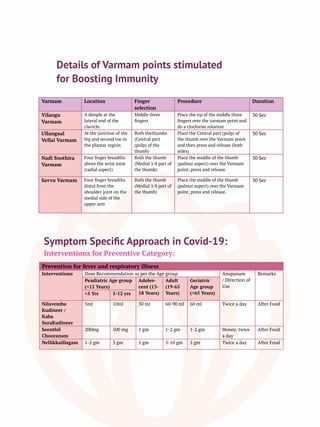
Details of Varmam points stimulated
for Boosting Immunity
Varmam Location Finger
selection
Procedure Duration
Vilangu
Varmam
A dimple at the
lateral end of the
clavicle.
Middle three
fingers
Place the tip of the middle three
fingers over the varmam point and
do a clockwise rotation
30 Sec
Ullangaal
Vellai Varmam
At the junction of the
big and second toe in
the plantar region
Both thethumbs
(Central part
(pulp) of the
thumb)
Place the Central part (pulp) of
the thumb over the Varmam point
and then press and release (both
sides)
30 Sec
Nadi Soothira
Varmam
Four finger breadths
above the wrist joint
(radial aspect)
Both the thumb
(Medial 1⁄4 part of
the thumb)
Place the middle of the thumb
(palmar aspect) over the Varmam
point; press and release.
30 Sec
Savvu Varmam Four finger breadths
distal from the
shoulder joint on the
medial side of the
upper arm
Both the thumb
(Medial 1⁄4 part of
the thumb)
Place the middle of the thumb
(palmar aspect) over the Varmam
point; press and release.
30 Sec
Symptom Specific Approach in Covid-19:
Prevention for fever and respiratory illness
Interventions Dose Recommendation as per the Age group Anupanam
/ Direction of
Use
Remarks
Peadiatric Age group
(<12 Years)
Adoles-
cent (13-
18 Years)
Adult
(19-65
Years)
Geriatric
Age group
(>65 Years)
<5 Yrs 5-12 yrs
Nilavembu
Kudineer /
Kaba
SuraKudineer
5ml 10ml 30 ml 60-90 ml 60 ml Twice a day After Food
Seenthil
Chooranam
200mg 500 mg 1 gm 1-2 gm 1-2 gm Honey/ twice
a day
After Food
NellikkaiIlagam 1-2 gm 3 gm 5 gm 5-10 gm 5 gm Twice a day After Food
Interventions for Preventive Category:
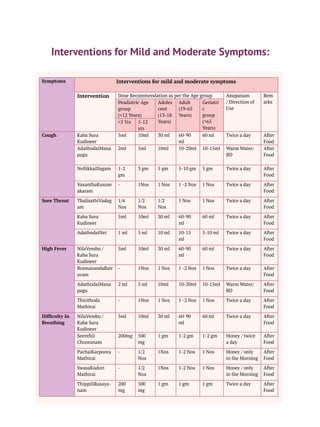
Interventions for Mild and Moderate Symptoms:
Symptoms Interventions for mild and moderate symptoms
Intervention Dose Recommendation as per the Age group Anupanam
/ Direction of
Use
Rem
arks
Peadiatric Age
group
(<12 Years)
Adoles
cent
(13-18
Years)
Adult
(19-65
Years)
Geriatri
c
group
(>65
Years)
<5 Yrs 5-12
yrs
Cough Kaba Sura
Kudineer
5ml 10ml 30 ml 60-90
ml
60 ml Twice a day After
Food
AdathodaiMana
pagu
2ml 5ml 10ml 10-20ml 10-15ml Warm Water/
BD
After
Food
NellikkaiIlagam 1-2
gm
3 gm 5 gm 5-10 gm 5 gm Twice a day After
Food
VasanthaKusum
akaram
- 1Nos 1 Nos 1 -2 Nos 1 Nos Twice a day After
Food
Sore Throat ThalisathiVadag
am
1/4
Nos
1/2
Nos
1/2
Nos
1 Nos 1 Nos Twice a day After
Food
Kaba Sura
Kudineer
5ml 10ml 30 ml 60-90
ml
60 ml Twice a day After
Food
AdathodaiNei 1 ml 5 ml 10 ml 10-15
ml
5-10 ml Twice a day After
Food
High Fever NilaVembu /
Kaba Sura
Kudineer
5ml 10ml 30 ml 60-90
ml
60 ml Twice a day After
Food
BramanandaBair
avam
- 1Nos 1 Nos 1 -2 Nos 1 Nos Twice a day After
Food
AdathodaiMana
pagu
2 ml 5 ml 10ml 10-20ml 10-15ml Warm Water/
BD
After
Food
Thirithoda
Mathirai
- 1Nos 1 Nos 1 -2 Nos 1 Nos Twice a day After
Food
Difficulty In
Breathing
NilaVembu /
Kaba Sura
Kudineer
5ml 10ml 30 ml 60-90
ml
60 ml Twice a day After
Food
Seenthil
Chooranam
200mg 500
mg
1 gm 1-2 gm 1-2 gm Honey / twice
a day
After
Food
PachaiKarpoora
Mathirai
- 1/2
Nos
1Nos 1-2 Nos 1 Nos Honey / only
in the Morning
After
Food
SwasaKudori
Mathirai
- 1/2
Nos
1Nos 1-2 Nos 1 Nos Honey / only
in the Morning
After
Food
ThippiliRasaya-
nam
200
mg
500
mg
1 gm 1 gm 1 gm Twice a day After
Food
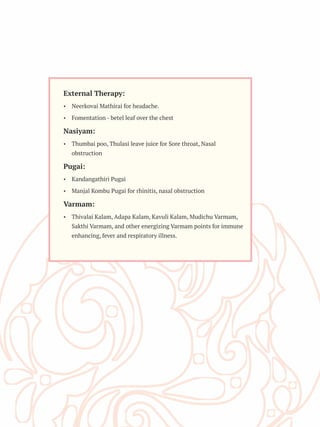
External Therapy:
Ÿ Neerkovai Mathirai for headache.
Ÿ Fomentation - betel leaf over the chest
Nasiyam:
Ÿ Thumbai poo, Thulasi leave juice for Sore throat, Nasal
obstruction
Pugai:
Ÿ Kandangathiri Pugai
Ÿ Manjal Kombu Pugai for rhinitis, nasal obstruction
Varmam:
Ÿ Thivalai Kalam, Adapa Kalam, Kavuli Kalam, Mudichu Varmam,
Sakthi Varmam, and other energizing Varmam points for immune
enhancing, fever and respiratory illness.
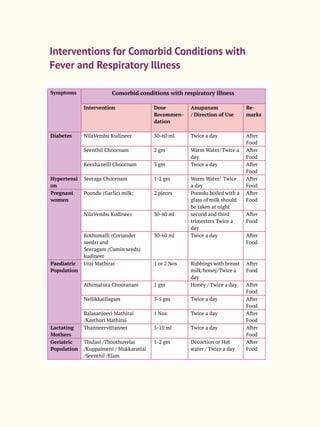
Interventions for Comorbid Conditions with
Fever and Respiratory Illness
Symptoms Comorbid conditions with respiratory illness
Intervention Dose
Recommen-
dation
Anupanam
/ Direction of Use
Re-
marks
Diabetes NilaVembu Kudineer 30-60 ml Twice a day After
Food
Seenthil Choornam 2 gm Warm Water/Twice a
day
After
Food
Keezhanelli Choornam 3 gm Twice a day After
Food
Hypertensi
on
Seeraga Choornam 1-2 gm Warm Water/ Twice
a day
After
Food
Pregnant
women
Poondu (Garlic) milk: 2 pieces Poondu boiled with a
glass of milk should
be taken at night
After
Food
NilaVembu Kudineer 30-60 ml second and third
trimesters Twice a
day
After
Food
Kothumalli (Coriander
seeds) and
Seeragam (Cumin seeds)
kudineer
30-60 ml Twice a day After
Food
Paediatric
Population
Urai Mathirai 1 or 2 Nos Rubbings with breast
milk/honey/Twice a
day
After
Food
Athimatura Chooranam 1 gm Honey / Twice a day After
Food
NellikkaiIlagam 3-5 gm Twice a day After
Food
Balasanjeevi Mathirai
/Kasthuri Mathirai
1 Nos Twice a day After
Food
Lactating
Mothers
Thanneervittannei 5-10 ml Twice a day After
Food
Geriatric
Population
Thulasi /Thoothuvelai
/Kuppaimeni / Mukkarattai
/Seenthil /Elam
1-2 gm Decoction or Hot
water / Twice a day
After
Food
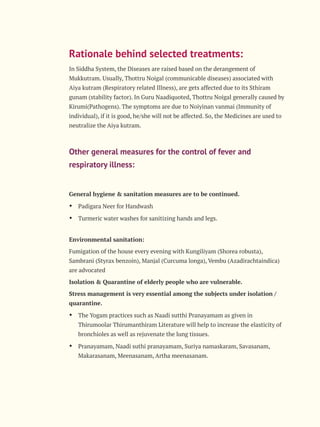
Rationale behind selected treatments:
In Siddha System, the Diseases are raised based on the derangement of
Mukkutram. Usually, Thottru Noigal (communicable diseases) associated with
Aiya kutram (Respiratory related Illness), are gets affected due to its Sthiram
gunam (stability factor). In Guru Naadiquoted, Thottru Noigal generally caused by
Kirumi(Pathogens). The symptoms are due to Noiyinan vanmai (Immunity of
individual), if it is good, he/she will not be affected. So, the Medicines are used to
neutralize the Aiya kutram.
Other general measures for the control of fever and
respiratory illness:
General hygiene & sanitation measures are to be continued.
Ÿ Padigara Neer for Handwash
Ÿ Turmeric water washes for sanitizing hands and legs.
Environmental sanitation:
Fumigation of the house every evening with Kungiliyam (Shorea robusta),
Sambrani (Styrax benzoin), Manjal (Curcuma longa), Vembu (Azadirachtaindica)
are advocated
Isolation & Quarantine of elderly people who are vulnerable.
Stress management is very essential among the subjects under isolation /
quarantine.
Ÿ The Yogam practices such as Naadi sutthi Pranayamam as given in
Thirumoolar Thirumanthiram Literature will help to increase the elasticity of
bronchioles as well as rejuvenate the lung tissues.
Ÿ Pranayamam, Naadi suthi pranayamam, Suriya namaskaram, Savasanam,
Makarasanam, Meenasanam, Artha meenasanam.
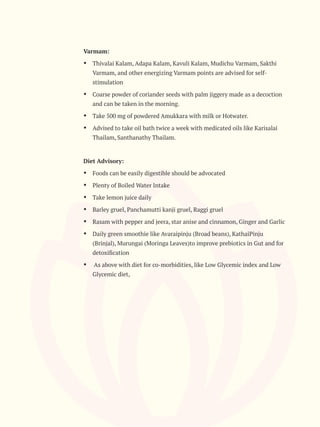
Varmam:
Ÿ Thivalai Kalam, Adapa Kalam, Kavuli Kalam, Mudichu Varmam, Sakthi
Varmam, and other energizing Varmam points are advised for self-
stimulation
Ÿ Coarse powder of coriander seeds with palm jiggery made as a decoction
and can be taken in the morning.
Ÿ Take 500 mg of powdered Amukkara with milk or Hotwater.
Ÿ Advised to take oil bath twice a week with medicated oils like Karisalai
Thailam, Santhanathy Thailam.
Diet Advisory:
Ÿ Foods can be easily digestible should be advocated
Ÿ Plenty of Boiled Water Intake
Ÿ Take lemon juice daily
Ÿ Barley gruel, Panchamutti kanji gruel, Raggi gruel
Ÿ Rasam with pepper and jeera, star anise and cinnamon, Ginger and Garlic
Ÿ Daily green smoothie like Avaraipinju (Broad beans), KathaiPinju
(Brinjal), Murungai (Moringa Leaves)to improve prebiotics in Gut and for
detoxification
Ÿ As above with diet for co-morbidities, like Low Glycemic index and Low
Glycemic diet,
Ÿ https://www.thehindu.com/news/national/india-coronavirus-lockdown-april-3-
2020-live-updates/article31243605.ece
Ÿ https://www.covid19india.org/
Ÿ T.V.Sambasivam Pillai,1991, Directorate of Indian Medicine & Homeopathy,
Chennai, Dictionary of Medicine, Chemistry, Botany and Allied Science ,Vol 2,
1724.
Ÿ Smith KB, Locklear HW. Ginger Root and its Benefits.
Ÿ Widyaningsih TD, Siska AI, Fanani R, Martati E. Traditional drink of black cincau
(Mesonapalustris BL)-based wedanguwuh as immunomodulator on alloxan-induced
diabetic rats. Nutrition & Food Science. 2020 Feb 20.
Ÿ Balasubramanian S, Roselin P, Singh KK, Zachariah J, Saxena SN. Postharvest
processing and benefits of black pepper, coriander, cinnamon, fenugreek, and
turmeric spices. Critical reviews in food science and nutrition. 2016 Jul
26;56(10):1585-607.
Ÿ Maurya H, Rao V. The Favorable Role of Alkaloids from Vitex negundo in the
Management of Human Ailments.
Ÿ Saxena RC. Practical applications of neem against pests of stored products. In
Annual International Research Conference on Methyl Bromide Alternatives and
Emissions Reductions, Orlando, Florida, USA 2009 (pp. 110-114).
Ÿ Jain J, Kumar A, Narayanan V, Ramaswamy RS, Sathiyarajeswaran P, Shree Devi MS,
Kannan M, Sunil S; Antiviral activity of ethanolic extract of Nilavembu Kudineer
against dengue and chikungunya virus through in vitro evaluation. J Ayurveda
Integr Med. 2019 Jan 23. pii: S0975-9476(18)30073-1. doi:
10.1016/j.jaim.2018.05.006.
Ÿ Shailaja et.al. A Review on Poly herbal Formulation — Visha Sura Kudineer
Chooranam — A Classical Anti —Viral Used in Siddha System, European Journal of
Pharmaceutical and Medical Research, 2017, 4 (9)184-192.
Ÿ Moghadamtousi SZ, Nikzad S, Kadir HA, Abubakar S, Zandi K. Potential antiviral
agents from marine fungi: an overview. Marine drugs. 2015 Jul;13(7):4520-38
Ÿ Mori Y, Ono T, Miyahira Y, Nguyen VQ, Matsui T, Ishihara M. Antiviral activity of
silver nanoparticle/chitosan composites against H1N1 influenza A virus. Nanoscale
research letters. 2013 Dec 1;8(1):93.
Ÿ Vitiello, M.; Galdiero, M.; Galdiero, M. Inhibition of viral-induced membrane fusion
by peptides. Protein Pept. Lett. 2009, 16, 786–793.
Ÿ Galdiero S, Falanga A, Vitiello M, Cantisani M, Marra V, Galdiero M. Silver
nanoparticles as potential antiviral agents. Molecules. 2011 Oct;16(10):8894-918.
BIBLIOGRAPHY
Ÿ Chang JS1, Wang KC, Yeh CF, Shieh DE, Chiang LC; Fresh ginger (Zingiber officinale) has anti-
viral activity against human respiratory syncytial virus in human respiratory tract cell lines.J
Ethnopharmacol. 2013 Jan 9;145(1):146-51. doi: 10.1016/j.jep.2012.10.043.
Ÿ G. JOSHI, S. SHARMA, J. ACHARYA, M. PARIDA;ASSESSMENT OF IN VITRO ANTIVIRAL
ACTIVITY OF Ocimum sanctum (TULSI) AGAINST PANDEMIC SWINE FLU H1N1 VIRUS
INFECTION; World Research Journal of Antimicrobial Agents, 3 (1), 62-67.
Ÿ CE Mair, R Liu, AG Atanasov, M Schmidtke, VM Dirsch, JM Rollinger; Antiviral and anti-
proliferative in vitro activities of piperamides from black pepper; Planta Med 2016; 82(S 01):S1-
S381DOI: 10.1055/s-0036-1596830
Ÿ Umar, S., Tanveer Munir, M., Subhan, S., Azam, T., un Nisa, Q., Irfan Khan, M., Umar, W., ur
Rehman, Z., Sattar Saqib, A., Ali Shah, M., Protective and antiviral activities of Nigella sativa
against avian influenza (H9N2) in turkeys, Journal of the Saudi Society of Agricultural Sciences
(2016), doi: http://dx.doi.org/ 10.1016/j.jssas.2016.09.004
Ÿ Sau Har Lee, Yin Quan Tang, Anusyah Rathkrishnan, Seok Mui Wang, Kien Chai Ong, Rishya
Manikam, Bobby Joe Payne, InduBala Jaganath & Shamala Devi Sekaran ; Effects of cocktail of
four local Malaysian medicinal plants (Phyllanthus spp.) against dengue virus 2; BMC
Complementary and Alternative Medicine volume 13, Article number: 192 (2013)
Ÿ Fiore C, Eisenhut M, Krausse R, Ragazzi E, Pellati D, Armanini D, Bielenberg J. Antiviral effects of
Glycyrrhiza species; Phytother Res. 2008 Feb;22(2):141-8.
Ÿ Mehrbod P1, Amini E1, Tavassoti-Kheiri M1 Antiviral Activity of Garlic Extract on Influenza
Virus Iranian Journal of Virology 2009;3(1): 19-23 ©2009, Iranian Society for Virology ;
Availablefrom:
https://www.researchgate.net/publication/287841390_Antiviral_activity_of_garlic_ex
tract_on_Influenza_virus [accessed Apr 04 2020].
Ÿ Investigation of Antiviral Properties of Medicinal Plant Extracts Research Scholar: Wadhwani
Ashish Devidas Guide: Dr. P. Vijayan Department: Pharmaceutical Biotechnology College: JSS
College of Pharmacy, Ootacamund University: JSS University, Mysore;
https://shodhganga.inflibnet.ac.in/bitstream/10603/30854/13/13_summary%20&%20conclusion.
pdf
Ÿ Chetan B, Nakum A. (2010) Use of natural compounds, chitin and tinosporin for the treatment of
the targeted viruses (retroviruses) (HIV-1, HIV-2) all subgroups, HTLV and other viral disease.
Indian patent Appl. IN 2010MU01350 A 20100730.
Ÿ M Ichsyani, A Ridhanya, M Risanti, H Desti, R Ceria, D H Putri, T M Sudiro and B E Dewi;
Antiviral effects of Curcuma longa L. against dengue virus in vitro and in vivo; IOP Conf. Series:
Earth and Environmental Science 101 (2017) 012005 doi:10.1088/1755-1315/101/1/012005
Ÿ Battistini R, Rossini I, Ercolini C, Goria M, Callipo MR, Maurella C, Pavoni E, Serracca L; Antiviral
Activity of Essential Oils Against Hepatitis A Virus in Soft Fruits. Food Environ Virol. 2019
Mar;11(1):90-95. doi: 10.1007/s12560-019-09367-3. Epub 2019 Jan 25.
Ÿ Badam L, Joshi SP, BedekarSS.'In vitro' antiviral activity of neem (Azadirachtaindica. A. Juss) leaf
extract against group B coxsackie viruses. J Commun Dis. 1999 Jun;31(2):79-90.
Disclaimer
These guidelines are in addition to the standard treatment guidelines of
Ministry of Health and Family Welfare, Govt of India and also vetted by
the Interdisciplinary AYUSH Research and Development Task Force setup
by Ministry of AYUSH, Govt of India
GUIDELINES for
SIDDHA PRACTIONERS for COVID 19
In the Siddha system, Epidemics/Pandemics are mentioned as “Uzhi Noi” or “Kothari
Noi”.In general, they are classified under “KollaiNoikal”(Communicable Diseases)
which are most commonly occurred the time of “Ayana Santhi” months (Means end a
month of Uthara Ayanam & Thatchana Ayanam), fall on Adi and Margazhi month in
Tamil Calendar. It is believed that in those days, the immunity of human beings will be
low based on MukkutramTheory.
MINISTRY OF AYUSH
AYUSH BHAWAN, B Block, GPO Complex, INA, NEW DELHI - 110023
http://ayush.gov.in | www.facebook.com/moayush | twitter.com/moayush

siddha-guidelines 2023-1.pdf

  • 1.
  • 2.
  • 3.
    Guidelines for SiddhaPractitioners Guidelines for Siddha Practitioners Current Status of Covid-19 in India Siddha System & Epidemics / Pandemics Preventive Care • Common Advisory Anti-virals • Anti-viral Siddha Formulation • Anti-viral Siddha Herbs Immunity Enhancers Specific To Respiratory Care • Details of Siddha Medicines for Boosting Immunity • Details of Varmam Points Stimulated for Boosting Immunity Symptom Specific Approach in Covid-19 • Interventions for Preventive Category • Interventions for Mild And Moderate Symptoms • Interventions for Comorbid Conditions with Fever and Respiratory Illness Rationale Behind Selected Treatments Other General Measures for the Control of Fever and Respiratory Illness Bibliography Contents
  • 4.
    Current Status ofCovid-19 in India th As on 13 April 2020, in India 9431 confirmed cases are increasing at the rate of 300 cases per day. Also active in quarantine is 7987 and confirmed death is 335. More than 3000 confirmed cases are available mostly in Maharashtra (2064), Tamil Nadu (1075), Delhi (1154), Rajasthan (847) and Madhya Pradesh (562) these 5 states. Andhra Pradesh, Uttar Pradesh, Madhya Pradesh, and Karnataka are having more than 200 cases in each state. It is clearly indicating almost 80% of cases available in this 9 States. Even among the exposed population, the growth rate is still moderate due to the initiatives taken by the government like nationwide lockdown creating awareness among the public about the social distancing. Also, we cannot ignore the self- immunity which we need to be boosted through our indigenous Medical Systems like Siddha. Day by day the number of cases of COVID-19 infection in India is increasing. With the Spread over more than 28 states, isolation and social distancing is the general measures taken up by the public promoted by the government in the form of lockdown. Siddha System & Epidemics / Pandemics In the Siddha system, Epidemics/Pandemics are mentioned as “Uzhi Noi” or “Kothari Noi”. In general, they are classified under “KollaiNoikal”(Communicable Diseases) which are most commonly occurred the time of “Ayana Santhi” months (Means end a month of Uthara Ayanam & Thatchana Ayanam), fall on Adi and Margazhi month in Tamil Calendar. It is believed that in those days, the immunity of human beings will be low based on MukkutramTheory.
  • 5.
    Preventive Care: Common Advisory: ŸDrinking water- Herbal water infusion made up of half teaspoon of Chukku (Dried Ginger) / boiled in two liters of water can be used as drinking water. Ÿ Inji thenooral / Inji (Ginger) Tea / Adhimaduram (Licorice) tea may be taken as hot beverages. Ÿ Avoiding Milk at bedtime is advisable if needed for children to add a quarter teaspoonful of Manjal (Turmeric) with Milagu (Pepper). Ÿ Steam inhalation – With Tulasi/ Nochi (Vitex negundo) leaves / Manjal (Turmeric) Ÿ Gargling – water boiled with a pinch of Salt and Turmeric should be used not less than 3 times . Ÿ All karappan pandam (allergic foodstuff) should be avoided in the diet. Ÿ Diet may include Nandu kanji (Crab soup), Pancha mudichi kanji (5-grain gruel) and Irumurai vadittha kanji (double-cooked gruel). Ÿ Environmental sanitation - Neem leaves fumigation is advocated Anti-Virals Anti-viral Siddha Formulation: Ÿ Kaba Sura Kudineer - 60 ml twice a day after food Ÿ NilaVembu Kudineer– 60 ml twice a day after food Ÿ Visha Sura Kudineer- 60 ml Twice a day after food Ÿ Pavala Parpam -100 mg twice a day with Honey Ÿ Velli parpam - 50 to 100 mg twice a day with Honey Anti-Viral Siddha herbs: Ÿ Inji (Zingiber officinale): Injisurasam– 10 ml Once a day Ÿ Thulasi (Ocimum sanctum): Thulasi Kudineer– 60 ml Twice a day Ÿ Milaku (Piper nigrum): With Thulasi as Kudineer said above Ÿ Karunjeerakam (Nigella sativa): Karunjeeraka Chooranam1gm BD Ÿ Keezhanelli (Phyllanthus niruri): Keezhanellisamoolam– 2gm Twice a day
  • 6.
    Ÿ Athimadhuram (Glycyrrhizaglabra): Athimadhura Chooranam- 1 gm BD Ÿ Vellaipoondu (Allium sativum): Poonduthaen Ÿ Cittra mutti (Sidacordifolia): Cittramutti Kudineer-30 ml Twice a day Ÿ Seenthil (Tinospora cordifolia): Seenthil Chooranam– 1gm Twice a day Ÿ Manjal (Curcuma longa) Ÿ Elumitchai (Citrus limonia) Volatile oil Ÿ Vembu (Azadirachtaindica) Note: Antiviral activity of the above mentioned drugs and formulations against COVID 19 is not established and not being claimed Immunity enhancers specific to respiratory care Details of Siddha medicines for Boosting Immunity S.No Immunity Enhancer Usage Remarks 1. Karpam: Korai kizhangukarpam Thoothuvelai Karpam With sugar Internal 2. Vatral: Kovaikkaivatral Manathakkalivatral Nellivatral As fryums It can be taken along with regular food. 3. Vadagam: Inji Vadagam 1 -2 tablets, with water, thrice a day. Internal 4. Adai: Musumusukkaiadai Leaves grind with boiled rice flour Internal 5. Others: 6. Seenthil Chooranam 1 - 2 gm, With Ghee Twice a day. Internal 7. Thiripala Chooranam 1 - 3 gm, With Honey, Ghee or Hot water, twice a day. Internal 8. Vallarai Choorana Mathirai 2 - 4 tablets, with hot water, twice a day. Internal 9. Urai Mathirai 50mg (Depend upon the age group) Internal for Children 10. Amukkara Chooranam 1 - 2 gm, with honey, hot water or milk, twice a day. Internal 11. NellikaiIlagam 2- 4 gm, twice a day Internal 12. Ennai muzhukku: Thulasithailakarpam Oil bath External
  • 7.
    Details of Varmampoints stimulated for Boosting Immunity Varmam Location Finger selection Procedure Duration Vilangu Varmam A dimple at the lateral end of the clavicle. Middle three fingers Place the tip of the middle three fingers over the varmam point and do a clockwise rotation 30 Sec Ullangaal Vellai Varmam At the junction of the big and second toe in the plantar region Both thethumbs (Central part (pulp) of the thumb) Place the Central part (pulp) of the thumb over the Varmam point and then press and release (both sides) 30 Sec Nadi Soothira Varmam Four finger breadths above the wrist joint (radial aspect) Both the thumb (Medial 1⁄4 part of the thumb) Place the middle of the thumb (palmar aspect) over the Varmam point; press and release. 30 Sec Savvu Varmam Four finger breadths distal from the shoulder joint on the medial side of the upper arm Both the thumb (Medial 1⁄4 part of the thumb) Place the middle of the thumb (palmar aspect) over the Varmam point; press and release. 30 Sec Symptom Specific Approach in Covid-19: Prevention for fever and respiratory illness Interventions Dose Recommendation as per the Age group Anupanam / Direction of Use Remarks Peadiatric Age group (<12 Years) Adoles- cent (13- 18 Years) Adult (19-65 Years) Geriatric Age group (>65 Years) <5 Yrs 5-12 yrs Nilavembu Kudineer / Kaba SuraKudineer 5ml 10ml 30 ml 60-90 ml 60 ml Twice a day After Food Seenthil Chooranam 200mg 500 mg 1 gm 1-2 gm 1-2 gm Honey/ twice a day After Food NellikkaiIlagam 1-2 gm 3 gm 5 gm 5-10 gm 5 gm Twice a day After Food Interventions for Preventive Category:
  • 8.
    Interventions for Mildand Moderate Symptoms: Symptoms Interventions for mild and moderate symptoms Intervention Dose Recommendation as per the Age group Anupanam / Direction of Use Rem arks Peadiatric Age group (<12 Years) Adoles cent (13-18 Years) Adult (19-65 Years) Geriatri c group (>65 Years) <5 Yrs 5-12 yrs Cough Kaba Sura Kudineer 5ml 10ml 30 ml 60-90 ml 60 ml Twice a day After Food AdathodaiMana pagu 2ml 5ml 10ml 10-20ml 10-15ml Warm Water/ BD After Food NellikkaiIlagam 1-2 gm 3 gm 5 gm 5-10 gm 5 gm Twice a day After Food VasanthaKusum akaram - 1Nos 1 Nos 1 -2 Nos 1 Nos Twice a day After Food Sore Throat ThalisathiVadag am 1/4 Nos 1/2 Nos 1/2 Nos 1 Nos 1 Nos Twice a day After Food Kaba Sura Kudineer 5ml 10ml 30 ml 60-90 ml 60 ml Twice a day After Food AdathodaiNei 1 ml 5 ml 10 ml 10-15 ml 5-10 ml Twice a day After Food High Fever NilaVembu / Kaba Sura Kudineer 5ml 10ml 30 ml 60-90 ml 60 ml Twice a day After Food BramanandaBair avam - 1Nos 1 Nos 1 -2 Nos 1 Nos Twice a day After Food AdathodaiMana pagu 2 ml 5 ml 10ml 10-20ml 10-15ml Warm Water/ BD After Food Thirithoda Mathirai - 1Nos 1 Nos 1 -2 Nos 1 Nos Twice a day After Food Difficulty In Breathing NilaVembu / Kaba Sura Kudineer 5ml 10ml 30 ml 60-90 ml 60 ml Twice a day After Food Seenthil Chooranam 200mg 500 mg 1 gm 1-2 gm 1-2 gm Honey / twice a day After Food PachaiKarpoora Mathirai - 1/2 Nos 1Nos 1-2 Nos 1 Nos Honey / only in the Morning After Food SwasaKudori Mathirai - 1/2 Nos 1Nos 1-2 Nos 1 Nos Honey / only in the Morning After Food ThippiliRasaya- nam 200 mg 500 mg 1 gm 1 gm 1 gm Twice a day After Food
  • 9.
    External Therapy: Ÿ NeerkovaiMathirai for headache. Ÿ Fomentation - betel leaf over the chest Nasiyam: Ÿ Thumbai poo, Thulasi leave juice for Sore throat, Nasal obstruction Pugai: Ÿ Kandangathiri Pugai Ÿ Manjal Kombu Pugai for rhinitis, nasal obstruction Varmam: Ÿ Thivalai Kalam, Adapa Kalam, Kavuli Kalam, Mudichu Varmam, Sakthi Varmam, and other energizing Varmam points for immune enhancing, fever and respiratory illness.
  • 10.
    Interventions for ComorbidConditions with Fever and Respiratory Illness Symptoms Comorbid conditions with respiratory illness Intervention Dose Recommen- dation Anupanam / Direction of Use Re- marks Diabetes NilaVembu Kudineer 30-60 ml Twice a day After Food Seenthil Choornam 2 gm Warm Water/Twice a day After Food Keezhanelli Choornam 3 gm Twice a day After Food Hypertensi on Seeraga Choornam 1-2 gm Warm Water/ Twice a day After Food Pregnant women Poondu (Garlic) milk: 2 pieces Poondu boiled with a glass of milk should be taken at night After Food NilaVembu Kudineer 30-60 ml second and third trimesters Twice a day After Food Kothumalli (Coriander seeds) and Seeragam (Cumin seeds) kudineer 30-60 ml Twice a day After Food Paediatric Population Urai Mathirai 1 or 2 Nos Rubbings with breast milk/honey/Twice a day After Food Athimatura Chooranam 1 gm Honey / Twice a day After Food NellikkaiIlagam 3-5 gm Twice a day After Food Balasanjeevi Mathirai /Kasthuri Mathirai 1 Nos Twice a day After Food Lactating Mothers Thanneervittannei 5-10 ml Twice a day After Food Geriatric Population Thulasi /Thoothuvelai /Kuppaimeni / Mukkarattai /Seenthil /Elam 1-2 gm Decoction or Hot water / Twice a day After Food
  • 11.
    Rationale behind selectedtreatments: In Siddha System, the Diseases are raised based on the derangement of Mukkutram. Usually, Thottru Noigal (communicable diseases) associated with Aiya kutram (Respiratory related Illness), are gets affected due to its Sthiram gunam (stability factor). In Guru Naadiquoted, Thottru Noigal generally caused by Kirumi(Pathogens). The symptoms are due to Noiyinan vanmai (Immunity of individual), if it is good, he/she will not be affected. So, the Medicines are used to neutralize the Aiya kutram. Other general measures for the control of fever and respiratory illness: General hygiene & sanitation measures are to be continued. Ÿ Padigara Neer for Handwash Ÿ Turmeric water washes for sanitizing hands and legs. Environmental sanitation: Fumigation of the house every evening with Kungiliyam (Shorea robusta), Sambrani (Styrax benzoin), Manjal (Curcuma longa), Vembu (Azadirachtaindica) are advocated Isolation & Quarantine of elderly people who are vulnerable. Stress management is very essential among the subjects under isolation / quarantine. Ÿ The Yogam practices such as Naadi sutthi Pranayamam as given in Thirumoolar Thirumanthiram Literature will help to increase the elasticity of bronchioles as well as rejuvenate the lung tissues. Ÿ Pranayamam, Naadi suthi pranayamam, Suriya namaskaram, Savasanam, Makarasanam, Meenasanam, Artha meenasanam.
  • 12.
    Varmam: Ÿ Thivalai Kalam,Adapa Kalam, Kavuli Kalam, Mudichu Varmam, Sakthi Varmam, and other energizing Varmam points are advised for self- stimulation Ÿ Coarse powder of coriander seeds with palm jiggery made as a decoction and can be taken in the morning. Ÿ Take 500 mg of powdered Amukkara with milk or Hotwater. Ÿ Advised to take oil bath twice a week with medicated oils like Karisalai Thailam, Santhanathy Thailam. Diet Advisory: Ÿ Foods can be easily digestible should be advocated Ÿ Plenty of Boiled Water Intake Ÿ Take lemon juice daily Ÿ Barley gruel, Panchamutti kanji gruel, Raggi gruel Ÿ Rasam with pepper and jeera, star anise and cinnamon, Ginger and Garlic Ÿ Daily green smoothie like Avaraipinju (Broad beans), KathaiPinju (Brinjal), Murungai (Moringa Leaves)to improve prebiotics in Gut and for detoxification Ÿ As above with diet for co-morbidities, like Low Glycemic index and Low Glycemic diet,
  • 13.
    Ÿ https://www.thehindu.com/news/national/india-coronavirus-lockdown-april-3- 2020-live-updates/article31243605.ece Ÿ https://www.covid19india.org/ ŸT.V.Sambasivam Pillai,1991, Directorate of Indian Medicine & Homeopathy, Chennai, Dictionary of Medicine, Chemistry, Botany and Allied Science ,Vol 2, 1724. Ÿ Smith KB, Locklear HW. Ginger Root and its Benefits. Ÿ Widyaningsih TD, Siska AI, Fanani R, Martati E. Traditional drink of black cincau (Mesonapalustris BL)-based wedanguwuh as immunomodulator on alloxan-induced diabetic rats. Nutrition & Food Science. 2020 Feb 20. Ÿ Balasubramanian S, Roselin P, Singh KK, Zachariah J, Saxena SN. Postharvest processing and benefits of black pepper, coriander, cinnamon, fenugreek, and turmeric spices. Critical reviews in food science and nutrition. 2016 Jul 26;56(10):1585-607. Ÿ Maurya H, Rao V. The Favorable Role of Alkaloids from Vitex negundo in the Management of Human Ailments. Ÿ Saxena RC. Practical applications of neem against pests of stored products. In Annual International Research Conference on Methyl Bromide Alternatives and Emissions Reductions, Orlando, Florida, USA 2009 (pp. 110-114). Ÿ Jain J, Kumar A, Narayanan V, Ramaswamy RS, Sathiyarajeswaran P, Shree Devi MS, Kannan M, Sunil S; Antiviral activity of ethanolic extract of Nilavembu Kudineer against dengue and chikungunya virus through in vitro evaluation. J Ayurveda Integr Med. 2019 Jan 23. pii: S0975-9476(18)30073-1. doi: 10.1016/j.jaim.2018.05.006. Ÿ Shailaja et.al. A Review on Poly herbal Formulation — Visha Sura Kudineer Chooranam — A Classical Anti —Viral Used in Siddha System, European Journal of Pharmaceutical and Medical Research, 2017, 4 (9)184-192. Ÿ Moghadamtousi SZ, Nikzad S, Kadir HA, Abubakar S, Zandi K. Potential antiviral agents from marine fungi: an overview. Marine drugs. 2015 Jul;13(7):4520-38 Ÿ Mori Y, Ono T, Miyahira Y, Nguyen VQ, Matsui T, Ishihara M. Antiviral activity of silver nanoparticle/chitosan composites against H1N1 influenza A virus. Nanoscale research letters. 2013 Dec 1;8(1):93. Ÿ Vitiello, M.; Galdiero, M.; Galdiero, M. Inhibition of viral-induced membrane fusion by peptides. Protein Pept. Lett. 2009, 16, 786–793. Ÿ Galdiero S, Falanga A, Vitiello M, Cantisani M, Marra V, Galdiero M. Silver nanoparticles as potential antiviral agents. Molecules. 2011 Oct;16(10):8894-918. BIBLIOGRAPHY
  • 14.
    Ÿ Chang JS1,Wang KC, Yeh CF, Shieh DE, Chiang LC; Fresh ginger (Zingiber officinale) has anti- viral activity against human respiratory syncytial virus in human respiratory tract cell lines.J Ethnopharmacol. 2013 Jan 9;145(1):146-51. doi: 10.1016/j.jep.2012.10.043. Ÿ G. JOSHI, S. SHARMA, J. ACHARYA, M. PARIDA;ASSESSMENT OF IN VITRO ANTIVIRAL ACTIVITY OF Ocimum sanctum (TULSI) AGAINST PANDEMIC SWINE FLU H1N1 VIRUS INFECTION; World Research Journal of Antimicrobial Agents, 3 (1), 62-67. Ÿ CE Mair, R Liu, AG Atanasov, M Schmidtke, VM Dirsch, JM Rollinger; Antiviral and anti- proliferative in vitro activities of piperamides from black pepper; Planta Med 2016; 82(S 01):S1- S381DOI: 10.1055/s-0036-1596830 Ÿ Umar, S., Tanveer Munir, M., Subhan, S., Azam, T., un Nisa, Q., Irfan Khan, M., Umar, W., ur Rehman, Z., Sattar Saqib, A., Ali Shah, M., Protective and antiviral activities of Nigella sativa against avian influenza (H9N2) in turkeys, Journal of the Saudi Society of Agricultural Sciences (2016), doi: http://dx.doi.org/ 10.1016/j.jssas.2016.09.004 Ÿ Sau Har Lee, Yin Quan Tang, Anusyah Rathkrishnan, Seok Mui Wang, Kien Chai Ong, Rishya Manikam, Bobby Joe Payne, InduBala Jaganath & Shamala Devi Sekaran ; Effects of cocktail of four local Malaysian medicinal plants (Phyllanthus spp.) against dengue virus 2; BMC Complementary and Alternative Medicine volume 13, Article number: 192 (2013) Ÿ Fiore C, Eisenhut M, Krausse R, Ragazzi E, Pellati D, Armanini D, Bielenberg J. Antiviral effects of Glycyrrhiza species; Phytother Res. 2008 Feb;22(2):141-8. Ÿ Mehrbod P1, Amini E1, Tavassoti-Kheiri M1 Antiviral Activity of Garlic Extract on Influenza Virus Iranian Journal of Virology 2009;3(1): 19-23 ©2009, Iranian Society for Virology ; Availablefrom: https://www.researchgate.net/publication/287841390_Antiviral_activity_of_garlic_ex tract_on_Influenza_virus [accessed Apr 04 2020]. Ÿ Investigation of Antiviral Properties of Medicinal Plant Extracts Research Scholar: Wadhwani Ashish Devidas Guide: Dr. P. Vijayan Department: Pharmaceutical Biotechnology College: JSS College of Pharmacy, Ootacamund University: JSS University, Mysore; https://shodhganga.inflibnet.ac.in/bitstream/10603/30854/13/13_summary%20&%20conclusion. pdf Ÿ Chetan B, Nakum A. (2010) Use of natural compounds, chitin and tinosporin for the treatment of the targeted viruses (retroviruses) (HIV-1, HIV-2) all subgroups, HTLV and other viral disease. Indian patent Appl. IN 2010MU01350 A 20100730. Ÿ M Ichsyani, A Ridhanya, M Risanti, H Desti, R Ceria, D H Putri, T M Sudiro and B E Dewi; Antiviral effects of Curcuma longa L. against dengue virus in vitro and in vivo; IOP Conf. Series: Earth and Environmental Science 101 (2017) 012005 doi:10.1088/1755-1315/101/1/012005 Ÿ Battistini R, Rossini I, Ercolini C, Goria M, Callipo MR, Maurella C, Pavoni E, Serracca L; Antiviral Activity of Essential Oils Against Hepatitis A Virus in Soft Fruits. Food Environ Virol. 2019 Mar;11(1):90-95. doi: 10.1007/s12560-019-09367-3. Epub 2019 Jan 25. Ÿ Badam L, Joshi SP, BedekarSS.'In vitro' antiviral activity of neem (Azadirachtaindica. A. Juss) leaf extract against group B coxsackie viruses. J Commun Dis. 1999 Jun;31(2):79-90.
  • 15.
    Disclaimer These guidelines arein addition to the standard treatment guidelines of Ministry of Health and Family Welfare, Govt of India and also vetted by the Interdisciplinary AYUSH Research and Development Task Force setup by Ministry of AYUSH, Govt of India
  • 16.
    GUIDELINES for SIDDHA PRACTIONERSfor COVID 19 In the Siddha system, Epidemics/Pandemics are mentioned as “Uzhi Noi” or “Kothari Noi”.In general, they are classified under “KollaiNoikal”(Communicable Diseases) which are most commonly occurred the time of “Ayana Santhi” months (Means end a month of Uthara Ayanam & Thatchana Ayanam), fall on Adi and Margazhi month in Tamil Calendar. It is believed that in those days, the immunity of human beings will be low based on MukkutramTheory. MINISTRY OF AYUSH AYUSH BHAWAN, B Block, GPO Complex, INA, NEW DELHI - 110023 http://ayush.gov.in | www.facebook.com/moayush | twitter.com/moayush