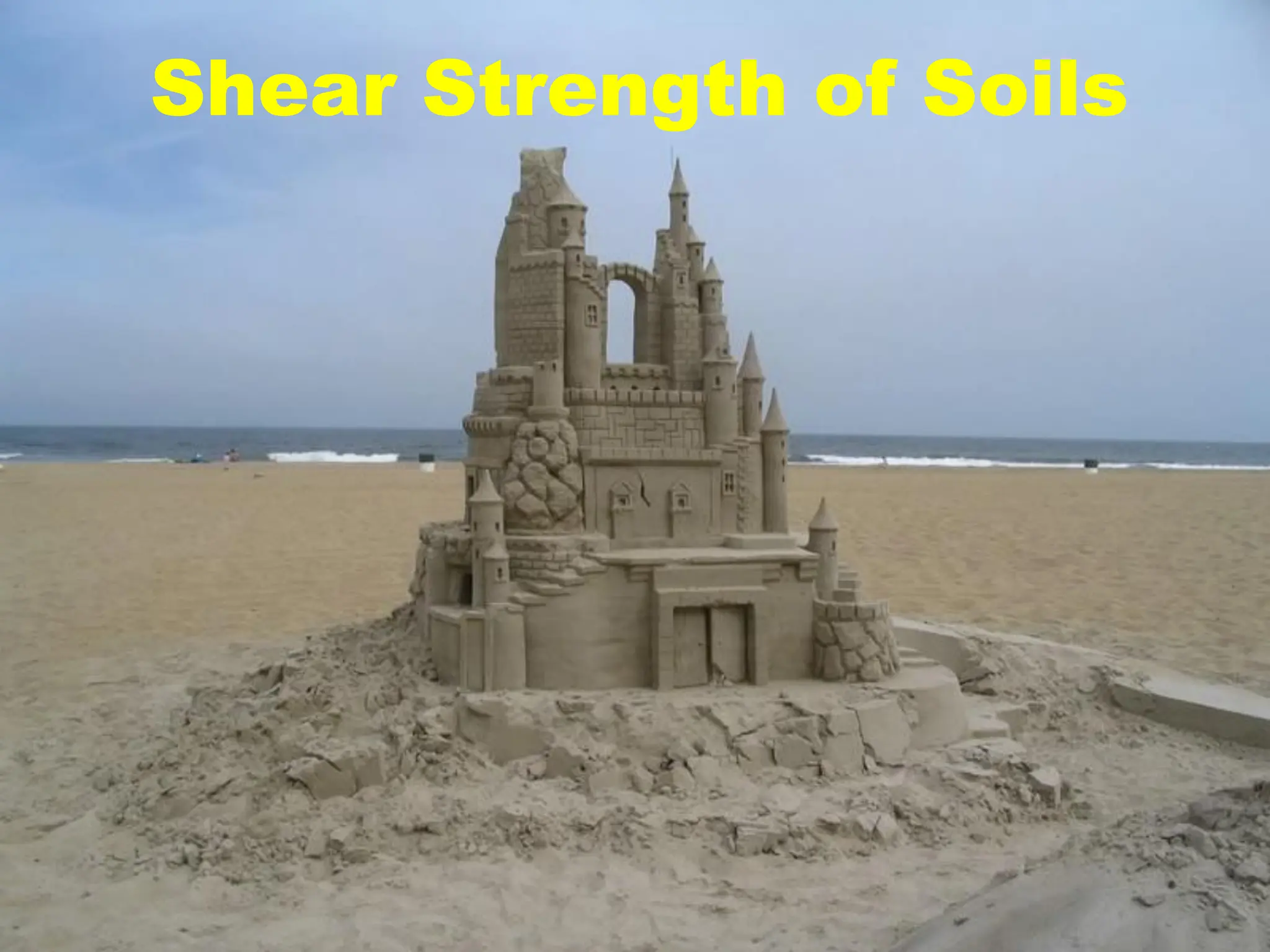
Shear Strength of Soils
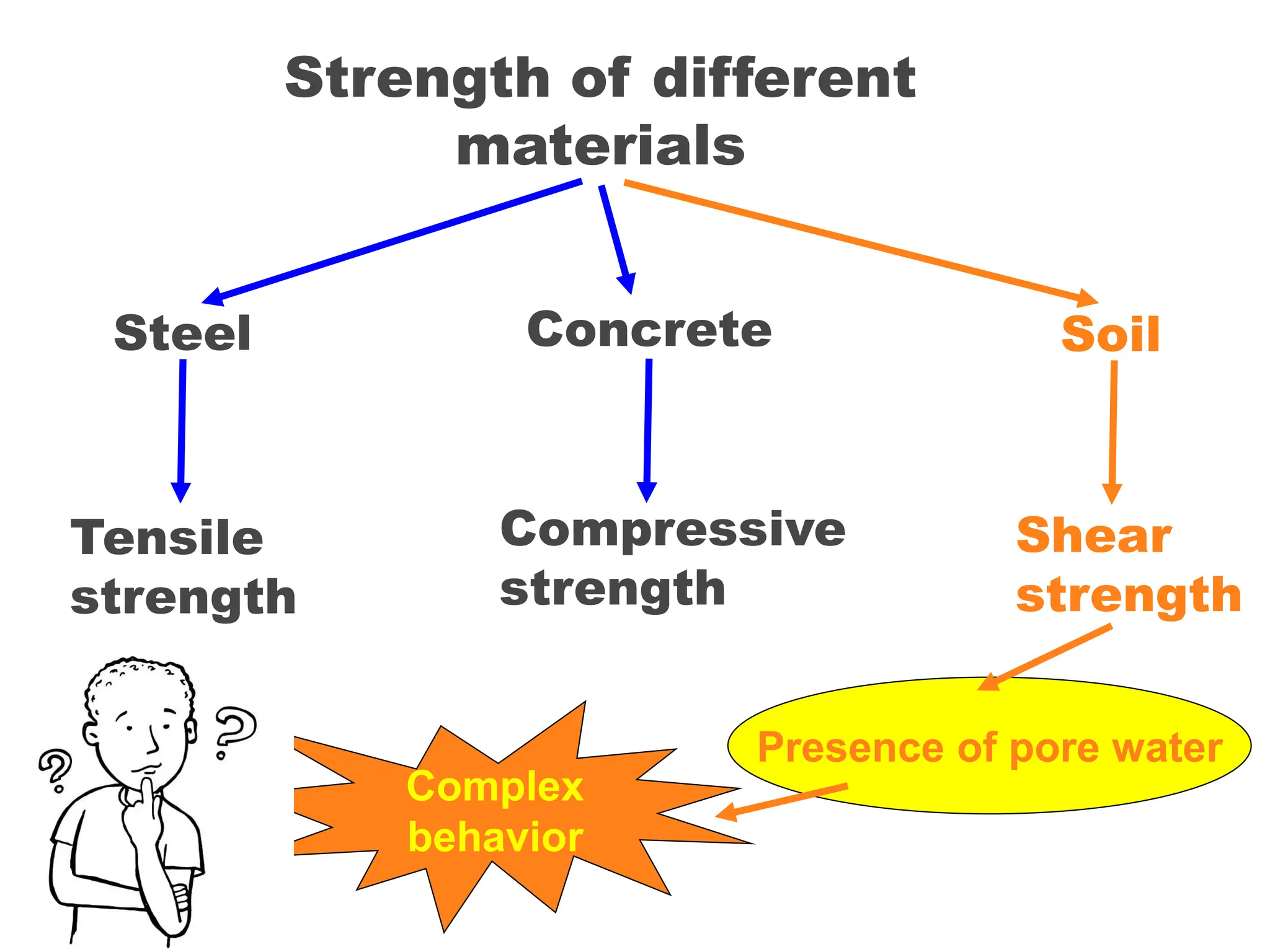
Strength of different
materials
Steel
Tensile
strength
Concrete
Compressive
strength
Soil
Shear
strength
Presence of pore water
Complex
behavior
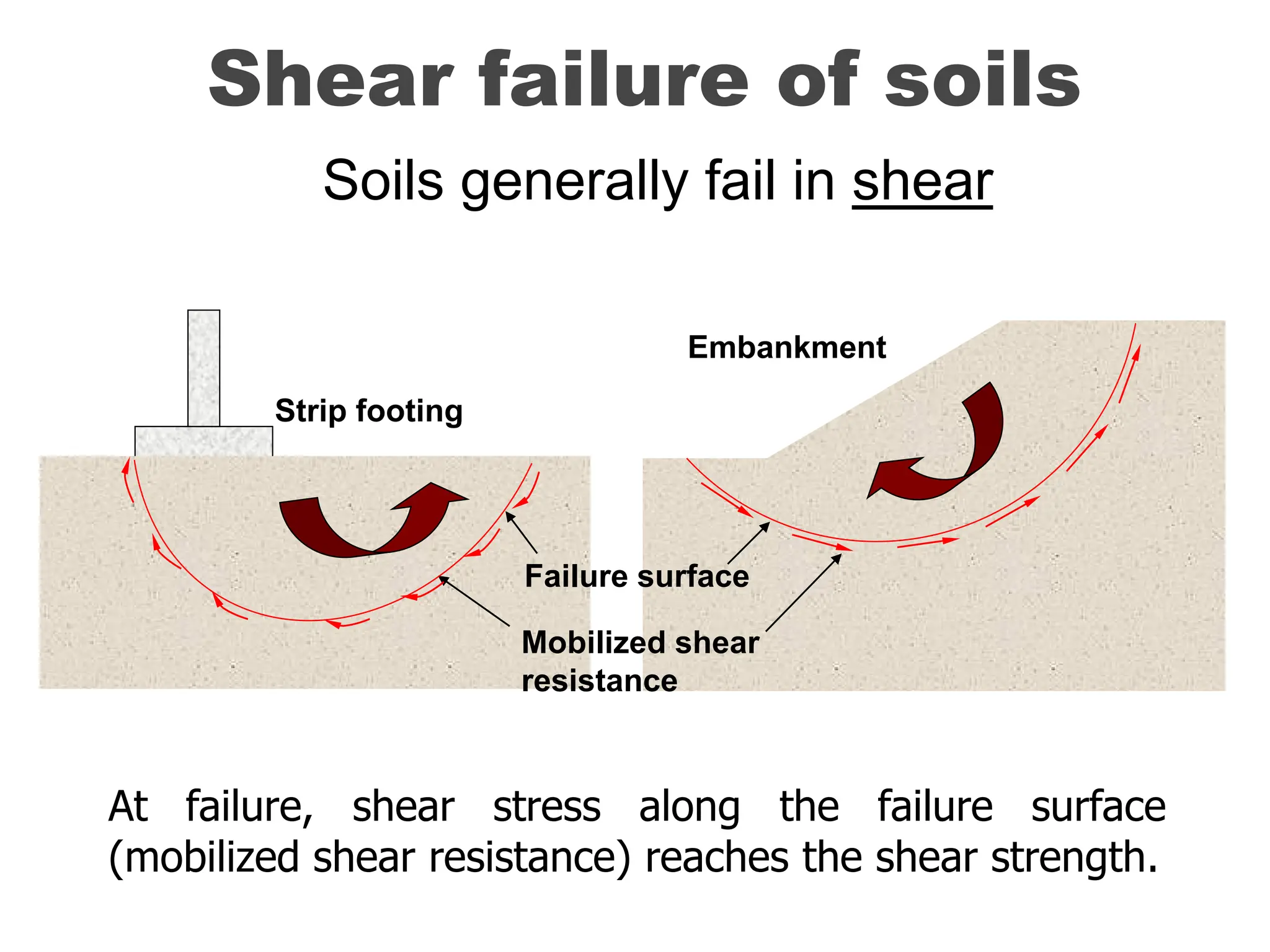
Embankment
Strip footing
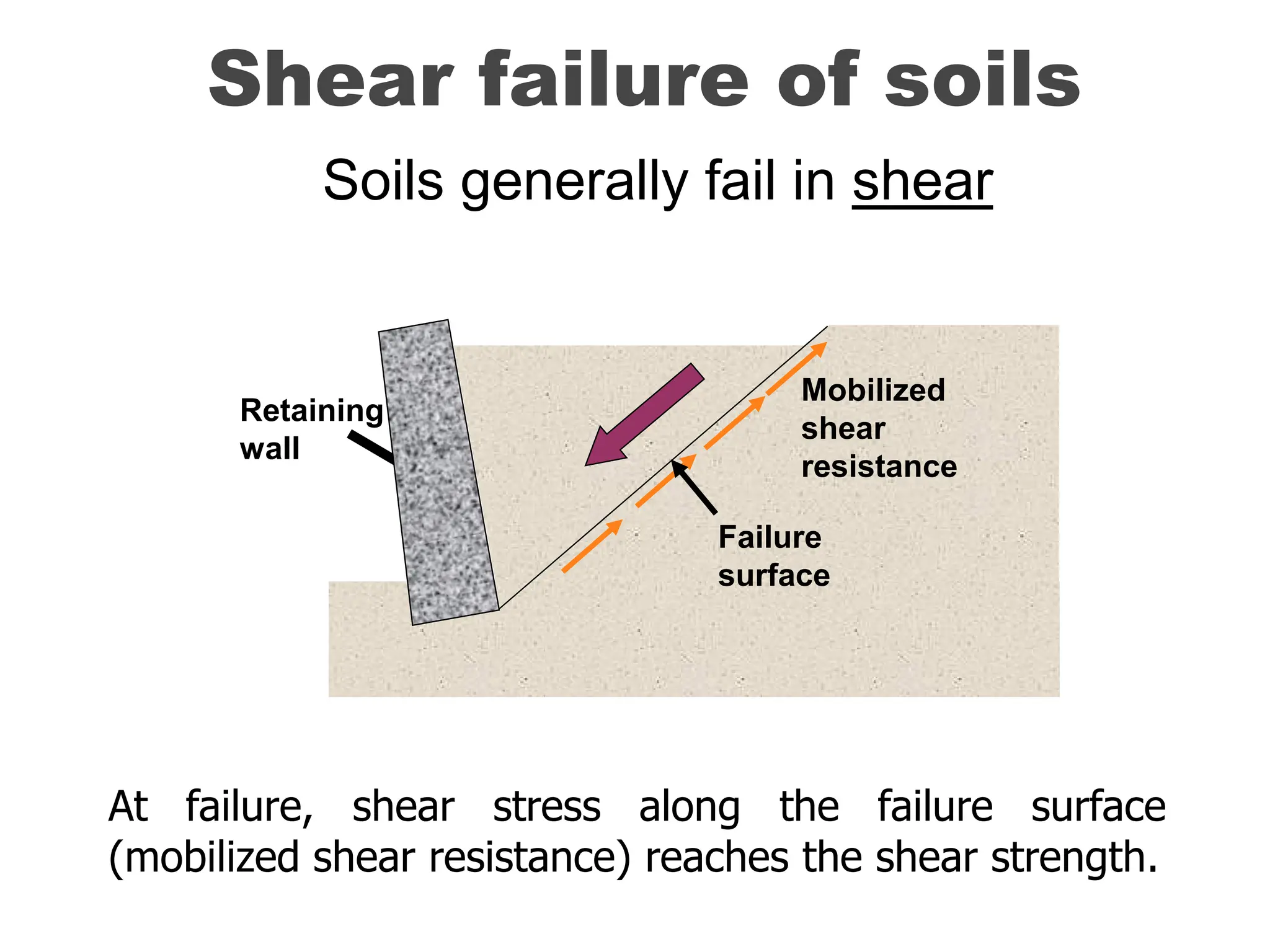
Shear failure of soils
Soils generally fail in shear
At failure, shear stress along the failure surface
(mobilized shear resistance) reaches the shear strength.
Failure surface
Mobilized shear
resistance
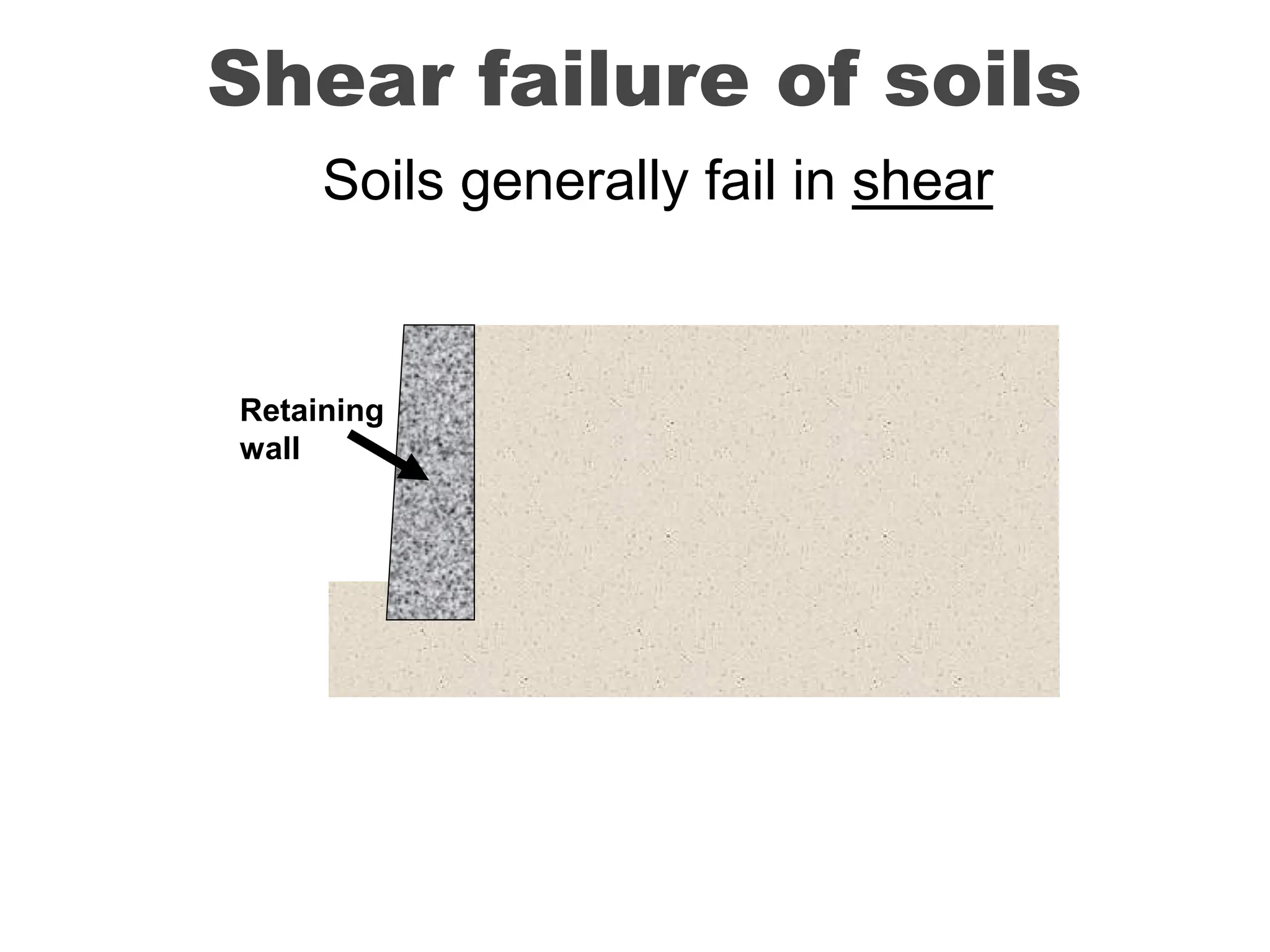
Retaining
wall
Shear failure of soils
Soils generally fail in shear
Retaining
wall
Shear failure of soils
At failure, shear stress along the failure surface
(mobilized shear resistance) reaches the shear strength.
Failure
surface
Mobilized
shear
resistance
Soils generally fail in shear
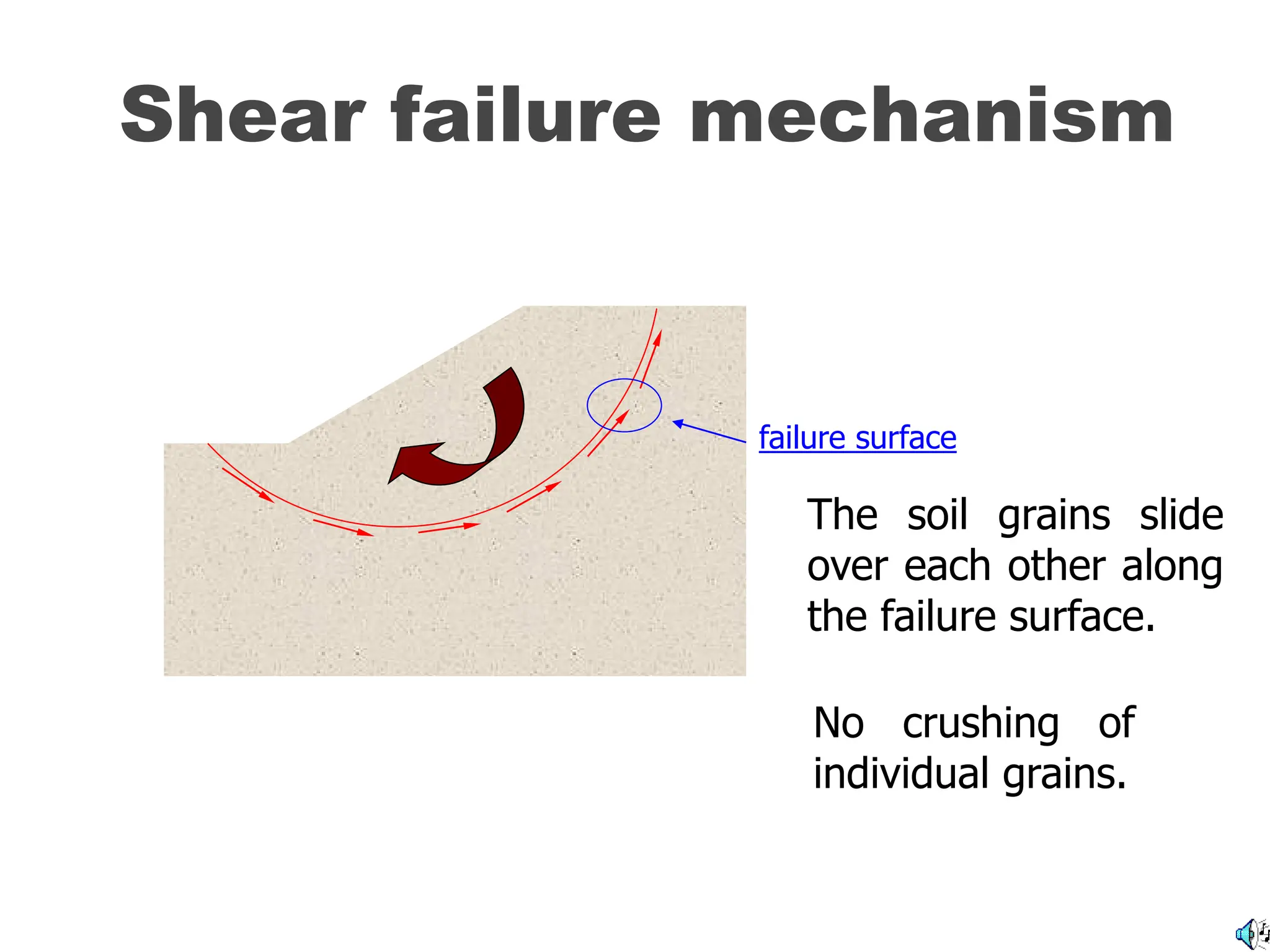
Shear failure mechanism
The soil grains slide
over each other along
the failure surface.
No crushing of
individual grains.
failure surface
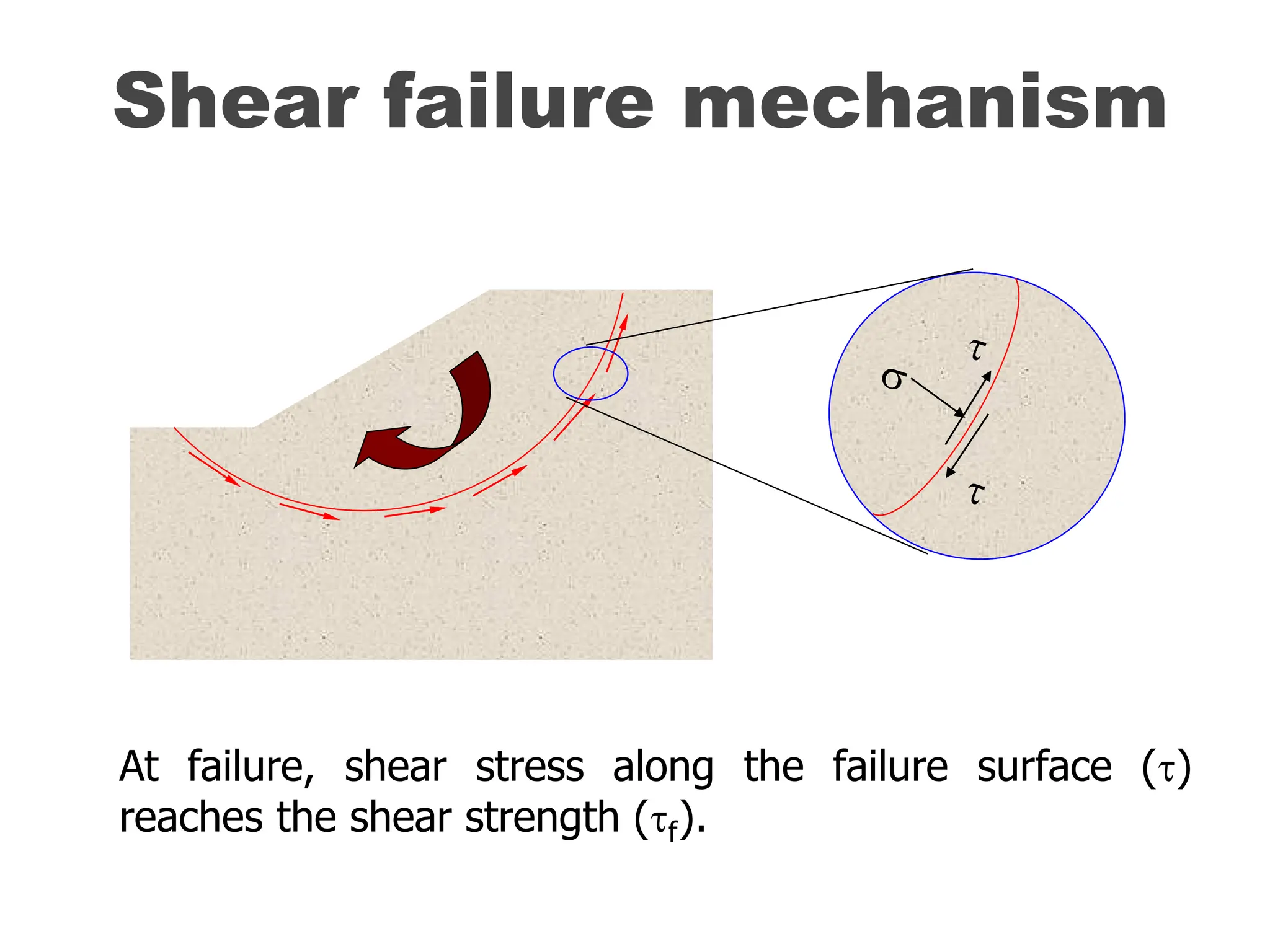
Shear failure mechanism
At failure, shear stress along the failure surface ()
reaches the shear strength (f).
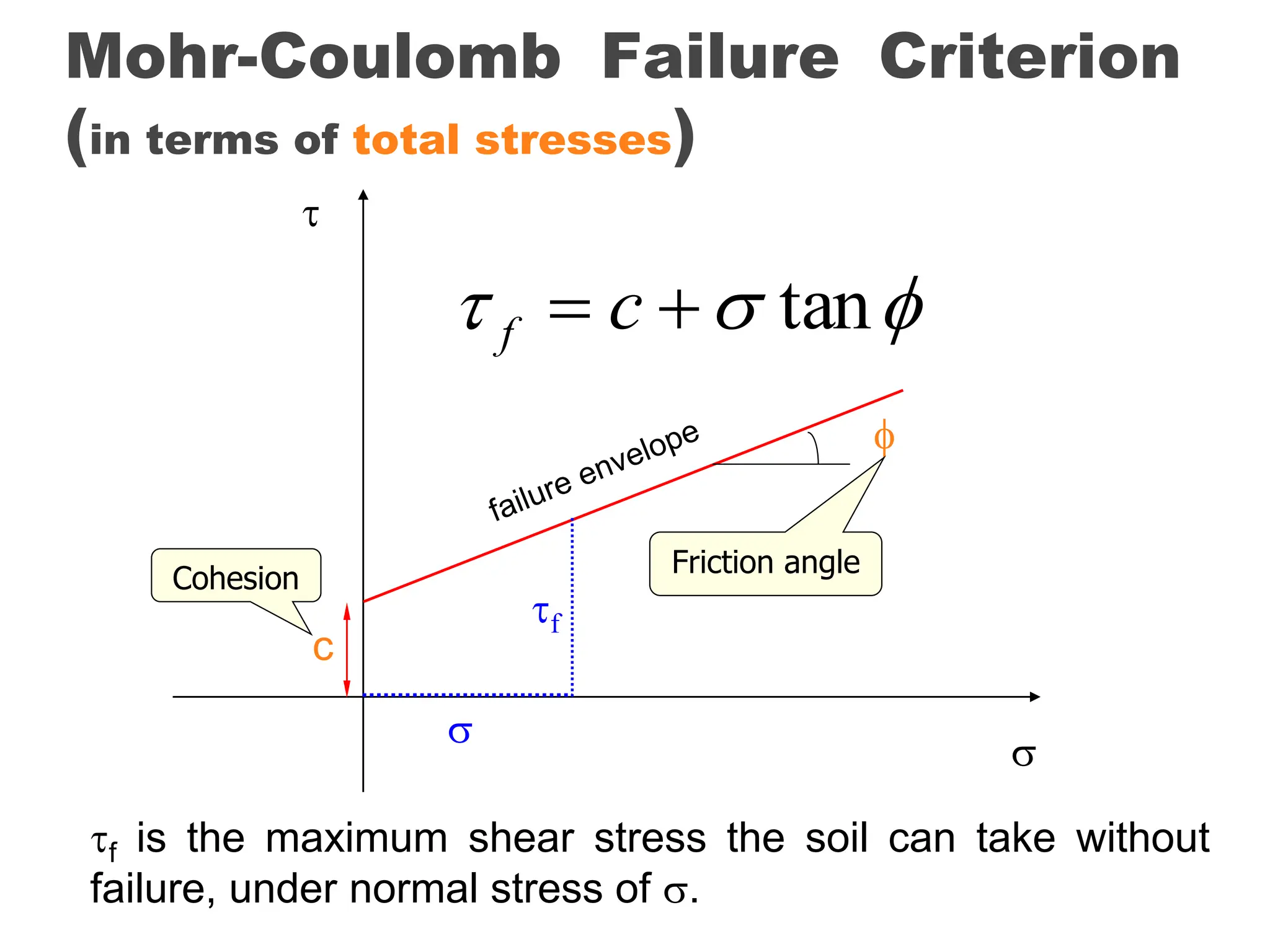
Mohr-Coulomb Failure Criterion
(in terms of total stresses)

f is the maximum shear stress the soil can take without
failure, under normal stress of .



 tan

 c
f
c

Cohesion
Friction angle
f

Mohr-Coulomb Failure Criterion
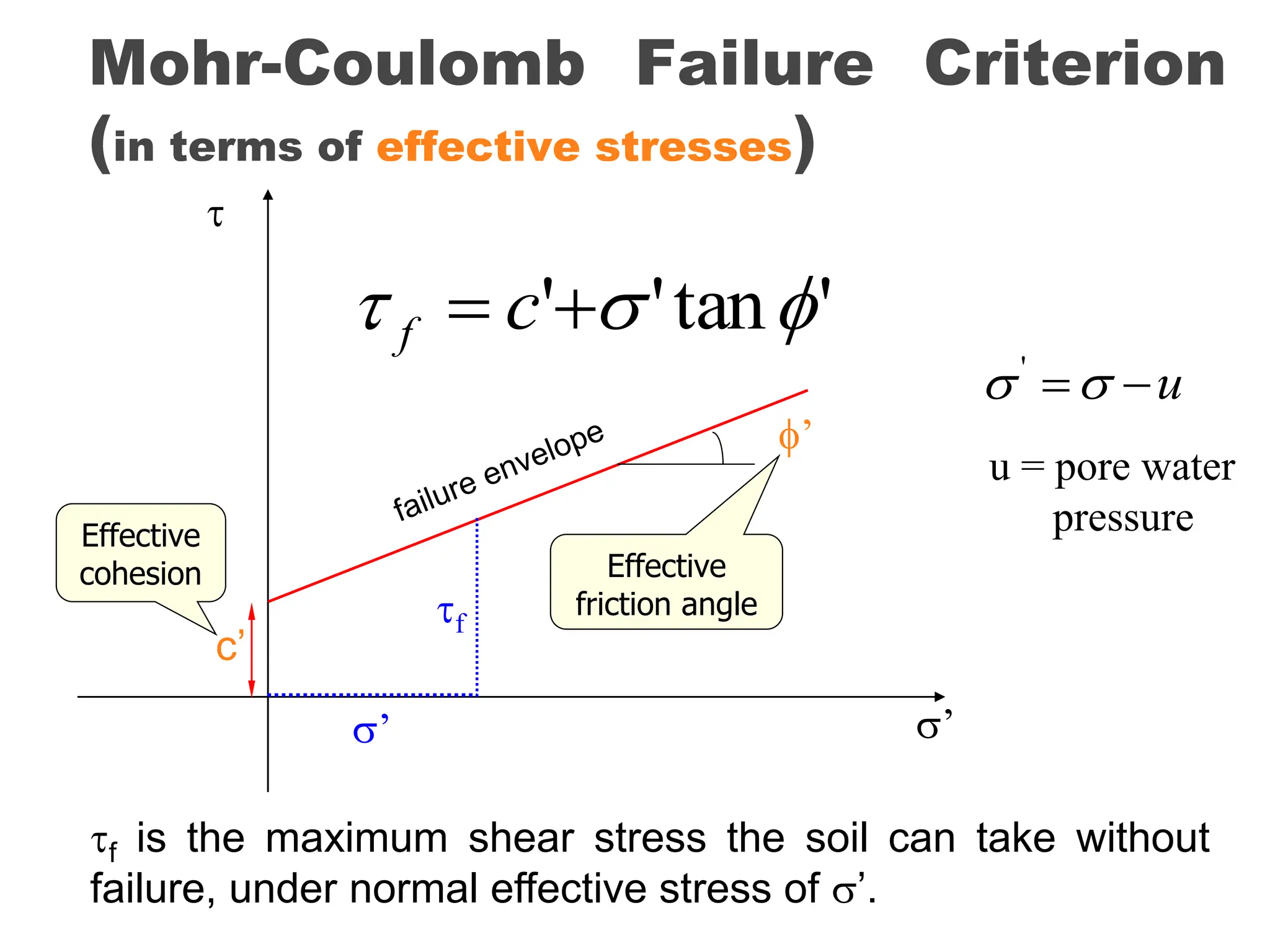
(in terms of effective stresses)
f is the maximum shear stress the soil can take without
failure, under normal effective stress of ’.

’
'
tan
'
' 

 
 c
f
c’
’
Effective
cohesion Effective
friction angle
f
’
u


'
u = pore water
pressure
Mohr-Coulomb Failure Criterion
'
tan
'
' 

 f
f c 

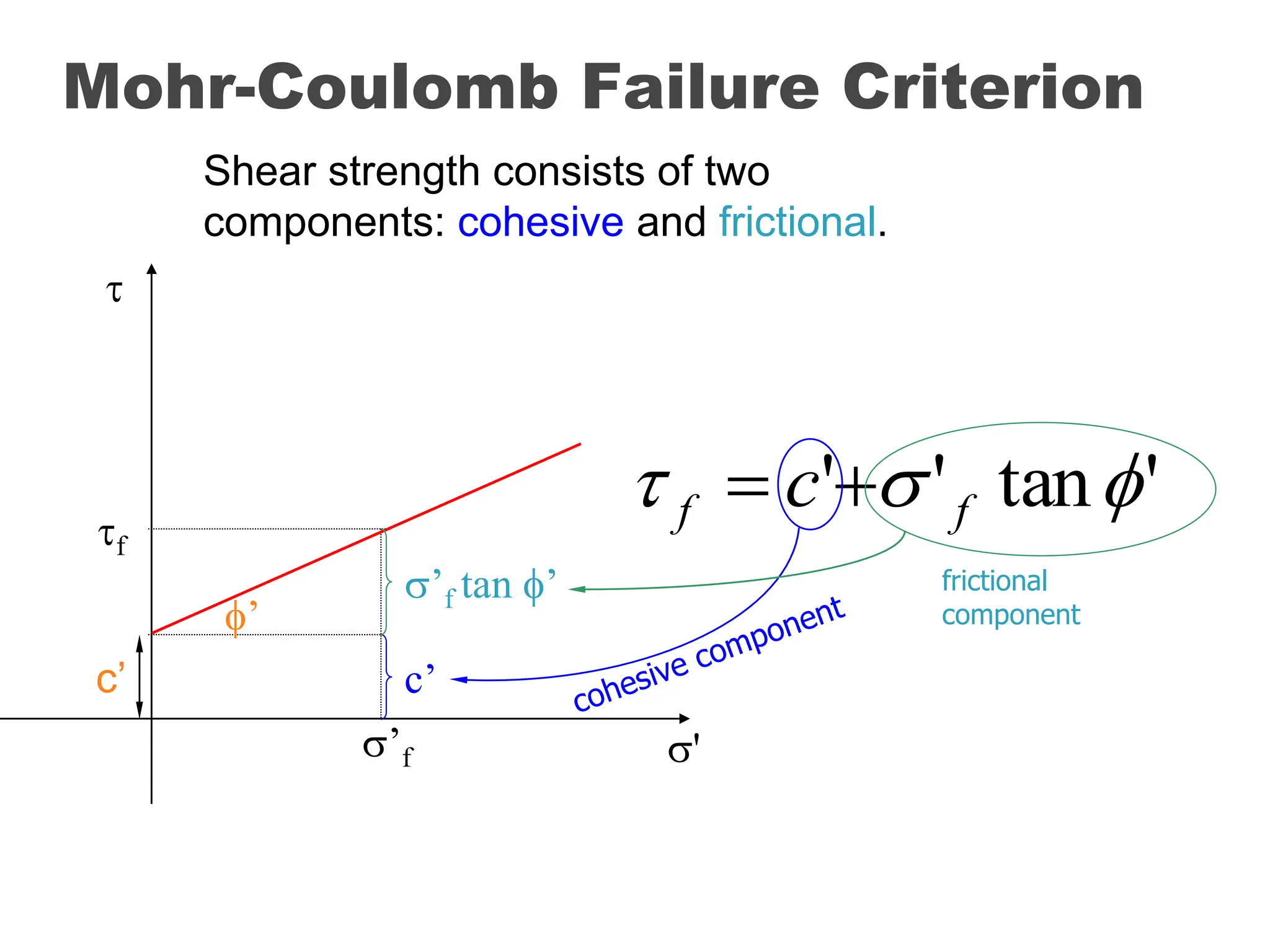
Shear strength consists of two
components: cohesive and frictional.
’f
f
’

'
c’ c’
’f tan ’ frictional
component
c and  are measures of shear strength.
Higher the values, higher the shear strength.
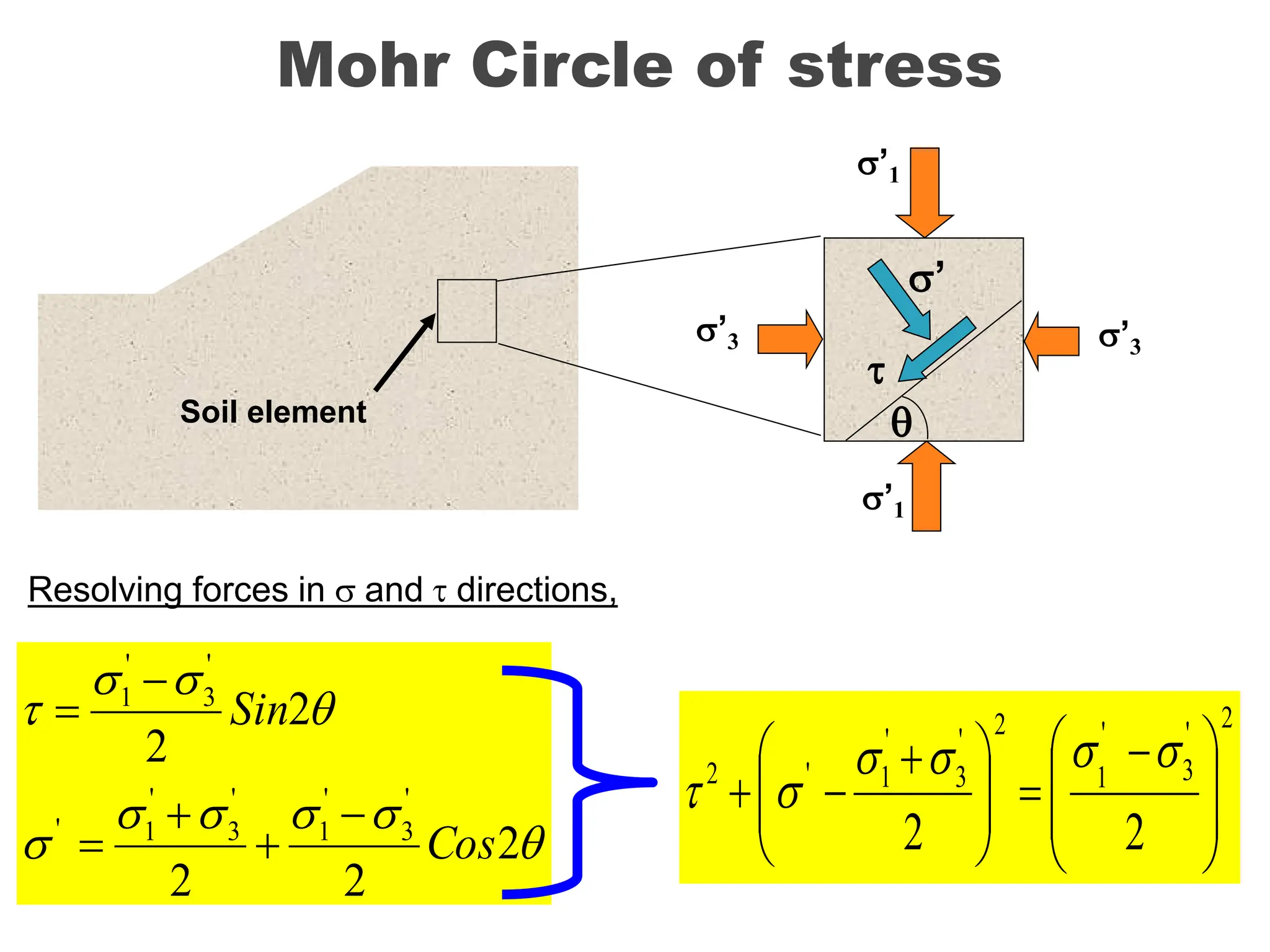
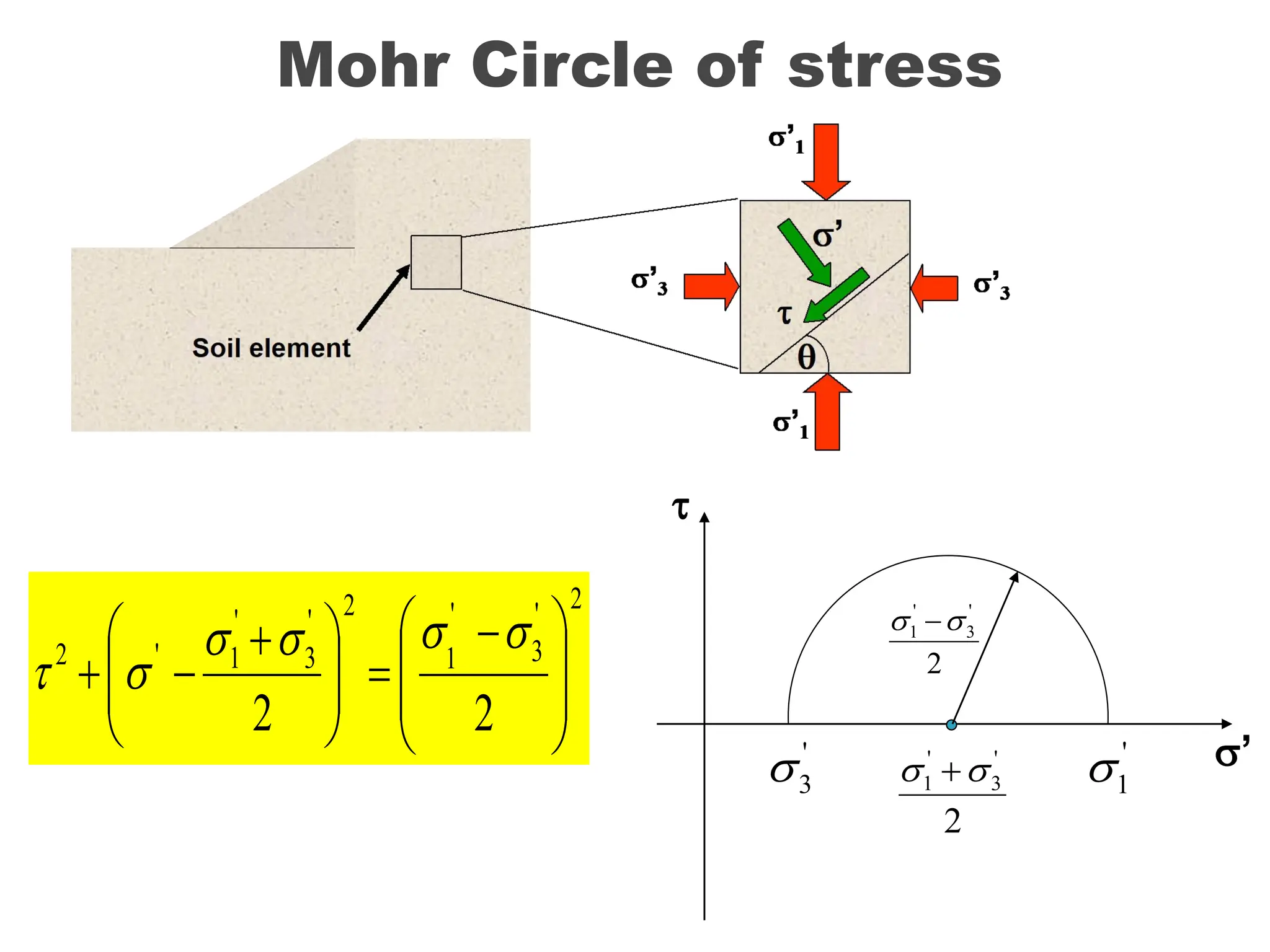
Mohr Circle of stress
Soil element
’1
’1
’3
’3
q
’

q





q



2
2
2
2
2
'
3
'
1
'
3
'
1
'
'
3
'
1
Cos
Sin






Resolving forces in  and  directions,
2
'
3
'
1
2
'
3
'
1
'
2
2
2 






 








 








Mohr Circle of stress
2
'
3
'
1
2
'
3
'
1
'
2
2
2 






 








 









’
2
'
3
'
1 
 
2
'
3
'
1 
 
'
3
 '
1

Mohr Circle of stress
2
'
3
'
1
2
'
3
'
1
'
2
2
2 






 








 









’
2
'
3
'
1 
 
2
'
3
'
1 
 
'
3
 '
1

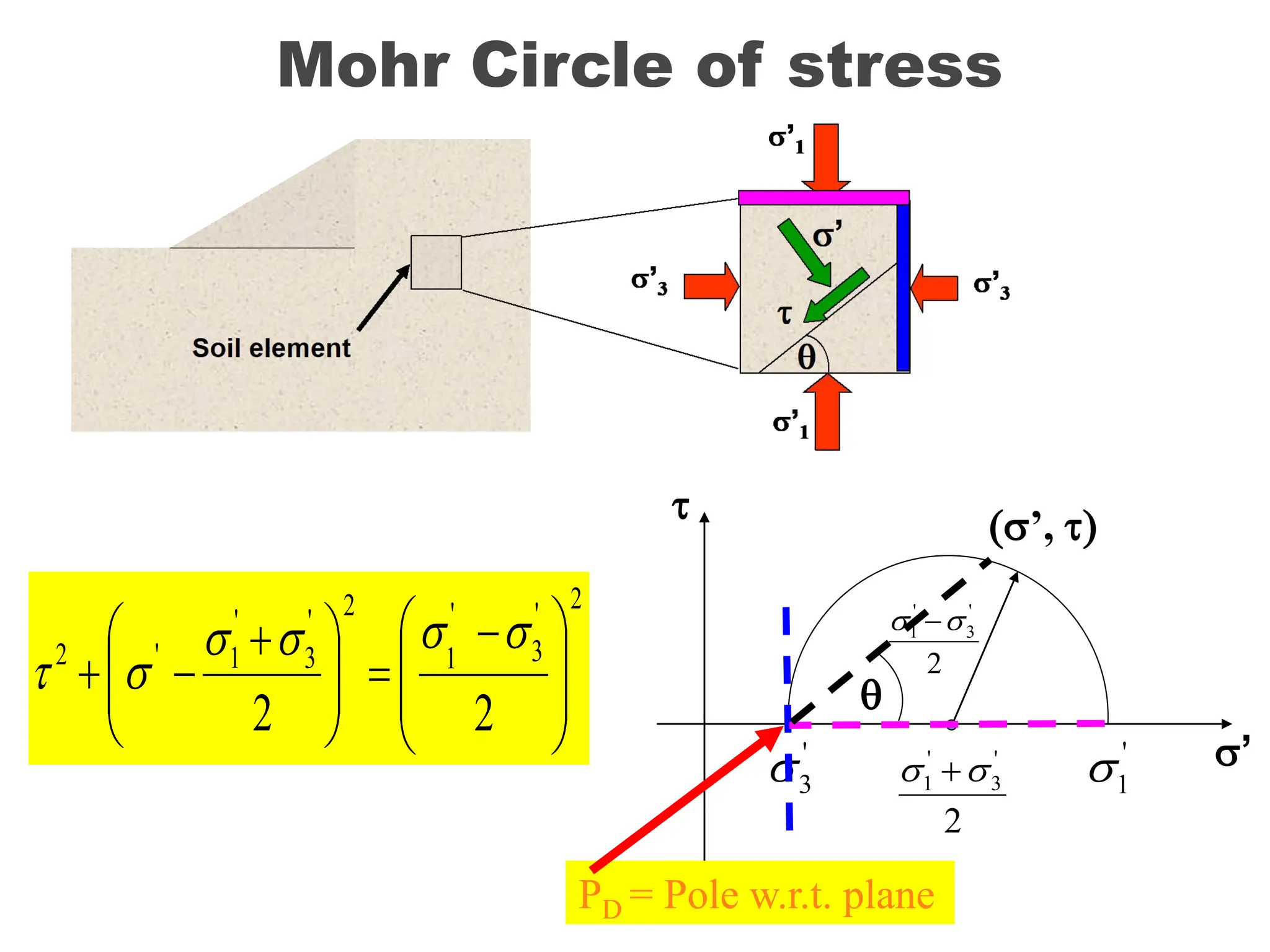
PD = Pole w.r.t. plane
q
(’, )
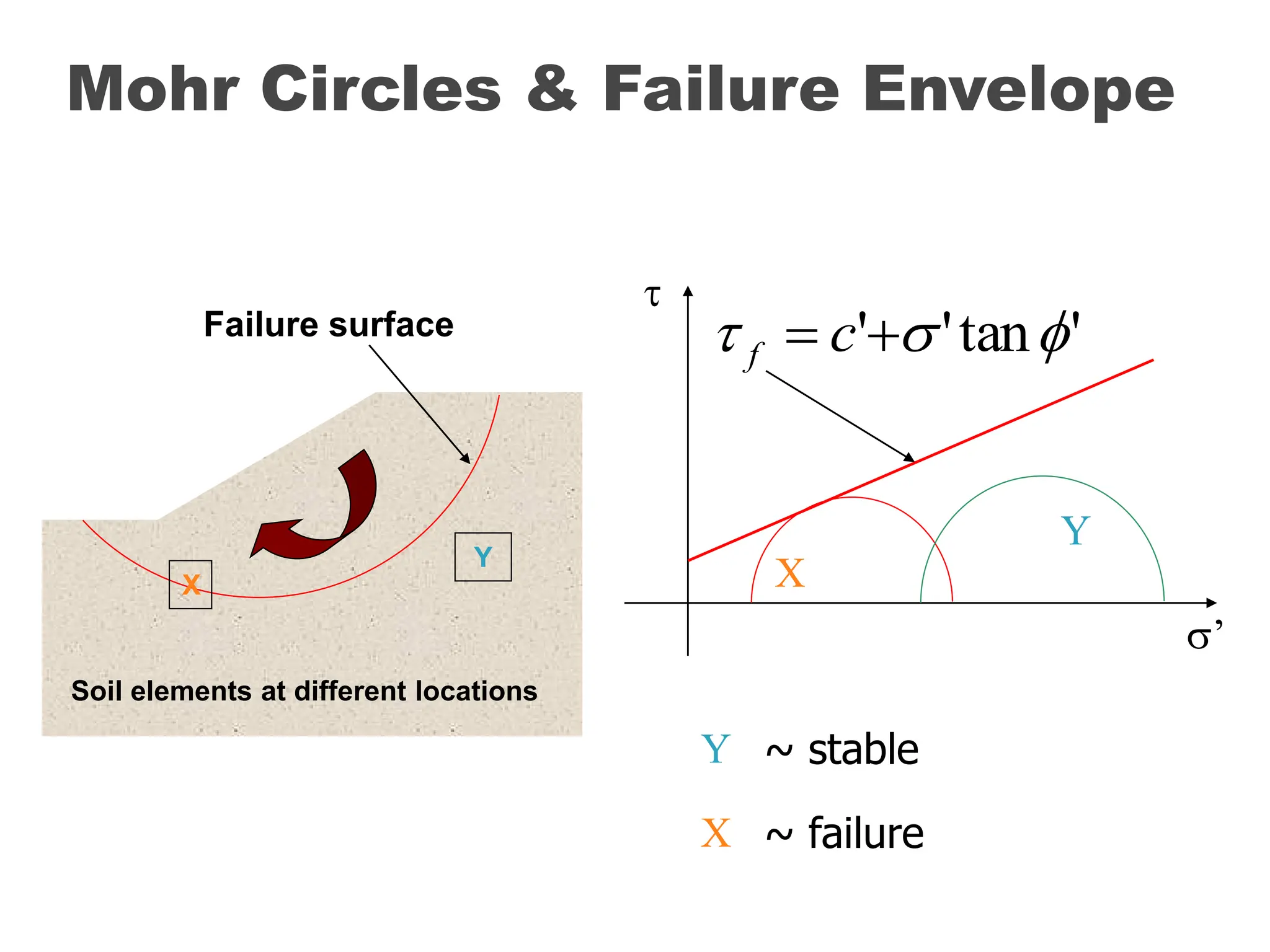
Soil elements at different locations
Failure surface
Mohr Circles & Failure Envelope
X X
X ~ failure
Y
Y
Y ~ stable

’
'
tan
'
' 

 
 c
f
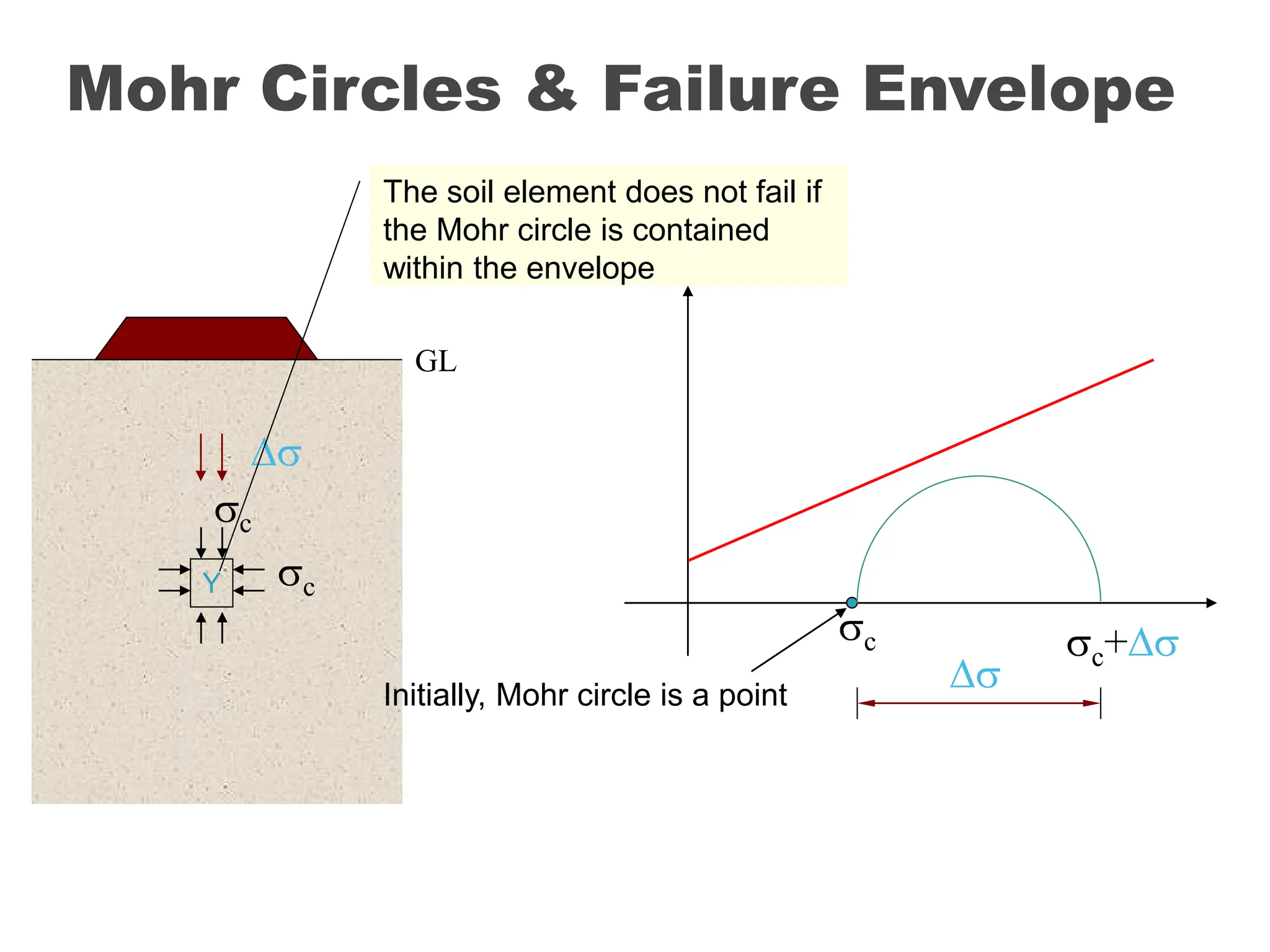
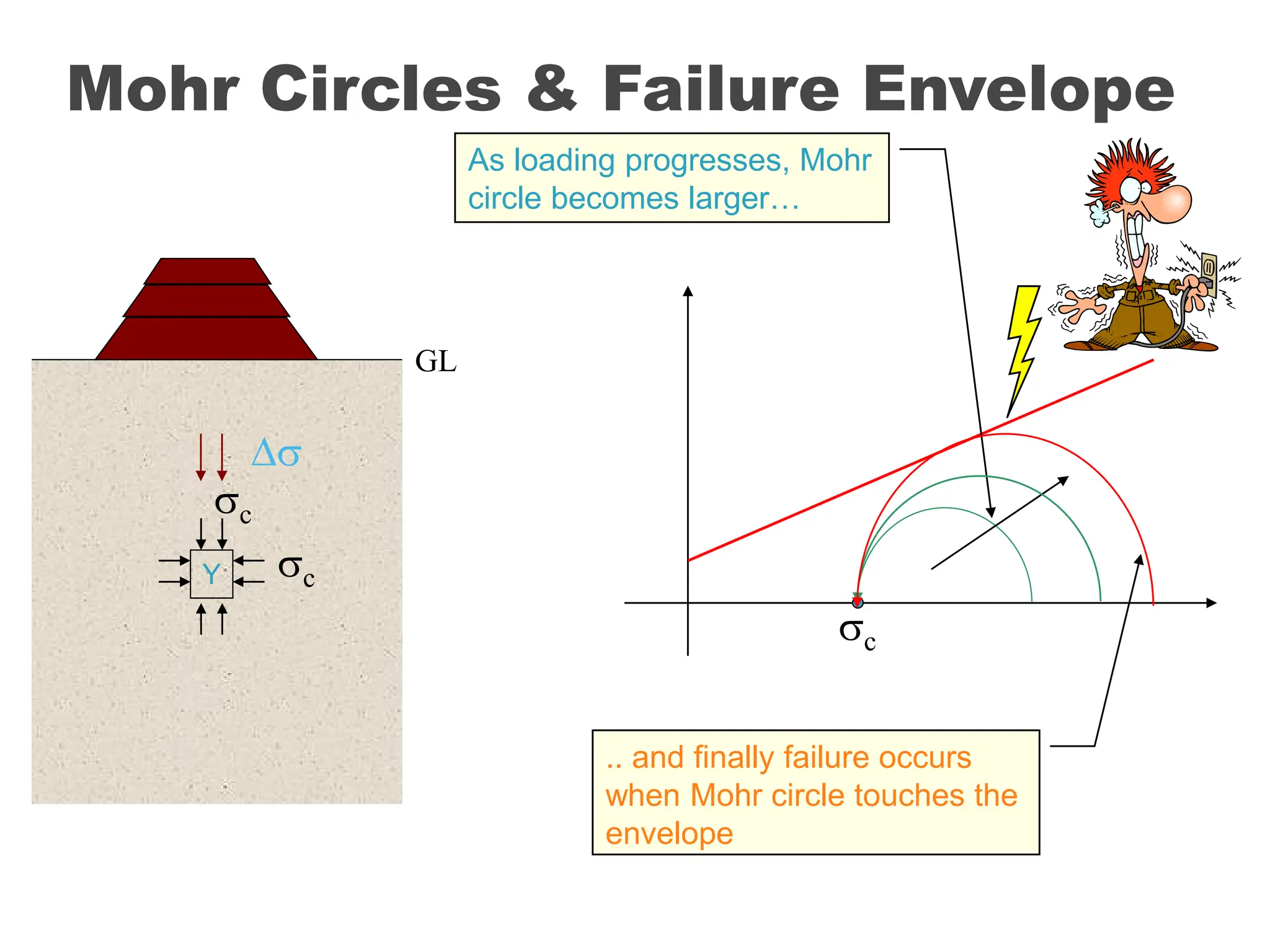
Mohr Circles & Failure Envelope
Y
c
c
c
Initially, Mohr circle is a point

c+

The soil element does not fail if
the Mohr circle is contained
within the envelope
GL
Mohr Circles & Failure Envelope
Y
c
c
c
GL
As loading progresses, Mohr
circle becomes larger…
.. and finally failure occurs
when Mohr circle touches the
envelope

’
2
'
3
'
1 
 
'
3
 '
1

PD = Pole w.r.t. plane
q
(’, f)
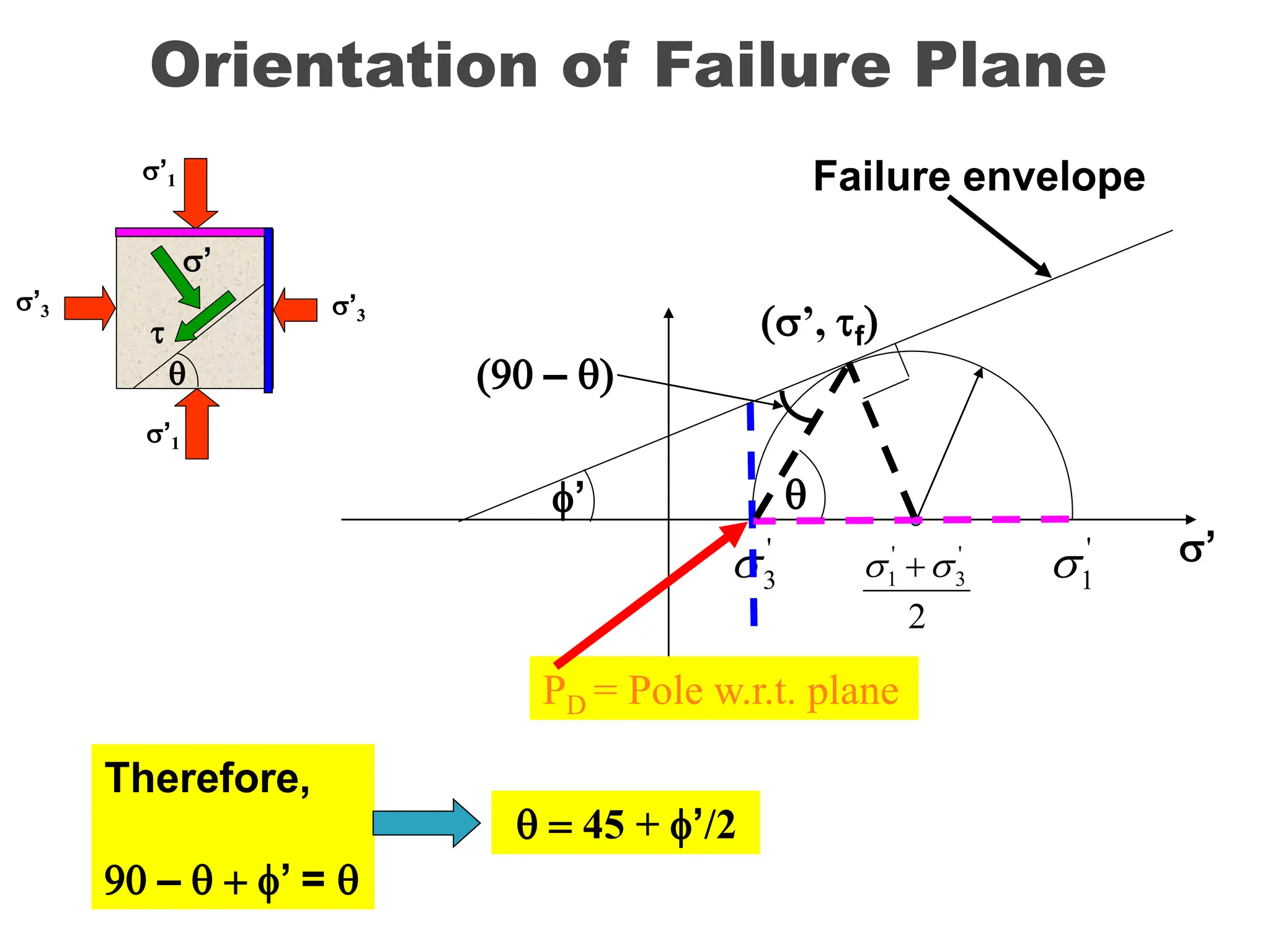
Orientation of Failure Plane
’
’1
’1
’3
’3
q
’

’1
’1
’3
’3
q
q
’

Failure envelope
(90 – q)
Therefore,
90 – q  ’ = q
q  45 + ’/2
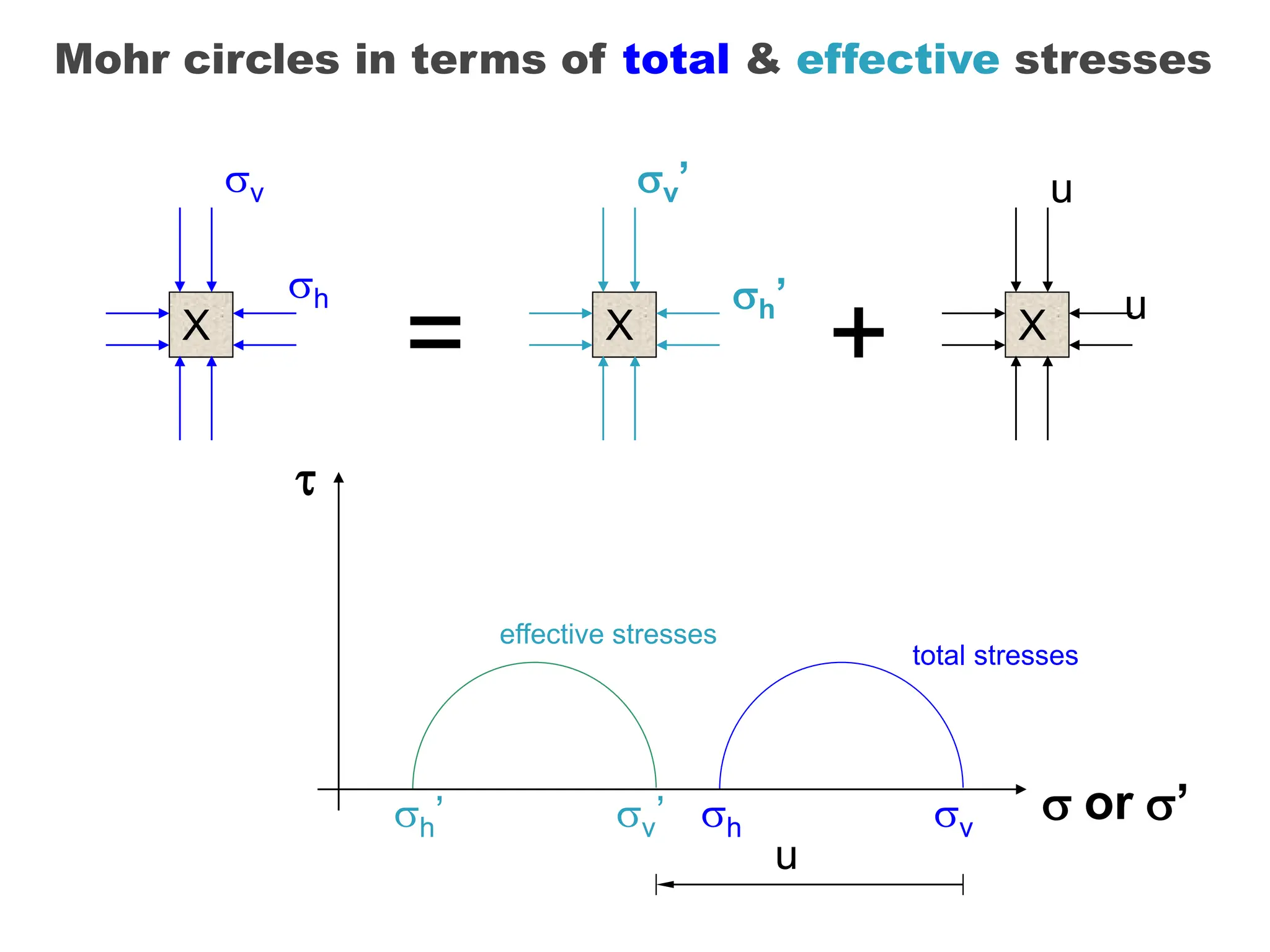
Mohr circles in terms of total & effective stresses
= X
v’
h’
X
u
u
+
v’
h’
effective stresses
u
v
h
X
v
h
total stresses

 or ’
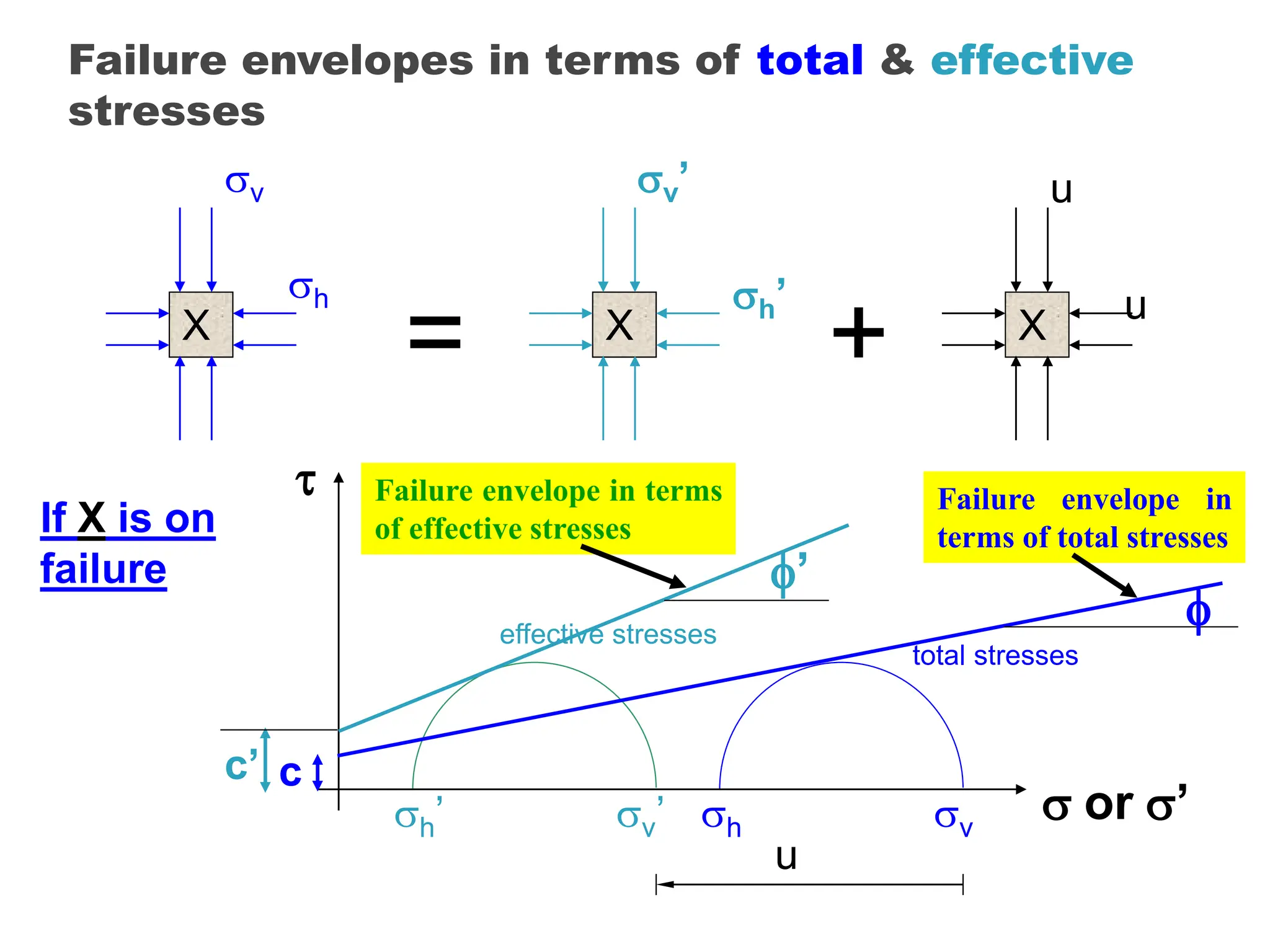
Failure envelopes in terms of total & effective
stresses
= X
v’
h’
X
u
u
+
v’
h’
effective stresses
u
v
h
X
v
h
total stresses

 or ’
If X is on
failure
c

Failure envelope in
terms of total stresses
’
c’
Failure envelope in terms
of effective stresses
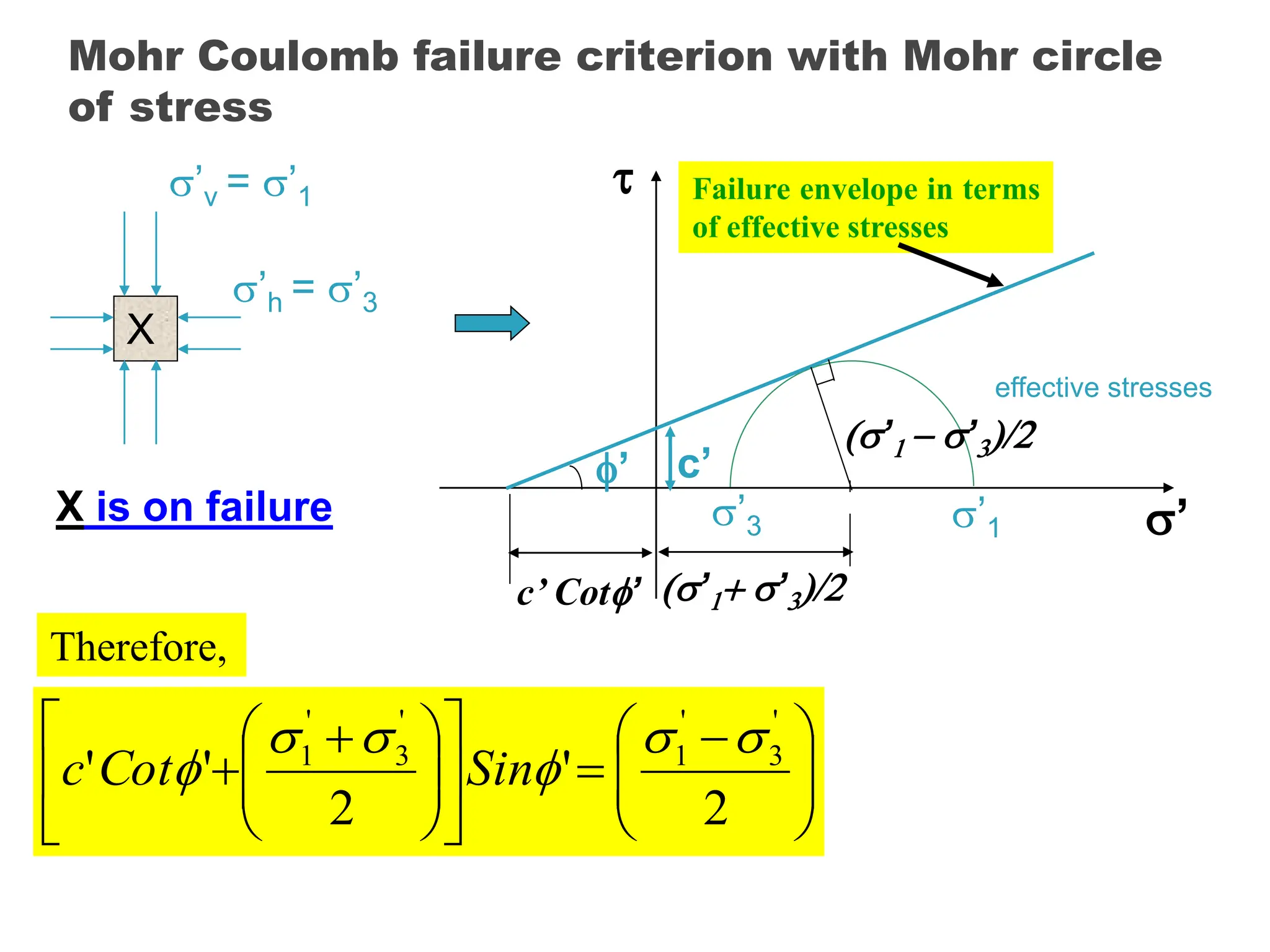
Mohr Coulomb failure criterion with Mohr circle
of stress
X
’v = ’1
’h = ’3
X is on failure ’1
’3
effective stresses

’
’ c’
Failure envelope in terms
of effective stresses
c’ Cot’ (’1 ’3)/2
(’1  ’3)/2







 














 

2
'
2
'
'
'
3
'
1
'
3
'
1 




 Sin
Cot
c
Therefore,
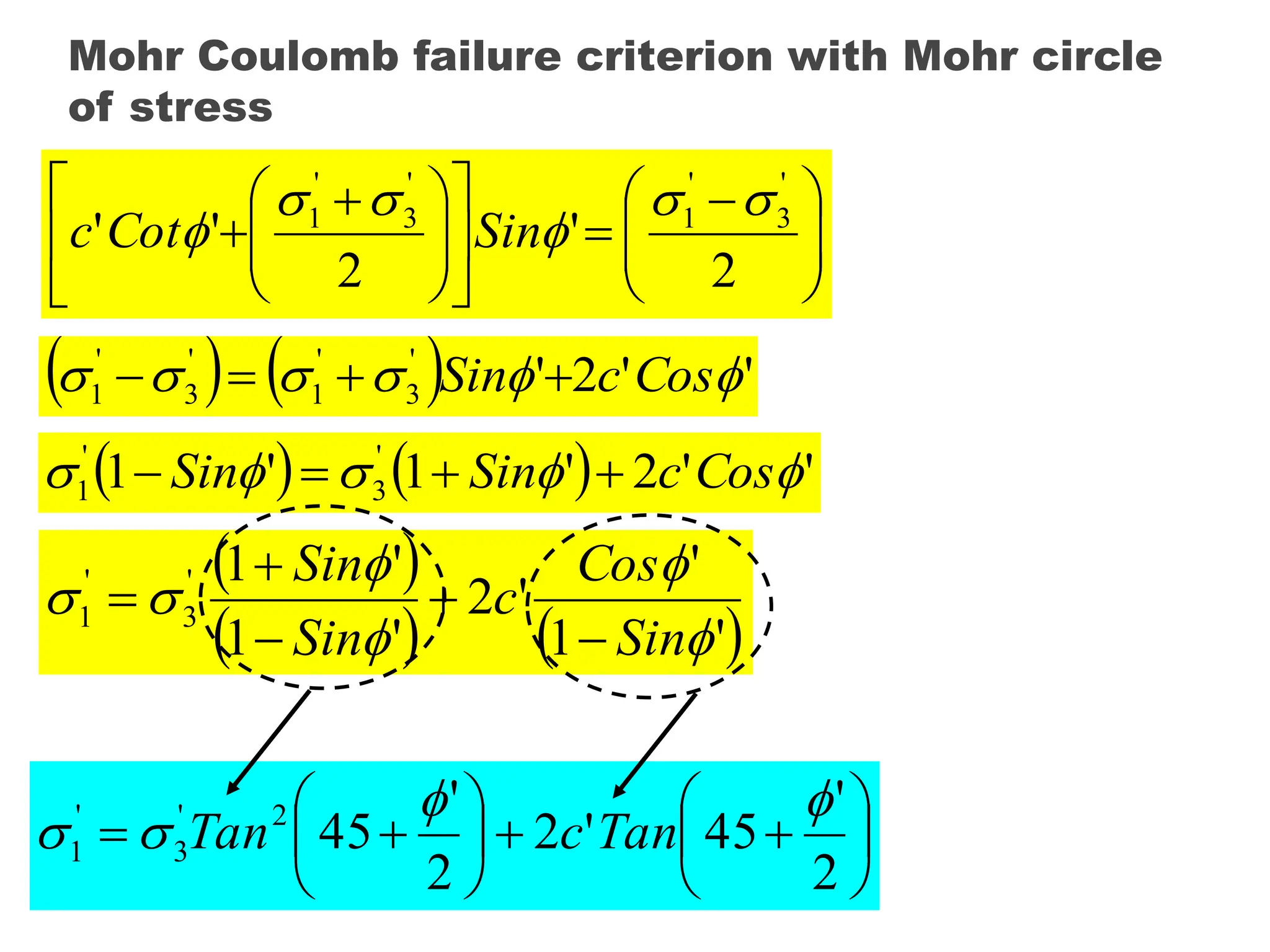
Mohr Coulomb failure criterion with Mohr circle
of stress







 














 

2
'
2
'
'
'
3
'
1
'
3
'
1 




 Sin
Cot
c
( ) ( ) '
'
2
'
'
3
'
1
'
3
'
1 




 Cos
c
Sin 



( ) ( ) '
'
2
'
1
'
1 '
3
'
1 



 Cos
c
Sin
Sin 



( )
( ) ( )
'
1
'
'
2
'
1
'
1
'
3
'
1






Sin
Cos
c
Sin
Sin





















2
'
45
'
2
2
'
45
2
'
3
'
1



 Tan
c
Tan
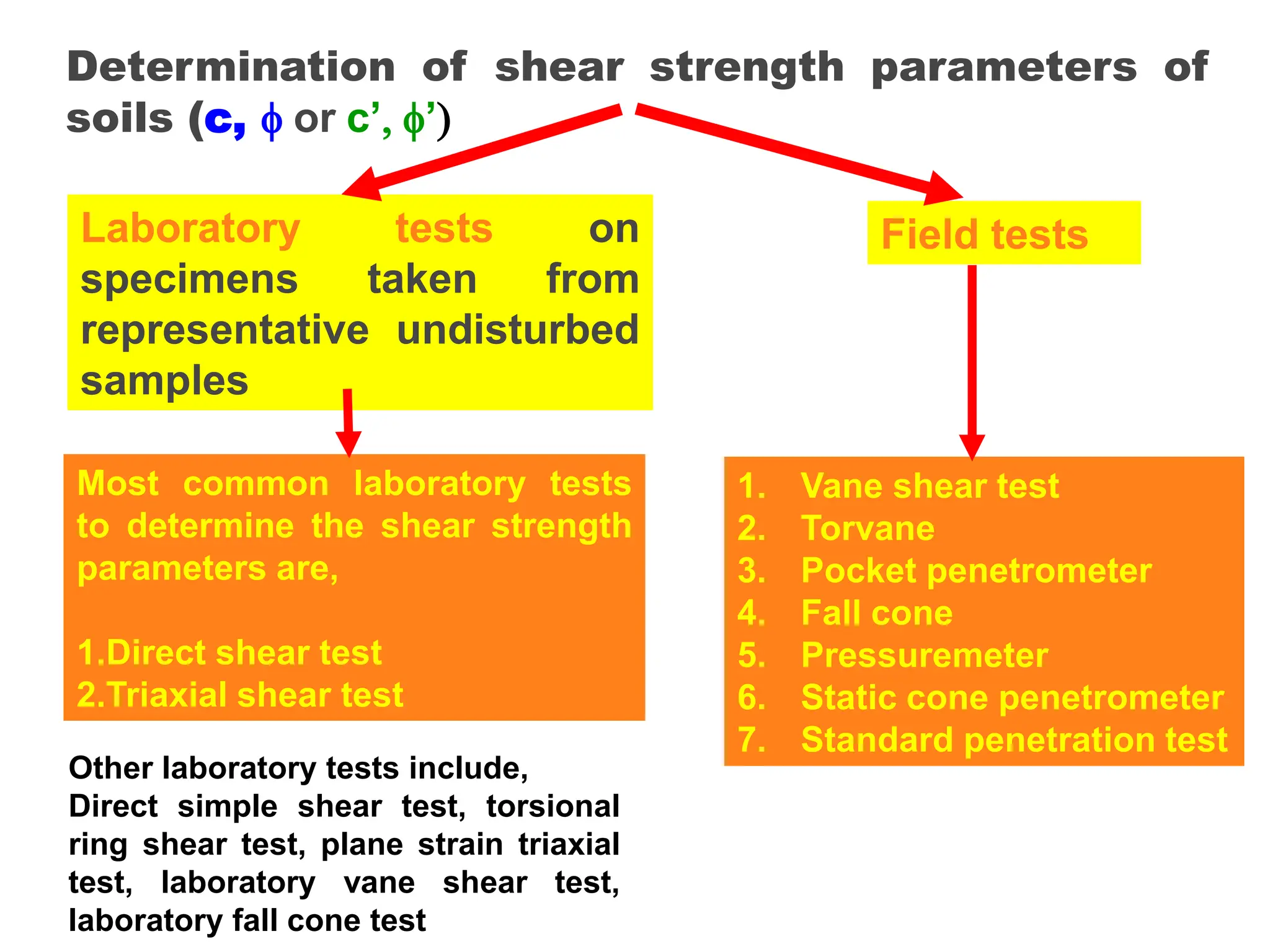
Other laboratory tests include,
Direct simple shear test, torsional
ring shear test, plane strain triaxial
test, laboratory vane shear test,
laboratory fall cone test
Determination of shear strength parameters of
soils (c,  or c’, ’)
Laboratory tests on
specimens taken from
representative undisturbed
samples
Field tests
Most common laboratory tests
to determine the shear strength
parameters are,
1.Direct shear test
2.Triaxial shear test
1. Vane shear test
2. Torvane
3. Pocket penetrometer
4. Fall cone
5. Pressuremeter
6. Static cone penetrometer
7. Standard penetration test
Laboratory tests
How to take undisturbed samples
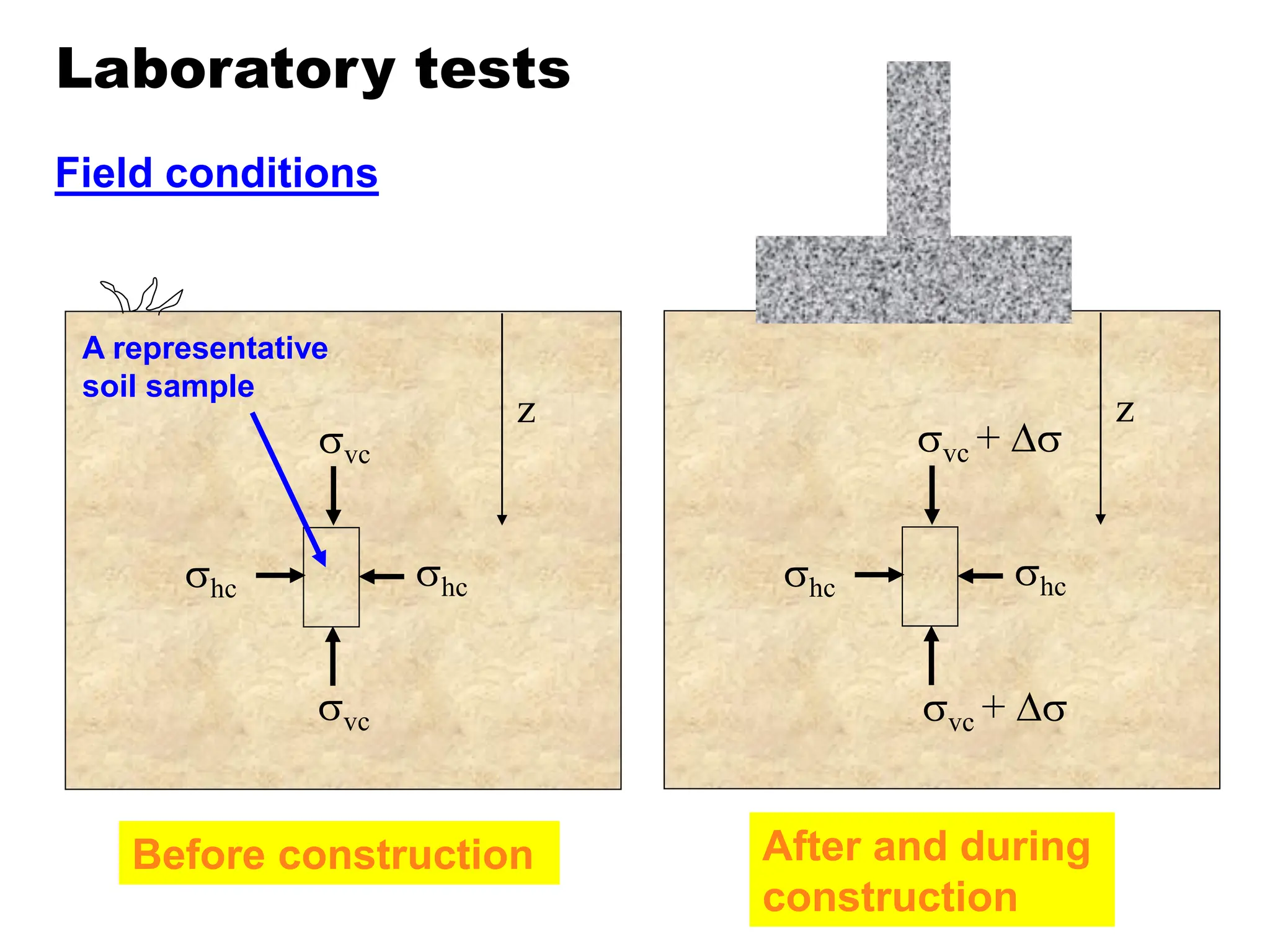
Laboratory tests
Field conditions
z
vc
vc
hc
hc
Before construction
A representative
soil sample
z
vc + 
hc
hc
After and during
construction
vc + 
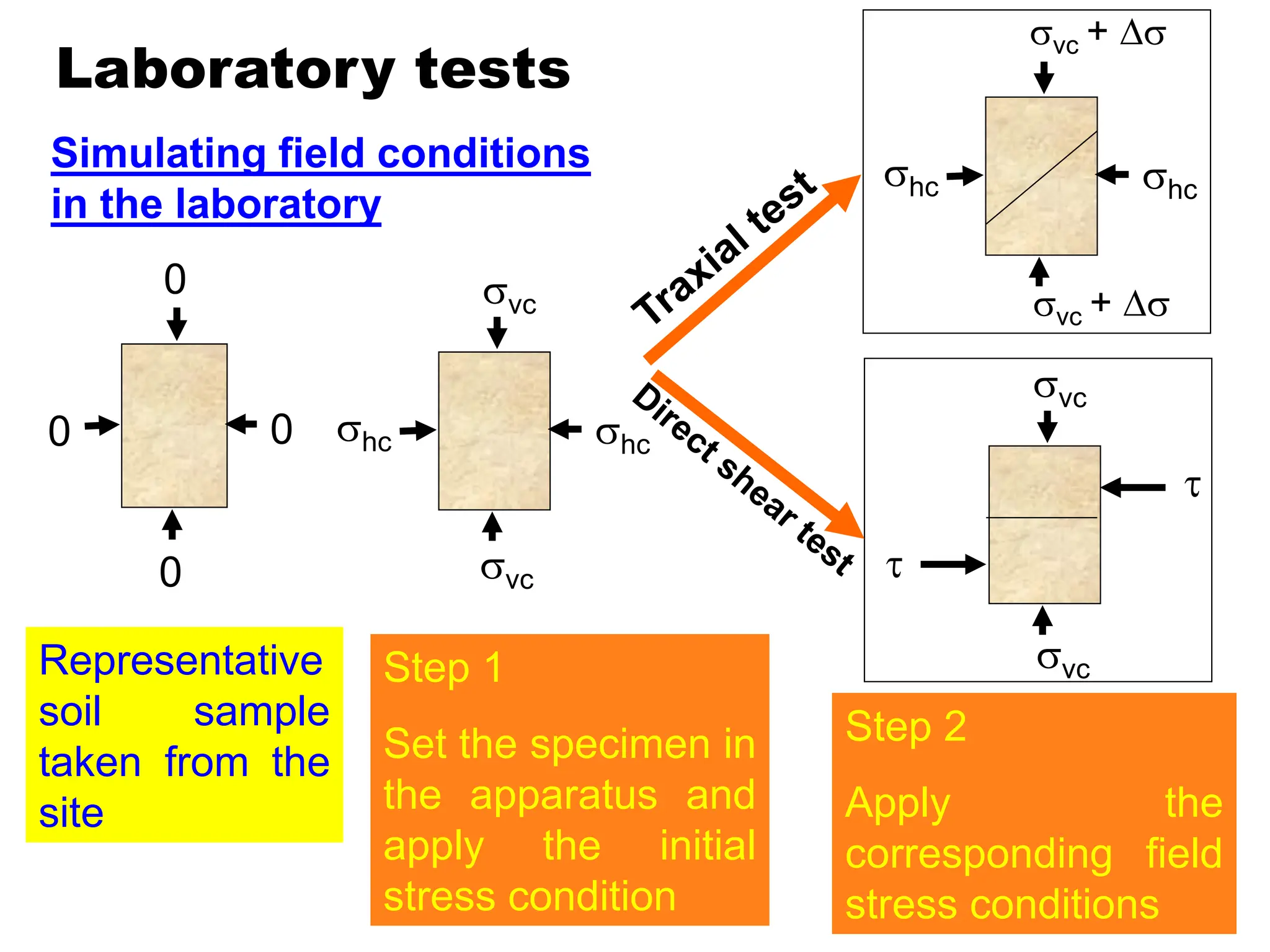
Laboratory tests
Simulating field conditions
in the laboratory
Step 1
Set the specimen in
the apparatus and
apply the initial
stress condition
vc
vc
hc
hc
Representative
soil sample
taken from the
site
0
0
0
0
Step 2
Apply the
corresponding field
stress conditions
vc + 
hc
hc
vc + 
vc
vc


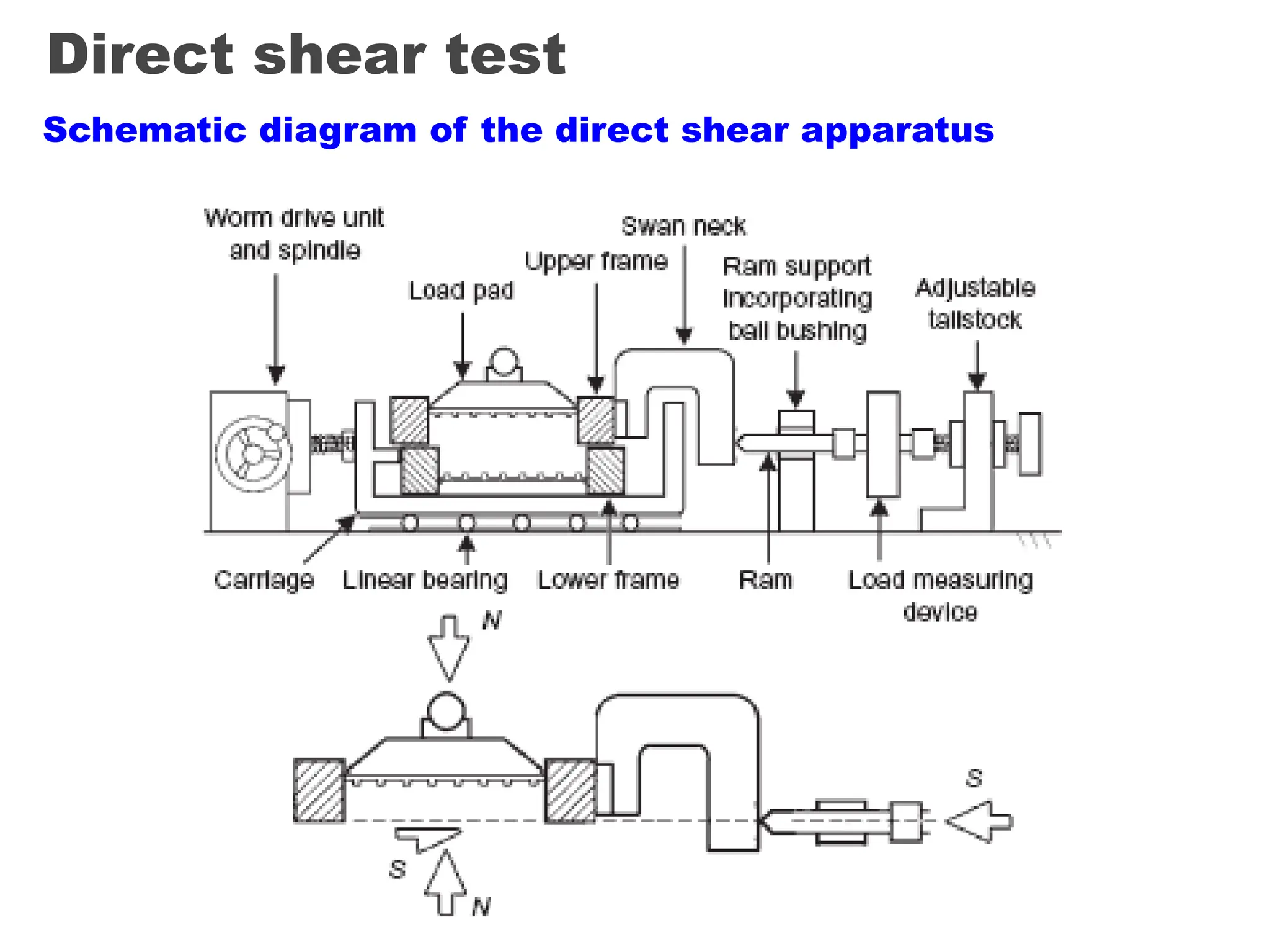
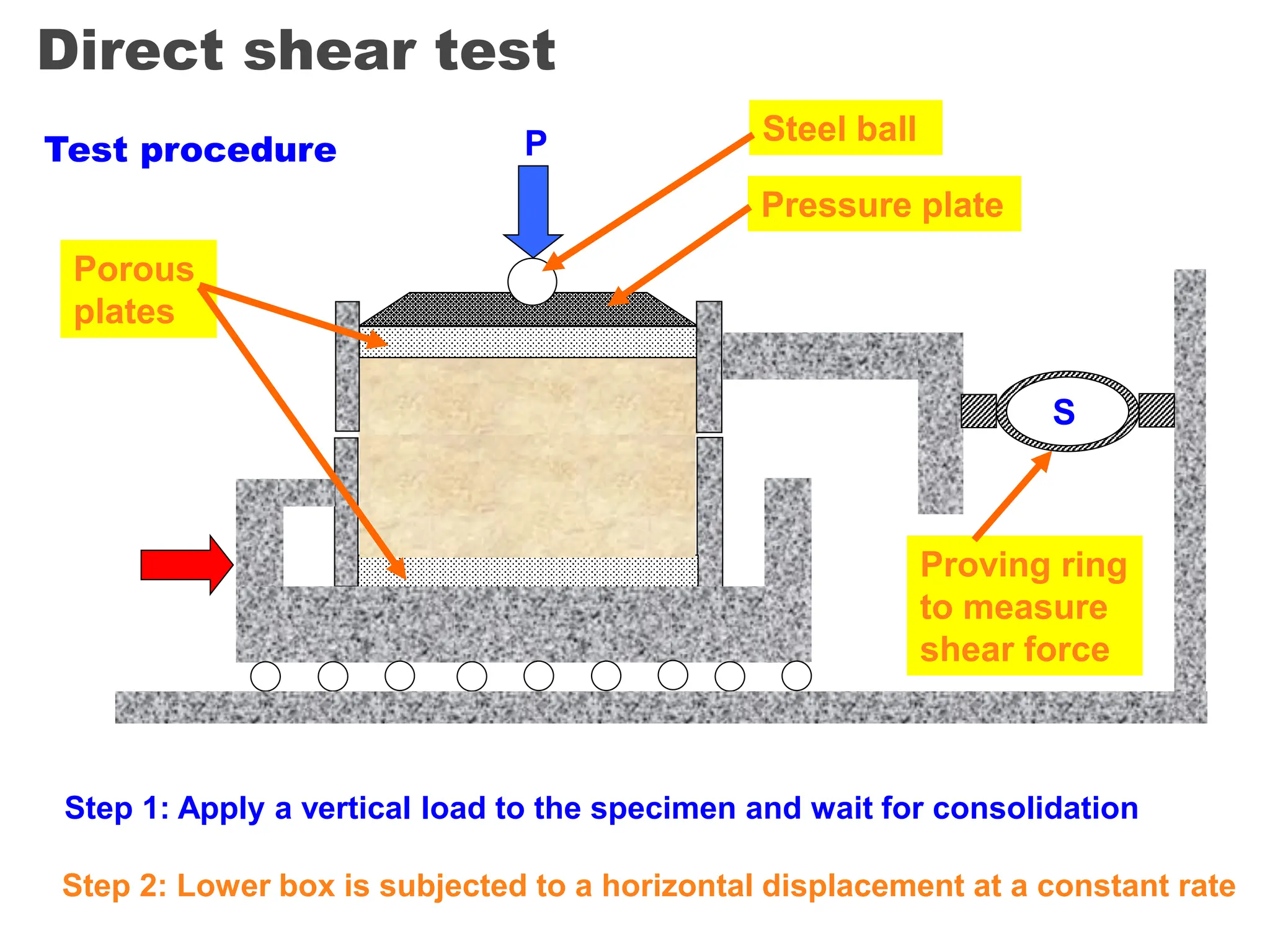
Direct shear test
Schematic diagram of the direct shear apparatus
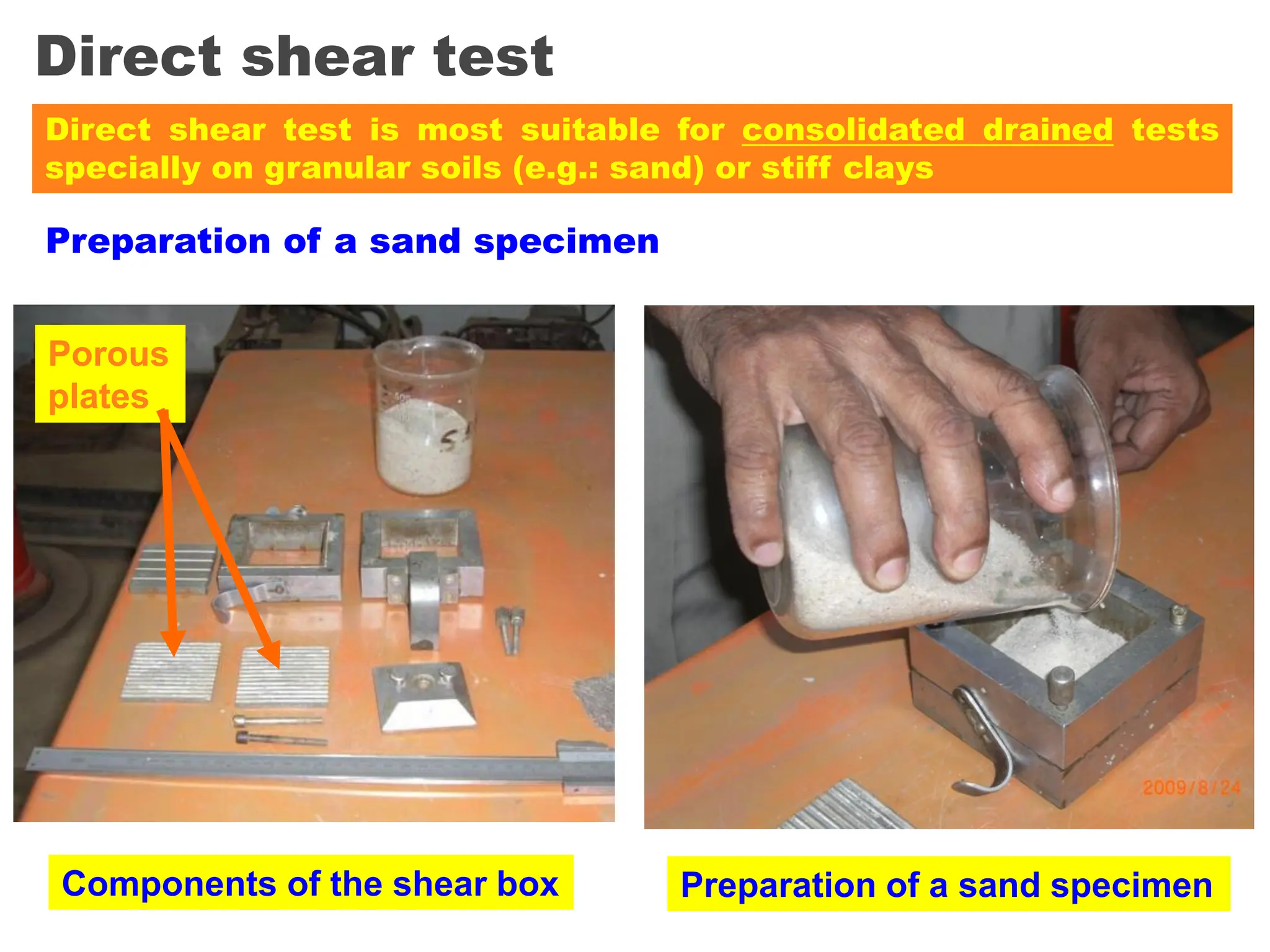
Direct shear test
Preparation of a sand specimen
Components of the shear box Preparation of a sand specimen
Porous
plates
Direct shear test is most suitable for consolidated drained tests
specially on granular soils (e.g.: sand) or stiff clays
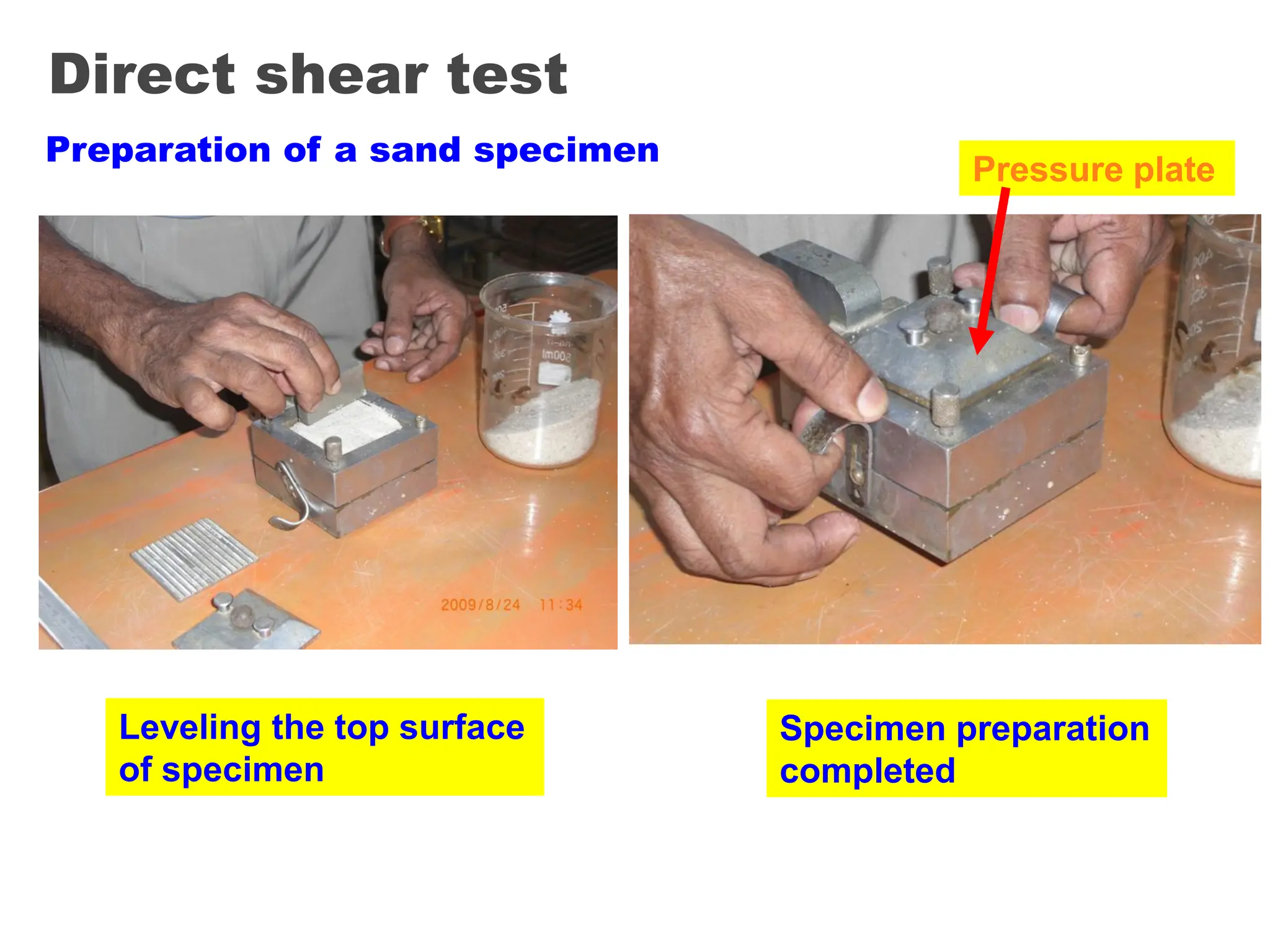
Direct shear test
Leveling the top surface
of specimen
Preparation of a sand specimen
Specimen preparation
completed
Pressure plate
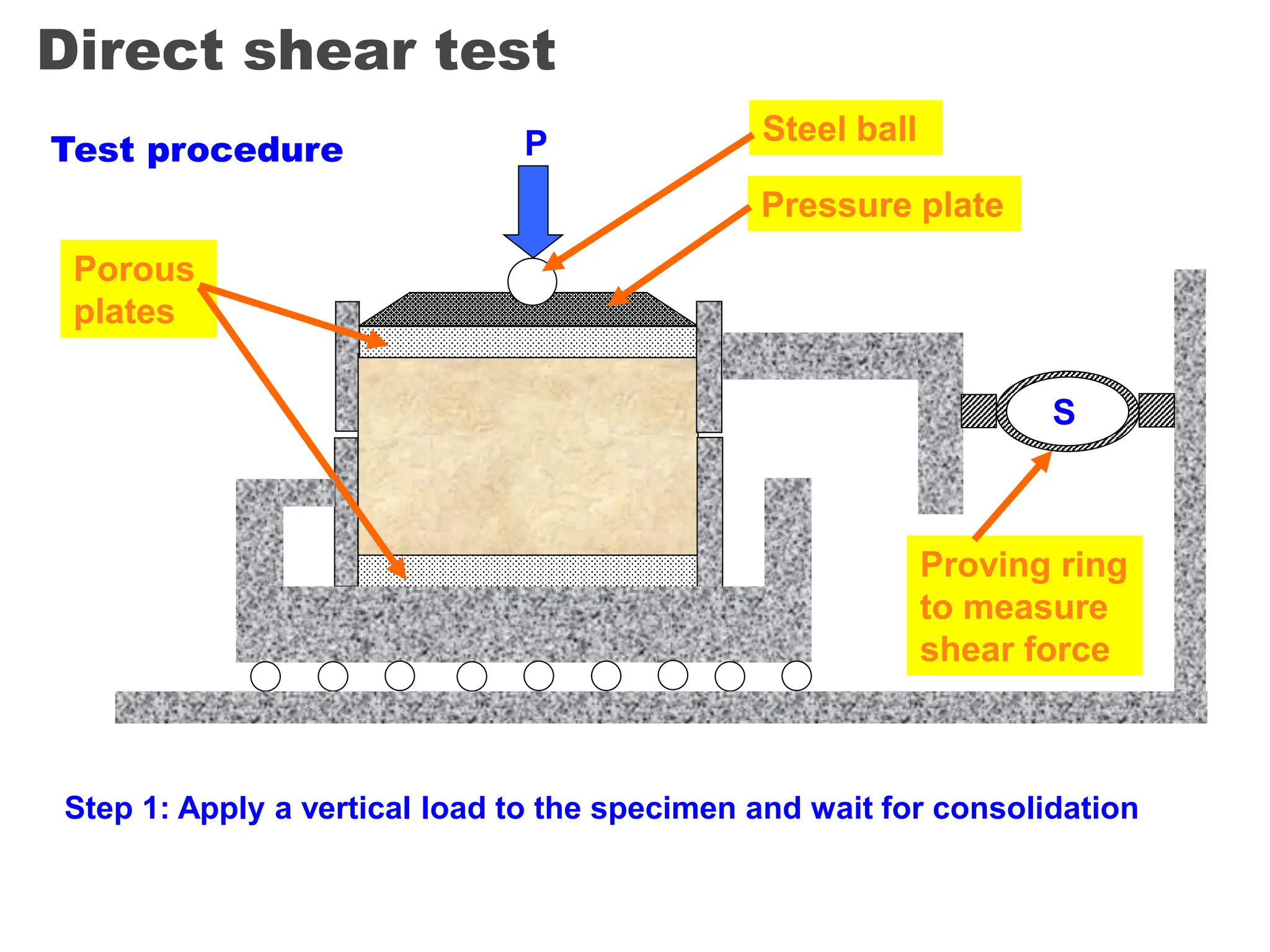
Direct shear test
Test procedure
Porous
plates
Pressure plate
Steel ball
Step 1: Apply a vertical load to the specimen and wait for consolidation
P
Proving ring
to measure
shear force
S
Direct shear test
Step 2: Lower box is subjected to a horizontal displacement at a constant rate
Step 1: Apply a vertical load to the specimen and wait for consolidation
P
Test procedure
Pressure plate
Steel ball
Proving ring
to measure
shear force
S
Porous
plates
Direct shear test
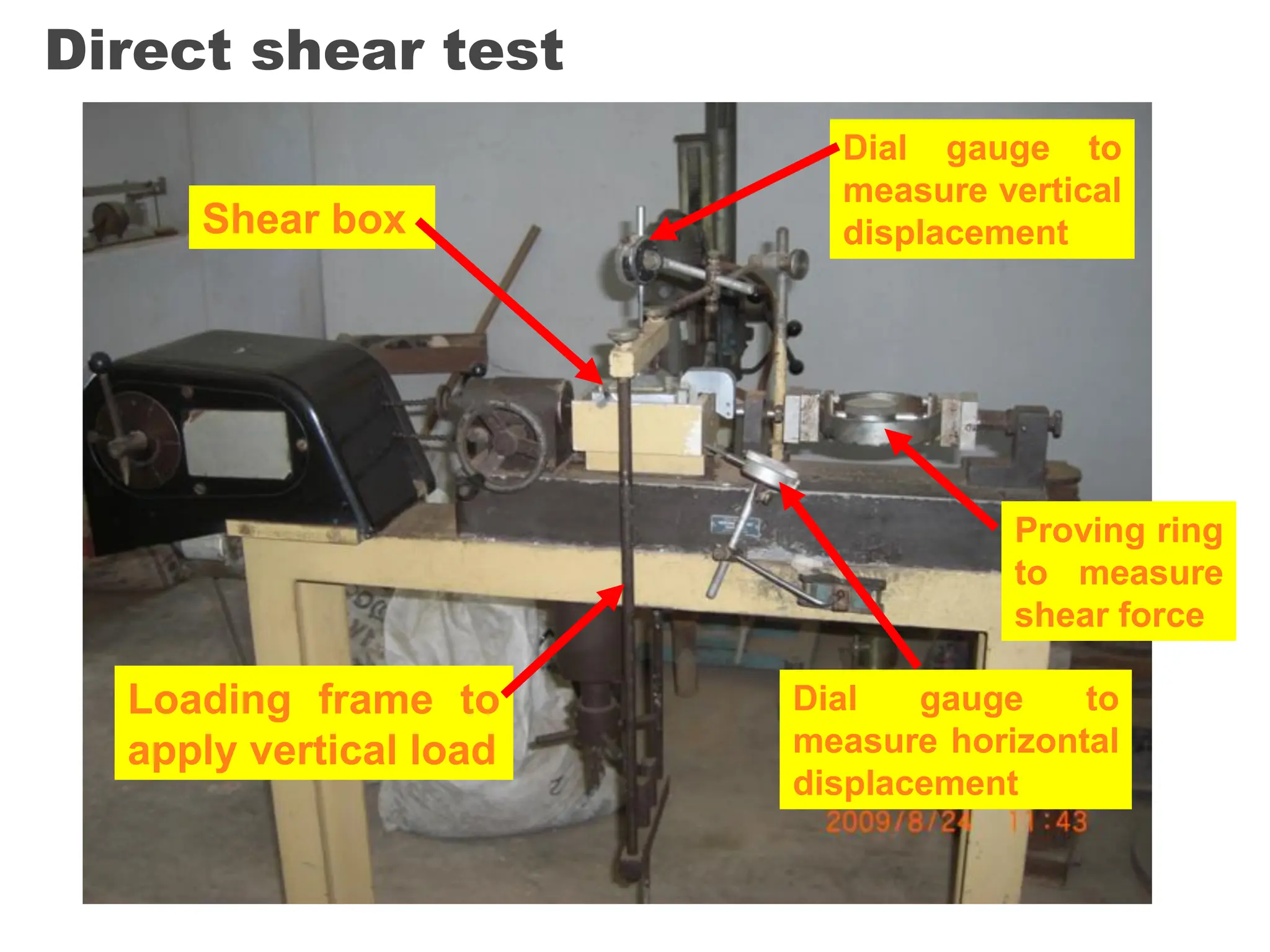
Shear box
Loading frame to
apply vertical load
Dial gauge to
measure vertical
displacement
Dial gauge to
measure horizontal
displacement
Proving ring
to measure
shear force
Direct shear test
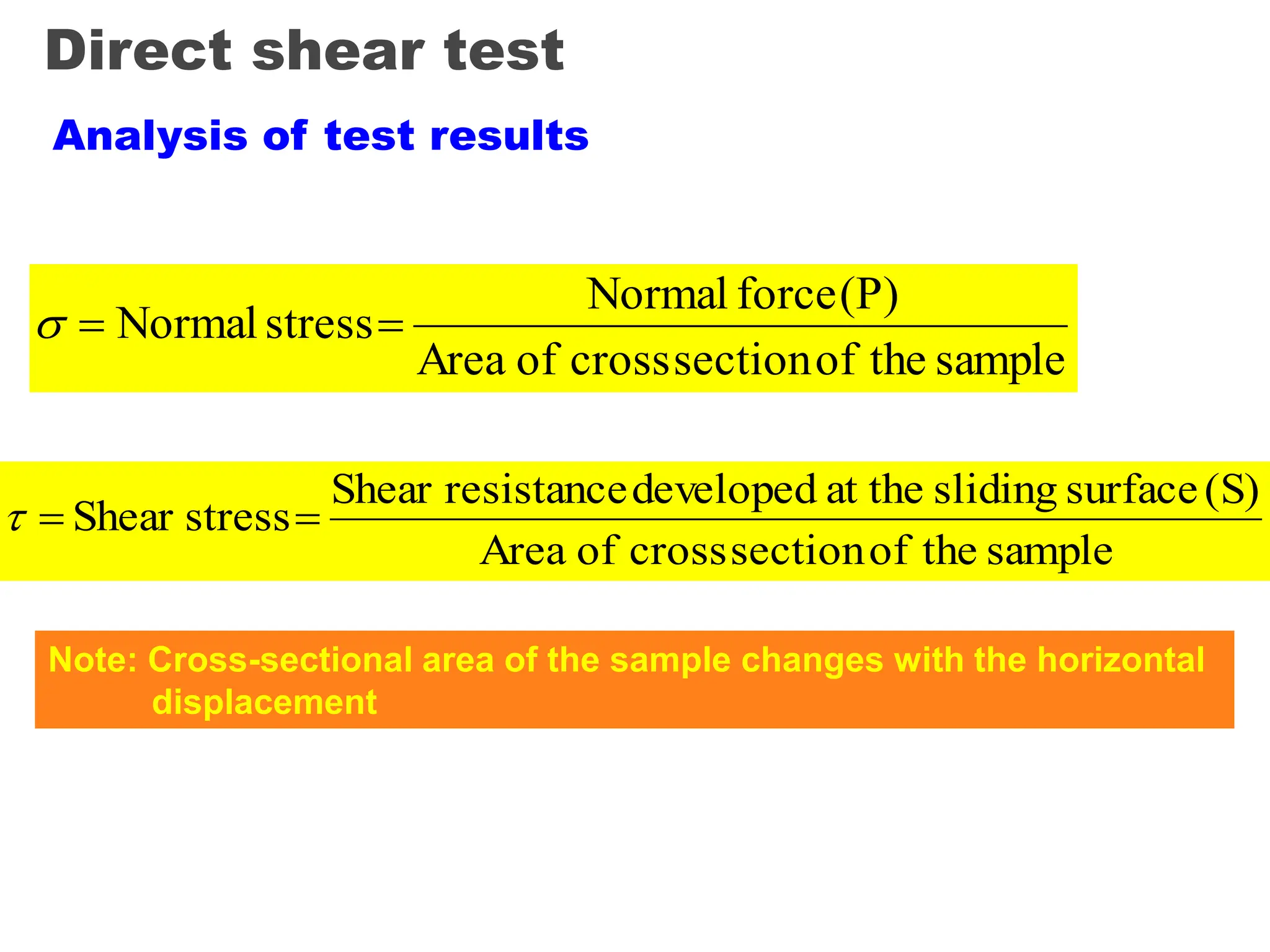
Analysis of test results
sample
the
of
section
cross
of
Area
(P)
force
Normal
stress
Normal 


sample
the
of
section
cross
of
Area
(S)
surface
sliding
at the
developed
resistance
Shear
stress
Shear 


Note: Cross-sectional area of the sample changes with the horizontal
displacement
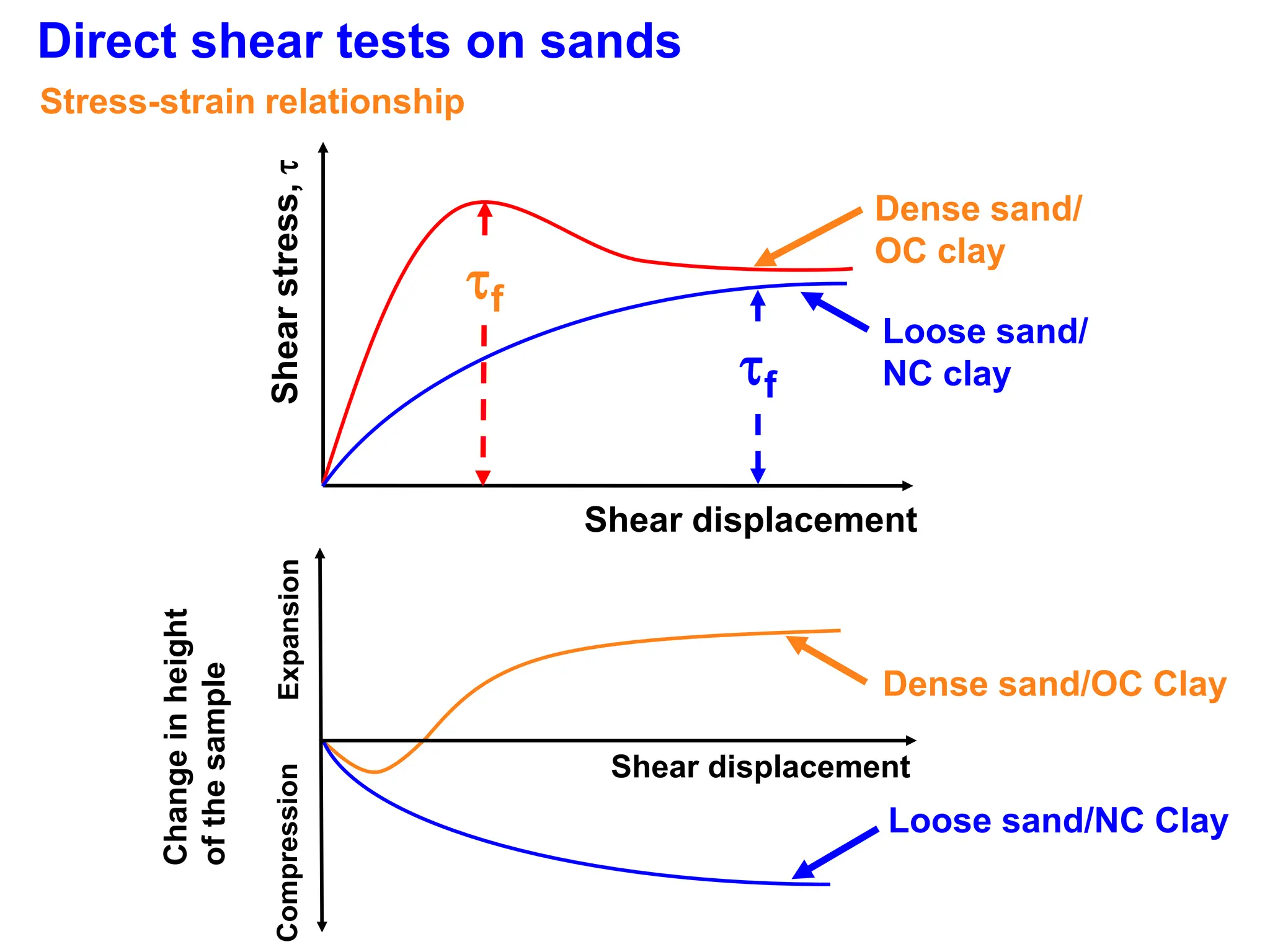
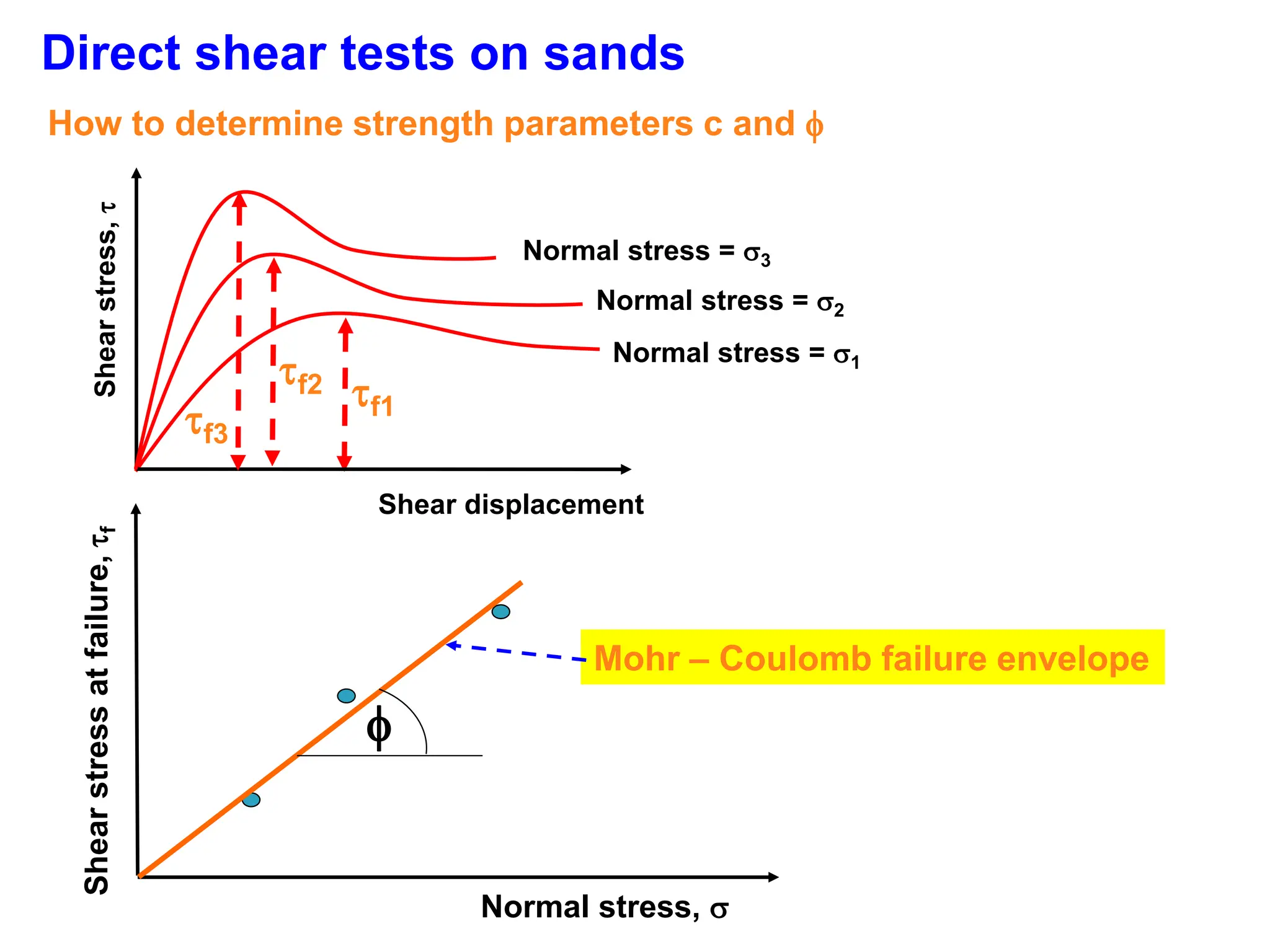
Direct shear tests on sands
Shear
stress,

Shear displacement
Dense sand/
OC clay
f
Loose sand/
NC clay
f
Dense sand/OC Clay
Loose sand/NC Clay
Change
in
height
of
the
sample
Expansion
Compression
Shear displacement
Stress-strain relationship
f1
Normal stress = 1
Direct shear tests on sands
How to determine strength parameters c and 
Shear
stress,

Shear displacement
f2
Normal stress = 2
f3
Normal stress = 3
Shear
stress
at
failure,

f
Normal stress, 

Mohr – Coulomb failure envelope
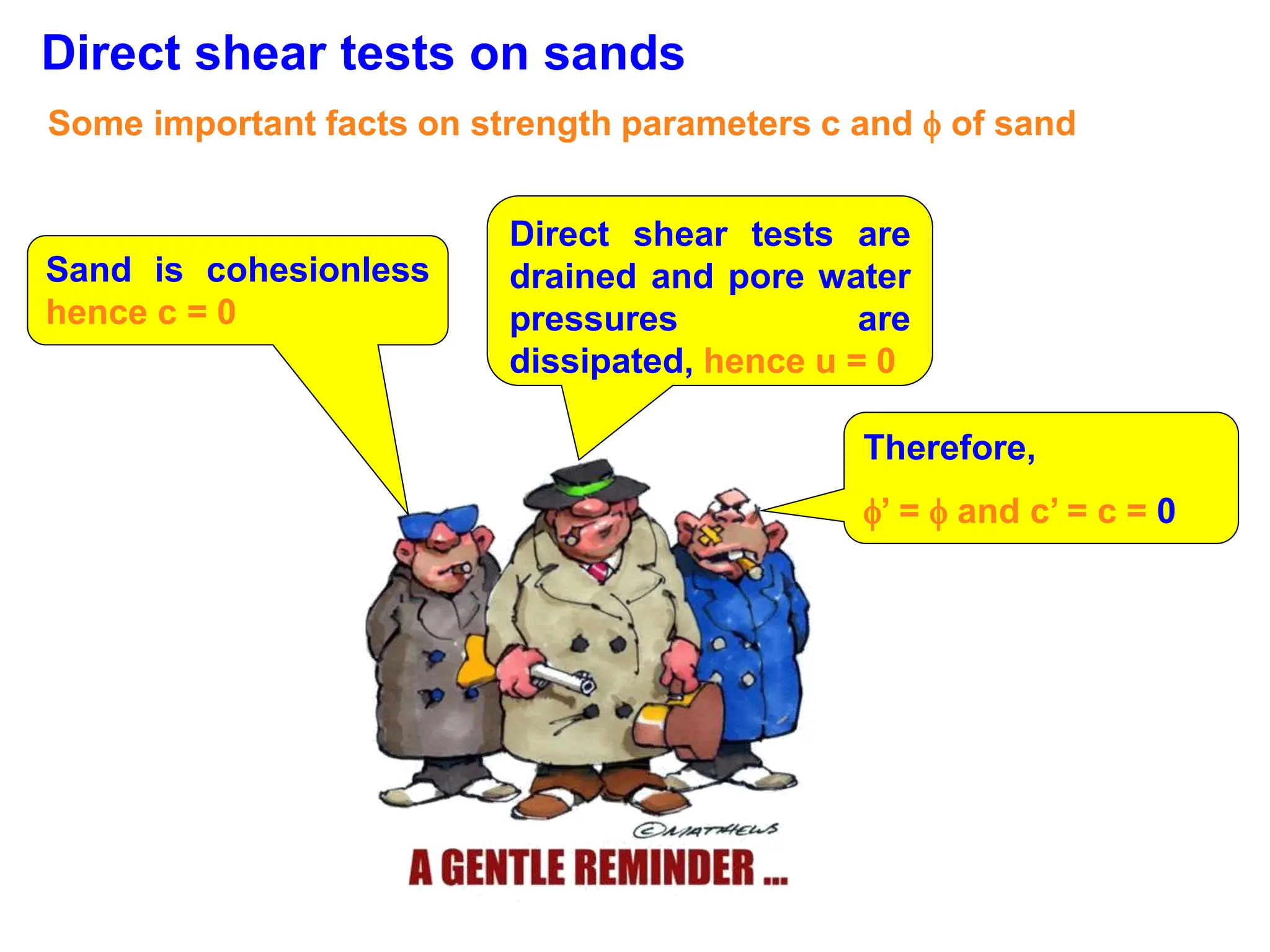
Direct shear tests on sands
Some important facts on strength parameters c and  of sand
Sand is cohesionless
hence c = 0
Direct shear tests are
drained and pore water
pressures are
dissipated, hence u = 0
Therefore,
’ =  and c’ = c = 0
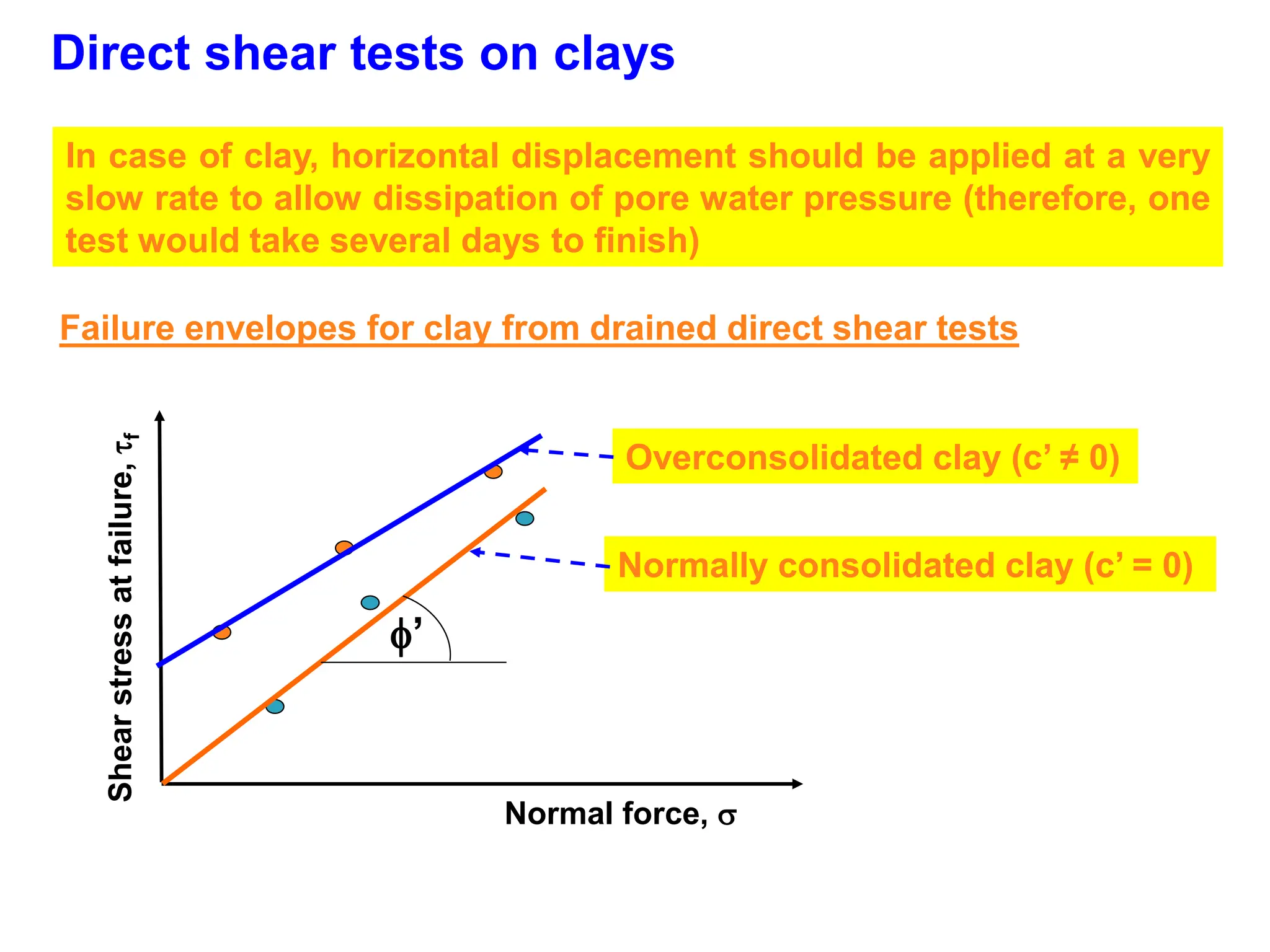
Direct shear tests on clays
Failure envelopes for clay from drained direct shear tests
Shear
stress
at
failure,

f
Normal force, 
’
Normally consolidated clay (c’ = 0)
In case of clay, horizontal displacement should be applied at a very
slow rate to allow dissipation of pore water pressure (therefore, one
test would take several days to finish)
Overconsolidated clay (c’ ≠ 0)
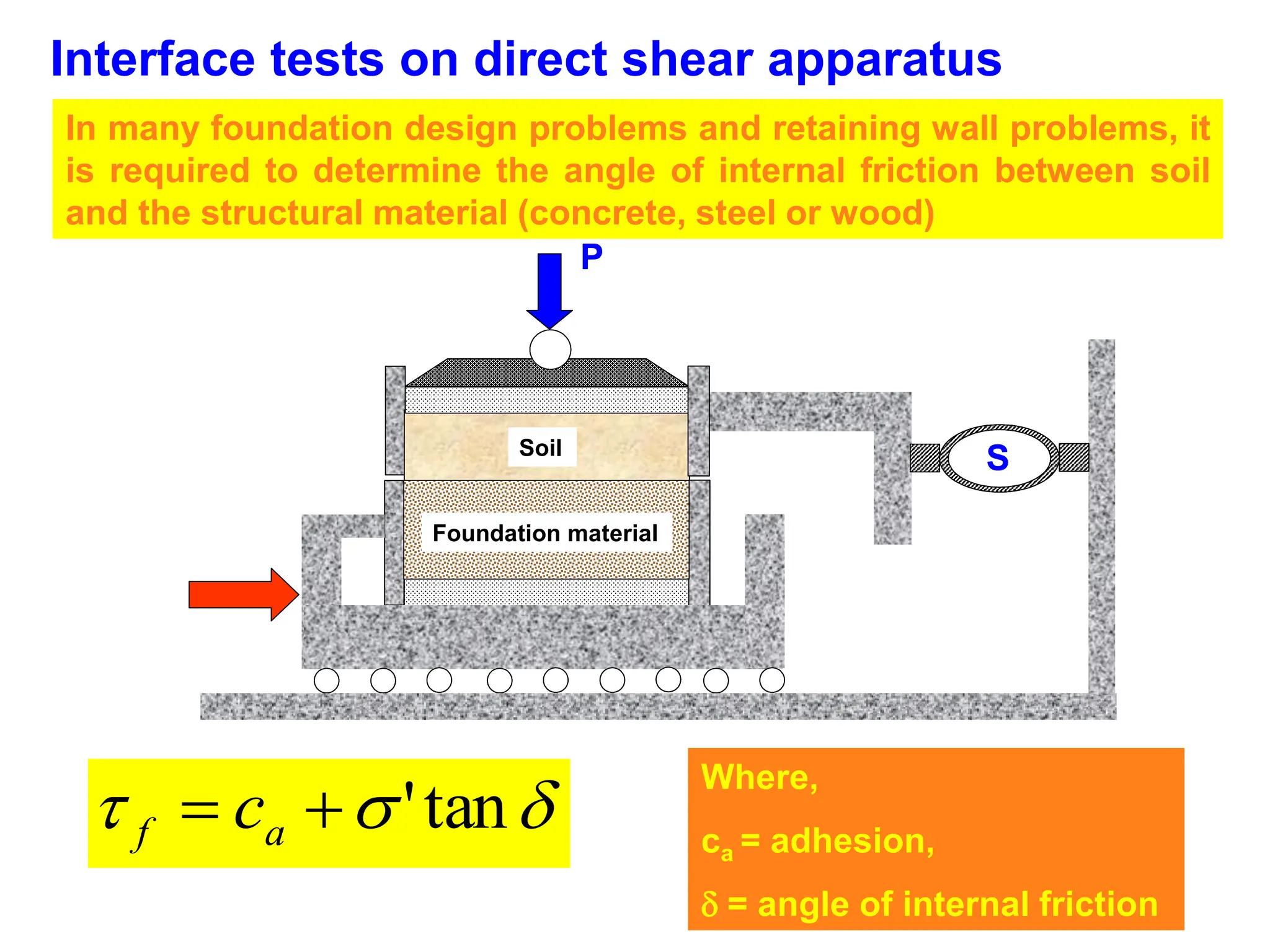
Interface tests on direct shear apparatus
In many foundation design problems and retaining wall problems, it
is required to determine the angle of internal friction between soil
and the structural material (concrete, steel or wood)


 tan
'

 a
f c
Where,
ca = adhesion,
 = angle of internal friction
Foundation material
Soil
P
S
Foundation material
Soil
P
S
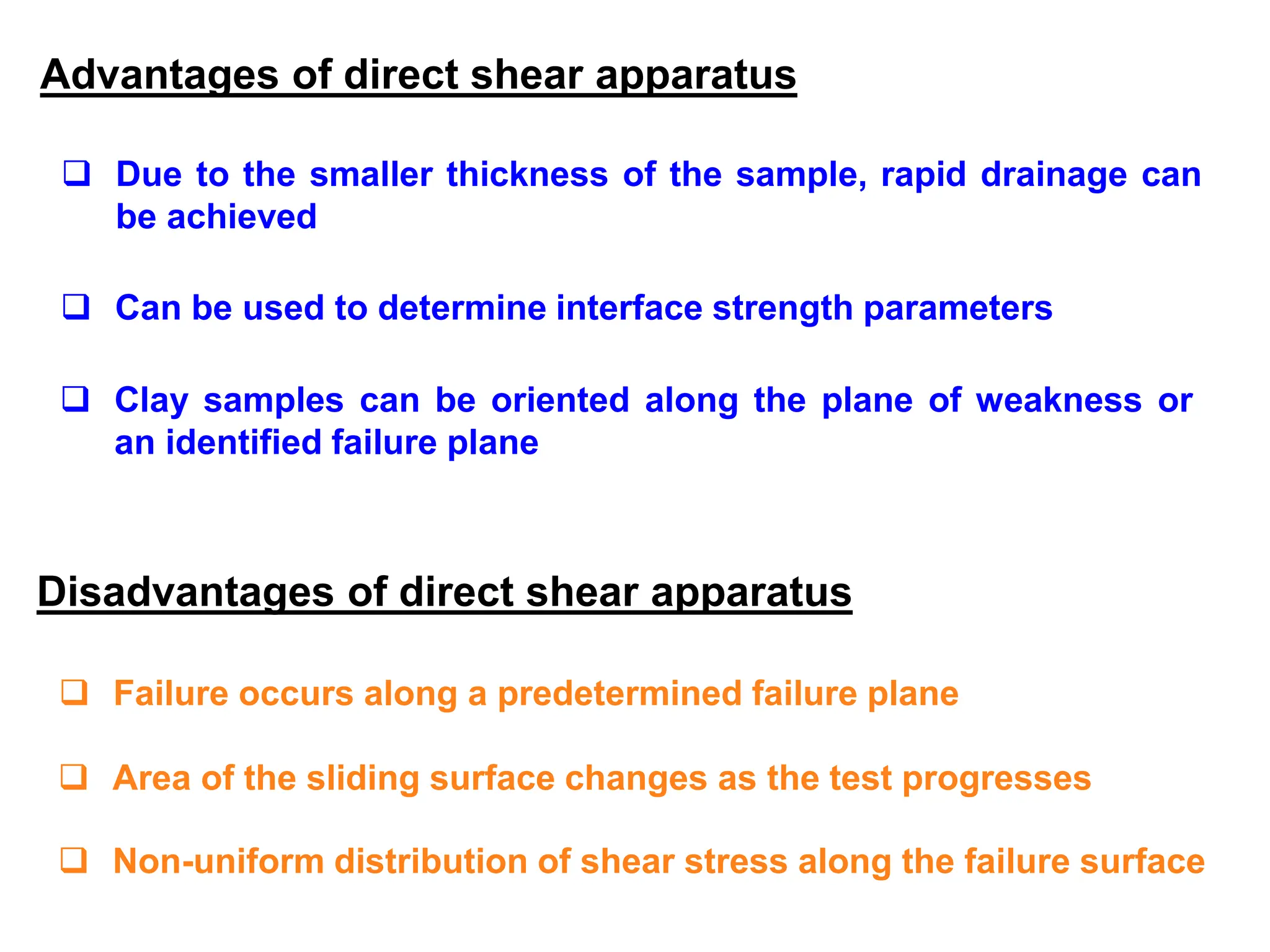
Advantages of direct shear apparatus
 Due to the smaller thickness of the sample, rapid drainage can
be achieved
 Can be used to determine interface strength parameters
 Clay samples can be oriented along the plane of weakness or
an identified failure plane
Disadvantages of direct shear apparatus
 Failure occurs along a predetermined failure plane
 Area of the sliding surface changes as the test progresses
 Non-uniform distribution of shear stress along the failure surface
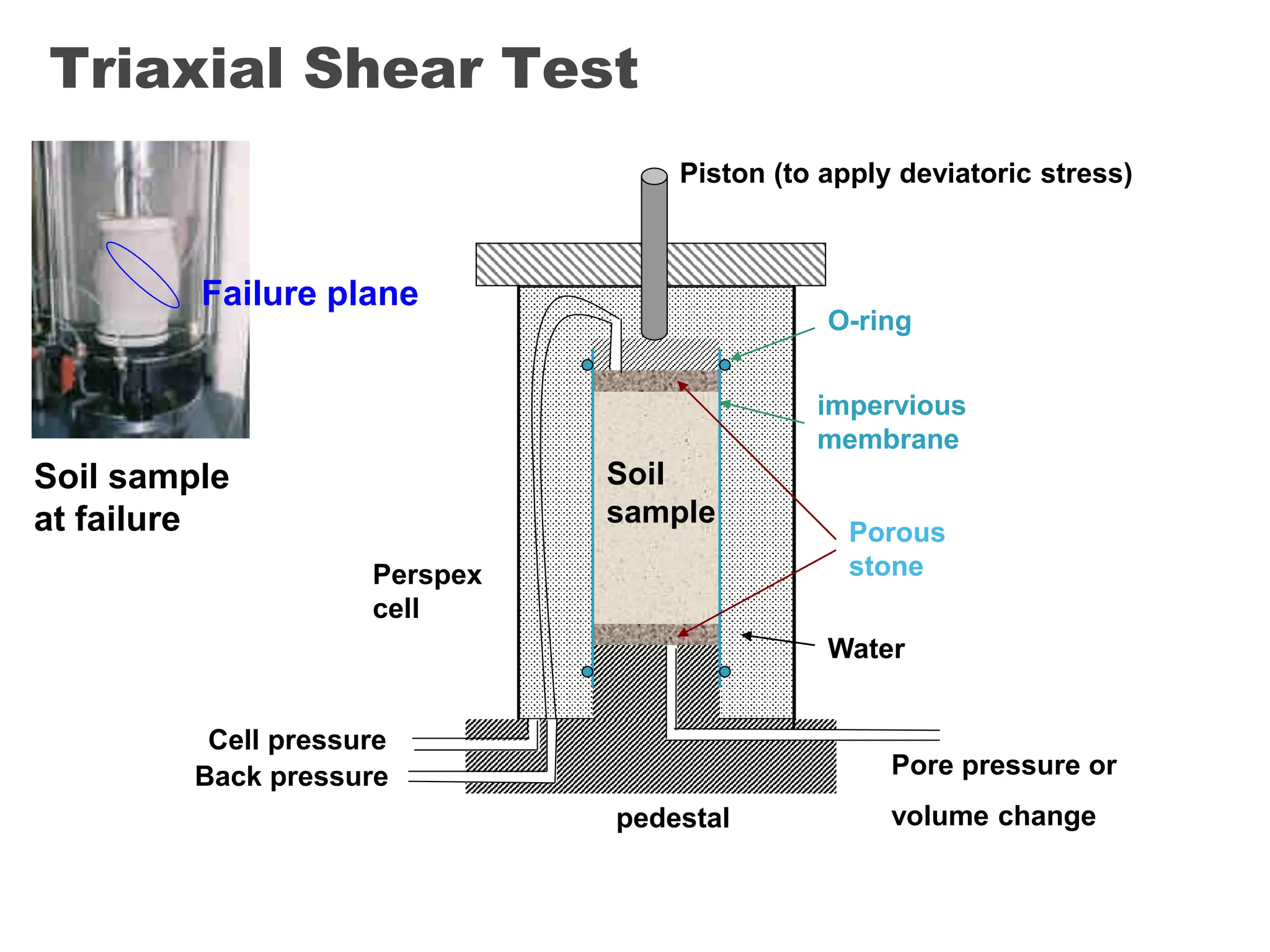
Triaxial Shear Test
Soil sample
at failure
Failure plane
Porous
stone
impervious
membrane
Piston (to apply deviatoric stress)
O-ring
pedestal
Perspex
cell
Cell pressure
Back pressure Pore pressure or
volume change
Water
Soil
sample
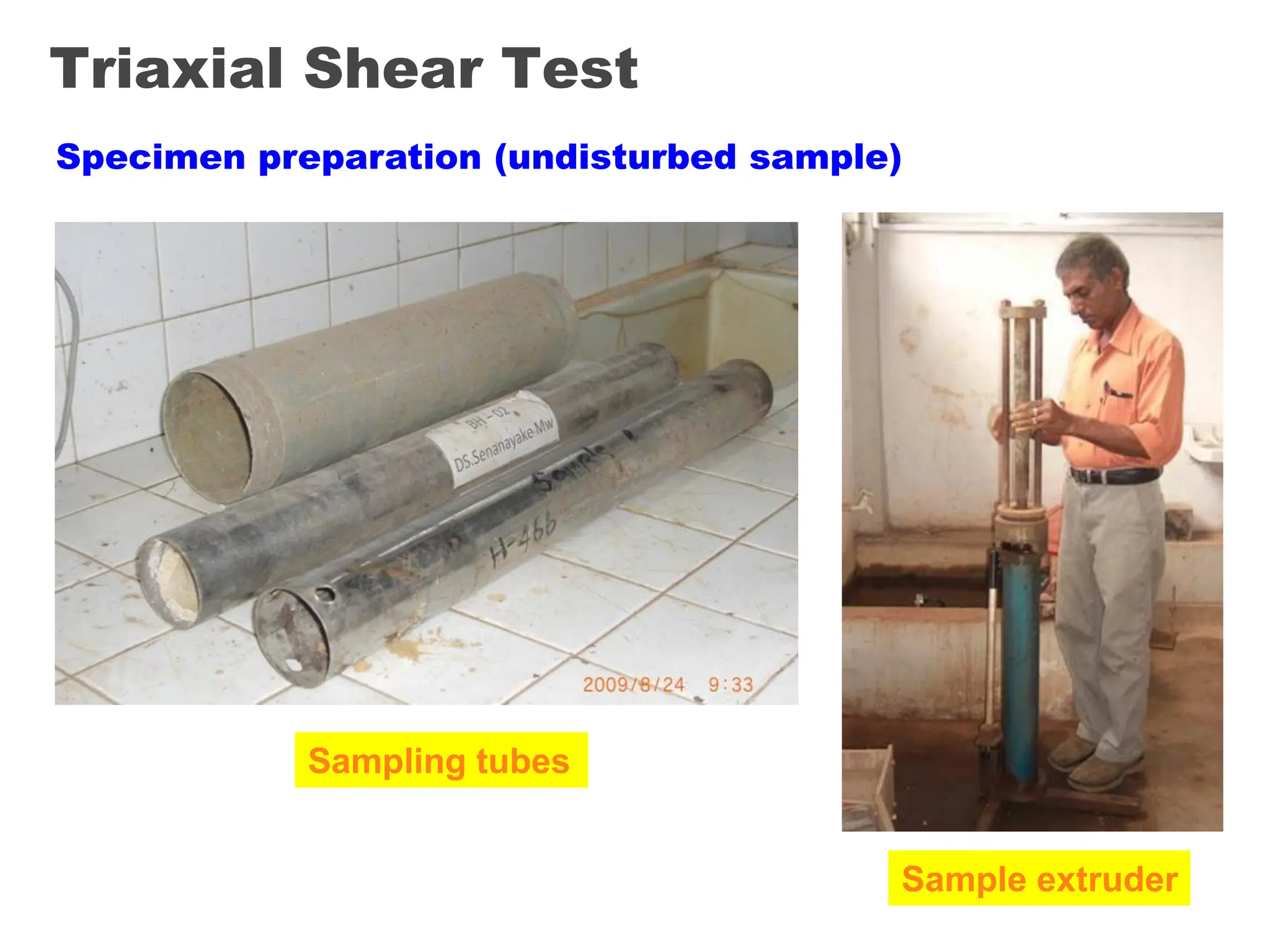
Triaxial Shear Test
Specimen preparation (undisturbed sample)
Sampling tubes
Sample extruder
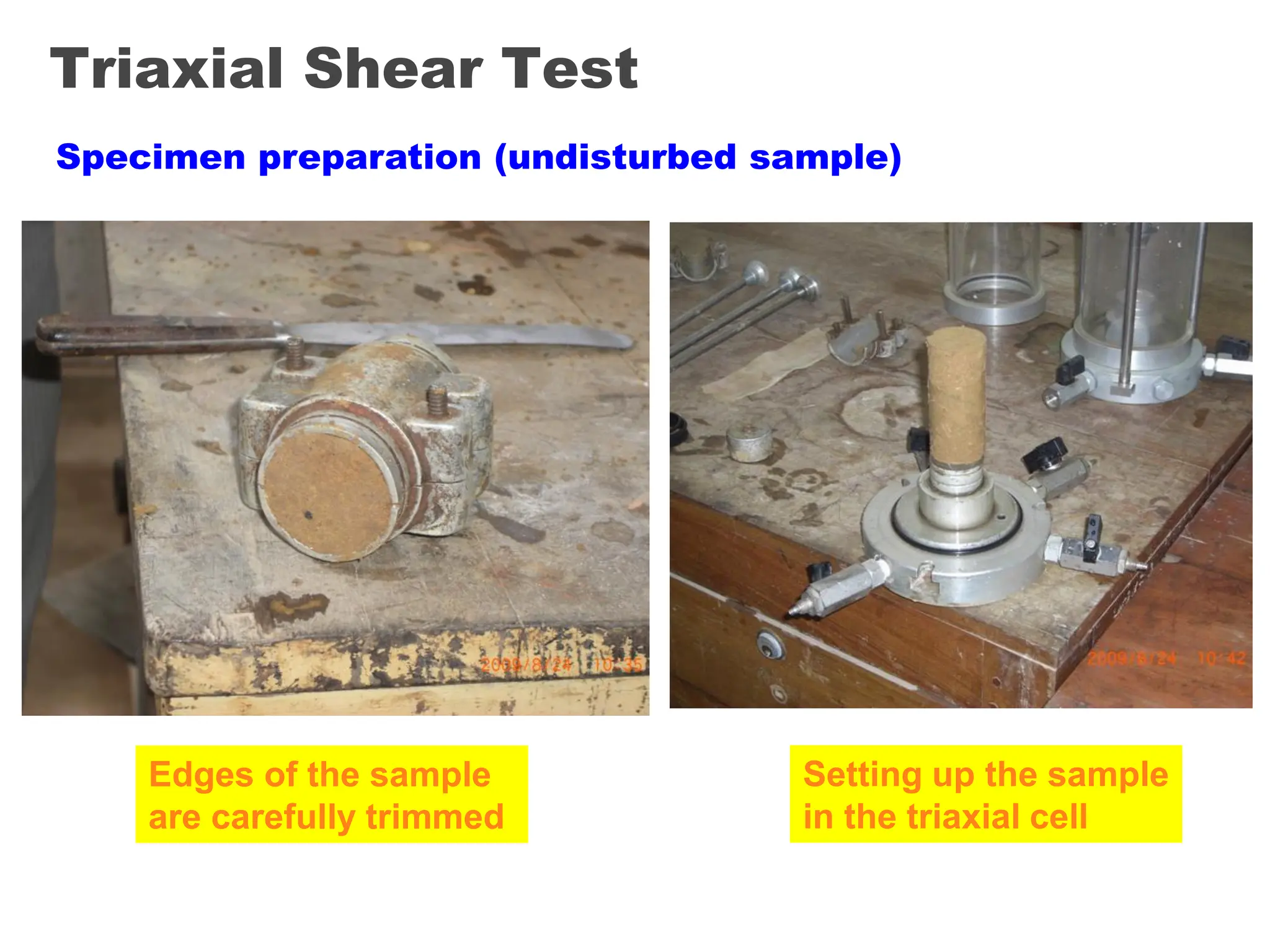
Triaxial Shear Test
Specimen preparation (undisturbed sample)
Edges of the sample
are carefully trimmed
Setting up the sample
in the triaxial cell
Triaxial Shear Test
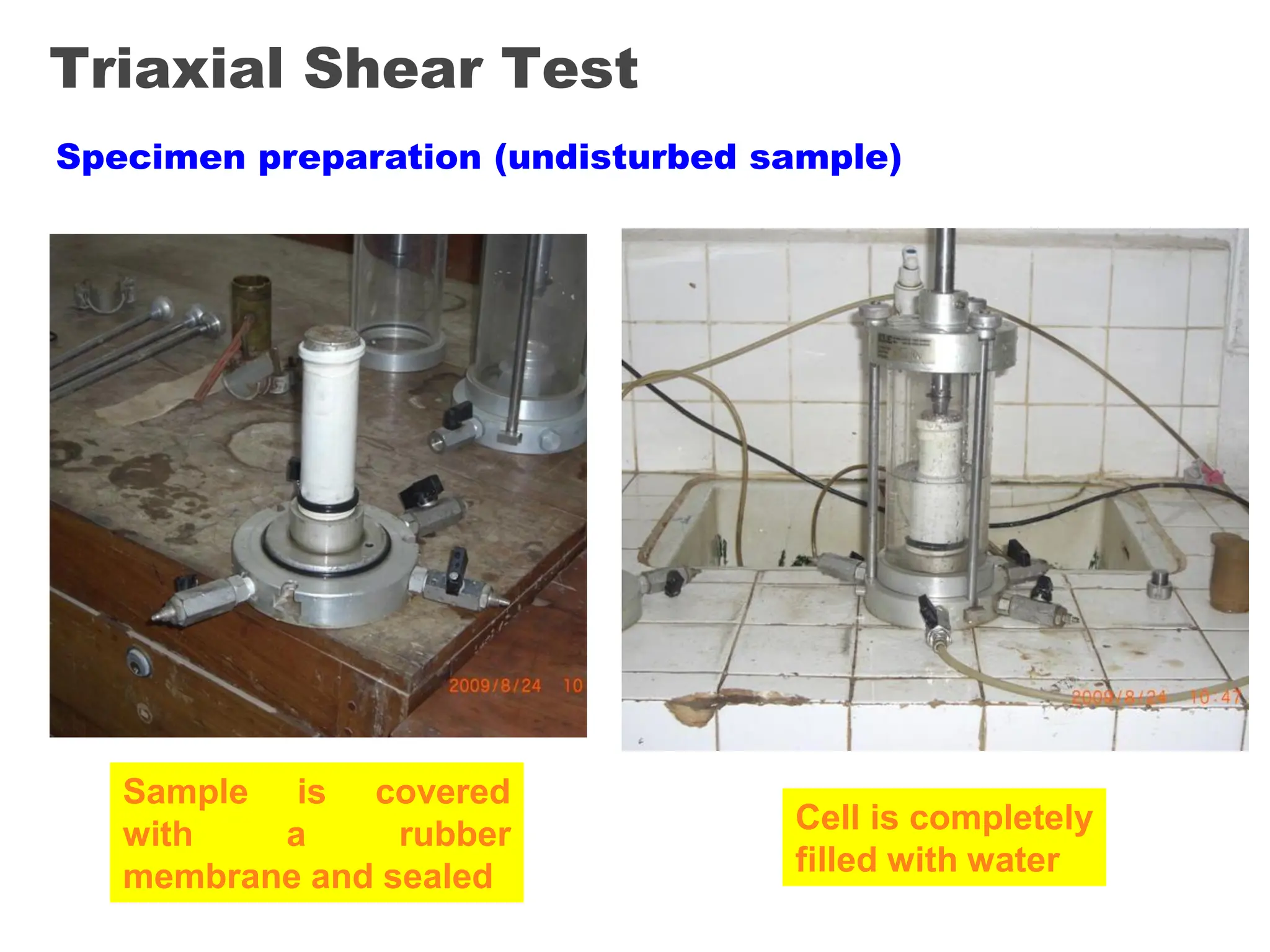
Sample is covered
with a rubber
membrane and sealed
Cell is completely
filled with water
Specimen preparation (undisturbed sample)
Triaxial Shear Test
Specimen preparation (undisturbed sample)
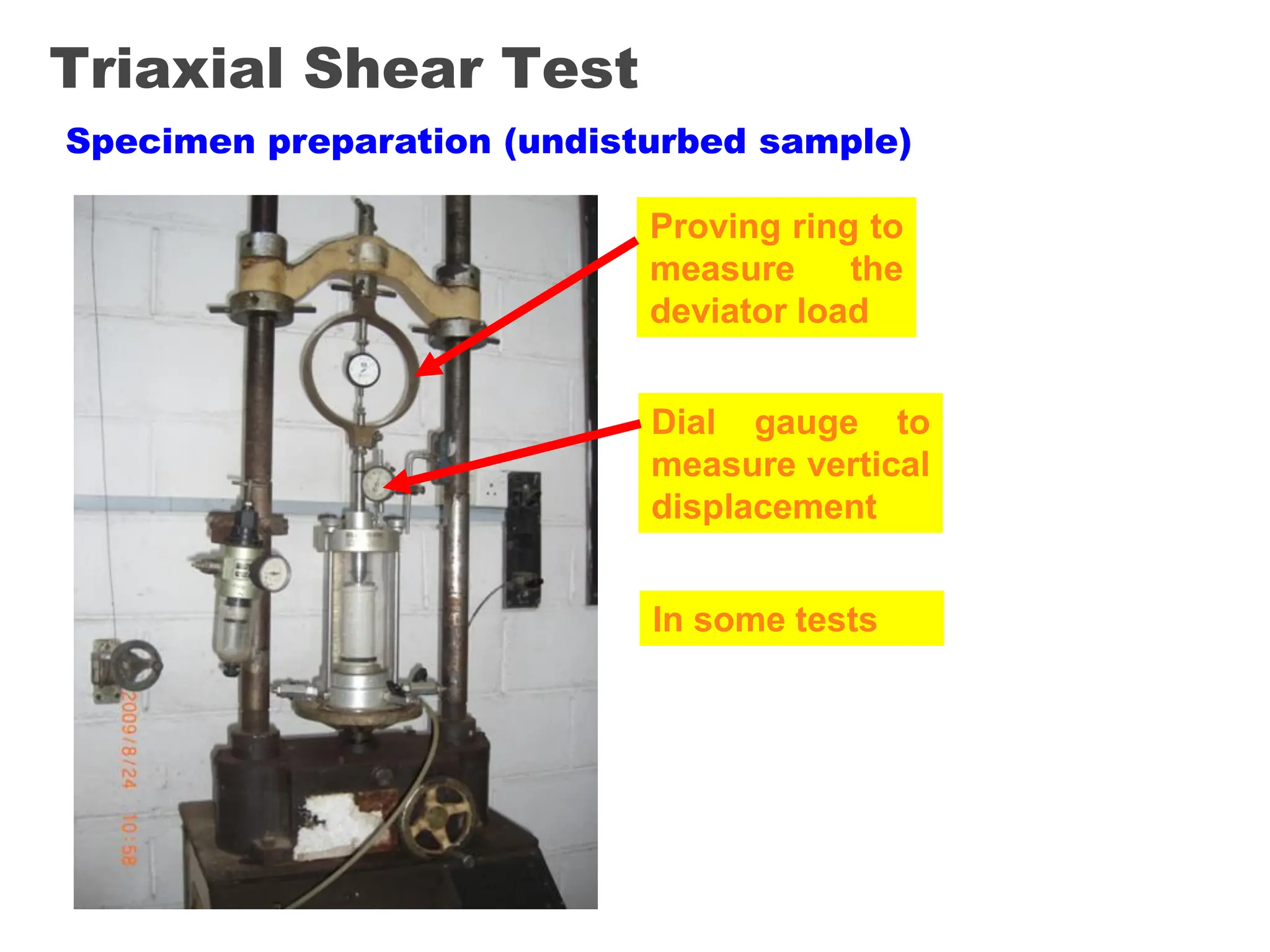
Proving ring to
measure the
deviator load
Dial gauge to
measure vertical
displacement
In some tests
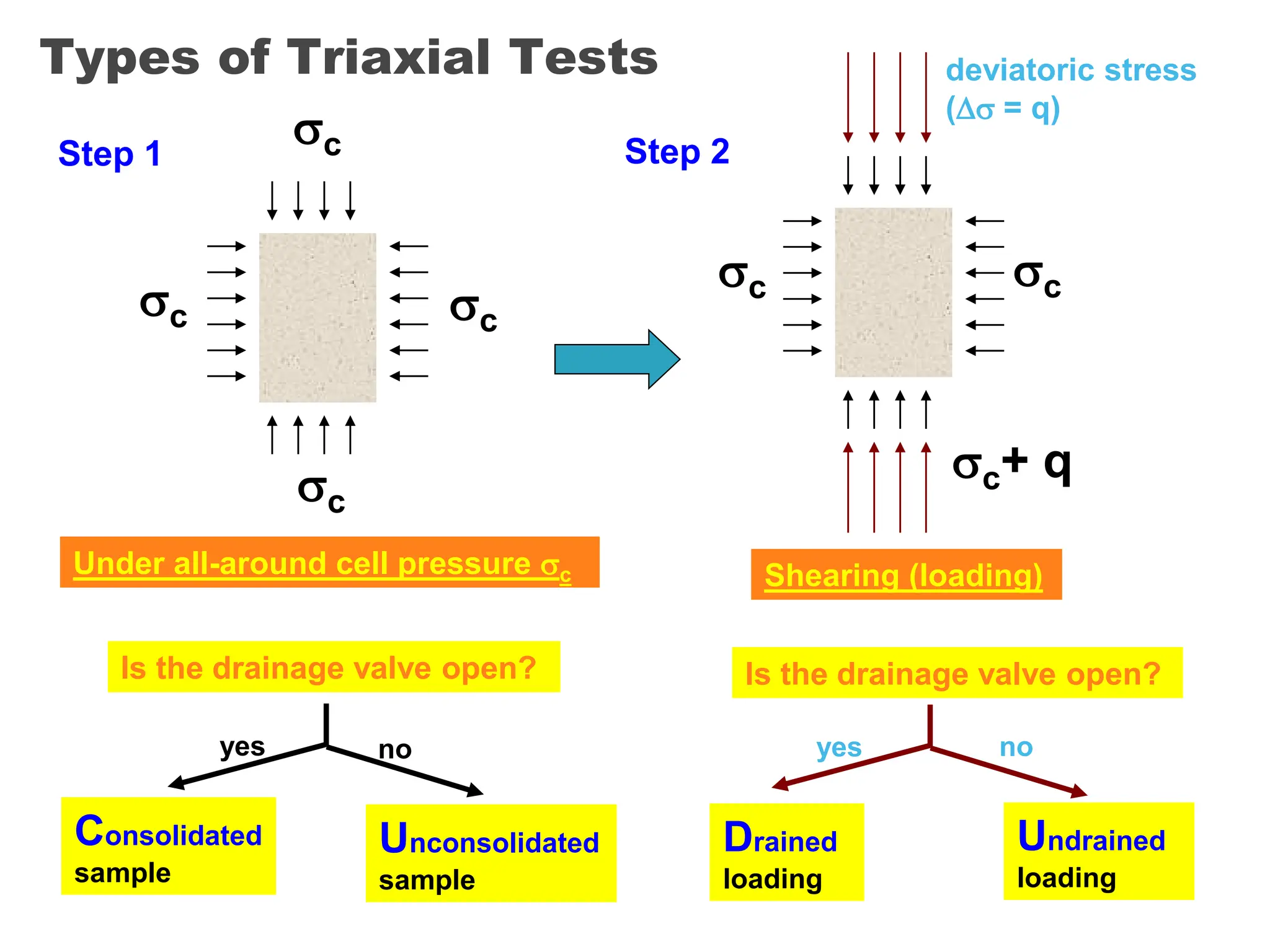
Types of Triaxial Tests
Is the drainage valve open?
yes no
Consolidated
sample
Unconsolidated
sample
Is the drainage valve open?
yes no
Drained
loading
Undrained
loading
Under all-around cell pressure c
c
c
c
c
Step 1
deviatoric stress
( = q)
Shearing (loading)
Step 2
c c
c+ q
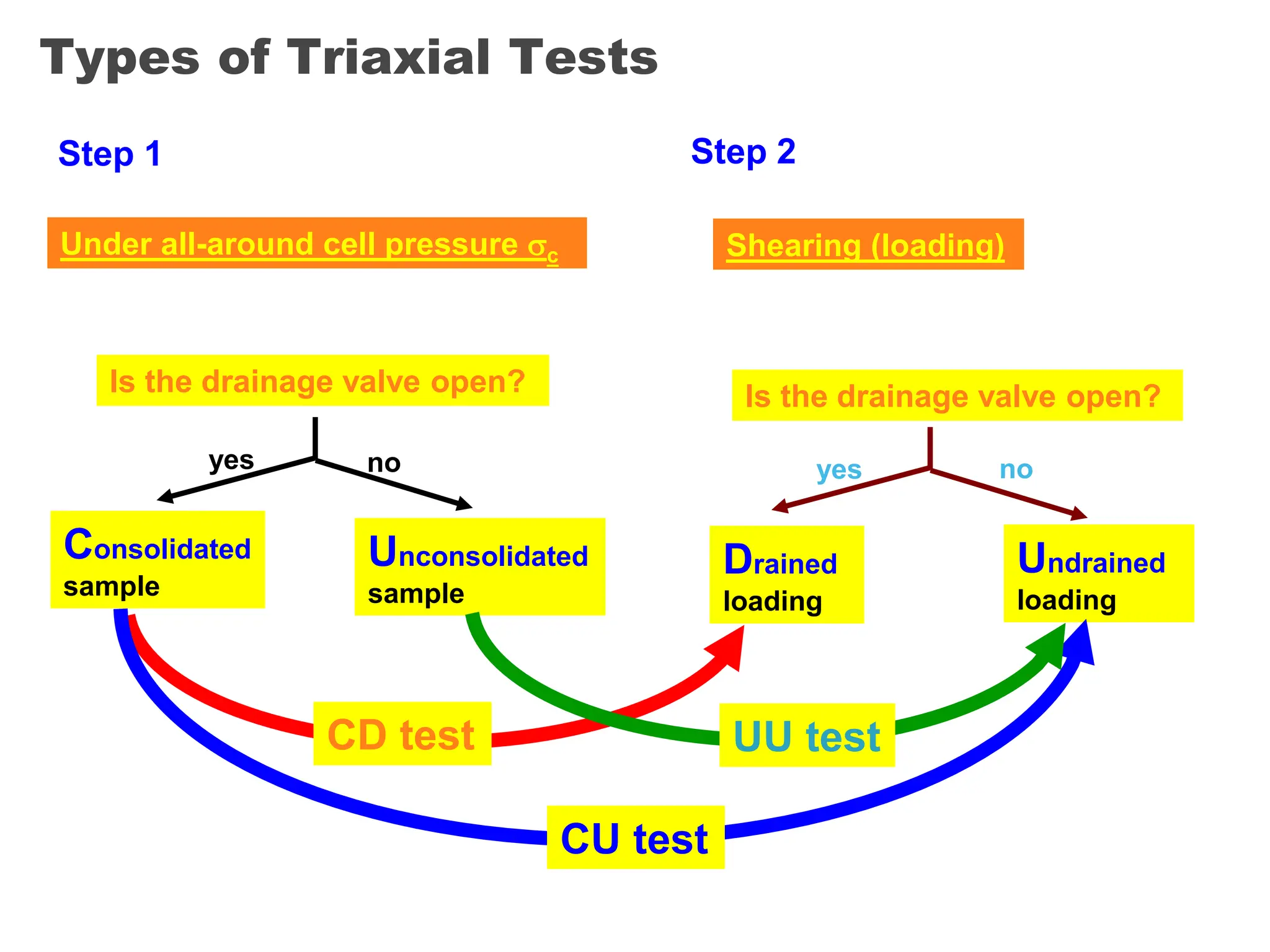
Types of Triaxial Tests
Is the drainage valve open?
yes no
Consolidated
sample
Unconsolidated
sample
Under all-around cell pressure c
Step 1
Is the drainage valve open?
yes no
Drained
loading
Undrained
loading
Shearing (loading)
Step 2
CD test
CU test
UU test
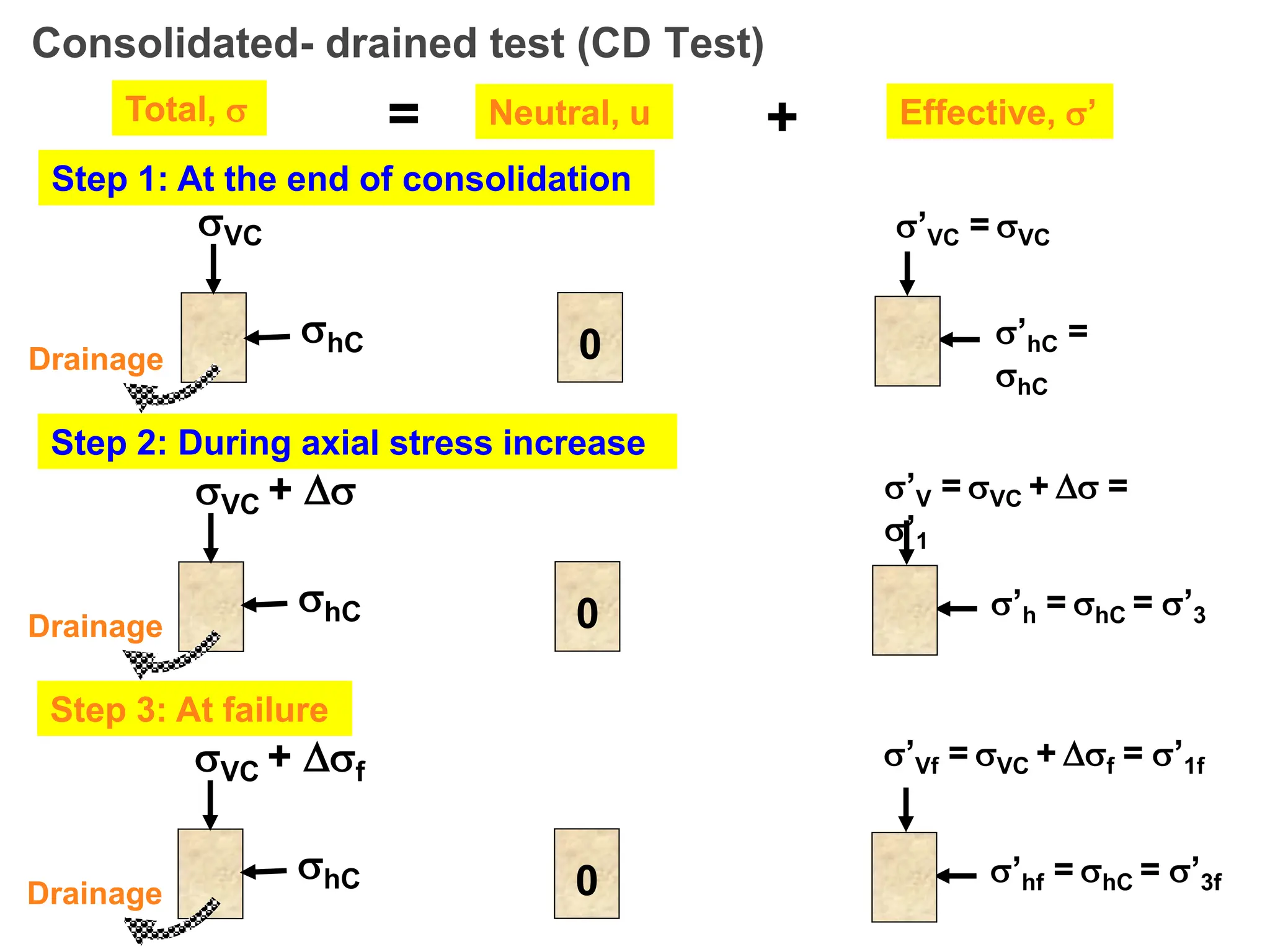
Consolidated- drained test (CD Test)
Step 1: At the end of consolidation
VC
hC
Total,  = Neutral, u Effective, ’
+
0
Step 2: During axial stress increase
’VC = VC
’hC =
hC
VC + 
hC 0
’V = VC +  =
’1
’h = hC = ’3
Drainage
Drainage
Step 3: At failure
VC + f
hC 0
’Vf = VC + f = ’1f
’hf = hC = ’3f
Drainage
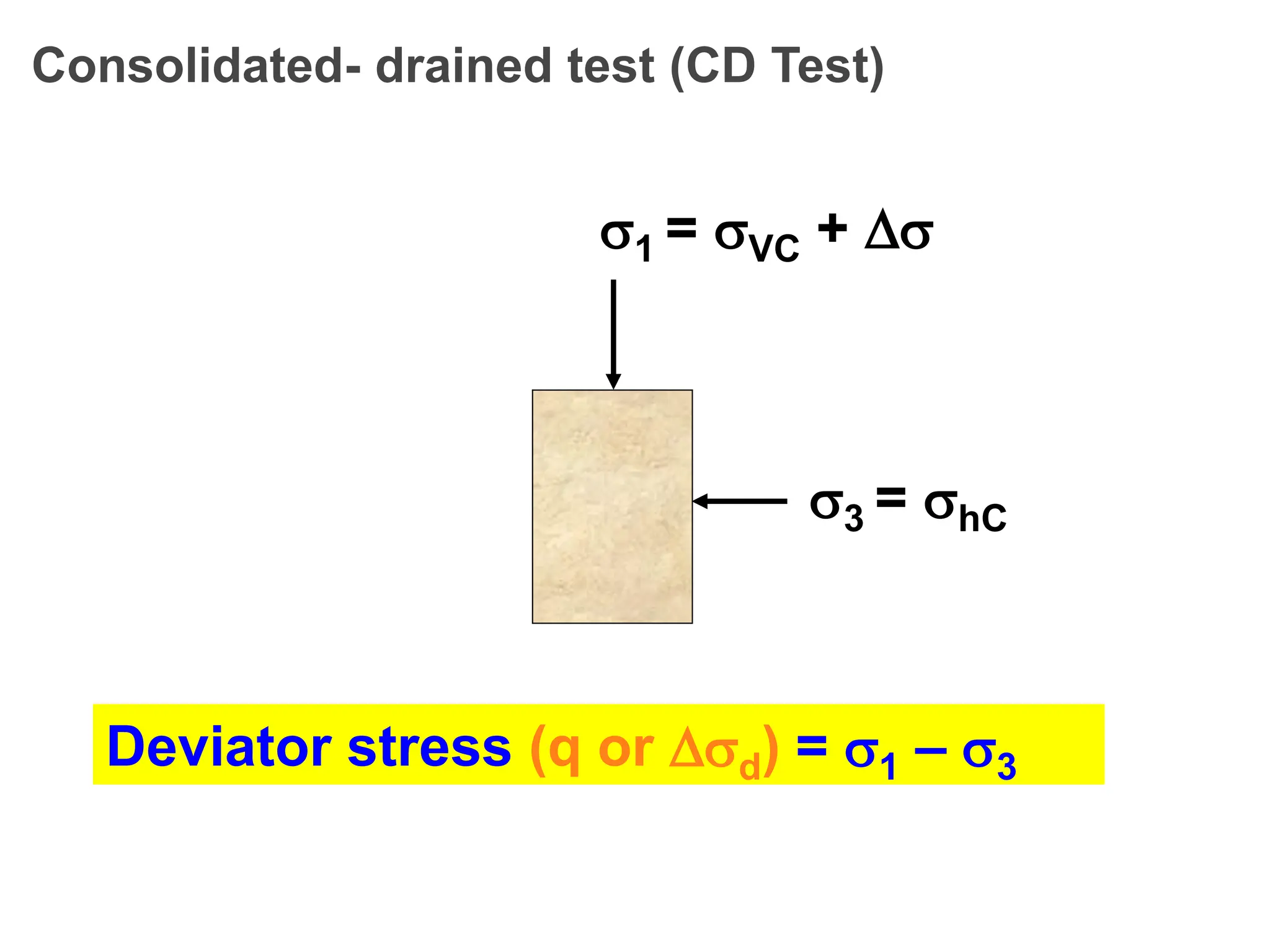
Deviator stress (q or d) = 1 – 3
Consolidated- drained test (CD Test)
1 = VC + 
3 = hC
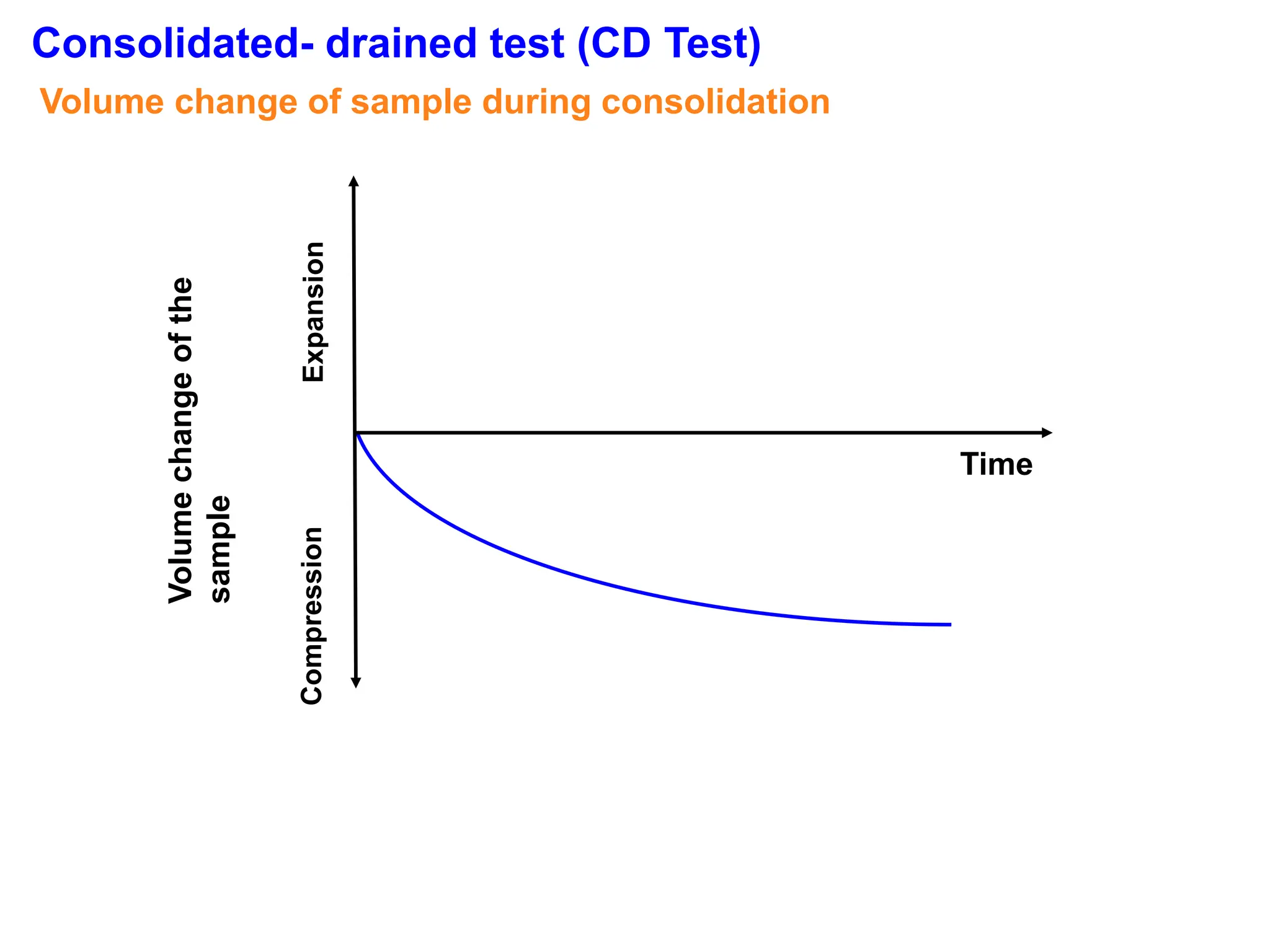
Volume
change
of
the
sample
Expansion
Compression
Time
Volume change of sample during consolidation
Consolidated- drained test (CD Test)
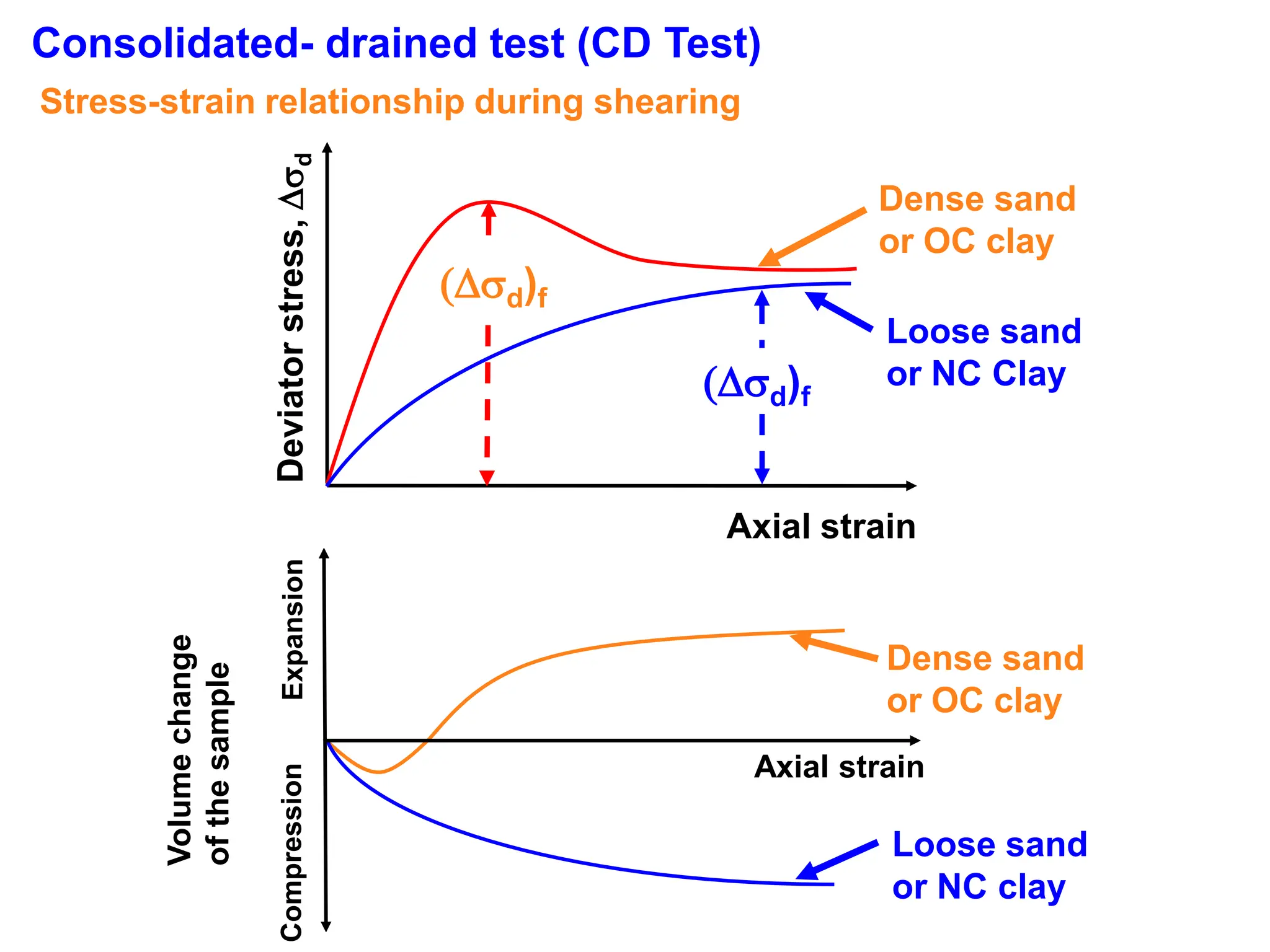
Deviator
stress,

d
Axial strain
Dense sand
or OC clay
(d)f
Dense sand
or OC clay
Loose sand
or NC clay
Volume
change
of
the
sample
Expansion
Compression
Axial strain
Stress-strain relationship during shearing
Consolidated- drained test (CD Test)
Loose sand
or NC Clay
(d)f
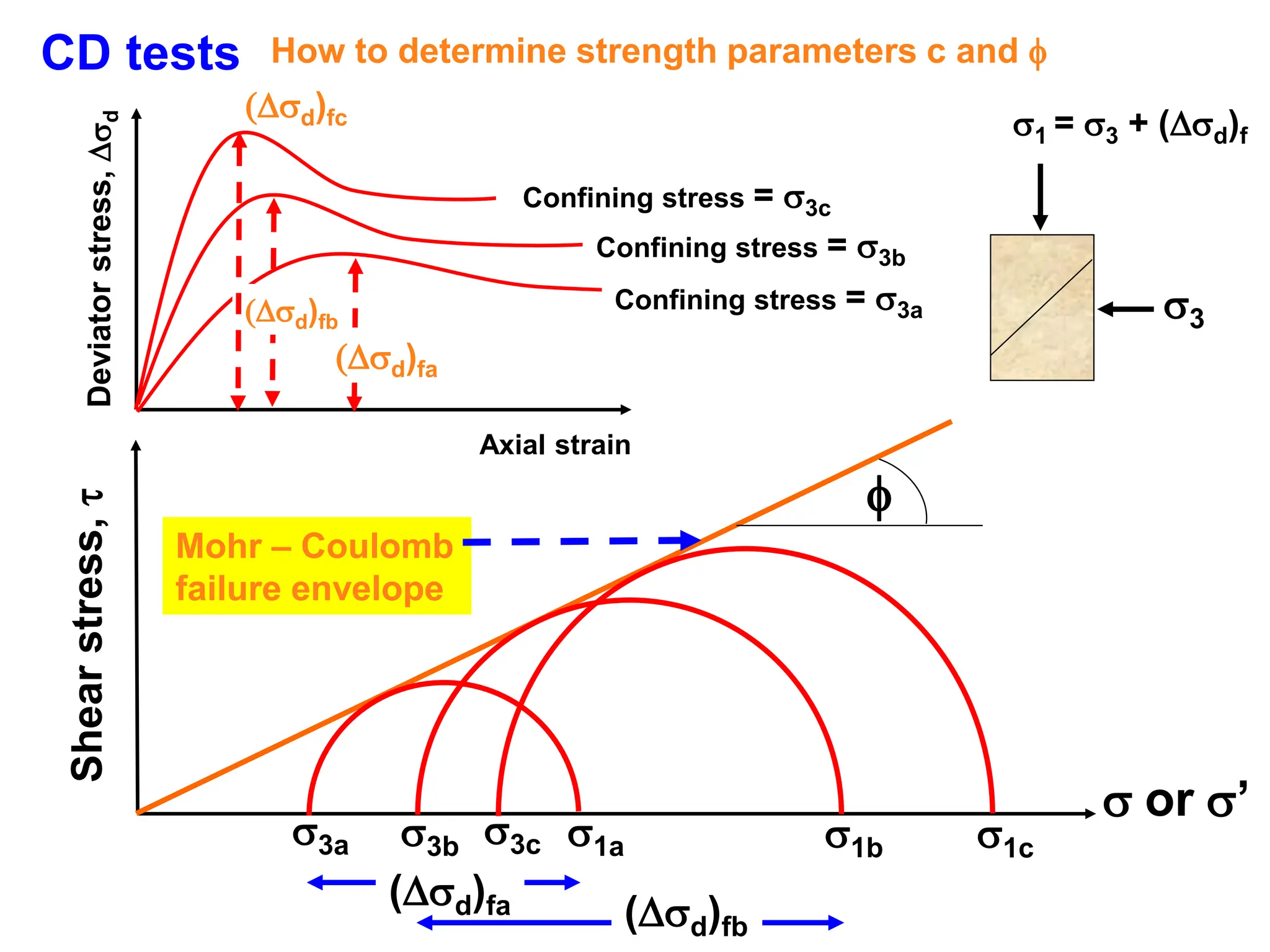
CD tests How to determine strength parameters c and 
Deviator
stress,

d
Axial strain
Shear
stress,

 or ’

Mohr – Coulomb
failure envelope
(d)fa
Confining stress = 3a
(d)fb
Confining stress = 3b
(d)fc
Confining stress = 3c
3c 1c
3a 1a
(d)fa
3b 1b
(d)fb
1 = 3 + (d)f
3
CD tests
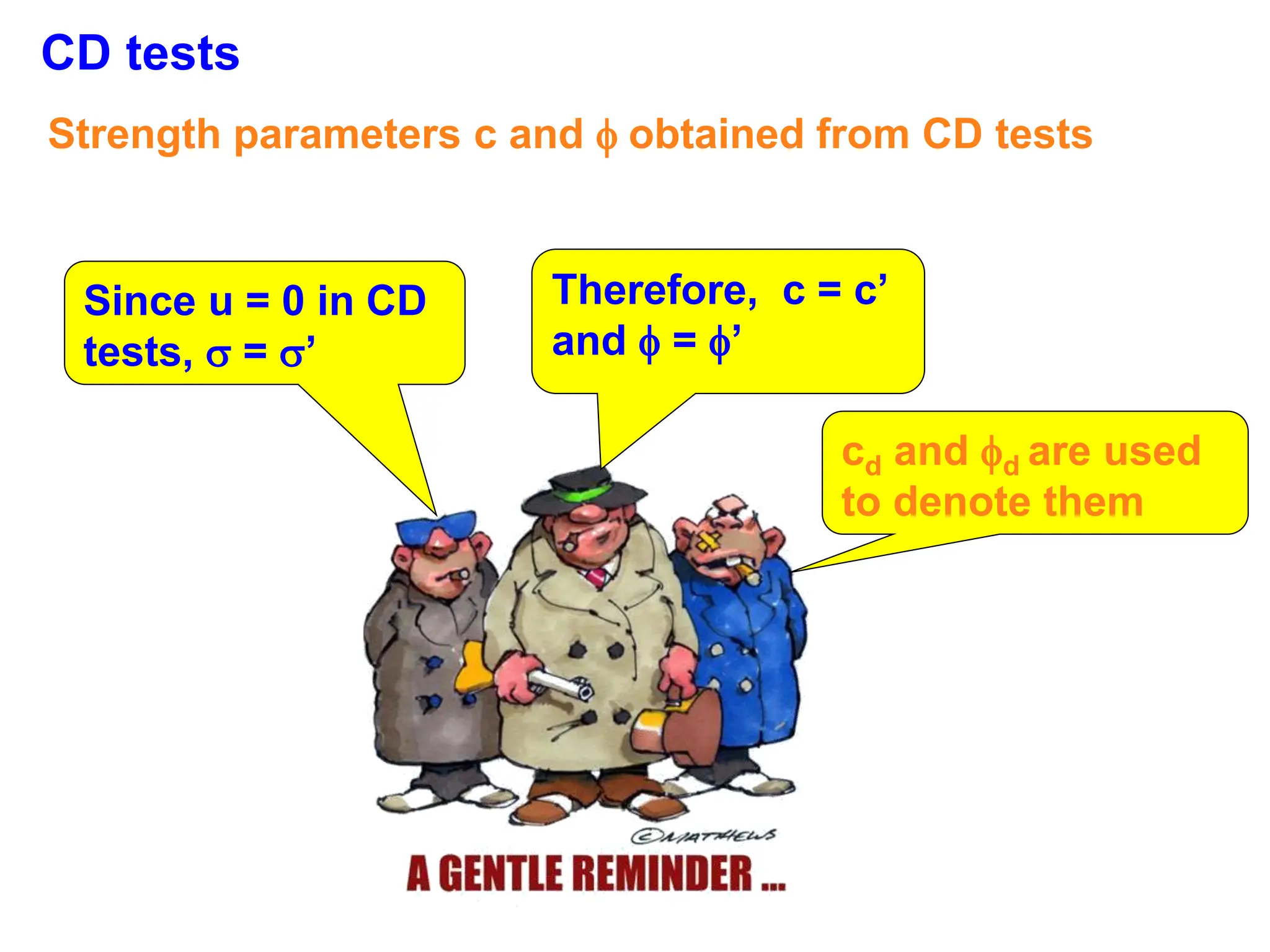
Strength parameters c and  obtained from CD tests
Since u = 0 in CD
tests,  = ’
Therefore, c = c’
and  = ’
cd and d are used
to denote them
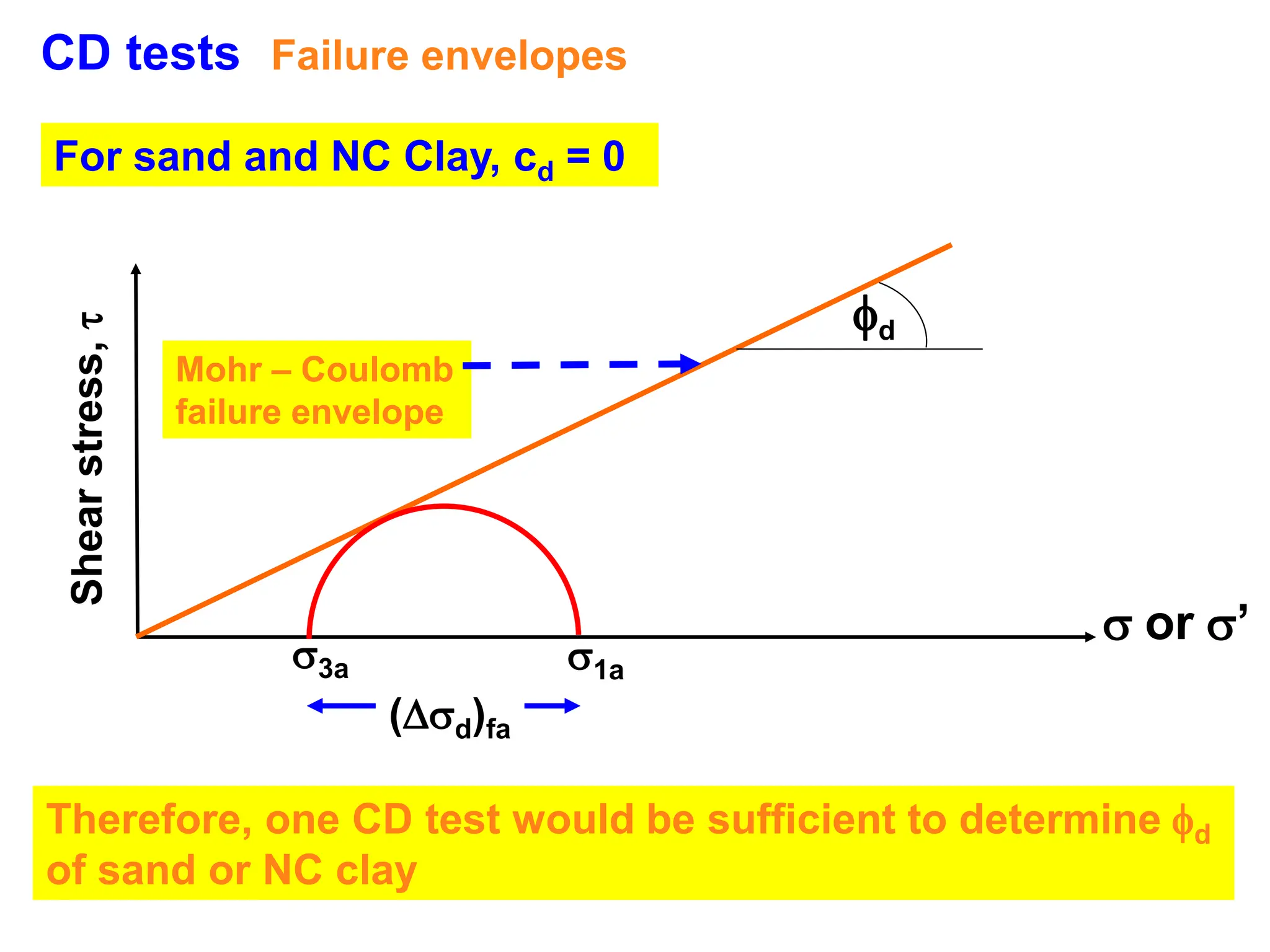
CD tests Failure envelopes
Shear
stress,

 or ’
d
Mohr – Coulomb
failure envelope
3a 1a
(d)fa
For sand and NC Clay, cd = 0
Therefore, one CD test would be sufficient to determine d
of sand or NC clay
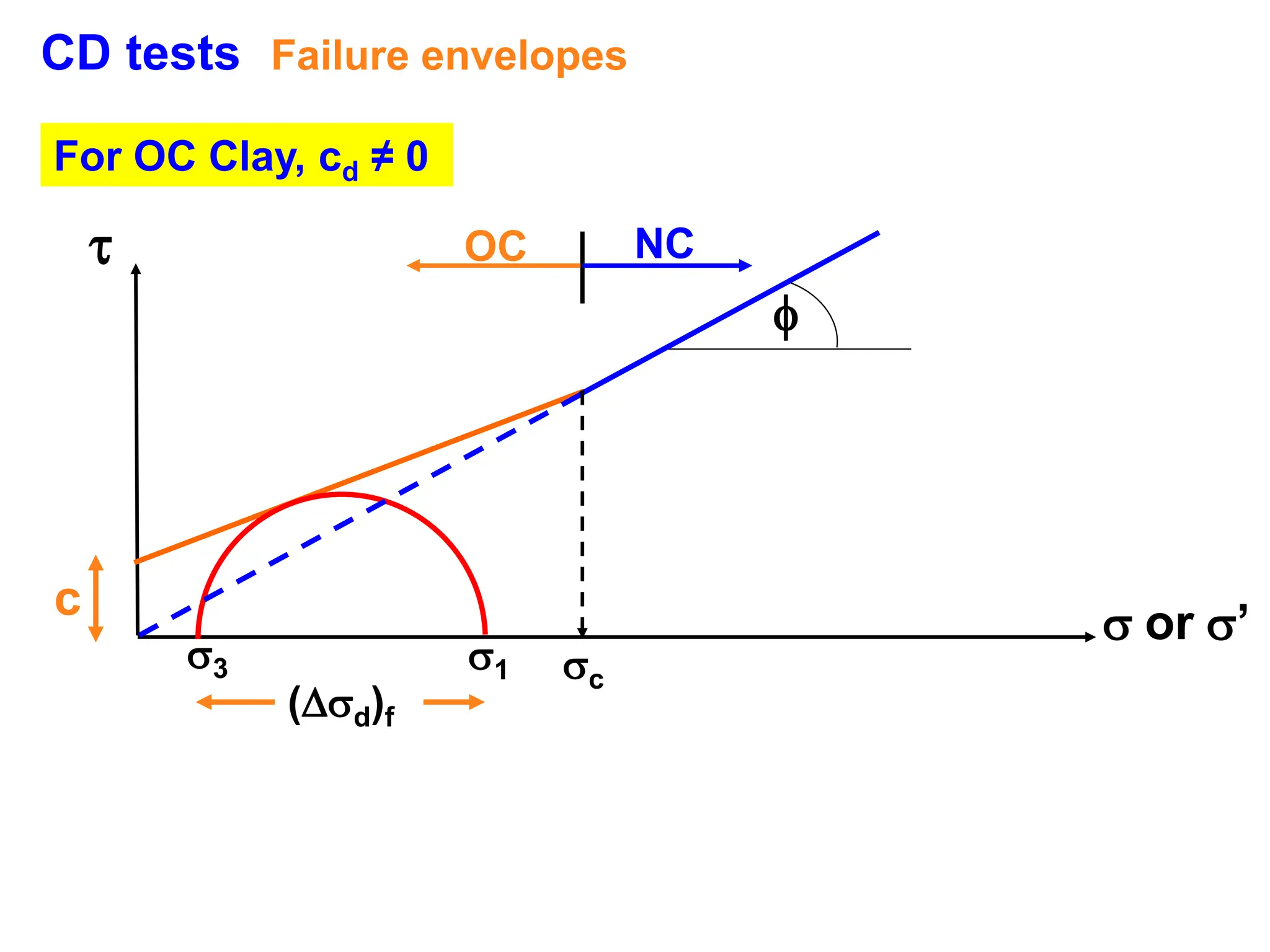
CD tests Failure envelopes
For OC Clay, cd ≠ 0

 or ’

3 1
(d)f
c
c
OC NC
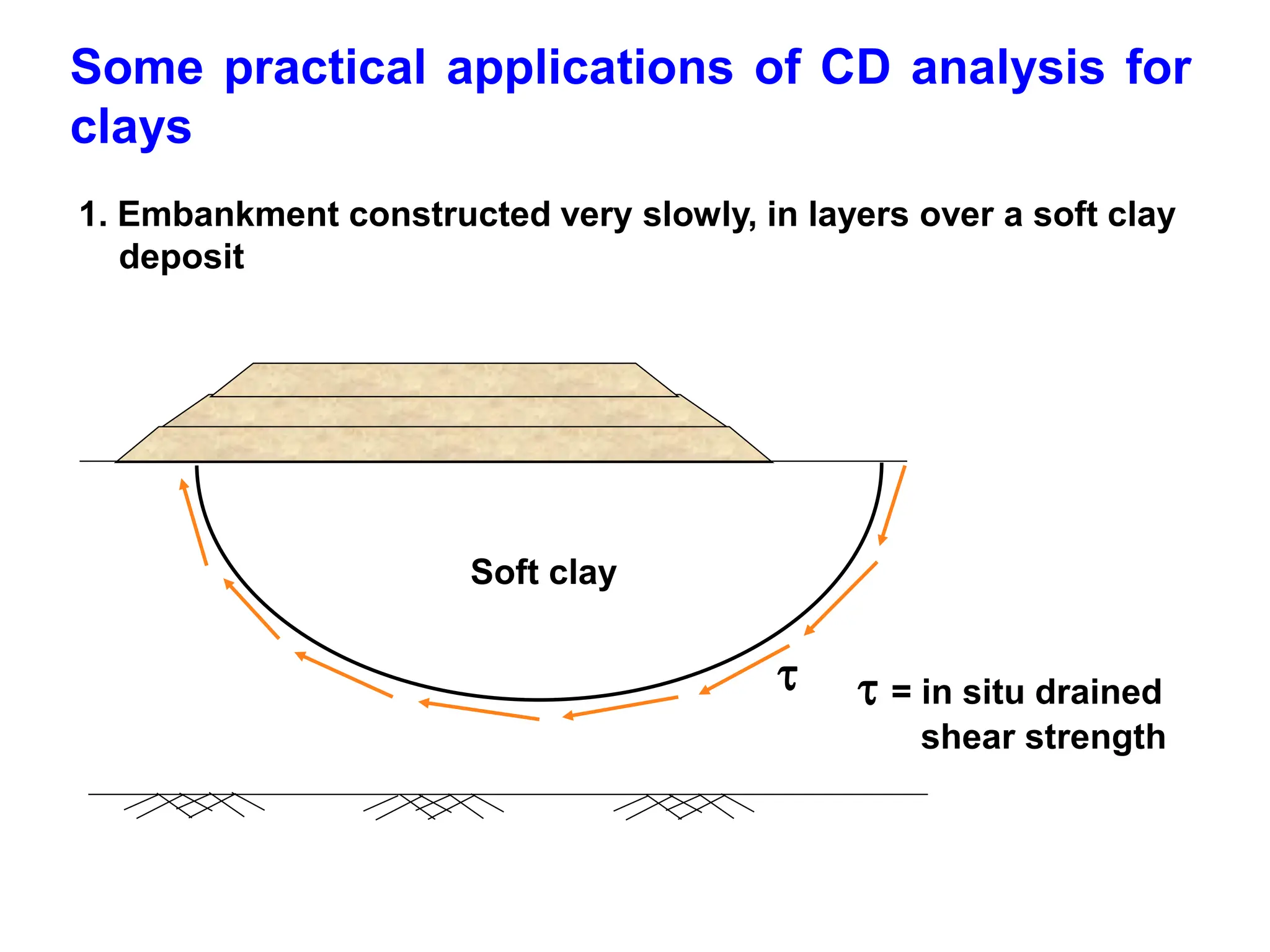
Some practical applications of CD analysis for
clays
  = in situ drained
shear strength
Soft clay
1. Embankment constructed very slowly, in layers over a soft clay
deposit
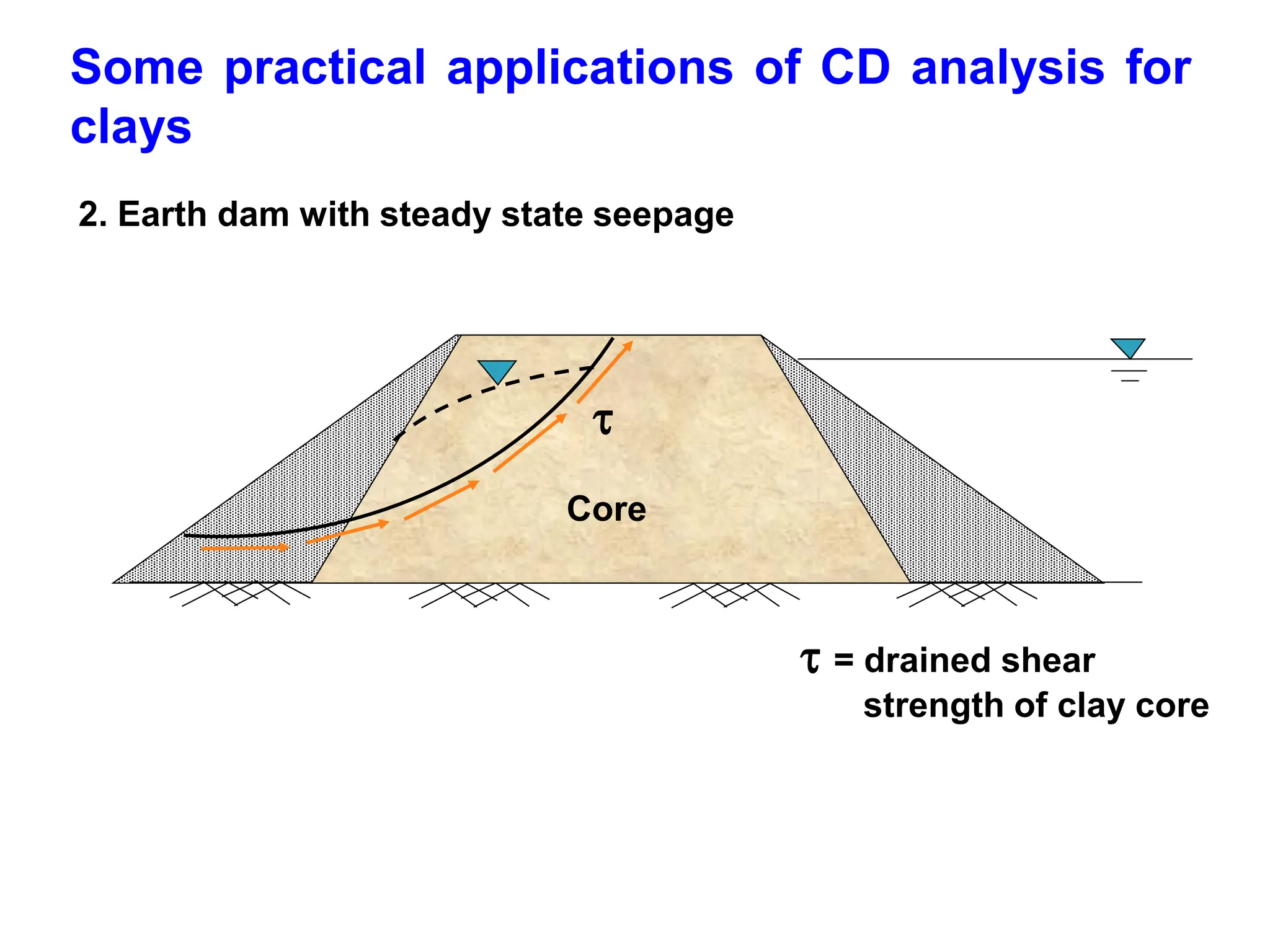
Some practical applications of CD analysis for
clays
2. Earth dam with steady state seepage
 = drained shear
strength of clay core

Core
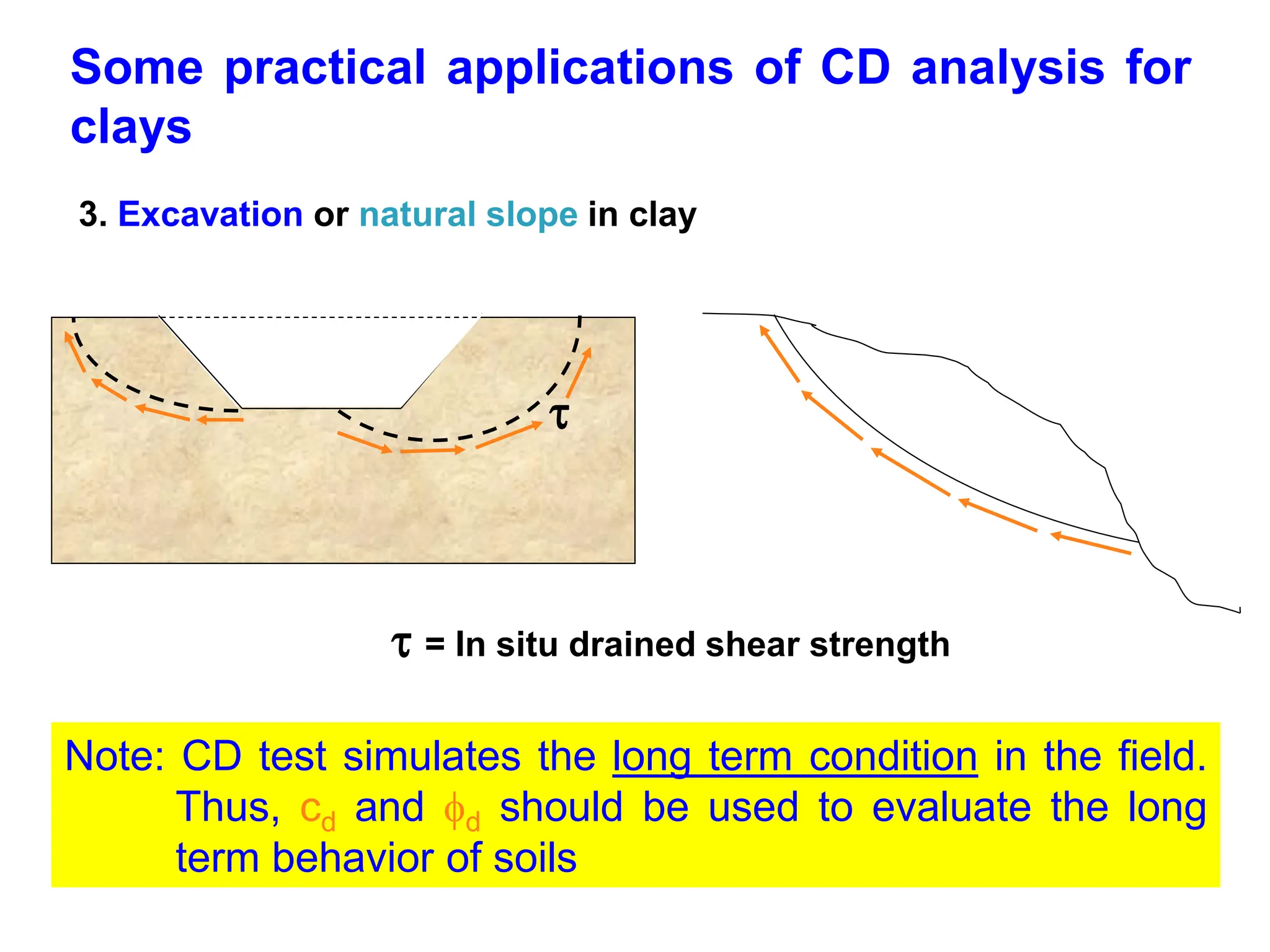
Some practical applications of CD analysis for
clays
3. Excavation or natural slope in clay
 = In situ drained shear strength

Note: CD test simulates the long term condition in the field.
Thus, cd and d should be used to evaluate the long
term behavior of soils
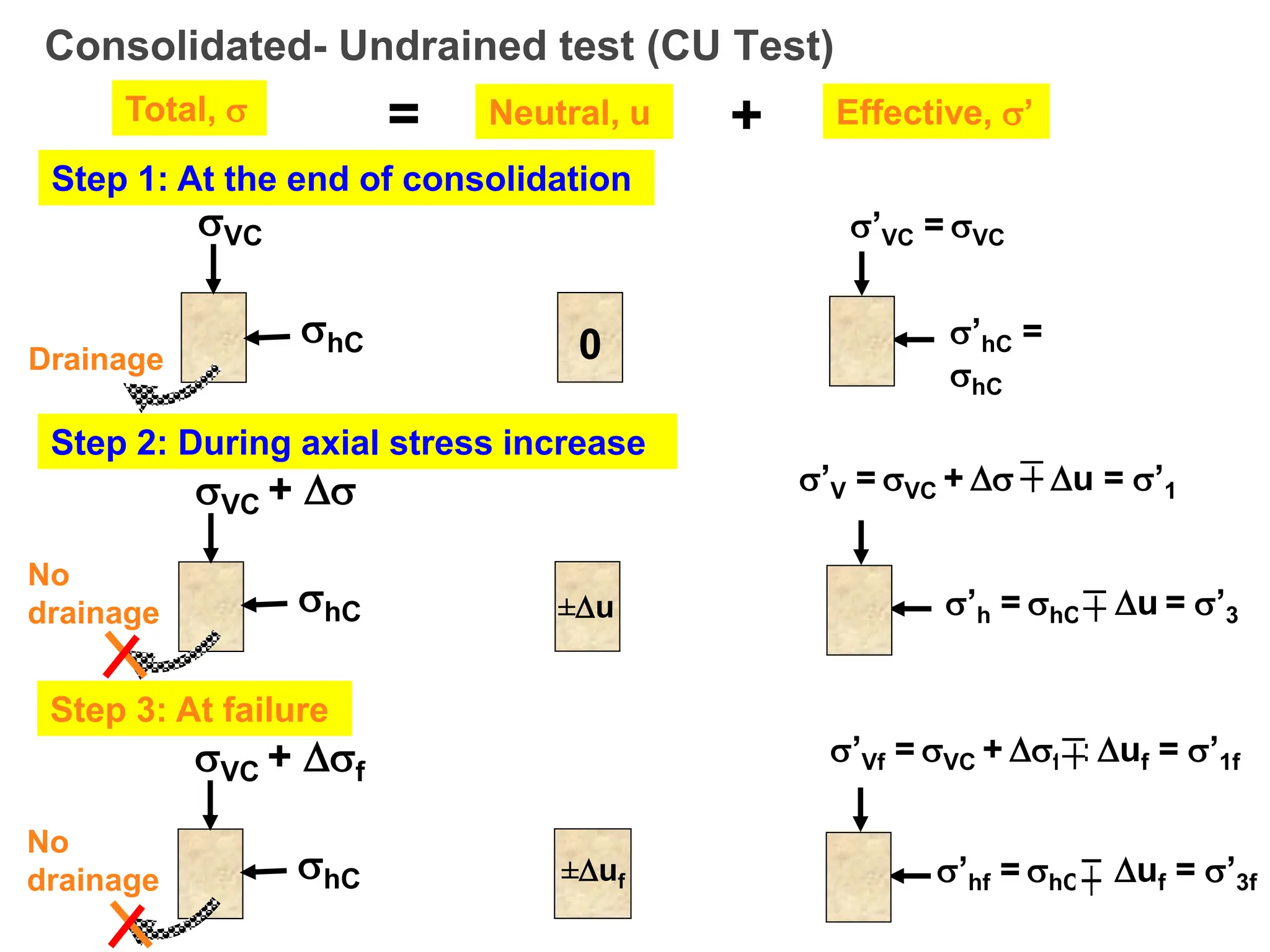
Consolidated- Undrained test (CU Test)
Step 1: At the end of consolidation
VC
hC
Total,  = Neutral, u Effective, ’
+
0
Step 2: During axial stress increase
’VC = VC
’hC =
hC
VC + 
hC ±u
Drainage
Step 3: At failure
VC + f
hC
No
drainage
No
drainage ±uf
’V = VC +  ± u = ’1
’h = hC ± u = ’3
’Vf = VC + f ± uf = ’1f
’hf = hC ± uf = ’3f

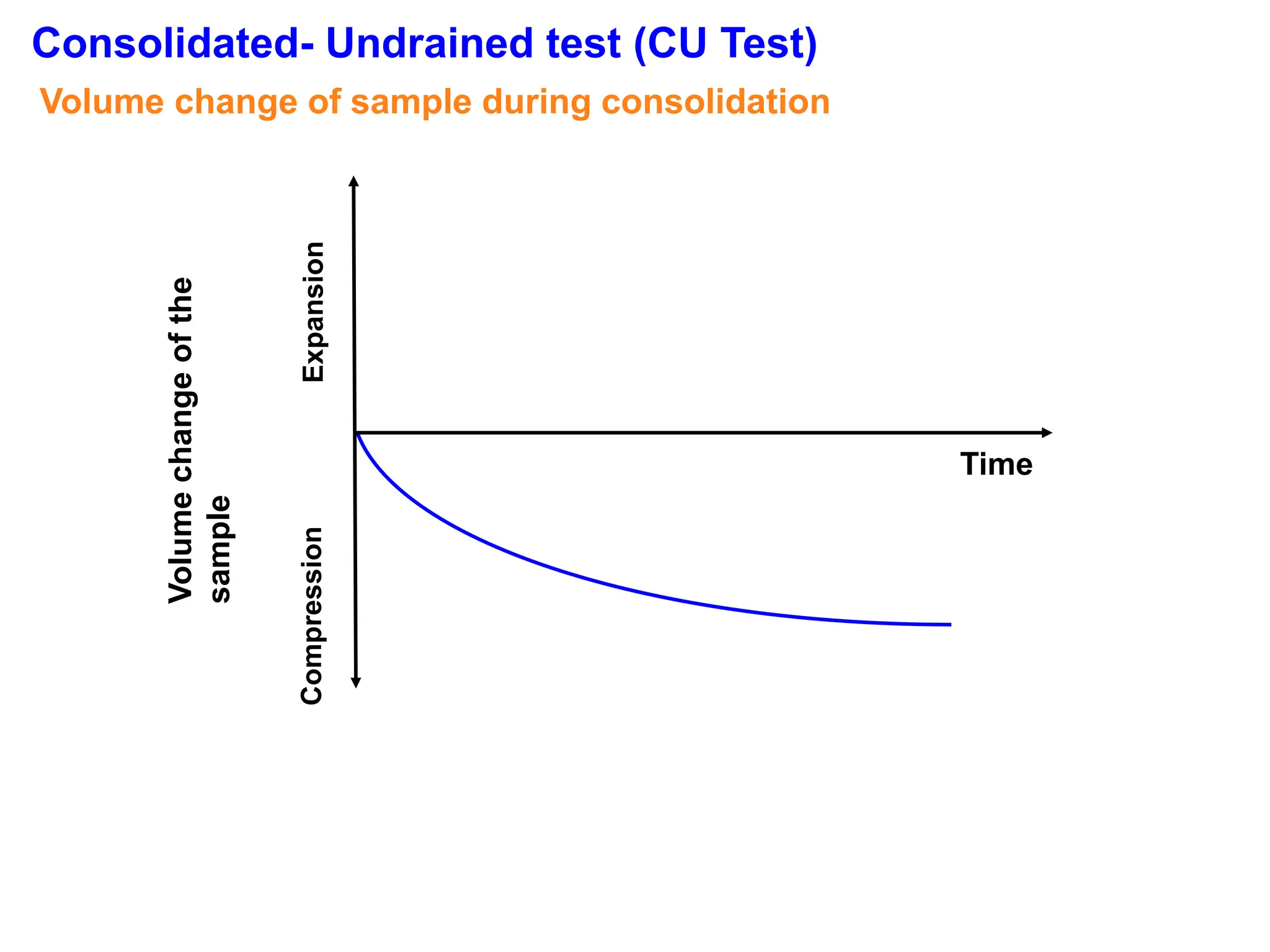
Volume
change
of
the
sample
Expansion
Compression
Time
Volume change of sample during consolidation
Consolidated- Undrained test (CU Test)
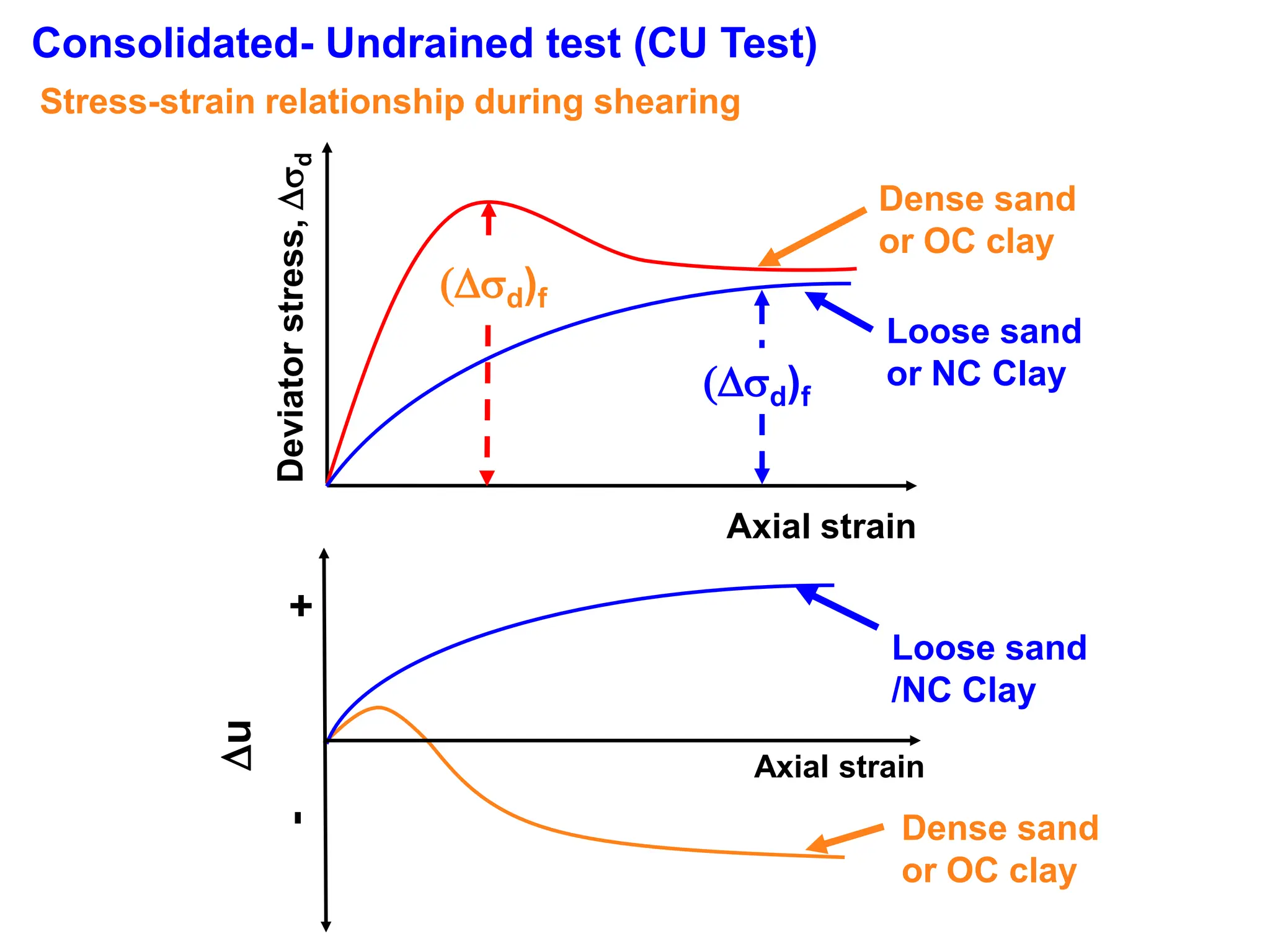
Deviator
stress,

d
Axial strain
Dense sand
or OC clay
(d)f
Dense sand
or OC clay
Loose sand
/NC Clay
u
+
-
Axial strain
Stress-strain relationship during shearing
Consolidated- Undrained test (CU Test)
Loose sand
or NC Clay
(d)f
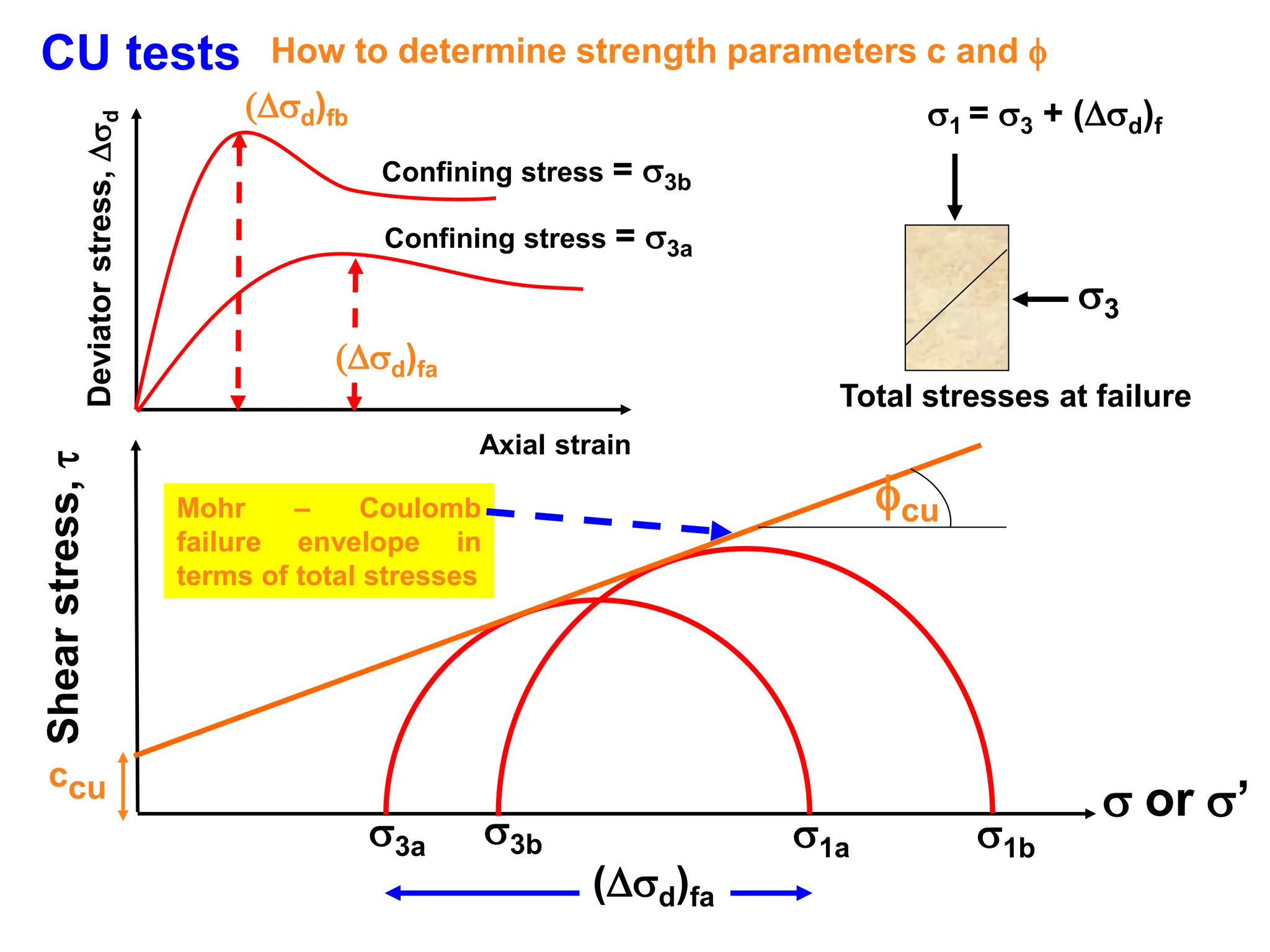
CU tests How to determine strength parameters c and 
Deviator
stress,

d
Axial strain
Shear
stress,

 or ’
(d)fb
Confining stress = 3b
3b 1b
3a 1a
(d)fa
cu
Mohr – Coulomb
failure envelope in
terms of total stresses
ccu
1 = 3 + (d)f
3
Total stresses at failure
(d)fa
Confining stress = 3a
(d)fa
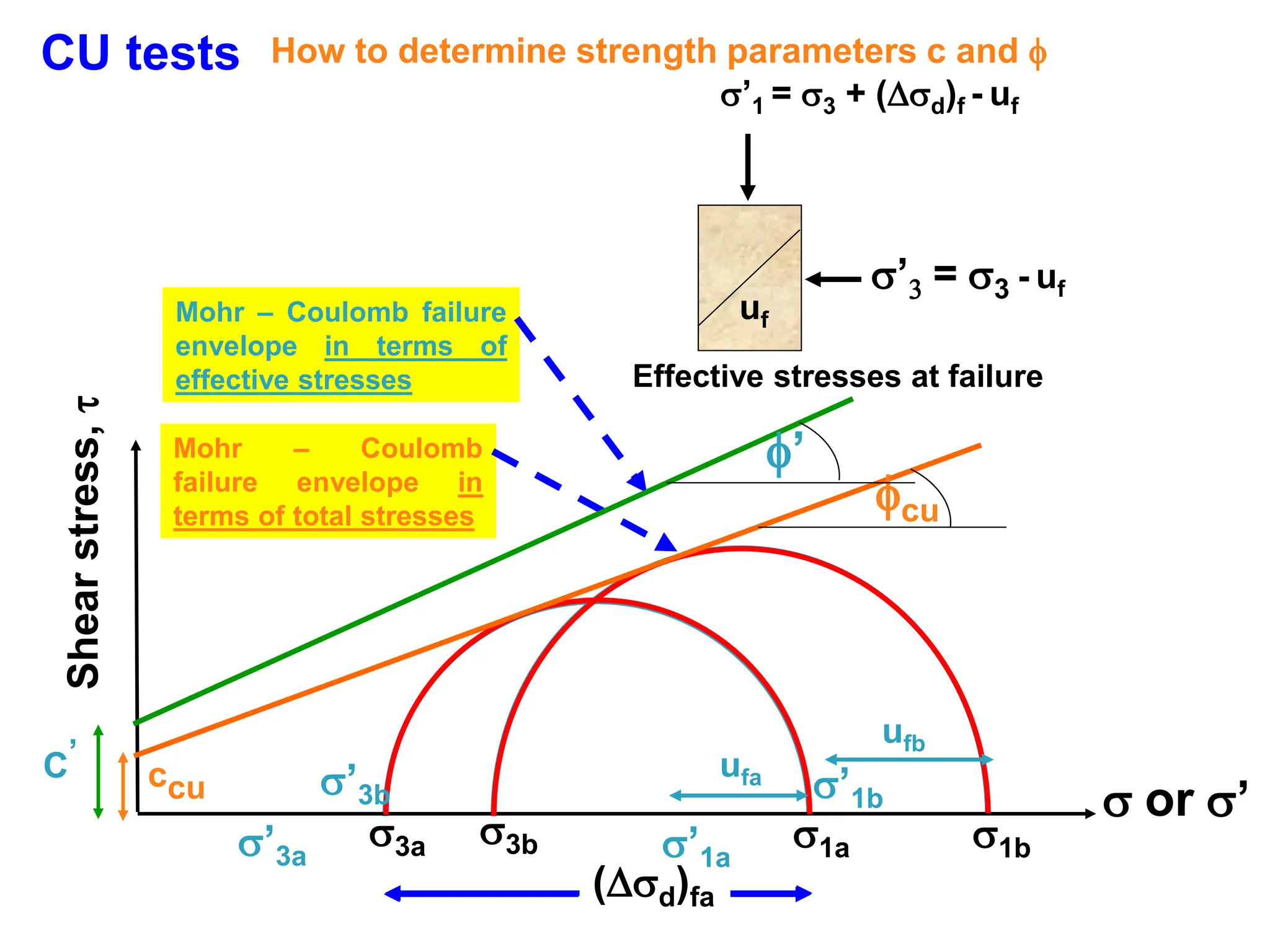
CU tests How to determine strength parameters c and 
Shear
stress,

 or ’
3b 1b
3a 1a
(d)fa
cu
Mohr – Coulomb
failure envelope in
terms of total stresses
ccu ’3b ’1b
’3a ’1a
Mohr – Coulomb failure
envelope in terms of
effective stresses
’
C’ ufa
ufb
’1 = 3 + (d)f - uf
’3 = 3 - uf
Effective stresses at failure
uf
CU tests
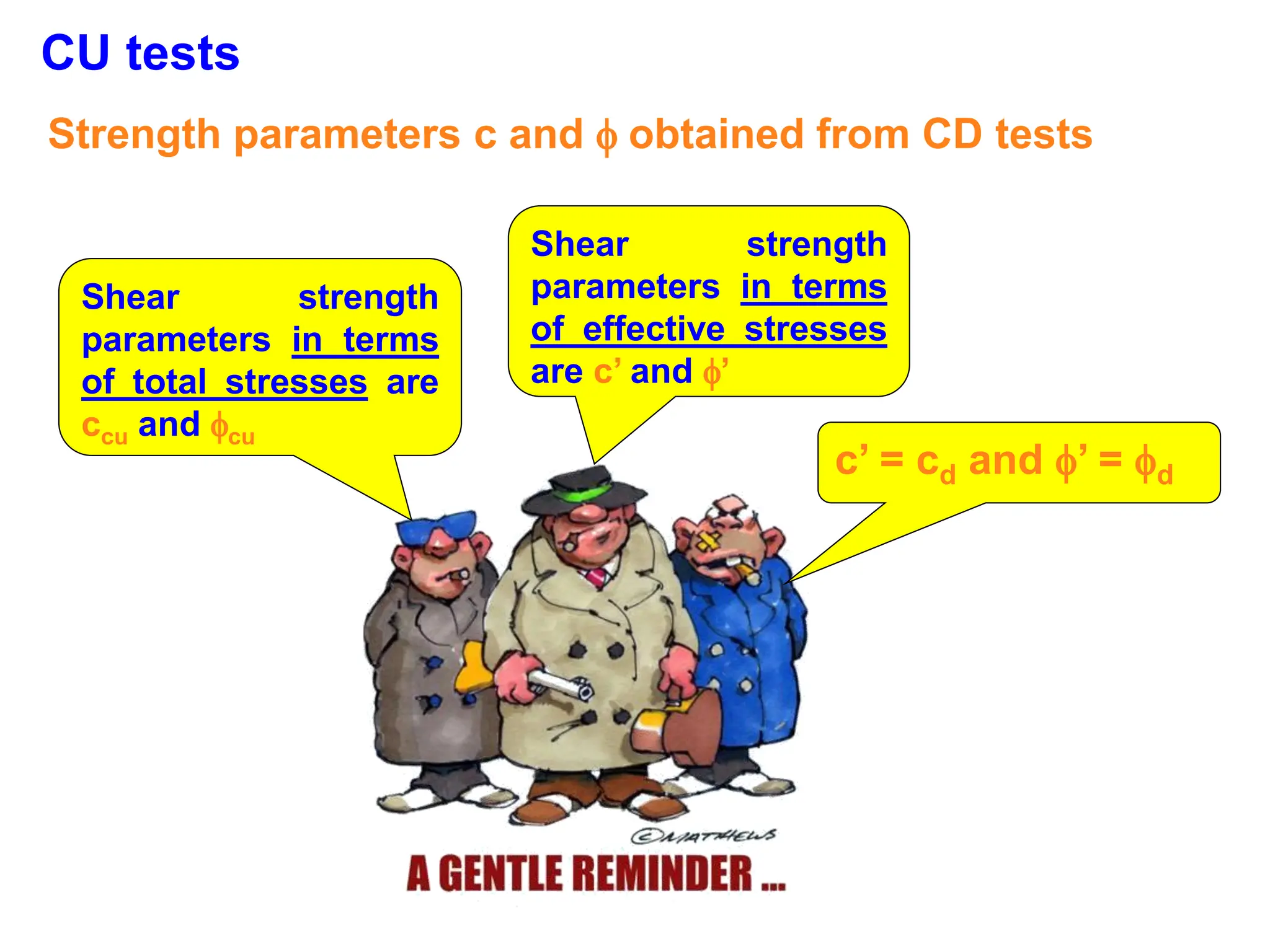
Strength parameters c and  obtained from CD tests
Shear strength
parameters in terms
of total stresses are
ccu and cu
Shear strength
parameters in terms
of effective stresses
are c’ and ’
c’ = cd and ’ = d
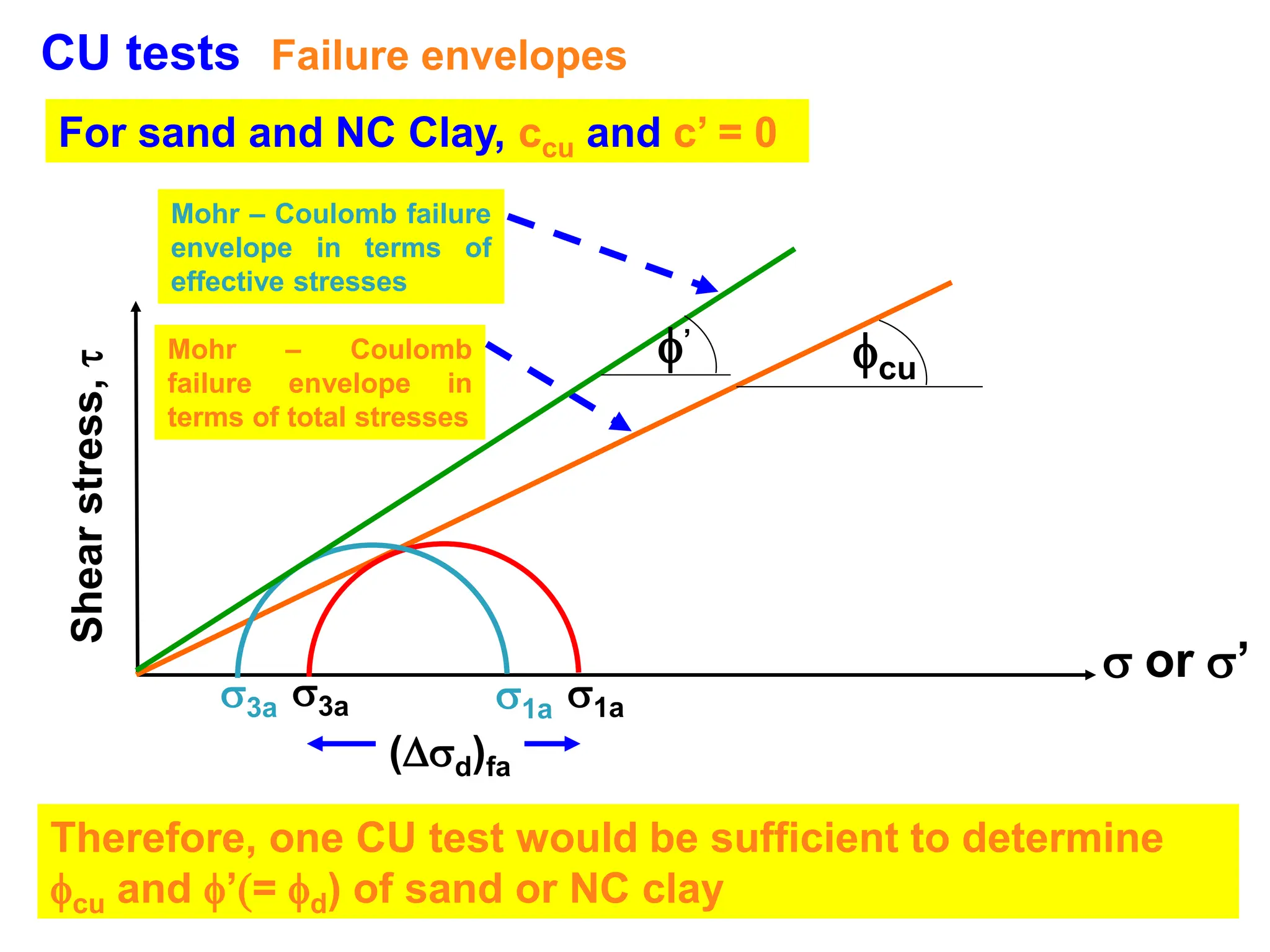
CU tests Failure envelopes
For sand and NC Clay, ccu and c’ = 0
Therefore, one CU test would be sufficient to determine
cu and ’(= d) of sand or NC clay
Shear
stress,

 or ’
cu
Mohr – Coulomb
failure envelope in
terms of total stresses
3a 1a
(d)fa
3a 1a
’
Mohr – Coulomb failure
envelope in terms of
effective stresses
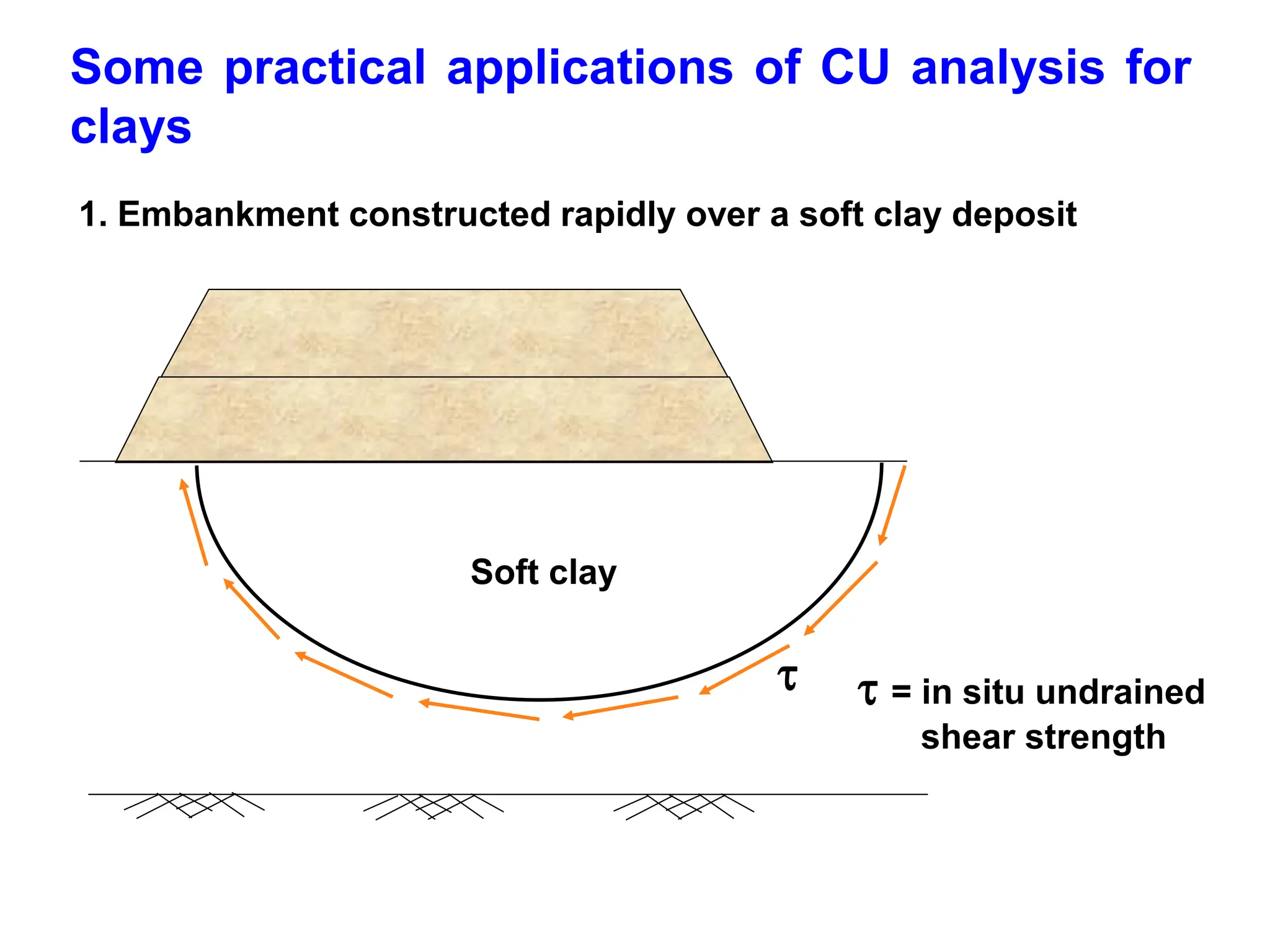
Some practical applications of CU analysis for
clays
  = in situ undrained
shear strength
Soft clay
1. Embankment constructed rapidly over a soft clay deposit
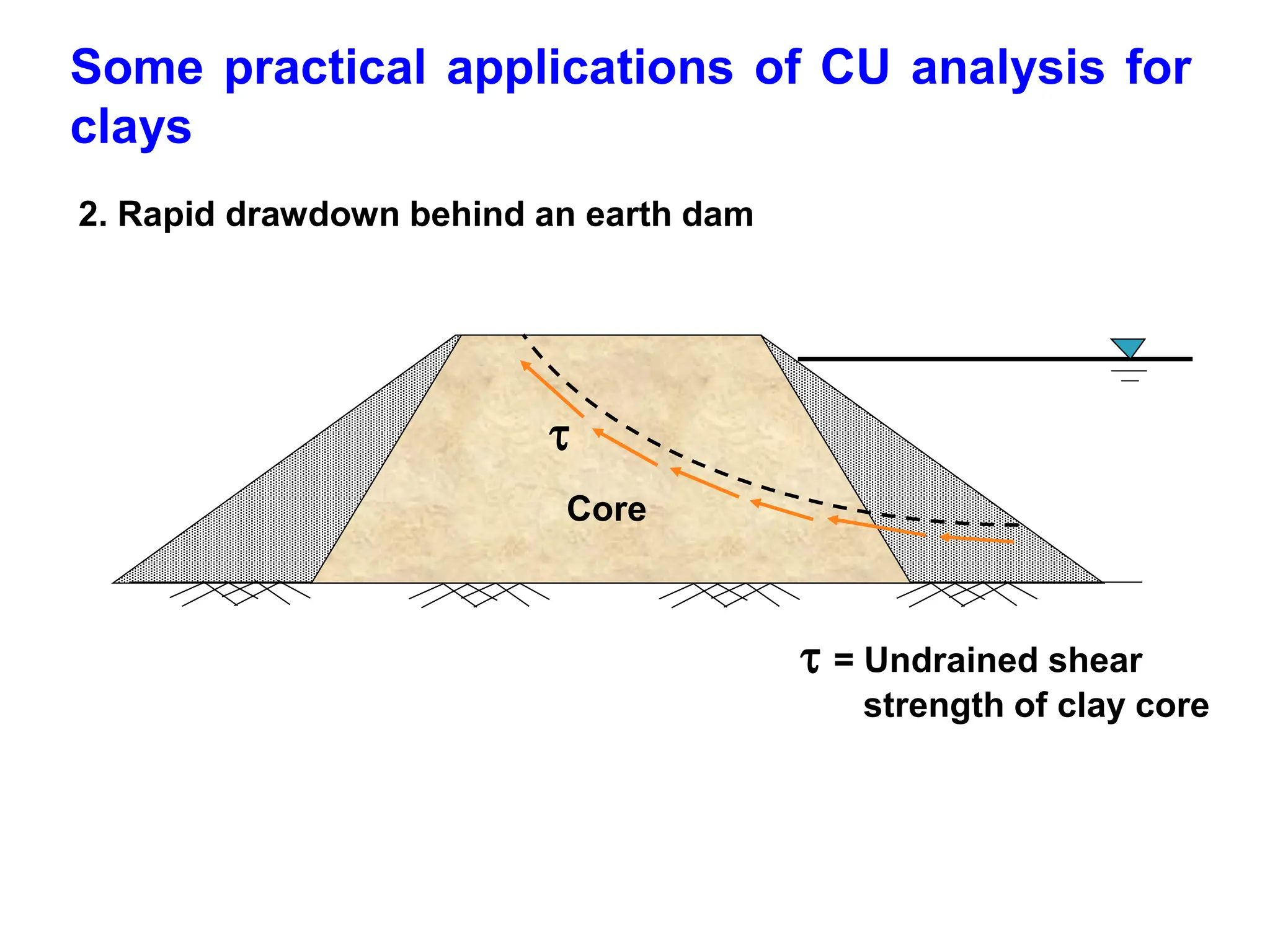
Some practical applications of CU analysis for
clays
2. Rapid drawdown behind an earth dam
 = Undrained shear
strength of clay core
Core

Some practical applications of CU analysis for
clays
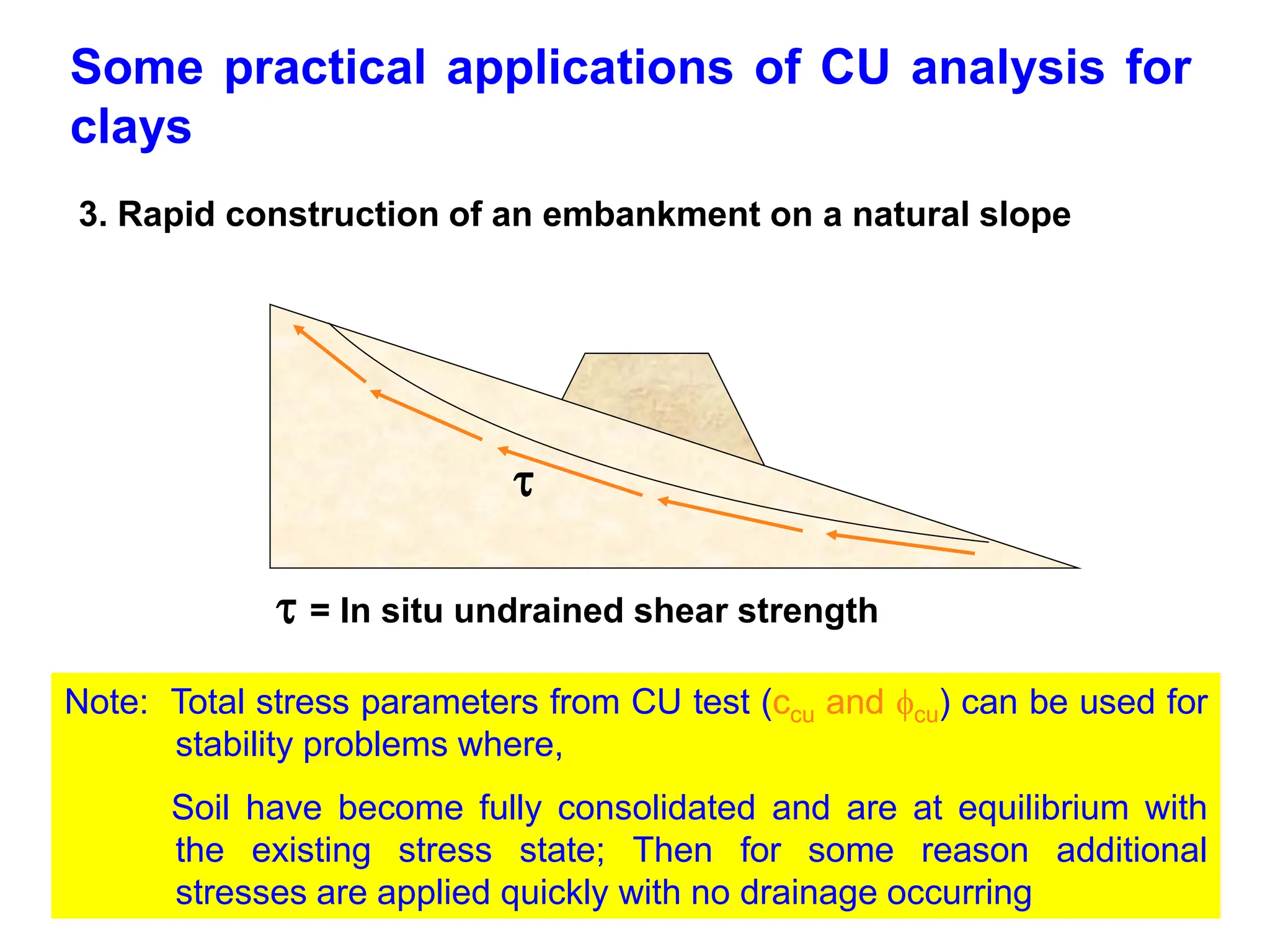
3. Rapid construction of an embankment on a natural slope
Note: Total stress parameters from CU test (ccu and cu) can be used for
stability problems where,
Soil have become fully consolidated and are at equilibrium with
the existing stress state; Then for some reason additional
stresses are applied quickly with no drainage occurring
 = In situ undrained shear strength

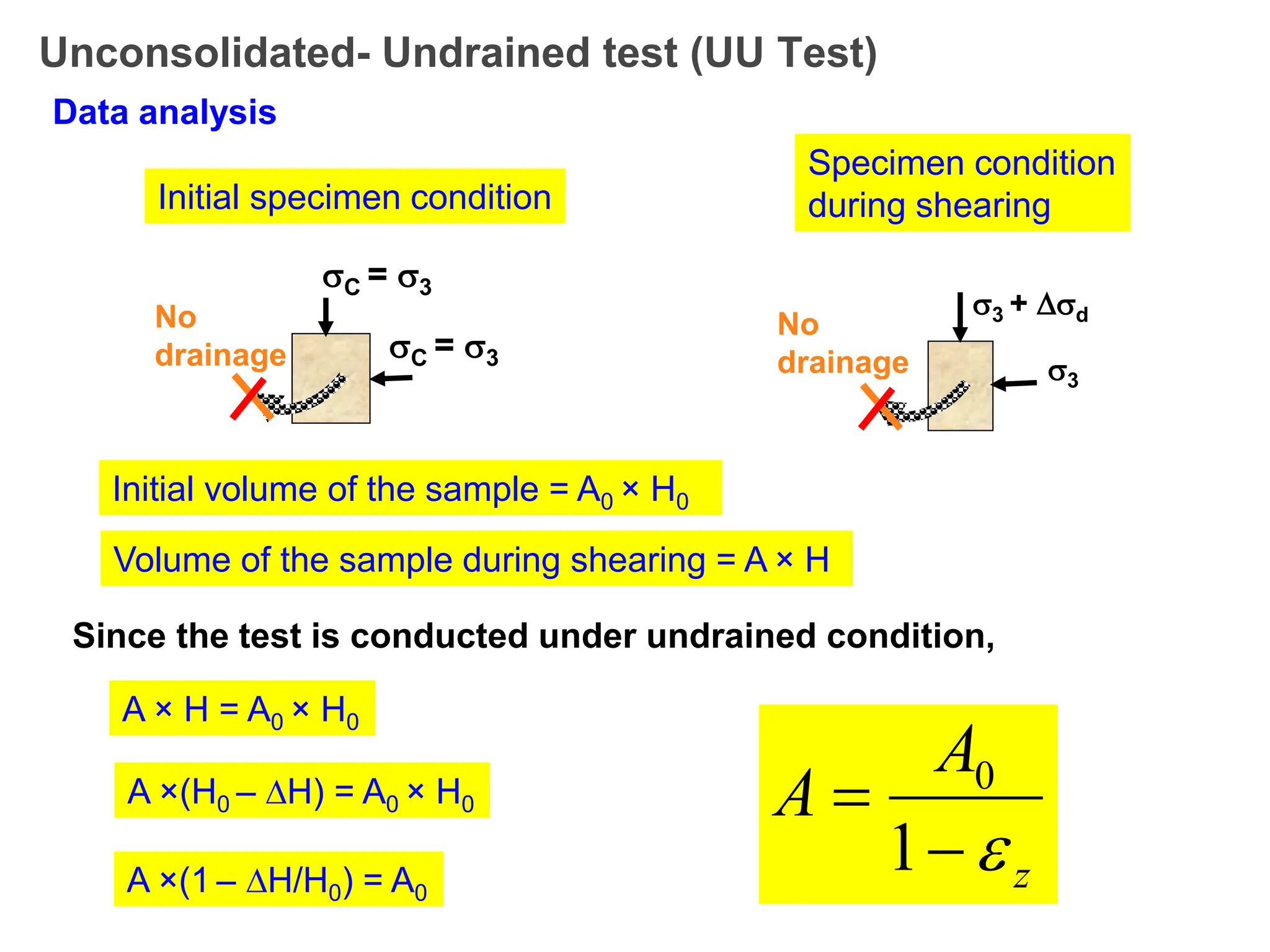
Unconsolidated- Undrained test (UU Test)
Data analysis
C = 3
C = 3
No
drainage
Initial specimen condition
3 + d
3
No
drainage
Specimen condition
during shearing
Initial volume of the sample = A0 × H0
Volume of the sample during shearing = A × H
Since the test is conducted under undrained condition,
A × H = A0 × H0
A ×(H0 – H) = A0 × H0
A ×(1 – H/H0) = A0
z
A
A



1
0
Unconsolidated- Undrained test (UU Test)
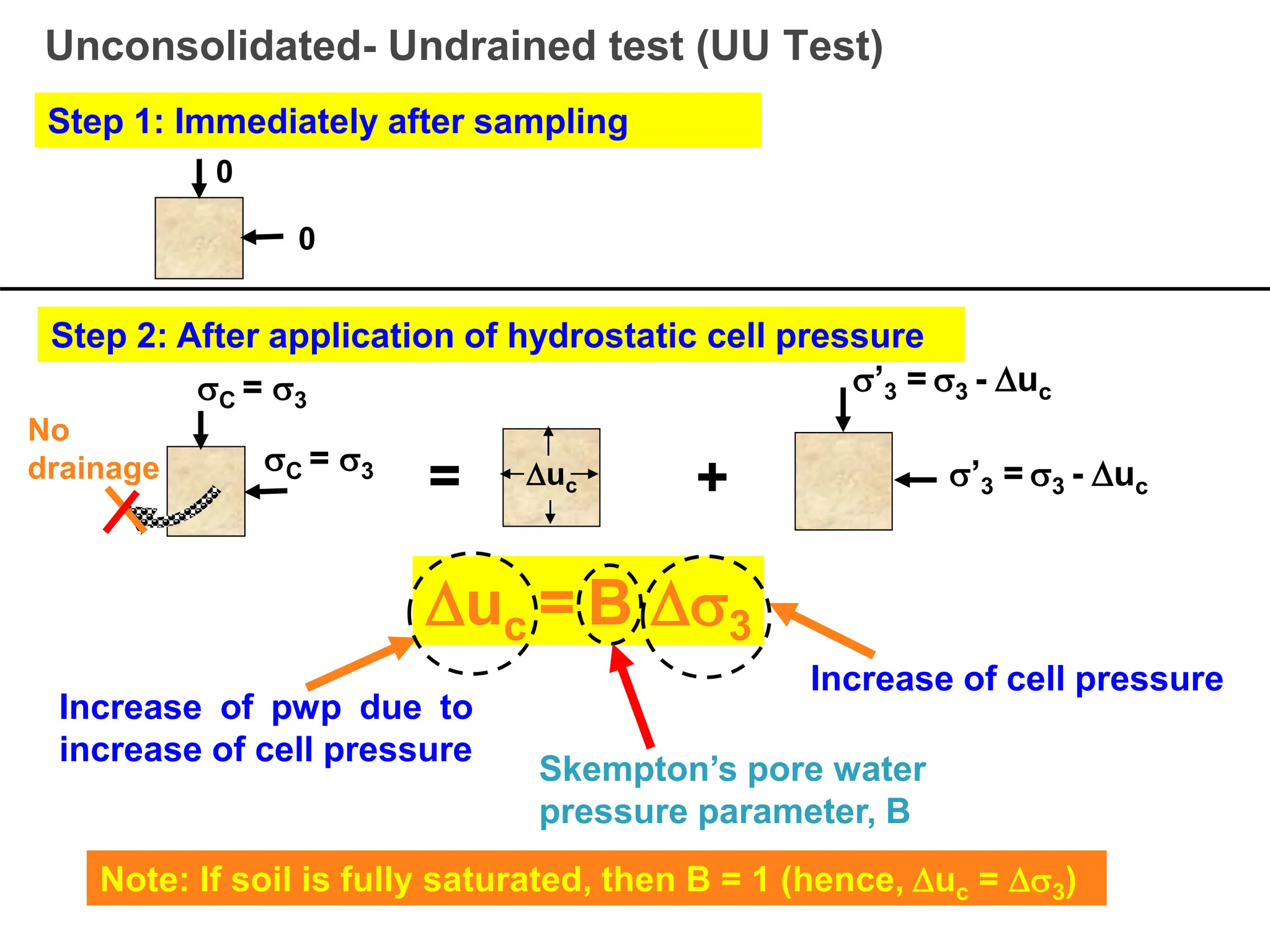
Step 1: Immediately after sampling
0
0
= +
Step 2: After application of hydrostatic cell pressure
uc = B 3
C = 3
C = 3 uc
’3 = 3 - uc
’3 = 3 - uc
No
drainage
Increase of pwp due to
increase of cell pressure
Increase of cell pressure
Skempton’s pore water
pressure parameter, B
Note: If soil is fully saturated, then B = 1 (hence, uc = 3)
Unconsolidated- Undrained test (UU Test)
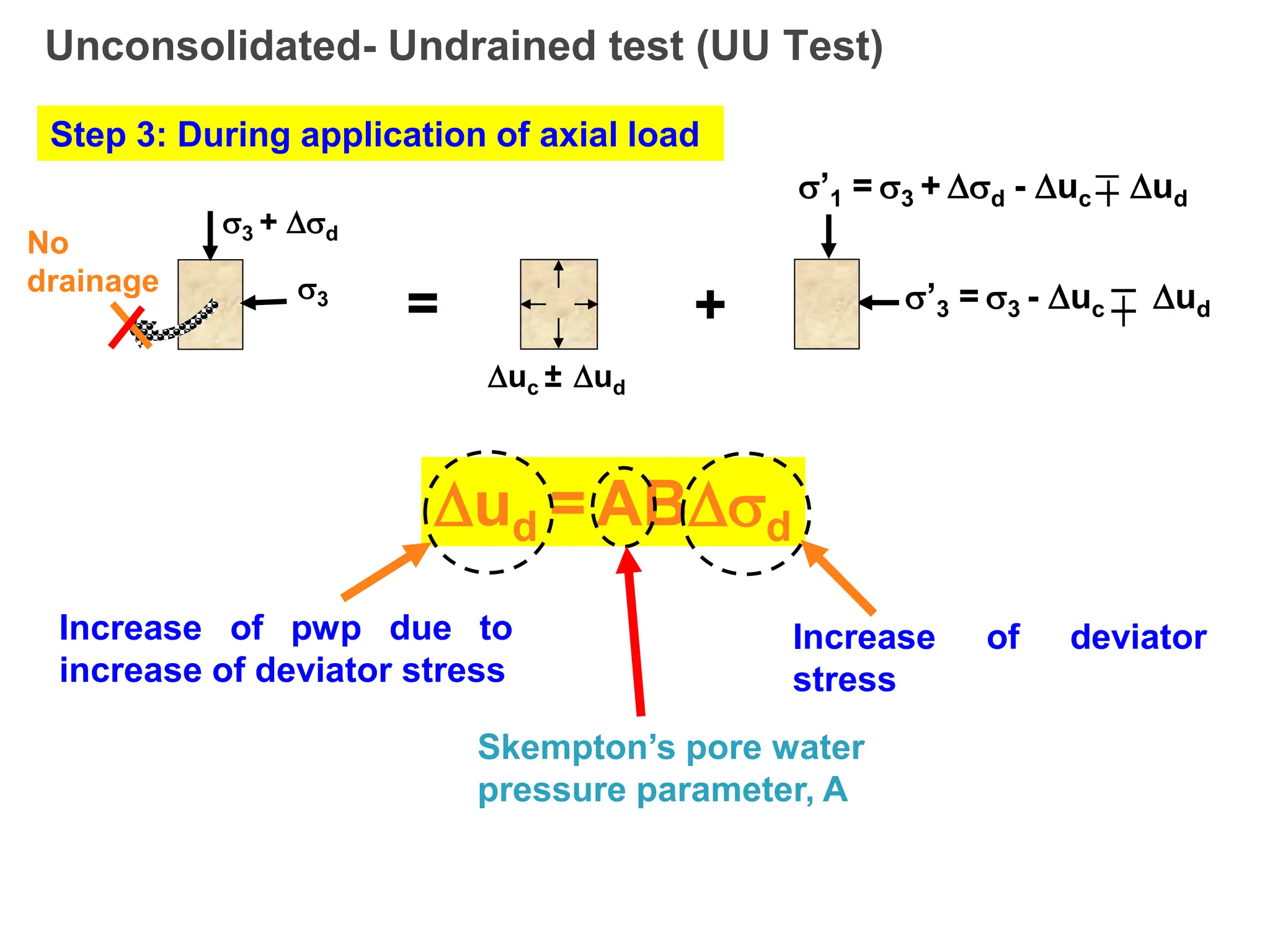
Step 3: During application of axial load
3 + d
3
No
drainage
’1 = 3 + d - uc ud
’3 = 3 - uc ud

ud = ABd
uc ± ud
= +
Increase of pwp due to
increase of deviator stress
Increase of deviator
stress
Skempton’s pore water
pressure parameter, A
Unconsolidated- Undrained test (UU Test)
Combining steps 2 and 3,
uc = B 3 ud = ABd
u = uc + ud
Total pore water pressure increment at any stage, u
u = B [3 + Ad]
Skempton’s pore
water pressure
equation
u = B [3 + A(1 – 3]
Unconsolidated- Undrained test (UU Test)
Derivation of Skempton’s pore water pressure equation
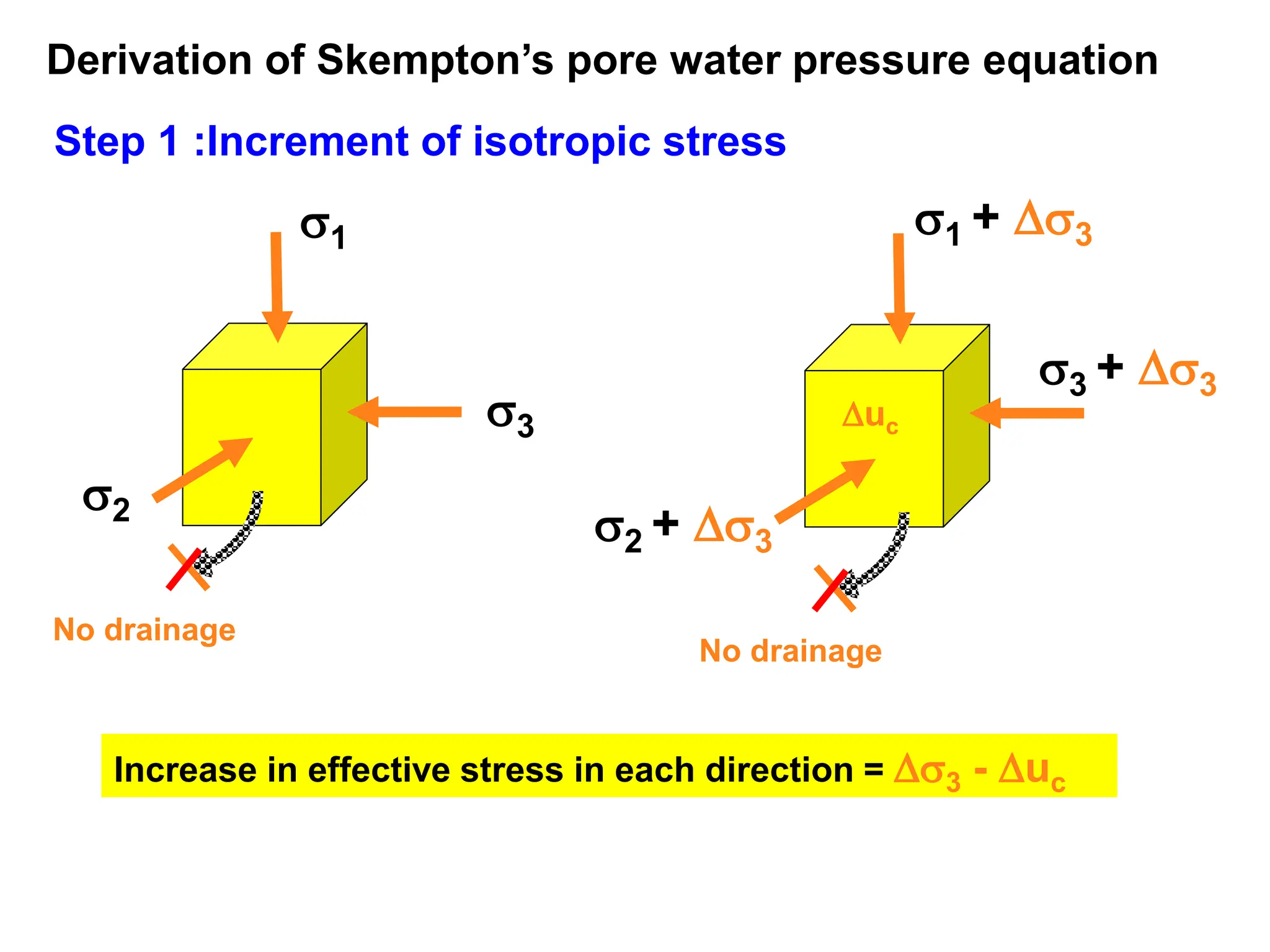
Step 1 :Increment of isotropic stress
Derivation of Skempton’s pore water pressure equation
2
3
1
No drainage
1 + 3
3 + 3
2 + 3
No drainage
uc
Increase in effective stress in each direction = 3 - uc
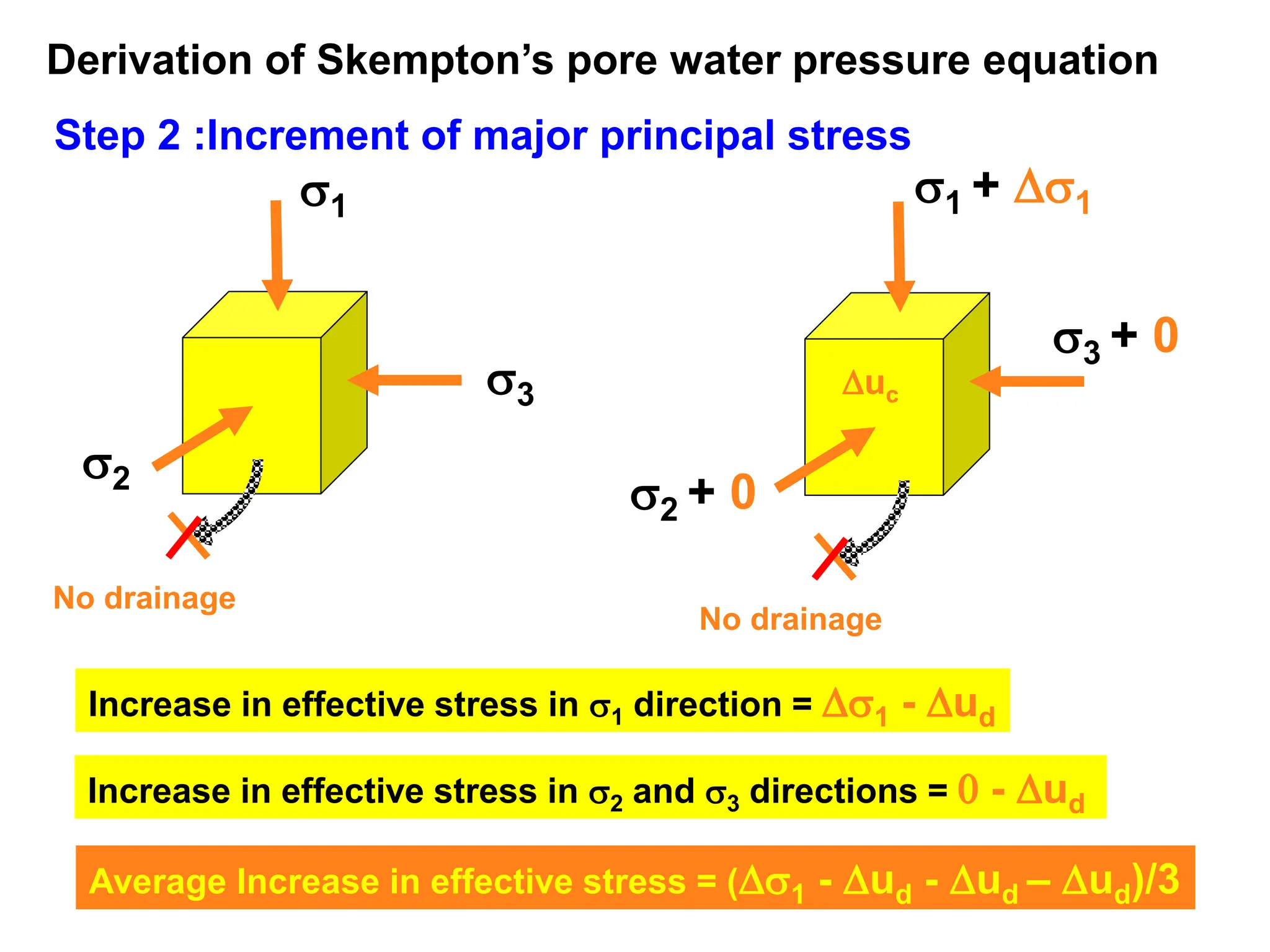
Step 2 :Increment of major principal stress
Derivation of Skempton’s pore water pressure equation
2
3
1
No drainage
1 + 1
3 + 0
2 + 0
No drainage
uc
Increase in effective stress in 1 direction = 1 - ud
Increase in effective stress in 2 and 3 directions = 0 - ud
Average Increase in effective stress = (1 - ud - ud – ud)/3
Typical values for parameter B
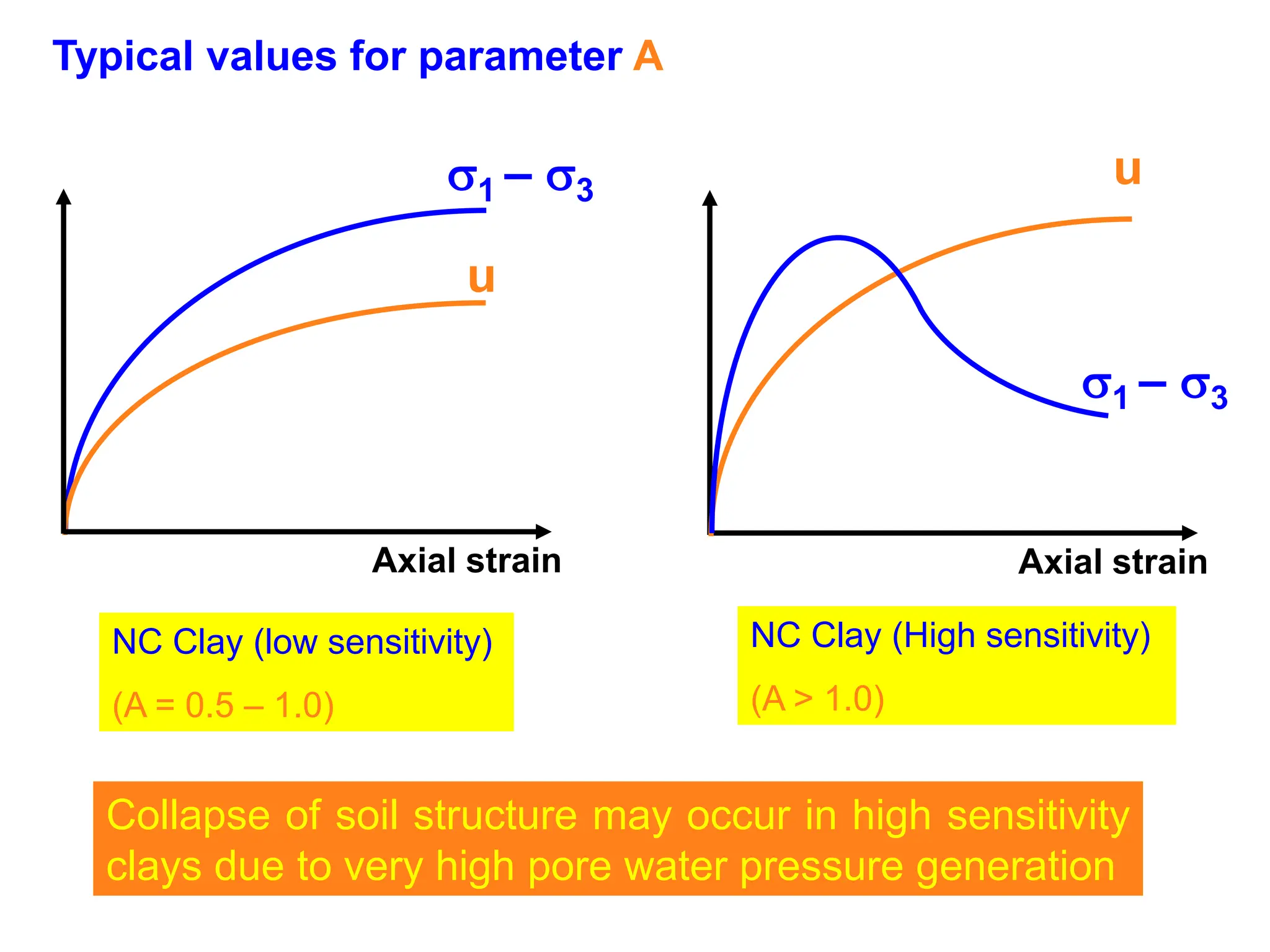
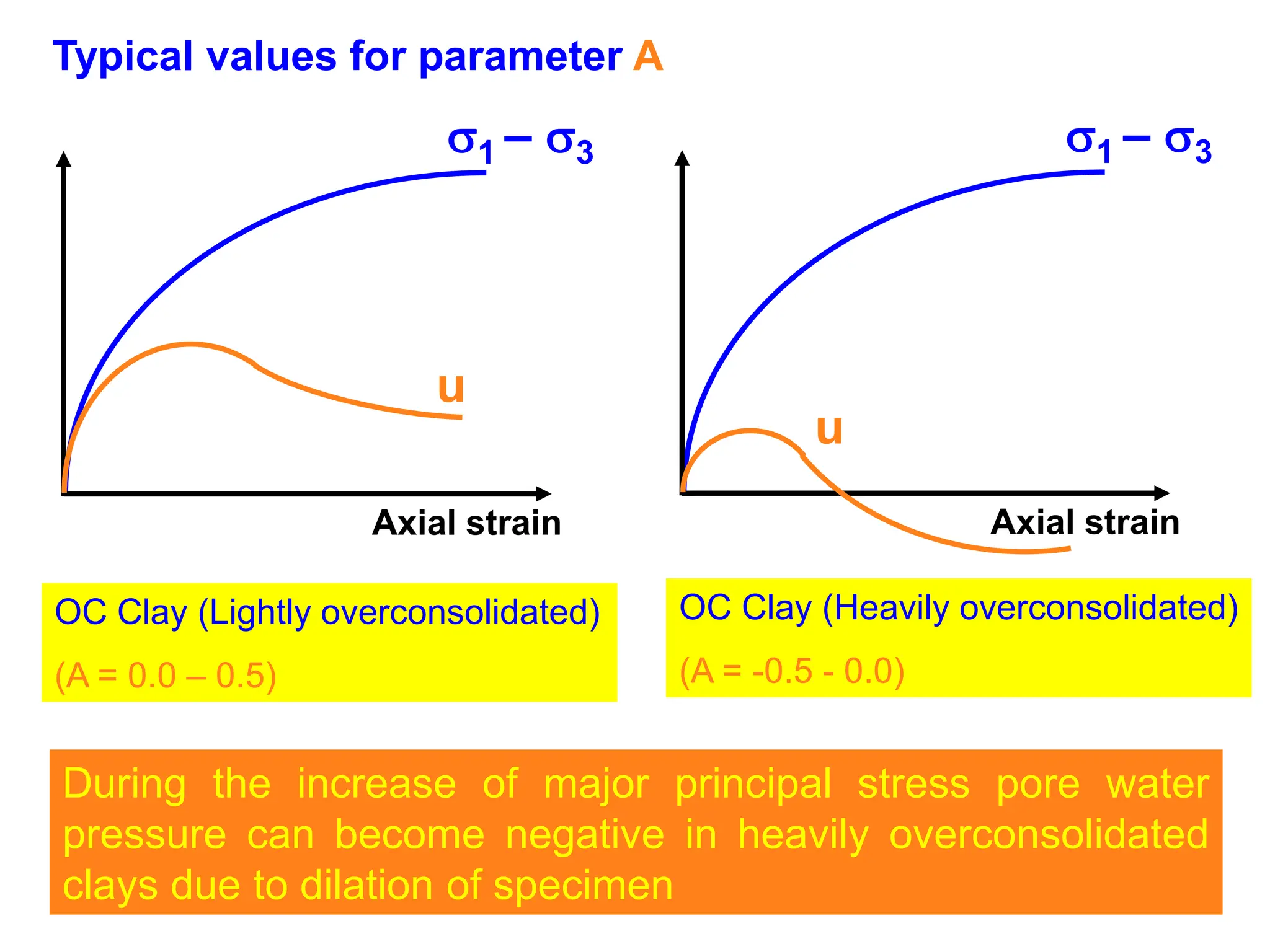
Typical values for parameter A
1 – 3
u
Axial strain
NC Clay (low sensitivity)
(A = 0.5 – 1.0)
NC Clay (High sensitivity)
(A > 1.0)
Axial strain
u
1 – 3
Collapse of soil structure may occur in high sensitivity
clays due to very high pore water pressure generation
Typical values for parameter A
1 – 3
Axial strain
OC Clay (Lightly overconsolidated)
(A = 0.0 – 0.5)
OC Clay (Heavily overconsolidated)
(A = -0.5 - 0.0)
During the increase of major principal stress pore water
pressure can become negative in heavily overconsolidated
clays due to dilation of specimen
u
1 – 3
Axial strain
u
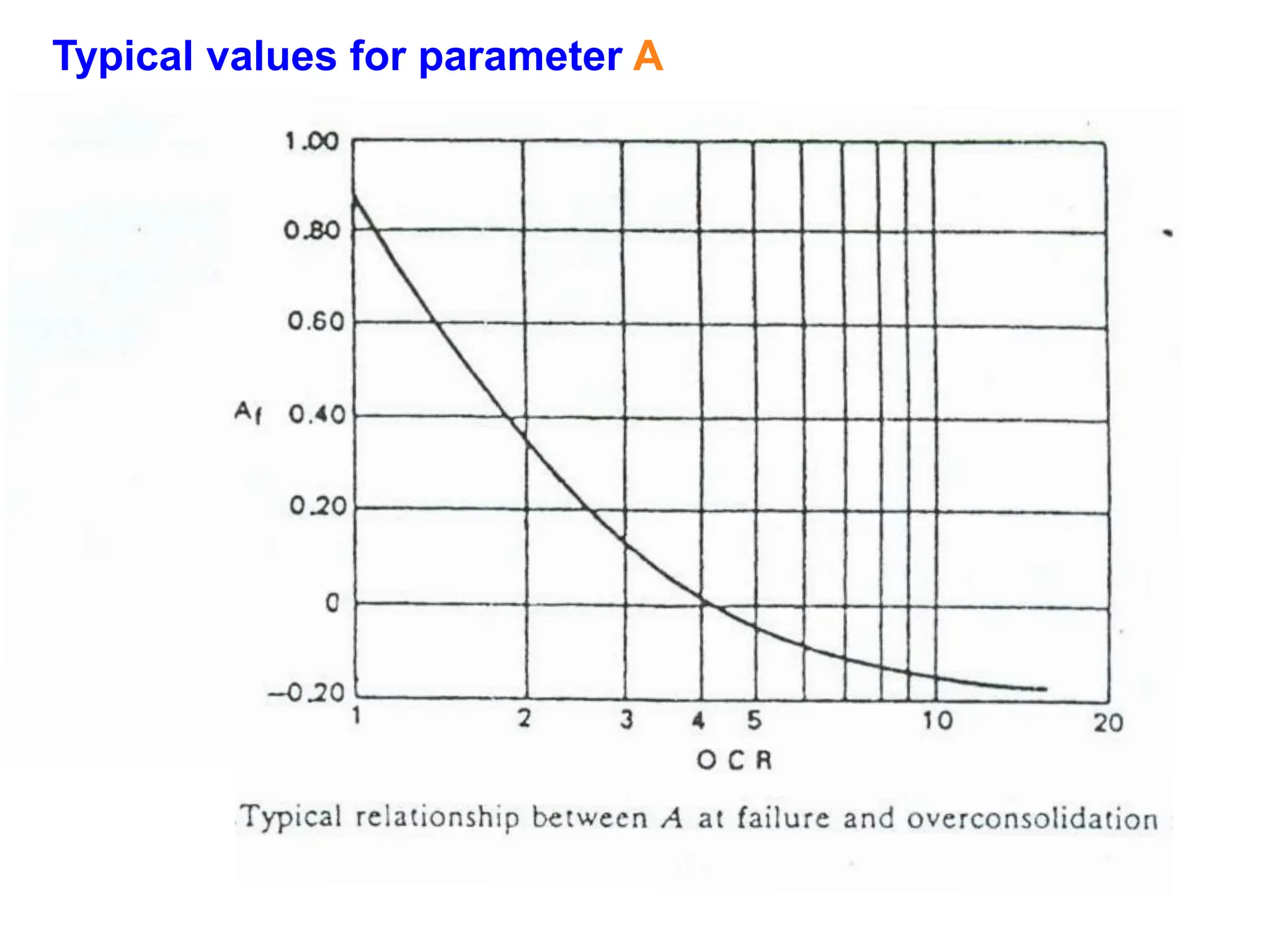
Typical values for parameter A
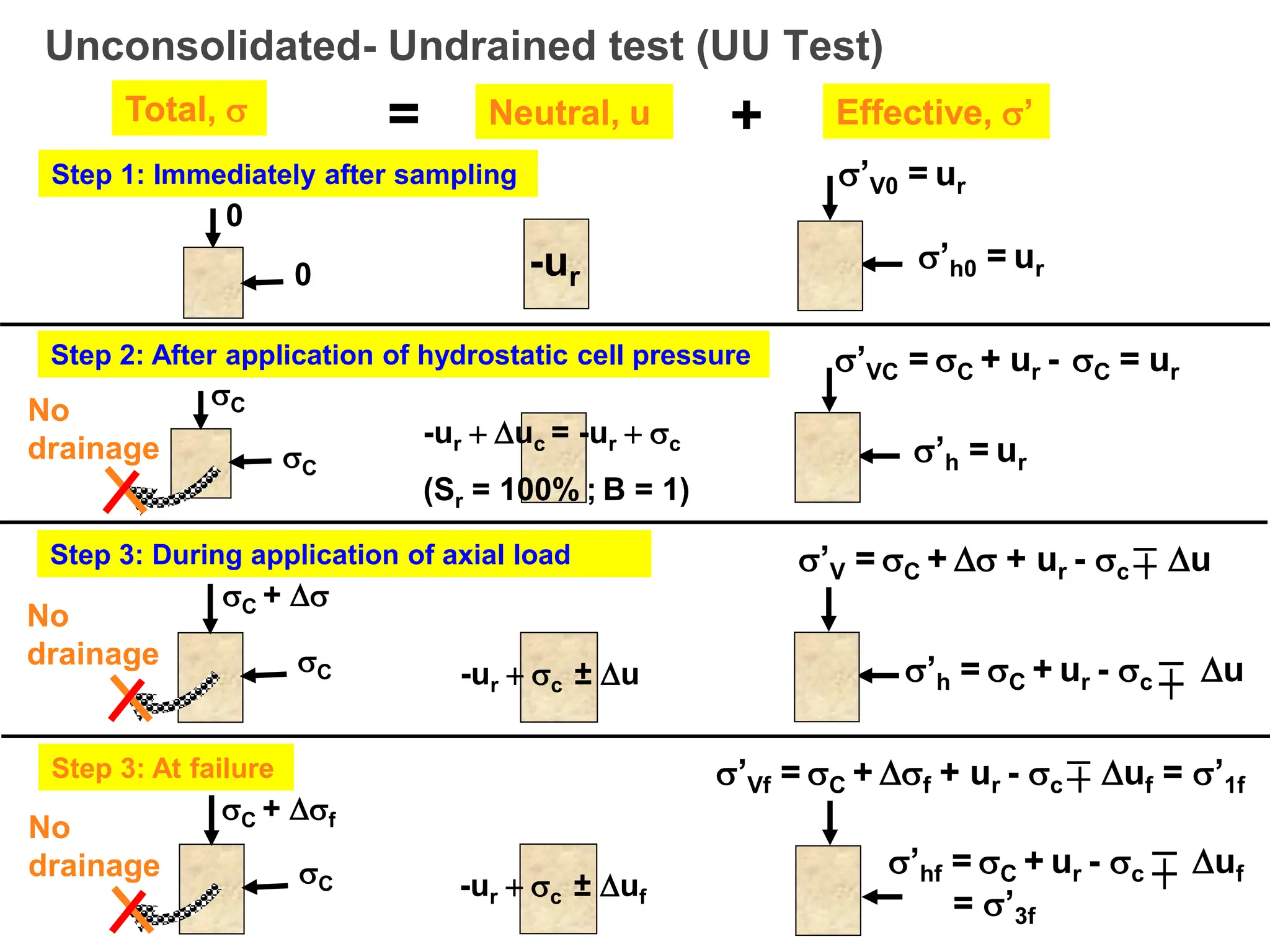
Unconsolidated- Undrained test (UU Test)
Step 1: Immediately after sampling
0
0
Total,  = Neutral, u Effective, ’
+
-ur
Step 2: After application of hydrostatic cell pressure
’V0 = ur
’h0 = ur
C
C
-ur  uc = -ur  c
(Sr = 100% ; B = 1)
Step 3: During application of axial load
C + 
C
No
drainage
No
drainage
-ur  c ± u
’VC = C + ur - C = ur
’h = ur
Step 3: At failure
’V = C +  + ur - c u
’h = C + ur - c u

’hf = C + ur - c uf
= ’3f
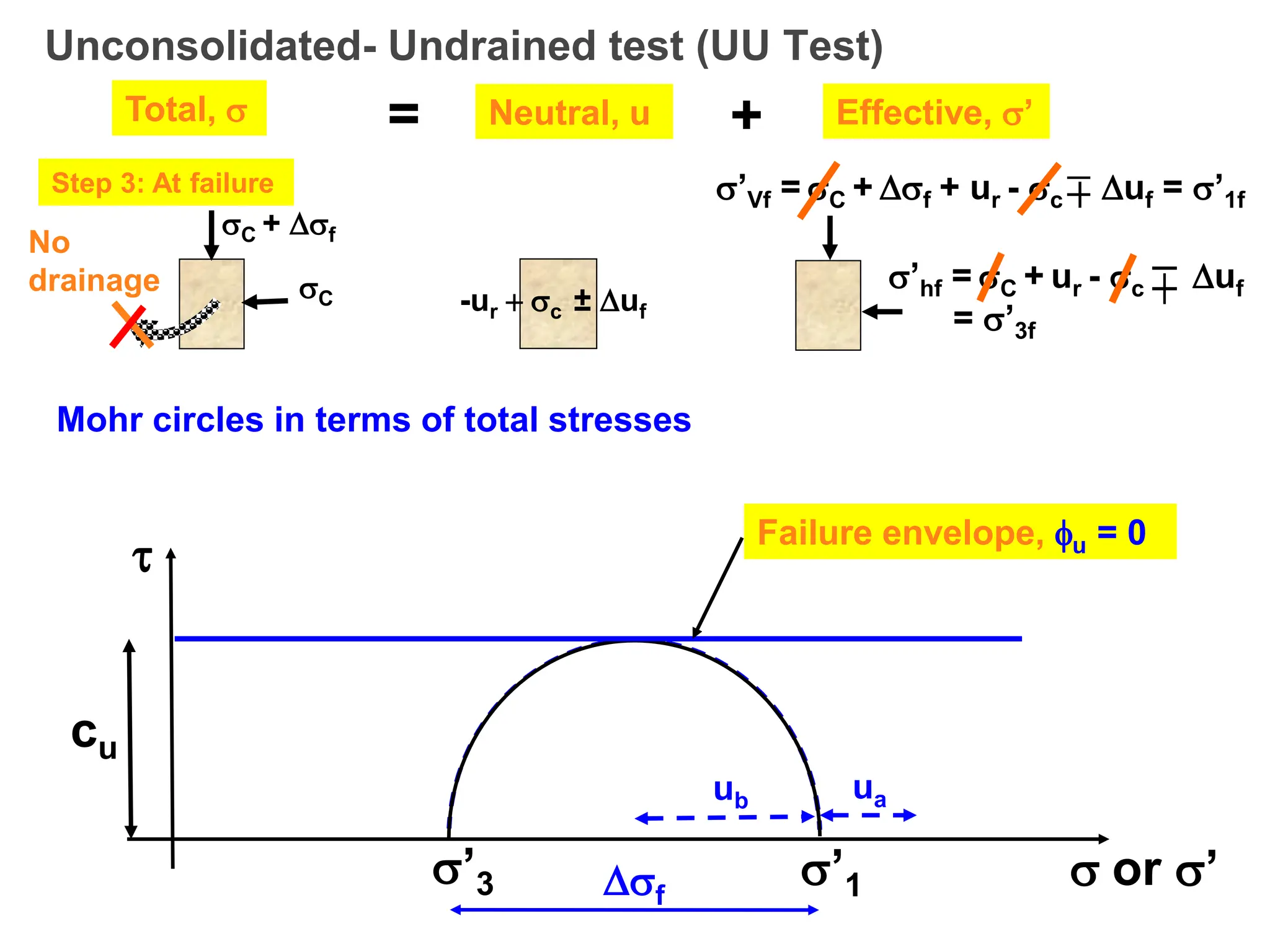
’Vf = C + f + ur - c uf = ’1f

-ur  c ± uf
C
C + f
No
drainage
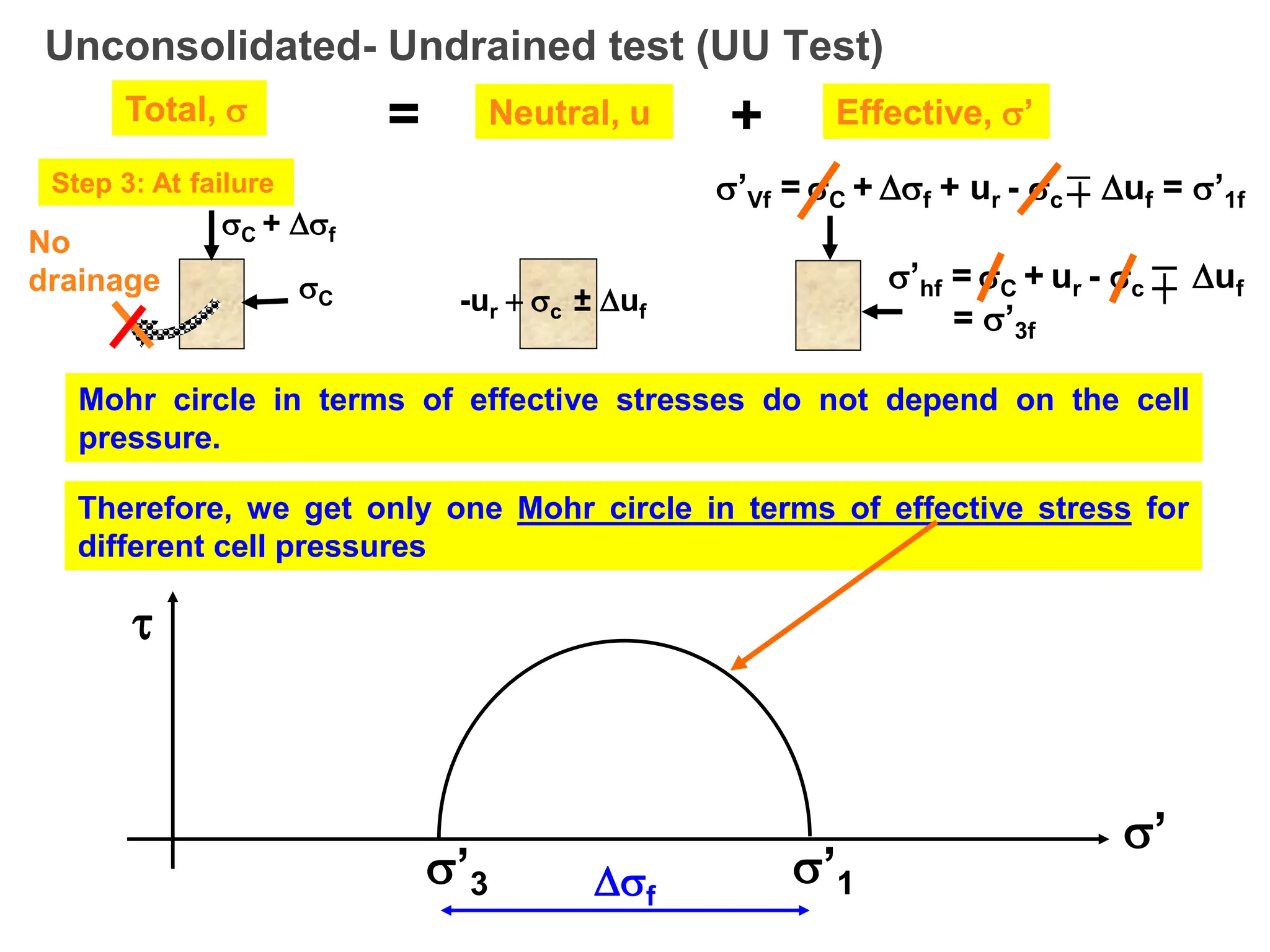
Unconsolidated- Undrained test (UU Test)
Total,  = Neutral, u Effective, ’
+
Step 3: At failure
’hf = C + ur - c uf
= ’3f
’Vf = C + f + ur - c uf = ’1f

-ur  c ± uf
C
C + f
No
drainage
Mohr circle in terms of effective stresses do not depend on the cell
pressure.
Therefore, we get only one Mohr circle in terms of effective stress for
different cell pressures

’
’3 ’1
f
3b 1b
3a 1a
f
’3 ’1
Unconsolidated- Undrained test (UU Test)
Total,  = Neutral, u Effective, ’
+
Step 3: At failure
’hf = C + ur - c uf
= ’3f
’Vf = C + f + ur - c uf = ’1f

-ur  c ± uf
C
C + f
No
drainage

 or ’
Mohr circles in terms of total stresses
ua
ub
Failure envelope, u = 0
cu
3b 1b
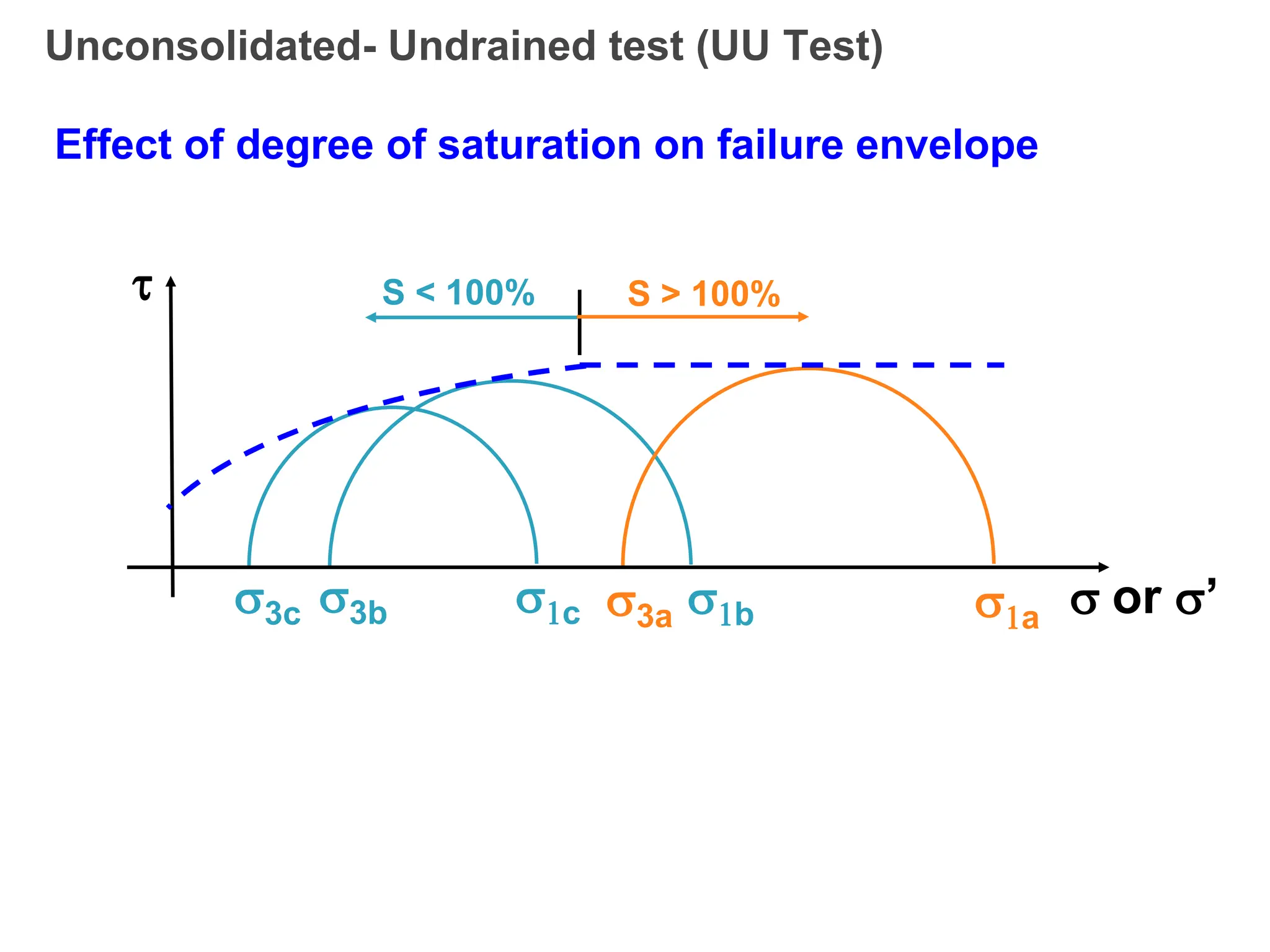
Unconsolidated- Undrained test (UU Test)
Effect of degree of saturation on failure envelope
3a 1a
3c 1c

 or ’
S < 100% S > 100%
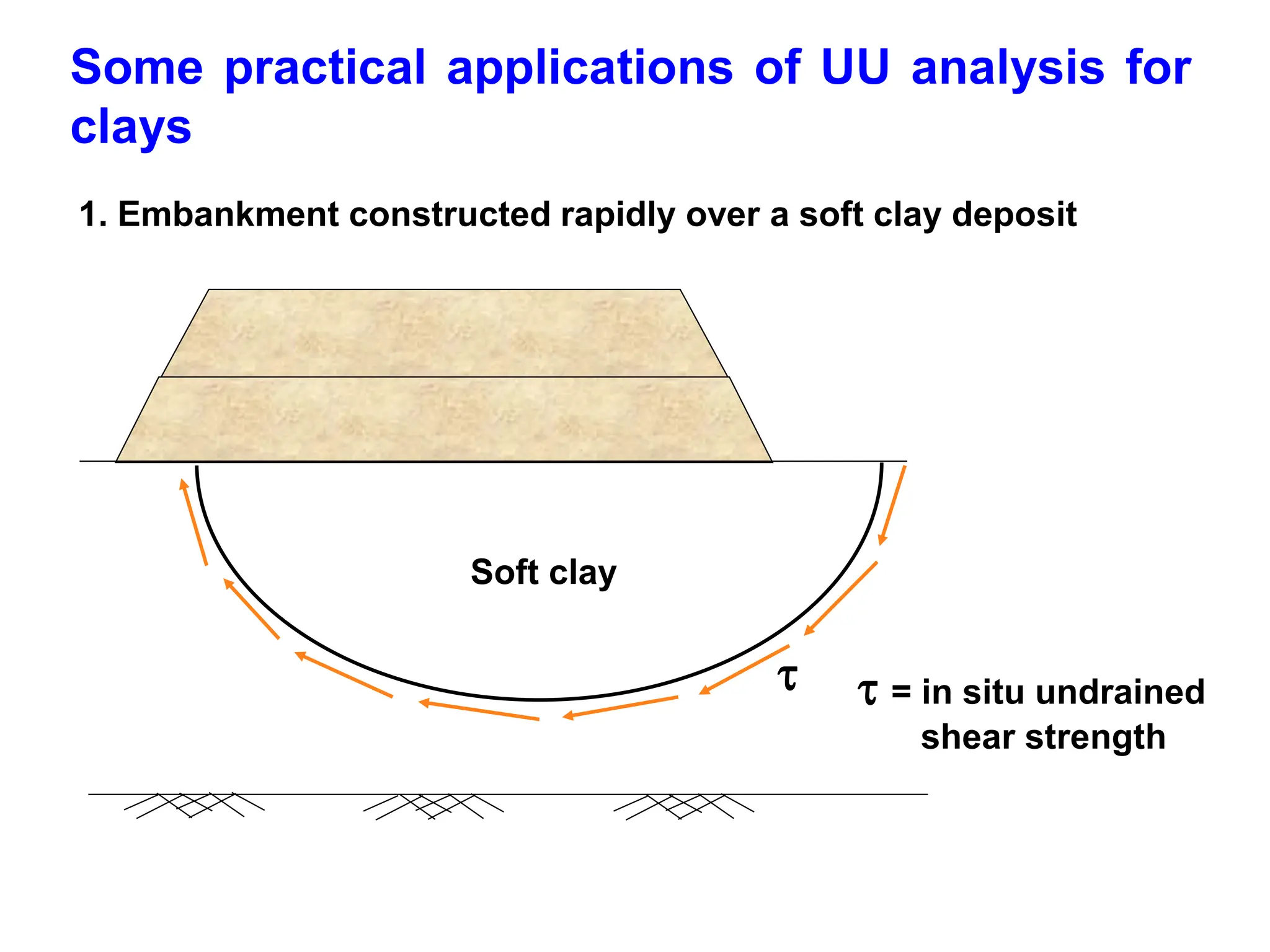
Some practical applications of UU analysis for
clays
  = in situ undrained
shear strength
Soft clay
1. Embankment constructed rapidly over a soft clay deposit
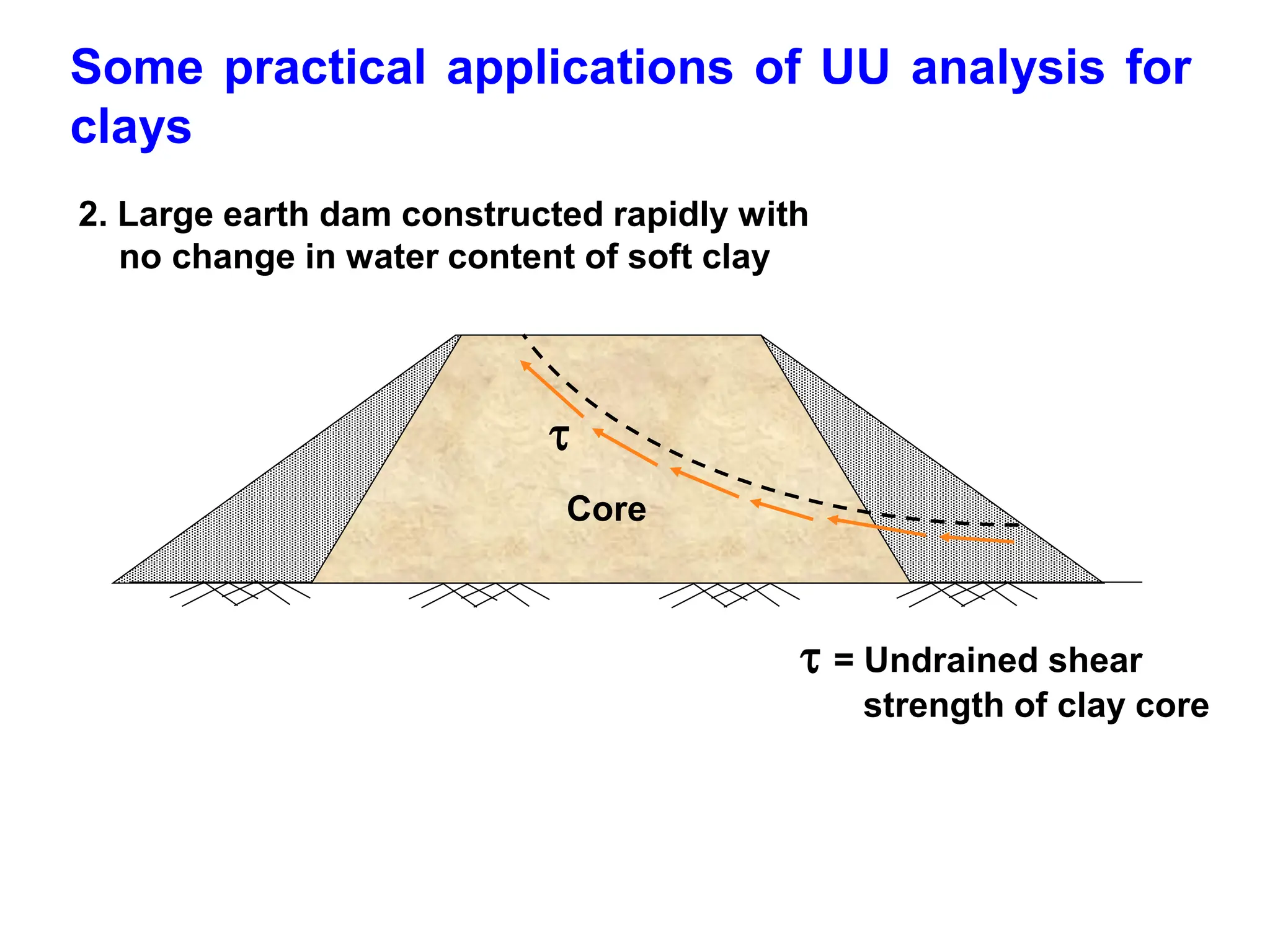
Some practical applications of UU analysis for
clays
2. Large earth dam constructed rapidly with
no change in water content of soft clay
Core
 = Undrained shear
strength of clay core

Some practical applications of UU analysis for
clays
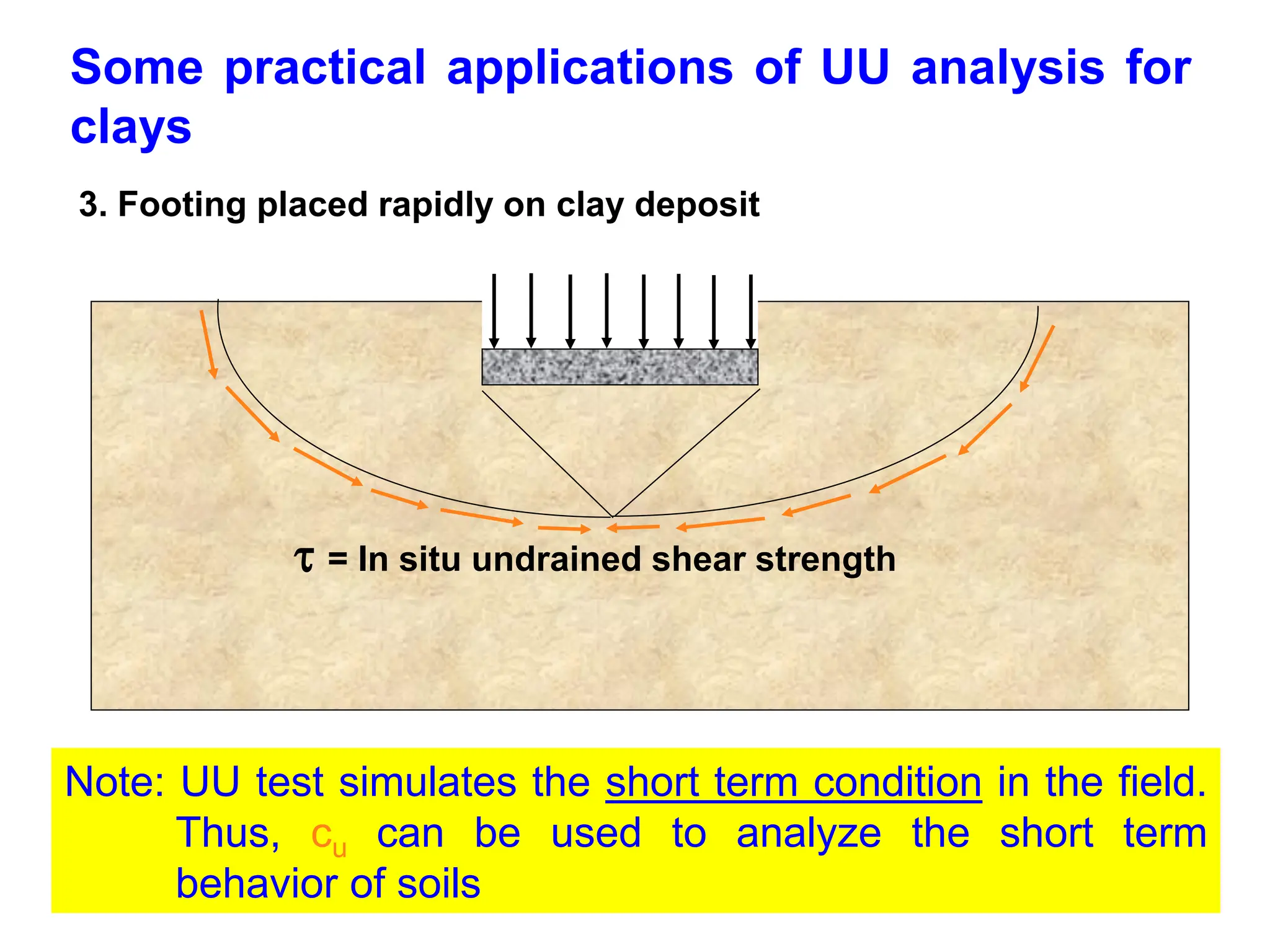
3. Footing placed rapidly on clay deposit
 = In situ undrained shear strength
Note: UU test simulates the short term condition in the field.
Thus, cu can be used to analyze the short term
behavior of soils
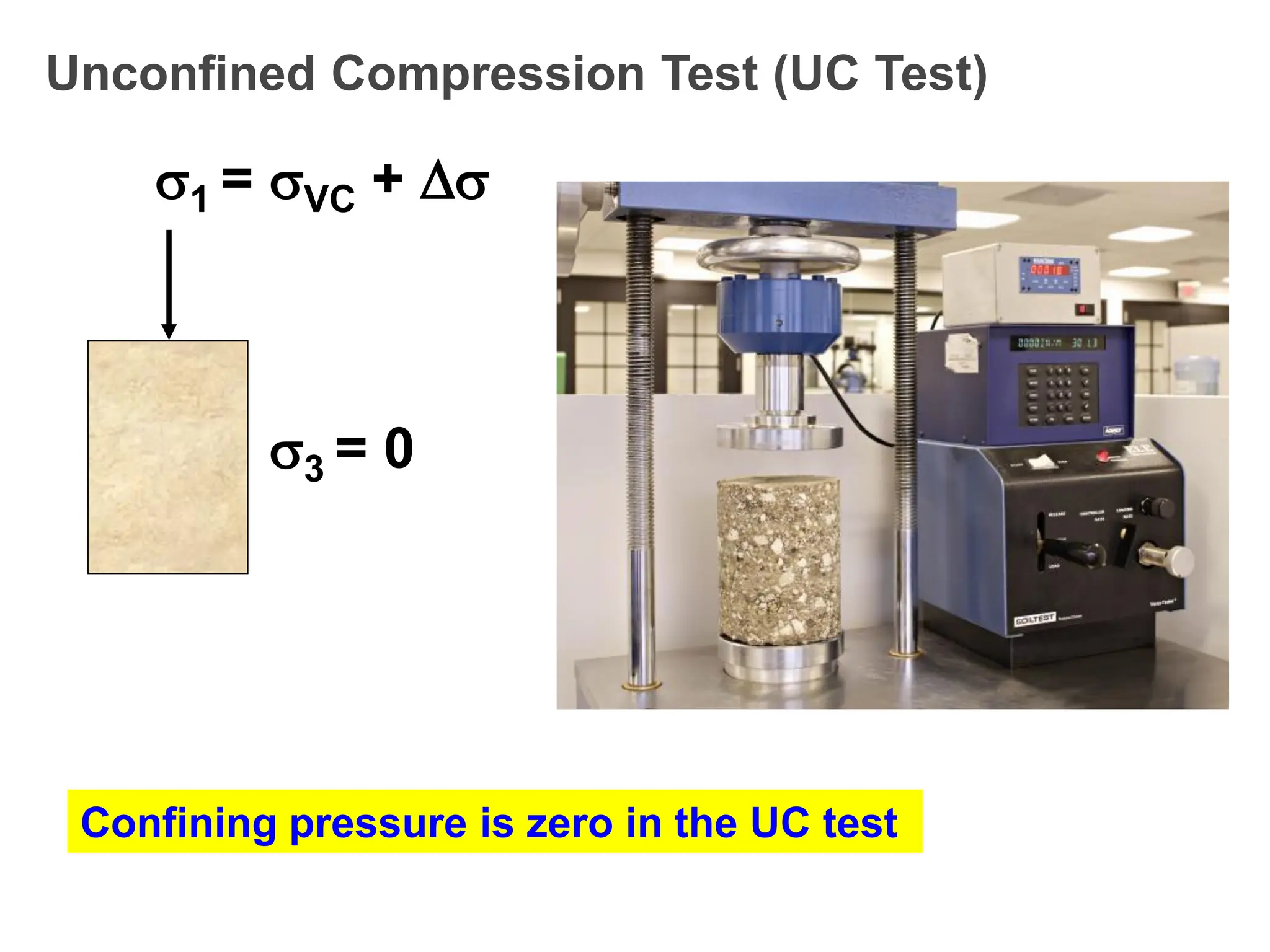
Unconfined Compression Test (UC Test)
1 = VC + 
3 = 0
Confining pressure is zero in the UC test
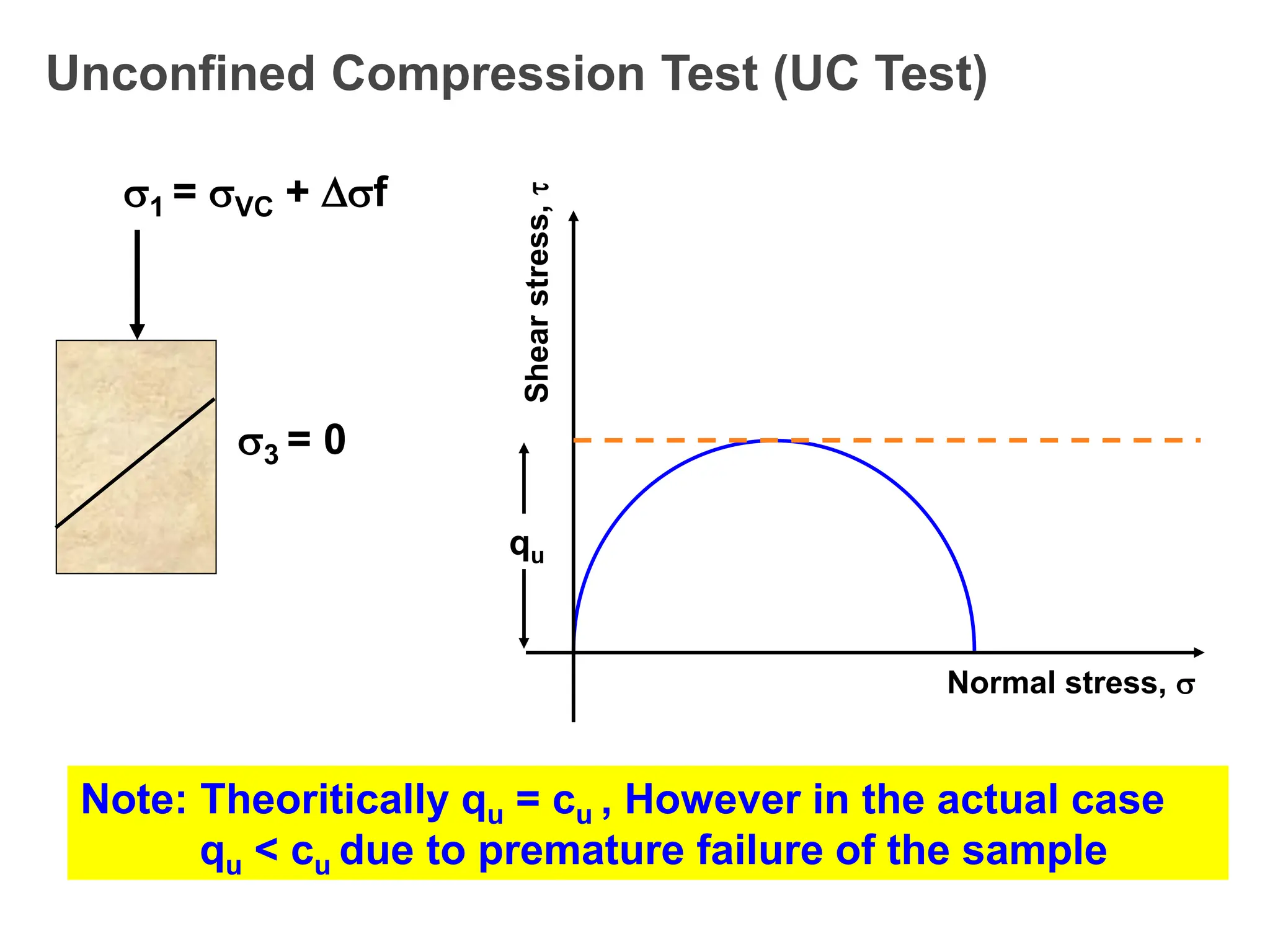
Unconfined Compression Test (UC Test)
1 = VC + f
3 = 0
Shear
stress,

Normal stress, 
qu
Note: Theoritically qu = cu , However in the actual case
qu < cu due to premature failure of the sample
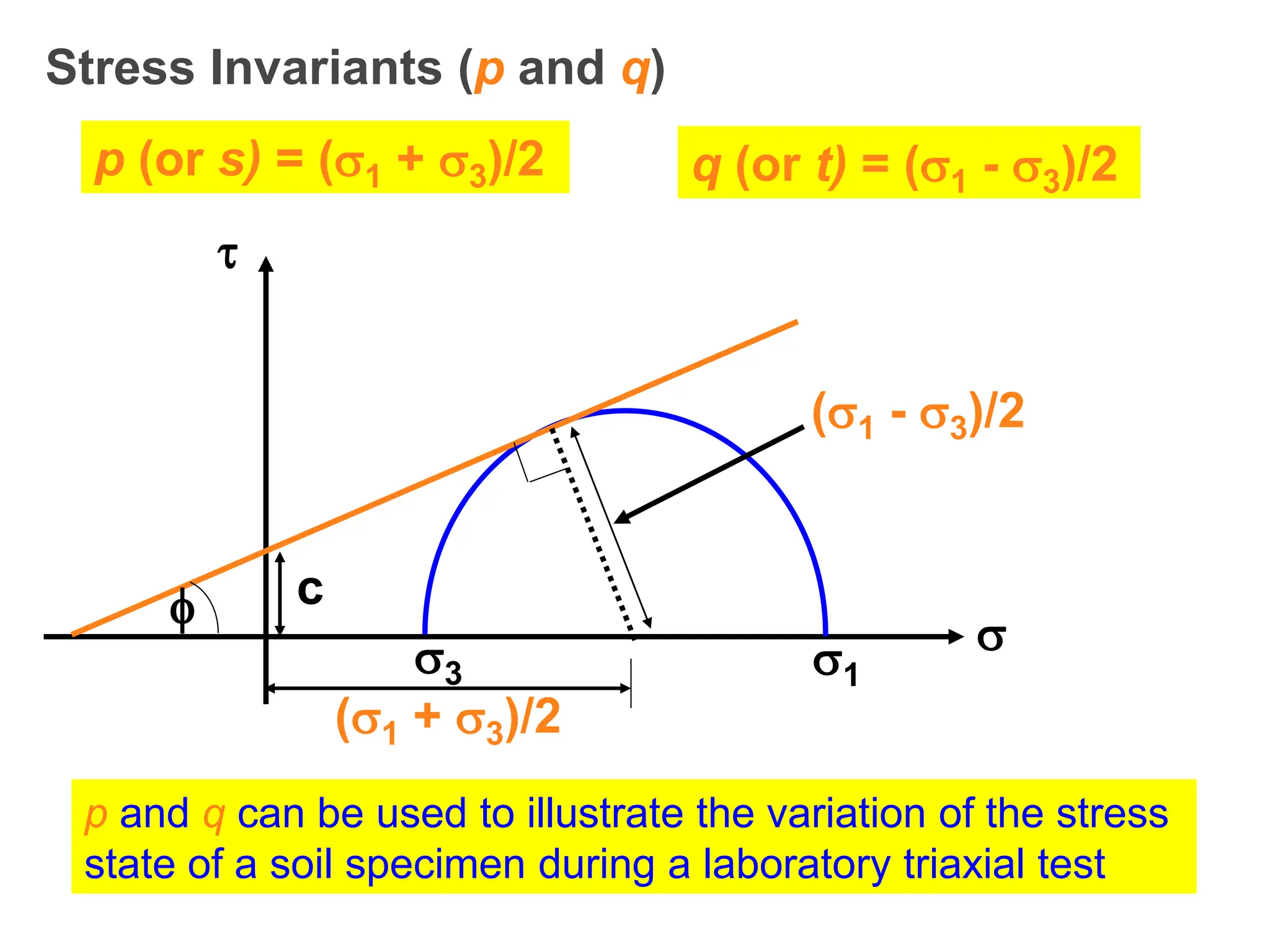
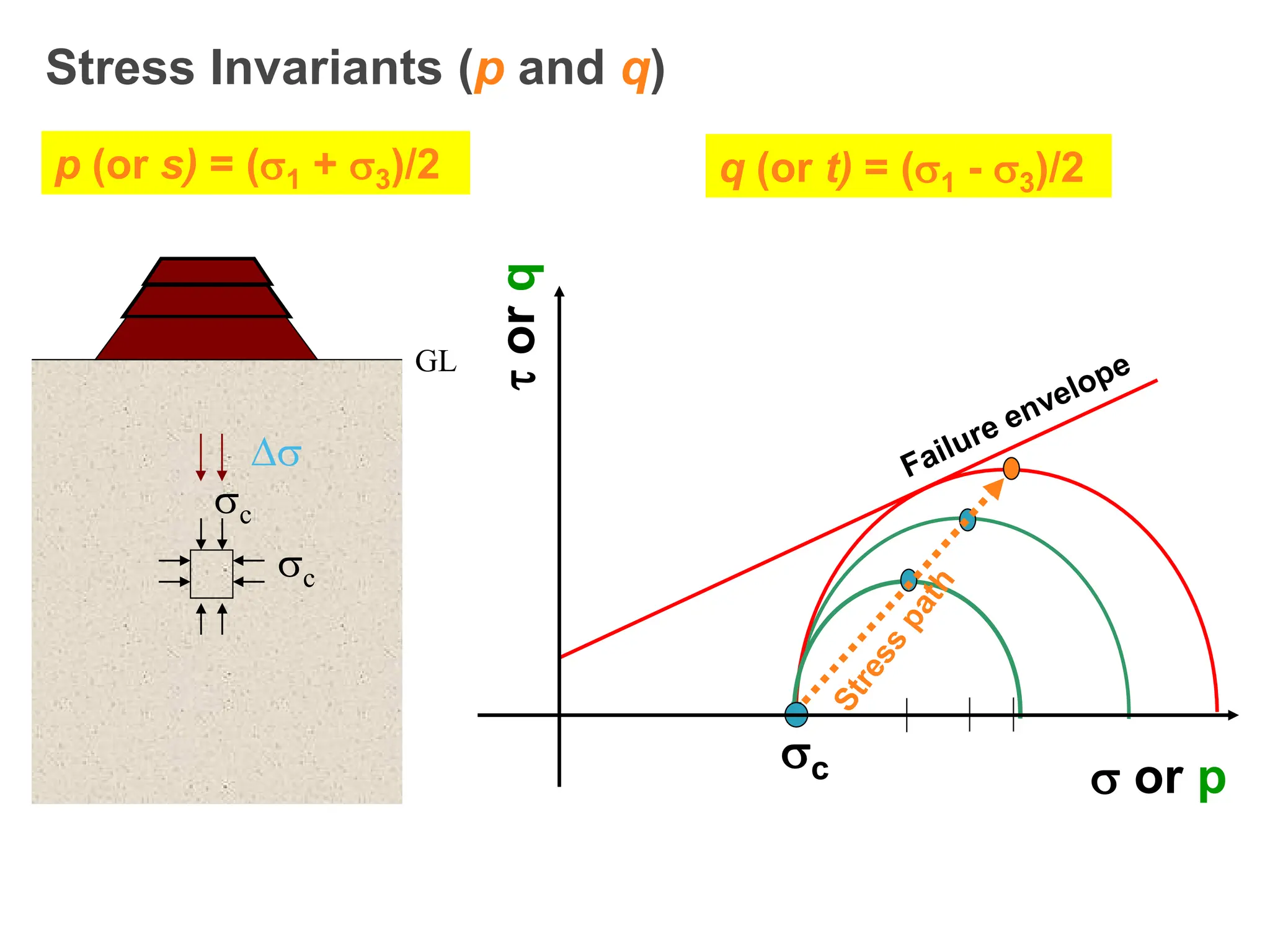
Stress Invariants (p and q)
p (or s) = (1 + 3)/2 q (or t) = (1 - 3)/2


3 1
(1 + 3)/2
(1 - 3)/2
c

p and q can be used to illustrate the variation of the stress
state of a soil specimen during a laboratory triaxial test
c
c
GL

Stress Invariants (p and q)
c
p (or s) = (1 + 3)/2 q (or t) = (1 - 3)/2

or
q
 or p
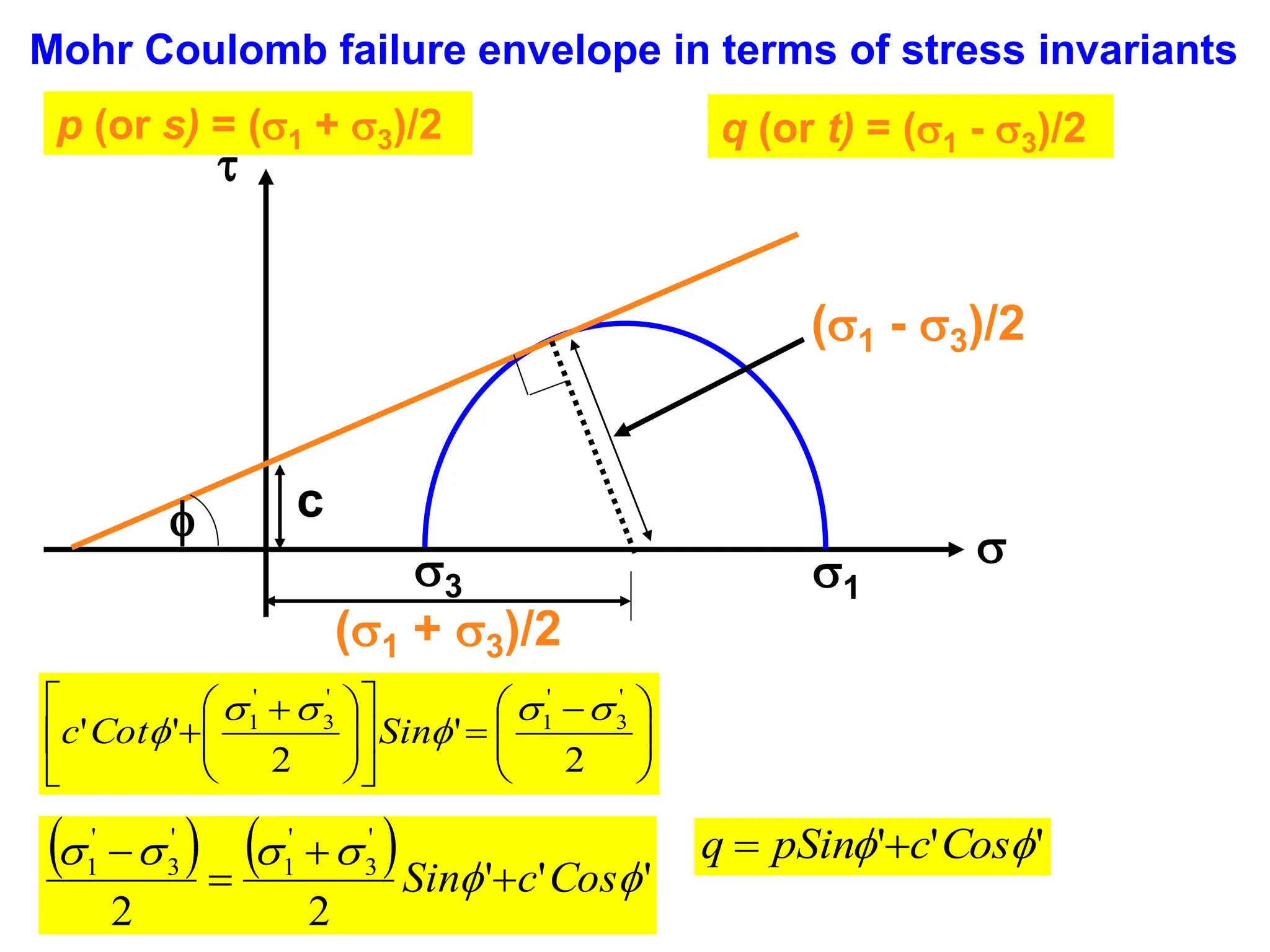
Mohr Coulomb failure envelope in terms of stress invariants
p (or s) = (1 + 3)/2 q (or t) = (1 - 3)/2







 














 

2
'
2
'
'
'
3
'
1
'
3
'
1 




 Sin
Cot
c
( ) ( ) '
'
'
2
2
'
3
'
1
'
3
'
1






Cos
c
Sin 





3 1
(1 + 3)/2
(1 - 3)/2
c

'
'
' 
 Cos
c
pSin
q 

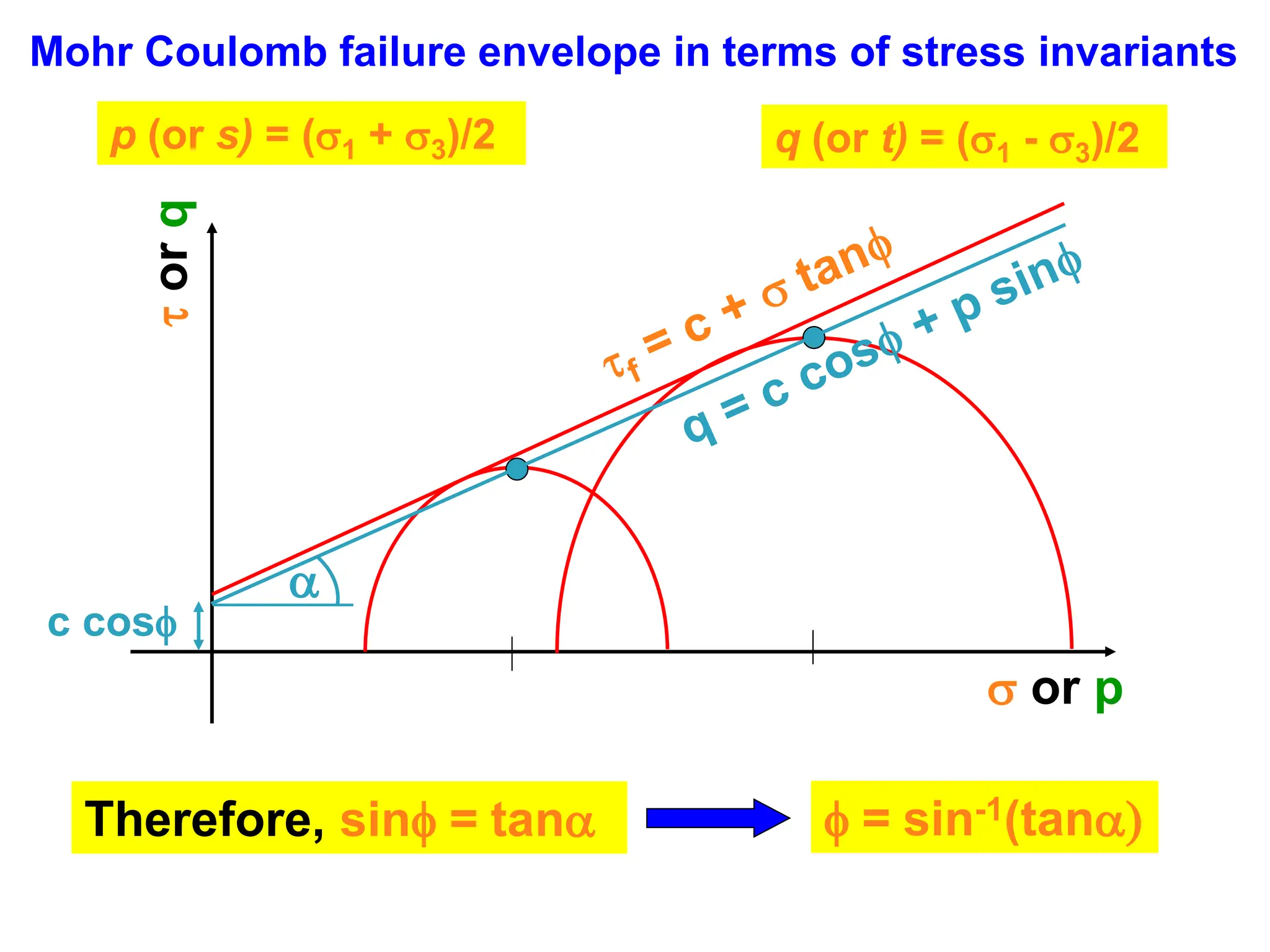
p (or s) = (1 + 3)/2 q (or t) = (1 - 3)/2

or
q
 or p
Mohr Coulomb failure envelope in terms of stress invariants
a
Therefore, sin = tana  = sin-1(tana)
c cos
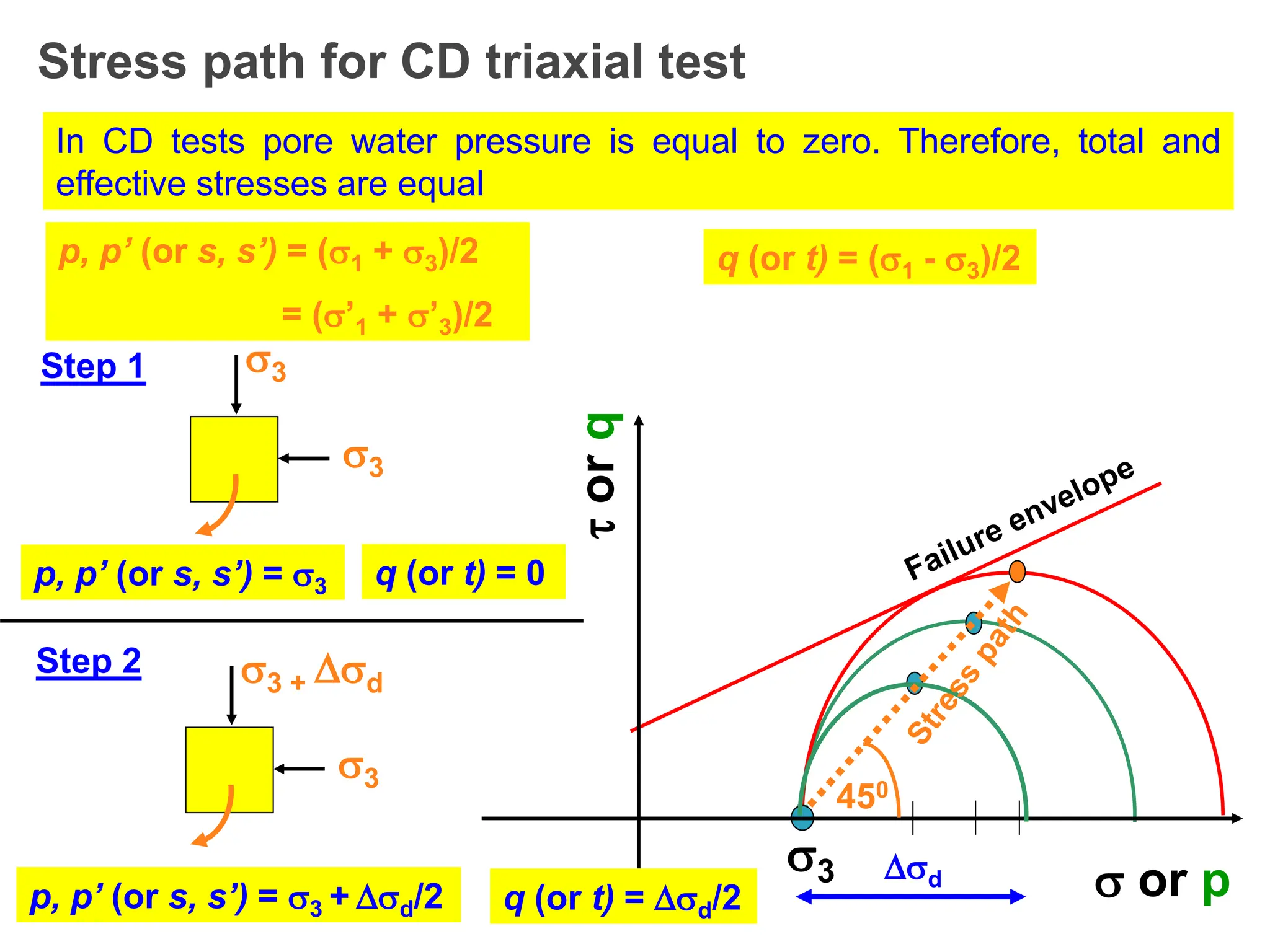
Stress path for CD triaxial test
3
p, p’ (or s, s’) = (1 + 3)/2
= (’1 + ’3)/2
q (or t) = (1 - 3)/2

or
q
 or p
In CD tests pore water pressure is equal to zero. Therefore, total and
effective stresses are equal
Step 1 3
3
p, p’ (or s, s’) = 3 q (or t) = 0
Step 2 3 + d
3
p, p’ (or s, s’) = 3 + d/2 q (or t) = d/2
d
450
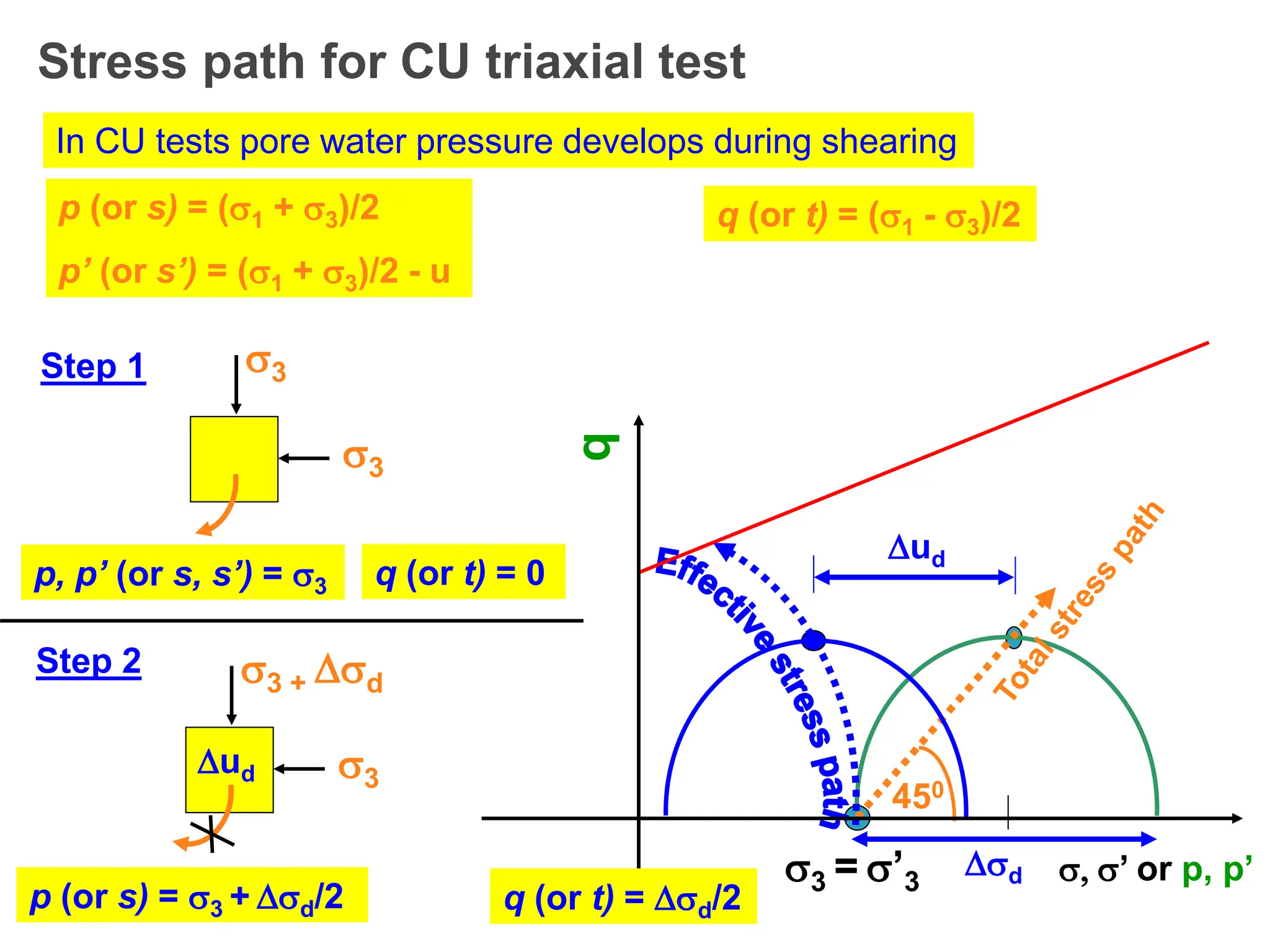
Stress path for CU triaxial test
3 = ’3
p (or s) = (1 + 3)/2
p’ (or s’) = (1 + 3)/2 - u
q (or t) = (1 - 3)/2
In CU tests pore water pressure develops during shearing
Step 1 3
3
p, p’ (or s, s’) = 3 q (or t) = 0
p (or s) = 3 + d/2
d
450
ud
Step 2 3 + d
3
ud
q
, ’ or p, p’
q (or t) = d/2
Other laboratory shear tests
 Direct simple shear test
 Torsional ring shear test
 Plane strain triaxial test
Other laboratory shear tests
 Direct simple shear test
 Torsional ring shear test
 Plane strain triaxial test
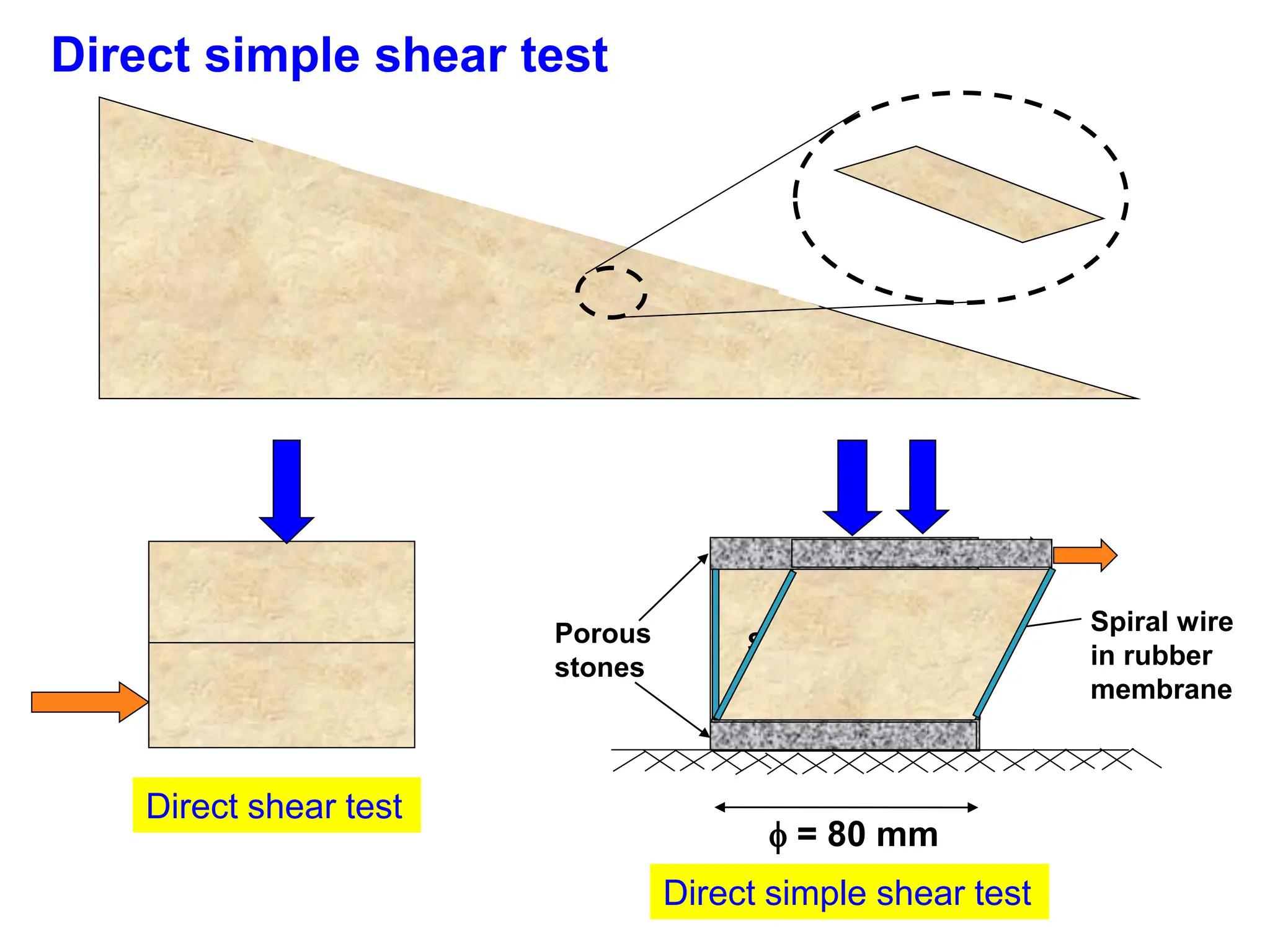
Direct simple shear test
Direct shear test
 = 80 mm
Soil specimen
Porous
stones
Spiral wire
in rubber
membrane
Direct simple shear test
Other laboratory shear tests
 Direct simple shear test
 Torsional ring shear test
 Plane strain triaxial test
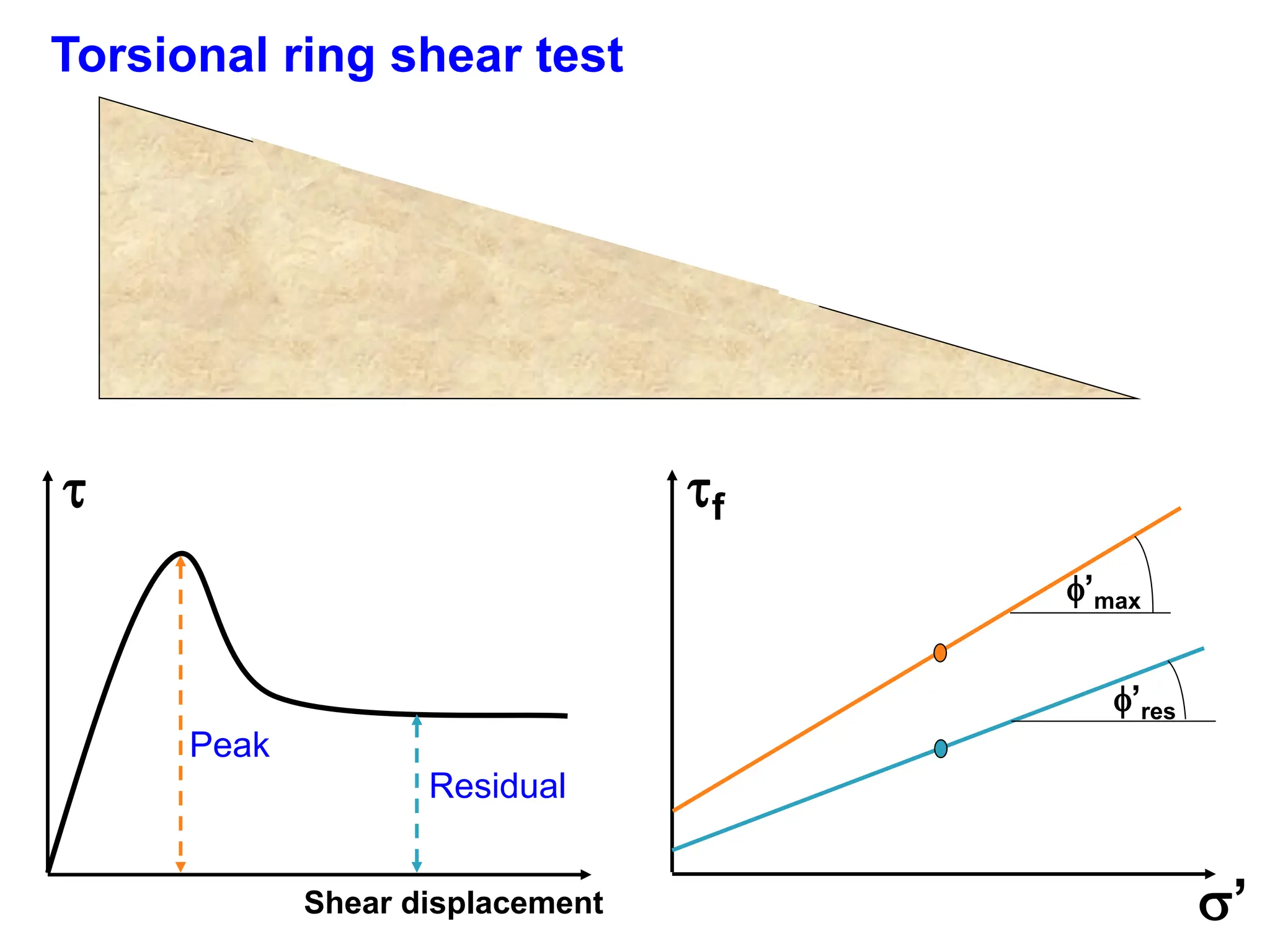
Torsional ring shear test
Peak
Residual

Shear displacement
f
’
’max
’res
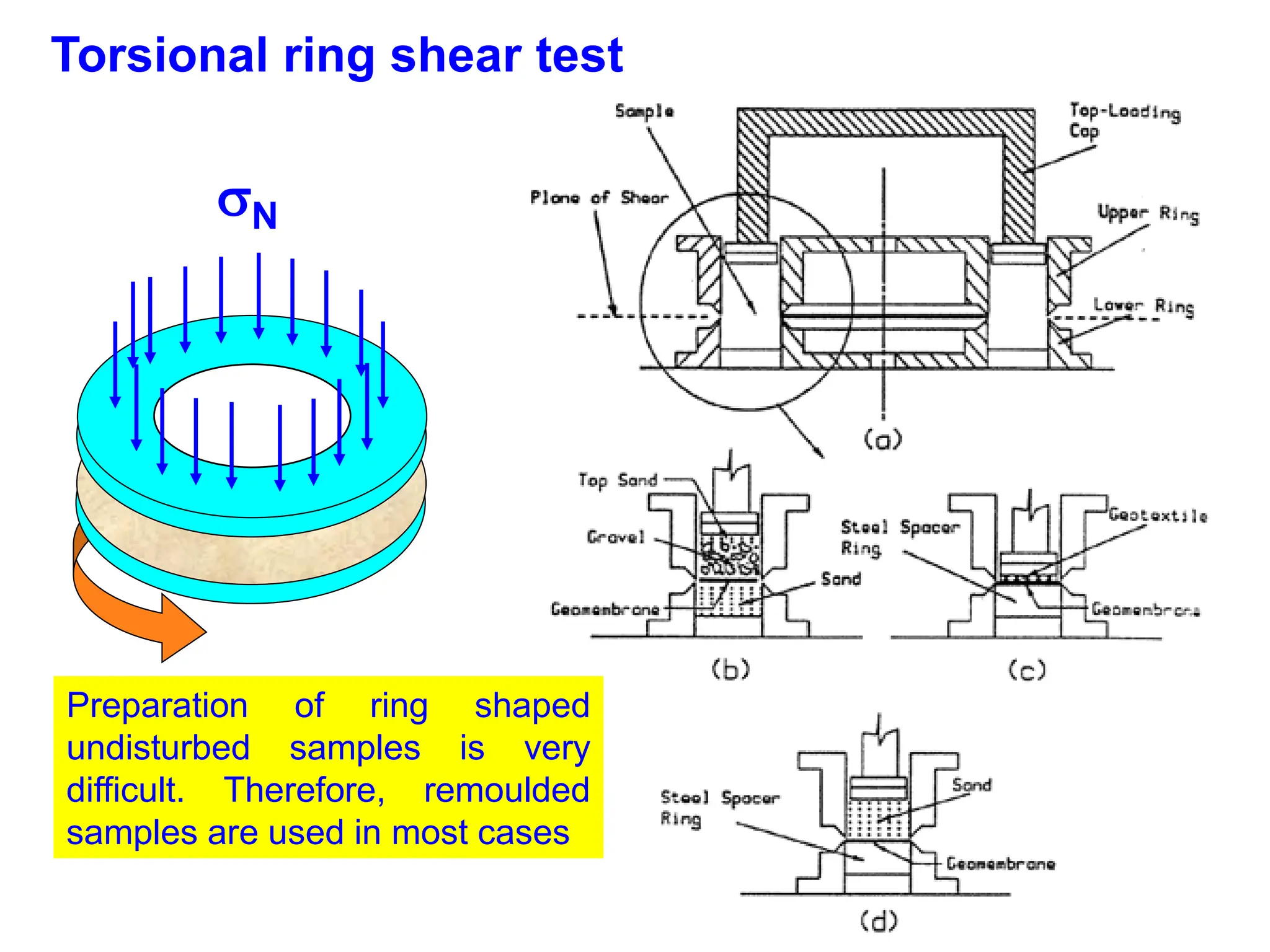
Torsional ring shear test
N
Preparation of ring shaped
undisturbed samples is very
difficult. Therefore, remoulded
samples are used in most cases
Other laboratory shear tests
 Direct simple shear test
 Torsional ring shear test
 Plane strain triaxial test
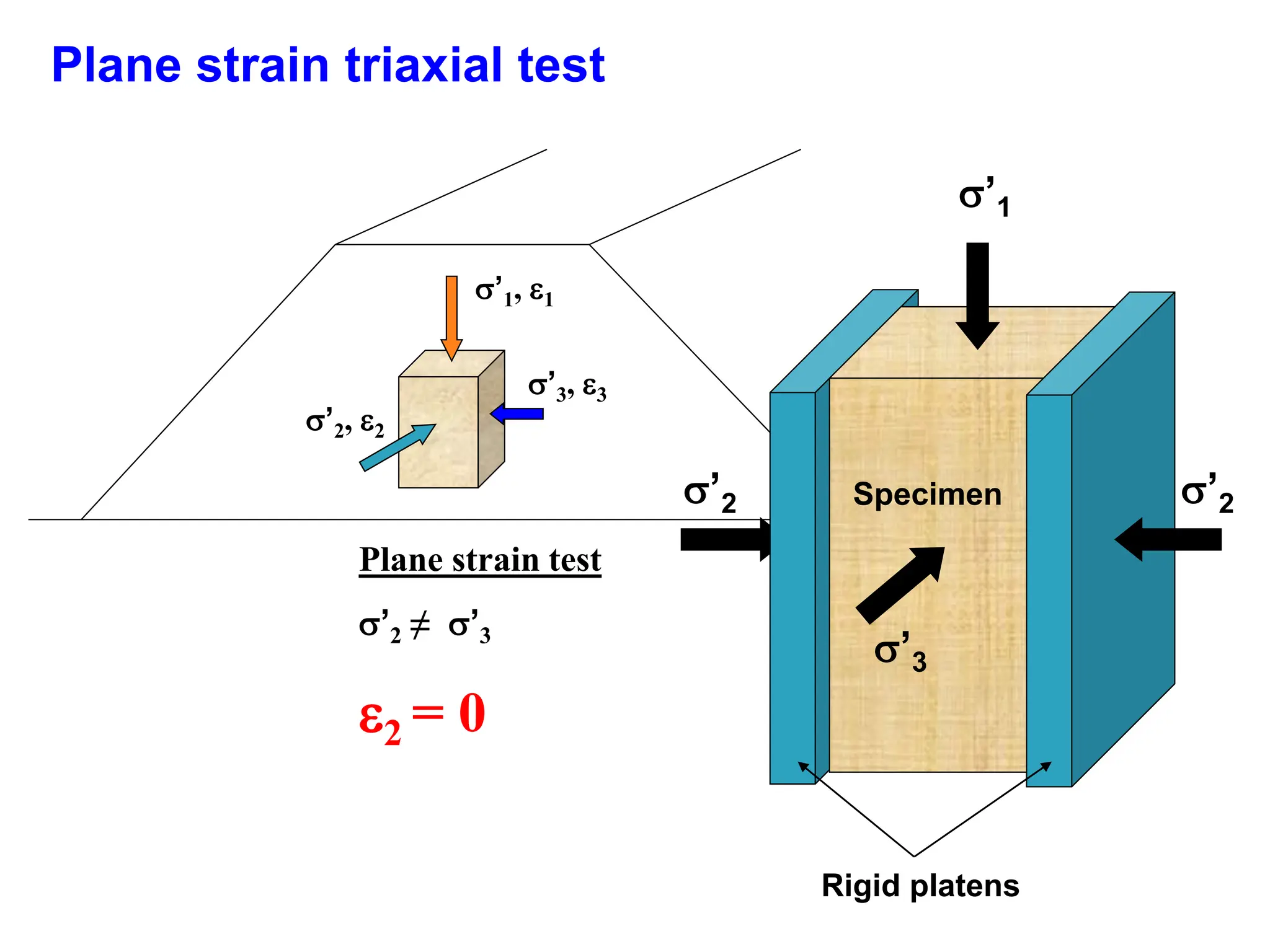
Plane strain triaxial test
’1, 1
’2, 2
’3, 3
Plane strain test
’2 ≠ ’3
2 = 0
’1
’2
’3
’2
Rigid platens
Specimen
In-situ shear tests
 Vane shear test
 Torvane
 Pocket Penetrometer
 Pressuremeter
 Static Cone Penetrometer test (Push
Cone Penetrometer Test, PCPT)
 Standard Penetration Test, SPT
In-situ shear tests
 Vane shear test (suitable for soft to stiff clays)
 Torvane
 Pocket Penetrometer
 Pressuremeter
 Static Cone Penetrometer test (Push
Cone Penetrometer Test, PCPT)
 Standard Penetration Test, SPT
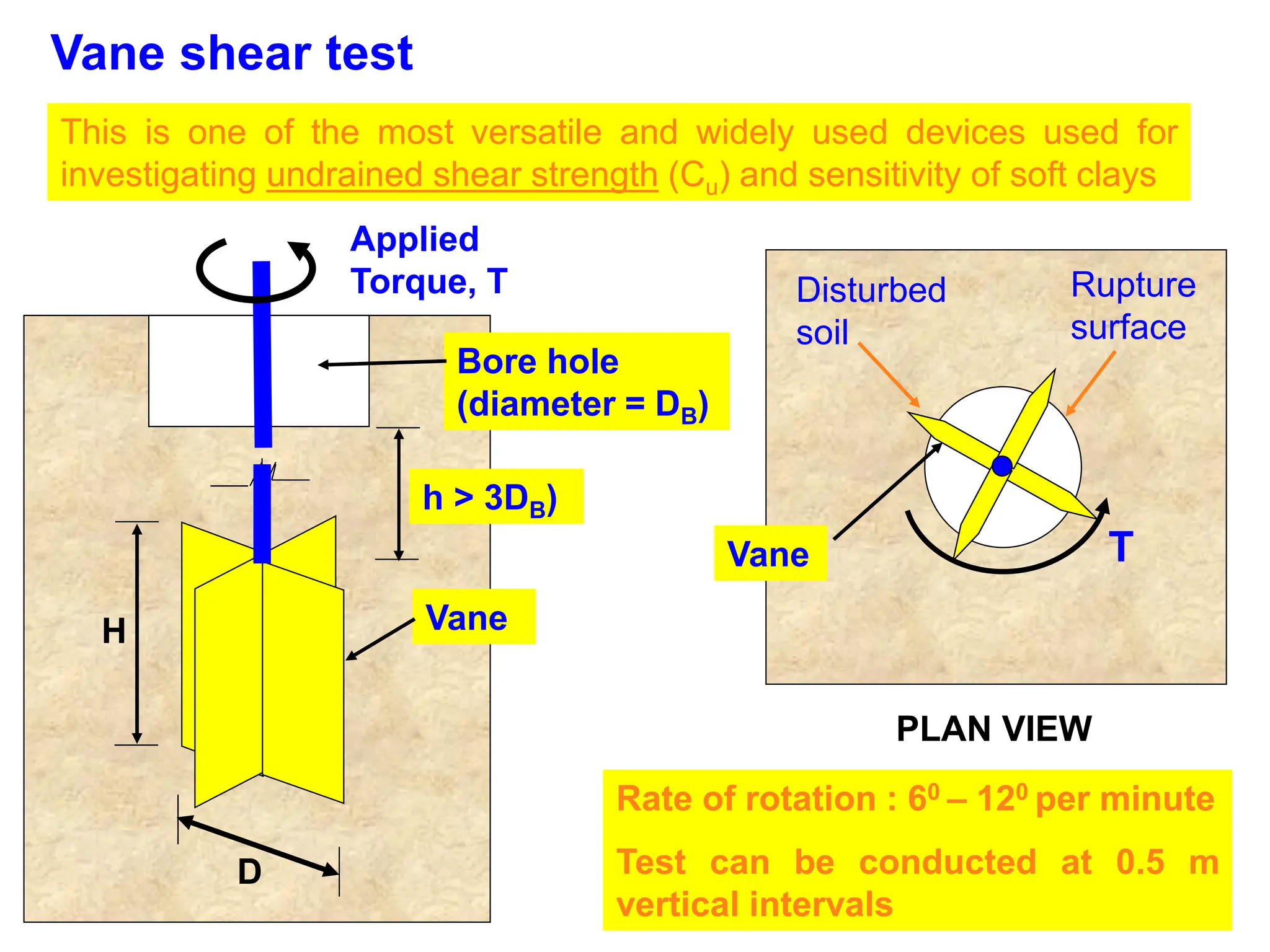
PLAN VIEW
Vane shear test
This is one of the most versatile and widely used devices used for
investigating undrained shear strength (Cu) and sensitivity of soft clays
Bore hole
(diameter = DB)
h > 3DB)
Vane
D
H
Applied
Torque, T
Vane T
Rupture
surface
Disturbed
soil
Rate of rotation : 60 – 120 per minute
Test can be conducted at 0.5 m
vertical intervals
Vane shear test
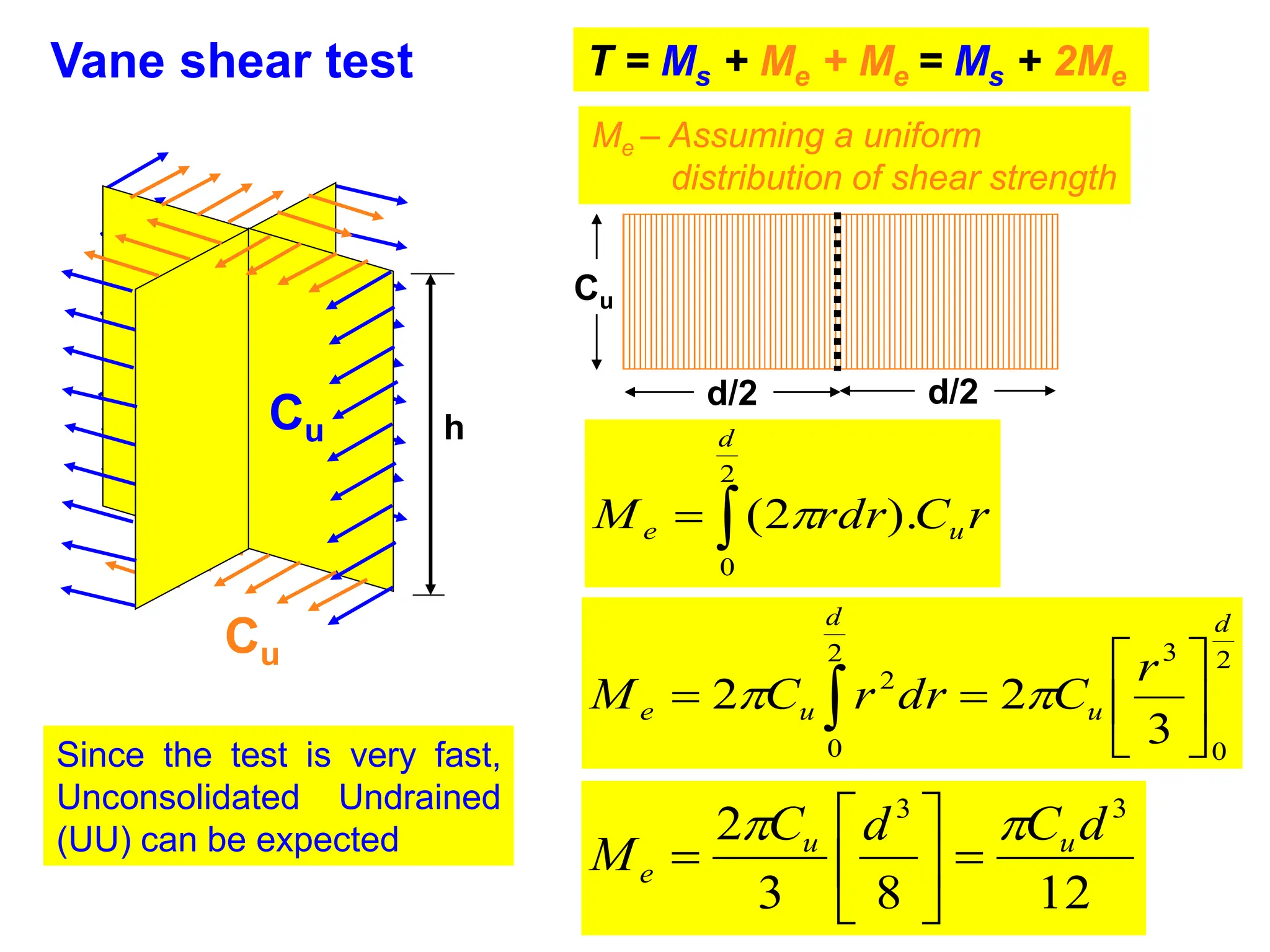
Since the test is very fast,
Unconsolidated Undrained
(UU) can be expected
Cu
Cu
T = Ms + Me + Me = Ms + 2Me
Me – Assuming a uniform
distribution of shear strength


2
0
).
2
(
d
u
e r
C
rdr
M 
2
0
3
2
0
2
3
2
2
d
u
d
u
e
r
C
dr
r
C
M 






  

12
8
3
2 3
3
d
C
d
C
M u
u
e










d/2
d/2
Cu
h
Vane shear test
Since the test is very fast,
Unconsolidated Undrained
(UU) can be expected
Cu
Cu
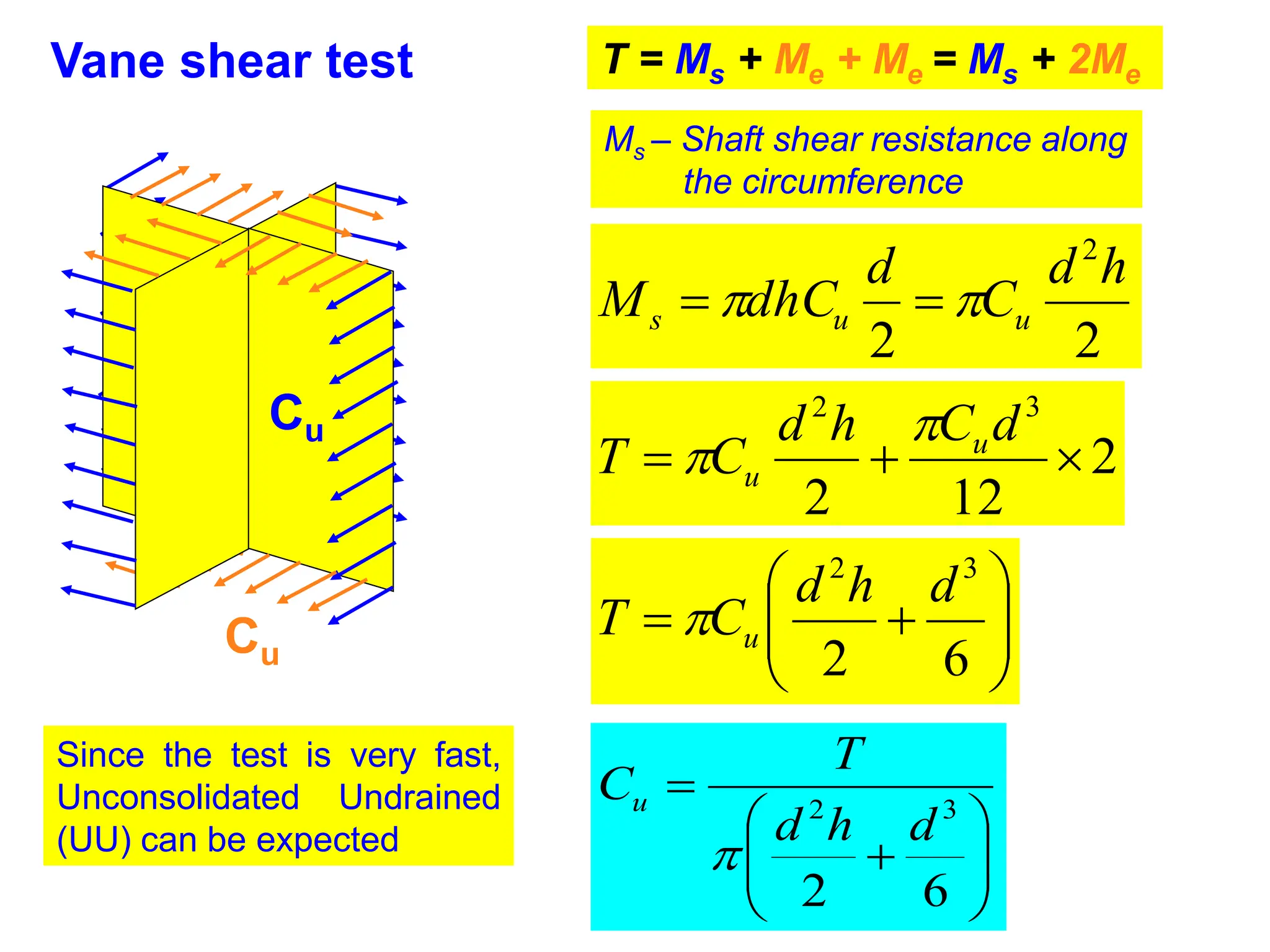
Ms – Shaft shear resistance along
the circumference
2
2
2
h
d
C
d
dhC
M u
u
s 
 

2
12
2
3
2



d
C
h
d
C
T u
u












6
2
3
2
d
h
d
C
T u











6
2
3
2
d
h
d
T
Cu

T = Ms + Me + Me = Ms + 2Me
Vane shear test
Since the test is very fast,
Unconsolidated Undrained
(UU) can be expected
Cu
Cu
T = Ms + Me + Me = Ms + 2Me
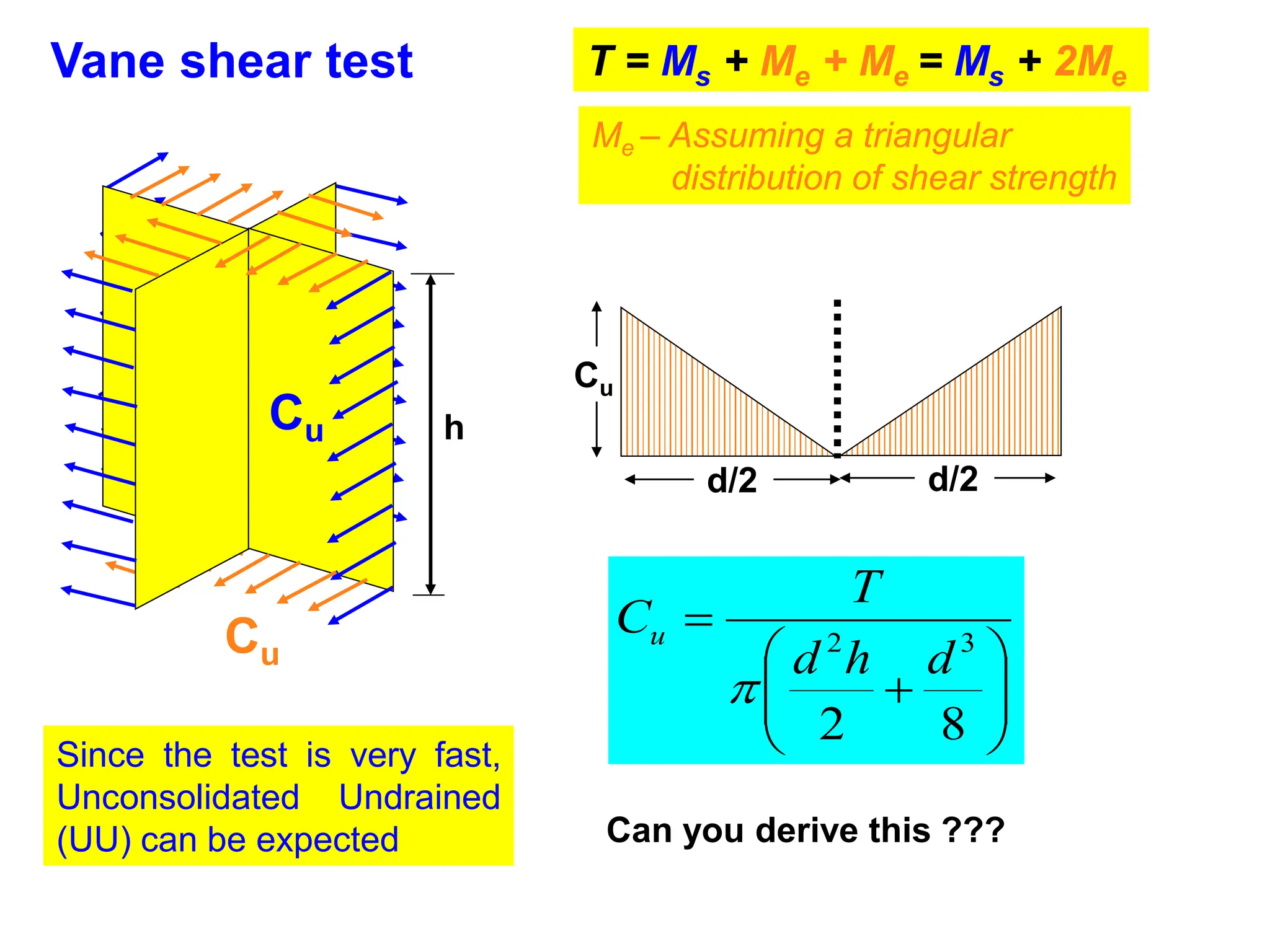
Me – Assuming a triangular
distribution of shear strength
h
d/2
d/2
Cu










8
2
3
2
d
h
d
T
Cu

Can you derive this ???
Vane shear test
Since the test is very fast,
Unconsolidated Undrained
(UU) can be expected
Cu
Cu
T = Ms + Me + Me = Ms + 2Me
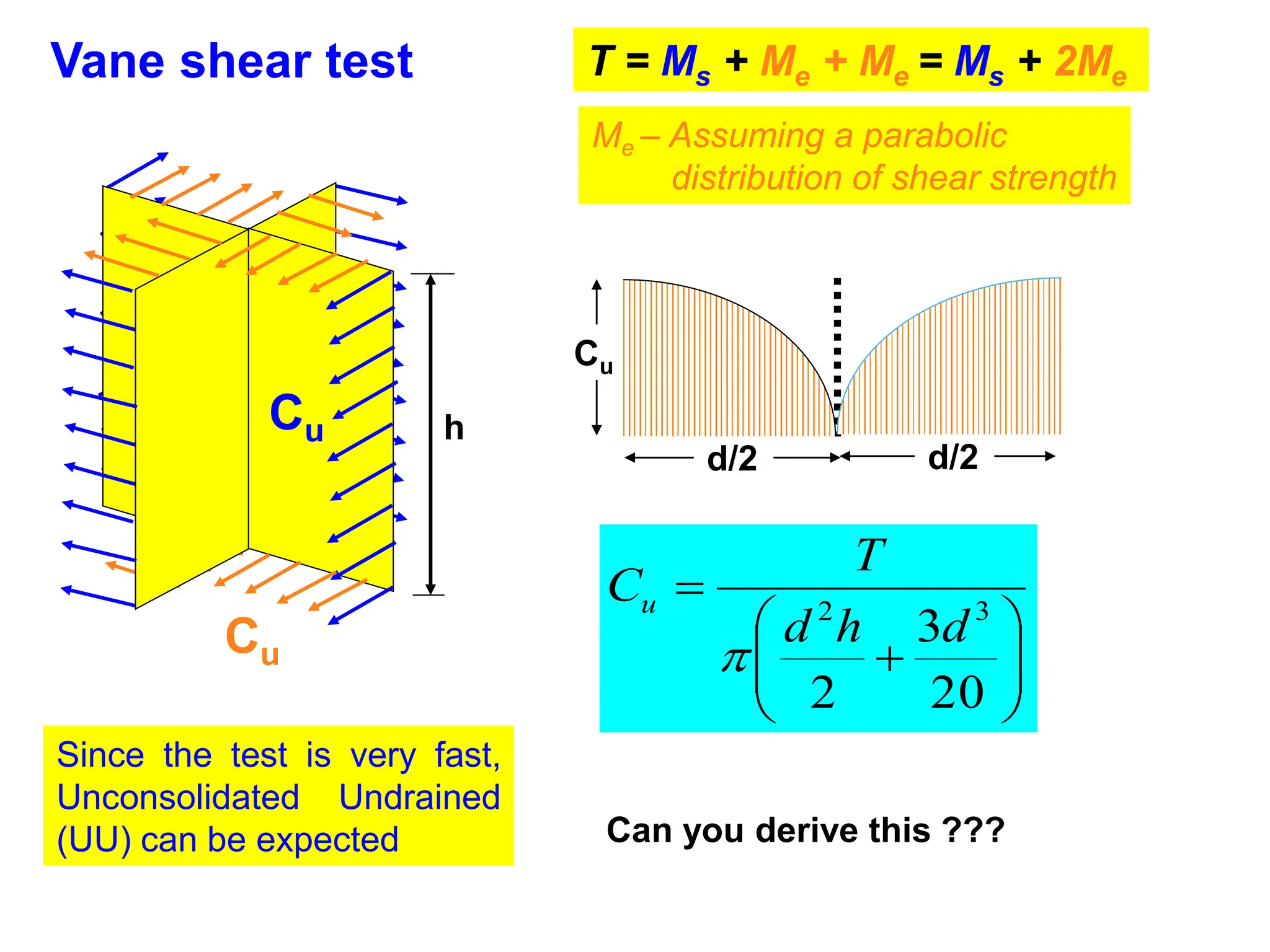
Me – Assuming a parabolic
distribution of shear strength
h










20
3
2
3
2
d
h
d
T
Cu

Can you derive this ???
d/2
d/2
Cu
Vane shear test
Since the test is very fast,
Unconsolidated Undrained
(UU) can be expected
Cu
Cu
h
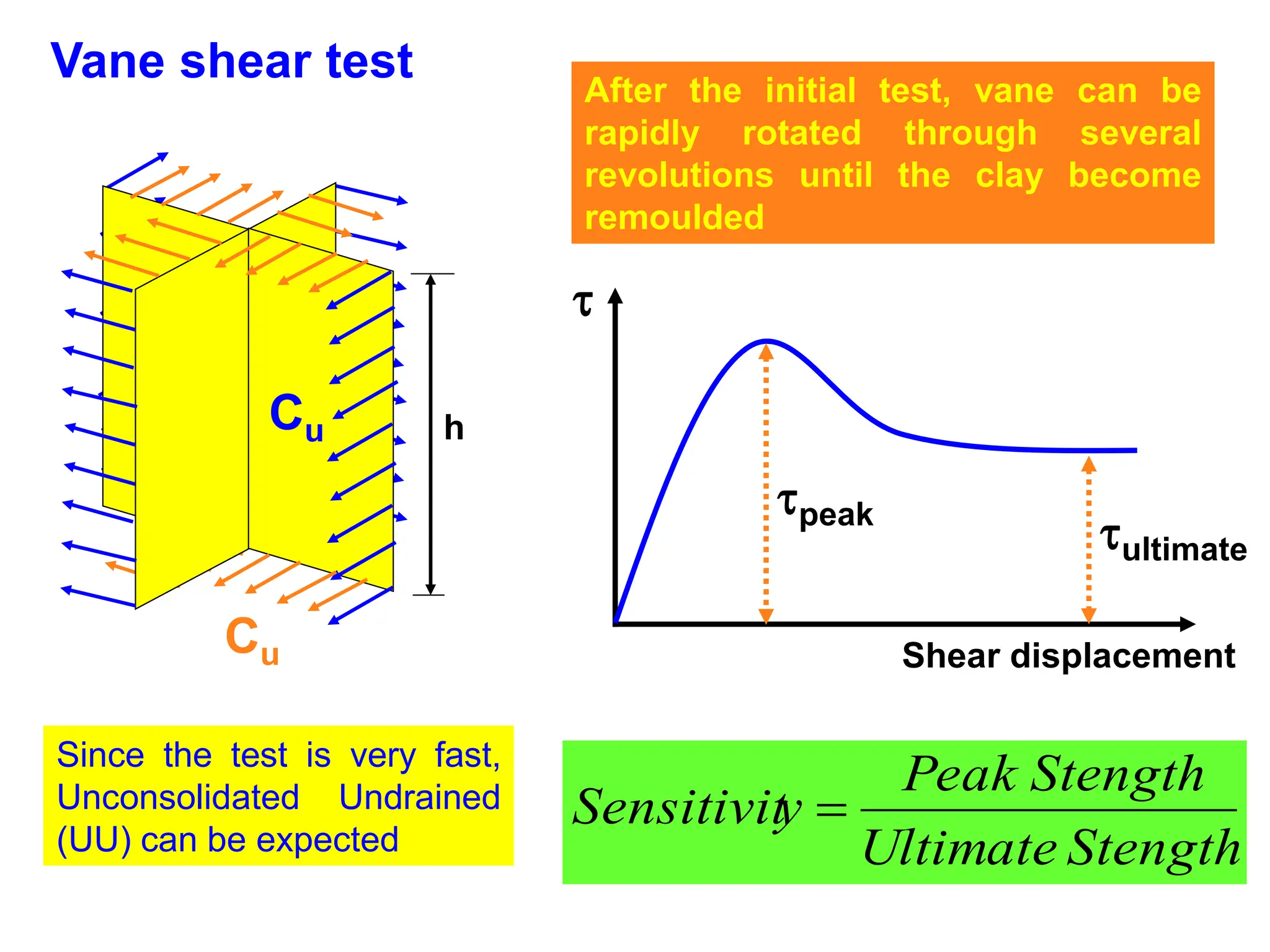
After the initial test, vane can be
rapidly rotated through several
revolutions until the clay become
remoulded
peak
ultimate

Shear displacement
Stength
Ultimate
Stength
Peak
y
Sensitivit 
Some important facts on vane shear test
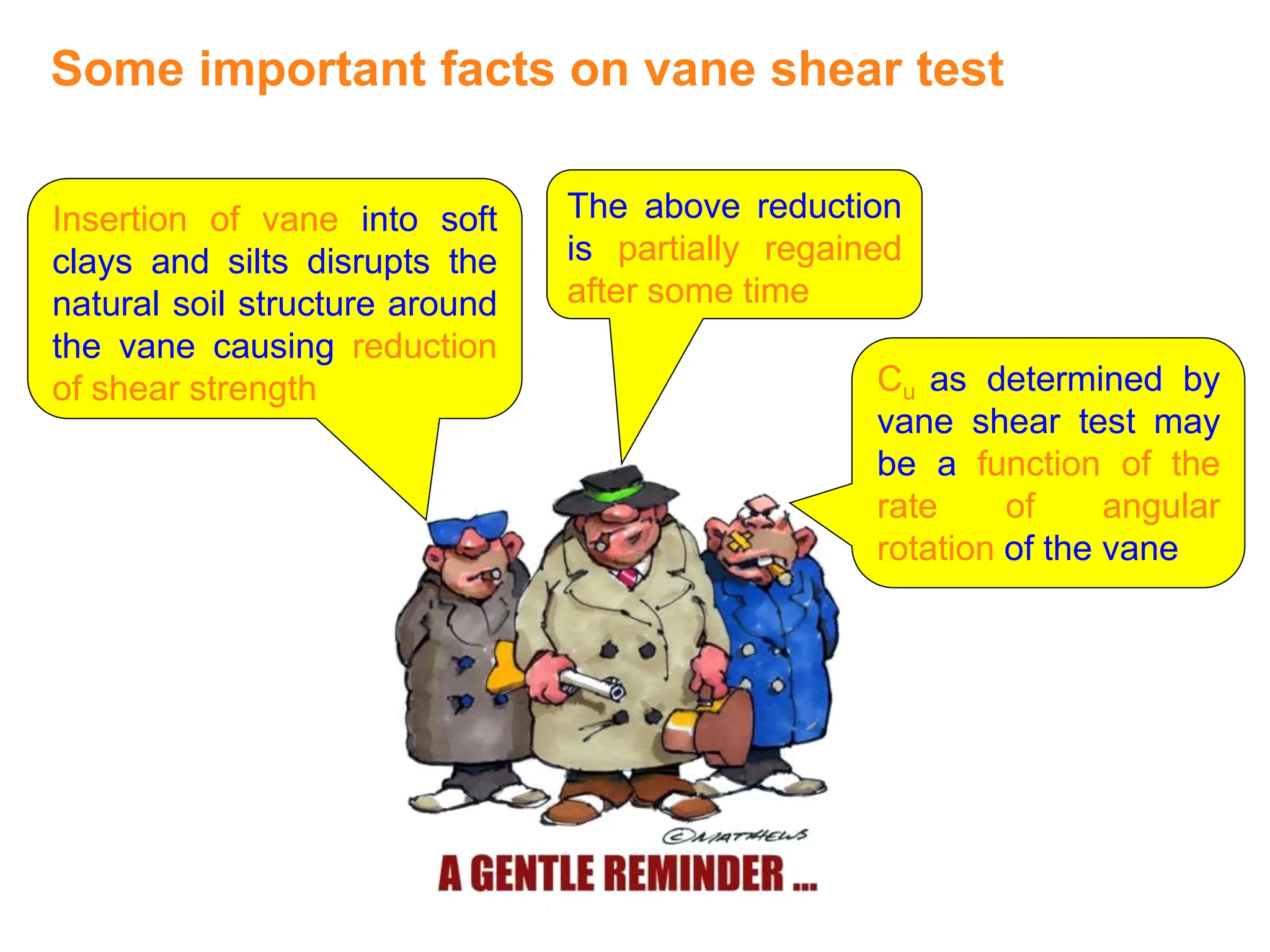
Insertion of vane into soft
clays and silts disrupts the
natural soil structure around
the vane causing reduction
of shear strength
The above reduction
is partially regained
after some time
Cu as determined by
vane shear test may
be a function of the
rate of angular
rotation of the vane
Correction for the strength parameters obtained
from vane shear test
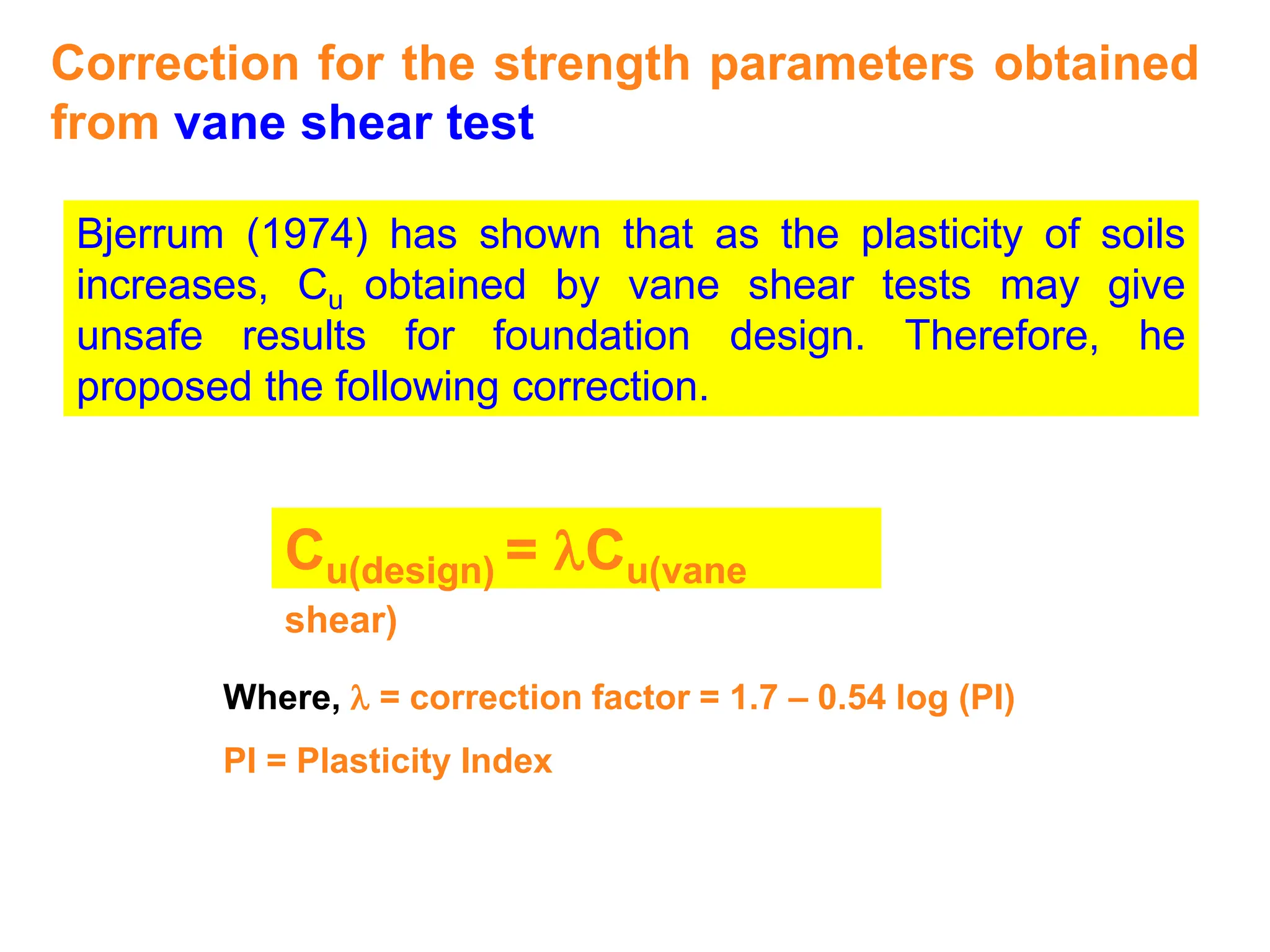
Bjerrum (1974) has shown that as the plasticity of soils
increases, Cu obtained by vane shear tests may give
unsafe results for foundation design. Therefore, he
proposed the following correction.
Cu(design) = lCu(vane
shear)
Where, l = correction factor = 1.7 – 0.54 log (PI)
PI = Plasticity Index
In-situ shear tests
 Vane shear test
 Torvane (suitable for very soft to stiff clays)
 Pocket Penetrometer
 Pressuremeter
 Static Cone Penetrometer test (Push
Cone Penetrometer Test, PCPT)
 Standard Penetration Test, SPT
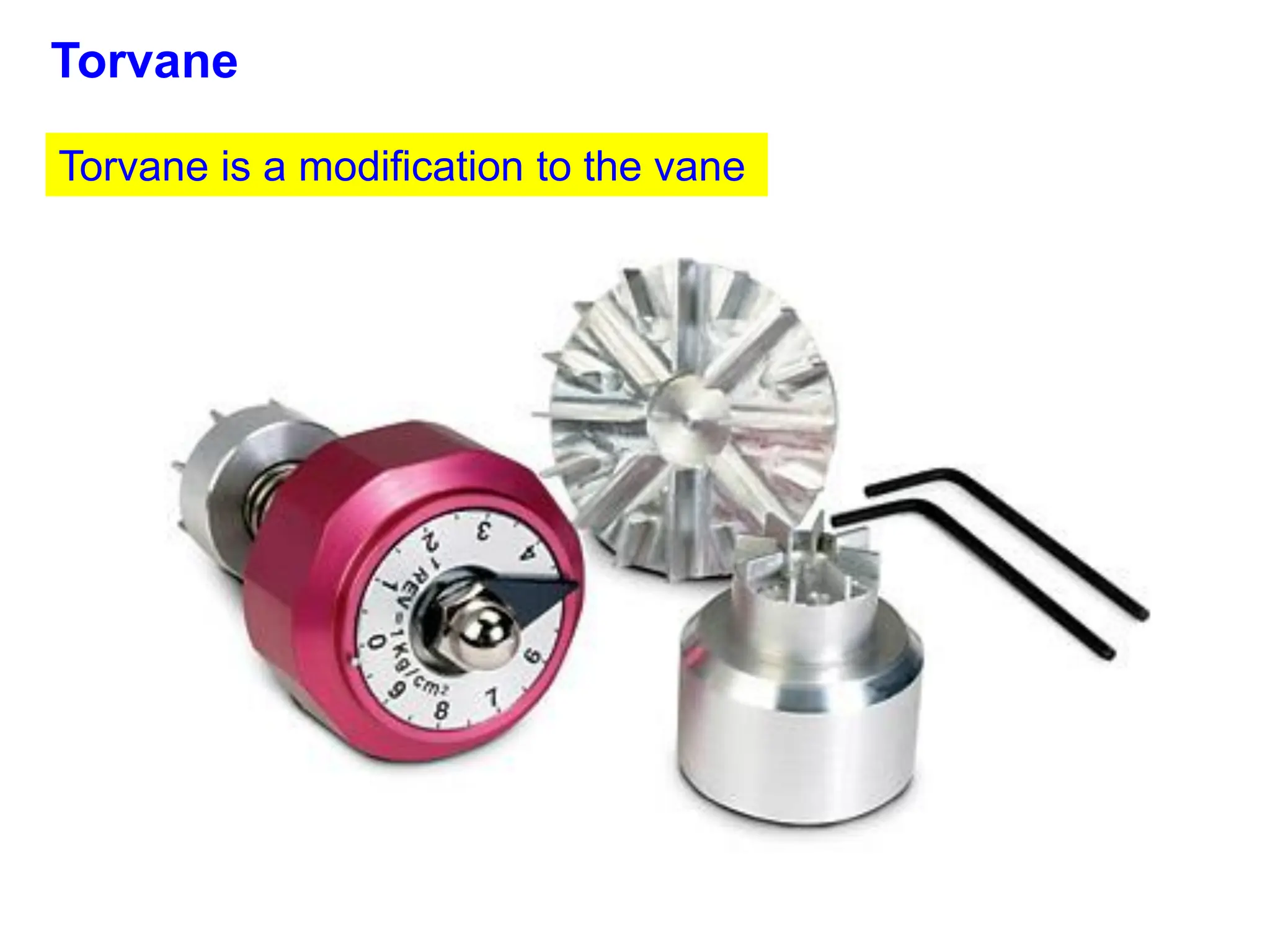
Torvane
Torvane is a modification to the vane
In-situ shear tests
 Vane shear test
 Torvane
 Pocket Penetrometer (suitable for very soft to stiff clays)
 Pressuremeter
 Static Cone Penetrometer test (Push
Cone Penetrometer Test, PCPT)
 Standard Penetration Test, SPT
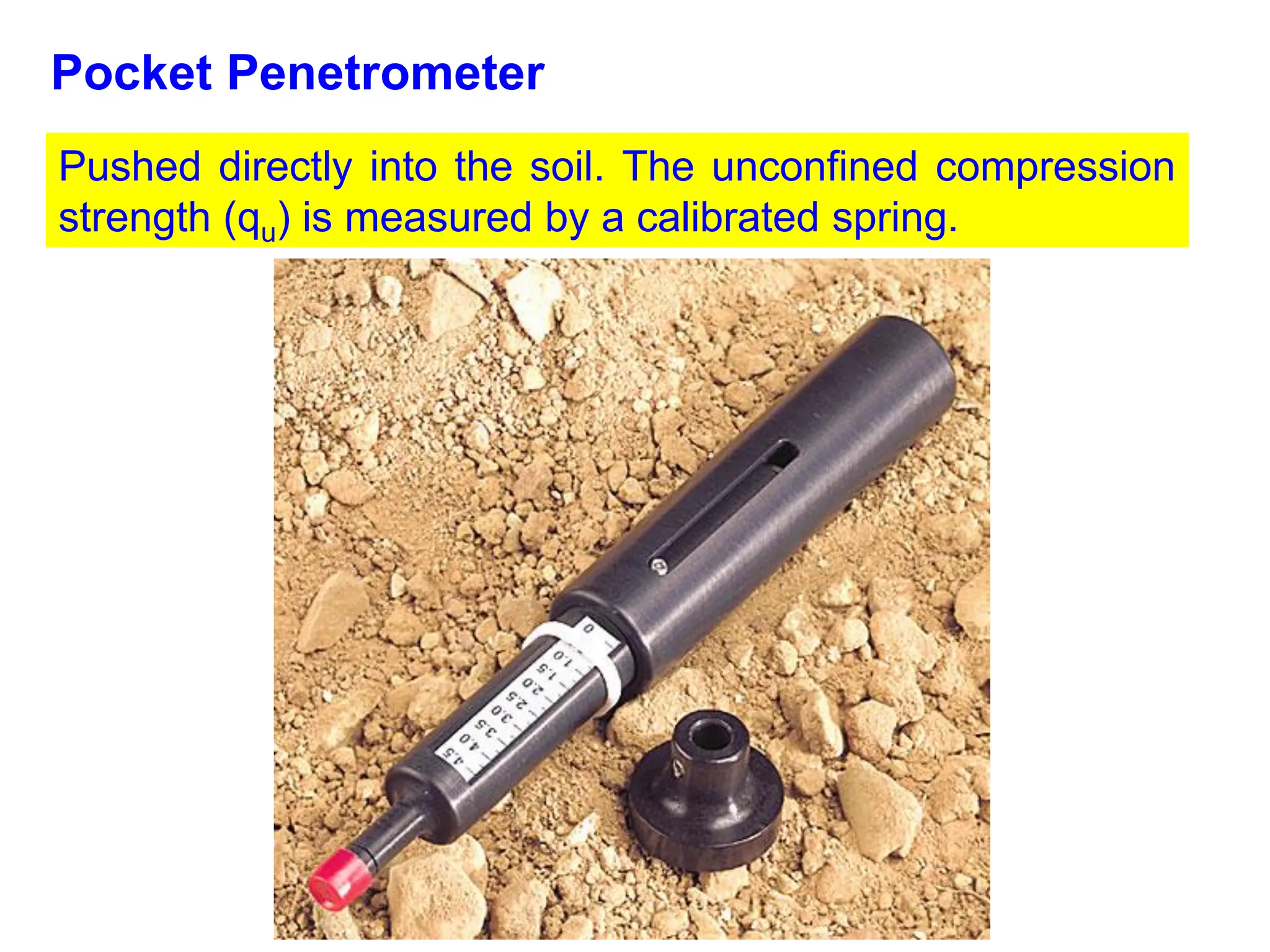
Pocket Penetrometer
Pushed directly into the soil. The unconfined compression
strength (qu) is measured by a calibrated spring.
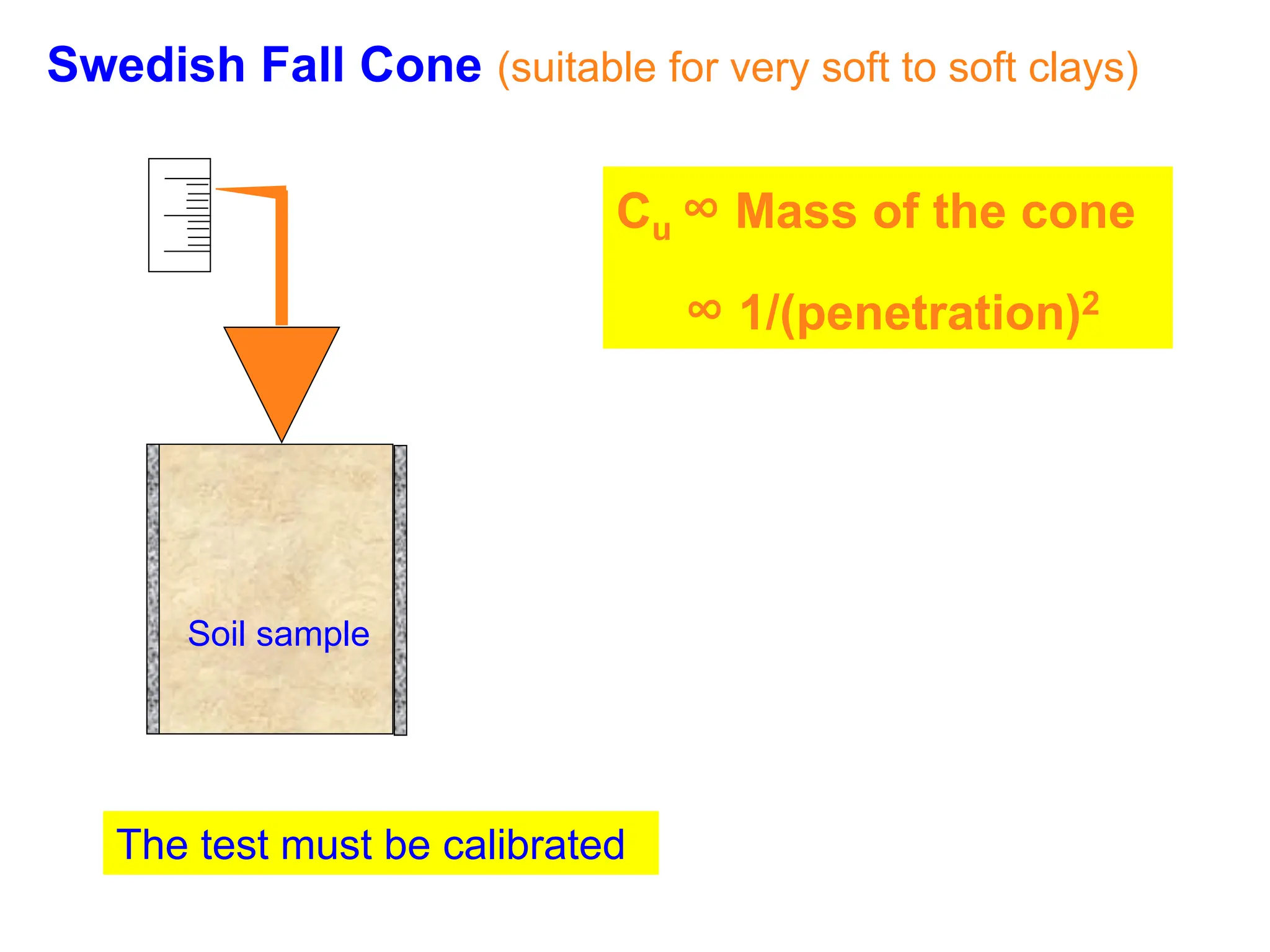
Swedish Fall Cone (suitable for very soft to soft clays)
The test must be calibrated
Soil sample
Cu ∞ Mass of the cone
∞ 1/(penetration)2
In-situ shear tests
 Vane shear test
 Torvane
 Pocket Penetrometer
 Pressuremeter (suitable for all soil types)
 Static Cone Penetrometer test (Push
Cone Penetrometer Test, PCPT)
 Standard Penetration Test, SPT
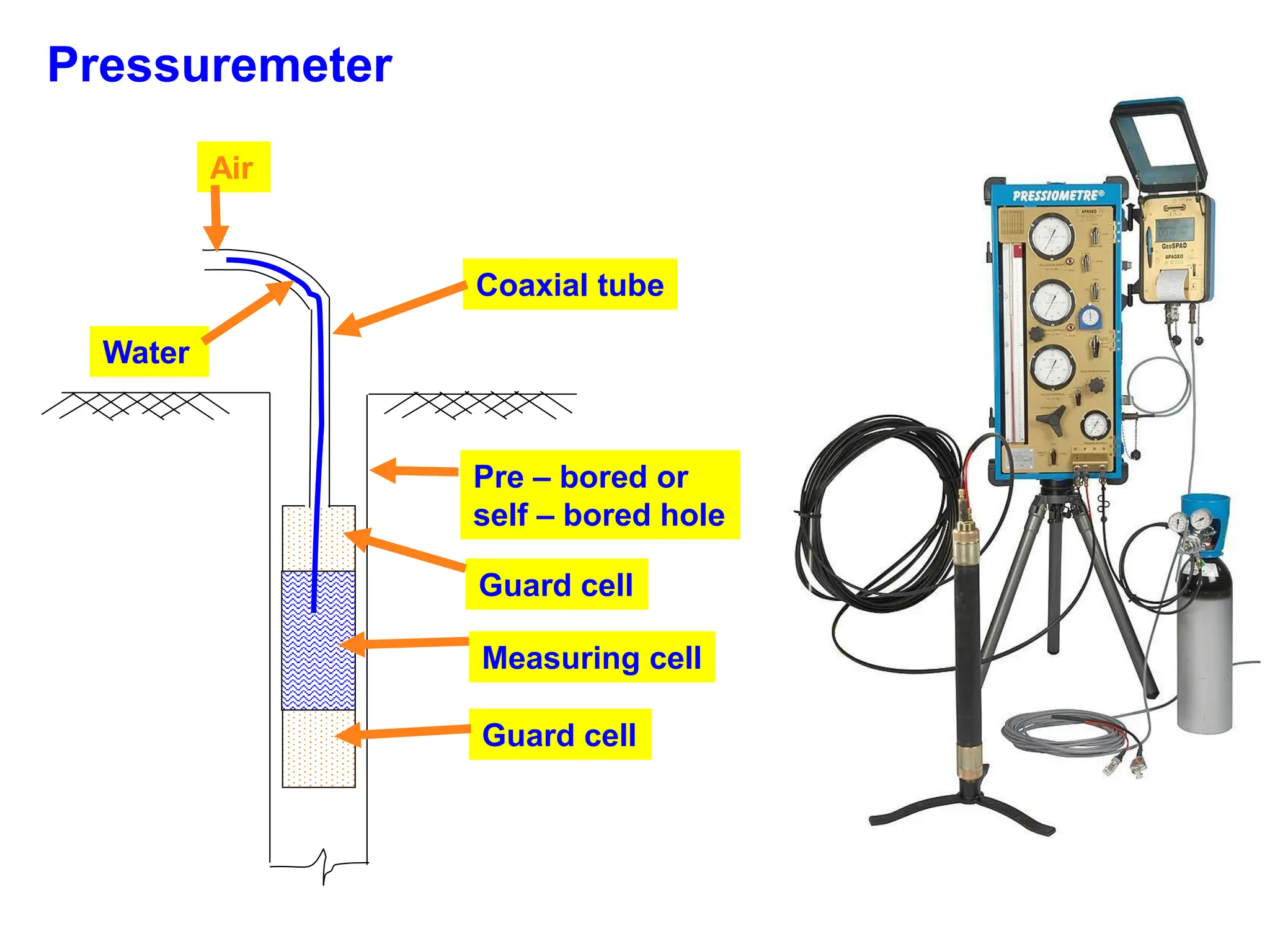
Pressuremeter
Pre – bored or
self – bored hole
Guard cell
Measuring cell
Guard cell
Coaxial tube
Water
Air
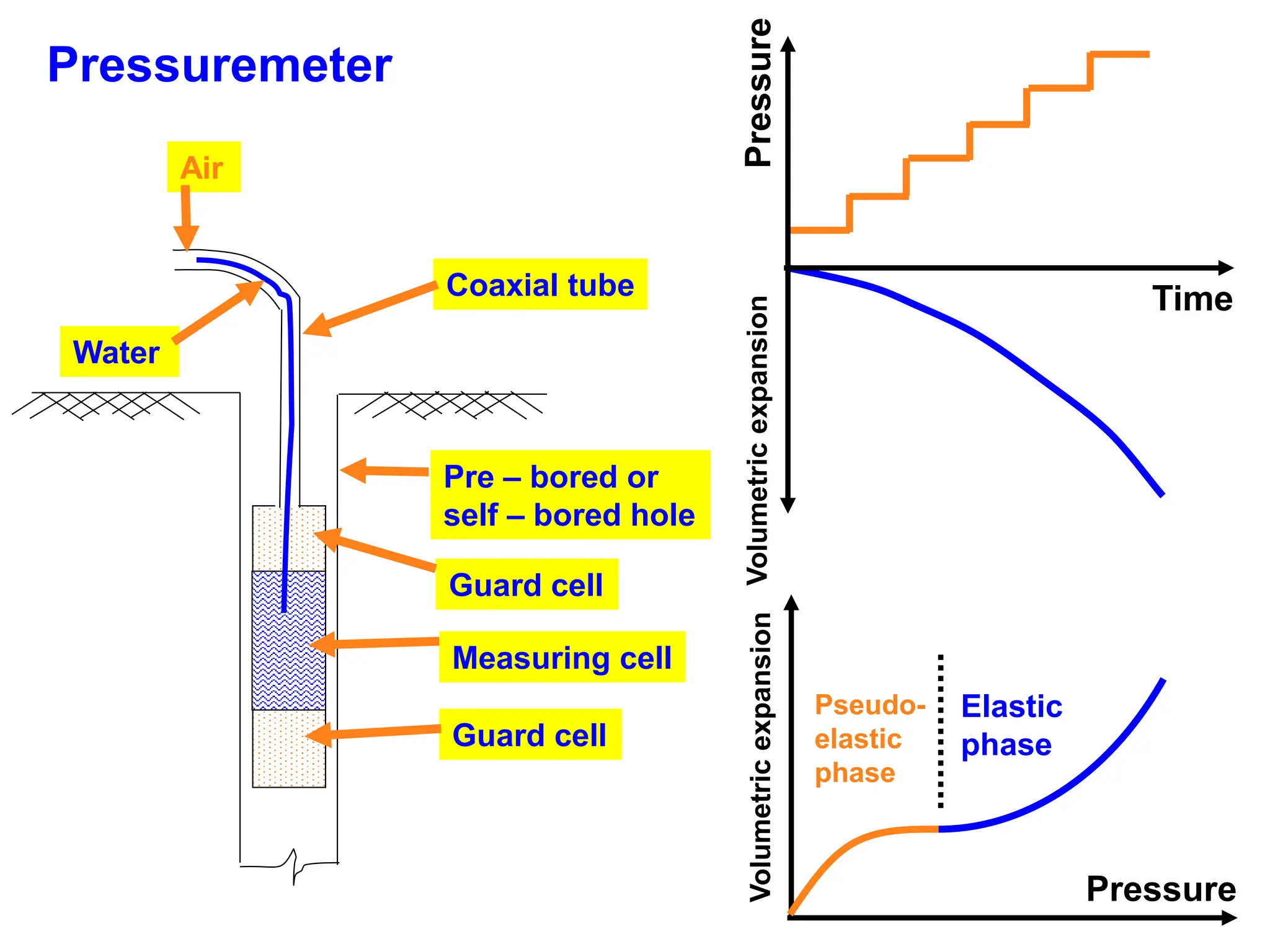
Pressuremeter
Pre – bored or
self – bored hole
Guard cell
Measuring cell
Guard cell
Coaxial tube
Water
Air
Pressure
Volumetric
expansion
Time
Pressure
Volumetric
expansion
Pseudo-
elastic
phase
Elastic
phase
In-situ shear tests
 Vane shear test
 Torvane
 Pocket Penetrometer
 Pressuremeter
 Static Cone Penetrometer test (Push
Cone Penetrometer Test, PCPT)
(suitable for all soil types except very course
granular materials)
 Standard Penetration Test, SPT
Static Cone
Penetrometer
test
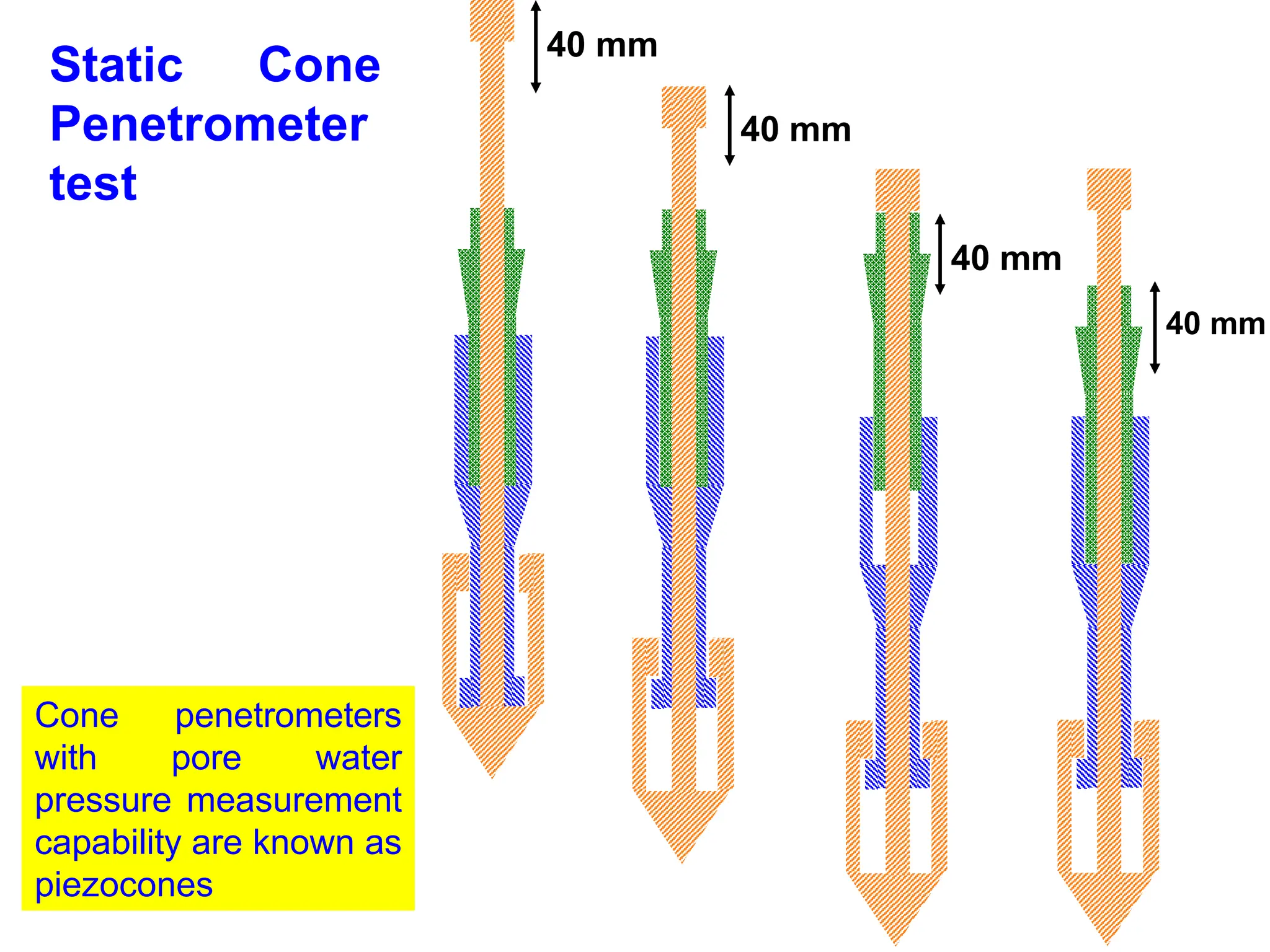
Cone penetrometers
with pore water
pressure measurement
capability are known as
piezocones
40 mm
40 mm
40 mm
40 mm
Static Cone Penetrometer test
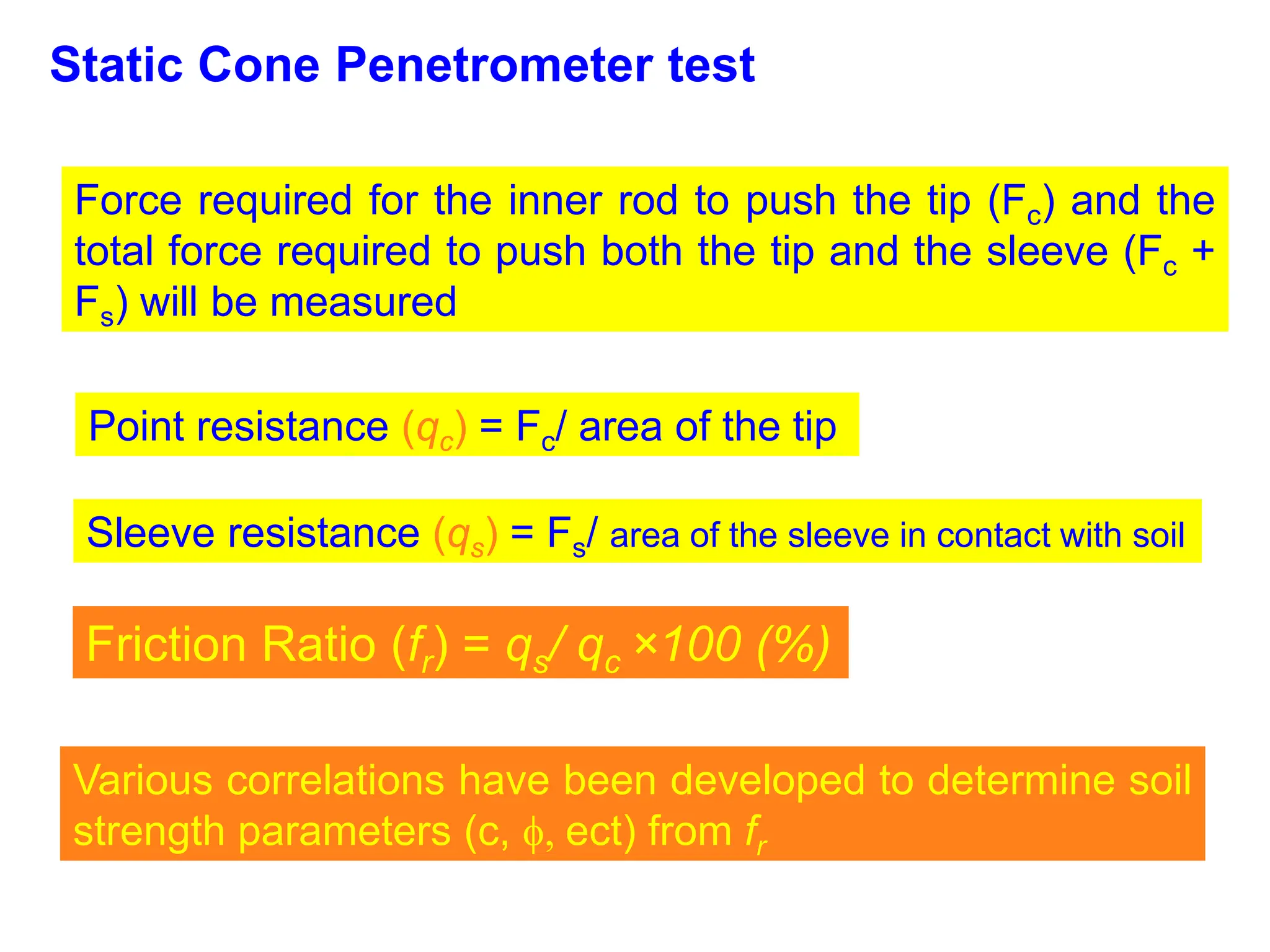
Force required for the inner rod to push the tip (Fc) and the
total force required to push both the tip and the sleeve (Fc +
Fs) will be measured
Point resistance (qc) = Fc/ area of the tip
Sleeve resistance (qs) = Fs/ area of the sleeve in contact with soil
Friction Ratio (fr) = qs/ qc ×100 (%)
Various correlations have been developed to determine soil
strength parameters (c, , ect) from fr
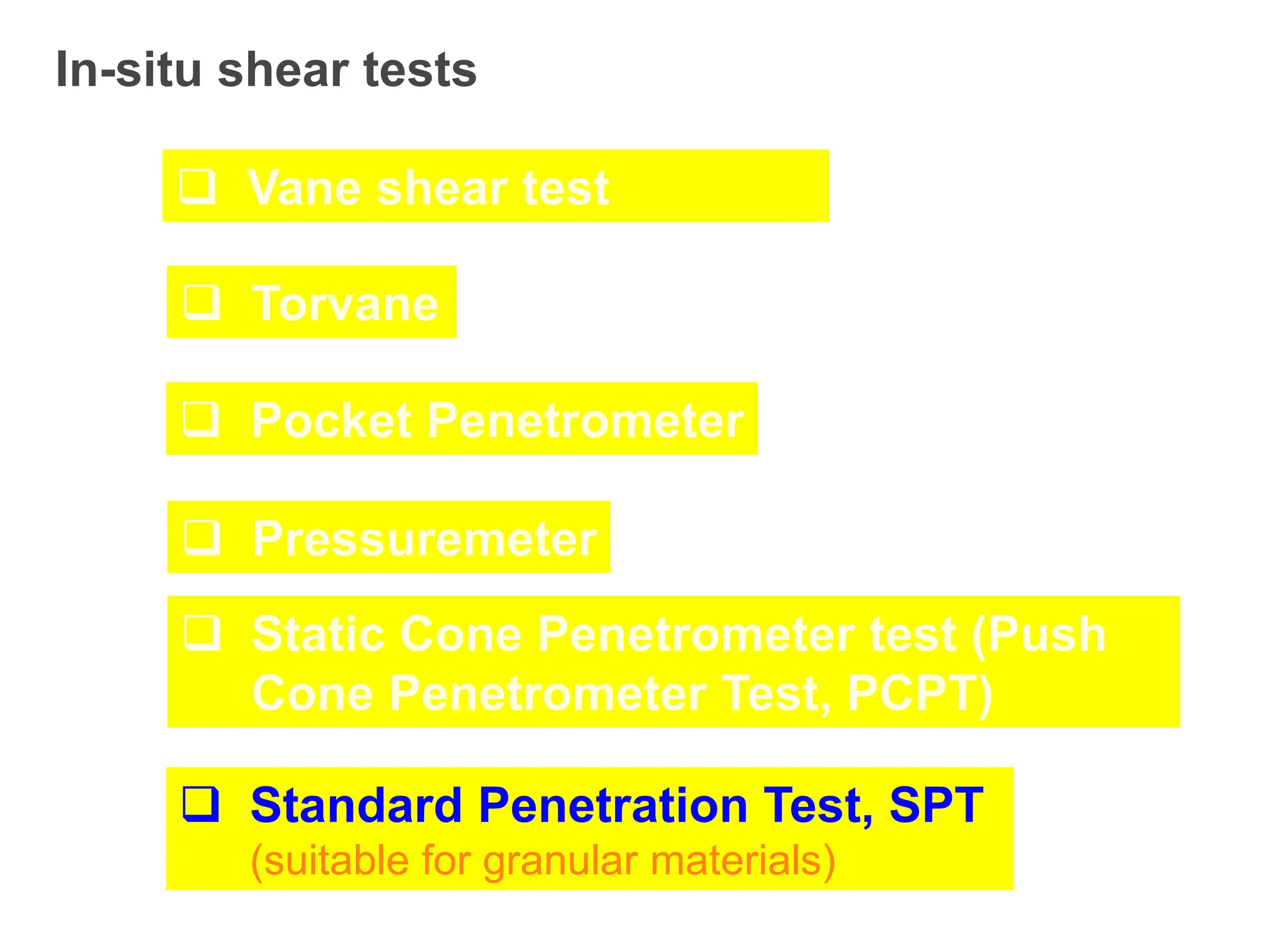
In-situ shear tests
 Vane shear test
 Torvane
 Pocket Penetrometer
 Pressuremeter
 Static Cone Penetrometer test (Push
Cone Penetrometer Test, PCPT)
 Standard Penetration Test, SPT
(suitable for granular materials)
Standard Penetration Test, SPT
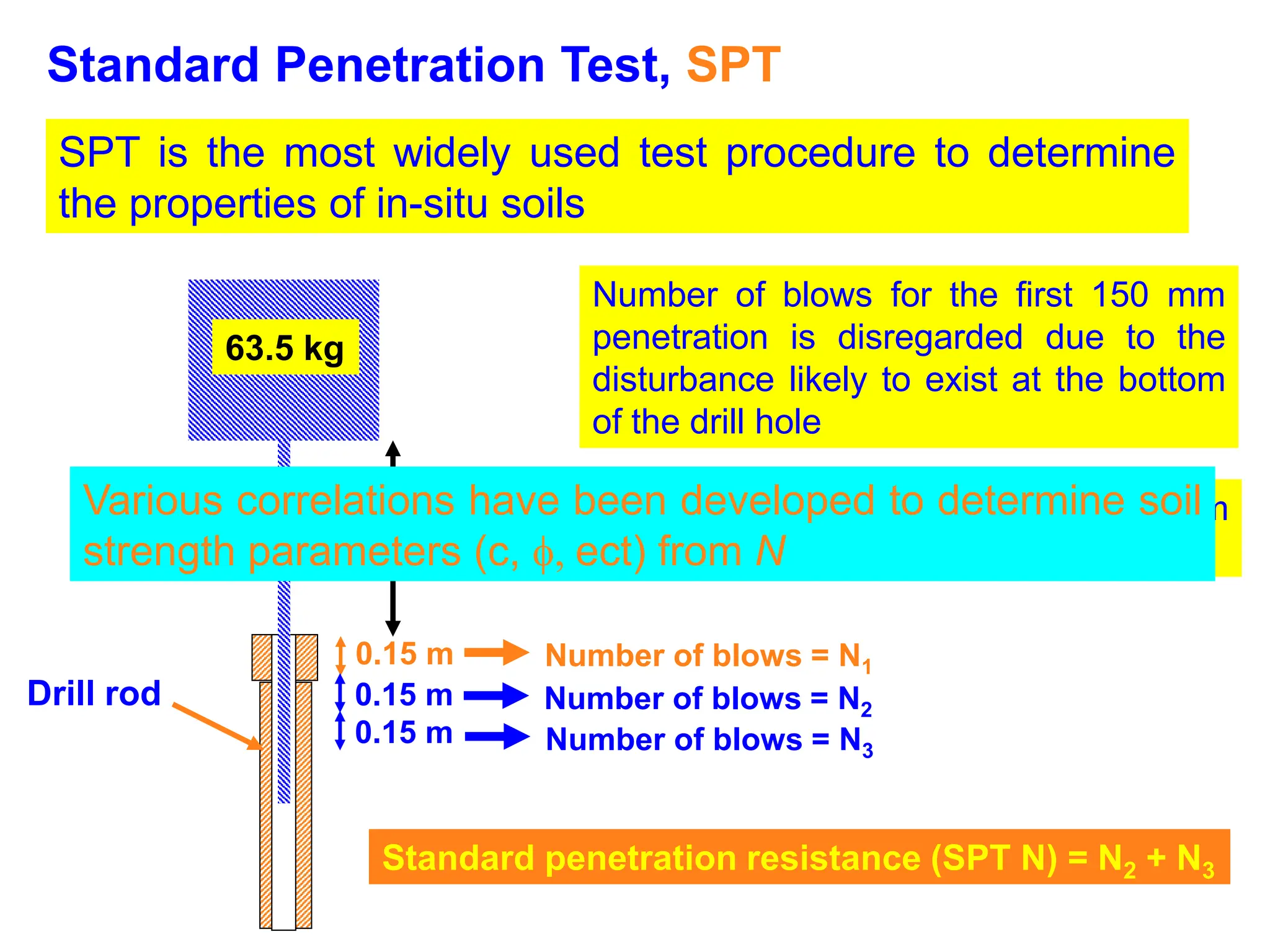
SPT is the most widely used test procedure to determine
the properties of in-situ soils
63.5 kg
0.76 m
Drill rod
0.15 m
0.15 m
0.15 m
Number of blows = N1
Number of blows = N2
Number of blows = N3
Standard penetration resistance (SPT N) = N2 + N3
Number of blows for the first 150 mm
penetration is disregarded due to the
disturbance likely to exist at the bottom
of the drill hole
The test can be conducted at every 1m
vertical intervals
Various correlations have been developed to determine soil
strength parameters (c, , ect) from N
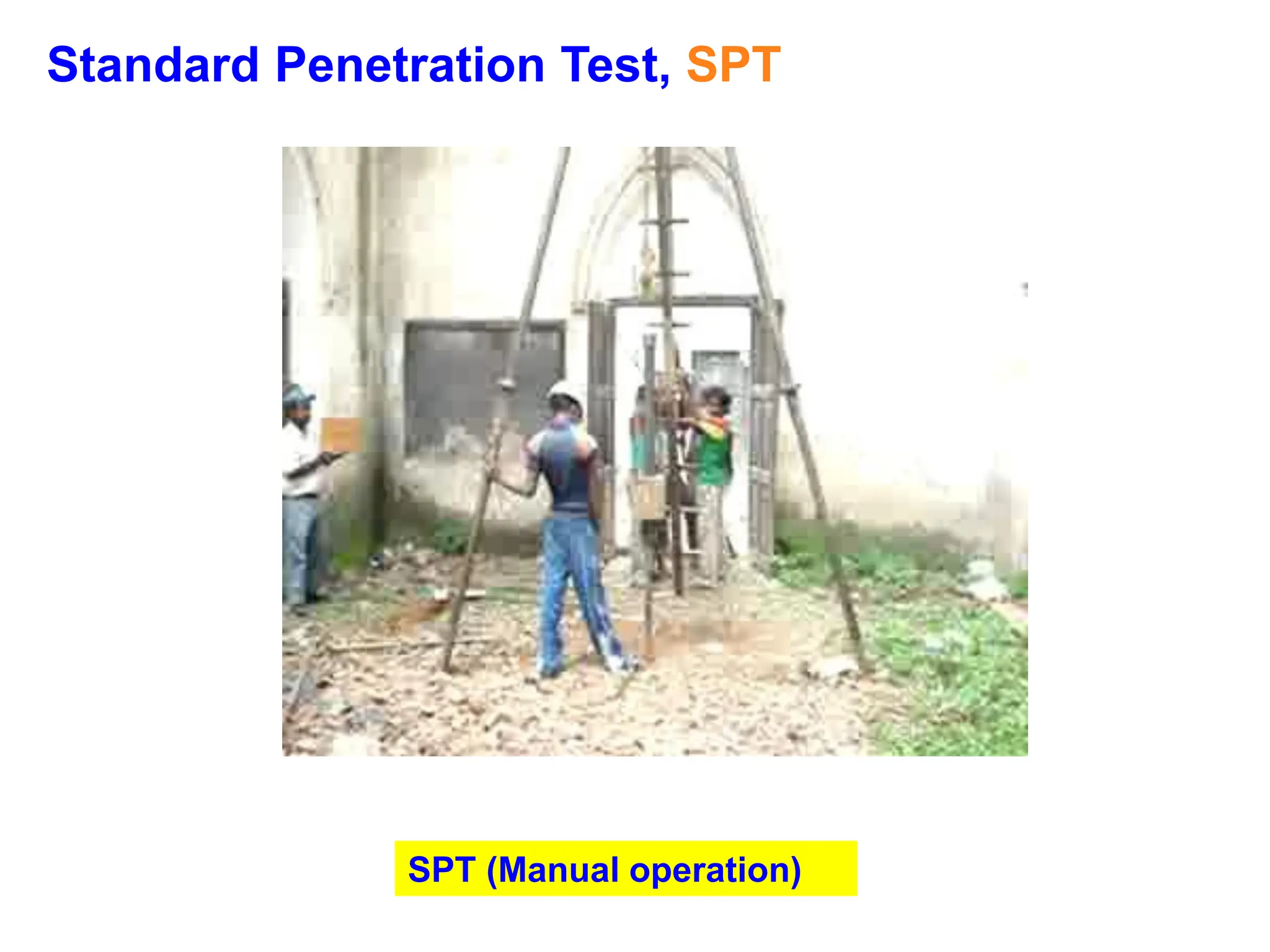
Standard Penetration Test, SPT
SPT (Manual operation)
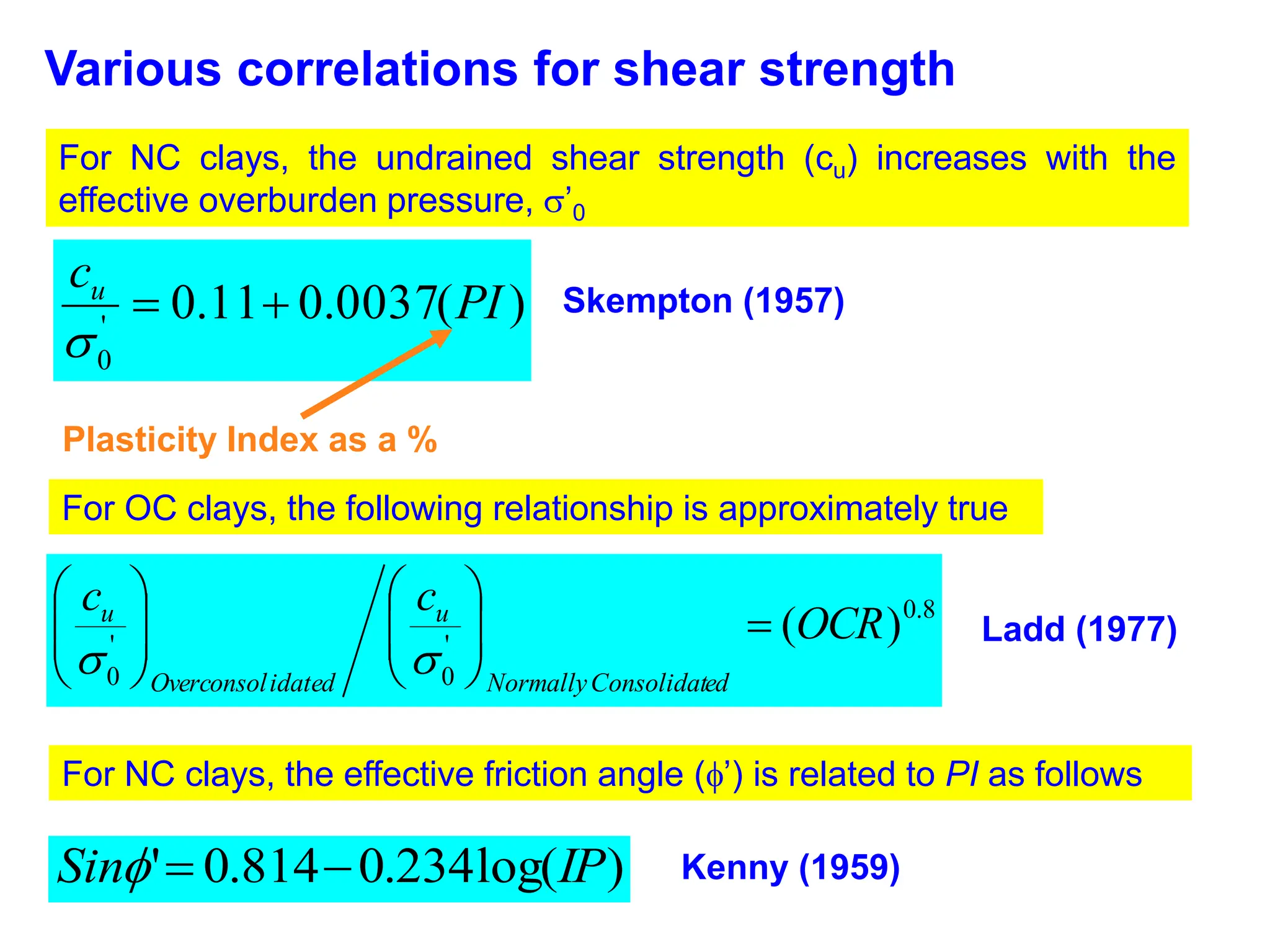
Various correlations for shear strength
For NC clays, the undrained shear strength (cu) increases with the
effective overburden pressure, ’0
)
(
0037
.
0
11
.
0
'
0
PI
cu



Skempton (1957)
Plasticity Index as a %
For OC clays, the following relationship is approximately true
8
.
0
'
0
'
0
)
(OCR
c
c
ed
Consolidat
Normally
u
idated
Overconsol
u



















Ladd (1977)
For NC clays, the effective friction angle (’) is related to PI as follows
)
log(
234
.
0
814
.
0
' IP
Sin 

 Kenny (1959)
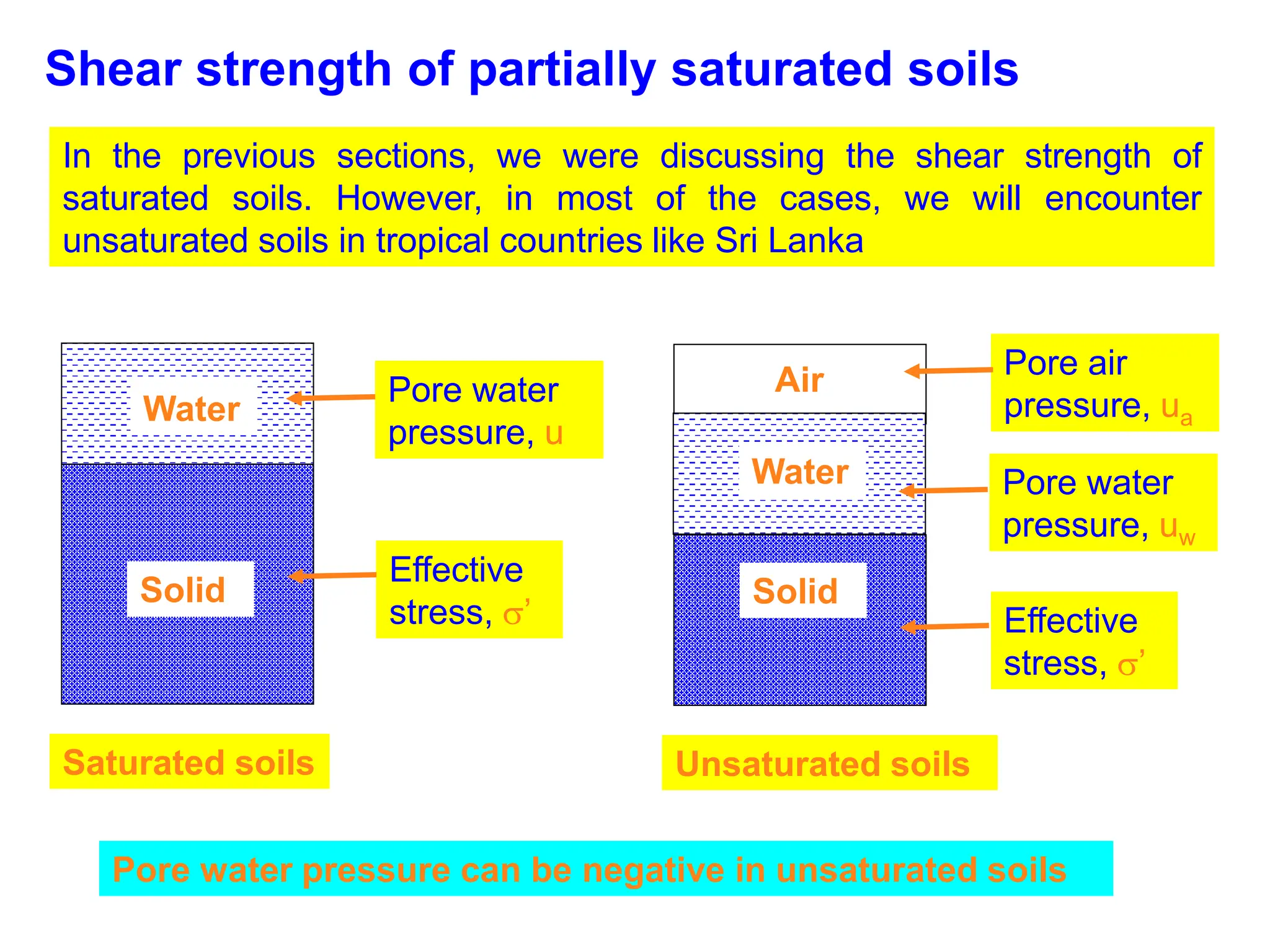
Shear strength of partially saturated soils
In the previous sections, we were discussing the shear strength of
saturated soils. However, in most of the cases, we will encounter
unsaturated soils in tropical countries like Sri Lanka
Solid
Water
Saturated soils
Pore water
pressure, u
Effective
stress, ’
Solid
Unsaturated soils
Pore water
pressure, uw
Effective
stress, ’
Water
Air Pore air
pressure, ua
Pore water pressure can be negative in unsaturated soils
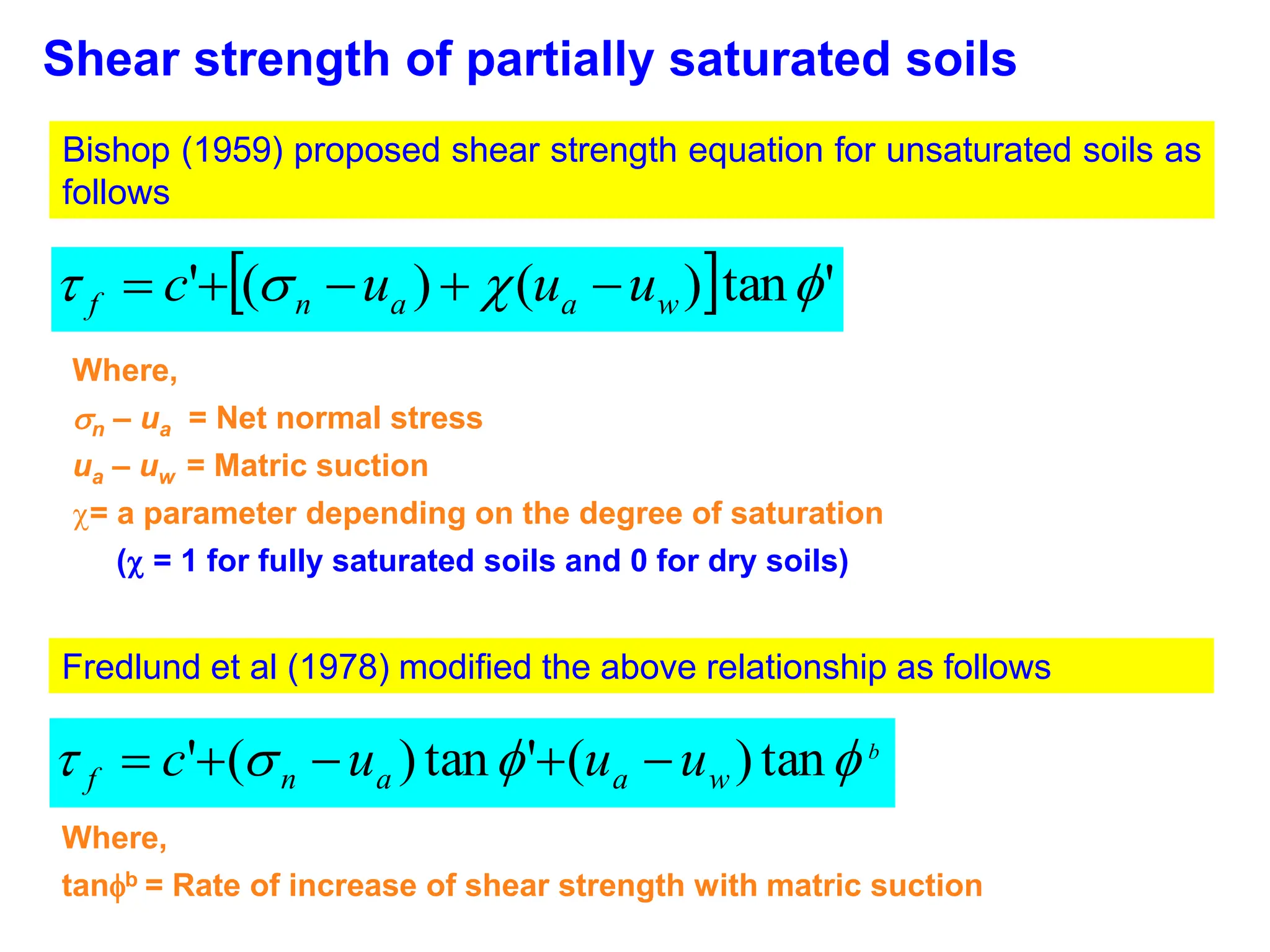
Shear strength of partially saturated soils
Bishop (1959) proposed shear strength equation for unsaturated soils as
follows
  '
tan
)
(
)
(
' 


 w
a
a
n
f u
u
u
c 




Where,
n – ua = Net normal stress
ua – uw = Matric suction
= a parameter depending on the degree of saturation
( = 1 for fully saturated soils and 0 for dry soils)
Fredlund et al (1978) modified the above relationship as follows
b
w
a
a
n
f u
u
u
c 


 tan
)
(
'
tan
)
(
' 




Where,
tanb = Rate of increase of shear strength with matric suction
Shear strength of partially saturated soils
b
w
a
a
n
f u
u
u
c 


 tan
)
(
'
tan
)
(
' 




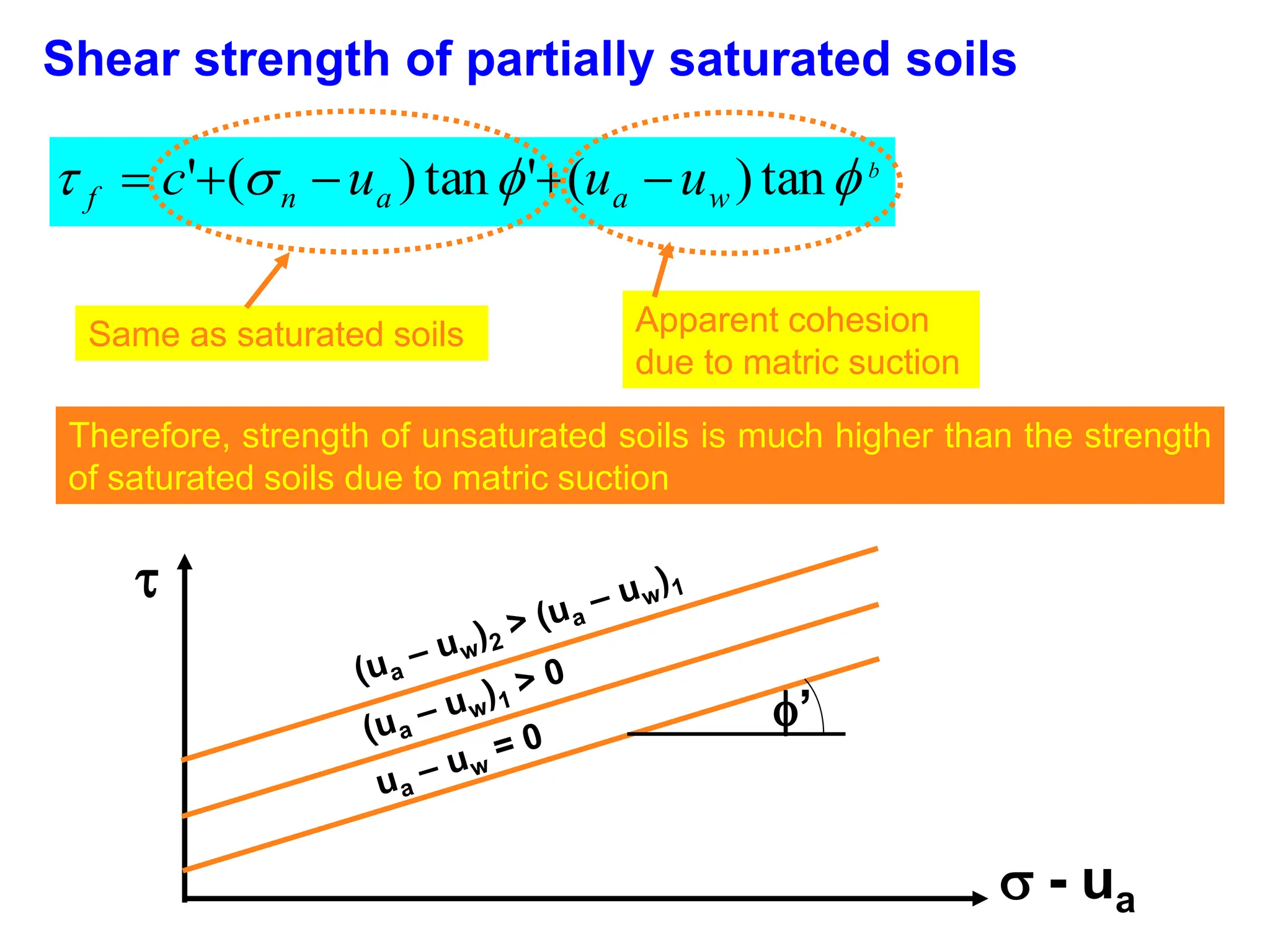
Same as saturated soils Apparent cohesion
due to matric suction
Therefore, strength of unsaturated soils is much higher than the strength
of saturated soils due to matric suction

 - ua
’

 - ua
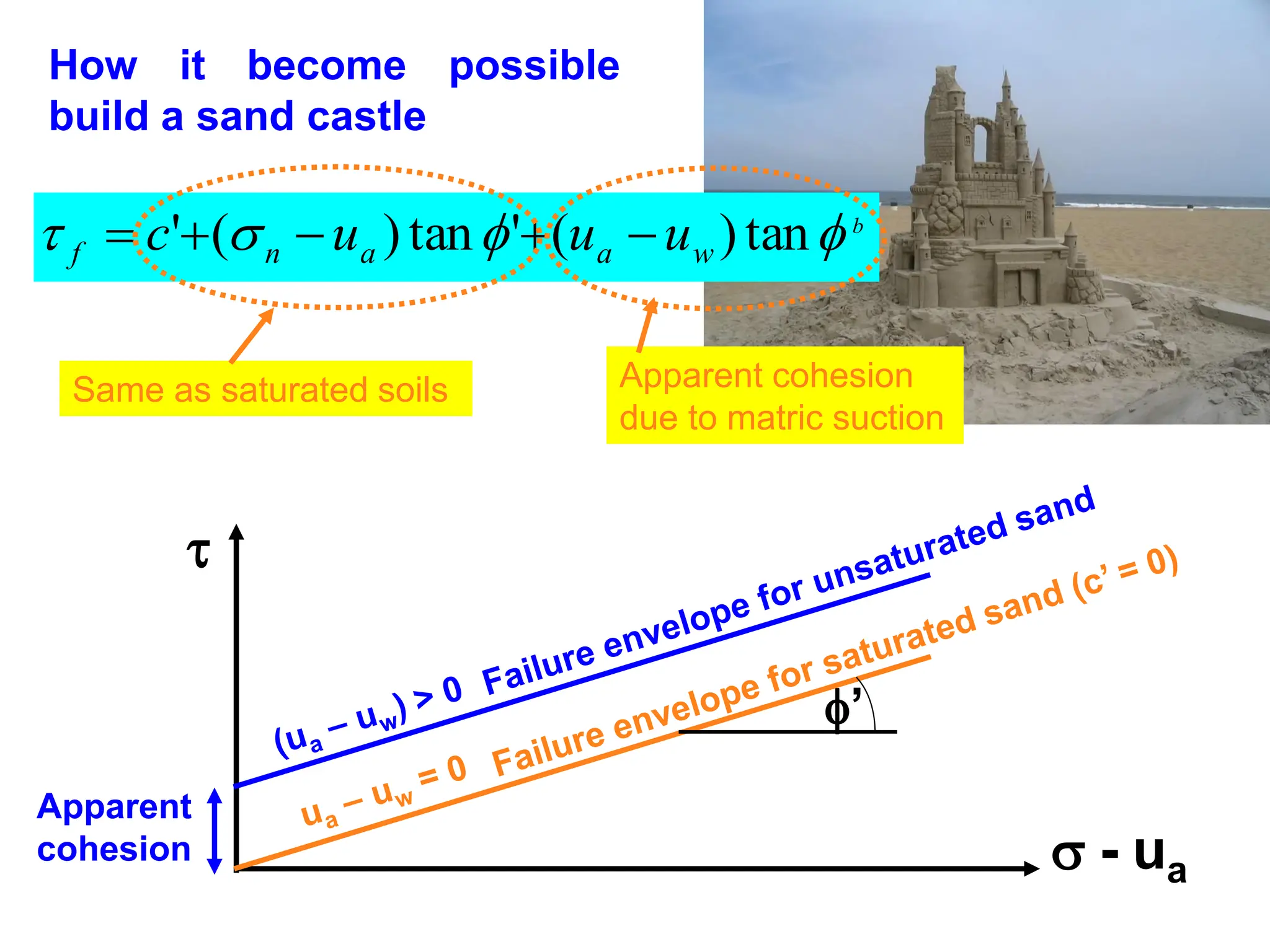
How it become possible
build a sand castle
b
w
a
a
n
f u
u
u
c 


 tan
)
(
'
tan
)
(
' 




Same as saturated soils Apparent cohesion
due to matric suction
’
Apparent
cohesion
Shear Strength of Soil in Geotechnical engineering.pdf

Shear Strength of Soil in Geotechnical engineering.pdf

  • 1.
  • 2.
  • 3.
    Embankment Strip footing Shear failureof soils Soils generally fail in shear At failure, shear stress along the failure surface (mobilized shear resistance) reaches the shear strength. Failure surface Mobilized shear resistance
  • 4.
    Retaining wall Shear failure ofsoils Soils generally fail in shear
  • 5.
    Retaining wall Shear failure ofsoils At failure, shear stress along the failure surface (mobilized shear resistance) reaches the shear strength. Failure surface Mobilized shear resistance Soils generally fail in shear
  • 6.
    Shear failure mechanism Thesoil grains slide over each other along the failure surface. No crushing of individual grains. failure surface
  • 7.
    Shear failure mechanism Atfailure, shear stress along the failure surface () reaches the shear strength (f).
  • 8.
    Mohr-Coulomb Failure Criterion (interms of total stresses)  f is the maximum shear stress the soil can take without failure, under normal stress of .     tan   c f c  Cohesion Friction angle f 
  • 9.
    Mohr-Coulomb Failure Criterion (interms of effective stresses) f is the maximum shear stress the soil can take without failure, under normal effective stress of ’.  ’ ' tan ' '      c f c’ ’ Effective cohesion Effective friction angle f ’ u   ' u = pore water pressure
  • 10.
    Mohr-Coulomb Failure Criterion ' tan ' '   f f c   Shear strength consists of two components: cohesive and frictional. ’f f ’  ' c’ c’ ’f tan ’ frictional component
  • 11.
    c and are measures of shear strength. Higher the values, higher the shear strength.
  • 12.
    Mohr Circle ofstress Soil element ’1 ’1 ’3 ’3 q ’  q      q    2 2 2 2 2 ' 3 ' 1 ' 3 ' 1 ' ' 3 ' 1 Cos Sin       Resolving forces in  and  directions, 2 ' 3 ' 1 2 ' 3 ' 1 ' 2 2 2                           
  • 13.
    Mohr Circle ofstress 2 ' 3 ' 1 2 ' 3 ' 1 ' 2 2 2                             ’ 2 ' 3 ' 1    2 ' 3 ' 1    ' 3  ' 1 
  • 14.
    Mohr Circle ofstress 2 ' 3 ' 1 2 ' 3 ' 1 ' 2 2 2                             ’ 2 ' 3 ' 1    2 ' 3 ' 1    ' 3  ' 1  PD = Pole w.r.t. plane q (’, )
  • 15.
    Soil elements atdifferent locations Failure surface Mohr Circles & Failure Envelope X X X ~ failure Y Y Y ~ stable  ’ ' tan ' '      c f
  • 16.
    Mohr Circles &Failure Envelope Y c c c Initially, Mohr circle is a point  c+  The soil element does not fail if the Mohr circle is contained within the envelope GL
  • 17.
    Mohr Circles &Failure Envelope Y c c c GL As loading progresses, Mohr circle becomes larger… .. and finally failure occurs when Mohr circle touches the envelope 
  • 18.
    ’ 2 ' 3 ' 1    ' 3 ' 1  PD = Pole w.r.t. plane q (’, f) Orientation of Failure Plane ’ ’1 ’1 ’3 ’3 q ’  ’1 ’1 ’3 ’3 q q ’  Failure envelope (90 – q) Therefore, 90 – q  ’ = q q  45 + ’/2
  • 19.
    Mohr circles interms of total & effective stresses = X v’ h’ X u u + v’ h’ effective stresses u v h X v h total stresses   or ’
  • 20.
    Failure envelopes interms of total & effective stresses = X v’ h’ X u u + v’ h’ effective stresses u v h X v h total stresses   or ’ If X is on failure c  Failure envelope in terms of total stresses ’ c’ Failure envelope in terms of effective stresses
  • 21.
    Mohr Coulomb failurecriterion with Mohr circle of stress X ’v = ’1 ’h = ’3 X is on failure ’1 ’3 effective stresses  ’ ’ c’ Failure envelope in terms of effective stresses c’ Cot’ (’1 ’3)/2 (’1  ’3)/2                           2 ' 2 ' ' ' 3 ' 1 ' 3 ' 1       Sin Cot c Therefore,
  • 22.
    Mohr Coulomb failurecriterion with Mohr circle of stress                           2 ' 2 ' ' ' 3 ' 1 ' 3 ' 1       Sin Cot c ( ) ( ) ' ' 2 ' ' 3 ' 1 ' 3 ' 1       Cos c Sin     ( ) ( ) ' ' 2 ' 1 ' 1 ' 3 ' 1      Cos c Sin Sin     ( ) ( ) ( ) ' 1 ' ' 2 ' 1 ' 1 ' 3 ' 1       Sin Cos c Sin Sin                      2 ' 45 ' 2 2 ' 45 2 ' 3 ' 1     Tan c Tan
  • 23.
    Other laboratory testsinclude, Direct simple shear test, torsional ring shear test, plane strain triaxial test, laboratory vane shear test, laboratory fall cone test Determination of shear strength parameters of soils (c,  or c’, ’) Laboratory tests on specimens taken from representative undisturbed samples Field tests Most common laboratory tests to determine the shear strength parameters are, 1.Direct shear test 2.Triaxial shear test 1. Vane shear test 2. Torvane 3. Pocket penetrometer 4. Fall cone 5. Pressuremeter 6. Static cone penetrometer 7. Standard penetration test
  • 24.
    Laboratory tests How totake undisturbed samples
  • 25.
    Laboratory tests Field conditions z vc vc hc hc Beforeconstruction A representative soil sample z vc +  hc hc After and during construction vc + 
  • 26.
    Laboratory tests Simulating fieldconditions in the laboratory Step 1 Set the specimen in the apparatus and apply the initial stress condition vc vc hc hc Representative soil sample taken from the site 0 0 0 0 Step 2 Apply the corresponding field stress conditions vc +  hc hc vc +  vc vc  
  • 27.
    Direct shear test Schematicdiagram of the direct shear apparatus
  • 28.
    Direct shear test Preparationof a sand specimen Components of the shear box Preparation of a sand specimen Porous plates Direct shear test is most suitable for consolidated drained tests specially on granular soils (e.g.: sand) or stiff clays
  • 29.
    Direct shear test Levelingthe top surface of specimen Preparation of a sand specimen Specimen preparation completed Pressure plate
  • 30.
    Direct shear test Testprocedure Porous plates Pressure plate Steel ball Step 1: Apply a vertical load to the specimen and wait for consolidation P Proving ring to measure shear force S
  • 31.
    Direct shear test Step2: Lower box is subjected to a horizontal displacement at a constant rate Step 1: Apply a vertical load to the specimen and wait for consolidation P Test procedure Pressure plate Steel ball Proving ring to measure shear force S Porous plates
  • 32.
    Direct shear test Shearbox Loading frame to apply vertical load Dial gauge to measure vertical displacement Dial gauge to measure horizontal displacement Proving ring to measure shear force
  • 33.
    Direct shear test Analysisof test results sample the of section cross of Area (P) force Normal stress Normal    sample the of section cross of Area (S) surface sliding at the developed resistance Shear stress Shear    Note: Cross-sectional area of the sample changes with the horizontal displacement
  • 34.
    Direct shear testson sands Shear stress,  Shear displacement Dense sand/ OC clay f Loose sand/ NC clay f Dense sand/OC Clay Loose sand/NC Clay Change in height of the sample Expansion Compression Shear displacement Stress-strain relationship
  • 35.
    f1 Normal stress =1 Direct shear tests on sands How to determine strength parameters c and  Shear stress,  Shear displacement f2 Normal stress = 2 f3 Normal stress = 3 Shear stress at failure,  f Normal stress,   Mohr – Coulomb failure envelope
  • 36.
    Direct shear testson sands Some important facts on strength parameters c and  of sand Sand is cohesionless hence c = 0 Direct shear tests are drained and pore water pressures are dissipated, hence u = 0 Therefore, ’ =  and c’ = c = 0
  • 37.
    Direct shear testson clays Failure envelopes for clay from drained direct shear tests Shear stress at failure,  f Normal force,  ’ Normally consolidated clay (c’ = 0) In case of clay, horizontal displacement should be applied at a very slow rate to allow dissipation of pore water pressure (therefore, one test would take several days to finish) Overconsolidated clay (c’ ≠ 0)
  • 38.
    Interface tests ondirect shear apparatus In many foundation design problems and retaining wall problems, it is required to determine the angle of internal friction between soil and the structural material (concrete, steel or wood)    tan '   a f c Where, ca = adhesion,  = angle of internal friction Foundation material Soil P S Foundation material Soil P S
  • 39.
    Advantages of directshear apparatus  Due to the smaller thickness of the sample, rapid drainage can be achieved  Can be used to determine interface strength parameters  Clay samples can be oriented along the plane of weakness or an identified failure plane Disadvantages of direct shear apparatus  Failure occurs along a predetermined failure plane  Area of the sliding surface changes as the test progresses  Non-uniform distribution of shear stress along the failure surface
  • 41.
    Triaxial Shear Test Soilsample at failure Failure plane Porous stone impervious membrane Piston (to apply deviatoric stress) O-ring pedestal Perspex cell Cell pressure Back pressure Pore pressure or volume change Water Soil sample
  • 42.
    Triaxial Shear Test Specimenpreparation (undisturbed sample) Sampling tubes Sample extruder
  • 43.
    Triaxial Shear Test Specimenpreparation (undisturbed sample) Edges of the sample are carefully trimmed Setting up the sample in the triaxial cell
  • 44.
    Triaxial Shear Test Sampleis covered with a rubber membrane and sealed Cell is completely filled with water Specimen preparation (undisturbed sample)
  • 45.
    Triaxial Shear Test Specimenpreparation (undisturbed sample) Proving ring to measure the deviator load Dial gauge to measure vertical displacement In some tests
  • 46.
    Types of TriaxialTests Is the drainage valve open? yes no Consolidated sample Unconsolidated sample Is the drainage valve open? yes no Drained loading Undrained loading Under all-around cell pressure c c c c c Step 1 deviatoric stress ( = q) Shearing (loading) Step 2 c c c+ q
  • 47.
    Types of TriaxialTests Is the drainage valve open? yes no Consolidated sample Unconsolidated sample Under all-around cell pressure c Step 1 Is the drainage valve open? yes no Drained loading Undrained loading Shearing (loading) Step 2 CD test CU test UU test
  • 48.
    Consolidated- drained test(CD Test) Step 1: At the end of consolidation VC hC Total,  = Neutral, u Effective, ’ + 0 Step 2: During axial stress increase ’VC = VC ’hC = hC VC +  hC 0 ’V = VC +  = ’1 ’h = hC = ’3 Drainage Drainage Step 3: At failure VC + f hC 0 ’Vf = VC + f = ’1f ’hf = hC = ’3f Drainage
  • 49.
    Deviator stress (qor d) = 1 – 3 Consolidated- drained test (CD Test) 1 = VC +  3 = hC
  • 50.
    Volume change of the sample Expansion Compression Time Volume change ofsample during consolidation Consolidated- drained test (CD Test)
  • 51.
    Deviator stress,  d Axial strain Dense sand orOC clay (d)f Dense sand or OC clay Loose sand or NC clay Volume change of the sample Expansion Compression Axial strain Stress-strain relationship during shearing Consolidated- drained test (CD Test) Loose sand or NC Clay (d)f
  • 52.
    CD tests Howto determine strength parameters c and  Deviator stress,  d Axial strain Shear stress,   or ’  Mohr – Coulomb failure envelope (d)fa Confining stress = 3a (d)fb Confining stress = 3b (d)fc Confining stress = 3c 3c 1c 3a 1a (d)fa 3b 1b (d)fb 1 = 3 + (d)f 3
  • 53.
    CD tests Strength parametersc and  obtained from CD tests Since u = 0 in CD tests,  = ’ Therefore, c = c’ and  = ’ cd and d are used to denote them
  • 54.
    CD tests Failureenvelopes Shear stress,   or ’ d Mohr – Coulomb failure envelope 3a 1a (d)fa For sand and NC Clay, cd = 0 Therefore, one CD test would be sufficient to determine d of sand or NC clay
  • 55.
    CD tests Failureenvelopes For OC Clay, cd ≠ 0   or ’  3 1 (d)f c c OC NC
  • 56.
    Some practical applicationsof CD analysis for clays   = in situ drained shear strength Soft clay 1. Embankment constructed very slowly, in layers over a soft clay deposit
  • 57.
    Some practical applicationsof CD analysis for clays 2. Earth dam with steady state seepage  = drained shear strength of clay core  Core
  • 58.
    Some practical applicationsof CD analysis for clays 3. Excavation or natural slope in clay  = In situ drained shear strength  Note: CD test simulates the long term condition in the field. Thus, cd and d should be used to evaluate the long term behavior of soils
  • 59.
    Consolidated- Undrained test(CU Test) Step 1: At the end of consolidation VC hC Total,  = Neutral, u Effective, ’ + 0 Step 2: During axial stress increase ’VC = VC ’hC = hC VC +  hC ±u Drainage Step 3: At failure VC + f hC No drainage No drainage ±uf ’V = VC +  ± u = ’1 ’h = hC ± u = ’3 ’Vf = VC + f ± uf = ’1f ’hf = hC ± uf = ’3f 
  • 60.
    Volume change of the sample Expansion Compression Time Volume change ofsample during consolidation Consolidated- Undrained test (CU Test)
  • 61.
    Deviator stress,  d Axial strain Dense sand orOC clay (d)f Dense sand or OC clay Loose sand /NC Clay u + - Axial strain Stress-strain relationship during shearing Consolidated- Undrained test (CU Test) Loose sand or NC Clay (d)f
  • 62.
    CU tests Howto determine strength parameters c and  Deviator stress,  d Axial strain Shear stress,   or ’ (d)fb Confining stress = 3b 3b 1b 3a 1a (d)fa cu Mohr – Coulomb failure envelope in terms of total stresses ccu 1 = 3 + (d)f 3 Total stresses at failure (d)fa Confining stress = 3a
  • 63.
    (d)fa CU tests Howto determine strength parameters c and  Shear stress,   or ’ 3b 1b 3a 1a (d)fa cu Mohr – Coulomb failure envelope in terms of total stresses ccu ’3b ’1b ’3a ’1a Mohr – Coulomb failure envelope in terms of effective stresses ’ C’ ufa ufb ’1 = 3 + (d)f - uf ’3 = 3 - uf Effective stresses at failure uf
  • 64.
    CU tests Strength parametersc and  obtained from CD tests Shear strength parameters in terms of total stresses are ccu and cu Shear strength parameters in terms of effective stresses are c’ and ’ c’ = cd and ’ = d
  • 65.
    CU tests Failureenvelopes For sand and NC Clay, ccu and c’ = 0 Therefore, one CU test would be sufficient to determine cu and ’(= d) of sand or NC clay Shear stress,   or ’ cu Mohr – Coulomb failure envelope in terms of total stresses 3a 1a (d)fa 3a 1a ’ Mohr – Coulomb failure envelope in terms of effective stresses
  • 66.
    Some practical applicationsof CU analysis for clays   = in situ undrained shear strength Soft clay 1. Embankment constructed rapidly over a soft clay deposit
  • 67.
    Some practical applicationsof CU analysis for clays 2. Rapid drawdown behind an earth dam  = Undrained shear strength of clay core Core 
  • 68.
    Some practical applicationsof CU analysis for clays 3. Rapid construction of an embankment on a natural slope Note: Total stress parameters from CU test (ccu and cu) can be used for stability problems where, Soil have become fully consolidated and are at equilibrium with the existing stress state; Then for some reason additional stresses are applied quickly with no drainage occurring  = In situ undrained shear strength 
  • 70.
    Unconsolidated- Undrained test(UU Test) Data analysis C = 3 C = 3 No drainage Initial specimen condition 3 + d 3 No drainage Specimen condition during shearing Initial volume of the sample = A0 × H0 Volume of the sample during shearing = A × H Since the test is conducted under undrained condition, A × H = A0 × H0 A ×(H0 – H) = A0 × H0 A ×(1 – H/H0) = A0 z A A    1 0
  • 71.
    Unconsolidated- Undrained test(UU Test) Step 1: Immediately after sampling 0 0 = + Step 2: After application of hydrostatic cell pressure uc = B 3 C = 3 C = 3 uc ’3 = 3 - uc ’3 = 3 - uc No drainage Increase of pwp due to increase of cell pressure Increase of cell pressure Skempton’s pore water pressure parameter, B Note: If soil is fully saturated, then B = 1 (hence, uc = 3)
  • 72.
    Unconsolidated- Undrained test(UU Test) Step 3: During application of axial load 3 + d 3 No drainage ’1 = 3 + d - uc ud ’3 = 3 - uc ud  ud = ABd uc ± ud = + Increase of pwp due to increase of deviator stress Increase of deviator stress Skempton’s pore water pressure parameter, A
  • 73.
    Unconsolidated- Undrained test(UU Test) Combining steps 2 and 3, uc = B 3 ud = ABd u = uc + ud Total pore water pressure increment at any stage, u u = B [3 + Ad] Skempton’s pore water pressure equation u = B [3 + A(1 – 3]
  • 74.
    Unconsolidated- Undrained test(UU Test) Derivation of Skempton’s pore water pressure equation
  • 75.
    Step 1 :Incrementof isotropic stress Derivation of Skempton’s pore water pressure equation 2 3 1 No drainage 1 + 3 3 + 3 2 + 3 No drainage uc Increase in effective stress in each direction = 3 - uc
  • 76.
    Step 2 :Incrementof major principal stress Derivation of Skempton’s pore water pressure equation 2 3 1 No drainage 1 + 1 3 + 0 2 + 0 No drainage uc Increase in effective stress in 1 direction = 1 - ud Increase in effective stress in 2 and 3 directions = 0 - ud Average Increase in effective stress = (1 - ud - ud – ud)/3
  • 77.
    Typical values forparameter B
  • 78.
    Typical values forparameter A 1 – 3 u Axial strain NC Clay (low sensitivity) (A = 0.5 – 1.0) NC Clay (High sensitivity) (A > 1.0) Axial strain u 1 – 3 Collapse of soil structure may occur in high sensitivity clays due to very high pore water pressure generation
  • 79.
    Typical values forparameter A 1 – 3 Axial strain OC Clay (Lightly overconsolidated) (A = 0.0 – 0.5) OC Clay (Heavily overconsolidated) (A = -0.5 - 0.0) During the increase of major principal stress pore water pressure can become negative in heavily overconsolidated clays due to dilation of specimen u 1 – 3 Axial strain u
  • 80.
    Typical values forparameter A
  • 81.
    Unconsolidated- Undrained test(UU Test) Step 1: Immediately after sampling 0 0 Total,  = Neutral, u Effective, ’ + -ur Step 2: After application of hydrostatic cell pressure ’V0 = ur ’h0 = ur C C -ur  uc = -ur  c (Sr = 100% ; B = 1) Step 3: During application of axial load C +  C No drainage No drainage -ur  c ± u ’VC = C + ur - C = ur ’h = ur Step 3: At failure ’V = C +  + ur - c u ’h = C + ur - c u  ’hf = C + ur - c uf = ’3f ’Vf = C + f + ur - c uf = ’1f  -ur  c ± uf C C + f No drainage
  • 82.
    Unconsolidated- Undrained test(UU Test) Total,  = Neutral, u Effective, ’ + Step 3: At failure ’hf = C + ur - c uf = ’3f ’Vf = C + f + ur - c uf = ’1f  -ur  c ± uf C C + f No drainage Mohr circle in terms of effective stresses do not depend on the cell pressure. Therefore, we get only one Mohr circle in terms of effective stress for different cell pressures  ’ ’3 ’1 f
  • 83.
    3b 1b 3a 1a f ’3’1 Unconsolidated- Undrained test (UU Test) Total,  = Neutral, u Effective, ’ + Step 3: At failure ’hf = C + ur - c uf = ’3f ’Vf = C + f + ur - c uf = ’1f  -ur  c ± uf C C + f No drainage   or ’ Mohr circles in terms of total stresses ua ub Failure envelope, u = 0 cu
  • 84.
    3b 1b Unconsolidated- Undrainedtest (UU Test) Effect of degree of saturation on failure envelope 3a 1a 3c 1c   or ’ S < 100% S > 100%
  • 85.
    Some practical applicationsof UU analysis for clays   = in situ undrained shear strength Soft clay 1. Embankment constructed rapidly over a soft clay deposit
  • 86.
    Some practical applicationsof UU analysis for clays 2. Large earth dam constructed rapidly with no change in water content of soft clay Core  = Undrained shear strength of clay core 
  • 87.
    Some practical applicationsof UU analysis for clays 3. Footing placed rapidly on clay deposit  = In situ undrained shear strength Note: UU test simulates the short term condition in the field. Thus, cu can be used to analyze the short term behavior of soils
  • 88.
    Unconfined Compression Test(UC Test) 1 = VC +  3 = 0 Confining pressure is zero in the UC test
  • 89.
    Unconfined Compression Test(UC Test) 1 = VC + f 3 = 0 Shear stress,  Normal stress,  qu Note: Theoritically qu = cu , However in the actual case qu < cu due to premature failure of the sample
  • 91.
    Stress Invariants (pand q) p (or s) = (1 + 3)/2 q (or t) = (1 - 3)/2   3 1 (1 + 3)/2 (1 - 3)/2 c  p and q can be used to illustrate the variation of the stress state of a soil specimen during a laboratory triaxial test
  • 92.
    c c GL  Stress Invariants (pand q) c p (or s) = (1 + 3)/2 q (or t) = (1 - 3)/2  or q  or p
  • 93.
    Mohr Coulomb failureenvelope in terms of stress invariants p (or s) = (1 + 3)/2 q (or t) = (1 - 3)/2                           2 ' 2 ' ' ' 3 ' 1 ' 3 ' 1       Sin Cot c ( ) ( ) ' ' ' 2 2 ' 3 ' 1 ' 3 ' 1       Cos c Sin       3 1 (1 + 3)/2 (1 - 3)/2 c  ' ' '   Cos c pSin q  
  • 94.
    p (or s)= (1 + 3)/2 q (or t) = (1 - 3)/2  or q  or p Mohr Coulomb failure envelope in terms of stress invariants a Therefore, sin = tana  = sin-1(tana) c cos
  • 95.
    Stress path forCD triaxial test 3 p, p’ (or s, s’) = (1 + 3)/2 = (’1 + ’3)/2 q (or t) = (1 - 3)/2  or q  or p In CD tests pore water pressure is equal to zero. Therefore, total and effective stresses are equal Step 1 3 3 p, p’ (or s, s’) = 3 q (or t) = 0 Step 2 3 + d 3 p, p’ (or s, s’) = 3 + d/2 q (or t) = d/2 d 450
  • 96.
    Stress path forCU triaxial test 3 = ’3 p (or s) = (1 + 3)/2 p’ (or s’) = (1 + 3)/2 - u q (or t) = (1 - 3)/2 In CU tests pore water pressure develops during shearing Step 1 3 3 p, p’ (or s, s’) = 3 q (or t) = 0 p (or s) = 3 + d/2 d 450 ud Step 2 3 + d 3 ud q , ’ or p, p’ q (or t) = d/2
  • 98.
    Other laboratory sheartests  Direct simple shear test  Torsional ring shear test  Plane strain triaxial test
  • 99.
    Other laboratory sheartests  Direct simple shear test  Torsional ring shear test  Plane strain triaxial test
  • 100.
    Direct simple sheartest Direct shear test  = 80 mm Soil specimen Porous stones Spiral wire in rubber membrane Direct simple shear test
  • 101.
    Other laboratory sheartests  Direct simple shear test  Torsional ring shear test  Plane strain triaxial test
  • 102.
    Torsional ring sheartest Peak Residual  Shear displacement f ’ ’max ’res
  • 103.
    Torsional ring sheartest N Preparation of ring shaped undisturbed samples is very difficult. Therefore, remoulded samples are used in most cases
  • 104.
    Other laboratory sheartests  Direct simple shear test  Torsional ring shear test  Plane strain triaxial test
  • 105.
    Plane strain triaxialtest ’1, 1 ’2, 2 ’3, 3 Plane strain test ’2 ≠ ’3 2 = 0 ’1 ’2 ’3 ’2 Rigid platens Specimen
  • 106.
    In-situ shear tests Vane shear test  Torvane  Pocket Penetrometer  Pressuremeter  Static Cone Penetrometer test (Push Cone Penetrometer Test, PCPT)  Standard Penetration Test, SPT
  • 107.
    In-situ shear tests Vane shear test (suitable for soft to stiff clays)  Torvane  Pocket Penetrometer  Pressuremeter  Static Cone Penetrometer test (Push Cone Penetrometer Test, PCPT)  Standard Penetration Test, SPT
  • 108.
    PLAN VIEW Vane sheartest This is one of the most versatile and widely used devices used for investigating undrained shear strength (Cu) and sensitivity of soft clays Bore hole (diameter = DB) h > 3DB) Vane D H Applied Torque, T Vane T Rupture surface Disturbed soil Rate of rotation : 60 – 120 per minute Test can be conducted at 0.5 m vertical intervals
  • 109.
    Vane shear test Sincethe test is very fast, Unconsolidated Undrained (UU) can be expected Cu Cu T = Ms + Me + Me = Ms + 2Me Me – Assuming a uniform distribution of shear strength   2 0 ). 2 ( d u e r C rdr M  2 0 3 2 0 2 3 2 2 d u d u e r C dr r C M            12 8 3 2 3 3 d C d C M u u e           d/2 d/2 Cu h
  • 110.
    Vane shear test Sincethe test is very fast, Unconsolidated Undrained (UU) can be expected Cu Cu Ms – Shaft shear resistance along the circumference 2 2 2 h d C d dhC M u u s     2 12 2 3 2    d C h d C T u u             6 2 3 2 d h d C T u            6 2 3 2 d h d T Cu  T = Ms + Me + Me = Ms + 2Me
  • 111.
    Vane shear test Sincethe test is very fast, Unconsolidated Undrained (UU) can be expected Cu Cu T = Ms + Me + Me = Ms + 2Me Me – Assuming a triangular distribution of shear strength h d/2 d/2 Cu           8 2 3 2 d h d T Cu  Can you derive this ???
  • 112.
    Vane shear test Sincethe test is very fast, Unconsolidated Undrained (UU) can be expected Cu Cu T = Ms + Me + Me = Ms + 2Me Me – Assuming a parabolic distribution of shear strength h           20 3 2 3 2 d h d T Cu  Can you derive this ??? d/2 d/2 Cu
  • 113.
    Vane shear test Sincethe test is very fast, Unconsolidated Undrained (UU) can be expected Cu Cu h After the initial test, vane can be rapidly rotated through several revolutions until the clay become remoulded peak ultimate  Shear displacement Stength Ultimate Stength Peak y Sensitivit 
  • 114.
    Some important factson vane shear test Insertion of vane into soft clays and silts disrupts the natural soil structure around the vane causing reduction of shear strength The above reduction is partially regained after some time Cu as determined by vane shear test may be a function of the rate of angular rotation of the vane
  • 115.
    Correction for thestrength parameters obtained from vane shear test Bjerrum (1974) has shown that as the plasticity of soils increases, Cu obtained by vane shear tests may give unsafe results for foundation design. Therefore, he proposed the following correction. Cu(design) = lCu(vane shear) Where, l = correction factor = 1.7 – 0.54 log (PI) PI = Plasticity Index
  • 116.
    In-situ shear tests Vane shear test  Torvane (suitable for very soft to stiff clays)  Pocket Penetrometer  Pressuremeter  Static Cone Penetrometer test (Push Cone Penetrometer Test, PCPT)  Standard Penetration Test, SPT
  • 117.
    Torvane Torvane is amodification to the vane
  • 118.
    In-situ shear tests Vane shear test  Torvane  Pocket Penetrometer (suitable for very soft to stiff clays)  Pressuremeter  Static Cone Penetrometer test (Push Cone Penetrometer Test, PCPT)  Standard Penetration Test, SPT
  • 119.
    Pocket Penetrometer Pushed directlyinto the soil. The unconfined compression strength (qu) is measured by a calibrated spring.
  • 120.
    Swedish Fall Cone(suitable for very soft to soft clays) The test must be calibrated Soil sample Cu ∞ Mass of the cone ∞ 1/(penetration)2
  • 121.
    In-situ shear tests Vane shear test  Torvane  Pocket Penetrometer  Pressuremeter (suitable for all soil types)  Static Cone Penetrometer test (Push Cone Penetrometer Test, PCPT)  Standard Penetration Test, SPT
  • 122.
    Pressuremeter Pre – boredor self – bored hole Guard cell Measuring cell Guard cell Coaxial tube Water Air
  • 123.
    Pressuremeter Pre – boredor self – bored hole Guard cell Measuring cell Guard cell Coaxial tube Water Air Pressure Volumetric expansion Time Pressure Volumetric expansion Pseudo- elastic phase Elastic phase
  • 124.
    In-situ shear tests Vane shear test  Torvane  Pocket Penetrometer  Pressuremeter  Static Cone Penetrometer test (Push Cone Penetrometer Test, PCPT) (suitable for all soil types except very course granular materials)  Standard Penetration Test, SPT
  • 125.
    Static Cone Penetrometer test Cone penetrometers withpore water pressure measurement capability are known as piezocones 40 mm 40 mm 40 mm 40 mm
  • 126.
    Static Cone Penetrometertest Force required for the inner rod to push the tip (Fc) and the total force required to push both the tip and the sleeve (Fc + Fs) will be measured Point resistance (qc) = Fc/ area of the tip Sleeve resistance (qs) = Fs/ area of the sleeve in contact with soil Friction Ratio (fr) = qs/ qc ×100 (%) Various correlations have been developed to determine soil strength parameters (c, , ect) from fr
  • 127.
    In-situ shear tests Vane shear test  Torvane  Pocket Penetrometer  Pressuremeter  Static Cone Penetrometer test (Push Cone Penetrometer Test, PCPT)  Standard Penetration Test, SPT (suitable for granular materials)
  • 128.
    Standard Penetration Test,SPT SPT is the most widely used test procedure to determine the properties of in-situ soils 63.5 kg 0.76 m Drill rod 0.15 m 0.15 m 0.15 m Number of blows = N1 Number of blows = N2 Number of blows = N3 Standard penetration resistance (SPT N) = N2 + N3 Number of blows for the first 150 mm penetration is disregarded due to the disturbance likely to exist at the bottom of the drill hole The test can be conducted at every 1m vertical intervals Various correlations have been developed to determine soil strength parameters (c, , ect) from N
  • 129.
    Standard Penetration Test,SPT SPT (Manual operation)
  • 130.
    Various correlations forshear strength For NC clays, the undrained shear strength (cu) increases with the effective overburden pressure, ’0 ) ( 0037 . 0 11 . 0 ' 0 PI cu    Skempton (1957) Plasticity Index as a % For OC clays, the following relationship is approximately true 8 . 0 ' 0 ' 0 ) (OCR c c ed Consolidat Normally u idated Overconsol u                    Ladd (1977) For NC clays, the effective friction angle (’) is related to PI as follows ) log( 234 . 0 814 . 0 ' IP Sin    Kenny (1959)
  • 131.
    Shear strength ofpartially saturated soils In the previous sections, we were discussing the shear strength of saturated soils. However, in most of the cases, we will encounter unsaturated soils in tropical countries like Sri Lanka Solid Water Saturated soils Pore water pressure, u Effective stress, ’ Solid Unsaturated soils Pore water pressure, uw Effective stress, ’ Water Air Pore air pressure, ua Pore water pressure can be negative in unsaturated soils
  • 132.
    Shear strength ofpartially saturated soils Bishop (1959) proposed shear strength equation for unsaturated soils as follows   ' tan ) ( ) ( '     w a a n f u u u c      Where, n – ua = Net normal stress ua – uw = Matric suction = a parameter depending on the degree of saturation ( = 1 for fully saturated soils and 0 for dry soils) Fredlund et al (1978) modified the above relationship as follows b w a a n f u u u c     tan ) ( ' tan ) ( '      Where, tanb = Rate of increase of shear strength with matric suction
  • 133.
    Shear strength ofpartially saturated soils b w a a n f u u u c     tan ) ( ' tan ) ( '      Same as saturated soils Apparent cohesion due to matric suction Therefore, strength of unsaturated soils is much higher than the strength of saturated soils due to matric suction   - ua ’
  • 134.
      - ua Howit become possible build a sand castle b w a a n f u u u c     tan ) ( ' tan ) ( '      Same as saturated soils Apparent cohesion due to matric suction ’ Apparent cohesion