
Jenny Allen Varun Khanduja Xiaohan Liu Brandon Stephens fostering a relationship through exploration of meals and food preparation Prepare to Share!
problem space how can collaborative technology be used to support the development or maintenance of an relationship?
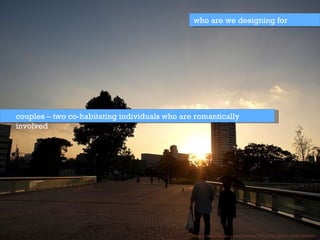
who are we designing for http://www.flickr.com/photos/77735640@N00/2964368500/ couples – two co-habitating individuals who are romantically involved
a slew of secondary research what we did http://www.flickr.com/photos/pakitt/2330286413/
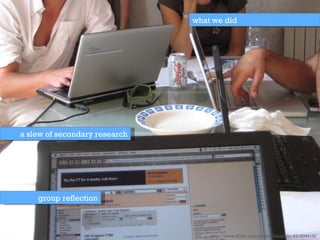
a slew of secondary research what we did group reflection http://www.flickr.com/photos/benindc/491609415 /
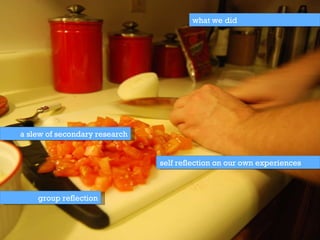
a slew of secondary research self reflection on our own experiences what we did group reflection
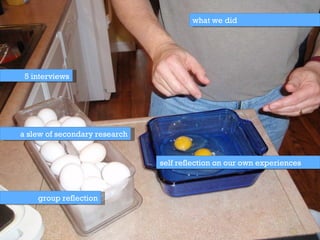
a slew of secondary research 5 interviews self reflection on our own experiences what we did group reflection
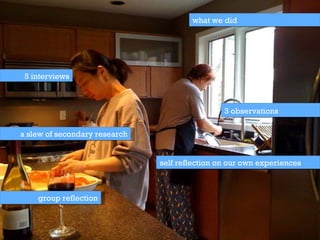
a slew of secondary research 5 interviews 3 observations self reflection on our own experiences what we did group reflection
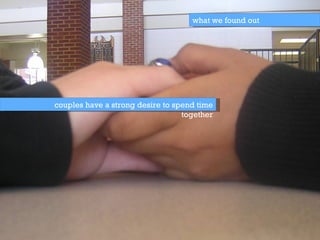
couples have a strong desire to spend time together what we found out
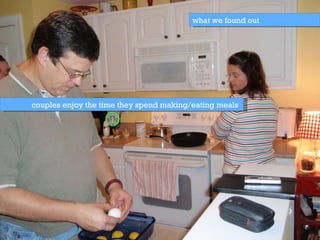
what we found out couples enjoy the time they spend making/eating meals
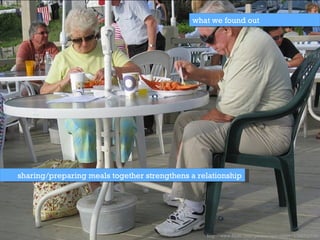
what we found out sharing/preparing meals together strengthens a relationship http://www.flickr.com/photos/specialkrb/2768750530/
what we found out couples face barriers to effectively preparing/sharing meals together  http://www.flickr.com/photos/slambo_42/2772555302/
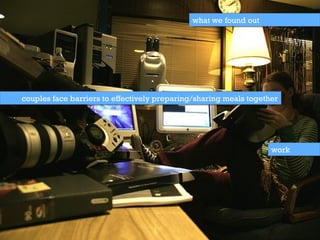
what we found out couples face barriers to effectively preparing/sharing meals together  work
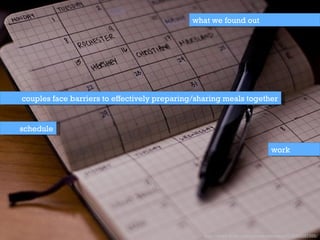
what we found out couples face barriers to effectively preparing/sharing meals together  work schedule http://www.flickr.com/photos/wenzday01/3005297355/
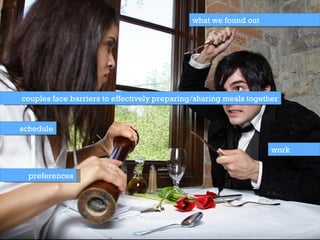
what we found out couples face barriers to effectively preparing/sharing meals together  work schedule preferences http://www.flickr.com/photos/sgw/2714848745/
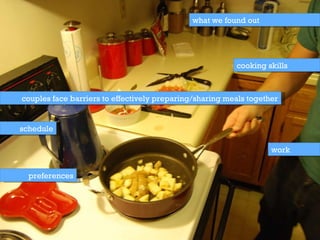
what we found out couples face barriers to effectively preparing/sharing meals together  work schedule cooking skills preferences
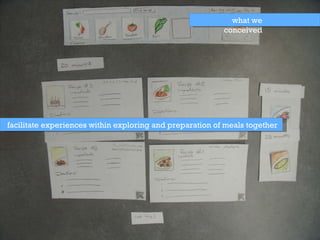
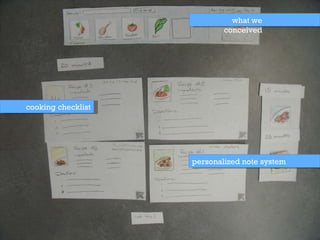
what we conceived facilitate experiences within exploring and preparation of meals together
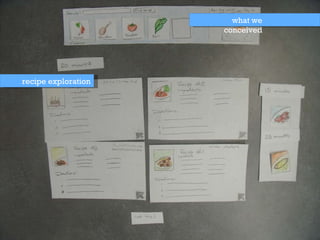
what we conceived recipe exploration
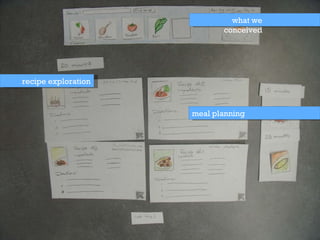
what we conceived recipe exploration meal planning
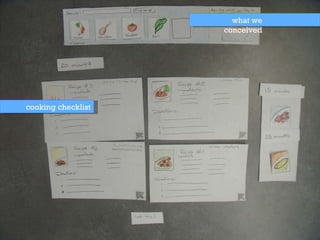
what we conceived cooking checklist
what we conceived cooking checklist personalized note system
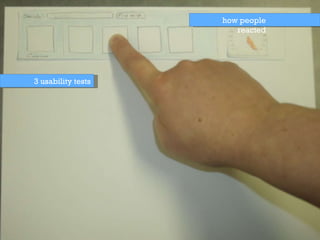
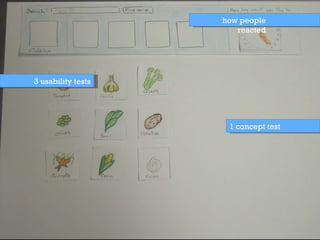
how people reacted 3 usability tests
how people reacted 3 usability tests 1 concept test
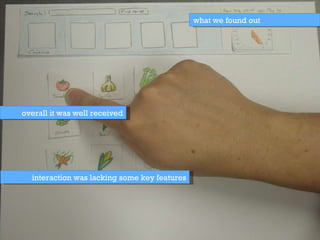
what we found out interaction was lacking some key features overall it was well received
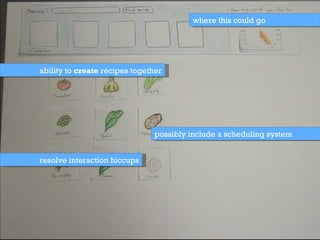
where this could go ability to  create  recipes together possibly include a scheduling system resolve interaction hiccups
questions?
1. Julie L. Locher et al (October 2005).Comfort foods: An Exploratory journey into the social and emotional significance of food. Food and food ways, 13:273-297. DOI: 10.1080/07409710500334509 scout slides Citations 2. Genevieve Bell et al (Spring 2002).Design technology for domestic spaces: A kitchen Manifesto. Gastronomica, 2:46-62. DOI 10.1525/gfc.2002.2.2.46) 3. Dan P. McAdams (1989). Intimacy: the need to be close. Doubleday.

Share to prepare design CSCW

  • 1.
    Jenny Allen VarunKhanduja Xiaohan Liu Brandon Stephens fostering a relationship through exploration of meals and food preparation Prepare to Share!
  • 2.
    problem space howcan collaborative technology be used to support the development or maintenance of an relationship?
  • 3.
    who are wedesigning for http://www.flickr.com/photos/77735640@N00/2964368500/ couples – two co-habitating individuals who are romantically involved
  • 4.
    a slew ofsecondary research what we did http://www.flickr.com/photos/pakitt/2330286413/
  • 5.
    a slew ofsecondary research what we did group reflection http://www.flickr.com/photos/benindc/491609415 /
  • 6.
    a slew ofsecondary research self reflection on our own experiences what we did group reflection
  • 7.
    a slew ofsecondary research 5 interviews self reflection on our own experiences what we did group reflection
  • 8.
    a slew ofsecondary research 5 interviews 3 observations self reflection on our own experiences what we did group reflection
  • 9.
    couples have astrong desire to spend time together what we found out
  • 10.
    what we foundout couples enjoy the time they spend making/eating meals
  • 11.
    what we foundout sharing/preparing meals together strengthens a relationship http://www.flickr.com/photos/specialkrb/2768750530/
  • 12.
    what we foundout couples face barriers to effectively preparing/sharing meals together http://www.flickr.com/photos/slambo_42/2772555302/
  • 13.
    what we foundout couples face barriers to effectively preparing/sharing meals together work
  • 14.
    what we foundout couples face barriers to effectively preparing/sharing meals together work schedule http://www.flickr.com/photos/wenzday01/3005297355/
  • 15.
    what we foundout couples face barriers to effectively preparing/sharing meals together work schedule preferences http://www.flickr.com/photos/sgw/2714848745/
  • 16.
    what we foundout couples face barriers to effectively preparing/sharing meals together work schedule cooking skills preferences
  • 17.
    what we conceivedfacilitate experiences within exploring and preparation of meals together
  • 18.
    what we conceivedrecipe exploration
  • 19.
    what we conceivedrecipe exploration meal planning
  • 20.
    what we conceivedcooking checklist
  • 21.
    what we conceivedcooking checklist personalized note system
  • 22.
    how people reacted3 usability tests
  • 23.
    how people reacted3 usability tests 1 concept test
  • 24.
    what we foundout interaction was lacking some key features overall it was well received
  • 25.
    where this couldgo ability to create recipes together possibly include a scheduling system resolve interaction hiccups
  • 26.
  • 27.
    1. Julie L.Locher et al (October 2005).Comfort foods: An Exploratory journey into the social and emotional significance of food. Food and food ways, 13:273-297. DOI: 10.1080/07409710500334509 scout slides Citations 2. Genevieve Bell et al (Spring 2002).Design technology for domestic spaces: A kitchen Manifesto. Gastronomica, 2:46-62. DOI 10.1525/gfc.2002.2.2.46) 3. Dan P. McAdams (1989). Intimacy: the need to be close. Doubleday.

Editor's Notes

  • #2 Good morning everyone. Introduction of team members Our design concerns fostering relationships through exploration of meals and food preparation. Xiaohan was unable to be here today. Through our own experience and observations, we recognize that ones relationship with ones partner is extremely important to ones quality of life. Based on that insight, we determined our problem space to be “how can collaborative technology be used to support the development or maintenance of a relationship.
  • #3 Through our own experience and observations, we recognize that ones relationship with ones partner is extremely important to ones quality of life. Based on that insight, we determined our problem space to be “how can collaborative technology be used to support the development or maintenance of a relationship. .
  • #4 what do we mean
  • #5 For this project, we used several methods of primary research, along with secondary research, to inform our design process. Initially we started with an overview of literature in the field, and then moved on to more qualitative research methods. We focused mostly on intimacy development and food sharing and preparation for bond strengthening. First we began with a group exercise where we shared a meal and reflected on our experiences. After this reflection, we developed questions to help lead our interviews. We then conducted 5 interviews along with 3 in-home observations with couples to analyze the interactions that occur in the kitchen. We hoped to gather valuable insights from the interactions that occurred during food preparation, and possibly meal consumption. Xiaohan will take you through the insights that we developed from our primary and secondary research.
  • #6 For this project, we used several methods of primary research, along with secondary research, to inform our design process. Initially we started with an overview of literature in the field, and then moved on to more qualitative research methods. We focused mostly on intimacy development and food sharing and preparation for bond strengthening. First we began with a group exercise where we shared a meal and reflected on our experiences. After this reflection, we developed questions to help lead our interviews. We then conducted 5 interviews along with 3 in-home observations with couples to analyze the interactions that occur in the kitchen. We hoped to gather valuable insights from the interactions that occurred during food preparation, and possibly meal consumption. Xiaohan will take you through the insights that we developed from our primary and secondary research.
  • #7 For this project, we used several methods of primary research, along with secondary research, to inform our design process. Initially we started with an overview of literature in the field, and then moved on to more qualitative research methods. We focused mostly on intimacy development and food sharing and preparation for bond strengthening. First we began with a group exercise where we shared a meal and reflected on our experiences. After this reflection, we developed questions to help lead our interviews. We then conducted 5 interviews along with 3 in-home observations with couples to analyze the interactions that occur in the kitchen. We hoped to gather valuable insights from the interactions that occurred during food preparation, and possibly meal consumption. Xiaohan will take you through the insights that we developed from our primary and secondary research.
  • #8 For this project, we used several methods of primary research, along with secondary research, to inform our design process. Initially we started with an overview of literature in the field, and then moved on to more qualitative research methods. We focused mostly on intimacy development and food sharing and preparation for bond strengthening. First we began with a group exercise where we shared a meal and reflected on our experiences. After this reflection, we developed questions to help lead our interviews. We then conducted 5 interviews along with 3 in-home observations with couples to analyze the interactions that occur in the kitchen. We hoped to gather valuable insights from the interactions that occurred during food preparation, and possibly meal consumption. Xiaohan will take you through the insights that we developed from our primary and secondary research.
  • #9 For this project, we used several methods of primary research, along with secondary research, to inform our design process. Initially we started with an overview of literature in the field, and then moved on to more qualitative research methods. We focused mostly on intimacy development and food sharing and preparation for bond strengthening. First we began with a group exercise where we shared a meal and reflected on our experiences. After this reflection, we developed questions to help lead our interviews. We then conducted 5 interviews along with 3 in-home observations with couples to analyze the interactions that occur in the kitchen. We hoped to gather valuable insights from the interactions that occurred during food preparation, and possibly meal consumption. Xiaohan will take you through the insights that we developed from our primary and secondary research.
  • #10 From our primary research- the interviews and observations, we found that there is a great desire from people in a relationship to spend time with their significant other.
  • #11 When talking about preparing and consuming food, our research specially showed us that that the time spent with each other on making and eating meals is very enjoyable for both members in the relationship.
  • #12 There are some papers in this field, such as Comfort Foods by Julie Locher, and by Genevieve Bell’s paper “Designing technology for domestic spaces”, indicate that sharing and preparing meal together build and create intimacy. Our interviews and observations have very similar findings as well. The couples in our research showed passions on meal preparation and consumption together and said that this benefit their relationship. //Moreover, both our primary and secondary research show that the direct time in meal preparation and consumption benefits a couples strength.
  • #13 But at the same time, we also found that couples actually face barriers which against their desires to effectively share or prepare meals together //Furthermore, we found that there are barriers that couples face when trying to effectively share or prepare meals together.
  • #14 Specifically from our interviews, we found that couples have different work schedule,it is quite rare for them to arrive at home at the same time. This is especially true when couples do not work with each other, or do not carpool home. //We also found from our interviews and observations that couples, who are often busy with work, school or other activities, have issues in coordinating their time with each other.
  • #15 Even on weekends, they may have different activities, which make it hard for them to coordinate time prepare and share food together without prior planning
  • #16 Couples tend to different preferences, and this is especially obvious when they are from different countries or regions.
  • #17 Further, they may also have different cooking skills, for example, one is better at chopping, while the other prefers to peeling. Or one is really good at cooking meat, while the other is expert on preparing salads.
  • #21 We wanted to provide a way for the couple to perform non-temporal, non-collocated collaboration. In order to do this, we wanted the couples to leverage what they each good at in the kitchen in order to
  • #22 We wanted to provide a way for the couple to perform non-temporal, non-collocated collaboration. In order to do this, we wanted the couples to leverage what they each good at in the kitchen in order to
  • #25 The concept test and the three usability tests showed that this system would be well received.
  • #26 A few steps that we would approach for future work of this project focus on making this interactive device or service more personal. We imagine this occurring through the creation of recipes, where the couples could upload photos, create, annotate, tag and possibly share their recipes. We would also like to look in to the prospect of this system providing a scheduling service, which would allow the system to anticipate their arrival, and tailor what they see based on their skill level at the time. And with all future design, it is important to look in to and resolve the interface hiccups.
  • #27 Any questions?