Seven Ineffective Coding Habits of Many Programmers 
@KevlinHenney
It turns out that style matters in programming for the same reason that it matters in writing. It makes for better reading. 
Douglas Crockford JavaScript: The Good Parts
Noisy Code
Signal-to-noise ratio (often abbreviated SNR or S/N) is a measure used in science and engineering that compares the level of a desired signal to the level of background noise. Signal-to-noise ratio is sometimes used informally to refer to the ratio of useful information to false or irrelevant data in a conversation or exchange. 
http://en.wikipedia.org/wiki/Signal_to_noise_ratio
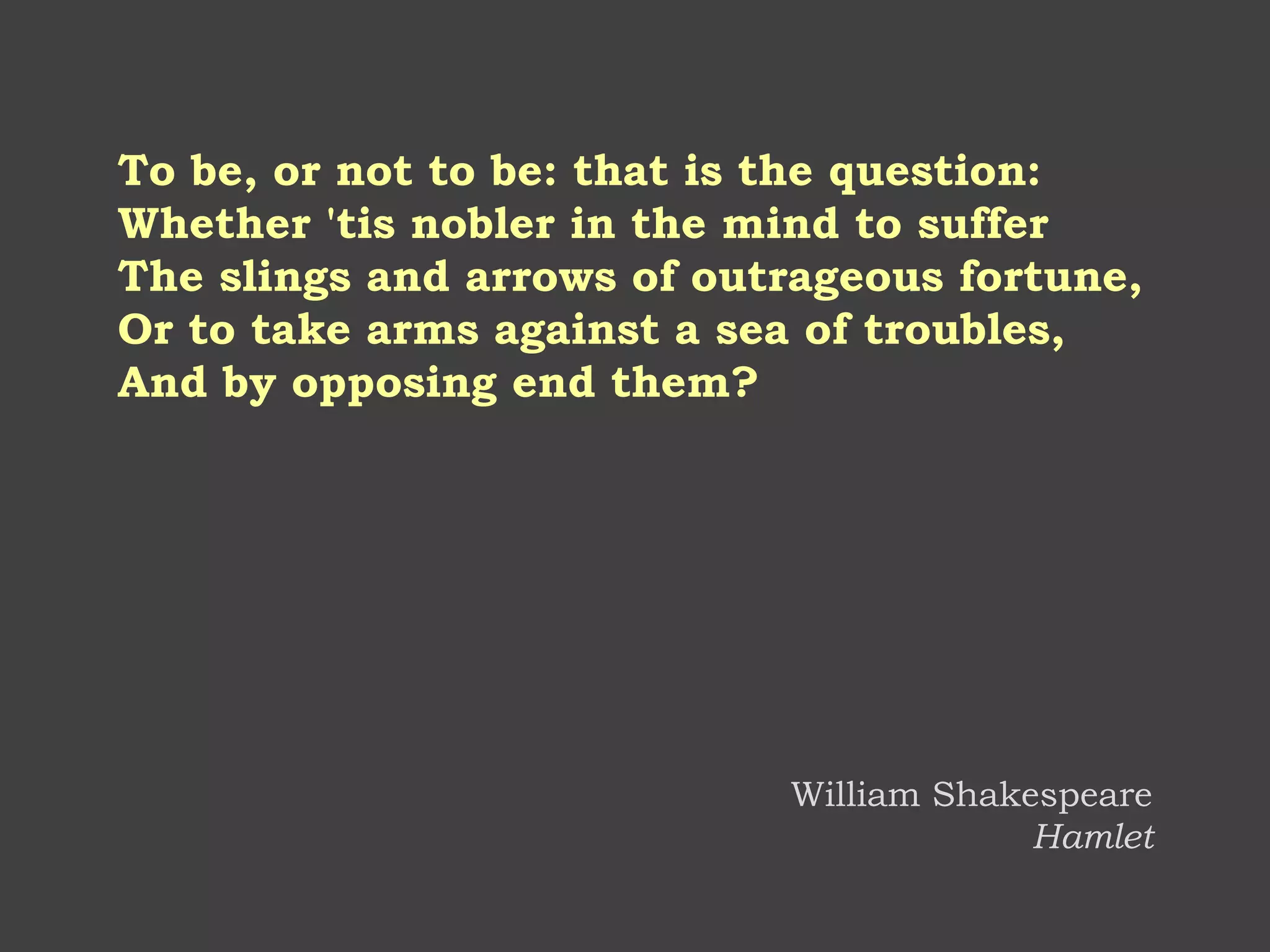
To be, or not to be: that is the question: Whether 'tis nobler in the mind to suffer The slings and arrows of outrageous fortune, Or to take arms against a sea of troubles, And by opposing end them? 
William Shakespeare Hamlet
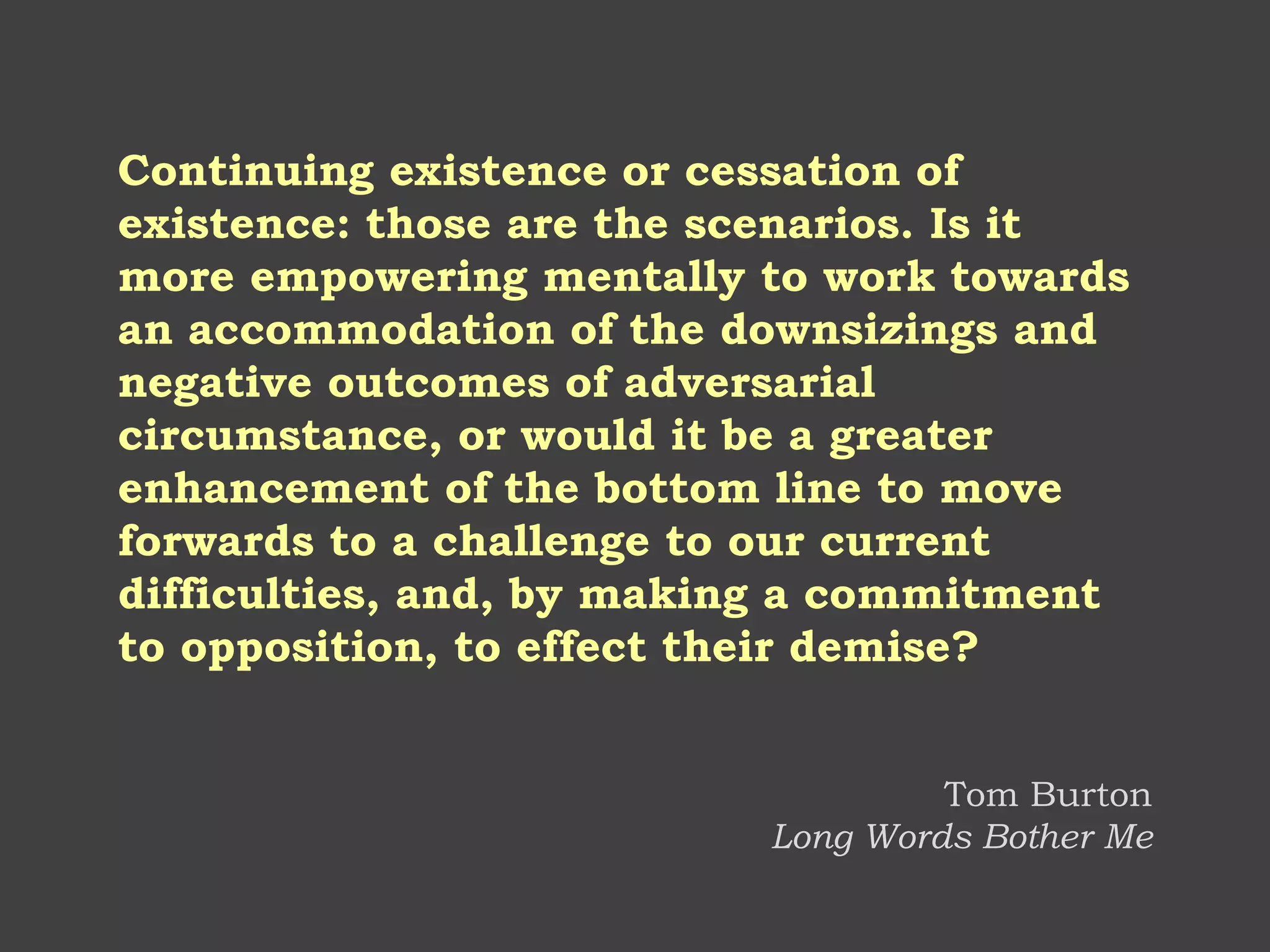
Continuing existence or cessation of existence: those are the scenarios. Is it more empowering mentally to work towards an accommodation of the downsizings and negative outcomes of adversarial circumstance, or would it be a greater enhancement of the bottom line to move forwards to a challenge to our current difficulties, and, by making a commitment to opposition, to effect their demise? 
Tom Burton Long Words Bother Me
public class RecentlyUsedList 
{ 
private List<string> items; 
public RecentlyUsedList() 
{ 
items = new List<string>(); 
} 
public void Add(string newItem) 
{ 
if (items.Contains(newItem)) 
{ 
int position = items.IndexOf(newItem); 
string existingItem = items[position]; 
items.RemoveAt(position); 
items.Insert(0, existingItem); 
} 
else 
{ 
items.Insert(0, newItem); 
} 
} 
public int Count 
{ 
get 
{ 
int size = items.Count; 
return size; 
} 
} 
public string this[int index] 
{ 
get 
{ 
int position = 0; 
foreach (string item in items) 
{ 
if (position == index) 
return item; 
++position; 
} 
throw new ArgumentOutOfRangeException(); 
} 
} 
}
public class RecentlyUsedList { private List<string> items; public RecentlyUsedList() { items = new List<string>(); } public void Add(string newItem) { if (items.Contains(newItem)) { int position = items.IndexOf(newItem); string existingItem = list[position]; items.RemoveAt(position); items.Insert(0, existingItem); } else { items.Insert(0, newItem); } } public int Count { get { int size = items.Count; return size; } } public string this[int index] { get { int position = 0; foreach (string value in items) { if (position == index) return value; ++position; } throw new ArgumentOutOfRangeException(); } } } 
public class RecentlyUsedList { private List<string> items = new List<string>(); public void Add(string newItem) { items.Remove(newItem); items.Add(newItem); } public int Count { get { return items.Count; } } public string this[int index] { get { return items[Count - index - 1]; } } }
Comments 
A delicate matter, requiring taste and judgement. I tend to err on the side of eliminating comments, for several reasons. First, if the code is clear, and uses good type names and variable names, it should explain itself. Second, comments aren't checked by the compiler, so there is no guarantee they're right, especially after the code is modified. A misleading comment can be very confusing. Third, the issue of typography: comments clutter code. 
Rob Pike, "Notes on Programming in C"
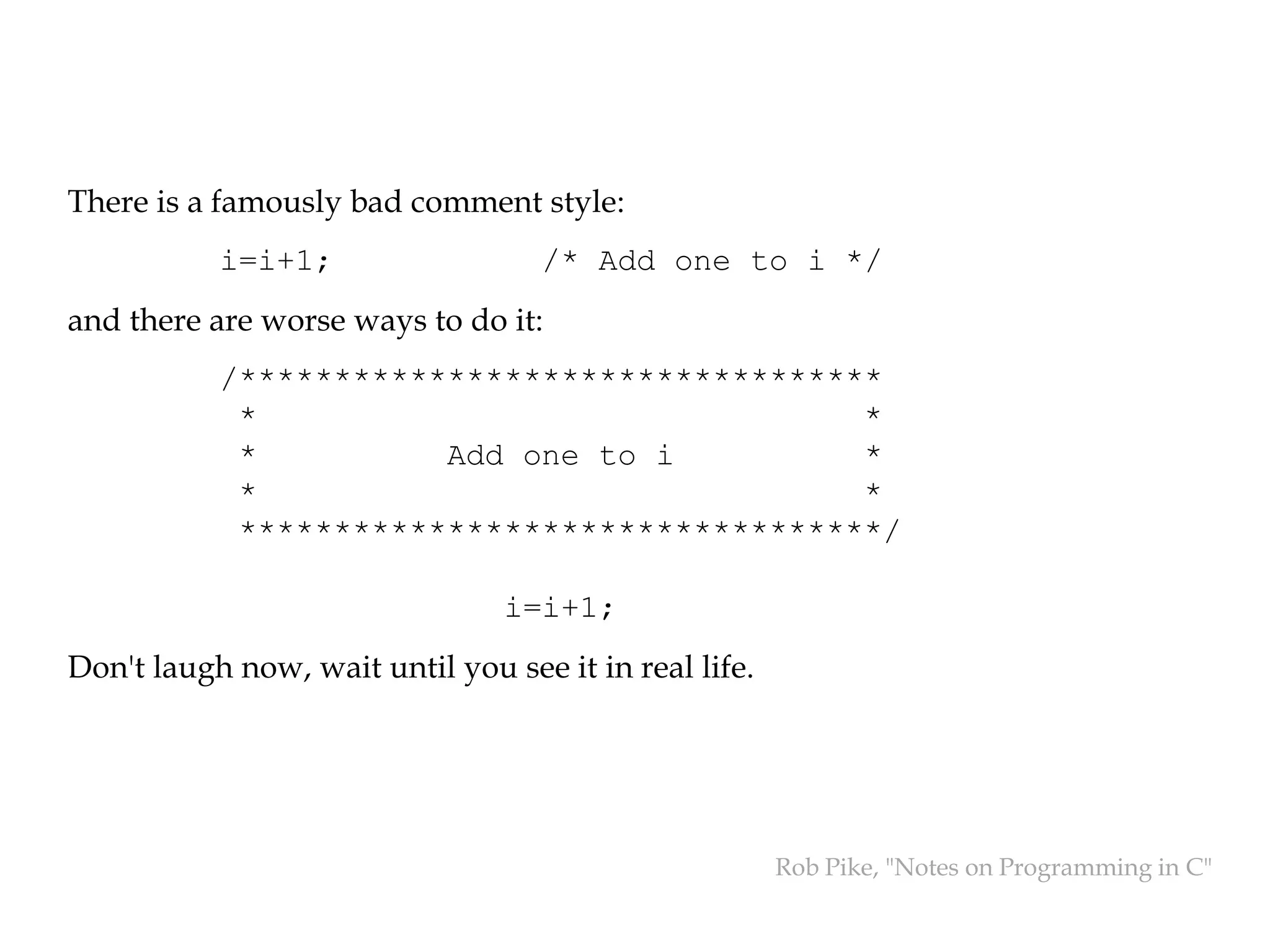
There is a famously bad comment style: 
i=i+1; /* Add one to i */ 
and there are worse ways to do it: 
/********************************** 
* * 
* Add one to i * 
* * 
**********************************/ 
i=i+1; 
Don't laugh now, wait until you see it in real life. 
Rob Pike, "Notes on Programming in C"
A common fallacy is to assume authors of incomprehensible code will somehow be able to express themselves lucidly and clearly in comments. 
Kevlin Henney https://twitter.com/KevlinHenney/status/381021802941906944
Unsustainable Spacing
To be, or not to be: that is the question: Whether 'tis nobler in the mind to suffer The slings and arrows of outrageous fortune, Or to take arms against a sea of troubles, And by opposing end them? 
William Shakespeare Hamlet
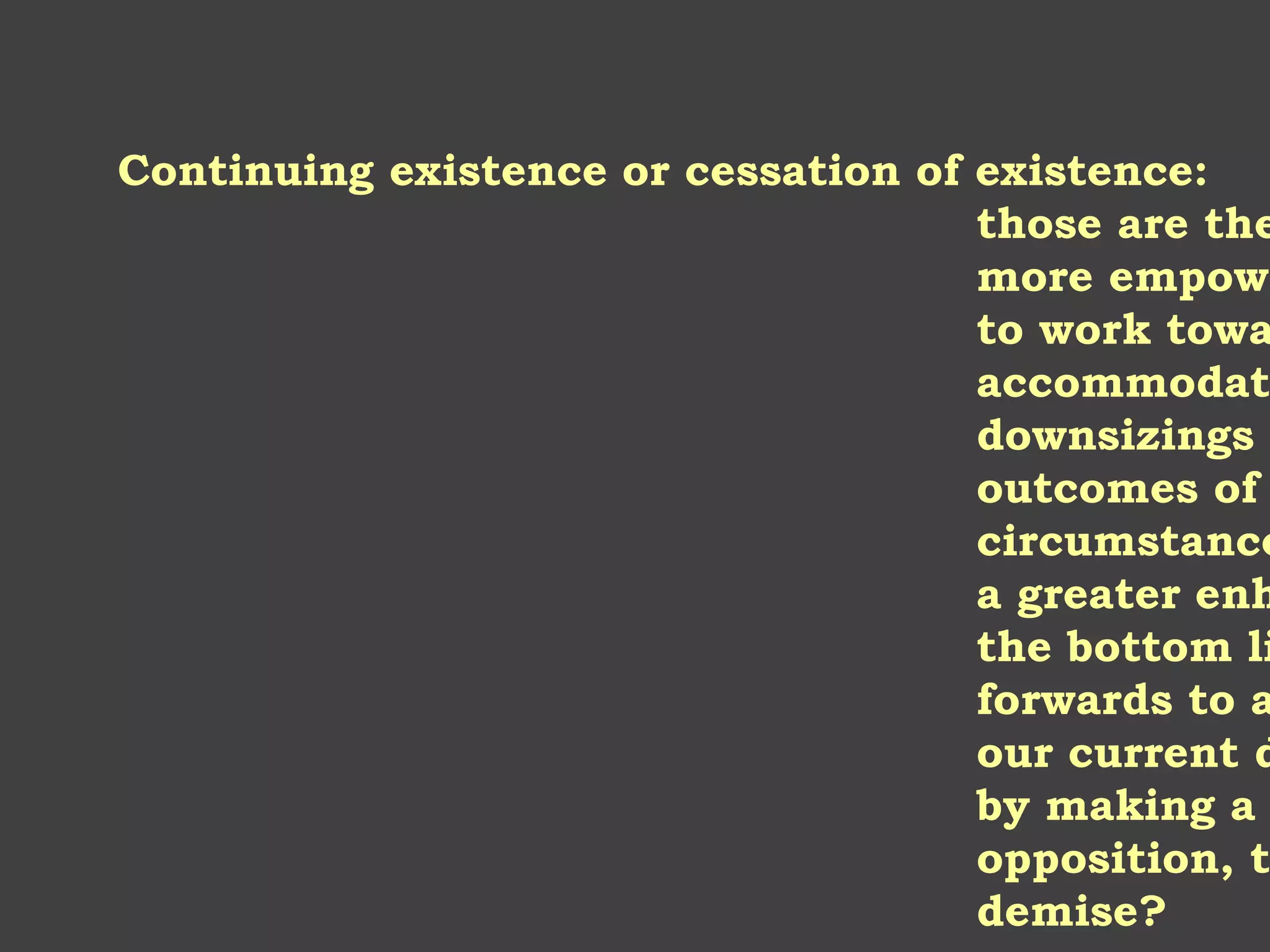
Continuing existence or cessation of existence: those are the scenarios. Is it more empowering mentally to work towards an accommodation of the downsizings and negative outcomes of adversarial circumstance, or would it be a greater enhancement of the bottom line to move forwards to a challenge to our current difficulties, and, by making a commitment to opposition, to effect their demise? 
Tom Burton Long Words Bother Me
Continuing existence or cessation of existence: those are the more empowering to work towards accommodation downsizings outcomes of circumstance, a greater enhancement the bottom line forwards to a our current difficulties, by making a opposition, to demise?
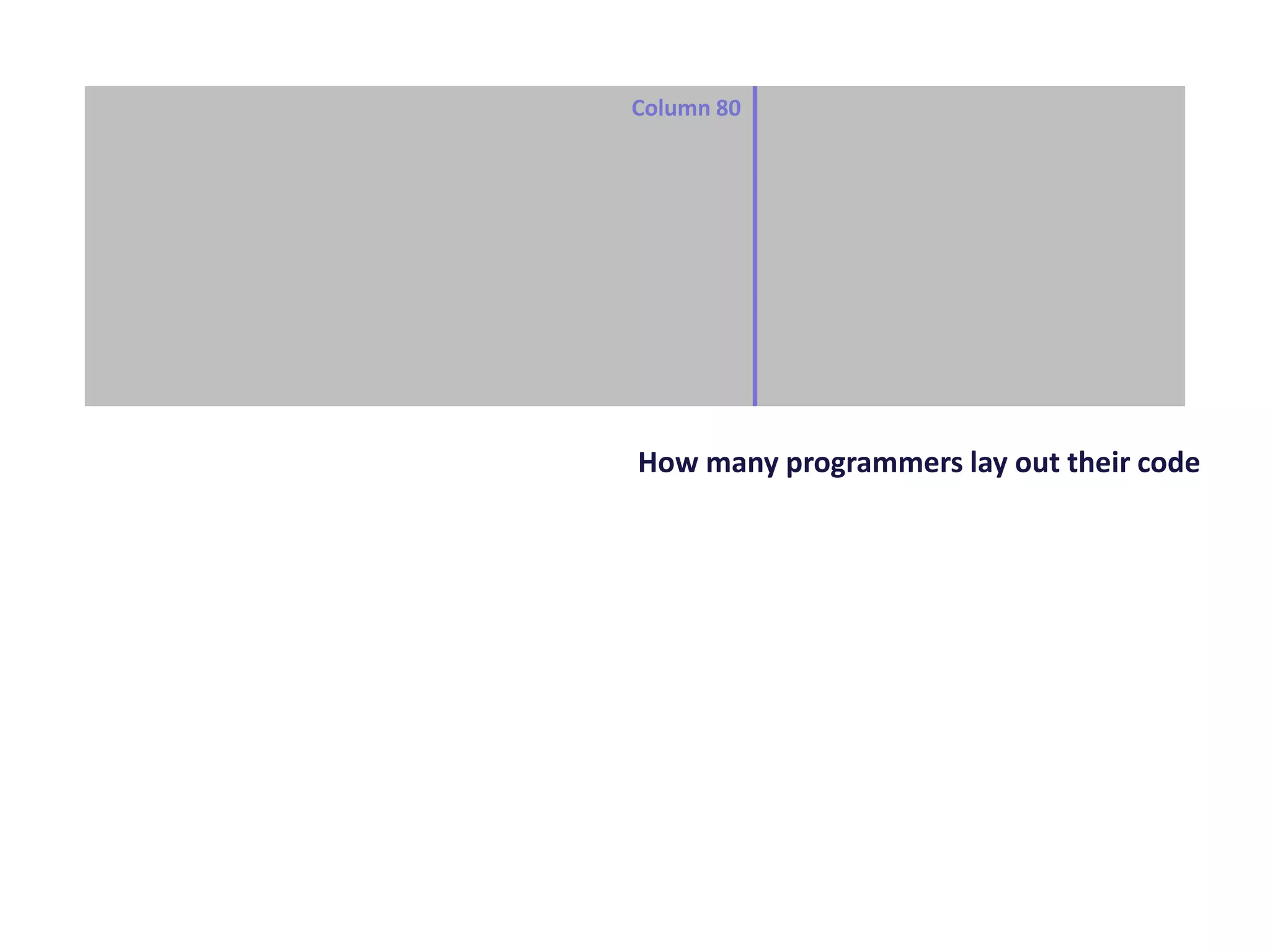
How many programmers lay out their code 
Column 80
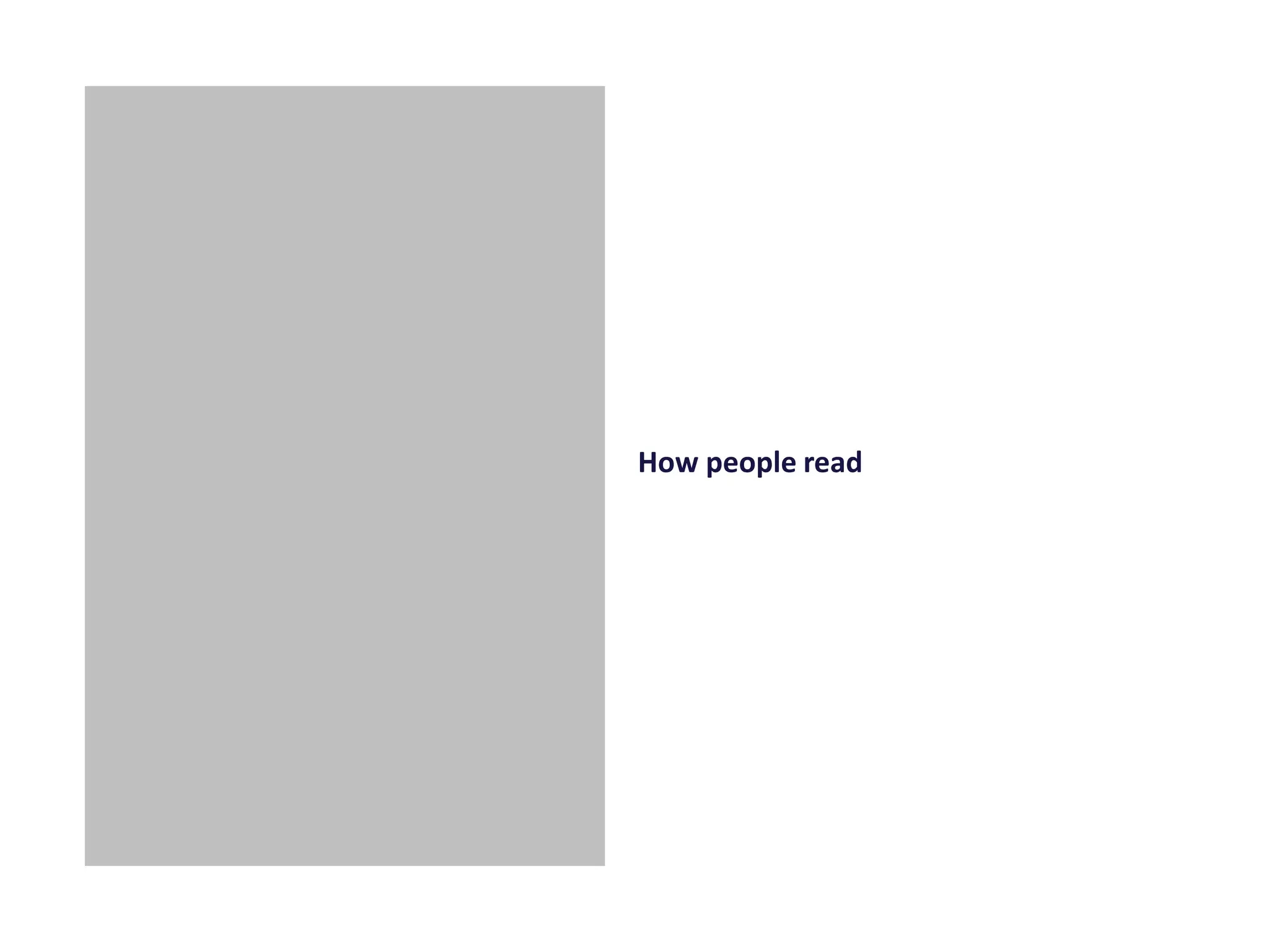
How people read
To answer the question "What is clean design?" most succinctly: a clean design is one that supports visual thinking so people can meet their informational needs with a minimum of conscious effort. 
Daniel Higginbotham ∙ "Clean Up Your Mess — A Guide to Visual Design for Everyone" ∙ http://www.visualmess.com/
You convey information by the way you arrange a design's elements in relation to each other. This information is understood immediately, if not consciously, by the people viewing your designs. 
Daniel Higginbotham ∙ "Clean Up Your Mess — A Guide to Visual Design for Everyone" ∙ http://www.visualmess.com/
This is great if the visual relationships are obvious and accurate, but if they're not, your audience is going to get confused. They'll have to examine your work carefully, going back and forth between the different parts to make sure they understand. 
Daniel Higginbotham ∙ "Clean Up Your Mess — A Guide to Visual Design for Everyone" ∙ http://www.visualmess.com/
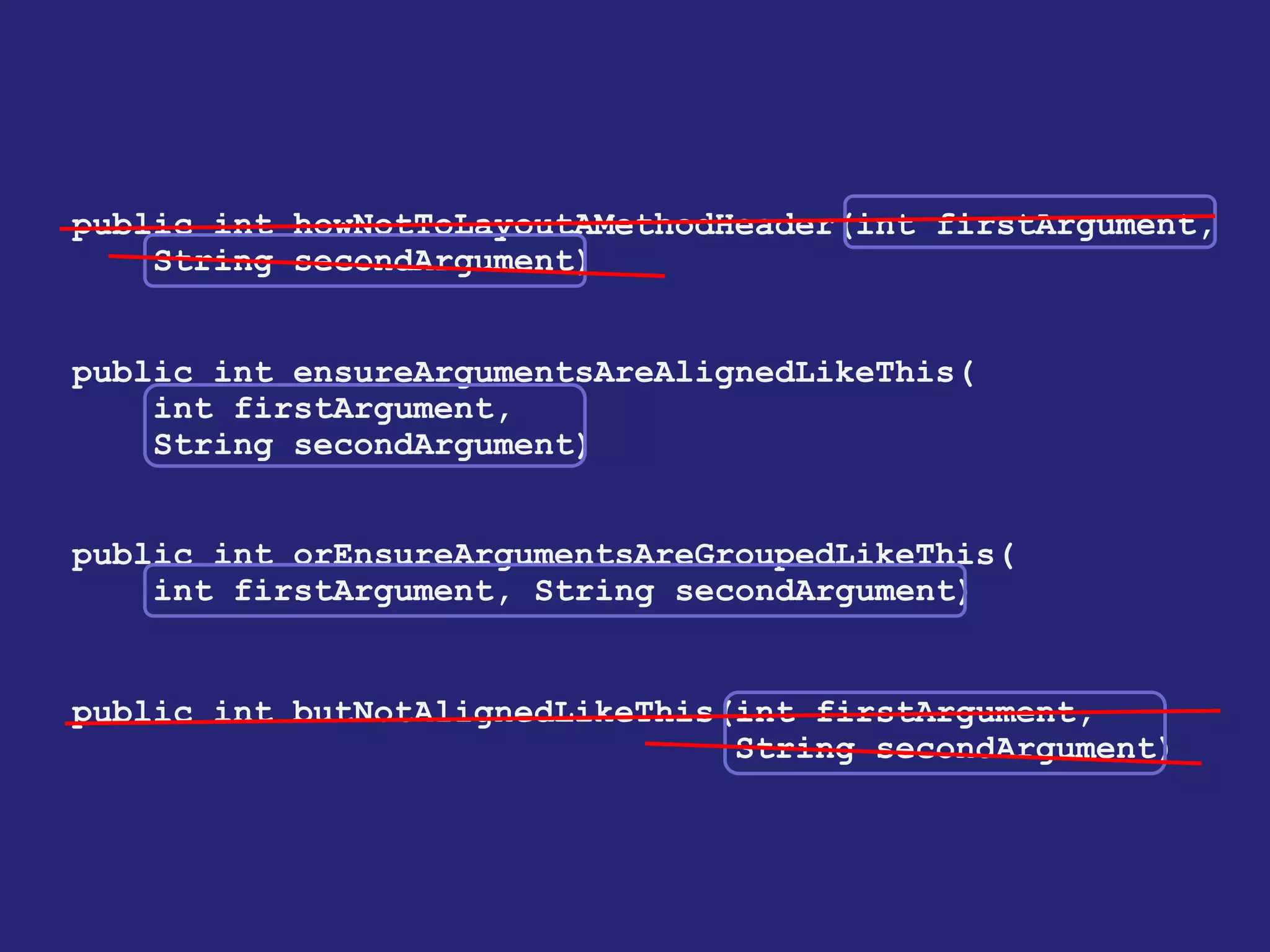
public int howNotToLayoutAMethodHeader(int firstArgument, 
String secondArgument) 
public int ensureArgumentsAreAlignedLikeThis( int firstArgument, String secondArgument) 
public int orEnsureArgumentsAreGroupedLikeThis( int firstArgument, String secondArgument) 
public int butNotAlignedLikeThis(int firstArgument, 
String secondArgument)
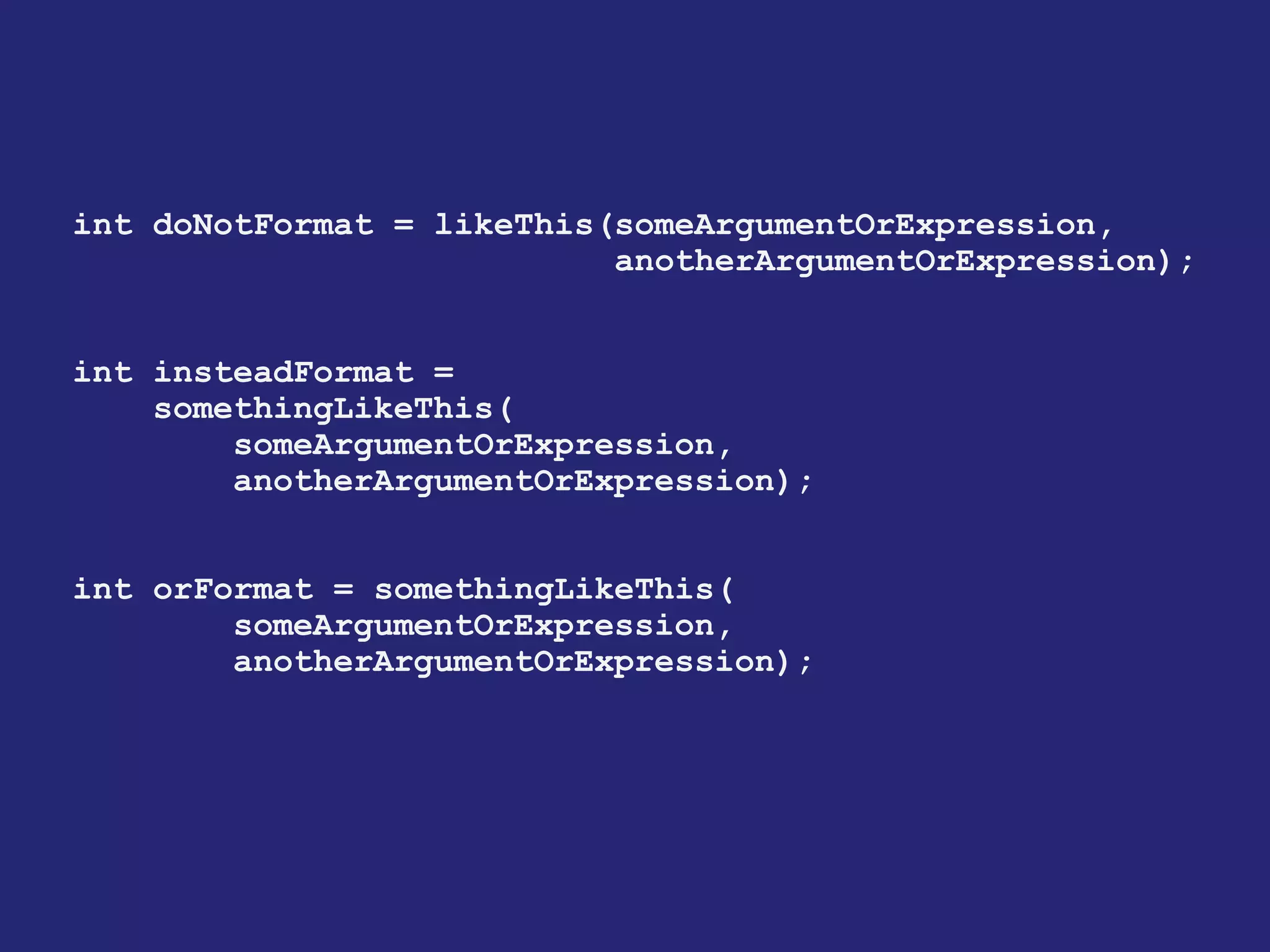
int doNotFormat = likeThis(someArgumentOrExpression, 
anotherArgumentOrExpression); 
int insteadFormat = 
somethingLikeThis( 
someArgumentOrExpression, 
anotherArgumentOrExpression); 
int orFormat = somethingLikeThis( 
someArgumentOrExpression, 
anotherArgumentOrExpression);
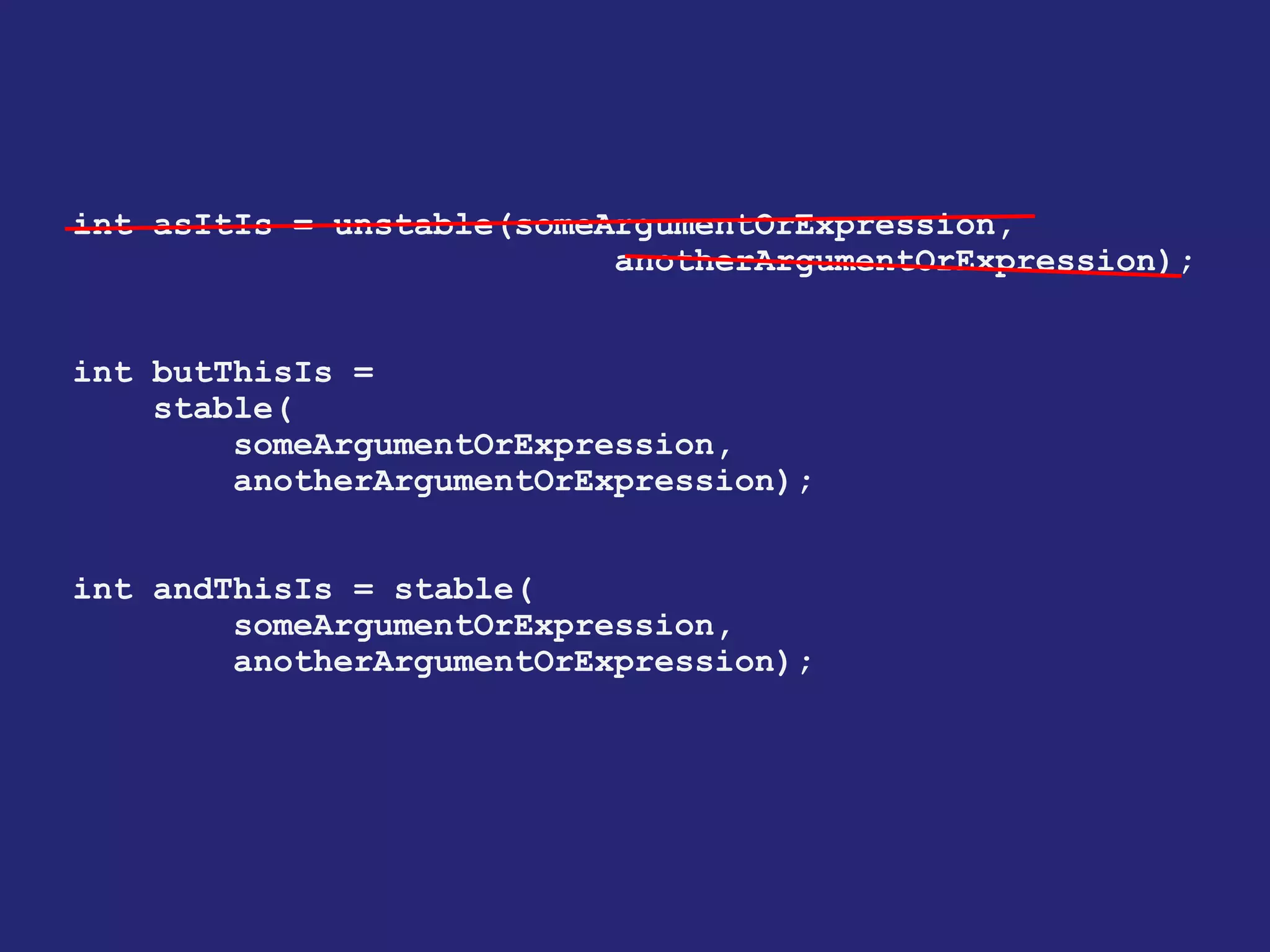
int asItIs = unstable(someArgumentOrExpression, 
anotherArgumentOrExpression); 
int butThisIs = 
stable( 
someArgumentOrExpression, 
anotherArgumentOrExpression); 
int andThisIs = stable( someArgumentOrExpression, anotherArgumentOrExpression);
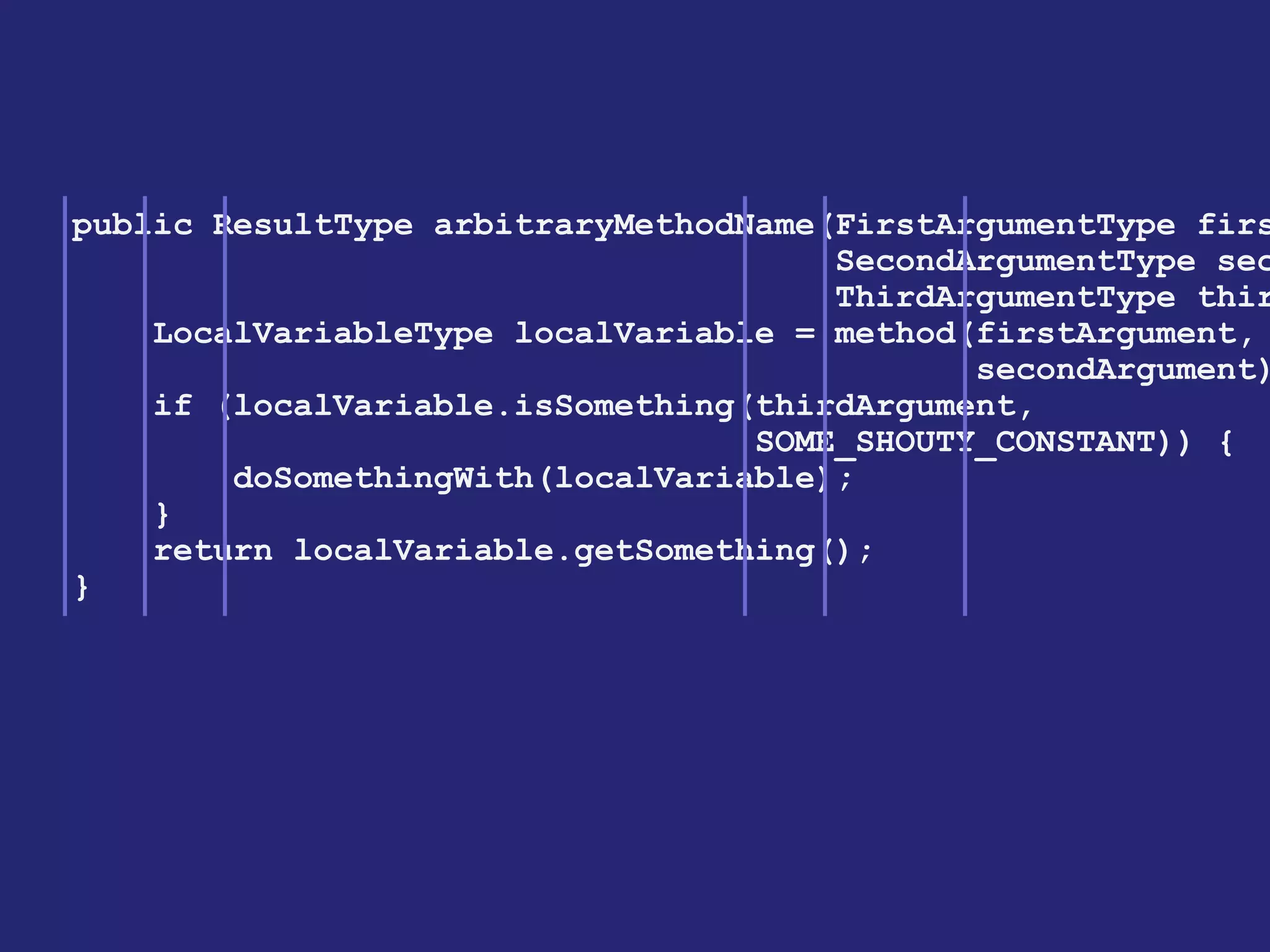
public ResultType arbitraryMethodName(FirstArgumentType firstArgument, SecondArgumentType secondArgument, ThirdArgumentType thirdArgument) LocalVariableType localVariable = method(firstArgument, secondArgument); if (localVariable.isSomething(thirdArgument, SOME_SHOUTY_CONSTANT)) { doSomethingWith(localVariable); } return localVariable.getSomething(); }
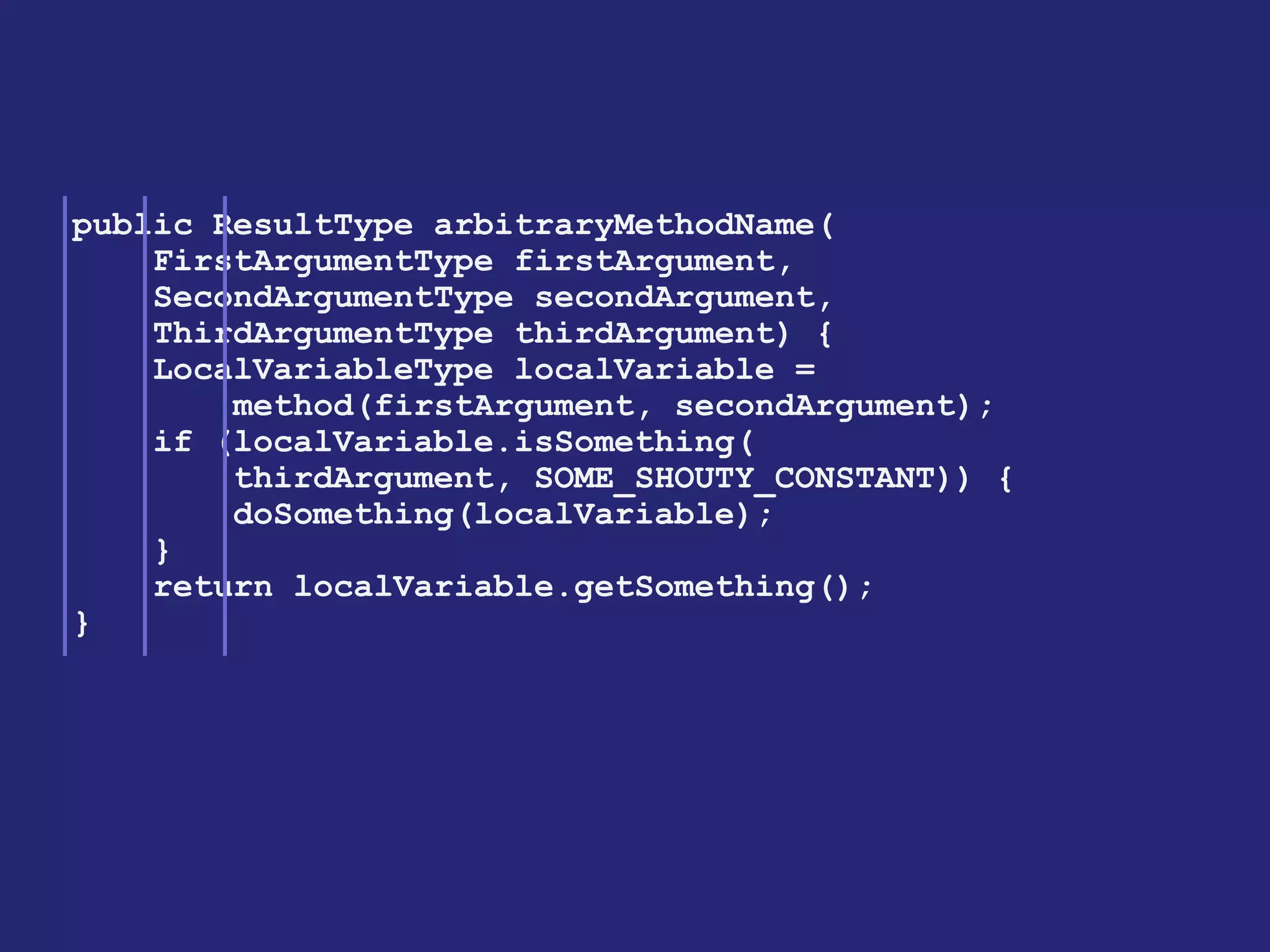
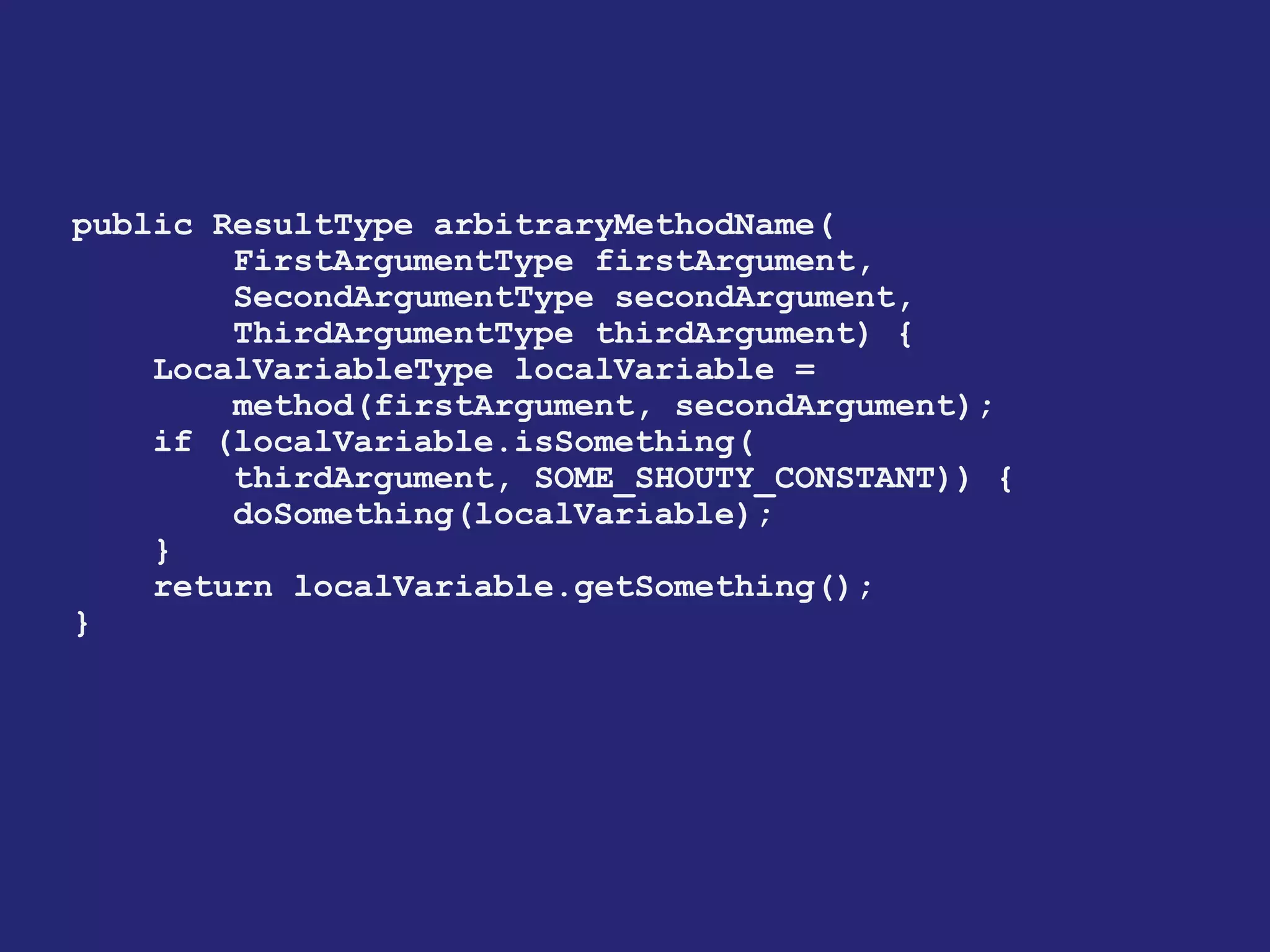
public ResultType arbitraryMethodName( 
FirstArgumentType firstArgument, 
SecondArgumentType secondArgument, 
ThirdArgumentType thirdArgument) { 
LocalVariableType localVariable = 
method(firstArgument, secondArgument); 
if (localVariable.isSomething( 
thirdArgument, SOME_SHOUTY_CONSTANT)) { 
doSomething(localVariable); 
} 
return localVariable.getSomething(); 
}
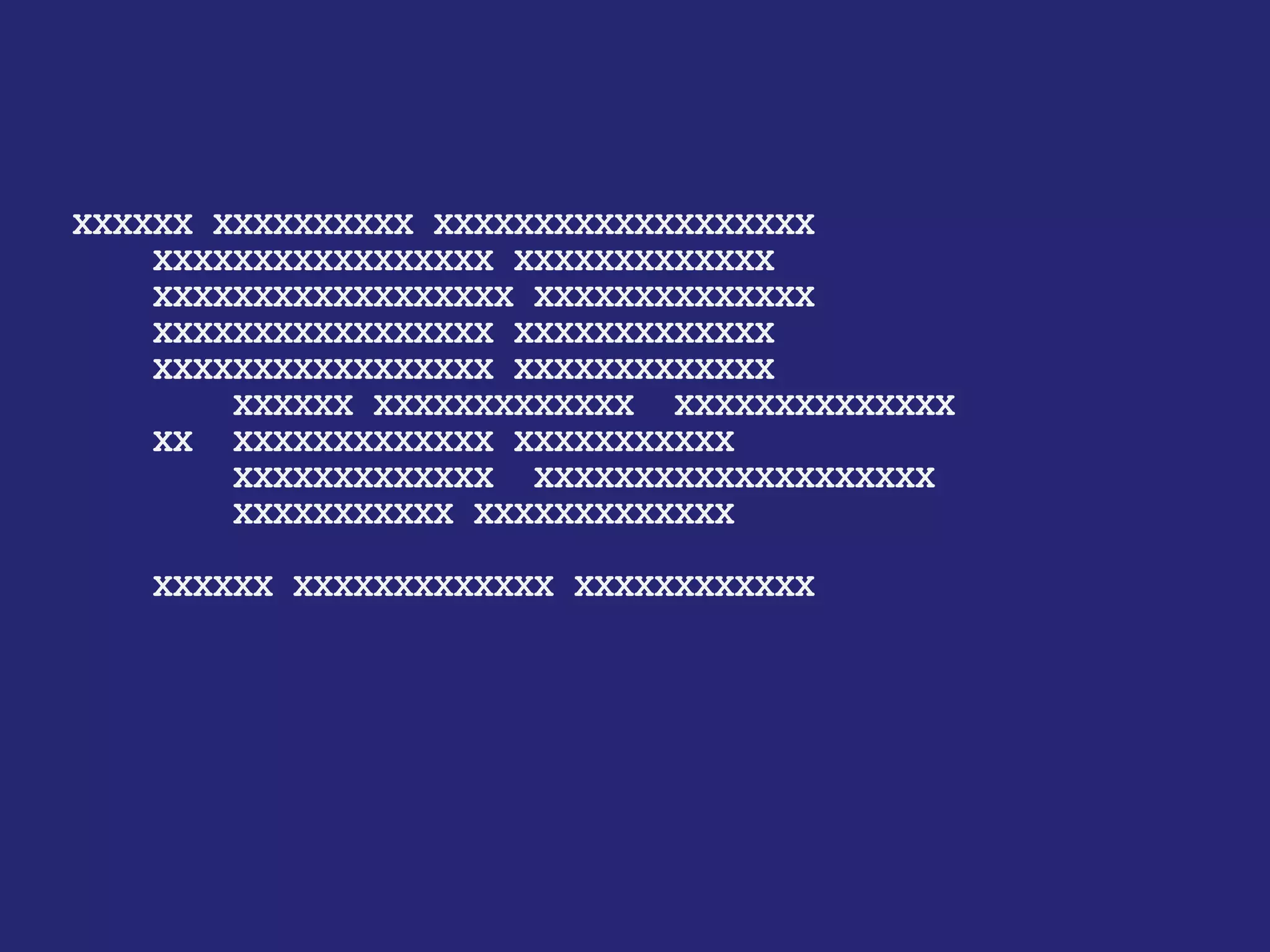
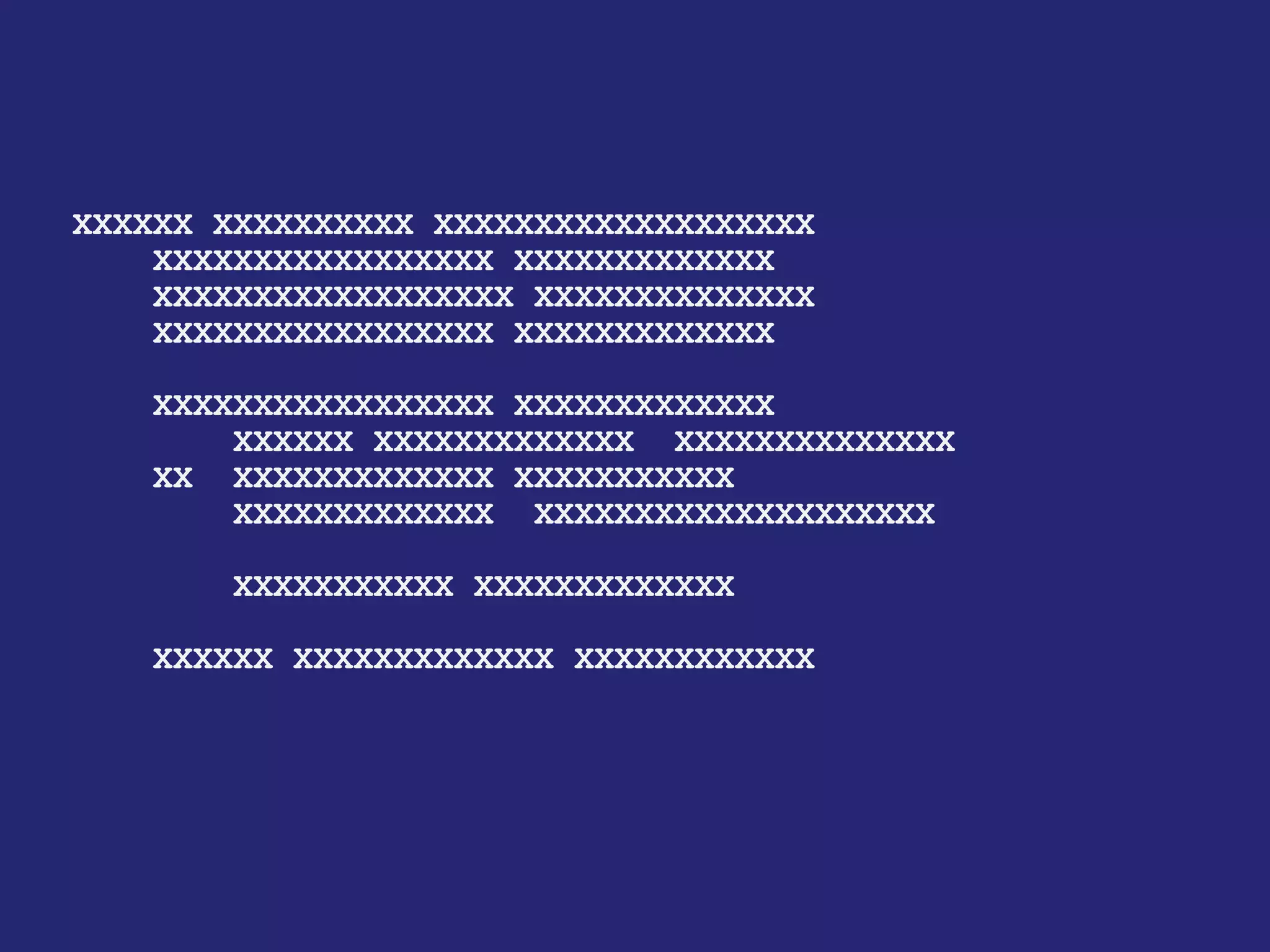
XXXXXX XXXXXXXXXX XXXXXXXXXXXXXXXXXXX 
XXXXXXXXXXXXXXXXX XXXXXXXXXXXXX 
XXXXXXXXXXXXXXXXXX XXXXXXXXXXXXXX 
XXXXXXXXXXXXXXXXX XXXXXXXXXXXXX 
XXXXXX XXXXXXXXXXXXX XXXXXXXXXXXXXX 
XX XXXXXXXXXXXXX XXXXXXXXXXX 
XXXXXXXXXXXXX XXXXXXXXXXXXXXXXXXXX 
XXXXXXXXXXX XXXXXXXXXXXXX 
XXXXXX XXXXXXXXXXXXX XXXXXXXXXXXX
public ResultType arbitraryMethodName( 
FirstArgumentType firstArgument, 
SecondArgumentType secondArgument, 
ThirdArgumentType thirdArgument) { 
LocalVariableType localVariable = 
method(firstArgument, secondArgument); 
if (localVariable.isSomething( 
thirdArgument, SOME_SHOUTY_CONSTANT)) { 
doSomething(localVariable); 
} 
return localVariable.getSomething(); 
}
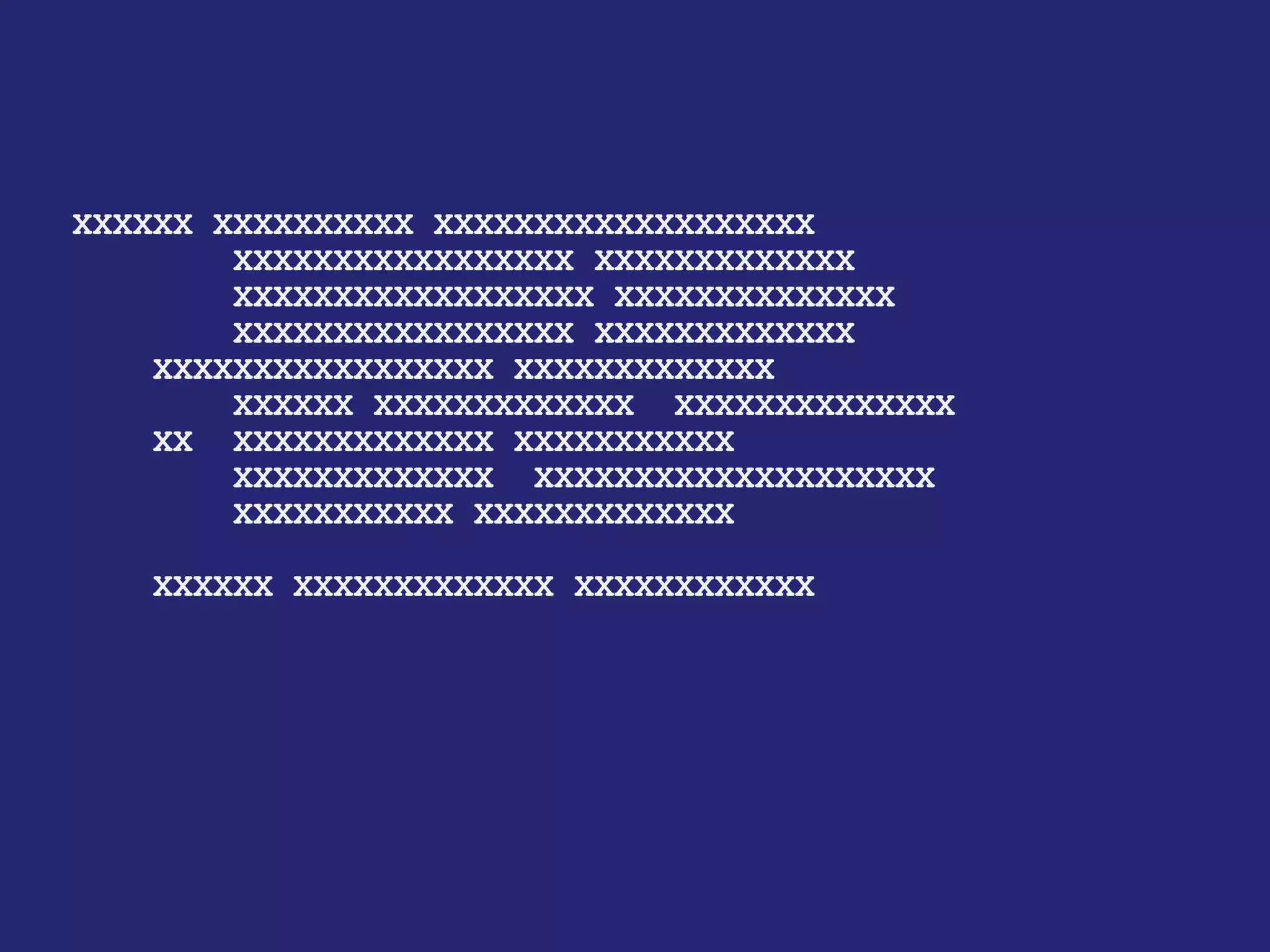
XXXXXX XXXXXXXXXX XXXXXXXXXXXXXXXXXXX 
XXXXXXXXXXXXXXXXX XXXXXXXXXXXXX 
XXXXXXXXXXXXXXXXXX XXXXXXXXXXXXXX 
XXXXXXXXXXXXXXXXX XXXXXXXXXXXXX 
XXXXXX XXXXXXXXXXXXX XXXXXXXXXXXXXX 
XX XXXXXXXXXXXXX XXXXXXXXXXX 
XXXXXXXXXXXXX XXXXXXXXXXXXXXXXXXXX 
XXXXXXXXXXX XXXXXXXXXXXXX 
XXXXXX XXXXXXXXXXXXX XXXXXXXXXXXX
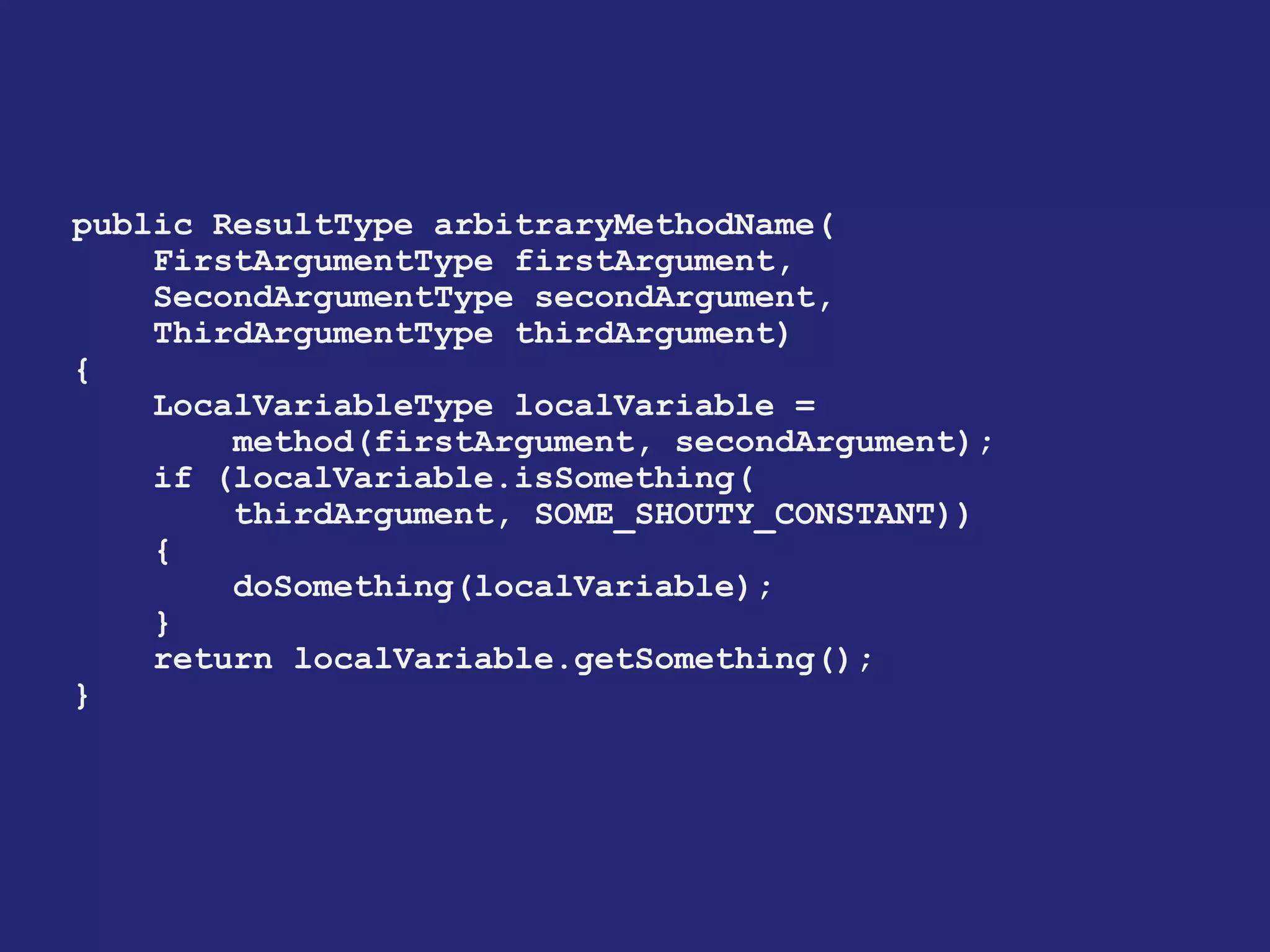
public ResultType arbitraryMethodName( 
FirstArgumentType firstArgument, 
SecondArgumentType secondArgument, 
ThirdArgumentType thirdArgument) 
{ 
LocalVariableType localVariable = 
method(firstArgument, secondArgument); 
if (localVariable.isSomething( 
thirdArgument, SOME_SHOUTY_CONSTANT)) 
{ 
doSomething(localVariable); 
} 
return localVariable.getSomething(); 
}
XXXXXX XXXXXXXXXX XXXXXXXXXXXXXXXXXXX 
XXXXXXXXXXXXXXXXX XXXXXXXXXXXXX 
XXXXXXXXXXXXXXXXXX XXXXXXXXXXXXXX 
XXXXXXXXXXXXXXXXX XXXXXXXXXXXXX 
XXXXXX XXXXXXXXXXXXX XXXXXXXXXXXXXX 
XX XXXXXXXXXXXXX XXXXXXXXXXX 
XXXXXXXXXXXXX XXXXXXXXXXXXXXXXXXXX 
XXXXXXXXXXX XXXXXXXXXXXXX 
XXXXXX XXXXXXXXXXXXX XXXXXXXXXXXX
Lego Naming
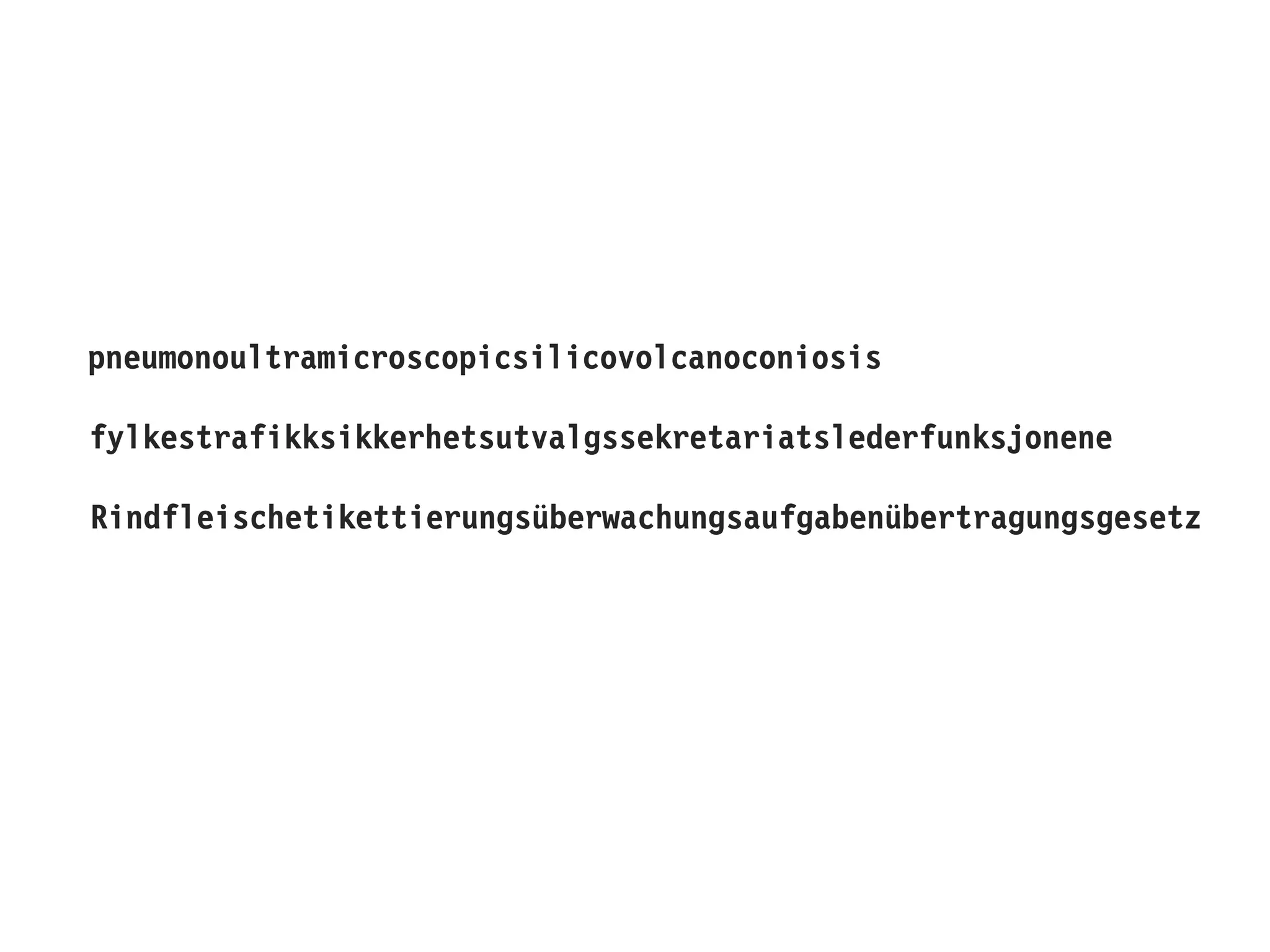
Agglutination is a process in linguistic morphology derivation in which complex words are formed by stringing together morphemes, each with a single grammatical or semantic meaning. Languages that use agglutination widely are called agglutinative languages. 
http://en.wikipedia.org/wiki/Agglutination
pneumonoultramicroscopicsilicovolcanoconiosis 
Rindfleischetikettierungsüberwachungsaufgabenübertragungsgesetz 
fylkestrafikksikkerhetsutvalgssekretariatslederfunksjonene
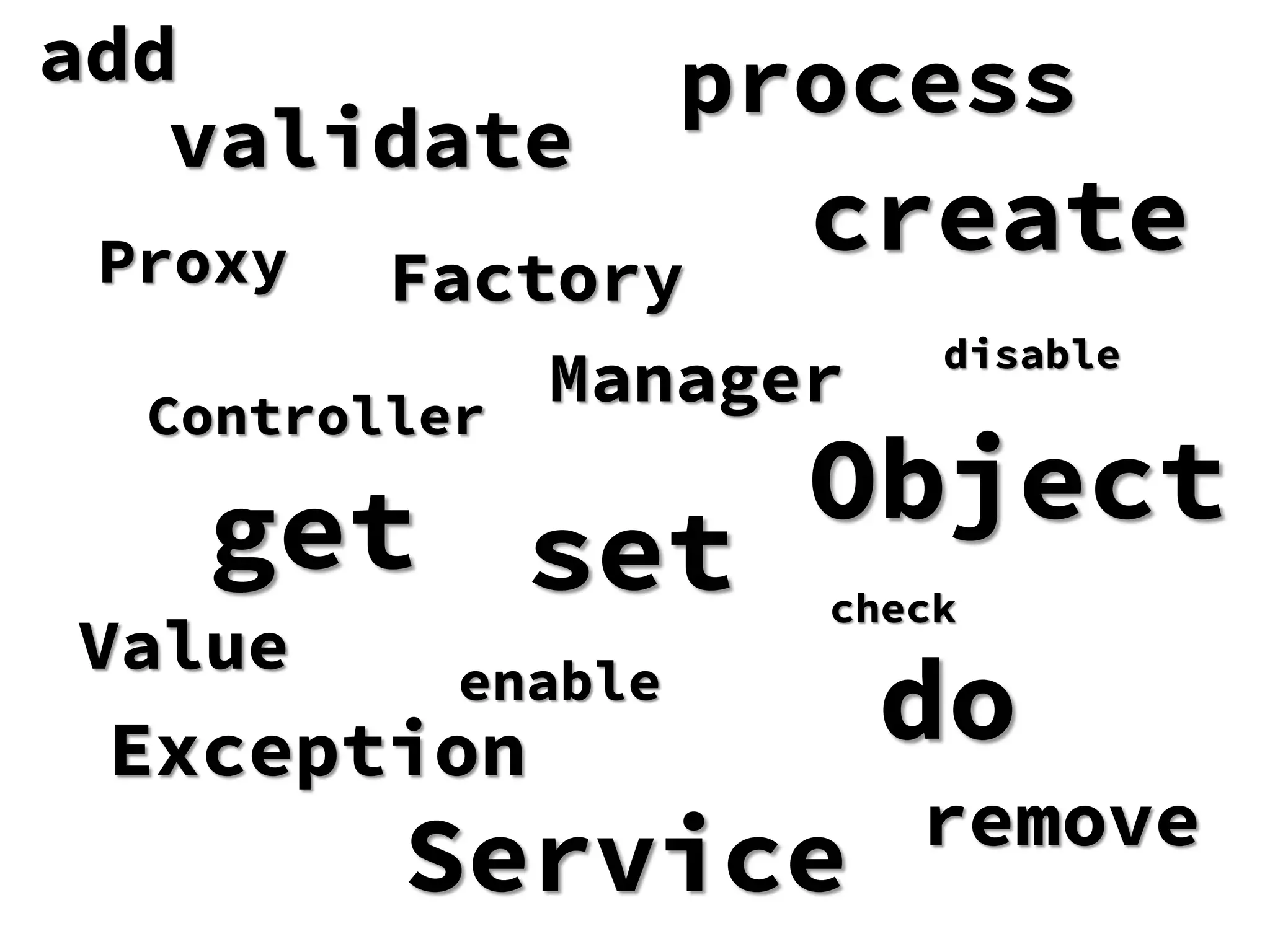
Proxy 
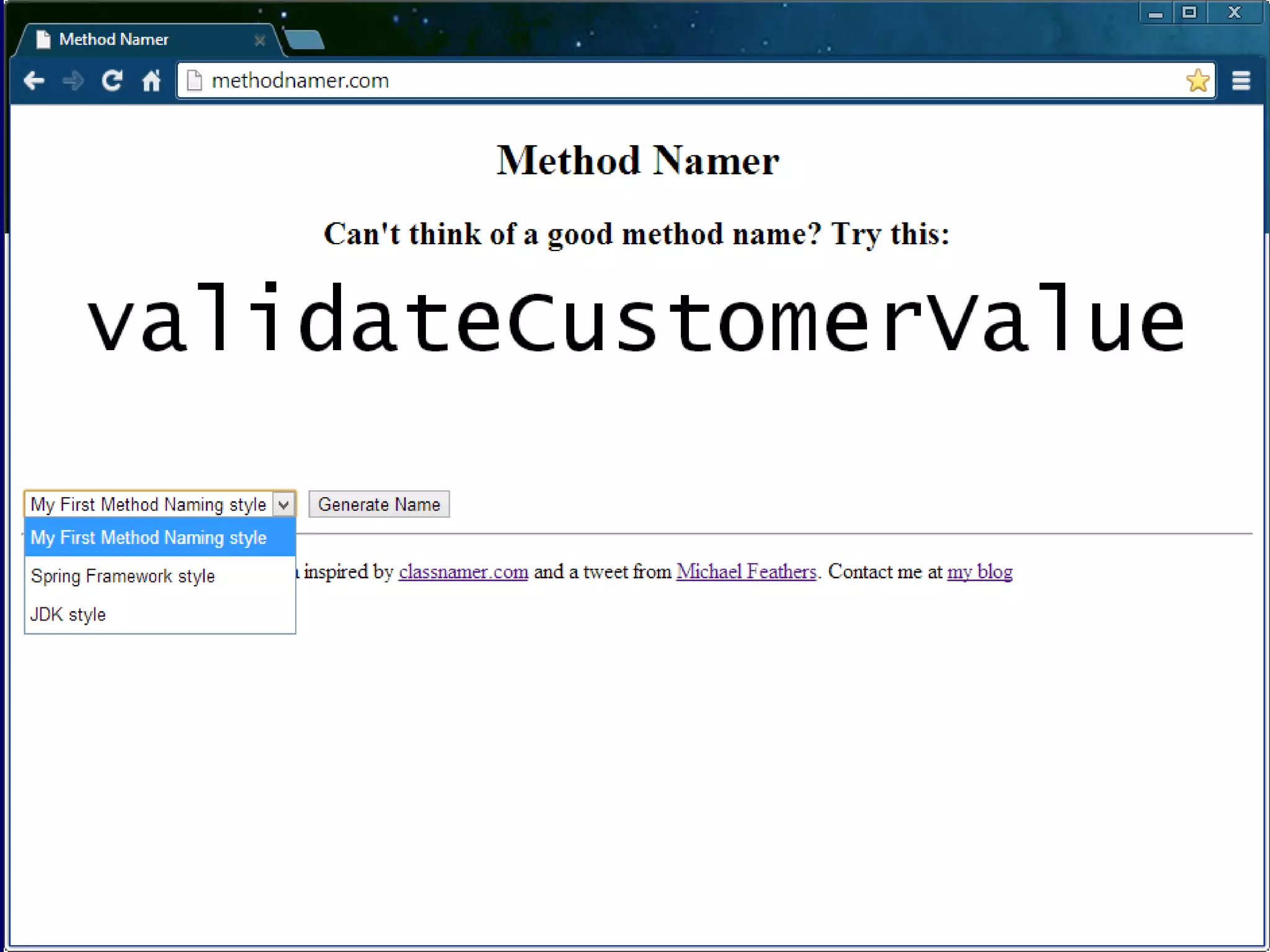
validate 
Service 
Value 
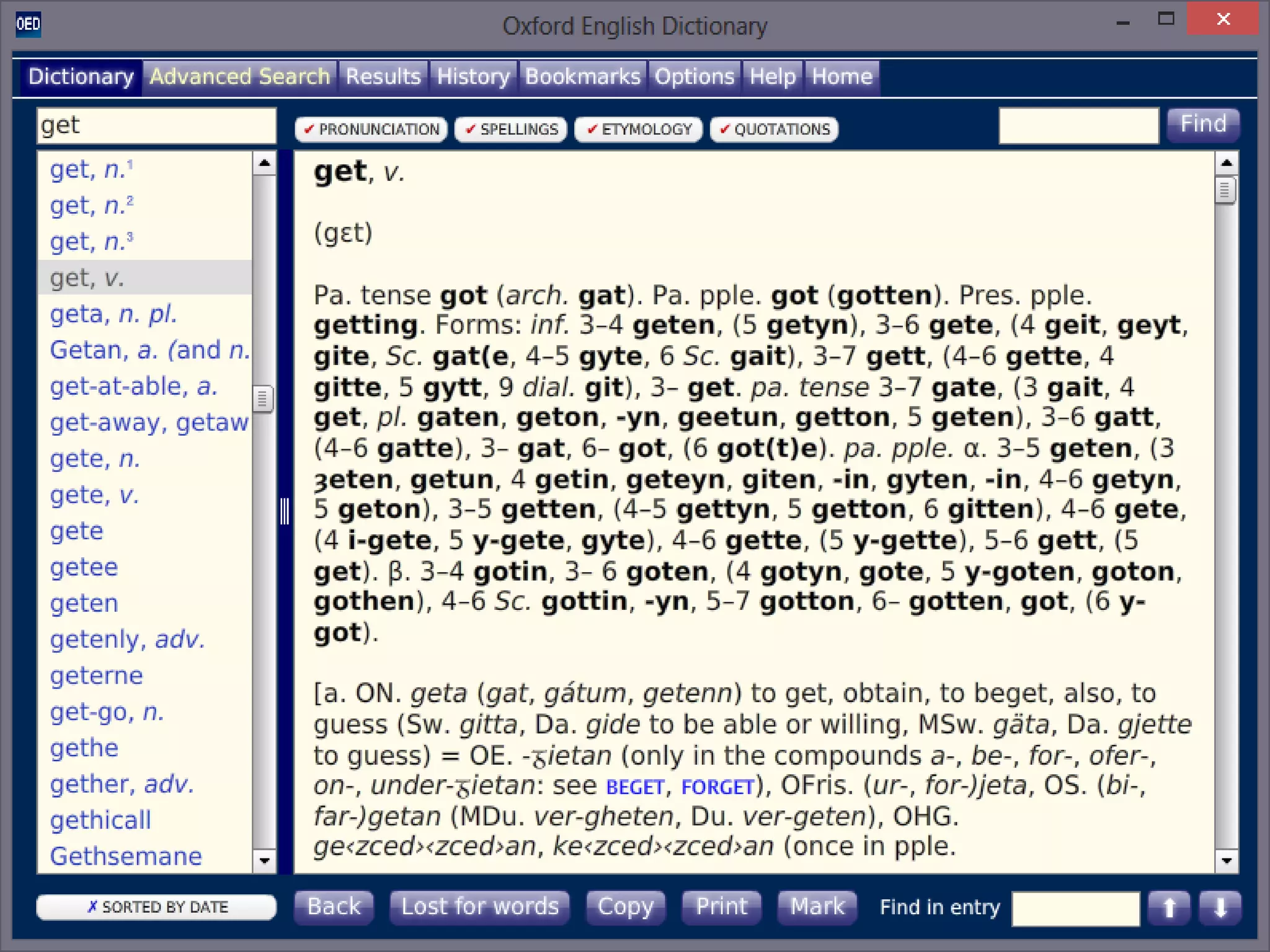
get 
create 
Manager 
check 
Controller 
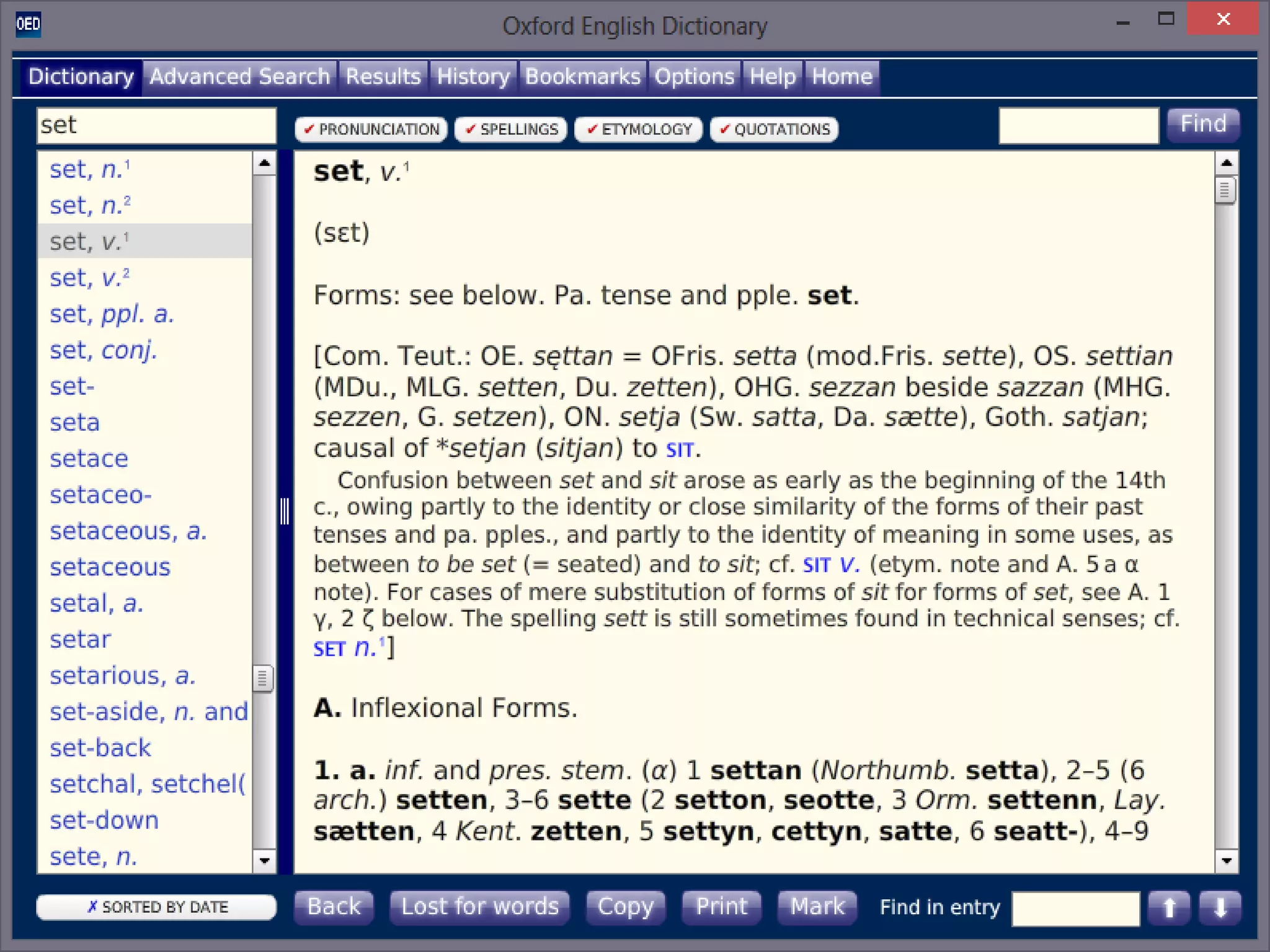
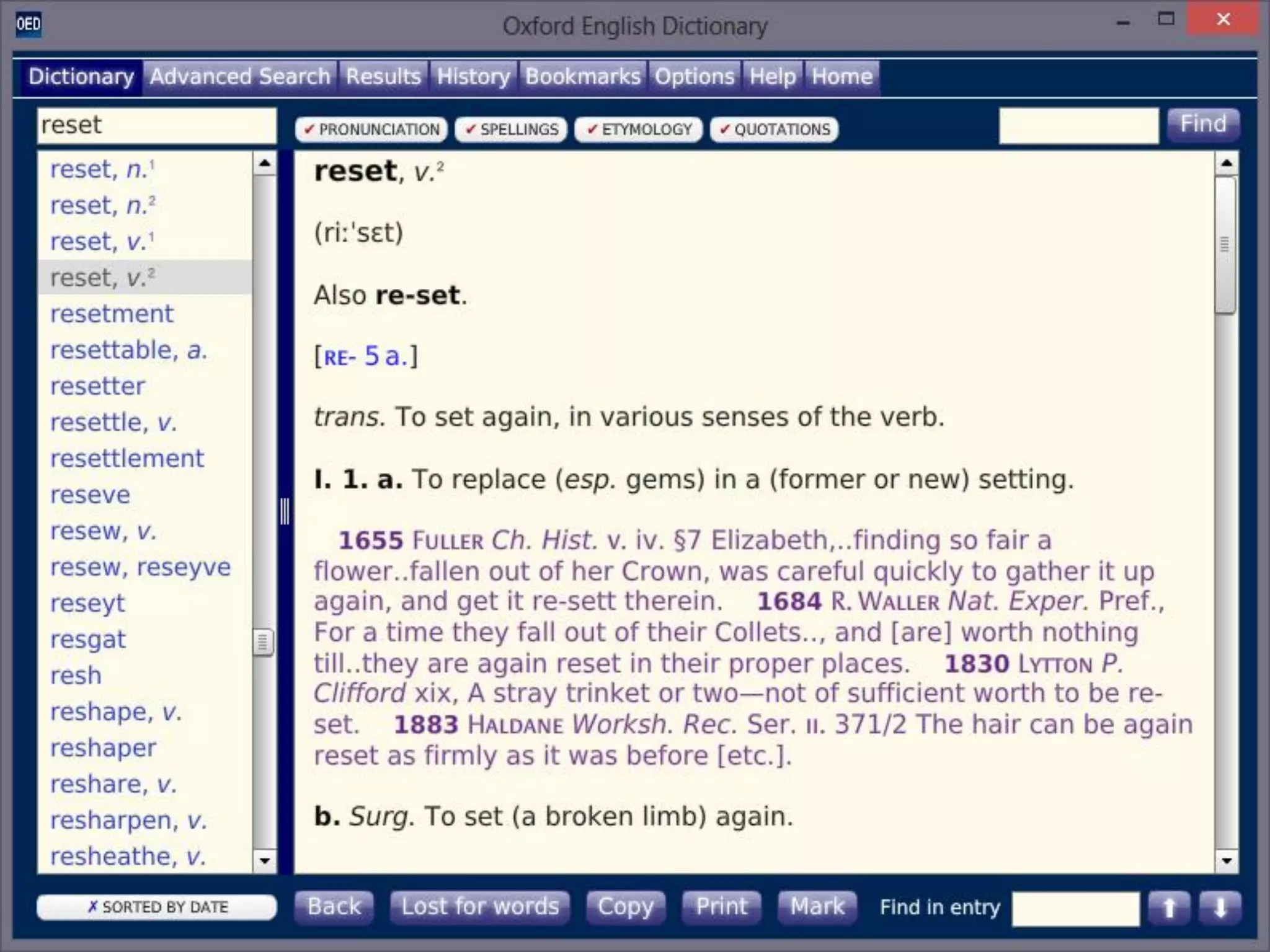
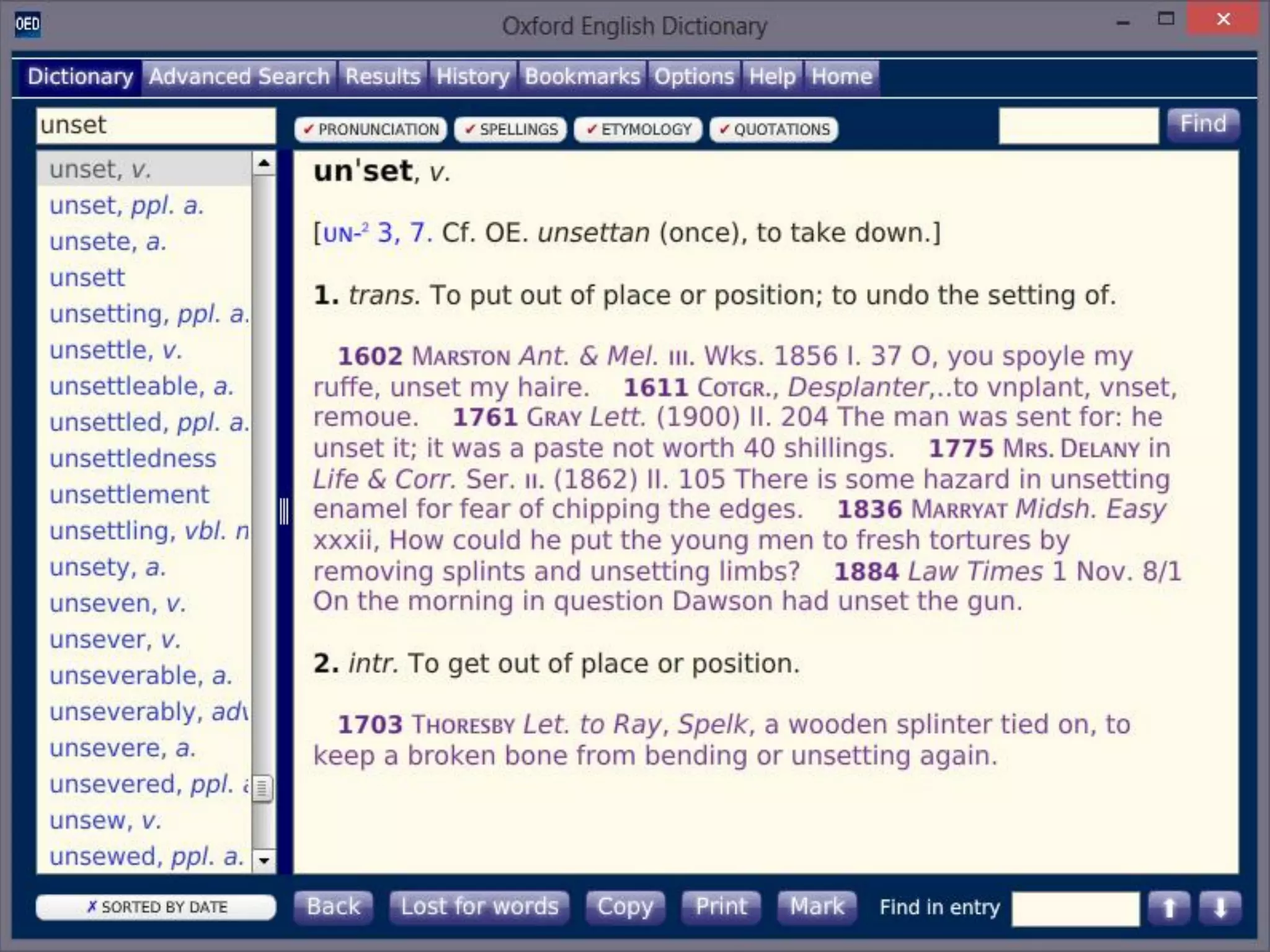
set 
Factory 
Object 
do 
enable 
process 
disable 
Exception 
add 
remove
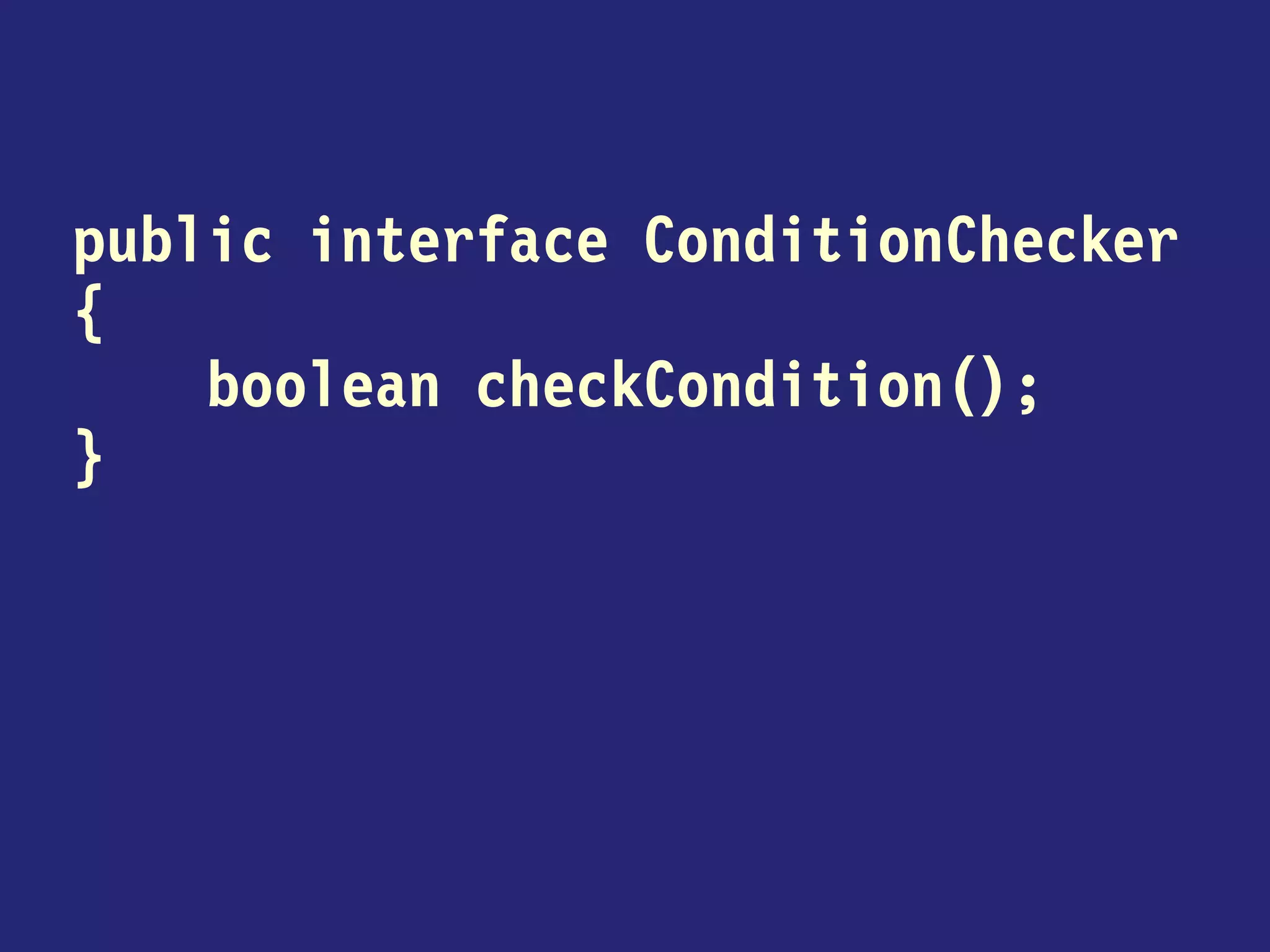
public interface ConditionChecker { boolean checkCondition(); }
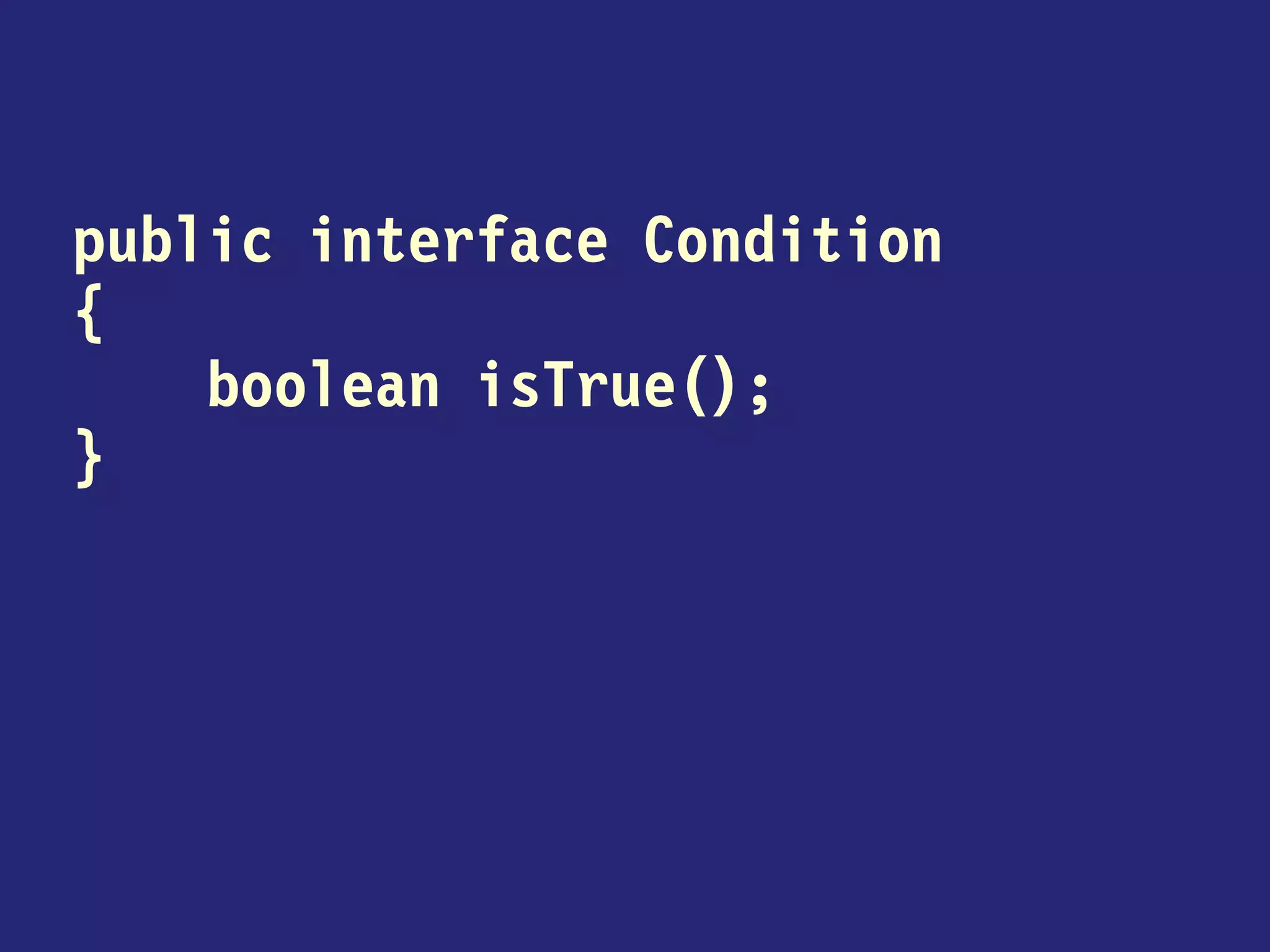
public interface Condition 
{ 
boolean isTrue(); 
}
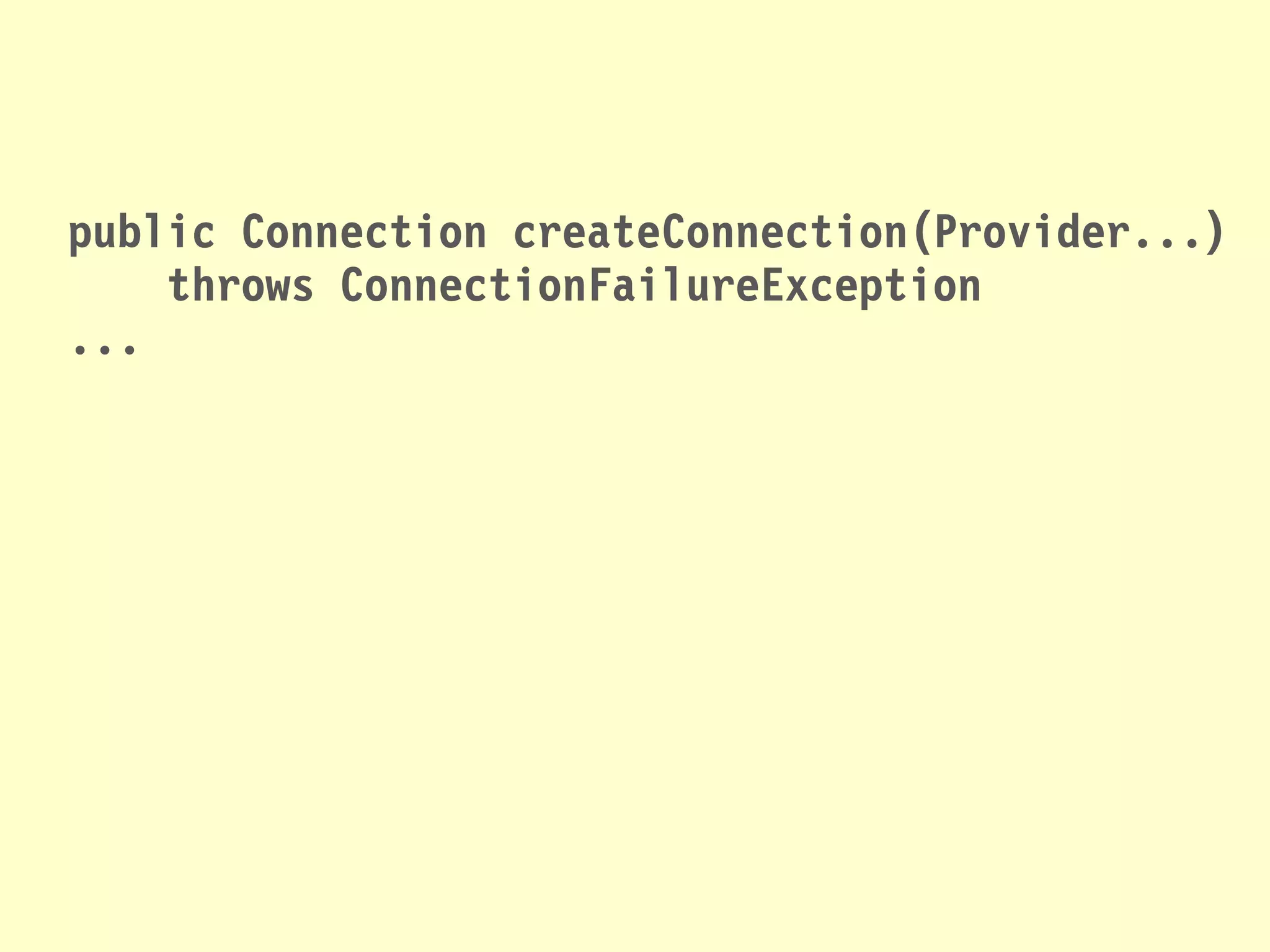
public Connection createConnection(Provider...) 
throws ConnectionFailureException 
...
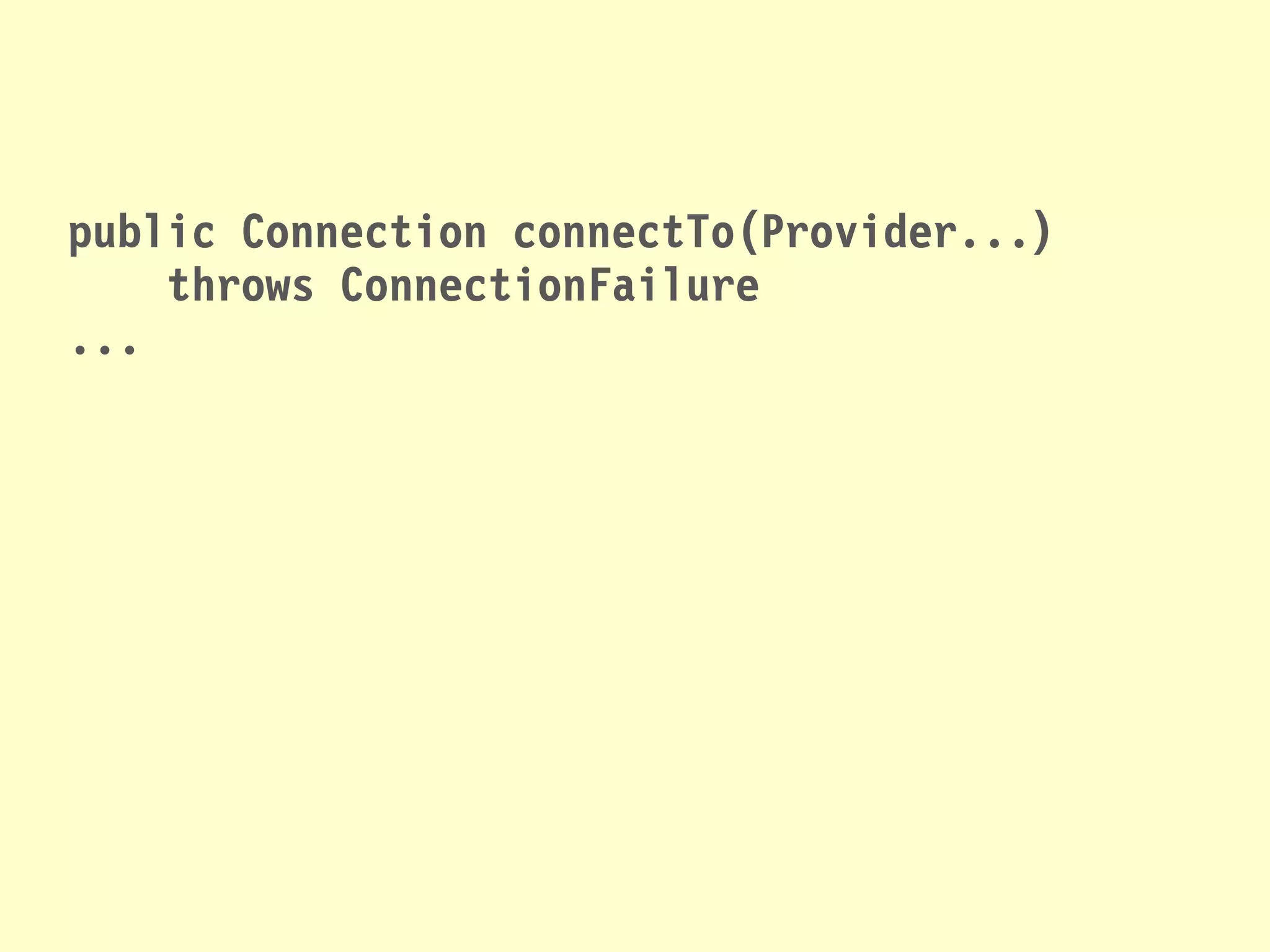
public Connection connectTo(Provider...) 
throws ConnectionFailure 
...
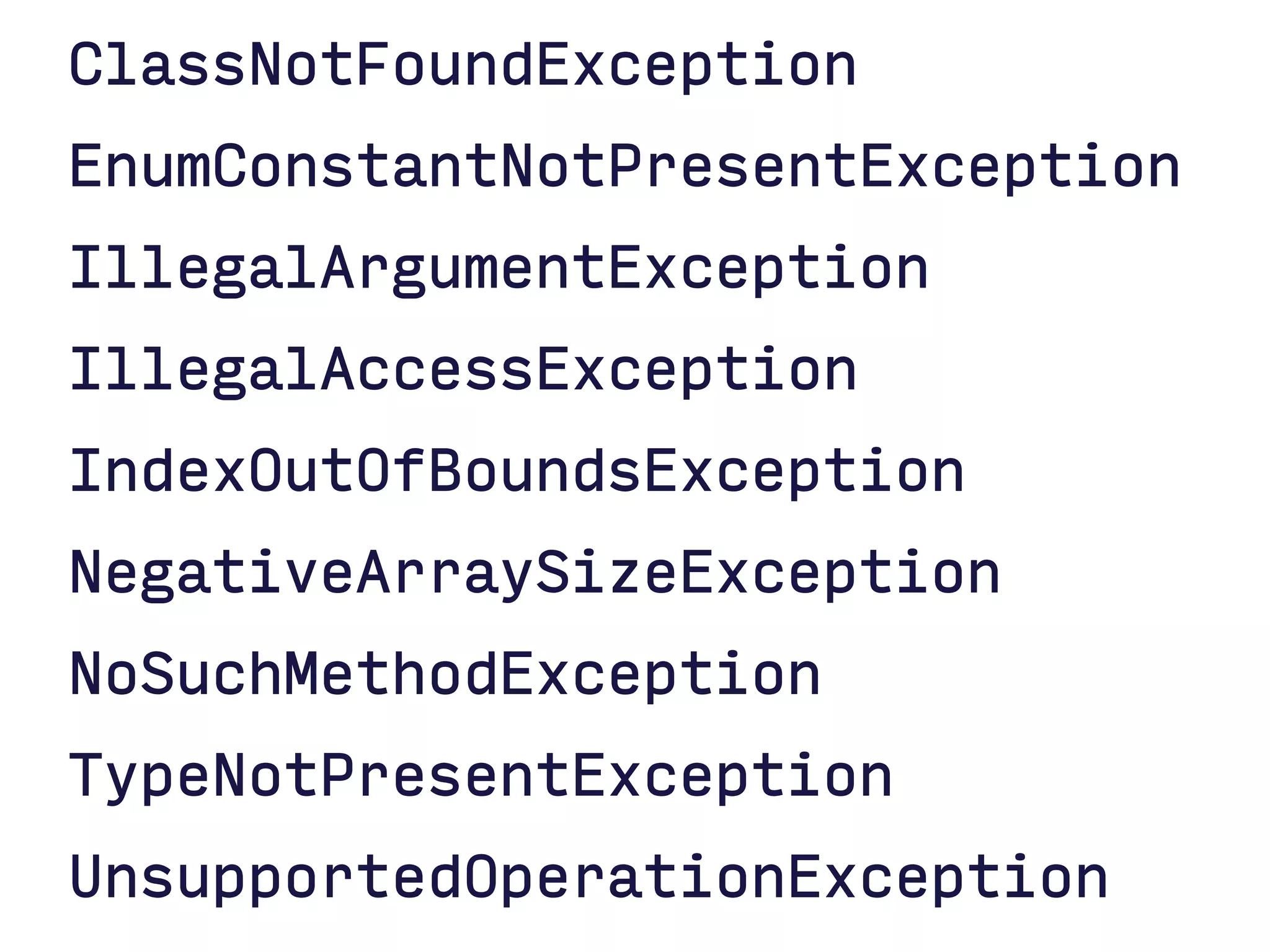
ClassNotFoundException 
EnumConstantNotPresentException 
IllegalArgumentException 
IllegalAccessException 
IndexOutOfBoundsException 
NegativeArraySizeException 
NoSuchMethodException 
TypeNotPresentException 
UnsupportedOperationException
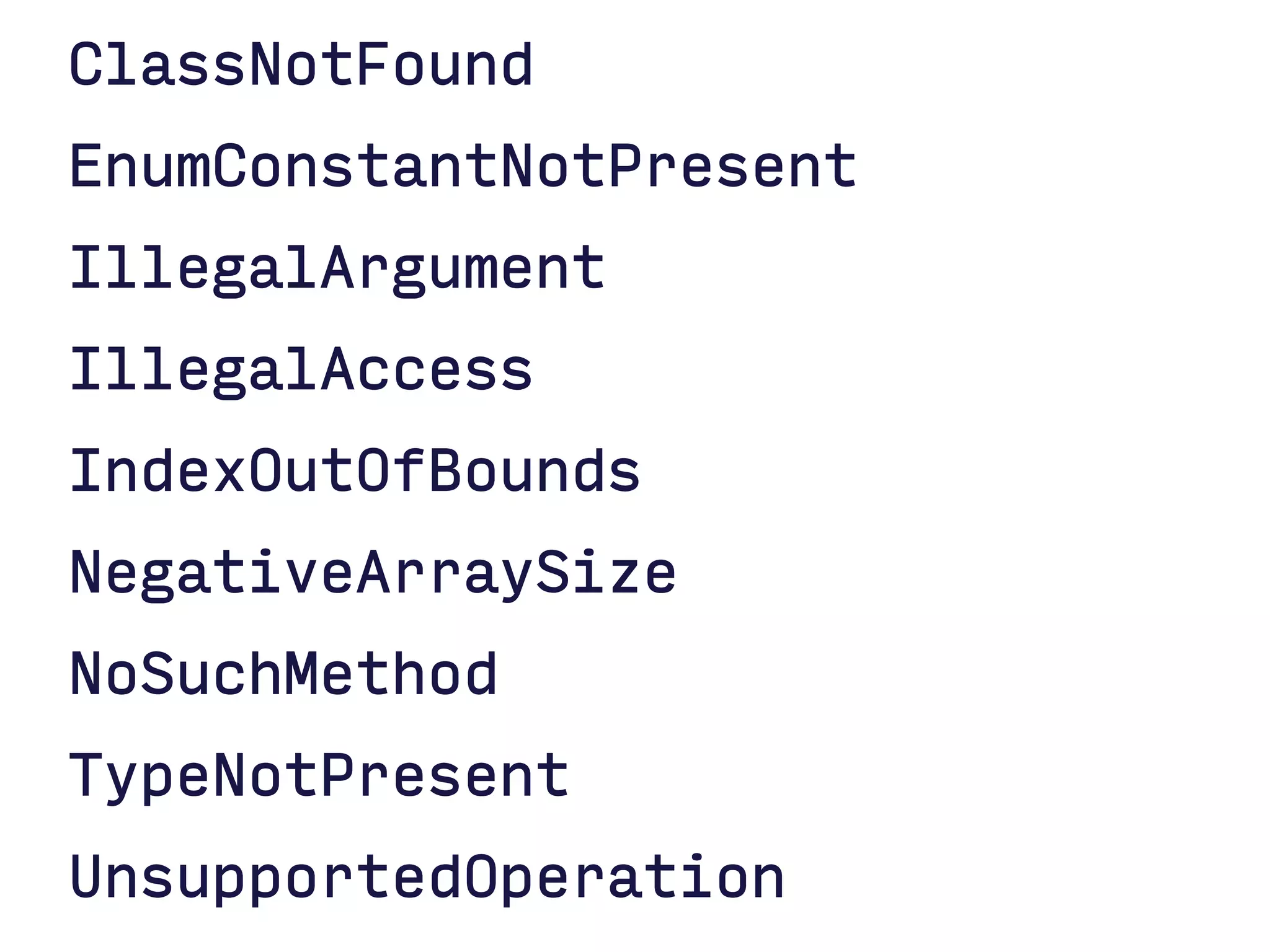
ClassNotFound 
EnumConstantNotPresent 
IllegalArgument 
IllegalAccess 
IndexOutOfBounds 
NegativeArraySize 
NoSuchMethod 
TypeNotPresent 
UnsupportedOperation
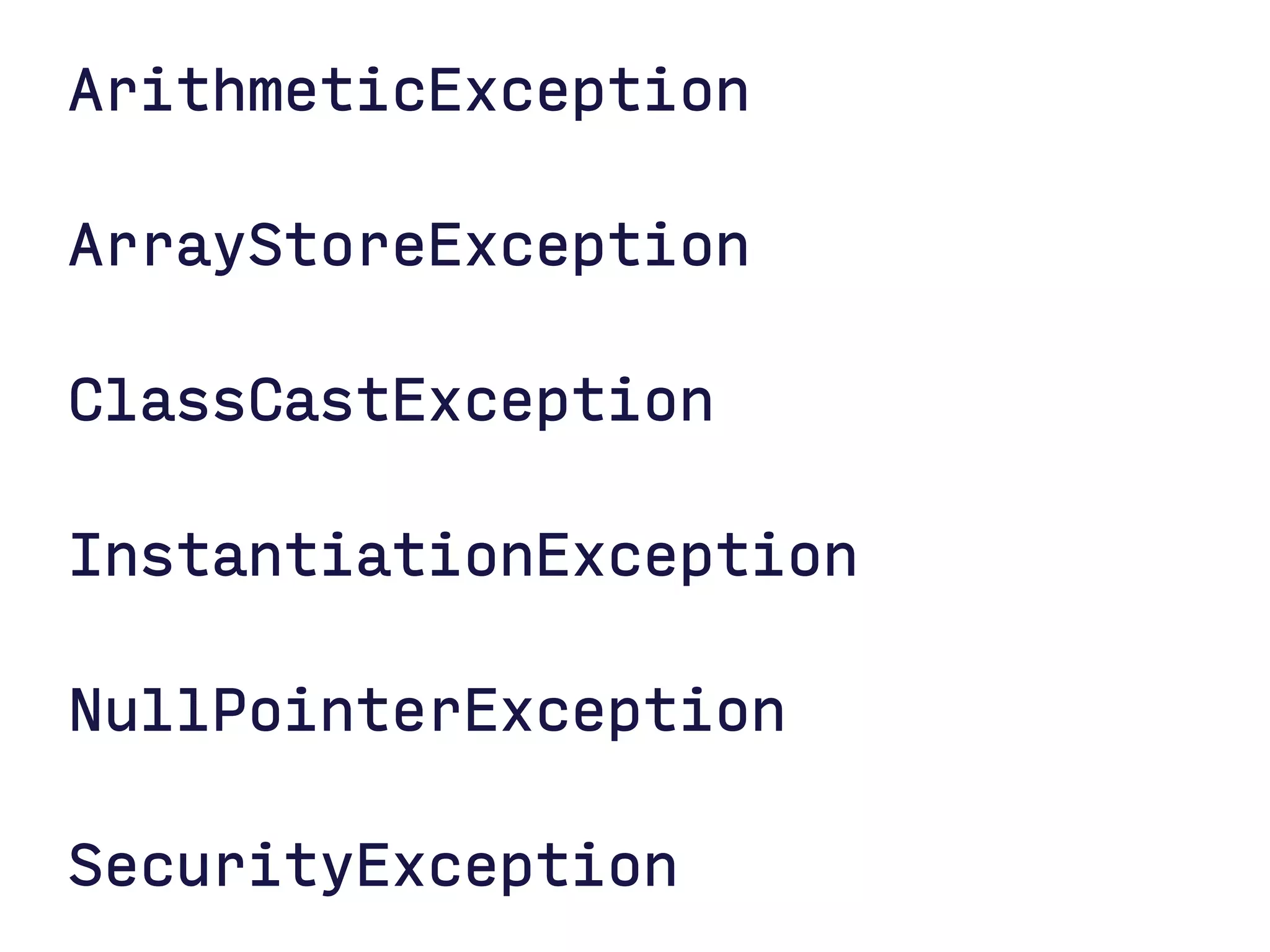
ArithmeticException 
ArrayStoreException 
ClassCastException 
InstantiationException 
NullPointerException 
SecurityException
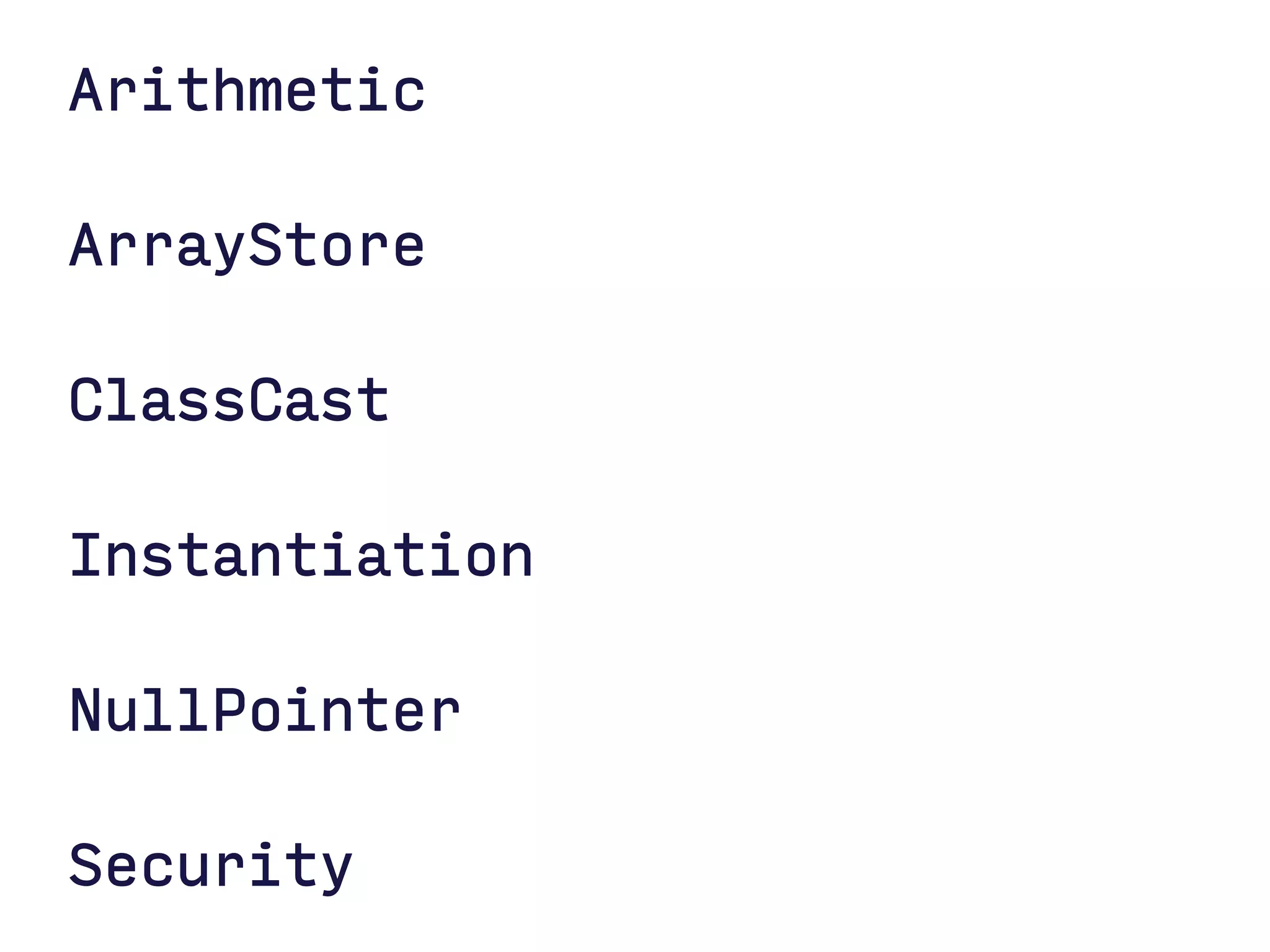
Arithmetic ArrayStore ClassCast Instantiation NullPointer Security
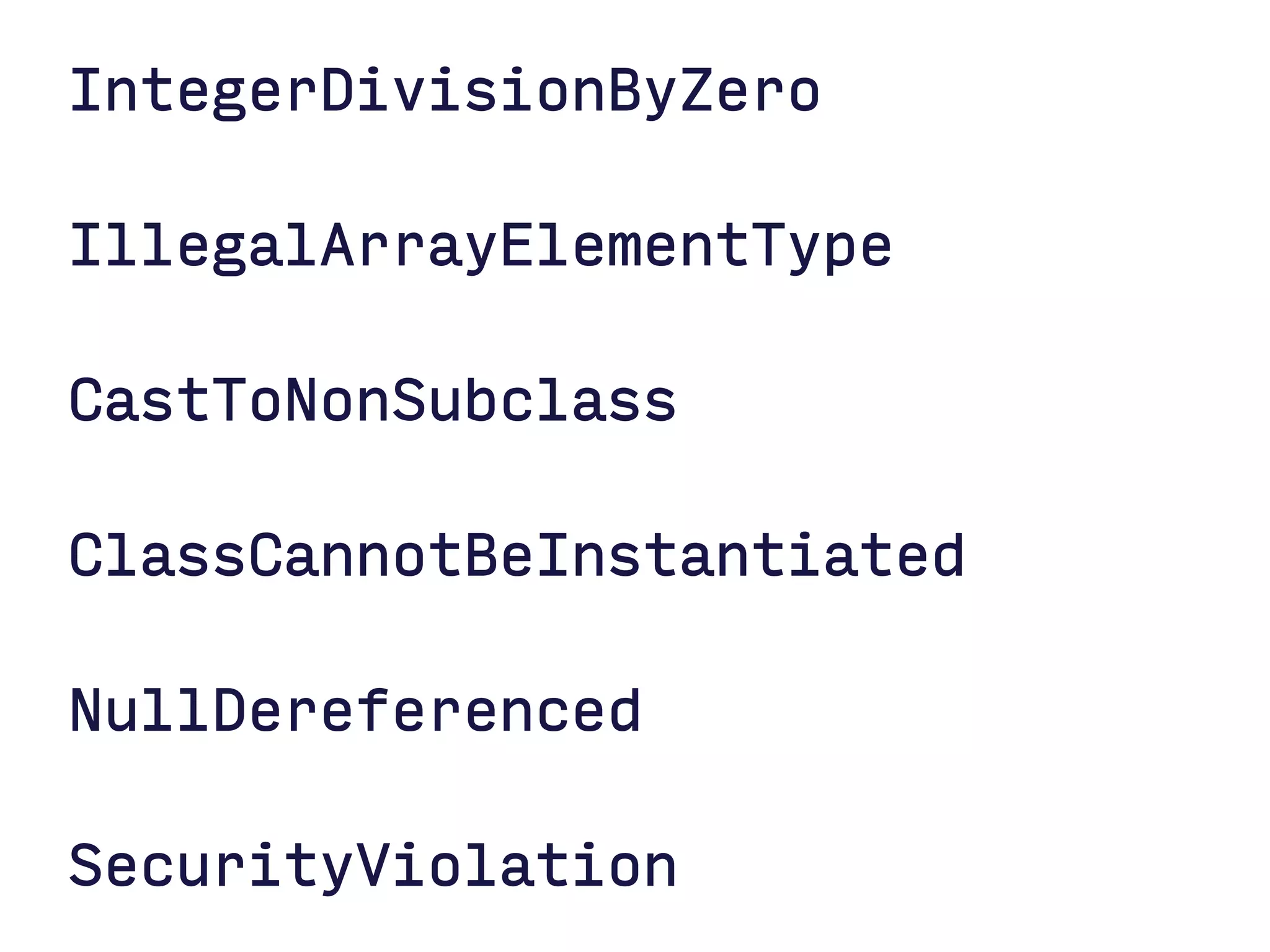
IntegerDivisionByZero IllegalArrayElementType CastToNonSubclass ClassCannotBeInstantiated NullDereferenced SecurityViolation
Omit needless words. 
William Strunk and E B White The Elements of Style
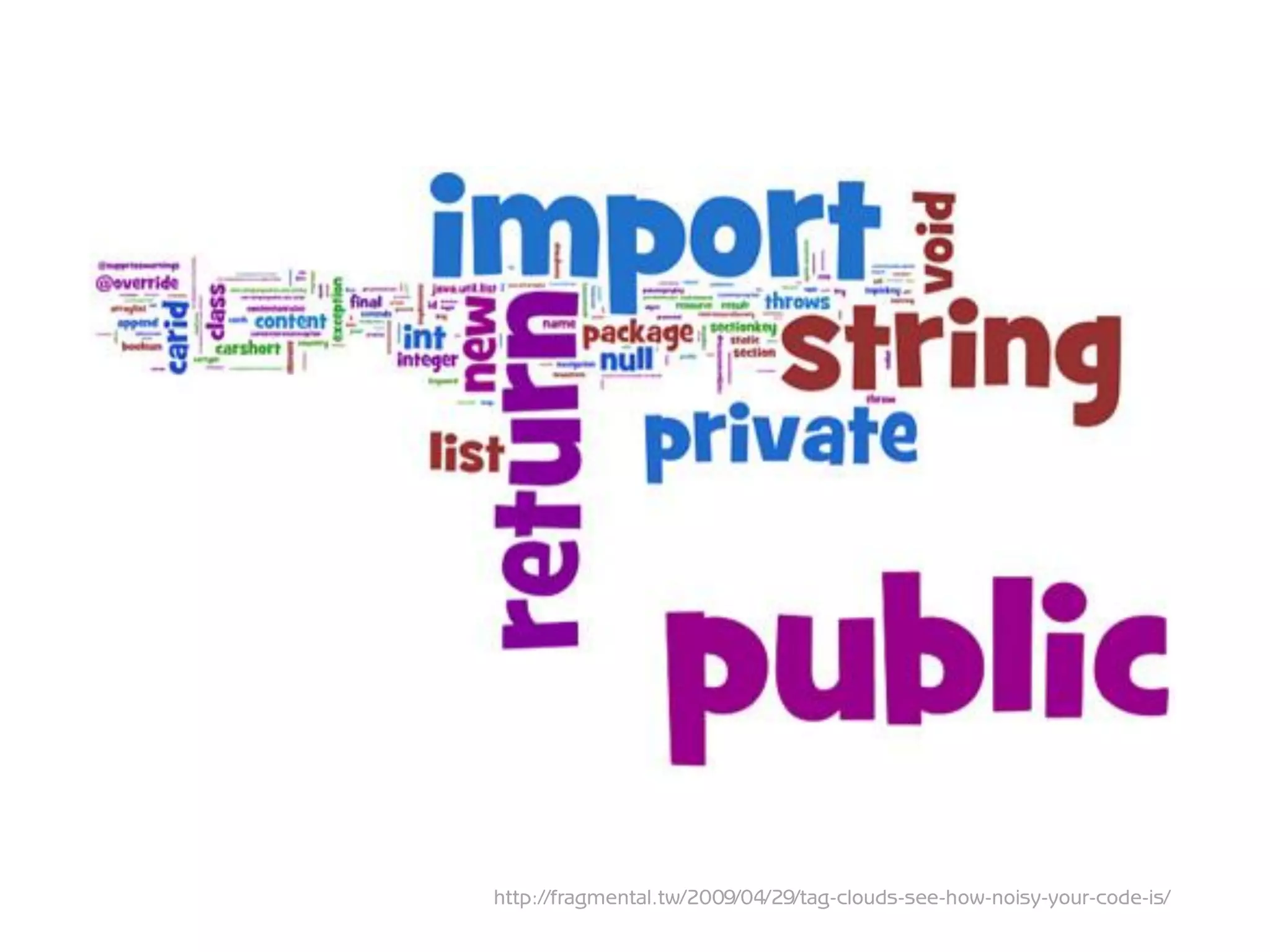
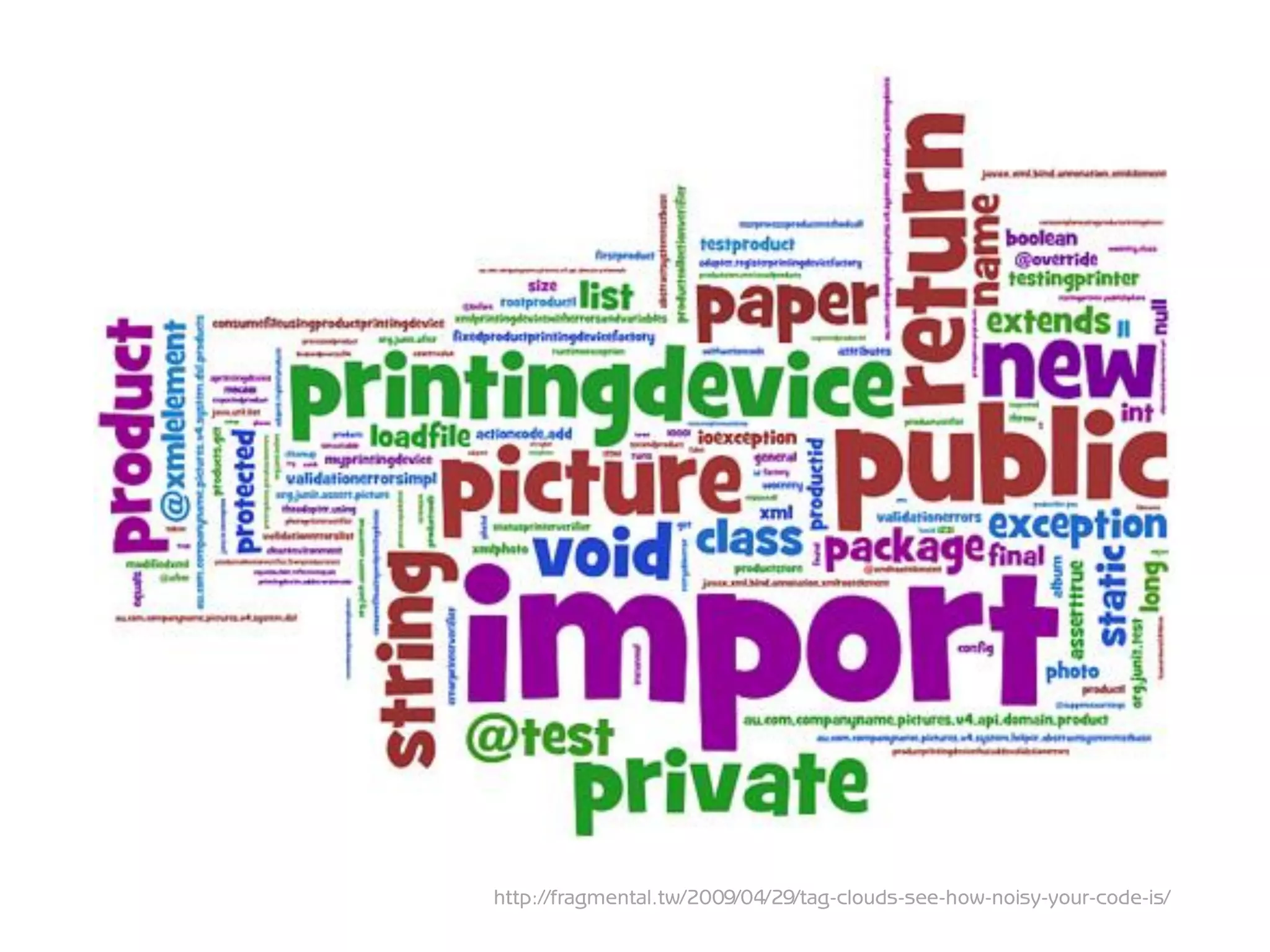
Underabstraction
http://fragmental.tw/2009/04/29/tag-clouds-see-how-noisy-your-code-is/
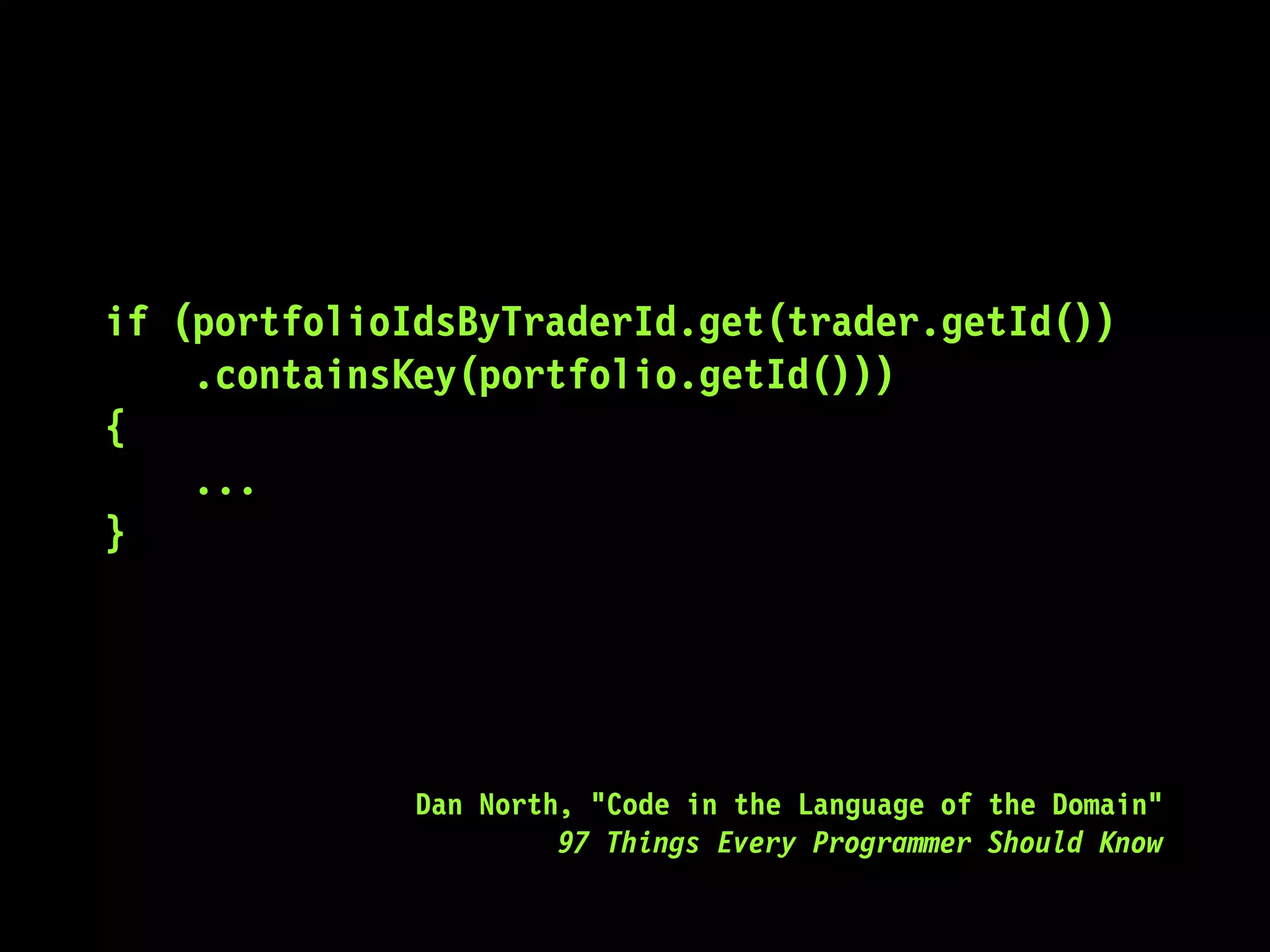
if (portfolioIdsByTraderId.get(trader.getId()) 
.containsKey(portfolio.getId())) 
{ 
... 
} 
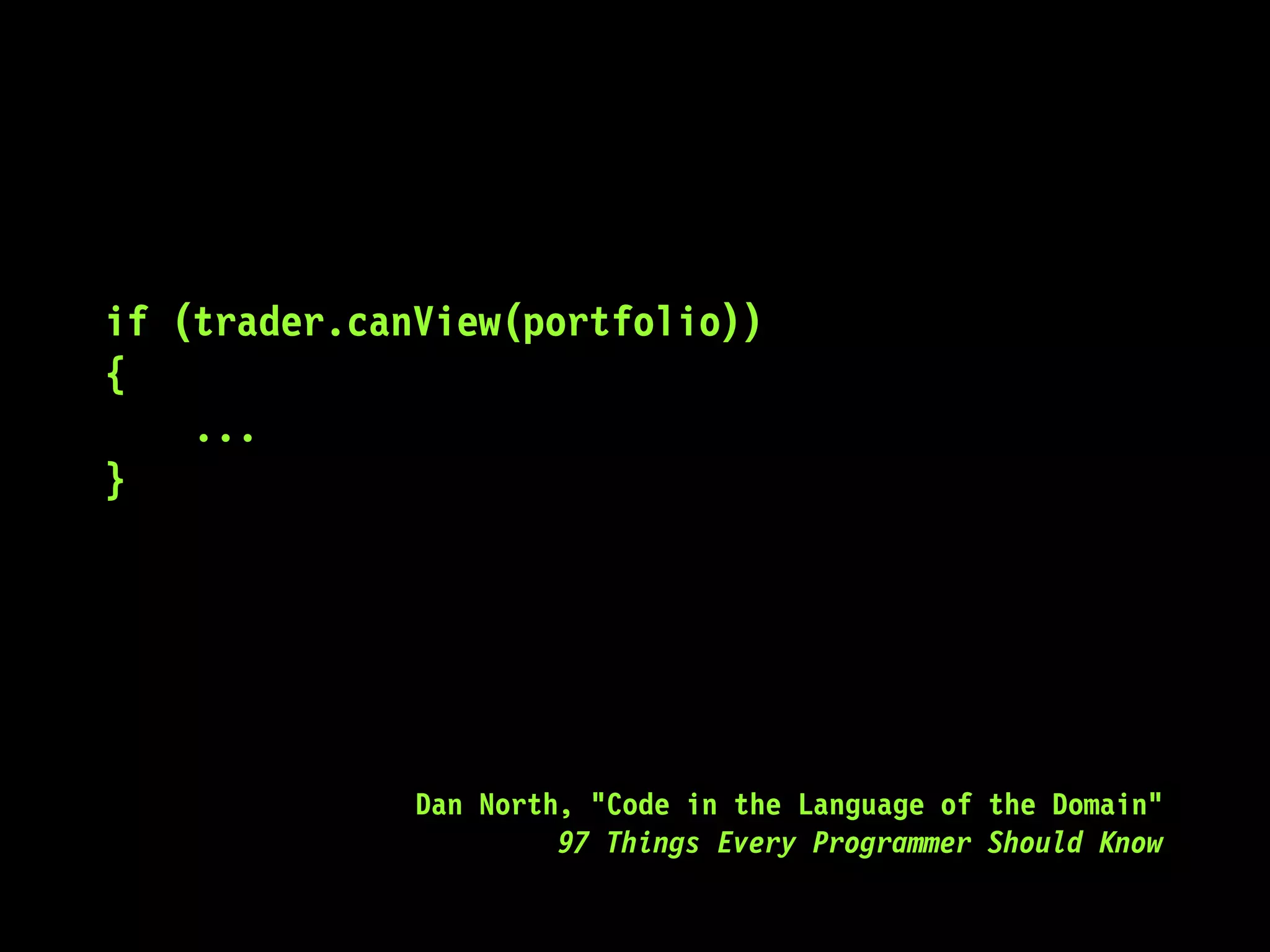
Dan North, "Code in the Language of the Domain" 
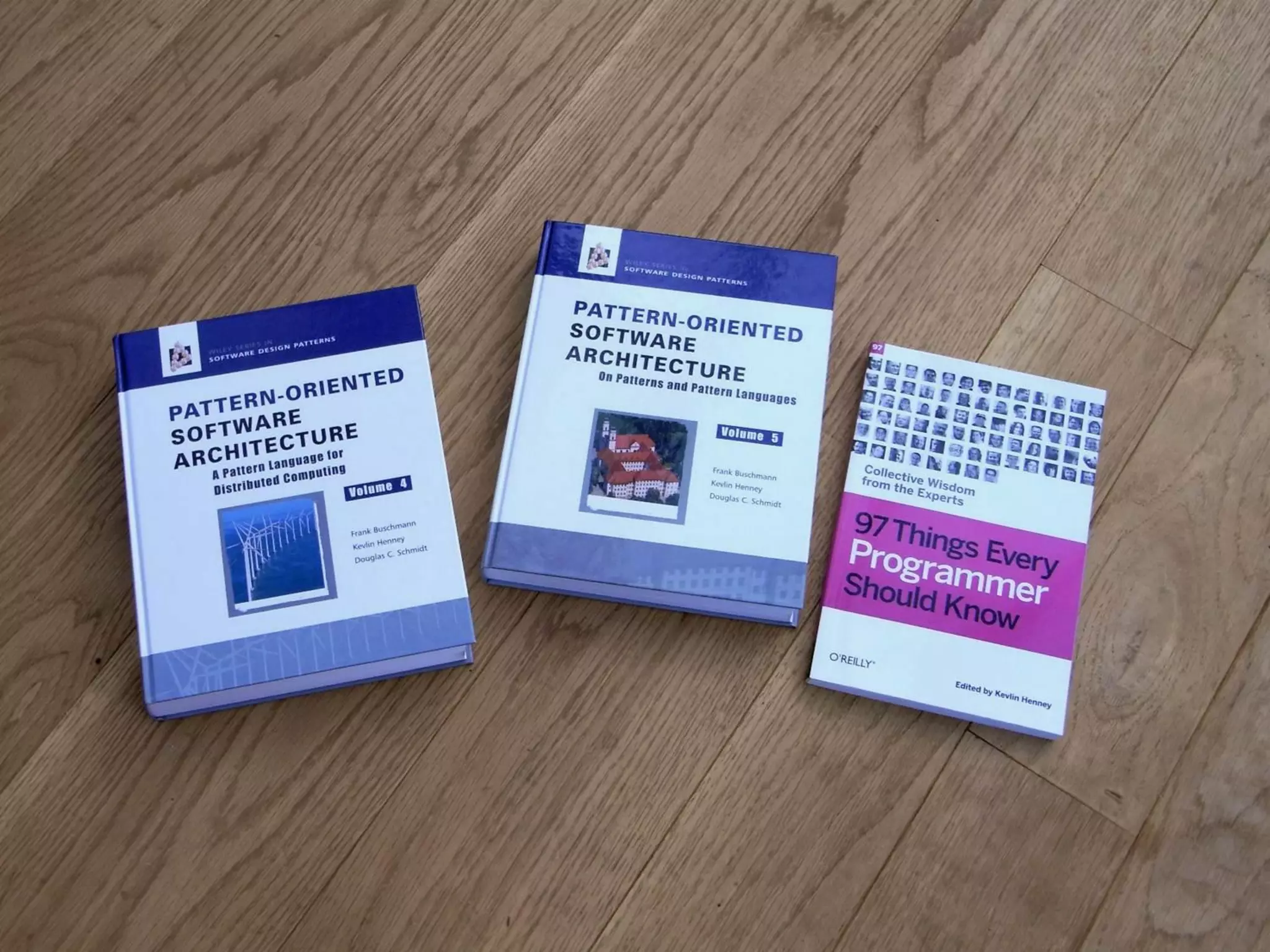
97 Things Every Programmer Should Know
if (trader.canView(portfolio)) { ... } 
Dan North, "Code in the Language of the Domain" 97 Things Every Programmer Should Know
Unencapsulated State
An affordance is a quality of an object, or an environment, which allows an individual to perform an action. For example, a knob affords twisting, and perhaps pushing, while a cord affords pulling. 
http://en.wikipedia.org/wiki/Affordance
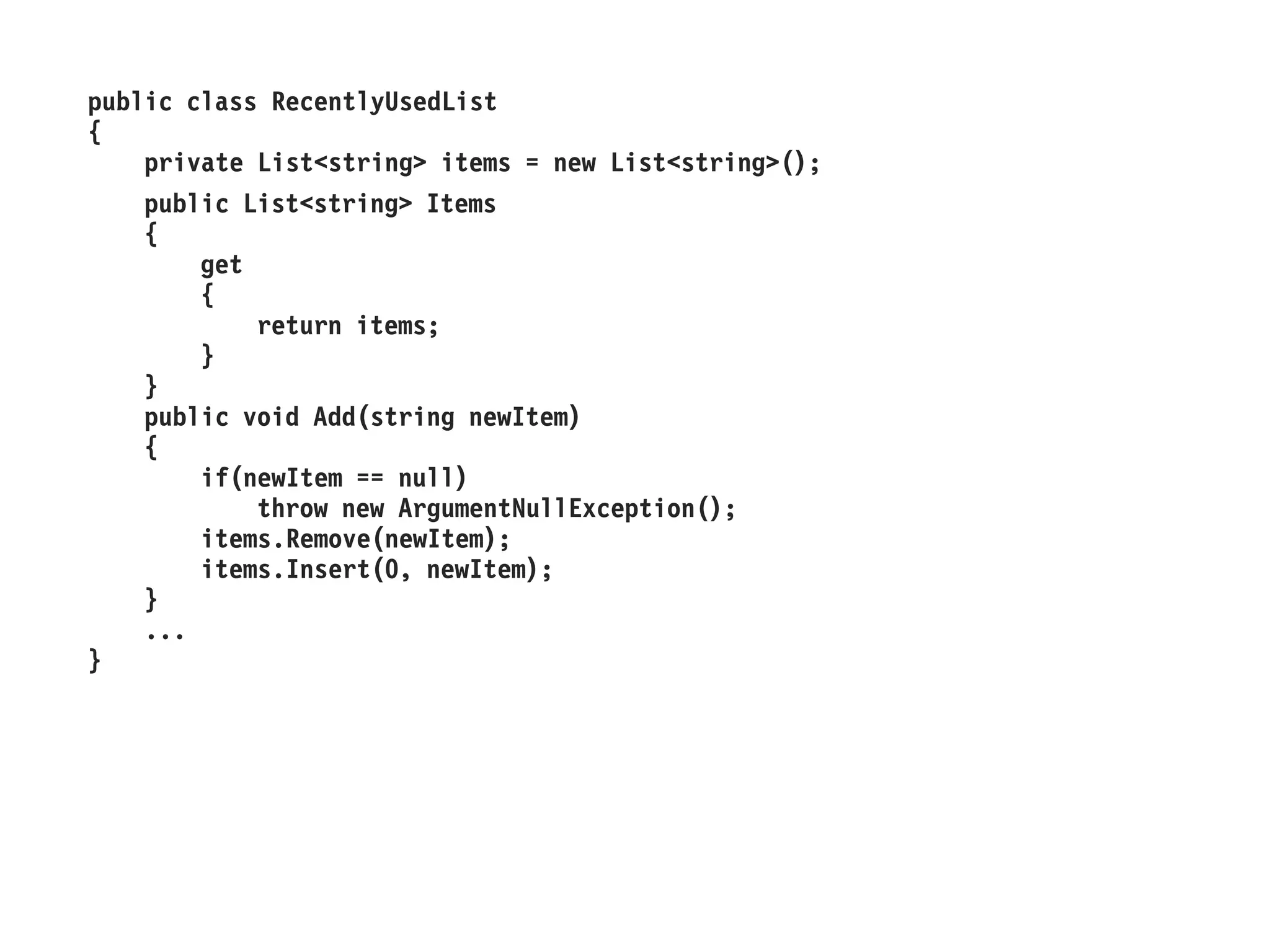
public class RecentlyUsedList 
{ 
private List<string> items = new List<string>(); 
public List<string> Items 
{ 
get 
{ 
return items; 
} 
} 
public void Add(string newItem) 
{ 
if(newItem == null) 
throw new ArgumentNullException(); 
items.Remove(newItem); 
items.Insert(0, newItem); 
} 
... 
}
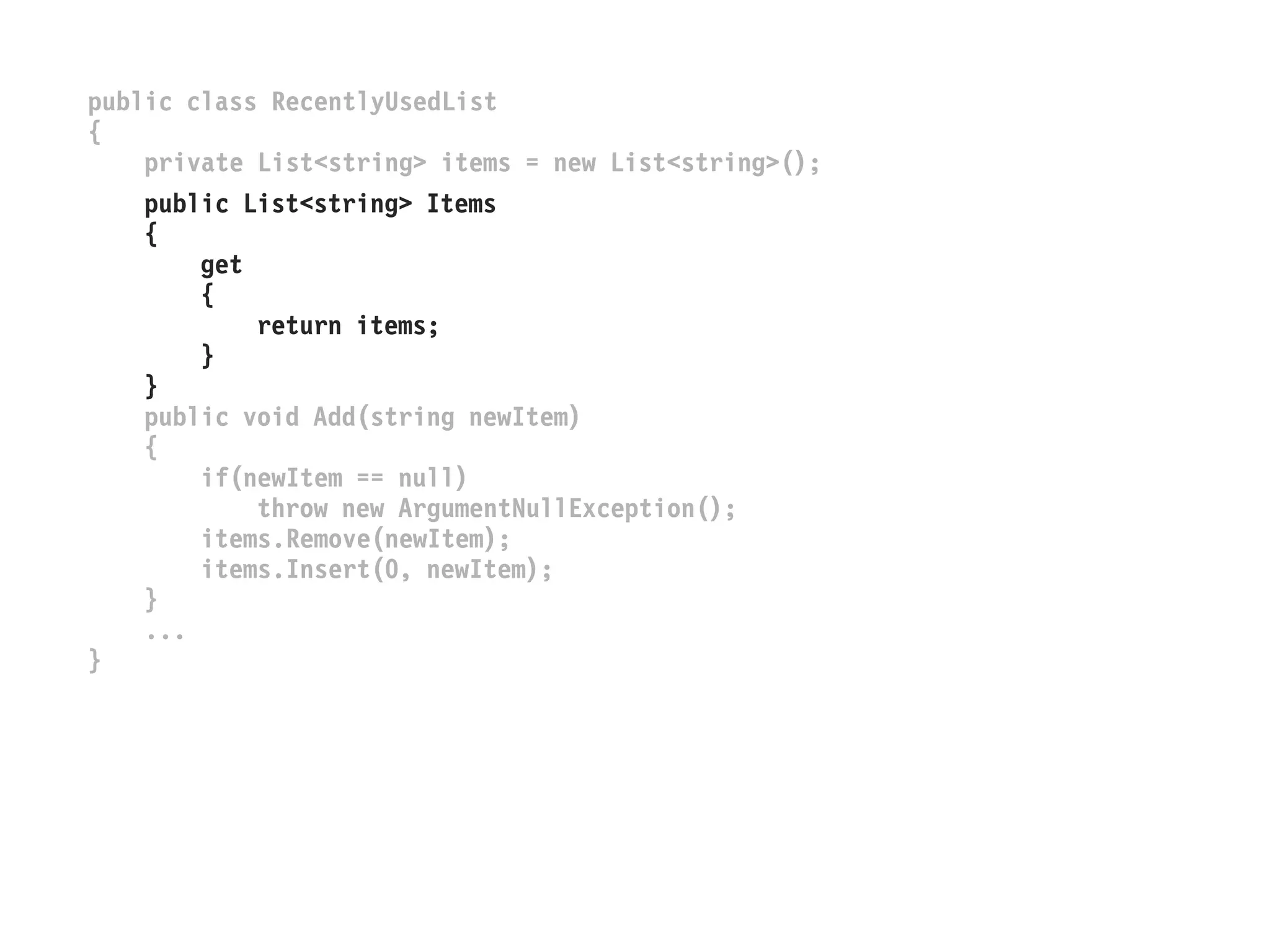
public class RecentlyUsedList 
{ 
private List<string> items = new List<string>(); 
public List<string> Items 
{ 
get 
{ 
return items; 
} 
} 
public void Add(string newItem) 
{ 
if(newItem == null) 
throw new ArgumentNullException(); 
items.Remove(newItem); 
items.Insert(0, newItem); 
} 
... 
}
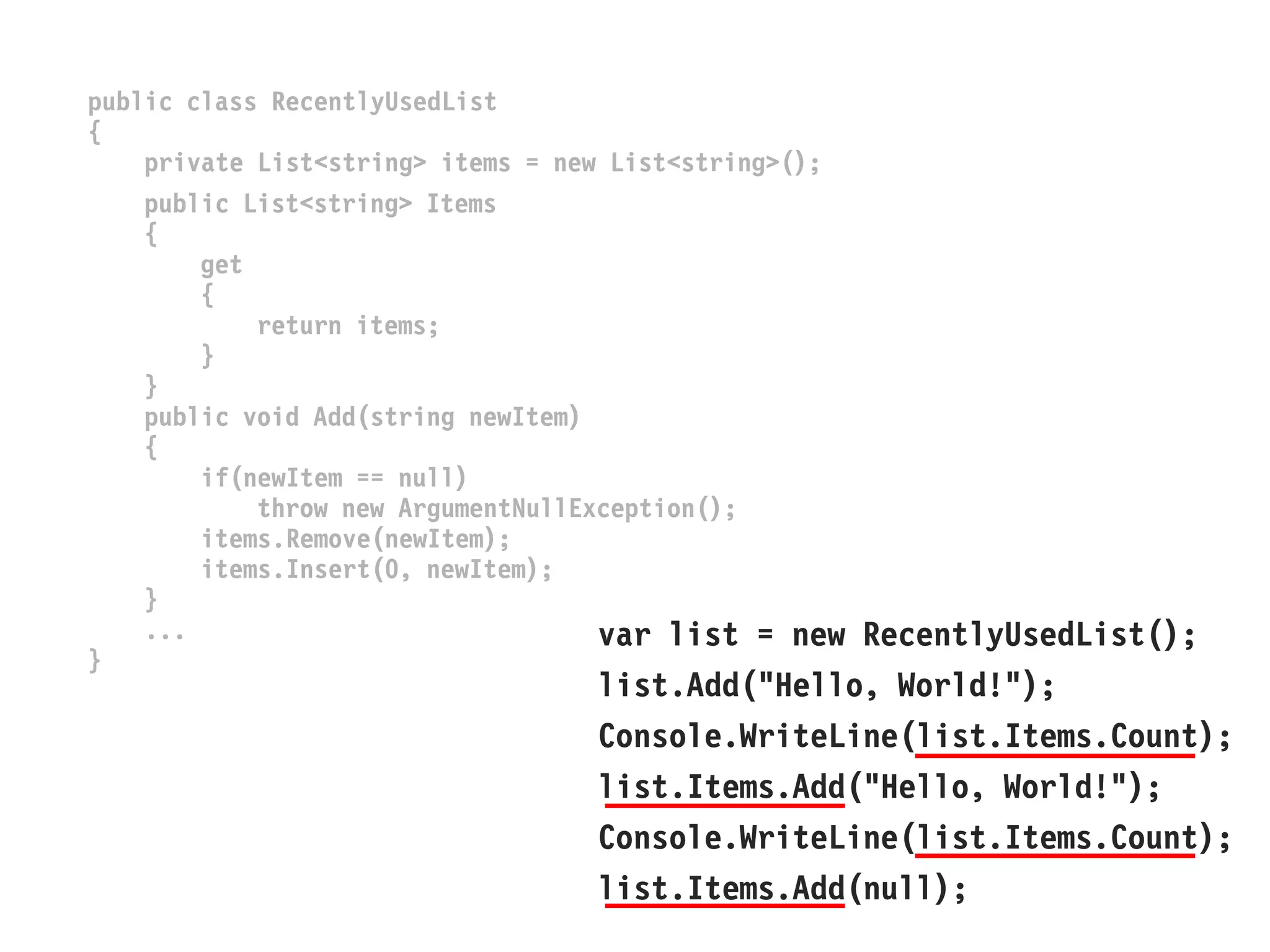
public class RecentlyUsedList 
{ 
private List<string> items = new List<string>(); 
public List<string> Items 
{ 
get 
{ 
return items; 
} 
} 
public void Add(string newItem) 
{ 
if(newItem == null) 
throw new ArgumentNullException(); 
items.Remove(newItem); 
items.Insert(0, newItem); 
} 
... 
} 
var list = new RecentlyUsedList(); 
list.Add("Hello, World!"); 
Console.WriteLine(list.Items.Count); 
list.Items.Add("Hello, World!"); 
Console.WriteLine(list.Items.Count); 
list.Items.Add(null);
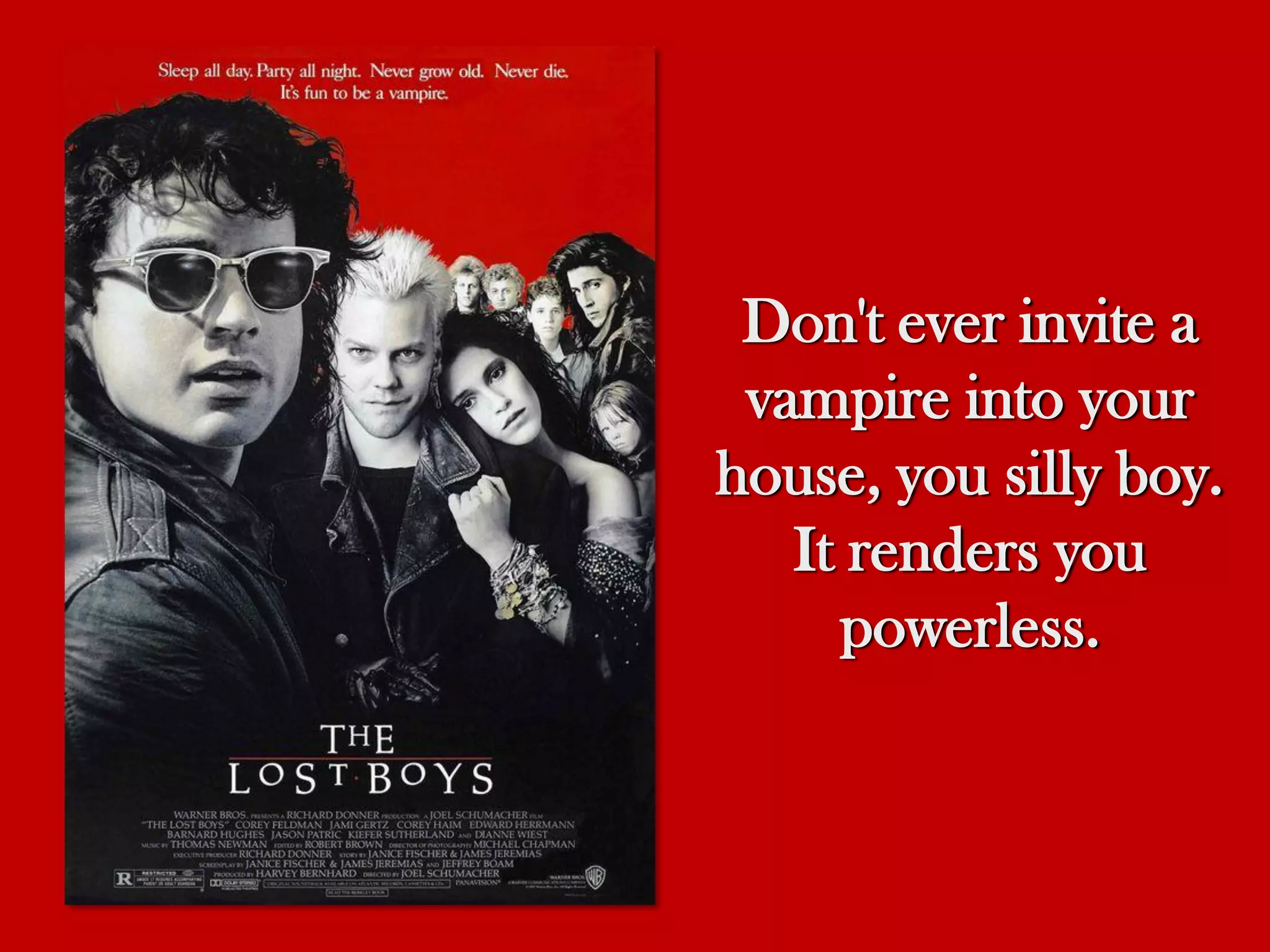
Don't ever invite a vampire into your house, you silly boy. It renders you powerless.
public class RecentlyUsedList { private IList<string> items = new List<string>(); public int Count { get { return items.Count; } } public string this[int index] { get { return items[index]; } } public void Add(string newItem) { if(newItem == null) throw new ArgumentNullException(); items.Remove(newItem); items.Insert(0, newItem); } ... }
public class RecentlyUsedList 
{ 
private IList<string> items = new List<string>(); 
public int Count 
{ 
get 
{ 
return items.Count; 
} 
} 
public string this[int index] 
{ 
get 
{ 
return items[Count – index - 1]; 
} 
} 
public void Add(string newItem) 
{ 
if(newItem == null) 
throw new ArgumentNullException(); 
items.Remove(newItem); 
items.Add(newItem); 
} 
... 
}
Getters and Setters
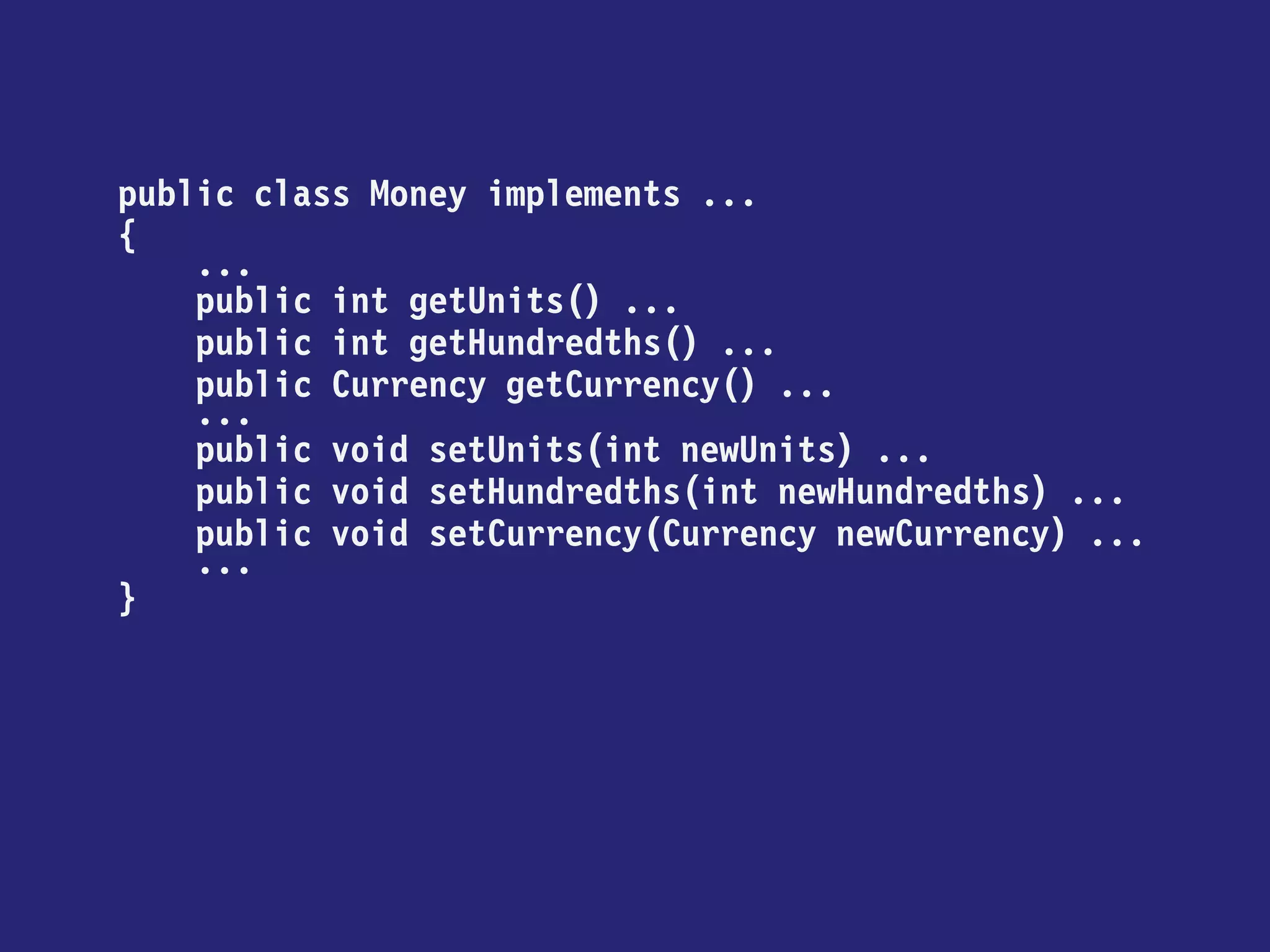
public class Money implements ... 
{ 
... 
public int getUnits() ... 
public int getHundredths() ... 
public Currency getCurrency() ... 
... 
public void setUnits(int newUnits) ... 
public void setHundredths(int newHundredths) ... 
public void setCurrency(Currency newCurrency) ... 
... 
}
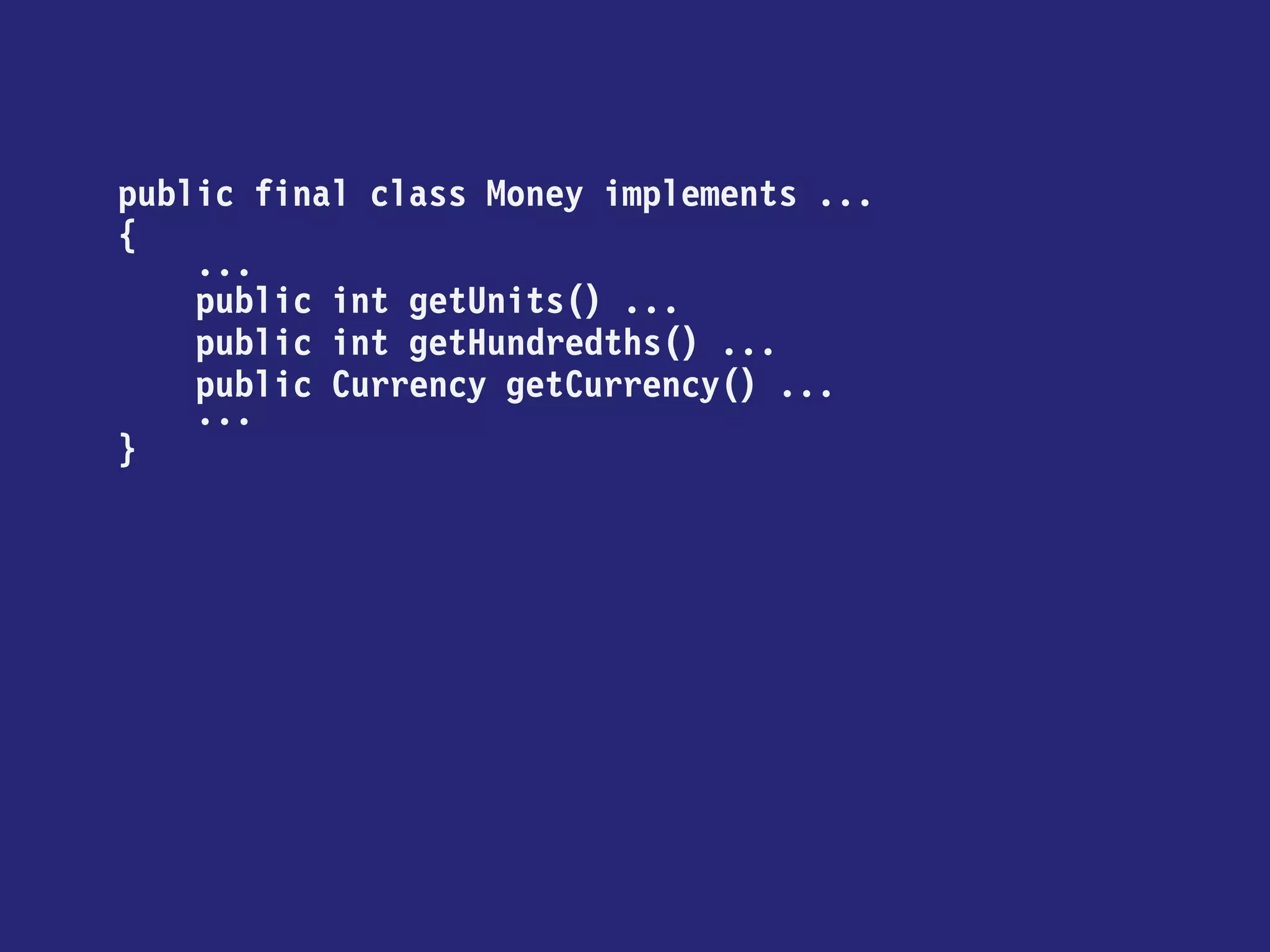
public final class Money implements ... 
{ 
... 
public int getUnits() ... 
public int getHundredths() ... 
public Currency getCurrency() ... 
... 
}
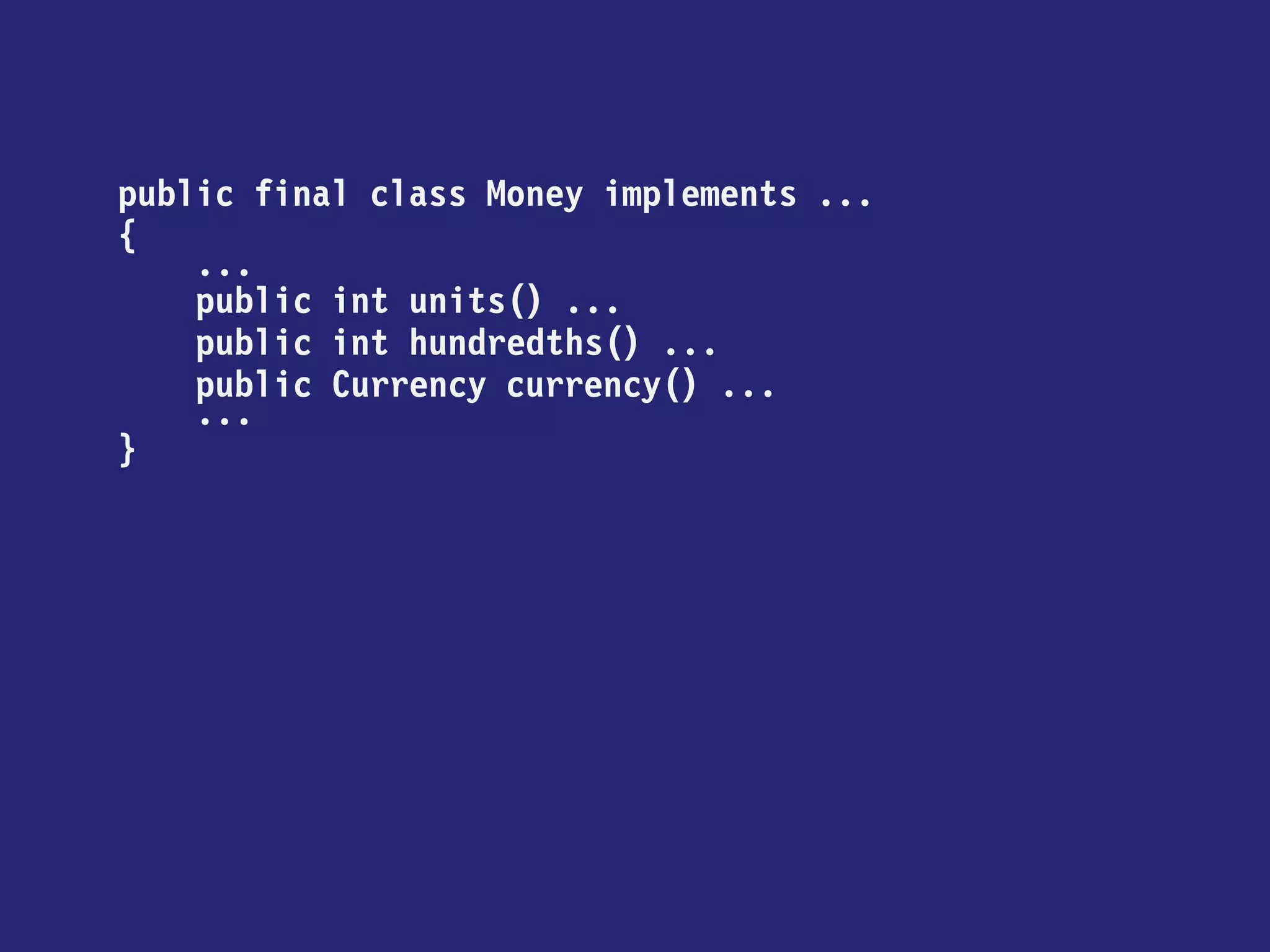
public final class Money implements ... 
{ 
... 
public int units() ... 
public int hundredths() ... 
public Currency currency() ... 
... 
}
When it is not necessary to change, it is necessary not to change. 
Lucius Cary
Uncohesive Tests
Everybody knows that TDD stands for Test Driven Development. However, people too often concentrate on the words "Test" and "Development" and don't consider what the word "Driven" really implies. For tests to drive development they must do more than just test that code performs its required functionality: they must clearly express that required functionality to the reader. That is, they must be clear specifications of the required functionality. Tests that are not written with their role as specifications in mind can be very confusing to read. Nat Pryce and Steve Freeman "Are Your Tests Really Driving Your Development?"
public class RecentlyUsedList 
{ 
... 
public RecentlyUsedList() ... 
public int Count 
{ 
get... 
} 
public string this[int index] 
{ 
get... 
} 
public void Add(string newItem) ... 
... 
}
[TestFixture] 
public class RecentlyUsedListTests 
{ 
[Test] 
public void TestConstructor() ... 
[Test] 
public void TestCountGet() ... 
[Test] 
public void TestIndexerGet() ... 
[Test] 
public void TestAdd() ... 
... 
}
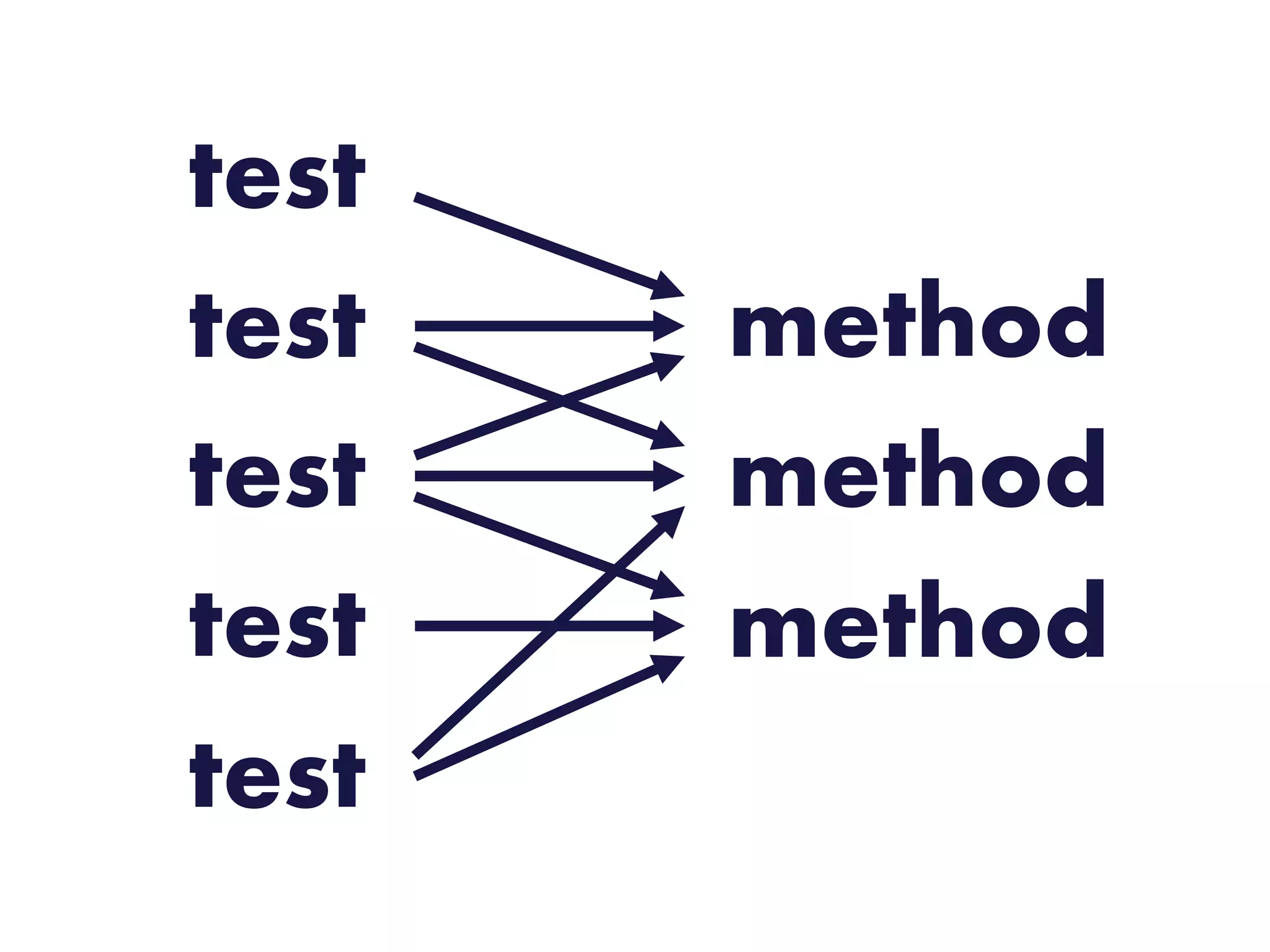
method 
test 
test 
test 
method 
method 
test 
test
namespace RecentlyUsedList_spec 
{ 
[TestFixture] 
public class A_new_list 
{ 
[Test] public void Is_empty()  
} 
[TestFixture] 
public class An_empty_list 
{ 
[Test] public void Retains_a_single_addition()  
[Test] public void Retains_unique_additions_in_stack_order()  
} 
[TestFixture] 
public class A_non_empty_list 
{ 
[Test] public void Is_unchanged_when_head_item_is_readded()  
[Test] public void Moves_non_head_item_to_head_when_it_is_readded()  
} 
[TestFixture] 
public class Any_list_rejects 
{ 
[Test] public void Addition_of_null_items()  
[Test] public void Indexing_past_its_end()  
[Test] public void Negative_indexing()  
} 
}
namespace RecentlyUsedList_spec 
{ 
[TestFixture] 
public class A_new_list 
{ 
[Test] public void Is_empty()  
} 
[TestFixture] 
public class An_empty_list 
{ 
[Test] public void Retains_a_single_addition()  
[Test] public void Retains_unique_additions_in_stack_order()  
} 
[TestFixture] 
public class A_non_empty_list 
{ 
[Test] public void Is_unchanged_when_head_item_is_readded()  
[Test] public void Moves_non_head_item_to_head_when_it_is_readded()  
} 
[TestFixture] 
public class Any_list_rejects 
{ 
[Test] public void Addition_of_null_items()  
[Test] public void Indexing_past_its_end()  
[Test] public void Negative_indexing()  
} 
}
A test case should be just that: it should correspond to a single case.
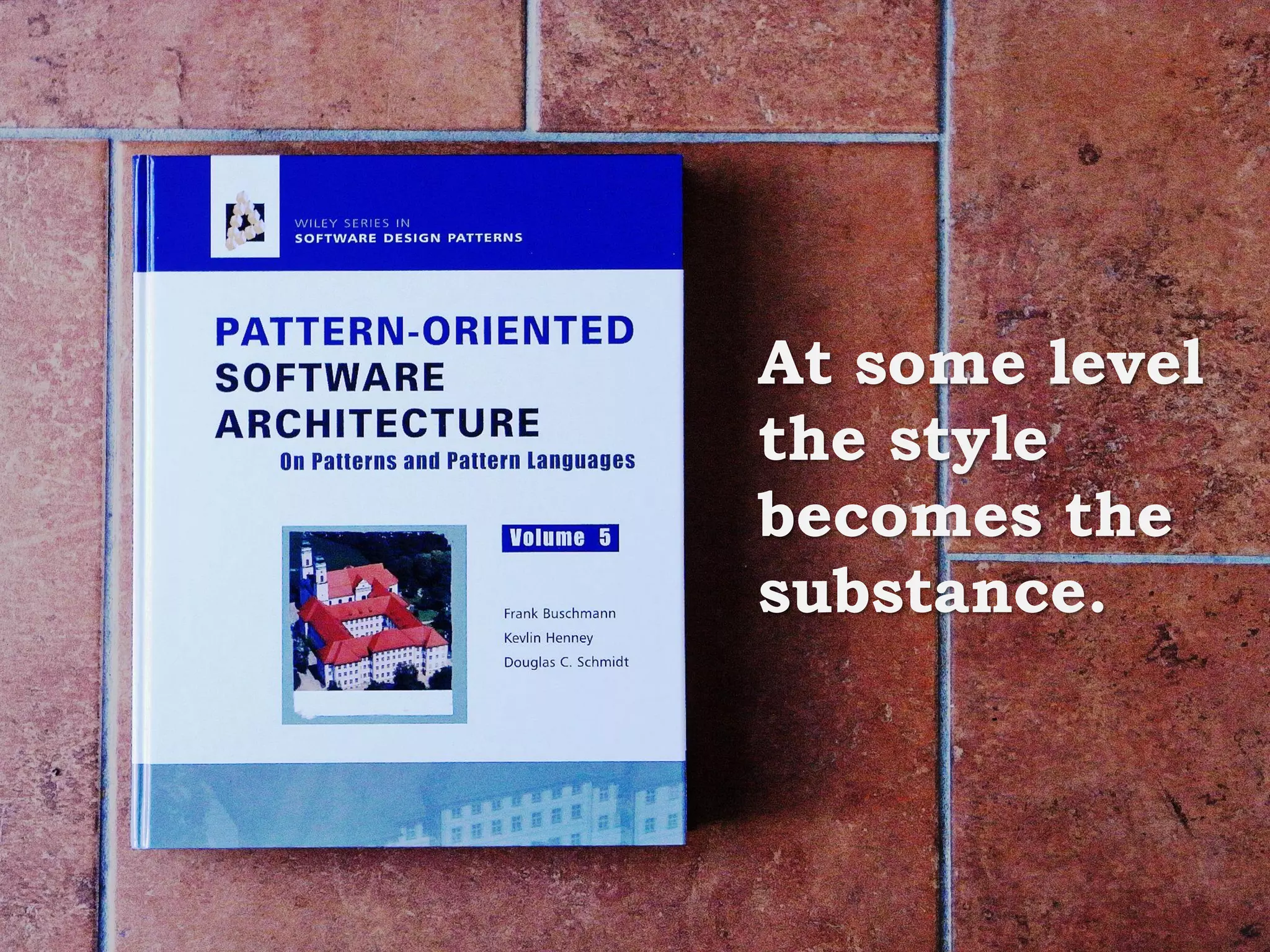
At some level the style becomes the substance.

Seven Ineffective Coding Habits of Many Programmers

  • 1.
    Seven Ineffective CodingHabits of Many Programmers @KevlinHenney
  • 5.
    It turns outthat style matters in programming for the same reason that it matters in writing. It makes for better reading. Douglas Crockford JavaScript: The Good Parts
  • 7.
  • 8.
    Signal-to-noise ratio (oftenabbreviated SNR or S/N) is a measure used in science and engineering that compares the level of a desired signal to the level of background noise. Signal-to-noise ratio is sometimes used informally to refer to the ratio of useful information to false or irrelevant data in a conversation or exchange. http://en.wikipedia.org/wiki/Signal_to_noise_ratio
  • 9.
    To be, ornot to be: that is the question: Whether 'tis nobler in the mind to suffer The slings and arrows of outrageous fortune, Or to take arms against a sea of troubles, And by opposing end them? William Shakespeare Hamlet
  • 10.
    Continuing existence orcessation of existence: those are the scenarios. Is it more empowering mentally to work towards an accommodation of the downsizings and negative outcomes of adversarial circumstance, or would it be a greater enhancement of the bottom line to move forwards to a challenge to our current difficulties, and, by making a commitment to opposition, to effect their demise? Tom Burton Long Words Bother Me
  • 11.
    public class RecentlyUsedList { private List<string> items; public RecentlyUsedList() { items = new List<string>(); } public void Add(string newItem) { if (items.Contains(newItem)) { int position = items.IndexOf(newItem); string existingItem = items[position]; items.RemoveAt(position); items.Insert(0, existingItem); } else { items.Insert(0, newItem); } } public int Count { get { int size = items.Count; return size; } } public string this[int index] { get { int position = 0; foreach (string item in items) { if (position == index) return item; ++position; } throw new ArgumentOutOfRangeException(); } } }
  • 12.
    public class RecentlyUsedList{ private List<string> items; public RecentlyUsedList() { items = new List<string>(); } public void Add(string newItem) { if (items.Contains(newItem)) { int position = items.IndexOf(newItem); string existingItem = list[position]; items.RemoveAt(position); items.Insert(0, existingItem); } else { items.Insert(0, newItem); } } public int Count { get { int size = items.Count; return size; } } public string this[int index] { get { int position = 0; foreach (string value in items) { if (position == index) return value; ++position; } throw new ArgumentOutOfRangeException(); } } } public class RecentlyUsedList { private List<string> items = new List<string>(); public void Add(string newItem) { items.Remove(newItem); items.Add(newItem); } public int Count { get { return items.Count; } } public string this[int index] { get { return items[Count - index - 1]; } } }
  • 15.
    Comments A delicatematter, requiring taste and judgement. I tend to err on the side of eliminating comments, for several reasons. First, if the code is clear, and uses good type names and variable names, it should explain itself. Second, comments aren't checked by the compiler, so there is no guarantee they're right, especially after the code is modified. A misleading comment can be very confusing. Third, the issue of typography: comments clutter code. Rob Pike, "Notes on Programming in C"
  • 16.
    There is afamously bad comment style: i=i+1; /* Add one to i */ and there are worse ways to do it: /********************************** * * * Add one to i * * * **********************************/ i=i+1; Don't laugh now, wait until you see it in real life. Rob Pike, "Notes on Programming in C"
  • 17.
    A common fallacyis to assume authors of incomprehensible code will somehow be able to express themselves lucidly and clearly in comments. Kevlin Henney https://twitter.com/KevlinHenney/status/381021802941906944
  • 19.
  • 20.
    To be, ornot to be: that is the question: Whether 'tis nobler in the mind to suffer The slings and arrows of outrageous fortune, Or to take arms against a sea of troubles, And by opposing end them? William Shakespeare Hamlet
  • 21.
    Continuing existence orcessation of existence: those are the scenarios. Is it more empowering mentally to work towards an accommodation of the downsizings and negative outcomes of adversarial circumstance, or would it be a greater enhancement of the bottom line to move forwards to a challenge to our current difficulties, and, by making a commitment to opposition, to effect their demise? Tom Burton Long Words Bother Me
  • 22.
    Continuing existence orcessation of existence: those are the more empowering to work towards accommodation downsizings outcomes of circumstance, a greater enhancement the bottom line forwards to a our current difficulties, by making a opposition, to demise?
  • 23.
    How many programmerslay out their code Column 80
  • 24.
  • 25.
    To answer thequestion "What is clean design?" most succinctly: a clean design is one that supports visual thinking so people can meet their informational needs with a minimum of conscious effort. Daniel Higginbotham ∙ "Clean Up Your Mess — A Guide to Visual Design for Everyone" ∙ http://www.visualmess.com/
  • 26.
    You convey informationby the way you arrange a design's elements in relation to each other. This information is understood immediately, if not consciously, by the people viewing your designs. Daniel Higginbotham ∙ "Clean Up Your Mess — A Guide to Visual Design for Everyone" ∙ http://www.visualmess.com/
  • 27.
    This is greatif the visual relationships are obvious and accurate, but if they're not, your audience is going to get confused. They'll have to examine your work carefully, going back and forth between the different parts to make sure they understand. Daniel Higginbotham ∙ "Clean Up Your Mess — A Guide to Visual Design for Everyone" ∙ http://www.visualmess.com/
  • 28.
    public int howNotToLayoutAMethodHeader(intfirstArgument, String secondArgument) public int ensureArgumentsAreAlignedLikeThis( int firstArgument, String secondArgument) public int orEnsureArgumentsAreGroupedLikeThis( int firstArgument, String secondArgument) public int butNotAlignedLikeThis(int firstArgument, String secondArgument)
  • 29.
    int doNotFormat =likeThis(someArgumentOrExpression, anotherArgumentOrExpression); int insteadFormat = somethingLikeThis( someArgumentOrExpression, anotherArgumentOrExpression); int orFormat = somethingLikeThis( someArgumentOrExpression, anotherArgumentOrExpression);
  • 30.
    int asItIs =unstable(someArgumentOrExpression, anotherArgumentOrExpression); int butThisIs = stable( someArgumentOrExpression, anotherArgumentOrExpression); int andThisIs = stable( someArgumentOrExpression, anotherArgumentOrExpression);
  • 31.
    public ResultType arbitraryMethodName(FirstArgumentTypefirstArgument, SecondArgumentType secondArgument, ThirdArgumentType thirdArgument) LocalVariableType localVariable = method(firstArgument, secondArgument); if (localVariable.isSomething(thirdArgument, SOME_SHOUTY_CONSTANT)) { doSomethingWith(localVariable); } return localVariable.getSomething(); }
  • 32.
    public ResultType arbitraryMethodName( FirstArgumentType firstArgument, SecondArgumentType secondArgument, ThirdArgumentType thirdArgument) { LocalVariableType localVariable = method(firstArgument, secondArgument); if (localVariable.isSomething( thirdArgument, SOME_SHOUTY_CONSTANT)) { doSomething(localVariable); } return localVariable.getSomething(); }
  • 33.
    XXXXXX XXXXXXXXXX XXXXXXXXXXXXXXXXXXX XXXXXXXXXXXXXXXXX XXXXXXXXXXXXX XXXXXXXXXXXXXXXXXX XXXXXXXXXXXXXX XXXXXXXXXXXXXXXXX XXXXXXXXXXXXX XXXXXXXXXXXXXXXXX XXXXXXXXXXXXX XXXXXX XXXXXXXXXXXXX XXXXXXXXXXXXXX XX XXXXXXXXXXXXX XXXXXXXXXXX XXXXXXXXXXXXX XXXXXXXXXXXXXXXXXXXX XXXXXXXXXXX XXXXXXXXXXXXX XXXXXX XXXXXXXXXXXXX XXXXXXXXXXXX
  • 34.
    public ResultType arbitraryMethodName( FirstArgumentType firstArgument, SecondArgumentType secondArgument, ThirdArgumentType thirdArgument) { LocalVariableType localVariable = method(firstArgument, secondArgument); if (localVariable.isSomething( thirdArgument, SOME_SHOUTY_CONSTANT)) { doSomething(localVariable); } return localVariable.getSomething(); }
  • 35.
    XXXXXX XXXXXXXXXX XXXXXXXXXXXXXXXXXXX XXXXXXXXXXXXXXXXX XXXXXXXXXXXXX XXXXXXXXXXXXXXXXXX XXXXXXXXXXXXXX XXXXXXXXXXXXXXXXX XXXXXXXXXXXXX XXXXXXXXXXXXXXXXX XXXXXXXXXXXXX XXXXXX XXXXXXXXXXXXX XXXXXXXXXXXXXX XX XXXXXXXXXXXXX XXXXXXXXXXX XXXXXXXXXXXXX XXXXXXXXXXXXXXXXXXXX XXXXXXXXXXX XXXXXXXXXXXXX XXXXXX XXXXXXXXXXXXX XXXXXXXXXXXX
  • 36.
    public ResultType arbitraryMethodName( FirstArgumentType firstArgument, SecondArgumentType secondArgument, ThirdArgumentType thirdArgument) { LocalVariableType localVariable = method(firstArgument, secondArgument); if (localVariable.isSomething( thirdArgument, SOME_SHOUTY_CONSTANT)) { doSomething(localVariable); } return localVariable.getSomething(); }
  • 37.
    XXXXXX XXXXXXXXXX XXXXXXXXXXXXXXXXXXX XXXXXXXXXXXXXXXXX XXXXXXXXXXXXX XXXXXXXXXXXXXXXXXX XXXXXXXXXXXXXX XXXXXXXXXXXXXXXXX XXXXXXXXXXXXX XXXXXXXXXXXXXXXXX XXXXXXXXXXXXX XXXXXX XXXXXXXXXXXXX XXXXXXXXXXXXXX XX XXXXXXXXXXXXX XXXXXXXXXXX XXXXXXXXXXXXX XXXXXXXXXXXXXXXXXXXX XXXXXXXXXXX XXXXXXXXXXXXX XXXXXX XXXXXXXXXXXXX XXXXXXXXXXXX
  • 39.
  • 40.
    Agglutination is aprocess in linguistic morphology derivation in which complex words are formed by stringing together morphemes, each with a single grammatical or semantic meaning. Languages that use agglutination widely are called agglutinative languages. http://en.wikipedia.org/wiki/Agglutination
  • 41.
  • 43.
    Proxy validate Service Value get create Manager check Controller set Factory Object do enable process disable Exception add remove
  • 44.
    public interface ConditionChecker{ boolean checkCondition(); }
  • 45.
    public interface Condition { boolean isTrue(); }
  • 46.
    public Connection createConnection(Provider...) throws ConnectionFailureException ...
  • 47.
    public Connection connectTo(Provider...) throws ConnectionFailure ...
  • 48.
    ClassNotFoundException EnumConstantNotPresentException IllegalArgumentException IllegalAccessException IndexOutOfBoundsException NegativeArraySizeException NoSuchMethodException TypeNotPresentException UnsupportedOperationException
  • 49.
    ClassNotFound EnumConstantNotPresent IllegalArgument IllegalAccess IndexOutOfBounds NegativeArraySize NoSuchMethod TypeNotPresent UnsupportedOperation
  • 50.
    ArithmeticException ArrayStoreException ClassCastException InstantiationException NullPointerException SecurityException
  • 51.
    Arithmetic ArrayStore ClassCastInstantiation NullPointer Security
  • 52.
    IntegerDivisionByZero IllegalArrayElementType CastToNonSubclassClassCannotBeInstantiated NullDereferenced SecurityViolation
  • 53.
    Omit needless words. William Strunk and E B White The Elements of Style
  • 55.
  • 56.
  • 57.
  • 58.
    if (portfolioIdsByTraderId.get(trader.getId()) .containsKey(portfolio.getId())) { ... } Dan North, "Code in the Language of the Domain" 97 Things Every Programmer Should Know
  • 59.
    if (trader.canView(portfolio)) {... } Dan North, "Code in the Language of the Domain" 97 Things Every Programmer Should Know
  • 61.
  • 62.
    An affordance isa quality of an object, or an environment, which allows an individual to perform an action. For example, a knob affords twisting, and perhaps pushing, while a cord affords pulling. http://en.wikipedia.org/wiki/Affordance
  • 63.
    public class RecentlyUsedList { private List<string> items = new List<string>(); public List<string> Items { get { return items; } } public void Add(string newItem) { if(newItem == null) throw new ArgumentNullException(); items.Remove(newItem); items.Insert(0, newItem); } ... }
  • 64.
    public class RecentlyUsedList { private List<string> items = new List<string>(); public List<string> Items { get { return items; } } public void Add(string newItem) { if(newItem == null) throw new ArgumentNullException(); items.Remove(newItem); items.Insert(0, newItem); } ... }
  • 65.
    public class RecentlyUsedList { private List<string> items = new List<string>(); public List<string> Items { get { return items; } } public void Add(string newItem) { if(newItem == null) throw new ArgumentNullException(); items.Remove(newItem); items.Insert(0, newItem); } ... } var list = new RecentlyUsedList(); list.Add("Hello, World!"); Console.WriteLine(list.Items.Count); list.Items.Add("Hello, World!"); Console.WriteLine(list.Items.Count); list.Items.Add(null);
  • 66.
    Don't ever invitea vampire into your house, you silly boy. It renders you powerless.
  • 67.
    public class RecentlyUsedList{ private IList<string> items = new List<string>(); public int Count { get { return items.Count; } } public string this[int index] { get { return items[index]; } } public void Add(string newItem) { if(newItem == null) throw new ArgumentNullException(); items.Remove(newItem); items.Insert(0, newItem); } ... }
  • 68.
    public class RecentlyUsedList { private IList<string> items = new List<string>(); public int Count { get { return items.Count; } } public string this[int index] { get { return items[Count – index - 1]; } } public void Add(string newItem) { if(newItem == null) throw new ArgumentNullException(); items.Remove(newItem); items.Add(newItem); } ... }
  • 71.
  • 76.
    public class Moneyimplements ... { ... public int getUnits() ... public int getHundredths() ... public Currency getCurrency() ... ... public void setUnits(int newUnits) ... public void setHundredths(int newHundredths) ... public void setCurrency(Currency newCurrency) ... ... }
  • 77.
    public final classMoney implements ... { ... public int getUnits() ... public int getHundredths() ... public Currency getCurrency() ... ... }
  • 78.
    public final classMoney implements ... { ... public int units() ... public int hundredths() ... public Currency currency() ... ... }
  • 79.
    When it isnot necessary to change, it is necessary not to change. Lucius Cary
  • 81.
  • 82.
    Everybody knows thatTDD stands for Test Driven Development. However, people too often concentrate on the words "Test" and "Development" and don't consider what the word "Driven" really implies. For tests to drive development they must do more than just test that code performs its required functionality: they must clearly express that required functionality to the reader. That is, they must be clear specifications of the required functionality. Tests that are not written with their role as specifications in mind can be very confusing to read. Nat Pryce and Steve Freeman "Are Your Tests Really Driving Your Development?"
  • 83.
    public class RecentlyUsedList { ... public RecentlyUsedList() ... public int Count { get... } public string this[int index] { get... } public void Add(string newItem) ... ... }
  • 84.
    [TestFixture] public classRecentlyUsedListTests { [Test] public void TestConstructor() ... [Test] public void TestCountGet() ... [Test] public void TestIndexerGet() ... [Test] public void TestAdd() ... ... }
  • 85.
    method test test test method method test test
  • 86.
    namespace RecentlyUsedList_spec { [TestFixture] public class A_new_list { [Test] public void Is_empty()  } [TestFixture] public class An_empty_list { [Test] public void Retains_a_single_addition()  [Test] public void Retains_unique_additions_in_stack_order()  } [TestFixture] public class A_non_empty_list { [Test] public void Is_unchanged_when_head_item_is_readded()  [Test] public void Moves_non_head_item_to_head_when_it_is_readded()  } [TestFixture] public class Any_list_rejects { [Test] public void Addition_of_null_items()  [Test] public void Indexing_past_its_end()  [Test] public void Negative_indexing()  } }
  • 87.
    namespace RecentlyUsedList_spec { [TestFixture] public class A_new_list { [Test] public void Is_empty()  } [TestFixture] public class An_empty_list { [Test] public void Retains_a_single_addition()  [Test] public void Retains_unique_additions_in_stack_order()  } [TestFixture] public class A_non_empty_list { [Test] public void Is_unchanged_when_head_item_is_readded()  [Test] public void Moves_non_head_item_to_head_when_it_is_readded()  } [TestFixture] public class Any_list_rejects { [Test] public void Addition_of_null_items()  [Test] public void Indexing_past_its_end()  [Test] public void Negative_indexing()  } }
  • 88.
    A test caseshould be just that: it should correspond to a single case.
  • 89.
    At some levelthe style becomes the substance.