@NSilnitsky
@NSilnitsky
How to successfully manage a ZIO Fiber
How to successfully manage a
ZIO Fiber’s lifecycle
Natan Silnitsky Backend Infra TL, Wix.com
natansil.com twitter@NSilnitsky linkedin/natansilnitsky github.com/natansil
@NSilnitsky
How to successfully manage a ZIO Fiber
>200 Million registered users from 190 countries
Agenda 1. What’s a Fiber?
2. Handling unexpected failure
3. Interrupt a Fiber
4. Monitoring Fibers state
How to successfully manage a ZIO Fiber
@NSilnitsky
What’s a Fiber?
01
What’s a Fiber?
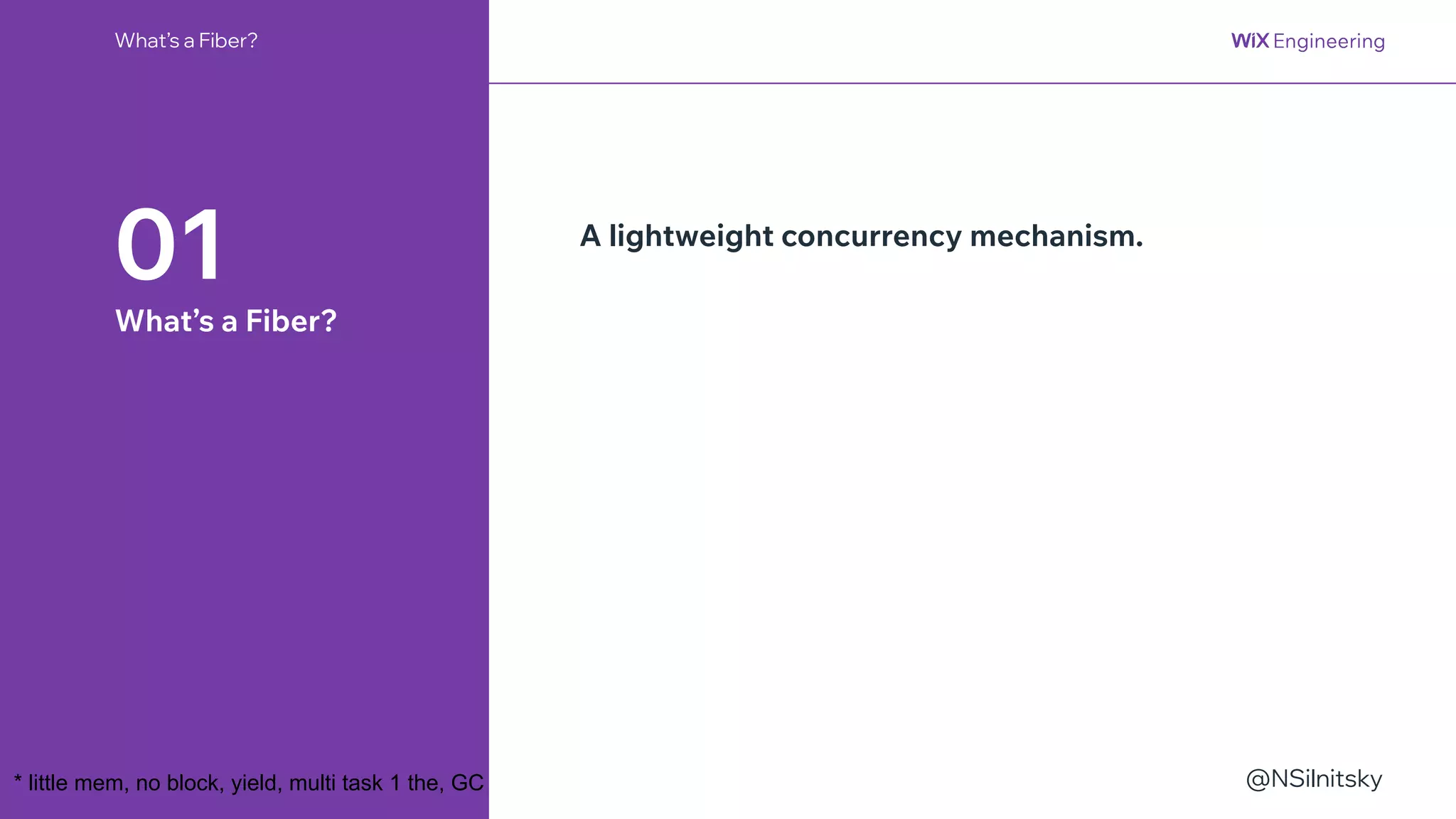
A lightweight concurrency mechanism.
* little mem, no block, yield, multi task 1 the, GC
@NSilnitsky
object WhatIsAFiber extends App {
override def run(args: List[String]): URIO[zio.ZEnv,
ExitCode] =
for {
fiber <- runSomething().fork
_ <- runSomethingElse()
_ <- fiber.join
} yield ExitCode(0)
}
What’s a Fiber?
Fork
Join
@NSilnitsky
What’s a Fiber?
01
What’s a Fiber
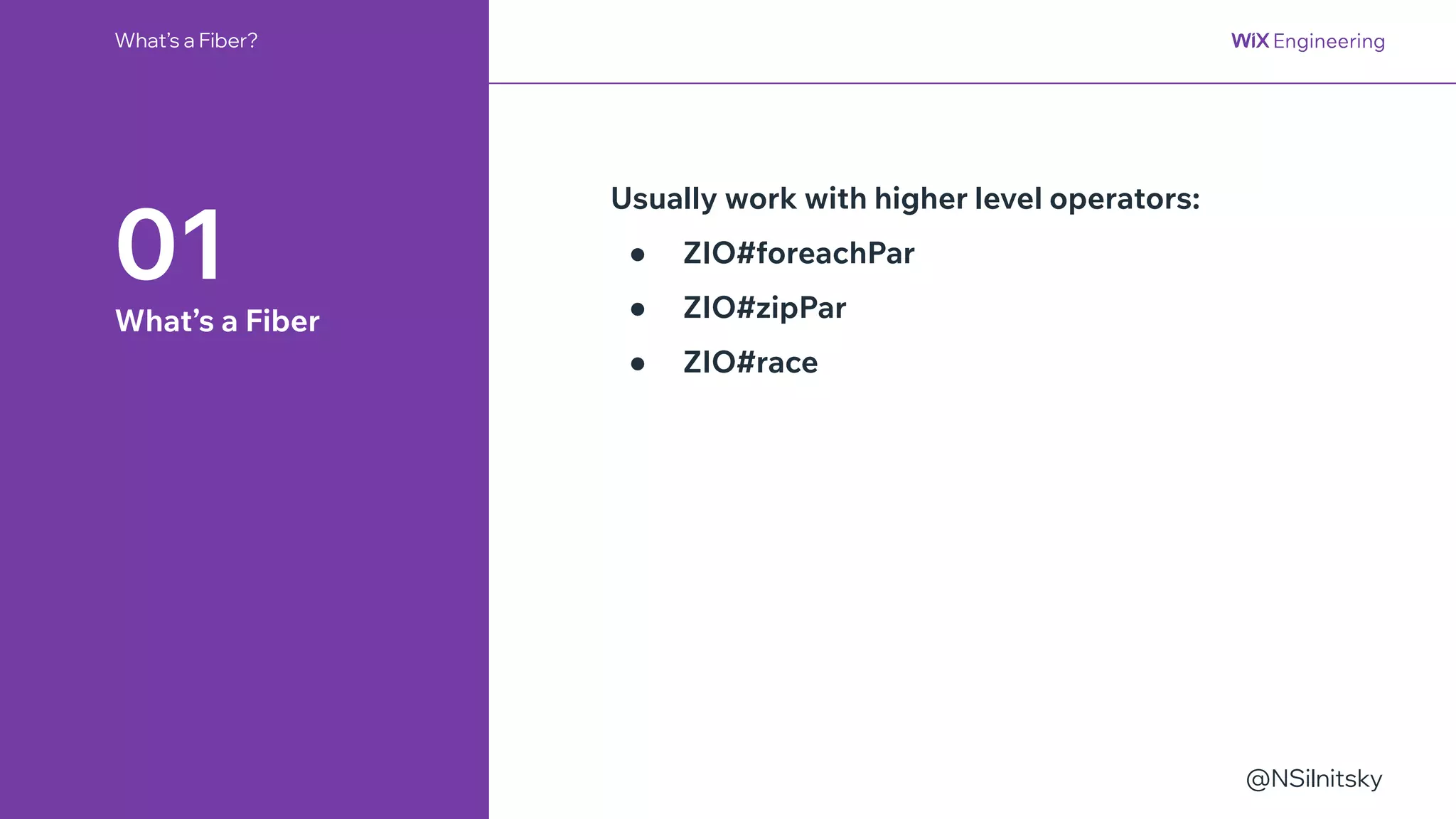
Usually work with higher level operators:
● ZIO#foreachPar
● ZIO#zipPar
● ZIO#race
@NSilnitsky
object WhatIsAFiber extends App {
override def run(args: List[String]): URIO[zio.ZEnv,
ExitCode] =
for {
fiber <- runSomething().forkDaemon
_ <- runSomethingElse()
_ <- fiber.join
} yield ExitCode(0)
}
What’s a
Fiber
What’s a Fiber?
M
Main
Fiber
B
A
Fork
A1 A2 B1
M2
Fork
Daemon
Fork
@NSilnitsky
object WhatIsAFiber extends App {
override def run(args: List[String]): URIO[zio.ZEnv,
ExitCode] =
for {
fiber <- runSomething().forkDaemon
_ <- runSomethingElse()
_ <- fiber.join
} yield ExitCode(0)
}
What’s a
Fiber
What’s a Fiber?
Main
Fiber
B
A
Fork
A1 A2 B1
Fork
M2
M
Fork
Daemon
@NSilnitsky
object WhatIsAFiber extends App {
override def run(args: List[String]): URIO[zio.ZEnv,
ExitCode] =
for {
fiber <- runSomething().forkDaemon
_ <- runSomethingElse()
_ <- fiber.join
} yield ExitCode(0)
}
What’s a
Fiber
What’s a Fiber?
Main
Fiber
B
A
Fork
A1 A2 B1
Fork
M M2
Fork
Daemon
@NSilnitsky
Handling unexpected failures
Make sure the job continues to run periodically
even when an unexpected error occurs
→
02
Handling
unexpected
failures
* imagine - periodic, update state
@NSilnitsky
object DefectNotHandledExample extends App {
import zio._
import zio.duration._
override def run(args: List[String]): URIO[zio.ZEnv, ExitCode] =
for {
_ <- runSomePeriodicJob
.catchAll(e => console.putStrLn(s"job failed with $e"))
.repeat(Schedule.spaced(1.seconds))
.forkDaemon
_ <- console.putStrLn("do other stuff")
.repeat(Schedule.spaced(1.seconds))
} yield ExitCode(0)
private def runSomePeriodicJob = {
ZIO.succeed(throw new RuntimeException("unexpected defect")) *> ZIO.effect(println("running job..."))
}
}
Death of a Fiber
@NSilnitsky
object DefectNotHandledExample extends App {
...
override def run(args: List[String]): URIO[zio.ZEnv, ExitCode] =
for {
_ <- runSomePeriodicJob
.catchAll(e => console.putStrLn(s"job failed with $e"))
.repeat(Schedule.spaced(1.seconds))
.forkDaemon
_ <- console.putStrLn("do other stuff")
.repeat(Schedule.spaced(1.seconds))
} yield ExitCode(0)
private def runSomePeriodicJob = {
ZIO.succeed(throw new RuntimeException("unexpected defect")) *>
ZIO.effect(println("running job..."))
}
}
Death of a Fiber
@NSilnitsky
@NSilnitsky
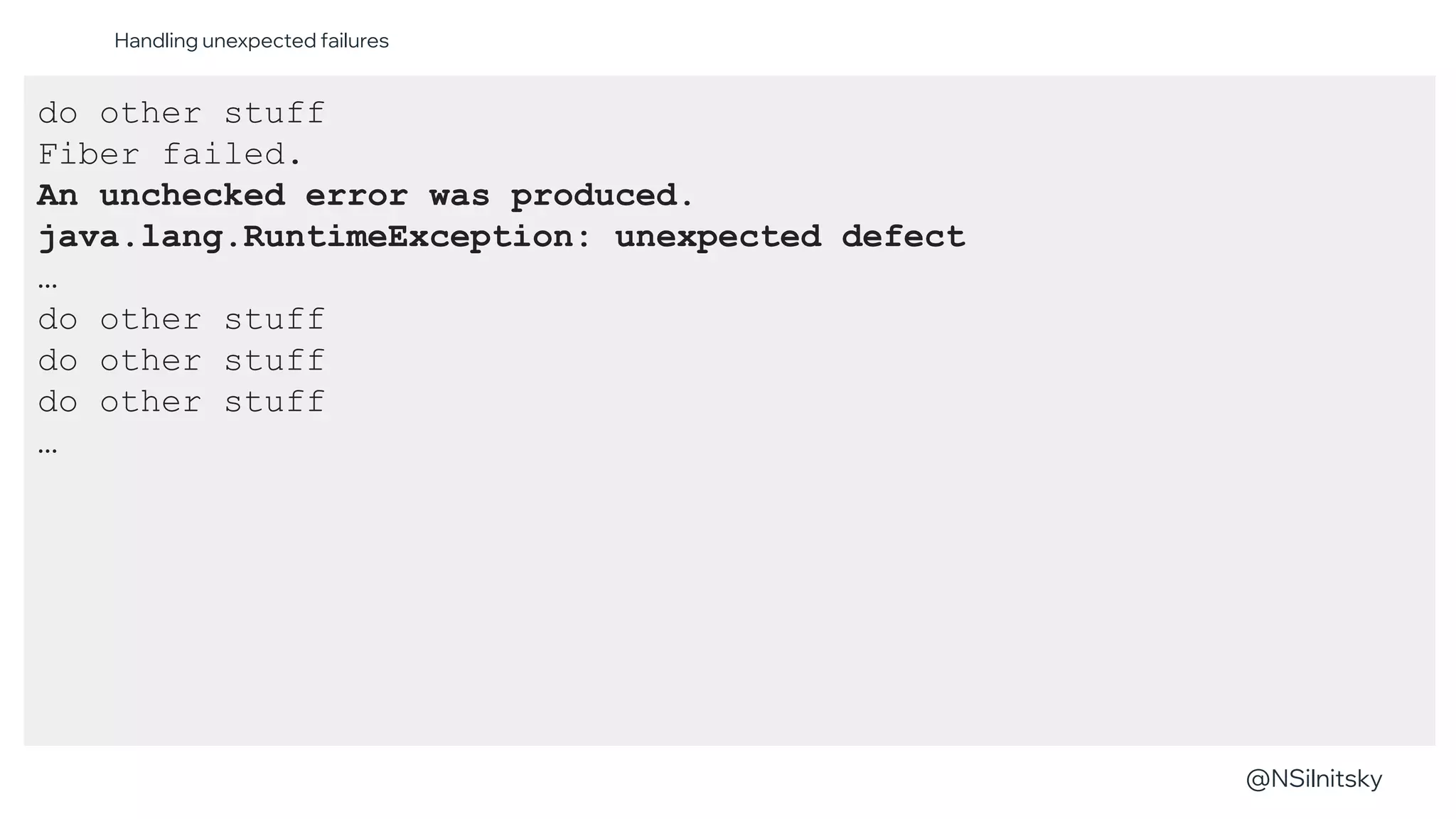
do other stuff
Fiber failed.
An unchecked error was produced.
java.lang.RuntimeException: unexpected defect
…
do other stuff
do other stuff
do other stuff
…
Handling unexpected failures
@NSilnitsky
Handling unexpected failures
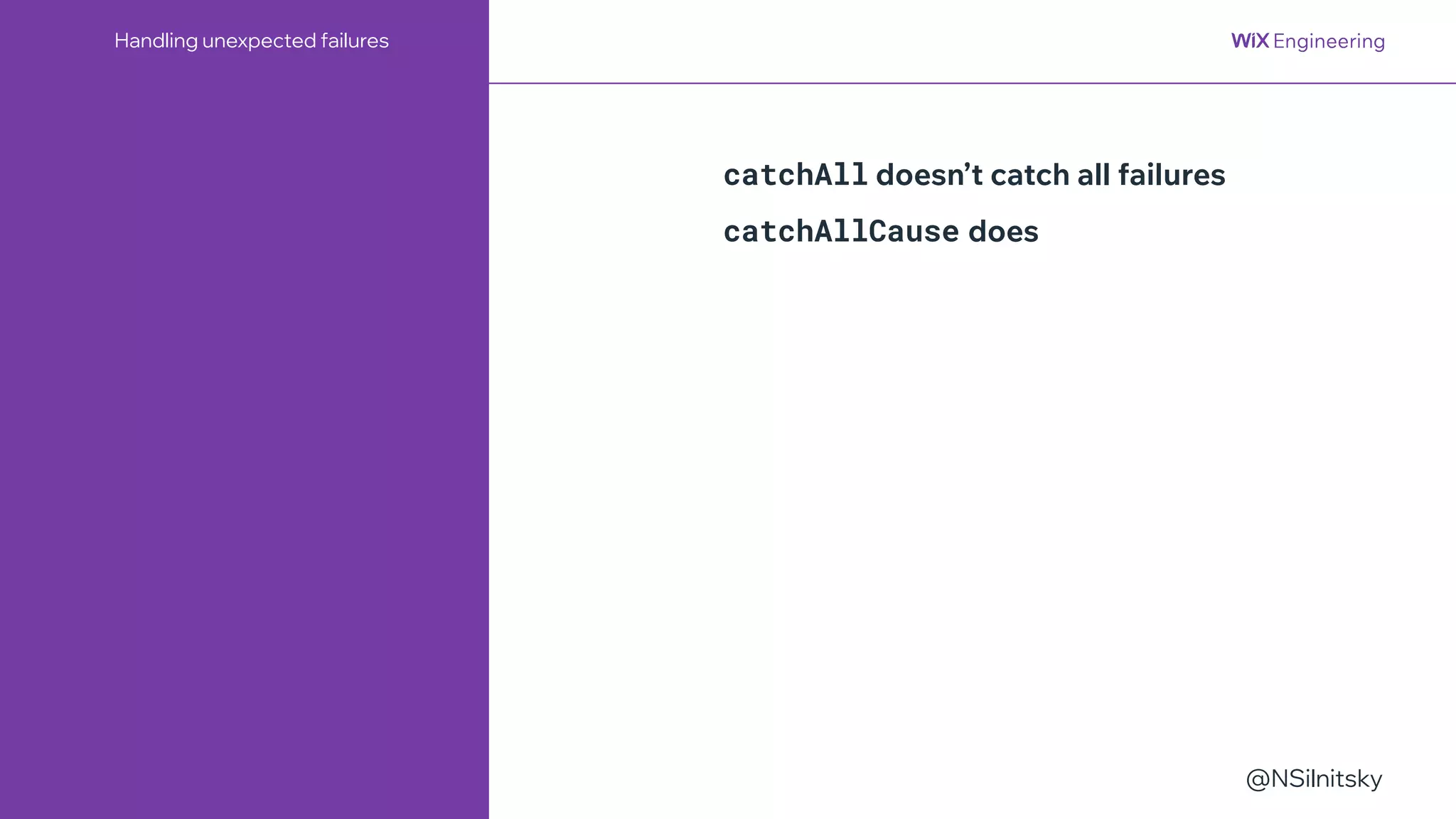
catchAll doesn’t catch all failures
catchAllCause does
@NSilnitsky
Handling unexpected failures
catchAll doesn’t catch all failures
catchAllCause does
The E type of ZIO[R, E, A] refers only to expected
failures.
Cause[E] is a description of a full story of failure.
Cause can be either Fail[+E](value: E), Die(value:
Throwable), or Interrupt(fiberId: Fiber.Id)
@NSilnitsky
object DefectNotHandledExample extends App {
...
override def run(args: List[String]): URIO[zio.ZEnv, ExitCode] =
for {
_ <- runSomePeriodicJob
.catchAllCause(cause => console.putStrLn(s"job failed with $cause"))
.repeat(Schedule.spaced(1.seconds))
.forkDaemon
_ <- console.putStrLn("do other stuff")
.repeat(Schedule.spaced(1.seconds))
} yield ExitCode(0)
private def runSomePeriodicJob = {
ZIO.succeed(throw new RuntimeException("unexpected defect")) *>
ZIO.effect(println("running job..."))
}
}
Death of a Fiber
@NSilnitsky
@NSilnitsky
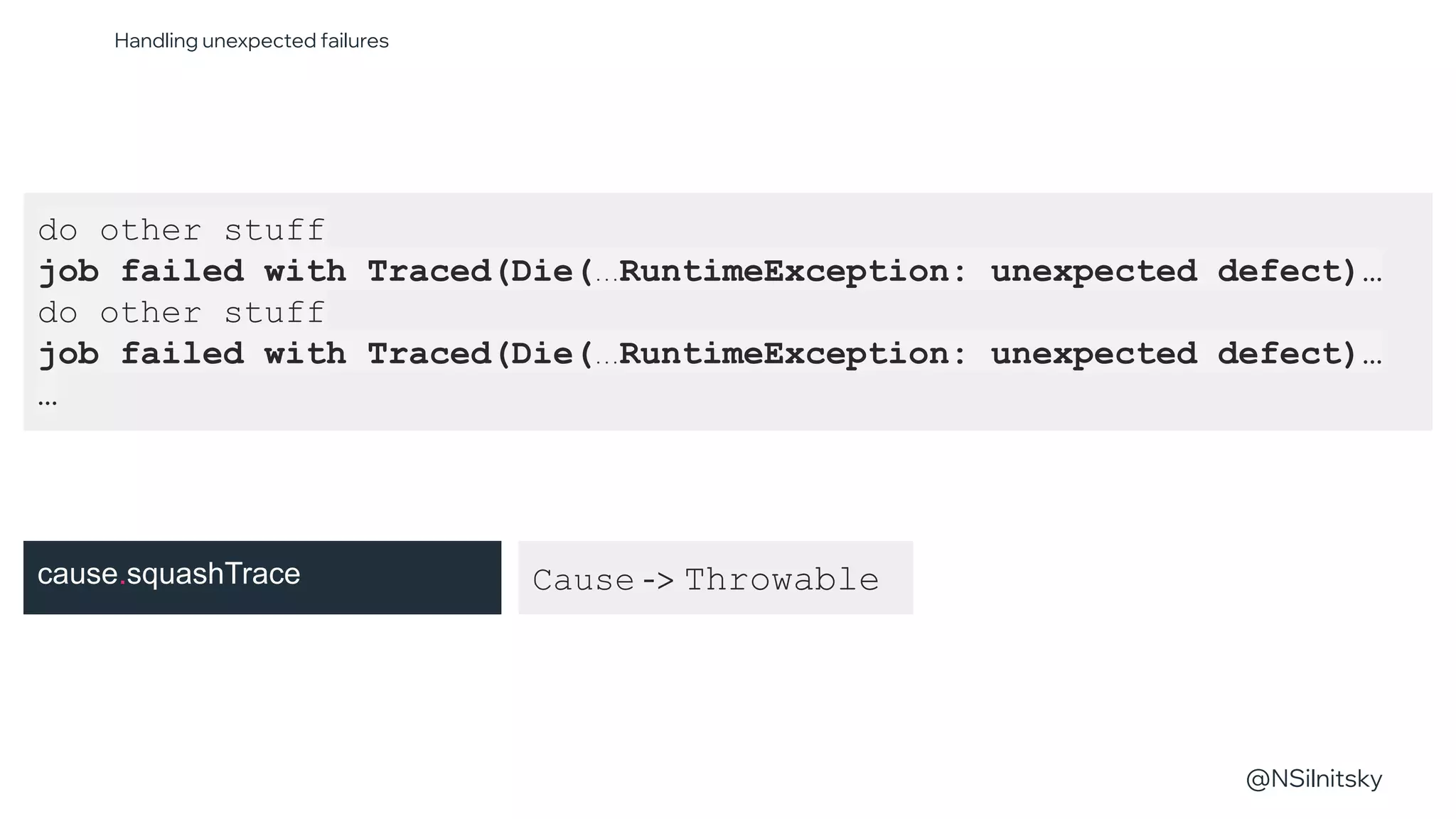
do other stuff
job failed with Traced(Die(...RuntimeException: unexpected defect)…
do other stuff
job failed with Traced(Die(...RuntimeException: unexpected defect)…
…
Cause -> Throwable
Handling unexpected failures
cause.squashTrace
@NSilnitsky
runtime.mapPlatform(_.withReportFailure(_ => [report unexpected failure]))
Handling unexpected
failures
* monitoring service
@NSilnitsky
Interrupt a Fiber
03
Interrupt a Fiber
There are certain situations where interrupting
a fiber is required.
Releasing a managed resource, that forked a
fiber, when it was acquired.
@NSilnitsky
object InterruptExample extends App {
...
override def run(args: List[String]): URIO[zio.ZEnv, ExitCode] =
for {
fiber <- runSomeLongJob
.ensuring(printWithTime("finalizing job!"))
.forkDaemon
_ <- printWithTime("do stuff").repeat(Schedule.spaced(1.seconds) && Schedule.recurs(2))
_ <- fiber.interrupt
_ <- printWithTime("do other stuff").repeat(Schedule.spaced(1.seconds))
} yield ExitCode(0)
private def runSomeLongJob = {
printWithTime("long running job...") *> clock.sleep(100.seconds)
}
}
Interrupt a Fiber
@NSilnitsky
object InterruptExample extends App {
...
override def run(args: List[String]): URIO[zio.ZEnv, ExitCode] =
for {
fiber <- runSomeLongJob
.ensuring(printWithTime("finalizing job!"))
.forkDaemon
_ <- printWithTime("do stuff").repeat(Schedule.spaced(1.seconds) && Schedule.recurs(2))
_ <- fiber.interrupt
_ <- printWithTime("do other stuff").repeat(Schedule.spaced(1.seconds))
} yield ExitCode(0)
private def runSomeLongJob = {
printWithTime("long running job...") *> clock.sleep(100.seconds)
}
}
Interrupt a Fiber
@NSilnitsky
@NSilnitsky
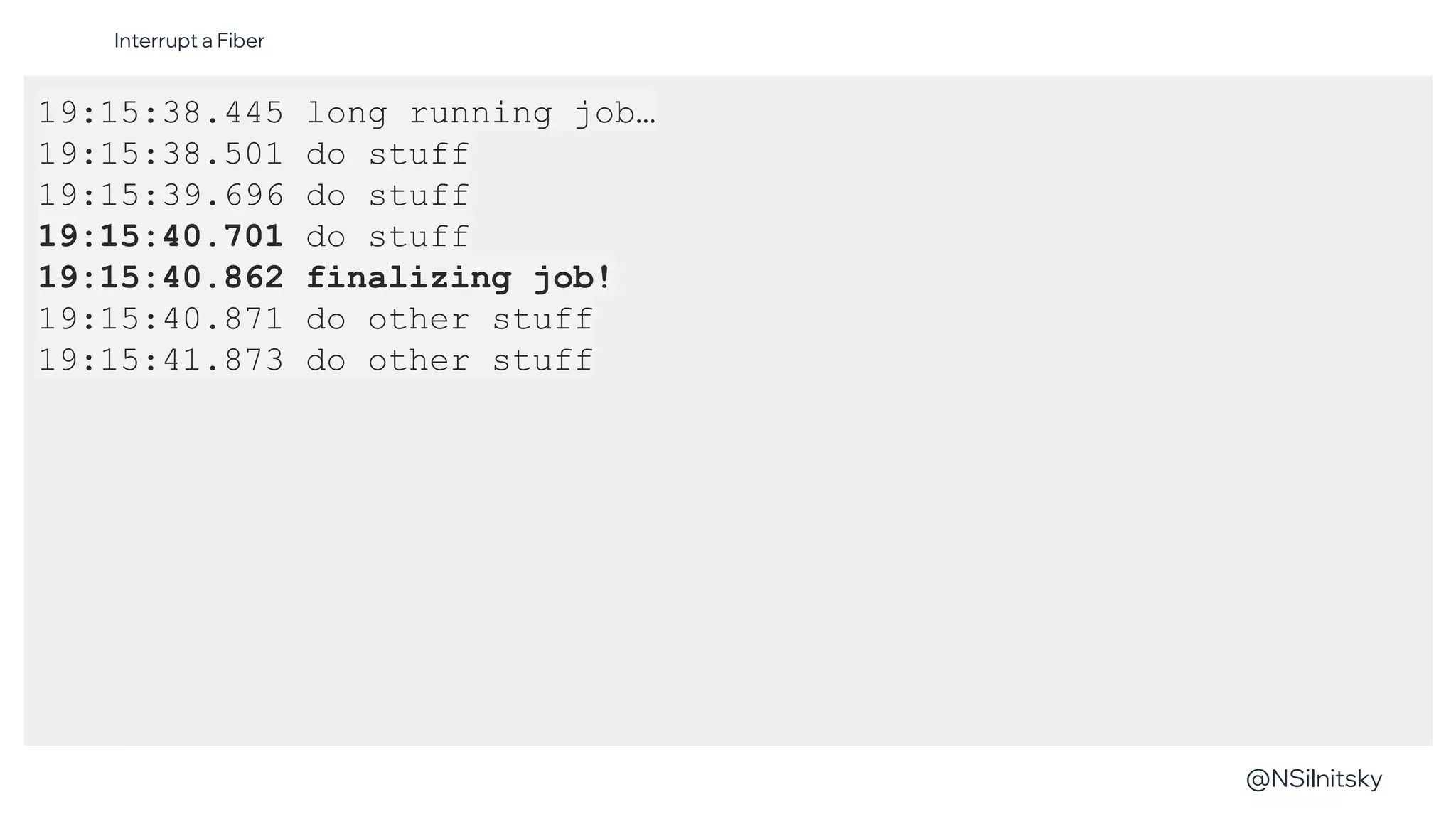
19:15:38.445 long running job…
19:15:38.501 do stuff
19:15:39.696 do stuff
19:15:40.701 do stuff
19:15:40.862 finalizing job!
19:15:40.871 do other stuff
19:15:41.873 do other stuff
Interrupt a Fiber
@NSilnitsky
override def run(args: List[String]): URIO[zio.ZEnv, ExitCode] =
for {
fiber <- runSomeLongJob
.ensuring(printWithTime("finalizing job!"))
.forkDaemon
_ <- printWithTime("do stuff").repeat(Schedule.spaced(1.seconds) && Schedule.recurs(2))
timeout <- fiber.join.resurrect.ignore.disconnect.timeout(5.seconds)
_ <- ZIO.when(timeout.isEmpty)(fiber.interruptFork)
_ <- printWithTime("do other stuff").repeat(Schedule.spaced(1.seconds))
} yield ExitCode(0)
Graceful
Termination
@NSilnitsky
override def run(args: List[String]): URIO[zio.ZEnv, ExitCode] =
for {
fiber <- runSomeLongJob
.ensuring(printWithTime("finalizing job!"))
.forkDaemon
_ <- printWithTime("do stuff").repeat(Schedule.spaced(1.seconds) && Schedule.recurs(2))
timeout <- fiber.join.resurrect.ignore.disconnect.timeout(5.seconds)
_ <- ZIO.when(timeout.isEmpty)(fiber.interruptFork)
_ <- printWithTime("do other stuff").repeat(Schedule.spaced(1.seconds))
} yield ExitCode(0)
Graceful
Termination
@NSilnitsky
override def run(args: List[String]): URIO[zio.ZEnv, ExitCode] =
for {
fiber <- runSomeLongJob
.ensuring(printWithTime("finalizing job!"))
.forkDaemon
_ <- printWithTime("do stuff").repeat(Schedule.spaced(1.seconds) && Schedule.recurs(2))
timeout <- fiber.join.resurrect.ignore.disconnect.timeout(5.seconds)
_ <- ZIO.when(timeout.isEmpty)(fiber.interruptFork)
_ <- printWithTime("do other stuff").repeat(Schedule.spaced(1.seconds))
} yield ExitCode(0)
Graceful
Termination
@NSilnitsky
@NSilnitsky
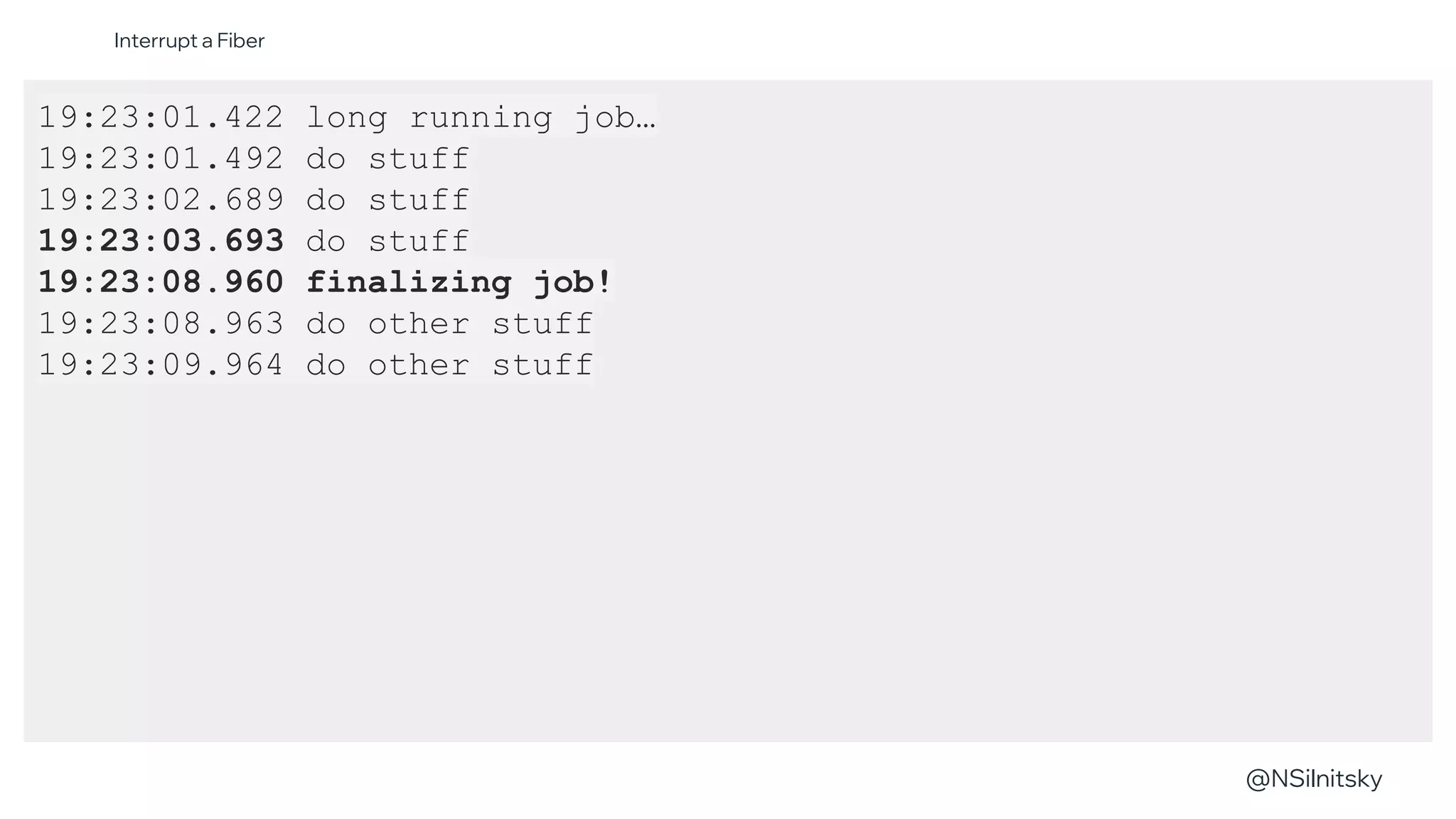
19:23:01.422 long running job…
19:23:01.492 do stuff
19:23:02.689 do stuff
19:23:03.693 do stuff
19:23:08.960 finalizing job!
19:23:08.963 do other stuff
19:23:09.964 do other stuff
Interrupt a Fiber
@NSilnitsky
Monitoring Fiber state
04
Monitoring Fiber
state
Good old Java thread dumps don’t give you
interesting information when it comes to ZIO apps
ZIO fiber dumps can give you stack traces...
@NSilnitsky
@NSilnitsky
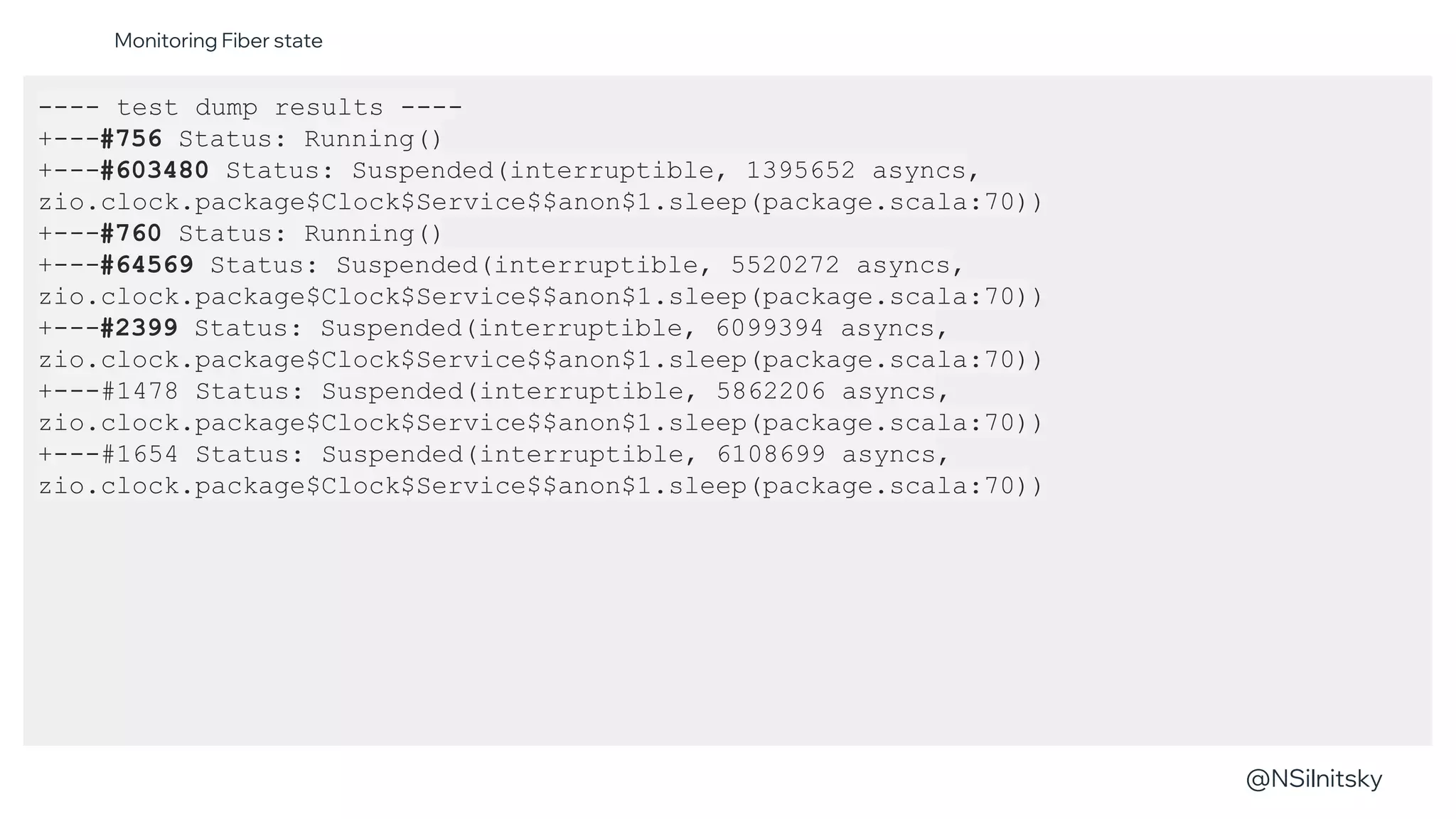
---- test dump results ----
+---#756 Status: Running()
+---#603480 Status: Suspended(interruptible, 1395652 asyncs,
zio.clock.package$Clock$Service$$anon$1.sleep(package.scala:70))
+---#760 Status: Running()
+---#64569 Status: Suspended(interruptible, 5520272 asyncs,
zio.clock.package$Clock$Service$$anon$1.sleep(package.scala:70))
+---#2399 Status: Suspended(interruptible, 6099394 asyncs,
zio.clock.package$Clock$Service$$anon$1.sleep(package.scala:70))
+---#1478 Status: Suspended(interruptible, 5862206 asyncs,
zio.clock.package$Clock$Service$$anon$1.sleep(package.scala:70))
+---#1654 Status: Suspended(interruptible, 6108699 asyncs,
zio.clock.package$Clock$Service$$anon$1.sleep(package.scala:70))
Monitoring Fiber state
@NSilnitsky
@NSilnitsky
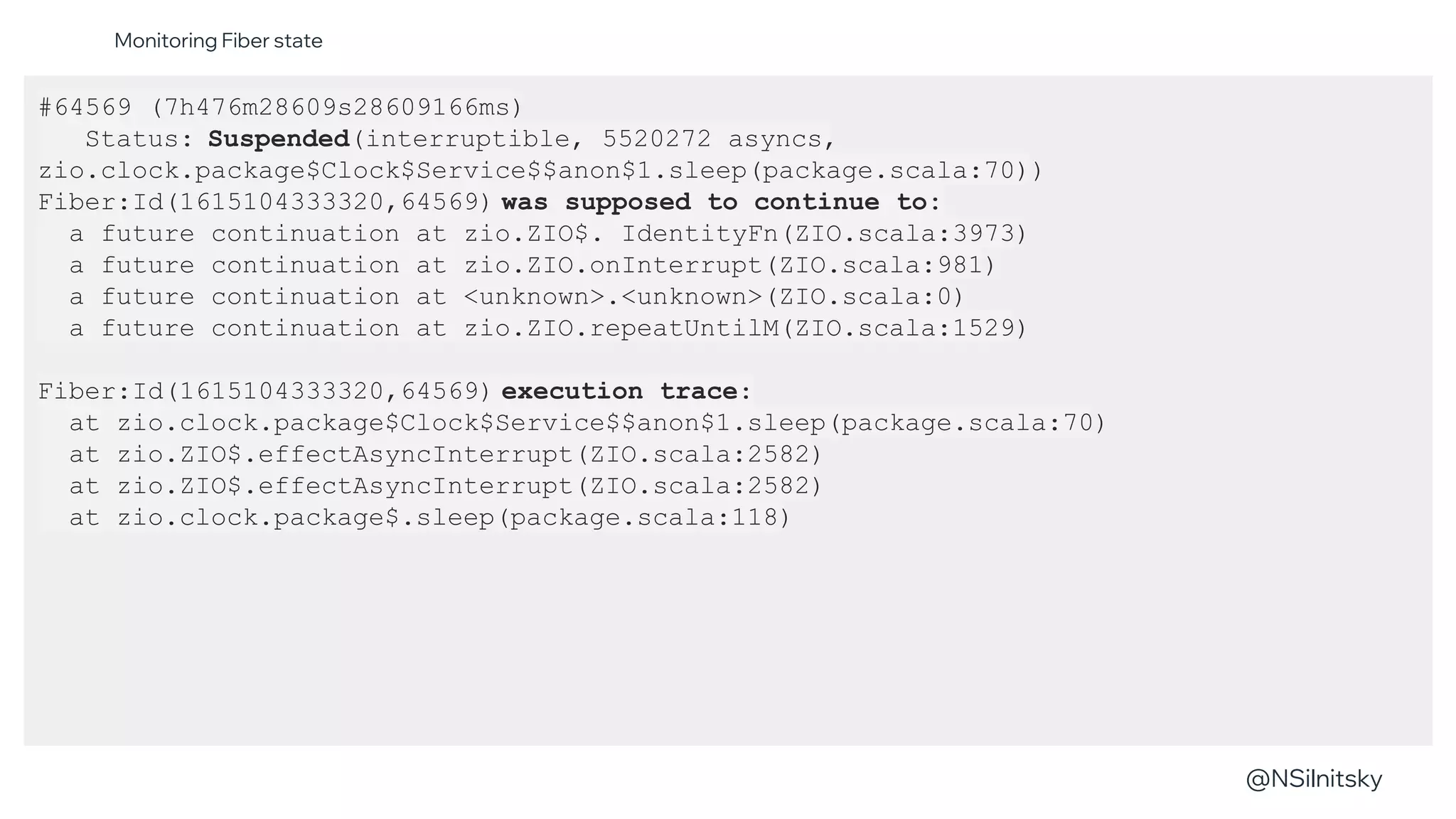
#64569 (7h476m28609s28609166ms)
Status: Suspended(interruptible, 5520272 asyncs,
zio.clock.package$Clock$Service$$anon$1.sleep(package.scala:70))
Fiber:Id(1615104333320,64569) was supposed to continue to:
a future continuation at zio.ZIO$._IdentityFn(ZIO.scala:3973)
a future continuation at zio.ZIO.onInterrupt(ZIO.scala:981)
a future continuation at <unknown>.<unknown>(ZIO.scala:0)
a future continuation at zio.ZIO.repeatUntilM(ZIO.scala:1529)
Fiber:Id(1615104333320,64569) execution trace:
at zio.clock.package$Clock$Service$$anon$1.sleep(package.scala:70)
at zio.ZIO$.effectAsyncInterrupt(ZIO.scala:2582)
at zio.clock.package$.sleep(package.scala:118)
Monitoring Fiber state
@NSilnitsky
ZIO-ZMX
val diagnosticsLayer: ZLayer[ZEnv, Throwable, Diagnostics] =
Diagnostics.live(“localhost”, 1111)
val runtime: Runtime[ZEnv] =
Runtime.default.mapPlatform(_.withSupervisor(ZMXSupervisor))
Monitoring Fibers
state
@NSilnitsky
Or roll your own...
object RuntimeOps {
implicit class RuntimeEnvOps[R <: Has[_]](val runtime: zio.Runtime[R]) extends AnyVal {
def withFiberTracking(implicit tag: zio.Tag[R]): zio.Runtime[R with FiberTracking] = {
val supervisor = runtime.unsafeRunTask(Supervisor.track(weak = false))
runtime
.mapPlatform(_.withSupervisor(supervisor))
.map(_.union[FiberTracking](FiberTracking.make(supervisor)))
}
}
}
Monitoring Fibers
state
Summary
1. What’s a Fiber
2. Handling unexpected failure
3. Interrupt a Fiber
4. Monitoring Fiber state
How to successfully manage a ZIO Fiber
2. catchAllCause, ensuring, withReportFailure
4. Supervisor, fiber dumps
3. resurrect, interruptFork and disconnect
@NSilnitsky
https://medium.com/wix-engineering/how-to-successfully-manage-a-zi
o-fibers-lifecycle-96fe9c4ecd06
The blog post
How to successfully manage a ZIO Fiber
@NSilnitsky
A Scala ZIO high-level functional SDK for Apache Kafka.
github.com/wix/greyhound
How to successfully manage a ZIO Fiber
0.2 is out!
@NSilnitsky
@NSilnitsky
Thank
You!
natansil.com twitter@NSilnitsky linkedin/natansilnitsky github.com/natansil
👉 slideshare.net/NatanSilnitsky
Any questions?
How to successfully manage a ZIO Fiber
@NSilnitsky
@NSilnitsky
Q&A
natansil.com twitter@NSilnitsky linkedin/natansilnitsky github.com/natansil
👉 slideshare.net/NatanSilnitsky
Any questions?
How to successfully manage a ZIO Fiber

How to successfully manage a ZIO fiber’s lifecycle - Functional Scala 2021

  • 1.
    @NSilnitsky @NSilnitsky How to successfullymanage a ZIO Fiber How to successfully manage a ZIO Fiber’s lifecycle Natan Silnitsky Backend Infra TL, Wix.com natansil.com twitter@NSilnitsky linkedin/natansilnitsky github.com/natansil
  • 2.
    @NSilnitsky How to successfullymanage a ZIO Fiber >200 Million registered users from 190 countries
  • 3.
    Agenda 1. What’sa Fiber? 2. Handling unexpected failure 3. Interrupt a Fiber 4. Monitoring Fibers state How to successfully manage a ZIO Fiber
  • 4.
    @NSilnitsky What’s a Fiber? 01 What’sa Fiber? A lightweight concurrency mechanism. * little mem, no block, yield, multi task 1 the, GC
  • 5.
    @NSilnitsky object WhatIsAFiber extendsApp { override def run(args: List[String]): URIO[zio.ZEnv, ExitCode] = for { fiber <- runSomething().fork _ <- runSomethingElse() _ <- fiber.join } yield ExitCode(0) } What’s a Fiber? Fork Join
  • 6.
    @NSilnitsky What’s a Fiber? 01 What’sa Fiber Usually work with higher level operators: ● ZIO#foreachPar ● ZIO#zipPar ● ZIO#race
  • 7.
    @NSilnitsky object WhatIsAFiber extendsApp { override def run(args: List[String]): URIO[zio.ZEnv, ExitCode] = for { fiber <- runSomething().forkDaemon _ <- runSomethingElse() _ <- fiber.join } yield ExitCode(0) } What’s a Fiber What’s a Fiber? M Main Fiber B A Fork A1 A2 B1 M2 Fork Daemon Fork
  • 8.
    @NSilnitsky object WhatIsAFiber extendsApp { override def run(args: List[String]): URIO[zio.ZEnv, ExitCode] = for { fiber <- runSomething().forkDaemon _ <- runSomethingElse() _ <- fiber.join } yield ExitCode(0) } What’s a Fiber What’s a Fiber? Main Fiber B A Fork A1 A2 B1 Fork M2 M Fork Daemon
  • 9.
    @NSilnitsky object WhatIsAFiber extendsApp { override def run(args: List[String]): URIO[zio.ZEnv, ExitCode] = for { fiber <- runSomething().forkDaemon _ <- runSomethingElse() _ <- fiber.join } yield ExitCode(0) } What’s a Fiber What’s a Fiber? Main Fiber B A Fork A1 A2 B1 Fork M M2 Fork Daemon
  • 10.
    @NSilnitsky Handling unexpected failures Makesure the job continues to run periodically even when an unexpected error occurs → 02 Handling unexpected failures * imagine - periodic, update state
  • 11.
    @NSilnitsky object DefectNotHandledExample extendsApp { import zio._ import zio.duration._ override def run(args: List[String]): URIO[zio.ZEnv, ExitCode] = for { _ <- runSomePeriodicJob .catchAll(e => console.putStrLn(s"job failed with $e")) .repeat(Schedule.spaced(1.seconds)) .forkDaemon _ <- console.putStrLn("do other stuff") .repeat(Schedule.spaced(1.seconds)) } yield ExitCode(0) private def runSomePeriodicJob = { ZIO.succeed(throw new RuntimeException("unexpected defect")) *> ZIO.effect(println("running job...")) } } Death of a Fiber
  • 12.
    @NSilnitsky object DefectNotHandledExample extendsApp { ... override def run(args: List[String]): URIO[zio.ZEnv, ExitCode] = for { _ <- runSomePeriodicJob .catchAll(e => console.putStrLn(s"job failed with $e")) .repeat(Schedule.spaced(1.seconds)) .forkDaemon _ <- console.putStrLn("do other stuff") .repeat(Schedule.spaced(1.seconds)) } yield ExitCode(0) private def runSomePeriodicJob = { ZIO.succeed(throw new RuntimeException("unexpected defect")) *> ZIO.effect(println("running job...")) } } Death of a Fiber
  • 13.
    @NSilnitsky @NSilnitsky do other stuff Fiberfailed. An unchecked error was produced. java.lang.RuntimeException: unexpected defect … do other stuff do other stuff do other stuff … Handling unexpected failures
  • 14.
    @NSilnitsky Handling unexpected failures catchAlldoesn’t catch all failures catchAllCause does
  • 15.
    @NSilnitsky Handling unexpected failures catchAlldoesn’t catch all failures catchAllCause does The E type of ZIO[R, E, A] refers only to expected failures. Cause[E] is a description of a full story of failure. Cause can be either Fail[+E](value: E), Die(value: Throwable), or Interrupt(fiberId: Fiber.Id)
  • 16.
    @NSilnitsky object DefectNotHandledExample extendsApp { ... override def run(args: List[String]): URIO[zio.ZEnv, ExitCode] = for { _ <- runSomePeriodicJob .catchAllCause(cause => console.putStrLn(s"job failed with $cause")) .repeat(Schedule.spaced(1.seconds)) .forkDaemon _ <- console.putStrLn("do other stuff") .repeat(Schedule.spaced(1.seconds)) } yield ExitCode(0) private def runSomePeriodicJob = { ZIO.succeed(throw new RuntimeException("unexpected defect")) *> ZIO.effect(println("running job...")) } } Death of a Fiber
  • 17.
    @NSilnitsky @NSilnitsky do other stuff jobfailed with Traced(Die(...RuntimeException: unexpected defect)… do other stuff job failed with Traced(Die(...RuntimeException: unexpected defect)… … Cause -> Throwable Handling unexpected failures cause.squashTrace
  • 18.
    @NSilnitsky runtime.mapPlatform(_.withReportFailure(_ => [reportunexpected failure])) Handling unexpected failures * monitoring service
  • 19.
    @NSilnitsky Interrupt a Fiber 03 Interrupta Fiber There are certain situations where interrupting a fiber is required. Releasing a managed resource, that forked a fiber, when it was acquired.
  • 20.
    @NSilnitsky object InterruptExample extendsApp { ... override def run(args: List[String]): URIO[zio.ZEnv, ExitCode] = for { fiber <- runSomeLongJob .ensuring(printWithTime("finalizing job!")) .forkDaemon _ <- printWithTime("do stuff").repeat(Schedule.spaced(1.seconds) && Schedule.recurs(2)) _ <- fiber.interrupt _ <- printWithTime("do other stuff").repeat(Schedule.spaced(1.seconds)) } yield ExitCode(0) private def runSomeLongJob = { printWithTime("long running job...") *> clock.sleep(100.seconds) } } Interrupt a Fiber
  • 21.
    @NSilnitsky object InterruptExample extendsApp { ... override def run(args: List[String]): URIO[zio.ZEnv, ExitCode] = for { fiber <- runSomeLongJob .ensuring(printWithTime("finalizing job!")) .forkDaemon _ <- printWithTime("do stuff").repeat(Schedule.spaced(1.seconds) && Schedule.recurs(2)) _ <- fiber.interrupt _ <- printWithTime("do other stuff").repeat(Schedule.spaced(1.seconds)) } yield ExitCode(0) private def runSomeLongJob = { printWithTime("long running job...") *> clock.sleep(100.seconds) } } Interrupt a Fiber
  • 22.
    @NSilnitsky @NSilnitsky 19:15:38.445 long runningjob… 19:15:38.501 do stuff 19:15:39.696 do stuff 19:15:40.701 do stuff 19:15:40.862 finalizing job! 19:15:40.871 do other stuff 19:15:41.873 do other stuff Interrupt a Fiber
  • 23.
    @NSilnitsky override def run(args:List[String]): URIO[zio.ZEnv, ExitCode] = for { fiber <- runSomeLongJob .ensuring(printWithTime("finalizing job!")) .forkDaemon _ <- printWithTime("do stuff").repeat(Schedule.spaced(1.seconds) && Schedule.recurs(2)) timeout <- fiber.join.resurrect.ignore.disconnect.timeout(5.seconds) _ <- ZIO.when(timeout.isEmpty)(fiber.interruptFork) _ <- printWithTime("do other stuff").repeat(Schedule.spaced(1.seconds)) } yield ExitCode(0) Graceful Termination
  • 24.
    @NSilnitsky override def run(args:List[String]): URIO[zio.ZEnv, ExitCode] = for { fiber <- runSomeLongJob .ensuring(printWithTime("finalizing job!")) .forkDaemon _ <- printWithTime("do stuff").repeat(Schedule.spaced(1.seconds) && Schedule.recurs(2)) timeout <- fiber.join.resurrect.ignore.disconnect.timeout(5.seconds) _ <- ZIO.when(timeout.isEmpty)(fiber.interruptFork) _ <- printWithTime("do other stuff").repeat(Schedule.spaced(1.seconds)) } yield ExitCode(0) Graceful Termination
  • 25.
    @NSilnitsky override def run(args:List[String]): URIO[zio.ZEnv, ExitCode] = for { fiber <- runSomeLongJob .ensuring(printWithTime("finalizing job!")) .forkDaemon _ <- printWithTime("do stuff").repeat(Schedule.spaced(1.seconds) && Schedule.recurs(2)) timeout <- fiber.join.resurrect.ignore.disconnect.timeout(5.seconds) _ <- ZIO.when(timeout.isEmpty)(fiber.interruptFork) _ <- printWithTime("do other stuff").repeat(Schedule.spaced(1.seconds)) } yield ExitCode(0) Graceful Termination
  • 26.
    @NSilnitsky @NSilnitsky 19:23:01.422 long runningjob… 19:23:01.492 do stuff 19:23:02.689 do stuff 19:23:03.693 do stuff 19:23:08.960 finalizing job! 19:23:08.963 do other stuff 19:23:09.964 do other stuff Interrupt a Fiber
  • 27.
    @NSilnitsky Monitoring Fiber state 04 MonitoringFiber state Good old Java thread dumps don’t give you interesting information when it comes to ZIO apps ZIO fiber dumps can give you stack traces...
  • 28.
    @NSilnitsky @NSilnitsky ---- test dumpresults ---- +---#756 Status: Running() +---#603480 Status: Suspended(interruptible, 1395652 asyncs, zio.clock.package$Clock$Service$$anon$1.sleep(package.scala:70)) +---#760 Status: Running() +---#64569 Status: Suspended(interruptible, 5520272 asyncs, zio.clock.package$Clock$Service$$anon$1.sleep(package.scala:70)) +---#2399 Status: Suspended(interruptible, 6099394 asyncs, zio.clock.package$Clock$Service$$anon$1.sleep(package.scala:70)) +---#1478 Status: Suspended(interruptible, 5862206 asyncs, zio.clock.package$Clock$Service$$anon$1.sleep(package.scala:70)) +---#1654 Status: Suspended(interruptible, 6108699 asyncs, zio.clock.package$Clock$Service$$anon$1.sleep(package.scala:70)) Monitoring Fiber state
  • 29.
    @NSilnitsky @NSilnitsky #64569 (7h476m28609s28609166ms) Status: Suspended(interruptible,5520272 asyncs, zio.clock.package$Clock$Service$$anon$1.sleep(package.scala:70)) Fiber:Id(1615104333320,64569) was supposed to continue to: a future continuation at zio.ZIO$._IdentityFn(ZIO.scala:3973) a future continuation at zio.ZIO.onInterrupt(ZIO.scala:981) a future continuation at <unknown>.<unknown>(ZIO.scala:0) a future continuation at zio.ZIO.repeatUntilM(ZIO.scala:1529) Fiber:Id(1615104333320,64569) execution trace: at zio.clock.package$Clock$Service$$anon$1.sleep(package.scala:70) at zio.ZIO$.effectAsyncInterrupt(ZIO.scala:2582) at zio.ZIO$.effectAsyncInterrupt(ZIO.scala:2582) at zio.clock.package$.sleep(package.scala:118) Monitoring Fiber state
  • 30.
    @NSilnitsky ZIO-ZMX val diagnosticsLayer: ZLayer[ZEnv,Throwable, Diagnostics] = Diagnostics.live(“localhost”, 1111) val runtime: Runtime[ZEnv] = Runtime.default.mapPlatform(_.withSupervisor(ZMXSupervisor)) Monitoring Fibers state
  • 31.
    @NSilnitsky Or roll yourown... object RuntimeOps { implicit class RuntimeEnvOps[R <: Has[_]](val runtime: zio.Runtime[R]) extends AnyVal { def withFiberTracking(implicit tag: zio.Tag[R]): zio.Runtime[R with FiberTracking] = { val supervisor = runtime.unsafeRunTask(Supervisor.track(weak = false)) runtime .mapPlatform(_.withSupervisor(supervisor)) .map(_.union[FiberTracking](FiberTracking.make(supervisor))) } } } Monitoring Fibers state
  • 32.
    Summary 1. What’s aFiber 2. Handling unexpected failure 3. Interrupt a Fiber 4. Monitoring Fiber state How to successfully manage a ZIO Fiber 2. catchAllCause, ensuring, withReportFailure 4. Supervisor, fiber dumps 3. resurrect, interruptFork and disconnect
  • 33.
  • 34.
    @NSilnitsky A Scala ZIOhigh-level functional SDK for Apache Kafka. github.com/wix/greyhound How to successfully manage a ZIO Fiber 0.2 is out!
  • 35.
    @NSilnitsky @NSilnitsky Thank You! natansil.com twitter@NSilnitsky linkedin/natansilnitskygithub.com/natansil 👉 slideshare.net/NatanSilnitsky Any questions? How to successfully manage a ZIO Fiber
  • 36.
    @NSilnitsky @NSilnitsky Q&A natansil.com twitter@NSilnitsky linkedin/natansilnitskygithub.com/natansil 👉 slideshare.net/NatanSilnitsky Any questions? How to successfully manage a ZIO Fiber