DESIGNING YOUR ESTATE PLAN TO
 AVOID CONFLICT AND CONTESTS
                  BARRY L. ADAMS
                     Attorney at Law
           Law Office of Adams & Rafferty, P.C.
      1400 N. Dutton Avenue, Santa Rosa, CA 95401
                     (707) 542-6644
               barry@adamsandrafferty.com
GO BEYOND THE BASICS
• Basic estate planning involves signing the necessary
  documents: will, trust, power of attorney, advance
  health care directive, as well as funding your trust
• To avoid conflict – you need to understand the issues
  and figure out ways to avoid conflict between your
  beneficiaries
• Have an honest discourse with yourself, your spouse
  and your attorney about potential discord in the family
  and hot button issues. Don’t hide your head in the
  sand and hope for the best – plan for the worst
• One of my sayings is: After the parents die, the family
  goes from hierarchy to anarchy.
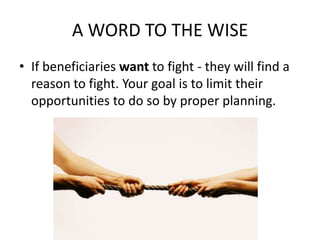
A WORD TO THE WISE
• If beneficiaries want to fight - they will find a
  reason to fight. Your goal is to limit their
  opportunities to do so by proper planning.
COMMON DISPUTES THAT END
           UP IN COURT
• Distribution of personal property, such as family heirlooms
  and cherished items
• Loans to children/beneficiaries
• Joint title and possession Issues
• Unequal division of property among children
• Unwritten and unfulfilled promises to children and others
• “Deathbed” Amendments
• Caregiving claims by family members
• Blended family issues
   – Amendments by widow/widower
   – Splits between children and step-children
BE REALISTIC ABOUT FAMILY
              DYNAMICS
• Be upfront with your attorney about potential
  conflict between siblings
• Family dynamics change after the parents’
  death
• Consider a family meeting prior to your death
  – or a letter to be opened after your death
• Acknowledge skeletons in the closet.
  Familysecrets come out as the children go
  through your drawers after your death
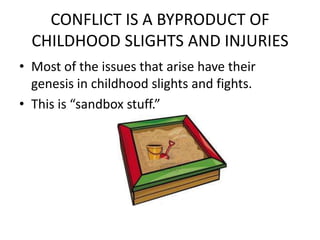
CONFLICT IS A BYPRODUCT OF
  CHILDHOOD SLIGHTS AND INJURIES
• Most of the issues that arise have their
  genesis in childhood slights and fights.
• This is “sandbox stuff.”
SIMPLIFYING DIVISION OF YOUR
               ESTATE
• Battleground Areas:
  – Personal Property
     • Jewelry, Antiques, Photos, Other Prized Possessions
  – Family Home
     • Option of one child to purchase
     • Child living in home at time of parent’s death
     • Child as caregiver entitlement issues
  – Loans or Gifts during lifetime
     • Documentation during life
     • Forgiveness or acknowledgement in trust instrument
  – Family Business
AVOID MISUNDERSTANDINGS
• Communicate wishes to children during your
  life to avoid misunderstandings and ill feelings
  after your death
• If you do not want to communicate your
  wishes during life, you should make very clear
  those wishes in your trust and possibly in a
  supplemental letter to the children in your
  own words
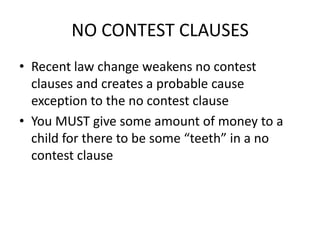
NO CONTEST CLAUSES
• Recent law change weakens no contest
  clauses and creates a probable cause
  exception to the no contest clause
• You MUST give some amount of money to a
  child for there to be some “teeth” in a no
  contest clause
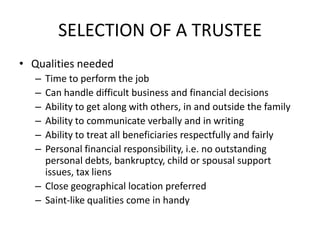
SELECTION OF A TRUSTEE
• Qualities needed
   – Time to perform the job
   – Can handle difficult business and financial decisions
   – Ability to get along with others, in and outside the family
   – Ability to communicate verbally and in writing
   – Ability to treat all beneficiaries respectfully and fairly
   – Personal financial responsibility, i.e. no outstanding
     personal debts, bankruptcy, child or spousal support
     issues, tax liens
   – Close geographical location preferred
   – Saint-like qualities come in handy
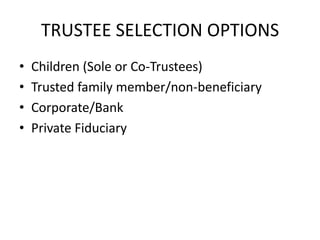
TRUSTEE SELECTION OPTIONS
•   Children (Sole or Co-Trustees)
•   Trusted family member/non-beneficiary
•   Corporate/Bank
•   Private Fiduciary
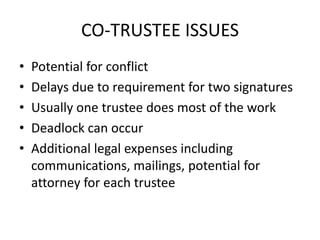
CO-TRUSTEE ISSUES
•   Potential for conflict
•   Delays due to requirement for two signatures
•   Usually one trustee does most of the work
•   Deadlock can occur
•   Additional legal expenses including
    communications, mailings, potential for
    attorney for each trustee
SUMMARY
• Careful selection of a Fiduciary
• Consider a Restatement of Trust if you have a number of
  amendments to avoid confusion and possible bad feelings
• Clear communication about intent prior to death and in the
  trust instrument
• Include a no-contest clause
• Consider providing the trustee with discretion or other
  guidance in certain areas if conflict arises, i.e.
   – Dispose of personal property to charity or by sale if dispute
     arises
• Avoid Co-Trustees in most cases
• If you are disinheriting one of your children, make sure you
  explicitly state that in your trust

Setting Up Your Estate Plan to Avoid Conflict and Contests

  • 1.
    DESIGNING YOUR ESTATEPLAN TO AVOID CONFLICT AND CONTESTS BARRY L. ADAMS Attorney at Law Law Office of Adams & Rafferty, P.C. 1400 N. Dutton Avenue, Santa Rosa, CA 95401 (707) 542-6644 barry@adamsandrafferty.com
  • 2.
    GO BEYOND THEBASICS • Basic estate planning involves signing the necessary documents: will, trust, power of attorney, advance health care directive, as well as funding your trust • To avoid conflict – you need to understand the issues and figure out ways to avoid conflict between your beneficiaries • Have an honest discourse with yourself, your spouse and your attorney about potential discord in the family and hot button issues. Don’t hide your head in the sand and hope for the best – plan for the worst • One of my sayings is: After the parents die, the family goes from hierarchy to anarchy.
  • 3.
    A WORD TOTHE WISE • If beneficiaries want to fight - they will find a reason to fight. Your goal is to limit their opportunities to do so by proper planning.
  • 4.
    COMMON DISPUTES THATEND UP IN COURT • Distribution of personal property, such as family heirlooms and cherished items • Loans to children/beneficiaries • Joint title and possession Issues • Unequal division of property among children • Unwritten and unfulfilled promises to children and others • “Deathbed” Amendments • Caregiving claims by family members • Blended family issues – Amendments by widow/widower – Splits between children and step-children
  • 5.
    BE REALISTIC ABOUTFAMILY DYNAMICS • Be upfront with your attorney about potential conflict between siblings • Family dynamics change after the parents’ death • Consider a family meeting prior to your death – or a letter to be opened after your death • Acknowledge skeletons in the closet. Familysecrets come out as the children go through your drawers after your death
  • 6.
    CONFLICT IS ABYPRODUCT OF CHILDHOOD SLIGHTS AND INJURIES • Most of the issues that arise have their genesis in childhood slights and fights. • This is “sandbox stuff.”
  • 7.
    SIMPLIFYING DIVISION OFYOUR ESTATE • Battleground Areas: – Personal Property • Jewelry, Antiques, Photos, Other Prized Possessions – Family Home • Option of one child to purchase • Child living in home at time of parent’s death • Child as caregiver entitlement issues – Loans or Gifts during lifetime • Documentation during life • Forgiveness or acknowledgement in trust instrument – Family Business
  • 8.
    AVOID MISUNDERSTANDINGS • Communicatewishes to children during your life to avoid misunderstandings and ill feelings after your death • If you do not want to communicate your wishes during life, you should make very clear those wishes in your trust and possibly in a supplemental letter to the children in your own words
  • 9.
    NO CONTEST CLAUSES •Recent law change weakens no contest clauses and creates a probable cause exception to the no contest clause • You MUST give some amount of money to a child for there to be some “teeth” in a no contest clause
  • 10.
    SELECTION OF ATRUSTEE • Qualities needed – Time to perform the job – Can handle difficult business and financial decisions – Ability to get along with others, in and outside the family – Ability to communicate verbally and in writing – Ability to treat all beneficiaries respectfully and fairly – Personal financial responsibility, i.e. no outstanding personal debts, bankruptcy, child or spousal support issues, tax liens – Close geographical location preferred – Saint-like qualities come in handy
  • 11.
    TRUSTEE SELECTION OPTIONS • Children (Sole or Co-Trustees) • Trusted family member/non-beneficiary • Corporate/Bank • Private Fiduciary
  • 12.
    CO-TRUSTEE ISSUES • Potential for conflict • Delays due to requirement for two signatures • Usually one trustee does most of the work • Deadlock can occur • Additional legal expenses including communications, mailings, potential for attorney for each trustee
  • 13.
    SUMMARY • Careful selectionof a Fiduciary • Consider a Restatement of Trust if you have a number of amendments to avoid confusion and possible bad feelings • Clear communication about intent prior to death and in the trust instrument • Include a no-contest clause • Consider providing the trustee with discretion or other guidance in certain areas if conflict arises, i.e. – Dispose of personal property to charity or by sale if dispute arises • Avoid Co-Trustees in most cases • If you are disinheriting one of your children, make sure you explicitly state that in your trust