Copyright © Oracle Corporation, 2004. All rights reserved.
Setting Up Oracle Workflow
1-2 Copyright © Oracle Corporation, 2004. All rights reserved.
Objectives
After completing this lesson, you should be able to do
the following:
• Describe the required setup steps for Oracle
Workflow.
• Describe the optional setup steps for Oracle
Workflow.
1-3 Copyright © Oracle Corporation, 2004. All rights reserved.
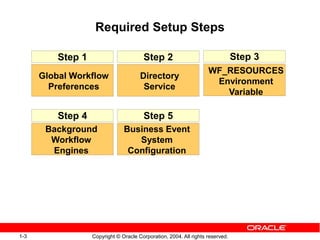
Required Setup Steps
Step 3
WF_RESOURCES
Environment
Variable
Step 4
Step 1
Global Workflow
Preferences
Background
Workflow
Engines
Step 5
Step 2
Directory
Service
Business Event
System
Configuration
1-4 Copyright © Oracle Corporation, 2004. All rights reserved.
Step 1
Setting Global Workflow Preferences
• In Oracle E-Business Suite, set your preferences in
the Workflow Configuration page.
– Define the workflow administrator role.
– Set system-wide preference values.
– Set default user preference values.
• Individual user preferences set by users override
the defaults set in the Workflow Configuration page.
1-5 Copyright © Oracle Corporation, 2004. All rights reserved.
Step 1
Setting Global Workflow Preferences
• In standalone Oracle Workflow, set your preferences
in the Global Workflow Preferences page.
– Define the workflow administrator role.
– Set system-wide preference values.
– Set default user preference values.
• Individual user preferences set by users override
the defaults set in the Global Workflow Preferences
page.
1-6 Copyright © Oracle Corporation, 2004. All rights reserved.
Step 2
Setting Up an Oracle Workflow Directory
Service
• Oracle Workflow requires a directory service to
provide information about the individuals and roles
in your organization who may use Oracle Workflow
functionality and receive workflow notifications.
• Predefined directory services are implemented by
default during installation.
– In Oracle E-Business Suite, a directory service for
users and roles from the unified Oracle E-Business
Suite environment is automatically implemented for
you.
– In standalone Oracle Workflow, you can integrate
either with Oracle Internet Directory or with Oracle
Database users and roles as your directory repository.
1-7 Copyright © Oracle Corporation, 2004. All rights reserved.
Step 2
Setting Up an Oracle Workflow Directory
Service
• In Oracle E-Business Suite, Oracle Workflow uses a
directory service model in which denormalized
information is maintained in the Workflow local
tables for performance gain.
• You should maintain synchronization between the
user and role information stored in application
tables by the source modules and the information
stored in the Workflow local tables.
1-8 Copyright © Oracle Corporation, 2004. All rights reserved.
Step 2
Setting Up an Oracle Workflow Directory
Service
• Patches will be made available to automatically
synchronize user and role information from each
module on an incremental basis, as soon as the
information is updated in the source module.
• Until these incremental synchronization patches are
released, you can run a concurrent program named
Synchronize WF LOCAL Tables or a request set
named Synchronize Workflow LOCAL Tables to
perform synchronization in bulk.
• The concurrent program periodically refreshes the
information in the Workflow local tables for the
specified modules.
1-9 Copyright © Oracle Corporation, 2004. All rights reserved.
Step 2
Setting Up an Oracle Workflow Directory
Service
• You can integrate your standalone Workflow
directory service with Oracle Internet Directory
using Lightweight Directory Access Protocol.
• Oracle Internet Directory integration is
recommended so you can manage and publish user
information in a central location.
• Integration with Oracle Internet Directory enables
Oracle Workflow to:
– Assign ownership of work items and send notifications
to users defined in Oracle Internet Directory.
– Synchronize with other external user directories that
are synchronized with Oracle Internet Directory.
– Participate in Oracle Application Server single sign-on
1-10 Copyright © Oracle Corporation, 2004. All rights reserved.
Step 3
Setting the WF_RESOURCES Environment
Variable
• If you are using the standalone version of Oracle
Workflow and the Workflow server is installed on a
UNIX platform, set the WF_RESOURCES
environment variable.
• This environment variable points to the language-
dependent Oracle Workflow resource file
wf<language>.res.
• The resource file is generally located in the res
subdirectory of the Oracle Workflow server directory
structure.
1-11 Copyright © Oracle Corporation, 2004. All rights reserved.
Step 4
Running Background Engines
• Set up background engines to handle:
– Costly deferred activities, to allow the Workflow
Engine to continue to the next available activity
– Timed out notifications
– Stuck processes
• A background engine runs until it completes all
eligible activities at the time it was initiated.
• You should set background engines up to run
periodically.
1-12 Copyright © Oracle Corporation, 2004. All rights reserved.
Step 4
Running Background Engines
• For Oracle Workflow embedded in Oracle E-
Business Suite, use Oracle Workflow Manager in
Oracle Applications Manager to run the Workflow
Background Process concurrent program.
• For standalone Oracle Workflow, use Oracle
Workflow Manager in Oracle Enterprise Manager to
run background engine database jobs.
• For testing purposes, you can also run the
WF_ENGINE.Background API manually through
SQL*Plus.
1-13 Copyright © Oracle Corporation, 2004. All rights reserved.
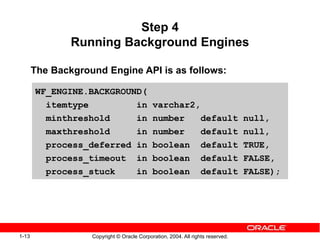
Step 4
Running Background Engines
The Background Engine API is as follows:
WF_ENGINE.BACKGROUND(
itemtype in varchar2,
minthreshold in number default null,
maxthreshold in number default null,
process_deferred in boolean default TRUE,
process_timeout in boolean default FALSE,
process_stuck in boolean default FALSE);
1-14 Copyright © Oracle Corporation, 2004. All rights reserved.
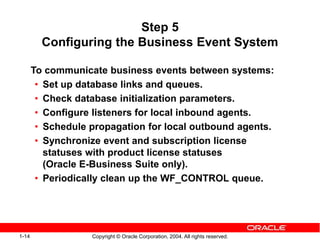
Step 5
Configuring the Business Event System
To communicate business events between systems:
• Set up database links and queues.
• Check database initialization parameters.
• Configure listeners for local inbound agents.
• Schedule propagation for local outbound agents.
• Synchronize event and subscription license
statuses with product license statuses
(Oracle E-Business Suite only).
• Periodically clean up the WF_CONTROL queue.
1-15 Copyright © Oracle Corporation, 2004. All rights reserved.
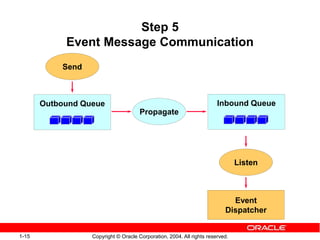
Step 5
Event Message Communication
Outbound Queue Inbound Queue
Event
Dispatcher
Propagate
Listen
Send
Inbound Queue
1-16 Copyright © Oracle Corporation, 2004. All rights reserved.
Step 5
Setting Up Database Links and Queues
• If you want to communicate business events
between the local system and external systems,
create database links to those external systems.
• If you want to use custom queues for propagating
events, set up your queues.
• You can either create database links and set up
queues manually, or use Oracle DBA Studio in
Oracle Enterprise Manager.
1-17 Copyright © Oracle Corporation, 2004. All rights reserved.
Step 5
Checking Database Parameters
Use Oracle Workflow Manager to verify the database
initialization parameters required for Oracle Workflow:
• JOB_QUEUE_PROCESSES
• AQ_TM_PROCESSES
1-18 Copyright © Oracle Corporation, 2004. All rights reserved.
Step 5
Scheduling Agent Listeners
• An agent listener checks an agent for inbound event
messages and dequeues messages for the Event
Manager to process.
– PL/SQL agent listeners process event subscriptions in
the database.
– Java agent listeners process event subscriptions in
the middle tier.
• The PL/SQL and Java agent listener programs are
defined as service component types in the Generic
Service Component Framework.
• Use Oracle Workflow Manager to submit and
manage agent listener service components.
1-19 Copyright © Oracle Corporation, 2004. All rights reserved.
Step 5
Scheduling Agent Listeners
• Oracle Workflow provides seeded agent listeners:
– Workflow Deferred Agent Listener
– Workflow Deferred Notification Agent Listener
– Workflow Error Agent Listener
– Workflow Inbound Notifications Agent Listener
– Workflow Java Deferred Agent Listener
– Workflow Java Error Agent Listener
• You can optionally create additional agent listeners.
1-20 Copyright © Oracle Corporation, 2004. All rights reserved.
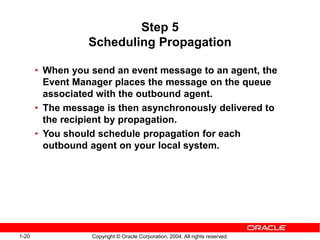
Step 5
Scheduling Propagation
• When you send an event message to an agent, the
Event Manager places the message on the queue
associated with the outbound agent.
• The message is then asynchronously delivered to
the recipient by propagation.
• You should schedule propagation for each
outbound agent on your local system.
1-21 Copyright © Oracle Corporation, 2004. All rights reserved.
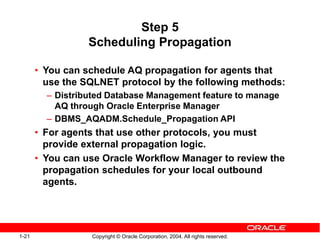
Step 5
Scheduling Propagation
• You can schedule AQ propagation for agents that
use the SQLNET protocol by the following methods:
– Distributed Database Management feature to manage
AQ through Oracle Enterprise Manager
– DBMS_AQADM.Schedule_Propagation API
• For agents that use other protocols, you must
provide external propagation logic.
• You can use Oracle Workflow Manager to review the
propagation schedules for your local outbound
agents.
1-22 Copyright © Oracle Corporation, 2004. All rights reserved.
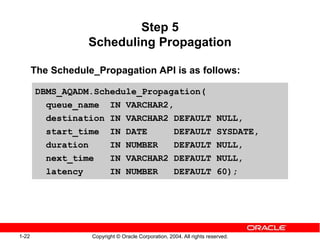
Step 5
Scheduling Propagation
The Schedule_Propagation API is as follows:
DBMS_AQADM.Schedule_Propagation(
queue_name IN VARCHAR2,
destination IN VARCHAR2 DEFAULT NULL,
start_time IN DATE DEFAULT SYSDATE,
duration IN NUMBER DEFAULT NULL,
next_time IN VARCHAR2 DEFAULT NULL,
latency IN NUMBER DEFAULT 60);
1-23 Copyright © Oracle Corporation, 2004. All rights reserved.
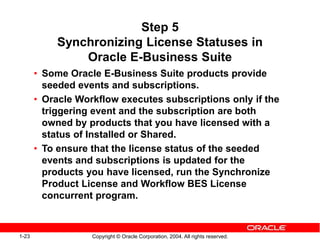
Step 5
Synchronizing License Statuses in
Oracle E-Business Suite
• Some Oracle E-Business Suite products provide
seeded events and subscriptions.
• Oracle Workflow executes subscriptions only if the
triggering event and the subscription are both
owned by products that you have licensed with a
status of Installed or Shared.
• To ensure that the license status of the seeded
events and subscriptions is updated for the
products you have licensed, run the Synchronize
Product License and Workflow BES License
concurrent program.
1-24 Copyright © Oracle Corporation, 2004. All rights reserved.
Step 5
Cleaning Up the WF_CONTROL Queue
• The Generic Service Component Framework uses
the standard WF_CONTROL queue to handle control
events for containers and service components.
• The subscribers to the WF_CONTROL queue need
to be cleaned up periodically.
– In Oracle E-Business Suite, a concurrent program
named Workflow Control Queue Cleanup is
automatically scheduled to perform this cleanup.
– In standalone Oracle Workflow, use Oracle Workflow
Manager in Oracle Enterprise Manager to run control
queue cleanup database jobs.
1-25 Copyright © Oracle Corporation, 2004. All rights reserved.
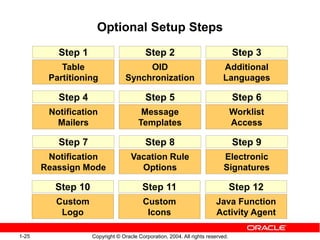
Optional Setup Steps
Table
Partitioning
Step 1
OID
Synchronization
Step 2
Additional
Languages
Step 3
Notification
Mailers
Step 4
Message
Templates
Step 5
Worklist
Access
Step 6
Notification
Reassign Mode
Step 7
Vacation Rule
Options
Step 8
Electronic
Signatures
Step 9
Custom
Logo
Step 10
Custom
Icons
Step 11
Java Function
Activity Agent
Step 12
1-26 Copyright © Oracle Corporation, 2004. All rights reserved.
Optional Step 1
Partitioning Workflow Tables
• You can optionally run a script to partition certain
Workflow tables for performance gain.
– For Oracle E-Business Suite: wfupartb.sql, located in
the $FND_TOP/admin/sql directory
– For standalone Oracle Workflow: wfupart.sql, located
in the ORACLE_HOME/wf/admin/sql directory
• These scripts partition four Workflow tables and
recreate the associated indexes.
1-27 Copyright © Oracle Corporation, 2004. All rights reserved.
Optional Step 2
Synchronizing with Oracle Internet
Directory
If you chose to integrate with Oracle Internet Directory
while installing standalone Oracle Workflow, you
should:
• Verify your global Workflow preferences related to
LDAP.
• Synchronize your Workflow directory service and
Oracle Internet Directory by running either the
WF_LDAP.Synch_changes API or the
WF_LDAP.Schedule_changes API.
1-28 Copyright © Oracle Corporation, 2004. All rights reserved.
Optional Step 3
Setting Up Additional Languages
You can:
• Display Oracle Workflow Web pages in other
languages
• Create and view workflow definitions in other
languages using Oracle Workflow Builder
• Load workflow definitions in other languages to a
database
• Send e-mail notifications in other languages
1-29 Copyright © Oracle Corporation, 2004. All rights reserved.
Optional Step 4
Implementing Notification Mailers
• Implement one or more notification mailers if you
want users to receive notifications by e-mail as well
as from the Worklist Web pages.
• A notification mailer is a Java program that
performs e-mail send and response processing for
the Oracle Workflow Notification System, using the
JavaMail API.
• Use Oracle Workflow Manager to configure and run
notification mailers.
1-30 Copyright © Oracle Corporation, 2004. All rights reserved.
Optional Step 4
Implementing Notification Mailers
• The notification mailer program is defined as a
service component type in the Generic Service
Component Framework.
• Oracle Workflow provides one seeded notification
mailer service component, called Workflow
Notification Mailer.
• You can optionally create additional notification
mailer service components.
1-31 Copyright © Oracle Corporation, 2004. All rights reserved.
Optional Step 4
Implementing Notification Mailers
• Oracle Workflow supports the following protocols:
– Simple Mail Transfer Protocol (SMTP) - for outbound
messages
– Internet Message Access Protocol (IMAP) - for inbound
messages
• You must have an SMTP server and an IMAP server
set up in order to send and receive Oracle Workflow
notification e-mail messages from your Workflow
server.
1-32 Copyright © Oracle Corporation, 2004. All rights reserved.
Optional Step 5
Customizing Message Templates
• Notification mailers use message templates to
generate e-mail notifications.
• Oracle Workflow provides a set of standard default
templates, as well as some alternative templates for
certain types of messages.
• You can optionally customize your message
templates:
– Use the alternative templates provided by Oracle
Workflow
– Create your own custom message templates using the
Workflow Builder
1-33 Copyright © Oracle Corporation, 2004. All rights reserved.
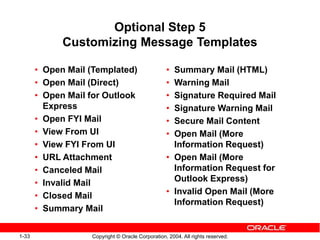
Optional Step 5
Customizing Message Templates
• Open Mail (Templated)
• Open Mail (Direct)
• Open Mail for Outlook
Express
• Open FYI Mail
• View From UI
• View FYI From UI
• URL Attachment
• Canceled Mail
• Invalid Mail
• Closed Mail
• Summary Mail
• Summary Mail (HTML)
• Warning Mail
• Signature Required Mail
• Signature Warning Mail
• Secure Mail Content
• Open Mail (More
Information Request)
• Open Mail (More
Information Request for
Outlook Express)
• Invalid Open Mail (More
Information Request)
1-34 Copyright © Oracle Corporation, 2004. All rights reserved.
Optional Step 6
Adding Worklist Functions to User
Responsibilities
• In Oracle E-Business Suite you can optionally give
users access to these Web pages from any
responsibility you choose:
– Advanced Worklist
– Personal Worklist
• To make a Worklist available from a particular
responsibility, you must add the appropriate
function to the menu associated with that
responsibility.
• You can then assign that responsibility to your
users.
1-35 Copyright © Oracle Corporation, 2004. All rights reserved.
Optional Step 7
Setting the Notification Reassign Mode
Use the WF: Notification Reassign Mode profile option
to control which reassign modes are available to
users.
• Delegate
• Transfer
• Reassign
1-36 Copyright © Oracle Corporation, 2004. All rights reserved.
Optional Step 8
Setting Up Vacation Rule Options
• Vacation rules are defined according to the item
type with which notifications are associated.
• In Oracle E-Business Suite, you can control what
item types are available for vacation rules.
– WF: Routing Rule Item Types lookup type – Add
specific item types to appear in the list for all users
– WF: Vacation Rules – Allow All profile option - Include
the ”All” option in the list of item types
1-37 Copyright © Oracle Corporation, 2004. All rights reserved.
Optional Step 9
Setting Up for Electronic Signatures
• Certificate-based digital signatures – Load users’
certificates into your Oracle E-Business Suite
database using the Workflow Certificate Loader.
• Password-based signatures – If you implement
single sign-on, set the Applications SSO Login
Types profile option to either Local or Both for users
who enter password-based signatures.
1-38 Copyright © Oracle Corporation, 2004. All rights reserved.
Optional Step 10
Customizing the Workflow Web Page Logo
• After your Web server is installed and set up, you
can customize the company logo that appears on
Oracle Workflow’s Web pages.
• Create your company logo file in gif format and save
it as:
– FNDLOGOS.gif if you are using Oracle Workflow
embedded in Oracle E-Business Suite
– WFLOGO.gif if you are using the standalone version of
Oracle Workflow
• Move the gif file to the physical directory associated
with your Web server’s /OA_MEDIA/ virtual
directory.
1-39 Copyright © Oracle Corporation, 2004. All rights reserved.
Optional Step 11
Adding Custom Icons
• Oracle Workflow provides a variety of icons that you
can use with your activities and processes.
• You can add additional icon files as long as they are
in the appropriate format.
• Oracle Workflow Builder looks for Windows icon
files (.ico) in the Icon subdirectory of the Oracle
Workflow area on your PC.
• The Oracle Workflow Monitor and other Workflow
Web pages look for gif files (.gif) in your Web
server’s /OA_MEDIA/ virtual directory.
1-40 Copyright © Oracle Corporation, 2004. All rights reserved.
Optional Step 12
Starting the Java Function Activity Agent
• Run the Java Function Activity Agent if you want to
execute external Java function activities.
• To start the Java Function Activity Agent, you can:
– Run sample scripts called wfjvlsnr.csh for UNIX
or wfjvlsnr.bat for Windows NT
– Run JRE against 'oracle.apps.fnd.wf.WFFALsnr'
1-41 Copyright © Oracle Corporation, 2004. All rights reserved.
Version Compatibility
• Each Oracle Workflow client module automatically
verifies that the module is compatible with the
version of the Oracle Workflow server that it is
operating against.
– Oracle Workflow Builder
– Notification mailers
– Workflow Monitor
– Workflow Definitions Loader
– Workflow XML Loader
• To determine which version of the Oracle Workflow
server is running, connect to the Workflow server
account using SQL*Plus and execute the script
wfver.sql.
1-42 Copyright © Oracle Corporation, 2004. All rights reserved.
Review Questions
1. What are the required setup steps for Oracle
Workflow?
2. What are the optional setup steps for Oracle
Workflow?
1-43 Copyright © Oracle Corporation, 2004. All rights reserved.
Review Questions
1. What are the required setup steps for Oracle
Workflow?
2. What are the optional setup steps for Oracle
Workflow?
1-44 Copyright © Oracle Corporation, 2004. All rights reserved.
Summary
In this lesson, you should have learned how to:
• Describe the required setup steps for Oracle
Workflow.
• Describe the optional setup steps for Oracle
Workflow.

Setting up Oracle WorkFlow.ppt

  • 1.
    Copyright © OracleCorporation, 2004. All rights reserved. Setting Up Oracle Workflow
  • 2.
    1-2 Copyright ©Oracle Corporation, 2004. All rights reserved. Objectives After completing this lesson, you should be able to do the following: • Describe the required setup steps for Oracle Workflow. • Describe the optional setup steps for Oracle Workflow.
  • 3.
    1-3 Copyright ©Oracle Corporation, 2004. All rights reserved. Required Setup Steps Step 3 WF_RESOURCES Environment Variable Step 4 Step 1 Global Workflow Preferences Background Workflow Engines Step 5 Step 2 Directory Service Business Event System Configuration
  • 4.
    1-4 Copyright ©Oracle Corporation, 2004. All rights reserved. Step 1 Setting Global Workflow Preferences • In Oracle E-Business Suite, set your preferences in the Workflow Configuration page. – Define the workflow administrator role. – Set system-wide preference values. – Set default user preference values. • Individual user preferences set by users override the defaults set in the Workflow Configuration page.
  • 5.
    1-5 Copyright ©Oracle Corporation, 2004. All rights reserved. Step 1 Setting Global Workflow Preferences • In standalone Oracle Workflow, set your preferences in the Global Workflow Preferences page. – Define the workflow administrator role. – Set system-wide preference values. – Set default user preference values. • Individual user preferences set by users override the defaults set in the Global Workflow Preferences page.
  • 6.
    1-6 Copyright ©Oracle Corporation, 2004. All rights reserved. Step 2 Setting Up an Oracle Workflow Directory Service • Oracle Workflow requires a directory service to provide information about the individuals and roles in your organization who may use Oracle Workflow functionality and receive workflow notifications. • Predefined directory services are implemented by default during installation. – In Oracle E-Business Suite, a directory service for users and roles from the unified Oracle E-Business Suite environment is automatically implemented for you. – In standalone Oracle Workflow, you can integrate either with Oracle Internet Directory or with Oracle Database users and roles as your directory repository.
  • 7.
    1-7 Copyright ©Oracle Corporation, 2004. All rights reserved. Step 2 Setting Up an Oracle Workflow Directory Service • In Oracle E-Business Suite, Oracle Workflow uses a directory service model in which denormalized information is maintained in the Workflow local tables for performance gain. • You should maintain synchronization between the user and role information stored in application tables by the source modules and the information stored in the Workflow local tables.
  • 8.
    1-8 Copyright ©Oracle Corporation, 2004. All rights reserved. Step 2 Setting Up an Oracle Workflow Directory Service • Patches will be made available to automatically synchronize user and role information from each module on an incremental basis, as soon as the information is updated in the source module. • Until these incremental synchronization patches are released, you can run a concurrent program named Synchronize WF LOCAL Tables or a request set named Synchronize Workflow LOCAL Tables to perform synchronization in bulk. • The concurrent program periodically refreshes the information in the Workflow local tables for the specified modules.
  • 9.
    1-9 Copyright ©Oracle Corporation, 2004. All rights reserved. Step 2 Setting Up an Oracle Workflow Directory Service • You can integrate your standalone Workflow directory service with Oracle Internet Directory using Lightweight Directory Access Protocol. • Oracle Internet Directory integration is recommended so you can manage and publish user information in a central location. • Integration with Oracle Internet Directory enables Oracle Workflow to: – Assign ownership of work items and send notifications to users defined in Oracle Internet Directory. – Synchronize with other external user directories that are synchronized with Oracle Internet Directory. – Participate in Oracle Application Server single sign-on
  • 10.
    1-10 Copyright ©Oracle Corporation, 2004. All rights reserved. Step 3 Setting the WF_RESOURCES Environment Variable • If you are using the standalone version of Oracle Workflow and the Workflow server is installed on a UNIX platform, set the WF_RESOURCES environment variable. • This environment variable points to the language- dependent Oracle Workflow resource file wf<language>.res. • The resource file is generally located in the res subdirectory of the Oracle Workflow server directory structure.
  • 11.
    1-11 Copyright ©Oracle Corporation, 2004. All rights reserved. Step 4 Running Background Engines • Set up background engines to handle: – Costly deferred activities, to allow the Workflow Engine to continue to the next available activity – Timed out notifications – Stuck processes • A background engine runs until it completes all eligible activities at the time it was initiated. • You should set background engines up to run periodically.
  • 12.
    1-12 Copyright ©Oracle Corporation, 2004. All rights reserved. Step 4 Running Background Engines • For Oracle Workflow embedded in Oracle E- Business Suite, use Oracle Workflow Manager in Oracle Applications Manager to run the Workflow Background Process concurrent program. • For standalone Oracle Workflow, use Oracle Workflow Manager in Oracle Enterprise Manager to run background engine database jobs. • For testing purposes, you can also run the WF_ENGINE.Background API manually through SQL*Plus.
  • 13.
    1-13 Copyright ©Oracle Corporation, 2004. All rights reserved. Step 4 Running Background Engines The Background Engine API is as follows: WF_ENGINE.BACKGROUND( itemtype in varchar2, minthreshold in number default null, maxthreshold in number default null, process_deferred in boolean default TRUE, process_timeout in boolean default FALSE, process_stuck in boolean default FALSE);
  • 14.
    1-14 Copyright ©Oracle Corporation, 2004. All rights reserved. Step 5 Configuring the Business Event System To communicate business events between systems: • Set up database links and queues. • Check database initialization parameters. • Configure listeners for local inbound agents. • Schedule propagation for local outbound agents. • Synchronize event and subscription license statuses with product license statuses (Oracle E-Business Suite only). • Periodically clean up the WF_CONTROL queue.
  • 15.
    1-15 Copyright ©Oracle Corporation, 2004. All rights reserved. Step 5 Event Message Communication Outbound Queue Inbound Queue Event Dispatcher Propagate Listen Send Inbound Queue
  • 16.
    1-16 Copyright ©Oracle Corporation, 2004. All rights reserved. Step 5 Setting Up Database Links and Queues • If you want to communicate business events between the local system and external systems, create database links to those external systems. • If you want to use custom queues for propagating events, set up your queues. • You can either create database links and set up queues manually, or use Oracle DBA Studio in Oracle Enterprise Manager.
  • 17.
    1-17 Copyright ©Oracle Corporation, 2004. All rights reserved. Step 5 Checking Database Parameters Use Oracle Workflow Manager to verify the database initialization parameters required for Oracle Workflow: • JOB_QUEUE_PROCESSES • AQ_TM_PROCESSES
  • 18.
    1-18 Copyright ©Oracle Corporation, 2004. All rights reserved. Step 5 Scheduling Agent Listeners • An agent listener checks an agent for inbound event messages and dequeues messages for the Event Manager to process. – PL/SQL agent listeners process event subscriptions in the database. – Java agent listeners process event subscriptions in the middle tier. • The PL/SQL and Java agent listener programs are defined as service component types in the Generic Service Component Framework. • Use Oracle Workflow Manager to submit and manage agent listener service components.
  • 19.
    1-19 Copyright ©Oracle Corporation, 2004. All rights reserved. Step 5 Scheduling Agent Listeners • Oracle Workflow provides seeded agent listeners: – Workflow Deferred Agent Listener – Workflow Deferred Notification Agent Listener – Workflow Error Agent Listener – Workflow Inbound Notifications Agent Listener – Workflow Java Deferred Agent Listener – Workflow Java Error Agent Listener • You can optionally create additional agent listeners.
  • 20.
    1-20 Copyright ©Oracle Corporation, 2004. All rights reserved. Step 5 Scheduling Propagation • When you send an event message to an agent, the Event Manager places the message on the queue associated with the outbound agent. • The message is then asynchronously delivered to the recipient by propagation. • You should schedule propagation for each outbound agent on your local system.
  • 21.
    1-21 Copyright ©Oracle Corporation, 2004. All rights reserved. Step 5 Scheduling Propagation • You can schedule AQ propagation for agents that use the SQLNET protocol by the following methods: – Distributed Database Management feature to manage AQ through Oracle Enterprise Manager – DBMS_AQADM.Schedule_Propagation API • For agents that use other protocols, you must provide external propagation logic. • You can use Oracle Workflow Manager to review the propagation schedules for your local outbound agents.
  • 22.
    1-22 Copyright ©Oracle Corporation, 2004. All rights reserved. Step 5 Scheduling Propagation The Schedule_Propagation API is as follows: DBMS_AQADM.Schedule_Propagation( queue_name IN VARCHAR2, destination IN VARCHAR2 DEFAULT NULL, start_time IN DATE DEFAULT SYSDATE, duration IN NUMBER DEFAULT NULL, next_time IN VARCHAR2 DEFAULT NULL, latency IN NUMBER DEFAULT 60);
  • 23.
    1-23 Copyright ©Oracle Corporation, 2004. All rights reserved. Step 5 Synchronizing License Statuses in Oracle E-Business Suite • Some Oracle E-Business Suite products provide seeded events and subscriptions. • Oracle Workflow executes subscriptions only if the triggering event and the subscription are both owned by products that you have licensed with a status of Installed or Shared. • To ensure that the license status of the seeded events and subscriptions is updated for the products you have licensed, run the Synchronize Product License and Workflow BES License concurrent program.
  • 24.
    1-24 Copyright ©Oracle Corporation, 2004. All rights reserved. Step 5 Cleaning Up the WF_CONTROL Queue • The Generic Service Component Framework uses the standard WF_CONTROL queue to handle control events for containers and service components. • The subscribers to the WF_CONTROL queue need to be cleaned up periodically. – In Oracle E-Business Suite, a concurrent program named Workflow Control Queue Cleanup is automatically scheduled to perform this cleanup. – In standalone Oracle Workflow, use Oracle Workflow Manager in Oracle Enterprise Manager to run control queue cleanup database jobs.
  • 25.
    1-25 Copyright ©Oracle Corporation, 2004. All rights reserved. Optional Setup Steps Table Partitioning Step 1 OID Synchronization Step 2 Additional Languages Step 3 Notification Mailers Step 4 Message Templates Step 5 Worklist Access Step 6 Notification Reassign Mode Step 7 Vacation Rule Options Step 8 Electronic Signatures Step 9 Custom Logo Step 10 Custom Icons Step 11 Java Function Activity Agent Step 12
  • 26.
    1-26 Copyright ©Oracle Corporation, 2004. All rights reserved. Optional Step 1 Partitioning Workflow Tables • You can optionally run a script to partition certain Workflow tables for performance gain. – For Oracle E-Business Suite: wfupartb.sql, located in the $FND_TOP/admin/sql directory – For standalone Oracle Workflow: wfupart.sql, located in the ORACLE_HOME/wf/admin/sql directory • These scripts partition four Workflow tables and recreate the associated indexes.
  • 27.
    1-27 Copyright ©Oracle Corporation, 2004. All rights reserved. Optional Step 2 Synchronizing with Oracle Internet Directory If you chose to integrate with Oracle Internet Directory while installing standalone Oracle Workflow, you should: • Verify your global Workflow preferences related to LDAP. • Synchronize your Workflow directory service and Oracle Internet Directory by running either the WF_LDAP.Synch_changes API or the WF_LDAP.Schedule_changes API.
  • 28.
    1-28 Copyright ©Oracle Corporation, 2004. All rights reserved. Optional Step 3 Setting Up Additional Languages You can: • Display Oracle Workflow Web pages in other languages • Create and view workflow definitions in other languages using Oracle Workflow Builder • Load workflow definitions in other languages to a database • Send e-mail notifications in other languages
  • 29.
    1-29 Copyright ©Oracle Corporation, 2004. All rights reserved. Optional Step 4 Implementing Notification Mailers • Implement one or more notification mailers if you want users to receive notifications by e-mail as well as from the Worklist Web pages. • A notification mailer is a Java program that performs e-mail send and response processing for the Oracle Workflow Notification System, using the JavaMail API. • Use Oracle Workflow Manager to configure and run notification mailers.
  • 30.
    1-30 Copyright ©Oracle Corporation, 2004. All rights reserved. Optional Step 4 Implementing Notification Mailers • The notification mailer program is defined as a service component type in the Generic Service Component Framework. • Oracle Workflow provides one seeded notification mailer service component, called Workflow Notification Mailer. • You can optionally create additional notification mailer service components.
  • 31.
    1-31 Copyright ©Oracle Corporation, 2004. All rights reserved. Optional Step 4 Implementing Notification Mailers • Oracle Workflow supports the following protocols: – Simple Mail Transfer Protocol (SMTP) - for outbound messages – Internet Message Access Protocol (IMAP) - for inbound messages • You must have an SMTP server and an IMAP server set up in order to send and receive Oracle Workflow notification e-mail messages from your Workflow server.
  • 32.
    1-32 Copyright ©Oracle Corporation, 2004. All rights reserved. Optional Step 5 Customizing Message Templates • Notification mailers use message templates to generate e-mail notifications. • Oracle Workflow provides a set of standard default templates, as well as some alternative templates for certain types of messages. • You can optionally customize your message templates: – Use the alternative templates provided by Oracle Workflow – Create your own custom message templates using the Workflow Builder
  • 33.
    1-33 Copyright ©Oracle Corporation, 2004. All rights reserved. Optional Step 5 Customizing Message Templates • Open Mail (Templated) • Open Mail (Direct) • Open Mail for Outlook Express • Open FYI Mail • View From UI • View FYI From UI • URL Attachment • Canceled Mail • Invalid Mail • Closed Mail • Summary Mail • Summary Mail (HTML) • Warning Mail • Signature Required Mail • Signature Warning Mail • Secure Mail Content • Open Mail (More Information Request) • Open Mail (More Information Request for Outlook Express) • Invalid Open Mail (More Information Request)
  • 34.
    1-34 Copyright ©Oracle Corporation, 2004. All rights reserved. Optional Step 6 Adding Worklist Functions to User Responsibilities • In Oracle E-Business Suite you can optionally give users access to these Web pages from any responsibility you choose: – Advanced Worklist – Personal Worklist • To make a Worklist available from a particular responsibility, you must add the appropriate function to the menu associated with that responsibility. • You can then assign that responsibility to your users.
  • 35.
    1-35 Copyright ©Oracle Corporation, 2004. All rights reserved. Optional Step 7 Setting the Notification Reassign Mode Use the WF: Notification Reassign Mode profile option to control which reassign modes are available to users. • Delegate • Transfer • Reassign
  • 36.
    1-36 Copyright ©Oracle Corporation, 2004. All rights reserved. Optional Step 8 Setting Up Vacation Rule Options • Vacation rules are defined according to the item type with which notifications are associated. • In Oracle E-Business Suite, you can control what item types are available for vacation rules. – WF: Routing Rule Item Types lookup type – Add specific item types to appear in the list for all users – WF: Vacation Rules – Allow All profile option - Include the ”All” option in the list of item types
  • 37.
    1-37 Copyright ©Oracle Corporation, 2004. All rights reserved. Optional Step 9 Setting Up for Electronic Signatures • Certificate-based digital signatures – Load users’ certificates into your Oracle E-Business Suite database using the Workflow Certificate Loader. • Password-based signatures – If you implement single sign-on, set the Applications SSO Login Types profile option to either Local or Both for users who enter password-based signatures.
  • 38.
    1-38 Copyright ©Oracle Corporation, 2004. All rights reserved. Optional Step 10 Customizing the Workflow Web Page Logo • After your Web server is installed and set up, you can customize the company logo that appears on Oracle Workflow’s Web pages. • Create your company logo file in gif format and save it as: – FNDLOGOS.gif if you are using Oracle Workflow embedded in Oracle E-Business Suite – WFLOGO.gif if you are using the standalone version of Oracle Workflow • Move the gif file to the physical directory associated with your Web server’s /OA_MEDIA/ virtual directory.
  • 39.
    1-39 Copyright ©Oracle Corporation, 2004. All rights reserved. Optional Step 11 Adding Custom Icons • Oracle Workflow provides a variety of icons that you can use with your activities and processes. • You can add additional icon files as long as they are in the appropriate format. • Oracle Workflow Builder looks for Windows icon files (.ico) in the Icon subdirectory of the Oracle Workflow area on your PC. • The Oracle Workflow Monitor and other Workflow Web pages look for gif files (.gif) in your Web server’s /OA_MEDIA/ virtual directory.
  • 40.
    1-40 Copyright ©Oracle Corporation, 2004. All rights reserved. Optional Step 12 Starting the Java Function Activity Agent • Run the Java Function Activity Agent if you want to execute external Java function activities. • To start the Java Function Activity Agent, you can: – Run sample scripts called wfjvlsnr.csh for UNIX or wfjvlsnr.bat for Windows NT – Run JRE against 'oracle.apps.fnd.wf.WFFALsnr'
  • 41.
    1-41 Copyright ©Oracle Corporation, 2004. All rights reserved. Version Compatibility • Each Oracle Workflow client module automatically verifies that the module is compatible with the version of the Oracle Workflow server that it is operating against. – Oracle Workflow Builder – Notification mailers – Workflow Monitor – Workflow Definitions Loader – Workflow XML Loader • To determine which version of the Oracle Workflow server is running, connect to the Workflow server account using SQL*Plus and execute the script wfver.sql.
  • 42.
    1-42 Copyright ©Oracle Corporation, 2004. All rights reserved. Review Questions 1. What are the required setup steps for Oracle Workflow? 2. What are the optional setup steps for Oracle Workflow?
  • 43.
    1-43 Copyright ©Oracle Corporation, 2004. All rights reserved. Review Questions 1. What are the required setup steps for Oracle Workflow? 2. What are the optional setup steps for Oracle Workflow?
  • 44.
    1-44 Copyright ©Oracle Corporation, 2004. All rights reserved. Summary In this lesson, you should have learned how to: • Describe the required setup steps for Oracle Workflow. • Describe the optional setup steps for Oracle Workflow.