Guides for Rehabilitation
at Home
Why home training?
Parents
• Are the child’s first and best teachers
• Are a constant in child’s everyday life
• Spend most time interacting with the child
• Know the child’s likes, dislikes & interests
• Understand their child the best
Icon source: Flaticon
Role of parents
• Help set goals with the therapist
• Describe daily activities & routine
• Learn strategies to be used at home
• Report changes & child’s progress
• Determine next steps along with the therapist
Icon source: Flaticon
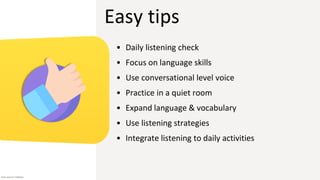
Easy tips
• Daily listening check
• Focus on language skills
• Use conversational level voice
• Practice in a quiet room
• Expand language & vocabulary
• Use listening strategies
• Integrate listening to daily activities
Icon source: Flaticon
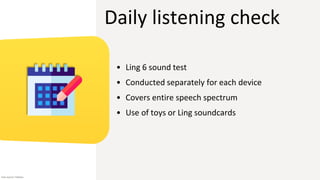
Daily listening check
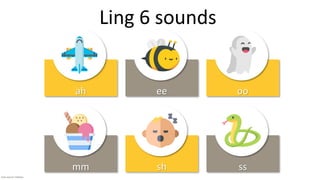
• Ling 6 sound test
• Conducted separately for each device
• Covers entire speech spectrum
• Use of toys or Ling soundcards
Icon source: Flaticon
ah
sh
oo
ss
ee
mm
Ling 6 sounds
Icon source: Flaticon
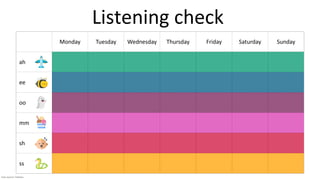
Monday Tuesday Wednesday Thursday Friday Saturday Sunday
ah
ee
oo
mm
sh
ss
Listening check
Icon source: Flaticon
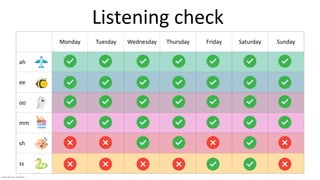
Monday Tuesday Wednesday Thursday Friday Saturday Sunday
ah
ee
oo
mm
sh
ss
Listening check
Icons source: Flaticon
Focus on language
skills
• Emphasis on building language skills first
• Develop pre-linguistic skills for younger children
• Follow the child’s lead
• Avoid repetitions
• Tip: Teach language, do not test
Icon source: Flaticon
आ
Use conversational
level voice
• Avoid speaking in very loud tone
• Use intonations with babies
• Monitor loudness level
• Make volume adjustments to the Sound
Processor(s)
Icon source: Flaticon
Practice in a quiet
room
• Focus on listening skills
• Control distractions & noise
• Optimise room acoustics
Icon source: Flaticon
Expand language &
vocabulary
• Use complete language
• Try to avoid short phrases
• Include new words into conversations
• Tip: Use speech, not gestures
Icon source: Flaticon
Listening strategies
• Use adequate pauses
• Practice the 10 second rule
• Other strategies
– Sound Processor(s) should be worn throughout the day
– Be close to the microphone while speaking (only
initial stages)
– Always maintain auditory presentation before visual
– Acoustic highlighting
– Auditory sandwich for older children
Icon source: Flaticon
Include listening into
the routine
• Listening should be a common goal in every
activity
• Fit listening activities into the routine
• Create opportunities through daily activities
Icon source: Flaticon
Opportunities for
incidental learning
Reference: Gillis & Schaerlaekens, 2000
Approximately 80% of what
a child learns in their language development
is done so incidentally.
Importance of
incidental learning
• Aids development of new vocabulary
• Encourages a deeper level of curiosity
• Skills learned can be generalised in natural &
realistic environment
Icon source: Flaticon
Language through
cooking
• Name the ingredients & cooking utensils
• Describe the food
• Explain each step before you do it
• If something goes wrong, talk about how you
can fix it
• Talk about origin of ingredients using
descriptive language
Icon source: Flaticon
Language through
laundry
• Name each piece of clothing
• Categorise the clothes
• Talk about all items that are used
• Explain each step like drying, folding &
separating
Icon source: Flaticon
Language through
reading
• Ask to point out animations, objects & colours
• Make sounds & encourage imitation
• Before moving forward, ask them to guess
what they think may happen next
• Talk about the pictures & objects
• Encourage other family members to participate
Icon source: Flaticon
Language through
games
• Develop listening skills
• Improve expressive language abilities
• Encourage use of descriptive words
• Include games like
– I spy
– Vocabulary games
– Auditory memory games
– Simon says
Icon source: Flaticon
Supporting
resources
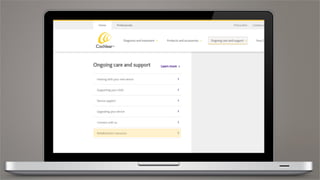
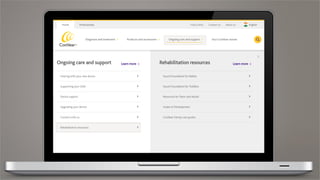
Cochlear resources
• Sound Foundation
– Babies (1-2 years)
– Toddlers (2-3 years)
– Children (3-4 years)
– Starting School Guide
• Leap on with language
• Listen, learn & talk
• Chit-chat
Mobile applications
• LingokidsTM
• ABC kids
• Easy music for kids
• Speech blubs
• Minimal pairs
• 28 categories for kids
• Epic!
• Avtar auditory verbal training
Icon source: Google
Other websites
• CBeebies
• YouTube for kids
• Storyline Online
• ManyThings
• RIDBC hearing resources
Icon source: Google
Practical advice
• Get comfortable with the processor
• Practice in quiet room
• Practice regularly
• Be patient
Icon source: Flaticon
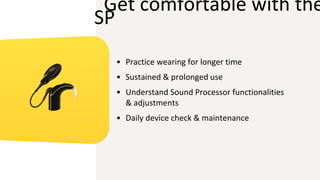
Get comfortable with the
SP
• Practice wearing for longer time
• Sustained & prolonged use
• Understand Sound Processor functionalities
& adjustments
• Daily device check & maintenance
Practice in a quiet room
• Try to avoid distractions
• Optimise room acoustics for easy listening
• Practice in comfortable loudness level
• Slowly increase complexities
Icon source: Flaticon
Practice regularly
• Practice for 15 to 30 minutes daily
• Practice at a fixed time regularly
• Listen to different voices
Icon source: Flaticon
Be patient
• Hearing rehabilitation may take longer to
show results
• Focus on listening with Sound Processor(s)
alone
• Have realistic expectations
Icon source: Flaticon
Practical
exercises
Level 1
• Wear your Sound Processor(s)
• Watch TV / online media / audio books with
captions
• Practice reading aloud – newspaper / books
• Pay close attention to what is being read
Icon source: Flaticon
Level 2
• Watch TV with captions disabled
• Close eyes occasionally to practice listening
without visual information
• Watch TED talks with captions enabled
• Listen to a talk show on the radio or a
podcast
Icon source: Flaticon
Level 3
• Start with video calls to familiar people &
subsequently with different people
• Increase complexity by moving to regular phone
calls
• Start in a quiet room & then increase difficulty
• Listen to an audiobook without the book to
follow
• Listen to a TED talk without captions
• Watch videos or listen to favorite music with
captions enabled
Icon source: Flaticon
Tips
• Examine the factors that influence
understanding during conversations
• Be an assertive communicator
• Use anticipatory & repair strategies
Icon source: Flaticon
Supporting
resources
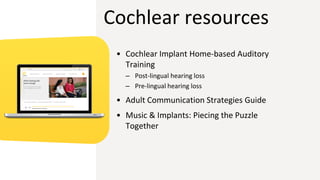
Cochlear resources
• Cochlear Implant Home-based Auditory
Training
– Post-lingual hearing loss
– Pre-lingual hearing loss
• Adult Communication Strategies Guide
• Music & Implants: Piecing the Puzzle
Together
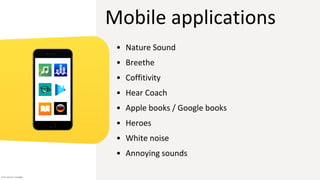
Mobile applications
• Nature Sound
• Breethe
• Coffitivity
• Hear Coach
• Apple books / Google books
• Heroes
• White noise
• Annoying sounds
Icon source: Google
Other websites
• Angel SoundTM
• ESL lab
• YouTube
Icon source: Google
• Home training is crucial for effective communication.
• Parents/ family/ caregivers have more opportunities to
experience, interact & communicate.
• Empower the parents/ caregivers to be the primary person
delivering therapy.
• Boost ideas & help family to come up with innovative ways of
integrating listening.
Summary
Icon source: Flaticon


Session notes_Guides for therapy at home.pdf

  • 1.
  • 2.
    Why home training? Parents •Are the child’s first and best teachers • Are a constant in child’s everyday life • Spend most time interacting with the child • Know the child’s likes, dislikes & interests • Understand their child the best Icon source: Flaticon
  • 3.
    Role of parents •Help set goals with the therapist • Describe daily activities & routine • Learn strategies to be used at home • Report changes & child’s progress • Determine next steps along with the therapist Icon source: Flaticon
  • 9.
    Easy tips • Dailylistening check • Focus on language skills • Use conversational level voice • Practice in a quiet room • Expand language & vocabulary • Use listening strategies • Integrate listening to daily activities Icon source: Flaticon
  • 10.
    Daily listening check •Ling 6 sound test • Conducted separately for each device • Covers entire speech spectrum • Use of toys or Ling soundcards Icon source: Flaticon
  • 11.
  • 12.
    Monday Tuesday WednesdayThursday Friday Saturday Sunday ah ee oo mm sh ss Listening check Icon source: Flaticon

  • 13.
    Monday Tuesday WednesdayThursday Friday Saturday Sunday ah ee oo mm sh ss Listening check Icons source: Flaticon
  • 14.
    Focus on language skills •Emphasis on building language skills first • Develop pre-linguistic skills for younger children • Follow the child’s lead • Avoid repetitions • Tip: Teach language, do not test Icon source: Flaticon आ
  • 15.
    Use conversational level voice •Avoid speaking in very loud tone • Use intonations with babies • Monitor loudness level • Make volume adjustments to the Sound Processor(s) Icon source: Flaticon
  • 16.
    Practice in aquiet room • Focus on listening skills • Control distractions & noise • Optimise room acoustics Icon source: Flaticon
  • 17.
    Expand language & vocabulary •Use complete language • Try to avoid short phrases • Include new words into conversations • Tip: Use speech, not gestures Icon source: Flaticon
  • 18.
    Listening strategies • Useadequate pauses • Practice the 10 second rule • Other strategies – Sound Processor(s) should be worn throughout the day – Be close to the microphone while speaking (only initial stages) – Always maintain auditory presentation before visual – Acoustic highlighting – Auditory sandwich for older children Icon source: Flaticon

  • 19.
    Include listening into theroutine • Listening should be a common goal in every activity • Fit listening activities into the routine • Create opportunities through daily activities Icon source: Flaticon
  • 20.
  • 21.
    Reference: Gillis &Schaerlaekens, 2000 Approximately 80% of what a child learns in their language development is done so incidentally.
  • 22.
    Importance of incidental learning •Aids development of new vocabulary • Encourages a deeper level of curiosity • Skills learned can be generalised in natural & realistic environment Icon source: Flaticon
  • 23.
    Language through cooking • Namethe ingredients & cooking utensils • Describe the food • Explain each step before you do it • If something goes wrong, talk about how you can fix it • Talk about origin of ingredients using descriptive language Icon source: Flaticon
  • 24.
    Language through laundry • Nameeach piece of clothing • Categorise the clothes • Talk about all items that are used • Explain each step like drying, folding & separating Icon source: Flaticon

  • 25.
    Language through reading • Askto point out animations, objects & colours • Make sounds & encourage imitation • Before moving forward, ask them to guess what they think may happen next • Talk about the pictures & objects • Encourage other family members to participate Icon source: Flaticon
  • 26.
    Language through games • Developlistening skills • Improve expressive language abilities • Encourage use of descriptive words • Include games like – I spy – Vocabulary games – Auditory memory games – Simon says Icon source: Flaticon
  • 27.
  • 28.
    Cochlear resources • SoundFoundation – Babies (1-2 years) – Toddlers (2-3 years) – Children (3-4 years) – Starting School Guide • Leap on with language • Listen, learn & talk • Chit-chat
  • 29.
    Mobile applications • LingokidsTM •ABC kids • Easy music for kids • Speech blubs • Minimal pairs • 28 categories for kids • Epic! • Avtar auditory verbal training Icon source: Google
  • 30.
    Other websites • CBeebies •YouTube for kids • Storyline Online • ManyThings • RIDBC hearing resources Icon source: Google
  • 32.
    Practical advice • Getcomfortable with the processor • Practice in quiet room • Practice regularly • Be patient Icon source: Flaticon
  • 33.
    Get comfortable withthe SP • Practice wearing for longer time • Sustained & prolonged use • Understand Sound Processor functionalities & adjustments • Daily device check & maintenance
  • 34.
    Practice in aquiet room • Try to avoid distractions • Optimise room acoustics for easy listening • Practice in comfortable loudness level • Slowly increase complexities Icon source: Flaticon
  • 35.
    Practice regularly • Practicefor 15 to 30 minutes daily • Practice at a fixed time regularly • Listen to different voices Icon source: Flaticon

  • 36.
    Be patient • Hearingrehabilitation may take longer to show results • Focus on listening with Sound Processor(s) alone • Have realistic expectations Icon source: Flaticon
  • 37.
  • 38.
    Level 1 • Wearyour Sound Processor(s) • Watch TV / online media / audio books with captions • Practice reading aloud – newspaper / books • Pay close attention to what is being read Icon source: Flaticon
  • 39.
    Level 2 • WatchTV with captions disabled • Close eyes occasionally to practice listening without visual information • Watch TED talks with captions enabled • Listen to a talk show on the radio or a podcast Icon source: Flaticon
  • 40.
    Level 3 • Startwith video calls to familiar people & subsequently with different people • Increase complexity by moving to regular phone calls • Start in a quiet room & then increase difficulty • Listen to an audiobook without the book to follow • Listen to a TED talk without captions • Watch videos or listen to favorite music with captions enabled Icon source: Flaticon
  • 41.
    Tips • Examine thefactors that influence understanding during conversations • Be an assertive communicator • Use anticipatory & repair strategies Icon source: Flaticon
  • 42.
  • 43.
    Cochlear resources • CochlearImplant Home-based Auditory Training – Post-lingual hearing loss – Pre-lingual hearing loss • Adult Communication Strategies Guide • Music & Implants: Piecing the Puzzle Together
  • 44.
    Mobile applications • NatureSound • Breethe • Coffitivity • Hear Coach • Apple books / Google books • Heroes • White noise • Annoying sounds Icon source: Google
  • 45.
    Other websites • AngelSoundTM • ESL lab • YouTube Icon source: Google
  • 46.
    • Home trainingis crucial for effective communication. • Parents/ family/ caregivers have more opportunities to experience, interact & communicate. • Empower the parents/ caregivers to be the primary person delivering therapy. • Boost ideas & help family to come up with innovative ways of integrating listening. Summary Icon source: Flaticon