Separation Process Principles with Applications
Using Process Simulators 4th Edition J. D.
Seader download
https://ebookgate.com/product/separation-process-principles-with-
applications-using-process-simulators-4th-edition-j-d-seader/
Get Instant Ebook Downloads – Browse at https://ebookgate.com
Get Your Digital Files Instantly: PDF, ePub, MOBI and More
Quick Digital Downloads: PDF, ePub, MOBI and Other Formats
Separation Process Engineering Second Edition Safari
https://ebookgate.com/product/separation-process-engineering-
second-edition-safari/
Process Heat Transfer Principles Applications and Rules
of Thumb 1st Edition Thomas Lestina
https://ebookgate.com/product/process-heat-transfer-principles-
applications-and-rules-of-thumb-1st-edition-thomas-lestina/
Process simulation using WITNESS including lean and Six
sigma applications 1st Edition Raid Al-Aomar
https://ebookgate.com/product/process-simulation-using-witness-
including-lean-and-six-sigma-applications-1st-edition-raid-al-
aomar/
The Research Process 4th Candian Edition Lori Wilkinson
https://ebookgate.com/product/the-research-process-4th-candian-
edition-lori-wilkinson/
Process Dynamics and Control 4th Edition Dale E. Seborg
https://ebookgate.com/product/process-dynamics-and-control-4th-
edition-dale-e-seborg/
Real Estate Development Principles and Process Fifth
Edition Mike E. Miles
https://ebookgate.com/product/real-estate-development-principles-
and-process-fifth-edition-mike-e-miles/
Bayesian Hierarchical Models With Applications Using R
Second Edition Peter D. Congdon (Author)
https://ebookgate.com/product/bayesian-hierarchical-models-with-
applications-using-r-second-edition-peter-d-congdon-author/
Business Process Outsourcing Process Strategies and
Contracts Second Edition Halvey J.K.
https://ebookgate.com/product/business-process-outsourcing-
process-strategies-and-contracts-second-edition-halvey-j-k/
Applications of Random Process Excursion Analysis 1st
Edition Irina S. Brainina
https://ebookgate.com/product/applications-of-random-process-
excursion-analysis-1st-edition-irina-s-brainina/
Trim Size: 8.5in x 11in Seader f02.tex V2 - 11/16/2015 7:25 P.M. Page viii
Trim Size: 8.5in x 11in Seader b02.tex V2 - 09/23/2015 7:15 A.M. Page 1
Factors for Converting AE and CGS Units to SI Units
To convert from To Multiply by
Area
ft2
m2
0.0929
in2
m2
6.452 × 10⁻⁴
Acceleration
ft/h2
m/s2
2.352 × 10⁻⁸
Density
lbm∕ft3
kg/m3
16.02
lbm∕gal (US) kg/m3
119.8
g/cm3
kg/m3
= g/L 1000
Diffusivity, Kinematic Viscosity
ft2
/h m2
/s 2.581 × 10⁻⁵
cm2
/s m2
/s 1 × 10⁻⁴
Energy, Work, Heat
ft-lbf J 1.356
Btu (IT) J 1055
cal (IT) J 4.187
erg J 1 × 10⁻⁷
kW-h J 3.6 × 10⁶
Enthalpy
Btu (IT)/lbm J/kg 2326
cal (IT)/g J/kg 4187
Force
lbf N 4.448
dyne N 1 × 10⁻⁵
Heat-Transfer Coefficient
Btu (IT)/h-ft2
-∘F W/m2
-K 5.679
cal (IT)/s-cm2
-∘C W/m2
-K 4.187 × 10⁻⁴
Interfacial Tension
lbf/ft kg/s2
14.59
dyne/cm kg/s2
1 × 10⁻⁴
Length
ft m 0.3048
in m 0.0254
Mass
lbm kg 0.4536
ton kg 907.2
tonne (metric ton) kg 1000
Trim Size: 8.5in x 11in Seader b02.tex V2 - 09/23/2015 7:15 A.M. Page 2
To convert from To Multiply by
Mass Flow Rate
lbm∕h kg/s 1.26 × 10⁻⁴
lbm∕s kg/s 0.4536
Mass Flux, Mass Velocity
lbm∕h-ft2
kg/s-m2
1.356 × 10⁻³
Power
ft-lbf/h W = J/s 3.766 × 10⁻⁴
ft-lbf W = J/s 1.356
hp W = J/s 745.7
Btu (IT)/h W = J/s 0.2931
Pressure
lbf∕ft2
Pa 47.88
lbf∕in2
Pa 6895
atm Pa 1.013 × 10⁵
Bar Pa 1 × 10⁵
torr = mmHg Pa 133.3
in Hg Pa 3386
in H2O Pa 249.1
Specific Heat
Btu (IT)/lbm-∘F J/kg-K 4187
cal/g-∘C J/kg-K 4187
Surface Tension
lbf/ft N/m 14.59
dyne/cm N/m 0.001
erg/cm2
N/m 0.001
Thermal Conductivity
Btu (I/T)-ft/h-ft2
-∘F W/m-K = J/s-m-K 1.731
cal (IT)-cm/s-cm2
-∘C W/m-K = J/s-m-K 418.7
Velocity
ft/h m/s 8.467 × 10⁻⁵
ft/s m/s 0.3048
Viscosity
lbm/ft-s kg/m-s 1.488
lbm/ft-h kg/m-s 4.134 × 10⁻⁴
cP kg/m-s 0.001
Volume kg/m-s 0.001
ft3
m3
0.02832
L m3
1 × 10⁻³
gal (US) m3
3.785 × 10⁻³
Trim Size: 8.5in x 11in Seader ffirs.tex V1 - 11/05/2015 3:51 P.M. Page i
SEPARATION PROCESS
PRINCIPLES
with Applications Using
Process Simulators
FOURTH EDITION
J. D. Seader
Department of Chemical Engineering
University of Utah
Ernest J. Henley
Department of Chemical Engineering
University of Houston
D. Keith Roper
Ralph E. Martin Department of Chemical Engineering
University of Arkansas
Trim Size: 8.5in x 11in Seader ffirs.tex V1 - 11/11/2015 8:00 P.M. Page ii
VICE PRESIDENT & DIRECTOR Laurie Rosatone
SENIOR DIRECTOR Don Fowley
EXECUTIVE EDITOR Linda Ratts
SPONSORING EDITOR Mary O’Sullivan
ASSISTANT DEVELOPMENT EDITOR Adria Giattino
SENIOR ASSISTANT Courtney Jordan
FREELANCE PROJECT MANAGER Ellen Keohane
PROJECT SPECIALIST Nichole Urban
FREELANCE PROJECT ASSISTANT Anna Melhorn
EXECUTIVE MARKETING MANAGER Daniel Sayre
ASSISTANT MARKETING MANAGER Puja Katariwala
ASSOCIATE DIRECTOR Kevin Holm
SENIOR CONTENT SPECIALIST Nicole Repasky
PRODUCTION EDITOR Linda Christina E
PHOTO RESEARCHER Mary Ann Price
COVER PHOTO CREDIT Courtesy J.D. Seader
This book was set in 10/12 Times LT Std Roman by SPi Global and printed and bound by Lightning Source Inc.
Founded in 1807, John Wiley & Sons, Inc. has been a valued source of knowledge and understanding for more than 200 years, helping people around the world
meet their needs and fulfill their aspirations. Our company is built on a foundation of principles that include responsibility to the communities we serve and
where we live and work.
In 2008, we launched a Corporate Citizenship Initiative, a global effort to address the environmental, social, economic, and ethical challenges we face in our
business. Among the issues we are addressing are carbon impact, paper specifications and procurement, ethical conduct within our business and among our
vendors, and community and charitable support. For more information, please visit our website: www.wiley.com/go/citizenship.
Copyright © 2016, 2011, 2006, 1998 John Wiley & Sons, Inc. All rights reserved. No part of this publication may be reproduced, stored in a retrieval system or
transmitted in any form or by any means, electronic, mechanical, photocopying, recording, scanning or otherwise, except as permitted under Sections 107 or
108 of the 1976 United States Copyright Act, without either the prior written permission of the Publisher, or authorization through payment of the appropriate
per-copy fee to the Copyright Clearance Center, Inc. 222 Rosewood Drive, Danvers, MA 01923, website www.copyright.com. Requests to the Publisher for
permission should be addressed to the Permissions Department, John Wiley & Sons, Inc., 111 River Street, Hoboken, NJ 07030-5774, (201)748-6011, fax
(201)748-6008, website http://www.wiley.com/go/permissions.
Evaluation copies are provided to qualified academics and professionals for review purposes only, for use in their courses during the next academic year. These
copies are licensed and may not be sold or transferred to a third party. Upon completion of the review period, please return the evaluation copy to Wiley. Return
instructions and a free of charge return shipping label are available at www.wiley.com/go/returnlabel. Outside of the United States, please contact your local
representative.
ISBN: 978-1-119-23959-8 (PBK)
ISBN: 978-1-119-22412-9 (EVALC)
Library of Congress Cataloging-in-Publication Data
Names: Seader, J. D. | Henley, Ernest J. | Roper, D. Keith.
Title: Separation process principles with applications using process
simulators / J.D. Seader, Department of Chemical Engineering, University
of Utah, Ernest J. Henley, Department of Chemical Engineering, University
of Houston, D. Keith Roper, Ralph E. Martin Department of Chemical
Engineering, University of Arkansas.
Description: Fourth edition. | Hoboken, NJ : John Wiley & Sons, Inc., 2016. |
Includes bibliographical references and index.
Identifiers: LCCN 2015021981 (print) | LCCN 2015022980 (ebook) | ISBN
9781119239598 (pbk.) | ISBN 9781119141303 (pdf) | ISBN
9781119141297 (epub)
Subjects: LCSH: Separation (Technology)–Textbooks.
Classification: LCC TP156.S45 S364 2016 (print) | LCC TP156.S45 (ebook) | DDC
660/.2842–dc23
LC record available at http://lccn.loc.gov/2015021981
Printing identification and country of origin will either be included on this page and/or the end of the book. In addition, if the ISBN on this page and the back
cover do not match, the ISBN on the back cover should be considered the correct ISBN.
Printed in the United States of America
10 9 8 7 6 5 4 3 2 1
Trim Size: 8.5in x 11in Seader f01.tex V2 - 10/16/2015 7:51 P.M. Page iii
About the Authors
J. D. Seader is Professor Emeritus of Chemical Engineering
at the University of Utah. He received B.S. (summa cum laude)
and M.S. degrees from the University of California at Berkeley
and a Ph.D. from the University of Wisconsin–Madison. From
1952 to 1959, he worked for Chevron Research in Richmond,
California, where he designed petroleum and petrochemical
processes and supervised engineering research, including
the development of one of the first computer-aided process
simulation programs and the first widely used vapor-liquid
equilibrium correlation. From 1959 to 1965, he conducted
rocket engine research on all of the engines that took man
to the moon for the Rocketdyne Division of North American
Aviation in Canoga Park, California. Before joining the fac-
ulty at the University of Utah, where he served for 37 years
from 1966 until 2003, he was a professor at the University
of Idaho. He has authored or coauthored 111 technical arti-
cles, nine books, and four patents and also coauthored the
section on distillation in the sixth and seventh editions of
Perry’s Chemical Engineers’ Handbook. His co-authored
textbooks include FLOWTRAN Simulation—An Introduction
in three editions; Equilibrium-Stage Separation Operations
in Chemical Engineering, Product & Process Design Prin-
ciples in four editions; and the previous three editions of
Separation Process Principles. He was a founding member
and trustee of CACHE for 33 years, serving as executive
officer from 1980 to 1984. From 1975 to 1978, he served
as chairman of the Chemical Engineering Department at the
University of Utah. For 20 years, he directed the use and
distribution of Monsanto’s FLOWTRAN process simulation
computer program to 190 chemical engineering departments
worldwide, helping to usher in the addition of instruction in
computer-aided process design to the chemical engineering
curriculum. For 12 years, he served as an associate editor of
the journal Industrial and Engineering Chemistry Research.
He served as a director of AIChE from 1983 to 1985. In 1983,
he presented the 35th Annual Institute Lecture of AIChE; in
1988, he received the Computing in Chemical Engineering
Award of the CAST Division of AIChE; in 2004, he received
the CACHE Award for Excellence in Chemical Engineering
Education from the ASEE; and in 2004 he was a co-recipient,
with Professor Warren D. Seider, of the Warren K. Lewis
Award for Chemical Engineering Education of the AIChE.
In 2008, as part of the AIChE Centennial Celebration, he
was named one of 30 authors of groundbreaking chemical
engineering books.
Ernest J. Henley is Professor of Chemical Engineering at
the University of Houston. He received his B.S. degree
from the University of Delaware and his Dr. Eng. Sci. from
Columbia University, where he served as a professor from
1953 to 1959. Henley also has held professorships at the
Stevens Institute of Technology, the University of Brazil,
Stanford University, Cambridge University, and the City
University of New York. He has authored or coauthored
72 technical articles and 17 books. For 17 years, he was a
trustee of CACHE, serving as president from 1975 to 1976
and directing the efforts that produced the seven-volume set
of Computer Programs for Chemical Engineering Education
and the five-volume set, AIChE Modular Instruction. An
active consultant, Henley holds nine patents and has served
on the Board of Directors of 12 industrial corporations and
three philanthropies. In 1998, he received the McGraw-Hill
Company Award for “Outstanding Personal Achievement in
Chemical Engineering” and in 2002, received the CACHE
Award of the ASEE for “recognition of his contribution to the
use of computers in chemical engineering education.” He is
president of the Henley Foundation and his biography appears
in Who’s Who in America and Who’s Who in the World.
D. Keith Roper is the Charles W. Oxford Professor of
Emerging Technologies in the Ralph E. Martin Department
of Chemical Engineering at the University of Arkansas.
He is also Program Leader for the Engineering Research
Centers and Network for Computational Nanotechnology at
the National Science Foundation. He received a B.S. degree
(magna cum laude) from Brigham Young University in 1989
and a Ph.D. from the University of Wisconsin–Madison in
1994. He developed processes for cell culture, fermentation,
biorecovery, and analysis of polysaccharide, protein, DNA,
and adenoviral-vectored antigens at Merck & Co. (West
Point, PA); extraction of photodynamic cancer therapeutics
at Frontier Scientific, Inc. (Logan, UT); and virus binding
methods for Millipore Corp (Billerica, MA). Previously,
he held faculty appointments in chemical engineering and
materials science and engineering at the University of Utah.
From 2010 to 2013, he served as Assistant Director of the
Microelectronics-Photonics graduate program at the Univer-
sity of Arkansas. From 2012 to 2014, he served as Program
Director in the Education Engineering and Centers Division
at the National Science Foundation. He is an active consul-
tant with industries in biotechnology, biopharmaceuticals,
iii
Trim Size: 8.5in x 11in Seader f01.tex V2 - 10/16/2015 7:51 P.M. Page iv
iv About the Authors
chemicals, optoelectronics, and energy as well as with uni-
versities in translating discovery to disruptive innovation
through university–industry partnerships. He has authored
or coauthored more than 65 technical articles, one book,
two book chapters, three U.S. patents, and six U.S. patent
applications. He was instrumental in developing one viral and
three bacterial vaccine products, 16 Good Manufacturing Pro-
cess documents, and multiple bioprocess equipment designs.
He is a fellow of the American Institute for Medical and
Biological Engineering and a member of the Arkansas
Academy of Science. He holds memberships in Tau Beta Pi,
ASEE, ACS, SPIE, and AIChE. His research examines elec-
trodynamics in biochemical and nano-optical material systems
important to advanced biomanufacturing, biomedicine, opto-
electronics, and sustainable energy, with recent advances
in computation, nanolithography, spectroscopy, and electron
microscopy of nanoplasmonic metamaterials and polymer thin
films.
Trim Size: 8.5in x 11in Seader f02.tex V2 - 11/16/2015 7:25 P.M. Page v
Preface to the Fourth Edition
INTRODUCTION
Separation Process Principles was first published in 1988 to
provide a rigorous and comprehensive treatment of industrial
separation processes in the form of a student-friendly textbook
format. Both equilibrium-stage and mass-transfer (rate-based)
models were covered. Included also were chapters on thermo-
dynamic and mass-transfer theory for separation operations.
Five of the 15 chapters began with an example of an indus-
trial separation process and descriptions of how and why
modern process design techniques evolved. The 2006 second
edition expanded the coverage of mass-transfer-based design
methods by adding three new chapters (16, 17, and 18)
covering leaching, washing, crystallization, desublimation,
evaporation, and drying of solids. In the 2011 third edition,
the content was enlarged to include approximately 175 pages
on biochemical separations as well as a new Chapter 19
covering mechanical phase separations such as filtration
and centrifugation. The title of the third edition, Separation
Process Principles—Chemical and Biochemical Operations,
reflected this expansion.
This new condensed fourth edition focuses on material
widely taught in undergraduate separations courses and
on process simulations using Aspen Plus, CHEMCAD, and
ChemSep to design separation operations. Hence, the new title
for the fourth edition: Separation Process Principles–with
Applications Using Process Simulators. Professor Seader
began using process simulation programs in 1957 while
engaged in process design in the petroleum industry and was
the AIChE Institute Lecturer on this subject in 1984. Professor
Henley founded what is now Chemstations and was its first
president (when it was named COADE). Professor Roper
introduced simulation to vaccine process development in
1997. Authors of this fourth edition believe that students who
learn to solve separation problems with process simulators as
juniors will be well prepared to tackle difficult process design
problems in their senior year. The fourth edition provides com-
parisons of features of process simulators as well as examples
of how they are used to solve industrial-level design problems.
Much of the material removed from the third edition—
biochemical separation process principles in: sections of
Chapters 1, 2, 3, 8, 14, and 15; Chapters 16, 17, and 18,
and Chapter 19 on mechanical phase separations—is being
prepared by the authors for inclusion in a volume devoted to
bioseparation operations. Meanwhile, this content will remain
available from the publisher in the third edition.
STUDENT-FRIENDLY FEATURES
Each chapter begins by stating an average of nine instructional
objectives to give the student an introduction to the author’s
expectations. In chapters that introduce separation technology,
this is followed by a flow sheet and description of an industrial
process to demonstrate how the technology is used to create
saleable products. The theory needed to design equipment or
simulate a separation operation is developed and applications
are demonstrated by more than 200 examples, many of which
make use of process simulators.
Each chapter ends with study questions suitable for class
discussion (the inverted classroom) or qualitative examination
questions. There are more than 600 homework exercises,
many of which require the use of a process simulator. Other
examples and exercises involve nonlinear equations with rec-
ommendations for using Matlab to solve them. In preparation
of the fourth edition, text was clarified based on student feed-
back, and errors were eliminated. Following a suggestion by
some reviewers, chapter-specific nomenclature sections have
been added. A general nomenclature lists symbols common
to many of the chapters. Each chapter-specific nomenclature
keys symbols to equations, figures, or chapter sections. These
revisions in the fourth edition reflect our desire to prepare an
accessible introduction to chemical separations that includes
the methods and equations used by process simulators and the
problems and opportunities this has created.
TOPICAL ORGANIZATION
Chapter 1 provides the student with a classification of
separation operations and an overview of industrial chemical
engineering separations. The next two chapters review ther-
modynamics and mass transfer, as applied to separation
operations, at a level consistent with the level of this book.
Chapter 4, which introduces design specifications, and
equilibrium flash calculations are a prerequisite for all sub-
sequent chapters. Chapter 5, which is also a prerequisite for
all subsequent chapters, extends the single-stage concept
to multiple-equilibrium-stage processing units, including a
degrees-of-freedom analysis for determining the number of
design variables that can be specified for a given separation
process. A further prerequisite is Chapter 6, which describes
trays and packing, introduces general graphical methods,
stage efficiencies, and a transfer unit design method for
packed units.
v
Trim Size: 8.5in x 11in Seader f02.tex V2 - 11/16/2015 7:25 P.M. Page vi
vi Preface to the Fourth Edition
Once the contents of the first six chapters have been
mastered, the subsequent chapters can be studied in any
order preferred by the reader or the instructor, with a few
exceptions: (1) Concepts of minimum stage and minimum
reflux are mentioned early in the text, but a quantitative elab-
oration, using McCabe–Thiele diagrams, resides in Section
7.2. McCabe–Thiele diagrams are used in three other chapters
to help readers visualize concepts such as pinch points.
(2) Unique technology such as Freundlich and Langmuir
isotherms is fully developed in Chapter 15 but applied earlier.
(3) Mathematical tools such as solution methods for stiff
differential equations and the Newton–Raphson method for
solving nonlinear algebraic equations are described where
applied. In these three instances, the reader is referred to a
book section where the technique is fully developed.
To help students obtain an awareness of a section’s com-
plexity, section titles listed in the table of contents include the
following symbols as prefixes:
∗ Important for a basic understanding of separations and
therefore recommended for presentation in class, unless
already covered in a previous course.
o Optional because the material is descriptive, probably
covered in a previous course, or can be read outside of
class with little or no discussion in class.
• Advanced material suitable for an undergraduate course
if students are familiar with, and have access to, a process
simulator.
NEW TO THIS EDITION
The focus on using process simulators to design separa-
tion processes required some rearrangement and revision of
Chapters 1, 2, and 4–13, which deal with operations covered
in process simulators. Many of the examples and exercises
have been revised and new ones added. Some chapters contain
correlations that stretch the state of the art. Chapter 7, for
example, develops an improved method for obtaining plate
efficiencies for sieve-tray columns that is just beginning to
appear in process simulators.
HELPUL WEBSITES In the 1980s, local computer net-
works began to interconnect in a global system, called the
Internet. In late 1990, Tim Berners-Lee at the European
Organization for Nuclear Research (CERN), Switzerland,
completed all the tools required for sharing information over
the Internet. This included the HyperText Transfer Protocol
(HTTP), the HyperText Markup Language (HTML), and a
document-information system called the World Wide Web
(WWW). In early 1991, the first-known web page was sent
over the internet by Lee to Paul Jones of UNC-Chapel Hill.
Physicists around the world could now quickly and efficiently
share data. Later that year, the WWW became available to
the public, but its popularity was restrained until the release
of the Mosaic web browser in December 1992. Today the
combination of a web browser (e.g., Chrome, Firefox, and
Internet Explorer) and a general search engine (e.g., Google,
Yahoo, Bing, and Ask) has made it so simple to search for
information that the number of internet users has increased
from about 400 million in 2000 to almost 3 billion (compared
to a world population of 7.2 billion) in 2014.
Some useful websites for the study of separation pro-
cesses are presented in chapters of this book. However, such
websites are sometimes removed from the Internet. Readers
of this book are encouraged to conduct their own searches by
using key words. Many subjects have articles in the Wikipedia,
a free, open-ended encyclopedia on the internet. An initial
search, where the word “wiki” is added to the key word(s) is
often useful. For example, if the key words “distillation wiki”
are entered in the Google search engine, a 13-page article
appears that provides excellent background material on a wide
spectrum of the subject.
The 15 most-used websites are:
Search engines (Google, Yahoo, Bing, and Ask)
Social networking websites (Facebook, Twitter, Instagram,
LinkedIn, and Pinterest)
News, Entertainment, Purchases, and Information
(YouTube, Amazon, eBay, MSN)
Blog creation (WordPress)
Students using this book are encouraged to communicate
with each other and their instructors via social networking
websites to enhance their learning of separation processes.
RESOURCES FOR INSTRUCTORS
The website www.wiley.com/college/seader furnishes the fol-
lowing resources in the Instructor Companion Site:
1. Instructor’s Solution Manual
2. Resources for Instructors-An introduction
3. Image Gallery
4. PowerPoint slides
5. Sample Preliminary Examination
6. Suggestions for Completing Homework Exercise
7. Suggested Review of Prerequisite Material
Instructors adopting this book must request a password from
their Wiley sales representative.
RESOURCES FOR STUDENTS
Students are encouraged to consult www.wiley.com/college/
seader for the following resources in the Student Companion
Site:
1. Suggestions for Completing HW Exercises
2. Suggested Review of Prerequisite Material
Trim Size: 8.5in x 11in Seader f02.tex V2 - 11/16/2015 7:25 P.M. Page vii
Preface to the Fourth Edition vii
ACKNOWLEDGEMENTS
Since publication of the 3rd edition of this book, the authors
have received valuable comments, corrections, and sug-
gestions from Professor Phillip R. Westmoreland of North
Carolina University, Professor Shuguang Deng of New
Mexico State University, Professor Daniel E. Rosner of Yale
University, and particularly Professor N. Lawrence Ricker of
the University of Washington.
The selection of the content for the 4th edition was greatly
influenced by the responses of reviewers to two surveys con-
ducted by Wiley.
Dr. D. Keith Roper is currently on intergovernmental
personnel assignment with the National Science Foundation.
Any opinions, findings, and conclusions or recommenda-
tions expressed in this book are those of the authors and
do not necessarily reflect the views of the National Science
Foundation.
J. D. Seader
Ernest J. Henley
D. Keith Roper
Trim Size: 8.5in x 11in Seader f02.tex V2 - 11/16/2015 7:25 P.M. Page viii
Trim Size: 8.5in x 11in Seader ftoc.tex V1 - 10/16/2015 7:52 P.M. Page ix
Contents
About the Authors iii
Preface to the Fourth Edition v
General Nomenclature xiii
Dimensions and Units xvii
1. Separation Processes 1
1.0∗
Instructional Objectives 1
1.1∗ Industrial Chemical Processes 1
1.2∗
Basic Separation Techniques 3
1.3⚬
Separations by Phase Creation 4
1.4⚬
Separations by Phase Addition 6
1.5⚬
Separations by Barrier 7
1.6⚬
Separations by an External Field or
Gradient 7
1.7∗ Brief Comparison of Common Separation
Operations 8
1.8∗
Separation Processes, Product Purity,
Component Recovery, and Separation
Sequences 9
Summary, References, Study Questions,
Exercises
2. Thermodynamics of Separation Operations 16
2.0∗
Instructional Objectives 16
2.1∗
Phase Equilibria 16
2.2∗
Ideal-Gas, Ideal-Liquid-Solution Model 20
2.3⚬
Graphical Representation of Thermodynamic
Properties 21
2.4⚬ Nonideal Thermodynamic Property
Models 23
2.5⚬
P-v-T Equation-of-State (EOS) Models 23
2.6⚬
Highly Nonideal Liquid Solutions 27
2.7⚬
Gibbs Excess Free-Energy (gE
) Models 29
2.8⚬
Predictive Models 34
2.9⚬
Electrolyte Solution Models 36
2.10⚬ Polymer Solution Models 36
2.11∗
K-Value Methods in Process Simulators 36
2.12∗ Exergy and Second-Law Analysis 37
Nomenclature, Summary, References, Study
Questions, Exercises
3. Mass Transfer and Diffusion 46
3.0∗
Instructional Objectives 46
3.1∗
Steady-State, Ordinary Molecular
Diffusion 47
3.2∗
Diffusion Coefficients (Diffusivities) 51
3.3∗
Steady-State and Unsteady-State Mass Transfer
Through Stationary Media 58
3.4∗ Mass Transfer in Laminar Flow 60
3.5∗
Mass Transfer in Turbulent Flow 68
3.6∗ Models for Mass Transfer in Fluids with a
Fluid–Fluid Interface 73
3.7∗
Two-Film Theory and Overall Mass-Transfer
Coefficients 76
Nomenclature, Summary, References, Study
Questions, Exercises
4. Single Equilibrium Stages and Flash
Calculations 87
4.0∗
Instructional Objectives 87
4.1∗ Gibbs’ Phase Rule and Degrees of
Freedom 88
4.2∗ Binary Vapor–Liquid Systems at
Equilibrium 89
4.3∗
Equilibrium Two-Phase Flash Calculations 93
4.4∗
Ternary Liquid–Liquid Systems at
Equilibrium 97
4.5⚬
Multicomponent Liquid–Liquid Systems 101
4.6∗
Liquid–Solid Systems 102
4.7∗ Gas–Liquid Systems 104
4.8∗
Gas–Solid Systems 105
4.9⦁
Three-Phase Equilibrium Systems 107
Nomenclature, Summary, References, Study
Questions, Exercises
5. Multistage Cascades and Hybrid Systems 118
5.0∗
Instructional Objectives 118
5.1∗
Cascade Configurations 118
5.2∗
Single-Section Liquid–Liquid Extraction
Cascades 119
ix
Trim Size: 8.5in x 11in Seader ftoc.tex V1 - 10/16/2015 7:52 P.M. Page x
x Contents
5.3∗
Two-Section Distillation Cascades 121
5.4⚬
Membrane Cascades 123
5.5⚬
Hybrid Systems 125
5.6∗
Degrees of Freedom and Specifications for
Cascades 125
Nomenclature, Summary, References, Study
Questions, Exercises
6. Absorption and Stripping 137
6.0∗
Instructional Objectives 137
6.1⚬ Equipment for Vapor–Liquid
Separations 138
6.2⚬ General Design Considerations 143
6.3∗
Graphical Method for Trayed Towers 144
6.4∗
Kremser Group Method for Multicomponent
Absorption and Stripping 148
6.5∗
Stage Efficiency and Column Height for Trayed
Columns 154
6.6∗
Flooding, Column Diameter, and Tray Layout
for Trayed Columns 161
6.7∗
Rate-Based Method for Packed Columns 164
6.8∗
Packed-Column Liquid Holdup, Diameter,
Flooding, Pressure Drop, and Mass-Transfer
Efficiency 169
6.9⦁
Reactive (Chemical) Absorption 180
Nomenclature, Summary, References, Study
Questions, Exercises
7. Distillation of Binary Mixtures 191
7.0∗
Instructional Objectives 191
7.1⚬
Equipment and Design Considerations 193
7.2∗
McCabe–Thiele Graphical Method for Trayed
Towers 193
7.3⚬ Extensions of the McCabe–Thiele
Method 203
7.4∗
Estimation of Tray Efficiency for
Distillation 208
7.5∗
Column and Reflux-Drum Diameters 215
7.6∗
Rate-Based Method for Packed Distillation
Columns 216
Nomenclature, Summary, References, Study
Questions, Exercises
8. Liquid–Liquid Extraction with Ternary
Systems 231
8.0∗
Instructional Objectives 231
8.1⚬ Equipment for Solvent Extraction 233
8.2⚬
General Design Considerations 239
8.3∗
Hunter–Nash Graphical Equilibrium-Stage
Method 243
8.4⚬
Theory and Scale-Up of Extractor
Performance 252
Nomenclature, Summary, References, Study
Questions, Exercises
9. Approximate Methods for Multicomponent
Distillation 267
9.0∗
Instructional Objectives 267
9.1∗
Fenske–Underwood–Gilliland (FUG)
Method 267
9.2∗
Using the Shortcut (FUG) Method with Process
Simulators 279
Nomenclature, Summary, References, Study
Questions, Exercises
10. Equilibrium-Based Methods for Multicomponent
Absorption, Stripping, Distillation, and
Extraction 284
10.0∗
Instructional Objectives 284
10.1∗ Simple Model for a Vapor–Liquid Equilibrium
Stage 284
10.2⦁ Evolution of Methods for Solving the Mesh
Equations 286
10.3∗
Strategies for Applying Process-Simulator
Methods 287
10.4∗
Main Mathematical Procedures 291
10.5∗
Bubble-Point (BP) and Sum-Rates (SR)
Methods 294
10.6∗ Simultaneous-Correction Method 297
10.7∗
Inside-Out Method 304
10.8⦁ Rigorous Methods for Liquid–Liquid
Extraction 309
Nomenclature, Summary, References, Study
Questions, Exercises
11. Enhanced Distillation and Supercritical
Extraction 320
11.0∗ Instructional Objectives 320
11.1∗
Use of Triangular Graphs 321
11.2∗
Extractive Distillation 332
11.3⦁
Salt Distillation 335
11.4⦁
Pressure-Swing Distillation 337
11.5⦁
Homogeneous Azeotropic Distillation 339
11.6∗
Heterogeneous Azeotropic Distillation 343
Trim Size: 8.5in x 11in Seader ftoc.tex V1 - 10/16/2015 7:52 P.M. Page xi
Contents xi
11.7⦁ Reactive Distillation 352
11.8⦁
Supercritical-Fluid Extraction 357
Nomenclature, Summary, References, Study
Questions, Exercises
12. Rate-Based Models for Vapor–Liquid Separation
Operations 368
12.0⦁
Instructional Objectives 368
12.1⦁ Rate-Based Model 370
12.2⦁
Thermodynamic Properties and Transport-Rate
Expressions 372
12.3⦁
Methods for Estimating Transport Coefficients
and Interfacial Area 375
12.4⦁
Vapor and Liquid Flow Patterns 375
12.5⦁
Method of Calculation 376
Nomenclature, Summary, References, Study
Questions, Exercises
13. Batch Distillation 385
13.0∗
Instructional Objectives 385
13.1∗ Differential Distillation 385
13.2∗
Binary Batch Rectification 388
13.3⦁ Batch Stripping and Complex Batch
Distillation 390
13.4⦁
Effect of Liquid Holdup 391
13.5∗
Stage-by-Stage Methods for Batch
Rectification 391
13.6∗
Intermediate-Cut Strategy 400
13.7⦁
Optimal Control by Variation of Reflux
Ratio 401
Nomenclature, Summary, References, Study
Questions, Exercises
∗Suitable for an UG course
⚬Optional
⦁Advanced
14. Membrane Separations 408
14.0∗
Instructional Objectives 408
14.1⚬
Membrane Materials 410
14.2⚬
Membrane Modules 414
14.3∗ Mass Transfer in Membranes 416
14.4∗
Dialysis 430
14.5⚬
Electrodialysis 432
14.6∗
Reverse Osmosis 434
14.7∗
Gas Permeation 438
14.8⚬
Pervaporation 441
Nomenclature, Summary, References, Study
Questions, Exercises
15. Adsorption, Ion Exchange, and
Chromatography 451
15.0∗
Instructional Objectives 451
15.1∗
Sorbents 453
15.2∗ Equilibrium Considerations 461
15.3∗
Kinetic and Transport Rate
Considerations 470
15.4⚬
Equipment for Sorption Operations 475
15.5∗
Slurry and Fixed-Bed Adsorption
Systems 479
15.6∗
Continuous, Countercurrent Adsorption
Systems 494
15.7⚬
Ion-Exchange Cycle 502
15.8∗ Chromatographic Separations 503
Nomenclature, Summary, References, Study
Questions, Exercises
Answers to Selected Exercises 519
Index 521
Trim Size: 8.5in x 11in Seader ftoc.tex V1 - 10/16/2015 7:52 P.M. Page xii
Trim Size: 8.5in x 11in Seader f03.tex V2 - 10/16/2015 7:52 P.M. Page xiii
General Nomenclature
All symbols are defined in the text where they first appear.
The list below contains only those symbols that are com-
mon to two or more chapters.
Other symbols are listed in chapter-specific nomenclatures
at the end of each chapter.
Abbreviations and Acronyms
BWR Benedict–Webb–Rubin EOS, §2.5
CSTR completely stirred tank or reactor, §3.6.3
CW (cw) cooling water, Figure 2.11
DAE differential-algebraic equations, §13.5.2
DDB Dortmund data bank, §2.5.3
DDBST DDB software package, §2.5.3
DECHEMA data bank, §2.5.3
EM equimolar diffusion, Table 6.5
EOS equation of state (P-v-T relationship), §2.2
ESA energy-separation agent, Table 1.1
FUG Fenske–Underwood–Gilliland method, §9.1
HEPT height equivalent to a theoretical plate,
(6-68)
HETS height equivalent to a theoretical stage,
(6-68)
HHK heavier than the heavy key, Figure 9.6
HK heavy key, §9.1
HTU height of a transfer unit, §6.8.3
LK light key, §9.1
LKP Lee–Kessler–Plöcker EOS, §2.11
LLK lighter than the light key, Figure 9.6
LM log mean, (3-33)
LW lost work, Table 2.10
MSA mass-separation agent, Table 1.2
MW molecular weight
NRTL nonrandom, two-liquid model, Table 2.8
NTU number of transfer units, Table 6.5
ODE ordinary differential equations, §13.5.2
PR Peng–Robinson EOS, Table 2.8
PSRK predictive SRK method, §2.8.2
RK Redlich–Kwong EOS, §2.8.2
STP standard conditions, 1 atm, 0∘C
SRK Suave–Redlich–Kwong EOS, Table 2.8
UNIFAC functional group activity coefficient
method, Table 2.8
UM unimolecular diffusion, Table 6.5
UNIQUAC universal quasichemical theory method,
Table 2.8
VLE vapor–liquid equilibrium, Figure 4.6
VLLE vapor–liquid–liquid equilibrium, §11.8
VOC volatile organic compounds
VTPR volume-translated P-R EOS, §2.8.3
Wilson Wilson EOS, Table 2.8
Latin Symbols
Å Angstrom, §14.1
A mass-transfer area, (3-13)
A absorption factor, L/KV, (5-38)
a interfacial area per unit volume, (14-5);
activity, Table 2.1
B identifier for bottoms, Figure 1.12
B bottoms molar flow rate, Figure 5.15
C identifier for condenser, Figure 1.12
C components, (4-1)
CD drag coefficient, Table 3.9
CP heat capacity at constant pressure, (2-38)
c liquid concentration, moles/volume,
(3-40)
D an identifier for distillate, Figure 1.12
DAB molecular diffusivity of A in B, (3-3a)
Di solute diffusivity, (14-14)
DK Knudsen diffusivity, (14-18)
De effective diffusivity, (3-49)
D distillate flow rate, Figure 5.7; diameter,
(3-121)
dH hydraulic diameter, (14-5)
dP particle diameter, (6-58)
E extract mass flow rate, Figure 5.2
E an identifier for extract phase, Figure 5.2
E extraction factor, (4-35)
EMV Murphree vapor tray efficiency, (6-53)
Eo stage (plate efficiency), (6-41)
EOV Murphree vapor point efficiency, (6-51)
F molar feed rate, Example 1.1
F identifier for feed, Figure 1.2
F Faraday’s constant, (3-47)
FD drag force, (6-57)
f pure component fugacity, §2.1.1; Fanning
friction factor, Table 3.9
xiii
Trim Size: 8.5in x 11in Seader f03.tex V2 - 10/16/2015 7:52 P.M. Page xiv
xiv General Nomenclature
fo fugacity at standard state, (2-14)
f partial fugacity, (2-7)
G Gibbs free energy, §2.1: mass velocity,
(3-145)
g Gibbs molar free energy, §2.1; gravitational
constant, (6-94)
gE excess free energy, (2-62)
gc force to mass conversion factor in AE
system of units
H Henry’s law constant (2-31); vessel height,
Figure 4.18
ΔH vap
enthalpy of vaporization, (2-43)
HL height of a mass-transfer unit (L) liquid or
(V) vapor, Table 6.5
HOL height of an overall mass-transfer unit (L or
V), Table 6.5
h molar enthalpy, §2.2; heat transfer
coefficient, (15-18)
ho ideal gas molar enthalpy, §2.2
J molar flux by molecular diffusion relative to
mixture, (3-3)
j mass flux relative to mixture, (3-5)
jD, jH, jM Chilton–Colburn factors for mass, heat, and
momentum transfer (3-147)
j-factor Table 3.9
K vapor–liquid equilibrium ratio (K-value),
(2-18)
K various subscripted overall mass-transfer
coefficients, Tables 6.5 and 3.12, §3.7.1
KD distribution ratio, partition coefficient,
(2-19)
K′
D liquid–liquid equilibrium ratio in mole or
mass ratios (4-33)
k various subscripted individual mass-transfer
coefficients, Tables 6.5 and 3.12, §3.7.1
k thermal conductivity, (3-2)
L liquid molar flow rate, Table 1.1; length,
(3-82)
LR liquid reflux flow rate, Figure 5.8
L liquid molar flow rate in stripping section,
Figure 7.5
l component liquid flow rate, (6-15); packed
height, Figure 6.25
lM membrane thickness, (14-1)
M molecular weight
m slope of equilibrium curve dy/dx, Figure
(3-16)
N number of moles, (2.1); number of stages
(5-7); flux, molar flow/area (3-1)
molar trans-membrane flux, (14-1)
NA Avogadro’s number, (3-38)
ND degrees of freedom, number of design
variables, (4-1)
NE number of independent equations, (4-3)
NP number of phases, (4-1)
NV number of variables, (4-1)
NFr Froude number, Table 3.9
NLe Lewis number, Table 3.9
NNu Nusselt number, Table 3.9
NPe Peclet number, Table 3.9
NRe Reynolds number, Table 3.9
NSc Schmidt number, Table 3.9
NSh Sherwood number, Table 3.9
NSt Stanton number, Table 3.9
NWe Weber number, Table 3.9
NG number of gas phase (G) or liquid phase (L)
mass-transfer units, Table 6.5
NOG number of overall gas (G) or liquid phase
(L) mass-transfer units, Table 6.5
n molar flow rate, Example 1.1; mass transfer
rate, §6.5.4
P pressure, (2-1); product flow rate, Figure 5.3
Ps
vapor pressure, (2-13)
PM permeability, KD, (14-1), (14-27)
PM = PM∕lM permeance, (14-1)
p partial pressure (for designated component)
Q rate of heat transfer, (4-17); volumetric flow
rate, (7-51)
q heat flux, Q∕A, (3-2); q –line, (4-11)
R universal gas constant, (3-47): retentate,
Example 1.1
R reflux ratio L/D, Table 7.2; raffinate flow
rate, Figure 5.2
R identifier for reflux, Example 2.5: raffinate,
Figure 4.14
r radius, (3-54)
S entropy (2-2); solvent flow rate, (4-32); side
stream, Table 5.4
S stripping factor, (5-51)
ΔSirr irreversible change in entropy, Table 2.11
S identifier for solvent, §4.4
s molar entropy, Table 2.3
T temperature, (2-1)
Tc critical temperature, Table 15.4
Tr reduced temperature, T/Tc, (2-49)
t time
u liquid velocity, (3-71)
V molar vapor flow rate, Table 1.1; volume,
(2-2)
V molar vapor flow in stripping section,
Figure 7.5
Trim Size: 8.5in x 11in Seader f03.tex V2 - 10/16/2015 7:52 P.M. Page xv
General Nomenclature xv
v kinematic viscosity (6-98); vapor
component flow rate, (6-13); liquid molar
volume, (3-43); pore flow velocity, (14-2)
Ws shaft work, Table 2.11
w mass fraction, (3-5)
X mass or mole ratio in liquid, (4-32)
x liquid mole fraction
Y mass or mole ratio in vapor,
Figure 4.19
y vapor mole fraction
z mole fraction of feed component,
Figure 2.9
Z compressibility factor, (2-49)
Greek Symbols
αAB relative volatility, KA∕KB, (4-10)
β relative selectivity, (2-21), (8-4)
γ activity coefficient, Table 2.1
Δ change in value of variable
ε porosity, (15-2)
η second-law efficiency, Table 2.10
μ viscosity, (3-38), chemical potential or partial
molar Gibbs free energy, (2-2)
ρ mass density
ρL liquid mass density, (2-41)
ρV vapor mass density, Table 2.3
σ liquid surface tension, (3-43)
τ tortuosity, (3-49)
ϕ pure species fugacity coefficient, Table 2.1
ϕs pure species fugacity coefficient at saturation
pressure, (2-30)
ϕ partial fugacity coefficient, Table 2.1
̄
Φ local volume fraction, §2.7.1
ω acentric factor, (2-48)
Subscripts
A,B,C components, Figure 5.4
B bottoms, (7-4)
C condenser, (7-37)
D distillate, (7-4)
F feed, (7-6)
c critical point, §2.5
i component in a mixture
irr irreversible
min minimum
j stage, Figure 10.1
n stage, (6-11)
R reboiler, (7-37)
r reference component, (9-14)
sat saturated
x in the x direction
y in the y direction
z in the z direction
o datum (reference state), 1 atm., 25∘C
∞ infinity
Superscripts
F feed, (4-32)
N number of stages, (5-7): a stage, (5-15)
R raffinate, Figure 5.4
s saturation vapor pressure, (2-28)
o reference state, Table 2.3
* phase equilibrium value (with respect to
another phase), Figure 3.16
– average, (3-74); partial molar property, (2-8)
′ derivative, (4-28); mass instead of moles, for
K and D values, etc., (4-33); normalized
values, §4.5; solute free gas or adsorbent, §6.3
Trim Size: 8.5in x 11in Seader f03.tex V2 - 10/16/2015 7:52 P.M. Page xvi
Trim Size: 8.5in x 11in Seader f04.tex V2 - 10/16/2015 7:52 P.M. Page xvii
Dimensions and Units
Chemical engineers must be proficient in the use of three systems of units: (1) the Interna-
tional System of Units, SI System (Systeme Internationale d’Unites), which was established
in 1960 by the 11th General Conference on Weights and Measures and has been widely
adopted; (2) the AE (American Engineering) System, which is based largely upon an English
system of units adopted when the Magna Carta was signed in 1215 and is a preferred system
in the United States; and (3) the CGS (centimeter-gram-second) System, which was devised
in 1790 by the National Assembly of France, and served as the basis for the development
of the SI System. A useful index to units and systems of units is given on the website
http://www.sizes.com/units/index.php.
Engineers must deal with dimensions units, and values to express numerical quantities.
Thus, for 10 gallons of gasoline, the dimension is volume, the unit is gallons, and the value
is 10. As detailed in NIST (National Institute of Standards and Technology) Special Publi-
cation 811, Guide for the Use of the International System of Units (SI), 2008 edition, which
is available at the website http://www.nist.gov/physlab/pubs/sp811/index.cfm, units are base
or derived.
BASE UNITS
The base units are those that are independent, cannot be subdivided, and are accurately defined.
The base units are for dimensions of length, mass, time, temperature, molar amount, electrical
current, and luminous intensity, all of which can be measured independently. Derived units
are expressed in terms of base units or other derived units and include dimensions of vol-
ume, velocity, density, force, and energy. In this book we deal with the first five of the base
dimensions. For these, the base units are:
Base Dimension SI Unit AE Unit CGS Unit
Length meter, m foot, ft centimeter, cm
Mass kilogram, kg pound, lbm gram, g
Time second, s hour, h second, s
Temperature kelvin, K Fahrenheit, ∘F Celsius, ∘C
Molar amount gram-mole, mol pound-mole, lbmol gram-mole, mol
ATOM AND MOLECULE UNITS
atomic weight = atomic mass unit = the mass of one atom
molecular weight (MW) = molecular mass (M) = formula weight∗
= formula mass∗
= the
sum of the atomic weights of all atoms in a molecule ( ∗also applies to ions)
1 atomic mass unit (amu or u) = 1 universal mass unit = 1 dalton (Da) = 1∕12 of the mass of
one atom of carbon-12 = the mass of one proton or one neutron
The units of MW are amu, u, Da, g∕mol, kg∕kmol, or lb∕lbmol (the last three are most
convenient when MW appears in a formula).
The number of molecules or ions in one mole = Avogadro’s number = 6.022 × 10²³.
xvii
Trim Size: 8.5in x 11in Seader f04.tex V2 - 10/16/2015 7:52 P.M. Page xviii
xviii Dimensions and Units
DERIVED UNITS
Many derived dimensions and units are used in chemical engineering. Some are listed in the
following table:
Derived Dimension SI Unit AE Unit CGS Unit
Area = Length2
m2
ft2
cm2
Volume = Length3
m3
ft3
cm3
Mass flow rate = Mass/Time kg/s lbm/h g/s
Molar flow rate = mol/s lbmol/h mol/s
Molar amount/Time
Velocity = Length/Time m/s ft/h cm/s
Acceleration = Velocity/Time m/s2
ft/h2
cm/s2
Force = Mass ⋅ Acceleration newton, N = 1 kg-m/s2
lbf dyne = 1 g-cm/s2
Pressure = Force/Area pascal, Pa =
1 N/m2
=
1 kg/m-s2
lbf/in.2
atm
Energy = Force ⋅ Length joule, J =
1 N-m =
1 kg-m2
/s2
ft-lbf, Btu erg = 1 dyne-cm =
1 g-cm2
/s2
, cal
Power = Energy/Time =
Work/Time
watt, W =
1 J/s =
1 N-m/s
1 kg-m2
/s3
hp erg/s
Density = Mass/Volume kg/m3
lbm/ft3
g/cm3
OTHER UNITS ACCEPTABLE FOR USE WITH THE SI SYSTEM
A major advantage of the SI System is the consistency of the derived units with the base units.
However, some acceptable deviations from this consistency and some other acceptable base
units are given in the following table:
Dimension Base or Derived SI Unit Acceptable SI Unit
Time s minute (min), hour (h), day (d), year (y)
Volume m3
liter (L) = 10−3
m3
Mass kg metric ton or tonne (t) = 103
kg
Pressure Pa bar = 105
Pa
PREFIXES
Also acceptable for use with the SI System are decimal multiples and submultiples of SI units
formed by prefixes. The following table lists the more commonly used prefixes:
Prefix Factor Symbol
tera 1012
T
giga 109
G
mega 106
M
kilo 103
k
deci 10−1
d
centi 10−2
c
milli 10−3
m
micro 10−6
μ
nano 10−9
n
pico 10−12
p
Trim Size: 8.5in x 11in Seader f04.tex V2 - 10/16/2015 7:52 P.M. Page xix
Dimensions and Units xix
USING THE AE SYSTEM OF UNITS
The AE System is more difficult to use than the SI System because of the units for force,
energy, and power. In the AE System, the force unit is the pound-force, lbf, which is defined to
be numerically equal to the pound-mass, lbm, at sea-level of the earth. Accordingly, Newton’s
second law of motion is written,
F = m
g
gc
where F = force in lbf, m = mass in lbm, g = acceleration due to gravity in ft∕s2, and, to
complete the definition, the constant gc = 32.174 lbm-ft∕lbf-s2, where 32.174 ft∕s2 is the
acceleration due to gravity at sea-level of the earth. The constant gc is not used with the SI
System or the CGS System because the former does not define a kgf and the CGS System does
not use a gf.
Thus, when using AE units in an equation that includes force and mass, incorporate gc to
adjust the units.
EXAMPLE OF UNIT CONVERSIONS
A 5.000-pound-mass weight, m, is held at a height, h, of 4.000 feet above sea-level. Calculate its potential energy above sea-level, P.E. = mgh,
using each of the three systems of units. Factors for converting units are given on the inside front cover of this book.
SI System:
m = 5.000 lbm = 5.000(0.4536) = 2.268 kg
g = 9.807 m∕s2
h = 4.000 ft = 4.000(0.3048) = 1.219 m
P.E. = 2.268(9.807)(1.219) = 27.11 kg-m2
∕s2
= 27.11 J
CGS System:
m = 5.000 lbm = 5.000(453.6) = 2268 g
g = 980.7 cm∕s2
h = 4.000 ft = 4.000(30.48) = 121.9 cm
P.E. = 2268(980.7)(121.9) = 2.711 × 10⁸
g-cm2
∕s2
= 2.711 × 10⁸
erg
AE System:
m = 5.000 lbm
g = 32.174 ft∕s2
h = 4.000 ft
P.E. = 5.000(32.174)(4.000) = 643.5 lbm-ft2
∕s2
However, the accepted unit of energy for the AE System is ft-lbf, which is obtained by dividing by gc. Therefore, P.E. = 643.5/32.174 =
20.00 ft-lbf.
Another difficulty with the AE System is the differentiation between energy as work and energy as heat. As seen in the preceding table,
the work unit is ft-lbf, while the heat unit is Btu. A similar situation exists in the CGS System with corresponding units of erg and calorie
(cal). In older textbooks, the conversion factor between work and heat is often incorporated into an equation with the symbol J, called Joule’s
constant or the mechanical equivalent of heat, where
J = 778.2 ft-lbf∕Btu = 4.184 × 10⁷
erg∕cal
Thus, in the previous example, the heat equivalents are
AE System:
20.00∕778.2 = 0.02570 Btu
CGS System:
2.711 × 10⁸
∕4.184 × 107
= 6.479 cal
Trim Size: 8.5in x 11in Seader f04.tex V2 - 10/16/2015 7:52 P.M. Page xx
xx Dimensions and Units
In the SI System, the prefix M, mega, stands for million. However, in the natural gas and petroleum industries of the United States, when
using the AE System, M stands for thousand and MM stands for million. Thus, MBtu stands for thousands of Btu, while MM Btu stands for
millions of Btu.
It should be noted that the common pressure and power units in use for the AE System are not consistent with the base units. Thus, for
pressure, pounds per square inch, psi or lbf/in.2
, is used rather than lbf/ft2
. For power, Hp is used instead of ft-lbf/h, where the conversion
factor is
1 hp = 1.980 × 10⁶
ft-lbf∕h
CONVERSION FACTORS
Physical constants may be found on the inside back cover of this book. Conversion factors are
given on the inside front cover. These factors permit direct conversion of AE and CGS values
to SI values. The following is an example of such a conversion, together with the reverse
conversion.
EXAMPLE
1. Convert 50 psia (lbf/in.2
absolute) to kPa:
The conversion factor for lbf/in.2
to Pa is 6,895, which results in
50(6, 895) = 345,000 Pa or 345 kPa
2. Convert 250 kPa to atm:
250 kPa = 250,000 Pa. The conversion factor for atm to Pa is 1.013 × 10⁵
. Therefore, dividing by the conversion factor,
250,000∕1.013 × 105
= 2.47 atm
Three of the units [gallons (gal), calories (cal), and British thermal unit (Btu)] in the list of conversion factors have two or more definitions.
The gallons unit cited here is the U.S. gallon, which is 83.3% of the Imperial gallon. The cal and Btu units used here are international (IT).
Also in common use are the thermochemical cal and Btu, which are 99.964% of the international cal and Btu.
FORMAT FOR EXERCISES IN THIS BOOK
In numerical exercises throughout this book, the system of units to be used to solve the problem
is stated. Then when given values are substituted into equations, units are not appended to the
values. Instead, the conversion of a given value to units in the above tables of base and derived
units is done prior to substitution into the equation or carried out directly in the equation, as
in the following example.
EXAMPLE
Using conversion factors on the inside back cover of this book, calculate a Reynolds number, NRe = Dvρ∕μ, given D = 4.0 ft, v = 4.5 ft∕s,
ρ = 60 lbm∕ft3
, and μ = 2.0 cP (i.e., centipoise).
Using the SI System (kg-m-s),
NRe =
Dvρ
μ
=
[(4.00)(0.3048)][(4.5)(0.3048)][(60)(16.02)]
[(2.0)(0.001)]
= 804,000
Using the CGS System (g-cm-s),
NRe =
Dvρ
μ
=
[(4.00)(30.48)][(4.5)(30.48)][(60)(0.01602)
[(0.02)]
= 804,000
Using the AE System (lbm-ft-h) and converting the viscosity 0.02 cP to lbm/ft-h,
NRe =
Dvρ
μ
=
(4.00)[(4.5)(3600)](60)
[(0.02)(241.9)]
= 804,000
Trim Size: 8.5in x 11in Seader c01.tex V2 - 10/16/2015 10:38 A.M. Page 1
Chapter 1
Separation Processes
§1.0 INSTRUCTIONAL OBJECTIVES
After completing this chapter, you should be able to:
• Explain the role of separation operations in the chemical industries.
• Enumerate the four basic separation techniques.
• Explain the uses of energy-separating agents (ESA) and mass-separating agents (MSA).
• Calculate component material balances around a separation operation based on specifications of component recovery
and/or product purity.
• Understand the concept of sequencing of separation operations, particularly distillation.
Separation processes for chemical mixtures have been known
for millennia. Early civilizations developed processes for:
(1) extraction of metals from ores, perfumes from flowers,
dyes from plants, and potash from burnt plants; (2) evapora-
tion of seawater to obtain salt; (3) refining of rock asphalt; and
(4) distilling of liquors. The human body could not function
if it had no kidney to separate water and waste products from
blood.
Chemical engineers design large-scale facilities that em-
ploy separation methods that most often differ considerably
from those used by chemists in laboratories. For example, che-
mists separate light-hydrocarbon mixtures by chromatogra-
phy, while a manufacturing plant uses distillation to separate
the same mixture. This book discusses methods for the
design of large-scale separation operations for processes that
manufacture chemical products economically. Included are
all of the most common operations, including distillation (both
continuous and batch), gas absorption, stripping, liquid–liquid
extraction, membrane separations, and gas and liquid adsorp-
tion. These design methods are incorporated into commercial
computer-aided process simulators such as Aspen Plus,
Aspen HYSYS, CHEMCAD, ChemSep, ProSimPlus, and
UniSim.
Chemical engineers also design small-scale industrial sep-
aration systems involving manufacture of specialty chemicals
by batch processing; recovery of biological solutes; crystal
growth of semiconductors; recovery of chemicals from wastes;
and products such as lung oxygenators, espresso machines,
and hemodialysis devices. A companion book, Bioseparation
Process Principles, covers these smaller-scale processes and
the principles of bioseparations. Included in that book are
membranes and adsorption for bio applications, chromatog-
raphy, electrophoresis, leaching, crystallization, drying, and
mechanical separation operations. Both large- and small-scale
operations are illustrated in examples and homework exercises
in this book and in Bioseparation Process Principles.
§1.1 INDUSTRIAL CHEMICAL PROCESSES
Chemical companies manufacture products that differ from
those in the feedstocks. Included can be (1) naturally occurring
living or nonliving materials; (2) chemical intermediates that
are precursors for producing other chemicals; (3) “chemicals
in commerce” that can be purchased from the global market;
or (4) waste products that can be processed into valuable
products. Especially common are oil refineries, which process
crude oil, synthetic crude oil from tar sands, and tight oil from
the use of horizontal drilling followed by fracking of shale
deposits, to produce a variety of hydrocarbon-based products.
For example, starting in 1967, Canada began increasing its
oil production dramatically by processing tar sands from the
huge Athabasca deposit in the province of Alberta. Figure 1.1
shows the initial products produced by Great Canadian Oil
Sands Ltd. (GCOS), now Suncor Energy, from its 1967 plant.
The products are the result of numerous separation opera-
tions within the plant. By 2013, several Canadian companies
produced more than 1.6 million barrels per day (bbl/day)
of synthetic crude oil (syncrude). Because Canada produces
more oil than it needs, it exports syncrude to the United
States by the Keystone Pipeline. If phases 3 and 4 of the
pipeline are completed, Canadian syncrude will flow more
than 2,000 miles from the Keystone Hardisty Terminal in
Alberta, Canada, to the Gulf near Houston, Texas.
Chemical plants operate in a batchwise, continuous, or
semicontinuous manner. Plant operations may be key oper-
ations unique to chemical engineering because they involve
changes in chemical composition, or auxiliary operations
that are necessary to the success of the key operations but
are often designed by mechanical engineers because they
do not involve changes in chemical composition. The key
operations involve (1) chemical reactions and (2) separation
of chemical mixtures, such as the separation of a mixture of
chemicals into pure, or nearly pure, species (components).
1
Trim Size: 8.5in x 11in Seader c01.tex V2 - 10/16/2015 10:38 A.M. Page 2
2 Chapter 1 Separation Processes
Plant fuel oil and fuel gas
Sulfur
2.85 × 10⁵
kg/day (314 tons/day)
2.36 × 10⁶
kg/day (2,600 tons/day)
8.41 × 10⁷
kg/day
(92,700 tons/day)
7.22 × 10⁷
kg/day
(79,600 tons/day)
Naphtha
Synthetic
crude
GCOS
Plant
Tar sands
Water
Natural gas
7154 m3
/day
(45,000 bbl/day)
Kerosene
2560 m3
/day
(16,100 bbl/day)
1685 m3
/day
(10,600 bbl/day)
2909 m3
/day
(18,300 bbl/day)
Gas oil
Coke
Tailings
Figure 1.1 GCOS process for producing synthetic crude oil from Canadian Athabasca tar sands.
The auxiliary operations include phase separation (e.g., sep-
aration of gas from liquid or separation of two immiscible
liquid phases), heat addition or removal (heat exchangers),
shaft-work (pumps, compressors, turbines), mixing or divid-
ing of streams, solids agglomeration, size reduction of solids,
and separation of solids by size.
Block-flow diagrams can represent key operations in
chemical processes. They indicate, by square or rectangular
blocks, only the chemical reaction and separation steps and,
by connecting lines, the process streams. More detail is shown
in process-flow diagrams, which also include auxiliary
operations and utilize icons that depict the particular type of
equipment employed. Figure 1.2 shows a block-flow diagram
for manufacturing hydrogen chloride gas from chlorine and
hydrogen. Central to the process is a chemical reactor, where
the gas-phase combustion reaction, H2 + Cl2 → 2HCl, occurs.
In this process, no separation operations are necessary because
of the complete conversion of chlorine and the absence of any
side reactions. A slight excess of hydrogen is used, and the
Figure 1.2 Synthetic process for anhydrous HCl production.
product, 99% HCl, with small amounts of H2, N2, H2O, CO,
and CO2, requires no purification. However, simple process
flowsheets that do not require separation operations are rare.
In most process flowsheets, separation operations dominate.
Most industrial chemical processes involve at least one
chemical reactor accompanied by one or more separation
operations. An example is the continuous hydration of ethy-
lene with water to produce ethyl alcohol, shown in Figure 1.3.
Central to the process is a reactor packed with catalyst parti-
cles, in which the reaction C2H4 + H2O → C2H5OH occurs.
Due to chemical equilibrium limitations, conversion of ethy-
lene is only 5% per pass through the reactor. However, by
recovering unreacted ethylene, in a partial condensation sep-
aration step, and recycling the ethylene to the reactor, nearly
complete overall conversion of the ethylene feed is achieved.
Recycling is a common element of chemical processes.
If pure ethylene were available as a feedstock and no
side reactions occurred, the simple process in Figure 1.3
could be realized. It utilizes a reactor, a partial condenser
for unreacted gaseous ethylene recovery, and distillation to
produce an overhead distillate of aqueous ethyl alcohol of
near-azeotropic composition (93 wt%), with a wastewater
bottoms product. Unfortunately, impurities in the ethylene
feed, together with side reactions involving ethylene and the
impurities, increase the number of separators required for the
process, as shown in Figure 1.4. Also, as shown, an additional
reactor may be necessary to convert impurities or by-products
to other chemicals that can be more easily separated from the
main product. Such an escalation of the need for separation
operations is common. Thus, most chemical processes include
many more separation operations than chemical reactors.
Trim Size: 8.5in x 11in Seader c01.tex V2 - 10/16/2015 10:38 A.M. Page 3
§1.2 Basic Separation Techniques 3
Figure 1.3 Process for hydration of ethylene
to ethanol.
Figure 1.4 Industrial process for hydration of ethylene to ethanol.
Chemical engineers also design products that can involve
separation operations. One such product is the espresso coffee
machine. Very hot water rapidly leaches desirable chemicals
from the coffee bean, leaving behind ingredients responsible
for undesirable acidity and bitterness. The resulting cup of
espresso has (1) a topping of creamy foam that traps the
extracted chemicals, (2) a fullness of body due to emulsifica-
tion, and (3) a richness of aroma. Typically, 25% of the coffee
bean is extracted and the espresso contains less caffeine than
filtered coffee. Cussler and Moggridge [1] and Seider, Seader,
Lewin, and Widagdo [2] discuss other examples of products
designed by chemical engineers that involve the separation of
chemical mixtures.
§1.2 BASIC SEPARATION TECHNIQUES
The separation of a chemical mixture into its components is
not a spontaneous process, like the mixing by diffusion of
soluble components. Separations require energy in some form.
A mixture to be separated into its separate chemical species
is usually a single, homogeneous phase. If it is multiphase, it
is often best to first separate the phases by gravity or centrifu-
gation, followed by the separation of each phase mixture.
A schematic of a general separation process is shown in
Figure 1.5. The phase state of the feed can be a vapor, liquid,
or solid mixture. The products of the separation differ in
composition from the feed and may differ in the state of the
Trim Size: 8.5in x 11in Seader c01.tex V2 - 10/16/2015 10:38 A.M. Page 4
4 Chapter 1 Separation Processes
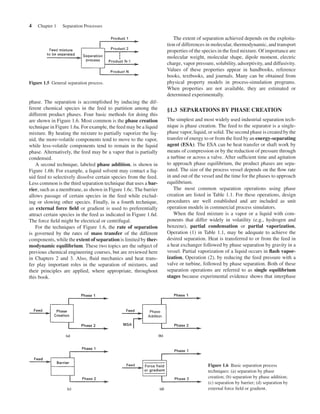
Figure 1.5 General separation process.
phase. The separation is accomplished by inducing the dif-
ferent chemical species in the feed to partition among the
different product phases. Four basic methods for doing this
are shown in Figure 1.6. Most common is the phase creation
technique in Figure 1.6a. For example, the feed may be a liquid
mixture. By heating the mixture to partially vaporize the liq-
uid, the more-volatile components tend to move to the vapor,
while less-volatile components tend to remain in the liquid
phase. Alternatively, the feed may be a vapor that is partially
condensed.
A second technique, labeled phase addition, is shown in
Figure 1.6b. For example, a liquid solvent may contact a liq-
uid feed to selectively dissolve certain species from the feed.
Less common is the third separation technique that uses a bar-
rier, such as a membrane, as shown in Figure 1.6c. The barrier
allows passage of certain species in the feed while exclud-
ing or slowing other species. Finally, in a fourth technique,
an external force field or gradient is used to preferentially
attract certain species in the feed as indicated in Figure 1.6d.
The force field might be electrical or centrifugal.
For the techniques of Figure 1.6, the rate of separation
is governed by the rates of mass transfer of the different
components, while the extent of separation is limited by ther-
modynamic equilibrium. These two topics are the subject of
previous chemical engineering courses, but are reviewed here
in Chapters 2 and 3. Also, fluid mechanics and heat trans-
fer play important roles in the separation of mixtures, and
their principles are applied, where appropriate, throughout
this book.
The extent of separation achieved depends on the exploita-
tion of differences in molecular, thermodynamic, and transport
properties of the species in the feed mixture. Of importance are
molecular weight, molecular shape, dipole moment, electric
charge, vapor pressure, solubility, adsorptivity, and diffusivity.
Values of these properties appear in handbooks, reference
books, textbooks, and journals. Many can be obtained from
physical property models in process-simulation programs.
When properties are not available, they are estimated or
determined experimentally.
§1.3 SEPARATIONS BY PHASE CREATION
The simplest and most widely used industrial separation tech-
nique is phase creation. The feed to the separator is a single-
phase vapor, liquid, or solid. The second phase is created by the
transfer of energy to or from the feed by an energy-separating
agent (ESA). The ESA can be heat transfer or shaft work by
means of compression or by the reduction of pressure through
a turbine or across a valve. After sufficient time and agitation
to approach phase equilibrium, the product phases are sepa-
rated. The size of the process vessel depends on the flow rate
in and out of the vessel and the time for the phases to approach
equilibrium.
The most common separation operations using phase
creation are listed in Table 1.1. For these operations, design
procedures are well established and are included as unit
operation models in commercial process simulators.
When the feed mixture is a vapor or a liquid with com-
ponents that differ widely in volatility (e.g., hydrogen and
benzene), partial condensation or partial vaporization,
Operation (1) in Table 1.1, may be adequate to achieve the
desired separation. Heat is transferred to or from the feed in
a heat exchanger followed by phase separation by gravity in a
vessel. Partial vaporization of a liquid occurs in flash vapor-
ization, Operation (2), by reducing the feed pressure with a
valve or turbine, followed by phase separation. Both of these
separation operations are referred to as single equilibrium
stages because experimental evidence shows that interphase
Figure 1.6 Basic separation process
techniques: (a) separation by phase
creation; (b) separation by phase addition;
(c) separation by barrier; (d) separation by
external force field or gradient.
Trim Size: 8.5in x 11in Seader c01.tex V2 - 10/16/2015 10:38 A.M. Page 5
§1.3 Separations by Phase Creation 5
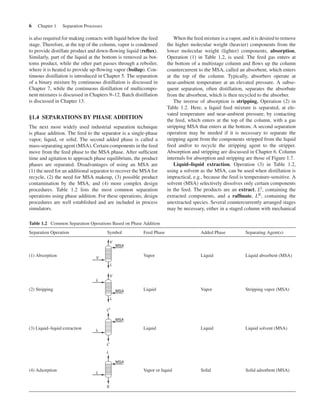
Table 1.1 Common Separation Operations Based on Phase Creation
Separation Operation Symbol Feed Phase Created Phase Separating Agent(s)
(1) Partial condensation
or vaporization
L
V
V/L Vapor and/or liquid Liquid or vapor Heat transfer (ESA)
(2) Flash
vaporization
L
V
L
Liquid Vapor Pressure reduction
(3) Distillation
L
L
V/L Vapor and/or liquid Vapor and liquid Heat transfer (ESA) and
sometimes shaft work (ESA)
mass transfer of species is so rapid that phase equilibrium
is closely approached. The liquid product is enriched with
respect to the less volatile species, while the vapor product
is enriched with respect to the more volatile species. These
operations are discussed in Chapter 4.
When the degree of separation by a single equilibrium
stage is inadequate because the volatility differences among
key species are insufficiently large (e.g., benzene and toluene),
distillation, Operation (3) in Table 1.1, with multiple stages,
often becomes the separation method of choice. It is and
has long been the most widely utilized industrial separa-
tion method. Distillation involves vigorous mixing during
contacts between countercurrently flowing liquid and vapor
phases. Figure 1.7 shows schematics of three widely used
phase-contacting methods. Figure 1.7a depicts a series of
trays, where the phases are mixed and then disengaged. Each
tray is some fraction of an equilibrium stage. In Figures 1.7b
and 1.7c, the phases are in continuous contact with other. In the
first case, randomly dumped ceramic, metal, or plastic rings
or saddles, called packing, promote turbulence as the vapor
follows a tortuous path through the liquid, which flows over
and through the packing. In the latter case, stacked, structured
packing is used in the form of metal or plastic meshes, grids,
or coils. Depending on the efficiency of the packing, inches or
feet of packed height are equivalent to an equilibrium stage.
In the icon for distillation in Table 1.1, horizontal lines within
the column indicate the stages. As vapor flows up the column,
it is increasingly enriched with respect to the more volatile
species. The liquid flowing down the column is increasingly
enriched with respect to the less-volatile species.
Feed to a distillation column enters at a stage somewhere
between the top and bottom stages. Any vapor in the feed starts
up the column; feed liquid starts down. Liquid is also required
for making contacts with vapor above the feed stage, and vapor
Tray Dumped packing Structured packing
Tray 1
Tray 2
Tray 3
(a) (b) (c)
L L L
L L
L
V
V V
V V V V V V
V V
Downcomer
Figure 1.7 Phase-contacting methods in distillation columns.
Trim Size: 8.5in x 11in Seader c01.tex V2 - 10/16/2015 10:38 A.M. Page 6
6 Chapter 1 Separation Processes
is also required for making contacts with liquid below the feed
stage. Therefore, at the top of the column, vapor is condensed
to provide distillate product and down-flowing liquid (reflux).
Similarly, part of the liquid at the bottom is removed as bot-
toms product, while the other part passes through a reboiler,
where it is heated to provide up-flowing vapor (boilup). Con-
tinuous distillation is introduced in Chapter 5. The separation
of a binary mixture by continuous distillation is discussed in
Chapter 7, while the continuous distillation of multicompo-
nent mixtures is discussed in Chapters 9–12. Batch distillation
is discussed in Chapter 13.
§1.4 SEPARATIONS BY PHASE ADDITION
The next most widely used industrial separation technique
is phase addition. The feed to the separator is a single-phase
vapor, liquid, or solid. The second added phase is called a
mass-separating agent (MSA). Certain components in the feed
move from the feed phase to the MSA phase. After sufficient
time and agitation to approach phase equilibrium, the product
phases are separated. Disadvantages of using an MSA are
(1) the need for an additional separator to recover the MSA for
recycle, (2) the need for MSA makeup, (3) possible product
contamination by the MSA, and (4) more complex design
procedures. Table 1.2 lists the most common separation
operations using phase addition. For these operations, design
procedures are well established and are included in process
simulators.
When the feed mixture is a vapor, and it is desired to remove
the higher molecular weight (heavier) components from the
lower molecular weight (lighter) components, absorption,
Operation (1) in Table 1.2, is used. The feed gas enters at
the bottom of a multistage column and flows up the column
countercurrent to the MSA, called an absorbent, which enters
at the top of the column. Typically, absorbers operate at
near-ambient temperature at an elevated pressure. A subse-
quent separation, often distillation, separates the absorbate
from the absorbent, which is then recycled to the absorber.
The inverse of absorption is stripping, Operation (2) in
Table 1.2. Here, a liquid feed mixture is separated, at ele-
vated temperature and near-ambient pressure, by contacting
the feed, which enters at the top of the column, with a gas
stripping MSA that enters at the bottom. A second separation
operation may be needed if it is necessary to separate the
stripping agent from the components stripped from the liquid
feed and/or to recycle the stripping agent to the stripper.
Absorption and stripping are discussed in Chapter 6. Column
internals for absorption and stripping are those of Figure 1.7.
Liquid–liquid extraction, Operation (3) in Table 1.2,
using a solvent as the MSA, can be used when distillation is
impractical, e.g., because the feed is temperature-sensitive. A
solvent (MSA) selectively dissolves only certain components
in the feed. The products are an extract, LI, containing the
extracted components, and a raffinate, LII, containing the
unextracted species. Several countercurrently arranged stages
may be necessary, either in a staged column with mechanical
Table 1.2 Common Separation Operations Based on Phase Addition
Separation Operation Symbol Feed Phase Added Phase Separating Agent(s)
(1) Absorption
L
V
V
MSA
Vapor Liquid Liquid absorbent (MSA)
(2) Stripping
L
L
V
MSA Liquid Vapor Stripping vapor (MSA)
(3) Liquid–liquid extraction L
LII
LI
MSA
Liquid Liquid Liquid solvent (MSA)
(4) Adsorption L
L
S
MSA
Vapor or liquid Solid Solid adsorbent (MSA)
Trim Size: 8.5in x 11in Seader c01.tex V2 - 10/16/2015 10:38 A.M. Page 7
§1.6 Separations by an External Field or Gradient 7
agitation or in a series of mixing and settling vessels. Addi-
tional separation operations, often distillation, are needed to
recover the solvent for recycle. Liquid–liquid extraction is
described in Chapter 8.
The MSA may be a porous solid, in the form of granules,
that selectively removes one or more components from a
vapor or liquid feed mixture by adsorption, Operation (4) in
Table 1.2. Adsorption is confined to the exterior and interior
surfaces of the solid adsorbent, unlike absorption, which
occurs throughout the liquid absorbent. Adsorption separa-
tions are often conducted batchwise or semicontinuously in
vessels or columns. However, equipment is available to simu-
late continuous operation, as in Table 1.2. When the adsorbent,
S, becomes saturated with the adsorbed solutes (adsorbate),
it must be regenerated to recover the adsorbate and reuse the
adsorbent. Alternatively, if the adsorbate is a waste product,
the spent adsorbent may be discarded and replaced with fresh
adsorbent. Adsorption is described in Chapter 15.
§1.5 SEPARATIONS BY BARRIER
The use of microporous and nonporous membranes as semi-
permeable barriers for separating vapor or liquid mixtures
is rapidly gaining adherents. The products are the retentate
(components that do not pass through the membrane) and
the permeate (components that do pass through the mem-
brane). For microporous membranes, separation is effected
by differing rates of species diffusion through the membrane
pores. For nonporous membranes, separation is controlled by
differences in solubility in the membrane and rates of species
diffusion through the membrane material. The most complex
and selective membranes are found in the trillions of cells in
the human body.
Table 1.3 lists four of the most common industrial
membrane separation operations. Dialysis, Operation (1) in
Table 1.3, is the transport, by a concentration gradient, of small
solute molecules through a porous membrane. The molecules
unable to pass through the membrane are small, insoluble,
non-diffusible particles. Reverse osmosis, Operation (2), is
the selective transport of a solvent, for example, water, through
a microporous membrane after the pressure of the feed is
increased to a value higher than the osmotic pressure of the
solution. Solutes in the solvent do not permeate the membrane.
It is widely used to produce drinkable water.
Separation of gases by selective gas permeation through
nonporous membranes, Operation (3), using a pressure driving
force, is a process first used by the U.S. government in the
1940s with porous fluorocarbon barriers to separate 235UF6 and
238UF6. Today, nonporous polymer membranes are employed
to enrich mixtures containing hydrogen, recover hydrocarbons
from gas streams, and produce oxygen-enriched air.
To achieve high purities, pervaporation, Operation (4), can
be used. Certain species in the liquid feed diffuse through the
nonporous membrane, where they are evaporated before exit-
ing as permeate. This method uses low pressures to enhance
vaporization and the heat of vaporization must be supplied. It
is used to separate azeotropic mixtures.
All four of the membrane separation operations in Table 1.3
are described in Chapter 14.
§1.6 SEPARATIONS BY AN EXTERNAL FIELD
OR GRADIENT
External fields take advantage of differing degrees of response
of certain molecules. Centrifugation establishes a pressure
field that separates mixtures according to their size, shape, and
density. It is used to separate 235UF6 from 238UF6, and can
also separate large polymer molecules according to molecular
weight.
If a temperature gradient is applied to a homogeneous
solution, concentration gradients induce thermal diffusion. It
has been used to enhance separation of isotopes in permeation
processes.
When water containing 0.000149 atom fraction deuterium
is decomposed by electrolysis into hydrogen and oxygen, the
deuterium concentration in the hydrogen is lower than in water.
Table 1.3 Common Separation Operations Based on Barriers
Separation Operation Symbol Feed Phase Barrier Separating Agent(s)
(1) Dialysis
L L
L
Liquid Microporous membrane Pressure (ESA)
(2) Reverse osmosis
L L
L
Liquid Microporous membrane Pressure (ESA)
(3) Gas permeation
V V
V
Vapor Nonporous membrane Pressure (ESA)
(4) Pervaporation
L L
V
Liquid Nonporous membrane Pressure and heat transfer (ESA)
Trim Size: 8.5in x 11in Seader c01.tex V2 - 10/16/2015 10:38 A.M. Page 8
8 Chapter 1 Separation Processes
Until 1953, this process was the source of heavy water (D2O).
In electrodialysis, cation- and anion-permeable membranes
carry a fixed charge that prevents migration of species with like
charge. This phenomenon is applied to desalinate seawater. A
related process is electrophoresis, which exploits the different
migration velocities of charged colloidal or suspended species
in an electric field.
These external field separation operations are not discussed
further in this textbook, with the exception of electrodialysis,
which is described in Chapter 14.
§1.7 BRIEF COMPARISON OF COMMON
SEPARATION OPERATIONS
When selecting among feasible separation techniques for
a given application, some major factors to consider are
(1) technological maturity, which allows designers to apply
prior knowledge; (2) cost; (3) ease of scale-up from labora-
tory experiments; (4) ease of providing multiple stages; and
(5) need for parallel units for large capacities. A survey
by Keller [3], Figure 1.8, shows that the degree to which
a separation operation is technologically mature correlates
with its extent of commercial use. Operations based on mem-
branes are more expensive than those based on phase creation
(e.g., distillation) or phase addition (e.g., absorption, extrac-
tion, and adsorption). All separation equipment is limited
to a maximum size. For capacities requiring a larger size,
parallel units must be provided. Except for size constraints
or fabrication problems, capacity of a single unit can be dou-
bled for an additional investment cost of about 60%. If two
parallel units are installed, the additional investment for the
second unit is 100% of the first unit, unless a volume-discount
Technological maturity
Use
maturity
Distillation
Gas absorption
Ext./azeo. dist.
Solvent ext.
Crystallization
Ion exchange
Adsorption: gas feed
Membranes: gas feed
Membranes: liquid feed
Chromatography: liquid feed
Adsorption: liquid feed
Supercritical
gas abs./ext.
Liquid
membranes
Field-induced separations
Affinity separations
Invention Technology
asymptote
Use
asymptote
First
application
Figure 1.8 Technological and use maturities of separation
processes.
[Reproduced from [3] with permission of the American Institute of
Chemical Engineers.]
Table 1.4 Ease of Scale-Up of the Most Common Separations
Operation in Decreasing
Ease of Scale-Up
Ease of
Staging
Need for
Parallel Units
Distillation Easy No need
Absorption Easy No need
Liquid–liquid
extraction
Easy Sometimes
Membranes Re-pressurization
required between
stages
Almost always
Adsorption Easy Only for
regeneration
cycle
applies. Table 1.4 lists operations ranked according to ease of
scale-up. Those ranked near the top are frequently designed
without pilot-plant or laboratory data. Operations near the
middle usually require laboratory data, while those near
the bottom require pilot-plant tests. Included in the table is
an indication of the ease of providing multiple stages and
whether parallel units may be required. Ultimately, the most
cost-effective process, based on operating, maintenance, and
capital costs, is selected, provided it is controllable, safe,
and nonpolluting.
Also of interest are studies by Sherwood, Pigford, and
Wilke [4], Dwyer [5], and Keller [3] that show that the cost
of recovering and purifying a chemical depends strongly on
its concentration in the feed. Keller’s correlation, Figure 1.9,
shows that the more dilute the feed in the product, the higher
the product price. The five highest priced and most dilute
chemicals shown are all proteins.
Urokinase
Factor
VIII
Luciferase
Insulin
Rennin
Ag
Co
Hg
Ni
Cu
Zn
Citric
Acid
Penicillin
1,000,000,000
100,000,000
10,000,000
Price,
$/lb
Weight fraction in substrate
1,000,000
100,000
10,000
1,000
100
10
1 0.1 0.01 0.001
1
0.10
10–4
10–5
10–6
10–7
10–8
10–9
Figure 1.9 Effect of concentration of product in feed material on
price.
[Reproduced from [3] with permission of the American Institute of
Chemical Engineers.]
Trim Size: 8.5in x 11in Seader c01.tex V2 - 10/16/2015 10:38 A.M. Page 9
§1.8 Separation Processes, Product Purity, Component Recovery, and Separation Sequences 9
§1.8 SEPARATION PROCESSES, PRODUCT
PURITY, COMPONENT RECOVERY, AND
SEPARATION SEQUENCES
Separation processes usually consist of more than one oper-
ation and may produce more than one product. The process
is designed to meet product specifications, given as product
purities and compositions. The process strives to do this with
high component recoveries.
Consider the continuous hydrocarbon recovery process
shown in Figure 1.10, which consists of a sequence of three
multistage distillation operations (C1, C2, and C3). The feed
consists of propane (C3H8), iso-butane (iC4H10), normal-
butane (nC4H10), iso- and normal-pentane (iC5H12 and
nC5H12), higher molecular weight (heavier) hydrocarbons
(C+
6 ), and a small amount of ethane (C2H6). The compo-
nents in the feed are rank-ordered by decreasing volatility
(increasing normal boiling point), with ethane being the most
volatile. The distillation columns were designed with the
Aspen Plus simulator, using mathematical models described
in Chapter 10, to produce four products: a C+
5 -rich bottoms
from C1, a C3 (propane)-rich distillate from C2, and an iC4
(isobutane)-rich distillate and an nC4 (normal butane)-rich
bottoms from C3. A material balance for the process is given
in Table 1.5. Streams 4, 6, and 7 are final products, while
Stream 2 is an intermediate that requires further processing.
Specifications for the products are included in Table 1.6. The
Figure 1.10 Hydrocarbon recovery process using distillation.
C+
5 -rich component for Stream 2 indicates that all components
less volatile than the pentanes are included.
Each column separates two key components in the column
feed. In Column C1, the separation is between nC4H10 (light
key) and iC5H12 (heavy key). This is indicated by the hori-
zontal line separating the flow rates of these two components
Table 1.5 Material Balance for Hydrocarbon Recovery Process of Figure 1.10
Flow rates in lbmol/h
Stream 1 2 3 4 5 6 7
Component Feed to C1 C+
5 -rich Product Feed to C2 C3-rich Product Feed to C3 iC4-rich Product nC4-rich Product
C2H6 0.60 0.00 0.60 0.60 0.00 0.00 0.00
C3H8 57.00 0.00 57.00 54.80 2.20 2.20 0.00
iC4H10 171.80 0.10 171.70 0.60 171.10 162.50 8.60
nC4H10 227.30 0.70 226.60 0.00 226.60 10.80 215.80
iC5H12 40.00 11.90 28.10 0.00 28.10 0.00 28.10
nC5H12 33.60 16.10 17.50 0.00 17.50 0.00 17.50
C+
6 205.30 205.30 0.00 0.00 0.00 0.00 0.00
Totals 735.60 234.10 501.50 56.00 445.50 175.50 270.00
Table 1.6 Comparison of Process Product Purities with Product Specifications
mol% in Product
Propane-Rich Iso-Butane-Rich Normal-Butane-Rich
Component Data Spec Data Spec Data Spec
C2H6 1.07 5 max 0 0
C3H8 97.86 93 min 1.25 3 max 0 1 max
iC4H10 1.07 2 max 92.59 92 min
nC4H10 0 6.16 7 max
{
83.11
{
80 min
C5
+
0 0 16.89 20 max
Total 100.00 100.00 100.00
Trim Size: 8.5in x 11in Seader c01.tex V2 - 10/16/2015 10:38 A.M. Page 10
10 Chapter 1 Separation Processes
in the “Feed to C1” column of Table 1.5. Column C1 pro-
duces a C+
5 -rich product (Stream 2) as bottoms. The distillate
from C1 is the feed to C2. Column C2 separates between C3H8
(light key) and iC4H10 (heavy key) to produce a C3-rich prod-
uct (Stream 4) as distillate. The bottoms from C2 is the feed
to C3, which produces two products by separating between
iC4H10 (light key) and nC4H10 (heavy key).
In Table 1.5, it should be noted that an overall material
balance equation is satisfied for each of the six components
and the C+
6 multicomponent. For Figure 1.10, that equation in
terms of ni, j, the lbmol∕h flow rate of component i in stream j is
ni,1 = ni,2 + ni,4 + ni,6 + ni,7
For example, for propane (C3H8), 57.00 = 0.00 + 54.80 +
2.20 + 0.00.
From the data in Table 1.5, product purities and compo-
nent recoveries for the process can be computed. For example,
the mol% purity of propane in the C3-rich product, Stream 4,
is 54.80∕56.00 = 0.9786 = 97.86 mol%. The propane recov-
ery in this product is 54.80∕57.00 = 0.9614 = 96.14%. Other
components in the propane product are ethane and isobutene.
Table 1.6 compares the product purities of the final products
of Streams 4, 6, and 7 with commercial product specifications.
Note that all product specifications are achieved.
The following example illustrates the use of material bal-
ances for a separator when product purities and/or component
recoveries are specified.
EXAMPLE 1.1 Material balances around a separator
A feed, F, of 100 kmol∕h of air containing 21 mol% O2 (1) and
79 mol% N2 (2) is to be partially separated by a gas permeation mem-
brane unit, Operation (3) in Table 1.3, according to each of three
sets of specifications. Compute the flow rates (nP and nR) in kmol∕h
and compositions in mol% of the two products (retentate, R, and
permeate, P). In Figure 1.6(c), Phase 1 is the retentate while Phase 2
is the permeate. The membrane is more permeable to O2 than to N2.
Case 1: 50% recovery of O2 to the permeate and 87.5% recovery of
N2 to the retentate.
Case 2: 50% recovery of O2 to the permeate and 50 mol% purity of
O2 in the permeate.
Case 3: 85 mol% purity of N2 in the retentate and 50 mol% purity of
O2 in the permeate.
Solution
The feed (F) rates of oxygen (1) and nitrogen (2) are
n1,F = 0.21(100) = 21 kmol∕h
n2,F = 0.79(100) = 79 kmol∕h
Case 1: Because two recoveries are given:
n1,P = 0.50(21) = 10.5 kmol∕h
n2,R = 0.875(79) = 69.1 kmol∕h
n1,R = 21 − 10.5 = 10.5 kmol∕h
n2,P = 79 − 69.1 = 9.9 kmol∕h
For the permeate: nP = 10.5 + 9.9 = 20.4 kmol∕h
mol% O2 = 10.5∕20.4 = 0.515 = 51.5%
mol% N2 = 100 − 51.5 = 48.5%
For the retentate: nR = 69.1 + 10.5 = 79.6 kmol∕h
mol% O2 = 10.5∕79.6 = 0.132 = 13.2%
mol% N2 = 100 − 13.2 = 86.8%
Case 2: O2 recovery is given; its distribution to the products is
n1,P = 0.50(21) = 10.5 kmol∕h
n1,R = 21 − 10.5 = 10.5 kmol∕h
Using the purity of O2 in the permeate, the total permeate flow rate is
nP = 10.5∕0.5 = 21 kmol∕h
By a total permeate material balance:
n2,P = 21 − 10.5 = 10.5 kmol∕h
By an overall N2 material balance:
n2,R = 79 − 10.5 = 68.5 kmol∕h
For the permeate: nP = 21 kmol∕h
mol% O2 = 10.5∕21 = 0.50 = 50%
mol% N2 = 100 − 50 = 50%
For the retentate: nR = 100 − 21 = 79 kmol∕h
mol% O2 = 10.5∕79 = 0.133 = 13.3%
mol% N2 = 100 − 13.3 = 86.7%
Case 3: Two material-balance equations, one for each component,
can be written:
For nitrogen, with a purity of 0.85 in the retentate and 1.00 − 0.50 =
0.50 in the permeate,
n2,F = 0.85nR + 0.50nP = 79 kmol∕h (1)
For oxygen, with a purity of 0.50 in the permeate and 1.00 − 0.85 =
0.15 in the retentate,
n1,F = 0.50nP + 0.15nR = 21 kmol∕h (2)
Solving (1) and (2) simultaneously for the total flow rates of the prod-
ucts gives
nP = 17.1 kmol∕h and nR = 82.9 kmol∕h
Therefore, the component flow rates are
n1,P = 0.50(17.1) = 8.6 kmol∕h
n2,R = 0.85(82.9) = 70.5 kmol∕h
n1,R = 82.9 − 70.5 = 12.4 kmol∕h
n2,P = 17.1 − 8.6 = 8.5 kmol∕h
For the permeate: nP = 17.1 kmol∕h
mol% O2 = 8.6∕17.1 = 0.503 = 50.3%
mol% N2 = 100 − 50.3 = 49.7%
For the retentate: nR = 100 − 17.1 = 82.9 kmol∕h
mol% O2 = 12.4∕82.9 = 0.150 = 15.0%
mol% N2 = 100 − 15.0 = 85.0%
Trim Size: 8.5in x 11in Seader c01.tex V2 - 10/16/2015 10:38 A.M. Page 11
§1.8 Separation Processes, Product Purity, Component Recovery, and Separation Sequences 11
§1.8.1 Purity and Composition Designations
The product purities in Table 1.6 are given in mol%, a des-
ignation usually restricted to gas mixtures, for which vol%
is equivalent to mol%. For liquids, purities are more often
specified in mass fractions or wt%. Although vol% is also
common for liquid mixtures, it is not easily calculated when
the liquid mixture is a nonideal solution. To meet environ-
mental regulations, the allowable concentration of an impurity
in gas, liquid, or solids streams is typically specified in parts
of impurity per million parts (ppm) or parts of impurity per
billion parts (ppb), where if a gas, the parts are moles or
volumes; if a liquid or solid, then mass or weight. For aqueous
solutions, especially those containing acids and bases, com-
mon designations for composition are molarity (M), which is
the molar concentration in moles of solute per liter of solution;
molality (m) in moles of solute per kilogram of solvent; and
normality (N) in number of equivalent weights of solute per
liter of solution. Concentrations (c) in mixtures can be in
units of moles or mass per volume (e.g., mol/L, g/L, kg/m3,
lbmol/ft3, lb/ft3). For some chemical products, an attribute,
such as color, may be used in place of purity in terms of
composition.
§1.8.2 Alternative Separation Sequences
The three-distillation-column recovery process shown in
Figure 1.10 is only one of five alternative sequences of distil-
lation operations that can separate the process feed into four
products when each column has a single feed that is separated
into one distillate and one bottoms. Consider a hydrocarbon
feed that consists, in the order of decreasing volatility, propane
(C3), isobutane (iC4), n-butane (nC4), isopentane (iC5), and
n-pentane (nC5). A sequence of distillation columns is used
to separate the feed into three nearly pure products of C3, iC4,
and nC4; and one multicomponent product of combined iC5
and nC5. Figure 1.11 shows the five alternative sequences.
When two final products are desired, only a single distillation
column is needed. For three final products, there are two alter-
native sequences. As the number of final products increases,
the number of alternative sequences grows rapidly as shown
in Table 1.7.
For the initial selection of a feasible sequence, the following
heuristics (plausible but not infallible rules) are useful and easy
to apply, and do not require an economic evaluation:
1. Remove unstable, corrosive, or chemically reactive
components early in the sequence. Then the materials
of construction used in later columns will be less expen-
sive. Also remove very volatile components early in the
sequence so that column pressures can be reduced in
later columns.
2. Remove final products one by one, in order of decreas-
ing volatility or increasing boiling point, as overhead
distillates.
3. Remove, early in the sequence, those components of
greatest molar percentage in the feed. The remaining
columns will be smaller in diameter.
Figure 1.11 Alternative distillation sequences to produce four products.
Trim Size: 8.5in x 11in Seader c01.tex V2 - 10/16/2015 10:38 A.M. Page 12
12 Chapter 1 Separation Processes
Table 1.7 Number of Alternative Sequences
Number of Final
Products
Number of
Columns
Number of Alternative
Sequences
2 1 1
3 2 2
4 3 5
5 4 14
6 5 42
4. Make the most difficult separations in the absence of the
other components. This will usually lower the diameter
of the tallest column.
5. Leave later in the sequence those separations that pro-
duce final products of the highest purities. This will also
lower the diameter of the tallest column.
6. Select the sequence that favors near-equimolar amounts
of distillate and bottoms in each column. Then the
two sections of the column will tend to have the same
diameter.
Unfortunately, these heuristics sometimes conflict with
one another so that one clear choice may not be possible. If
applicable, Heuristic 1 should always be employed. The most
common industrial sequence is that of Heuristic 2. When
energy costs are high, Heuristic 6 is favored because of lower
utility costs. When one of the separations is particularly diffi-
cult, such as the separation of isomers, Heuristic 4 is usually
applied. For determining an optimal sequence, Seider et al. [2]
present rigorous methods that do require column designs and
economic evaluations. They also consider complex sequences
that include separators of different types and complexity.
EXAMPLE 1.2 Selection of a Separation Sequence
using Heuristics.
A distillation sequence is to produce four final products from five
hydrocarbons. Figure 1.11 shows the five possible sequences. The
molar percentages in the process feed to the sequence are C3 (5.0%),
iC4 (15%), nC4 (25%), iC5 (20%), and nC5 (35%). The most difficult
separation by far is that between the isomers, iC4 and nC4. Use the
heuristics to determine the best sequence(s). All products are to be of
high purity.
Solution
Heuristic 1 does not apply. Heuristic 2 favors taking C3, iC4, and nC4
as distillates in Columns 1, 2, and 3, respectively, with the multicom-
ponent product of iC5 and nC5 taken as the bottoms in Column 3.
Heuristic 3 favors the removal of the multicomponent product (55%
of the feed) in Column 1. Heuristic 4 favors the separation of iC4
from nC4 in Column 3. Heuristics 3 and 4 can be combined with C3
taken as distillate in Column 2. Heuristic 5 does not apply. Heuristic 6
favors taking the multicomponent product as bottoms in Column 1
(45/55 mole split), nC4 as bottoms in Column 2 (20/25 mole split),
and C3 as distillate with iC4 as bottoms in Column 3. Thus, the heuris-
tics lead to three possible sequences as most favorable.
SUMMARY
1. Industrial chemical processes include equipment for sep-
arating chemical mixtures in process feed(s) and/or
produced in reactors within the process.
2. The more widely used separation operations involve trans-
fer of species between two phases, one of which is created
by an energy separation agent (ESA) or the introduction of
a mass-separating agent (MSA).
3. Less commonly used operations employ a barrier to prefer-
entially pass certain species or a force field to cause species
to diffuse to another location at different rates.
4. Separation operations are designed to achieve product
purity and to strive for high recovery.
5. A sequence of separators is usually required when more
than two products are to be produced or when the required
product purity cannot be achieved in a single separator.
6. The cost of purifying a chemical depends on its concentra-
tion in the feed. The extent of industrial use of a particular
separation operation depends on its cost and technological
maturity.
REFERENCES
1. Cussler, E.L., and G.D. Moggridge, Chemical Product Design, Cam-
bridge University Press, Cambridge, UK (2001).
2. Seider, W.D., J.D. Seader, D.R. Lewin and S. Widagdo, Product &
Process Design Principles 3rd ed., John Wiley & Sons, Hoboken, NJ
(2009).
3. Keller, G.E., II, AIChE Monogr. Ser, 83(17) (1987).
4. Sherwood, T.K., R.L. Pigford, and C.R. Wilke, Mass Transfer,
McGraw-Hill, New York (1975).
5. Dwyer, J.L., Biotechnology, 1, 957 (Nov. 1984).
STUDY QUESTIONS
1.1. What are the two key process operations in chemical
engineering?
1.2. What are the main auxiliary process operations in chemical
engineering?
1.3. What are the four general separation techniques and what do
they all have in common?
1.4. Why is the rate of mass transfer a major factor in separation
processes?
Trim Size: 8.5in x 11in Seader c01.tex V2 - 10/16/2015 10:38 A.M. Page 13
Exercises 13
1.5. What limits the extent to which the separation of a mixture can
be achieved?
1.6. What are the most common methods used to separate two fluid
phases?
1.7. What is the difference between an ESA and an MSA? Give
three disadvantages of using an MSA.
1.8. What is the most widely used industrial separation operation?
1.9. What is the difference between adsorption and absorption?
1.10. The degree of separation in a separation operation is often spec-
ified in terms of product purities and component recoveries.
How do these two differ?
1.11. What is a key component? What is a multicomponent product?
1.12. Why are sequences of separators sometimes necessary to sep-
arate a feed mixture?
EXERCISES
Section 1.1
1.1. Description of the ethanol process.
Considering possible side reactions, describe as best you can what
takes place in each block of the process shown in Figure 1.4.
Section 1.2
1.2. Mixing vs. separation.
Explain, using thermodynamic principles, why mixing pure chem-
icals to form a homogeneous mixture is a spontaneous process, while
separation of that mixture into its pure species is not.
1.3. Separation of a mixture requires energy.
Explain, using the laws of thermodynamics, why the separation
of a mixture into pure species or other mixtures of differing compo-
sitions requires energy transfer to the mixture.
Sections 1.3 and 1.4
1.4. ESA vs. MSA.
Compare the advantages and disadvantages of making separations
using an ESA versus using an MSA.
1.5. Differences among distillation and liquid–liquid
extraction.
Under what conditions should liquid–liquid extraction be consid-
ered over distillation?
Section 1.5
1.6. Osmotic pressure.
The osmotic pressure, π, of seawater is given by π = RTc∕M,
where c is the concentration of the dissolved salts (solutes) in
g∕cm3
, M is the average molecular weight of the solutes as ions, T
is temperature in Kelvin, and R is the ideal gas constant. Consider
recovering pure water from seawater containing 0.035 g of salts∕cm3
of seawater and M = 31.5, at 298 K. What is the minimum required
pressure difference across the membrane in kPa to just overcome the
osmotic pressure?
1.7. Basic separation techniques.
For each of the following separation operations, state the basic
separation process technique shown in Figure 1.6: absorption, adsorp-
tion, dialysis, distillation, flash vaporization, gas permeation, liquid–
liquid extraction, pervaporation, reverse osmosis, and stripping.
Section 1.7
1.8. Removing organic pollutants from wastewater.
The need to remove organic pollutants from wastewater is com-
mon to many industrial processes. Separation methods to be consid-
ered are: (1) adsorption, (2) distillation, (3) liquid–liquid extraction,
(4) membrane separation, (5) stripping with air, and (6) stripping with
steam. Discuss the advantages and disadvantages of each method.
Consider the fate of the organic material.
1.9. Removal of VOCs from a wastewater stream.
Many waste gas streams contain volatile organic compounds
(VOCs), which must be removed. Recovery of the VOCs may be
accomplished by (1) absorption, (2) adsorption, (3) condensation,
(4) freezing, (5) membrane separation, or (6) catalytic oxidation.
Discuss the pros and cons of each method, paying particular attention
to the fate of the VOC. For the case of a stream containing 3 mol%
acetone in air, draw a flow diagram for a process based on absorption.
Choose a reasonable absorbent and include in your process a means
to recover the acetone and recycle the absorbent.
1.10. Separation of air.
Describe three methods suitable for the separation of air into nitro-
gen and oxygen.
Section 1.8
1.11. Material balance for a distillation sequence.
The feed to Column C3 in Figure 1.10 is given in Table 1.5. The
separation is to be altered to produce a distillate of 95 mol% pure
isobutane with a recovery in the distillate of 96%. Because of the
sharp separation in Column C3 between iC4 and nC4, assume all
propane goes to the distillate and C5s to the bottoms.
(a) Compute the flow rates in lbmol∕h of each component in each of
the two products leaving Column C3.
(b) What is the percent purity of the n-butane bottoms product?
(c) If the isobutane purity in the distillate is fixed at 95%, what
percent recovery of isobutane in the distillate will maximize the
percent purity of normal butane in the bottoms product?
1.12. Material balance for a distillation sequence.
Five hundred kmol∕h of liquid alcohols containing, by moles,
40% methanol (M), 35% ethanol (E), 15% isopropanol (IP), and
10% normal propanol (NP) is distilled in two distillation columns in
series. The distillate from the first column is 98% pure M with a 96%
recovery of M. The distillate from the second is 92% pure E with a
95% recovery of E from the process feed. Assume no propanols in
the distillate from Column C1, no M in the bottoms from Column
C2, and no NP in the distillate from Column C2.
(a) Compute flow rates in kmol∕h of each component in each feed,
distillate, and bottoms. Draw a labeled block-flow diagram.
Include the material balances in a table, similar to Table 1.5.
(b) Compute the mole-percent purity of the propanol mixture leaving
as bottoms from the second column.
(c) If the recovery of ethanol is fixed at 95%, what is the maximum
purity of the ethanol in the distillate from the second column?
(d) If instead, the purity of the ethanol is fixed at 92%, what is the
maximum recovery of ethanol (based on the process feed)?
1.13. Material balance for separation by pervaporation.
Ethanol and benzene are separated in a network of distillation
and membrane separation steps. In one step, a near-azeotropic liquid
Trim Size: 8.5in x 11in Seader c01.tex V2 - 10/16/2015 10:38 A.M. Page 14
14 Chapter 1 Separation Processes
mixture of 8,000 kg∕h of 23 wt% ethanol in benzene is fed to a per-
vaporation membrane consisting of an ionomeric film of perfluoro-
sulfonic polymer cast on a Teflon support. The membrane is selective
for ethanol, producing a vapor permeate containing 60 wt% ethanol,
while the non-permeate (retentate) liquid contains 90 wt% benzene.
(a) Draw a flow diagram of the pervaporation using symbols from
Table 1.3 and include all process information.
(b) Compute the component flow rates in kg∕h in the feed stream
and in the product streams, and enter these results in the diagram.
(c) What separation operation could be used to purify the vapor
permeate?
1.14. Material balance for an absorption-distillation sequence.
1,000 kmol∕h of a gas mixture containing 90 mol% acetone and
10% nitrogen is to be processed to recover the acetone. First the gas
is fed to a multistage absorber where 95% of the acetone is absorbed
with 500 kmol∕h of a liquid absorbent of methyl-isobutyl-ketone
(MIBK). Two percent of the entering MIBK is lost to the gas leaving
the top of the absorber. Nitrogen does not dissolve in the MIBK.
The liquid leaving the bottom of the absorber is sent to a distilla-
tion column to separate the acetone from the MIBK. In this column,
a distillate of 98 mol% acetone and a bottoms of 99 mol% MIBK is
obtained.
(a) Draw a flow diagram of the separation process and place the
above data on the diagram.
(b) For each stream in the process, calculate by material balances
the flow rate of each component and enter your results in a table
similar to Table 1.5.
1.15. Separation by Gas Permeation.
The Prism gas permeation process developed by the Monsanto
Company is selective for hydrogen when using hollow-fiber mem-
branes made of silicone-coated polysulphone. A feed gas at 16.7 MPa
and 40∘C containing 42.4 H2, 7.0 CH4, and 0.5 N2 kmol∕h is sepa-
rated by the membrane into a retentate gas at 16.2 MPa and a permeate
gas at 4.56 MPa.
(a) Assume the membrane is non-permeable to nitrogen, the recov-
ery of H2 is 60.38%, and the mole ratio of CH4 to H2 in the
permeate is 0.0117. Calculate the total flow rate of the retentate
and permeate gases and the flow rates of each component in them.
(b) Compute the percent purity of the hydrogen in the permeate gas.
(c) Draw a process-flow diagram that displays pressure and compo-
nent flow rates.
1.16. Separation by membrane separation and adsorption.
Nitrogen is injected into oil wells to increase the recovery of
crude oil (enhanced oil recovery). It mixes with the natural gas
that is produced along with the oil. The nitrogen must be separated
from the natural gas. A total of 170,000 SCFH (based on 60∘F
and 14.7 psia) of natural gas containing 18% N2, 75% CH4, and
7% C2H6 at 100∘F and 800 psia is to be processed in two steps to
reduce nitrogen content to 3 mol%: (1) membrane separation with
a nonporous glassy polyimide membrane, followed by (2) adsorp-
tion using molecular sieves to which the permeate gas is fed. The
membrane separator is highly selective for N2 (90.83% recovery),
and completely impermeable to ethane. The mole ratio of CH4 to
N2 in the permeate is 1.756. The adsorption step selectively adsorbs
methane, giving 97% pure methane in the adsorbate, with an 85%
recovery of CH4 fed to the adsorber. The non-permeate (retentate)
gas from the membrane step and adsorbate from the adsorption step
are combined to give a methane stream that contains 3.0 mol% N2.
The pressure drop across the membrane is 760 psia. The permeate at
20∘F is compressed to 275 psia and cooled to 100∘F before entering
the adsorption step. The adsorbate, which exits the adsorber during
regeneration at 100∘F and 15 psia, is compressed to 800 psia and
cooled to 100∘F before being combined with non-permeate gas to
give the final pipeline natural gas.
(a) Draw a process flow diagram of the process using appropriate
symbols. Include compressors and heat exchangers. Label the
diagram with the data given and number all streams.
(b) Compute component flow rates of N2, CH4, and C2H6 in lbmol∕h
and create a material-balance table similar to Table 1.5.
1.17. Partial condensation of a reactor effluent.
Toluene (methylbenzene) is used as a solvent and a fuel and is
a precursor for making benzene by hydrodealkylation; benzene and
xylenes by disproportionation; and 2,4,6-trinitrotoluene (TNT)—an
explosive used by the military and construction companies—by
nitration. Consider a hydrodealkylation process, where the main
reaction is:
Toluene + H2 → Benzene + CH4
with an undesirable side reaction:
2 Benzene ⇌ Biphenyl + H2
The reactor effluent is cooled and partially condensed. The liquid
phase is then distilled in a sequence of three distillation columns to
give the following four products, one of which is recycled back to
the reactor.
Component
Off-gas,
kmol/h
Benzene
Product,
kmol/h
Toluene
Recycle,
kmol/h
Biphenyl
By-product,
kmol/h
Hydrogen 1.48 0.00 0.00 0.00
Methane 11.07 0.06 0.00 0.00
Benzene 0.80 264.72 1.33 0.00
Toluene 0.00 0.09 88.79 0.45
Biphenyl 0.00 0.00 0.02 4.59
Total 13.35 264.87 90.14 5.04
(a) Calculate for the sequence the percent recoveries for benzene
and biphenyl.
(b) Calculate the mol% purities for benzene and biphenyl.
(c) Why is there a toluene recycle stream?
(d) What would happen if the biphenyl was not separated from the
toluene, but was recycled back to the reactor with the toluene?
1.18. Separation by Gas Permeation.
In a hydrodealkylation process of the type stated in Exercises 1.17
and 1.22, a gas rich in hydrogen and methane is separated from the
reactor effluent by partial condensation. The gas is then sent to a gas
permeation membrane separator (Operation 3 in Table 1.3) to sepa-
rate the hydrogen from the methane. The permeate is recycled to the
reactor and the retentate is used for fuel. The component flow rates
for the membrane feed, retentate, and permeate are as follows:
Component Feed, kmol/h Retentate, kmol/h Permeate, kmol/h
Hydrogen 1575.7 157.6 1418.1
Methane 2388.1 2313.5 74.6
Benzene 29.8 29.8 0.0
Toluene 3.5 3.5 0.0
Biphenyl 0.0 0.0 0.0
Total 3997.1 2504.4 1492.7
Trim Size: 8.5in x 11in Seader c01.tex V2 - 10/16/2015 10:38 A.M. Page 15
Exercises 15
(a) Calculate the percent recoveries and mol% purities of hydrogen
in the permeate and methane in the retentate. (b) Why not sepa-
rate hydrogen from methane by distillation or absorption?
1.19. Distillation sequences.
The feed stream in the table below is to be separated into four
nearly pure products. None of the components is corrosive and, based
on the boiling points, none of the three separations is difficult. As seen
in Figure 1.11, five distillation sequences are possible. (a) Determine
a suitable sequence of three columns using the heuristics of §1.8.2.
(b) If a fifth component were added to give five products, Table 1.7
indicates that 14 alternative distillation sequences are possible. Draw,
in a manner similar to Figure 1.10, all 14 of these sequences.
Component Feed rate, kmol/h Normal boiling point, K
Methane 19 112
Benzene 263 353
Toluene 85 384
Ethylbenzene 23 409
1.20. Distillation sequence for a solution from
fermentation.
Starch from corn or sugarcane can be fermented to an aqueous
solution of acetone (A), n-butanol (B), and ethanol (E). Typically, the
mass ratio of bioproducts is 3(A):6(B):1(E). The solution contains
33 g of bioproducts per liter of water. After removal of solid particles
from the broth by centrifugation, the remaining liquid is distilled in a
sequence of distillation columns to recover (1) acetone with a maxi-
mum of 10 wt% water; (2) ethanol with a maximum of 10 wt% water;
(3) n-butanol (99.5 wt% purity with a maximum of 0.5% water); and
(4) water (W), which can be recycled to the fermenter. If the four
products distill according to their normal boiling points in ∘C of 56.5
(A), 117 (B), 78.4 (E), and 100 (W), devise a suitable distillation
sequence using the heuristics of §1.8.2.
1.21. Separation by a distillation sequence.
A light-hydrocarbon feed stream contains 45.4 kmol/h of propane,
136.1 kmol∕h of isobutane, 226.8 kmol∕h of n-butane, 181.4 kmol∕h
of isopentane, and 317.4 kmol∕h of n-pentane. This stream is to
be separated by a sequence of three distillation columns into four
products: (1) propane-rich, (2) isobutane-rich, (3) n-butane-rich,
and (4) combined pentanes–rich. The first-column distillate is the
propane-rich product; the distillate from Column 2 is the isobutane-
rich product; the distillate from Column 3 is the n-butane-rich
product, and the combined pentanes are the Column 3 bottoms.
The recovery of the main component in each product is 98%. For
example, 98% of the propane in the feed stream appears in the
propane-rich product.
(a) Draw a process-flow diagram for this distillation sequence,
similar to Figure 1.10.
(b) Complete a material balance for each column and summarize the
results in a table similar to Table 1.5. To complete the balance,
you must make assumptions about the flow rates of: (1) isobutane
in the distillates for Columns 1 and 3 and (2) n-butane in the
distillates for Columns 1 and 2, consistent with the specified
recoveries. Assume no propane in the distillate from Column 3
and no pentanes in the distillate from Column 2.
(c) Calculate the mol% purities of the products and summarize your
results as in Table 1.6, but without the specifications.
1.22. Distillation sequence for a wide-boiling mixture.
The effluent from the reactor of a toluene hydrodealkylation pro-
cess of the type stated in Exercise 1.17 is as follows:
Component Boiling Point, ∘C Flow Rate, kmol/h
Hydrogen –252.8 1577.1
Methane –169.0 2399.2
Benzene 80.1 296.6
Toluene 110.6 92.8
Biphenyl 255.2 4.6
Total 4370.3
The reactor effluent at 1265∘F and 500 psia is to be separated into
four products: (a) a gaseous mixture rich in hydrogen and methane;
(b) a benzene-rich product of high purity; (c) a toluene-rich mixture of
low purity that is recycled to the reactor; and (c) a biphenyl by-product
of high purity. Using the heuristics of §1.8.2, determine one or two
favorable sequences. A sequence can contain one single-stage partial
condenser in place of one multistage distillation column.
1.23. Distillation sequence for an alcohol mixture.
A mixture of five alcohols is to be separated into nearly pure prod-
ucts in a sequence of distillation columns, each of which produces
a distillate and a bottoms. According to Table 1.7, four columns
are needed that can be arranged into 14 different sequences. Using
the heuristics of §1.8.2, determine one or two feasible sequences.
The following table lists the alcohols in the order of volatility. The
volatilities relative to the fifth (least volatile) alcohol, 1-hexanol, are
shown. Also included are the flow rates of the five alcohols in the
feed to the sequence.
Alcohol
Feed flow rate,
kmol/h
Volatility relative to
1-hexanol
1-Butanol 360 3.6
2-Methyl-1-Butanol 180 2.5
3-Methyl-2-Butanol 360 2.3
1-Pentanol 2520 1.8
1-Hexanol 3600 1.0
Total 7020
Trim Size: 8.5in x 11in Seader c02.tex V2 - 10/16/2015 10:39 A.M. Page 16
Chapter 2
Thermodynamics of Separation Operations
§2.0 INSTRUCTIONAL OBJECTIVES
After completing this chapter, you should be able to:
• Explain phase equilibria in terms of Gibbs free energy, chemical potential, fugacity, fugacity coefficient, activity, and
activity coefficient.
• Understand the usefulness of phase equilibrium ratios (e.g., K-values and distribution ratios) for determining vapor
and liquid phase compositions.
• Derive K-value expressions in terms of fugacity coefficients and activity coefficients.
• Explain how computer programs use equation of state (EOS) models to compute thermodynamic properties of vapor
and liquid mixtures, including K-values.
• Explain how computer programs use liquid-phase activity-coefficients derived from Gibbs excess free-energy models
to compute thermodynamic properties, including K-values.
• Make energy, entropy, and exergy (availability) balances around a separation process.
Thermodynamic properties play a major role in designing
and simulating separation operations with respect to energy
requirements, phase equilibria, and equipment sizing. This
chapter reviews methods for calculating molar volume or den-
sity, enthalpy, entropy, exergy (availability), fugacities, activity
coefficients, and phase equilibria ratios of ideal and nonideal
vapor and liquid mixtures as functions of temperature, pres-
sure, and composition. These thermodynamic properties are
used for determining compositions at phase-equilibrium, and
for making energy balances, entropy balances, and exergy
balances to determine energy efficiency. Emphasis is on the
thermodynamic property methods most widely used in process
simulators.
Experimental thermodynamic property data should be
used, when available, to design and analyze separation oper-
ations. When not available, properties can often be estimated
with reasonable accuracy by methods discussed in this chapter.
The most comprehensive source of thermodynamic proper-
ties for pure compounds and nonelectrolyte and electrolyte
mixtures—including excess volume, excess enthalpy, activity
coefficients at infinite dilution, azeotropes, and vapor–liquid,
liquid–liquid, and solid–liquid equilibrium—is the comput-
erized Dortmund Data Bank (DDB), described briefly at
www.ddbst.com, and in detail by Gmehling, et al. [1]. It was
initiated by Gmehling and Onken in 1973. It is updated annu-
ally and widely used by industry and academic institutions on
a stand-alone basis or with process simulators via the DDB
software package (DDBST). In 2014, the DDB contained
more than 6.4 million data sets for more than 49,000 compo-
nents from more than 65,400 literature references. The DDB
contains openly available experimental data from journals,
which can be searched free of charge. A large percentage of the
data is from non-English sources, industry, and MS and PhD
theses. The DDB also presents comparisons of experimental
data with various estimation methods described in this chapter.
§2.1 PHASE EQUILIBRIA
Many separations are determined by the extent to which
species are partitioned among two or more phases at equilib-
rium at a specified T and P. The distribution is determined by
application of the Gibbs free energy, G. For each phase in a
multiphase, multicomponent system, the Gibbs free energy is
G = G{T, P, N1, N2, . . . , NC} (2-1)
where T = temperature, P = pressure, and Ni = moles of
species i. At equilibrium, the total G for all phases is a
minimum, and methods for determining this are referred
to as free-energy minimization techniques. Gibbs free
energy is also the starting point for the derivation of com-
monly used equations for phase equilibria. From classical
thermodynamics, the total differential of G is
dG = −S dT + V dP +
C
∑
i=1
μidNi (2-2)
where S = entropy, V = volume, and μi is the chemical poten-
tial or partial molar Gibbs free energy of species i. For a closed
system consisting of two or more phases in equilibrium, where
each phase is an open system capable of mass transfer with
another phase,
dGsystem =
NP
∑
p=1
[ C
∑
i=1
μ
(p)
i dN
(p)
i
]
P,T
(2-3)
16
Trim Size: 8.5in x 11in Seader c02.tex V2 - 10/16/2015 10:39 A.M. Page 17
§2.1 Phase Equilibria 17
where superscript (p) refers to each of NP phases. Conserva-
tion of moles of species, in the absence of chemical reaction,
requires that
dN(1)
i = −
NP
∑
p=2
dN
(p)
i (2-4)
which, upon substitution into (2-3), gives
NP
∑
p=2
[ C
∑
i=1
(
μ
(p)
i − μ(1)
i
)
dN
(p)
i
]
= 0 (2-5)
With dN(1)
i eliminated in (2-5), each dN
(p)
i term can be varied
independently of any other dN
(p)
i term. But this requires that
each coefficient of dN
(p)
i in (2-5) be zero. Therefore,
μ(1)
i = μ(2)
i = μ(3)
i = · · · = μ
(NP)
i (2-6)
Thus, the chemical potential of a species in a multicompo-
nent system is identical in all phases at physical equilibrium.
This equation is the basis for the development of all phase-
equilibrium calculations.
§2.1.1 Fugacities and Activity Coefficients
Chemical potential is not an absolute quantity, and the numer-
ical values are difficult to relate to more easily understood
physical quantities. Furthermore, the chemical potential appro-
aches an infinite negative value as pressure approaches zero.
Thus, the chemical potential is not a favored property for
phase-equilibria calculations. Instead, fugacity, invented by
G. N. Lewis in 1901, is employed as a surrogate.
The partial fugacity of species i in a mixture is like a
pseudo-pressure, defined in terms of the chemical potential by
̄
fi =  exp
( μi
RT
)
(2-7)
where  is a temperature-dependent constant. Regardless of
the value of , it is shown by Prausnitz, Lichtenthaler, and de
Azevedo [2] that (2-6) can be replaced with
̄
f(1)
i = ̄
f(2)
i = ̄
f(3)
i = · · · = ̄
f
(NP)
i (2-8)
where, ̄
fi is the partial fugacity of species i. Thus, at equi-
librium, a given species has the same partial fugacity in
each phase. This equality, together with equality of phase
temperatures and pressures,
T(1)
= T(2)
= T(3)
= · · · = T(NP)
(2-9)
P(1)
= P(2)
= P(3)
= · · · = P(NP)
(2-10)
constitutes the well-accepted conditions for phase equilibria.
For a pure component, the partial fugacity, ̄
fi, becomes the
pure-component fugacity, fi. For a pure, ideal gas, fugac-
ity equals the total pressure, and for a component in an
ideal-gas mixture, the partial fugacity equals its partial pres-
sure, pi = yiP, such that the sum of the partial pressures
equals the total pressure (Dalton’s Law). Because of the close
relationship between fugacity and pressure, it is convenient to
define a pure-species fugacity coefficient, ϕi, as
ϕi =
fi
P
(2-11)
which is 1.0 for an ideal gas. For a mixture, partial fugacity
coefficients for vapor and liquid phases, respectively, are
̄
ϕiV ≡
̄
fiV
yiP
(2-12)
̄
ϕiL ≡
̄
fiL
xiP
(2-13)
As ideal-gas behavior is approached, ̄
ϕiV → 1.0 and
̄
ϕiL → Ps
i ∕P, where Ps
i = vapor pressure.
At a given temperature, the ratio of the partial fugacity of a
component to its fugacity in a standard state, fo
i
, is termed the
activity, ai. If the standard state is selected as the pure species
at the same pressure and phase condition as the mixture, then
ai ≡
̄
fi
fo
i
(2-14)
Since at phase equilibrium, the value of fo
i
is the same for each
phase, substitution of (2-14) into (2-8) gives another alterna-
tive condition for phase equilibria,
a(1)
i = a(2)
i = a(3)
i = · · · = a
(NP)
i (2-15)
For an ideal solution, aiV = yi and aiL = xi.
To represent departure of activities from mole fractions
when solutions are nonideal, activity coefficients based on
concentrations in mole fractions are defined by
γiV ≡
aiV
yi
(2-16)
γiL ≡
aiL
xi
(2-17)
For ideal solutions, γiV = 1.0 and γiL = 1.0
For convenient reference, thermodynamic quantities useful
in phase equilibria are summarized in Table 2.1.
§2.1.2 Definitions of K-Values
A phase-equilibrium ratio is the ratio of mole fractions of
a species in two phases at equilibrium. For vapor–liquid sys-
tems, the ratio is called the K-value or vapor–liquid equilib-
rium ratio:
Ki ≡
yi
xi
(2-18)
For the liquid–liquid case, the ratio is a distribution ratio,
partition coefficient, or liquid–liquid equilibrium ratio:
KDi
≡
x(1)
i
x(2)
i
(2-19)
Trim Size: 8.5in x 11in Seader c02.tex V2 - 10/16/2015 10:39 A.M. Page 18
18 Chapter 2 Thermodynamics of Separation Operations
Table 2.1 Thermodynamic Quantities for Phase Equilibria
Thermodynamic Quantity Definition Physical Significance
Limiting Value for Ideal Gas
and Ideal Solution
Chemical potential μi ≡
(
∂G
∂Ni
)
P,T,Nj
Partial molar free energy, ̄
gi μi = ̄
gi
Partial fugacity ̄
fi ≡  exp
( μi
RT
)
Thermodynamic pressure ̄
fiV = yiP
̄
fiL = xiPS
i
Fugacity coefficient of a pure
species
ϕi ≡
fi
P
Deviation to fugacity due to pressure ϕiV = 1.0
ϕiL =
PS
i
P
Partial fugacity coefficient of
a species in a mixture
̄
ϕiV ≡
̄
fiV
yiP
̄
ϕiL ≡
̄
fiL
xiP
Deviations to fugacity due to pressure
and composition
̄
ϕiV = 1.0
̄
ϕiL =
PS
i
P
Activity ai ≡
̄
fi
fo
i
Relative thermodynamic pressure aiV = yi
aiL = xi
Activity coefficient γiV ≡
aiV
yi
γiL ≡
aiL
xi
Deviation to fugacity due to
composition
γiV = 1.0
γiL = 1.0
For equilibrium-stage calculations, separation factors are defi-
ned by forming ratios of equilibrium ratios. For the vapor–
liquid case, relative volatility αi, j between components i and
j is given by
αi, j ≡
Ki
Kj
(2-20)
Separations are easy for very large values of αi, j, but become
impractical for values close to 1.00.
Similarly for the liquid–liquid case, the relative selectivity
βi, j is
βi, j ≡
KDi
KDj
(2-21)
Equilibrium ratios are formulated in a variety of ways using
the thermodynamic quantities in Table 2.1. The two of most
practical interest are formulated next.
§2.1.3 Rigorous K-Value Formulations
For vapor–liquid equilibrium, (2-8) becomes, for each
component,
̄
fiV = ̄
fiL (2-22)
To form an equilibrium ratio, partial fugacities are commonly
replaced by expressions involving mole fractions. From the
definitions in Table 2.1:
̄
fiL = γiLxi fo
iL (2-23)
or
̄
fiL = ̄
ϕiLxiP (2-24)
and
̄
fiV = ̄
ϕiVyiP (2-25)
If (2-24) and (2-25) are used with (2-18), an equation-of-
state (EOS) formulation of the K-value follows, where the
partial fugacity coefficients are obtained from an EOS, as
described later in this chapter.
Ki =
̄
ϕiL
̄
ϕiV
(2-26)
If (2-23) and (2-25) are used, an activity coefficient or
gamma-phi formulation of the K-value is obtained:
Ki =
γiL fo
iL
̄
ϕiVP
=
γiLϕiL
̄
ϕiV
(2-27)
If the ideal gas EOS, Pv = RT applies—where v =
molar volume and R = the ideal-gas constant—and both the
vapor and liquid form ideal solutions, then γiL = 1.0, ϕiL =
Ps
i ∕P, and ̄
ϕiV = 1.0. If these are substituted into (2-27), the
result is Raoult’s law or ideal K-value expression:
Ki =
Ps
i
P
(2-28)
Trim Size: 8.5in x 11in Seader c02.tex V2 - 10/16/2015 10:39 A.M. Page 19
§2.1 Phase Equilibria 19
If, however, the liquid phase is a nonideal solution,
γiL ≠ 1.0 and (2-28) becomes the modified Raoult’s law
K-value expression:
Ki =
γiLPs
i
P
(2-29)
For moderate pressures, the Poynting correction is intro-
duced into (2-27) by approximating the pure-component liquid
fugacity coefficient in (2-27) by
ϕiL = ϕs
iV
Ps
i
P
exp
(
1
RT ∫
P
Ps
i
viLdP
)
(2-30)
where ϕs
iV
= pure component vapor fugacity coefficient at
the saturation pressure. The exponential term is the Poynting
correction. If the liquid molar volume, v, is reasonably con-
stant over the pressure range, the integral in (2-28) becomes
viL(P − Ps
i ). For moderate to high pressures, an EOS is used
to obtain ̄
ϕiV in (2-27).
For a low-molecular-weight gas species, whose tempera-
ture at the critical point, Tc, is less than the system temperature,
the Henry’s law form for the K-value is convenient, provided
Hi, the Henry’s law coefficient, is available. It depends on
composition, temperature, and pressure. At low to moderate
pressures, it replaces the vapor pressure in (2-28) to give
Ki =
Hi
P
(2-31)
Table 2.2 lists the above-mentioned vapor–liquid K-value
expressions and includes recommendations for their appli-
cation.
Regardless of which thermodynamic formulation in
Table 2.2 is used for estimating K-values, its accuracy depends
on the correlations used for the thermodynamic properties
(vapor pressure, activity coefficient, and fugacity coefficients).
For practical applications, the choice of K-value formulation
is a compromise among accuracy, complexity, convenience,
and past experience.
For liquid–liquid equilibria, (2-8) becomes
̄
f(1)
iL
= ̄
f(2)
iL
(2-32)
where superscripts (1) and (2) refer to the immiscible liquid
phases. A rigorous formulation for the distribution coefficient
is obtained by combining (2-23) with (2-19) to obtain an
expression involving only activity coefficients:
KDi
=
x(1)
i
x(2)
i
=
γ(2)
iL
fo(2)
iL
γ(1)
iL
fo(1)
iL
=
γ(2)
iL
γ(1)
iL
(2-33)
For vapor–solid equilibria, if the solid phase consists of
just one of the components of the vapor phase, combination
of (2-8) and (2-25) gives
fiS = ̄
ϕiVyiP (2-34)
At low pressures, ̄
ϕiV = 1.0 and the fugacity of the solid is
approximated by its vapor pressure. Thus, for the vapor-phase
mole fraction of the component forming the solid phase:
yi =
(Ps
i )solid
P
(2-35)
For liquid–solid equilibria, if the solid phase is a pure com-
ponent, the combination of (2-8) and (2-23) gives
fiS = γiL xi fo
iL (2-36)
At low pressure, the fugacity of a solid is approximated by
vapor pressure to give, for a component in the solid phase,
xi =
(Ps
i )solid
γiL(Ps
i )liquid
(2-37)
Table 2.2 Useful K-Value Expressions for Estimating Vapor–Liquid Equilibria (Ki = yi/xi)
Equation Recommended Application
Rigorous forms:
(1) Equation-of-state Ki =
̄
ϕiL
̄
ϕiV
Hydrocarbon and light gas mixtures from cryogenic temperatures to
the critical region
(2) Activity coefficient Ki =
γiLϕiL
̄
ϕiV
All mixtures from ambient to near-critical temperature
Approximate forms:
(3) Raoult’s law (ideal) Ki =
Ps
i
P
Ideal solutions at near-ambient pressure
(4) Modified Raoult’s law Ki =
γiLPs
i
P
Nonideal liquid solutions at near-ambient pressure
(5) Poynting correction Ki = γiLϕs
iV
(
Ps
i
P
)
exp
(
1
RT ∫
P
Ps
i
viLdP
)
Nonideal liquid solutions at moderate pressure and below the
critical temperature
(6) Henry’s law Ki =
Hi
P
Low-to-moderate pressures for species at supercritical temperature
Trim Size: 8.5in x 11in Seader c02.tex V2 - 10/16/2015 10:39 A.M. Page 20
20 Chapter 2 Thermodynamics of Separation Operations
EXAMPLE 2.1 K-Values from Raoult’s and Henry’s
Laws.
Estimate K-values and the relative volatility, αM,W, of a vapor–liquid
mixture of water (W) and methane (M) at P = 2 atm, T = 20 and
80∘C. What is the effect of T on the K-values?
Solution
At these conditions, water exists mainly in the liquid phase and will
follow Raoult’s law (2-28) if little methane dissolves in the water.
Because methane has a critical temperature of −82.5∘C, well below
the temperatures of interest, it will exist mainly in the vapor phase
and follow Henry’s law (2-31). The Aspen Plus process simulator is
used to make the calculations using the Ideal Properties option with
methane as a Henry’s law component. The Henry’s law constants for
the solubility of methane in water are provided in the simulator data
bank. The results are as follows:
T, ∘C KW KM αM,W
20 0.01154 18,078 1,567,000
80 0.23374 33,847 144,800
For both temperatures, the mole fraction of methane in the water is
less than 0.0001. The K-values for H2O are low but increase rapidly
with temperature. The K-values for methane are extremely high and
change much less rapidly with temperature.
§2.2 IDEAL-GAS, IDEAL-LIQUID-SOLUTION
MODEL
Classical thermodynamics provides a means for obtaining
fluid thermodynamic properties in a consistent manner from
P–v–T EOS models. The simplest model applies when both
liquid and vapor phases are ideal solutions (all activity coef-
ficients equal 1.0) and the vapor is an ideal gas. Then the
thermodynamic properties of mixtures can be computed
from pure-component properties of each species using the
equations given in Table 2.3. These ideal equations apply only
at low pressures—not much above ambient—for components
of similar molecular structure.
The vapor molar volume, vV, and mass density, ρV, are com-
puted from (1), the ideal-gas law in Table 2.3. It requires only
the mixture molecular weight, M, and the gas constant, R. It
assumes that Dalton’s law of additive partial pressures and
Amagat’s law of additive volumes apply.
The molar vapor enthalpy, hV, is computed from (2) in
Table 2.3 by integrating an equation in temperature for the
zero-pressure heat capacity at constant pressure, Co
PV
, starting
from a reference (datum) temperature, To, to the temperature
of interest, and then summing the resulting species vapor
enthalpies on a mole-fraction basis. Typically, To is taken
as 25∘C, although 0 K is also common. Pressure has no
effect on the enthalpy of an ideal gas. A number of empirical
equations have been used to correlate the effect of temperature
on the zero-pressure vapor heat capacity. An example is the
fourth-degree polynomial:
Co
PV
=
[
a0 + a1T + a2T2
+ a3T3
+ a4T4
]
R (2-38)
Table 2.3 Thermodynamic Properties for Ideal Mixtures
Ideal gas and ideal-gas solution:
(1) vV =
V
C
∑
i=1
Ni
=
M
ρV
=
RT
P
, M =
C
∑
i=1
yiMi
(2) hV =
C
∑
i=1
yi
∫
T
To
(Co
P)iV dT =
C
∑
i=1
yiho
iV
(3) sV =
C
∑
i=1
yi
∫
T
To
(Co
P)iV
T
dT − R ln
(
P
Po
)
− R
C
∑
i=1
yi ln yi,
where the first term is so
V
Ideal-liquid solution:
(4) vL =
V
C
∑
i=1
Ni
=
M
ρL
=
C
∑
i=1
xiviL, M =
C
∑
i=1
xiMi
(5) hL =
C
∑
i=1
xi(ho
iV − ΔH
vap
i )
(6) sL =
C
∑
i=1
xi
[
∫
T
To
(
Co
P
)
iV
T
dT −
ΔH
vap
i
T
]
− R ln
(
P
Po
)
− R
C
∑
i=1
xi ln xi
Vapor–liquid equilibria:
(7) Ki =
Ps
i
P
Reference conditions (datum): h, ideal gas at To and zero pressure; s, ideal
gas at To and Po = 1 atm.
Refer to elements if chemical reactions occur; otherwise refer to
components.
where the constants, a, depend on the species. Values of the
constants for hundreds of compounds, with T in K, are tabu-
lated by Poling, Prausnitz, and O’Connell [3]. Because CP =
dh∕dT, (2-38) can be integrated for each species to give the
ideal-gas species molar enthalpy:
ho
V =
∫
T
To
Co
PV
dT =
5
∑
k=1
ak−1(Tk − Tk
o)R
k
(2-39)
The molar vapor entropy, sV, is computed from (3) in
Table 2.3 by integrating Co
PV
∕T from To to T for each species;
summing on a mole-fraction basis; adding a term for the
effect of pressure referenced to a datum pressure, Po, which is
generally taken to be 1 atm (101.3 kPa); and adding a term for
the entropy change of mixing. Unlike the ideal vapor enthalpy,
the ideal vapor entropy includes terms for the effects of pres-
sure and mixing. The reference pressure is not zero, because
Trim Size: 8.5in x 11in Seader c02.tex V2 - 10/16/2015 10:39 A.M. Page 21
§2.3 Graphical Representation of Thermodynamic Properties 21
the entropy is infinity at zero pressure. If (2-38) is used for the
heat capacity,
∫
T
To
(
Co
PV
T
)
dT =
[
a0 ln
(
T
To
)
+
4
∑
k=1
ak(Tk − Tk
o)
k
]
R
(2-40)
The liquid molar volume, vL, and mass density, ρL, are
computed from the pure species using (4) in Table 2.3 and
assuming additive molar volumes (not densities). The effect of
temperature on pure-component liquid density from the freez-
ing point to the near-critical region at saturation pressure is
correlated well by the Rackett equation [4]:
ρL =
A
B(1−T∕Tc)2∕7 (2-41)
where values of constants A and B, and the critical temperature,
Tc, are tabulated for approximately 700 organic compounds by
Yaws et al. [5].
The vapor pressure of a liquid species, Ps, is well repre-
sented over temperatures from below the normal boiling point
to the critical region by an extended Antoine equation:
ln Ps
= k1 + k2∕(k3 + T) + k4T + k5 ln T + k6Tk7 (2-42)
where constants k for hundreds of compounds are built into the
physical-property libraries of all process simulation programs.
At low pressures, the molar enthalpy of vaporization is given
in terms of vapor pressure by classical thermodynamics:
ΔHvap
= RT2
(
d ln Ps
dT
)
(2-43)
If (2-42) is used for the vapor pressure, (2-43) becomes
ΔHvap
= RT2
(
−
k2
(
k3 + T
)2 + k4 +
k5
T
+ k7k6Tk7−1
)
(2-44)
The molar enthalpy, hL, of an ideal-liquid mixture is
obtained by subtracting the molar enthalpy of vaporization
from the ideal molar vapor enthalpy for each species, as given
by (2-39), and summing, as shown in (5) in Table 2.3. The
molar entropy, sL, of the ideal-liquid mixture, given by (6), is
obtained in a similar manner from the ideal-gas entropy by
subtracting the molar entropy of vaporization, ΔHvap∕T.
The final equation in Table 2.3 gives the expression for
the ideal K-value, previously included in Table 2.2. It is the
K-value based on Raoult’s law, using
pi = xiPs
i (2-45)
and Dalton’s law:
pi = yiP (2-46)
Combination of (2-45) and (2-46) gives the Raoult’s law
K-value:
Ki ≡
yi
xi
=
Ps
i
P
(2-47)
where the extended Antoine equation, (2-42), is used to esti-
mate vapor pressure. The ideal K-value is independent of com-
position, but exponentially dependent on temperature because
of the vapor pressure, and inversely proportional to pressure.
Note that from (2-20), the ideal relative volatility using (2-47)
is pressure independent.
EXAMPLE 2.2 Thermodynamic Properties of an
Ideal Mixture.
Styrene is manufactured by catalytic dehydrogenation of ethyl ben-
zene, followed by vacuum distillation to separate styrene from unre-
acted ethyl benzene [6]. Typical conditions for the feed are 77.9∘C
(351 K) and 100 torr (13.33 kPa), with the following flow rates:
n, kmol/h
Component Feed
Ethyl benzene (EB) 103.82
Styrene (S) 90.15
Assuming that the ideal-gas law holds and that vapor and liquid
phases exist and are ideal solutions, use a process simulator to
determine the feed-stream phase conditions and the thermody-
namic properties listed in Table 2.2. Also, compute the relative
volatility, αEB,S.
Solution:
The Aspen Plus Simulator with the Ideal Properties option gives the
following results where the datum is the elements (not the compo-
nents) at 25∘C and 1 atm.
Property Vapor Liquid
EB Flow rate, kmol/h 57.74 46.08
S Flow rate, kmol/h 42.91 47.24
Total Flow rate, kmol/h 100.65 93.32
Temperature, ∘C 77.9 77.9
Pressure, Bar 0.1333 0.1333
Molar Enthalpy, kJ/kmol 87,200 56,213
Molar Entropy, kJ/kmol-K –244.4 –350.0
Molar Volume, m3
/kmol 219.0 0.126
Average MW 105.31 105.15
Vapor Pressure, Bar 0.1546 0.1124
K-Value 1.16 for EB 0.843 for S
Relative Volatility 1.376
§2.3 GRAPHICAL REPRESENTATION
OF THERMODYNAMIC PROPERTIES
Plots of thermodynamic properties are useful not only for
the data they contain, but also for the graphical representa-
tion, which permits the user to: (1) make general observations
about the effects of temperature, pressure, and composition;
(2) establish correlations and make comparisons with experi-
mental data; and (3) make extrapolations. All process simula-
tors that calculate thermodynamic properties also allow the
user to make property plots. Handbooks and thermodynamic
textbooks contain generalized plots of thermodynamic proper-
ties as a function of temperature and/or pressure. A typical plot
is Figure 2.1, which shows vapor pressure curves of common
Discovering Diverse Content Through
Random Scribd Documents
Thetis flinched. For a moment she stood with her eyes closed and her
hands clenched. Then, opening her eyes, she said, "All right. I know
that is the only way open for me. It's also the only way you could
have devised to have me. But I want to tell you that I loathe and
despise you. And I'll be hating every atom of your flesh while you're
in possession of mine."
He chuckled and said, "I know it. But your hate will only make me
relish you the more. It'll be the sauce on the salad."
"Oh, you heel!" she said in a trembling voice. "You dirty, sneaking,
miserable, slimy heel!"
"Agreed." He picked up a bottle and poured two drinks. "Shall we
toast to that?"
Hector's death happened, as planned, and the tear-jerking scene in
which his father, King Priam, came to beg his son's body from
Achilles. Four days later, Achilles led the attack on the Scaian gate. It
was arranged that Paris should be standing on the wall above the
gate. Apollo, invisible behind him, would shoot the arrow that would
strike Achilles' foot if Paris' arrow bounced off the force field.
Apollo spoke to Thetis, who was standing beside him. "You seem very
nervous. Don't worry. You'll see your lovely warrior in Italy in a few
weeks. And you can explain to him that you aren't his mother, that
you had to tell him that to protect him from the god Apollo's jealousy.
But now that Zeus has raised him from the dead, you have been
given to him as a special favor. And all will end happily. That is, until
living with him will become so unbearable you'd give a thousand
years off your life to leave this planet. Then, of course, it'll be too
late. There won't be another ship along for several millennia."
"Shut up," she said. "I know what I'm doing."
"So do I," he said. "Ah, here comes the great hero Achilles, chasing a
poor Trojan whom he plans to slaughter. We'll see about that."
He lifted the airgun in whose barrel lay the long dart with the trick
head. He took careful aim, saying, "I'll wait until he goes to throw his
spear. His force field will be off.... Now!"
Thetis gave a strangled cry. Achilles, the arrow sticking from the
tendon just above the heel, had toppled backward from the chariot
onto the plain, where dust settled on his shining armor. He lay
motionless.
"Oh, that was an awful fall," she moaned. "Perhaps he broke his
neck. I'd better go down there and see if he's all right."
"Don't bother," said Apollo. "He's dead."
Thetis looked at him with wide brown eyes set in a gray face.
"I put poison on the needle," said Apollo, smiling crookedly at her.
"That was my idea, but your father approved of it. He said I'd
redeemed my blunder in killing Patroclos by telling him what you
planned. Of course, I didn't inform him of the means you took to
insure that I would carry out my bargain with you. I was afraid your
father would have been very shocked to hear of your immoral
behavior."
Thetis choked out, "You unspeakable ... vicious ... vicious ... you ...
you...."
"Dry your pretty tears," said Apollo. "It's all for your own good. And
for Achilles', too. The story of his brief but glorious life will be a
legend among his people. And out in the Galaxy the movie based on
his career will become the most stupendous epic ever seen."
Apollo was right. Four thousand years later, it was still a tremendous
box-office attraction. There was talk that now that Earth was civilized
enough to have space travel, it might even be shown there.
*** END OF THE PROJECT GUTENBERG EBOOK HEEL ***
Updated editions will replace the previous one—the old editions will
be renamed.
Creating the works from print editions not protected by U.S.
copyright law means that no one owns a United States copyright in
these works, so the Foundation (and you!) can copy and distribute it
in the United States without permission and without paying
copyright royalties. Special rules, set forth in the General Terms of
Use part of this license, apply to copying and distributing Project
Gutenberg™ electronic works to protect the PROJECT GUTENBERG™
concept and trademark. Project Gutenberg is a registered trademark,
and may not be used if you charge for an eBook, except by following
the terms of the trademark license, including paying royalties for use
of the Project Gutenberg trademark. If you do not charge anything
for copies of this eBook, complying with the trademark license is
very easy. You may use this eBook for nearly any purpose such as
creation of derivative works, reports, performances and research.
Project Gutenberg eBooks may be modified and printed and given
away—you may do practically ANYTHING in the United States with
eBooks not protected by U.S. copyright law. Redistribution is subject
to the trademark license, especially commercial redistribution.
START: FULL LICENSE
THE FULL PROJECT GUTENBERG LICENSE
PLEASE READ THIS BEFORE YOU DISTRIBUTE OR USE THIS WORK
To protect the Project Gutenberg™ mission of promoting the free
distribution of electronic works, by using or distributing this work (or
any other work associated in any way with the phrase “Project
Gutenberg”), you agree to comply with all the terms of the Full
Project Gutenberg™ License available with this file or online at
www.gutenberg.org/license.
Section 1. General Terms of Use and
Redistributing Project Gutenberg™
electronic works
1.A. By reading or using any part of this Project Gutenberg™
electronic work, you indicate that you have read, understand, agree
to and accept all the terms of this license and intellectual property
(trademark/copyright) agreement. If you do not agree to abide by all
the terms of this agreement, you must cease using and return or
destroy all copies of Project Gutenberg™ electronic works in your
possession. If you paid a fee for obtaining a copy of or access to a
Project Gutenberg™ electronic work and you do not agree to be
bound by the terms of this agreement, you may obtain a refund
from the person or entity to whom you paid the fee as set forth in
paragraph 1.E.8.
1.B. “Project Gutenberg” is a registered trademark. It may only be
used on or associated in any way with an electronic work by people
who agree to be bound by the terms of this agreement. There are a
few things that you can do with most Project Gutenberg™ electronic
works even without complying with the full terms of this agreement.
See paragraph 1.C below. There are a lot of things you can do with
Project Gutenberg™ electronic works if you follow the terms of this
agreement and help preserve free future access to Project
Gutenberg™ electronic works. See paragraph 1.E below.
1.C. The Project Gutenberg Literary Archive Foundation (“the
Foundation” or PGLAF), owns a compilation copyright in the
collection of Project Gutenberg™ electronic works. Nearly all the
individual works in the collection are in the public domain in the
United States. If an individual work is unprotected by copyright law
in the United States and you are located in the United States, we do
not claim a right to prevent you from copying, distributing,
performing, displaying or creating derivative works based on the
work as long as all references to Project Gutenberg are removed. Of
course, we hope that you will support the Project Gutenberg™
mission of promoting free access to electronic works by freely
sharing Project Gutenberg™ works in compliance with the terms of
this agreement for keeping the Project Gutenberg™ name associated
with the work. You can easily comply with the terms of this
agreement by keeping this work in the same format with its attached
full Project Gutenberg™ License when you share it without charge
with others.
1.D. The copyright laws of the place where you are located also
govern what you can do with this work. Copyright laws in most
countries are in a constant state of change. If you are outside the
United States, check the laws of your country in addition to the
terms of this agreement before downloading, copying, displaying,
performing, distributing or creating derivative works based on this
work or any other Project Gutenberg™ work. The Foundation makes
no representations concerning the copyright status of any work in
any country other than the United States.
1.E. Unless you have removed all references to Project Gutenberg:
1.E.1. The following sentence, with active links to, or other
immediate access to, the full Project Gutenberg™ License must
appear prominently whenever any copy of a Project Gutenberg™
work (any work on which the phrase “Project Gutenberg” appears,
or with which the phrase “Project Gutenberg” is associated) is
accessed, displayed, performed, viewed, copied or distributed:
This eBook is for the use of anyone anywhere in the United
States and most other parts of the world at no cost and with
almost no restrictions whatsoever. You may copy it, give it away
or re-use it under the terms of the Project Gutenberg License
included with this eBook or online at www.gutenberg.org. If you
are not located in the United States, you will have to check the
laws of the country where you are located before using this
eBook.
1.E.2. If an individual Project Gutenberg™ electronic work is derived
from texts not protected by U.S. copyright law (does not contain a
notice indicating that it is posted with permission of the copyright
holder), the work can be copied and distributed to anyone in the
United States without paying any fees or charges. If you are
redistributing or providing access to a work with the phrase “Project
Gutenberg” associated with or appearing on the work, you must
comply either with the requirements of paragraphs 1.E.1 through
1.E.7 or obtain permission for the use of the work and the Project
Gutenberg™ trademark as set forth in paragraphs 1.E.8 or 1.E.9.
1.E.3. If an individual Project Gutenberg™ electronic work is posted
with the permission of the copyright holder, your use and distribution
must comply with both paragraphs 1.E.1 through 1.E.7 and any
additional terms imposed by the copyright holder. Additional terms
will be linked to the Project Gutenberg™ License for all works posted
with the permission of the copyright holder found at the beginning
of this work.
1.E.4. Do not unlink or detach or remove the full Project
Gutenberg™ License terms from this work, or any files containing a
part of this work or any other work associated with Project
Gutenberg™.
1.E.5. Do not copy, display, perform, distribute or redistribute this
electronic work, or any part of this electronic work, without
prominently displaying the sentence set forth in paragraph 1.E.1
with active links or immediate access to the full terms of the Project
Gutenberg™ License.
1.E.6. You may convert to and distribute this work in any binary,
compressed, marked up, nonproprietary or proprietary form,
including any word processing or hypertext form. However, if you
provide access to or distribute copies of a Project Gutenberg™ work
in a format other than “Plain Vanilla ASCII” or other format used in
the official version posted on the official Project Gutenberg™ website
(www.gutenberg.org), you must, at no additional cost, fee or
expense to the user, provide a copy, a means of exporting a copy, or
a means of obtaining a copy upon request, of the work in its original
“Plain Vanilla ASCII” or other form. Any alternate format must
include the full Project Gutenberg™ License as specified in
paragraph 1.E.1.
1.E.7. Do not charge a fee for access to, viewing, displaying,
performing, copying or distributing any Project Gutenberg™ works
unless you comply with paragraph 1.E.8 or 1.E.9.
1.E.8. You may charge a reasonable fee for copies of or providing
access to or distributing Project Gutenberg™ electronic works
provided that:
• You pay a royalty fee of 20% of the gross profits you derive
from the use of Project Gutenberg™ works calculated using the
method you already use to calculate your applicable taxes. The
fee is owed to the owner of the Project Gutenberg™ trademark,
but he has agreed to donate royalties under this paragraph to
the Project Gutenberg Literary Archive Foundation. Royalty
payments must be paid within 60 days following each date on
which you prepare (or are legally required to prepare) your
periodic tax returns. Royalty payments should be clearly marked
as such and sent to the Project Gutenberg Literary Archive
Foundation at the address specified in Section 4, “Information
about donations to the Project Gutenberg Literary Archive
Foundation.”
• You provide a full refund of any money paid by a user who
notifies you in writing (or by e-mail) within 30 days of receipt
that s/he does not agree to the terms of the full Project
Gutenberg™ License. You must require such a user to return or
destroy all copies of the works possessed in a physical medium
and discontinue all use of and all access to other copies of
Project Gutenberg™ works.
• You provide, in accordance with paragraph 1.F.3, a full refund of
any money paid for a work or a replacement copy, if a defect in
the electronic work is discovered and reported to you within 90
days of receipt of the work.
• You comply with all other terms of this agreement for free
distribution of Project Gutenberg™ works.
1.E.9. If you wish to charge a fee or distribute a Project Gutenberg™
electronic work or group of works on different terms than are set
forth in this agreement, you must obtain permission in writing from
the Project Gutenberg Literary Archive Foundation, the manager of
the Project Gutenberg™ trademark. Contact the Foundation as set
forth in Section 3 below.
1.F.
1.F.1. Project Gutenberg volunteers and employees expend
considerable effort to identify, do copyright research on, transcribe
and proofread works not protected by U.S. copyright law in creating
the Project Gutenberg™ collection. Despite these efforts, Project
Gutenberg™ electronic works, and the medium on which they may
be stored, may contain “Defects,” such as, but not limited to,
incomplete, inaccurate or corrupt data, transcription errors, a
copyright or other intellectual property infringement, a defective or
damaged disk or other medium, a computer virus, or computer
codes that damage or cannot be read by your equipment.
1.F.2. LIMITED WARRANTY, DISCLAIMER OF DAMAGES - Except for
the “Right of Replacement or Refund” described in paragraph 1.F.3,
the Project Gutenberg Literary Archive Foundation, the owner of the
Project Gutenberg™ trademark, and any other party distributing a
Project Gutenberg™ electronic work under this agreement, disclaim
all liability to you for damages, costs and expenses, including legal
fees. YOU AGREE THAT YOU HAVE NO REMEDIES FOR
NEGLIGENCE, STRICT LIABILITY, BREACH OF WARRANTY OR
BREACH OF CONTRACT EXCEPT THOSE PROVIDED IN PARAGRAPH
1.F.3. YOU AGREE THAT THE FOUNDATION, THE TRADEMARK
OWNER, AND ANY DISTRIBUTOR UNDER THIS AGREEMENT WILL
NOT BE LIABLE TO YOU FOR ACTUAL, DIRECT, INDIRECT,
CONSEQUENTIAL, PUNITIVE OR INCIDENTAL DAMAGES EVEN IF
YOU GIVE NOTICE OF THE POSSIBILITY OF SUCH DAMAGE.
1.F.3. LIMITED RIGHT OF REPLACEMENT OR REFUND - If you
discover a defect in this electronic work within 90 days of receiving
it, you can receive a refund of the money (if any) you paid for it by
sending a written explanation to the person you received the work
from. If you received the work on a physical medium, you must
return the medium with your written explanation. The person or
entity that provided you with the defective work may elect to provide
a replacement copy in lieu of a refund. If you received the work
electronically, the person or entity providing it to you may choose to
give you a second opportunity to receive the work electronically in
lieu of a refund. If the second copy is also defective, you may
demand a refund in writing without further opportunities to fix the
problem.
1.F.4. Except for the limited right of replacement or refund set forth
in paragraph 1.F.3, this work is provided to you ‘AS-IS’, WITH NO
OTHER WARRANTIES OF ANY KIND, EXPRESS OR IMPLIED,
INCLUDING BUT NOT LIMITED TO WARRANTIES OF
MERCHANTABILITY OR FITNESS FOR ANY PURPOSE.
1.F.5. Some states do not allow disclaimers of certain implied
warranties or the exclusion or limitation of certain types of damages.
If any disclaimer or limitation set forth in this agreement violates the
law of the state applicable to this agreement, the agreement shall be
interpreted to make the maximum disclaimer or limitation permitted
by the applicable state law. The invalidity or unenforceability of any
provision of this agreement shall not void the remaining provisions.
1.F.6. INDEMNITY - You agree to indemnify and hold the Foundation,
the trademark owner, any agent or employee of the Foundation,
anyone providing copies of Project Gutenberg™ electronic works in
accordance with this agreement, and any volunteers associated with
the production, promotion and distribution of Project Gutenberg™
electronic works, harmless from all liability, costs and expenses,
including legal fees, that arise directly or indirectly from any of the
following which you do or cause to occur: (a) distribution of this or
any Project Gutenberg™ work, (b) alteration, modification, or
additions or deletions to any Project Gutenberg™ work, and (c) any
Defect you cause.
Section 2. Information about the Mission
of Project Gutenberg™
Project Gutenberg™ is synonymous with the free distribution of
electronic works in formats readable by the widest variety of
computers including obsolete, old, middle-aged and new computers.
It exists because of the efforts of hundreds of volunteers and
donations from people in all walks of life.
Volunteers and financial support to provide volunteers with the
assistance they need are critical to reaching Project Gutenberg™’s
goals and ensuring that the Project Gutenberg™ collection will
remain freely available for generations to come. In 2001, the Project
Gutenberg Literary Archive Foundation was created to provide a
secure and permanent future for Project Gutenberg™ and future
generations. To learn more about the Project Gutenberg Literary
Archive Foundation and how your efforts and donations can help,
see Sections 3 and 4 and the Foundation information page at
www.gutenberg.org.
Section 3. Information about the Project
Gutenberg Literary Archive Foundation
The Project Gutenberg Literary Archive Foundation is a non-profit
501(c)(3) educational corporation organized under the laws of the
state of Mississippi and granted tax exempt status by the Internal
Revenue Service. The Foundation’s EIN or federal tax identification
number is 64-6221541. Contributions to the Project Gutenberg
Literary Archive Foundation are tax deductible to the full extent
permitted by U.S. federal laws and your state’s laws.
The Foundation’s business office is located at 809 North 1500 West,
Salt Lake City, UT 84116, (801) 596-1887. Email contact links and up
to date contact information can be found at the Foundation’s website
and official page at www.gutenberg.org/contact
Section 4. Information about Donations to
the Project Gutenberg Literary Archive
Foundation
Project Gutenberg™ depends upon and cannot survive without
widespread public support and donations to carry out its mission of
increasing the number of public domain and licensed works that can
be freely distributed in machine-readable form accessible by the
widest array of equipment including outdated equipment. Many
small donations ($1 to $5,000) are particularly important to
maintaining tax exempt status with the IRS.
The Foundation is committed to complying with the laws regulating
charities and charitable donations in all 50 states of the United
States. Compliance requirements are not uniform and it takes a
considerable effort, much paperwork and many fees to meet and
keep up with these requirements. We do not solicit donations in
locations where we have not received written confirmation of
compliance. To SEND DONATIONS or determine the status of
compliance for any particular state visit www.gutenberg.org/donate.
While we cannot and do not solicit contributions from states where
we have not met the solicitation requirements, we know of no
prohibition against accepting unsolicited donations from donors in
such states who approach us with offers to donate.
International donations are gratefully accepted, but we cannot make
any statements concerning tax treatment of donations received from
outside the United States. U.S. laws alone swamp our small staff.
Please check the Project Gutenberg web pages for current donation
methods and addresses. Donations are accepted in a number of
other ways including checks, online payments and credit card
donations. To donate, please visit: www.gutenberg.org/donate.
Section 5. General Information About
Project Gutenberg™ electronic works
Professor Michael S. Hart was the originator of the Project
Gutenberg™ concept of a library of electronic works that could be
freely shared with anyone. For forty years, he produced and
distributed Project Gutenberg™ eBooks with only a loose network of
volunteer support.
Project Gutenberg™ eBooks are often created from several printed
editions, all of which are confirmed as not protected by copyright in
the U.S. unless a copyright notice is included. Thus, we do not
necessarily keep eBooks in compliance with any particular paper
edition.
Most people start at our website which has the main PG search
facility: www.gutenberg.org.
This website includes information about Project Gutenberg™,
including how to make donations to the Project Gutenberg Literary
Archive Foundation, how to help produce our new eBooks, and how
to subscribe to our email newsletter to hear about new eBooks.
Welcome to Our Bookstore - The Ultimate Destination for Book Lovers
Are you passionate about books and eager to explore new worlds of
knowledge? At our website, we offer a vast collection of books that
cater to every interest and age group. From classic literature to
specialized publications, self-help books, and children’s stories, we
have it all! Each book is a gateway to new adventures, helping you
expand your knowledge and nourish your soul
Experience Convenient and Enjoyable Book Shopping Our website is more
than just an online bookstore—it’s a bridge connecting readers to the
timeless values of culture and wisdom. With a sleek and user-friendly
interface and a smart search system, you can find your favorite books
quickly and easily. Enjoy special promotions, fast home delivery, and
a seamless shopping experience that saves you time and enhances your
love for reading.
Let us accompany you on the journey of exploring knowledge and
personal growth!
ebookgate.com

Separation Process Principles with Applications Using Process Simulators 4th Edition J. D. Seader

  • 1.
    Separation Process Principleswith Applications Using Process Simulators 4th Edition J. D. Seader download https://ebookgate.com/product/separation-process-principles-with- applications-using-process-simulators-4th-edition-j-d-seader/ Get Instant Ebook Downloads – Browse at https://ebookgate.com
  • 2.
    Get Your DigitalFiles Instantly: PDF, ePub, MOBI and More Quick Digital Downloads: PDF, ePub, MOBI and Other Formats Separation Process Engineering Second Edition Safari https://ebookgate.com/product/separation-process-engineering- second-edition-safari/ Process Heat Transfer Principles Applications and Rules of Thumb 1st Edition Thomas Lestina https://ebookgate.com/product/process-heat-transfer-principles- applications-and-rules-of-thumb-1st-edition-thomas-lestina/ Process simulation using WITNESS including lean and Six sigma applications 1st Edition Raid Al-Aomar https://ebookgate.com/product/process-simulation-using-witness- including-lean-and-six-sigma-applications-1st-edition-raid-al- aomar/ The Research Process 4th Candian Edition Lori Wilkinson https://ebookgate.com/product/the-research-process-4th-candian- edition-lori-wilkinson/
  • 3.
    Process Dynamics andControl 4th Edition Dale E. Seborg https://ebookgate.com/product/process-dynamics-and-control-4th- edition-dale-e-seborg/ Real Estate Development Principles and Process Fifth Edition Mike E. Miles https://ebookgate.com/product/real-estate-development-principles- and-process-fifth-edition-mike-e-miles/ Bayesian Hierarchical Models With Applications Using R Second Edition Peter D. Congdon (Author) https://ebookgate.com/product/bayesian-hierarchical-models-with- applications-using-r-second-edition-peter-d-congdon-author/ Business Process Outsourcing Process Strategies and Contracts Second Edition Halvey J.K. https://ebookgate.com/product/business-process-outsourcing- process-strategies-and-contracts-second-edition-halvey-j-k/ Applications of Random Process Excursion Analysis 1st Edition Irina S. Brainina https://ebookgate.com/product/applications-of-random-process- excursion-analysis-1st-edition-irina-s-brainina/
  • 5.
    Trim Size: 8.5inx 11in Seader f02.tex V2 - 11/16/2015 7:25 P.M. Page viii
  • 6.
    Trim Size: 8.5inx 11in Seader b02.tex V2 - 09/23/2015 7:15 A.M. Page 1 Factors for Converting AE and CGS Units to SI Units To convert from To Multiply by Area ft2 m2 0.0929 in2 m2 6.452 × 10⁻⁴ Acceleration ft/h2 m/s2 2.352 × 10⁻⁸ Density lbm∕ft3 kg/m3 16.02 lbm∕gal (US) kg/m3 119.8 g/cm3 kg/m3 = g/L 1000 Diffusivity, Kinematic Viscosity ft2 /h m2 /s 2.581 × 10⁻⁵ cm2 /s m2 /s 1 × 10⁻⁴ Energy, Work, Heat ft-lbf J 1.356 Btu (IT) J 1055 cal (IT) J 4.187 erg J 1 × 10⁻⁷ kW-h J 3.6 × 10⁶ Enthalpy Btu (IT)/lbm J/kg 2326 cal (IT)/g J/kg 4187 Force lbf N 4.448 dyne N 1 × 10⁻⁵ Heat-Transfer Coefficient Btu (IT)/h-ft2 -∘F W/m2 -K 5.679 cal (IT)/s-cm2 -∘C W/m2 -K 4.187 × 10⁻⁴ Interfacial Tension lbf/ft kg/s2 14.59 dyne/cm kg/s2 1 × 10⁻⁴ Length ft m 0.3048 in m 0.0254 Mass lbm kg 0.4536 ton kg 907.2 tonne (metric ton) kg 1000
  • 7.
    Trim Size: 8.5inx 11in Seader b02.tex V2 - 09/23/2015 7:15 A.M. Page 2 To convert from To Multiply by Mass Flow Rate lbm∕h kg/s 1.26 × 10⁻⁴ lbm∕s kg/s 0.4536 Mass Flux, Mass Velocity lbm∕h-ft2 kg/s-m2 1.356 × 10⁻³ Power ft-lbf/h W = J/s 3.766 × 10⁻⁴ ft-lbf W = J/s 1.356 hp W = J/s 745.7 Btu (IT)/h W = J/s 0.2931 Pressure lbf∕ft2 Pa 47.88 lbf∕in2 Pa 6895 atm Pa 1.013 × 10⁵ Bar Pa 1 × 10⁵ torr = mmHg Pa 133.3 in Hg Pa 3386 in H2O Pa 249.1 Specific Heat Btu (IT)/lbm-∘F J/kg-K 4187 cal/g-∘C J/kg-K 4187 Surface Tension lbf/ft N/m 14.59 dyne/cm N/m 0.001 erg/cm2 N/m 0.001 Thermal Conductivity Btu (I/T)-ft/h-ft2 -∘F W/m-K = J/s-m-K 1.731 cal (IT)-cm/s-cm2 -∘C W/m-K = J/s-m-K 418.7 Velocity ft/h m/s 8.467 × 10⁻⁵ ft/s m/s 0.3048 Viscosity lbm/ft-s kg/m-s 1.488 lbm/ft-h kg/m-s 4.134 × 10⁻⁴ cP kg/m-s 0.001 Volume kg/m-s 0.001 ft3 m3 0.02832 L m3 1 × 10⁻³ gal (US) m3 3.785 × 10⁻³
  • 8.
    Trim Size: 8.5inx 11in Seader ffirs.tex V1 - 11/05/2015 3:51 P.M. Page i SEPARATION PROCESS PRINCIPLES with Applications Using Process Simulators FOURTH EDITION J. D. Seader Department of Chemical Engineering University of Utah Ernest J. Henley Department of Chemical Engineering University of Houston D. Keith Roper Ralph E. Martin Department of Chemical Engineering University of Arkansas
  • 9.
    Trim Size: 8.5inx 11in Seader ffirs.tex V1 - 11/11/2015 8:00 P.M. Page ii VICE PRESIDENT & DIRECTOR Laurie Rosatone SENIOR DIRECTOR Don Fowley EXECUTIVE EDITOR Linda Ratts SPONSORING EDITOR Mary O’Sullivan ASSISTANT DEVELOPMENT EDITOR Adria Giattino SENIOR ASSISTANT Courtney Jordan FREELANCE PROJECT MANAGER Ellen Keohane PROJECT SPECIALIST Nichole Urban FREELANCE PROJECT ASSISTANT Anna Melhorn EXECUTIVE MARKETING MANAGER Daniel Sayre ASSISTANT MARKETING MANAGER Puja Katariwala ASSOCIATE DIRECTOR Kevin Holm SENIOR CONTENT SPECIALIST Nicole Repasky PRODUCTION EDITOR Linda Christina E PHOTO RESEARCHER Mary Ann Price COVER PHOTO CREDIT Courtesy J.D. Seader This book was set in 10/12 Times LT Std Roman by SPi Global and printed and bound by Lightning Source Inc. Founded in 1807, John Wiley & Sons, Inc. has been a valued source of knowledge and understanding for more than 200 years, helping people around the world meet their needs and fulfill their aspirations. Our company is built on a foundation of principles that include responsibility to the communities we serve and where we live and work. In 2008, we launched a Corporate Citizenship Initiative, a global effort to address the environmental, social, economic, and ethical challenges we face in our business. Among the issues we are addressing are carbon impact, paper specifications and procurement, ethical conduct within our business and among our vendors, and community and charitable support. For more information, please visit our website: www.wiley.com/go/citizenship. Copyright © 2016, 2011, 2006, 1998 John Wiley & Sons, Inc. All rights reserved. No part of this publication may be reproduced, stored in a retrieval system or transmitted in any form or by any means, electronic, mechanical, photocopying, recording, scanning or otherwise, except as permitted under Sections 107 or 108 of the 1976 United States Copyright Act, without either the prior written permission of the Publisher, or authorization through payment of the appropriate per-copy fee to the Copyright Clearance Center, Inc. 222 Rosewood Drive, Danvers, MA 01923, website www.copyright.com. Requests to the Publisher for permission should be addressed to the Permissions Department, John Wiley & Sons, Inc., 111 River Street, Hoboken, NJ 07030-5774, (201)748-6011, fax (201)748-6008, website http://www.wiley.com/go/permissions. Evaluation copies are provided to qualified academics and professionals for review purposes only, for use in their courses during the next academic year. These copies are licensed and may not be sold or transferred to a third party. Upon completion of the review period, please return the evaluation copy to Wiley. Return instructions and a free of charge return shipping label are available at www.wiley.com/go/returnlabel. Outside of the United States, please contact your local representative. ISBN: 978-1-119-23959-8 (PBK) ISBN: 978-1-119-22412-9 (EVALC) Library of Congress Cataloging-in-Publication Data Names: Seader, J. D. | Henley, Ernest J. | Roper, D. Keith. Title: Separation process principles with applications using process simulators / J.D. Seader, Department of Chemical Engineering, University of Utah, Ernest J. Henley, Department of Chemical Engineering, University of Houston, D. Keith Roper, Ralph E. Martin Department of Chemical Engineering, University of Arkansas. Description: Fourth edition. | Hoboken, NJ : John Wiley & Sons, Inc., 2016. | Includes bibliographical references and index. Identifiers: LCCN 2015021981 (print) | LCCN 2015022980 (ebook) | ISBN 9781119239598 (pbk.) | ISBN 9781119141303 (pdf) | ISBN 9781119141297 (epub) Subjects: LCSH: Separation (Technology)–Textbooks. Classification: LCC TP156.S45 S364 2016 (print) | LCC TP156.S45 (ebook) | DDC 660/.2842–dc23 LC record available at http://lccn.loc.gov/2015021981 Printing identification and country of origin will either be included on this page and/or the end of the book. In addition, if the ISBN on this page and the back cover do not match, the ISBN on the back cover should be considered the correct ISBN. Printed in the United States of America 10 9 8 7 6 5 4 3 2 1
  • 10.
    Trim Size: 8.5inx 11in Seader f01.tex V2 - 10/16/2015 7:51 P.M. Page iii About the Authors J. D. Seader is Professor Emeritus of Chemical Engineering at the University of Utah. He received B.S. (summa cum laude) and M.S. degrees from the University of California at Berkeley and a Ph.D. from the University of Wisconsin–Madison. From 1952 to 1959, he worked for Chevron Research in Richmond, California, where he designed petroleum and petrochemical processes and supervised engineering research, including the development of one of the first computer-aided process simulation programs and the first widely used vapor-liquid equilibrium correlation. From 1959 to 1965, he conducted rocket engine research on all of the engines that took man to the moon for the Rocketdyne Division of North American Aviation in Canoga Park, California. Before joining the fac- ulty at the University of Utah, where he served for 37 years from 1966 until 2003, he was a professor at the University of Idaho. He has authored or coauthored 111 technical arti- cles, nine books, and four patents and also coauthored the section on distillation in the sixth and seventh editions of Perry’s Chemical Engineers’ Handbook. His co-authored textbooks include FLOWTRAN Simulation—An Introduction in three editions; Equilibrium-Stage Separation Operations in Chemical Engineering, Product & Process Design Prin- ciples in four editions; and the previous three editions of Separation Process Principles. He was a founding member and trustee of CACHE for 33 years, serving as executive officer from 1980 to 1984. From 1975 to 1978, he served as chairman of the Chemical Engineering Department at the University of Utah. For 20 years, he directed the use and distribution of Monsanto’s FLOWTRAN process simulation computer program to 190 chemical engineering departments worldwide, helping to usher in the addition of instruction in computer-aided process design to the chemical engineering curriculum. For 12 years, he served as an associate editor of the journal Industrial and Engineering Chemistry Research. He served as a director of AIChE from 1983 to 1985. In 1983, he presented the 35th Annual Institute Lecture of AIChE; in 1988, he received the Computing in Chemical Engineering Award of the CAST Division of AIChE; in 2004, he received the CACHE Award for Excellence in Chemical Engineering Education from the ASEE; and in 2004 he was a co-recipient, with Professor Warren D. Seider, of the Warren K. Lewis Award for Chemical Engineering Education of the AIChE. In 2008, as part of the AIChE Centennial Celebration, he was named one of 30 authors of groundbreaking chemical engineering books. Ernest J. Henley is Professor of Chemical Engineering at the University of Houston. He received his B.S. degree from the University of Delaware and his Dr. Eng. Sci. from Columbia University, where he served as a professor from 1953 to 1959. Henley also has held professorships at the Stevens Institute of Technology, the University of Brazil, Stanford University, Cambridge University, and the City University of New York. He has authored or coauthored 72 technical articles and 17 books. For 17 years, he was a trustee of CACHE, serving as president from 1975 to 1976 and directing the efforts that produced the seven-volume set of Computer Programs for Chemical Engineering Education and the five-volume set, AIChE Modular Instruction. An active consultant, Henley holds nine patents and has served on the Board of Directors of 12 industrial corporations and three philanthropies. In 1998, he received the McGraw-Hill Company Award for “Outstanding Personal Achievement in Chemical Engineering” and in 2002, received the CACHE Award of the ASEE for “recognition of his contribution to the use of computers in chemical engineering education.” He is president of the Henley Foundation and his biography appears in Who’s Who in America and Who’s Who in the World. D. Keith Roper is the Charles W. Oxford Professor of Emerging Technologies in the Ralph E. Martin Department of Chemical Engineering at the University of Arkansas. He is also Program Leader for the Engineering Research Centers and Network for Computational Nanotechnology at the National Science Foundation. He received a B.S. degree (magna cum laude) from Brigham Young University in 1989 and a Ph.D. from the University of Wisconsin–Madison in 1994. He developed processes for cell culture, fermentation, biorecovery, and analysis of polysaccharide, protein, DNA, and adenoviral-vectored antigens at Merck & Co. (West Point, PA); extraction of photodynamic cancer therapeutics at Frontier Scientific, Inc. (Logan, UT); and virus binding methods for Millipore Corp (Billerica, MA). Previously, he held faculty appointments in chemical engineering and materials science and engineering at the University of Utah. From 2010 to 2013, he served as Assistant Director of the Microelectronics-Photonics graduate program at the Univer- sity of Arkansas. From 2012 to 2014, he served as Program Director in the Education Engineering and Centers Division at the National Science Foundation. He is an active consul- tant with industries in biotechnology, biopharmaceuticals, iii
  • 11.
    Trim Size: 8.5inx 11in Seader f01.tex V2 - 10/16/2015 7:51 P.M. Page iv iv About the Authors chemicals, optoelectronics, and energy as well as with uni- versities in translating discovery to disruptive innovation through university–industry partnerships. He has authored or coauthored more than 65 technical articles, one book, two book chapters, three U.S. patents, and six U.S. patent applications. He was instrumental in developing one viral and three bacterial vaccine products, 16 Good Manufacturing Pro- cess documents, and multiple bioprocess equipment designs. He is a fellow of the American Institute for Medical and Biological Engineering and a member of the Arkansas Academy of Science. He holds memberships in Tau Beta Pi, ASEE, ACS, SPIE, and AIChE. His research examines elec- trodynamics in biochemical and nano-optical material systems important to advanced biomanufacturing, biomedicine, opto- electronics, and sustainable energy, with recent advances in computation, nanolithography, spectroscopy, and electron microscopy of nanoplasmonic metamaterials and polymer thin films.
  • 12.
    Trim Size: 8.5inx 11in Seader f02.tex V2 - 11/16/2015 7:25 P.M. Page v Preface to the Fourth Edition INTRODUCTION Separation Process Principles was first published in 1988 to provide a rigorous and comprehensive treatment of industrial separation processes in the form of a student-friendly textbook format. Both equilibrium-stage and mass-transfer (rate-based) models were covered. Included also were chapters on thermo- dynamic and mass-transfer theory for separation operations. Five of the 15 chapters began with an example of an indus- trial separation process and descriptions of how and why modern process design techniques evolved. The 2006 second edition expanded the coverage of mass-transfer-based design methods by adding three new chapters (16, 17, and 18) covering leaching, washing, crystallization, desublimation, evaporation, and drying of solids. In the 2011 third edition, the content was enlarged to include approximately 175 pages on biochemical separations as well as a new Chapter 19 covering mechanical phase separations such as filtration and centrifugation. The title of the third edition, Separation Process Principles—Chemical and Biochemical Operations, reflected this expansion. This new condensed fourth edition focuses on material widely taught in undergraduate separations courses and on process simulations using Aspen Plus, CHEMCAD, and ChemSep to design separation operations. Hence, the new title for the fourth edition: Separation Process Principles–with Applications Using Process Simulators. Professor Seader began using process simulation programs in 1957 while engaged in process design in the petroleum industry and was the AIChE Institute Lecturer on this subject in 1984. Professor Henley founded what is now Chemstations and was its first president (when it was named COADE). Professor Roper introduced simulation to vaccine process development in 1997. Authors of this fourth edition believe that students who learn to solve separation problems with process simulators as juniors will be well prepared to tackle difficult process design problems in their senior year. The fourth edition provides com- parisons of features of process simulators as well as examples of how they are used to solve industrial-level design problems. Much of the material removed from the third edition— biochemical separation process principles in: sections of Chapters 1, 2, 3, 8, 14, and 15; Chapters 16, 17, and 18, and Chapter 19 on mechanical phase separations—is being prepared by the authors for inclusion in a volume devoted to bioseparation operations. Meanwhile, this content will remain available from the publisher in the third edition. STUDENT-FRIENDLY FEATURES Each chapter begins by stating an average of nine instructional objectives to give the student an introduction to the author’s expectations. In chapters that introduce separation technology, this is followed by a flow sheet and description of an industrial process to demonstrate how the technology is used to create saleable products. The theory needed to design equipment or simulate a separation operation is developed and applications are demonstrated by more than 200 examples, many of which make use of process simulators. Each chapter ends with study questions suitable for class discussion (the inverted classroom) or qualitative examination questions. There are more than 600 homework exercises, many of which require the use of a process simulator. Other examples and exercises involve nonlinear equations with rec- ommendations for using Matlab to solve them. In preparation of the fourth edition, text was clarified based on student feed- back, and errors were eliminated. Following a suggestion by some reviewers, chapter-specific nomenclature sections have been added. A general nomenclature lists symbols common to many of the chapters. Each chapter-specific nomenclature keys symbols to equations, figures, or chapter sections. These revisions in the fourth edition reflect our desire to prepare an accessible introduction to chemical separations that includes the methods and equations used by process simulators and the problems and opportunities this has created. TOPICAL ORGANIZATION Chapter 1 provides the student with a classification of separation operations and an overview of industrial chemical engineering separations. The next two chapters review ther- modynamics and mass transfer, as applied to separation operations, at a level consistent with the level of this book. Chapter 4, which introduces design specifications, and equilibrium flash calculations are a prerequisite for all sub- sequent chapters. Chapter 5, which is also a prerequisite for all subsequent chapters, extends the single-stage concept to multiple-equilibrium-stage processing units, including a degrees-of-freedom analysis for determining the number of design variables that can be specified for a given separation process. A further prerequisite is Chapter 6, which describes trays and packing, introduces general graphical methods, stage efficiencies, and a transfer unit design method for packed units. v
  • 13.
    Trim Size: 8.5inx 11in Seader f02.tex V2 - 11/16/2015 7:25 P.M. Page vi vi Preface to the Fourth Edition Once the contents of the first six chapters have been mastered, the subsequent chapters can be studied in any order preferred by the reader or the instructor, with a few exceptions: (1) Concepts of minimum stage and minimum reflux are mentioned early in the text, but a quantitative elab- oration, using McCabe–Thiele diagrams, resides in Section 7.2. McCabe–Thiele diagrams are used in three other chapters to help readers visualize concepts such as pinch points. (2) Unique technology such as Freundlich and Langmuir isotherms is fully developed in Chapter 15 but applied earlier. (3) Mathematical tools such as solution methods for stiff differential equations and the Newton–Raphson method for solving nonlinear algebraic equations are described where applied. In these three instances, the reader is referred to a book section where the technique is fully developed. To help students obtain an awareness of a section’s com- plexity, section titles listed in the table of contents include the following symbols as prefixes: ∗ Important for a basic understanding of separations and therefore recommended for presentation in class, unless already covered in a previous course. o Optional because the material is descriptive, probably covered in a previous course, or can be read outside of class with little or no discussion in class. • Advanced material suitable for an undergraduate course if students are familiar with, and have access to, a process simulator. NEW TO THIS EDITION The focus on using process simulators to design separa- tion processes required some rearrangement and revision of Chapters 1, 2, and 4–13, which deal with operations covered in process simulators. Many of the examples and exercises have been revised and new ones added. Some chapters contain correlations that stretch the state of the art. Chapter 7, for example, develops an improved method for obtaining plate efficiencies for sieve-tray columns that is just beginning to appear in process simulators. HELPUL WEBSITES In the 1980s, local computer net- works began to interconnect in a global system, called the Internet. In late 1990, Tim Berners-Lee at the European Organization for Nuclear Research (CERN), Switzerland, completed all the tools required for sharing information over the Internet. This included the HyperText Transfer Protocol (HTTP), the HyperText Markup Language (HTML), and a document-information system called the World Wide Web (WWW). In early 1991, the first-known web page was sent over the internet by Lee to Paul Jones of UNC-Chapel Hill. Physicists around the world could now quickly and efficiently share data. Later that year, the WWW became available to the public, but its popularity was restrained until the release of the Mosaic web browser in December 1992. Today the combination of a web browser (e.g., Chrome, Firefox, and Internet Explorer) and a general search engine (e.g., Google, Yahoo, Bing, and Ask) has made it so simple to search for information that the number of internet users has increased from about 400 million in 2000 to almost 3 billion (compared to a world population of 7.2 billion) in 2014. Some useful websites for the study of separation pro- cesses are presented in chapters of this book. However, such websites are sometimes removed from the Internet. Readers of this book are encouraged to conduct their own searches by using key words. Many subjects have articles in the Wikipedia, a free, open-ended encyclopedia on the internet. An initial search, where the word “wiki” is added to the key word(s) is often useful. For example, if the key words “distillation wiki” are entered in the Google search engine, a 13-page article appears that provides excellent background material on a wide spectrum of the subject. The 15 most-used websites are: Search engines (Google, Yahoo, Bing, and Ask) Social networking websites (Facebook, Twitter, Instagram, LinkedIn, and Pinterest) News, Entertainment, Purchases, and Information (YouTube, Amazon, eBay, MSN) Blog creation (WordPress) Students using this book are encouraged to communicate with each other and their instructors via social networking websites to enhance their learning of separation processes. RESOURCES FOR INSTRUCTORS The website www.wiley.com/college/seader furnishes the fol- lowing resources in the Instructor Companion Site: 1. Instructor’s Solution Manual 2. Resources for Instructors-An introduction 3. Image Gallery 4. PowerPoint slides 5. Sample Preliminary Examination 6. Suggestions for Completing Homework Exercise 7. Suggested Review of Prerequisite Material Instructors adopting this book must request a password from their Wiley sales representative. RESOURCES FOR STUDENTS Students are encouraged to consult www.wiley.com/college/ seader for the following resources in the Student Companion Site: 1. Suggestions for Completing HW Exercises 2. Suggested Review of Prerequisite Material
  • 14.
    Trim Size: 8.5inx 11in Seader f02.tex V2 - 11/16/2015 7:25 P.M. Page vii Preface to the Fourth Edition vii ACKNOWLEDGEMENTS Since publication of the 3rd edition of this book, the authors have received valuable comments, corrections, and sug- gestions from Professor Phillip R. Westmoreland of North Carolina University, Professor Shuguang Deng of New Mexico State University, Professor Daniel E. Rosner of Yale University, and particularly Professor N. Lawrence Ricker of the University of Washington. The selection of the content for the 4th edition was greatly influenced by the responses of reviewers to two surveys con- ducted by Wiley. Dr. D. Keith Roper is currently on intergovernmental personnel assignment with the National Science Foundation. Any opinions, findings, and conclusions or recommenda- tions expressed in this book are those of the authors and do not necessarily reflect the views of the National Science Foundation. J. D. Seader Ernest J. Henley D. Keith Roper
  • 15.
    Trim Size: 8.5inx 11in Seader f02.tex V2 - 11/16/2015 7:25 P.M. Page viii
  • 16.
    Trim Size: 8.5inx 11in Seader ftoc.tex V1 - 10/16/2015 7:52 P.M. Page ix Contents About the Authors iii Preface to the Fourth Edition v General Nomenclature xiii Dimensions and Units xvii 1. Separation Processes 1 1.0∗ Instructional Objectives 1 1.1∗ Industrial Chemical Processes 1 1.2∗ Basic Separation Techniques 3 1.3⚬ Separations by Phase Creation 4 1.4⚬ Separations by Phase Addition 6 1.5⚬ Separations by Barrier 7 1.6⚬ Separations by an External Field or Gradient 7 1.7∗ Brief Comparison of Common Separation Operations 8 1.8∗ Separation Processes, Product Purity, Component Recovery, and Separation Sequences 9 Summary, References, Study Questions, Exercises 2. Thermodynamics of Separation Operations 16 2.0∗ Instructional Objectives 16 2.1∗ Phase Equilibria 16 2.2∗ Ideal-Gas, Ideal-Liquid-Solution Model 20 2.3⚬ Graphical Representation of Thermodynamic Properties 21 2.4⚬ Nonideal Thermodynamic Property Models 23 2.5⚬ P-v-T Equation-of-State (EOS) Models 23 2.6⚬ Highly Nonideal Liquid Solutions 27 2.7⚬ Gibbs Excess Free-Energy (gE ) Models 29 2.8⚬ Predictive Models 34 2.9⚬ Electrolyte Solution Models 36 2.10⚬ Polymer Solution Models 36 2.11∗ K-Value Methods in Process Simulators 36 2.12∗ Exergy and Second-Law Analysis 37 Nomenclature, Summary, References, Study Questions, Exercises 3. Mass Transfer and Diffusion 46 3.0∗ Instructional Objectives 46 3.1∗ Steady-State, Ordinary Molecular Diffusion 47 3.2∗ Diffusion Coefficients (Diffusivities) 51 3.3∗ Steady-State and Unsteady-State Mass Transfer Through Stationary Media 58 3.4∗ Mass Transfer in Laminar Flow 60 3.5∗ Mass Transfer in Turbulent Flow 68 3.6∗ Models for Mass Transfer in Fluids with a Fluid–Fluid Interface 73 3.7∗ Two-Film Theory and Overall Mass-Transfer Coefficients 76 Nomenclature, Summary, References, Study Questions, Exercises 4. Single Equilibrium Stages and Flash Calculations 87 4.0∗ Instructional Objectives 87 4.1∗ Gibbs’ Phase Rule and Degrees of Freedom 88 4.2∗ Binary Vapor–Liquid Systems at Equilibrium 89 4.3∗ Equilibrium Two-Phase Flash Calculations 93 4.4∗ Ternary Liquid–Liquid Systems at Equilibrium 97 4.5⚬ Multicomponent Liquid–Liquid Systems 101 4.6∗ Liquid–Solid Systems 102 4.7∗ Gas–Liquid Systems 104 4.8∗ Gas–Solid Systems 105 4.9⦁ Three-Phase Equilibrium Systems 107 Nomenclature, Summary, References, Study Questions, Exercises 5. Multistage Cascades and Hybrid Systems 118 5.0∗ Instructional Objectives 118 5.1∗ Cascade Configurations 118 5.2∗ Single-Section Liquid–Liquid Extraction Cascades 119 ix
  • 17.
    Trim Size: 8.5inx 11in Seader ftoc.tex V1 - 10/16/2015 7:52 P.M. Page x x Contents 5.3∗ Two-Section Distillation Cascades 121 5.4⚬ Membrane Cascades 123 5.5⚬ Hybrid Systems 125 5.6∗ Degrees of Freedom and Specifications for Cascades 125 Nomenclature, Summary, References, Study Questions, Exercises 6. Absorption and Stripping 137 6.0∗ Instructional Objectives 137 6.1⚬ Equipment for Vapor–Liquid Separations 138 6.2⚬ General Design Considerations 143 6.3∗ Graphical Method for Trayed Towers 144 6.4∗ Kremser Group Method for Multicomponent Absorption and Stripping 148 6.5∗ Stage Efficiency and Column Height for Trayed Columns 154 6.6∗ Flooding, Column Diameter, and Tray Layout for Trayed Columns 161 6.7∗ Rate-Based Method for Packed Columns 164 6.8∗ Packed-Column Liquid Holdup, Diameter, Flooding, Pressure Drop, and Mass-Transfer Efficiency 169 6.9⦁ Reactive (Chemical) Absorption 180 Nomenclature, Summary, References, Study Questions, Exercises 7. Distillation of Binary Mixtures 191 7.0∗ Instructional Objectives 191 7.1⚬ Equipment and Design Considerations 193 7.2∗ McCabe–Thiele Graphical Method for Trayed Towers 193 7.3⚬ Extensions of the McCabe–Thiele Method 203 7.4∗ Estimation of Tray Efficiency for Distillation 208 7.5∗ Column and Reflux-Drum Diameters 215 7.6∗ Rate-Based Method for Packed Distillation Columns 216 Nomenclature, Summary, References, Study Questions, Exercises 8. Liquid–Liquid Extraction with Ternary Systems 231 8.0∗ Instructional Objectives 231 8.1⚬ Equipment for Solvent Extraction 233 8.2⚬ General Design Considerations 239 8.3∗ Hunter–Nash Graphical Equilibrium-Stage Method 243 8.4⚬ Theory and Scale-Up of Extractor Performance 252 Nomenclature, Summary, References, Study Questions, Exercises 9. Approximate Methods for Multicomponent Distillation 267 9.0∗ Instructional Objectives 267 9.1∗ Fenske–Underwood–Gilliland (FUG) Method 267 9.2∗ Using the Shortcut (FUG) Method with Process Simulators 279 Nomenclature, Summary, References, Study Questions, Exercises 10. Equilibrium-Based Methods for Multicomponent Absorption, Stripping, Distillation, and Extraction 284 10.0∗ Instructional Objectives 284 10.1∗ Simple Model for a Vapor–Liquid Equilibrium Stage 284 10.2⦁ Evolution of Methods for Solving the Mesh Equations 286 10.3∗ Strategies for Applying Process-Simulator Methods 287 10.4∗ Main Mathematical Procedures 291 10.5∗ Bubble-Point (BP) and Sum-Rates (SR) Methods 294 10.6∗ Simultaneous-Correction Method 297 10.7∗ Inside-Out Method 304 10.8⦁ Rigorous Methods for Liquid–Liquid Extraction 309 Nomenclature, Summary, References, Study Questions, Exercises 11. Enhanced Distillation and Supercritical Extraction 320 11.0∗ Instructional Objectives 320 11.1∗ Use of Triangular Graphs 321 11.2∗ Extractive Distillation 332 11.3⦁ Salt Distillation 335 11.4⦁ Pressure-Swing Distillation 337 11.5⦁ Homogeneous Azeotropic Distillation 339 11.6∗ Heterogeneous Azeotropic Distillation 343
  • 18.
    Trim Size: 8.5inx 11in Seader ftoc.tex V1 - 10/16/2015 7:52 P.M. Page xi Contents xi 11.7⦁ Reactive Distillation 352 11.8⦁ Supercritical-Fluid Extraction 357 Nomenclature, Summary, References, Study Questions, Exercises 12. Rate-Based Models for Vapor–Liquid Separation Operations 368 12.0⦁ Instructional Objectives 368 12.1⦁ Rate-Based Model 370 12.2⦁ Thermodynamic Properties and Transport-Rate Expressions 372 12.3⦁ Methods for Estimating Transport Coefficients and Interfacial Area 375 12.4⦁ Vapor and Liquid Flow Patterns 375 12.5⦁ Method of Calculation 376 Nomenclature, Summary, References, Study Questions, Exercises 13. Batch Distillation 385 13.0∗ Instructional Objectives 385 13.1∗ Differential Distillation 385 13.2∗ Binary Batch Rectification 388 13.3⦁ Batch Stripping and Complex Batch Distillation 390 13.4⦁ Effect of Liquid Holdup 391 13.5∗ Stage-by-Stage Methods for Batch Rectification 391 13.6∗ Intermediate-Cut Strategy 400 13.7⦁ Optimal Control by Variation of Reflux Ratio 401 Nomenclature, Summary, References, Study Questions, Exercises ∗Suitable for an UG course ⚬Optional ⦁Advanced 14. Membrane Separations 408 14.0∗ Instructional Objectives 408 14.1⚬ Membrane Materials 410 14.2⚬ Membrane Modules 414 14.3∗ Mass Transfer in Membranes 416 14.4∗ Dialysis 430 14.5⚬ Electrodialysis 432 14.6∗ Reverse Osmosis 434 14.7∗ Gas Permeation 438 14.8⚬ Pervaporation 441 Nomenclature, Summary, References, Study Questions, Exercises 15. Adsorption, Ion Exchange, and Chromatography 451 15.0∗ Instructional Objectives 451 15.1∗ Sorbents 453 15.2∗ Equilibrium Considerations 461 15.3∗ Kinetic and Transport Rate Considerations 470 15.4⚬ Equipment for Sorption Operations 475 15.5∗ Slurry and Fixed-Bed Adsorption Systems 479 15.6∗ Continuous, Countercurrent Adsorption Systems 494 15.7⚬ Ion-Exchange Cycle 502 15.8∗ Chromatographic Separations 503 Nomenclature, Summary, References, Study Questions, Exercises Answers to Selected Exercises 519 Index 521
  • 19.
    Trim Size: 8.5inx 11in Seader ftoc.tex V1 - 10/16/2015 7:52 P.M. Page xii
  • 20.
    Trim Size: 8.5inx 11in Seader f03.tex V2 - 10/16/2015 7:52 P.M. Page xiii General Nomenclature All symbols are defined in the text where they first appear. The list below contains only those symbols that are com- mon to two or more chapters. Other symbols are listed in chapter-specific nomenclatures at the end of each chapter. Abbreviations and Acronyms BWR Benedict–Webb–Rubin EOS, §2.5 CSTR completely stirred tank or reactor, §3.6.3 CW (cw) cooling water, Figure 2.11 DAE differential-algebraic equations, §13.5.2 DDB Dortmund data bank, §2.5.3 DDBST DDB software package, §2.5.3 DECHEMA data bank, §2.5.3 EM equimolar diffusion, Table 6.5 EOS equation of state (P-v-T relationship), §2.2 ESA energy-separation agent, Table 1.1 FUG Fenske–Underwood–Gilliland method, §9.1 HEPT height equivalent to a theoretical plate, (6-68) HETS height equivalent to a theoretical stage, (6-68) HHK heavier than the heavy key, Figure 9.6 HK heavy key, §9.1 HTU height of a transfer unit, §6.8.3 LK light key, §9.1 LKP Lee–Kessler–Plöcker EOS, §2.11 LLK lighter than the light key, Figure 9.6 LM log mean, (3-33) LW lost work, Table 2.10 MSA mass-separation agent, Table 1.2 MW molecular weight NRTL nonrandom, two-liquid model, Table 2.8 NTU number of transfer units, Table 6.5 ODE ordinary differential equations, §13.5.2 PR Peng–Robinson EOS, Table 2.8 PSRK predictive SRK method, §2.8.2 RK Redlich–Kwong EOS, §2.8.2 STP standard conditions, 1 atm, 0∘C SRK Suave–Redlich–Kwong EOS, Table 2.8 UNIFAC functional group activity coefficient method, Table 2.8 UM unimolecular diffusion, Table 6.5 UNIQUAC universal quasichemical theory method, Table 2.8 VLE vapor–liquid equilibrium, Figure 4.6 VLLE vapor–liquid–liquid equilibrium, §11.8 VOC volatile organic compounds VTPR volume-translated P-R EOS, §2.8.3 Wilson Wilson EOS, Table 2.8 Latin Symbols Å Angstrom, §14.1 A mass-transfer area, (3-13) A absorption factor, L/KV, (5-38) a interfacial area per unit volume, (14-5); activity, Table 2.1 B identifier for bottoms, Figure 1.12 B bottoms molar flow rate, Figure 5.15 C identifier for condenser, Figure 1.12 C components, (4-1) CD drag coefficient, Table 3.9 CP heat capacity at constant pressure, (2-38) c liquid concentration, moles/volume, (3-40) D an identifier for distillate, Figure 1.12 DAB molecular diffusivity of A in B, (3-3a) Di solute diffusivity, (14-14) DK Knudsen diffusivity, (14-18) De effective diffusivity, (3-49) D distillate flow rate, Figure 5.7; diameter, (3-121) dH hydraulic diameter, (14-5) dP particle diameter, (6-58) E extract mass flow rate, Figure 5.2 E an identifier for extract phase, Figure 5.2 E extraction factor, (4-35) EMV Murphree vapor tray efficiency, (6-53) Eo stage (plate efficiency), (6-41) EOV Murphree vapor point efficiency, (6-51) F molar feed rate, Example 1.1 F identifier for feed, Figure 1.2 F Faraday’s constant, (3-47) FD drag force, (6-57) f pure component fugacity, §2.1.1; Fanning friction factor, Table 3.9 xiii
  • 21.
    Trim Size: 8.5inx 11in Seader f03.tex V2 - 10/16/2015 7:52 P.M. Page xiv xiv General Nomenclature fo fugacity at standard state, (2-14) f partial fugacity, (2-7) G Gibbs free energy, §2.1: mass velocity, (3-145) g Gibbs molar free energy, §2.1; gravitational constant, (6-94) gE excess free energy, (2-62) gc force to mass conversion factor in AE system of units H Henry’s law constant (2-31); vessel height, Figure 4.18 ΔH vap enthalpy of vaporization, (2-43) HL height of a mass-transfer unit (L) liquid or (V) vapor, Table 6.5 HOL height of an overall mass-transfer unit (L or V), Table 6.5 h molar enthalpy, §2.2; heat transfer coefficient, (15-18) ho ideal gas molar enthalpy, §2.2 J molar flux by molecular diffusion relative to mixture, (3-3) j mass flux relative to mixture, (3-5) jD, jH, jM Chilton–Colburn factors for mass, heat, and momentum transfer (3-147) j-factor Table 3.9 K vapor–liquid equilibrium ratio (K-value), (2-18) K various subscripted overall mass-transfer coefficients, Tables 6.5 and 3.12, §3.7.1 KD distribution ratio, partition coefficient, (2-19) K′ D liquid–liquid equilibrium ratio in mole or mass ratios (4-33) k various subscripted individual mass-transfer coefficients, Tables 6.5 and 3.12, §3.7.1 k thermal conductivity, (3-2) L liquid molar flow rate, Table 1.1; length, (3-82) LR liquid reflux flow rate, Figure 5.8 L liquid molar flow rate in stripping section, Figure 7.5 l component liquid flow rate, (6-15); packed height, Figure 6.25 lM membrane thickness, (14-1) M molecular weight m slope of equilibrium curve dy/dx, Figure (3-16) N number of moles, (2.1); number of stages (5-7); flux, molar flow/area (3-1) molar trans-membrane flux, (14-1) NA Avogadro’s number, (3-38) ND degrees of freedom, number of design variables, (4-1) NE number of independent equations, (4-3) NP number of phases, (4-1) NV number of variables, (4-1) NFr Froude number, Table 3.9 NLe Lewis number, Table 3.9 NNu Nusselt number, Table 3.9 NPe Peclet number, Table 3.9 NRe Reynolds number, Table 3.9 NSc Schmidt number, Table 3.9 NSh Sherwood number, Table 3.9 NSt Stanton number, Table 3.9 NWe Weber number, Table 3.9 NG number of gas phase (G) or liquid phase (L) mass-transfer units, Table 6.5 NOG number of overall gas (G) or liquid phase (L) mass-transfer units, Table 6.5 n molar flow rate, Example 1.1; mass transfer rate, §6.5.4 P pressure, (2-1); product flow rate, Figure 5.3 Ps vapor pressure, (2-13) PM permeability, KD, (14-1), (14-27) PM = PM∕lM permeance, (14-1) p partial pressure (for designated component) Q rate of heat transfer, (4-17); volumetric flow rate, (7-51) q heat flux, Q∕A, (3-2); q –line, (4-11) R universal gas constant, (3-47): retentate, Example 1.1 R reflux ratio L/D, Table 7.2; raffinate flow rate, Figure 5.2 R identifier for reflux, Example 2.5: raffinate, Figure 4.14 r radius, (3-54) S entropy (2-2); solvent flow rate, (4-32); side stream, Table 5.4 S stripping factor, (5-51) ΔSirr irreversible change in entropy, Table 2.11 S identifier for solvent, §4.4 s molar entropy, Table 2.3 T temperature, (2-1) Tc critical temperature, Table 15.4 Tr reduced temperature, T/Tc, (2-49) t time u liquid velocity, (3-71) V molar vapor flow rate, Table 1.1; volume, (2-2) V molar vapor flow in stripping section, Figure 7.5
  • 22.
    Trim Size: 8.5inx 11in Seader f03.tex V2 - 10/16/2015 7:52 P.M. Page xv General Nomenclature xv v kinematic viscosity (6-98); vapor component flow rate, (6-13); liquid molar volume, (3-43); pore flow velocity, (14-2) Ws shaft work, Table 2.11 w mass fraction, (3-5) X mass or mole ratio in liquid, (4-32) x liquid mole fraction Y mass or mole ratio in vapor, Figure 4.19 y vapor mole fraction z mole fraction of feed component, Figure 2.9 Z compressibility factor, (2-49) Greek Symbols αAB relative volatility, KA∕KB, (4-10) β relative selectivity, (2-21), (8-4) γ activity coefficient, Table 2.1 Δ change in value of variable ε porosity, (15-2) η second-law efficiency, Table 2.10 μ viscosity, (3-38), chemical potential or partial molar Gibbs free energy, (2-2) ρ mass density ρL liquid mass density, (2-41) ρV vapor mass density, Table 2.3 σ liquid surface tension, (3-43) τ tortuosity, (3-49) ϕ pure species fugacity coefficient, Table 2.1 ϕs pure species fugacity coefficient at saturation pressure, (2-30) ϕ partial fugacity coefficient, Table 2.1 ̄ Φ local volume fraction, §2.7.1 ω acentric factor, (2-48) Subscripts A,B,C components, Figure 5.4 B bottoms, (7-4) C condenser, (7-37) D distillate, (7-4) F feed, (7-6) c critical point, §2.5 i component in a mixture irr irreversible min minimum j stage, Figure 10.1 n stage, (6-11) R reboiler, (7-37) r reference component, (9-14) sat saturated x in the x direction y in the y direction z in the z direction o datum (reference state), 1 atm., 25∘C ∞ infinity Superscripts F feed, (4-32) N number of stages, (5-7): a stage, (5-15) R raffinate, Figure 5.4 s saturation vapor pressure, (2-28) o reference state, Table 2.3 * phase equilibrium value (with respect to another phase), Figure 3.16 – average, (3-74); partial molar property, (2-8) ′ derivative, (4-28); mass instead of moles, for K and D values, etc., (4-33); normalized values, §4.5; solute free gas or adsorbent, §6.3
  • 23.
    Trim Size: 8.5inx 11in Seader f03.tex V2 - 10/16/2015 7:52 P.M. Page xvi
  • 24.
    Trim Size: 8.5inx 11in Seader f04.tex V2 - 10/16/2015 7:52 P.M. Page xvii Dimensions and Units Chemical engineers must be proficient in the use of three systems of units: (1) the Interna- tional System of Units, SI System (Systeme Internationale d’Unites), which was established in 1960 by the 11th General Conference on Weights and Measures and has been widely adopted; (2) the AE (American Engineering) System, which is based largely upon an English system of units adopted when the Magna Carta was signed in 1215 and is a preferred system in the United States; and (3) the CGS (centimeter-gram-second) System, which was devised in 1790 by the National Assembly of France, and served as the basis for the development of the SI System. A useful index to units and systems of units is given on the website http://www.sizes.com/units/index.php. Engineers must deal with dimensions units, and values to express numerical quantities. Thus, for 10 gallons of gasoline, the dimension is volume, the unit is gallons, and the value is 10. As detailed in NIST (National Institute of Standards and Technology) Special Publi- cation 811, Guide for the Use of the International System of Units (SI), 2008 edition, which is available at the website http://www.nist.gov/physlab/pubs/sp811/index.cfm, units are base or derived. BASE UNITS The base units are those that are independent, cannot be subdivided, and are accurately defined. The base units are for dimensions of length, mass, time, temperature, molar amount, electrical current, and luminous intensity, all of which can be measured independently. Derived units are expressed in terms of base units or other derived units and include dimensions of vol- ume, velocity, density, force, and energy. In this book we deal with the first five of the base dimensions. For these, the base units are: Base Dimension SI Unit AE Unit CGS Unit Length meter, m foot, ft centimeter, cm Mass kilogram, kg pound, lbm gram, g Time second, s hour, h second, s Temperature kelvin, K Fahrenheit, ∘F Celsius, ∘C Molar amount gram-mole, mol pound-mole, lbmol gram-mole, mol ATOM AND MOLECULE UNITS atomic weight = atomic mass unit = the mass of one atom molecular weight (MW) = molecular mass (M) = formula weight∗ = formula mass∗ = the sum of the atomic weights of all atoms in a molecule ( ∗also applies to ions) 1 atomic mass unit (amu or u) = 1 universal mass unit = 1 dalton (Da) = 1∕12 of the mass of one atom of carbon-12 = the mass of one proton or one neutron The units of MW are amu, u, Da, g∕mol, kg∕kmol, or lb∕lbmol (the last three are most convenient when MW appears in a formula). The number of molecules or ions in one mole = Avogadro’s number = 6.022 × 10²³. xvii
  • 25.
    Trim Size: 8.5inx 11in Seader f04.tex V2 - 10/16/2015 7:52 P.M. Page xviii xviii Dimensions and Units DERIVED UNITS Many derived dimensions and units are used in chemical engineering. Some are listed in the following table: Derived Dimension SI Unit AE Unit CGS Unit Area = Length2 m2 ft2 cm2 Volume = Length3 m3 ft3 cm3 Mass flow rate = Mass/Time kg/s lbm/h g/s Molar flow rate = mol/s lbmol/h mol/s Molar amount/Time Velocity = Length/Time m/s ft/h cm/s Acceleration = Velocity/Time m/s2 ft/h2 cm/s2 Force = Mass ⋅ Acceleration newton, N = 1 kg-m/s2 lbf dyne = 1 g-cm/s2 Pressure = Force/Area pascal, Pa = 1 N/m2 = 1 kg/m-s2 lbf/in.2 atm Energy = Force ⋅ Length joule, J = 1 N-m = 1 kg-m2 /s2 ft-lbf, Btu erg = 1 dyne-cm = 1 g-cm2 /s2 , cal Power = Energy/Time = Work/Time watt, W = 1 J/s = 1 N-m/s 1 kg-m2 /s3 hp erg/s Density = Mass/Volume kg/m3 lbm/ft3 g/cm3 OTHER UNITS ACCEPTABLE FOR USE WITH THE SI SYSTEM A major advantage of the SI System is the consistency of the derived units with the base units. However, some acceptable deviations from this consistency and some other acceptable base units are given in the following table: Dimension Base or Derived SI Unit Acceptable SI Unit Time s minute (min), hour (h), day (d), year (y) Volume m3 liter (L) = 10−3 m3 Mass kg metric ton or tonne (t) = 103 kg Pressure Pa bar = 105 Pa PREFIXES Also acceptable for use with the SI System are decimal multiples and submultiples of SI units formed by prefixes. The following table lists the more commonly used prefixes: Prefix Factor Symbol tera 1012 T giga 109 G mega 106 M kilo 103 k deci 10−1 d centi 10−2 c milli 10−3 m micro 10−6 μ nano 10−9 n pico 10−12 p
  • 26.
    Trim Size: 8.5inx 11in Seader f04.tex V2 - 10/16/2015 7:52 P.M. Page xix Dimensions and Units xix USING THE AE SYSTEM OF UNITS The AE System is more difficult to use than the SI System because of the units for force, energy, and power. In the AE System, the force unit is the pound-force, lbf, which is defined to be numerically equal to the pound-mass, lbm, at sea-level of the earth. Accordingly, Newton’s second law of motion is written, F = m g gc where F = force in lbf, m = mass in lbm, g = acceleration due to gravity in ft∕s2, and, to complete the definition, the constant gc = 32.174 lbm-ft∕lbf-s2, where 32.174 ft∕s2 is the acceleration due to gravity at sea-level of the earth. The constant gc is not used with the SI System or the CGS System because the former does not define a kgf and the CGS System does not use a gf. Thus, when using AE units in an equation that includes force and mass, incorporate gc to adjust the units. EXAMPLE OF UNIT CONVERSIONS A 5.000-pound-mass weight, m, is held at a height, h, of 4.000 feet above sea-level. Calculate its potential energy above sea-level, P.E. = mgh, using each of the three systems of units. Factors for converting units are given on the inside front cover of this book. SI System: m = 5.000 lbm = 5.000(0.4536) = 2.268 kg g = 9.807 m∕s2 h = 4.000 ft = 4.000(0.3048) = 1.219 m P.E. = 2.268(9.807)(1.219) = 27.11 kg-m2 ∕s2 = 27.11 J CGS System: m = 5.000 lbm = 5.000(453.6) = 2268 g g = 980.7 cm∕s2 h = 4.000 ft = 4.000(30.48) = 121.9 cm P.E. = 2268(980.7)(121.9) = 2.711 × 10⁸ g-cm2 ∕s2 = 2.711 × 10⁸ erg AE System: m = 5.000 lbm g = 32.174 ft∕s2 h = 4.000 ft P.E. = 5.000(32.174)(4.000) = 643.5 lbm-ft2 ∕s2 However, the accepted unit of energy for the AE System is ft-lbf, which is obtained by dividing by gc. Therefore, P.E. = 643.5/32.174 = 20.00 ft-lbf. Another difficulty with the AE System is the differentiation between energy as work and energy as heat. As seen in the preceding table, the work unit is ft-lbf, while the heat unit is Btu. A similar situation exists in the CGS System with corresponding units of erg and calorie (cal). In older textbooks, the conversion factor between work and heat is often incorporated into an equation with the symbol J, called Joule’s constant or the mechanical equivalent of heat, where J = 778.2 ft-lbf∕Btu = 4.184 × 10⁷ erg∕cal Thus, in the previous example, the heat equivalents are AE System: 20.00∕778.2 = 0.02570 Btu CGS System: 2.711 × 10⁸ ∕4.184 × 107 = 6.479 cal
  • 27.
    Trim Size: 8.5inx 11in Seader f04.tex V2 - 10/16/2015 7:52 P.M. Page xx xx Dimensions and Units In the SI System, the prefix M, mega, stands for million. However, in the natural gas and petroleum industries of the United States, when using the AE System, M stands for thousand and MM stands for million. Thus, MBtu stands for thousands of Btu, while MM Btu stands for millions of Btu. It should be noted that the common pressure and power units in use for the AE System are not consistent with the base units. Thus, for pressure, pounds per square inch, psi or lbf/in.2 , is used rather than lbf/ft2 . For power, Hp is used instead of ft-lbf/h, where the conversion factor is 1 hp = 1.980 × 106 ft-lbf∕h CONVERSION FACTORS Physical constants may be found on the inside back cover of this book. Conversion factors are given on the inside front cover. These factors permit direct conversion of AE and CGS values to SI values. The following is an example of such a conversion, together with the reverse conversion. EXAMPLE 1. Convert 50 psia (lbf/in.2 absolute) to kPa: The conversion factor for lbf/in.2 to Pa is 6,895, which results in 50(6, 895) = 345,000 Pa or 345 kPa 2. Convert 250 kPa to atm: 250 kPa = 250,000 Pa. The conversion factor for atm to Pa is 1.013 × 10⁵ . Therefore, dividing by the conversion factor, 250,000∕1.013 × 105 = 2.47 atm Three of the units [gallons (gal), calories (cal), and British thermal unit (Btu)] in the list of conversion factors have two or more definitions. The gallons unit cited here is the U.S. gallon, which is 83.3% of the Imperial gallon. The cal and Btu units used here are international (IT). Also in common use are the thermochemical cal and Btu, which are 99.964% of the international cal and Btu. FORMAT FOR EXERCISES IN THIS BOOK In numerical exercises throughout this book, the system of units to be used to solve the problem is stated. Then when given values are substituted into equations, units are not appended to the values. Instead, the conversion of a given value to units in the above tables of base and derived units is done prior to substitution into the equation or carried out directly in the equation, as in the following example. EXAMPLE Using conversion factors on the inside back cover of this book, calculate a Reynolds number, NRe = Dvρ∕μ, given D = 4.0 ft, v = 4.5 ft∕s, ρ = 60 lbm∕ft3 , and μ = 2.0 cP (i.e., centipoise). Using the SI System (kg-m-s), NRe = Dvρ μ = [(4.00)(0.3048)][(4.5)(0.3048)][(60)(16.02)] [(2.0)(0.001)] = 804,000 Using the CGS System (g-cm-s), NRe = Dvρ μ = [(4.00)(30.48)][(4.5)(30.48)][(60)(0.01602) [(0.02)] = 804,000 Using the AE System (lbm-ft-h) and converting the viscosity 0.02 cP to lbm/ft-h, NRe = Dvρ μ = (4.00)[(4.5)(3600)](60) [(0.02)(241.9)] = 804,000
  • 28.
    Trim Size: 8.5inx 11in Seader c01.tex V2 - 10/16/2015 10:38 A.M. Page 1 Chapter 1 Separation Processes §1.0 INSTRUCTIONAL OBJECTIVES After completing this chapter, you should be able to: • Explain the role of separation operations in the chemical industries. • Enumerate the four basic separation techniques. • Explain the uses of energy-separating agents (ESA) and mass-separating agents (MSA). • Calculate component material balances around a separation operation based on specifications of component recovery and/or product purity. • Understand the concept of sequencing of separation operations, particularly distillation. Separation processes for chemical mixtures have been known for millennia. Early civilizations developed processes for: (1) extraction of metals from ores, perfumes from flowers, dyes from plants, and potash from burnt plants; (2) evapora- tion of seawater to obtain salt; (3) refining of rock asphalt; and (4) distilling of liquors. The human body could not function if it had no kidney to separate water and waste products from blood. Chemical engineers design large-scale facilities that em- ploy separation methods that most often differ considerably from those used by chemists in laboratories. For example, che- mists separate light-hydrocarbon mixtures by chromatogra- phy, while a manufacturing plant uses distillation to separate the same mixture. This book discusses methods for the design of large-scale separation operations for processes that manufacture chemical products economically. Included are all of the most common operations, including distillation (both continuous and batch), gas absorption, stripping, liquid–liquid extraction, membrane separations, and gas and liquid adsorp- tion. These design methods are incorporated into commercial computer-aided process simulators such as Aspen Plus, Aspen HYSYS, CHEMCAD, ChemSep, ProSimPlus, and UniSim. Chemical engineers also design small-scale industrial sep- aration systems involving manufacture of specialty chemicals by batch processing; recovery of biological solutes; crystal growth of semiconductors; recovery of chemicals from wastes; and products such as lung oxygenators, espresso machines, and hemodialysis devices. A companion book, Bioseparation Process Principles, covers these smaller-scale processes and the principles of bioseparations. Included in that book are membranes and adsorption for bio applications, chromatog- raphy, electrophoresis, leaching, crystallization, drying, and mechanical separation operations. Both large- and small-scale operations are illustrated in examples and homework exercises in this book and in Bioseparation Process Principles. §1.1 INDUSTRIAL CHEMICAL PROCESSES Chemical companies manufacture products that differ from those in the feedstocks. Included can be (1) naturally occurring living or nonliving materials; (2) chemical intermediates that are precursors for producing other chemicals; (3) “chemicals in commerce” that can be purchased from the global market; or (4) waste products that can be processed into valuable products. Especially common are oil refineries, which process crude oil, synthetic crude oil from tar sands, and tight oil from the use of horizontal drilling followed by fracking of shale deposits, to produce a variety of hydrocarbon-based products. For example, starting in 1967, Canada began increasing its oil production dramatically by processing tar sands from the huge Athabasca deposit in the province of Alberta. Figure 1.1 shows the initial products produced by Great Canadian Oil Sands Ltd. (GCOS), now Suncor Energy, from its 1967 plant. The products are the result of numerous separation opera- tions within the plant. By 2013, several Canadian companies produced more than 1.6 million barrels per day (bbl/day) of synthetic crude oil (syncrude). Because Canada produces more oil than it needs, it exports syncrude to the United States by the Keystone Pipeline. If phases 3 and 4 of the pipeline are completed, Canadian syncrude will flow more than 2,000 miles from the Keystone Hardisty Terminal in Alberta, Canada, to the Gulf near Houston, Texas. Chemical plants operate in a batchwise, continuous, or semicontinuous manner. Plant operations may be key oper- ations unique to chemical engineering because they involve changes in chemical composition, or auxiliary operations that are necessary to the success of the key operations but are often designed by mechanical engineers because they do not involve changes in chemical composition. The key operations involve (1) chemical reactions and (2) separation of chemical mixtures, such as the separation of a mixture of chemicals into pure, or nearly pure, species (components). 1
  • 29.
    Trim Size: 8.5inx 11in Seader c01.tex V2 - 10/16/2015 10:38 A.M. Page 2 2 Chapter 1 Separation Processes Plant fuel oil and fuel gas Sulfur 2.85 × 10⁵ kg/day (314 tons/day) 2.36 × 10⁶ kg/day (2,600 tons/day) 8.41 × 10⁷ kg/day (92,700 tons/day) 7.22 × 10⁷ kg/day (79,600 tons/day) Naphtha Synthetic crude GCOS Plant Tar sands Water Natural gas 7154 m3 /day (45,000 bbl/day) Kerosene 2560 m3 /day (16,100 bbl/day) 1685 m3 /day (10,600 bbl/day) 2909 m3 /day (18,300 bbl/day) Gas oil Coke Tailings Figure 1.1 GCOS process for producing synthetic crude oil from Canadian Athabasca tar sands. The auxiliary operations include phase separation (e.g., sep- aration of gas from liquid or separation of two immiscible liquid phases), heat addition or removal (heat exchangers), shaft-work (pumps, compressors, turbines), mixing or divid- ing of streams, solids agglomeration, size reduction of solids, and separation of solids by size. Block-flow diagrams can represent key operations in chemical processes. They indicate, by square or rectangular blocks, only the chemical reaction and separation steps and, by connecting lines, the process streams. More detail is shown in process-flow diagrams, which also include auxiliary operations and utilize icons that depict the particular type of equipment employed. Figure 1.2 shows a block-flow diagram for manufacturing hydrogen chloride gas from chlorine and hydrogen. Central to the process is a chemical reactor, where the gas-phase combustion reaction, H2 + Cl2 → 2HCl, occurs. In this process, no separation operations are necessary because of the complete conversion of chlorine and the absence of any side reactions. A slight excess of hydrogen is used, and the Figure 1.2 Synthetic process for anhydrous HCl production. product, 99% HCl, with small amounts of H2, N2, H2O, CO, and CO2, requires no purification. However, simple process flowsheets that do not require separation operations are rare. In most process flowsheets, separation operations dominate. Most industrial chemical processes involve at least one chemical reactor accompanied by one or more separation operations. An example is the continuous hydration of ethy- lene with water to produce ethyl alcohol, shown in Figure 1.3. Central to the process is a reactor packed with catalyst parti- cles, in which the reaction C2H4 + H2O → C2H5OH occurs. Due to chemical equilibrium limitations, conversion of ethy- lene is only 5% per pass through the reactor. However, by recovering unreacted ethylene, in a partial condensation sep- aration step, and recycling the ethylene to the reactor, nearly complete overall conversion of the ethylene feed is achieved. Recycling is a common element of chemical processes. If pure ethylene were available as a feedstock and no side reactions occurred, the simple process in Figure 1.3 could be realized. It utilizes a reactor, a partial condenser for unreacted gaseous ethylene recovery, and distillation to produce an overhead distillate of aqueous ethyl alcohol of near-azeotropic composition (93 wt%), with a wastewater bottoms product. Unfortunately, impurities in the ethylene feed, together with side reactions involving ethylene and the impurities, increase the number of separators required for the process, as shown in Figure 1.4. Also, as shown, an additional reactor may be necessary to convert impurities or by-products to other chemicals that can be more easily separated from the main product. Such an escalation of the need for separation operations is common. Thus, most chemical processes include many more separation operations than chemical reactors.
  • 30.
    Trim Size: 8.5inx 11in Seader c01.tex V2 - 10/16/2015 10:38 A.M. Page 3 §1.2 Basic Separation Techniques 3 Figure 1.3 Process for hydration of ethylene to ethanol. Figure 1.4 Industrial process for hydration of ethylene to ethanol. Chemical engineers also design products that can involve separation operations. One such product is the espresso coffee machine. Very hot water rapidly leaches desirable chemicals from the coffee bean, leaving behind ingredients responsible for undesirable acidity and bitterness. The resulting cup of espresso has (1) a topping of creamy foam that traps the extracted chemicals, (2) a fullness of body due to emulsifica- tion, and (3) a richness of aroma. Typically, 25% of the coffee bean is extracted and the espresso contains less caffeine than filtered coffee. Cussler and Moggridge [1] and Seider, Seader, Lewin, and Widagdo [2] discuss other examples of products designed by chemical engineers that involve the separation of chemical mixtures. §1.2 BASIC SEPARATION TECHNIQUES The separation of a chemical mixture into its components is not a spontaneous process, like the mixing by diffusion of soluble components. Separations require energy in some form. A mixture to be separated into its separate chemical species is usually a single, homogeneous phase. If it is multiphase, it is often best to first separate the phases by gravity or centrifu- gation, followed by the separation of each phase mixture. A schematic of a general separation process is shown in Figure 1.5. The phase state of the feed can be a vapor, liquid, or solid mixture. The products of the separation differ in composition from the feed and may differ in the state of the
  • 31.
    Trim Size: 8.5inx 11in Seader c01.tex V2 - 10/16/2015 10:38 A.M. Page 4 4 Chapter 1 Separation Processes Figure 1.5 General separation process. phase. The separation is accomplished by inducing the dif- ferent chemical species in the feed to partition among the different product phases. Four basic methods for doing this are shown in Figure 1.6. Most common is the phase creation technique in Figure 1.6a. For example, the feed may be a liquid mixture. By heating the mixture to partially vaporize the liq- uid, the more-volatile components tend to move to the vapor, while less-volatile components tend to remain in the liquid phase. Alternatively, the feed may be a vapor that is partially condensed. A second technique, labeled phase addition, is shown in Figure 1.6b. For example, a liquid solvent may contact a liq- uid feed to selectively dissolve certain species from the feed. Less common is the third separation technique that uses a bar- rier, such as a membrane, as shown in Figure 1.6c. The barrier allows passage of certain species in the feed while exclud- ing or slowing other species. Finally, in a fourth technique, an external force field or gradient is used to preferentially attract certain species in the feed as indicated in Figure 1.6d. The force field might be electrical or centrifugal. For the techniques of Figure 1.6, the rate of separation is governed by the rates of mass transfer of the different components, while the extent of separation is limited by ther- modynamic equilibrium. These two topics are the subject of previous chemical engineering courses, but are reviewed here in Chapters 2 and 3. Also, fluid mechanics and heat trans- fer play important roles in the separation of mixtures, and their principles are applied, where appropriate, throughout this book. The extent of separation achieved depends on the exploita- tion of differences in molecular, thermodynamic, and transport properties of the species in the feed mixture. Of importance are molecular weight, molecular shape, dipole moment, electric charge, vapor pressure, solubility, adsorptivity, and diffusivity. Values of these properties appear in handbooks, reference books, textbooks, and journals. Many can be obtained from physical property models in process-simulation programs. When properties are not available, they are estimated or determined experimentally. §1.3 SEPARATIONS BY PHASE CREATION The simplest and most widely used industrial separation tech- nique is phase creation. The feed to the separator is a single- phase vapor, liquid, or solid. The second phase is created by the transfer of energy to or from the feed by an energy-separating agent (ESA). The ESA can be heat transfer or shaft work by means of compression or by the reduction of pressure through a turbine or across a valve. After sufficient time and agitation to approach phase equilibrium, the product phases are sepa- rated. The size of the process vessel depends on the flow rate in and out of the vessel and the time for the phases to approach equilibrium. The most common separation operations using phase creation are listed in Table 1.1. For these operations, design procedures are well established and are included as unit operation models in commercial process simulators. When the feed mixture is a vapor or a liquid with com- ponents that differ widely in volatility (e.g., hydrogen and benzene), partial condensation or partial vaporization, Operation (1) in Table 1.1, may be adequate to achieve the desired separation. Heat is transferred to or from the feed in a heat exchanger followed by phase separation by gravity in a vessel. Partial vaporization of a liquid occurs in flash vapor- ization, Operation (2), by reducing the feed pressure with a valve or turbine, followed by phase separation. Both of these separation operations are referred to as single equilibrium stages because experimental evidence shows that interphase Figure 1.6 Basic separation process techniques: (a) separation by phase creation; (b) separation by phase addition; (c) separation by barrier; (d) separation by external force field or gradient.
  • 32.
    Trim Size: 8.5inx 11in Seader c01.tex V2 - 10/16/2015 10:38 A.M. Page 5 §1.3 Separations by Phase Creation 5 Table 1.1 Common Separation Operations Based on Phase Creation Separation Operation Symbol Feed Phase Created Phase Separating Agent(s) (1) Partial condensation or vaporization L V V/L Vapor and/or liquid Liquid or vapor Heat transfer (ESA) (2) Flash vaporization L V L Liquid Vapor Pressure reduction (3) Distillation L L V/L Vapor and/or liquid Vapor and liquid Heat transfer (ESA) and sometimes shaft work (ESA) mass transfer of species is so rapid that phase equilibrium is closely approached. The liquid product is enriched with respect to the less volatile species, while the vapor product is enriched with respect to the more volatile species. These operations are discussed in Chapter 4. When the degree of separation by a single equilibrium stage is inadequate because the volatility differences among key species are insufficiently large (e.g., benzene and toluene), distillation, Operation (3) in Table 1.1, with multiple stages, often becomes the separation method of choice. It is and has long been the most widely utilized industrial separa- tion method. Distillation involves vigorous mixing during contacts between countercurrently flowing liquid and vapor phases. Figure 1.7 shows schematics of three widely used phase-contacting methods. Figure 1.7a depicts a series of trays, where the phases are mixed and then disengaged. Each tray is some fraction of an equilibrium stage. In Figures 1.7b and 1.7c, the phases are in continuous contact with other. In the first case, randomly dumped ceramic, metal, or plastic rings or saddles, called packing, promote turbulence as the vapor follows a tortuous path through the liquid, which flows over and through the packing. In the latter case, stacked, structured packing is used in the form of metal or plastic meshes, grids, or coils. Depending on the efficiency of the packing, inches or feet of packed height are equivalent to an equilibrium stage. In the icon for distillation in Table 1.1, horizontal lines within the column indicate the stages. As vapor flows up the column, it is increasingly enriched with respect to the more volatile species. The liquid flowing down the column is increasingly enriched with respect to the less-volatile species. Feed to a distillation column enters at a stage somewhere between the top and bottom stages. Any vapor in the feed starts up the column; feed liquid starts down. Liquid is also required for making contacts with vapor above the feed stage, and vapor Tray Dumped packing Structured packing Tray 1 Tray 2 Tray 3 (a) (b) (c) L L L L L L V V V V V V V V V V V Downcomer Figure 1.7 Phase-contacting methods in distillation columns.
  • 33.
    Trim Size: 8.5inx 11in Seader c01.tex V2 - 10/16/2015 10:38 A.M. Page 6 6 Chapter 1 Separation Processes is also required for making contacts with liquid below the feed stage. Therefore, at the top of the column, vapor is condensed to provide distillate product and down-flowing liquid (reflux). Similarly, part of the liquid at the bottom is removed as bot- toms product, while the other part passes through a reboiler, where it is heated to provide up-flowing vapor (boilup). Con- tinuous distillation is introduced in Chapter 5. The separation of a binary mixture by continuous distillation is discussed in Chapter 7, while the continuous distillation of multicompo- nent mixtures is discussed in Chapters 9–12. Batch distillation is discussed in Chapter 13. §1.4 SEPARATIONS BY PHASE ADDITION The next most widely used industrial separation technique is phase addition. The feed to the separator is a single-phase vapor, liquid, or solid. The second added phase is called a mass-separating agent (MSA). Certain components in the feed move from the feed phase to the MSA phase. After sufficient time and agitation to approach phase equilibrium, the product phases are separated. Disadvantages of using an MSA are (1) the need for an additional separator to recover the MSA for recycle, (2) the need for MSA makeup, (3) possible product contamination by the MSA, and (4) more complex design procedures. Table 1.2 lists the most common separation operations using phase addition. For these operations, design procedures are well established and are included in process simulators. When the feed mixture is a vapor, and it is desired to remove the higher molecular weight (heavier) components from the lower molecular weight (lighter) components, absorption, Operation (1) in Table 1.2, is used. The feed gas enters at the bottom of a multistage column and flows up the column countercurrent to the MSA, called an absorbent, which enters at the top of the column. Typically, absorbers operate at near-ambient temperature at an elevated pressure. A subse- quent separation, often distillation, separates the absorbate from the absorbent, which is then recycled to the absorber. The inverse of absorption is stripping, Operation (2) in Table 1.2. Here, a liquid feed mixture is separated, at ele- vated temperature and near-ambient pressure, by contacting the feed, which enters at the top of the column, with a gas stripping MSA that enters at the bottom. A second separation operation may be needed if it is necessary to separate the stripping agent from the components stripped from the liquid feed and/or to recycle the stripping agent to the stripper. Absorption and stripping are discussed in Chapter 6. Column internals for absorption and stripping are those of Figure 1.7. Liquid–liquid extraction, Operation (3) in Table 1.2, using a solvent as the MSA, can be used when distillation is impractical, e.g., because the feed is temperature-sensitive. A solvent (MSA) selectively dissolves only certain components in the feed. The products are an extract, LI, containing the extracted components, and a raffinate, LII, containing the unextracted species. Several countercurrently arranged stages may be necessary, either in a staged column with mechanical Table 1.2 Common Separation Operations Based on Phase Addition Separation Operation Symbol Feed Phase Added Phase Separating Agent(s) (1) Absorption L V V MSA Vapor Liquid Liquid absorbent (MSA) (2) Stripping L L V MSA Liquid Vapor Stripping vapor (MSA) (3) Liquid–liquid extraction L LII LI MSA Liquid Liquid Liquid solvent (MSA) (4) Adsorption L L S MSA Vapor or liquid Solid Solid adsorbent (MSA)
  • 34.
    Trim Size: 8.5inx 11in Seader c01.tex V2 - 10/16/2015 10:38 A.M. Page 7 §1.6 Separations by an External Field or Gradient 7 agitation or in a series of mixing and settling vessels. Addi- tional separation operations, often distillation, are needed to recover the solvent for recycle. Liquid–liquid extraction is described in Chapter 8. The MSA may be a porous solid, in the form of granules, that selectively removes one or more components from a vapor or liquid feed mixture by adsorption, Operation (4) in Table 1.2. Adsorption is confined to the exterior and interior surfaces of the solid adsorbent, unlike absorption, which occurs throughout the liquid absorbent. Adsorption separa- tions are often conducted batchwise or semicontinuously in vessels or columns. However, equipment is available to simu- late continuous operation, as in Table 1.2. When the adsorbent, S, becomes saturated with the adsorbed solutes (adsorbate), it must be regenerated to recover the adsorbate and reuse the adsorbent. Alternatively, if the adsorbate is a waste product, the spent adsorbent may be discarded and replaced with fresh adsorbent. Adsorption is described in Chapter 15. §1.5 SEPARATIONS BY BARRIER The use of microporous and nonporous membranes as semi- permeable barriers for separating vapor or liquid mixtures is rapidly gaining adherents. The products are the retentate (components that do not pass through the membrane) and the permeate (components that do pass through the mem- brane). For microporous membranes, separation is effected by differing rates of species diffusion through the membrane pores. For nonporous membranes, separation is controlled by differences in solubility in the membrane and rates of species diffusion through the membrane material. The most complex and selective membranes are found in the trillions of cells in the human body. Table 1.3 lists four of the most common industrial membrane separation operations. Dialysis, Operation (1) in Table 1.3, is the transport, by a concentration gradient, of small solute molecules through a porous membrane. The molecules unable to pass through the membrane are small, insoluble, non-diffusible particles. Reverse osmosis, Operation (2), is the selective transport of a solvent, for example, water, through a microporous membrane after the pressure of the feed is increased to a value higher than the osmotic pressure of the solution. Solutes in the solvent do not permeate the membrane. It is widely used to produce drinkable water. Separation of gases by selective gas permeation through nonporous membranes, Operation (3), using a pressure driving force, is a process first used by the U.S. government in the 1940s with porous fluorocarbon barriers to separate 235UF6 and 238UF6. Today, nonporous polymer membranes are employed to enrich mixtures containing hydrogen, recover hydrocarbons from gas streams, and produce oxygen-enriched air. To achieve high purities, pervaporation, Operation (4), can be used. Certain species in the liquid feed diffuse through the nonporous membrane, where they are evaporated before exit- ing as permeate. This method uses low pressures to enhance vaporization and the heat of vaporization must be supplied. It is used to separate azeotropic mixtures. All four of the membrane separation operations in Table 1.3 are described in Chapter 14. §1.6 SEPARATIONS BY AN EXTERNAL FIELD OR GRADIENT External fields take advantage of differing degrees of response of certain molecules. Centrifugation establishes a pressure field that separates mixtures according to their size, shape, and density. It is used to separate 235UF6 from 238UF6, and can also separate large polymer molecules according to molecular weight. If a temperature gradient is applied to a homogeneous solution, concentration gradients induce thermal diffusion. It has been used to enhance separation of isotopes in permeation processes. When water containing 0.000149 atom fraction deuterium is decomposed by electrolysis into hydrogen and oxygen, the deuterium concentration in the hydrogen is lower than in water. Table 1.3 Common Separation Operations Based on Barriers Separation Operation Symbol Feed Phase Barrier Separating Agent(s) (1) Dialysis L L L Liquid Microporous membrane Pressure (ESA) (2) Reverse osmosis L L L Liquid Microporous membrane Pressure (ESA) (3) Gas permeation V V V Vapor Nonporous membrane Pressure (ESA) (4) Pervaporation L L V Liquid Nonporous membrane Pressure and heat transfer (ESA)
  • 35.
    Trim Size: 8.5inx 11in Seader c01.tex V2 - 10/16/2015 10:38 A.M. Page 8 8 Chapter 1 Separation Processes Until 1953, this process was the source of heavy water (D2O). In electrodialysis, cation- and anion-permeable membranes carry a fixed charge that prevents migration of species with like charge. This phenomenon is applied to desalinate seawater. A related process is electrophoresis, which exploits the different migration velocities of charged colloidal or suspended species in an electric field. These external field separation operations are not discussed further in this textbook, with the exception of electrodialysis, which is described in Chapter 14. §1.7 BRIEF COMPARISON OF COMMON SEPARATION OPERATIONS When selecting among feasible separation techniques for a given application, some major factors to consider are (1) technological maturity, which allows designers to apply prior knowledge; (2) cost; (3) ease of scale-up from labora- tory experiments; (4) ease of providing multiple stages; and (5) need for parallel units for large capacities. A survey by Keller [3], Figure 1.8, shows that the degree to which a separation operation is technologically mature correlates with its extent of commercial use. Operations based on mem- branes are more expensive than those based on phase creation (e.g., distillation) or phase addition (e.g., absorption, extrac- tion, and adsorption). All separation equipment is limited to a maximum size. For capacities requiring a larger size, parallel units must be provided. Except for size constraints or fabrication problems, capacity of a single unit can be dou- bled for an additional investment cost of about 60%. If two parallel units are installed, the additional investment for the second unit is 100% of the first unit, unless a volume-discount Technological maturity Use maturity Distillation Gas absorption Ext./azeo. dist. Solvent ext. Crystallization Ion exchange Adsorption: gas feed Membranes: gas feed Membranes: liquid feed Chromatography: liquid feed Adsorption: liquid feed Supercritical gas abs./ext. Liquid membranes Field-induced separations Affinity separations Invention Technology asymptote Use asymptote First application Figure 1.8 Technological and use maturities of separation processes. [Reproduced from [3] with permission of the American Institute of Chemical Engineers.] Table 1.4 Ease of Scale-Up of the Most Common Separations Operation in Decreasing Ease of Scale-Up Ease of Staging Need for Parallel Units Distillation Easy No need Absorption Easy No need Liquid–liquid extraction Easy Sometimes Membranes Re-pressurization required between stages Almost always Adsorption Easy Only for regeneration cycle applies. Table 1.4 lists operations ranked according to ease of scale-up. Those ranked near the top are frequently designed without pilot-plant or laboratory data. Operations near the middle usually require laboratory data, while those near the bottom require pilot-plant tests. Included in the table is an indication of the ease of providing multiple stages and whether parallel units may be required. Ultimately, the most cost-effective process, based on operating, maintenance, and capital costs, is selected, provided it is controllable, safe, and nonpolluting. Also of interest are studies by Sherwood, Pigford, and Wilke [4], Dwyer [5], and Keller [3] that show that the cost of recovering and purifying a chemical depends strongly on its concentration in the feed. Keller’s correlation, Figure 1.9, shows that the more dilute the feed in the product, the higher the product price. The five highest priced and most dilute chemicals shown are all proteins. Urokinase Factor VIII Luciferase Insulin Rennin Ag Co Hg Ni Cu Zn Citric Acid Penicillin 1,000,000,000 100,000,000 10,000,000 Price, $/lb Weight fraction in substrate 1,000,000 100,000 10,000 1,000 100 10 1 0.1 0.01 0.001 1 0.10 10–4 10–5 10–6 10–7 10–8 10–9 Figure 1.9 Effect of concentration of product in feed material on price. [Reproduced from [3] with permission of the American Institute of Chemical Engineers.]
  • 36.
    Trim Size: 8.5inx 11in Seader c01.tex V2 - 10/16/2015 10:38 A.M. Page 9 §1.8 Separation Processes, Product Purity, Component Recovery, and Separation Sequences 9 §1.8 SEPARATION PROCESSES, PRODUCT PURITY, COMPONENT RECOVERY, AND SEPARATION SEQUENCES Separation processes usually consist of more than one oper- ation and may produce more than one product. The process is designed to meet product specifications, given as product purities and compositions. The process strives to do this with high component recoveries. Consider the continuous hydrocarbon recovery process shown in Figure 1.10, which consists of a sequence of three multistage distillation operations (C1, C2, and C3). The feed consists of propane (C3H8), iso-butane (iC4H10), normal- butane (nC4H10), iso- and normal-pentane (iC5H12 and nC5H12), higher molecular weight (heavier) hydrocarbons (C+ 6 ), and a small amount of ethane (C2H6). The compo- nents in the feed are rank-ordered by decreasing volatility (increasing normal boiling point), with ethane being the most volatile. The distillation columns were designed with the Aspen Plus simulator, using mathematical models described in Chapter 10, to produce four products: a C+ 5 -rich bottoms from C1, a C3 (propane)-rich distillate from C2, and an iC4 (isobutane)-rich distillate and an nC4 (normal butane)-rich bottoms from C3. A material balance for the process is given in Table 1.5. Streams 4, 6, and 7 are final products, while Stream 2 is an intermediate that requires further processing. Specifications for the products are included in Table 1.6. The Figure 1.10 Hydrocarbon recovery process using distillation. C+ 5 -rich component for Stream 2 indicates that all components less volatile than the pentanes are included. Each column separates two key components in the column feed. In Column C1, the separation is between nC4H10 (light key) and iC5H12 (heavy key). This is indicated by the hori- zontal line separating the flow rates of these two components Table 1.5 Material Balance for Hydrocarbon Recovery Process of Figure 1.10 Flow rates in lbmol/h Stream 1 2 3 4 5 6 7 Component Feed to C1 C+ 5 -rich Product Feed to C2 C3-rich Product Feed to C3 iC4-rich Product nC4-rich Product C2H6 0.60 0.00 0.60 0.60 0.00 0.00 0.00 C3H8 57.00 0.00 57.00 54.80 2.20 2.20 0.00 iC4H10 171.80 0.10 171.70 0.60 171.10 162.50 8.60 nC4H10 227.30 0.70 226.60 0.00 226.60 10.80 215.80 iC5H12 40.00 11.90 28.10 0.00 28.10 0.00 28.10 nC5H12 33.60 16.10 17.50 0.00 17.50 0.00 17.50 C+ 6 205.30 205.30 0.00 0.00 0.00 0.00 0.00 Totals 735.60 234.10 501.50 56.00 445.50 175.50 270.00 Table 1.6 Comparison of Process Product Purities with Product Specifications mol% in Product Propane-Rich Iso-Butane-Rich Normal-Butane-Rich Component Data Spec Data Spec Data Spec C2H6 1.07 5 max 0 0 C3H8 97.86 93 min 1.25 3 max 0 1 max iC4H10 1.07 2 max 92.59 92 min nC4H10 0 6.16 7 max { 83.11 { 80 min C5 + 0 0 16.89 20 max Total 100.00 100.00 100.00
  • 37.
    Trim Size: 8.5inx 11in Seader c01.tex V2 - 10/16/2015 10:38 A.M. Page 10 10 Chapter 1 Separation Processes in the “Feed to C1” column of Table 1.5. Column C1 pro- duces a C+ 5 -rich product (Stream 2) as bottoms. The distillate from C1 is the feed to C2. Column C2 separates between C3H8 (light key) and iC4H10 (heavy key) to produce a C3-rich prod- uct (Stream 4) as distillate. The bottoms from C2 is the feed to C3, which produces two products by separating between iC4H10 (light key) and nC4H10 (heavy key). In Table 1.5, it should be noted that an overall material balance equation is satisfied for each of the six components and the C+ 6 multicomponent. For Figure 1.10, that equation in terms of ni, j, the lbmol∕h flow rate of component i in stream j is ni,1 = ni,2 + ni,4 + ni,6 + ni,7 For example, for propane (C3H8), 57.00 = 0.00 + 54.80 + 2.20 + 0.00. From the data in Table 1.5, product purities and compo- nent recoveries for the process can be computed. For example, the mol% purity of propane in the C3-rich product, Stream 4, is 54.80∕56.00 = 0.9786 = 97.86 mol%. The propane recov- ery in this product is 54.80∕57.00 = 0.9614 = 96.14%. Other components in the propane product are ethane and isobutene. Table 1.6 compares the product purities of the final products of Streams 4, 6, and 7 with commercial product specifications. Note that all product specifications are achieved. The following example illustrates the use of material bal- ances for a separator when product purities and/or component recoveries are specified. EXAMPLE 1.1 Material balances around a separator A feed, F, of 100 kmol∕h of air containing 21 mol% O2 (1) and 79 mol% N2 (2) is to be partially separated by a gas permeation mem- brane unit, Operation (3) in Table 1.3, according to each of three sets of specifications. Compute the flow rates (nP and nR) in kmol∕h and compositions in mol% of the two products (retentate, R, and permeate, P). In Figure 1.6(c), Phase 1 is the retentate while Phase 2 is the permeate. The membrane is more permeable to O2 than to N2. Case 1: 50% recovery of O2 to the permeate and 87.5% recovery of N2 to the retentate. Case 2: 50% recovery of O2 to the permeate and 50 mol% purity of O2 in the permeate. Case 3: 85 mol% purity of N2 in the retentate and 50 mol% purity of O2 in the permeate. Solution The feed (F) rates of oxygen (1) and nitrogen (2) are n1,F = 0.21(100) = 21 kmol∕h n2,F = 0.79(100) = 79 kmol∕h Case 1: Because two recoveries are given: n1,P = 0.50(21) = 10.5 kmol∕h n2,R = 0.875(79) = 69.1 kmol∕h n1,R = 21 − 10.5 = 10.5 kmol∕h n2,P = 79 − 69.1 = 9.9 kmol∕h For the permeate: nP = 10.5 + 9.9 = 20.4 kmol∕h mol% O2 = 10.5∕20.4 = 0.515 = 51.5% mol% N2 = 100 − 51.5 = 48.5% For the retentate: nR = 69.1 + 10.5 = 79.6 kmol∕h mol% O2 = 10.5∕79.6 = 0.132 = 13.2% mol% N2 = 100 − 13.2 = 86.8% Case 2: O2 recovery is given; its distribution to the products is n1,P = 0.50(21) = 10.5 kmol∕h n1,R = 21 − 10.5 = 10.5 kmol∕h Using the purity of O2 in the permeate, the total permeate flow rate is nP = 10.5∕0.5 = 21 kmol∕h By a total permeate material balance: n2,P = 21 − 10.5 = 10.5 kmol∕h By an overall N2 material balance: n2,R = 79 − 10.5 = 68.5 kmol∕h For the permeate: nP = 21 kmol∕h mol% O2 = 10.5∕21 = 0.50 = 50% mol% N2 = 100 − 50 = 50% For the retentate: nR = 100 − 21 = 79 kmol∕h mol% O2 = 10.5∕79 = 0.133 = 13.3% mol% N2 = 100 − 13.3 = 86.7% Case 3: Two material-balance equations, one for each component, can be written: For nitrogen, with a purity of 0.85 in the retentate and 1.00 − 0.50 = 0.50 in the permeate, n2,F = 0.85nR + 0.50nP = 79 kmol∕h (1) For oxygen, with a purity of 0.50 in the permeate and 1.00 − 0.85 = 0.15 in the retentate, n1,F = 0.50nP + 0.15nR = 21 kmol∕h (2) Solving (1) and (2) simultaneously for the total flow rates of the prod- ucts gives nP = 17.1 kmol∕h and nR = 82.9 kmol∕h Therefore, the component flow rates are n1,P = 0.50(17.1) = 8.6 kmol∕h n2,R = 0.85(82.9) = 70.5 kmol∕h n1,R = 82.9 − 70.5 = 12.4 kmol∕h n2,P = 17.1 − 8.6 = 8.5 kmol∕h For the permeate: nP = 17.1 kmol∕h mol% O2 = 8.6∕17.1 = 0.503 = 50.3% mol% N2 = 100 − 50.3 = 49.7% For the retentate: nR = 100 − 17.1 = 82.9 kmol∕h mol% O2 = 12.4∕82.9 = 0.150 = 15.0% mol% N2 = 100 − 15.0 = 85.0%
  • 38.
    Trim Size: 8.5inx 11in Seader c01.tex V2 - 10/16/2015 10:38 A.M. Page 11 §1.8 Separation Processes, Product Purity, Component Recovery, and Separation Sequences 11 §1.8.1 Purity and Composition Designations The product purities in Table 1.6 are given in mol%, a des- ignation usually restricted to gas mixtures, for which vol% is equivalent to mol%. For liquids, purities are more often specified in mass fractions or wt%. Although vol% is also common for liquid mixtures, it is not easily calculated when the liquid mixture is a nonideal solution. To meet environ- mental regulations, the allowable concentration of an impurity in gas, liquid, or solids streams is typically specified in parts of impurity per million parts (ppm) or parts of impurity per billion parts (ppb), where if a gas, the parts are moles or volumes; if a liquid or solid, then mass or weight. For aqueous solutions, especially those containing acids and bases, com- mon designations for composition are molarity (M), which is the molar concentration in moles of solute per liter of solution; molality (m) in moles of solute per kilogram of solvent; and normality (N) in number of equivalent weights of solute per liter of solution. Concentrations (c) in mixtures can be in units of moles or mass per volume (e.g., mol/L, g/L, kg/m3, lbmol/ft3, lb/ft3). For some chemical products, an attribute, such as color, may be used in place of purity in terms of composition. §1.8.2 Alternative Separation Sequences The three-distillation-column recovery process shown in Figure 1.10 is only one of five alternative sequences of distil- lation operations that can separate the process feed into four products when each column has a single feed that is separated into one distillate and one bottoms. Consider a hydrocarbon feed that consists, in the order of decreasing volatility, propane (C3), isobutane (iC4), n-butane (nC4), isopentane (iC5), and n-pentane (nC5). A sequence of distillation columns is used to separate the feed into three nearly pure products of C3, iC4, and nC4; and one multicomponent product of combined iC5 and nC5. Figure 1.11 shows the five alternative sequences. When two final products are desired, only a single distillation column is needed. For three final products, there are two alter- native sequences. As the number of final products increases, the number of alternative sequences grows rapidly as shown in Table 1.7. For the initial selection of a feasible sequence, the following heuristics (plausible but not infallible rules) are useful and easy to apply, and do not require an economic evaluation: 1. Remove unstable, corrosive, or chemically reactive components early in the sequence. Then the materials of construction used in later columns will be less expen- sive. Also remove very volatile components early in the sequence so that column pressures can be reduced in later columns. 2. Remove final products one by one, in order of decreas- ing volatility or increasing boiling point, as overhead distillates. 3. Remove, early in the sequence, those components of greatest molar percentage in the feed. The remaining columns will be smaller in diameter. Figure 1.11 Alternative distillation sequences to produce four products.
  • 39.
    Trim Size: 8.5inx 11in Seader c01.tex V2 - 10/16/2015 10:38 A.M. Page 12 12 Chapter 1 Separation Processes Table 1.7 Number of Alternative Sequences Number of Final Products Number of Columns Number of Alternative Sequences 2 1 1 3 2 2 4 3 5 5 4 14 6 5 42 4. Make the most difficult separations in the absence of the other components. This will usually lower the diameter of the tallest column. 5. Leave later in the sequence those separations that pro- duce final products of the highest purities. This will also lower the diameter of the tallest column. 6. Select the sequence that favors near-equimolar amounts of distillate and bottoms in each column. Then the two sections of the column will tend to have the same diameter. Unfortunately, these heuristics sometimes conflict with one another so that one clear choice may not be possible. If applicable, Heuristic 1 should always be employed. The most common industrial sequence is that of Heuristic 2. When energy costs are high, Heuristic 6 is favored because of lower utility costs. When one of the separations is particularly diffi- cult, such as the separation of isomers, Heuristic 4 is usually applied. For determining an optimal sequence, Seider et al. [2] present rigorous methods that do require column designs and economic evaluations. They also consider complex sequences that include separators of different types and complexity. EXAMPLE 1.2 Selection of a Separation Sequence using Heuristics. A distillation sequence is to produce four final products from five hydrocarbons. Figure 1.11 shows the five possible sequences. The molar percentages in the process feed to the sequence are C3 (5.0%), iC4 (15%), nC4 (25%), iC5 (20%), and nC5 (35%). The most difficult separation by far is that between the isomers, iC4 and nC4. Use the heuristics to determine the best sequence(s). All products are to be of high purity. Solution Heuristic 1 does not apply. Heuristic 2 favors taking C3, iC4, and nC4 as distillates in Columns 1, 2, and 3, respectively, with the multicom- ponent product of iC5 and nC5 taken as the bottoms in Column 3. Heuristic 3 favors the removal of the multicomponent product (55% of the feed) in Column 1. Heuristic 4 favors the separation of iC4 from nC4 in Column 3. Heuristics 3 and 4 can be combined with C3 taken as distillate in Column 2. Heuristic 5 does not apply. Heuristic 6 favors taking the multicomponent product as bottoms in Column 1 (45/55 mole split), nC4 as bottoms in Column 2 (20/25 mole split), and C3 as distillate with iC4 as bottoms in Column 3. Thus, the heuris- tics lead to three possible sequences as most favorable. SUMMARY 1. Industrial chemical processes include equipment for sep- arating chemical mixtures in process feed(s) and/or produced in reactors within the process. 2. The more widely used separation operations involve trans- fer of species between two phases, one of which is created by an energy separation agent (ESA) or the introduction of a mass-separating agent (MSA). 3. Less commonly used operations employ a barrier to prefer- entially pass certain species or a force field to cause species to diffuse to another location at different rates. 4. Separation operations are designed to achieve product purity and to strive for high recovery. 5. A sequence of separators is usually required when more than two products are to be produced or when the required product purity cannot be achieved in a single separator. 6. The cost of purifying a chemical depends on its concentra- tion in the feed. The extent of industrial use of a particular separation operation depends on its cost and technological maturity. REFERENCES 1. Cussler, E.L., and G.D. Moggridge, Chemical Product Design, Cam- bridge University Press, Cambridge, UK (2001). 2. Seider, W.D., J.D. Seader, D.R. Lewin and S. Widagdo, Product & Process Design Principles 3rd ed., John Wiley & Sons, Hoboken, NJ (2009). 3. Keller, G.E., II, AIChE Monogr. Ser, 83(17) (1987). 4. Sherwood, T.K., R.L. Pigford, and C.R. Wilke, Mass Transfer, McGraw-Hill, New York (1975). 5. Dwyer, J.L., Biotechnology, 1, 957 (Nov. 1984). STUDY QUESTIONS 1.1. What are the two key process operations in chemical engineering? 1.2. What are the main auxiliary process operations in chemical engineering? 1.3. What are the four general separation techniques and what do they all have in common? 1.4. Why is the rate of mass transfer a major factor in separation processes?
  • 40.
    Trim Size: 8.5inx 11in Seader c01.tex V2 - 10/16/2015 10:38 A.M. Page 13 Exercises 13 1.5. What limits the extent to which the separation of a mixture can be achieved? 1.6. What are the most common methods used to separate two fluid phases? 1.7. What is the difference between an ESA and an MSA? Give three disadvantages of using an MSA. 1.8. What is the most widely used industrial separation operation? 1.9. What is the difference between adsorption and absorption? 1.10. The degree of separation in a separation operation is often spec- ified in terms of product purities and component recoveries. How do these two differ? 1.11. What is a key component? What is a multicomponent product? 1.12. Why are sequences of separators sometimes necessary to sep- arate a feed mixture? EXERCISES Section 1.1 1.1. Description of the ethanol process. Considering possible side reactions, describe as best you can what takes place in each block of the process shown in Figure 1.4. Section 1.2 1.2. Mixing vs. separation. Explain, using thermodynamic principles, why mixing pure chem- icals to form a homogeneous mixture is a spontaneous process, while separation of that mixture into its pure species is not. 1.3. Separation of a mixture requires energy. Explain, using the laws of thermodynamics, why the separation of a mixture into pure species or other mixtures of differing compo- sitions requires energy transfer to the mixture. Sections 1.3 and 1.4 1.4. ESA vs. MSA. Compare the advantages and disadvantages of making separations using an ESA versus using an MSA. 1.5. Differences among distillation and liquid–liquid extraction. Under what conditions should liquid–liquid extraction be consid- ered over distillation? Section 1.5 1.6. Osmotic pressure. The osmotic pressure, π, of seawater is given by π = RTc∕M, where c is the concentration of the dissolved salts (solutes) in g∕cm3 , M is the average molecular weight of the solutes as ions, T is temperature in Kelvin, and R is the ideal gas constant. Consider recovering pure water from seawater containing 0.035 g of salts∕cm3 of seawater and M = 31.5, at 298 K. What is the minimum required pressure difference across the membrane in kPa to just overcome the osmotic pressure? 1.7. Basic separation techniques. For each of the following separation operations, state the basic separation process technique shown in Figure 1.6: absorption, adsorp- tion, dialysis, distillation, flash vaporization, gas permeation, liquid– liquid extraction, pervaporation, reverse osmosis, and stripping. Section 1.7 1.8. Removing organic pollutants from wastewater. The need to remove organic pollutants from wastewater is com- mon to many industrial processes. Separation methods to be consid- ered are: (1) adsorption, (2) distillation, (3) liquid–liquid extraction, (4) membrane separation, (5) stripping with air, and (6) stripping with steam. Discuss the advantages and disadvantages of each method. Consider the fate of the organic material. 1.9. Removal of VOCs from a wastewater stream. Many waste gas streams contain volatile organic compounds (VOCs), which must be removed. Recovery of the VOCs may be accomplished by (1) absorption, (2) adsorption, (3) condensation, (4) freezing, (5) membrane separation, or (6) catalytic oxidation. Discuss the pros and cons of each method, paying particular attention to the fate of the VOC. For the case of a stream containing 3 mol% acetone in air, draw a flow diagram for a process based on absorption. Choose a reasonable absorbent and include in your process a means to recover the acetone and recycle the absorbent. 1.10. Separation of air. Describe three methods suitable for the separation of air into nitro- gen and oxygen. Section 1.8 1.11. Material balance for a distillation sequence. The feed to Column C3 in Figure 1.10 is given in Table 1.5. The separation is to be altered to produce a distillate of 95 mol% pure isobutane with a recovery in the distillate of 96%. Because of the sharp separation in Column C3 between iC4 and nC4, assume all propane goes to the distillate and C5s to the bottoms. (a) Compute the flow rates in lbmol∕h of each component in each of the two products leaving Column C3. (b) What is the percent purity of the n-butane bottoms product? (c) If the isobutane purity in the distillate is fixed at 95%, what percent recovery of isobutane in the distillate will maximize the percent purity of normal butane in the bottoms product? 1.12. Material balance for a distillation sequence. Five hundred kmol∕h of liquid alcohols containing, by moles, 40% methanol (M), 35% ethanol (E), 15% isopropanol (IP), and 10% normal propanol (NP) is distilled in two distillation columns in series. The distillate from the first column is 98% pure M with a 96% recovery of M. The distillate from the second is 92% pure E with a 95% recovery of E from the process feed. Assume no propanols in the distillate from Column C1, no M in the bottoms from Column C2, and no NP in the distillate from Column C2. (a) Compute flow rates in kmol∕h of each component in each feed, distillate, and bottoms. Draw a labeled block-flow diagram. Include the material balances in a table, similar to Table 1.5. (b) Compute the mole-percent purity of the propanol mixture leaving as bottoms from the second column. (c) If the recovery of ethanol is fixed at 95%, what is the maximum purity of the ethanol in the distillate from the second column? (d) If instead, the purity of the ethanol is fixed at 92%, what is the maximum recovery of ethanol (based on the process feed)? 1.13. Material balance for separation by pervaporation. Ethanol and benzene are separated in a network of distillation and membrane separation steps. In one step, a near-azeotropic liquid
  • 41.
    Trim Size: 8.5inx 11in Seader c01.tex V2 - 10/16/2015 10:38 A.M. Page 14 14 Chapter 1 Separation Processes mixture of 8,000 kg∕h of 23 wt% ethanol in benzene is fed to a per- vaporation membrane consisting of an ionomeric film of perfluoro- sulfonic polymer cast on a Teflon support. The membrane is selective for ethanol, producing a vapor permeate containing 60 wt% ethanol, while the non-permeate (retentate) liquid contains 90 wt% benzene. (a) Draw a flow diagram of the pervaporation using symbols from Table 1.3 and include all process information. (b) Compute the component flow rates in kg∕h in the feed stream and in the product streams, and enter these results in the diagram. (c) What separation operation could be used to purify the vapor permeate? 1.14. Material balance for an absorption-distillation sequence. 1,000 kmol∕h of a gas mixture containing 90 mol% acetone and 10% nitrogen is to be processed to recover the acetone. First the gas is fed to a multistage absorber where 95% of the acetone is absorbed with 500 kmol∕h of a liquid absorbent of methyl-isobutyl-ketone (MIBK). Two percent of the entering MIBK is lost to the gas leaving the top of the absorber. Nitrogen does not dissolve in the MIBK. The liquid leaving the bottom of the absorber is sent to a distilla- tion column to separate the acetone from the MIBK. In this column, a distillate of 98 mol% acetone and a bottoms of 99 mol% MIBK is obtained. (a) Draw a flow diagram of the separation process and place the above data on the diagram. (b) For each stream in the process, calculate by material balances the flow rate of each component and enter your results in a table similar to Table 1.5. 1.15. Separation by Gas Permeation. The Prism gas permeation process developed by the Monsanto Company is selective for hydrogen when using hollow-fiber mem- branes made of silicone-coated polysulphone. A feed gas at 16.7 MPa and 40∘C containing 42.4 H2, 7.0 CH4, and 0.5 N2 kmol∕h is sepa- rated by the membrane into a retentate gas at 16.2 MPa and a permeate gas at 4.56 MPa. (a) Assume the membrane is non-permeable to nitrogen, the recov- ery of H2 is 60.38%, and the mole ratio of CH4 to H2 in the permeate is 0.0117. Calculate the total flow rate of the retentate and permeate gases and the flow rates of each component in them. (b) Compute the percent purity of the hydrogen in the permeate gas. (c) Draw a process-flow diagram that displays pressure and compo- nent flow rates. 1.16. Separation by membrane separation and adsorption. Nitrogen is injected into oil wells to increase the recovery of crude oil (enhanced oil recovery). It mixes with the natural gas that is produced along with the oil. The nitrogen must be separated from the natural gas. A total of 170,000 SCFH (based on 60∘F and 14.7 psia) of natural gas containing 18% N2, 75% CH4, and 7% C2H6 at 100∘F and 800 psia is to be processed in two steps to reduce nitrogen content to 3 mol%: (1) membrane separation with a nonporous glassy polyimide membrane, followed by (2) adsorp- tion using molecular sieves to which the permeate gas is fed. The membrane separator is highly selective for N2 (90.83% recovery), and completely impermeable to ethane. The mole ratio of CH4 to N2 in the permeate is 1.756. The adsorption step selectively adsorbs methane, giving 97% pure methane in the adsorbate, with an 85% recovery of CH4 fed to the adsorber. The non-permeate (retentate) gas from the membrane step and adsorbate from the adsorption step are combined to give a methane stream that contains 3.0 mol% N2. The pressure drop across the membrane is 760 psia. The permeate at 20∘F is compressed to 275 psia and cooled to 100∘F before entering the adsorption step. The adsorbate, which exits the adsorber during regeneration at 100∘F and 15 psia, is compressed to 800 psia and cooled to 100∘F before being combined with non-permeate gas to give the final pipeline natural gas. (a) Draw a process flow diagram of the process using appropriate symbols. Include compressors and heat exchangers. Label the diagram with the data given and number all streams. (b) Compute component flow rates of N2, CH4, and C2H6 in lbmol∕h and create a material-balance table similar to Table 1.5. 1.17. Partial condensation of a reactor effluent. Toluene (methylbenzene) is used as a solvent and a fuel and is a precursor for making benzene by hydrodealkylation; benzene and xylenes by disproportionation; and 2,4,6-trinitrotoluene (TNT)—an explosive used by the military and construction companies—by nitration. Consider a hydrodealkylation process, where the main reaction is: Toluene + H2 → Benzene + CH4 with an undesirable side reaction: 2 Benzene ⇌ Biphenyl + H2 The reactor effluent is cooled and partially condensed. The liquid phase is then distilled in a sequence of three distillation columns to give the following four products, one of which is recycled back to the reactor. Component Off-gas, kmol/h Benzene Product, kmol/h Toluene Recycle, kmol/h Biphenyl By-product, kmol/h Hydrogen 1.48 0.00 0.00 0.00 Methane 11.07 0.06 0.00 0.00 Benzene 0.80 264.72 1.33 0.00 Toluene 0.00 0.09 88.79 0.45 Biphenyl 0.00 0.00 0.02 4.59 Total 13.35 264.87 90.14 5.04 (a) Calculate for the sequence the percent recoveries for benzene and biphenyl. (b) Calculate the mol% purities for benzene and biphenyl. (c) Why is there a toluene recycle stream? (d) What would happen if the biphenyl was not separated from the toluene, but was recycled back to the reactor with the toluene? 1.18. Separation by Gas Permeation. In a hydrodealkylation process of the type stated in Exercises 1.17 and 1.22, a gas rich in hydrogen and methane is separated from the reactor effluent by partial condensation. The gas is then sent to a gas permeation membrane separator (Operation 3 in Table 1.3) to sepa- rate the hydrogen from the methane. The permeate is recycled to the reactor and the retentate is used for fuel. The component flow rates for the membrane feed, retentate, and permeate are as follows: Component Feed, kmol/h Retentate, kmol/h Permeate, kmol/h Hydrogen 1575.7 157.6 1418.1 Methane 2388.1 2313.5 74.6 Benzene 29.8 29.8 0.0 Toluene 3.5 3.5 0.0 Biphenyl 0.0 0.0 0.0 Total 3997.1 2504.4 1492.7
  • 42.
    Trim Size: 8.5inx 11in Seader c01.tex V2 - 10/16/2015 10:38 A.M. Page 15 Exercises 15 (a) Calculate the percent recoveries and mol% purities of hydrogen in the permeate and methane in the retentate. (b) Why not sepa- rate hydrogen from methane by distillation or absorption? 1.19. Distillation sequences. The feed stream in the table below is to be separated into four nearly pure products. None of the components is corrosive and, based on the boiling points, none of the three separations is difficult. As seen in Figure 1.11, five distillation sequences are possible. (a) Determine a suitable sequence of three columns using the heuristics of §1.8.2. (b) If a fifth component were added to give five products, Table 1.7 indicates that 14 alternative distillation sequences are possible. Draw, in a manner similar to Figure 1.10, all 14 of these sequences. Component Feed rate, kmol/h Normal boiling point, K Methane 19 112 Benzene 263 353 Toluene 85 384 Ethylbenzene 23 409 1.20. Distillation sequence for a solution from fermentation. Starch from corn or sugarcane can be fermented to an aqueous solution of acetone (A), n-butanol (B), and ethanol (E). Typically, the mass ratio of bioproducts is 3(A):6(B):1(E). The solution contains 33 g of bioproducts per liter of water. After removal of solid particles from the broth by centrifugation, the remaining liquid is distilled in a sequence of distillation columns to recover (1) acetone with a maxi- mum of 10 wt% water; (2) ethanol with a maximum of 10 wt% water; (3) n-butanol (99.5 wt% purity with a maximum of 0.5% water); and (4) water (W), which can be recycled to the fermenter. If the four products distill according to their normal boiling points in ∘C of 56.5 (A), 117 (B), 78.4 (E), and 100 (W), devise a suitable distillation sequence using the heuristics of §1.8.2. 1.21. Separation by a distillation sequence. A light-hydrocarbon feed stream contains 45.4 kmol/h of propane, 136.1 kmol∕h of isobutane, 226.8 kmol∕h of n-butane, 181.4 kmol∕h of isopentane, and 317.4 kmol∕h of n-pentane. This stream is to be separated by a sequence of three distillation columns into four products: (1) propane-rich, (2) isobutane-rich, (3) n-butane-rich, and (4) combined pentanes–rich. The first-column distillate is the propane-rich product; the distillate from Column 2 is the isobutane- rich product; the distillate from Column 3 is the n-butane-rich product, and the combined pentanes are the Column 3 bottoms. The recovery of the main component in each product is 98%. For example, 98% of the propane in the feed stream appears in the propane-rich product. (a) Draw a process-flow diagram for this distillation sequence, similar to Figure 1.10. (b) Complete a material balance for each column and summarize the results in a table similar to Table 1.5. To complete the balance, you must make assumptions about the flow rates of: (1) isobutane in the distillates for Columns 1 and 3 and (2) n-butane in the distillates for Columns 1 and 2, consistent with the specified recoveries. Assume no propane in the distillate from Column 3 and no pentanes in the distillate from Column 2. (c) Calculate the mol% purities of the products and summarize your results as in Table 1.6, but without the specifications. 1.22. Distillation sequence for a wide-boiling mixture. The effluent from the reactor of a toluene hydrodealkylation pro- cess of the type stated in Exercise 1.17 is as follows: Component Boiling Point, ∘C Flow Rate, kmol/h Hydrogen –252.8 1577.1 Methane –169.0 2399.2 Benzene 80.1 296.6 Toluene 110.6 92.8 Biphenyl 255.2 4.6 Total 4370.3 The reactor effluent at 1265∘F and 500 psia is to be separated into four products: (a) a gaseous mixture rich in hydrogen and methane; (b) a benzene-rich product of high purity; (c) a toluene-rich mixture of low purity that is recycled to the reactor; and (c) a biphenyl by-product of high purity. Using the heuristics of §1.8.2, determine one or two favorable sequences. A sequence can contain one single-stage partial condenser in place of one multistage distillation column. 1.23. Distillation sequence for an alcohol mixture. A mixture of five alcohols is to be separated into nearly pure prod- ucts in a sequence of distillation columns, each of which produces a distillate and a bottoms. According to Table 1.7, four columns are needed that can be arranged into 14 different sequences. Using the heuristics of §1.8.2, determine one or two feasible sequences. The following table lists the alcohols in the order of volatility. The volatilities relative to the fifth (least volatile) alcohol, 1-hexanol, are shown. Also included are the flow rates of the five alcohols in the feed to the sequence. Alcohol Feed flow rate, kmol/h Volatility relative to 1-hexanol 1-Butanol 360 3.6 2-Methyl-1-Butanol 180 2.5 3-Methyl-2-Butanol 360 2.3 1-Pentanol 2520 1.8 1-Hexanol 3600 1.0 Total 7020
  • 43.
    Trim Size: 8.5inx 11in Seader c02.tex V2 - 10/16/2015 10:39 A.M. Page 16 Chapter 2 Thermodynamics of Separation Operations §2.0 INSTRUCTIONAL OBJECTIVES After completing this chapter, you should be able to: • Explain phase equilibria in terms of Gibbs free energy, chemical potential, fugacity, fugacity coefficient, activity, and activity coefficient. • Understand the usefulness of phase equilibrium ratios (e.g., K-values and distribution ratios) for determining vapor and liquid phase compositions. • Derive K-value expressions in terms of fugacity coefficients and activity coefficients. • Explain how computer programs use equation of state (EOS) models to compute thermodynamic properties of vapor and liquid mixtures, including K-values. • Explain how computer programs use liquid-phase activity-coefficients derived from Gibbs excess free-energy models to compute thermodynamic properties, including K-values. • Make energy, entropy, and exergy (availability) balances around a separation process. Thermodynamic properties play a major role in designing and simulating separation operations with respect to energy requirements, phase equilibria, and equipment sizing. This chapter reviews methods for calculating molar volume or den- sity, enthalpy, entropy, exergy (availability), fugacities, activity coefficients, and phase equilibria ratios of ideal and nonideal vapor and liquid mixtures as functions of temperature, pres- sure, and composition. These thermodynamic properties are used for determining compositions at phase-equilibrium, and for making energy balances, entropy balances, and exergy balances to determine energy efficiency. Emphasis is on the thermodynamic property methods most widely used in process simulators. Experimental thermodynamic property data should be used, when available, to design and analyze separation oper- ations. When not available, properties can often be estimated with reasonable accuracy by methods discussed in this chapter. The most comprehensive source of thermodynamic proper- ties for pure compounds and nonelectrolyte and electrolyte mixtures—including excess volume, excess enthalpy, activity coefficients at infinite dilution, azeotropes, and vapor–liquid, liquid–liquid, and solid–liquid equilibrium—is the comput- erized Dortmund Data Bank (DDB), described briefly at www.ddbst.com, and in detail by Gmehling, et al. [1]. It was initiated by Gmehling and Onken in 1973. It is updated annu- ally and widely used by industry and academic institutions on a stand-alone basis or with process simulators via the DDB software package (DDBST). In 2014, the DDB contained more than 6.4 million data sets for more than 49,000 compo- nents from more than 65,400 literature references. The DDB contains openly available experimental data from journals, which can be searched free of charge. A large percentage of the data is from non-English sources, industry, and MS and PhD theses. The DDB also presents comparisons of experimental data with various estimation methods described in this chapter. §2.1 PHASE EQUILIBRIA Many separations are determined by the extent to which species are partitioned among two or more phases at equilib- rium at a specified T and P. The distribution is determined by application of the Gibbs free energy, G. For each phase in a multiphase, multicomponent system, the Gibbs free energy is G = G{T, P, N1, N2, . . . , NC} (2-1) where T = temperature, P = pressure, and Ni = moles of species i. At equilibrium, the total G for all phases is a minimum, and methods for determining this are referred to as free-energy minimization techniques. Gibbs free energy is also the starting point for the derivation of com- monly used equations for phase equilibria. From classical thermodynamics, the total differential of G is dG = −S dT + V dP + C ∑ i=1 μidNi (2-2) where S = entropy, V = volume, and μi is the chemical poten- tial or partial molar Gibbs free energy of species i. For a closed system consisting of two or more phases in equilibrium, where each phase is an open system capable of mass transfer with another phase, dGsystem = NP ∑ p=1 [ C ∑ i=1 μ (p) i dN (p) i ] P,T (2-3) 16
  • 44.
    Trim Size: 8.5inx 11in Seader c02.tex V2 - 10/16/2015 10:39 A.M. Page 17 §2.1 Phase Equilibria 17 where superscript (p) refers to each of NP phases. Conserva- tion of moles of species, in the absence of chemical reaction, requires that dN(1) i = − NP ∑ p=2 dN (p) i (2-4) which, upon substitution into (2-3), gives NP ∑ p=2 [ C ∑ i=1 ( μ (p) i − μ(1) i ) dN (p) i ] = 0 (2-5) With dN(1) i eliminated in (2-5), each dN (p) i term can be varied independently of any other dN (p) i term. But this requires that each coefficient of dN (p) i in (2-5) be zero. Therefore, μ(1) i = μ(2) i = μ(3) i = · · · = μ (NP) i (2-6) Thus, the chemical potential of a species in a multicompo- nent system is identical in all phases at physical equilibrium. This equation is the basis for the development of all phase- equilibrium calculations. §2.1.1 Fugacities and Activity Coefficients Chemical potential is not an absolute quantity, and the numer- ical values are difficult to relate to more easily understood physical quantities. Furthermore, the chemical potential appro- aches an infinite negative value as pressure approaches zero. Thus, the chemical potential is not a favored property for phase-equilibria calculations. Instead, fugacity, invented by G. N. Lewis in 1901, is employed as a surrogate. The partial fugacity of species i in a mixture is like a pseudo-pressure, defined in terms of the chemical potential by ̄ fi =  exp ( μi RT ) (2-7) where  is a temperature-dependent constant. Regardless of the value of , it is shown by Prausnitz, Lichtenthaler, and de Azevedo [2] that (2-6) can be replaced with ̄ f(1) i = ̄ f(2) i = ̄ f(3) i = · · · = ̄ f (NP) i (2-8) where, ̄ fi is the partial fugacity of species i. Thus, at equi- librium, a given species has the same partial fugacity in each phase. This equality, together with equality of phase temperatures and pressures, T(1) = T(2) = T(3) = · · · = T(NP) (2-9) P(1) = P(2) = P(3) = · · · = P(NP) (2-10) constitutes the well-accepted conditions for phase equilibria. For a pure component, the partial fugacity, ̄ fi, becomes the pure-component fugacity, fi. For a pure, ideal gas, fugac- ity equals the total pressure, and for a component in an ideal-gas mixture, the partial fugacity equals its partial pres- sure, pi = yiP, such that the sum of the partial pressures equals the total pressure (Dalton’s Law). Because of the close relationship between fugacity and pressure, it is convenient to define a pure-species fugacity coefficient, ϕi, as ϕi = fi P (2-11) which is 1.0 for an ideal gas. For a mixture, partial fugacity coefficients for vapor and liquid phases, respectively, are ̄ ϕiV ≡ ̄ fiV yiP (2-12) ̄ ϕiL ≡ ̄ fiL xiP (2-13) As ideal-gas behavior is approached, ̄ ϕiV → 1.0 and ̄ ϕiL → Ps i ∕P, where Ps i = vapor pressure. At a given temperature, the ratio of the partial fugacity of a component to its fugacity in a standard state, fo i , is termed the activity, ai. If the standard state is selected as the pure species at the same pressure and phase condition as the mixture, then ai ≡ ̄ fi fo i (2-14) Since at phase equilibrium, the value of fo i is the same for each phase, substitution of (2-14) into (2-8) gives another alterna- tive condition for phase equilibria, a(1) i = a(2) i = a(3) i = · · · = a (NP) i (2-15) For an ideal solution, aiV = yi and aiL = xi. To represent departure of activities from mole fractions when solutions are nonideal, activity coefficients based on concentrations in mole fractions are defined by γiV ≡ aiV yi (2-16) γiL ≡ aiL xi (2-17) For ideal solutions, γiV = 1.0 and γiL = 1.0 For convenient reference, thermodynamic quantities useful in phase equilibria are summarized in Table 2.1. §2.1.2 Definitions of K-Values A phase-equilibrium ratio is the ratio of mole fractions of a species in two phases at equilibrium. For vapor–liquid sys- tems, the ratio is called the K-value or vapor–liquid equilib- rium ratio: Ki ≡ yi xi (2-18) For the liquid–liquid case, the ratio is a distribution ratio, partition coefficient, or liquid–liquid equilibrium ratio: KDi ≡ x(1) i x(2) i (2-19)
  • 45.
    Trim Size: 8.5inx 11in Seader c02.tex V2 - 10/16/2015 10:39 A.M. Page 18 18 Chapter 2 Thermodynamics of Separation Operations Table 2.1 Thermodynamic Quantities for Phase Equilibria Thermodynamic Quantity Definition Physical Significance Limiting Value for Ideal Gas and Ideal Solution Chemical potential μi ≡ ( ∂G ∂Ni ) P,T,Nj Partial molar free energy, ̄ gi μi = ̄ gi Partial fugacity ̄ fi ≡  exp ( μi RT ) Thermodynamic pressure ̄ fiV = yiP ̄ fiL = xiPS i Fugacity coefficient of a pure species ϕi ≡ fi P Deviation to fugacity due to pressure ϕiV = 1.0 ϕiL = PS i P Partial fugacity coefficient of a species in a mixture ̄ ϕiV ≡ ̄ fiV yiP ̄ ϕiL ≡ ̄ fiL xiP Deviations to fugacity due to pressure and composition ̄ ϕiV = 1.0 ̄ ϕiL = PS i P Activity ai ≡ ̄ fi fo i Relative thermodynamic pressure aiV = yi aiL = xi Activity coefficient γiV ≡ aiV yi γiL ≡ aiL xi Deviation to fugacity due to composition γiV = 1.0 γiL = 1.0 For equilibrium-stage calculations, separation factors are defi- ned by forming ratios of equilibrium ratios. For the vapor– liquid case, relative volatility αi, j between components i and j is given by αi, j ≡ Ki Kj (2-20) Separations are easy for very large values of αi, j, but become impractical for values close to 1.00. Similarly for the liquid–liquid case, the relative selectivity βi, j is βi, j ≡ KDi KDj (2-21) Equilibrium ratios are formulated in a variety of ways using the thermodynamic quantities in Table 2.1. The two of most practical interest are formulated next. §2.1.3 Rigorous K-Value Formulations For vapor–liquid equilibrium, (2-8) becomes, for each component, ̄ fiV = ̄ fiL (2-22) To form an equilibrium ratio, partial fugacities are commonly replaced by expressions involving mole fractions. From the definitions in Table 2.1: ̄ fiL = γiLxi fo iL (2-23) or ̄ fiL = ̄ ϕiLxiP (2-24) and ̄ fiV = ̄ ϕiVyiP (2-25) If (2-24) and (2-25) are used with (2-18), an equation-of- state (EOS) formulation of the K-value follows, where the partial fugacity coefficients are obtained from an EOS, as described later in this chapter. Ki = ̄ ϕiL ̄ ϕiV (2-26) If (2-23) and (2-25) are used, an activity coefficient or gamma-phi formulation of the K-value is obtained: Ki = γiL fo iL ̄ ϕiVP = γiLϕiL ̄ ϕiV (2-27) If the ideal gas EOS, Pv = RT applies—where v = molar volume and R = the ideal-gas constant—and both the vapor and liquid form ideal solutions, then γiL = 1.0, ϕiL = Ps i ∕P, and ̄ ϕiV = 1.0. If these are substituted into (2-27), the result is Raoult’s law or ideal K-value expression: Ki = Ps i P (2-28)
  • 46.
    Trim Size: 8.5inx 11in Seader c02.tex V2 - 10/16/2015 10:39 A.M. Page 19 §2.1 Phase Equilibria 19 If, however, the liquid phase is a nonideal solution, γiL ≠ 1.0 and (2-28) becomes the modified Raoult’s law K-value expression: Ki = γiLPs i P (2-29) For moderate pressures, the Poynting correction is intro- duced into (2-27) by approximating the pure-component liquid fugacity coefficient in (2-27) by ϕiL = ϕs iV Ps i P exp ( 1 RT ∫ P Ps i viLdP ) (2-30) where ϕs iV = pure component vapor fugacity coefficient at the saturation pressure. The exponential term is the Poynting correction. If the liquid molar volume, v, is reasonably con- stant over the pressure range, the integral in (2-28) becomes viL(P − Ps i ). For moderate to high pressures, an EOS is used to obtain ̄ ϕiV in (2-27). For a low-molecular-weight gas species, whose tempera- ture at the critical point, Tc, is less than the system temperature, the Henry’s law form for the K-value is convenient, provided Hi, the Henry’s law coefficient, is available. It depends on composition, temperature, and pressure. At low to moderate pressures, it replaces the vapor pressure in (2-28) to give Ki = Hi P (2-31) Table 2.2 lists the above-mentioned vapor–liquid K-value expressions and includes recommendations for their appli- cation. Regardless of which thermodynamic formulation in Table 2.2 is used for estimating K-values, its accuracy depends on the correlations used for the thermodynamic properties (vapor pressure, activity coefficient, and fugacity coefficients). For practical applications, the choice of K-value formulation is a compromise among accuracy, complexity, convenience, and past experience. For liquid–liquid equilibria, (2-8) becomes ̄ f(1) iL = ̄ f(2) iL (2-32) where superscripts (1) and (2) refer to the immiscible liquid phases. A rigorous formulation for the distribution coefficient is obtained by combining (2-23) with (2-19) to obtain an expression involving only activity coefficients: KDi = x(1) i x(2) i = γ(2) iL fo(2) iL γ(1) iL fo(1) iL = γ(2) iL γ(1) iL (2-33) For vapor–solid equilibria, if the solid phase consists of just one of the components of the vapor phase, combination of (2-8) and (2-25) gives fiS = ̄ ϕiVyiP (2-34) At low pressures, ̄ ϕiV = 1.0 and the fugacity of the solid is approximated by its vapor pressure. Thus, for the vapor-phase mole fraction of the component forming the solid phase: yi = (Ps i )solid P (2-35) For liquid–solid equilibria, if the solid phase is a pure com- ponent, the combination of (2-8) and (2-23) gives fiS = γiL xi fo iL (2-36) At low pressure, the fugacity of a solid is approximated by vapor pressure to give, for a component in the solid phase, xi = (Ps i )solid γiL(Ps i )liquid (2-37) Table 2.2 Useful K-Value Expressions for Estimating Vapor–Liquid Equilibria (Ki = yi/xi) Equation Recommended Application Rigorous forms: (1) Equation-of-state Ki = ̄ ϕiL ̄ ϕiV Hydrocarbon and light gas mixtures from cryogenic temperatures to the critical region (2) Activity coefficient Ki = γiLϕiL ̄ ϕiV All mixtures from ambient to near-critical temperature Approximate forms: (3) Raoult’s law (ideal) Ki = Ps i P Ideal solutions at near-ambient pressure (4) Modified Raoult’s law Ki = γiLPs i P Nonideal liquid solutions at near-ambient pressure (5) Poynting correction Ki = γiLϕs iV ( Ps i P ) exp ( 1 RT ∫ P Ps i viLdP ) Nonideal liquid solutions at moderate pressure and below the critical temperature (6) Henry’s law Ki = Hi P Low-to-moderate pressures for species at supercritical temperature
  • 47.
    Trim Size: 8.5inx 11in Seader c02.tex V2 - 10/16/2015 10:39 A.M. Page 20 20 Chapter 2 Thermodynamics of Separation Operations EXAMPLE 2.1 K-Values from Raoult’s and Henry’s Laws. Estimate K-values and the relative volatility, αM,W, of a vapor–liquid mixture of water (W) and methane (M) at P = 2 atm, T = 20 and 80∘C. What is the effect of T on the K-values? Solution At these conditions, water exists mainly in the liquid phase and will follow Raoult’s law (2-28) if little methane dissolves in the water. Because methane has a critical temperature of −82.5∘C, well below the temperatures of interest, it will exist mainly in the vapor phase and follow Henry’s law (2-31). The Aspen Plus process simulator is used to make the calculations using the Ideal Properties option with methane as a Henry’s law component. The Henry’s law constants for the solubility of methane in water are provided in the simulator data bank. The results are as follows: T, ∘C KW KM αM,W 20 0.01154 18,078 1,567,000 80 0.23374 33,847 144,800 For both temperatures, the mole fraction of methane in the water is less than 0.0001. The K-values for H2O are low but increase rapidly with temperature. The K-values for methane are extremely high and change much less rapidly with temperature. §2.2 IDEAL-GAS, IDEAL-LIQUID-SOLUTION MODEL Classical thermodynamics provides a means for obtaining fluid thermodynamic properties in a consistent manner from P–v–T EOS models. The simplest model applies when both liquid and vapor phases are ideal solutions (all activity coef- ficients equal 1.0) and the vapor is an ideal gas. Then the thermodynamic properties of mixtures can be computed from pure-component properties of each species using the equations given in Table 2.3. These ideal equations apply only at low pressures—not much above ambient—for components of similar molecular structure. The vapor molar volume, vV, and mass density, ρV, are com- puted from (1), the ideal-gas law in Table 2.3. It requires only the mixture molecular weight, M, and the gas constant, R. It assumes that Dalton’s law of additive partial pressures and Amagat’s law of additive volumes apply. The molar vapor enthalpy, hV, is computed from (2) in Table 2.3 by integrating an equation in temperature for the zero-pressure heat capacity at constant pressure, Co PV , starting from a reference (datum) temperature, To, to the temperature of interest, and then summing the resulting species vapor enthalpies on a mole-fraction basis. Typically, To is taken as 25∘C, although 0 K is also common. Pressure has no effect on the enthalpy of an ideal gas. A number of empirical equations have been used to correlate the effect of temperature on the zero-pressure vapor heat capacity. An example is the fourth-degree polynomial: Co PV = [ a0 + a1T + a2T2 + a3T3 + a4T4 ] R (2-38) Table 2.3 Thermodynamic Properties for Ideal Mixtures Ideal gas and ideal-gas solution: (1) vV = V C ∑ i=1 Ni = M ρV = RT P , M = C ∑ i=1 yiMi (2) hV = C ∑ i=1 yi ∫ T To (Co P)iV dT = C ∑ i=1 yiho iV (3) sV = C ∑ i=1 yi ∫ T To (Co P)iV T dT − R ln ( P Po ) − R C ∑ i=1 yi ln yi, where the first term is so V Ideal-liquid solution: (4) vL = V C ∑ i=1 Ni = M ρL = C ∑ i=1 xiviL, M = C ∑ i=1 xiMi (5) hL = C ∑ i=1 xi(ho iV − ΔH vap i ) (6) sL = C ∑ i=1 xi [ ∫ T To ( Co P ) iV T dT − ΔH vap i T ] − R ln ( P Po ) − R C ∑ i=1 xi ln xi Vapor–liquid equilibria: (7) Ki = Ps i P Reference conditions (datum): h, ideal gas at To and zero pressure; s, ideal gas at To and Po = 1 atm. Refer to elements if chemical reactions occur; otherwise refer to components. where the constants, a, depend on the species. Values of the constants for hundreds of compounds, with T in K, are tabu- lated by Poling, Prausnitz, and O’Connell [3]. Because CP = dh∕dT, (2-38) can be integrated for each species to give the ideal-gas species molar enthalpy: ho V = ∫ T To Co PV dT = 5 ∑ k=1 ak−1(Tk − Tk o)R k (2-39) The molar vapor entropy, sV, is computed from (3) in Table 2.3 by integrating Co PV ∕T from To to T for each species; summing on a mole-fraction basis; adding a term for the effect of pressure referenced to a datum pressure, Po, which is generally taken to be 1 atm (101.3 kPa); and adding a term for the entropy change of mixing. Unlike the ideal vapor enthalpy, the ideal vapor entropy includes terms for the effects of pres- sure and mixing. The reference pressure is not zero, because
  • 48.
    Trim Size: 8.5inx 11in Seader c02.tex V2 - 10/16/2015 10:39 A.M. Page 21 §2.3 Graphical Representation of Thermodynamic Properties 21 the entropy is infinity at zero pressure. If (2-38) is used for the heat capacity, ∫ T To ( Co PV T ) dT = [ a0 ln ( T To ) + 4 ∑ k=1 ak(Tk − Tk o) k ] R (2-40) The liquid molar volume, vL, and mass density, ρL, are computed from the pure species using (4) in Table 2.3 and assuming additive molar volumes (not densities). The effect of temperature on pure-component liquid density from the freez- ing point to the near-critical region at saturation pressure is correlated well by the Rackett equation [4]: ρL = A B(1−T∕Tc)2∕7 (2-41) where values of constants A and B, and the critical temperature, Tc, are tabulated for approximately 700 organic compounds by Yaws et al. [5]. The vapor pressure of a liquid species, Ps, is well repre- sented over temperatures from below the normal boiling point to the critical region by an extended Antoine equation: ln Ps = k1 + k2∕(k3 + T) + k4T + k5 ln T + k6Tk7 (2-42) where constants k for hundreds of compounds are built into the physical-property libraries of all process simulation programs. At low pressures, the molar enthalpy of vaporization is given in terms of vapor pressure by classical thermodynamics: ΔHvap = RT2 ( d ln Ps dT ) (2-43) If (2-42) is used for the vapor pressure, (2-43) becomes ΔHvap = RT2 ( − k2 ( k3 + T )2 + k4 + k5 T + k7k6Tk7−1 ) (2-44) The molar enthalpy, hL, of an ideal-liquid mixture is obtained by subtracting the molar enthalpy of vaporization from the ideal molar vapor enthalpy for each species, as given by (2-39), and summing, as shown in (5) in Table 2.3. The molar entropy, sL, of the ideal-liquid mixture, given by (6), is obtained in a similar manner from the ideal-gas entropy by subtracting the molar entropy of vaporization, ΔHvap∕T. The final equation in Table 2.3 gives the expression for the ideal K-value, previously included in Table 2.2. It is the K-value based on Raoult’s law, using pi = xiPs i (2-45) and Dalton’s law: pi = yiP (2-46) Combination of (2-45) and (2-46) gives the Raoult’s law K-value: Ki ≡ yi xi = Ps i P (2-47) where the extended Antoine equation, (2-42), is used to esti- mate vapor pressure. The ideal K-value is independent of com- position, but exponentially dependent on temperature because of the vapor pressure, and inversely proportional to pressure. Note that from (2-20), the ideal relative volatility using (2-47) is pressure independent. EXAMPLE 2.2 Thermodynamic Properties of an Ideal Mixture. Styrene is manufactured by catalytic dehydrogenation of ethyl ben- zene, followed by vacuum distillation to separate styrene from unre- acted ethyl benzene [6]. Typical conditions for the feed are 77.9∘C (351 K) and 100 torr (13.33 kPa), with the following flow rates: n, kmol/h Component Feed Ethyl benzene (EB) 103.82 Styrene (S) 90.15 Assuming that the ideal-gas law holds and that vapor and liquid phases exist and are ideal solutions, use a process simulator to determine the feed-stream phase conditions and the thermody- namic properties listed in Table 2.2. Also, compute the relative volatility, αEB,S. Solution: The Aspen Plus Simulator with the Ideal Properties option gives the following results where the datum is the elements (not the compo- nents) at 25∘C and 1 atm. Property Vapor Liquid EB Flow rate, kmol/h 57.74 46.08 S Flow rate, kmol/h 42.91 47.24 Total Flow rate, kmol/h 100.65 93.32 Temperature, ∘C 77.9 77.9 Pressure, Bar 0.1333 0.1333 Molar Enthalpy, kJ/kmol 87,200 56,213 Molar Entropy, kJ/kmol-K –244.4 –350.0 Molar Volume, m3 /kmol 219.0 0.126 Average MW 105.31 105.15 Vapor Pressure, Bar 0.1546 0.1124 K-Value 1.16 for EB 0.843 for S Relative Volatility 1.376 §2.3 GRAPHICAL REPRESENTATION OF THERMODYNAMIC PROPERTIES Plots of thermodynamic properties are useful not only for the data they contain, but also for the graphical representa- tion, which permits the user to: (1) make general observations about the effects of temperature, pressure, and composition; (2) establish correlations and make comparisons with experi- mental data; and (3) make extrapolations. All process simula- tors that calculate thermodynamic properties also allow the user to make property plots. Handbooks and thermodynamic textbooks contain generalized plots of thermodynamic proper- ties as a function of temperature and/or pressure. A typical plot is Figure 2.1, which shows vapor pressure curves of common
  • 49.
    Discovering Diverse ContentThrough Random Scribd Documents
  • 50.
    Thetis flinched. Fora moment she stood with her eyes closed and her hands clenched. Then, opening her eyes, she said, "All right. I know that is the only way open for me. It's also the only way you could have devised to have me. But I want to tell you that I loathe and despise you. And I'll be hating every atom of your flesh while you're in possession of mine." He chuckled and said, "I know it. But your hate will only make me relish you the more. It'll be the sauce on the salad." "Oh, you heel!" she said in a trembling voice. "You dirty, sneaking, miserable, slimy heel!" "Agreed." He picked up a bottle and poured two drinks. "Shall we toast to that?" Hector's death happened, as planned, and the tear-jerking scene in which his father, King Priam, came to beg his son's body from Achilles. Four days later, Achilles led the attack on the Scaian gate. It was arranged that Paris should be standing on the wall above the gate. Apollo, invisible behind him, would shoot the arrow that would strike Achilles' foot if Paris' arrow bounced off the force field. Apollo spoke to Thetis, who was standing beside him. "You seem very nervous. Don't worry. You'll see your lovely warrior in Italy in a few weeks. And you can explain to him that you aren't his mother, that you had to tell him that to protect him from the god Apollo's jealousy. But now that Zeus has raised him from the dead, you have been given to him as a special favor. And all will end happily. That is, until living with him will become so unbearable you'd give a thousand years off your life to leave this planet. Then, of course, it'll be too late. There won't be another ship along for several millennia." "Shut up," she said. "I know what I'm doing." "So do I," he said. "Ah, here comes the great hero Achilles, chasing a poor Trojan whom he plans to slaughter. We'll see about that."
  • 51.
    He lifted theairgun in whose barrel lay the long dart with the trick head. He took careful aim, saying, "I'll wait until he goes to throw his spear. His force field will be off.... Now!" Thetis gave a strangled cry. Achilles, the arrow sticking from the tendon just above the heel, had toppled backward from the chariot onto the plain, where dust settled on his shining armor. He lay motionless. "Oh, that was an awful fall," she moaned. "Perhaps he broke his neck. I'd better go down there and see if he's all right." "Don't bother," said Apollo. "He's dead." Thetis looked at him with wide brown eyes set in a gray face. "I put poison on the needle," said Apollo, smiling crookedly at her. "That was my idea, but your father approved of it. He said I'd redeemed my blunder in killing Patroclos by telling him what you planned. Of course, I didn't inform him of the means you took to insure that I would carry out my bargain with you. I was afraid your father would have been very shocked to hear of your immoral behavior." Thetis choked out, "You unspeakable ... vicious ... vicious ... you ... you...." "Dry your pretty tears," said Apollo. "It's all for your own good. And for Achilles', too. The story of his brief but glorious life will be a legend among his people. And out in the Galaxy the movie based on his career will become the most stupendous epic ever seen." Apollo was right. Four thousand years later, it was still a tremendous box-office attraction. There was talk that now that Earth was civilized enough to have space travel, it might even be shown there.
  • 52.
    *** END OFTHE PROJECT GUTENBERG EBOOK HEEL *** Updated editions will replace the previous one—the old editions will be renamed. Creating the works from print editions not protected by U.S. copyright law means that no one owns a United States copyright in these works, so the Foundation (and you!) can copy and distribute it in the United States without permission and without paying copyright royalties. Special rules, set forth in the General Terms of Use part of this license, apply to copying and distributing Project Gutenberg™ electronic works to protect the PROJECT GUTENBERG™ concept and trademark. Project Gutenberg is a registered trademark, and may not be used if you charge for an eBook, except by following the terms of the trademark license, including paying royalties for use of the Project Gutenberg trademark. If you do not charge anything for copies of this eBook, complying with the trademark license is very easy. You may use this eBook for nearly any purpose such as creation of derivative works, reports, performances and research. Project Gutenberg eBooks may be modified and printed and given away—you may do practically ANYTHING in the United States with eBooks not protected by U.S. copyright law. Redistribution is subject to the trademark license, especially commercial redistribution. START: FULL LICENSE
  • 53.
    THE FULL PROJECTGUTENBERG LICENSE
  • 54.
    PLEASE READ THISBEFORE YOU DISTRIBUTE OR USE THIS WORK To protect the Project Gutenberg™ mission of promoting the free distribution of electronic works, by using or distributing this work (or any other work associated in any way with the phrase “Project Gutenberg”), you agree to comply with all the terms of the Full Project Gutenberg™ License available with this file or online at www.gutenberg.org/license. Section 1. General Terms of Use and Redistributing Project Gutenberg™ electronic works 1.A. By reading or using any part of this Project Gutenberg™ electronic work, you indicate that you have read, understand, agree to and accept all the terms of this license and intellectual property (trademark/copyright) agreement. If you do not agree to abide by all the terms of this agreement, you must cease using and return or destroy all copies of Project Gutenberg™ electronic works in your possession. If you paid a fee for obtaining a copy of or access to a Project Gutenberg™ electronic work and you do not agree to be bound by the terms of this agreement, you may obtain a refund from the person or entity to whom you paid the fee as set forth in paragraph 1.E.8. 1.B. “Project Gutenberg” is a registered trademark. It may only be used on or associated in any way with an electronic work by people who agree to be bound by the terms of this agreement. There are a few things that you can do with most Project Gutenberg™ electronic works even without complying with the full terms of this agreement. See paragraph 1.C below. There are a lot of things you can do with Project Gutenberg™ electronic works if you follow the terms of this agreement and help preserve free future access to Project Gutenberg™ electronic works. See paragraph 1.E below.
  • 55.
    1.C. The ProjectGutenberg Literary Archive Foundation (“the Foundation” or PGLAF), owns a compilation copyright in the collection of Project Gutenberg™ electronic works. Nearly all the individual works in the collection are in the public domain in the United States. If an individual work is unprotected by copyright law in the United States and you are located in the United States, we do not claim a right to prevent you from copying, distributing, performing, displaying or creating derivative works based on the work as long as all references to Project Gutenberg are removed. Of course, we hope that you will support the Project Gutenberg™ mission of promoting free access to electronic works by freely sharing Project Gutenberg™ works in compliance with the terms of this agreement for keeping the Project Gutenberg™ name associated with the work. You can easily comply with the terms of this agreement by keeping this work in the same format with its attached full Project Gutenberg™ License when you share it without charge with others. 1.D. The copyright laws of the place where you are located also govern what you can do with this work. Copyright laws in most countries are in a constant state of change. If you are outside the United States, check the laws of your country in addition to the terms of this agreement before downloading, copying, displaying, performing, distributing or creating derivative works based on this work or any other Project Gutenberg™ work. The Foundation makes no representations concerning the copyright status of any work in any country other than the United States. 1.E. Unless you have removed all references to Project Gutenberg: 1.E.1. The following sentence, with active links to, or other immediate access to, the full Project Gutenberg™ License must appear prominently whenever any copy of a Project Gutenberg™ work (any work on which the phrase “Project Gutenberg” appears, or with which the phrase “Project Gutenberg” is associated) is accessed, displayed, performed, viewed, copied or distributed:
  • 56.
    This eBook isfor the use of anyone anywhere in the United States and most other parts of the world at no cost and with almost no restrictions whatsoever. You may copy it, give it away or re-use it under the terms of the Project Gutenberg License included with this eBook or online at www.gutenberg.org. If you are not located in the United States, you will have to check the laws of the country where you are located before using this eBook. 1.E.2. If an individual Project Gutenberg™ electronic work is derived from texts not protected by U.S. copyright law (does not contain a notice indicating that it is posted with permission of the copyright holder), the work can be copied and distributed to anyone in the United States without paying any fees or charges. If you are redistributing or providing access to a work with the phrase “Project Gutenberg” associated with or appearing on the work, you must comply either with the requirements of paragraphs 1.E.1 through 1.E.7 or obtain permission for the use of the work and the Project Gutenberg™ trademark as set forth in paragraphs 1.E.8 or 1.E.9. 1.E.3. If an individual Project Gutenberg™ electronic work is posted with the permission of the copyright holder, your use and distribution must comply with both paragraphs 1.E.1 through 1.E.7 and any additional terms imposed by the copyright holder. Additional terms will be linked to the Project Gutenberg™ License for all works posted with the permission of the copyright holder found at the beginning of this work. 1.E.4. Do not unlink or detach or remove the full Project Gutenberg™ License terms from this work, or any files containing a part of this work or any other work associated with Project Gutenberg™. 1.E.5. Do not copy, display, perform, distribute or redistribute this electronic work, or any part of this electronic work, without prominently displaying the sentence set forth in paragraph 1.E.1
  • 57.
    with active linksor immediate access to the full terms of the Project Gutenberg™ License. 1.E.6. You may convert to and distribute this work in any binary, compressed, marked up, nonproprietary or proprietary form, including any word processing or hypertext form. However, if you provide access to or distribute copies of a Project Gutenberg™ work in a format other than “Plain Vanilla ASCII” or other format used in the official version posted on the official Project Gutenberg™ website (www.gutenberg.org), you must, at no additional cost, fee or expense to the user, provide a copy, a means of exporting a copy, or a means of obtaining a copy upon request, of the work in its original “Plain Vanilla ASCII” or other form. Any alternate format must include the full Project Gutenberg™ License as specified in paragraph 1.E.1. 1.E.7. Do not charge a fee for access to, viewing, displaying, performing, copying or distributing any Project Gutenberg™ works unless you comply with paragraph 1.E.8 or 1.E.9. 1.E.8. You may charge a reasonable fee for copies of or providing access to or distributing Project Gutenberg™ electronic works provided that: • You pay a royalty fee of 20% of the gross profits you derive from the use of Project Gutenberg™ works calculated using the method you already use to calculate your applicable taxes. The fee is owed to the owner of the Project Gutenberg™ trademark, but he has agreed to donate royalties under this paragraph to the Project Gutenberg Literary Archive Foundation. Royalty payments must be paid within 60 days following each date on which you prepare (or are legally required to prepare) your periodic tax returns. Royalty payments should be clearly marked as such and sent to the Project Gutenberg Literary Archive Foundation at the address specified in Section 4, “Information
  • 58.
    about donations tothe Project Gutenberg Literary Archive Foundation.” • You provide a full refund of any money paid by a user who notifies you in writing (or by e-mail) within 30 days of receipt that s/he does not agree to the terms of the full Project Gutenberg™ License. You must require such a user to return or destroy all copies of the works possessed in a physical medium and discontinue all use of and all access to other copies of Project Gutenberg™ works. • You provide, in accordance with paragraph 1.F.3, a full refund of any money paid for a work or a replacement copy, if a defect in the electronic work is discovered and reported to you within 90 days of receipt of the work. • You comply with all other terms of this agreement for free distribution of Project Gutenberg™ works. 1.E.9. If you wish to charge a fee or distribute a Project Gutenberg™ electronic work or group of works on different terms than are set forth in this agreement, you must obtain permission in writing from the Project Gutenberg Literary Archive Foundation, the manager of the Project Gutenberg™ trademark. Contact the Foundation as set forth in Section 3 below. 1.F. 1.F.1. Project Gutenberg volunteers and employees expend considerable effort to identify, do copyright research on, transcribe and proofread works not protected by U.S. copyright law in creating the Project Gutenberg™ collection. Despite these efforts, Project Gutenberg™ electronic works, and the medium on which they may be stored, may contain “Defects,” such as, but not limited to, incomplete, inaccurate or corrupt data, transcription errors, a copyright or other intellectual property infringement, a defective or
  • 59.
    damaged disk orother medium, a computer virus, or computer codes that damage or cannot be read by your equipment. 1.F.2. LIMITED WARRANTY, DISCLAIMER OF DAMAGES - Except for the “Right of Replacement or Refund” described in paragraph 1.F.3, the Project Gutenberg Literary Archive Foundation, the owner of the Project Gutenberg™ trademark, and any other party distributing a Project Gutenberg™ electronic work under this agreement, disclaim all liability to you for damages, costs and expenses, including legal fees. YOU AGREE THAT YOU HAVE NO REMEDIES FOR NEGLIGENCE, STRICT LIABILITY, BREACH OF WARRANTY OR BREACH OF CONTRACT EXCEPT THOSE PROVIDED IN PARAGRAPH 1.F.3. YOU AGREE THAT THE FOUNDATION, THE TRADEMARK OWNER, AND ANY DISTRIBUTOR UNDER THIS AGREEMENT WILL NOT BE LIABLE TO YOU FOR ACTUAL, DIRECT, INDIRECT, CONSEQUENTIAL, PUNITIVE OR INCIDENTAL DAMAGES EVEN IF YOU GIVE NOTICE OF THE POSSIBILITY OF SUCH DAMAGE. 1.F.3. LIMITED RIGHT OF REPLACEMENT OR REFUND - If you discover a defect in this electronic work within 90 days of receiving it, you can receive a refund of the money (if any) you paid for it by sending a written explanation to the person you received the work from. If you received the work on a physical medium, you must return the medium with your written explanation. The person or entity that provided you with the defective work may elect to provide a replacement copy in lieu of a refund. If you received the work electronically, the person or entity providing it to you may choose to give you a second opportunity to receive the work electronically in lieu of a refund. If the second copy is also defective, you may demand a refund in writing without further opportunities to fix the problem. 1.F.4. Except for the limited right of replacement or refund set forth in paragraph 1.F.3, this work is provided to you ‘AS-IS’, WITH NO OTHER WARRANTIES OF ANY KIND, EXPRESS OR IMPLIED,
  • 60.
    INCLUDING BUT NOTLIMITED TO WARRANTIES OF MERCHANTABILITY OR FITNESS FOR ANY PURPOSE. 1.F.5. Some states do not allow disclaimers of certain implied warranties or the exclusion or limitation of certain types of damages. If any disclaimer or limitation set forth in this agreement violates the law of the state applicable to this agreement, the agreement shall be interpreted to make the maximum disclaimer or limitation permitted by the applicable state law. The invalidity or unenforceability of any provision of this agreement shall not void the remaining provisions. 1.F.6. INDEMNITY - You agree to indemnify and hold the Foundation, the trademark owner, any agent or employee of the Foundation, anyone providing copies of Project Gutenberg™ electronic works in accordance with this agreement, and any volunteers associated with the production, promotion and distribution of Project Gutenberg™ electronic works, harmless from all liability, costs and expenses, including legal fees, that arise directly or indirectly from any of the following which you do or cause to occur: (a) distribution of this or any Project Gutenberg™ work, (b) alteration, modification, or additions or deletions to any Project Gutenberg™ work, and (c) any Defect you cause. Section 2. Information about the Mission of Project Gutenberg™ Project Gutenberg™ is synonymous with the free distribution of electronic works in formats readable by the widest variety of computers including obsolete, old, middle-aged and new computers. It exists because of the efforts of hundreds of volunteers and donations from people in all walks of life. Volunteers and financial support to provide volunteers with the assistance they need are critical to reaching Project Gutenberg™’s goals and ensuring that the Project Gutenberg™ collection will
  • 61.
    remain freely availablefor generations to come. In 2001, the Project Gutenberg Literary Archive Foundation was created to provide a secure and permanent future for Project Gutenberg™ and future generations. To learn more about the Project Gutenberg Literary Archive Foundation and how your efforts and donations can help, see Sections 3 and 4 and the Foundation information page at www.gutenberg.org. Section 3. Information about the Project Gutenberg Literary Archive Foundation The Project Gutenberg Literary Archive Foundation is a non-profit 501(c)(3) educational corporation organized under the laws of the state of Mississippi and granted tax exempt status by the Internal Revenue Service. The Foundation’s EIN or federal tax identification number is 64-6221541. Contributions to the Project Gutenberg Literary Archive Foundation are tax deductible to the full extent permitted by U.S. federal laws and your state’s laws. The Foundation’s business office is located at 809 North 1500 West, Salt Lake City, UT 84116, (801) 596-1887. Email contact links and up to date contact information can be found at the Foundation’s website and official page at www.gutenberg.org/contact Section 4. Information about Donations to the Project Gutenberg Literary Archive Foundation Project Gutenberg™ depends upon and cannot survive without widespread public support and donations to carry out its mission of increasing the number of public domain and licensed works that can be freely distributed in machine-readable form accessible by the widest array of equipment including outdated equipment. Many
  • 62.
    small donations ($1to $5,000) are particularly important to maintaining tax exempt status with the IRS. The Foundation is committed to complying with the laws regulating charities and charitable donations in all 50 states of the United States. Compliance requirements are not uniform and it takes a considerable effort, much paperwork and many fees to meet and keep up with these requirements. We do not solicit donations in locations where we have not received written confirmation of compliance. To SEND DONATIONS or determine the status of compliance for any particular state visit www.gutenberg.org/donate. While we cannot and do not solicit contributions from states where we have not met the solicitation requirements, we know of no prohibition against accepting unsolicited donations from donors in such states who approach us with offers to donate. International donations are gratefully accepted, but we cannot make any statements concerning tax treatment of donations received from outside the United States. U.S. laws alone swamp our small staff. Please check the Project Gutenberg web pages for current donation methods and addresses. Donations are accepted in a number of other ways including checks, online payments and credit card donations. To donate, please visit: www.gutenberg.org/donate. Section 5. General Information About Project Gutenberg™ electronic works Professor Michael S. Hart was the originator of the Project Gutenberg™ concept of a library of electronic works that could be freely shared with anyone. For forty years, he produced and distributed Project Gutenberg™ eBooks with only a loose network of volunteer support.
  • 63.
    Project Gutenberg™ eBooksare often created from several printed editions, all of which are confirmed as not protected by copyright in the U.S. unless a copyright notice is included. Thus, we do not necessarily keep eBooks in compliance with any particular paper edition. Most people start at our website which has the main PG search facility: www.gutenberg.org. This website includes information about Project Gutenberg™, including how to make donations to the Project Gutenberg Literary Archive Foundation, how to help produce our new eBooks, and how to subscribe to our email newsletter to hear about new eBooks.
  • 64.
    Welcome to OurBookstore - The Ultimate Destination for Book Lovers Are you passionate about books and eager to explore new worlds of knowledge? At our website, we offer a vast collection of books that cater to every interest and age group. From classic literature to specialized publications, self-help books, and children’s stories, we have it all! Each book is a gateway to new adventures, helping you expand your knowledge and nourish your soul Experience Convenient and Enjoyable Book Shopping Our website is more than just an online bookstore—it’s a bridge connecting readers to the timeless values of culture and wisdom. With a sleek and user-friendly interface and a smart search system, you can find your favorite books quickly and easily. Enjoy special promotions, fast home delivery, and a seamless shopping experience that saves you time and enhances your love for reading. Let us accompany you on the journey of exploring knowledge and personal growth! ebookgate.com