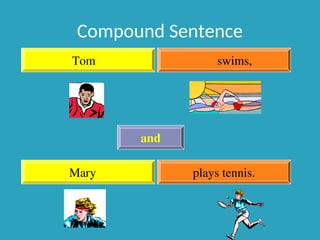
Compound Sentence
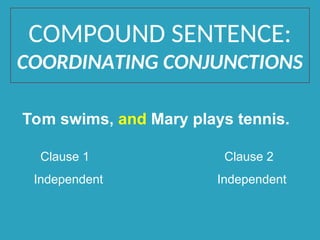
• Acompound sentence has more than one
part that can stand alone (independent
clauses).
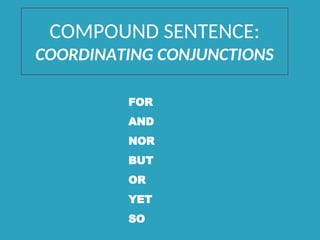
• Independent clauses are connected by
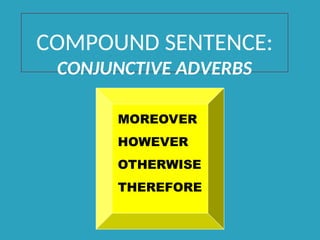
coordinating conjunctions, conjunctive
adverbs or a semi-colon.
Conjunctive Adverbs “float”
•Conjunctive adverbs are sometimes
called “floating” adverbs because
they can be positioned at the
beginning, in the middle, or at the
end of a clause.
26.
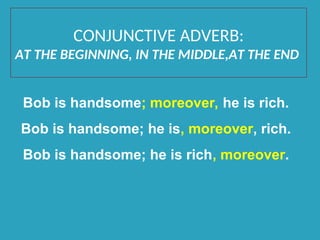
CONJUNCTIVE ADVERB:
AT THEBEGINNING, IN THE MIDDLE,AT THE END
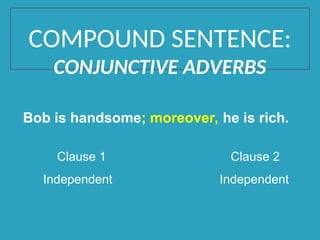
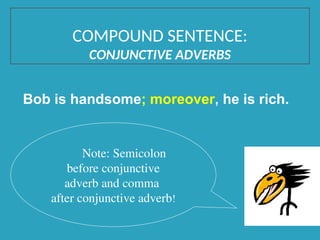
Bob is handsome; moreover, he is rich.
Bob is handsome; he is, moreover, rich.
Bob is handsome; he is rich, moreover.
27.
Semicolons
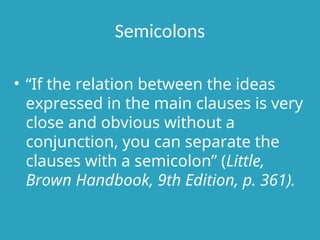
• “If therelation between the ideas
expressed in the main clauses is very
close and obvious without a
conjunction, you can separate the
clauses with a semicolon” (Little,
Brown Handbook, 9th Edition, p. 361).
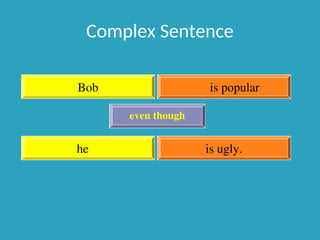
Complex Sentence
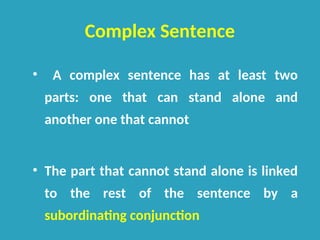
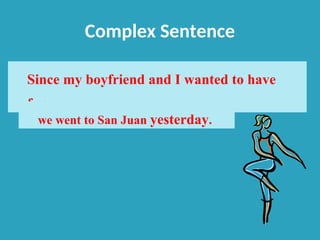
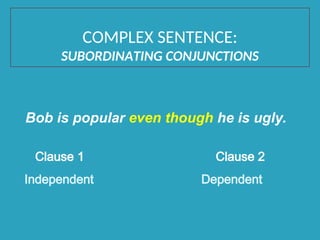
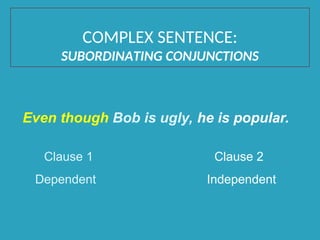
• Acomplex sentence has at least two
parts: one that can stand alone and
another one that cannot
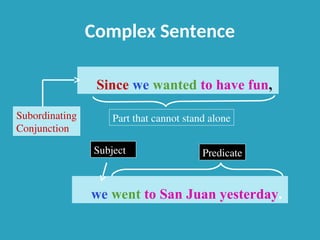
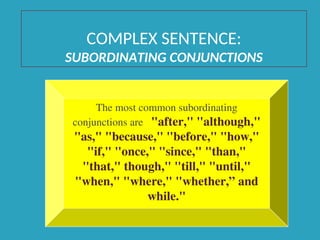
• The part that cannot stand alone is linked
to the rest of the sentence by a
subordinating conjunction
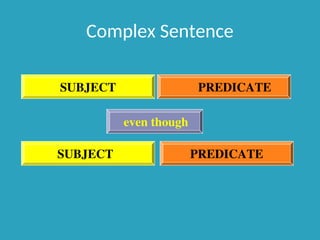
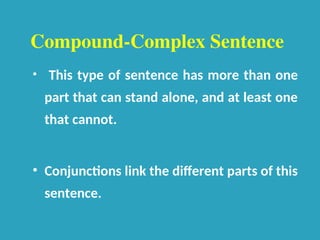
• This typeof sentence has more than one
part that can stand alone, and at least one
that cannot.
• Conjunctions link the different parts of this
sentence.
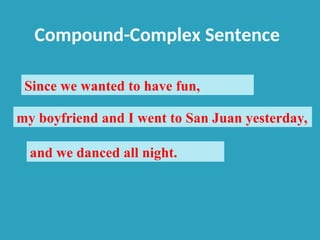
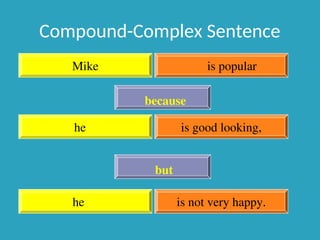
Compound-Complex Sentence
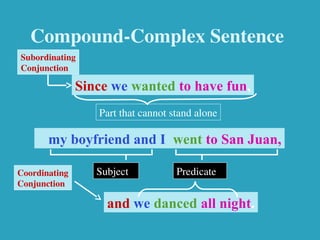
Since we wantedto have fun,
my boyfriend and I went to San Juan,
and we danced all night.
Subject Predicate
Subordinating
Conjunction
Coordinating
Conjunction
Part that cannot stand alone
Compound-Complex Sentence
Exercises
Say if thefollowing sentences are:
Simple, compound, complex or
compound-complex.
44.
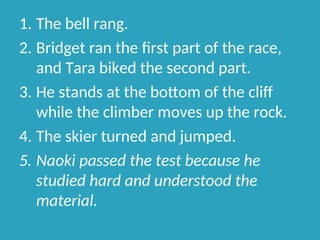
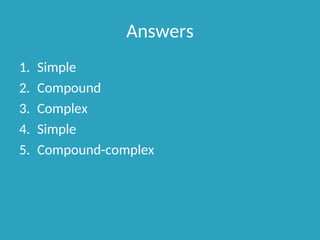
1. The bellrang.
2. Bridget ran the first part of the race,
and Tara biked the second part.
3. He stands at the bottom of the cliff
while the climber moves up the rock.
4. The skier turned and jumped.
5. Naoki passed the test because he
studied hard and understood the
material.
References
Writing Academic English,Second Edition, by Alice
Oshima and Ann Hogue. White Plains: Addison,
Wesley, Longman, 1999.
The Little, Brown Handbook, by H. Ramsey Fowler and
Jane E. Aaron, Pearson, 2004.