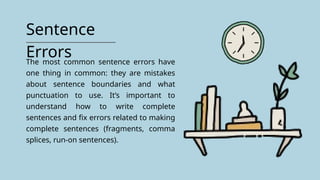
Sentence
Errors
The most commonsentence errors have
one thing in common: they are mistakes
about sentence boundaries and what
punctuation to use. It’s important to
understand how to write complete
sentences and fix errors related to making
complete sentences (fragments, comma
splices, run-on sentences).
3.
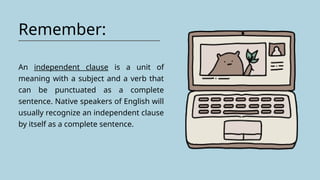
Remember:
An independent clauseis a unit of
meaning with a subject and a verb that
can be punctuated as a complete
sentence. Native speakers of English will
usually recognize an independent clause
by itself as a complete sentence.
4.
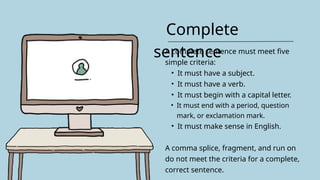
Complete
sentence
A complete sentencemust meet five
simple criteria:
• It must have a subject.
• It must have a verb.
• It must begin with a capital letter.
• It must end with a period, question
mark, or exclamation mark.
• It must make sense in English.
A comma splice, fragment, and run on
do not meet the criteria for a complete,
correct sentence.
Fragments
A fragment occurswhen writers fail to
create complete sentences. With few
exceptions, a sentence must have a subject
and verb and express a complete thought.
In other words, sentences should have at
least one independent clause.
7.
Take a lookat these
sentences
A. While driving down the street in my car with
my friends. [fragment]
B. During the summer, my brother who loves to
eat hot dogs. [fragment]
C. Aunt Mary is kind. Especially to strangers. [The
sentence that begins “Especially” is a fragment]
8.
Fragments
Fragments are generallyvery careless errors that show a lack of revision
effort. Since they tend to be incomplete ideas, they confuse readers, who,
as a result of the fragment, don’t understand the point of the sentence or
how the ideas relate.
Note the following constructions, which, coincidentally, tend to be found
where there are fragments:
1. Who, whose, which, that, and words that end –ing tend to create
fragments.
2. Avoid beginning sentences with “especially” and “which”.
9.
How to Fixthem?
There are several ways to fix a fragment. Here are three of the more common
approaches:
1. Add an independent clause. [Revised version of A]: While driving down the
street in my car with my friends, I texted my girlfriend.
2. Delete the part causing the fragment. [Revised version of B]: During the
summer, my brother who loves to eat hot dogs.
3. Combine the fragment with a neighboring sentence by using a comma.
[Revised version of C]: Aunt Mary is kind, especially to strangers.
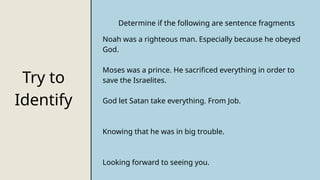
10.
Try to
Identify
Determine ifthe following are sentence fragments
Noah was a righteous man. Especially because he obeyed
God.
Moses was a prince. He sacrificed everything in order to
save the Israelites.
God let Satan take everything. From Job.
Knowing that he was in big trouble.
Looking forward to seeing you.
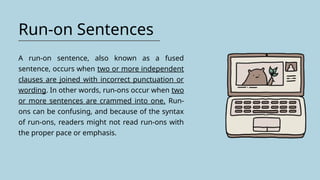
Run-on Sentences
A run-onsentence, also known as a fused
sentence, occurs when two or more independent
clauses are joined with incorrect punctuation or
wording. In other words, run-ons occur when two
or more sentences are crammed into one. Run-
ons can be confusing, and because of the syntax
of run-ons, readers might not read run-ons with
the proper pace or emphasis.
13.
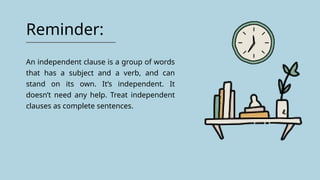
Reminder:
An independent clauseis a group of words
that has a subject and a verb, and can
stand on its own. It’s independent. It
doesn’t need any help. Treat independent
clauses as complete sentences.
14.
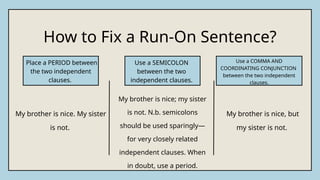
How to Fixa Run-On Sentence?
My brother is nice. My sister
is not.
My brother is nice; my sister
is not. N.b. semicolons
should be used sparingly—
for very closely related
independent clauses. When
in doubt, use a period.
My brother is nice, but
my sister is not.
Place a PERIOD between
the two independent
clauses.
Use a SEMICOLON
between the two
independent clauses.
Use a COMMA AND
COORDINATING CONJUNCTION
between the two independent
clauses.
15.
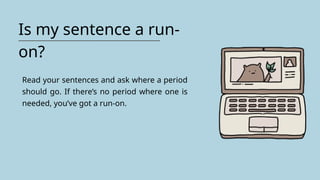
Is my sentencea run-
on?
Read your sentences and ask where a period
should go. If there’s no period where one is
needed, you’ve got a run-on.
16.
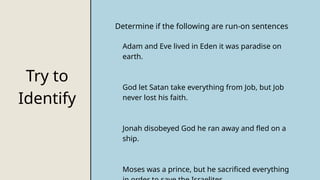
Try to
Identify
Determine ifthe following are run-on sentences
Adam and Eve lived in Eden it was paradise on
earth.
God let Satan take everything from Job, but Job
never lost his faith.
Jonah disobeyed God he ran away and fled on a
ship.
Moses was a prince, but he sacrificed everything
Comma Splice
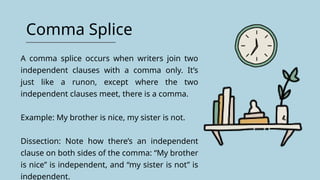
A commasplice occurs when writers join two
independent clauses with a comma only. It’s
just like a runon, except where the two
independent clauses meet, there is a comma.
Example: My brother is nice, my sister is not.
Dissection: Note how there’s an independent
clause on both sides of the comma: “My brother
is nice” is independent, and “my sister is not” is
independent.
19.
Remember:
Comma splices oftenoccur when writers use personal
or demonstrative pronouns after commas. Example:
Dad is cranky in the morning, he needs his coffee.
[splice]
Dissection: Note how the personal pronoun, “he” comes
right after the comma.
Like run-ons, comma splices can be confusing to the
reader because of the way they incorrectly emphasize
words and the way they distort the pace with which you
20.
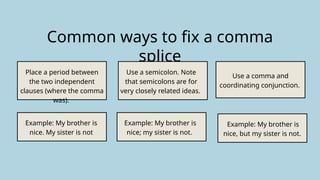
Common ways tofix a comma
splice
Place a period between
the two independent
clauses (where the comma
was).
Use a semicolon. Note
that semicolons are for
very closely related ideas.
Use a comma and
coordinating conjunction.
Example: My brother is
nice. My sister is not
Example: My brother is
nice; my sister is not.
Example: My brother is
nice, but my sister is not.
21.
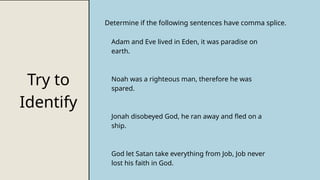
Try to
Identify
Determine ifthe following sentences have comma splice.
Adam and Eve lived in Eden, it was paradise on
earth.
Noah was a righteous man, therefore he was
spared.
Jonah disobeyed God, he ran away and fled on a
ship.
God let Satan take everything from Job, Job never
lost his faith in God.



![Take a look at these
sentences
A. While driving down the street in my car with
my friends. [fragment]
B. During the summer, my brother who loves to
eat hot dogs. [fragment]
C. Aunt Mary is kind. Especially to strangers. [The
sentence that begins “Especially” is a fragment]](https://image.slidesharecdn.com/sentence-errors-250505225157-cde0cb45/85/Sentence-Errors-pptxssssssssssssssssssss-7-320.jpg)
![How to Fix them?
There are several ways to fix a fragment. Here are three of the more common
approaches:
1. Add an independent clause. [Revised version of A]: While driving down the
street in my car with my friends, I texted my girlfriend.
2. Delete the part causing the fragment. [Revised version of B]: During the
summer, my brother who loves to eat hot dogs.
3. Combine the fragment with a neighboring sentence by using a comma.
[Revised version of C]: Aunt Mary is kind, especially to strangers.](https://image.slidesharecdn.com/sentence-errors-250505225157-cde0cb45/85/Sentence-Errors-pptxssssssssssssssssssss-9-320.jpg)


![Remember:
Comma splices often occur when writers use personal
or demonstrative pronouns after commas. Example:
Dad is cranky in the morning, he needs his coffee.
[splice]
Dissection: Note how the personal pronoun, “he” comes
right after the comma.
Like run-ons, comma splices can be confusing to the
reader because of the way they incorrectly emphasize
words and the way they distort the pace with which you](https://image.slidesharecdn.com/sentence-errors-250505225157-cde0cb45/85/Sentence-Errors-pptxssssssssssssssssssss-19-320.jpg)