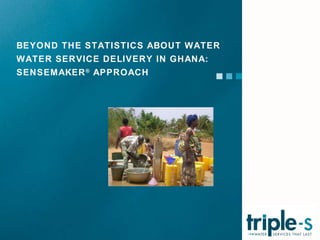
BEYOND THE STATISTICS ABOUT WATER WATER SERVICE DELIVERY IN GHANA: SENSEMAKER ®  APPROACH
BEYOND THE STATISTICS ABOUT WATER SERVICE DELIVERY IN GHANA: SenseMaker ®  APPROACH Presented By:  Esinu Abbey (IT Coordinator, CWSA) & Prosper Dzansi (Monitoring, Evaluation & Learning Expert)
Irene Guijt, Learning by Design Dave Snowden, Cognitive Edge  Acknowledgement
Outline Part 1:  The SenseMaker Approach Part 2: Application of SenseMaker
SenseMaker….. What is it? A software suite developed by Cognitive Edge to help find patterns among stories A tool for capturing story based data An Evaluation tool
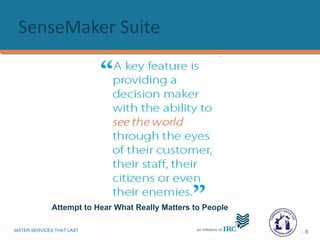
SenseMaker Suite Attempt to Hear What Really Matters to People
Examples   of   applications Liverpool  Museum  of Slavery culture of  violence  – Latin America grassroots  initiatives - East Africa girls’  empowerment – Rwanda, Ethiopia agricultural  value  chains - cotton, tea, banana water  service  delivery - Ghana, Uganda  youth  leadership  - global
Why use SenseMaker? Dynamic contexts need  adaptive  programme Respond to emerging  needs Understand  diversity   of perspectives Focus on  values  and people’s  experiences , with quantification Not stand alone approach Build in other evaluation frameworks
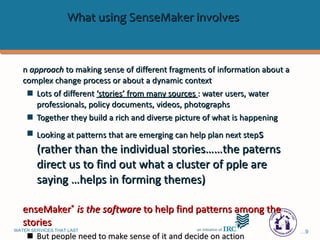
What using SenseMaker involves An  approach  to making sense of different fragments of information about a complex change process or about a dynamic context Lots of different  ‘stories’ from many sources  : water users, water professionals, policy documents, videos, photographs Together they build a rich and diverse picture of what is happening Looking at patterns that are emerging can help plan next step s (rather than the individual stories……the paterns direct us to find out what a cluster of pple are saying …helps in forming themes) SenseMaker ®  is the software  to help find patterns among the stories But people need to make sense of it and decide on action
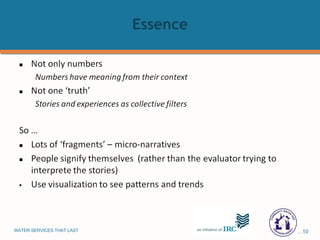
Essence
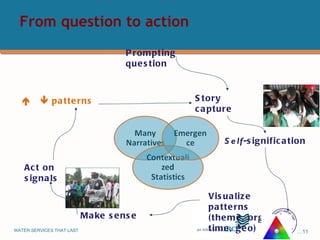
From question to action Prompting question    patterns Act on signals Story capture Self -signification Visualize patterns (theme, org, time, geo)  Make sense
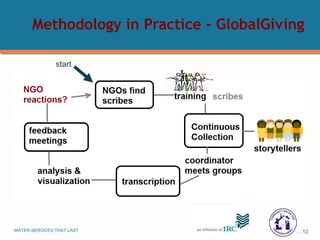
Methodology in Practice - GlobalGiving start
Asking  what? Goals, values, behaviours Non-negotiables seek  surprise & confirm  known
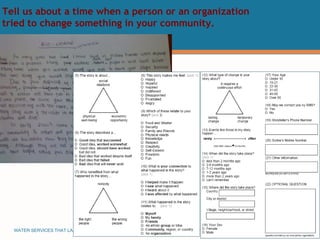
Tell us about a time when a person or an organization tried to change something in your community.
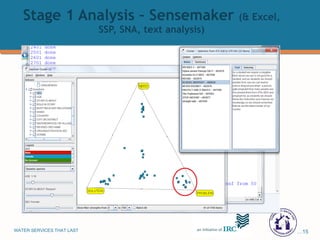
Stage 1 Analysis – Sensemaker  (& Excel, SSP, SNA, text analysis)
Stage 2 Analysis – People
Ghana Group Discussions per Theme Look at the patterns, reflect on your own experiences and read the related stories.  Discuss: What messages are emerging from the patterns? Which patterns are odd? And what might explain those patterns?  Which patterns do you recognise? What do the patterns suggest might be areas and issues that require attention?  New issues needing investment, some not worthwhile, etc.
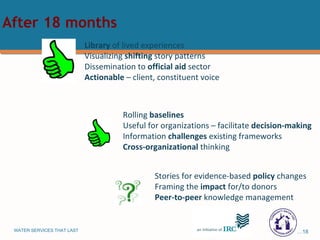
Library  of lived experiences Visualizing  shifting  story patterns Dissemination to  official aid  sector Actionable  – client, constituent voice Rolling  baselines Useful for organizations – facilitate  decision-making  Information  challenges  existing frameworks Cross-organizational  thinking Stories for evidence-based  policy  changes Framing the  impact  for/to donors Peer-to-peer  knowledge management After 18 months
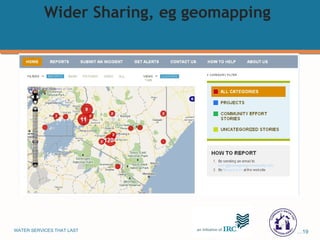
Wider Sharing, eg geomapping
Last thoughts See- Attend- Act It’s not just getting material in front of people Statistical links (especially self-discovered) create attention Linked “objectivised anecdotes” provide explanatory power and lead to action Measure success without  pre-defining (no pre defined mined set like logg frames…open mind) measures of success change over time allowing learning through tolerated failure  (do and learn from  mistakes made) contextual adjustment Evidence-based  policy tests of coherence empower ‘people’ to use statistics potential for whole of population engagement complexity/narratives alternatives to “Delphi” to allow real time distributed consultation
Part 2
BEYOND THE STATISTICS ABOUT WATER SERVICE DELIVERY IN GHANA:    SENSE MAKER APPLICATION IN TRIPLE-S
PRESENTATION OUTLINE 1.Background of Triple-S 2. Why use SenseMaker in Triple-S 3. Methodology for story collection 4. Analysis 5. Results 6.  Next steps
BACKGROUND TO TRIPLE-S Triple-S: a six year research project 2009 – 2014 Managed by IRC in collaboration with partners and funded by the Bill & Melinda Gates Foundation Seeks to tackle log-term challenges of sustainable water supply by contributing to shift from “infrastructure perspective” to  service delivery approach  for  rural water  sector through: Action research in Ghana, Uganda (& Burkina Faso) Working with government and sector stakeholders  Research, documentation and dissemination International partnerships and advocacy
WHY USE SENSE MAKER FOR TRIPLE S ? Respond to emerging needs – flexible funding for new ideas.  Diversity of perspectives  - especially users and professionals. Getting beyond statistics about water points and policy intentions to people’s lived experiences in the water sector. Monitor water users satisfaction of the services they are receiving .
SERVING A LARGER LEARNING PURPOSE Triple-S  identified  Narratives  as a means of monitoring and evaluation. Learning in Triple-S takes place in two areas (Narratives). Narrative 1: tells the story about sector change towards sustainability ( changes in discourse, new ideas emerging, changing practices and policies ) Narrative 2 tells the story of the process to enable this change. Use of statistical methods and stories in these narratives Learning is geared towards improving our performance;
METHODOLOGY OF STORY COLLECTION Who tells stories? 1.  Two main categories of stakeholders; Users at water facility level: Akatsi, East Gonja, &  Sunyani West District Assemblies Water Professionals: Government & NGO staff at Central & Decentralized level 2. Actual stories collected: 1, 256,  water users  842, water professionals 414 3. Pilot stage =300
METHODOLOGY OF STORY COLLECTION Who collects  stories?  Recruited and trained 22 story collectors young unemployed graduates or national service personnel,  teachers,  assembly men ,  environmental health officers,  community development officers  and  Social welfare officers
METHODOLOGY OF STORY COLLECTION Methods for Story  Collection User stories were collected through  interviews :  Story collectors where deployed to all area councils in each pilot District to ensure spread of stories & representativeness . Water Professionals stories were collected through: -  interviews( in offices of water professionals and  sector events - an e-based collector  website   Incentives Lunch and transport  allowances were provided to story collectors Feedback ( sharing and discussion of results to motivate people to share stories)
LESSONS/CONSIDERATIONS Things that work well Both water users and professionals were willing to share stories The use of the word ‘story’ prompted respondents to share long narratives and sometimes fairytales or fiction’ Things that did not  work well  The use of the collector website did not work well as practitioners saw no motivation to respond  Practitioners preferred speaking out their experiences rather than writing them.
DATA ENTRY & ANALYSIS 1.  Data entry outsourced 2. Two levels of analysis are planned: Preliminary analysis on demographics, & key highlights and trends observed by Triple- S Sharing the Results with Stakeholders at National Learning Alliance Platform for them  to: Make sense of the trends observed,  Identify  messages that emerging from the patterns? New issues needing investment, some not worthwhile
B. Results
What do we need to know?  Water Users How do people think of their water supply (quality, reliability, quantity etc)?  How do water users perceive water professionals?  How do people know their rights and responsibilities to water use What are the views of water users/people on who should pay for water?  Water Professionals?  What are the implementation challenges associated with sustainable provision of new water facilities?   What success story of non technical /infrastructure can the sector build on?  Where are we seeing stagnation and where are we seeing good Is there harmonization and alignment being done positive and negative?
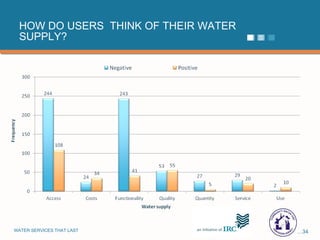
HOW DO USERS  THINK OF THEIR WATER SUPPLY?
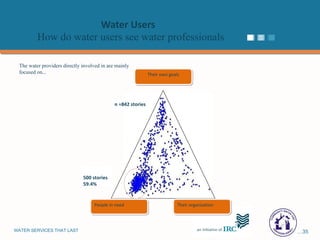
Water Users   How do water users see water professionals 500 stories 59.4% n =842 stories Their own goals People in need Their organization The water providers directly involved in are mainly focused on …
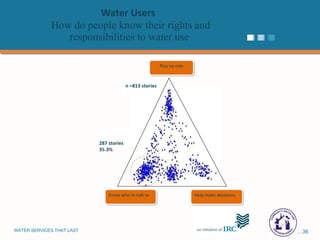
Water Users   How do people know their rights and responsibilities to water use Play no role Help make decisions Know who to talk to n =813 stories 287 stories 35.3%
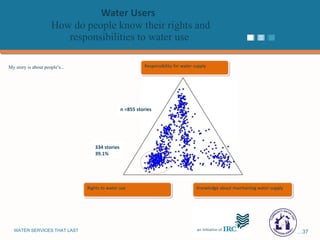
Water Users   How do people know their rights and responsibilities to water use Responsibility for water supply Rights to water use Knowledge about maintaining water supply n =855 stories 334 stories 39.1% My story is about people ’ s...
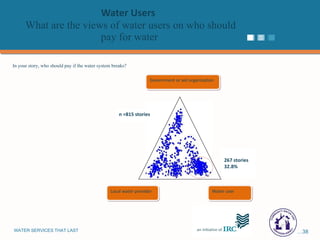
Water Users   What are the views of water users on who should pay for water Government or aid organization Water user Local water provider n =815 stories 267 stories 32.8% In your story, who should pay if the water system breaks?
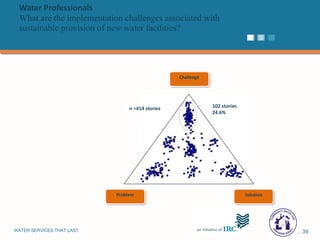
Water Professionals  What are the implementation challenges associated with sustainable provision of new water facilities? Challenge Solution Problem n =414 stories 102 stories 24.6%
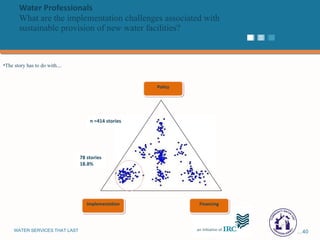
Water Professionals  What are the implementation challenges associated with sustainable provision of new water facilities? Policy Implementation Financing n =414 stories 78 stories 18.8% The story has to do with … .
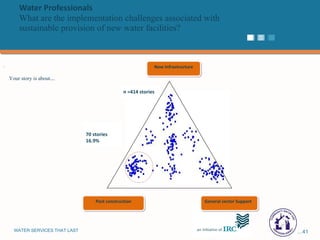
Water Professionals  What are the implementation challenges associated with sustainable provision of new water facilities? . New Infrastructure Post construction General sector Support n =414 stories 70 stories 16.9% Your story is about … .
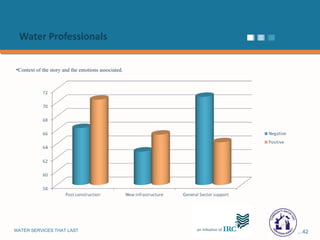
Water Professionals Context of the story and the emotions associated.
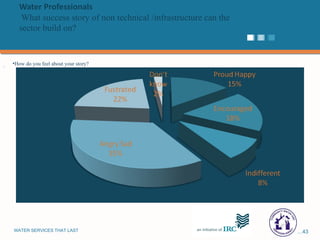
Water Professionals    What success story of non technical /infrastructure can the sector build on?  . How do you feel about your story?
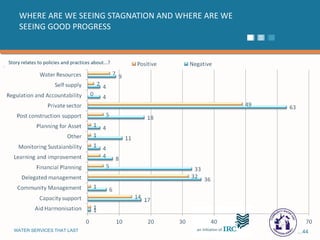
WHERE ARE WE SEEING STAGNATION AND WHERE ARE WE SEEING GOOD PROGRESS  . Story relates to policies and practices about... ?
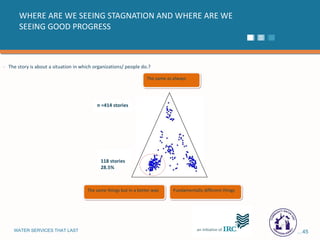
WHERE ARE WE SEEING STAGNATION AND WHERE ARE WE SEEING GOOD PROGRESS  . The same as always The same things but in a better way Fundamentally different things 118 stories 28.5% n =414 stories The story is about a situation in which organizations/ people do.?
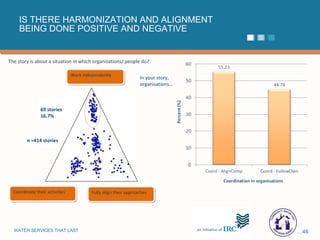
IS THERE HARMONIZATION AND ALIGNMENT BEING DONE POSITIVE AND NEGATIVE The story is about a situation in which organizations/ people do? Work independently Fully align their approaches Coordinate their activities n =414 stories 69 stories 16.7% In your story, organisations...
NEXT STEPS In the Next Steps … Sharing and discussing outputs from story analysis in review & coordination platforms at: - District  Regional - National level Setting up an institutionalized system of data collection  Anchor sense maker  activities into M&E system of CWSA and the sector
Thank you
Group Discussions per Theme Look at the patterns, reflect on your own experiences and read the related stories.  Discuss: What messages are emerging from the patterns? Which patterns are odd? And what might explain those patterns?  Which patterns do you recognise? What do the patterns suggest might be areas and issues that require attention?  New issues needing investment, some not worthwhile, etc.

SenseMaker approach Ghana

  • 1.
    BEYOND THE STATISTICSABOUT WATER WATER SERVICE DELIVERY IN GHANA: SENSEMAKER ® APPROACH
  • 2.
    BEYOND THE STATISTICSABOUT WATER SERVICE DELIVERY IN GHANA: SenseMaker ® APPROACH Presented By: Esinu Abbey (IT Coordinator, CWSA) & Prosper Dzansi (Monitoring, Evaluation & Learning Expert)
  • 3.
    Irene Guijt, Learningby Design Dave Snowden, Cognitive Edge Acknowledgement
  • 4.
    Outline Part 1: The SenseMaker Approach Part 2: Application of SenseMaker
  • 5.
    SenseMaker….. What isit? A software suite developed by Cognitive Edge to help find patterns among stories A tool for capturing story based data An Evaluation tool
  • 6.
    SenseMaker Suite Attemptto Hear What Really Matters to People
  • 7.
    Examples of applications Liverpool Museum of Slavery culture of violence – Latin America grassroots initiatives - East Africa girls’ empowerment – Rwanda, Ethiopia agricultural value chains - cotton, tea, banana water service delivery - Ghana, Uganda youth leadership - global
  • 8.
    Why use SenseMaker?Dynamic contexts need adaptive programme Respond to emerging needs Understand diversity of perspectives Focus on values and people’s experiences , with quantification Not stand alone approach Build in other evaluation frameworks
  • 9.
    What using SenseMakerinvolves An approach to making sense of different fragments of information about a complex change process or about a dynamic context Lots of different ‘stories’ from many sources : water users, water professionals, policy documents, videos, photographs Together they build a rich and diverse picture of what is happening Looking at patterns that are emerging can help plan next step s (rather than the individual stories……the paterns direct us to find out what a cluster of pple are saying …helps in forming themes) SenseMaker ® is the software to help find patterns among the stories But people need to make sense of it and decide on action
  • 10.
  • 11.
    From question toaction Prompting question  patterns Act on signals Story capture Self -signification Visualize patterns (theme, org, time, geo) Make sense
  • 12.
    Methodology in Practice- GlobalGiving start
  • 13.
    Asking what?Goals, values, behaviours Non-negotiables seek surprise & confirm known
  • 14.
    Tell us abouta time when a person or an organization tried to change something in your community.
  • 15.
    Stage 1 Analysis– Sensemaker (& Excel, SSP, SNA, text analysis)
  • 16.
    Stage 2 Analysis– People
  • 17.
    Ghana Group Discussionsper Theme Look at the patterns, reflect on your own experiences and read the related stories. Discuss: What messages are emerging from the patterns? Which patterns are odd? And what might explain those patterns? Which patterns do you recognise? What do the patterns suggest might be areas and issues that require attention? New issues needing investment, some not worthwhile, etc.
  • 18.
    Library oflived experiences Visualizing shifting story patterns Dissemination to official aid sector Actionable – client, constituent voice Rolling baselines Useful for organizations – facilitate decision-making Information challenges existing frameworks Cross-organizational thinking Stories for evidence-based policy changes Framing the impact for/to donors Peer-to-peer knowledge management After 18 months
  • 19.
  • 20.
    Last thoughts See-Attend- Act It’s not just getting material in front of people Statistical links (especially self-discovered) create attention Linked “objectivised anecdotes” provide explanatory power and lead to action Measure success without pre-defining (no pre defined mined set like logg frames…open mind) measures of success change over time allowing learning through tolerated failure (do and learn from mistakes made) contextual adjustment Evidence-based policy tests of coherence empower ‘people’ to use statistics potential for whole of population engagement complexity/narratives alternatives to “Delphi” to allow real time distributed consultation
  • 21.
  • 22.
    BEYOND THE STATISTICSABOUT WATER SERVICE DELIVERY IN GHANA: SENSE MAKER APPLICATION IN TRIPLE-S
  • 23.
    PRESENTATION OUTLINE 1.Backgroundof Triple-S 2. Why use SenseMaker in Triple-S 3. Methodology for story collection 4. Analysis 5. Results 6. Next steps
  • 24.
    BACKGROUND TO TRIPLE-STriple-S: a six year research project 2009 – 2014 Managed by IRC in collaboration with partners and funded by the Bill & Melinda Gates Foundation Seeks to tackle log-term challenges of sustainable water supply by contributing to shift from “infrastructure perspective” to service delivery approach for rural water sector through: Action research in Ghana, Uganda (& Burkina Faso) Working with government and sector stakeholders Research, documentation and dissemination International partnerships and advocacy
  • 25.
    WHY USE SENSEMAKER FOR TRIPLE S ? Respond to emerging needs – flexible funding for new ideas. Diversity of perspectives - especially users and professionals. Getting beyond statistics about water points and policy intentions to people’s lived experiences in the water sector. Monitor water users satisfaction of the services they are receiving .
  • 26.
    SERVING A LARGERLEARNING PURPOSE Triple-S identified Narratives as a means of monitoring and evaluation. Learning in Triple-S takes place in two areas (Narratives). Narrative 1: tells the story about sector change towards sustainability ( changes in discourse, new ideas emerging, changing practices and policies ) Narrative 2 tells the story of the process to enable this change. Use of statistical methods and stories in these narratives Learning is geared towards improving our performance;
  • 27.
    METHODOLOGY OF STORYCOLLECTION Who tells stories? 1. Two main categories of stakeholders; Users at water facility level: Akatsi, East Gonja, & Sunyani West District Assemblies Water Professionals: Government & NGO staff at Central & Decentralized level 2. Actual stories collected: 1, 256, water users 842, water professionals 414 3. Pilot stage =300
  • 28.
    METHODOLOGY OF STORYCOLLECTION Who collects stories? Recruited and trained 22 story collectors young unemployed graduates or national service personnel, teachers, assembly men , environmental health officers, community development officers and Social welfare officers
  • 29.
    METHODOLOGY OF STORYCOLLECTION Methods for Story Collection User stories were collected through interviews : Story collectors where deployed to all area councils in each pilot District to ensure spread of stories & representativeness . Water Professionals stories were collected through: - interviews( in offices of water professionals and sector events - an e-based collector website   Incentives Lunch and transport allowances were provided to story collectors Feedback ( sharing and discussion of results to motivate people to share stories)
  • 30.
    LESSONS/CONSIDERATIONS Things thatwork well Both water users and professionals were willing to share stories The use of the word ‘story’ prompted respondents to share long narratives and sometimes fairytales or fiction’ Things that did not work well The use of the collector website did not work well as practitioners saw no motivation to respond Practitioners preferred speaking out their experiences rather than writing them.
  • 31.
    DATA ENTRY &ANALYSIS 1. Data entry outsourced 2. Two levels of analysis are planned: Preliminary analysis on demographics, & key highlights and trends observed by Triple- S Sharing the Results with Stakeholders at National Learning Alliance Platform for them to: Make sense of the trends observed, Identify messages that emerging from the patterns? New issues needing investment, some not worthwhile
  • 32.
  • 33.
    What do weneed to know? Water Users How do people think of their water supply (quality, reliability, quantity etc)? How do water users perceive water professionals? How do people know their rights and responsibilities to water use What are the views of water users/people on who should pay for water? Water Professionals? What are the implementation challenges associated with sustainable provision of new water facilities?   What success story of non technical /infrastructure can the sector build on? Where are we seeing stagnation and where are we seeing good Is there harmonization and alignment being done positive and negative?
  • 34.
    HOW DO USERS THINK OF THEIR WATER SUPPLY?
  • 35.
    Water Users How do water users see water professionals 500 stories 59.4% n =842 stories Their own goals People in need Their organization The water providers directly involved in are mainly focused on …
  • 36.
    Water Users How do people know their rights and responsibilities to water use Play no role Help make decisions Know who to talk to n =813 stories 287 stories 35.3%
  • 37.
    Water Users How do people know their rights and responsibilities to water use Responsibility for water supply Rights to water use Knowledge about maintaining water supply n =855 stories 334 stories 39.1% My story is about people ’ s...
  • 38.
    Water Users What are the views of water users on who should pay for water Government or aid organization Water user Local water provider n =815 stories 267 stories 32.8% In your story, who should pay if the water system breaks?
  • 39.
    Water Professionals What are the implementation challenges associated with sustainable provision of new water facilities? Challenge Solution Problem n =414 stories 102 stories 24.6%
  • 40.
    Water Professionals What are the implementation challenges associated with sustainable provision of new water facilities? Policy Implementation Financing n =414 stories 78 stories 18.8% The story has to do with … .
  • 41.
    Water Professionals What are the implementation challenges associated with sustainable provision of new water facilities? . New Infrastructure Post construction General sector Support n =414 stories 70 stories 16.9% Your story is about … .
  • 42.
    Water Professionals Contextof the story and the emotions associated.
  • 43.
    Water Professionals What success story of non technical /infrastructure can the sector build on? . How do you feel about your story?
  • 44.
    WHERE ARE WESEEING STAGNATION AND WHERE ARE WE SEEING GOOD PROGRESS . Story relates to policies and practices about... ?
  • 45.
    WHERE ARE WESEEING STAGNATION AND WHERE ARE WE SEEING GOOD PROGRESS . The same as always The same things but in a better way Fundamentally different things 118 stories 28.5% n =414 stories The story is about a situation in which organizations/ people do.?
  • 46.
    IS THERE HARMONIZATIONAND ALIGNMENT BEING DONE POSITIVE AND NEGATIVE The story is about a situation in which organizations/ people do? Work independently Fully align their approaches Coordinate their activities n =414 stories 69 stories 16.7% In your story, organisations...
  • 47.
    NEXT STEPS Inthe Next Steps … Sharing and discussing outputs from story analysis in review & coordination platforms at: - District Regional - National level Setting up an institutionalized system of data collection Anchor sense maker activities into M&E system of CWSA and the sector
  • 48.
  • 49.
    Group Discussions perTheme Look at the patterns, reflect on your own experiences and read the related stories. Discuss: What messages are emerging from the patterns? Which patterns are odd? And what might explain those patterns? Which patterns do you recognise? What do the patterns suggest might be areas and issues that require attention? New issues needing investment, some not worthwhile, etc.

Editor's Notes

  • #2 ADDITIONAL LOGOS CAN GO TO THE RIGHT OF THE LINE NEXT TO THE IRC LOGO; MOVE IRC LOG0 LEFT TO MAKE MORE ROOM IF NEED BE
  • #20 Importance of Online and Offline Feedback Offline Workshops – Online Visibility/Recognition
  • #23 ADDITIONAL LOGOS CAN GO TO THE RIGHT OF THE LINE NEXT TO THE IRC LOGO; MOVE IRC LOG0 LEFT TO MAKE MORE ROOM IF NEED BE