SEMIOTIC 
By Juan Antonio Vera de la Cruz 
The Juarez Autonomous University of Tabasco
QUALIFY OF THE SEMIOTICS SIGNS 
• The science which studies signs and sign processes is called semiotics. A sign 
is a sensually perceived object, which represents another object and bears 
information for the percep- tion of that object. It represents not itself, but 
some- thing else, another object, located outside of it.
THE DIFERENCE OF A SIGN NORMAL OF 
SEMIOTIC SIGN 
• If we accept that the most important characteristic in the definition of a sign 
is that the sign ‘stands for something else’ and that ‘something else’ is goods 
or a service then the name of the thing is a trade mark. The Swiss linguist 
Ferdinand de Saussure (1857– 1913), considered to be the founder of 
semiotics, gives a dualistic idea of signs. The classical definition of a sign also 
belongs to Saussure. According to him signs have a certain structure, which 
he defines as an associ- ation between
PROPERTIES OF SEMIOTIC SIGNS 
• WHAT IS A SIGN? PROPERTIES: ATRADE MARK IS A SIGN, WHICH 
• 1. stands for something else ...signifies goods / services ... 
• 2. sign is difference ...serves for distinguishing of goods/services of a person, undertaking from those of others 
• 3. sign bears information ...gives information about a manufacturer, as well as about development of certain economic 
sectors 
• 4. sociality—signs are created by the community and are for the community 
• ...its usage may be related to a certain social category of the community 
• 5. bilateral unit—the so called layout ‘expressing—meaning’ exists 
• ...bears some message. What associative perceptions arise in a user? 
• ‘the thing that signifies’ or $ ‘the thing that is signified’ or ‘Signifier’ or $ ‘Signified’ or ‘signifying’ or $ ‘being signified’
MEAN OF ONE SEMIOTIC SIGN 
• A semiotic sign try give to know a history or definition of something for the 
town that it´s important for many industries becasue they want take over 
control on the marketing or some specific área, but a sign semiotic can 
contein a mean, just depend of the creator. This can get the atention of the 
people or just make a great shock on the country. 
• A sign semiotic just want to be the manager of all one Brand or something 
like that.
TYPES OF SEMIOTICS SIGNS 
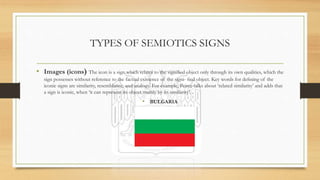
• Images (icons) The icon is a sign which relates to the signified object only through its own qualities, which the 
sign possesses without reference to the factual existence of the signi- fied object. Key words for defining of the 
iconic signs are similarity, resemblance, and analogy. For example, Peirce talks about ‘related similarity’ and adds that 
a sign is iconic, when ‘it can represent its object mainly by its similarity’. . 
• BULGARIA
Indicators (indices) Between indices and the thing they signify there is a cause-and-effect relationship. Indices are 
visible things which stand for something invisible. A popular example of indicators (indices) are indices of smoke, 
indicating fire, or of a flag of a ship, in- dicating that it has been registered under the laws of a certain country. 
OXFORD LIVERPOOL FOOTBALL CLUB EPO
Symbols A symbol is a word, sound, drawing or any object which presents an idea or a message through an 
association. A symbol is the ‘thing’ which bears meaning for the one, who reads, sees or hears it. The relation between 
what it signifies and what is signified depends mainly on who observes them both and on his intellect
BIBLIOGRAFIA 
• http://jiplp.oxfordjournals.org 
• Journal of Intellectual Property Law & Practice, 2013, (Binka Kirova and 
Ivan Penkin)

Semiotics signs

  • 1.
    SEMIOTIC By JuanAntonio Vera de la Cruz The Juarez Autonomous University of Tabasco
  • 2.
    QUALIFY OF THESEMIOTICS SIGNS • The science which studies signs and sign processes is called semiotics. A sign is a sensually perceived object, which represents another object and bears information for the percep- tion of that object. It represents not itself, but some- thing else, another object, located outside of it.
  • 3.
    THE DIFERENCE OFA SIGN NORMAL OF SEMIOTIC SIGN • If we accept that the most important characteristic in the definition of a sign is that the sign ‘stands for something else’ and that ‘something else’ is goods or a service then the name of the thing is a trade mark. The Swiss linguist Ferdinand de Saussure (1857– 1913), considered to be the founder of semiotics, gives a dualistic idea of signs. The classical definition of a sign also belongs to Saussure. According to him signs have a certain structure, which he defines as an associ- ation between
  • 4.
    PROPERTIES OF SEMIOTICSIGNS • WHAT IS A SIGN? PROPERTIES: ATRADE MARK IS A SIGN, WHICH • 1. stands for something else ...signifies goods / services ... • 2. sign is difference ...serves for distinguishing of goods/services of a person, undertaking from those of others • 3. sign bears information ...gives information about a manufacturer, as well as about development of certain economic sectors • 4. sociality—signs are created by the community and are for the community • ...its usage may be related to a certain social category of the community • 5. bilateral unit—the so called layout ‘expressing—meaning’ exists • ...bears some message. What associative perceptions arise in a user? • ‘the thing that signifies’ or $ ‘the thing that is signified’ or ‘Signifier’ or $ ‘Signified’ or ‘signifying’ or $ ‘being signified’
  • 5.
    MEAN OF ONESEMIOTIC SIGN • A semiotic sign try give to know a history or definition of something for the town that it´s important for many industries becasue they want take over control on the marketing or some specific área, but a sign semiotic can contein a mean, just depend of the creator. This can get the atention of the people or just make a great shock on the country. • A sign semiotic just want to be the manager of all one Brand or something like that.
  • 6.
    TYPES OF SEMIOTICSSIGNS • Images (icons) The icon is a sign which relates to the signified object only through its own qualities, which the sign possesses without reference to the factual existence of the signi- fied object. Key words for defining of the iconic signs are similarity, resemblance, and analogy. For example, Peirce talks about ‘related similarity’ and adds that a sign is iconic, when ‘it can represent its object mainly by its similarity’. . • BULGARIA
  • 7.
    Indicators (indices) Betweenindices and the thing they signify there is a cause-and-effect relationship. Indices are visible things which stand for something invisible. A popular example of indicators (indices) are indices of smoke, indicating fire, or of a flag of a ship, in- dicating that it has been registered under the laws of a certain country. OXFORD LIVERPOOL FOOTBALL CLUB EPO
  • 8.
    Symbols A symbolis a word, sound, drawing or any object which presents an idea or a message through an association. A symbol is the ‘thing’ which bears meaning for the one, who reads, sees or hears it. The relation between what it signifies and what is signified depends mainly on who observes them both and on his intellect
  • 9.
    BIBLIOGRAFIA • http://jiplp.oxfordjournals.org • Journal of Intellectual Property Law & Practice, 2013, (Binka Kirova and Ivan Penkin)