WELCOME
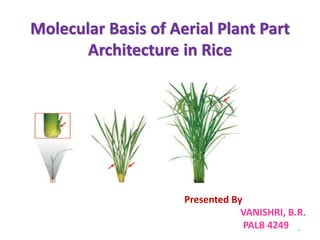
Molecular Basis of Aerial Plant Part
Architecture in Rice
2
Presented By
VANISHRI, B.R.
PALB 4249
Introduction
Tillering
Panicle morphology
Plant height
Case study
Conclusion
3
Plant Architecture
4
 Plant architecture is referred to as the three
dimensional organization of the plant.
 Crop plants with desirable architecture are able to
produce much higher grain yields.
 In case of the “Green Revolution” in which grain
yields have been significantly increased by growing
lodging-resistant semi- dwarf varieties of wheat and
rice.
Rice is an annual grass with round, hollow and
jointed stems (culms) that bear panicles.
Generally, rice plant growth is divided into
three stages:
1. Vegetative stage
2. Reproductive
3. Grain filling stage
5
Rice plant architecture
• Rice is an ideal system for studying plant architecture
of cereal crops.
• Rice plant architecture, a collection of the important
agronomic traits that determine its grain
production, is mainly affected by factors including
1. Tillering
2. Plant Height
3. Panicle Morphology
6
Tillering
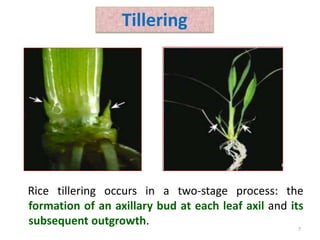
Rice tillering occurs in a two-stage process: the
formation of an axillary bud at each leaf axil and its
subsequent outgrowth.
7
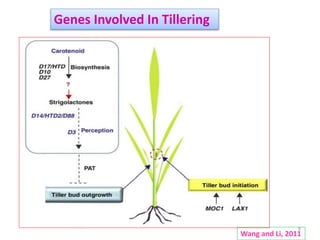
Genes Controlling Tillering
• MONOCULM 1 (MOC1)
• LAX PANICLE (LAX 1)
Genes involved in strigolactone biosynthesis
and signalling
8
9
Wang and Li, 2011
Genes Involved In Tillering
• Neither the extremely spreading nor the compact
plant type is beneficial to rice grain production.
Genes involved in regulating the tiller angle in rice:
• LAZY1 (LA1)
• TAC1 (Tiller Angle Control 1)
• PROG1 (PROSTRATE GROWTH1 )
10
LAZY1 (LA1)
Negative regulator in polar auxin transport
(PAT).
Mutations of LA1 enhance PAT greatly and alter
the endogenous IAA distribution in shoots,
leading to the tiller-spreading phenotype of rice
plants.
It regulates the lateral organ angle and mediates
branching and leaf formation (Li et al., 2007).
11
TAC1 (Tiller Angle Control 1)
• TAC1, positive regulator of rice tiller angle.
Mutation in TAC1
• Sharp upward asymmetrical growth of the base of
the culm.
• Compact plant architecture with erect tillers (Yu et
al., 2007).
12
PROSTRATE GROWTH1 (PROG1)
• Prostrate growth habit to erect tiller growth of rice.
• Transcription factor.
• Expression site: unelongated basal internodes of the
culm.
• Mutation in PROG1 leads to a phenotype of
significantly less vertical tiller angle.
13
• Tiller has the potential to produce a panicle by
transitioning from a vegetative SAM(shoot
apical meristem) into a reproductive SAM.
• Tillers that produce panicles are termed
effective tillers, and they contribute to the
grain yield.
Panicle Morphology
14
• Rice panicle develops into three types of axillary
meristems,
Rachis-branch Meristems,
 Lateral Spikelet Meristems
Terminal Spikelet Meristems.
• The initiation and outgrowth of these meristems
determines rice panicle morphology.
15
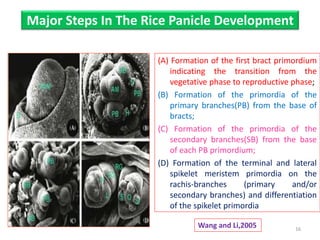
Major Steps In The Rice Panicle Development
(A) Formation of the first bract primordium
indicating the transition from the
vegetative phase to reproductive phase;
(B) Formation of the primordia of the
primary branches(PB) from the base of
bracts;
(C) Formation of the primordia of the
secondary branches(SB) from the base
of each PB primordium;
(D) Formation of the terminal and lateral
spikelet meristem primordia on the
rachis-branches (primary and/or
secondary branches) and differentiation
of the spikelet primordia
16
Wang and Li,2005
Key Genes Controlling Rice Panicle
Architecture
17
Wang and Li, 2008
Models representing the function of FZP during the
development of rice spikelets
18Komatso et al., 2003
Plant Height
Rice stem elongation starts at the beginning of
panicle initiation and is mainly ascribed to the rapid
elongation of cells in the top 4–6 internodes.
Gibberellins(GA) and Brassinosteroids(BR) have
been revealed to play major roles in modulating rice
plant height.
19
20Wang and Li,2008
CASE STUDY
21
INTRODUCTION
 Plant architecture, a complex of the important
agronomic traits that determine grain yield, is a
primary target of artificial selection of rice
domestication and improvement.
 Genetic identification and functional analysis of the
PLANT ARCHITECTURE AND YIELD 1 (PAY1) gene in
rice.
22
MATERIALS AND METHODS
Plant materials :
• YIL55 (a wild rice introgression line )
• The PAY1 mutant
YIL55 mutagenized with EMS to generate a library for
genetic screening of mutants with altered plant
architecture.
They identified a mutant with greatly changed plant
architecture, referred to as PLANT ARCHITECTURE AND
YIELD 1 (PAY1).
23
24
Phenotype of wild-type (YIL55) and PAY1 mutant.
(a) Introgression line YIL55 and the PAY1 mutant at maturity stage.
(b) Main panicle of YIL55 and PAY1 mutant.
(c) Stem structure of YIL55 and PAY1 mutant.
(d) Cross-sections of the fifth internode
(e) The diameter of the fifth internode between YIL55 and PAY1 mutant.
(f) Comparison of plant height, number of panicles per plant, grain number per
panicle and grain yield per plant between YIL55 and PAY1 mutant plants.
Cloning and Characterization of PAY1
• The F1 plants from the cross between PAY1 and YIL55
showed a similar phenotype to the PAY1 mutant .
• F2 plants, showed a segregation rate of the PAY1
mutant and YIL55 plants fitting a 3:1 ratio.
• These results indicated that the PAY1 mutant
phenotype was controlled by a single dominant
gene.
25
CLONING
• F2 populations were generated from the cross
between the PAY1 mutant and Nipponbare
• PAY1 mapped between the single sequence
repeat markers RM339 and RM223 on the
long arm of chromosome 8.
26
27
Molecular identification of PAY1
(a) PAY1 was mapped in the interval of RM339 and RM223 on the long arm of
chromosome 8.
(b) PAY1 was delimited to a 51-kb region between the sp5 and sp7 markers.
(c) Annotation of the 51-kb region harboring PAY1 on Nipponbare BAC AP004691.
(d) PAY1 structure and the mutation site in PAY1 mutant
Genetic Confirmation
• To verify altered plant architecture caused by the
single nucleotide change in the LOC_ Os08g31470
gene.
• They generated transgenic YIL55 plants with
overexpression of cDNA of the PAY1 mutant
• Real-time quantitative PCR (RT- qPCR) analysis
showed that the expression levels of PAY1 were
much higher in transgenic than in control plants.
28
Experimental Procedure
• The entire coding sequence of PAY1 cDNA , a 1773-bp
fragment, was inserted into the vector pCAMBIA1301
driven by the maize Ubiquitin promoter to form the
over expression construct pOE.
• The construct was introduced to Agrobacterium
tumefaciens strain EHA105 and subsequently
transferred into YIL55.
• There were 18 independent transgenic lines harvested,
and two lines (pOE6 and pOE8) were used for
phenotypic evaluation.
29
30
Comparison of control plant (CL3) and PAY1-overexpression transgenic plants .
The PAY1 mutant shows reduced
polar auxin transport(PAT) activity
 PAT plays a key role in the regulation of many aspects
of plant growth and development.
 The basipetal and acropetal indole-3-acetic acid (IAA)
transport in etiolated coleoptiles of wild-type and
PAY1 plants were compared.
31
32
3 groups of 5 days old Coleoptile Segments of 2cm length
incubation
Liq. Half strenght MS media, 100 rpm for 2hr
One end of apical/basal end is submerged in Half strenght MS media
To remove endogenous IAA
0.35% phytagel
500nm [3H]IAA
Dark
RT
2hr
NPA (N-1-naphthylphtalamic acid) applied to media for one group
Submerged end is washed with Half strenght MS media, 3times
Radioactivity of each section was counted by Liquid scintillation counter.
20 hr incubation in scintillation liquid
PAT Assay
33
Results and Discussion
Comparision of PAT between YIL55 and PAY1 mutant in dark grown coleoptiles
34
Comparision of auxin content in the tip of dark grown
coleoptiles between YIL55 and PAY1 mutants
PAY1 Used For High-yield Breeding
To evaluate the PAY1 potential application for
optimizing rice plant architecture and increasing
grain yields
They introduced the PAY1 into Teqing (TQ)
35
• The NILs were generated using continuous
backcrossing between PAY1, as the donor, and
elite indica variety Teqing as the recurrent
parent.
• BC3F3 generation plants were used for
phenotype analysis.
36
Continued
37
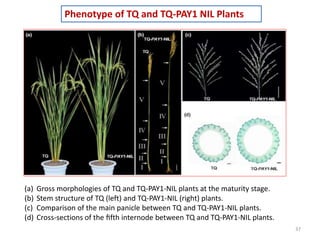
Phenotype of TQ and TQ-PAY1 NIL Plants
(a) Gross morphologies of TQ and TQ-PAY1-NIL plants at the maturity stage.
(b) Stem structure of TQ (left) and TQ-PAY1-NIL (right) plants.
(c) Comparison of the main panicle between TQ and TQ-PAY1-NIL plants.
(d) Cross-sections of the fifth internode between TQ and TQ-PAY1-NIL plants.
38
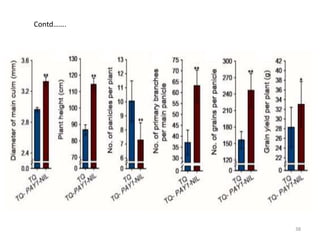
CContd…….
• The PAY1 mutant showed characteristics of ideal plant
architecture compared with the wild-type YIL55 via affecting
PAT activity and altering endogenous indole-3-acetic acid
distribution.
• The NILs with Teqing genetic background demonstrated that
PAY1 could shape better plant architecture and enhance
grain yield of rice.
• PAY1 is an important dominant regulator of rice plant
architecture and would be useful for rice genetic
improvement and breeding of new varieties with increased
grain yield, thus contributing to global food security.
39
CONCLUSION
SUMMARY
Rice is one of the most important staples and feeds more
than half of the world’s population.
The ability to produce more food in the same acreage is
crucial to feeding an increasing world population, and
therefore rice attracts tremendous attention in crop
improvement.
Elucidation of the molecular mechanisms underlying rice
plant architecture will provide a solid basis for modifying
the plant and in turn help to increase the yield.
40
41

seminar final

  • 1.
  • 2.
    Molecular Basis ofAerial Plant Part Architecture in Rice 2 Presented By VANISHRI, B.R. PALB 4249
  • 3.
  • 4.
    Plant Architecture 4  Plantarchitecture is referred to as the three dimensional organization of the plant.  Crop plants with desirable architecture are able to produce much higher grain yields.  In case of the “Green Revolution” in which grain yields have been significantly increased by growing lodging-resistant semi- dwarf varieties of wheat and rice.
  • 5.
    Rice is anannual grass with round, hollow and jointed stems (culms) that bear panicles. Generally, rice plant growth is divided into three stages: 1. Vegetative stage 2. Reproductive 3. Grain filling stage 5
  • 6.
    Rice plant architecture •Rice is an ideal system for studying plant architecture of cereal crops. • Rice plant architecture, a collection of the important agronomic traits that determine its grain production, is mainly affected by factors including 1. Tillering 2. Plant Height 3. Panicle Morphology 6
  • 7.
    Tillering Rice tillering occursin a two-stage process: the formation of an axillary bud at each leaf axil and its subsequent outgrowth. 7
  • 8.
    Genes Controlling Tillering •MONOCULM 1 (MOC1) • LAX PANICLE (LAX 1) Genes involved in strigolactone biosynthesis and signalling 8
  • 9.
    9 Wang and Li,2011 Genes Involved In Tillering
  • 10.
    • Neither theextremely spreading nor the compact plant type is beneficial to rice grain production. Genes involved in regulating the tiller angle in rice: • LAZY1 (LA1) • TAC1 (Tiller Angle Control 1) • PROG1 (PROSTRATE GROWTH1 ) 10
  • 11.
    LAZY1 (LA1) Negative regulatorin polar auxin transport (PAT). Mutations of LA1 enhance PAT greatly and alter the endogenous IAA distribution in shoots, leading to the tiller-spreading phenotype of rice plants. It regulates the lateral organ angle and mediates branching and leaf formation (Li et al., 2007). 11
  • 12.
    TAC1 (Tiller AngleControl 1) • TAC1, positive regulator of rice tiller angle. Mutation in TAC1 • Sharp upward asymmetrical growth of the base of the culm. • Compact plant architecture with erect tillers (Yu et al., 2007). 12
  • 13.
    PROSTRATE GROWTH1 (PROG1) •Prostrate growth habit to erect tiller growth of rice. • Transcription factor. • Expression site: unelongated basal internodes of the culm. • Mutation in PROG1 leads to a phenotype of significantly less vertical tiller angle. 13
  • 14.
    • Tiller hasthe potential to produce a panicle by transitioning from a vegetative SAM(shoot apical meristem) into a reproductive SAM. • Tillers that produce panicles are termed effective tillers, and they contribute to the grain yield. Panicle Morphology 14
  • 15.
    • Rice panicledevelops into three types of axillary meristems, Rachis-branch Meristems,  Lateral Spikelet Meristems Terminal Spikelet Meristems. • The initiation and outgrowth of these meristems determines rice panicle morphology. 15
  • 16.
    Major Steps InThe Rice Panicle Development (A) Formation of the first bract primordium indicating the transition from the vegetative phase to reproductive phase; (B) Formation of the primordia of the primary branches(PB) from the base of bracts; (C) Formation of the primordia of the secondary branches(SB) from the base of each PB primordium; (D) Formation of the terminal and lateral spikelet meristem primordia on the rachis-branches (primary and/or secondary branches) and differentiation of the spikelet primordia 16 Wang and Li,2005
  • 17.
    Key Genes ControllingRice Panicle Architecture 17 Wang and Li, 2008
  • 18.
    Models representing thefunction of FZP during the development of rice spikelets 18Komatso et al., 2003
  • 19.
    Plant Height Rice stemelongation starts at the beginning of panicle initiation and is mainly ascribed to the rapid elongation of cells in the top 4–6 internodes. Gibberellins(GA) and Brassinosteroids(BR) have been revealed to play major roles in modulating rice plant height. 19
  • 20.
  • 21.
  • 22.
    INTRODUCTION  Plant architecture,a complex of the important agronomic traits that determine grain yield, is a primary target of artificial selection of rice domestication and improvement.  Genetic identification and functional analysis of the PLANT ARCHITECTURE AND YIELD 1 (PAY1) gene in rice. 22
  • 23.
    MATERIALS AND METHODS Plantmaterials : • YIL55 (a wild rice introgression line ) • The PAY1 mutant YIL55 mutagenized with EMS to generate a library for genetic screening of mutants with altered plant architecture. They identified a mutant with greatly changed plant architecture, referred to as PLANT ARCHITECTURE AND YIELD 1 (PAY1). 23
  • 24.
    24 Phenotype of wild-type(YIL55) and PAY1 mutant. (a) Introgression line YIL55 and the PAY1 mutant at maturity stage. (b) Main panicle of YIL55 and PAY1 mutant. (c) Stem structure of YIL55 and PAY1 mutant. (d) Cross-sections of the fifth internode (e) The diameter of the fifth internode between YIL55 and PAY1 mutant. (f) Comparison of plant height, number of panicles per plant, grain number per panicle and grain yield per plant between YIL55 and PAY1 mutant plants.
  • 25.
    Cloning and Characterizationof PAY1 • The F1 plants from the cross between PAY1 and YIL55 showed a similar phenotype to the PAY1 mutant . • F2 plants, showed a segregation rate of the PAY1 mutant and YIL55 plants fitting a 3:1 ratio. • These results indicated that the PAY1 mutant phenotype was controlled by a single dominant gene. 25
  • 26.
    CLONING • F2 populationswere generated from the cross between the PAY1 mutant and Nipponbare • PAY1 mapped between the single sequence repeat markers RM339 and RM223 on the long arm of chromosome 8. 26
  • 27.
    27 Molecular identification ofPAY1 (a) PAY1 was mapped in the interval of RM339 and RM223 on the long arm of chromosome 8. (b) PAY1 was delimited to a 51-kb region between the sp5 and sp7 markers. (c) Annotation of the 51-kb region harboring PAY1 on Nipponbare BAC AP004691. (d) PAY1 structure and the mutation site in PAY1 mutant
  • 28.
    Genetic Confirmation • Toverify altered plant architecture caused by the single nucleotide change in the LOC_ Os08g31470 gene. • They generated transgenic YIL55 plants with overexpression of cDNA of the PAY1 mutant • Real-time quantitative PCR (RT- qPCR) analysis showed that the expression levels of PAY1 were much higher in transgenic than in control plants. 28
  • 29.
    Experimental Procedure • Theentire coding sequence of PAY1 cDNA , a 1773-bp fragment, was inserted into the vector pCAMBIA1301 driven by the maize Ubiquitin promoter to form the over expression construct pOE. • The construct was introduced to Agrobacterium tumefaciens strain EHA105 and subsequently transferred into YIL55. • There were 18 independent transgenic lines harvested, and two lines (pOE6 and pOE8) were used for phenotypic evaluation. 29
  • 30.
    30 Comparison of controlplant (CL3) and PAY1-overexpression transgenic plants .
  • 31.
    The PAY1 mutantshows reduced polar auxin transport(PAT) activity  PAT plays a key role in the regulation of many aspects of plant growth and development.  The basipetal and acropetal indole-3-acetic acid (IAA) transport in etiolated coleoptiles of wild-type and PAY1 plants were compared. 31
  • 32.
    32 3 groups of5 days old Coleoptile Segments of 2cm length incubation Liq. Half strenght MS media, 100 rpm for 2hr One end of apical/basal end is submerged in Half strenght MS media To remove endogenous IAA 0.35% phytagel 500nm [3H]IAA Dark RT 2hr NPA (N-1-naphthylphtalamic acid) applied to media for one group Submerged end is washed with Half strenght MS media, 3times Radioactivity of each section was counted by Liquid scintillation counter. 20 hr incubation in scintillation liquid PAT Assay
  • 33.
    33 Results and Discussion Comparisionof PAT between YIL55 and PAY1 mutant in dark grown coleoptiles
  • 34.
    34 Comparision of auxincontent in the tip of dark grown coleoptiles between YIL55 and PAY1 mutants
  • 35.
    PAY1 Used ForHigh-yield Breeding To evaluate the PAY1 potential application for optimizing rice plant architecture and increasing grain yields They introduced the PAY1 into Teqing (TQ) 35
  • 36.
    • The NILswere generated using continuous backcrossing between PAY1, as the donor, and elite indica variety Teqing as the recurrent parent. • BC3F3 generation plants were used for phenotype analysis. 36 Continued
  • 37.
    37 Phenotype of TQand TQ-PAY1 NIL Plants (a) Gross morphologies of TQ and TQ-PAY1-NIL plants at the maturity stage. (b) Stem structure of TQ (left) and TQ-PAY1-NIL (right) plants. (c) Comparison of the main panicle between TQ and TQ-PAY1-NIL plants. (d) Cross-sections of the fifth internode between TQ and TQ-PAY1-NIL plants.
  • 38.
  • 39.
    • The PAY1mutant showed characteristics of ideal plant architecture compared with the wild-type YIL55 via affecting PAT activity and altering endogenous indole-3-acetic acid distribution. • The NILs with Teqing genetic background demonstrated that PAY1 could shape better plant architecture and enhance grain yield of rice. • PAY1 is an important dominant regulator of rice plant architecture and would be useful for rice genetic improvement and breeding of new varieties with increased grain yield, thus contributing to global food security. 39 CONCLUSION
  • 40.
    SUMMARY Rice is oneof the most important staples and feeds more than half of the world’s population. The ability to produce more food in the same acreage is crucial to feeding an increasing world population, and therefore rice attracts tremendous attention in crop improvement. Elucidation of the molecular mechanisms underlying rice plant architecture will provide a solid basis for modifying the plant and in turn help to increase the yield. 40
  • 41.

Editor's Notes

  • #5 Therefore, understanding the mechanism that underlies plant architecture will facilitate to crop improvement.
  • #6 Heading stage : panicle is fully visible , (germination to panicle initiation to heading to maturity).
  • #8 Rice tiller is a specialized grain-bearing branch that is formed on the unelongated basal internode and grows independently of the mother stem (culm) by means of its own adventitious roots.
  • #9 initiate axillary buds and to promote their outgrowth. signal transduction…GRAS : GIBBERLIC ACID INSENSITIVE , REPRESSOR OF GAI, SCARECROW Lax produces basic HLH transcription reglalator
  • #10 Sl is inhibitor of tillering…. HTD high tillering and dwarfing :D17-CAROTENOID CLEAVAGE DEHYDROGENASE….D10:CCD  D27 encodes a novel iron-containing protein that localizes in chloroplasts and is expressed mainly in vascular cells of shoots and roots. D14 encodes hydrolase participate in perception of SL,,,,D3;LLR Wen there is mutation in these genes more branching
  • #14 PROG1 contains a single C2H2 type Zinc finger motif suggesting that the protein may function as a transcription factor, an idea consistent with its predominantly nuclear localisation.
  • #17 B. Formation of the primordia of the primary branches (PB) in a spiral pattern, showing the apical meristem (AM) that become degenerated after the formation of the primary branches and the bract hair cells (H) that are the degenerated forms of the bracts except the first one, D. A spikelet primordium differentiates in order the primordia of a rudimentary glume (RG), an empty glume (EG), a lemma (L), a palea (P), six stamens (S) and a pistil (O).
  • #18 FON1 :regulates stem cell proliferation and organ initiation, FON4 is putative ligand of FON1, which play a role in restricting the meristem size in rice.  Cytokinin: cyt accumulates in floral meristem and increase number of reproductive organs
  • #19 the inflorescence meristem (IM) generates branch meristems (BM) that in turn generate spikelet meristems (SM). Model 1, FZP acts to repress the formation of axillary meristems (AxM) from the SM and ensure that the SM acquires floral meristem (FM) identity. Model 2, FZP induces the transition from SM to FM identity. In fzp mutants, the transition to FM identity does not take place and ectopic AxMs behave as SMs
  • #21 SCF (Skp1-cullin-F-box) E3 ubiquitin ligase ..dwarf and gladius leaf 1 (dgl1), KTN1: ATPase katanin-like protein ,BR2: brachytic2 EUI: ELONGATED UPPERMOST INTERNODE ..BAK1: LRR-RLK BRI1-ASSOCIATED RECEPTOR KINASE1 BKI1: BRI1 kinase inhibitor 1 BRI1: BRASSINOSTEROID-INSENSITIVE1 BZR1: Brassinazole-resistant 1 BES1: Bri1-EMS-suppressor 1 BIN2: BR-INSENSITIVE 2,,,,, BSU1: BRI1 SUPPRESSOR 1 phosphatase 
  • #24 EMS: ethyl methane sulfonate
  • #25 Compared with YIL55, the PAY1 mutant exhibited greater plant height, lower tiller number, smaller tiller angle, thicker stems and larger panicles Mutant showed significantly more grains per panicle(73.7%), and grain yeild per plant 27.8%.
  • #28 Sequencing the 51-kb mapping region of wild-type YIL55 and mutant PAY1 revealed a single nucleotide change, G to A, at position +1244 in exon 4 of LOC_Os08g31470. single amino acid sub- stitution from glutamine (Q) in YIL55 to arginine (R) in the PAY1 mutant.
  • #31 These results clearly demonstrates that PAY1 contrles architecture and yeild
  • #32 To investigate whether PAY1 was involved in PAT, They compared
  • #33 Liquid scintillation counting (LSC) is the standard laboratory method to quantify the radioactivity of low energy radioisotopes,
  • #34 The basipetal IAA transport in PAY1 was reduced to approximately 41% of that in the wild-type, whereas basipetal transport of [3H]IAA treated with the PAT inhibitor N-1-naphthylphtalamic acid (NPA) showed no differences between wild-type and mutant plants
  • #35 These results indicated that reduced basipetal IAA transport activity led to altered endogenous IAA distribution in PAY1 mutant plants, and so affected plant architecture. Reduced basipetal IAA transport activity led to increasd endogenous IAA distribution in PAY1 mutant
  • #36 elite indica variety
  • #38 Compared with recipient plant (TQ ), TQ-PAY1-NIL showed enhanced greater plant height, less tiller number, smaller tiller angle, thicker culms, more secondary branches and larger panicles
  • #39 and significantly increased grain number per panicle (57.9 %), and grain yield per plant (16.8 %).