Download as PDF, PPTX
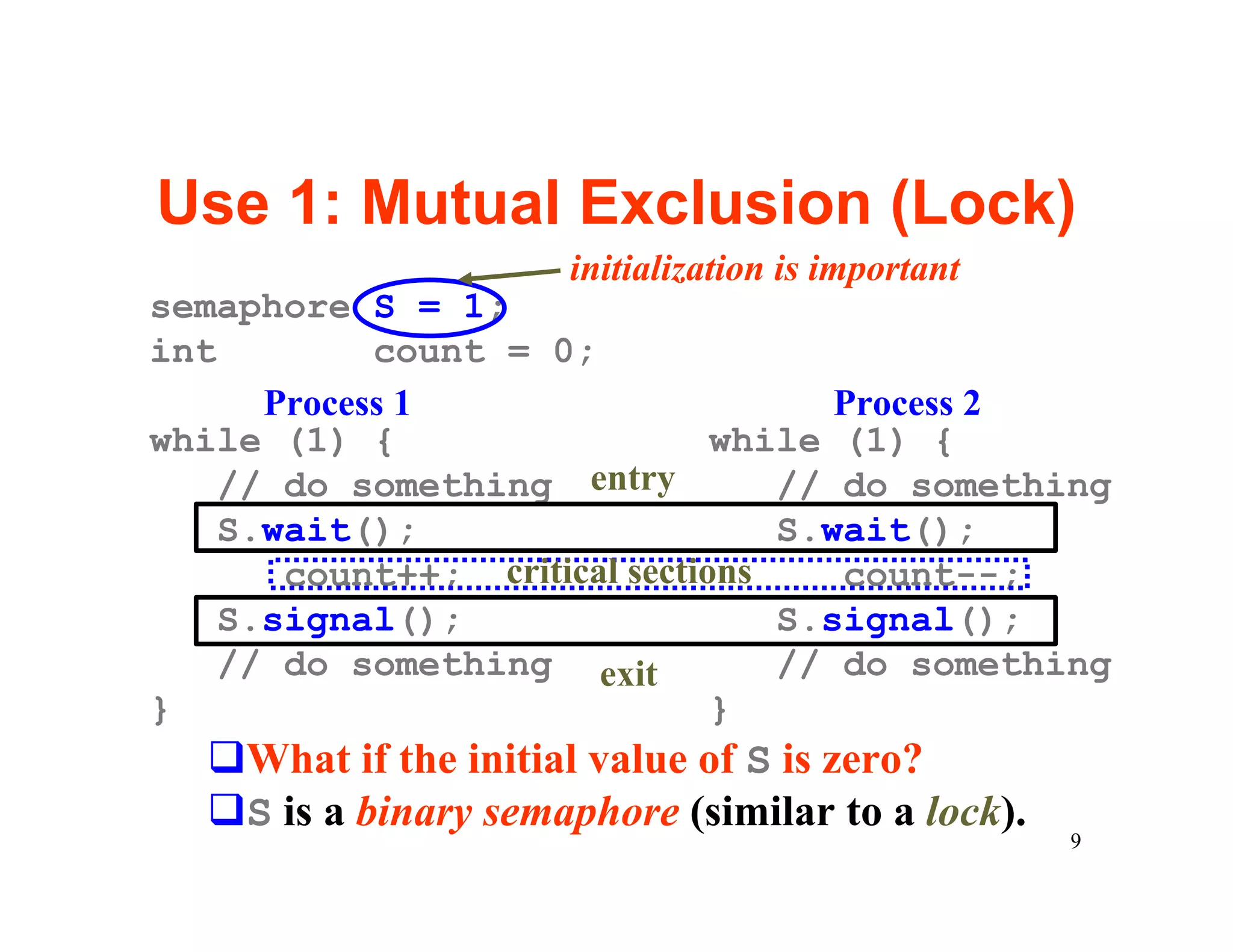
![Dining Philosopher: Ideas
qChopsticks are shared outer critical section
items (by two philosophers) left chop locked
and must be protected. Semaphore C[5] = 1;
qEach chopstick has a
C[i].wait();
semaphore with initial C[(i+1)%5].wait();
value 1.
has 2 chops and eats
qA philosopher calls
wait() before picks up a C[(i+1)%5].signal();
C[i].signal();
chopstick and calls
signal() to release it.
inner critical section
right chop locked 13](https://image.slidesharecdn.com/semaphores-120927060605-phpapp01/75/Semaphores-13-2048.jpg)
![Dining Philosophers: Code
semaphore C[5] = 1;
philosopher i wait for my left chop
while (1) {
// thinking
C[i].wait(); wait for my right chop
C[(i+1)%5].wait();
// eating release my right chop
C[(i+1)%5].signal();
C[i].signal(); release my left chop
// finishes eating
}
Does this solution work?
14](https://image.slidesharecdn.com/semaphores-120927060605-phpapp01/75/Semaphores-14-2048.jpg)
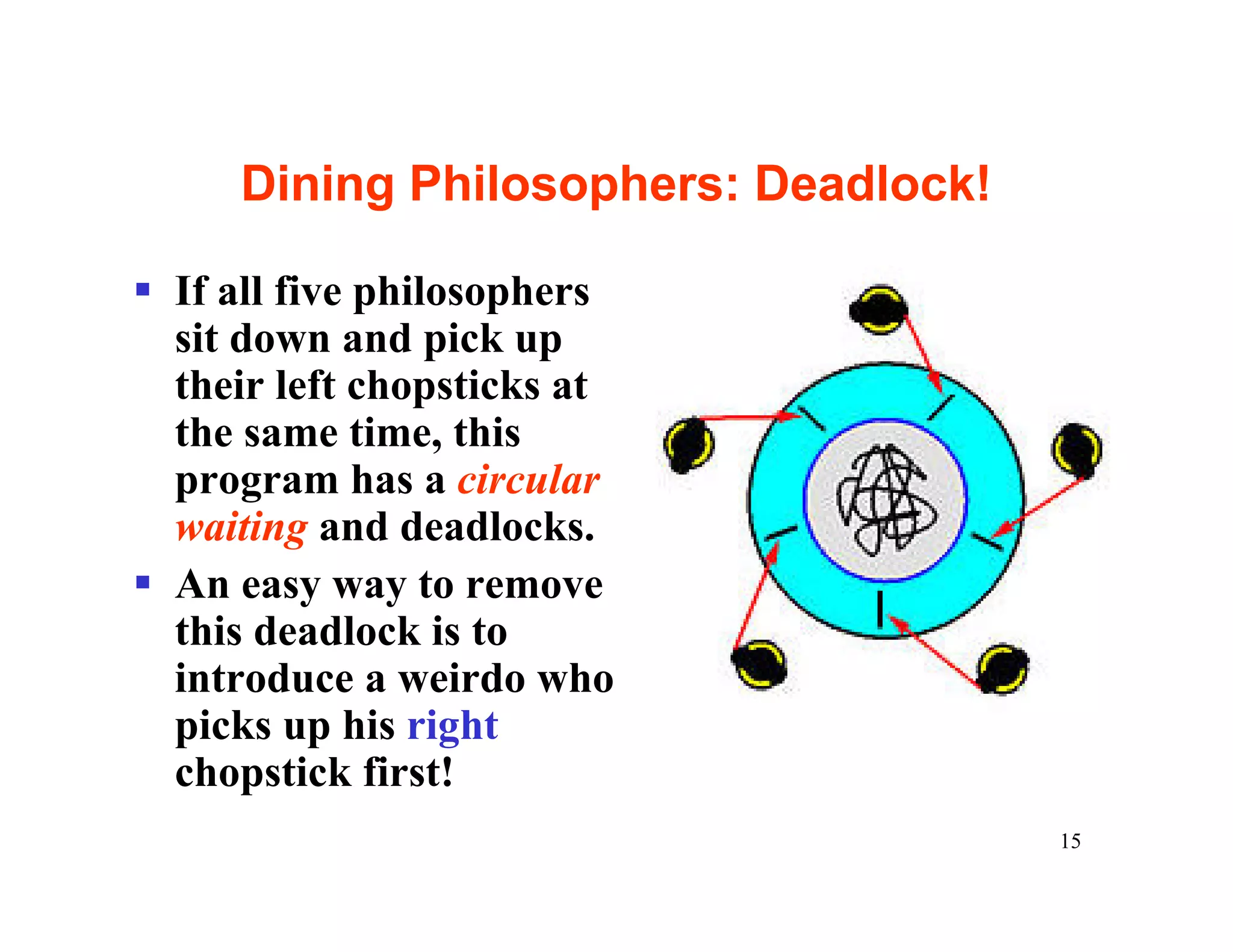
![Dining Philosophers: A Better Idea
semaphore C[5] = 1;
philosopher i (0, 1, 2, 3) Philosopher 4: the weirdo
while (1) { while (1) {
// thinking // thinking
C[i].wait(); C[(i+1)%5].wait();
C[(i+1)%5].wait(); C[i].wait();
// eating // eating
C[(i+1)%5].signal(); C[i].signal();
C[i].signal(); C[(i+1)%5].signal();
// finishes eating; // finishes eating
} }
lock left chop lock right chop
16](https://image.slidesharecdn.com/semaphores-120927060605-phpapp01/75/Semaphores-16-2048.jpg)
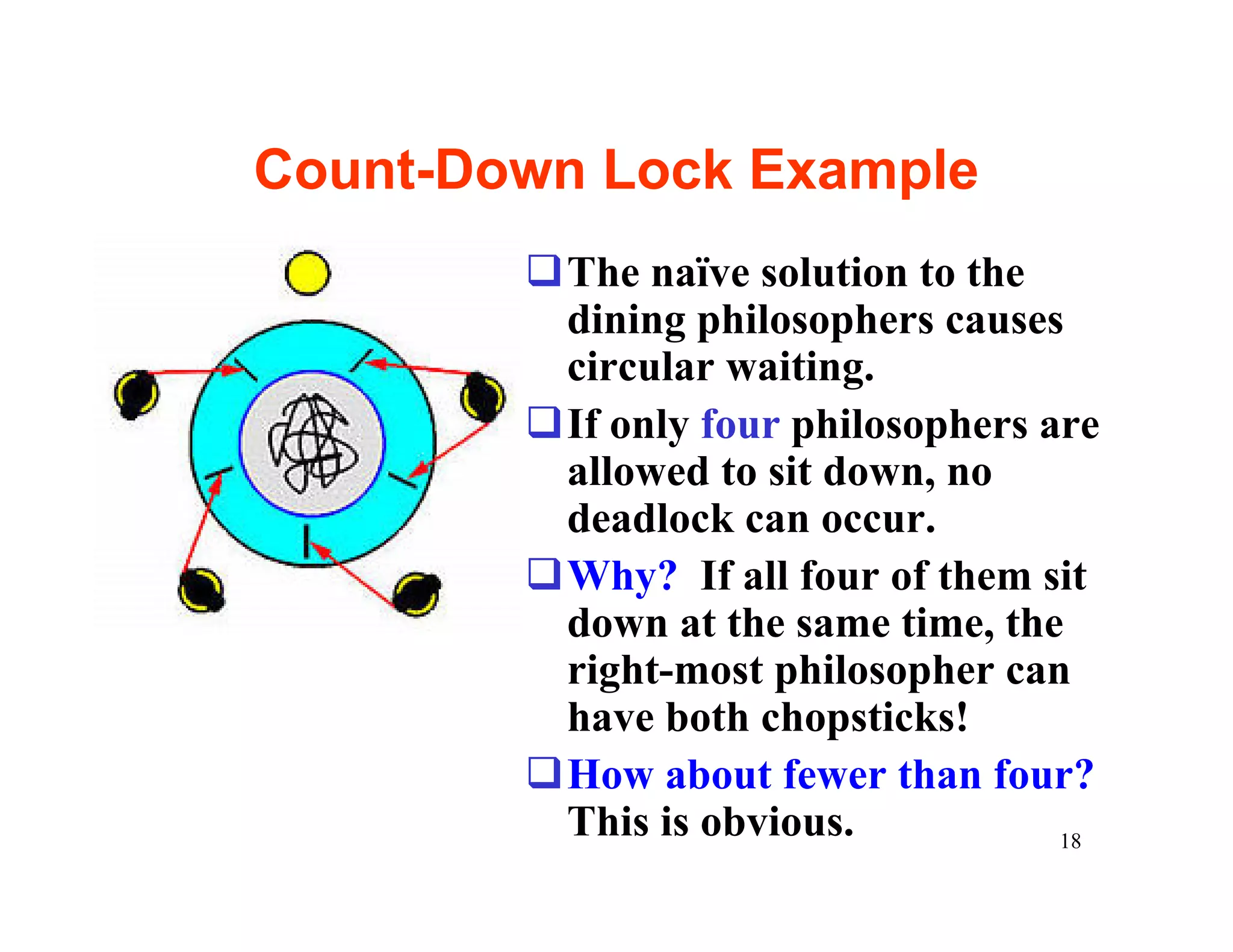
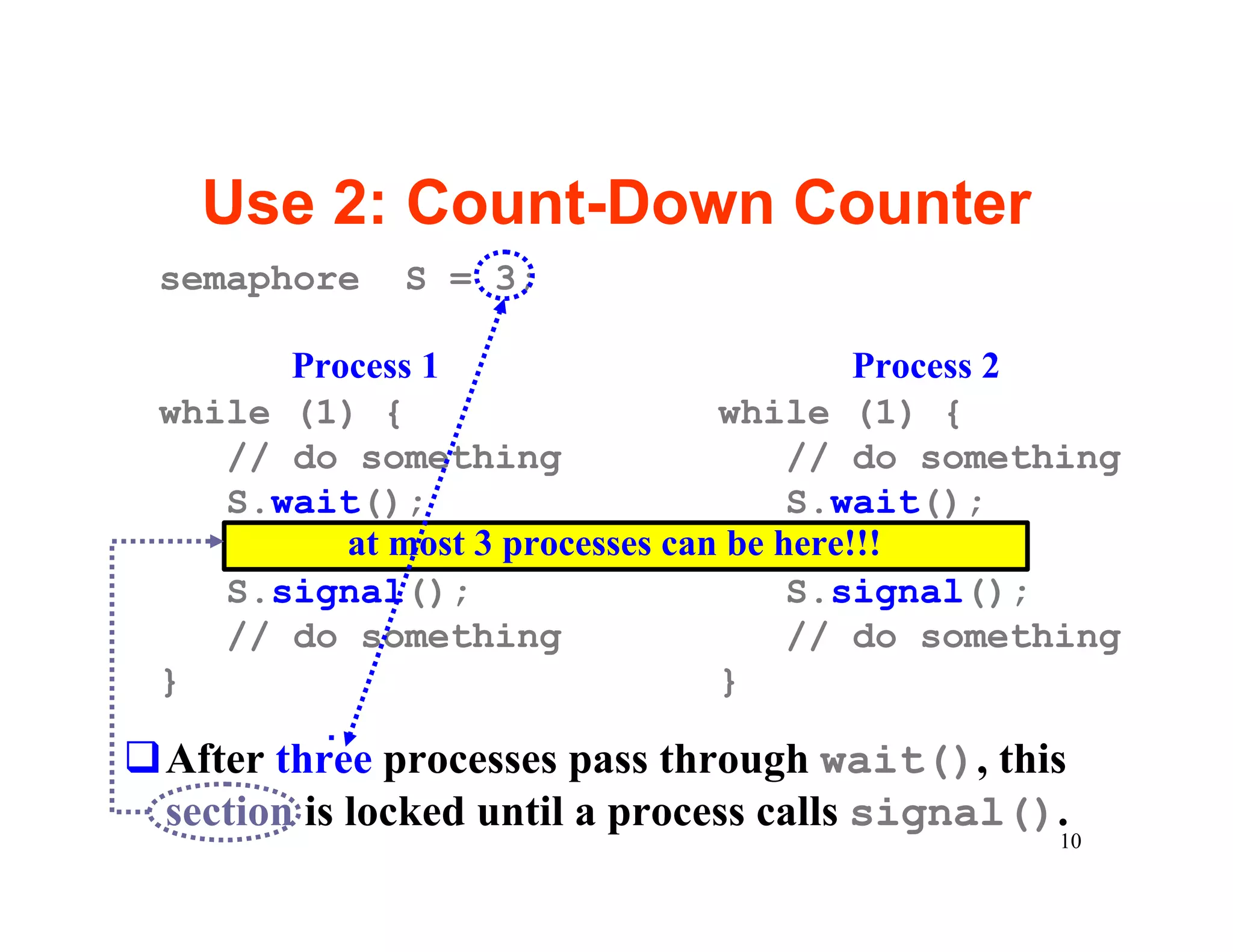
![Count-Down Lock Example
semaphore C[5]= 1;
semaphore Chair = 4;
get a chair
while (1) { this is a count-down lock
// thinking that only allows 4 to go!
Chair.wait();
C[i].wait();
C[(i+1)%5].wait();
// eating this is our old friend
C[(i+1)%5].signal();
C[i].signal();
Chair.signal();
} release my chair
19](https://image.slidesharecdn.com/semaphores-120927060605-phpapp01/75/Semaphores-19-2048.jpg)
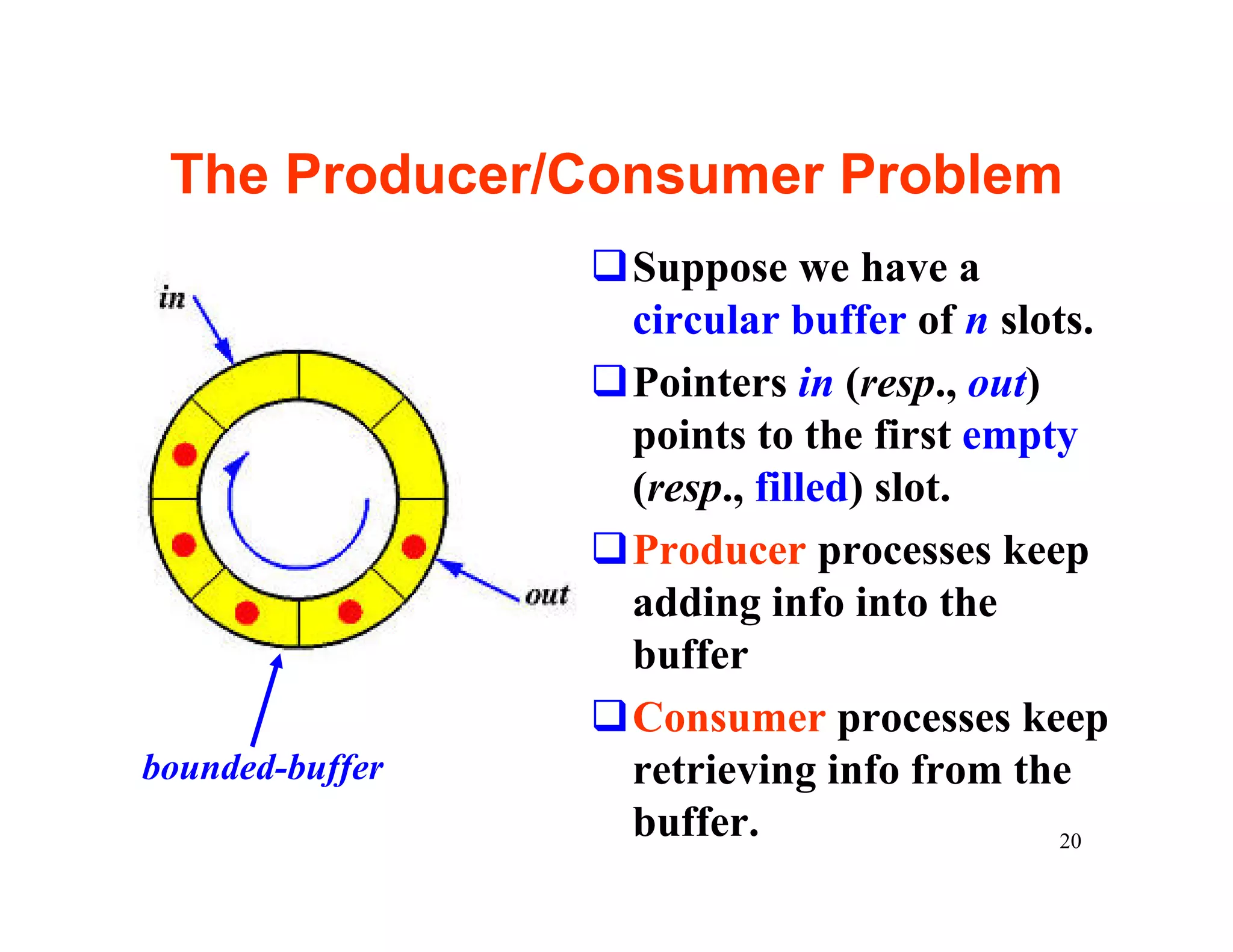
![Problem Analysis
qA producer deposits info into
Buf[in] and a consumer
retrieves info from Buf[out].
qin and out must be advanced.
qin is shared among producers.
qout is shared among consumers.
qIf Buf is full, producers should
buffer is implemented be blocked.
with an array Buf[ ] qIf Buf is empty, consumers
should be blocked.
21](https://image.slidesharecdn.com/semaphores-120927060605-phpapp01/75/Semaphores-21-2048.jpg)
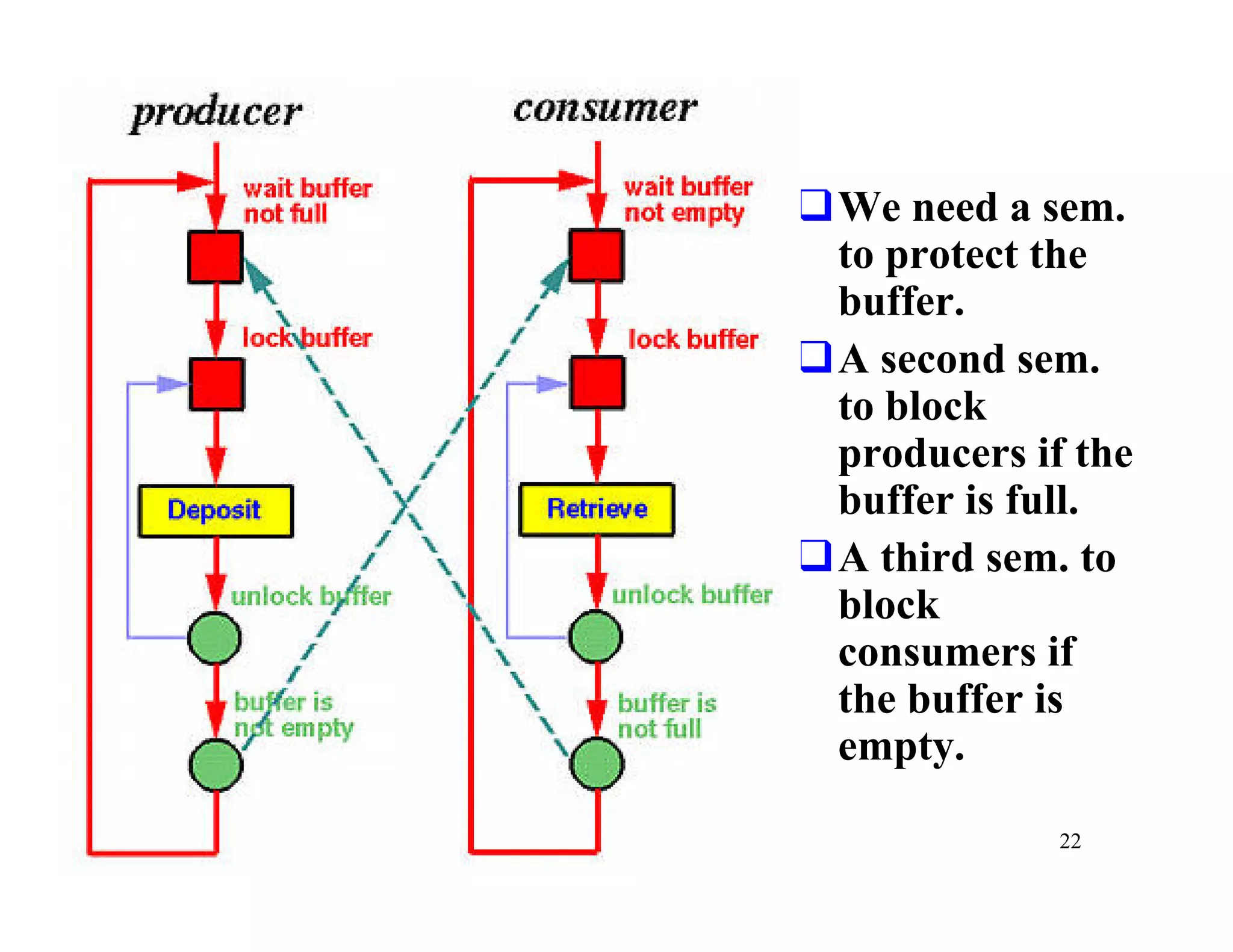
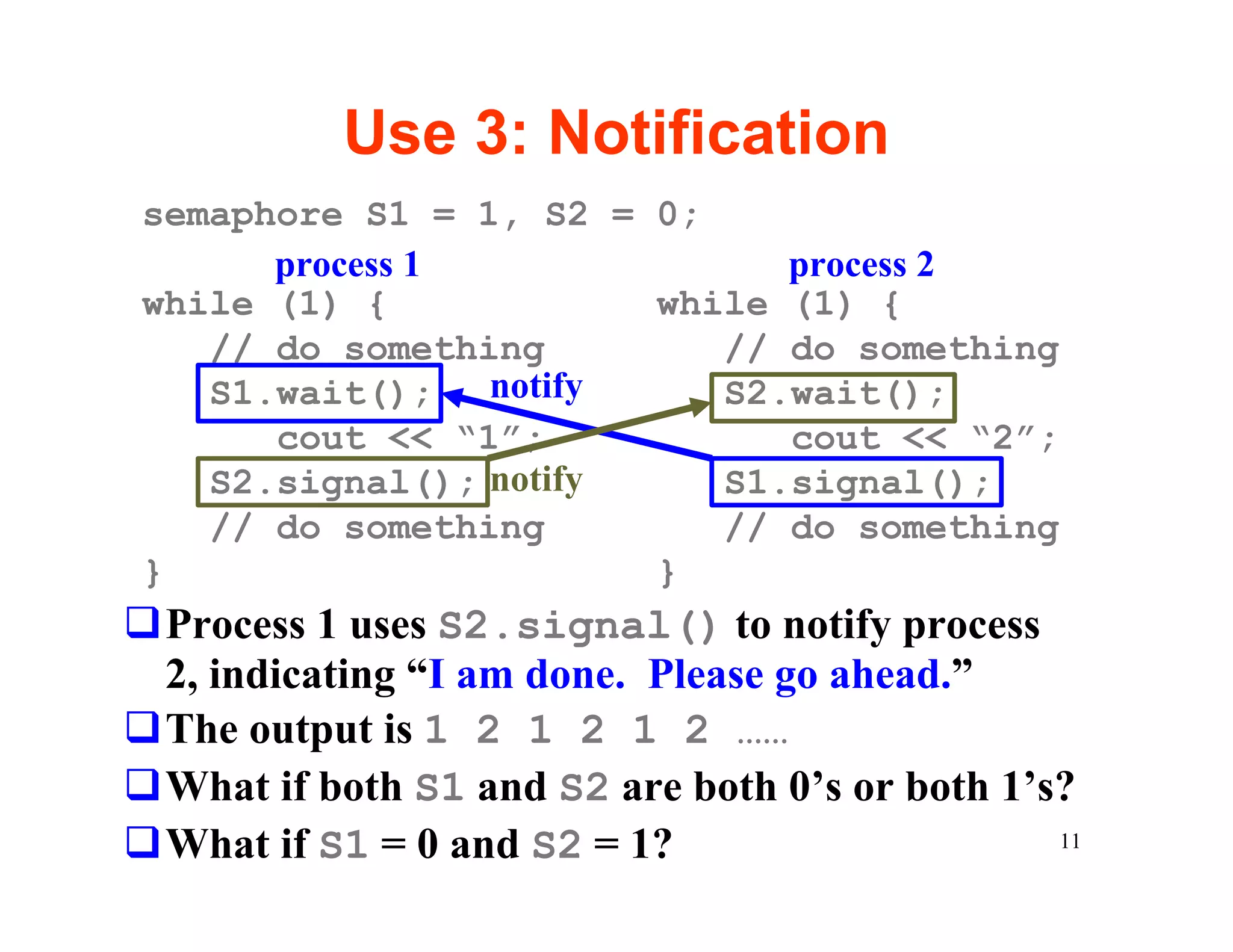
![Solution
no. of slots
semaphore NotFull=n, NotEmpty=0, Mutex=1;
producer consumer
while (1) { while (1) {
NotFull.wait(); NotEmpty.wait();
Mutex.wait(); Mutex.wait();
Buf[in] = x; x = Buf[out];
in = (in+1)%n; out = (out+1)%n;
Mutex.signal(); Mutex.signal();
NotEmpty.signal(); NotFull.signal();
} }
notifications
critical section
23](https://image.slidesharecdn.com/semaphores-120927060605-phpapp01/75/Semaphores-23-2048.jpg)
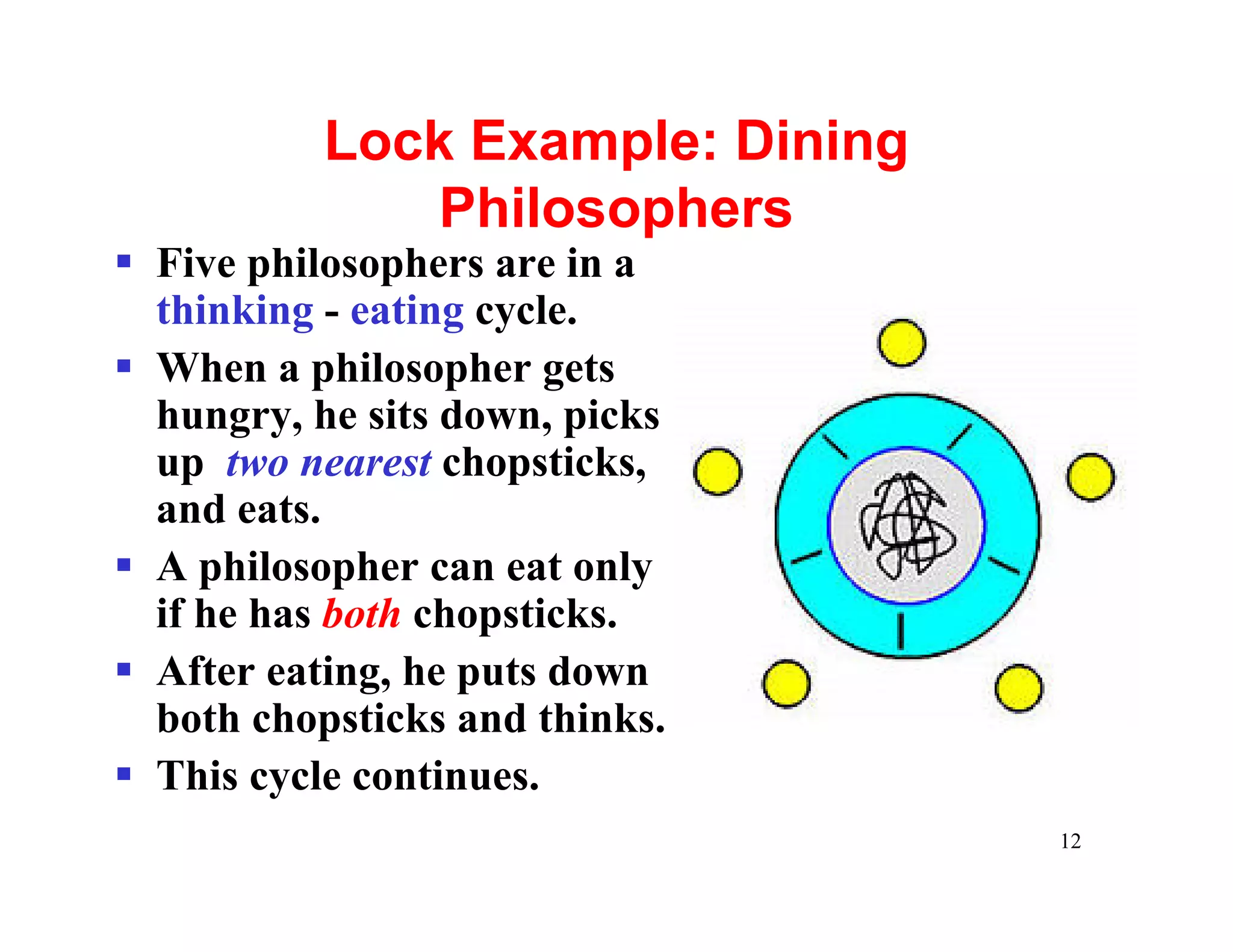
![Question
qWhat if the producer code is modified as follows?
qAnswer: a deadlock may occur. Why?
while (1) {
Mutex.wait();
NotFull.wait();
Buf[in] = x;
order changed in = (in+1)%n;
NotEmpty.signal();
Mutex.signal();
}
24](https://image.slidesharecdn.com/semaphores-120927060605-phpapp01/75/Semaphores-24-2048.jpg)

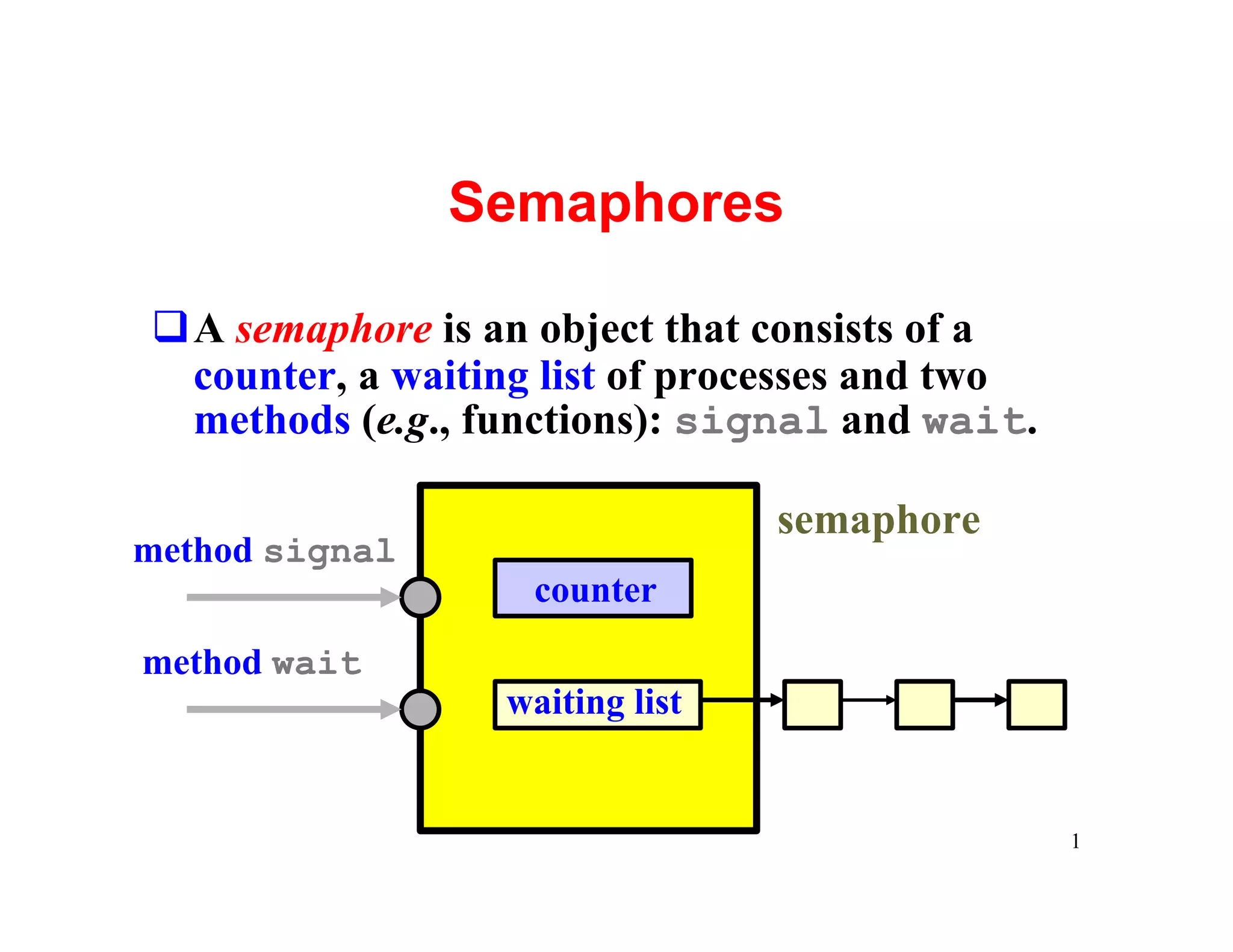
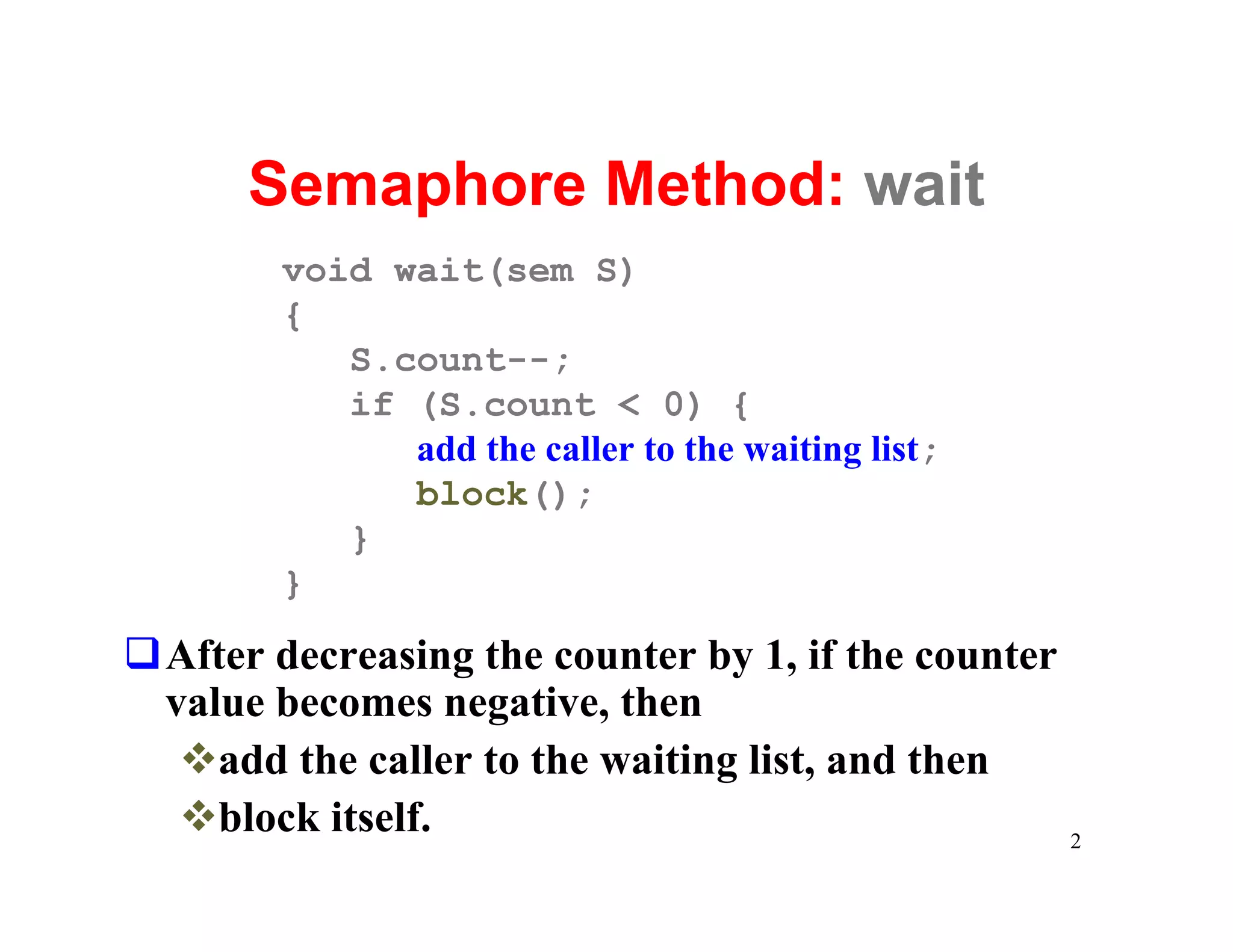
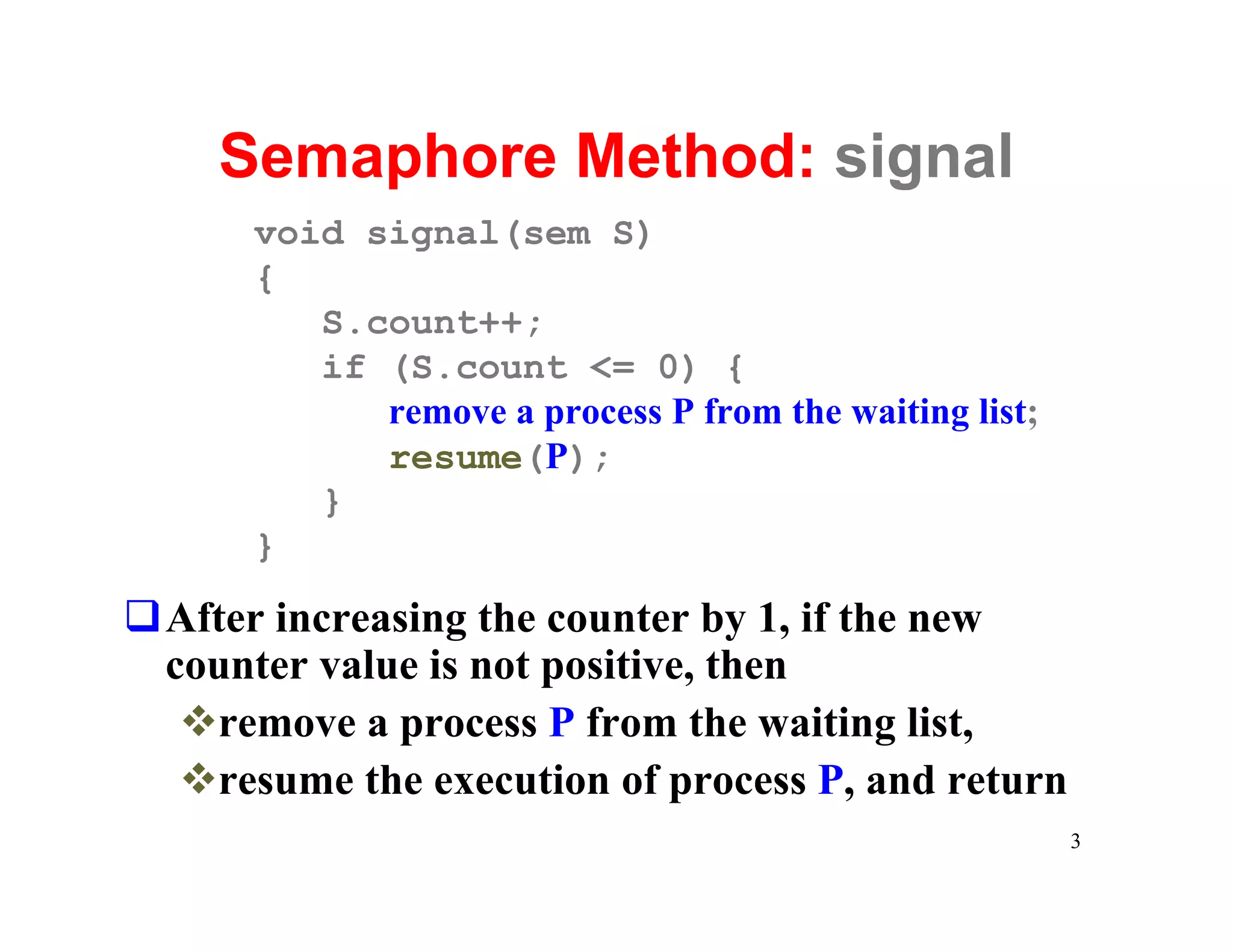
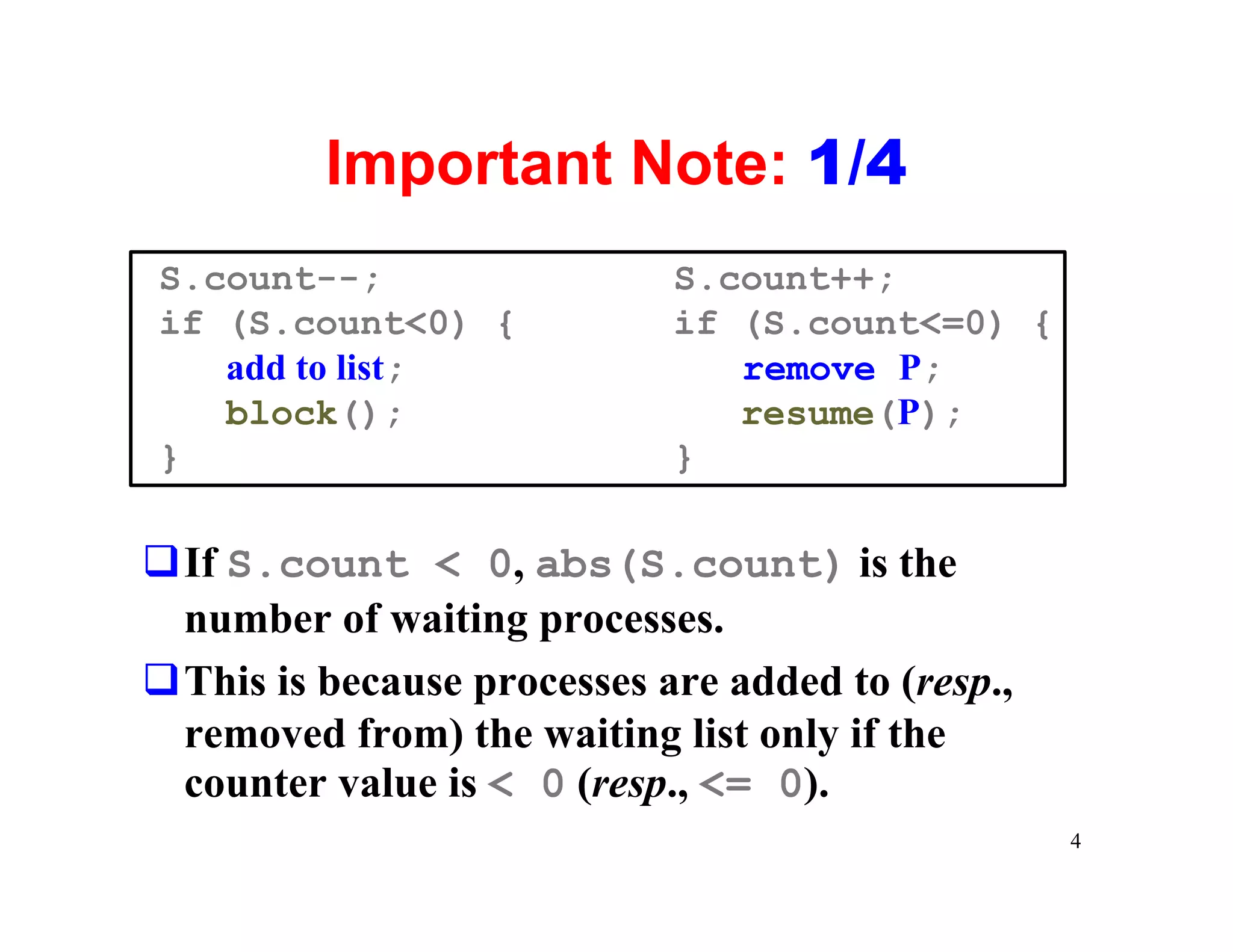
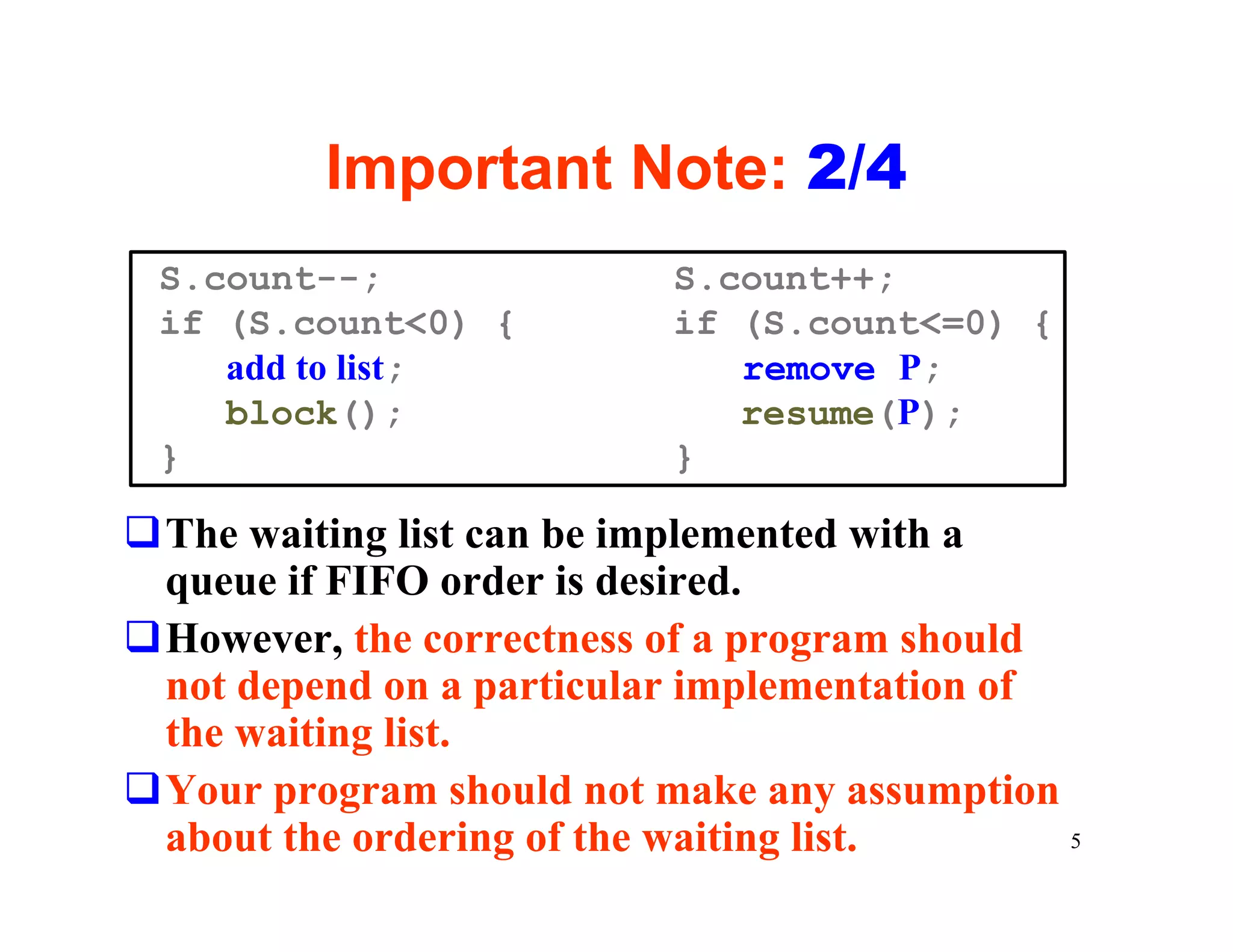
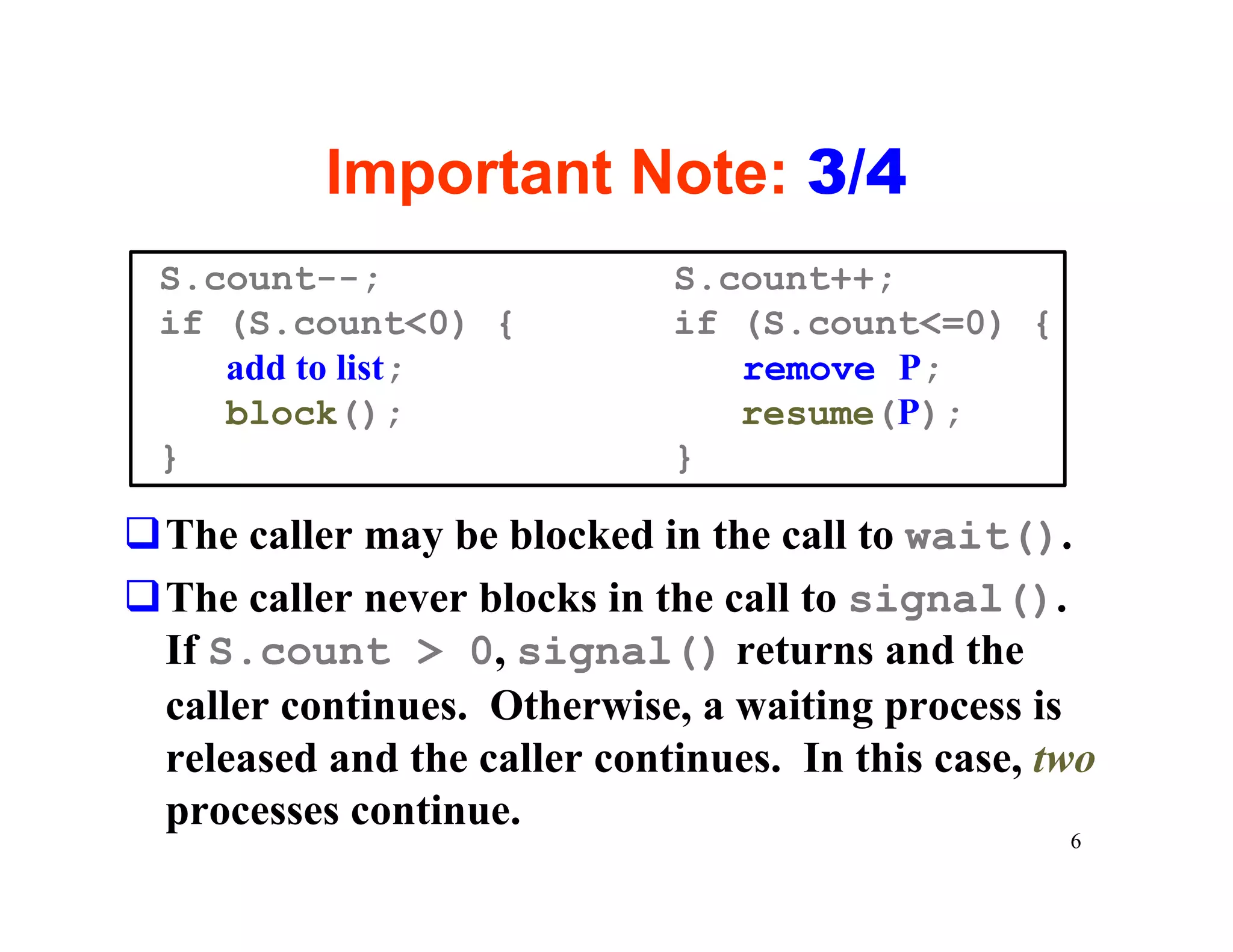
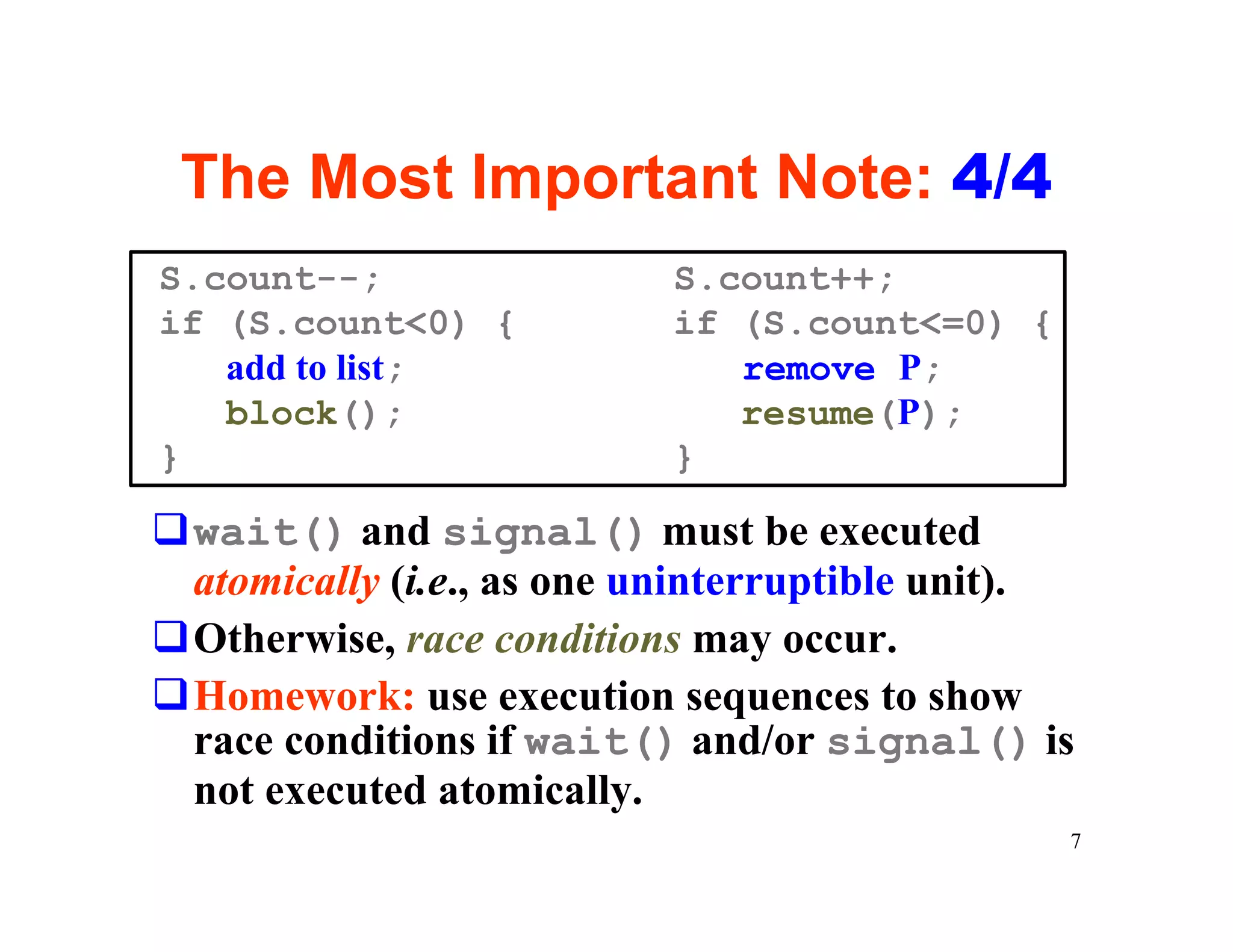
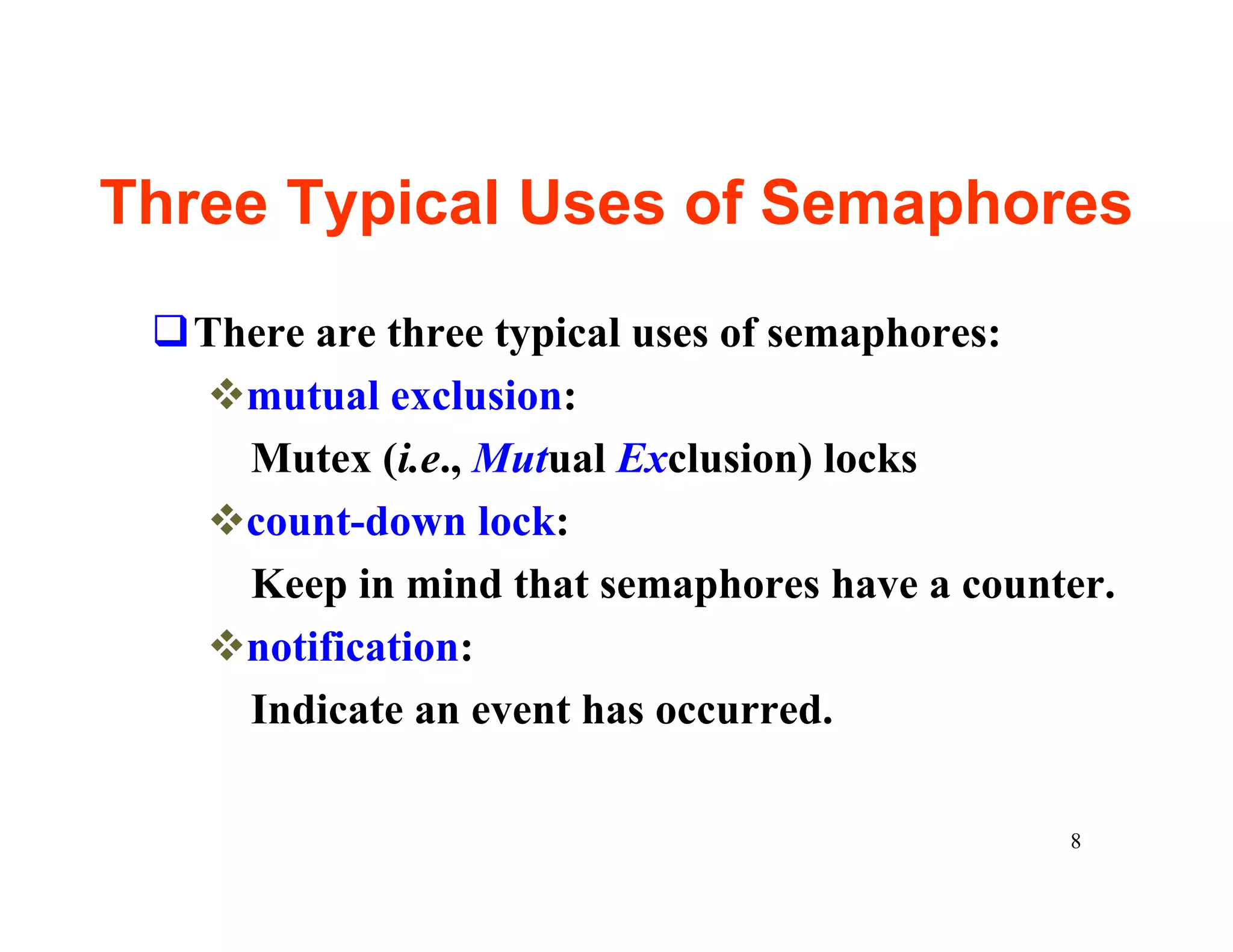
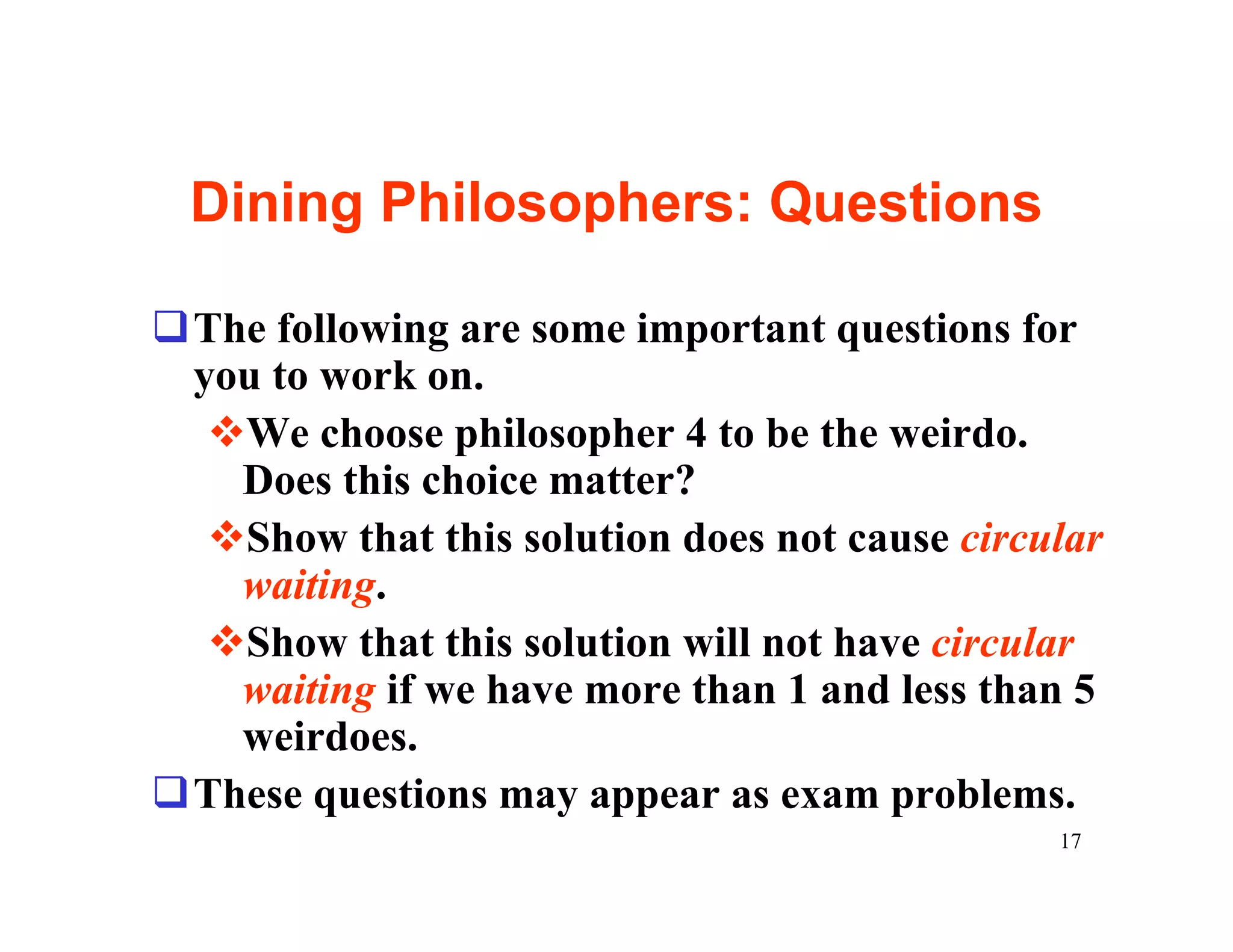
1) A semaphore consists of a counter, a waiting list, and wait() and signal() methods. Wait() decrements the counter and blocks if it becomes negative, while signal() increments the counter and resumes a blocked process if the counter becomes positive. 2) The dining philosophers problem is solved using semaphores to lock access to shared chopsticks, with one philosopher designated as a "weirdo" to avoid deadlock by acquiring locks in a different order. 3) The producer-consumer problem uses three semaphores - one to limit buffer size, one for empty slots, and one for locks - to coordinate producers adding to a bounded buffer


![Cs problem [repaired]](https://cdn.slidesharecdn.com/ss_thumbnails/csproblemrepaired-120307014039-phpapp01-thumbnail.jpg?width=640&height=640&fit=bounds)


![Coded Agents – with UiPath SDK + LangGraph [Virtual Hands-on Workshop]](https://cdn.slidesharecdn.com/ss_thumbnails/codedagentsdeck-251215155422-5497c599-thumbnail.jpg?width=640&height=640&fit=bounds)


