Presentation on Peterson
Algorithm for Critical Section
Problem Solution
1
By
Bipul Chandra kar (131-15-015 )
Mahadi Hasan (131-15-023)
Md.Mohaiminul Islam(132-15-114)
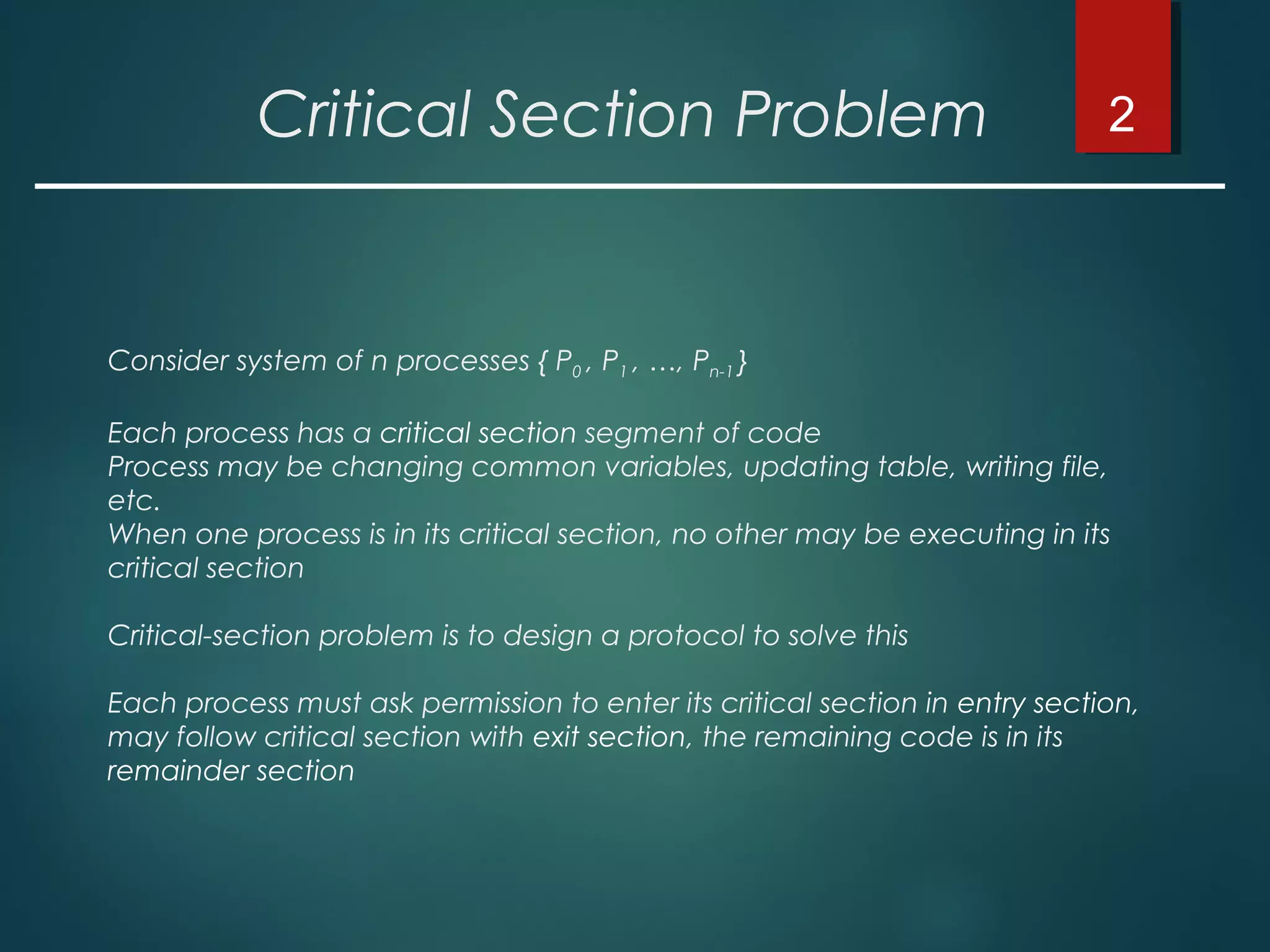
Consider system of n processes { P0 , P1 , …, Pn-1 }
Each process has a critical section segment of code
Process may be changing common variables, updating table, writing file,
etc.
When one process is in its critical section, no other may be executing in its
critical section
Critical-section problem is to design a protocol to solve this
Each process must ask permission to enter its critical section in entry section,
may follow critical section with exit section, the remaining code is in its
remainder section
2Critical Section Problem
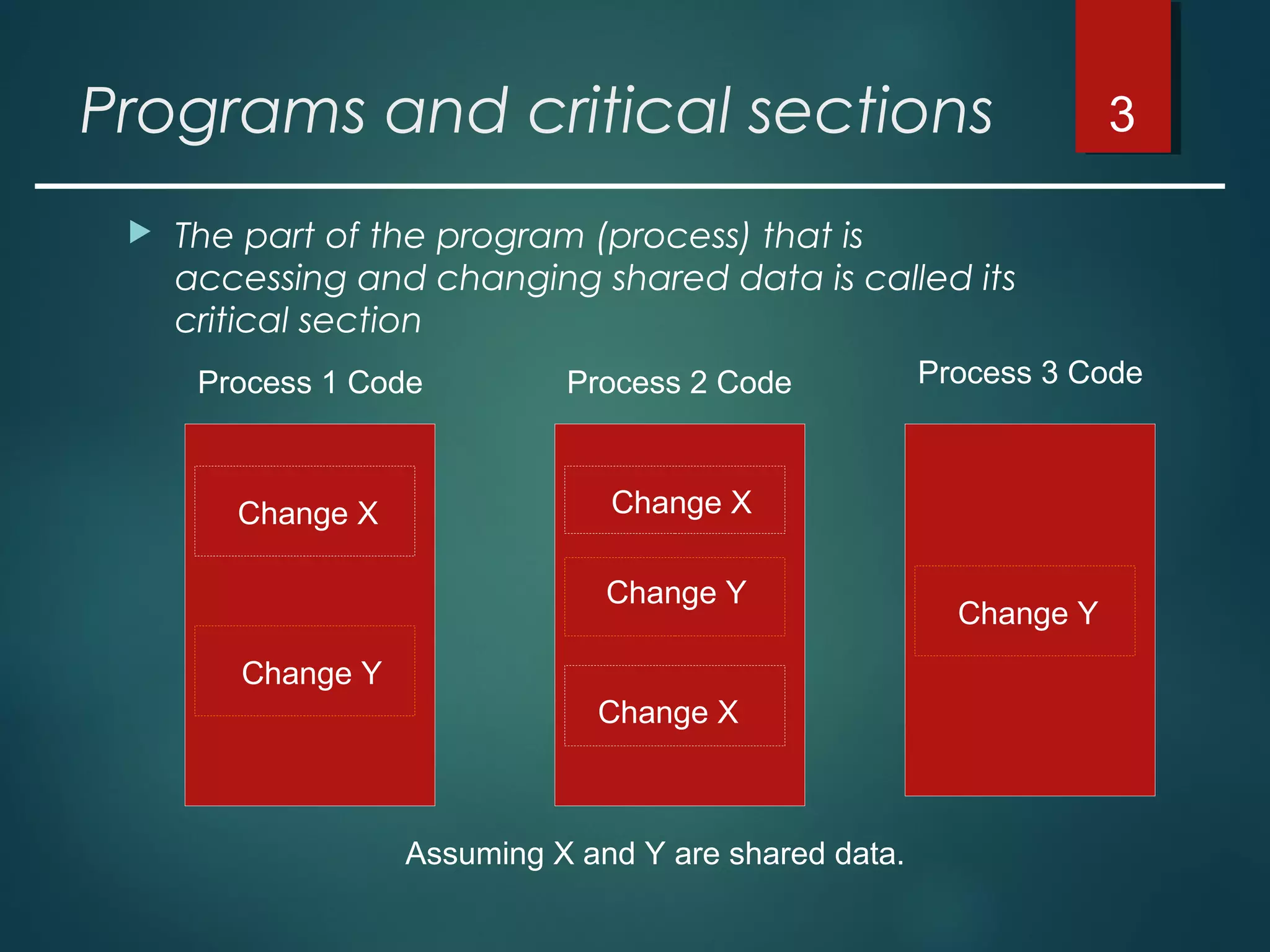
Programs and critical sections
 The part of the program (process) that is
accessing and changing shared data is called its
critical section
3
Change X
Change X
Change Y
Change Y
Change Y
Change X
Process 1 Code Process 2 Code Process 3 Code
Assuming X and Y are shared data.
Critical Section
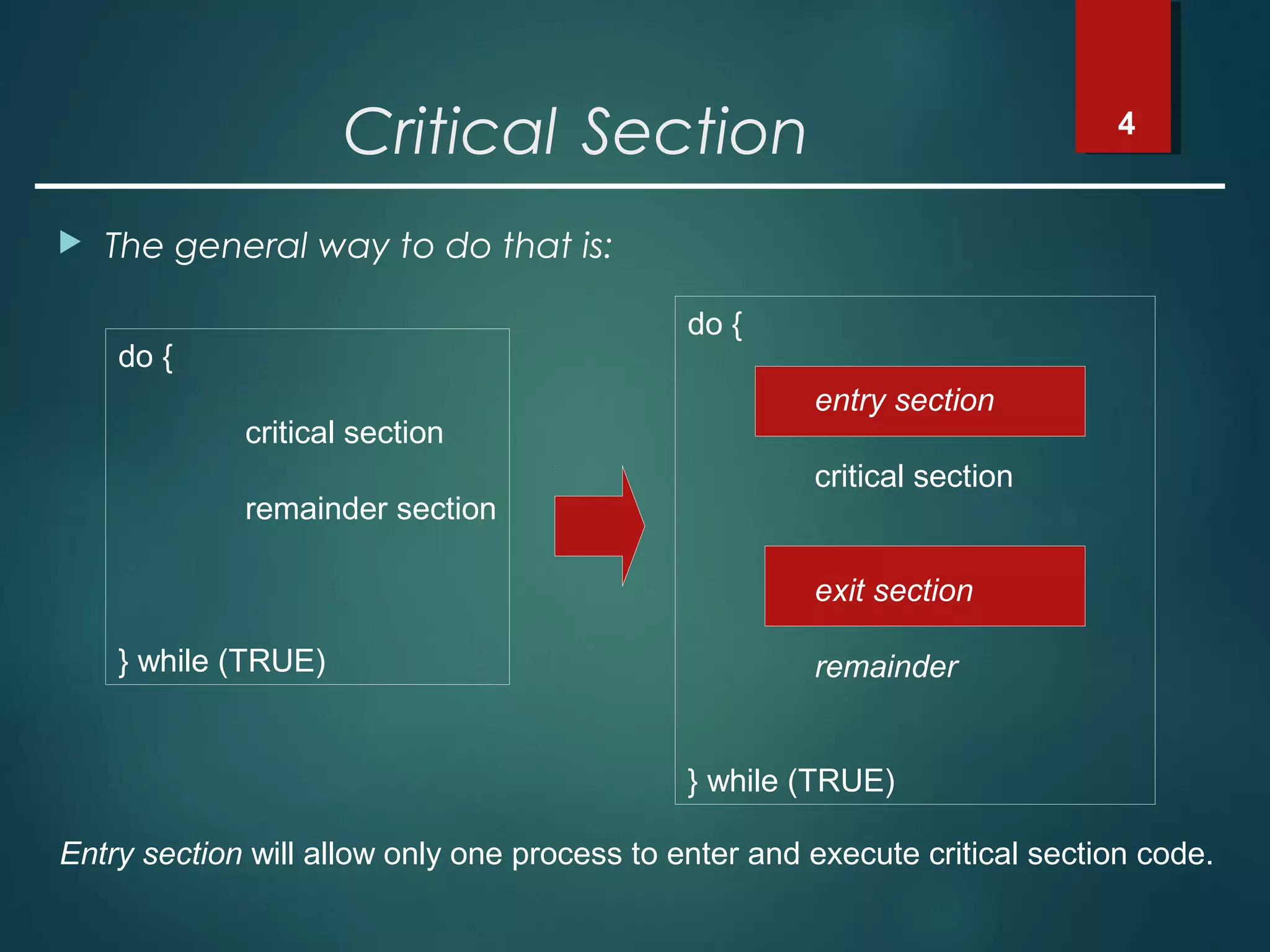
 The general way to do that is:
do {
critical section
remainder section
} while (TRUE)
do {
entry section
critical section
exit section
remainder
} while (TRUE)
Entry section will allow only one process to enter and execute critical section code.
4
Solution to Critical-Section Problem
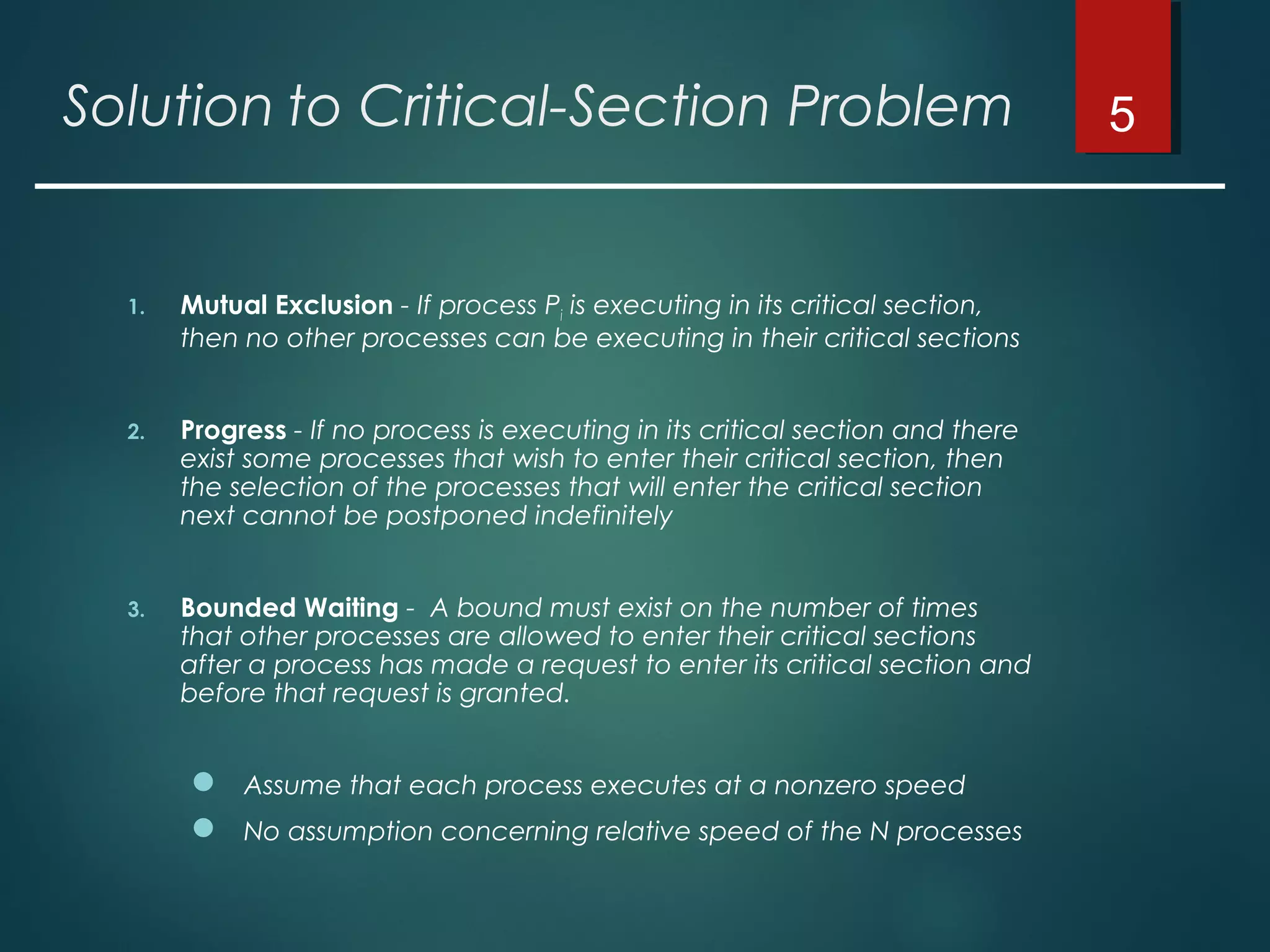
1. Mutual Exclusion - If process Pi is executing in its critical section,
then no other processes can be executing in their critical sections
2. Progress - If no process is executing in its critical section and there
exist some processes that wish to enter their critical section, then
the selection of the processes that will enter the critical section
next cannot be postponed indefinitely
3. Bounded Waiting - A bound must exist on the number of times
that other processes are allowed to enter their critical sections
after a process has made a request to enter its critical section and
before that request is granted.
 Assume that each process executes at a nonzero speed
 No assumption concerning relative speed of the N processes
5
Peterson’s Solution
 Two process solution
 Assume that the LOAD and STORE instructions are
atomic; that is, cannot be interrupted.
 The two processes share two variables:
 int turn;
 Boolean flag[2]
 The variable turn indicates whose turn it is to enter
the critical section.
 The flag array is used to indicate if a process is
ready to enter the critical section. flag[i] = true
implies that process Pi is ready!
6
Algorithm for Process Pi
7
do {
flag[i] = TRUE;
turn = j;
while (flag[j] && turn == j);
critical section
flag[i] = FALSE;
remainder section
} while (1)
entry section
exit section
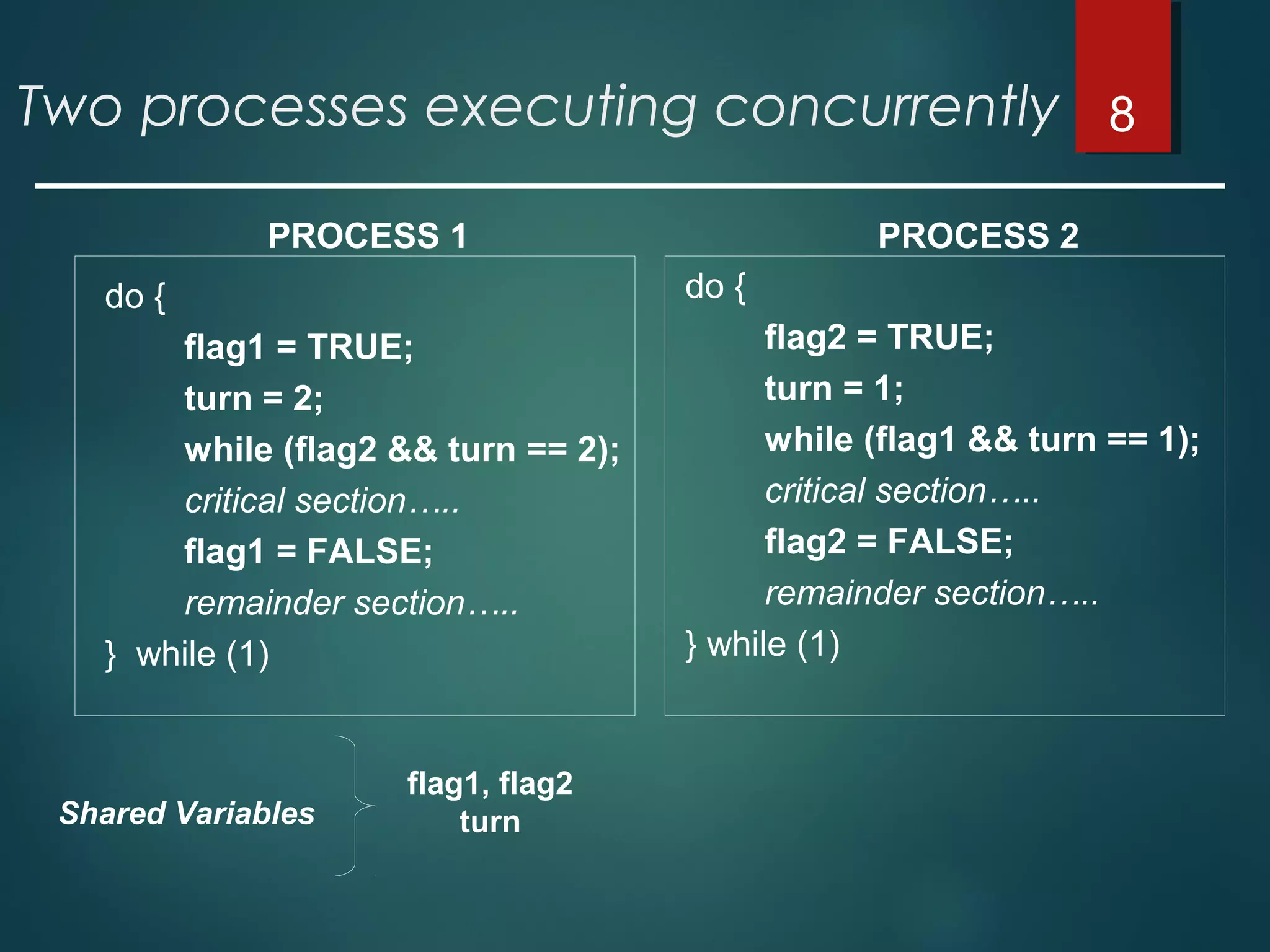
Two processes executing concurrently 8
do {
flag1 = TRUE;
turn = 2;
while (flag2 && turn == 2);
critical section…..
flag1 = FALSE;
remainder section…..
} while (1)
do {
flag2 = TRUE;
turn = 1;
while (flag1 && turn == 1);
critical section…..
flag2 = FALSE;
remainder section…..
} while (1)
PROCESS 1 PROCESS 2
Shared Variables
flag1, flag2
turn
EXAMPLE 9
Process 0:
flag[0] := TRUE
turn := 1
check (flag[1] = TRUE and turn = 1)
- Condition is false because flag[1] = FALSE
- Since condition is false, no waiting in while loop
- Enters the critical section
Phase-1
Process 1:
flag[1] := TRUE
turn := 0
check (flag[0] = TRUE and turn = 0)
- Since condition is true, it keeps busy waiting until
it loses the processor
- Process 0 resumes and continues until it finishes
in the critical section
Phase-2
Process 0:
- Leaves critical section
Sets flag[0] := FALSE
- Start executing the remainder (anything else a process
does besides using the critical section)
- Process 0 happens to lose the processor
Phase-3
Process 1:
check (flag[0] = TRUE and turn = 0)
- This condition fails because flag[0] = FALSE
- No more busy waiting
-Enter the critical section
Phase-4
10
public class cSection {
int turn;
boolean flag[] = new boolean[2];
int i = 0, j = 1;
// CSC variables
int counter = 0;// counter for giving processes an upper bound
int cscVar = 13;
private class ProcessI extends Thread { // process thread for i
@Override
public void run() {
try {
do {
flag[i] = true;
turn = j;
while (flag[j] && turn == j)
; // wait for j to finish
// critical section
System.out.println("I is in critical section");
cscVar++;
System.out.println(cscVar);
counter++;
System.out.println("counter is " + counter + "n___________");
//
flag[i] = false;
// remainder section
} while (counter < 100); // 100 is upper bound, to remove
// infinite looping
}
Implementation
Implementation 11
catch (Exception ex) {
ex.printStackTrace();
}
}
}
private class ProcessJ extends Thread { // process thread for j
@Override
public void run() {
try {
do {
flag[j] = true;
turn = i;
while (flag[i] && turn == i)
;// wait for i to finish
// critical section
System.out.println("J is in critical section");
cscVar--;
System.out.println(cscVar);
counter++;
System.out.println("counter is " + counter + "n___________");
//
flag[j] = false;
// remainder section
} while (counter < 100); // 100 is upper bound, to remove
// infinite looping
}
12
catch (Exception ex) {
ex.printStackTrace();
}
}
}
public cSection() {
System.out.println("Starting Threads/Processes");
Thread I = new ProcessI();
Thread J = new ProcessJ();
I.start(); // start process i
J.start(); // start process j
}
public static void main(String[] args) {
cSection cSec = new cSection();
}
}
Implementation
Conclusion 13
• Simplest algorithm for critical section problem solution.
• Peterson algorithm satisfies the three key point of solving the critical section
problem
Thank You To All .
14

Peterson Critical Section Problem Solution

  • 1.
    Presentation on Peterson Algorithmfor Critical Section Problem Solution 1 By Bipul Chandra kar (131-15-015 ) Mahadi Hasan (131-15-023) Md.Mohaiminul Islam(132-15-114)
  • 2.
    Consider system ofn processes { P0 , P1 , …, Pn-1 } Each process has a critical section segment of code Process may be changing common variables, updating table, writing file, etc. When one process is in its critical section, no other may be executing in its critical section Critical-section problem is to design a protocol to solve this Each process must ask permission to enter its critical section in entry section, may follow critical section with exit section, the remaining code is in its remainder section 2Critical Section Problem
  • 3.
    Programs and criticalsections  The part of the program (process) that is accessing and changing shared data is called its critical section 3 Change X Change X Change Y Change Y Change Y Change X Process 1 Code Process 2 Code Process 3 Code Assuming X and Y are shared data.
  • 4.
    Critical Section  Thegeneral way to do that is: do { critical section remainder section } while (TRUE) do { entry section critical section exit section remainder } while (TRUE) Entry section will allow only one process to enter and execute critical section code. 4
  • 5.
    Solution to Critical-SectionProblem 1. Mutual Exclusion - If process Pi is executing in its critical section, then no other processes can be executing in their critical sections 2. Progress - If no process is executing in its critical section and there exist some processes that wish to enter their critical section, then the selection of the processes that will enter the critical section next cannot be postponed indefinitely 3. Bounded Waiting - A bound must exist on the number of times that other processes are allowed to enter their critical sections after a process has made a request to enter its critical section and before that request is granted.  Assume that each process executes at a nonzero speed  No assumption concerning relative speed of the N processes 5
  • 6.
    Peterson’s Solution  Twoprocess solution  Assume that the LOAD and STORE instructions are atomic; that is, cannot be interrupted.  The two processes share two variables:  int turn;  Boolean flag[2]  The variable turn indicates whose turn it is to enter the critical section.  The flag array is used to indicate if a process is ready to enter the critical section. flag[i] = true implies that process Pi is ready! 6
  • 7.
    Algorithm for ProcessPi 7 do { flag[i] = TRUE; turn = j; while (flag[j] && turn == j); critical section flag[i] = FALSE; remainder section } while (1) entry section exit section
  • 8.
    Two processes executingconcurrently 8 do { flag1 = TRUE; turn = 2; while (flag2 && turn == 2); critical section….. flag1 = FALSE; remainder section….. } while (1) do { flag2 = TRUE; turn = 1; while (flag1 && turn == 1); critical section….. flag2 = FALSE; remainder section….. } while (1) PROCESS 1 PROCESS 2 Shared Variables flag1, flag2 turn
  • 9.
    EXAMPLE 9 Process 0: flag[0]:= TRUE turn := 1 check (flag[1] = TRUE and turn = 1) - Condition is false because flag[1] = FALSE - Since condition is false, no waiting in while loop - Enters the critical section Phase-1 Process 1: flag[1] := TRUE turn := 0 check (flag[0] = TRUE and turn = 0) - Since condition is true, it keeps busy waiting until it loses the processor - Process 0 resumes and continues until it finishes in the critical section Phase-2 Process 0: - Leaves critical section Sets flag[0] := FALSE - Start executing the remainder (anything else a process does besides using the critical section) - Process 0 happens to lose the processor Phase-3 Process 1: check (flag[0] = TRUE and turn = 0) - This condition fails because flag[0] = FALSE - No more busy waiting -Enter the critical section Phase-4
  • 10.
    10 public class cSection{ int turn; boolean flag[] = new boolean[2]; int i = 0, j = 1; // CSC variables int counter = 0;// counter for giving processes an upper bound int cscVar = 13; private class ProcessI extends Thread { // process thread for i @Override public void run() { try { do { flag[i] = true; turn = j; while (flag[j] && turn == j) ; // wait for j to finish // critical section System.out.println("I is in critical section"); cscVar++; System.out.println(cscVar); counter++; System.out.println("counter is " + counter + "n___________"); // flag[i] = false; // remainder section } while (counter < 100); // 100 is upper bound, to remove // infinite looping } Implementation
  • 11.
    Implementation 11 catch (Exceptionex) { ex.printStackTrace(); } } } private class ProcessJ extends Thread { // process thread for j @Override public void run() { try { do { flag[j] = true; turn = i; while (flag[i] && turn == i) ;// wait for i to finish // critical section System.out.println("J is in critical section"); cscVar--; System.out.println(cscVar); counter++; System.out.println("counter is " + counter + "n___________"); // flag[j] = false; // remainder section } while (counter < 100); // 100 is upper bound, to remove // infinite looping }
  • 12.
    12 catch (Exception ex){ ex.printStackTrace(); } } } public cSection() { System.out.println("Starting Threads/Processes"); Thread I = new ProcessI(); Thread J = new ProcessJ(); I.start(); // start process i J.start(); // start process j } public static void main(String[] args) { cSection cSec = new cSection(); } } Implementation
  • 13.
    Conclusion 13 • Simplestalgorithm for critical section problem solution. • Peterson algorithm satisfies the three key point of solving the critical section problem
  • 14.
    Thank You ToAll . 14