By
Selling
To Sharpen The Skills & Abilities In Selling For
Participants In Order To Sell Better & Improve
Professionalism.
Objectives
To Stand Out From The Crowd
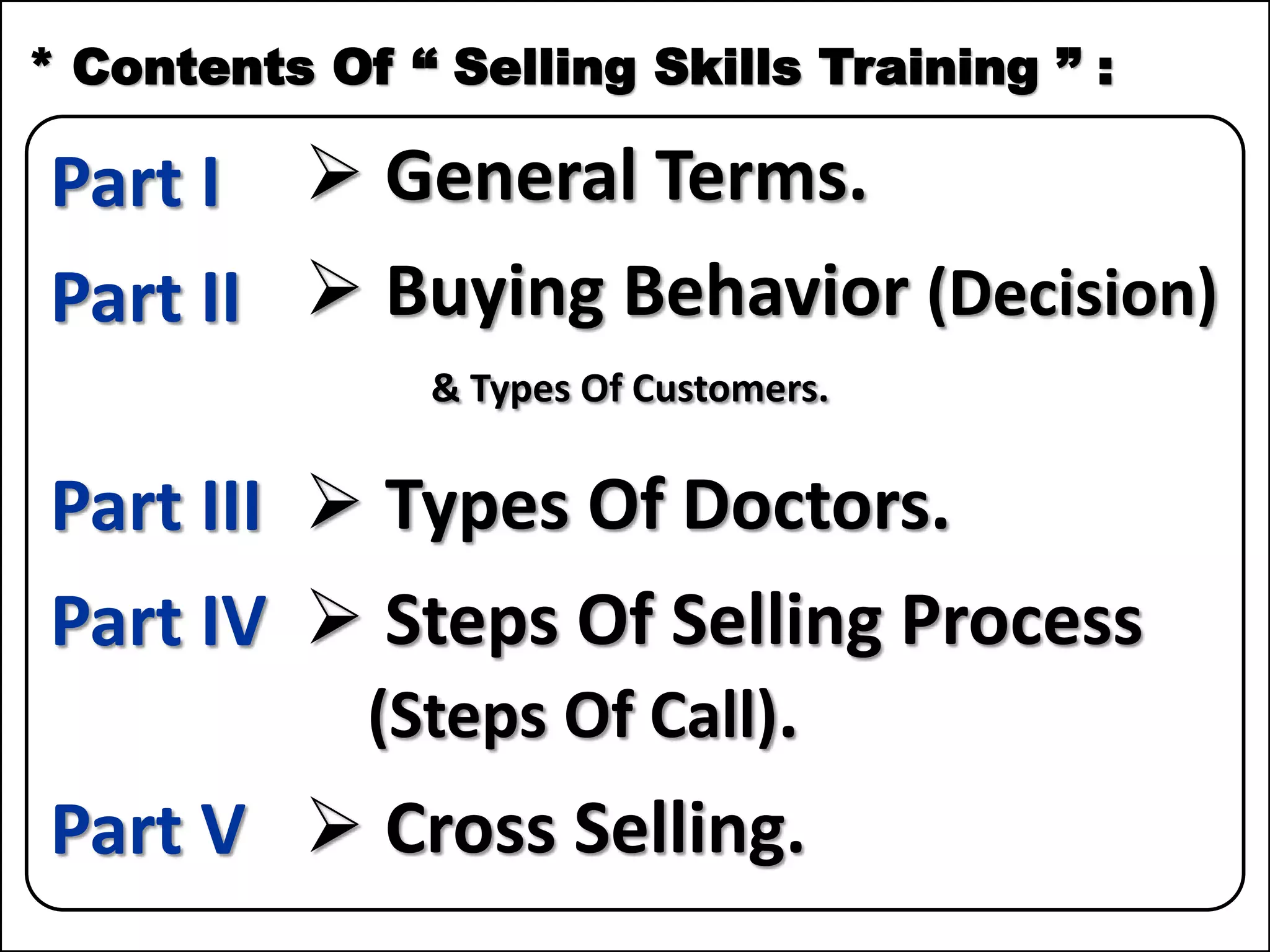
* Contents Of “ Selling Skills Training ” :
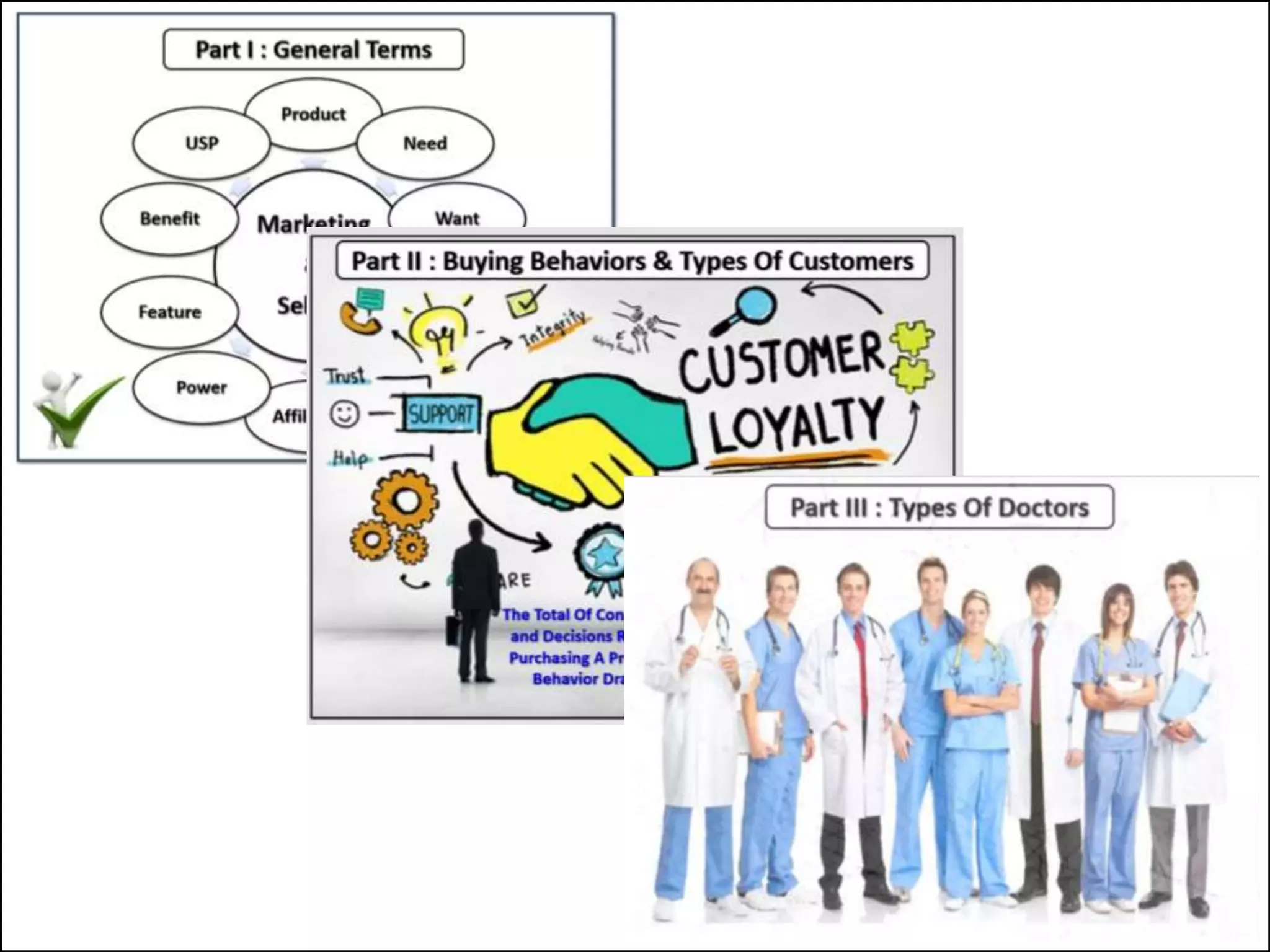
Part I
Part II
Part III
Part IV
Part V
 General Terms.
 Buying Behavior (Decision)
& Types Of Customers.
 Types Of Doctors.
 Steps Of Selling Process
(Steps Of Call).
 Cross Selling.
Part I : General Terms
Marketing
&
Selling
Product
Need
Want
Motive
Achievement
Affiliation
Power
Feature
Benefit
USP
Marketing
is a Process of Planning, Executing, Conception, Pricing,
Promotion & Distributing Any PRODUCT to Create an Exchange
That Satisfy Individual & Organizational Goals.
Product
is a Priced Item or Service Which Introduce a Value to The Customer.
Selling
Marketing
* Selling is Only The Tip Of Marketing Iceberg *
Marketing Aim to make selling superfluous,
Right Marketing Aim To Understand Customer,
So  a Product That Fits His Needs & it Will Sell itself.
Marketing Should Result in A Customer Who is Ready To BUY.
By Peter Ducker
• Selling is The Process of Assisting & Persuading a Prospective
Customer to Buy a Product or a Service.
(Uncovering Needs Of The Customer)
Need :
You Can’t Survive
Without it.
- Need For Food,
Air & Water
Want :
You Can Survive
Without it.
- I Want to Have a
Fashionable Car.
- Also “I Want
Falafel”
Demand :
When You Want a
specific PD & You
are Able to Pay For.
- I Want to Have a
BMW I Can Pay For.
Negative
Customer
Dislike
PD.
Demand
Non-Exist
Customer
Unaware
Of the PD
& Its
Benefits.
Declining
Customer
Buy PD
Less
Frequent
Or
Not at all.
Irregular
Customer
Purchase
Vary on a
Seasonal,
Monthly
Basis.
Full
Customer
Buy All PD.
Overfull
Customer
Buy
PD More
Than
What Can
Be
Satisfied.
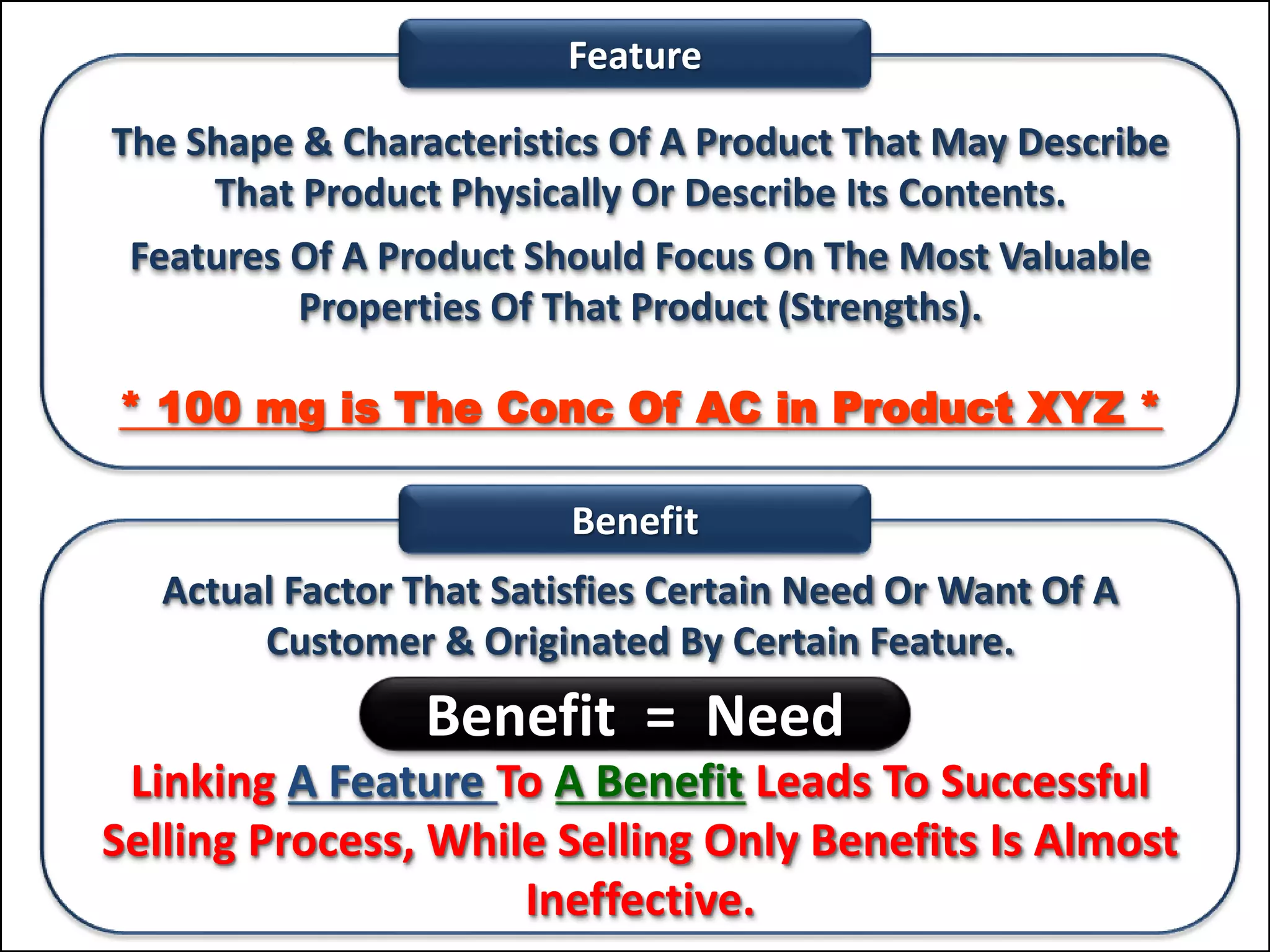
The Shape & Characteristics Of A Product That May Describe
That Product Physically Or Describe Its Contents.
Features Of A Product Should Focus On The Most Valuable
Properties Of That Product (Strengths).
* 100 mg is The Conc Of AC in Product XYZ *
Feature
Actual Factor That Satisfies Certain Need Or Want Of A
Customer & Originated By Certain Feature.
Linking A Feature To A Benefit Leads To Successful
Selling Process, While Selling Only Benefits Is Almost
Ineffective.
Benefit
Benefit = Need
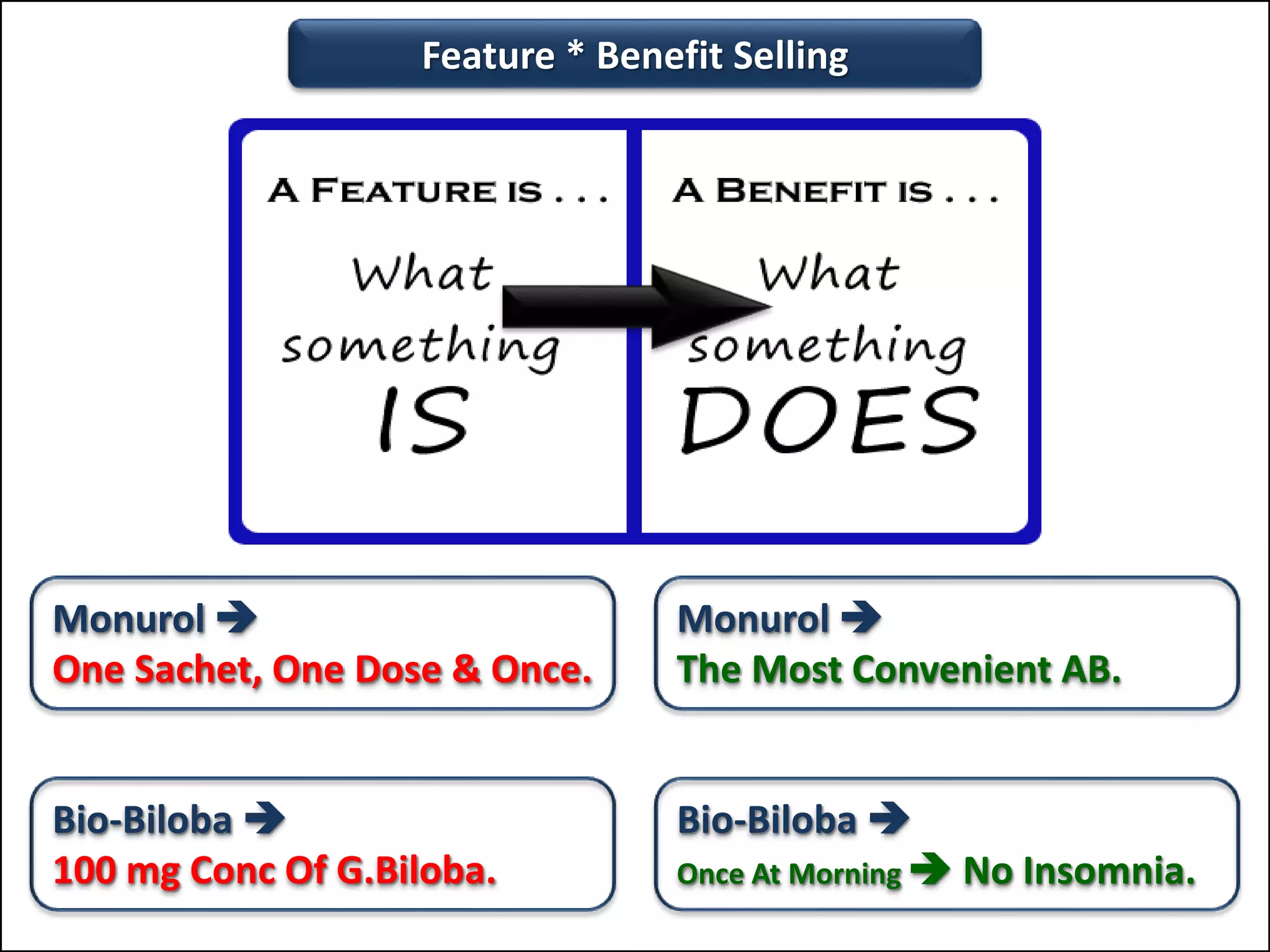
Feature * Benefit Selling
Monurol 
One Sachet, One Dose & Once.
Monurol 
The Most Convenient AB.
Bio-Biloba 
100 mg Conc Of G.Biloba.
Bio-Biloba 
Once At Morning  No Insomnia.
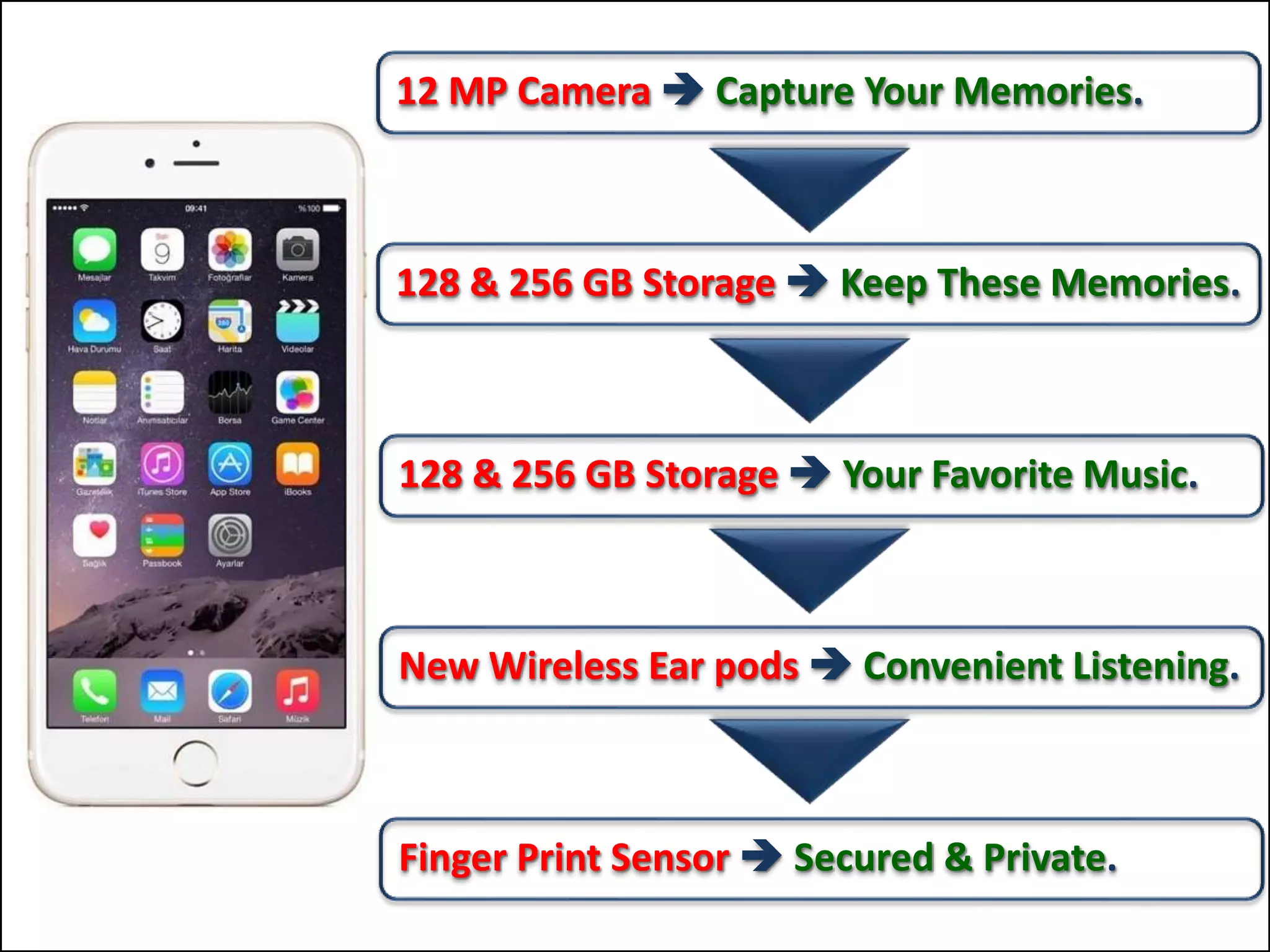
12 MP Camera  Capture Your Memories.
128 & 256 GB Storage  Keep These Memories.
128 & 256 GB Storage  Your Favorite Music.
New Wireless Ear pods  Convenient Listening.
Finger Print Sensor  Secured & Private.
* Unique Selling Point *
A Factor Presented By Seller As A Reason That A Product Is
Different & Better Than Another Competitor.
Or A Reason That Makes A Product Is Unique & Almost Has No
Competitors
USP
Monurol 
- New Molecule (Fosfomycin).
- Most Convenient As AB For LUTIs.
Bio-Marin 
- Triglycerides (Higher Absorption).
- Highest Conc Of EPA & DHA.
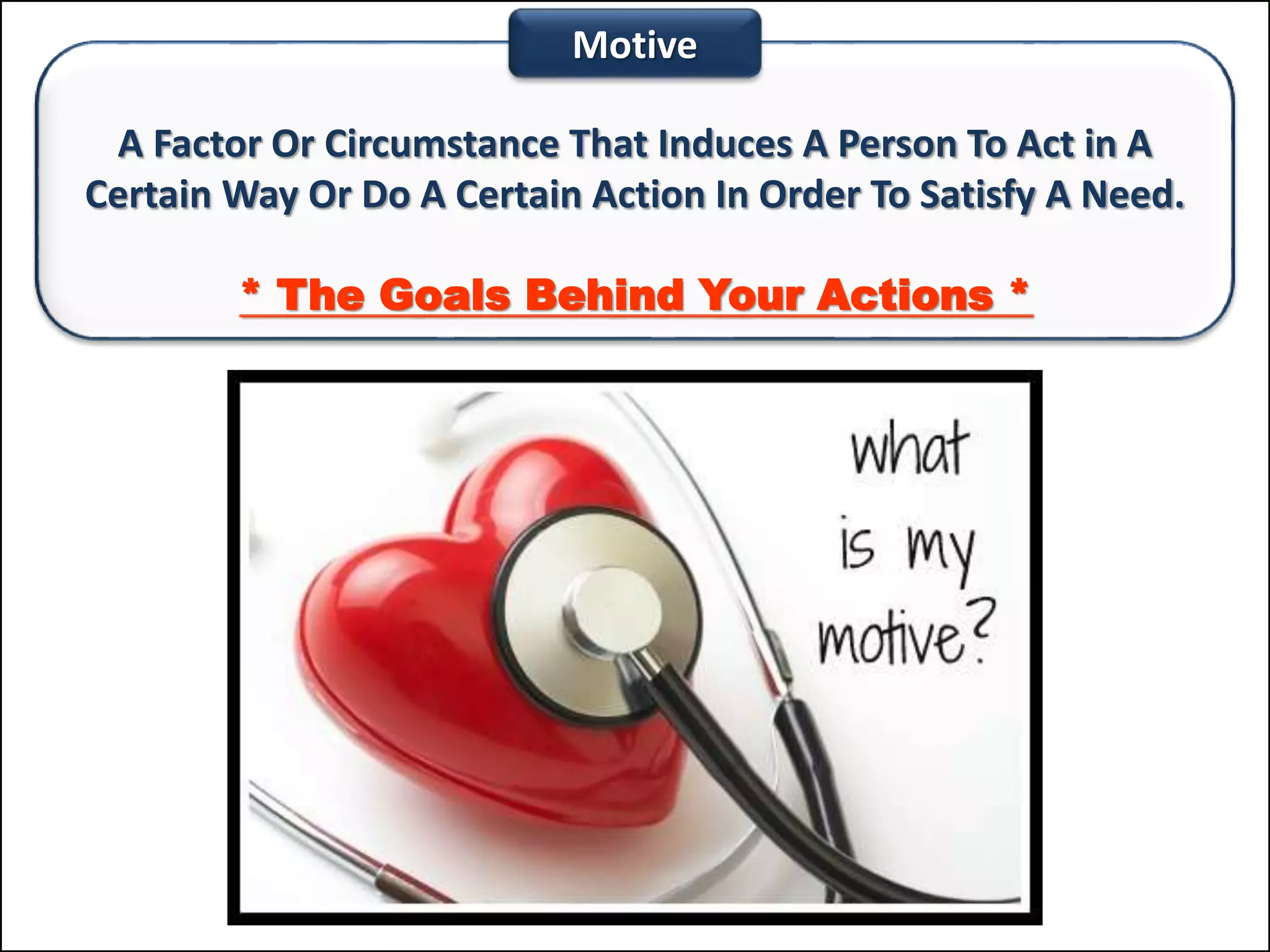
A Factor Or Circumstance That Induces A Person To Act in A
Certain Way Or Do A Certain Action In Order To Satisfy A Need.
* The Goals Behind Your Actions *
Motive
The Need To See Positive Results & To Avoid Failure.
* Reaching Your Goals After Hard Work *
Achievements
The Need To Be Associated With Other (To Help Others).
Affiliation
The Need To Prevail Over Others.
The Need To Control Or Command Over Others.
Power
4 Ps SWOT Maslow
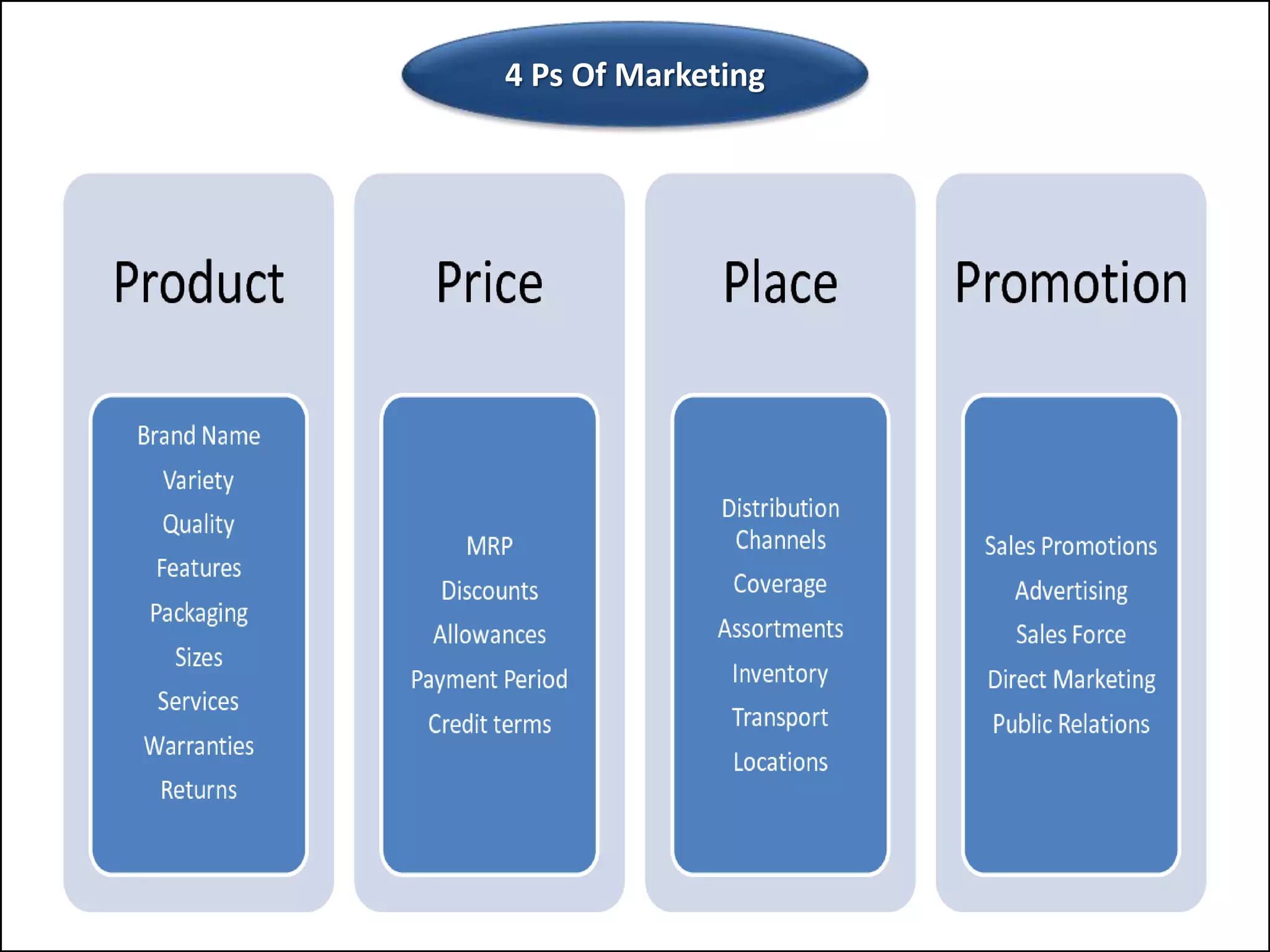
4 Ps Of Marketing
SWOT Analysis
MASLOW Hierarchy Of
Needs
Part II : Buying Behaviors & Types Of Customers
The Total Of Consumer's Attitudes, Preferences, Intentions,
and Decisions Regarding The Consumer's Behavior When
Purchasing A Product Or Service. This Study Of Consumer
Behavior Draws Upon Social Science Anthropology,
Psychology & Economics.
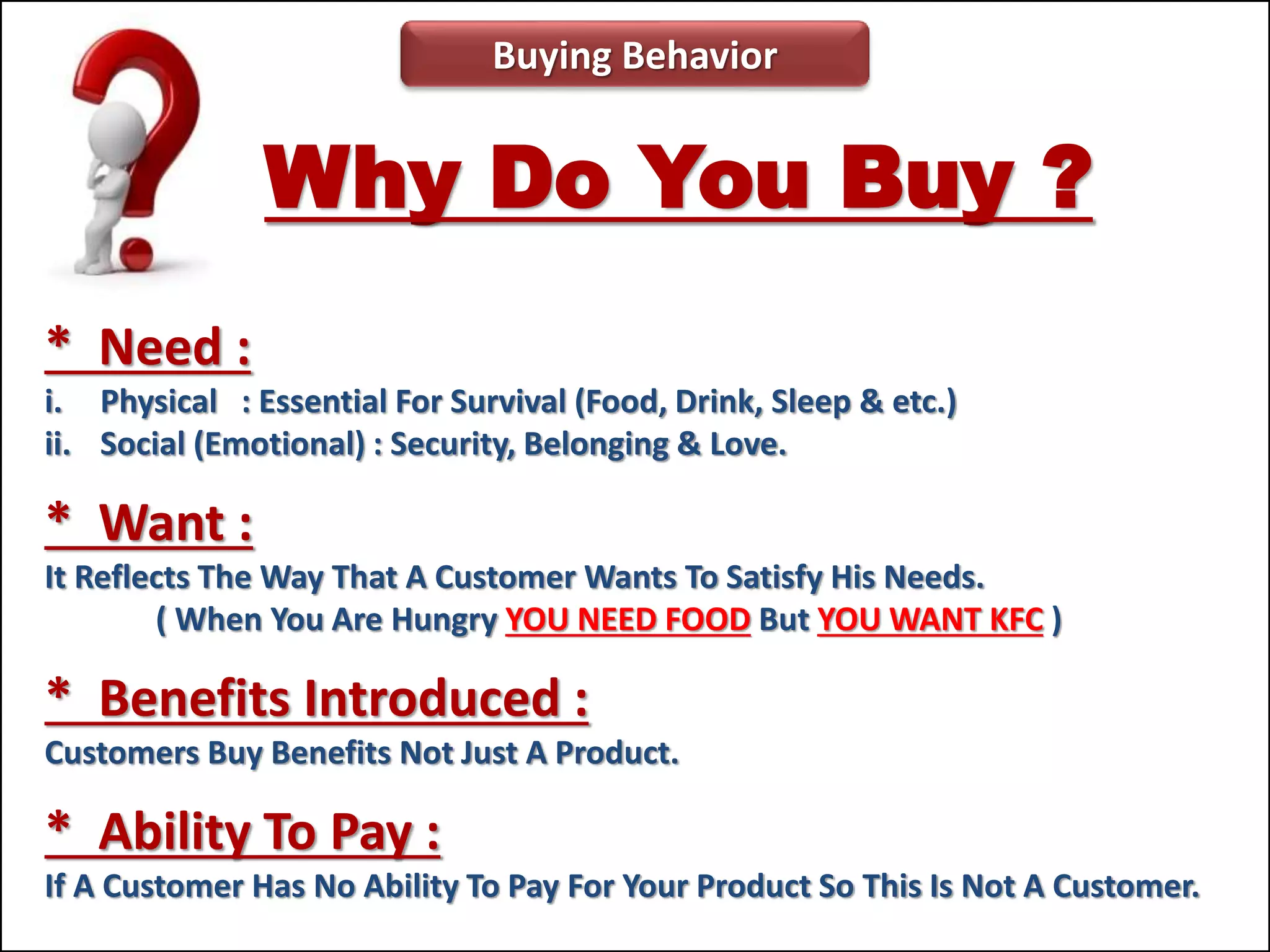
Buying Behavior
Why Do You Buy ?
* Need :
i. Physical : Essential For Survival (Food, Drink, Sleep & etc.)
ii. Social (Emotional) : Security, Belonging & Love.
* Want :
It Reflects The Way That A Customer Wants To Satisfy His Needs.
( When You Are Hungry YOU NEED FOOD But YOU WANT KFC )
* Benefits Introduced :
Customers Buy Benefits Not Just A Product.
* Ability To Pay :
If A Customer Has No Ability To Pay For Your Product So This Is Not A Customer.
Post-Purchase Evaluation
Purchase Decision
Evaluation Of Alternatives
Buying Decision Process
How Do You Buy ?
Collecting Information
Problem RecognitionNeed & Want
Friends & Family Previous Buyers
Ability
Web & Social Media Marketing Materials
Brand Loyal Benefits VS Price
Method Commitment
Warranty Services
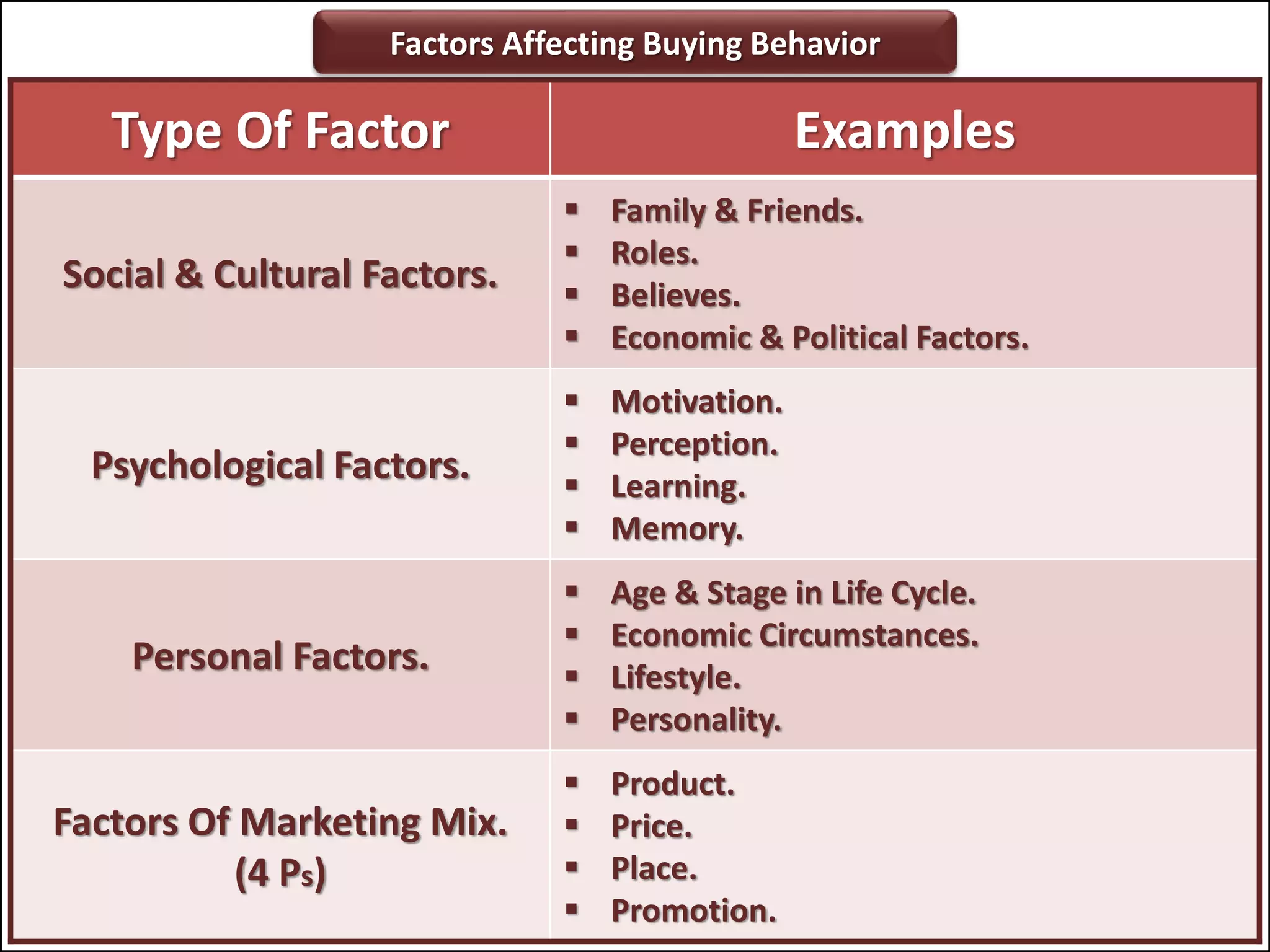
Type Of Factor Examples
Social & Cultural Factors.
 Family & Friends.
 Roles.
 Believes.
 Economic & Political Factors.
Psychological Factors.
 Motivation.
 Perception.
 Learning.
 Memory.
Personal Factors.
 Age & Stage in Life Cycle.
 Economic Circumstances.
 Lifestyle.
 Personality.
Factors Of Marketing Mix.
(4 Ps)
 Product.
 Price.
 Place.
 Promotion.
Factors Affecting Buying Behavior
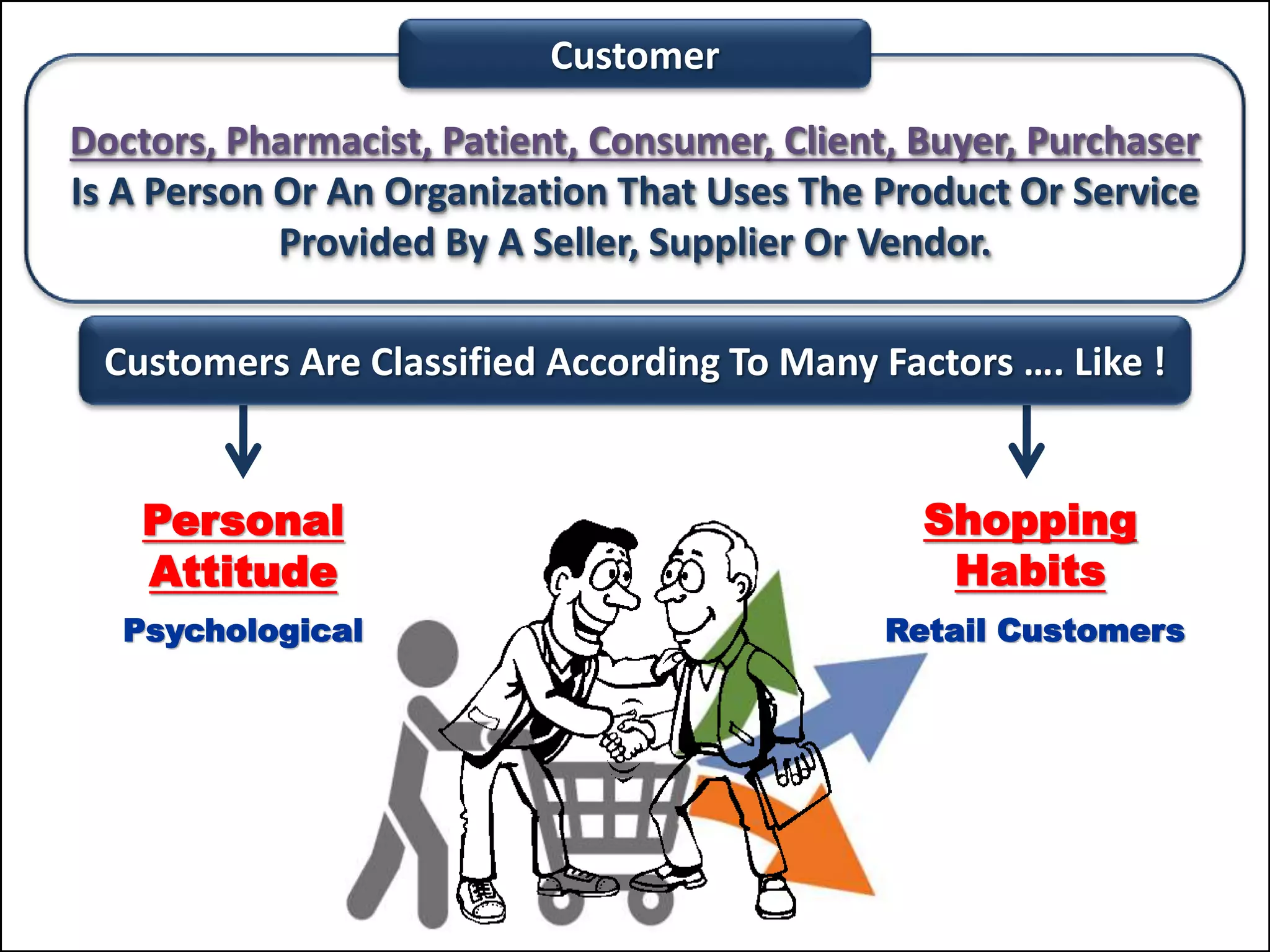
Customers Are Classified According To Many Factors …. Like !
Personal
Attitude
Shopping
Habits
Retail CustomersPsychological
Doctors, Pharmacist, Patient, Consumer, Client, Buyer, Purchaser
Is A Person Or An Organization That Uses The Product Or Service
Provided By A Seller, Supplier Or Vendor.
Customer
Customer
Type
Characteristics Handling (How To Deal)
Aggressive Or
Tough
 Egoistic.
 Impatient.
 Harsh.
 Listen & Allow Him To Talk.
 Express Your Points As Suggestions.
 Be Courteous But Firm.
Uncertain Or
Skeptical
 Non Demanding.
 Indecisive & Unsure
 Evasive.
 Seeks Assurance.
 Maintain Eye Contact.
 Break Barriers.
 Listen & Ask Right Questions.
Irate Or Angry
 Impatient.
 Argues.
 Doesn’t Listen.
 Be Assertive (Control) Not Angry.
 Jump To The Point.
 Explain With Calm & Clear Voice.
 No Hollow Promises.
Business Like
 Jump To The Point.
 Avoid Procrastination.
 Go On & Do Not Waste Time.
Knowledgeable
 Demanding.
 Has Good Knowledge.
 Satisfy His Desire For Detailing.
 Never Fooling Him.
Friendly
 Talkative.
 Warm & Good Natured
 Respond To Hospitality.
 Keep On Business Track.
Customers
(Attitude & Mindset)
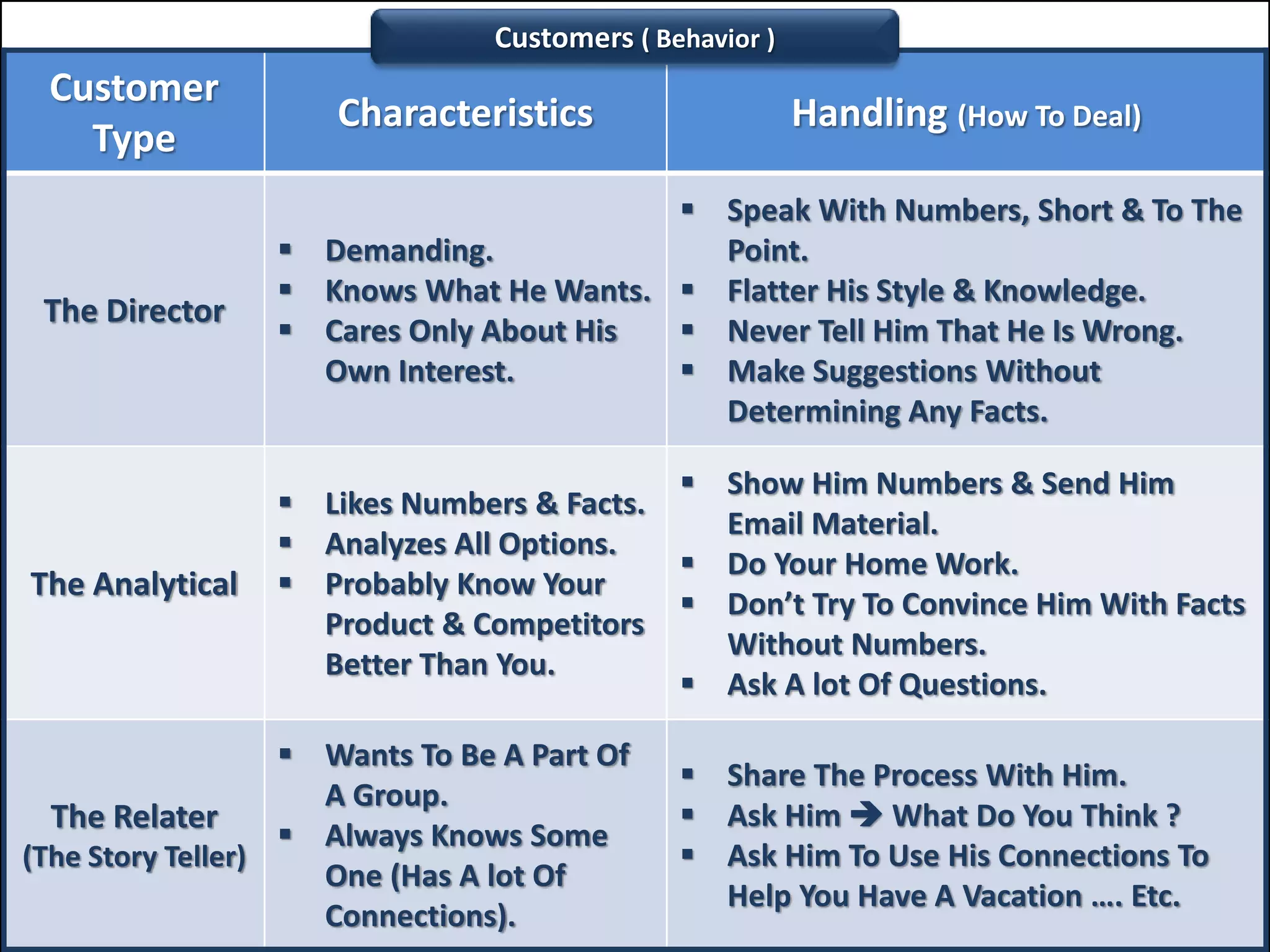
Customer
Type
Characteristics Handling (How To Deal)
The Director
 Demanding.
 Knows What He Wants.
 Cares Only About His
Own Interest.
 Speak With Numbers, Short & To The
Point.
 Flatter His Style & Knowledge.
 Never Tell Him That He Is Wrong.
 Make Suggestions Without
Determining Any Facts.
The Analytical
 Likes Numbers & Facts.
 Analyzes All Options.
 Probably Know Your
Product & Competitors
Better Than You.
 Show Him Numbers & Send Him
Email Material.
 Do Your Home Work.
 Don’t Try To Convince Him With Facts
Without Numbers.
 Ask A lot Of Questions.
The Relater
(The Story Teller)
 Wants To Be A Part Of
A Group.
 Always Knows Some
One (Has A lot Of
Connections).
 Share The Process With Him.
 Ask Him  What Do You Think ?
 Ask Him To Use His Connections To
Help You Have A Vacation …. Etc.
Customers ( Behavior )
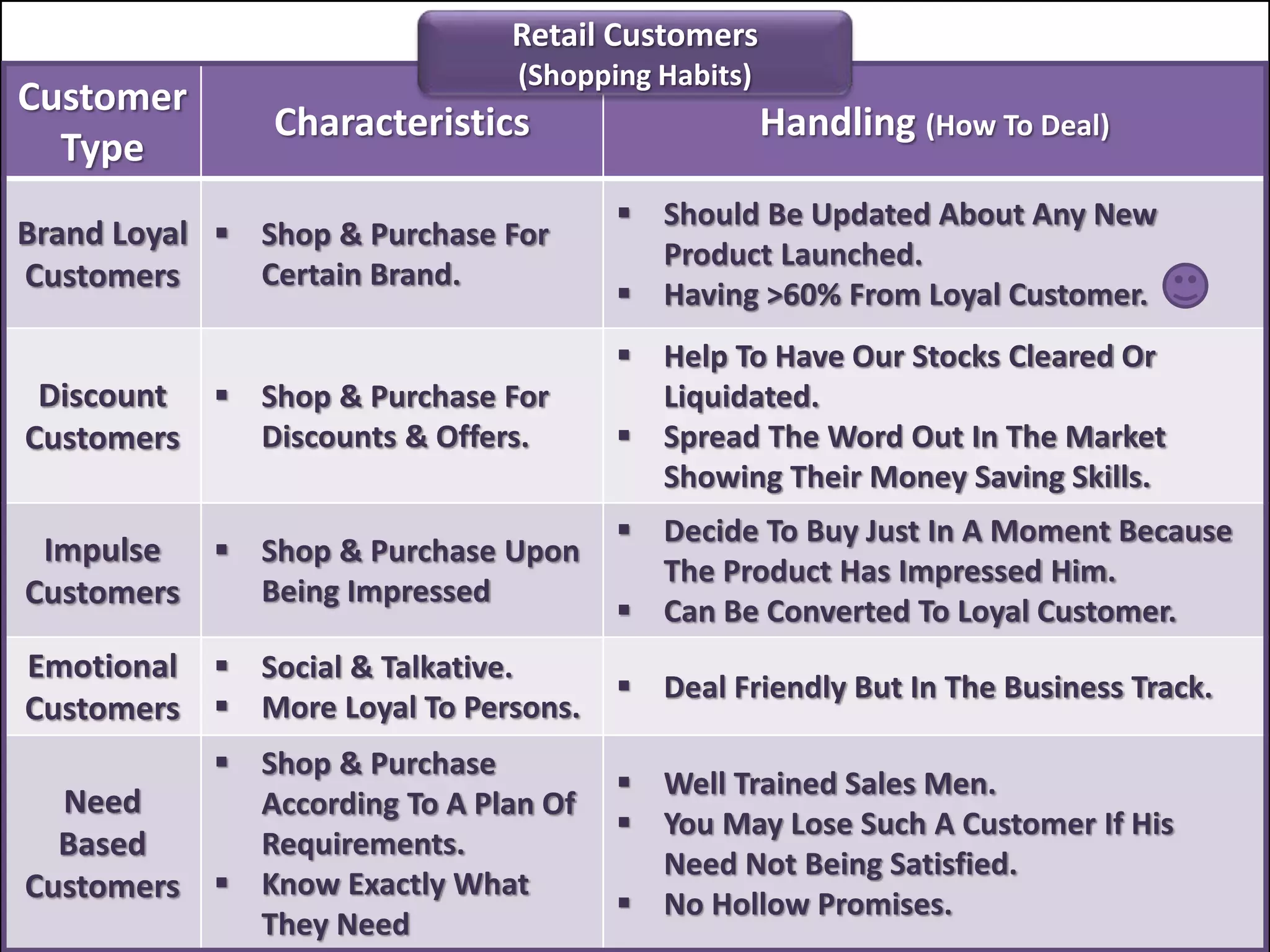
Customer
Type
Characteristics Handling (How To Deal)
Brand Loyal
Customers
 Shop & Purchase For
Certain Brand.
 Should Be Updated About Any New
Product Launched.
 Having >60% From Loyal Customer.
Discount
Customers
 Shop & Purchase For
Discounts & Offers.
 Help To Have Our Stocks Cleared Or
Liquidated.
 Spread The Word Out In The Market
Showing Their Money Saving Skills.
Impulse
Customers
 Shop & Purchase Upon
Being Impressed
 Decide To Buy Just In A Moment Because
The Product Has Impressed Him.
 Can Be Converted To Loyal Customer.
Emotional
Customers
 Social & Talkative.
 More Loyal To Persons.
 Deal Friendly But In The Business Track.
Need
Based
Customers
 Shop & Purchase
According To A Plan Of
Requirements.
 Know Exactly What
They Need
 Well Trained Sales Men.
 You May Lose Such A Customer If His
Need Not Being Satisfied.
 No Hollow Promises.
Retail Customers
(Shopping Habits)
Who Is Your Customer
You Must Identify Your Customer Type.
Part III : Types Of Doctors
Depending On Mix Of 3 Factors
Achievement & Power  + ve
Achievement & Power  - ve
Affiliation  + ve
Affiliation  - ve
 High Achievements.
 High Power.
X Low Affiliation.
“Resistant / Defensive”
Doctor
 High Achievements.
 High Power.
 High Affiliation.
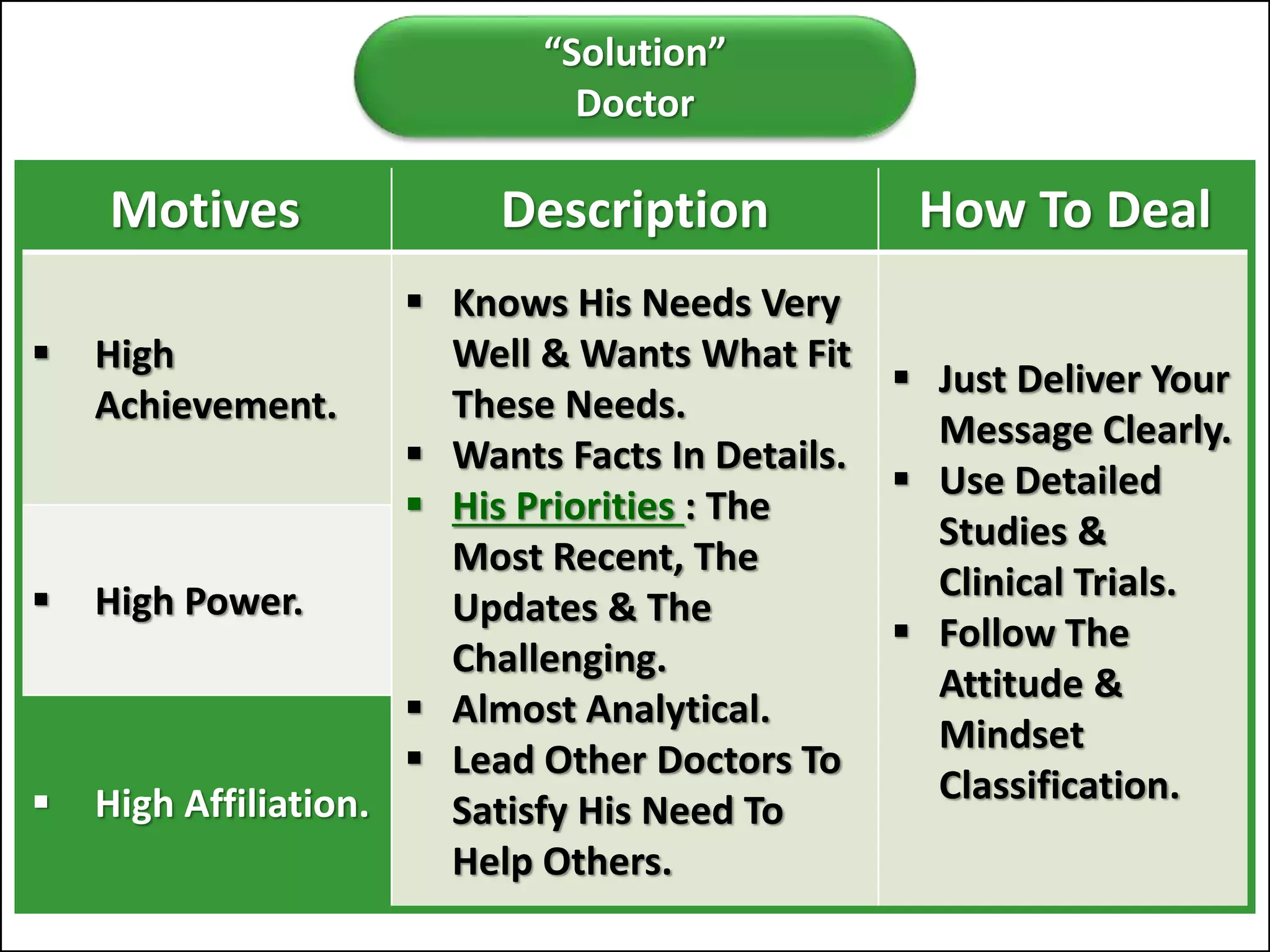
“Solution”
Doctor
X Low Achievements.
X Low Power.
X Low Affiliation.
“Pass The Buck”
Doctor
X Low Achievements.
X Low Power.
 High Affiliation.
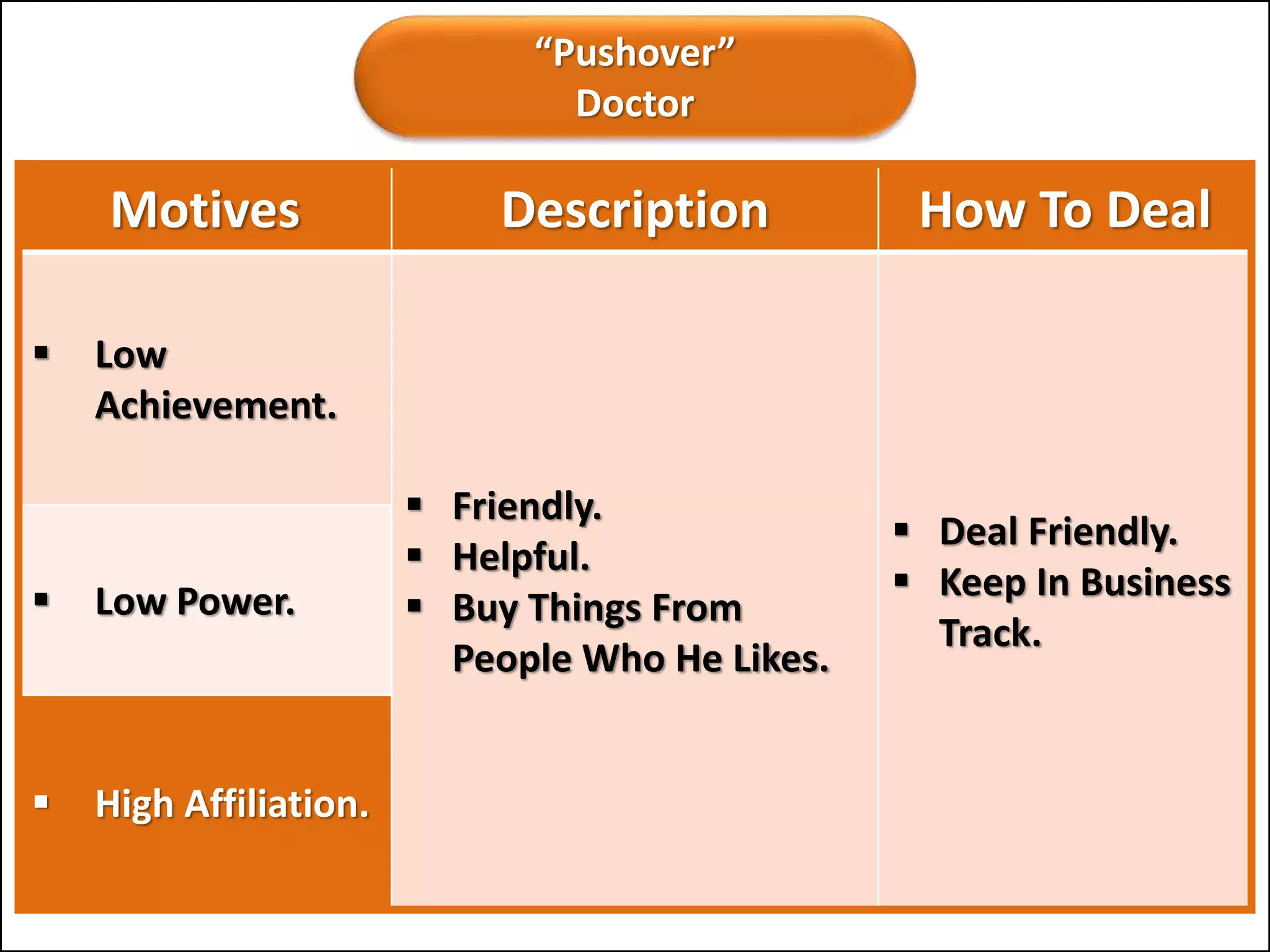
“Pushover”
Doctor
“Resistant / Defensive”
Doctor
Motives Description How To Deal
 High
Achievement.
 Hifi Personality.
 Dominates Discussions.
 Wants Maximum Value
In Returns.
 Time Is Valuable.
 Almost Director Or
Analytical.
 Respect.
 Listen.
 Do Your Home
Work.
 Explain Benefits.
 Show USPs.
 To The Point.
 Flatter His
Personality.
 Never To Tell
Him That He Is
Wrong.
 High Power.
 Low Affiliation.
“Solution”
Doctor
Motives Description How To Deal
 High
Achievement.
 Knows His Needs Very
Well & Wants What Fit
These Needs.
 Wants Facts In Details.
 His Priorities : The
Most Recent, The
Updates & The
Challenging.
 Almost Analytical.
 Lead Other Doctors To
Satisfy His Need To
Help Others.
 Just Deliver Your
Message Clearly.
 Use Detailed
Studies &
Clinical Trials.
 Follow The
Attitude &
Mindset
Classification.
 High Power.
 High Affiliation.
“Pass The Buck”
Doctor
Motives Description How To Deal
 Low
Achievement.  Conservative.
 Follow Others In Their
Decisions.
 Avoid Sales &
Marketing People.
 Keep Him Self Secured.
 No Risk & No Change.
 Emotional Key
May Help.
 Attending
Lectures With
Speakers Of
“Solution” Type
To Build Trust.
 Low Power.
 Low Affiliation.
“Pushover”
Doctor
Motives Description How To Deal
 Low
Achievement.
 Friendly.
 Helpful.
 Buy Things From
People Who He Likes.
 Deal Friendly.
 Keep In Business
Track.
 Low Power.
 High Affiliation.
Part IV : Steps Of Selling Process
* Steps Of Call *
7 Steps
7- Post-Call Analysis & Follow Up
6- The Closing (Commitment)
5- Handling Objections & Resistance
4- The Presentation (Marketing)
3- Questioning & Probing
2- Opening & Approach
1- Pre-Call PreparationProspecting Planning
What Is A Plan ?
Evaluate The Results
Tactics (Detailing)
Collecting Information About
Any Related Point To Your
Selling Process Plus Physical
Searching For :
- Markets, Segments,
Customers & Consumers.
- Competition.
- Requirements.
1- Pre-Call PreparationProspecting Planning
Specific
Measurable
Ambitious
Realistic
Strategy (How To Reach ?)
Time Bound
Goal (Objective Or Target)
Materials
Message
WWHW?
 No.# Of Doctors
 Specialty
 Potentiality
 Accounts
 Sales Team
 Med Reps
 Continue Learning.
 Attend Training.
 Online Courses.
 Stick To Professional
People.
 Say “I Don’t Know !”
BUT Find A Way To Do.
 Verbal & Non-Verbal.
 To Be +ve ABC Model :
Avoid : -ve People.
Believe : In Your Self.
Consider : Every Detail.
1- Pre-Call Preparation
SkillsAttitude
YOU
 Medical Knowledge.
 Product Knowledge.
 Competitors Knowledge.
 Area Knowledge.
 Customer Knowledge.
 Account Information.
 Historical Sales
Information.
Knowledge
Enthusiasm & Sincerity
Do Not Assume
Qualifications Of Professionals
- Smart Appearance & Presentable.
- Good Communicator & Active Listener.
- Smiling, Self Motivated & + ve Attitude.
- Leader, Dependable, Ethical & Flexible.
- Committed & Honest.
1- Pre-Call Preparation
You
Are
A
Star
 Decision Maker In This Center.
 The Reason Behind Competitor XYZ.
 Relations With Market Colleagues.
 Keep Inside (Facility) Relations.
 Rapport With Pharmacist, Purchaser & Warehouse Men.
 Read The Previous Visits Reports.
 Make Your Plan On
Monthly, Weekly & Daily
Basis. (Time Management).
 What is Your 1st Priority?
“Classes A, B & C”
 You Need To :
- List Your Customers.
- Draw A Map.
- Make Your Tasks.
- Think Objectively.
- Always Make A “Plan B”.
 Follow-Up The Sales Or
Marketing Team.
 Arrange Your Bag To
Ensure Having All
Materials.
1- Pre-Call Preparation
At The Office
 What About Your Car
Trunk ?
 Do You Have The Needed
Materials ?
 Do You Have A Pen ?
 Do You Have Your
Business Cards?
** NEVER SEACH
FOR ANY THING IN
YOUR BAG DURING
THE VISIT **
 Do You Have A
Deodorant.
 Do You Smoke ?
 Seats Are Made For
Patients.
 Never Take The Time Of
A Patient.
 During Waiting Time :
- Your Objectives.
- Your Materials.
- No#. Of Patient.
- Sex. (Male, Female)
- Competitors’
Promotional Materials
& Giveaways.
- Prescribing Habits.
- Doctors’ Interest.
- Time Consumed By
Each Med Rep.
At The Waiting AreaYour Car
LISTEN
2- Opening & Approach
 It Is The Skill Of Capturing Customer’s Attention & Focusing The Sales Call.
 Successful Opening  25% Of The Overall Call Success.
 You Need To Pass The 1st 30 Seconds.
- Being Will Prepared During The Pre-Call Preparation Help You To Pass These 30 Seconds
Successfully.
 Having Full Data About This Doctor (Customer) Before Meeting Him Makes Your Call An
Excellent Successful One.
 Introduce Your Name, Position & The Name Of Your Company In A Clear Voice Tone.
Ask Him If Your Company Is Familiar To Him.
Opening
Smile
Firm Handshake
Speak Clearly
Greeting
Is The Key To Gain The Attention & Awareness Of Your Customer.
So Choose The Best Approach Or Approaches That Fits Your Customer.
Used “Especially” During The First Visit To Decrease Tension Between You & Your Customer.
Ice Breaking
Approach
Approach
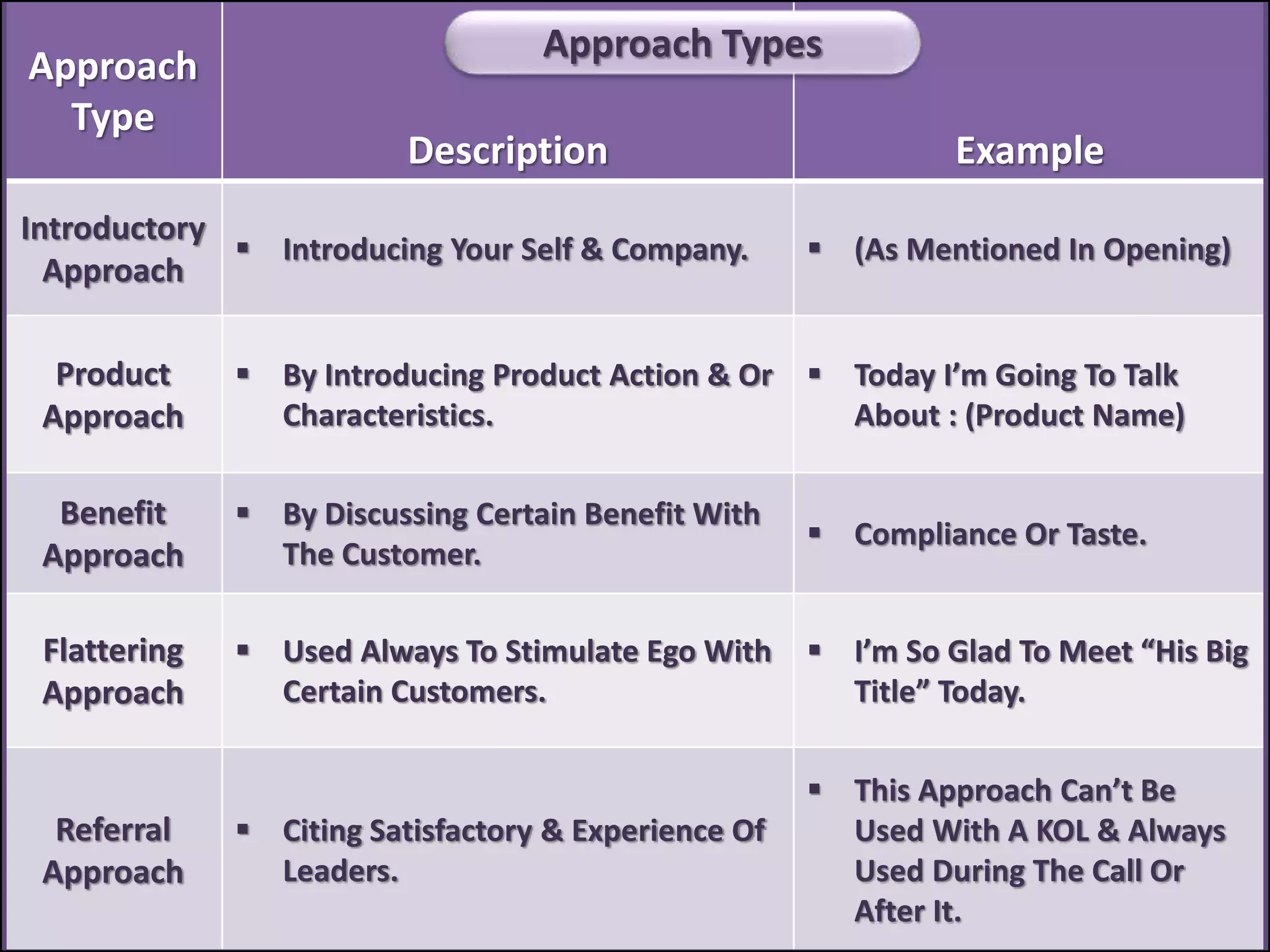
What Are The Types Of Approach ?
Approach
Type
Description Example
Introductory
Approach
 Introducing Your Self & Company.  (As Mentioned In Opening)
Product
Approach
 By Introducing Product Action & Or
Characteristics.
 Today I’m Going To Talk
About : (Product Name)
Benefit
Approach
 By Discussing Certain Benefit With
The Customer.
 Compliance Or Taste.
Flattering
Approach
 Used Always To Stimulate Ego With
Certain Customers.
 I’m So Glad To Meet “His Big
Title” Today.
Referral
Approach
 Citing Satisfactory & Experience Of
Leaders.
 This Approach Can’t Be
Used With A KOL & Always
Used During The Call Or
After It.
Approach Types
Approach
Type
Description Example
Survey
Approach
 By Discussing A Subject
Published By Medical
Centers, FDA Or etc.
 This Approach Can Be Used During
The Call.
Indication
Approach
 By Discussing Certain
Indication, Disease With The
Doctor Or Need With A
Customer.
 Do You Agree With That The Low
Back Pain Is A Serious Issue Facing
Your Patients?
Shock
Approach
 By Discussing Percent Of
Incidence.
 By Research Finding.
 Do You Agree That Omega-3 Intake
Cause Increase In HDL From 3-5%.
Mixed
Approach
 Greeting & Introduction, I’m Going To Introduce You The Most
Convenient Solution For The UC LUTIs.
Today I’ll Discuss With You A Product Which Is Approved From FDA For UC
LUTIs ? …….
Approach Types
Benefit Approach
Indication Approach Survey Approach
Negative Approaches
DO NOT
 Start With Close
Ended Question.
 Apologize At The
Beginning.
 Refer To The Last
Negative Visit.
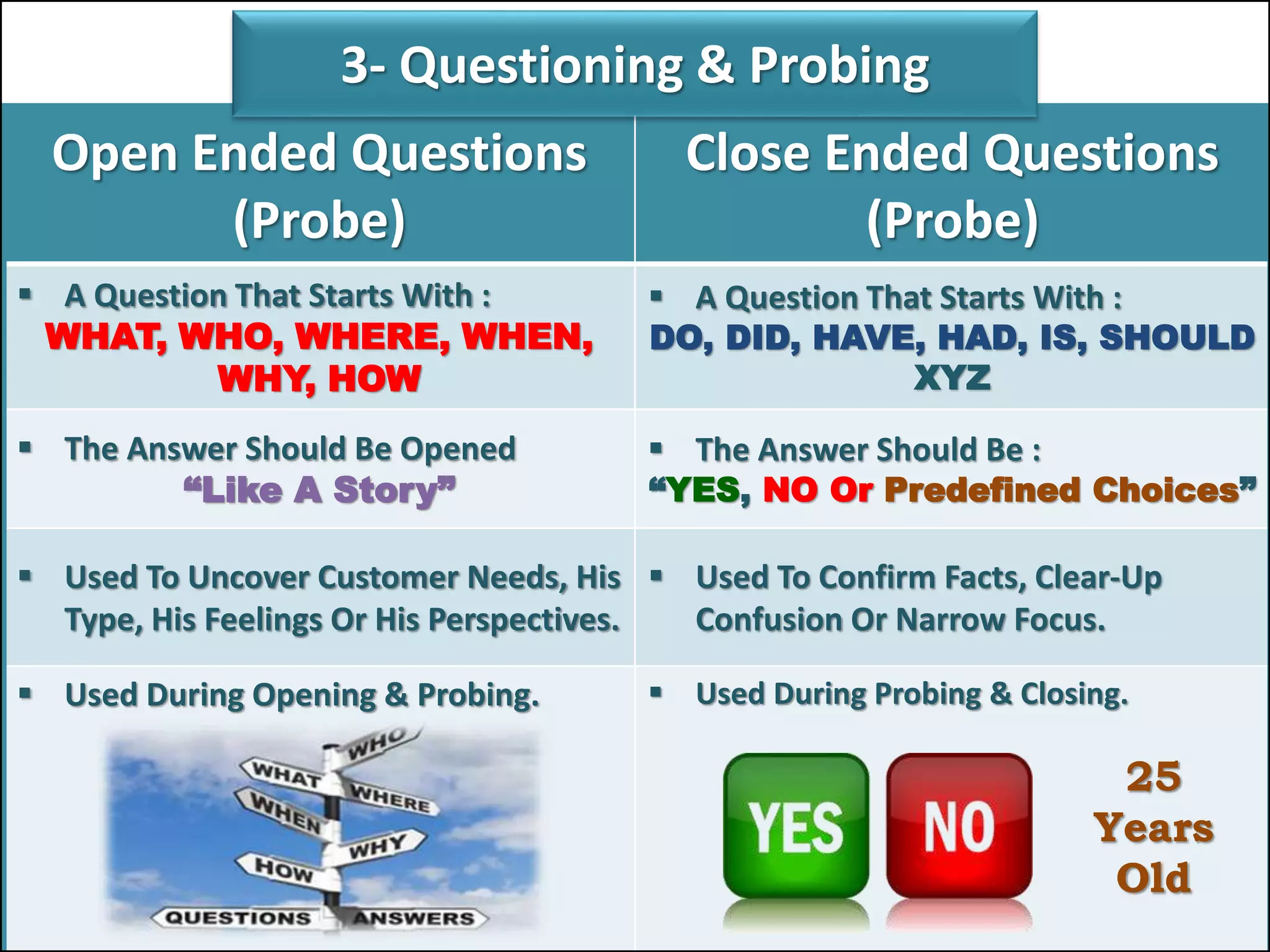
Open Ended Questions
(Probe)
Close Ended Questions
(Probe)
 A Question That Starts With :
WHAT, WHO, WHERE, WHEN,
WHY, HOW
 A Question That Starts With :
DO, DID, HAVE, HAD, IS, SHOULD
XYZ
 The Answer Should Be Opened
“Like A Story”
 The Answer Should Be :
“YES, NO Or Predefined Choices”
 Used To Uncover Customer Needs, His
Type, His Feelings Or His Perspectives.
 Used To Confirm Facts, Clear-Up
Confusion Or Narrow Focus.
 Used During Opening & Probing.  Used During Probing & Closing.
3- Questioning & Probing
25
Years
Old
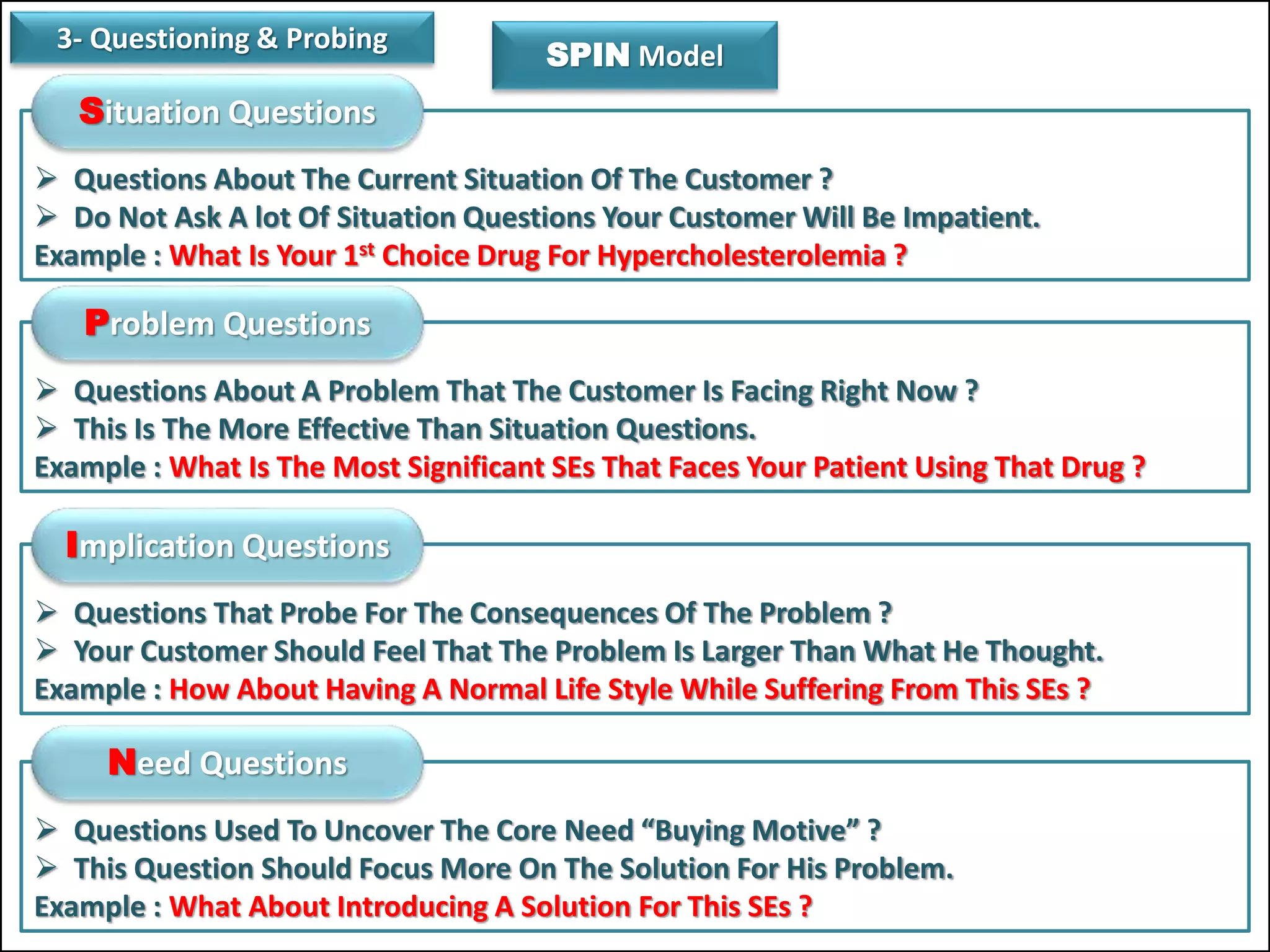
SPIN Model
 Questions About The Current Situation Of The Customer ?
 Do Not Ask A lot Of Situation Questions Your Customer Will Be Impatient.
Example : What Is Your 1st Choice Drug For Hypercholesterolemia ?
3- Questioning & Probing
Situation Questions
 Questions About A Problem That The Customer Is Facing Right Now ?
 This Is The More Effective Than Situation Questions.
Example : What Is The Most Significant SEs That Faces Your Patient Using That Drug ?
Problem Questions
 Questions That Probe For The Consequences Of The Problem ?
 Your Customer Should Feel That The Problem Is Larger Than What He Thought.
Example : How About Having A Normal Life Style While Suffering From This SEs ?
Implication Questions
 Questions Used To Uncover The Core Need “Buying Motive” ?
 This Question Should Focus More On The Solution For His Problem.
Example : What About Introducing A Solution For This SEs ?
Need Questions
NEED
NEED
NEED
NEED
NEED
NEED
NEED
NEED
NEED
NEED
NEED
NEED
To Presentation
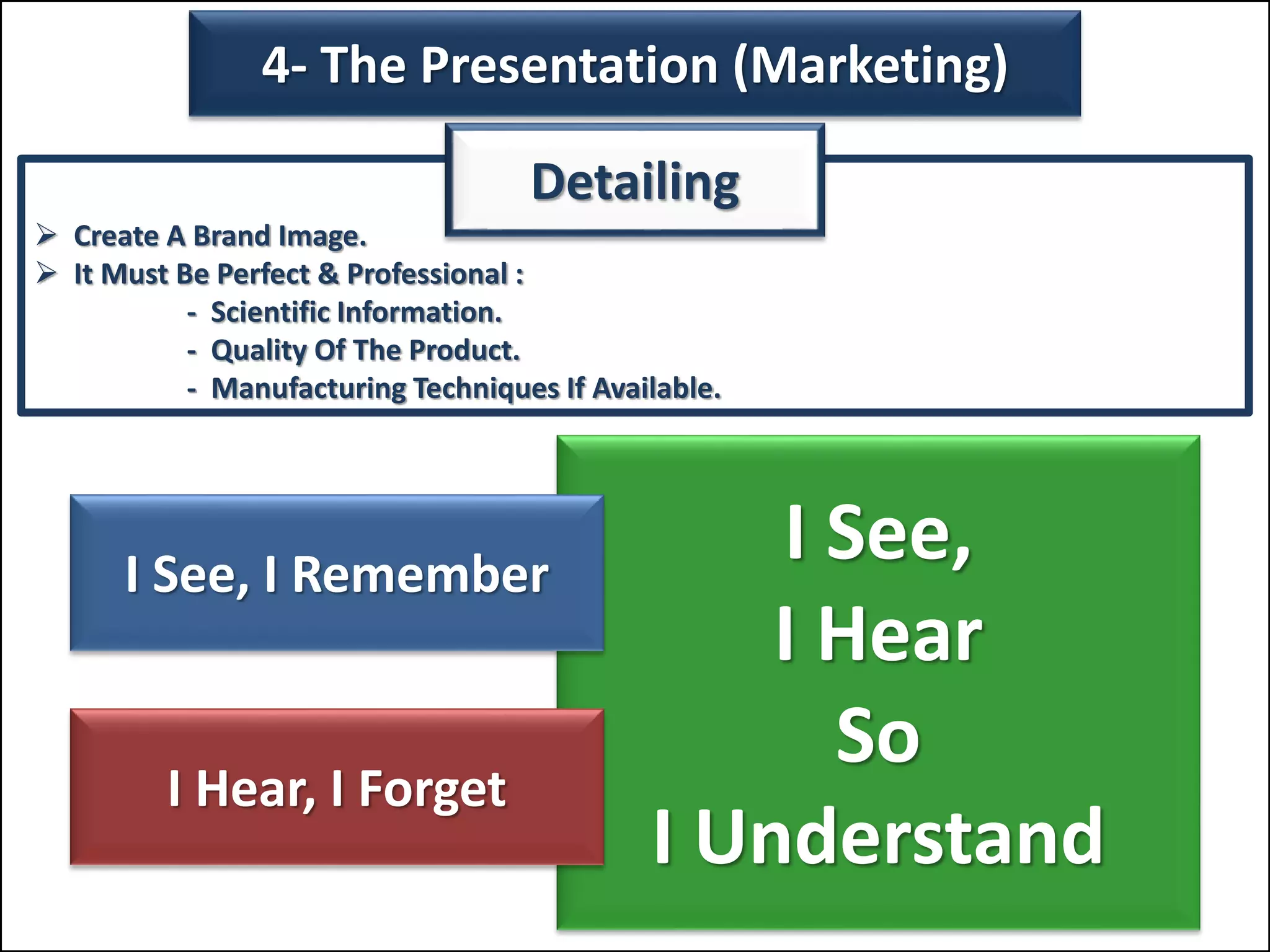
I See,
I Hear
So
I Understand
 Create A Brand Image.
 It Must Be Perfect & Professional :
- Scientific Information.
- Quality Of The Product.
- Manufacturing Techniques If Available.
4- The Presentation (Marketing)
Detailing
I See, I Remember
I Hear, I Forget
4- The Presentation (Marketing)
Steps Of Effective Detailing
1 • Text.
2 • Voice.
3 • Handling The Visual Aids.
4 • Eye To Eye Contact.
5 • Use A Pointer.
6 • Body Language.
7 • Listening.
8 • Use Of Sense.
9 • Time Management.
4- The Presentation (Marketing)
FAB Model
Feature Action / Advantage Benefit
One Sachet
Dose : One Sachet
For Once
Highest
Compliance
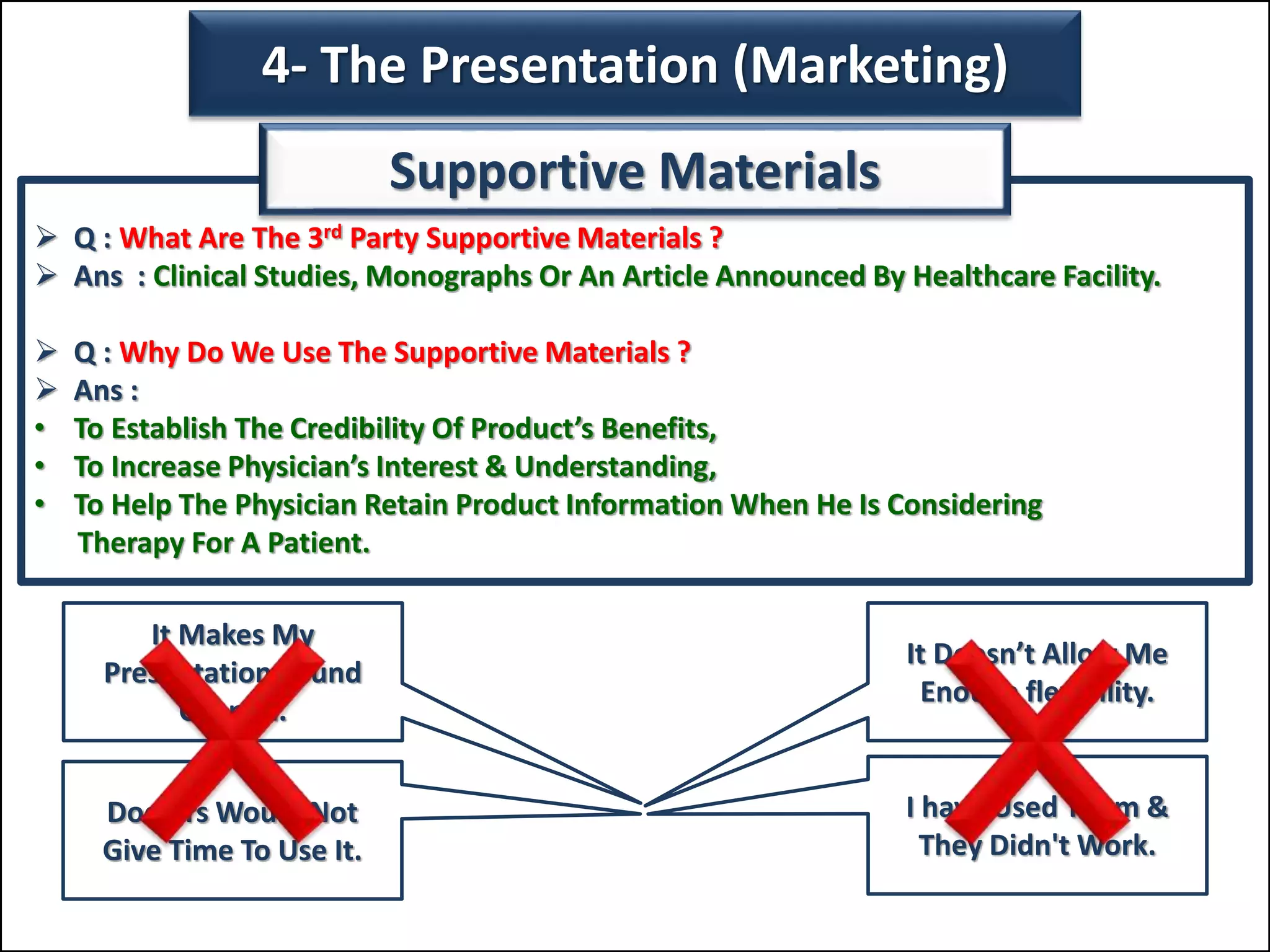
 Q : What Are The 3rd Party Supportive Materials ?
 Ans : Clinical Studies, Monographs Or An Article Announced By Healthcare Facility.
 Q : Why Do We Use The Supportive Materials ?
 Ans :
• To Establish The Credibility Of Product’s Benefits,
• To Increase Physician’s Interest & Understanding,
• To Help The Physician Retain Product Information When He Is Considering
Therapy For A Patient.
4- The Presentation (Marketing)
Supportive Materials
It Makes My
Presentation Sound
Canned.
It Doesn’t Allow Me
Enough flexibility.
Doctors Would Not
Give Time To Use It.
I have Used Them &
They Didn't Work.
 Mention The Unique Selling Points In Your Product In A Clear Way Explaining The
Benefits For The Feature Of “USP”.
4- The Presentation (Marketing)
USP
DO NOT
 Read From Your Material.
 Use The Same Voice Tone.
 Use Your Finger As A Pointer.
 Interrupt Him.
 Waste His Time.
5- Handling Objections & Resistance
In Such A Case You Should Go Directly To The Next Step  Closing & Commitment
No Objections  Acceptance
 Customer Accepted The
Benefits Of Your Product.
 Focus On These Benefits.
What If ….. You Did Your Call As Discussed BUT You Still Find That You Didn’t Get Your
Objective Yet.
Now You Are Facing An Objection : The Objection Is Never Something To Be Afraid Of.
The Objection Can Be Utilized To Be An Opportunity
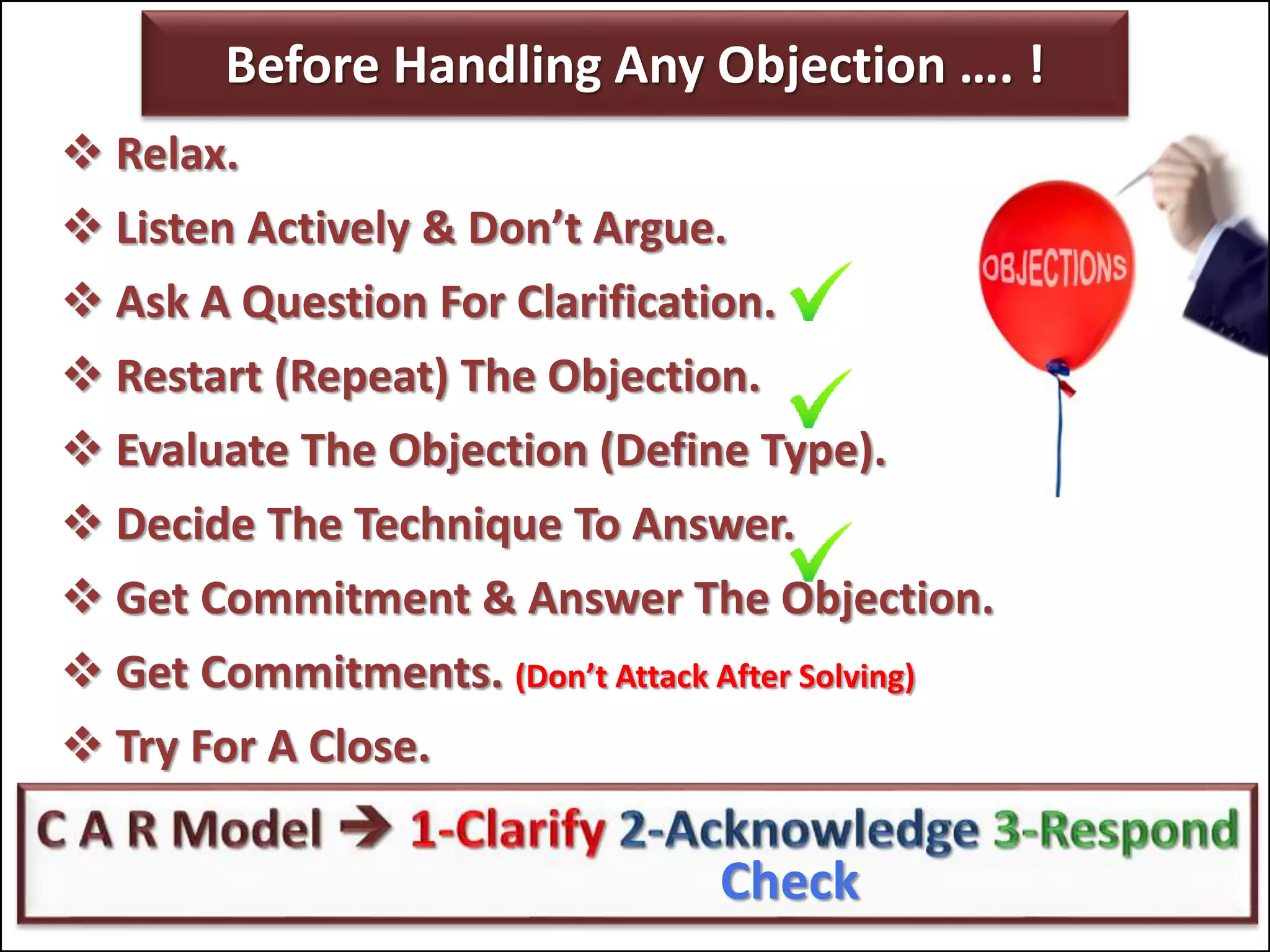
Check
Before Handling Any Objection …. !
 Relax.
 Listen Actively & Don’t Argue.
 Ask A Question For Clarification.
 Restart (Repeat) The Objection.
 Evaluate The Objection (Define Type).
 Decide The Technique To Answer.
 Get Commitment & Answer The Objection.
 Get Commitments. (Don’t Attack After Solving)
 Try For A Close.
Check
Response
Or Objection
Description Handling
Pure Negative
(Indifference)
 Not Interested In Your
Product & Usually
Interested In Another
Product.
 Firstly You Should Identify The
Other Product Benefits That Fits
His Needs.
 Then A Series Of Closed Probes
Till Discover His Needs.
Negative / Positive
(Skeptic)
 Doubt That Your
Product Can Actually
Deliver The Stated
Benefits.
 Offer Proofs.
(Clinical Studies & Articles)
** Trial Projects Using Free Samples
Are Very Effective
Real Objection
 A Real Disadvantage In
Your Product.
 A Product With No
Drawbacks Does Not Exist.
 Focus On Advantages.
False Objection
 Misunderstanding
Some Points Or
Benefits.
 Restart The Benefits & Clarify
The Misunderstood Points.
Types Of Responses & Objections
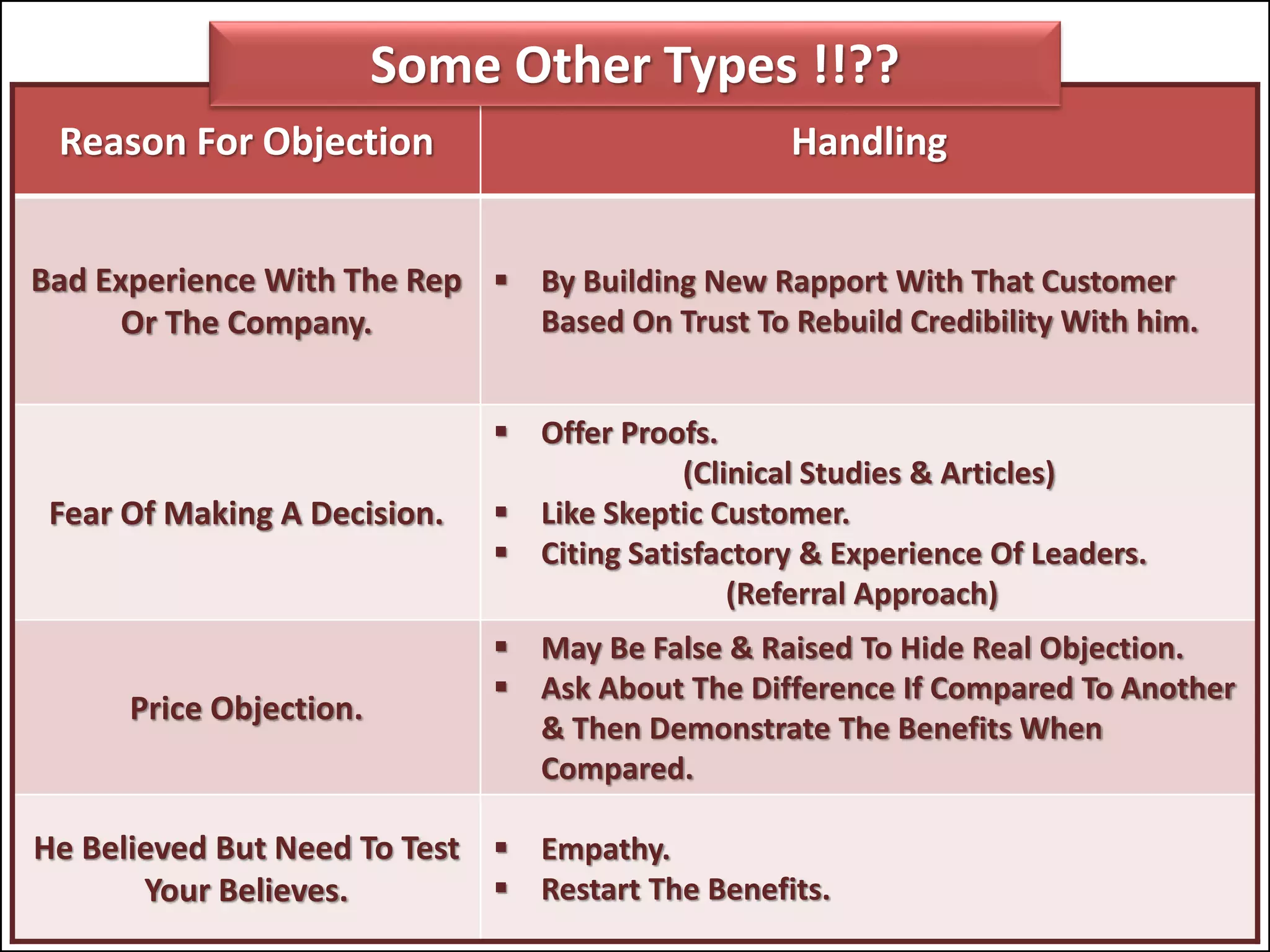
Reason For Objection Handling
Bad Experience With The Rep
Or The Company.
 By Building New Rapport With That Customer
Based On Trust To Rebuild Credibility With him.
Fear Of Making A Decision.
 Offer Proofs.
(Clinical Studies & Articles)
 Like Skeptic Customer.
 Citing Satisfactory & Experience Of Leaders.
(Referral Approach)
Price Objection.
 May Be False & Raised To Hide Real Objection.
 Ask About The Difference If Compared To Another
& Then Demonstrate The Benefits When
Compared.
He Believed But Need To Test
Your Believes.
 Empathy.
 Restart The Benefits.
Some Other Types !!??
Method Handling
Compensation
 Compensate By Adding & Magnifying Benefits.
 Agree – But (Rule), Used Also To Deny Without
Denying.
Boomerang
 Turning Objection Into Buying Reason.
 Objection Due To Lack Of Information.
Ask
 Used To Separate Excuses From Real Objections.
 Convert Generalized Objection  Concrete One.
Postpone
 If Objection Raised Earlier.
 Ask About The Price Early : I’m Coming To This
Point Sir.
Methods Of Handling Objections
6- The Closing (Commitment)
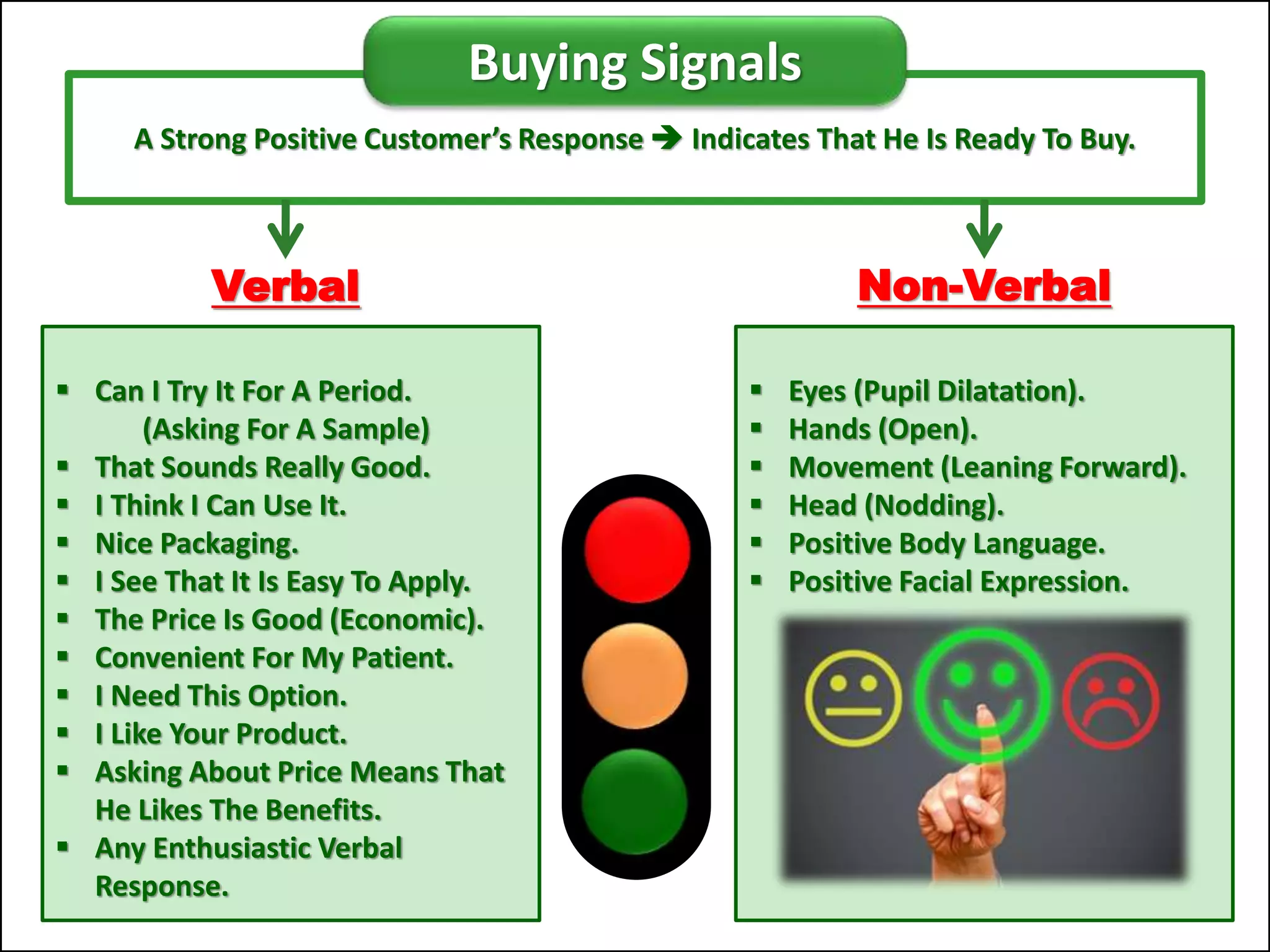
Buying Signals
A Strong Positive Customer’s Response  Indicates That He Is Ready To Buy.
Buying Signals
Verbal Non-Verbal
 Can I Try It For A Period.
(Asking For A Sample)
 That Sounds Really Good.
 I Think I Can Use It.
 Nice Packaging.
 I See That It Is Easy To Apply.
 The Price Is Good (Economic).
 Convenient For My Patient.
 I Need This Option.
 I Like Your Product.
 Asking About Price Means That
He Likes The Benefits.
 Any Enthusiastic Verbal
Response.
 Eyes (Pupil Dilatation).
 Hands (Open).
 Movement (Leaning Forward).
 Head (Nodding).
 Positive Body Language.
 Positive Facial Expression.
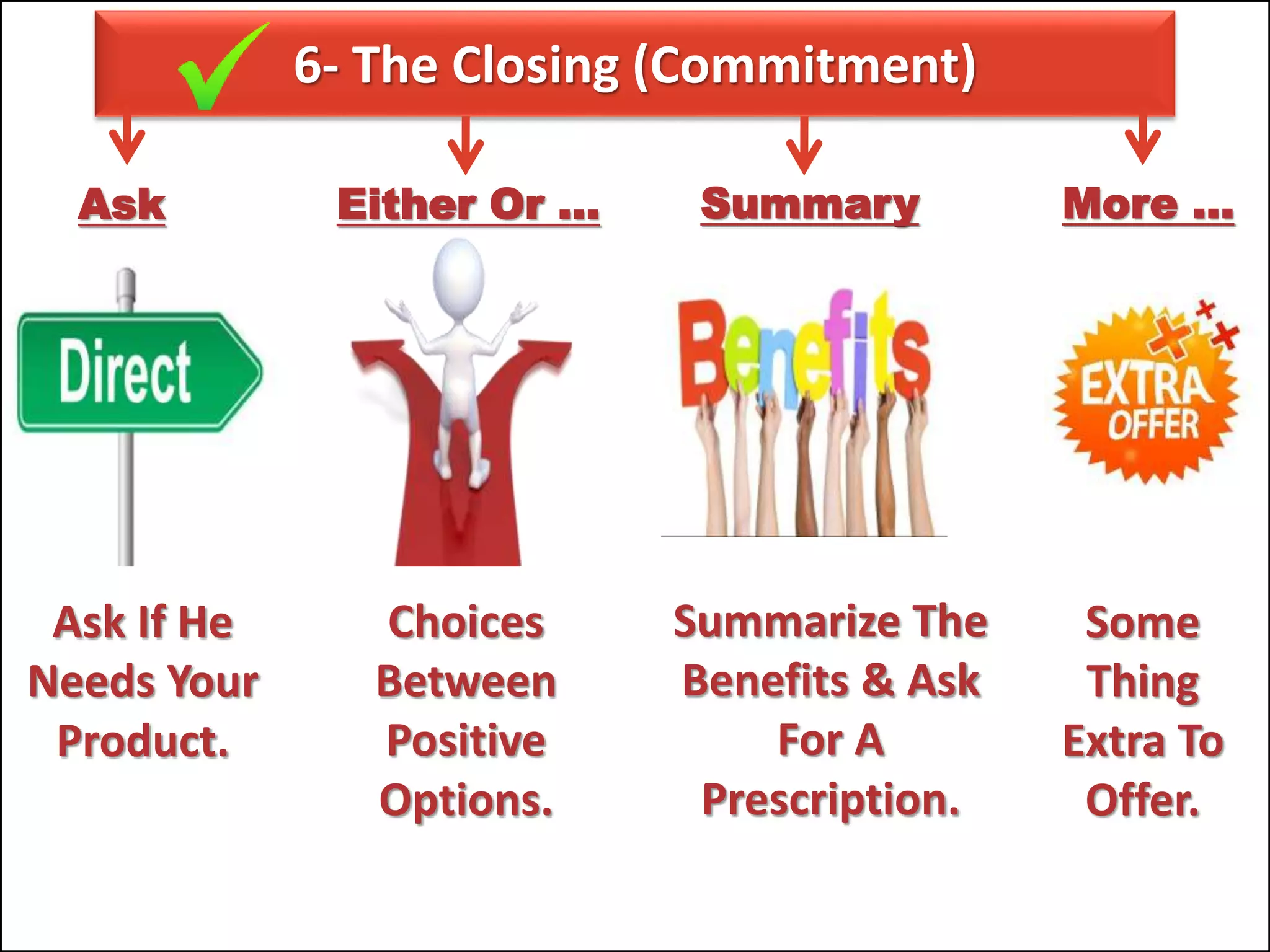
6- The Closing (Commitment)
Ask If He
Needs Your
Product.
Ask
Choices
Between
Positive
Options.
Either Or … Summary
Summarize The
Benefits & Ask
For A
Prescription.
More …
Some
Thing
Extra To
Offer.
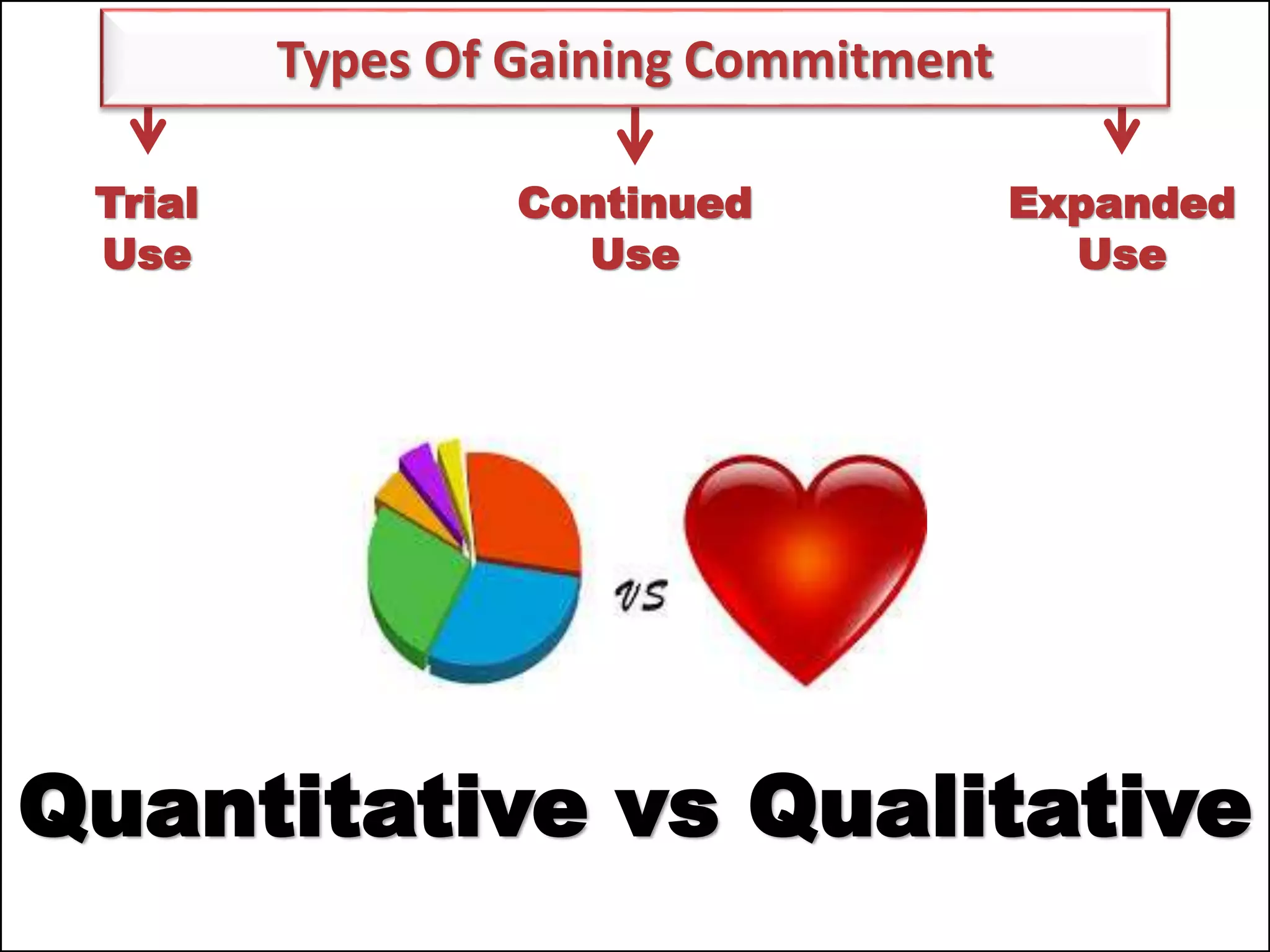
Types Of Gaining Commitment
Trial
Use
Continued
Use
Expanded
Use
Quantitative vs Qualitative
In Closing Please
The First Person Who Speak Loses.
7- Post-Call Analysis & Follow Up
Analyze
 Did I Sell.
 Did I Hold The Customer
Interest.
 Did I Emphasize Benefits.
 Did I Watch Non-Verbal
Signals.
 Did I Answer The Objections
Properly.
 Did I Match The Agreement
At The Right Time.
 What Will Be My Next Call
Objective.
Follow Up
 Did I Collect The P.O.
 Did I Call The Sales Rep.
 Did I Follow Up The Selling
Process & Delivery.
 Did I Follow Up The
Pharmacy.
 Did I Visit The Doctor After
The Delivery.
 Did I Collect The Feed Back
From Pharmacy.
 Did I Collect The Second P.O
And Evaluate The Qty.
7- Post-Call Analysis
6- The Closing
5- Objections
4- The Presentation
3- Probing
2- Approach
1- PreparationProspecting Planning
Opening Ice Break
Questioning SPIN Model
Detailing F A B Model
Types Of Objections Handling Objections
Buying Signals Commitment
Did I ….. ? Follow Up
Cross Selling Skills
Selling skills & Cross Selling

Selling skills & Cross Selling

  • 1.
  • 2.
    To Sharpen TheSkills & Abilities In Selling For Participants In Order To Sell Better & Improve Professionalism. Objectives To Stand Out From The Crowd
  • 3.
    * Contents Of“ Selling Skills Training ” : Part I Part II Part III Part IV Part V  General Terms.  Buying Behavior (Decision) & Types Of Customers.  Types Of Doctors.  Steps Of Selling Process (Steps Of Call).  Cross Selling.
  • 4.
    Part I :General Terms Marketing & Selling Product Need Want Motive Achievement Affiliation Power Feature Benefit USP
  • 5.
    Marketing is a Processof Planning, Executing, Conception, Pricing, Promotion & Distributing Any PRODUCT to Create an Exchange That Satisfy Individual & Organizational Goals. Product is a Priced Item or Service Which Introduce a Value to The Customer.
  • 6.
    Selling Marketing * Selling isOnly The Tip Of Marketing Iceberg * Marketing Aim to make selling superfluous, Right Marketing Aim To Understand Customer, So  a Product That Fits His Needs & it Will Sell itself. Marketing Should Result in A Customer Who is Ready To BUY. By Peter Ducker • Selling is The Process of Assisting & Persuading a Prospective Customer to Buy a Product or a Service. (Uncovering Needs Of The Customer)
  • 8.
    Need : You Can’tSurvive Without it. - Need For Food, Air & Water Want : You Can Survive Without it. - I Want to Have a Fashionable Car. - Also “I Want Falafel” Demand : When You Want a specific PD & You are Able to Pay For. - I Want to Have a BMW I Can Pay For. Negative Customer Dislike PD. Demand Non-Exist Customer Unaware Of the PD & Its Benefits. Declining Customer Buy PD Less Frequent Or Not at all. Irregular Customer Purchase Vary on a Seasonal, Monthly Basis. Full Customer Buy All PD. Overfull Customer Buy PD More Than What Can Be Satisfied.
  • 9.
    The Shape &Characteristics Of A Product That May Describe That Product Physically Or Describe Its Contents. Features Of A Product Should Focus On The Most Valuable Properties Of That Product (Strengths). * 100 mg is The Conc Of AC in Product XYZ * Feature Actual Factor That Satisfies Certain Need Or Want Of A Customer & Originated By Certain Feature. Linking A Feature To A Benefit Leads To Successful Selling Process, While Selling Only Benefits Is Almost Ineffective. Benefit Benefit = Need
  • 10.
    Feature * BenefitSelling Monurol  One Sachet, One Dose & Once. Monurol  The Most Convenient AB. Bio-Biloba  100 mg Conc Of G.Biloba. Bio-Biloba  Once At Morning  No Insomnia.
  • 11.
    12 MP Camera Capture Your Memories. 128 & 256 GB Storage  Keep These Memories. 128 & 256 GB Storage  Your Favorite Music. New Wireless Ear pods  Convenient Listening. Finger Print Sensor  Secured & Private.
  • 12.
    * Unique SellingPoint * A Factor Presented By Seller As A Reason That A Product Is Different & Better Than Another Competitor. Or A Reason That Makes A Product Is Unique & Almost Has No Competitors USP Monurol  - New Molecule (Fosfomycin). - Most Convenient As AB For LUTIs. Bio-Marin  - Triglycerides (Higher Absorption). - Highest Conc Of EPA & DHA.
  • 13.
    A Factor OrCircumstance That Induces A Person To Act in A Certain Way Or Do A Certain Action In Order To Satisfy A Need. * The Goals Behind Your Actions * Motive
  • 14.
    The Need ToSee Positive Results & To Avoid Failure. * Reaching Your Goals After Hard Work * Achievements The Need To Be Associated With Other (To Help Others). Affiliation The Need To Prevail Over Others. The Need To Control Or Command Over Others. Power
  • 15.
    4 Ps SWOTMaslow
  • 16.
    4 Ps OfMarketing
  • 17.
  • 18.
  • 20.
    Part II :Buying Behaviors & Types Of Customers The Total Of Consumer's Attitudes, Preferences, Intentions, and Decisions Regarding The Consumer's Behavior When Purchasing A Product Or Service. This Study Of Consumer Behavior Draws Upon Social Science Anthropology, Psychology & Economics.
  • 21.
    Buying Behavior Why DoYou Buy ? * Need : i. Physical : Essential For Survival (Food, Drink, Sleep & etc.) ii. Social (Emotional) : Security, Belonging & Love. * Want : It Reflects The Way That A Customer Wants To Satisfy His Needs. ( When You Are Hungry YOU NEED FOOD But YOU WANT KFC ) * Benefits Introduced : Customers Buy Benefits Not Just A Product. * Ability To Pay : If A Customer Has No Ability To Pay For Your Product So This Is Not A Customer.
  • 22.
    Post-Purchase Evaluation Purchase Decision EvaluationOf Alternatives Buying Decision Process How Do You Buy ? Collecting Information Problem RecognitionNeed & Want Friends & Family Previous Buyers Ability Web & Social Media Marketing Materials Brand Loyal Benefits VS Price Method Commitment Warranty Services
  • 23.
    Type Of FactorExamples Social & Cultural Factors.  Family & Friends.  Roles.  Believes.  Economic & Political Factors. Psychological Factors.  Motivation.  Perception.  Learning.  Memory. Personal Factors.  Age & Stage in Life Cycle.  Economic Circumstances.  Lifestyle.  Personality. Factors Of Marketing Mix. (4 Ps)  Product.  Price.  Place.  Promotion. Factors Affecting Buying Behavior
  • 24.
    Customers Are ClassifiedAccording To Many Factors …. Like ! Personal Attitude Shopping Habits Retail CustomersPsychological Doctors, Pharmacist, Patient, Consumer, Client, Buyer, Purchaser Is A Person Or An Organization That Uses The Product Or Service Provided By A Seller, Supplier Or Vendor. Customer
  • 25.
    Customer Type Characteristics Handling (HowTo Deal) Aggressive Or Tough  Egoistic.  Impatient.  Harsh.  Listen & Allow Him To Talk.  Express Your Points As Suggestions.  Be Courteous But Firm. Uncertain Or Skeptical  Non Demanding.  Indecisive & Unsure  Evasive.  Seeks Assurance.  Maintain Eye Contact.  Break Barriers.  Listen & Ask Right Questions. Irate Or Angry  Impatient.  Argues.  Doesn’t Listen.  Be Assertive (Control) Not Angry.  Jump To The Point.  Explain With Calm & Clear Voice.  No Hollow Promises. Business Like  Jump To The Point.  Avoid Procrastination.  Go On & Do Not Waste Time. Knowledgeable  Demanding.  Has Good Knowledge.  Satisfy His Desire For Detailing.  Never Fooling Him. Friendly  Talkative.  Warm & Good Natured  Respond To Hospitality.  Keep On Business Track. Customers (Attitude & Mindset)
  • 26.
    Customer Type Characteristics Handling (HowTo Deal) The Director  Demanding.  Knows What He Wants.  Cares Only About His Own Interest.  Speak With Numbers, Short & To The Point.  Flatter His Style & Knowledge.  Never Tell Him That He Is Wrong.  Make Suggestions Without Determining Any Facts. The Analytical  Likes Numbers & Facts.  Analyzes All Options.  Probably Know Your Product & Competitors Better Than You.  Show Him Numbers & Send Him Email Material.  Do Your Home Work.  Don’t Try To Convince Him With Facts Without Numbers.  Ask A lot Of Questions. The Relater (The Story Teller)  Wants To Be A Part Of A Group.  Always Knows Some One (Has A lot Of Connections).  Share The Process With Him.  Ask Him  What Do You Think ?  Ask Him To Use His Connections To Help You Have A Vacation …. Etc. Customers ( Behavior )
  • 27.
    Customer Type Characteristics Handling (HowTo Deal) Brand Loyal Customers  Shop & Purchase For Certain Brand.  Should Be Updated About Any New Product Launched.  Having >60% From Loyal Customer. Discount Customers  Shop & Purchase For Discounts & Offers.  Help To Have Our Stocks Cleared Or Liquidated.  Spread The Word Out In The Market Showing Their Money Saving Skills. Impulse Customers  Shop & Purchase Upon Being Impressed  Decide To Buy Just In A Moment Because The Product Has Impressed Him.  Can Be Converted To Loyal Customer. Emotional Customers  Social & Talkative.  More Loyal To Persons.  Deal Friendly But In The Business Track. Need Based Customers  Shop & Purchase According To A Plan Of Requirements.  Know Exactly What They Need  Well Trained Sales Men.  You May Lose Such A Customer If His Need Not Being Satisfied.  No Hollow Promises. Retail Customers (Shopping Habits)
  • 28.
    Who Is YourCustomer You Must Identify Your Customer Type.
  • 29.
    Part III :Types Of Doctors Depending On Mix Of 3 Factors
  • 30.
    Achievement & Power + ve Achievement & Power  - ve Affiliation  + ve Affiliation  - ve  High Achievements.  High Power. X Low Affiliation. “Resistant / Defensive” Doctor  High Achievements.  High Power.  High Affiliation. “Solution” Doctor X Low Achievements. X Low Power. X Low Affiliation. “Pass The Buck” Doctor X Low Achievements. X Low Power.  High Affiliation. “Pushover” Doctor
  • 31.
    “Resistant / Defensive” Doctor MotivesDescription How To Deal  High Achievement.  Hifi Personality.  Dominates Discussions.  Wants Maximum Value In Returns.  Time Is Valuable.  Almost Director Or Analytical.  Respect.  Listen.  Do Your Home Work.  Explain Benefits.  Show USPs.  To The Point.  Flatter His Personality.  Never To Tell Him That He Is Wrong.  High Power.  Low Affiliation.
  • 32.
    “Solution” Doctor Motives Description HowTo Deal  High Achievement.  Knows His Needs Very Well & Wants What Fit These Needs.  Wants Facts In Details.  His Priorities : The Most Recent, The Updates & The Challenging.  Almost Analytical.  Lead Other Doctors To Satisfy His Need To Help Others.  Just Deliver Your Message Clearly.  Use Detailed Studies & Clinical Trials.  Follow The Attitude & Mindset Classification.  High Power.  High Affiliation.
  • 33.
    “Pass The Buck” Doctor MotivesDescription How To Deal  Low Achievement.  Conservative.  Follow Others In Their Decisions.  Avoid Sales & Marketing People.  Keep Him Self Secured.  No Risk & No Change.  Emotional Key May Help.  Attending Lectures With Speakers Of “Solution” Type To Build Trust.  Low Power.  Low Affiliation.
  • 34.
    “Pushover” Doctor Motives Description HowTo Deal  Low Achievement.  Friendly.  Helpful.  Buy Things From People Who He Likes.  Deal Friendly.  Keep In Business Track.  Low Power.  High Affiliation.
  • 37.
    Part IV :Steps Of Selling Process * Steps Of Call * 7 Steps
  • 38.
    7- Post-Call Analysis& Follow Up 6- The Closing (Commitment) 5- Handling Objections & Resistance 4- The Presentation (Marketing) 3- Questioning & Probing 2- Opening & Approach 1- Pre-Call PreparationProspecting Planning
  • 39.
    What Is APlan ? Evaluate The Results Tactics (Detailing) Collecting Information About Any Related Point To Your Selling Process Plus Physical Searching For : - Markets, Segments, Customers & Consumers. - Competition. - Requirements. 1- Pre-Call PreparationProspecting Planning Specific Measurable Ambitious Realistic Strategy (How To Reach ?) Time Bound Goal (Objective Or Target) Materials Message WWHW?  No.# Of Doctors  Specialty  Potentiality  Accounts  Sales Team  Med Reps
  • 40.
     Continue Learning. Attend Training.  Online Courses.  Stick To Professional People.  Say “I Don’t Know !” BUT Find A Way To Do.  Verbal & Non-Verbal.  To Be +ve ABC Model : Avoid : -ve People. Believe : In Your Self. Consider : Every Detail. 1- Pre-Call Preparation SkillsAttitude YOU  Medical Knowledge.  Product Knowledge.  Competitors Knowledge.  Area Knowledge.  Customer Knowledge.  Account Information.  Historical Sales Information. Knowledge Enthusiasm & Sincerity Do Not Assume
  • 41.
    Qualifications Of Professionals -Smart Appearance & Presentable. - Good Communicator & Active Listener. - Smiling, Self Motivated & + ve Attitude. - Leader, Dependable, Ethical & Flexible. - Committed & Honest. 1- Pre-Call Preparation You Are A Star
  • 42.
     Decision MakerIn This Center.  The Reason Behind Competitor XYZ.  Relations With Market Colleagues.  Keep Inside (Facility) Relations.  Rapport With Pharmacist, Purchaser & Warehouse Men.  Read The Previous Visits Reports.
  • 43.
     Make YourPlan On Monthly, Weekly & Daily Basis. (Time Management).  What is Your 1st Priority? “Classes A, B & C”  You Need To : - List Your Customers. - Draw A Map. - Make Your Tasks. - Think Objectively. - Always Make A “Plan B”.  Follow-Up The Sales Or Marketing Team.  Arrange Your Bag To Ensure Having All Materials. 1- Pre-Call Preparation At The Office  What About Your Car Trunk ?  Do You Have The Needed Materials ?  Do You Have A Pen ?  Do You Have Your Business Cards? ** NEVER SEACH FOR ANY THING IN YOUR BAG DURING THE VISIT **  Do You Have A Deodorant.  Do You Smoke ?  Seats Are Made For Patients.  Never Take The Time Of A Patient.  During Waiting Time : - Your Objectives. - Your Materials. - No#. Of Patient. - Sex. (Male, Female) - Competitors’ Promotional Materials & Giveaways. - Prescribing Habits. - Doctors’ Interest. - Time Consumed By Each Med Rep. At The Waiting AreaYour Car LISTEN
  • 44.
    2- Opening &Approach  It Is The Skill Of Capturing Customer’s Attention & Focusing The Sales Call.  Successful Opening  25% Of The Overall Call Success.  You Need To Pass The 1st 30 Seconds. - Being Will Prepared During The Pre-Call Preparation Help You To Pass These 30 Seconds Successfully.  Having Full Data About This Doctor (Customer) Before Meeting Him Makes Your Call An Excellent Successful One.  Introduce Your Name, Position & The Name Of Your Company In A Clear Voice Tone. Ask Him If Your Company Is Familiar To Him. Opening Smile Firm Handshake Speak Clearly Greeting
  • 45.
    Is The KeyTo Gain The Attention & Awareness Of Your Customer. So Choose The Best Approach Or Approaches That Fits Your Customer. Used “Especially” During The First Visit To Decrease Tension Between You & Your Customer. Ice Breaking Approach Approach What Are The Types Of Approach ?
  • 46.
    Approach Type Description Example Introductory Approach  IntroducingYour Self & Company.  (As Mentioned In Opening) Product Approach  By Introducing Product Action & Or Characteristics.  Today I’m Going To Talk About : (Product Name) Benefit Approach  By Discussing Certain Benefit With The Customer.  Compliance Or Taste. Flattering Approach  Used Always To Stimulate Ego With Certain Customers.  I’m So Glad To Meet “His Big Title” Today. Referral Approach  Citing Satisfactory & Experience Of Leaders.  This Approach Can’t Be Used With A KOL & Always Used During The Call Or After It. Approach Types
  • 47.
    Approach Type Description Example Survey Approach  ByDiscussing A Subject Published By Medical Centers, FDA Or etc.  This Approach Can Be Used During The Call. Indication Approach  By Discussing Certain Indication, Disease With The Doctor Or Need With A Customer.  Do You Agree With That The Low Back Pain Is A Serious Issue Facing Your Patients? Shock Approach  By Discussing Percent Of Incidence.  By Research Finding.  Do You Agree That Omega-3 Intake Cause Increase In HDL From 3-5%. Mixed Approach  Greeting & Introduction, I’m Going To Introduce You The Most Convenient Solution For The UC LUTIs. Today I’ll Discuss With You A Product Which Is Approved From FDA For UC LUTIs ? ……. Approach Types Benefit Approach Indication Approach Survey Approach
  • 48.
    Negative Approaches DO NOT Start With Close Ended Question.  Apologize At The Beginning.  Refer To The Last Negative Visit.
  • 49.
    Open Ended Questions (Probe) CloseEnded Questions (Probe)  A Question That Starts With : WHAT, WHO, WHERE, WHEN, WHY, HOW  A Question That Starts With : DO, DID, HAVE, HAD, IS, SHOULD XYZ  The Answer Should Be Opened “Like A Story”  The Answer Should Be : “YES, NO Or Predefined Choices”  Used To Uncover Customer Needs, His Type, His Feelings Or His Perspectives.  Used To Confirm Facts, Clear-Up Confusion Or Narrow Focus.  Used During Opening & Probing.  Used During Probing & Closing. 3- Questioning & Probing 25 Years Old
  • 50.
    SPIN Model  QuestionsAbout The Current Situation Of The Customer ?  Do Not Ask A lot Of Situation Questions Your Customer Will Be Impatient. Example : What Is Your 1st Choice Drug For Hypercholesterolemia ? 3- Questioning & Probing Situation Questions  Questions About A Problem That The Customer Is Facing Right Now ?  This Is The More Effective Than Situation Questions. Example : What Is The Most Significant SEs That Faces Your Patient Using That Drug ? Problem Questions  Questions That Probe For The Consequences Of The Problem ?  Your Customer Should Feel That The Problem Is Larger Than What He Thought. Example : How About Having A Normal Life Style While Suffering From This SEs ? Implication Questions  Questions Used To Uncover The Core Need “Buying Motive” ?  This Question Should Focus More On The Solution For His Problem. Example : What About Introducing A Solution For This SEs ? Need Questions
  • 51.
  • 52.
    I See, I Hear So IUnderstand  Create A Brand Image.  It Must Be Perfect & Professional : - Scientific Information. - Quality Of The Product. - Manufacturing Techniques If Available. 4- The Presentation (Marketing) Detailing I See, I Remember I Hear, I Forget
  • 53.
    4- The Presentation(Marketing) Steps Of Effective Detailing 1 • Text. 2 • Voice. 3 • Handling The Visual Aids. 4 • Eye To Eye Contact. 5 • Use A Pointer. 6 • Body Language. 7 • Listening. 8 • Use Of Sense. 9 • Time Management.
  • 54.
    4- The Presentation(Marketing) FAB Model Feature Action / Advantage Benefit One Sachet Dose : One Sachet For Once Highest Compliance
  • 55.
     Q :What Are The 3rd Party Supportive Materials ?  Ans : Clinical Studies, Monographs Or An Article Announced By Healthcare Facility.  Q : Why Do We Use The Supportive Materials ?  Ans : • To Establish The Credibility Of Product’s Benefits, • To Increase Physician’s Interest & Understanding, • To Help The Physician Retain Product Information When He Is Considering Therapy For A Patient. 4- The Presentation (Marketing) Supportive Materials It Makes My Presentation Sound Canned. It Doesn’t Allow Me Enough flexibility. Doctors Would Not Give Time To Use It. I have Used Them & They Didn't Work.
  • 56.
     Mention TheUnique Selling Points In Your Product In A Clear Way Explaining The Benefits For The Feature Of “USP”. 4- The Presentation (Marketing) USP DO NOT  Read From Your Material.  Use The Same Voice Tone.  Use Your Finger As A Pointer.  Interrupt Him.  Waste His Time.
  • 57.
    5- Handling Objections& Resistance In Such A Case You Should Go Directly To The Next Step  Closing & Commitment No Objections  Acceptance  Customer Accepted The Benefits Of Your Product.  Focus On These Benefits. What If ….. You Did Your Call As Discussed BUT You Still Find That You Didn’t Get Your Objective Yet. Now You Are Facing An Objection : The Objection Is Never Something To Be Afraid Of. The Objection Can Be Utilized To Be An Opportunity
  • 58.
    Check Before Handling AnyObjection …. !  Relax.  Listen Actively & Don’t Argue.  Ask A Question For Clarification.  Restart (Repeat) The Objection.  Evaluate The Objection (Define Type).  Decide The Technique To Answer.  Get Commitment & Answer The Objection.  Get Commitments. (Don’t Attack After Solving)  Try For A Close. Check
  • 59.
    Response Or Objection Description Handling PureNegative (Indifference)  Not Interested In Your Product & Usually Interested In Another Product.  Firstly You Should Identify The Other Product Benefits That Fits His Needs.  Then A Series Of Closed Probes Till Discover His Needs. Negative / Positive (Skeptic)  Doubt That Your Product Can Actually Deliver The Stated Benefits.  Offer Proofs. (Clinical Studies & Articles) ** Trial Projects Using Free Samples Are Very Effective Real Objection  A Real Disadvantage In Your Product.  A Product With No Drawbacks Does Not Exist.  Focus On Advantages. False Objection  Misunderstanding Some Points Or Benefits.  Restart The Benefits & Clarify The Misunderstood Points. Types Of Responses & Objections
  • 60.
    Reason For ObjectionHandling Bad Experience With The Rep Or The Company.  By Building New Rapport With That Customer Based On Trust To Rebuild Credibility With him. Fear Of Making A Decision.  Offer Proofs. (Clinical Studies & Articles)  Like Skeptic Customer.  Citing Satisfactory & Experience Of Leaders. (Referral Approach) Price Objection.  May Be False & Raised To Hide Real Objection.  Ask About The Difference If Compared To Another & Then Demonstrate The Benefits When Compared. He Believed But Need To Test Your Believes.  Empathy.  Restart The Benefits. Some Other Types !!??
  • 61.
    Method Handling Compensation  CompensateBy Adding & Magnifying Benefits.  Agree – But (Rule), Used Also To Deny Without Denying. Boomerang  Turning Objection Into Buying Reason.  Objection Due To Lack Of Information. Ask  Used To Separate Excuses From Real Objections.  Convert Generalized Objection  Concrete One. Postpone  If Objection Raised Earlier.  Ask About The Price Early : I’m Coming To This Point Sir. Methods Of Handling Objections
  • 62.
    6- The Closing(Commitment) Buying Signals
  • 63.
    A Strong PositiveCustomer’s Response  Indicates That He Is Ready To Buy. Buying Signals Verbal Non-Verbal  Can I Try It For A Period. (Asking For A Sample)  That Sounds Really Good.  I Think I Can Use It.  Nice Packaging.  I See That It Is Easy To Apply.  The Price Is Good (Economic).  Convenient For My Patient.  I Need This Option.  I Like Your Product.  Asking About Price Means That He Likes The Benefits.  Any Enthusiastic Verbal Response.  Eyes (Pupil Dilatation).  Hands (Open).  Movement (Leaning Forward).  Head (Nodding).  Positive Body Language.  Positive Facial Expression.
  • 64.
    6- The Closing(Commitment) Ask If He Needs Your Product. Ask Choices Between Positive Options. Either Or … Summary Summarize The Benefits & Ask For A Prescription. More … Some Thing Extra To Offer.
  • 65.
    Types Of GainingCommitment Trial Use Continued Use Expanded Use Quantitative vs Qualitative
  • 66.
    In Closing Please TheFirst Person Who Speak Loses.
  • 67.
    7- Post-Call Analysis& Follow Up Analyze  Did I Sell.  Did I Hold The Customer Interest.  Did I Emphasize Benefits.  Did I Watch Non-Verbal Signals.  Did I Answer The Objections Properly.  Did I Match The Agreement At The Right Time.  What Will Be My Next Call Objective. Follow Up  Did I Collect The P.O.  Did I Call The Sales Rep.  Did I Follow Up The Selling Process & Delivery.  Did I Follow Up The Pharmacy.  Did I Visit The Doctor After The Delivery.  Did I Collect The Feed Back From Pharmacy.  Did I Collect The Second P.O And Evaluate The Qty.
  • 68.
    7- Post-Call Analysis 6-The Closing 5- Objections 4- The Presentation 3- Probing 2- Approach 1- PreparationProspecting Planning Opening Ice Break Questioning SPIN Model Detailing F A B Model Types Of Objections Handling Objections Buying Signals Commitment Did I ….. ? Follow Up
  • 69.