
Consumer Behavior
By Prof. Rajeev Kumar


The behavior that consumers display in
searching for, purchasing, using, evaluating, and
disposing of products and services that they
expect will satisfy their needs.
Personal Consumer
The individual who buys goods and services for
his or her own use, for household use, for the
use of a family member, or for a friend.
Organizational Consumer
A business, government agency, or other
institution (profit or nonprofit) that buys the
goods, services, and/or equipment necessary for
the organization to function.
FACTORS INFLUENCING CONSUMER
         BUYING BEHAVIOR

‡ Cultural factors:
      Culture
      Sub- Culture
             eg: Kellogg͛s
SOCIAL CLASS
‡   Upper Class
‡   Upper Middle Class
‡   Middle Class
‡   Lower Class
SOCIAL FACTORS
‡   Social Groups
‡   Colleagues at work
‡   Consumer Action Groups
‡   Reference Groups
‡   Family
PERSONAL FACTORS
‡ Age and Life Cycle stage
‡ Occupation and Financial status
‡ Life-style
PSYCHOLOGICAL FACTORS
‡   MOTIVATION
‡   PERCEPTION
‡   ATTITUDE
‡   LEARNING
Needs and Motivation
‡ Needs are the essence of the marketing
  concept.
‡ Motivation is the driving force within
  individuals that impels them to action.


Copyright 2007 by Prentice Hall
Consumer Motivation
‡ Represents the drive to satisfy both
  psychological and physiological needs through
  product purchase and consumption.
‡ gives insights into why people buy certain
  products.
‡ stems from consumer needs: industries have
  been built around basic human needs.
Types of Consumer Needs
‡ Physiological needs-
   Fundamental human needs, including food,
  water and shelter
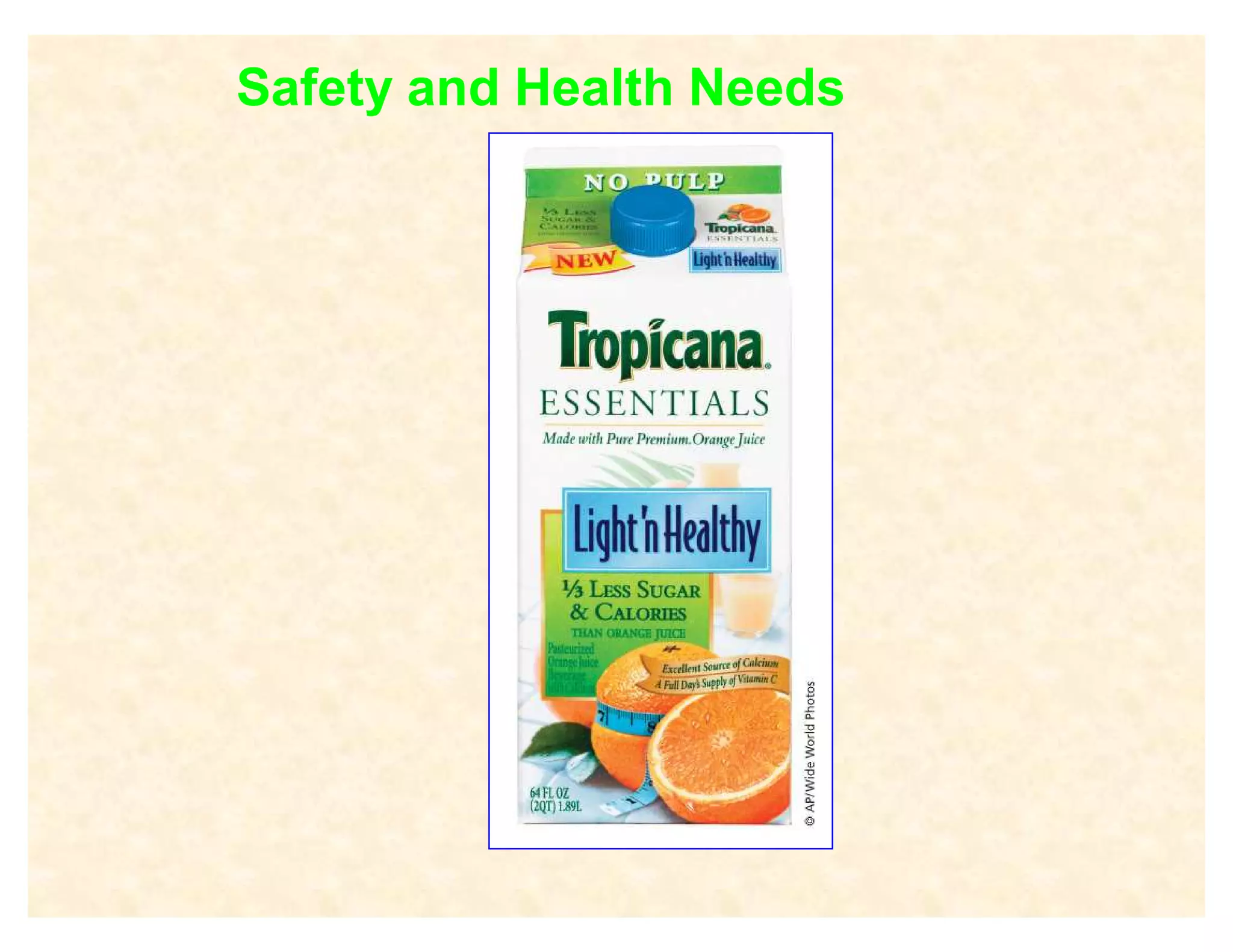
‡ Safety and Health needs-
  Threats to our safety and health motive
  purchases for personal security and
  protection.
‡ Safety and Health needs
   Protecting our personal information and
  computers represents new types of safety
  needs.
  Businesses provide a variety of products and
  services to appeal to safety and health
  conscious consumers.
Safety and Health Needs
Motivational conflicts and need
              priorities
‡ satisfying a need often comes at the expense
  of another need- this causes motivational
  conflicts.
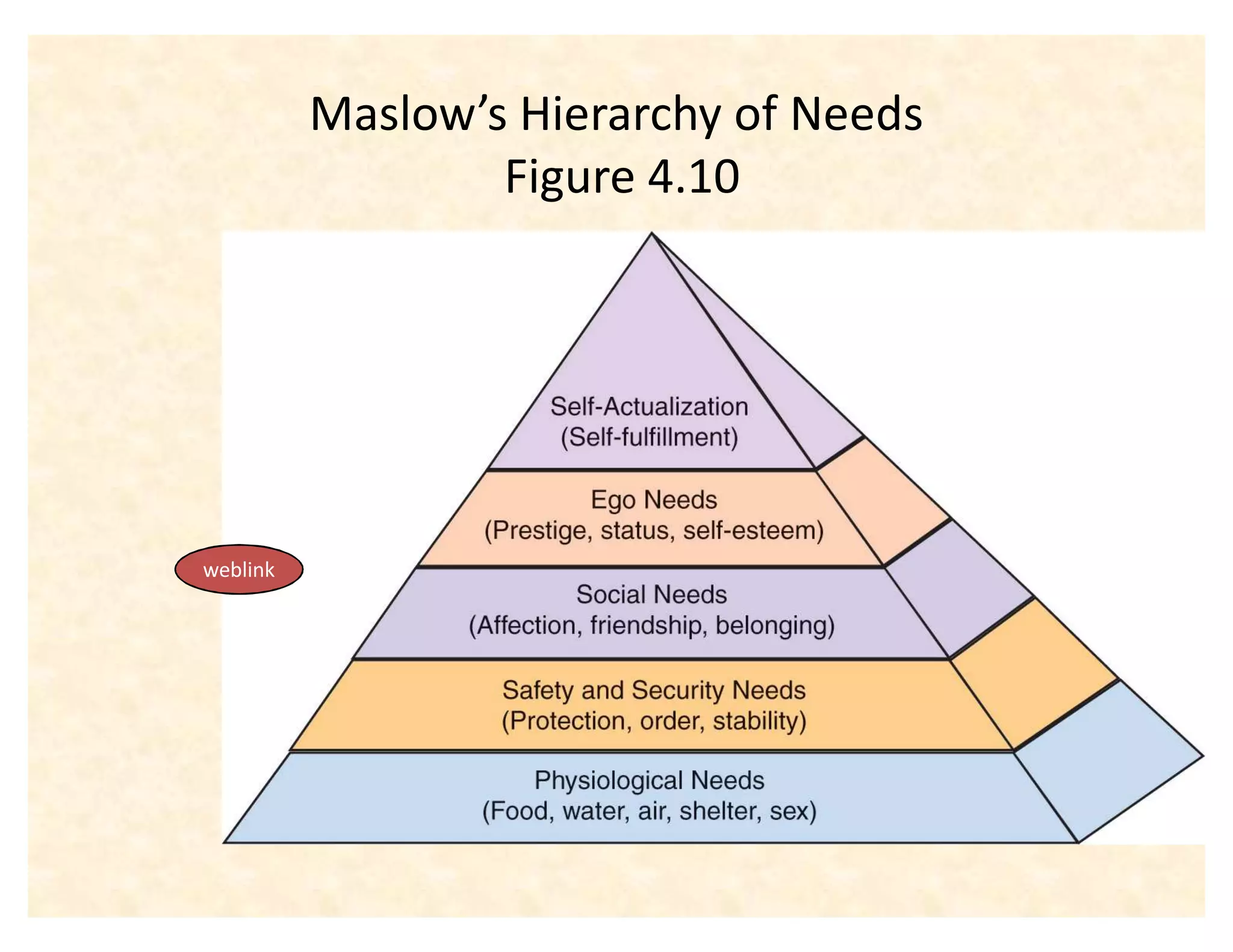
Maslow͛s Hierarchy of Needs
                  Figure 4.10


weblink
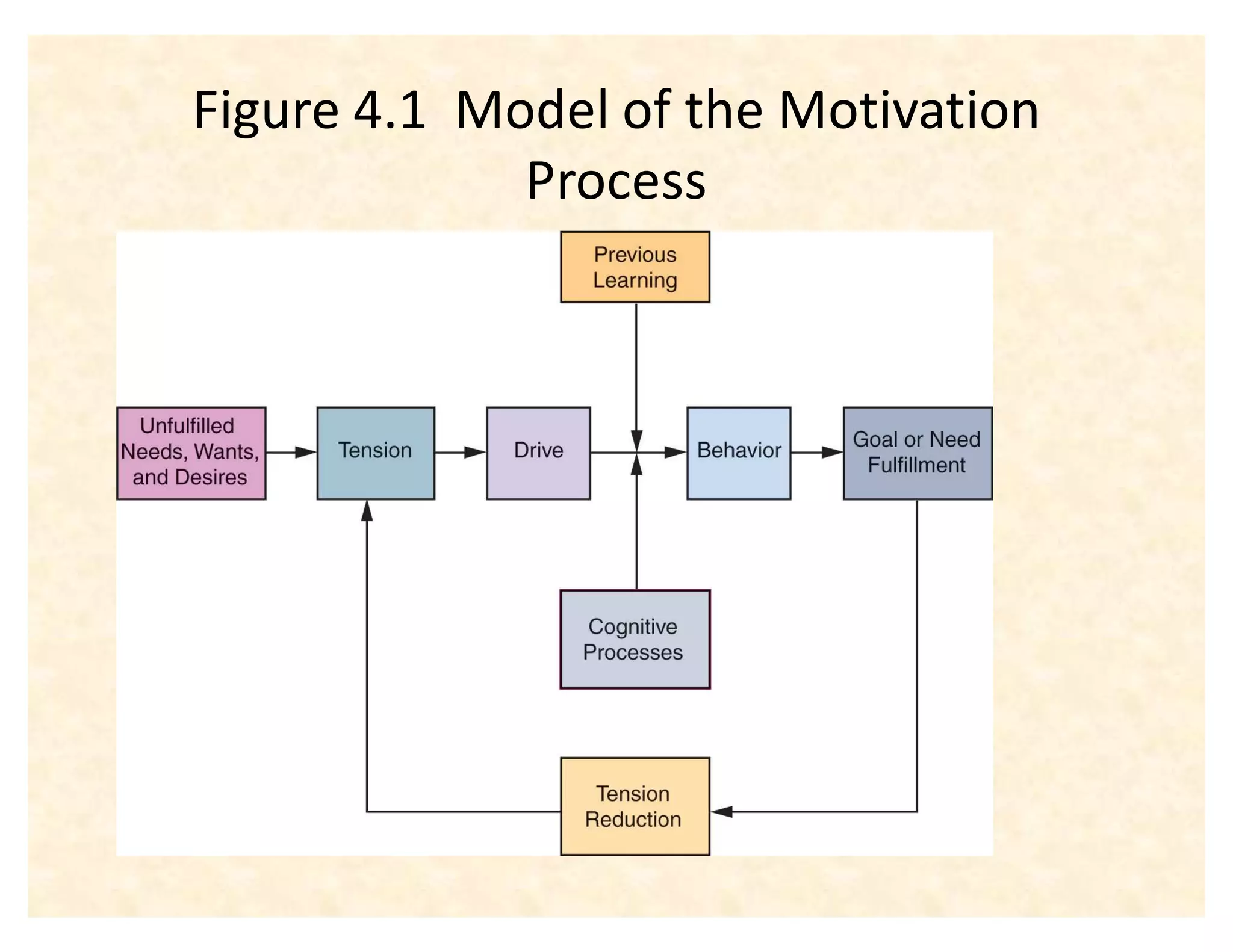
Figure 4.1 Model of the Motivation
             Process
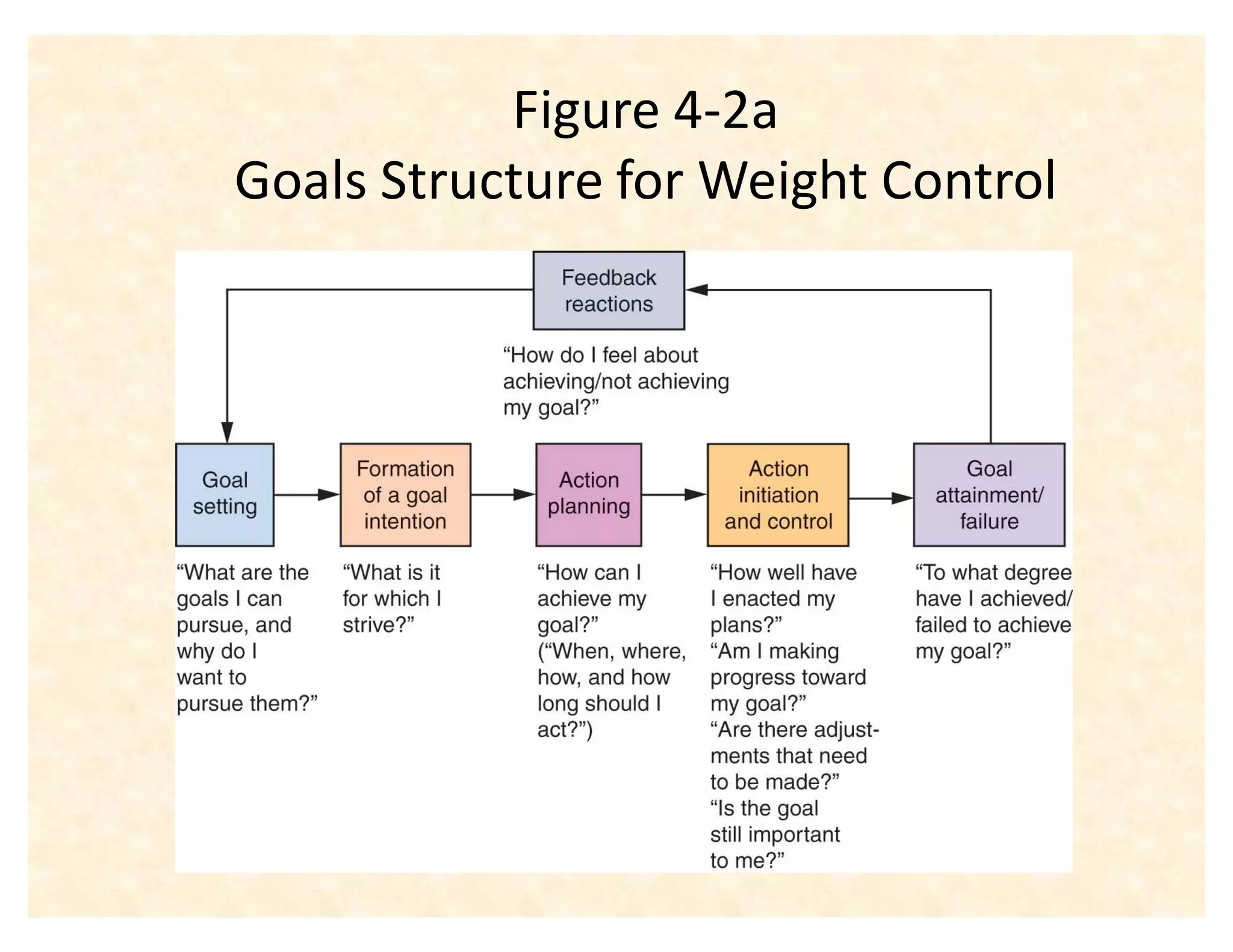
Figure 4-2a
Goals Structure for Weight Control
The Dynamic Nature of Motivation
‡ Needs are never fully satisfied
‡ New needs emerge as old needs are satisfied
‡ People who achieve their goals set new and
  higher goals for themselves
This ad reflects
   a need for
accomplishment
      with a
  toothpaste.
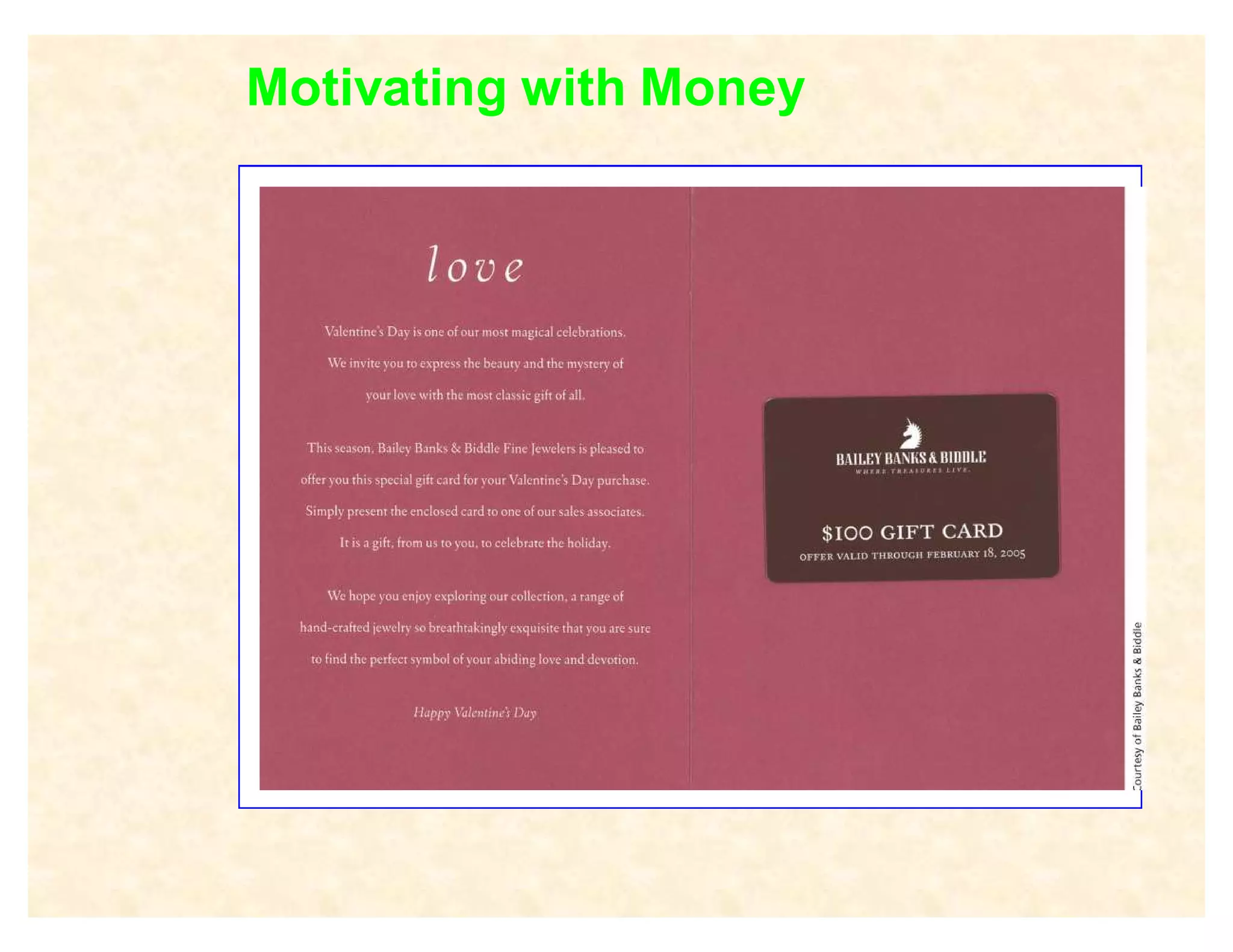
Motivating with Money
PERCEPTIONS
‡ The process by which an individual selects,
  organizes and interprets stimuli into
  meaningful thoughts and pictures.

(Customers perceive their environment through
  the sense of touch, smell, taste, hearing, etc.
BELIEFS AND ATTITUDE
‡ A belief is a descriptive image or thought that
  an individual holds about something.
‡ A person͛s attitude is a set of his feelings and
  the way in which he reacts to a given idea or
  thought.
LEARNING
‡ Consumer learning is a process which evolves
  and changes as a result of newly acquired
  knowledge or experience
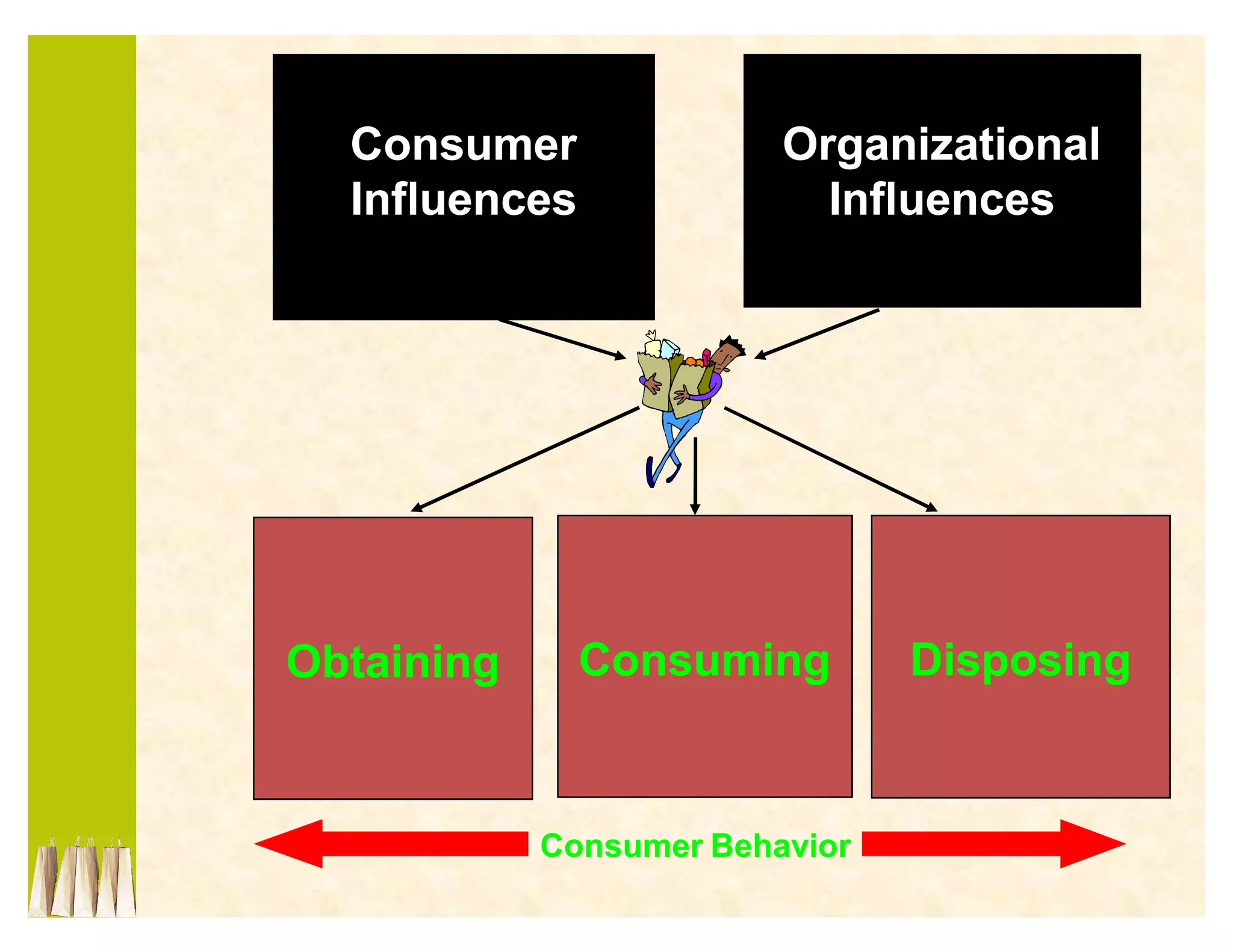
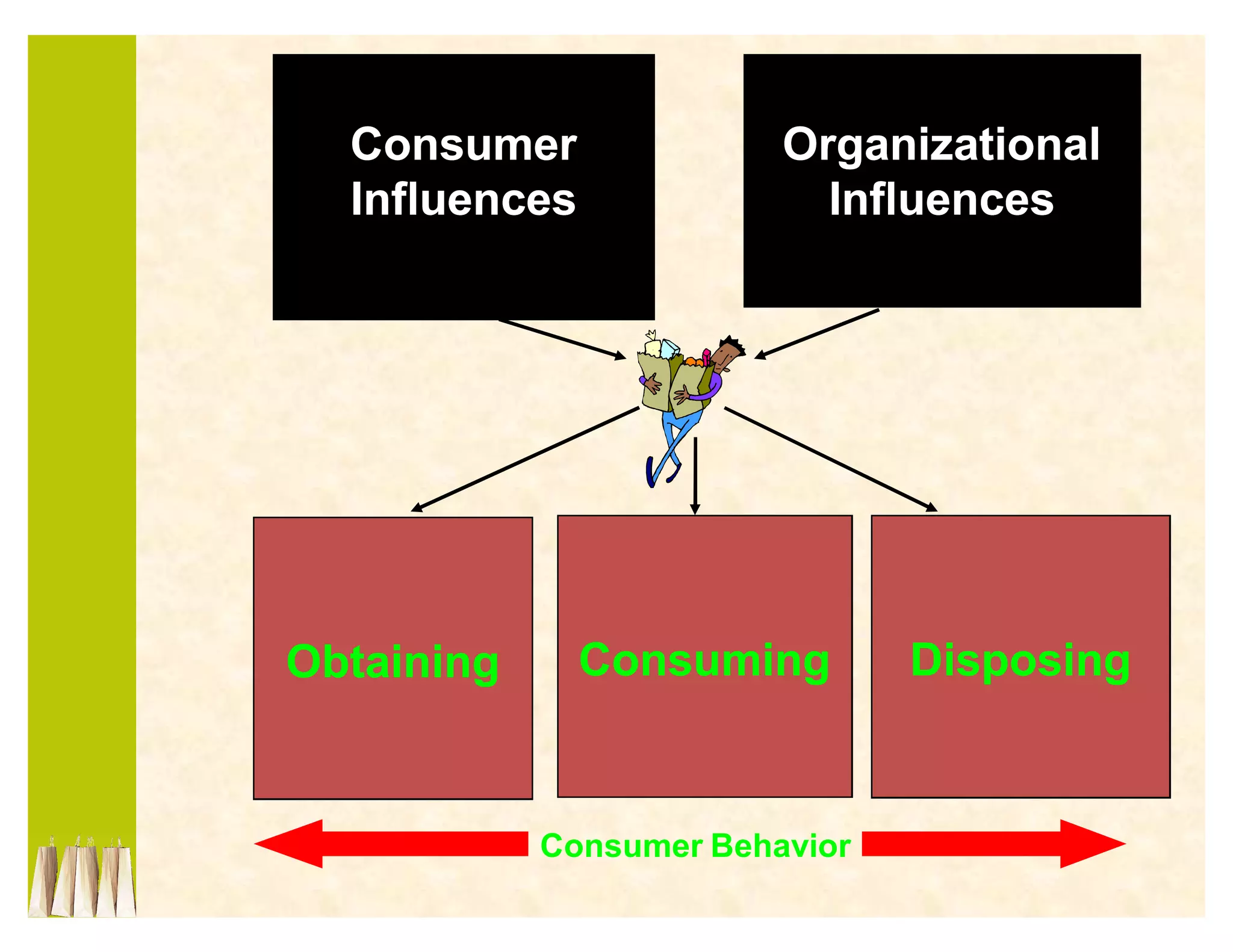
Consumer               Organizational
  Influences               Influences


Obtaining      Consuming        Disposing


            Consumer Behavior
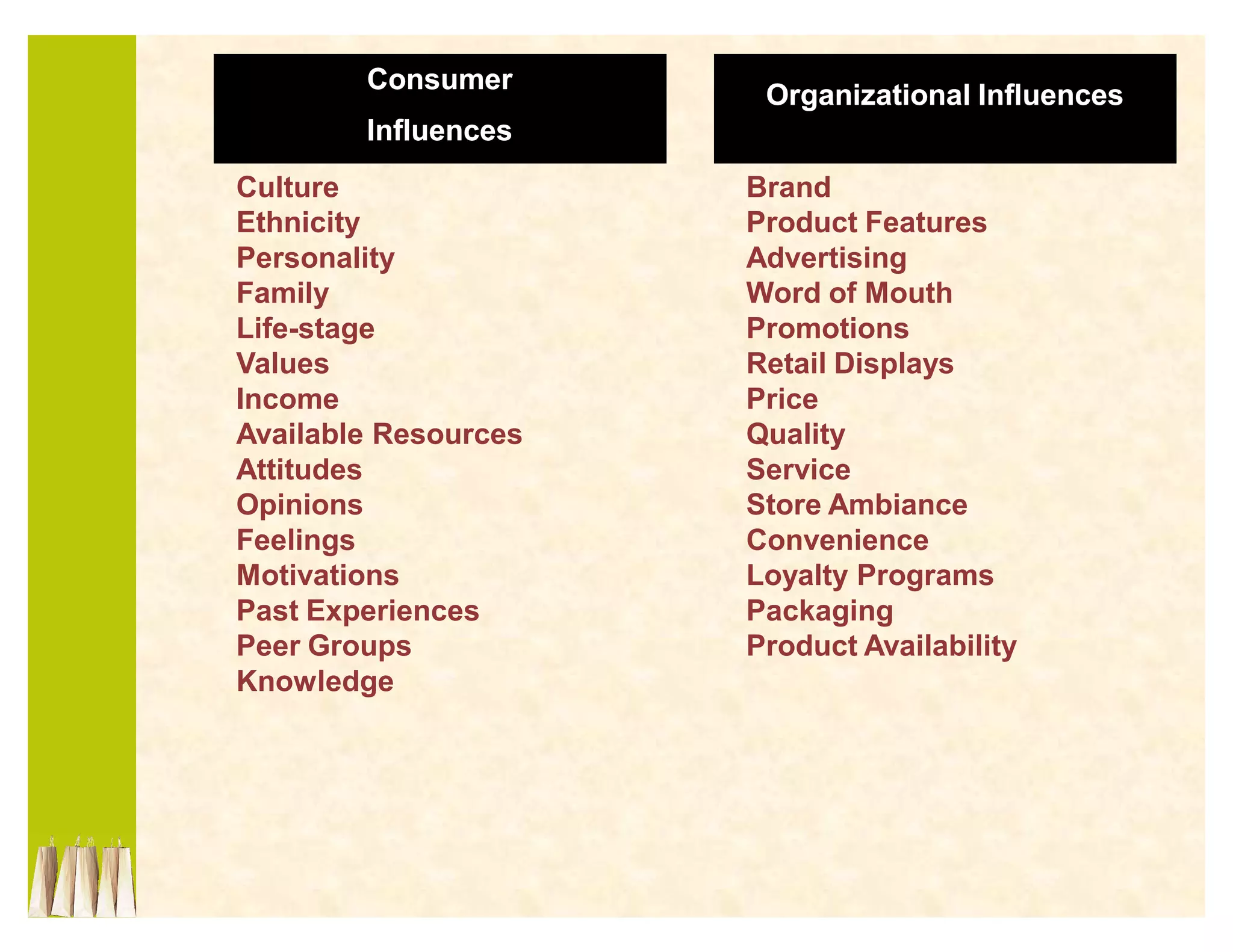
Consumer
                       Organizational Influences
        Influences
Culture               Brand
Ethnicity             Product Features
Personality           Advertising
Family                Word of Mouth
Life-stage            Promotions
Values                Retail Displays
Income                Price
Available Resources   Quality
Attitudes             Service
Opinions              Store Ambiance
Feelings              Convenience
Motivations           Loyalty Programs
Past Experiences      Packaging
Peer Groups           Product Availability
Knowledge
Consumer               Organizational
  Influences               Influences


Obtaining      Consuming        Disposing


            Consumer Behavior
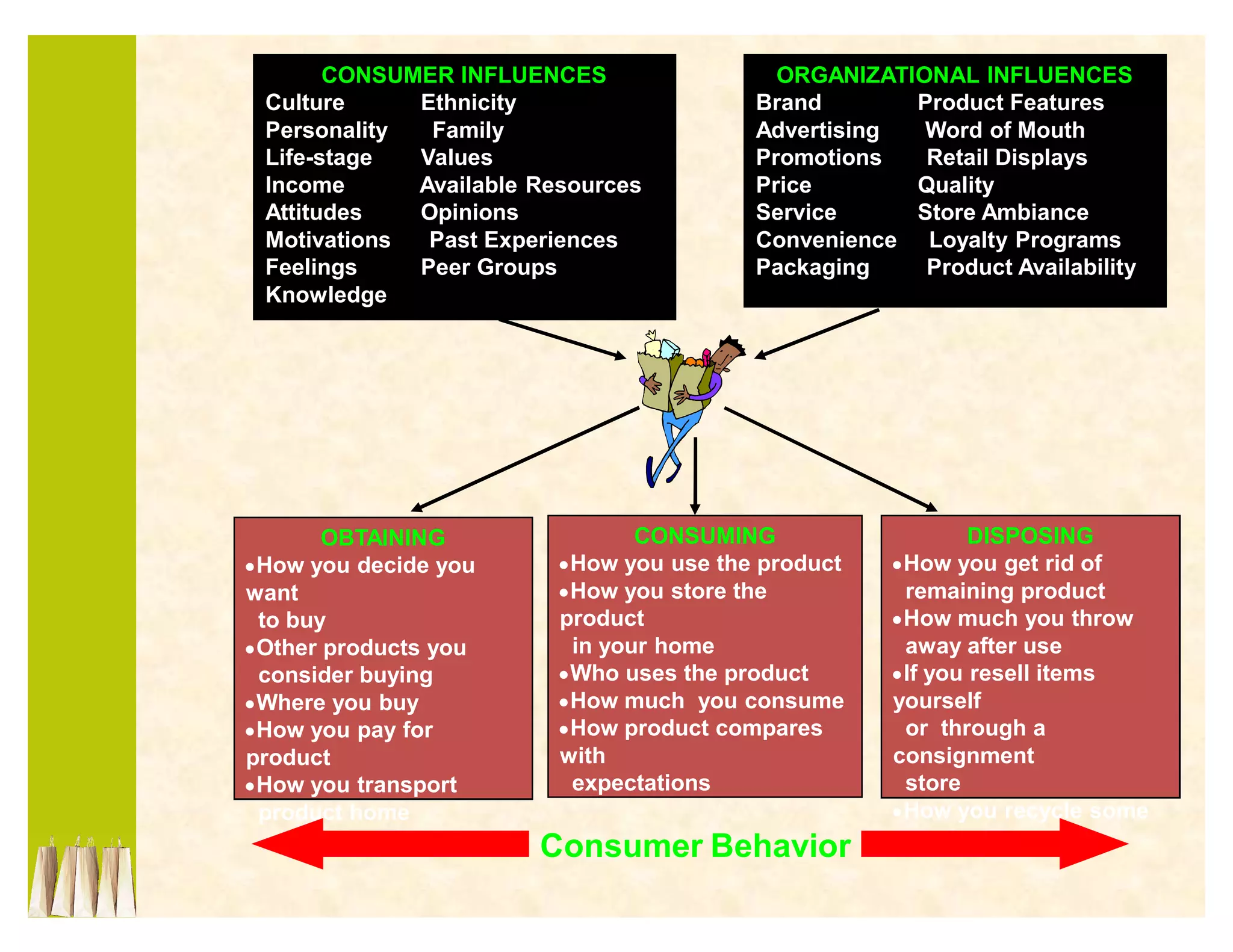
CONSUMER INFLUENCES                 ORGANIZATIONAL INFLUENCES
 Culture     Ethnicity                   Brand       Product Features
 Personality  Family                     Advertising  Word of Mouth
 Life-stage  Values                      Promotions   Retail Displays
 Income      Available Resources         Price       Quality
 Attitudes   Opinions                    Service     Store Ambiance
 Motivations  Past Experiences           Convenience Loyalty Programs
 Feelings    Peer Groups                 Packaging    Product Availability
 Knowledge


       OBTAINING                CONSUMING                   DISPOSING
yHow you decide you      yHow you use the product   yHow you get rid of
want                     yHow you store the          remaining product
 to buy                  product                    yHow much you throw
yOther products you       in your home               away after use
 consider buying         yWho uses the product      yIf you resell items
yWhere you buy           yHow much you consume      yourself
yHow you pay for         yHow product compares       or through a
product                  with                       consignment
yHow you transport        expectations               store
 product home                                       yHow you recycle some
                                                     products
                       Consumer Behavior
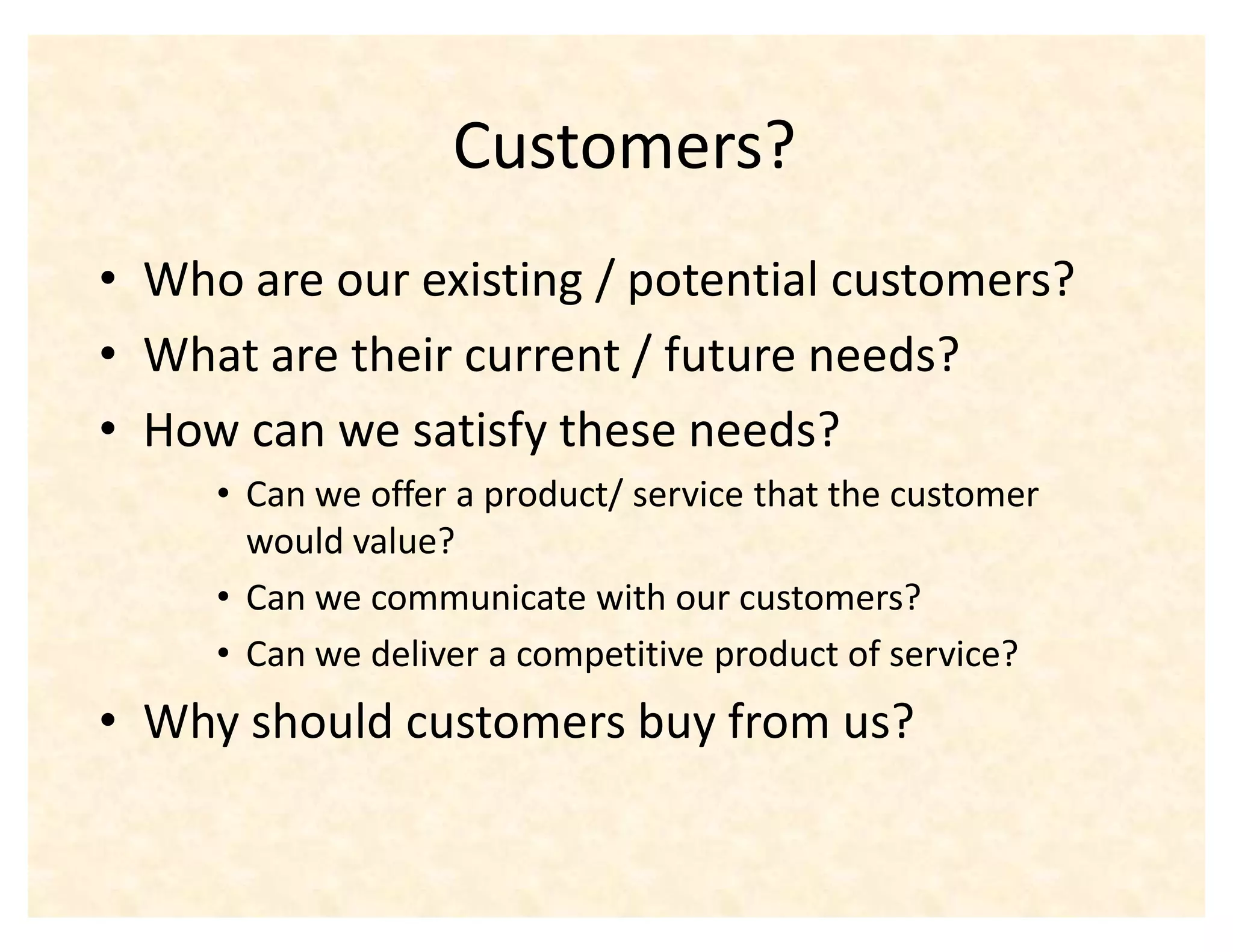
Customers?
‡ Who are our existing / potential customers?
‡ What are their current / future needs?
‡ How can we satisfy these needs?
     ‡ Can we offer a product/ service that the customer
       would value?
     ‡ Can we communicate with our customers?
     ‡ Can we deliver a competitive product of service?
‡ Why should customers buy from us?
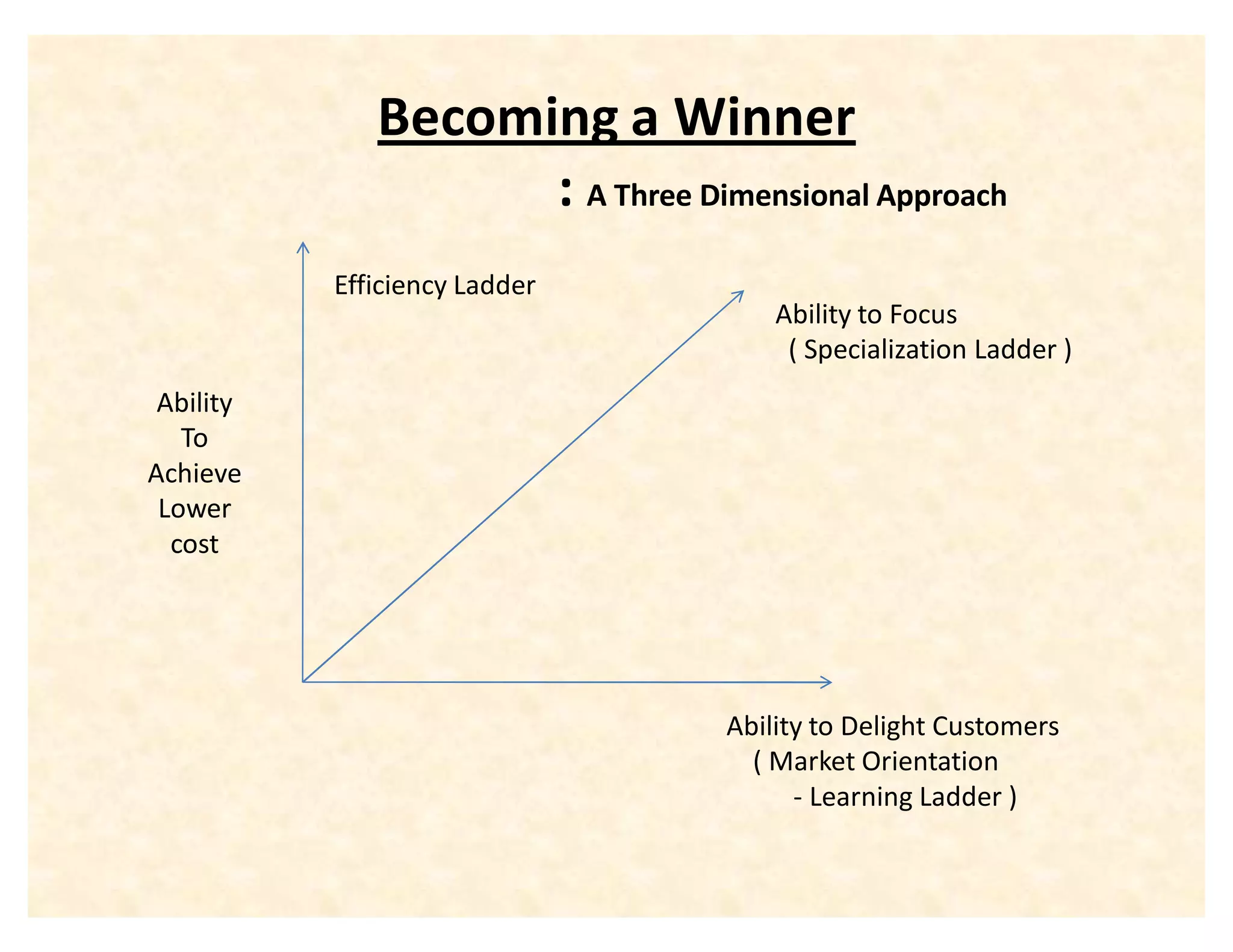
Becoming a Winner
                    : A Three Dimensional Approach
           Efficiency Ladder
                                     Ability to Focus
                                      ( Specialization Ladder )
 Ability
   To
Achieve
 Lower
  cost


                                 Ability to Delight Customers
                                   ( Market Orientation
                                       - Learning Ladder )
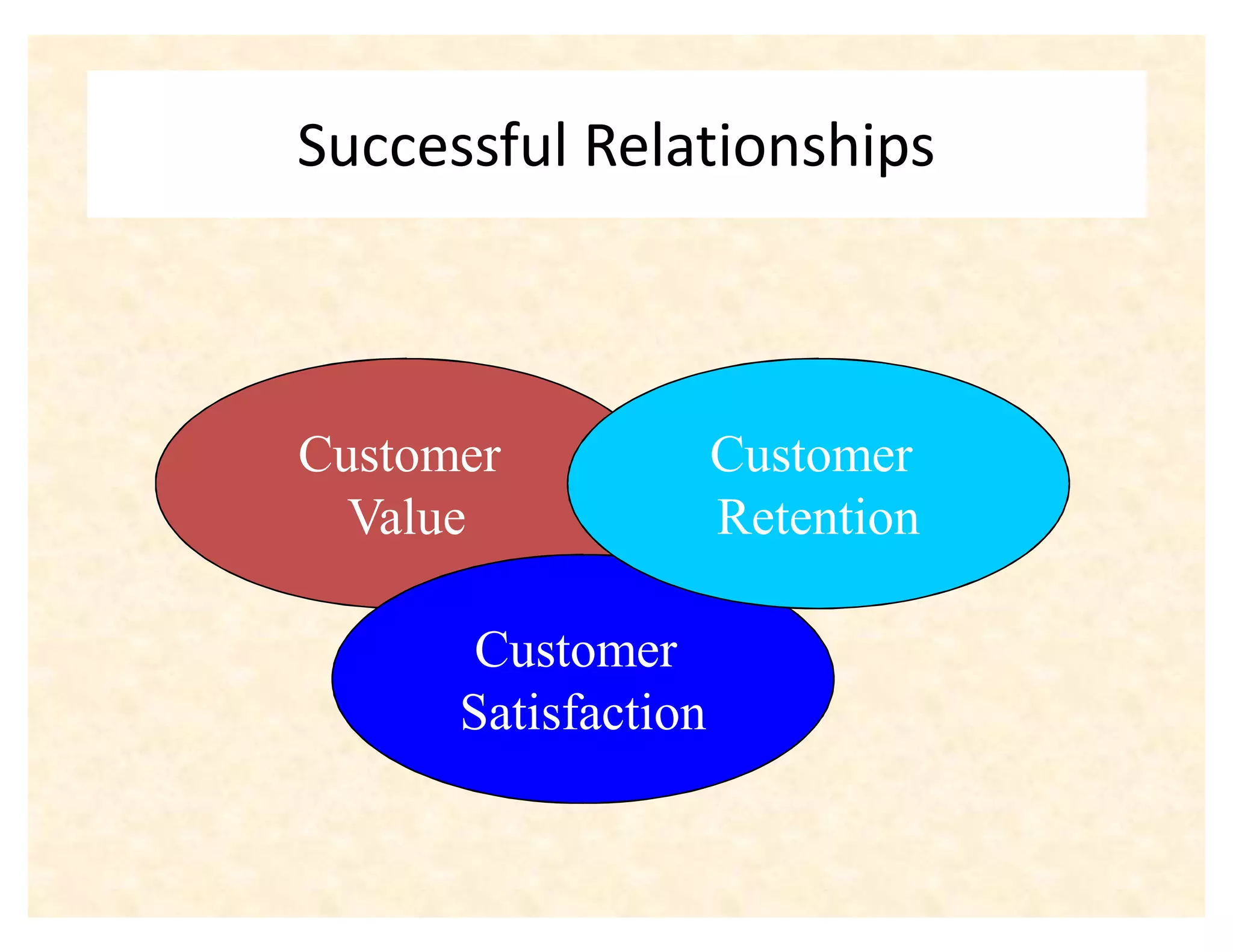
Successful Relationships


Customer             Customer
  Value              Retention

       Customer
      Satisfaction
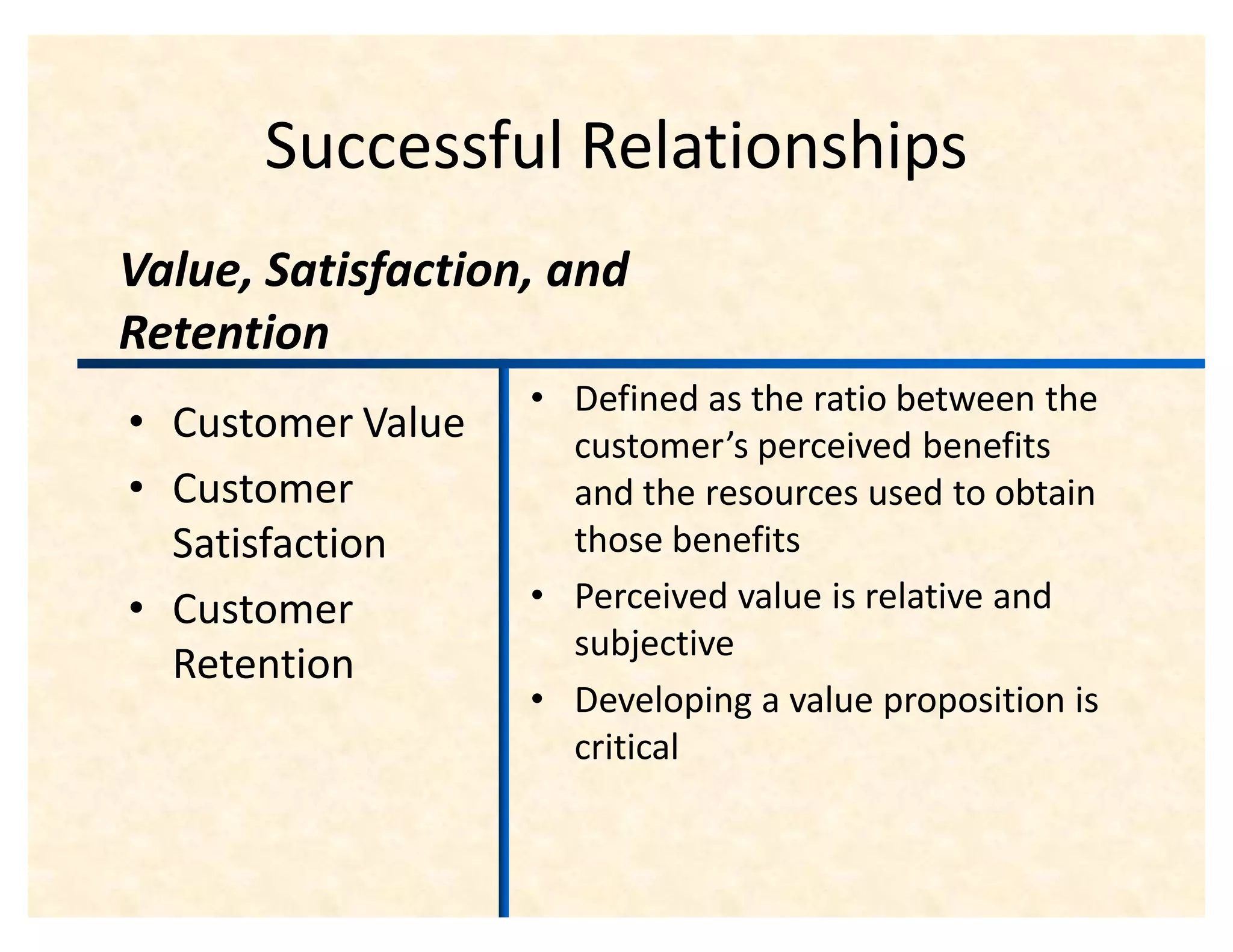
Successful Relationships
Value, Satisfaction, and
Retention
                   ‡ Defined as the ratio between the
‡ Customer Value     customer͛s perceived benefits
‡ Customer           and the resources used to obtain
  Satisfaction       those benefits
‡ Customer         ‡ Perceived value is relative and
                     subjective
  Retention
                   ‡ Developing a value proposition is
                     critical
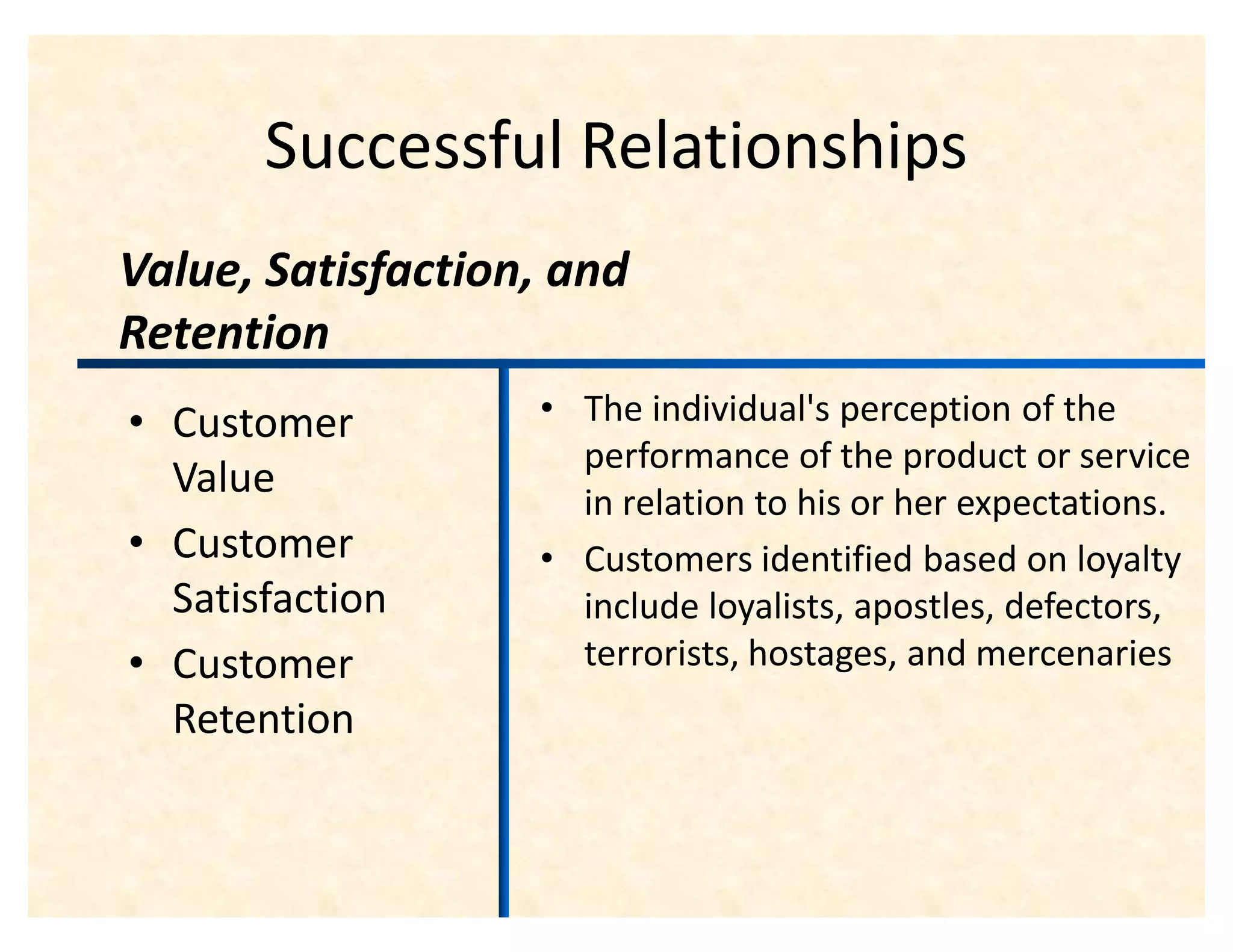
Successful Relationships
Value, Satisfaction, and
Retention
‡ Customer         ‡ The individual's perception of the
                     performance of the product or service
  Value
                     in relation to his or her expectations.
‡ Customer         ‡ Customers identified based on loyalty
  Satisfaction       include loyalists, apostles, defectors,
‡ Customer           terrorists, hostages, and mercenaries
  Retention
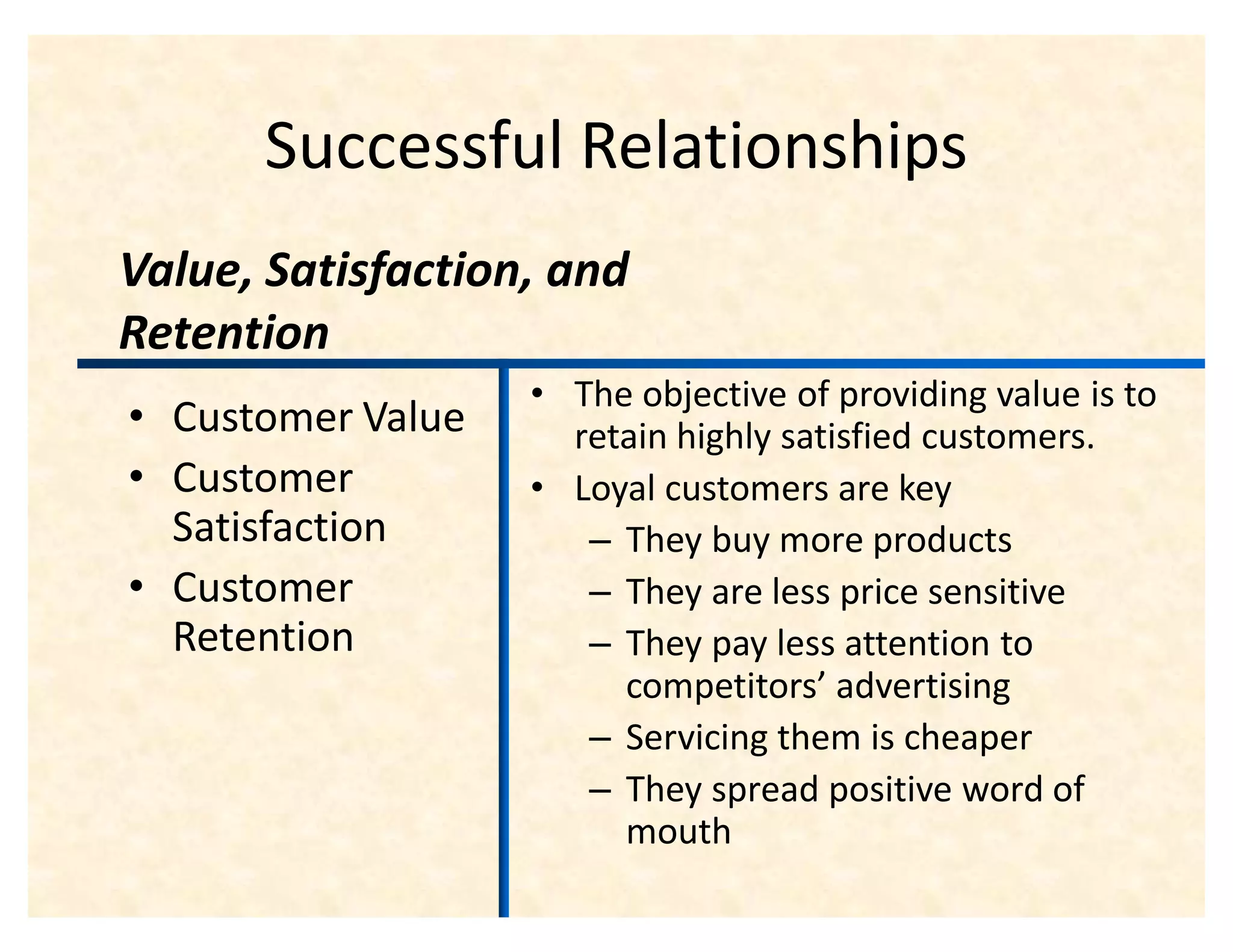
Successful Relationships
Value, Satisfaction, and
Retention
                   ‡ The objective of providing value is to
‡ Customer Value     retain highly satisfied customers.
‡ Customer         ‡ Loyal customers are key
  Satisfaction        ± They buy more products
‡ Customer            ± They are less price sensitive
  Retention           ± They pay less attention to
                        competitors͛ advertising
                      ± Servicing them is cheaper
                      ± They spread positive word of
                        mouth
Customer Profitability-Focused Marketing

‡ Tracks costs and revenues of individual
  consumers
‡ Categorizes them into tiers based on
  consumption behavior
‡ A customer pyramid groups customers into
  four tiers
Customer Profitability-Focused
         Marketing


                  Tier 1: Platinum
                    Tier 2: Gold
                    Tier 3: Iron
                    Tier 4: Lead
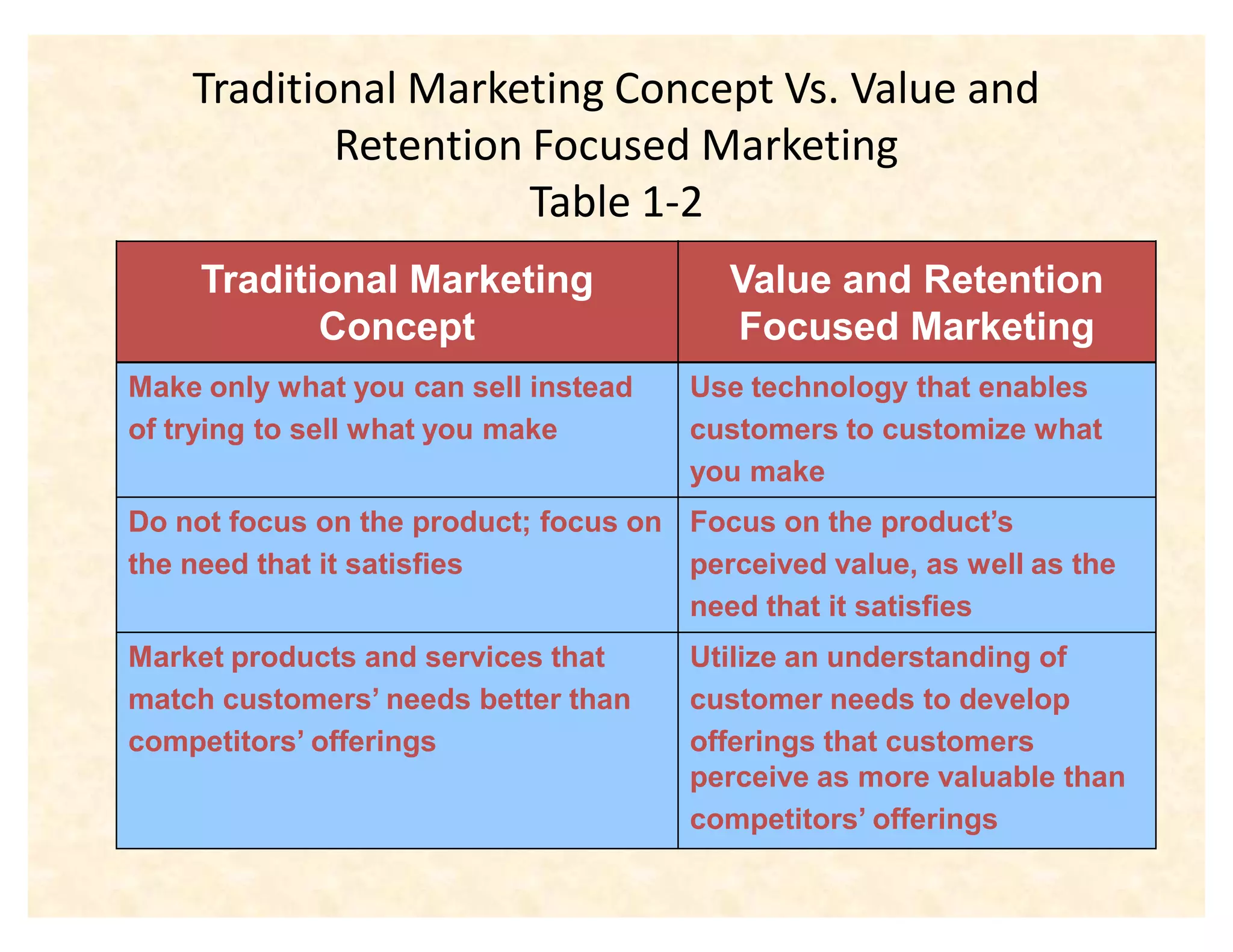
Traditional Marketing Concept Vs. Value and
            Retention Focused Marketing
                      Table 1-2
     Traditional Marketing                Value and Retention
            Concept                       Focused Marketing
Make only what you can sell instead    Use technology that enables
of trying to sell what you make        customers to customize what
                                       you make
Do not focus on the product; focus on Focus on the product¶s
the need that it satisfies            perceived value, as well as the
                                      need that it satisfies
Market products and services that      Utilize an understanding of
match customers¶ needs better than     customer needs to develop
competitors¶ offerings                 offerings that customers
                                       perceive as more valuable than
                                       competitors¶ offerings
Why Study Consumer Behavior?
"All marketing decisions are based on
assumptions and knowledge of
consumer behaviour," (Hawkins and
Mothersbaugh, 2007). Researching
consumer behaviour is a complex
process, but understanding consumer
behaviour is critical to marketers-they
can use it to:
Provide value and customer satisfaction.
             Effectively target customers.
         Enhance the value of the company.
           Improve products and services.
           Create a competitive advantage
Understand how customers view their products versus
             their competitors' products.
Expand the knowledge base in the field of marketing,
Apply marketing strategies toward a positive effect on
   society (encourage people to support charities,
    promote healthy habits, reduce drug use etc.)
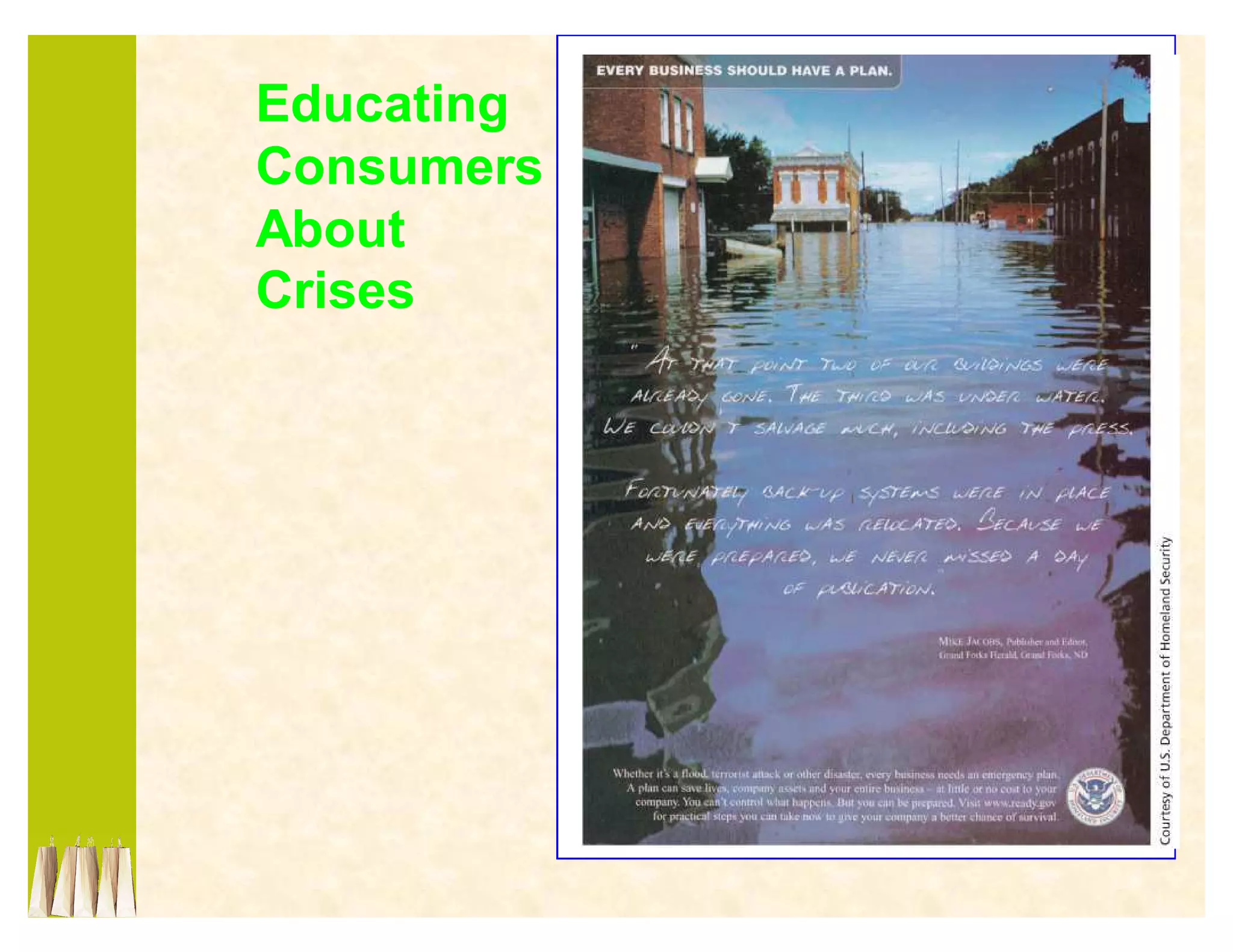
Educating
Consumers
About
Crises
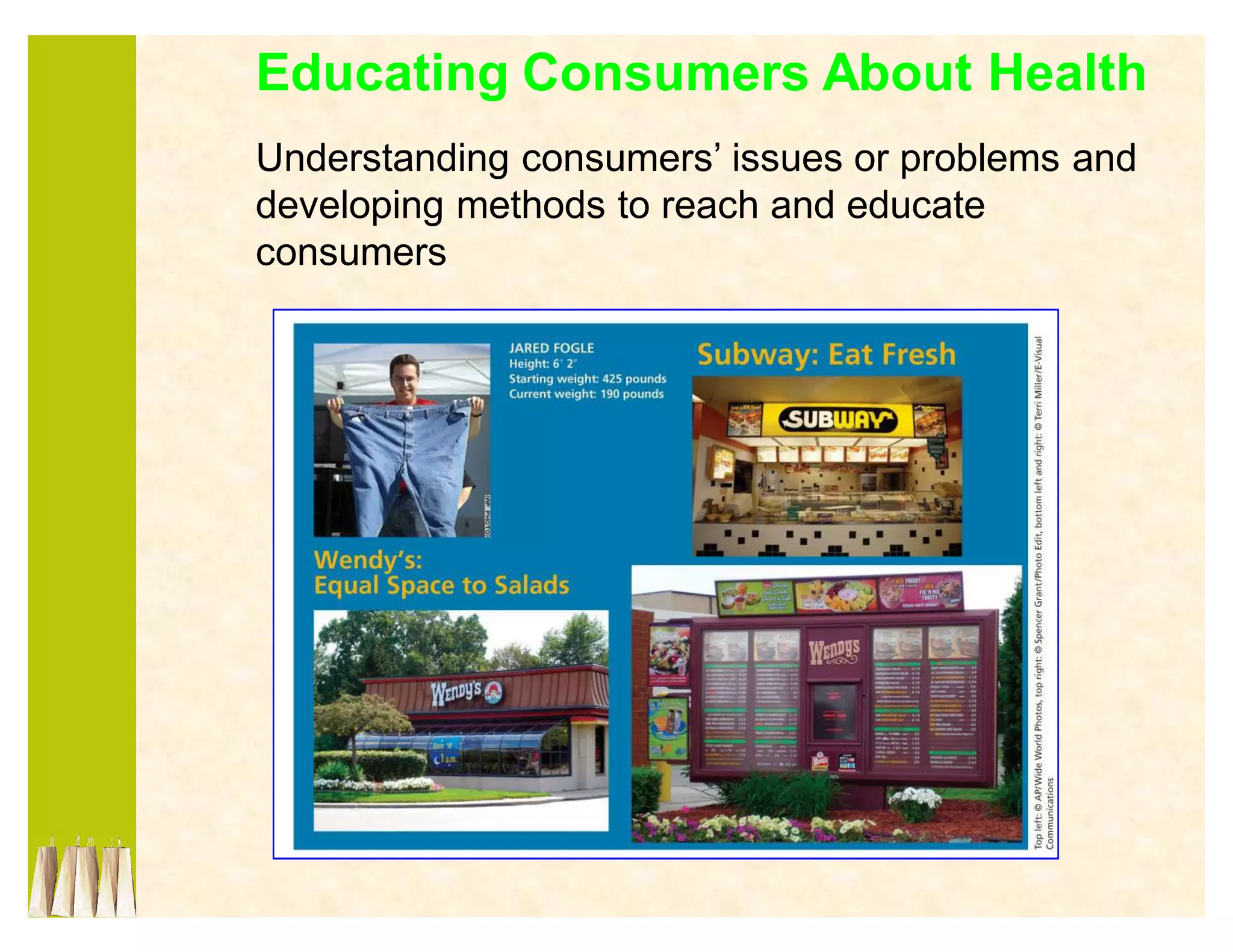
Educating Consumers About Health
Understanding consumers¶ issues or problems and
developing methods to reach and educate
consumers
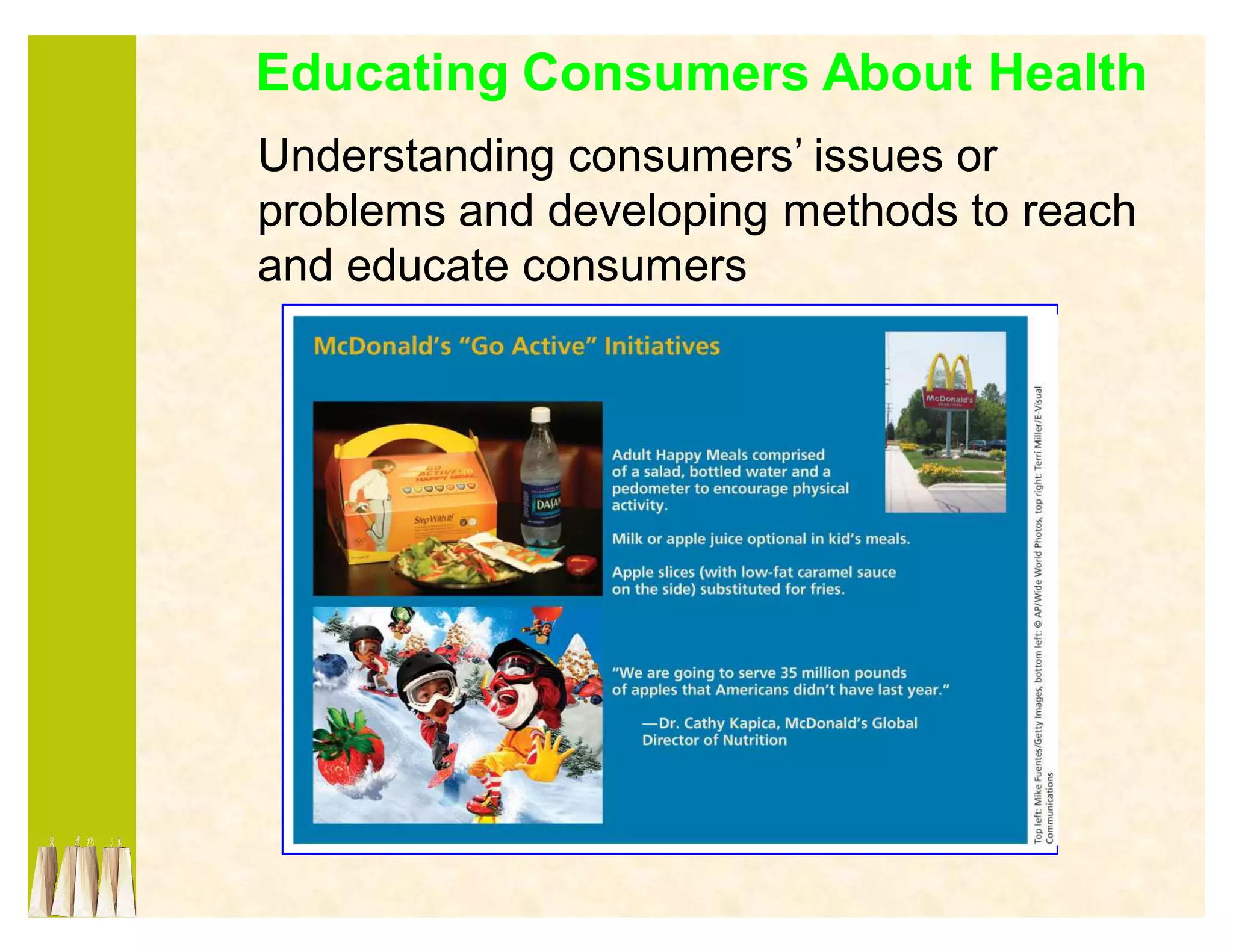
Educating Consumers About Health
Understanding consumers¶ issues or
problems and developing methods to reach
and educate consumers
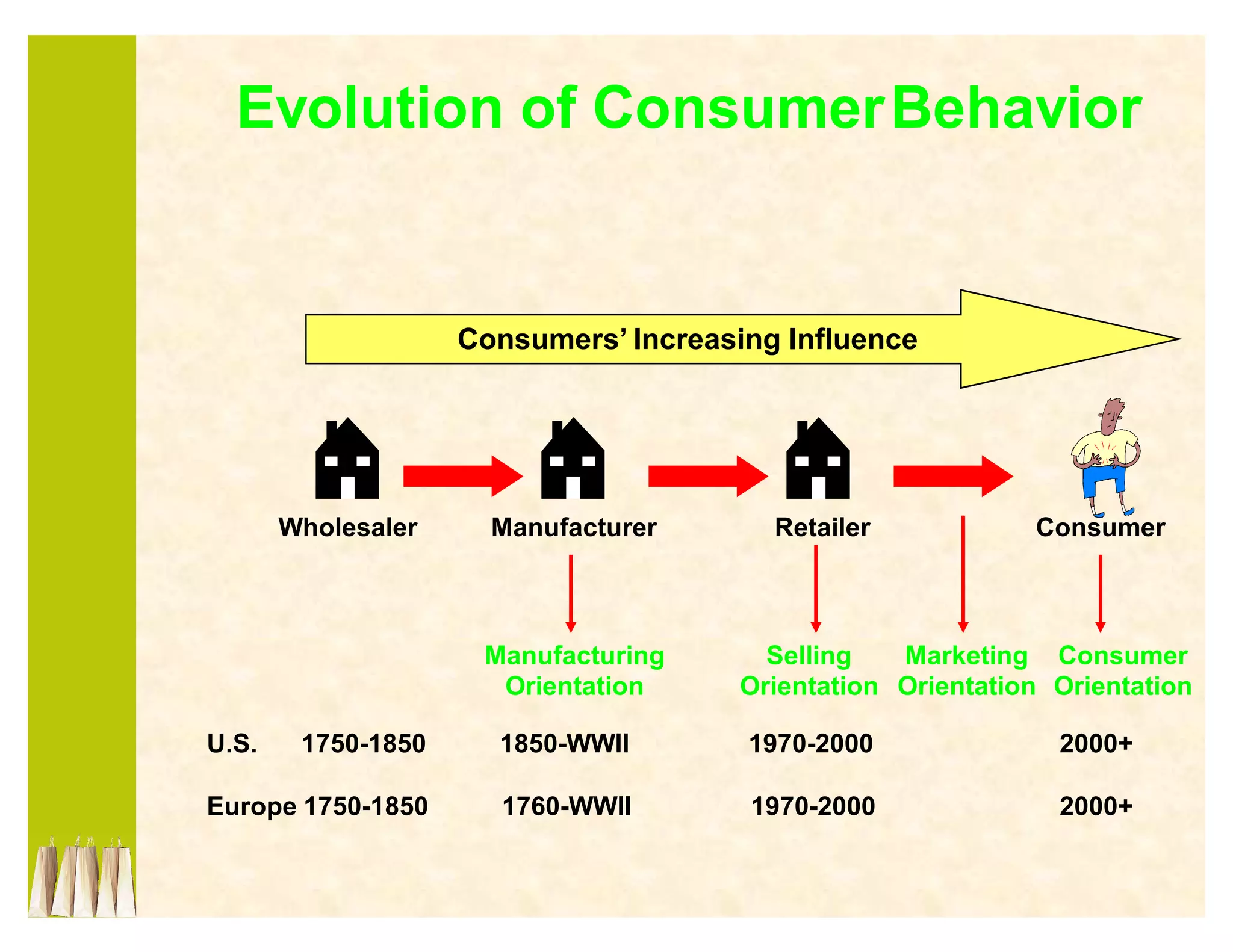
Evolution of ConsumerBehavior


                    Consumers¶ Increasing Influence


       Wholesaler     Manufacturer       Retailer            Consumer


                     Manufacturing       Selling   Marketing Consumer
                      Orientation      Orientation Orientation Orientation

U.S.    1750-1850     1850-WWII        1970-2000               2000+

Europe 1750-1850      1760-WWII        1970-2000               2000+
Consumer Behavior Is Interdisciplinary
‡   Psychology
‡   Sociology
‡   Social psychology
‡   Anthropology
‡   Economics
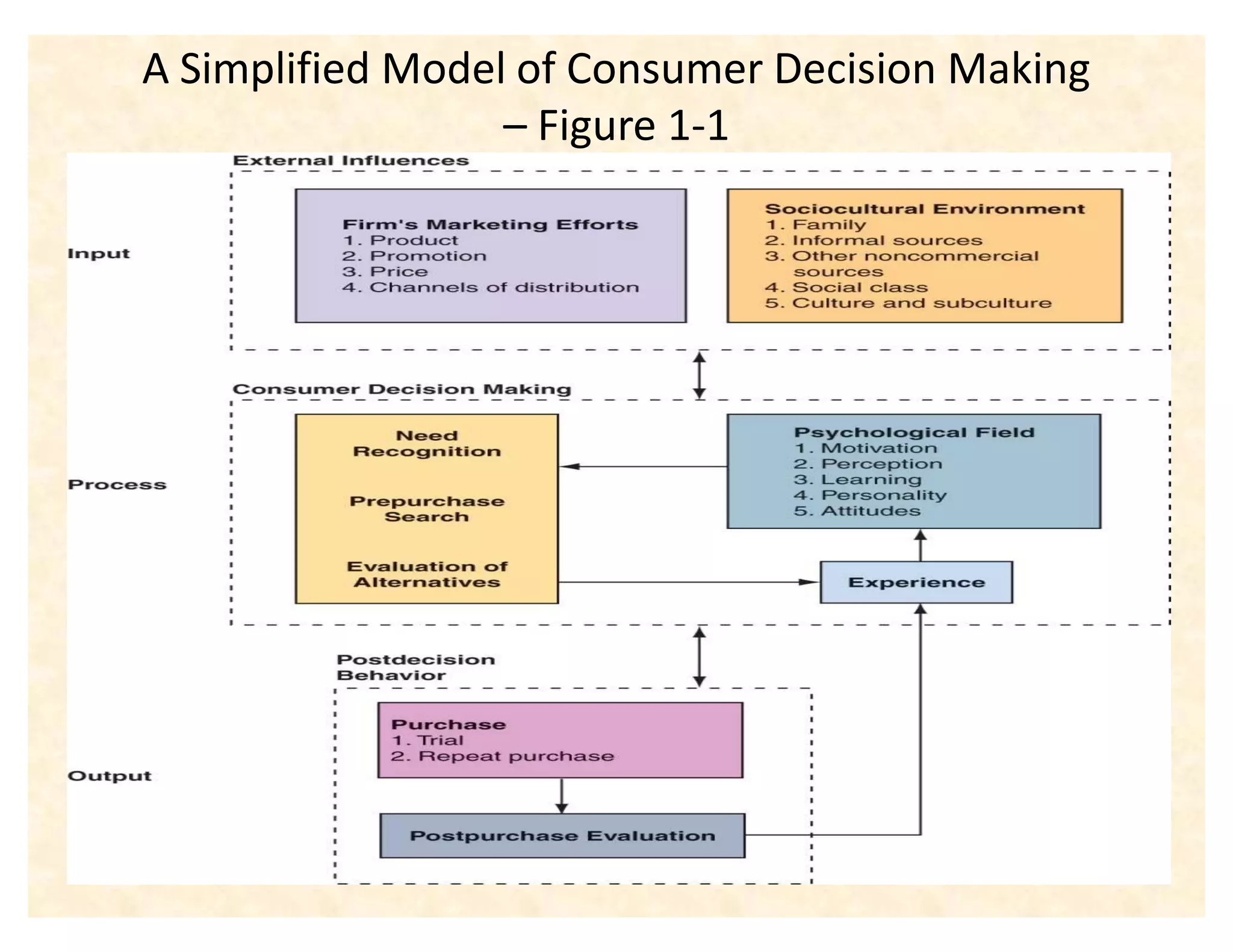
A Simplified Model of Consumer Decision Making
                  ʹ Figure 1-1
The Underlying Principles of
Consumer Behavior
The Consumer Is Sovereign
The Consumer Is Global
Consumers Are Different; Consumers Are
Alike

Consumer behvoiur

  • 1.
    Consumer Behavior By Prof.Rajeev Kumar The behavior that consumers display in searching for, purchasing, using, evaluating, and disposing of products and services that they expect will satisfy their needs.
  • 2.
    Personal Consumer The individualwho buys goods and services for his or her own use, for household use, for the use of a family member, or for a friend.
  • 3.
    Organizational Consumer A business,government agency, or other institution (profit or nonprofit) that buys the goods, services, and/or equipment necessary for the organization to function.
  • 4.
    FACTORS INFLUENCING CONSUMER BUYING BEHAVIOR ‡ Cultural factors: Culture Sub- Culture eg: Kellogg͛s
  • 5.
    SOCIAL CLASS ‡ Upper Class ‡ Upper Middle Class ‡ Middle Class ‡ Lower Class
  • 6.
    SOCIAL FACTORS ‡ Social Groups ‡ Colleagues at work ‡ Consumer Action Groups ‡ Reference Groups ‡ Family
  • 7.
    PERSONAL FACTORS ‡ Ageand Life Cycle stage ‡ Occupation and Financial status ‡ Life-style
  • 8.
    PSYCHOLOGICAL FACTORS ‡ MOTIVATION ‡ PERCEPTION ‡ ATTITUDE ‡ LEARNING
  • 9.
    Needs and Motivation ‡Needs are the essence of the marketing concept. ‡ Motivation is the driving force within individuals that impels them to action. Copyright 2007 by Prentice Hall
  • 10.
    Consumer Motivation ‡ Representsthe drive to satisfy both psychological and physiological needs through product purchase and consumption. ‡ gives insights into why people buy certain products. ‡ stems from consumer needs: industries have been built around basic human needs.
  • 11.
    Types of ConsumerNeeds ‡ Physiological needs- Fundamental human needs, including food, water and shelter ‡ Safety and Health needs- Threats to our safety and health motive purchases for personal security and protection.
  • 12.
    ‡ Safety andHealth needs Protecting our personal information and computers represents new types of safety needs. Businesses provide a variety of products and services to appeal to safety and health conscious consumers.
  • 13.
  • 14.
    Motivational conflicts andneed priorities ‡ satisfying a need often comes at the expense of another need- this causes motivational conflicts.
  • 15.
    Maslow͛s Hierarchy ofNeeds Figure 4.10 weblink
  • 16.
    Figure 4.1 Modelof the Motivation Process
  • 17.
    Figure 4-2a Goals Structurefor Weight Control
  • 18.
    The Dynamic Natureof Motivation ‡ Needs are never fully satisfied ‡ New needs emerge as old needs are satisfied ‡ People who achieve their goals set new and higher goals for themselves
  • 19.
    This ad reflects a need for accomplishment with a toothpaste.
  • 20.
  • 21.
    PERCEPTIONS ‡ The processby which an individual selects, organizes and interprets stimuli into meaningful thoughts and pictures. (Customers perceive their environment through the sense of touch, smell, taste, hearing, etc.
  • 22.
    BELIEFS AND ATTITUDE ‡A belief is a descriptive image or thought that an individual holds about something. ‡ A person͛s attitude is a set of his feelings and the way in which he reacts to a given idea or thought.
  • 23.
    LEARNING ‡ Consumer learningis a process which evolves and changes as a result of newly acquired knowledge or experience
  • 24.
    Consumer Organizational Influences Influences Obtaining Consuming Disposing Consumer Behavior
  • 25.
    Consumer Organizational Influences Influences Culture Brand Ethnicity Product Features Personality Advertising Family Word of Mouth Life-stage Promotions Values Retail Displays Income Price Available Resources Quality Attitudes Service Opinions Store Ambiance Feelings Convenience Motivations Loyalty Programs Past Experiences Packaging Peer Groups Product Availability Knowledge
  • 26.
    Consumer Organizational Influences Influences Obtaining Consuming Disposing Consumer Behavior
  • 27.
    CONSUMER INFLUENCES ORGANIZATIONAL INFLUENCES Culture Ethnicity Brand Product Features Personality Family Advertising Word of Mouth Life-stage Values Promotions Retail Displays Income Available Resources Price Quality Attitudes Opinions Service Store Ambiance Motivations Past Experiences Convenience Loyalty Programs Feelings Peer Groups Packaging Product Availability Knowledge OBTAINING CONSUMING DISPOSING yHow you decide you yHow you use the product yHow you get rid of want yHow you store the remaining product to buy product yHow much you throw yOther products you in your home away after use consider buying yWho uses the product yIf you resell items yWhere you buy yHow much you consume yourself yHow you pay for yHow product compares or through a product with consignment yHow you transport expectations store product home yHow you recycle some products Consumer Behavior
  • 28.
    Customers? ‡ Who areour existing / potential customers? ‡ What are their current / future needs? ‡ How can we satisfy these needs? ‡ Can we offer a product/ service that the customer would value? ‡ Can we communicate with our customers? ‡ Can we deliver a competitive product of service? ‡ Why should customers buy from us?
  • 29.
    Becoming a Winner : A Three Dimensional Approach Efficiency Ladder Ability to Focus ( Specialization Ladder ) Ability To Achieve Lower cost Ability to Delight Customers ( Market Orientation - Learning Ladder )
  • 30.
    Successful Relationships Customer Customer Value Retention Customer Satisfaction
  • 31.
    Successful Relationships Value, Satisfaction,and Retention ‡ Defined as the ratio between the ‡ Customer Value customer͛s perceived benefits ‡ Customer and the resources used to obtain Satisfaction those benefits ‡ Customer ‡ Perceived value is relative and subjective Retention ‡ Developing a value proposition is critical
  • 32.
    Successful Relationships Value, Satisfaction,and Retention ‡ Customer ‡ The individual's perception of the performance of the product or service Value in relation to his or her expectations. ‡ Customer ‡ Customers identified based on loyalty Satisfaction include loyalists, apostles, defectors, ‡ Customer terrorists, hostages, and mercenaries Retention
  • 33.
    Successful Relationships Value, Satisfaction,and Retention ‡ The objective of providing value is to ‡ Customer Value retain highly satisfied customers. ‡ Customer ‡ Loyal customers are key Satisfaction ± They buy more products ‡ Customer ± They are less price sensitive Retention ± They pay less attention to competitors͛ advertising ± Servicing them is cheaper ± They spread positive word of mouth
  • 34.
    Customer Profitability-Focused Marketing ‡Tracks costs and revenues of individual consumers ‡ Categorizes them into tiers based on consumption behavior ‡ A customer pyramid groups customers into four tiers
  • 35.
    Customer Profitability-Focused Marketing Tier 1: Platinum Tier 2: Gold Tier 3: Iron Tier 4: Lead
  • 36.
    Traditional Marketing ConceptVs. Value and Retention Focused Marketing Table 1-2 Traditional Marketing Value and Retention Concept Focused Marketing Make only what you can sell instead Use technology that enables of trying to sell what you make customers to customize what you make Do not focus on the product; focus on Focus on the product¶s the need that it satisfies perceived value, as well as the need that it satisfies Market products and services that Utilize an understanding of match customers¶ needs better than customer needs to develop competitors¶ offerings offerings that customers perceive as more valuable than competitors¶ offerings
  • 37.
    Why Study ConsumerBehavior? "All marketing decisions are based on assumptions and knowledge of consumer behaviour," (Hawkins and Mothersbaugh, 2007). Researching consumer behaviour is a complex process, but understanding consumer behaviour is critical to marketers-they can use it to:
  • 38.
    Provide value andcustomer satisfaction. Effectively target customers. Enhance the value of the company. Improve products and services. Create a competitive advantage Understand how customers view their products versus their competitors' products. Expand the knowledge base in the field of marketing, Apply marketing strategies toward a positive effect on society (encourage people to support charities, promote healthy habits, reduce drug use etc.)
  • 39.
  • 40.
    Educating Consumers AboutHealth Understanding consumers¶ issues or problems and developing methods to reach and educate consumers
  • 41.
    Educating Consumers AboutHealth Understanding consumers¶ issues or problems and developing methods to reach and educate consumers
  • 42.
    Evolution of ConsumerBehavior Consumers¶ Increasing Influence Wholesaler Manufacturer Retailer Consumer Manufacturing Selling Marketing Consumer Orientation Orientation Orientation Orientation U.S. 1750-1850 1850-WWII 1970-2000 2000+ Europe 1750-1850 1760-WWII 1970-2000 2000+
  • 43.
    Consumer Behavior IsInterdisciplinary ‡ Psychology ‡ Sociology ‡ Social psychology ‡ Anthropology ‡ Economics
  • 44.
    A Simplified Modelof Consumer Decision Making ʹ Figure 1-1
  • 45.
    The Underlying Principlesof Consumer Behavior The Consumer Is Sovereign The Consumer Is Global Consumers Are Different; Consumers Are Alike