Zina Petrushyna Supervised by Prof. Dr. M. Jarke RWTH Aachen University Informatik 5 (Information Systems) September 29th, 2010  Doctoral Consortium at EC-TEL 2010, Barcelona Self-Modeling and Self-Reflection of  E-learning Communities
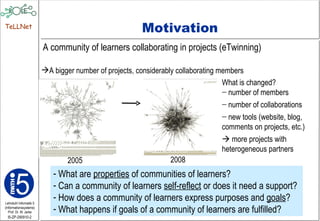
Motivation A community of learners collaborating in projects (eTwinning) What is changed? number of members number of collaborations  new tools (website, blog, comments on projects, etc.)    more projects with heterogeneous partners What are  properties  of communities of learners? Can a community of learners  self-reflect  or does it need a support?  How does a community of learners express purposes and  goals ? What happens if goals of a community of learners are fulfilled? 2005 2008 A bigger number of projects, considerably collaborating members
The Loop of Community Survival Activity Theory [ Enge87] Actor Network Theory [Lato05] Community of Practice [Weng98] disturbance disturbance disturbance +/- - Self-modeling phase contributes to self-reflection phase and vice versa + [PeKl08] Community experience repository
The Challenge of Pattern Sharing Pattern name:   A troll    a description  Pattern disturbance:  In a  mailing list, any person who posts only in  threads started by herself is  considered as a troll    a condition  Pattern description:  A troll  aims at drawing attention and starting  useless discussions     explains the problem  Pattern forces:  Troll, Thread, Message    actors that force a disturbance Pattern forces relations:  A troll posts in threads that were started by himself     corresponds to relations between forces Pattern solution:  …    actions that need to be carried out in the situation Pattern rationale:  …    reasoning about forces and disturbances Pattern relations:  …   make the structure of pattern language clear [KSD06, Alex78] What do we need to share successful patterns?- PALADIN [KSD06]
Actor Network Theory -„re-distribution of action“-Latour - for Wikipedia community  - for student community Structure of a repository Community E-learning system Student Student community Metalevel Metalevel Meta-metalevel Concept level Concept level [KlPe08] Wikipedia Contributors Wikipedia community
Techniques for Pattern Discovery Date of analysis Community of Practice [Weng98] Activity Help-Seeking Sentiment <rdf:Description …&quot;> <rdf:type rdf:resource=  &quot;http://s.opencalais.com/1/type/cat/DocCat&quot;/> <c:docId rdf:resource=  &quot;http://d.opencalais.com/dochash-1/2cbb2e7d-  fdfc-3d98-8dde-ab064ad19250&quot;/> <c:category rdf:resource=  &quot;http://d.opencalais.com/cat/Calais/Technology Internet&quot;/> <c:classifierName>Calais</c:classifierName> <c:categoryName>Technology_Internet </c:categoryName> <c:score>0.922</c:score> </rdf:Description> ROLE profile  03.10 I* model Interactions Goals Domain knowledge SNA PPIM Named entity recognition Named entity recognition ROLE profile  02.10 I* model Interactions Goals Domain knowledge SNA PPIM Named entity recognition Named entity recognition Community profile  01.10 Interactions Goals Domain knowledge Social Network Analysis Sentiment analysis Named entity recognition Named entity recognition
Modeling of Community Based on C ompetences and SNA
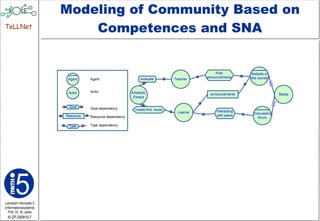
Modeling of Community Based on C ompetences and SNA [KlPe10] Agent- and goal-oriented modeling are appropriate for closing the gap between current and desired situation in a community
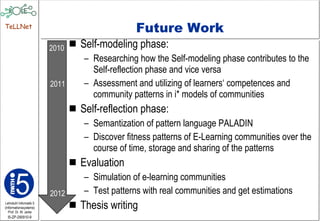
Future Work Self-modeling phase:  Researching how the Self-modeling phase contributes to the Self-reflection phase and vice versa Assessment and utilizing of learners‘ competences and community patterns in i* models of communities Self-reflection phase:  Semantization of pattern language PALADIN Discover fitness patterns of E-Learning communities over the course of time, storage and sharing of the patterns Evaluation  Simulation of e-learning communities Test patterns with real communities and get estimations Thesis writing 2010 2011 2012

Self-modeling and self-reflection of E-learning communities

  • 1.
    Zina Petrushyna Supervisedby Prof. Dr. M. Jarke RWTH Aachen University Informatik 5 (Information Systems) September 29th, 2010 Doctoral Consortium at EC-TEL 2010, Barcelona Self-Modeling and Self-Reflection of E-learning Communities
  • 2.
    Motivation A communityof learners collaborating in projects (eTwinning) What is changed? number of members number of collaborations new tools (website, blog, comments on projects, etc.)  more projects with heterogeneous partners What are properties of communities of learners? Can a community of learners self-reflect or does it need a support? How does a community of learners express purposes and goals ? What happens if goals of a community of learners are fulfilled? 2005 2008 A bigger number of projects, considerably collaborating members
  • 3.
    The Loop ofCommunity Survival Activity Theory [ Enge87] Actor Network Theory [Lato05] Community of Practice [Weng98] disturbance disturbance disturbance +/- - Self-modeling phase contributes to self-reflection phase and vice versa + [PeKl08] Community experience repository
  • 4.
    The Challenge ofPattern Sharing Pattern name: A troll  a description Pattern disturbance: In a mailing list, any person who posts only in threads started by herself is considered as a troll  a condition Pattern description: A troll aims at drawing attention and starting useless discussions  explains the problem Pattern forces: Troll, Thread, Message  actors that force a disturbance Pattern forces relations: A troll posts in threads that were started by himself  corresponds to relations between forces Pattern solution: …  actions that need to be carried out in the situation Pattern rationale: …  reasoning about forces and disturbances Pattern relations: …  make the structure of pattern language clear [KSD06, Alex78] What do we need to share successful patterns?- PALADIN [KSD06]
  • 5.
    Actor Network Theory-„re-distribution of action“-Latour - for Wikipedia community - for student community Structure of a repository Community E-learning system Student Student community Metalevel Metalevel Meta-metalevel Concept level Concept level [KlPe08] Wikipedia Contributors Wikipedia community
  • 6.
    Techniques for PatternDiscovery Date of analysis Community of Practice [Weng98] Activity Help-Seeking Sentiment <rdf:Description …&quot;> <rdf:type rdf:resource= &quot;http://s.opencalais.com/1/type/cat/DocCat&quot;/> <c:docId rdf:resource= &quot;http://d.opencalais.com/dochash-1/2cbb2e7d- fdfc-3d98-8dde-ab064ad19250&quot;/> <c:category rdf:resource= &quot;http://d.opencalais.com/cat/Calais/Technology Internet&quot;/> <c:classifierName>Calais</c:classifierName> <c:categoryName>Technology_Internet </c:categoryName> <c:score>0.922</c:score> </rdf:Description> ROLE profile 03.10 I* model Interactions Goals Domain knowledge SNA PPIM Named entity recognition Named entity recognition ROLE profile 02.10 I* model Interactions Goals Domain knowledge SNA PPIM Named entity recognition Named entity recognition Community profile 01.10 Interactions Goals Domain knowledge Social Network Analysis Sentiment analysis Named entity recognition Named entity recognition
  • 7.
    Modeling of CommunityBased on C ompetences and SNA
  • 8.
    Modeling of CommunityBased on C ompetences and SNA [KlPe10] Agent- and goal-oriented modeling are appropriate for closing the gap between current and desired situation in a community
  • 9.
    Future Work Self-modelingphase: Researching how the Self-modeling phase contributes to the Self-reflection phase and vice versa Assessment and utilizing of learners‘ competences and community patterns in i* models of communities Self-reflection phase: Semantization of pattern language PALADIN Discover fitness patterns of E-Learning communities over the course of time, storage and sharing of the patterns Evaluation Simulation of e-learning communities Test patterns with real communities and get estimations Thesis writing 2010 2011 2012

Editor's Notes

  • #2 Der Standardname für unseren Lehrstuhl ist Informatik 5 (Information Systems) Den sollten wir immer benutzen Ich würde nicht immer am ende der Zeile ein komma machen (hab ich entfernt)
  • #3 Considerately (freundlich, aufmerksam, bedachtsam) ist hier total falsch, oder? (so wie adopt-&gt;adapt)  Considerably Comments to  comments on Communities mature or die over the course of time. Therefore, we aim to preserve the communities together with their knowledge of communities by discovering and exploiting patterns of community tness so as to support them in reacting on changes inside the community and in their environment. Community of drivers - changes because of environment changes - disturbances Media is different - earlier the horse / now the car However the community of ppl riding horses and driving carriages and carts are nearly dead. The topic is changed. Interactions influence on aliveness of a community – example Wikipedia, less interactions now. Conference communities - tweets about conferences are very high but fall down afterwards
  • #4 In dem Bild ist ja gar kein loop mehr??? A CoP stresses collaborative work of learners while Engeströ m explains learning through goal-directed activites of learners. ANT was already discussed. So on the first stage the community and its environment is modeled according to the current situation. We consider our reality that changes every second and community need to reflect according to changes, either negative or positive. Patterns are a certain type of perceived behavior. Disturbances are conditions which indicates patterns. In self-reflection phase community solves the situation caused by disturbances and provide a solution. However it can happened infinitely when community trying to find a solution thus it have to use successful factors the others have done. Because of it the community can change a bit. As in example with driving community they have to change their medium, vehicles.
  • #5 Scenario Learning communities: Math for pupils Both get exercises that should be performed in groups Both have e-learnig environment with chat, collaborative creation of online artefacts Perform better than 2) Why? they start to do the task in a class so have no additional questions Make 2) group possible to meet together – location, in a class What are patterns here -&gt; didn‘t solve the in collaborative e-leaning environment Disturbance: no or minor students solve tasks collaboratively in the env Solution: look at 1) and do similar What do we need to share successfull experience ? A pattern has a name, disturbance, description, forces, force relations, solution, rationale, and pattern relations. The name of the pattern is a short but descriptive name. Disturbance is a condition which indicates the existence of the pattern in a social network. The description explains the problem to which the pattern provides a solution and the settings when the pattern occurs. A force represents an actor relevant to the disturbance. The force relation corresponds to a relation between actors included in the pattern as forces. The solution contains the actions which are proposed to be carried out in the situation to which the pattern refers. The rationale is used for reasoning about the forces and the disturbance. It may include examples, stories of past successes or failures. The pattern relations show if the pattern being currently defined has anything in common with other patterns. The pattern relations are important for the structure of the pattern language.
  • #6 Das Bild sieht ein bisschen groß aus für die Folie Actors can be arbitrary formulated - Ralf For creating a model of a community, we apply not only the learning theories but Actor Network Theory (ANT) which considers the environment as a set of agents. It states that all elements in the environment as actors. Hence, all members of a community are actors as well as the media and artefacts they use. We need to create a model of a community that is extandable as the environment and the community change and we do not know what actor should be added to the model over the course of time. According to the ANT, we can add any event or resource as an actor if it is still not dened in the model. So when we have the same structure we can compare communities
  • #7 Was heißt „Date of analysis name“? Summarizing all, a community model includes community parameters that are computed by techniques for extracting community parameters that were explained in this section. So that different states of a community over the course of time are saved in a database. The pattern discovery must be then performed under community parameters in the database
  • #9 Is  are Delete: perform an additional task/ change: Tools- to Media The person responsible for competence management and development (the course manager or the teacher of the course) can help the learner to focus on professional competences so that the learner can better succeed in the course. The learner can be asked to handle more often with Artefacts, e.g., to create a knowledge map about a topic from the course. Afterwards, the learner can discuss his Artefact in a Discussion Forum as according to the communicator pattern, it is the part of learning he enjoys to do. While this is a competence development application, the next scenario is an example of competence management . On the other hand, if the teacher of the course needs to organize an event for the students of the course, the learner is the right person for the task. The result of the application of the SNA pattern-based framework is depicted in Figure 5.2. Here we use the Role i* notation for illustrating the communicator pattern. Other test-bed scenarios have been considered but have not been shown here because of lack of space. In order to apply the methods of the SNA pattern-based framework we need to define collaboration networks that exist in the scenario. There are at least two two types of CNs possible: Learner - Learner CNs and Learner-Teacher CNs. With the help of the framework we can identify a learner network characteristics in Learner - Learner CNs, in Learner-Teacher CN and a teacher network characteristics in Learner-Teacher CN. Based on numerous network characteristics it is possible to answer whether the learner’s status in Learner-Teacher or the status in Learner - Learner CNs correlate with the learner’s marks. As a result it can be discovered that the learner is too communicative ( communicator pattern) but pays not enough attention to using learning material ( create/find/reuse task for Artefact, low marks for created Artefacts ).
  • #10 Finding? Oder eher Researching ? Oder aber Defining? Discovery fitness of e-learning community -&gt; Discover fitness of e-learning communitites Network models identification that explains media communities evolvement 06.2011 Detection of communities, their properties and components 09.2011 Community goal mining based on patterns and learner activities in a community 12.2011 Activity patterns and recommendations for communities 12.2011