Slide 7.1
Saunders, Lewis and Thornhill, Research Methods for Business Students, 5th
Edition, © Mark Saunders, Philip Lewis and Adrian Thornhill 2009
Chapter 7
Selecting Samples
Slide 7.2
Saunders, Lewis and Thornhill, Research Methods for Business Students, 5th
Edition, © Mark Saunders, Philip Lewis and Adrian Thornhill 2009
Selecting samples
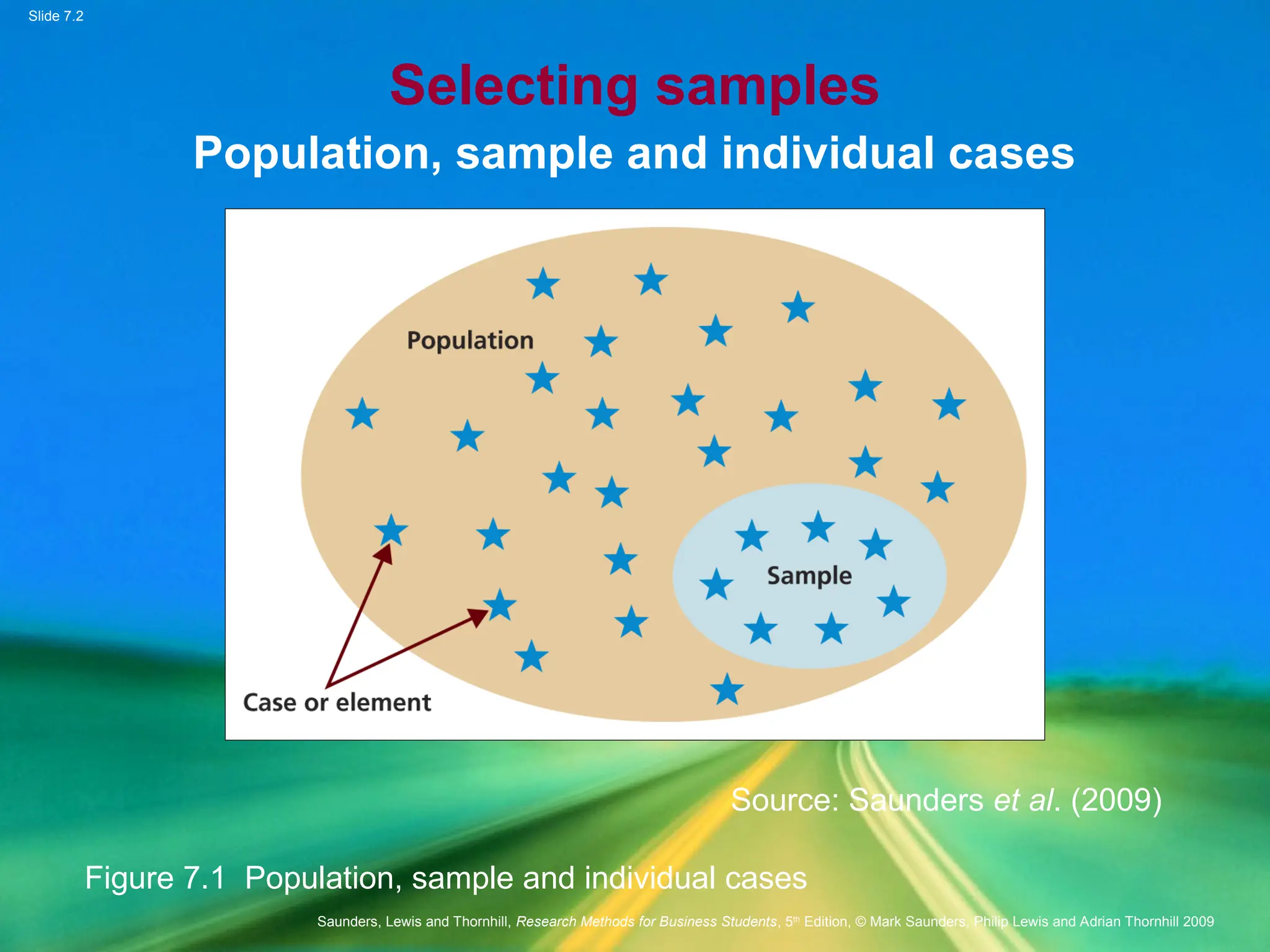
Population, sample and individual cases
Source: Saunders et al. (2009)
Figure 7.1 Population, sample and individual cases
Slide 7.3
Saunders, Lewis and Thornhill, Research Methods for Business Students, 5th
Edition, © Mark Saunders, Philip Lewis and Adrian Thornhill 2009
The need to sample
Slide 7.4
Saunders, Lewis and Thornhill, Research Methods for Business Students, 5th
Edition, © Mark Saunders, Philip Lewis and Adrian Thornhill 2009
Overview of sampling techniques
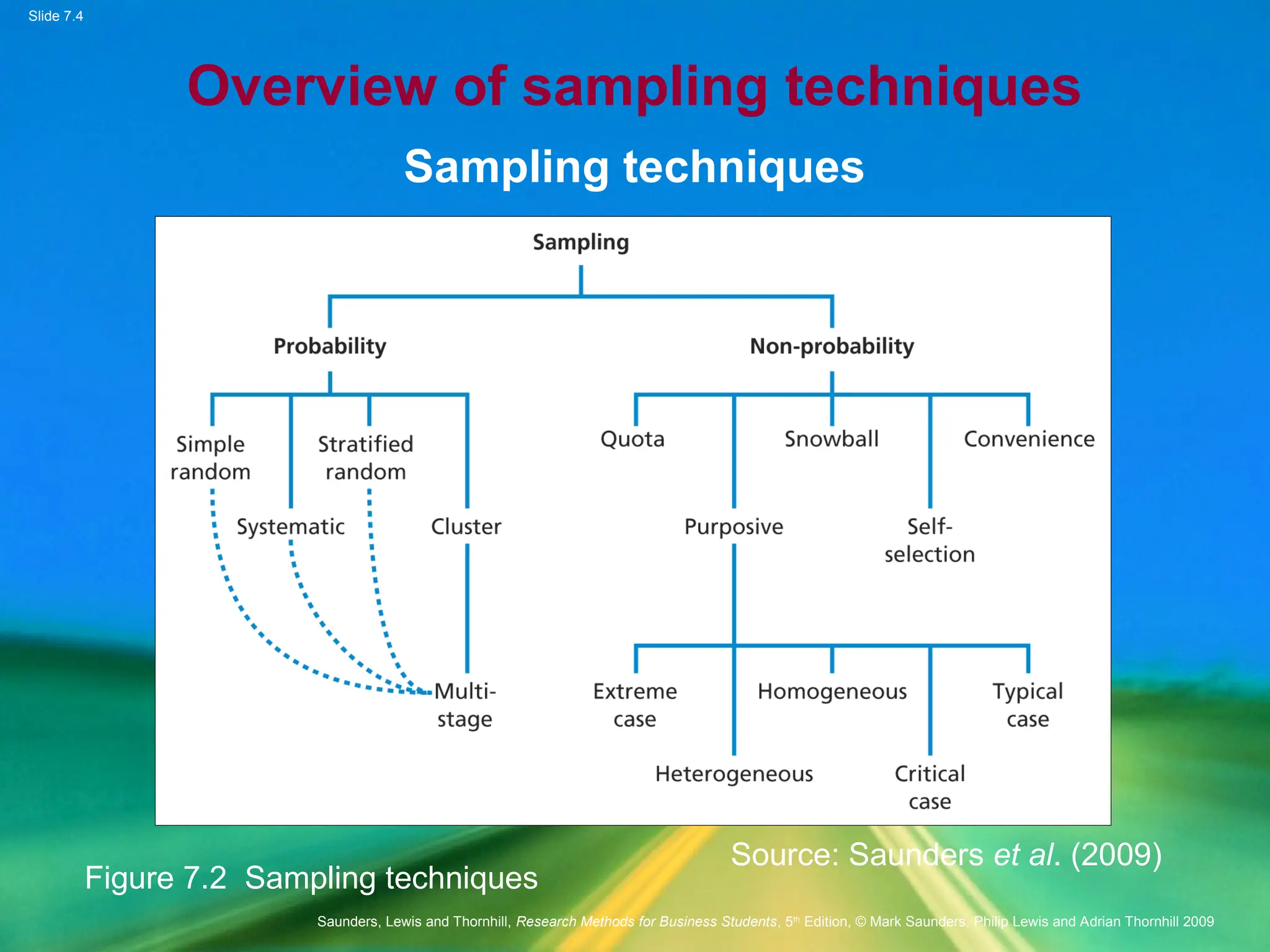
Sampling techniques
Source: Saunders et al. (2009)
Figure 7.2 Sampling techniques
Slide 7.5
Saunders, Lewis and Thornhill, Research Methods for Business Students, 5th
Edition, © Mark Saunders, Philip Lewis and Adrian Thornhill 2009
Probability sampling
Slide 7.6
Saunders, Lewis and Thornhill, Research Methods for Business Students, 5th
Edition, © Mark Saunders, Philip Lewis and Adrian Thornhill 2009
Identifying a suitable sampling frame
Slide 7.7
Saunders, Lewis and Thornhill, Research Methods for Business Students, 5th
Edition, © Mark Saunders, Philip Lewis and Adrian Thornhill 2009
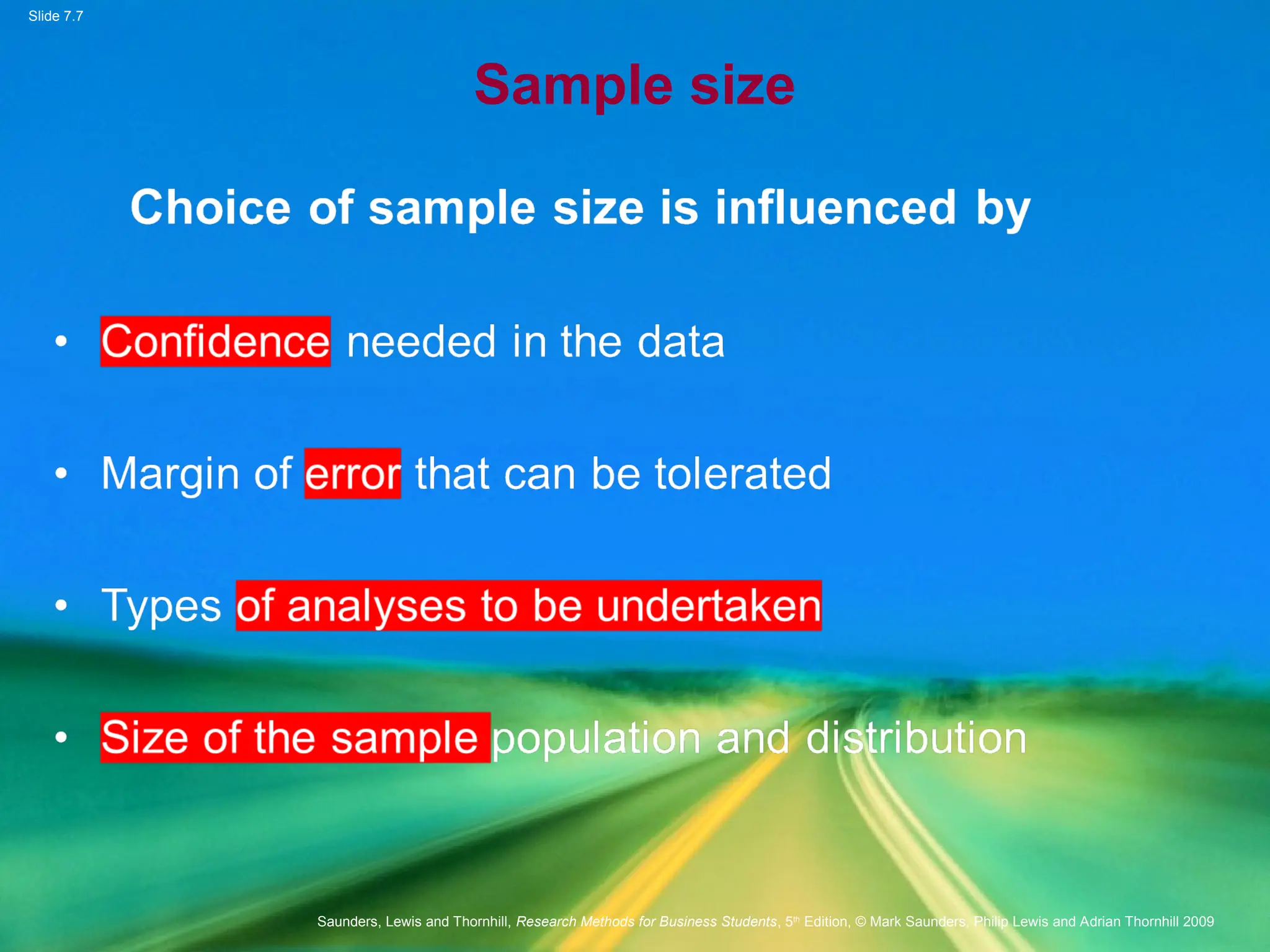
Sample size
Slide 7.8
Saunders, Lewis and Thornhill, Research Methods for Business Students, 5th
Edition, © Mark Saunders, Philip Lewis and Adrian Thornhill 2009
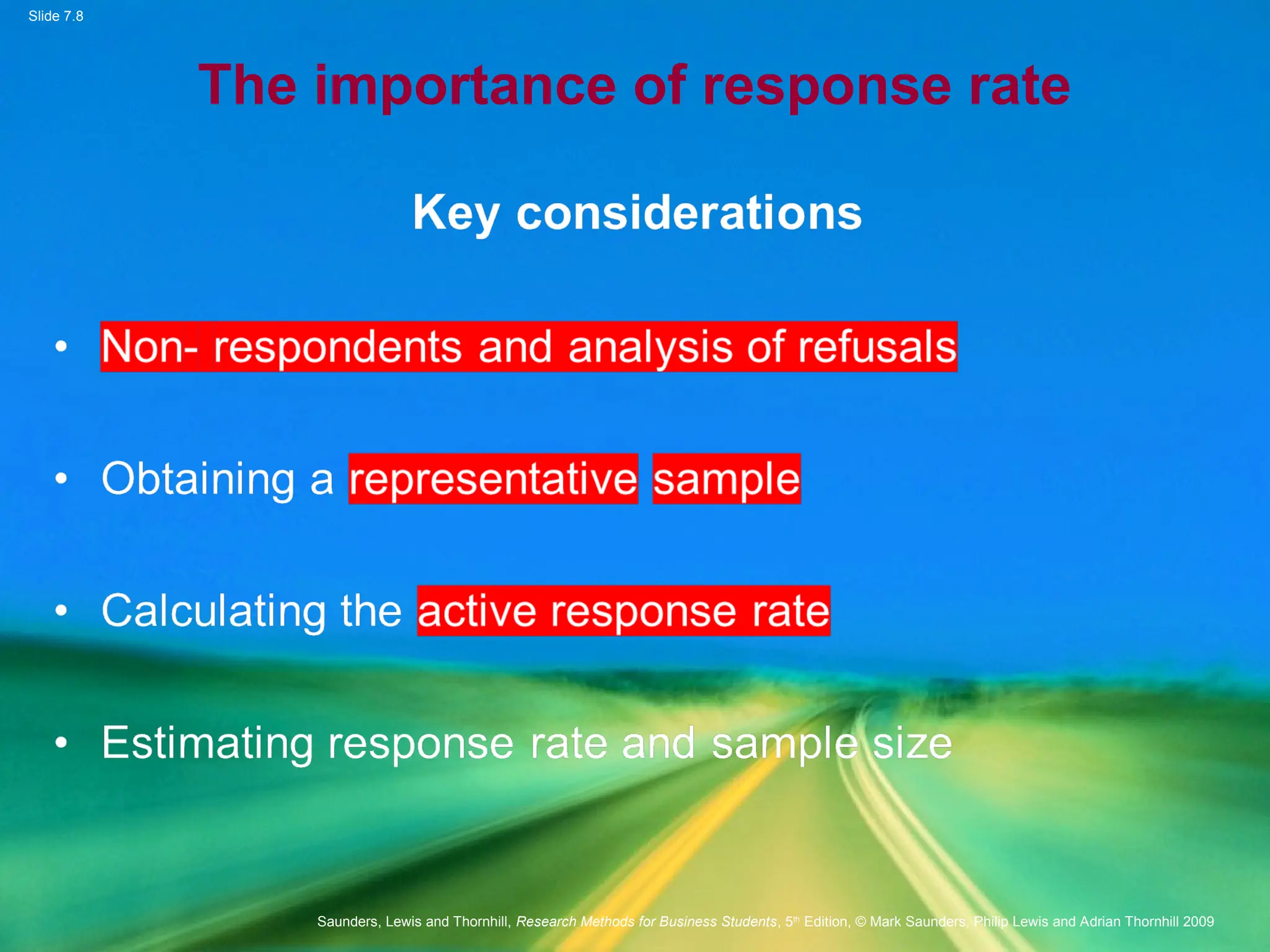
The importance of response rate
Slide 7.9
Saunders, Lewis and Thornhill, Research Methods for Business Students, 5th
Edition, © Mark Saunders, Philip Lewis and Adrian Thornhill 2009
Selecting a sampling technique
Five main techniques used for a probability sample
• Simple random
• Systematic
• Stratified random
• Cluster
• Multi-stage
Slide 7.10
Saunders, Lewis and Thornhill, Research Methods for Business Students, 5th
Edition, © Mark Saunders, Philip Lewis and Adrian Thornhill 2009
Non- probability sampling (1)
Key considerations
• Deciding on a suitable sample size
• Selecting the appropriate technique
Slide 7.11
Saunders, Lewis and Thornhill, Research Methods for Business Students, 5th
Edition, © Mark Saunders, Philip Lewis and Adrian Thornhill 2009
Non- probability sampling (2)
Sampling techniques
• Quota sampling (larger populations)
• Purposive sampling
• Snowball sampling
• Self-selection sampling
• Convenience sampling
Slide 7.12
Saunders, Lewis and Thornhill, Research Methods for Business Students, 5th
Edition, © Mark Saunders, Philip Lewis and Adrian Thornhill 2009
Summary: Chapter 7
Slide 7.13
Saunders, Lewis and Thornhill, Research Methods for Business Students, 5th
Edition, © Mark Saunders, Philip Lewis and Adrian Thornhill 2009
Summary: Chapter 7
Slide 7.14
Saunders, Lewis and Thornhill, Research Methods for Business Students, 5th
Edition, © Mark Saunders, Philip Lewis and Adrian Thornhill 2009
Summary: Chapter 7
All choices depend on the ability to gain
access to organisations

selecting research sample and poulation.ppt

  • 1.
    Slide 7.1 Saunders, Lewisand Thornhill, Research Methods for Business Students, 5th Edition, © Mark Saunders, Philip Lewis and Adrian Thornhill 2009 Chapter 7 Selecting Samples
  • 2.
    Slide 7.2 Saunders, Lewisand Thornhill, Research Methods for Business Students, 5th Edition, © Mark Saunders, Philip Lewis and Adrian Thornhill 2009 Selecting samples Population, sample and individual cases Source: Saunders et al. (2009) Figure 7.1 Population, sample and individual cases
  • 3.
    Slide 7.3 Saunders, Lewisand Thornhill, Research Methods for Business Students, 5th Edition, © Mark Saunders, Philip Lewis and Adrian Thornhill 2009 The need to sample
  • 4.
    Slide 7.4 Saunders, Lewisand Thornhill, Research Methods for Business Students, 5th Edition, © Mark Saunders, Philip Lewis and Adrian Thornhill 2009 Overview of sampling techniques Sampling techniques Source: Saunders et al. (2009) Figure 7.2 Sampling techniques
  • 5.
    Slide 7.5 Saunders, Lewisand Thornhill, Research Methods for Business Students, 5th Edition, © Mark Saunders, Philip Lewis and Adrian Thornhill 2009 Probability sampling
  • 6.
    Slide 7.6 Saunders, Lewisand Thornhill, Research Methods for Business Students, 5th Edition, © Mark Saunders, Philip Lewis and Adrian Thornhill 2009 Identifying a suitable sampling frame
  • 7.
    Slide 7.7 Saunders, Lewisand Thornhill, Research Methods for Business Students, 5th Edition, © Mark Saunders, Philip Lewis and Adrian Thornhill 2009 Sample size
  • 8.
    Slide 7.8 Saunders, Lewisand Thornhill, Research Methods for Business Students, 5th Edition, © Mark Saunders, Philip Lewis and Adrian Thornhill 2009 The importance of response rate
  • 9.
    Slide 7.9 Saunders, Lewisand Thornhill, Research Methods for Business Students, 5th Edition, © Mark Saunders, Philip Lewis and Adrian Thornhill 2009 Selecting a sampling technique Five main techniques used for a probability sample • Simple random • Systematic • Stratified random • Cluster • Multi-stage
  • 10.
    Slide 7.10 Saunders, Lewisand Thornhill, Research Methods for Business Students, 5th Edition, © Mark Saunders, Philip Lewis and Adrian Thornhill 2009 Non- probability sampling (1) Key considerations • Deciding on a suitable sample size • Selecting the appropriate technique
  • 11.
    Slide 7.11 Saunders, Lewisand Thornhill, Research Methods for Business Students, 5th Edition, © Mark Saunders, Philip Lewis and Adrian Thornhill 2009 Non- probability sampling (2) Sampling techniques • Quota sampling (larger populations) • Purposive sampling • Snowball sampling • Self-selection sampling • Convenience sampling
  • 12.
    Slide 7.12 Saunders, Lewisand Thornhill, Research Methods for Business Students, 5th Edition, © Mark Saunders, Philip Lewis and Adrian Thornhill 2009 Summary: Chapter 7
  • 13.
    Slide 7.13 Saunders, Lewisand Thornhill, Research Methods for Business Students, 5th Edition, © Mark Saunders, Philip Lewis and Adrian Thornhill 2009 Summary: Chapter 7
  • 14.
    Slide 7.14 Saunders, Lewisand Thornhill, Research Methods for Business Students, 5th Edition, © Mark Saunders, Philip Lewis and Adrian Thornhill 2009 Summary: Chapter 7 All choices depend on the ability to gain access to organisations

Editor's Notes

  • #2 A sample should always represent the full set of cases in a way that is meaningful and which we can justify (Becker 1998). The full set of cases from which the population is taken is called the population. The population does not necessarily signify people, it could also point to Chinese restaurants or electric cars in a specific region for example
  • #5 Sampling techniques                                  There are five main techniques for selecting a probability sample: Simple random Systematic random Stratified random Cluster Multi stage