Esra Boushaala 4331
Heba Al-Rahman Gamal 4326
Supervisor: Mr. Khalil Almoqasbi
Comparison between SRv4 and SRv6
Outline
 Introduction
 Aim
 Segment Routing
 Problem Statement
 Objectives
 Project Time Plan
Introduction
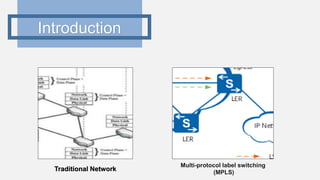
Multi-protocol label switching
(MPLS)
Traditional Network
Introduction
Multi-protocol label switching
(MPLS)
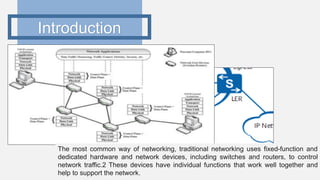
The most common way of networking, traditional networking uses fixed-function and
dedicated hardware and network devices, including switches and routers, to control
network traffic.2 These devices have individual functions that work well together and
help to support the network.
Multi-protocol label switching
(MPLS)
Segment Routing (SR)
Traditional Network
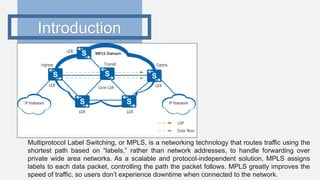
Multiprotocol Label Switching, or MPLS, is a networking technology that routes traffic using the
shortest path based on “labels,” rather than network addresses, to handle forwarding over
private wide area networks. As a scalable and protocol-independent solution, MPLS assigns
labels to each data packet, controlling the path the packet follows. MPLS greatly improves the
speed of traffic, so users don’t experience downtime when connected to the network.
Introduction
Multi-Protocol Label Switching (MPLS) Although the MPLS forwarding plane is
praised thanks to MPLS's label switching concept, the MPLS control plane is
criticized due to defects such as complex protocols, poor extensibility, and
difficult deployment/maintenance. As the two major protocols used in the MPLS
control plane have some disadvantages LDP, which distributes labels based on
IGP path computation results, mainly has the following disadvantages:
 Because LDP depends on IGP but both protocols are independent of each
other, LDP-IGP asynchronization exists, resulting in traffic blackholing.
 LDP can forward traffic only through the shortest path and does not support
either traffic engineering or path planning.
SR aims to overcome the issues associated with traditional MPLS networks while
also retaining the advantages of such networks
Problem Statement
The aim of this project is to provide comprehensive survey and detailed
study between SRv4 & SRv6 , with exploration how segment Routing can
improve the performance of networks.
Aim
 To study Traditional network and MPLS
 To study segment routing
 To study how Segment Routing can improve networks
 To Implement SR-v4 and SR-v6
 To compare SR-v4 and SR-v6
Objectives
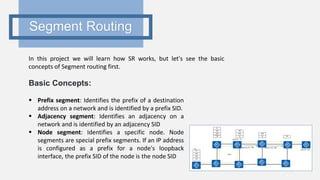
Basic Concepts:
Segment Routing
In this project we will learn how SR works, but let's see the basic
concepts of Segment routing first.
 Prefix segment: Identifies the prefix of a destination
address on a network and is identified by a prefix SID.
 Adjacency segment: Identifies an adjacency on a
network and is identified by an adjacency SID
 Node segment: Identifies a specific node. Node
segments are special prefix segments. If an IP address
is configured as a prefix for a node's loopback
interface, the prefix SID of the node is the node SID
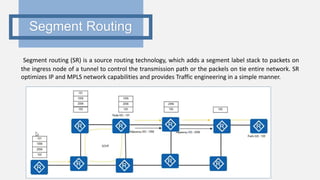
Segment routing (SR) is a source routing technology, which adds a segment label stack to packets on
the ingress node of a tunnel to control the transmission path or the packels on tie entire network. SR
optimizes IP and MPLS network capabilities and provides Traffic engineering in a simple manner.
Segment Routing
October November December January February March
Task  Time
Determine the project
title
Meeting with
Supervisor
Setting aim & Objectives
Setting project
methodology
Collect resources
Preparing & Writing
Chapter 1 & 2
Preparing & Writing
Chapter 3 & 4
Preparing & Writing
Chapter 5
PLAN YOUR PROJECT
Project Time Plan
Thank You

Segment Routing- Pre.pptx

  • 2.
    Esra Boushaala 4331 HebaAl-Rahman Gamal 4326 Supervisor: Mr. Khalil Almoqasbi Comparison between SRv4 and SRv6
  • 3.
    Outline  Introduction  Aim Segment Routing  Problem Statement  Objectives  Project Time Plan
  • 4.
  • 5.
    Introduction Multi-protocol label switching (MPLS) Themost common way of networking, traditional networking uses fixed-function and dedicated hardware and network devices, including switches and routers, to control network traffic.2 These devices have individual functions that work well together and help to support the network.
  • 6.
    Multi-protocol label switching (MPLS) SegmentRouting (SR) Traditional Network Multiprotocol Label Switching, or MPLS, is a networking technology that routes traffic using the shortest path based on “labels,” rather than network addresses, to handle forwarding over private wide area networks. As a scalable and protocol-independent solution, MPLS assigns labels to each data packet, controlling the path the packet follows. MPLS greatly improves the speed of traffic, so users don’t experience downtime when connected to the network. Introduction
  • 7.
    Multi-Protocol Label Switching(MPLS) Although the MPLS forwarding plane is praised thanks to MPLS's label switching concept, the MPLS control plane is criticized due to defects such as complex protocols, poor extensibility, and difficult deployment/maintenance. As the two major protocols used in the MPLS control plane have some disadvantages LDP, which distributes labels based on IGP path computation results, mainly has the following disadvantages:  Because LDP depends on IGP but both protocols are independent of each other, LDP-IGP asynchronization exists, resulting in traffic blackholing.  LDP can forward traffic only through the shortest path and does not support either traffic engineering or path planning. SR aims to overcome the issues associated with traditional MPLS networks while also retaining the advantages of such networks Problem Statement
  • 8.
    The aim ofthis project is to provide comprehensive survey and detailed study between SRv4 & SRv6 , with exploration how segment Routing can improve the performance of networks. Aim
  • 9.
     To studyTraditional network and MPLS  To study segment routing  To study how Segment Routing can improve networks  To Implement SR-v4 and SR-v6  To compare SR-v4 and SR-v6 Objectives
  • 10.
    Basic Concepts: Segment Routing Inthis project we will learn how SR works, but let's see the basic concepts of Segment routing first.  Prefix segment: Identifies the prefix of a destination address on a network and is identified by a prefix SID.  Adjacency segment: Identifies an adjacency on a network and is identified by an adjacency SID  Node segment: Identifies a specific node. Node segments are special prefix segments. If an IP address is configured as a prefix for a node's loopback interface, the prefix SID of the node is the node SID
  • 11.
    Segment routing (SR)is a source routing technology, which adds a segment label stack to packets on the ingress node of a tunnel to control the transmission path or the packels on tie entire network. SR optimizes IP and MPLS network capabilities and provides Traffic engineering in a simple manner. Segment Routing
  • 12.
    October November DecemberJanuary February March Task Time Determine the project title Meeting with Supervisor Setting aim & Objectives Setting project methodology Collect resources Preparing & Writing Chapter 1 & 2 Preparing & Writing Chapter 3 & 4 Preparing & Writing Chapter 5 PLAN YOUR PROJECT Project Time Plan
  • 13.