SECURING TCP
CONNECTIONS USING SSL
Presented By:
Raushan Mahaseth (2067/BEX/132)
Sagar Mali (2067/BEX/133)
Sanid Prajapati (2067/BEX/134)
Saugat Gautam (2067/BEX/135)
INTRODUCTION
• SSL stands for Secure Sockets Layer
• SSL is the standard security technology for establishing
an Encrypted link between a web server and a browser.
• This link ensures that all data passed between the web
servers and the browsers remain Private & Integral.
NEED of SSL
• Authentication of server
How does the client know who they are dealing with?
• Information Integrity
How do we know third party has not altered data en route?
OBJECTIVES of SSL PROTOCOL
• Data encryption
• Server authentication
• Message integrity
• Optional client authentication for aTCP/IP
connection.
Application of SSL in web browser:
An example
Normal HTTP: http://www.bbc.com
Secured HTTP: https://www.facebook.com
BRIEF HISTORY
• Netscape developed the SSL protocol in 1994, as a
response to the growing concern over the security on the
Internet.
• SSL was originally developed for the securing web
browser and server communications.
SSLVERSIONS
• There are several versions of the SSL protocol defined.
• The latest version ,Transport Layer Security Protocol (TLS) is
based on SSL 3.0
• SSL version 1.0
• SSL version 2.0
• SSL version 3.0
• TLS version 1.0
• TLS version 2.0 with SSL version 3.0 compatibility
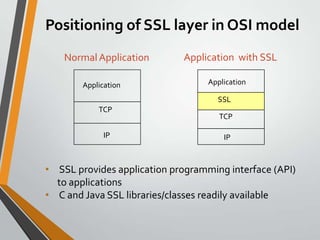
Positioning of SSL layer in OSI model
Application
TCP
IP
Normal Application
Application
SSL
TCP
IP
Application with SSL
• SSL provides application programming interface (API)
to applications
• C and Java SSL libraries/classes readily available
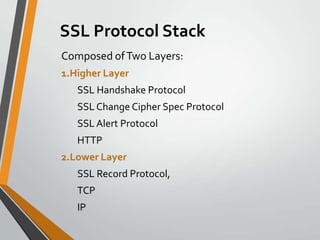
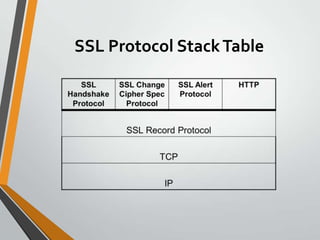
SSL Protocol Stack
Composed ofTwo Layers:
1.Higher Layer
SSL Handshake Protocol
SSL Change Cipher Spec Protocol
SSL Alert Protocol
HTTP
2.Lower Layer
SSL Record Protocol,
TCP
IP
SSL Protocol StackTable
SSL Sub protocols
Two Sub protocols -
• Handshake Protocol: For establishing secure connection
• Record Protocol: For secure transmission of data
HANDSHAKE PROTOCOL
• Allows server & client to:
• authenticate each other
• to negotiate encryption, MAC algorithms and keys
• Comprises a series of messages exchanged in phases:
• Establish Security Capabilities
• Server Authentication and Key Exchange
• Client Authentication and Key Exchange
HANDSHAKE PROTOCOL EXPLAINED
SSL Record Protocol
• The Record Protocol
1. takes an application message to be transmitted,
2. fragments the data into blocks,
3. compresses the data (optionally),
4. applies a MAC,
5. encrypts,
6. adds a header and
7. transmits the resulting unit.
SSL Record Protocol Operation
SUMMARY
• SSL protocol developed for secure internet browsing
• Operates in between Application andTransport layer
• Uses two sub protocol
• Handshake protocol
• Record protocol
• Widely applied by various servers and web browsers
REFERENCES
• Books:
• Computer Networks, A.S.Tatenbaum (Fourth Edition) PHI
• Computer Networking- A top down approach, J.F. Kurose &
K.W. Ross (Fifth Edition) Pearson
• Websites:
• http://en.wikipedia.org/wiki/Transport_Layer_Security
• http://www.webopedia.com/TERM/S/SSL.html
• https://www.globalsign.eu/ssl-information-center/what-is-ssl.html
• http://www.postgresql.org/docs/9.1/static/ssl-tcp.html
• http://www.digicert.com/ssl.htm
THANKYOU
AND
HAPPY
SECURE WEB BROWSING!

Securing TCP connections using SSL

  • 1.
    SECURING TCP CONNECTIONS USINGSSL Presented By: Raushan Mahaseth (2067/BEX/132) Sagar Mali (2067/BEX/133) Sanid Prajapati (2067/BEX/134) Saugat Gautam (2067/BEX/135)
  • 2.
    INTRODUCTION • SSL standsfor Secure Sockets Layer • SSL is the standard security technology for establishing an Encrypted link between a web server and a browser. • This link ensures that all data passed between the web servers and the browsers remain Private & Integral.
  • 3.
    NEED of SSL •Authentication of server How does the client know who they are dealing with? • Information Integrity How do we know third party has not altered data en route?
  • 4.
    OBJECTIVES of SSLPROTOCOL • Data encryption • Server authentication • Message integrity • Optional client authentication for aTCP/IP connection.
  • 5.
    Application of SSLin web browser: An example Normal HTTP: http://www.bbc.com Secured HTTP: https://www.facebook.com
  • 6.
    BRIEF HISTORY • Netscapedeveloped the SSL protocol in 1994, as a response to the growing concern over the security on the Internet. • SSL was originally developed for the securing web browser and server communications.
  • 7.
    SSLVERSIONS • There areseveral versions of the SSL protocol defined. • The latest version ,Transport Layer Security Protocol (TLS) is based on SSL 3.0 • SSL version 1.0 • SSL version 2.0 • SSL version 3.0 • TLS version 1.0 • TLS version 2.0 with SSL version 3.0 compatibility
  • 8.
    Positioning of SSLlayer in OSI model Application TCP IP Normal Application Application SSL TCP IP Application with SSL • SSL provides application programming interface (API) to applications • C and Java SSL libraries/classes readily available
  • 9.
    SSL Protocol Stack ComposedofTwo Layers: 1.Higher Layer SSL Handshake Protocol SSL Change Cipher Spec Protocol SSL Alert Protocol HTTP 2.Lower Layer SSL Record Protocol, TCP IP
  • 10.
  • 11.
    SSL Sub protocols TwoSub protocols - • Handshake Protocol: For establishing secure connection • Record Protocol: For secure transmission of data
  • 12.
    HANDSHAKE PROTOCOL • Allowsserver & client to: • authenticate each other • to negotiate encryption, MAC algorithms and keys • Comprises a series of messages exchanged in phases: • Establish Security Capabilities • Server Authentication and Key Exchange • Client Authentication and Key Exchange
  • 13.
  • 15.
    SSL Record Protocol •The Record Protocol 1. takes an application message to be transmitted, 2. fragments the data into blocks, 3. compresses the data (optionally), 4. applies a MAC, 5. encrypts, 6. adds a header and 7. transmits the resulting unit.
  • 16.
  • 17.
    SUMMARY • SSL protocoldeveloped for secure internet browsing • Operates in between Application andTransport layer • Uses two sub protocol • Handshake protocol • Record protocol • Widely applied by various servers and web browsers
  • 18.
    REFERENCES • Books: • ComputerNetworks, A.S.Tatenbaum (Fourth Edition) PHI • Computer Networking- A top down approach, J.F. Kurose & K.W. Ross (Fifth Edition) Pearson • Websites: • http://en.wikipedia.org/wiki/Transport_Layer_Security • http://www.webopedia.com/TERM/S/SSL.html • https://www.globalsign.eu/ssl-information-center/what-is-ssl.html • http://www.postgresql.org/docs/9.1/static/ssl-tcp.html • http://www.digicert.com/ssl.htm
  • 19.