Section 4
Islamic Civilization &
Culture
Meaning of Civilization & Culture
Islamic Culture & Its Characteristics
Islamic Civilization & Its Characteristics
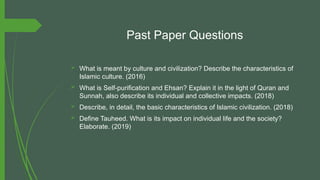
Past Paper Questions
 What is meant by culture and civilization? Describe the characteristics of
Islamic culture. (2016)
 What is Self-purification and Ehsan? Explain it in the light of Quran and
Sunnah, also describe its individual and collective impacts. (2018)
 Describe, in detail, the basic characteristics of Islamic civilization. (2018)
 Define Tauheed. What is its impact on individual life and the society?
Elaborate. (2019)
Culture & Civilization
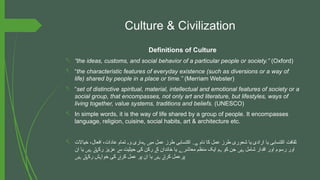
Definitions of Culture
- “the ideas, customs, and social behavior of a particular people or society.” (Oxford)
- “the characteristic features of everyday existence (such as diversions or a way of
life) shared by people in a place or time.” (Merriam Webster)
- “set of distinctive spiritual, material, intellectual and emotional features of society or a
social group, that encompasses, not only art and literature, but lifestyles, ways of
living together, value systems, traditions and beliefs. (UNESCO)
- In simple words, it is the way of life shared by a group of people. It encompasses
language, religion, cuisine, social habits, art & architecture etc.
- ‫خیاالت‬ ،‫افعال‬ ،‫عادات‬ ‫تمام‬ ‫و‬ ‫ماری‬ ‫می‬ ‫عمل‬ ‫طرز‬ ‫اکتسابی‬ ‫نام‬ ‫کا‬ ‫عمل‬ ‫طرز‬ ‫شعوری‬ ‫یا‬ ‫ارادی‬ ‫یا‬ ‫اکتسابی‬ ‫ثقافت‬
‫ہ‬ ‫ہ‬ ‫ں‬ ‫ےہ۔‬
‫ان‬ ‫یا‬ ‫ی‬ ‫ت‬ ‫رک‬ ‫عزیز‬ ‫س‬ ‫حیثیت‬ ‫کی‬ ‫رکن‬ ‫ک‬ ‫خاندان‬ ‫یا‬ ‫معاشر‬ ‫منظم‬ ‫ایک‬ ‫م‬ ‫کو‬ ‫جن‬ ‫ی‬ ‫شامل‬ ‫اقدار‬ ‫اور‬ ‫رسوم‬ ‫اور‬
‫ں‬ ‫ہ‬ ‫ے‬ ‫ھ‬ ‫ے‬ ‫ے‬ ‫ے‬ ‫ہ‬ ‫ں‬ ‫ہ‬
‫ی‬ ‫ت‬ ‫رک‬ ‫ش‬ ‫خوا‬ ‫کی‬ ‫کرن‬ ‫عمل‬ ‫پر‬ ‫ان‬ ‫یا‬ ‫ی‬ ‫کرت‬ ‫پرعمل‬
‫ں‬ ‫ہ‬ ‫ے‬ ‫ھ‬ ‫ہ‬ ‫ے‬ ‫ں‬ ‫ہ‬ ‫ے‬
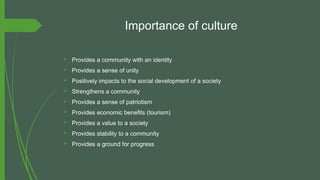
Importance of culture
 Provides a community with an identity
 Provides a sense of unity
 Positively impacts to the social development of a society
 Strengthens a community
 Provides a sense of patriotism
 Provides economic benefits (tourism)
 Provides a value to a society
 Provides stability to a community
 Provides a ground for progress
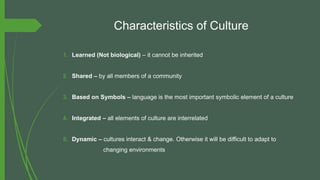
Characteristics of Culture
1. Learned (Not biological) – it cannot be inherited
2. Shared – by all members of a community
3. Based on Symbols – language is the most important symbolic element of a culture
4. Integrated – all elements of culture are interrelated
5. Dynamic – cultures interact & change. Otherwise it will be difficult to adapt to
changing environments
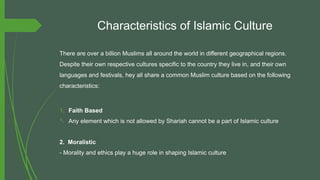
Characteristics of Islamic Culture
There are over a billion Muslims all around the world in different geographical regions.
Despite their own respective cultures specific to the country they live in, and their own
languages and festivals, hey all share a common Muslim culture based on the following
characteristics:
1. Faith Based
- Any element which is not allowed by Shariah cannot be a part of Islamic culture
2. Moralistic
- Morality and ethics play a huge role in shaping Islamic culture
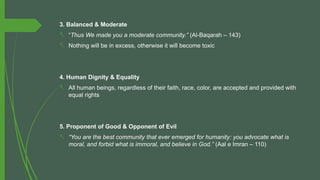
3. Balanced & Moderate
- “Thus We made you a moderate community.” (Al-Baqarah – 143)
- Nothing will be in excess, otherwise it will become toxic
4. Human Dignity & Equality
- All human beings, regardless of their faith, race, color, are accepted and provided with
equal rights
5. Proponent of Good & Opponent of Evil
- “You are the best community that ever emerged for humanity: you advocate what is
moral, and forbid what is immoral, and believe in God.” (Aal e Imran – 110)
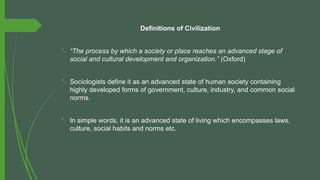
Definitions of Civilization
- “The process by which a society or place reaches an advanced stage of
social and cultural development and organization.” (Oxford)
- Sociologists define it as an advanced state of human society containing
highly developed forms of government, culture, industry, and common social
norms.
- In simple words, it is an advanced state of living which encompasses laws,
culture, social habits and norms etc.
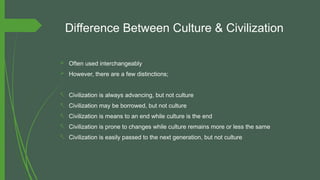
Difference Between Culture & Civilization
 Often used interchangeably
 However, there are a few distinctions;
- Civilization is always advancing, but not culture
- Civilization may be borrowed, but not culture
- Civilization is means to an end while culture is the end
- Civilization is prone to changes while culture remains more or less the same
- Civilization is easily passed to the next generation, but not culture
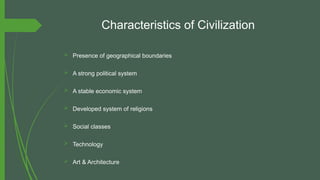
Characteristics of Civilization
 Presence of geographical boundaries
 A strong political system
 A stable economic system
 Developed system of religions
 Social classes
 Technology
 Art & Architecture
Characteristics/Features of Islamic
Civilization
1. Tawhid
Kindly refer to section 1, slides 14 - 19
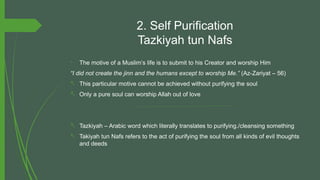
2. Self Purification
Tazkiyah tun Nafs
- The motive of a Muslim’s life is to submit to his Creator and worship Him
“I did not create the jinn and the humans except to worship Me.” (Az-Zariyat – 56)
- This particular motive cannot be achieved without purifying the soul
- Only a pure soul can worship Allah out of love
- Tazkiyah – Arabic word which literally translates to purifying./cleansing something
- Takiyah tun Nafs refers to the act of purifying the soul from all kinds of evil thoughts
and deeds
Importance of Self Purification
 One of the primary duties of the Prophet SAW
“It is He who sent among the unlettered a messenger from themselves; reciting His
revelations to them, and purifying them, and teaching them the Scripture and wisdom;
although they were in obvious error before that.” (Al-Jumu’ah – 2)
 The basis for success in both worlds. Allah mentioned it after taking an oath on 11
of His majestic creations.
“By the sun and its radiance. And the moon as it follows it. And the day as it reveals it.
And the night as it conceals it. And the sky and He who built it. And the earth and He
who spread it. And the soul and He who proportioned it. And inspired it with its
wickedness and its righteousness. Successful is he who purifies it. Failing is he who
corrupts it.
 3 types of Self/Nafs as mentioned in the Quran;
1. Nafs e Ammarah – The Sinful Soul
- “The soul commands evil.” (Yousuf – 53)
- The lowest level, the self that only pushes a person to do evil
2. Nafs e Lawwamah – The Regretful Soul
- “And I swear by the reproaching soul.” (Al-Qiyamah – 2)
- The soul that sins but realizes its mistake and repents
3. Nafs e Mutmainnah – The Peaceful Soul
- “But as for you, O tranquil soul. Return to your Lord, pleased and accepted. Enter
among My servants. Enter My Paradise.” (Al-Fajr – 27 – 30)
- The required state of the self
Impacts of Self Purification
On an Individual
 Helps in attaining inner peace
 Helps an individual get close to his Creator
 A self purified person is the one who is ‘rich’ according to our Prophet SAW
“Richness does not lie in the abundance of (worldly) goods but richness is the
richness of the soul.” (Muslim)
 Helps in building a strong character and moral values
 The real Mujahid according to our Prophet SAW
“The Mujahid is one who strives against his own soul.” (Tirmizi)
On a Society
 Helps building a strong moral & ethical society
 Eradication of all sorts of crimes
 Eradication of all sorts of social evils such as jealousy etc.
 A united society
 Helps attracting the blessings of Allah SWT
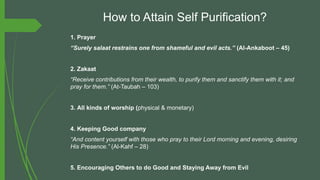
How to Attain Self Purification?
1. Prayer
“Surely salaat restrains one from shameful and evil acts.” (Al-Ankaboot – 45)
2. Zakaat
“Receive contributions from their wealth, to purify them and sanctify them with it; and
pray for them.” (At-Taubah – 103)
3. All kinds of worship (physical & monetary)
4. Keeping Good company
“And content yourself with those who pray to their Lord morning and evening, desiring
His Presence.” (Al-Kahf – 28)
5. Encouraging Others to do Good and Staying Away from Evil
3. Dignity of Man
Kindly refer to section 3, slides 15 - 16
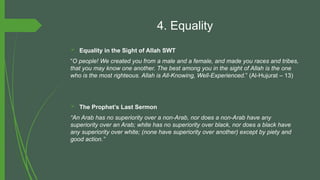
4. Equality
 Equality in the Sight of Allah SWT
“O people! We created you from a male and a female, and made you races and tribes,
that you may know one another. The best among you in the sight of Allah is the one
who is the most righteous. Allah is All-Knowing, Well-Experienced.” (Al-Hujurat – 13)
 The Prophet’s Last Sermon
“An Arab has no superiority over a non-Arab, nor does a non-Arab have any
superiority over an Arab; white has no superiority over black, nor does a black have
any superiority over white; (none have superiority over another) except by piety and
good action.”
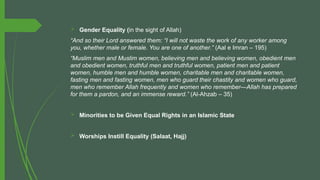
 Gender Equality (in the sight of Allah)
“And so their Lord answered them: “I will not waste the work of any worker among
you, whether male or female. You are one of another.” (Aal e Imran – 195)
“Muslim men and Muslim women, believing men and believing women, obedient men
and obedient women, truthful men and truthful women, patient men and patient
women, humble men and humble women, charitable men and charitable women,
fasting men and fasting women, men who guard their chastity and women who guard,
men who remember Allah frequently and women who remember—Allah has prepared
for them a pardon, and an immense reward.” (Al-Ahzab – 35)
 Minorities to be Given Equal Rights in an Islamic State
 Worships Instill Equality (Salaat, Hajj)
5. Social Justice
 Social justice refers to justice in terms of the distribution of wealth, opportunities,
and privileges within a society.
 The element of equality in Islamic civilization itself ensures social justice.
 No one can be considered superior because of their wealth, social status, race etc.
 Islam heavily emphasizes on maintaining justice within a society, and Allah SWT
has promised a great reward for a just ruler.
“"Seven are (the persons) whom Allah will give Shade of His Thrown on the Day when
there would be no shade other than His Throne's Shade: A just ruler…..” (Bukhari &
Muslim)
*Detail to be discussed in Islam’s judicial system*
6. Tolerance
 “The repayment of a bad action is one equivalent to it. But whoever pardons and
makes reconciliation, his reward lies with God. He does not love the unjust.” (Ash-
Shura – 40)
 "Shall I not inform you of whom the Fire is unlawful and he is unlawful for the Fire?
Every person who is near(to people), amicable, and easy(to deal with).” (Tirmizi)
 ‘O Ashajj, you have two characteristics that Allah likes: “Tolerance and
carefulness.” (Ibn Maajah)
 Incidents regarding tolerance from the Prophet’s SAW life
- Tolerating extreme persecution at Makkah
- Visit to Taif
- His decision regarding the people of Makkah at the time of its conquest etc.
 Dignity
 Piety
 Tolerance
 Justice
 Kindness
 Truthful
7. Moral Values
 An Islamic civilization must be led by Muslims of high moral and ethical values
 We have the Prophet SAW as an example of how an ideal Muslim should be, as
Allah SWT Himself praised his character
“And you are of a great moral character.” (Al-Qalam – 4)
 His character was a personification of the Quran
“A person asked Aisha R.A. about the character of the Prophet SAW. She said; “Don’t
you read the Quran?” The person replied in positive. Upon this she said: “The
character of the Prophet SAW was the Quran.” (Muslim)
 The Prophet SAW also described it as one of his primary duties
"I was sent to perfect good character.” (Muwatta)
 A Muslim with good moral values has been described as a perfect Muslim
“The Prophet SAW did not indulge in loose talk, nor did he like to listen to it. He used to
say, "The best of you is the best among you in conduct.“ (Bukhari & Muslim)
List of Some Desirable Moral Values
Dignity Truthfulness
Piety Modesty
Tolerance Moderation
Justice Punctual
Kindness Generous
8. Rule of Law
 An extremely important feature of an Islamic civilization
 Must be upheld at all costs to maintain law and order
 It refers to the fact that no one is above the laws prescribed by Shariah
 And Muslims will also be bound to any law formulated for their betterment,
provided that it does not contradict with Shariah
 The Prophet SAW described the absence of rule of law as a declining factor of
previous nations
“O people, those who have gone before you were destroyed, because if any one of
high rank committed theft amongst them, they spared him; and it anyone of low rank
committed theft, they inflicted the prescribed punishment upon him. By Allah, if
Fatima, daughter of Muhammad, were to steal, I would have her hand cut off.”
(Muslim)
 The Prophet SAW emphasized on this feature when the powerful could do
anything and get away with it.

Section 4 - Islamic Civilization & Culture.pptx

  • 1.
    Section 4 Islamic Civilization& Culture Meaning of Civilization & Culture Islamic Culture & Its Characteristics Islamic Civilization & Its Characteristics
  • 2.
    Past Paper Questions What is meant by culture and civilization? Describe the characteristics of Islamic culture. (2016)  What is Self-purification and Ehsan? Explain it in the light of Quran and Sunnah, also describe its individual and collective impacts. (2018)  Describe, in detail, the basic characteristics of Islamic civilization. (2018)  Define Tauheed. What is its impact on individual life and the society? Elaborate. (2019)
  • 3.
    Culture & Civilization Definitionsof Culture - “the ideas, customs, and social behavior of a particular people or society.” (Oxford) - “the characteristic features of everyday existence (such as diversions or a way of life) shared by people in a place or time.” (Merriam Webster) - “set of distinctive spiritual, material, intellectual and emotional features of society or a social group, that encompasses, not only art and literature, but lifestyles, ways of living together, value systems, traditions and beliefs. (UNESCO) - In simple words, it is the way of life shared by a group of people. It encompasses language, religion, cuisine, social habits, art & architecture etc. - ‫خیاالت‬ ،‫افعال‬ ،‫عادات‬ ‫تمام‬ ‫و‬ ‫ماری‬ ‫می‬ ‫عمل‬ ‫طرز‬ ‫اکتسابی‬ ‫نام‬ ‫کا‬ ‫عمل‬ ‫طرز‬ ‫شعوری‬ ‫یا‬ ‫ارادی‬ ‫یا‬ ‫اکتسابی‬ ‫ثقافت‬ ‫ہ‬ ‫ہ‬ ‫ں‬ ‫ےہ۔‬ ‫ان‬ ‫یا‬ ‫ی‬ ‫ت‬ ‫رک‬ ‫عزیز‬ ‫س‬ ‫حیثیت‬ ‫کی‬ ‫رکن‬ ‫ک‬ ‫خاندان‬ ‫یا‬ ‫معاشر‬ ‫منظم‬ ‫ایک‬ ‫م‬ ‫کو‬ ‫جن‬ ‫ی‬ ‫شامل‬ ‫اقدار‬ ‫اور‬ ‫رسوم‬ ‫اور‬ ‫ں‬ ‫ہ‬ ‫ے‬ ‫ھ‬ ‫ے‬ ‫ے‬ ‫ے‬ ‫ہ‬ ‫ں‬ ‫ہ‬ ‫ی‬ ‫ت‬ ‫رک‬ ‫ش‬ ‫خوا‬ ‫کی‬ ‫کرن‬ ‫عمل‬ ‫پر‬ ‫ان‬ ‫یا‬ ‫ی‬ ‫کرت‬ ‫پرعمل‬ ‫ں‬ ‫ہ‬ ‫ے‬ ‫ھ‬ ‫ہ‬ ‫ے‬ ‫ں‬ ‫ہ‬ ‫ے‬
  • 4.
    Importance of culture Provides a community with an identity  Provides a sense of unity  Positively impacts to the social development of a society  Strengthens a community  Provides a sense of patriotism  Provides economic benefits (tourism)  Provides a value to a society  Provides stability to a community  Provides a ground for progress
  • 5.
    Characteristics of Culture 1.Learned (Not biological) – it cannot be inherited 2. Shared – by all members of a community 3. Based on Symbols – language is the most important symbolic element of a culture 4. Integrated – all elements of culture are interrelated 5. Dynamic – cultures interact & change. Otherwise it will be difficult to adapt to changing environments
  • 6.
    Characteristics of IslamicCulture There are over a billion Muslims all around the world in different geographical regions. Despite their own respective cultures specific to the country they live in, and their own languages and festivals, hey all share a common Muslim culture based on the following characteristics: 1. Faith Based - Any element which is not allowed by Shariah cannot be a part of Islamic culture 2. Moralistic - Morality and ethics play a huge role in shaping Islamic culture
  • 7.
    3. Balanced &Moderate - “Thus We made you a moderate community.” (Al-Baqarah – 143) - Nothing will be in excess, otherwise it will become toxic 4. Human Dignity & Equality - All human beings, regardless of their faith, race, color, are accepted and provided with equal rights 5. Proponent of Good & Opponent of Evil - “You are the best community that ever emerged for humanity: you advocate what is moral, and forbid what is immoral, and believe in God.” (Aal e Imran – 110)
  • 8.
    Definitions of Civilization -“The process by which a society or place reaches an advanced stage of social and cultural development and organization.” (Oxford) - Sociologists define it as an advanced state of human society containing highly developed forms of government, culture, industry, and common social norms. - In simple words, it is an advanced state of living which encompasses laws, culture, social habits and norms etc.
  • 9.
    Difference Between Culture& Civilization  Often used interchangeably  However, there are a few distinctions; - Civilization is always advancing, but not culture - Civilization may be borrowed, but not culture - Civilization is means to an end while culture is the end - Civilization is prone to changes while culture remains more or less the same - Civilization is easily passed to the next generation, but not culture
  • 10.
    Characteristics of Civilization Presence of geographical boundaries  A strong political system  A stable economic system  Developed system of religions  Social classes  Technology  Art & Architecture
  • 11.
    Characteristics/Features of Islamic Civilization 1.Tawhid Kindly refer to section 1, slides 14 - 19
  • 12.
    2. Self Purification Tazkiyahtun Nafs - The motive of a Muslim’s life is to submit to his Creator and worship Him “I did not create the jinn and the humans except to worship Me.” (Az-Zariyat – 56) - This particular motive cannot be achieved without purifying the soul - Only a pure soul can worship Allah out of love - Tazkiyah – Arabic word which literally translates to purifying./cleansing something - Takiyah tun Nafs refers to the act of purifying the soul from all kinds of evil thoughts and deeds
  • 13.
    Importance of SelfPurification  One of the primary duties of the Prophet SAW “It is He who sent among the unlettered a messenger from themselves; reciting His revelations to them, and purifying them, and teaching them the Scripture and wisdom; although they were in obvious error before that.” (Al-Jumu’ah – 2)  The basis for success in both worlds. Allah mentioned it after taking an oath on 11 of His majestic creations. “By the sun and its radiance. And the moon as it follows it. And the day as it reveals it. And the night as it conceals it. And the sky and He who built it. And the earth and He who spread it. And the soul and He who proportioned it. And inspired it with its wickedness and its righteousness. Successful is he who purifies it. Failing is he who corrupts it.
  • 14.
     3 typesof Self/Nafs as mentioned in the Quran; 1. Nafs e Ammarah – The Sinful Soul - “The soul commands evil.” (Yousuf – 53) - The lowest level, the self that only pushes a person to do evil 2. Nafs e Lawwamah – The Regretful Soul - “And I swear by the reproaching soul.” (Al-Qiyamah – 2) - The soul that sins but realizes its mistake and repents 3. Nafs e Mutmainnah – The Peaceful Soul - “But as for you, O tranquil soul. Return to your Lord, pleased and accepted. Enter among My servants. Enter My Paradise.” (Al-Fajr – 27 – 30) - The required state of the self
  • 15.
    Impacts of SelfPurification On an Individual  Helps in attaining inner peace  Helps an individual get close to his Creator  A self purified person is the one who is ‘rich’ according to our Prophet SAW “Richness does not lie in the abundance of (worldly) goods but richness is the richness of the soul.” (Muslim)  Helps in building a strong character and moral values  The real Mujahid according to our Prophet SAW “The Mujahid is one who strives against his own soul.” (Tirmizi)
  • 16.
    On a Society Helps building a strong moral & ethical society  Eradication of all sorts of crimes  Eradication of all sorts of social evils such as jealousy etc.  A united society  Helps attracting the blessings of Allah SWT
  • 17.
    How to AttainSelf Purification? 1. Prayer “Surely salaat restrains one from shameful and evil acts.” (Al-Ankaboot – 45) 2. Zakaat “Receive contributions from their wealth, to purify them and sanctify them with it; and pray for them.” (At-Taubah – 103) 3. All kinds of worship (physical & monetary) 4. Keeping Good company “And content yourself with those who pray to their Lord morning and evening, desiring His Presence.” (Al-Kahf – 28) 5. Encouraging Others to do Good and Staying Away from Evil
  • 18.
    3. Dignity ofMan Kindly refer to section 3, slides 15 - 16
  • 19.
    4. Equality  Equalityin the Sight of Allah SWT “O people! We created you from a male and a female, and made you races and tribes, that you may know one another. The best among you in the sight of Allah is the one who is the most righteous. Allah is All-Knowing, Well-Experienced.” (Al-Hujurat – 13)  The Prophet’s Last Sermon “An Arab has no superiority over a non-Arab, nor does a non-Arab have any superiority over an Arab; white has no superiority over black, nor does a black have any superiority over white; (none have superiority over another) except by piety and good action.”
  • 20.
     Gender Equality(in the sight of Allah) “And so their Lord answered them: “I will not waste the work of any worker among you, whether male or female. You are one of another.” (Aal e Imran – 195) “Muslim men and Muslim women, believing men and believing women, obedient men and obedient women, truthful men and truthful women, patient men and patient women, humble men and humble women, charitable men and charitable women, fasting men and fasting women, men who guard their chastity and women who guard, men who remember Allah frequently and women who remember—Allah has prepared for them a pardon, and an immense reward.” (Al-Ahzab – 35)  Minorities to be Given Equal Rights in an Islamic State  Worships Instill Equality (Salaat, Hajj)
  • 21.
    5. Social Justice Social justice refers to justice in terms of the distribution of wealth, opportunities, and privileges within a society.  The element of equality in Islamic civilization itself ensures social justice.  No one can be considered superior because of their wealth, social status, race etc.  Islam heavily emphasizes on maintaining justice within a society, and Allah SWT has promised a great reward for a just ruler. “"Seven are (the persons) whom Allah will give Shade of His Thrown on the Day when there would be no shade other than His Throne's Shade: A just ruler…..” (Bukhari & Muslim) *Detail to be discussed in Islam’s judicial system*
  • 22.
    6. Tolerance  “Therepayment of a bad action is one equivalent to it. But whoever pardons and makes reconciliation, his reward lies with God. He does not love the unjust.” (Ash- Shura – 40)  "Shall I not inform you of whom the Fire is unlawful and he is unlawful for the Fire? Every person who is near(to people), amicable, and easy(to deal with).” (Tirmizi)  ‘O Ashajj, you have two characteristics that Allah likes: “Tolerance and carefulness.” (Ibn Maajah)
  • 23.
     Incidents regardingtolerance from the Prophet’s SAW life - Tolerating extreme persecution at Makkah - Visit to Taif - His decision regarding the people of Makkah at the time of its conquest etc.  Dignity  Piety  Tolerance  Justice  Kindness  Truthful
  • 24.
    7. Moral Values An Islamic civilization must be led by Muslims of high moral and ethical values  We have the Prophet SAW as an example of how an ideal Muslim should be, as Allah SWT Himself praised his character “And you are of a great moral character.” (Al-Qalam – 4)  His character was a personification of the Quran “A person asked Aisha R.A. about the character of the Prophet SAW. She said; “Don’t you read the Quran?” The person replied in positive. Upon this she said: “The character of the Prophet SAW was the Quran.” (Muslim)
  • 25.
     The ProphetSAW also described it as one of his primary duties "I was sent to perfect good character.” (Muwatta)  A Muslim with good moral values has been described as a perfect Muslim “The Prophet SAW did not indulge in loose talk, nor did he like to listen to it. He used to say, "The best of you is the best among you in conduct.“ (Bukhari & Muslim) List of Some Desirable Moral Values Dignity Truthfulness Piety Modesty Tolerance Moderation Justice Punctual Kindness Generous
  • 26.
    8. Rule ofLaw  An extremely important feature of an Islamic civilization  Must be upheld at all costs to maintain law and order  It refers to the fact that no one is above the laws prescribed by Shariah  And Muslims will also be bound to any law formulated for their betterment, provided that it does not contradict with Shariah  The Prophet SAW described the absence of rule of law as a declining factor of previous nations “O people, those who have gone before you were destroyed, because if any one of high rank committed theft amongst them, they spared him; and it anyone of low rank committed theft, they inflicted the prescribed punishment upon him. By Allah, if Fatima, daughter of Muhammad, were to steal, I would have her hand cut off.” (Muslim)  The Prophet SAW emphasized on this feature when the powerful could do anything and get away with it.