Section 377
And
LGBTQ RIGHT
Rohit vashisht
Mind map
Introduction
Problems faced by LGBT Community
Constitutional Safeguards
Recommendations
Court Judgement
Argument against section 377
Impact
International practice
Concerns/Challenges
Conclusion
Presentation title 2
Introduction
Section 377 of the IPC states: Whoever voluntarily has carnal inter-
course against the order of nature with any man, woman or animal,
shall be punished with imprisonment for life, or with imprisonment
of either description for a term which may extend to ten years, and
shall also be liable to fine.“
Presentation title 3
Problems faced by LGBT Community
Throughout the world such laws have led to abuses against lesbian, gay. bisexual and
transgender people including arbitrary arrests, violence, bullying in schools, denial of access to
health and harassment at work.
Depression is high amongst members of the LGBT community and one of the primary reasons
for it is the failure to lead a normal life.
Jobs and, in turn, financial security is denied to people on the basis of sexual orientation
Constant police harassment of the gay community.
Doctors need to say that homosexuality is not a disease.
Government needs to train doctors to understand health issues specific to the homosexual
community, it needs to be part of the educational curriculum.
Presentation title 4
Constitutional Safeguards
The ideals of individual autonomy and liberty, equality for all, recognition of
identity with dignity and privacy of human beings constitute the cardinal four
corners of our Constitution.
Right to Privacy enshrined under Article 21 upholds that if a person cannot
enjoy his privacy then it hampers his right to dignified life.
( It violates the provision of equality before law Article 14).
Article 15 provides for a prohibition of discrimination on the grounds of religion,
race, caste, sex or place of birth.
Petitioners argue that Section 377 is a violation to Freedom of Expression
under Article 19 (1) (a).
Presentation title 5
Recommendation
172nd Law Commission Report recommended deletion of section
377
In 2016, a UN report had urged to decriminalize
consensual homosexual relations.
Presentation title 6
Court Judgement
The Delhi High Court in Naz Foundation v. Government of NCT of Delhi (2009) held that criminalising sexual activities with consent in
private not only impairs the dignity of those persons, but it is also discriminatory and impacts the health of those people.
The Delhi High Court decriminalised homosexuality on the grounds that Section 377 is a violation of Article 14, 15 and 21.
Supreme Court, in Suresh Kumar Koushal v. Naz Foundation (2013) case, set aside the Delhi High Court judgment and said that
homosexuality under Section 377 of IPC is illegal and will continue to be an offence.
The court said that Section 377 did not suffer from any "constitutional infirmity.]
It said there was no need to challenge Section 377 because the LGBT community constitutes only a minuscule minority.
The court also added the responsibility of amending or removing Section 377 lay with the Parliament.
In the Puttuswamy vs. Union of India case the Supreme Court held right to privacy as a fundamental right.
The court stated that privacy included the preservation of personal intimacies and that sexual orientation was an essential attribute of
privacy.
The Court argued that right to privacy and the protection of sexual orientation lay at the core of fundamental rights guaranteed under
Articie 14, 15 and 21.
Presentation title 7
Navtej Singh Johar v UOI
On September 6th 2018 a five-judge Bench unanimously struck
down Section 377 of the Indian Penal Code, to the extent that it
criminalised same-sex relations between consenting adults.
Presentation title 8
The Supreme Court has restored a landmark Deini High Court
judgement which had decriminalised homosexuality.
A five-judge bench led by CJI Dipak Misra diluted Section 377 of
the Indian Penal Code, to exclude all kinds of adult consensual
sexual behaviour.
Dipak Misra's opinion lays emphasis on transformative
constitutonalism that is, treating the Constitution as a dynamic
document that progressively realises various rights.
Presentation title 9
Arguments against Section 377
The constitutional morality makes it mandatory for the state to provide equality to all.
Section 377 abridges both human dignity as well as the fundamental right to privacy and choice of the citizenry.
It is the right of every individual including the LGBT (lesbian, gay, bisexual, transgender) to express their choices in terms of sexual inclination without the fear of
persecution or criminal prosecution.
No one can be discriminated against only on the grounds of their sexual orientation and called for constitutional protection to even sexual minorities.
Decriminalising homosexuality upholds universality of human rights.
Non-acceptance has been an issue for long and Section 377 fuelled it
It not only has repercussions on the development of the community, it affects the economic growth of the country as well.
By building an inclusive nation, everyone can contribute to the GDP of the country.
There is an entire market that caters to their needs and, therefore, legalisation of homosexuality legalises that market too.
The 2017 Supreme Court verdict on right to privacy highlights that the choice of one's sexual orientation is an important part of his/her privacy.
Presentation title 10
Impact
The Supreme Court, while decriminalising homosexuality.
has acknowedged the basic human needs of the citizens.
This will help the community claim equal constitutional status as other citizens.
It also affirms their right to claim the right to adopt, marry and have a family.
It may also prevent social exclusion with the court declaring that it was not a mental disorder. But
something innate to a human being.
It will take time for it to be openly accepted by the society.
It will provide an impetus for other countries, especially
those of the Commonwealth of Nations, to revoke similar
provisions that criminalise consensual sexual relations.
Presentation title 11
International Practice
In 2015, Ireland became the first country to legalise gay marriage.
In 2015, US Supreme Court held that same-sex marriages are legal.
Germany, France, UK, Canada, Australia and Brazil have de-
criminalized homosexuality.
Michelle Bachelet, the UN High Commissioner for Human Rights,
applauded the Supreme Court's
decision to decriminalise homosexualty.
Presentation title 12
Concerns/Challenges
It will throw up several challenges on equality and discrimination.
Since homosexuality is against the majoritarian view on sexual orientation, decriminalising Section 377
might lead to widespread criticisms across the country.
Decriminalization of Section 377 will open new debates on marriage, adoption, inheritance and other
such rights.
Mere decriminalizing Section 377 does not
ensure rights of the LGBT community.
Decriminalizing Section 377 does not ensure a halt in discrimination against the LGBT community.
The other challenge for LGBT members will be with respect to acceptance in jobs and in family
gatherings.
Presentation title 13
I am what I am. So take me as I
am. No one can escape from their
individuality.
“
”
CJI Dipak Mishra
There must be a time to end historical
discrimination on the basis of sexual
orientation and choice... That time is
now.
Justice Indu Malhotra
The Union of India shall take all
measures to ensure this judgment is
given wide publicity through
television, radio, print and online
media (...) Above all,
governmentofficials should be
sensitised.
Justice R F Nariman
Section 377, to the extent that it
criminalises sexual acts between
consenting adults, whether
homosexual or heterosexual,is
unconstitutional.
Justice DY Chandrachud
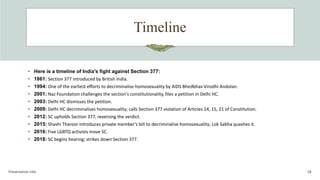
Timeline
Presentation title 18
• Here is a timeline of India's fight against Section 377:
• 1861: Section 377 introduced by British India.
• 1994: One of the earliest efforts to decriminalise homosexuality by AIDS Bhedbhav Virodhi Andolan.
• 2001: Naz Foundation challenges the section's constitutionality, files a petition in Delhi HC.
• 2003: Delhi HC dismisses the petition.
• 2009: Delhi HC decriminalises homosexuality; calls Section 377 violation of Articles 14, 15, 21 of Constitution.
• 2012: SC upholds Section 377, reversing the verdict.
• 2015: Shashi Tharoor introduces private member's bill to decriminalise homosexuality; Lok Sabha quashes it.
• 2016: Five LGBTQ activists move SC.
• 2018: SC begins hearing; strikes down Section 377.
Conclusion
It is time for the Indian Parliament to conduct wide-ranging review
of existing legal framework, repeal discriminatory laws, and
address other gaps in the law that prevent LGBT persons from fully
exercising their rights
Conclusion
Presentation title 19
Thank you
Rohit vashisht
LLM
1st sem
Professional
communication
rohitvashisht212@gmail.co
m

Section 377.pptx

  • 1.
  • 2.
    Mind map Introduction Problems facedby LGBT Community Constitutional Safeguards Recommendations Court Judgement Argument against section 377 Impact International practice Concerns/Challenges Conclusion Presentation title 2
  • 3.
    Introduction Section 377 ofthe IPC states: Whoever voluntarily has carnal inter- course against the order of nature with any man, woman or animal, shall be punished with imprisonment for life, or with imprisonment of either description for a term which may extend to ten years, and shall also be liable to fine.“ Presentation title 3
  • 4.
    Problems faced byLGBT Community Throughout the world such laws have led to abuses against lesbian, gay. bisexual and transgender people including arbitrary arrests, violence, bullying in schools, denial of access to health and harassment at work. Depression is high amongst members of the LGBT community and one of the primary reasons for it is the failure to lead a normal life. Jobs and, in turn, financial security is denied to people on the basis of sexual orientation Constant police harassment of the gay community. Doctors need to say that homosexuality is not a disease. Government needs to train doctors to understand health issues specific to the homosexual community, it needs to be part of the educational curriculum. Presentation title 4
  • 5.
    Constitutional Safeguards The idealsof individual autonomy and liberty, equality for all, recognition of identity with dignity and privacy of human beings constitute the cardinal four corners of our Constitution. Right to Privacy enshrined under Article 21 upholds that if a person cannot enjoy his privacy then it hampers his right to dignified life. ( It violates the provision of equality before law Article 14). Article 15 provides for a prohibition of discrimination on the grounds of religion, race, caste, sex or place of birth. Petitioners argue that Section 377 is a violation to Freedom of Expression under Article 19 (1) (a). Presentation title 5
  • 6.
    Recommendation 172nd Law CommissionReport recommended deletion of section 377 In 2016, a UN report had urged to decriminalize consensual homosexual relations. Presentation title 6
  • 7.
    Court Judgement The DelhiHigh Court in Naz Foundation v. Government of NCT of Delhi (2009) held that criminalising sexual activities with consent in private not only impairs the dignity of those persons, but it is also discriminatory and impacts the health of those people. The Delhi High Court decriminalised homosexuality on the grounds that Section 377 is a violation of Article 14, 15 and 21. Supreme Court, in Suresh Kumar Koushal v. Naz Foundation (2013) case, set aside the Delhi High Court judgment and said that homosexuality under Section 377 of IPC is illegal and will continue to be an offence. The court said that Section 377 did not suffer from any "constitutional infirmity.] It said there was no need to challenge Section 377 because the LGBT community constitutes only a minuscule minority. The court also added the responsibility of amending or removing Section 377 lay with the Parliament. In the Puttuswamy vs. Union of India case the Supreme Court held right to privacy as a fundamental right. The court stated that privacy included the preservation of personal intimacies and that sexual orientation was an essential attribute of privacy. The Court argued that right to privacy and the protection of sexual orientation lay at the core of fundamental rights guaranteed under Articie 14, 15 and 21. Presentation title 7
  • 8.
    Navtej Singh Joharv UOI On September 6th 2018 a five-judge Bench unanimously struck down Section 377 of the Indian Penal Code, to the extent that it criminalised same-sex relations between consenting adults. Presentation title 8
  • 9.
    The Supreme Courthas restored a landmark Deini High Court judgement which had decriminalised homosexuality. A five-judge bench led by CJI Dipak Misra diluted Section 377 of the Indian Penal Code, to exclude all kinds of adult consensual sexual behaviour. Dipak Misra's opinion lays emphasis on transformative constitutonalism that is, treating the Constitution as a dynamic document that progressively realises various rights. Presentation title 9
  • 10.
    Arguments against Section377 The constitutional morality makes it mandatory for the state to provide equality to all. Section 377 abridges both human dignity as well as the fundamental right to privacy and choice of the citizenry. It is the right of every individual including the LGBT (lesbian, gay, bisexual, transgender) to express their choices in terms of sexual inclination without the fear of persecution or criminal prosecution. No one can be discriminated against only on the grounds of their sexual orientation and called for constitutional protection to even sexual minorities. Decriminalising homosexuality upholds universality of human rights. Non-acceptance has been an issue for long and Section 377 fuelled it It not only has repercussions on the development of the community, it affects the economic growth of the country as well. By building an inclusive nation, everyone can contribute to the GDP of the country. There is an entire market that caters to their needs and, therefore, legalisation of homosexuality legalises that market too. The 2017 Supreme Court verdict on right to privacy highlights that the choice of one's sexual orientation is an important part of his/her privacy. Presentation title 10
  • 11.
    Impact The Supreme Court,while decriminalising homosexuality. has acknowedged the basic human needs of the citizens. This will help the community claim equal constitutional status as other citizens. It also affirms their right to claim the right to adopt, marry and have a family. It may also prevent social exclusion with the court declaring that it was not a mental disorder. But something innate to a human being. It will take time for it to be openly accepted by the society. It will provide an impetus for other countries, especially those of the Commonwealth of Nations, to revoke similar provisions that criminalise consensual sexual relations. Presentation title 11
  • 12.
    International Practice In 2015,Ireland became the first country to legalise gay marriage. In 2015, US Supreme Court held that same-sex marriages are legal. Germany, France, UK, Canada, Australia and Brazil have de- criminalized homosexuality. Michelle Bachelet, the UN High Commissioner for Human Rights, applauded the Supreme Court's decision to decriminalise homosexualty. Presentation title 12
  • 13.
    Concerns/Challenges It will throwup several challenges on equality and discrimination. Since homosexuality is against the majoritarian view on sexual orientation, decriminalising Section 377 might lead to widespread criticisms across the country. Decriminalization of Section 377 will open new debates on marriage, adoption, inheritance and other such rights. Mere decriminalizing Section 377 does not ensure rights of the LGBT community. Decriminalizing Section 377 does not ensure a halt in discrimination against the LGBT community. The other challenge for LGBT members will be with respect to acceptance in jobs and in family gatherings. Presentation title 13
  • 14.
    I am whatI am. So take me as I am. No one can escape from their individuality. “ ” CJI Dipak Mishra
  • 15.
    There must bea time to end historical discrimination on the basis of sexual orientation and choice... That time is now. Justice Indu Malhotra
  • 16.
    The Union ofIndia shall take all measures to ensure this judgment is given wide publicity through television, radio, print and online media (...) Above all, governmentofficials should be sensitised. Justice R F Nariman
  • 17.
    Section 377, tothe extent that it criminalises sexual acts between consenting adults, whether homosexual or heterosexual,is unconstitutional. Justice DY Chandrachud
  • 18.
    Timeline Presentation title 18 •Here is a timeline of India's fight against Section 377: • 1861: Section 377 introduced by British India. • 1994: One of the earliest efforts to decriminalise homosexuality by AIDS Bhedbhav Virodhi Andolan. • 2001: Naz Foundation challenges the section's constitutionality, files a petition in Delhi HC. • 2003: Delhi HC dismisses the petition. • 2009: Delhi HC decriminalises homosexuality; calls Section 377 violation of Articles 14, 15, 21 of Constitution. • 2012: SC upholds Section 377, reversing the verdict. • 2015: Shashi Tharoor introduces private member's bill to decriminalise homosexuality; Lok Sabha quashes it. • 2016: Five LGBTQ activists move SC. • 2018: SC begins hearing; strikes down Section 377.
  • 19.
    Conclusion It is timefor the Indian Parliament to conduct wide-ranging review of existing legal framework, repeal discriminatory laws, and address other gaps in the law that prevent LGBT persons from fully exercising their rights Conclusion Presentation title 19
  • 20.
    Thank you Rohit vashisht LLM 1stsem Professional communication rohitvashisht212@gmail.co m