Presented by : Jinal Mehta
T.Y.BSC(microbiology)
 The Cytoplasam of Eukaryotic Cells Is Permeated With An
Intricate Complex Of Membranous Organelles & Vesicles That
Move Materials Into The Cell Inside To Outside As Well As from
Location To Location Within cell Is Known As Secretory
Pathway.
 It Used To Move Materials To Various Sites Within The Cell , As
Well As To Either The Plasma Membrane Or Cell Exterior.
What is secretory pathway…?
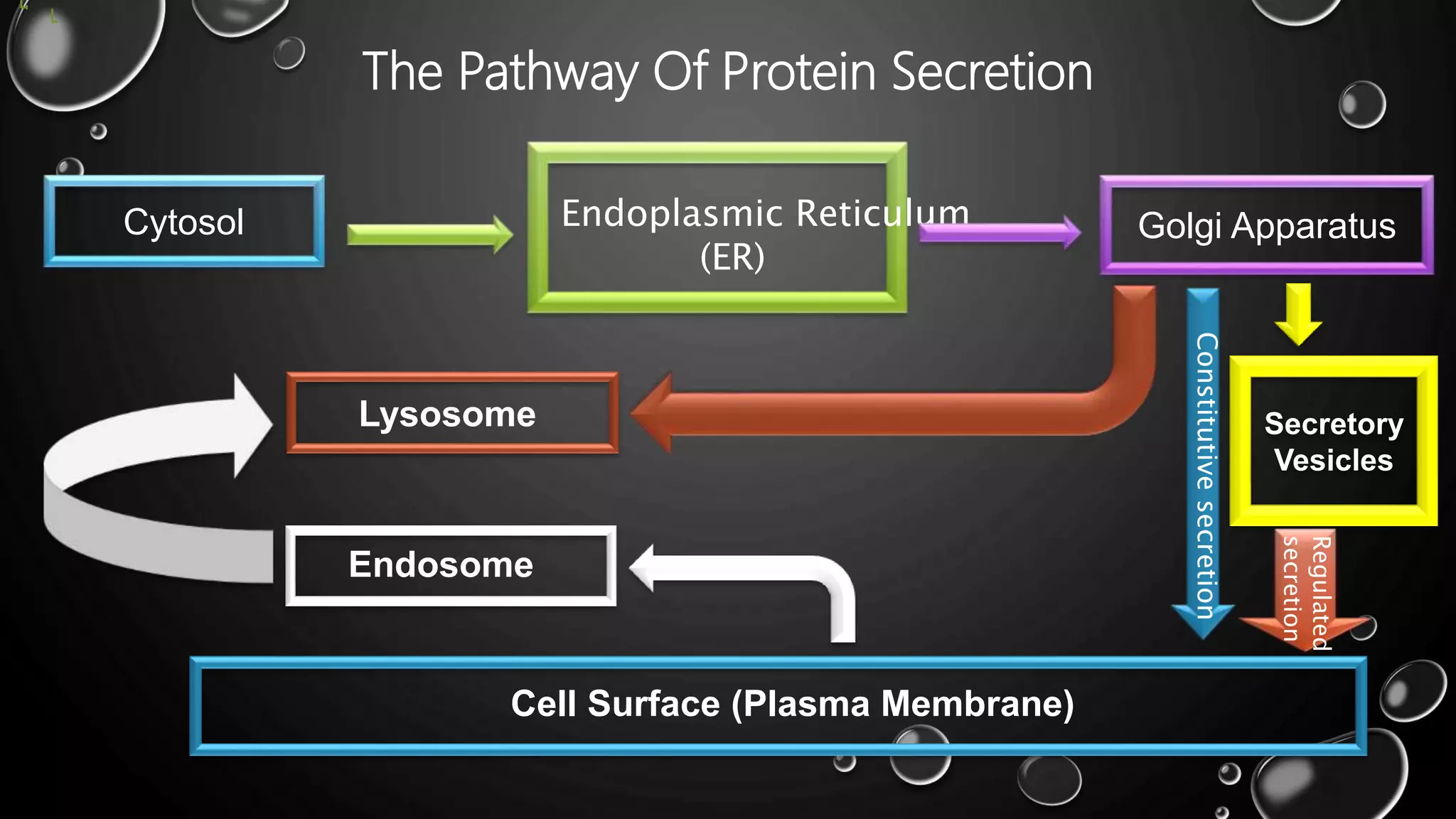
The Pathway Of Protein Secretion
Cytosol Endoplasmic Reticulum
(ER)
Golgi Apparatus
Lysosome
Endosome
Cell Surface (Plasma Membrane)
Secretory
Vesicles
Constitutive
secretion
Regulated
secretion
Endoplasmic reticulum
(er)
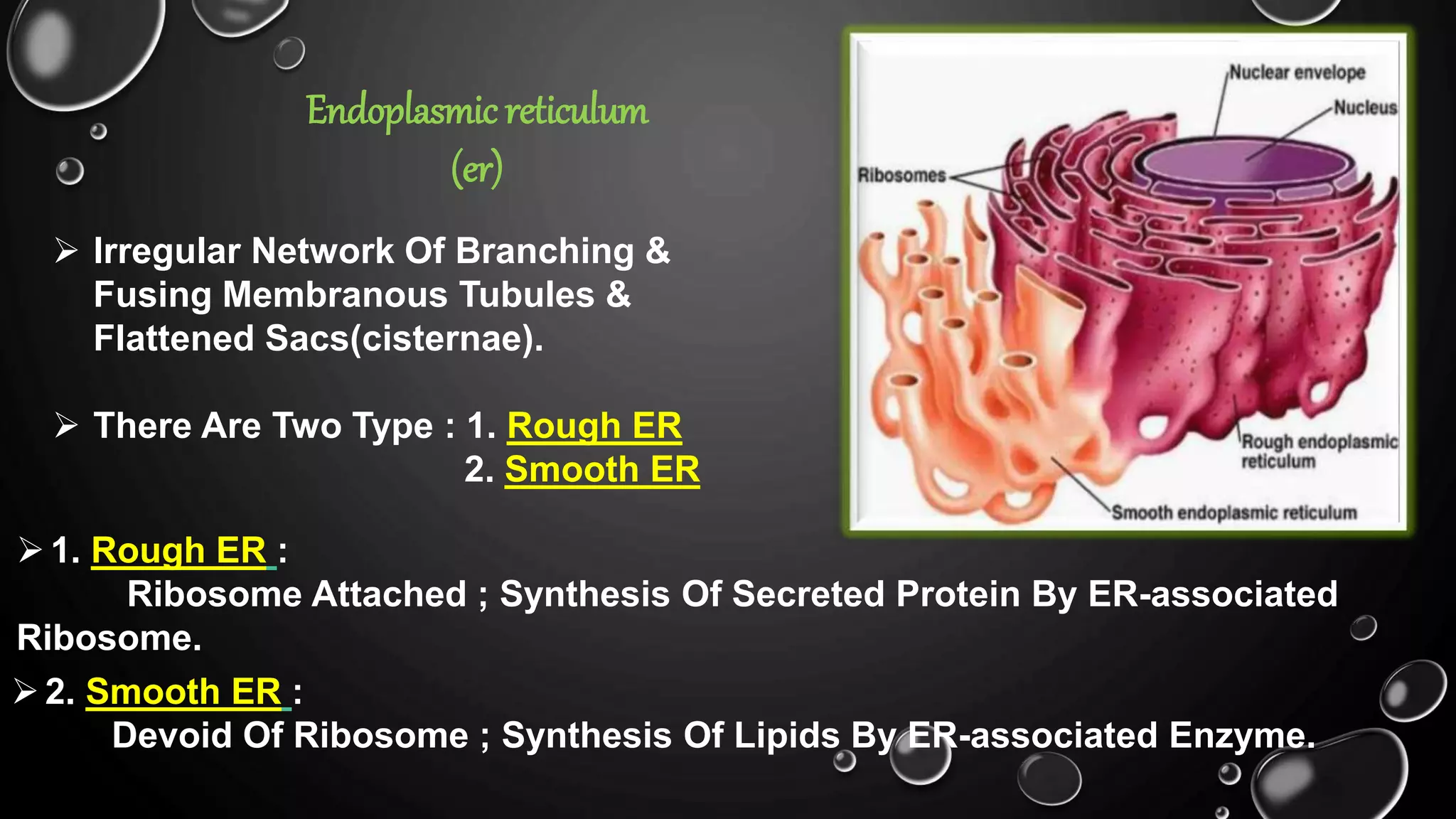
 Irregular Network Of Branching &
Fusing Membranous Tubules &
Flattened Sacs(cisternae).
 There Are Two Type : 1. Rough ER
2. Smooth ER
2. Smooth ER :
Devoid Of Ribosome ; Synthesis Of Lipids By ER-associated Enzyme.
1. Rough ER :
Ribosome Attached ; Synthesis Of Secreted Protein By ER-associated
Ribosome.
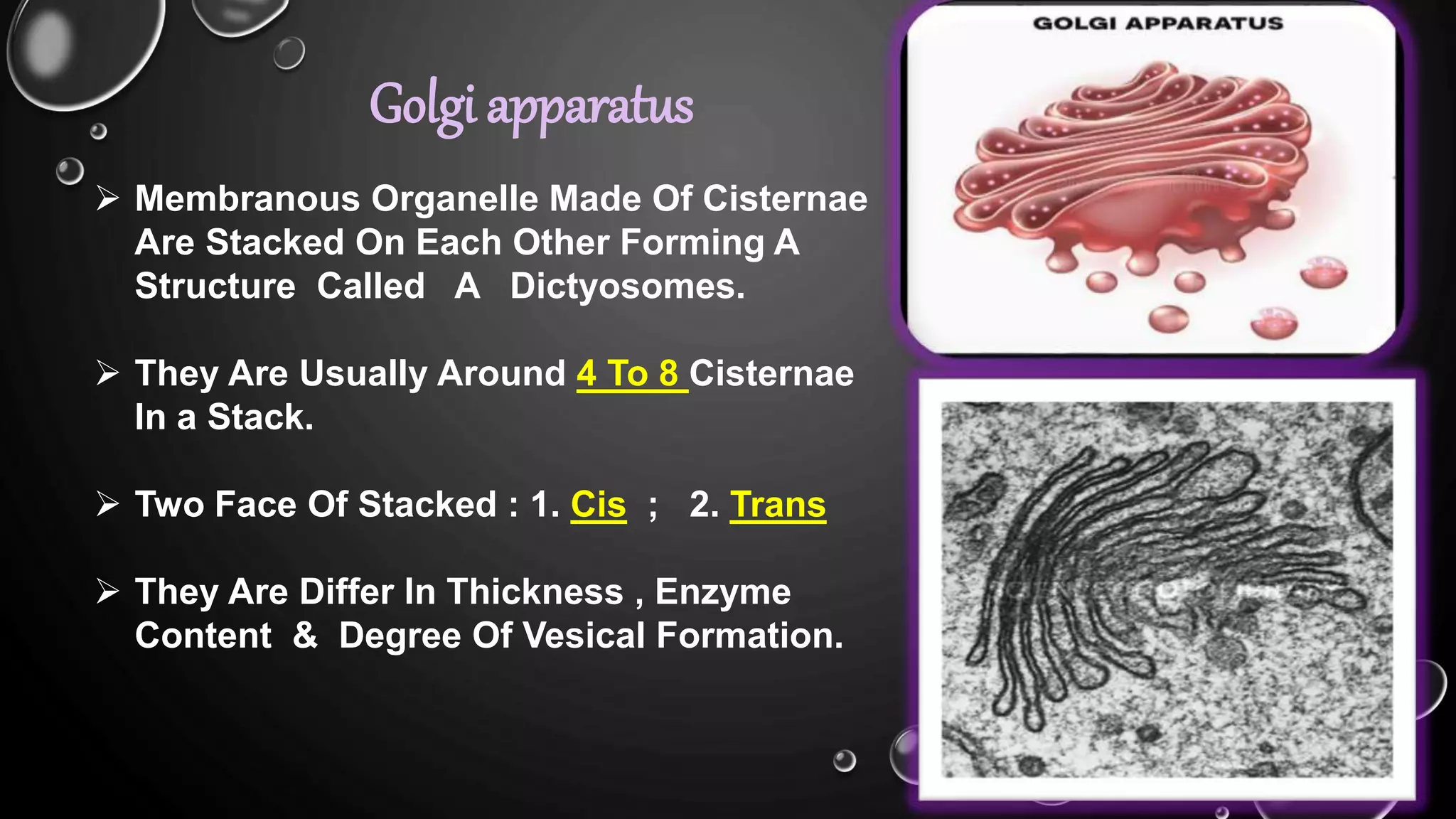
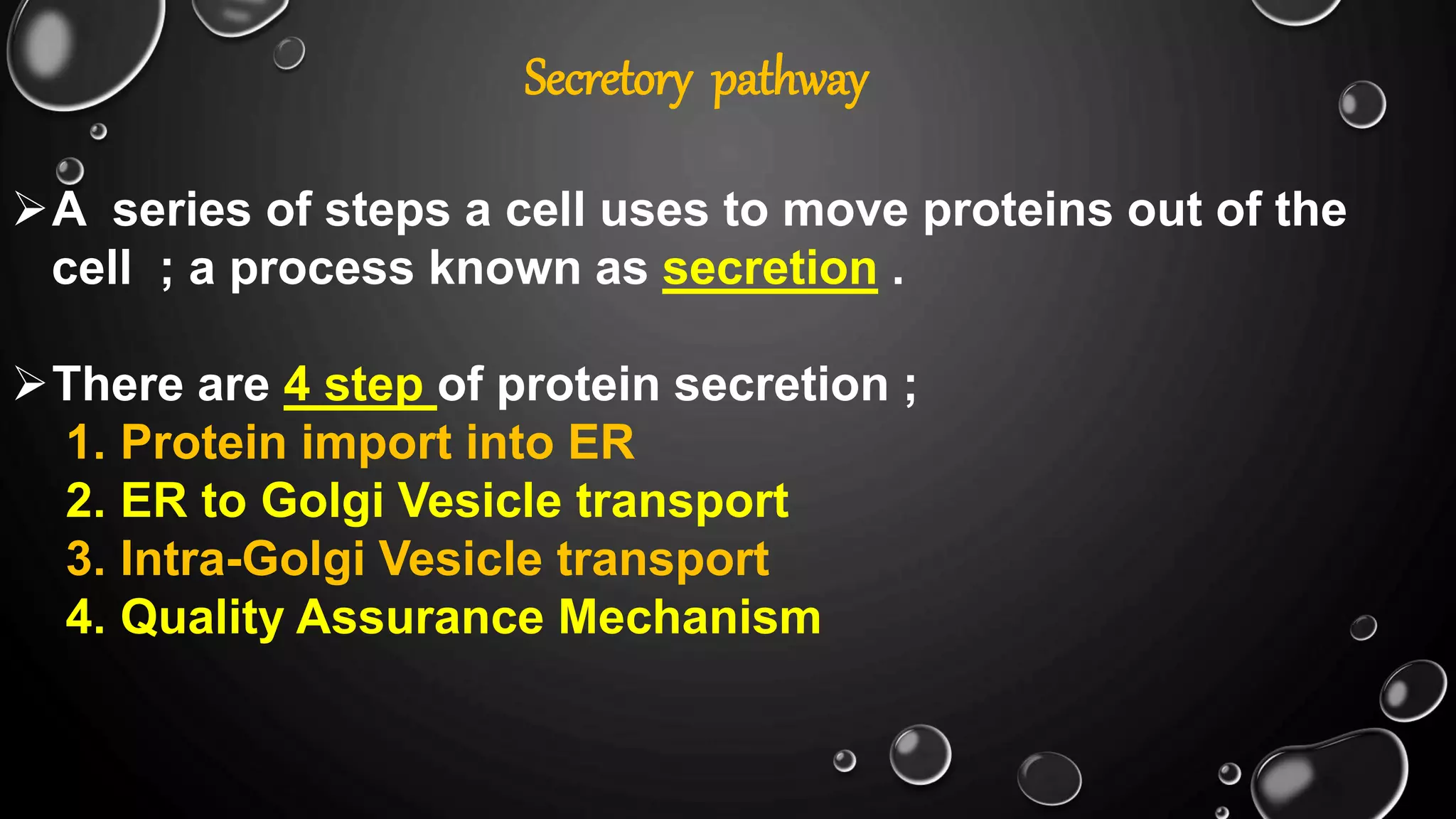
Golgi apparatus
 Membranous Organelle Made Of Cisternae
Are Stacked On Each Other Forming A
Structure Called A Dictyosomes.
 They Are Usually Around 4 To 8 Cisternae
In a Stack.
 Two Face Of Stacked : 1. Cis ; 2. Trans
 They Are Differ In Thickness , Enzyme
Content & Degree Of Vesical Formation.
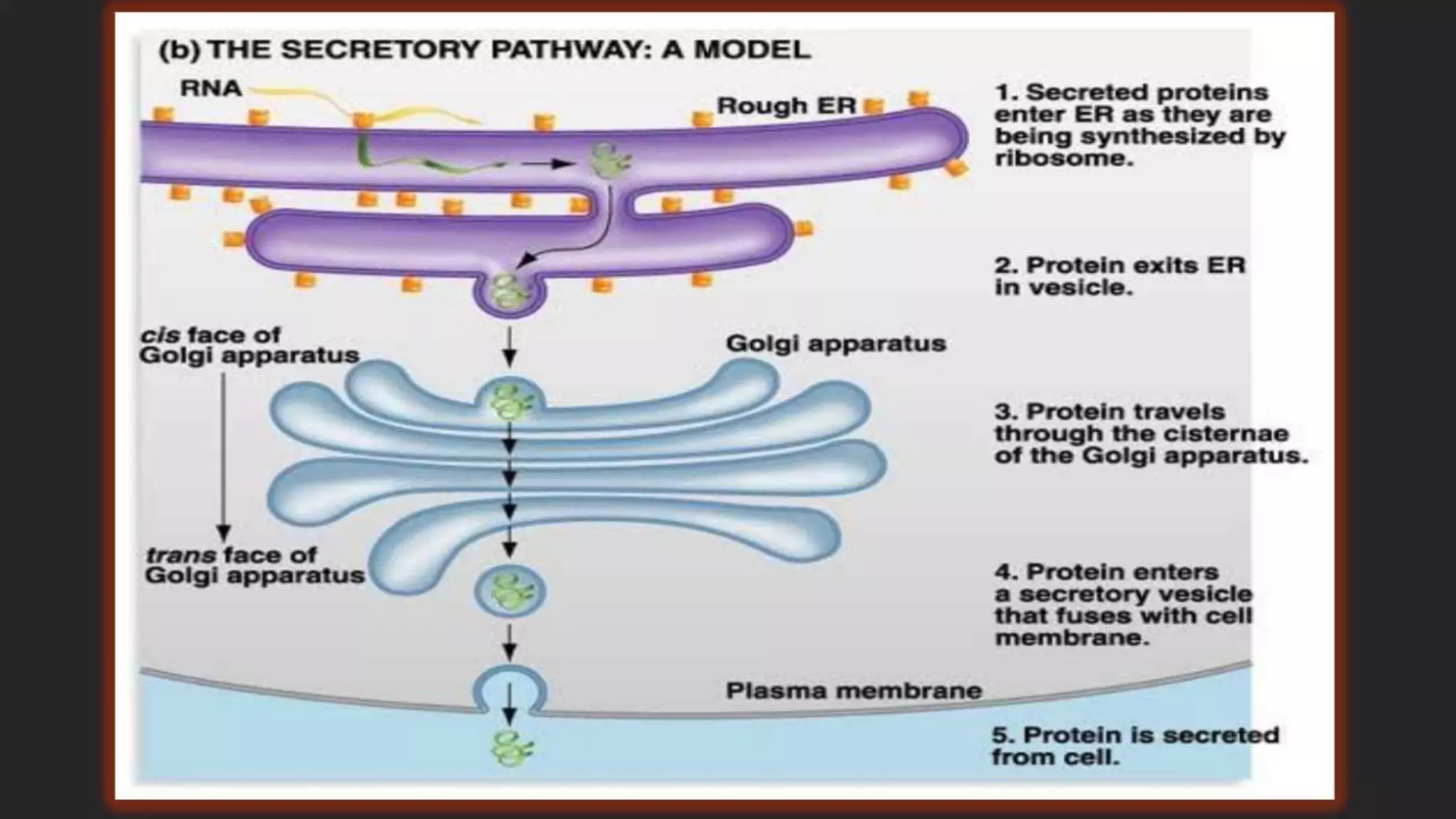
Secretory pathway
A series of steps a cell uses to move proteins out of the
cell ; a process known as secretion .
There are 4 step of protein secretion ;
1. Protein import into ER
2. ER to Golgi Vesicle transport
3. Intra-Golgi Vesicle transport
4. Quality Assurance Mechanism
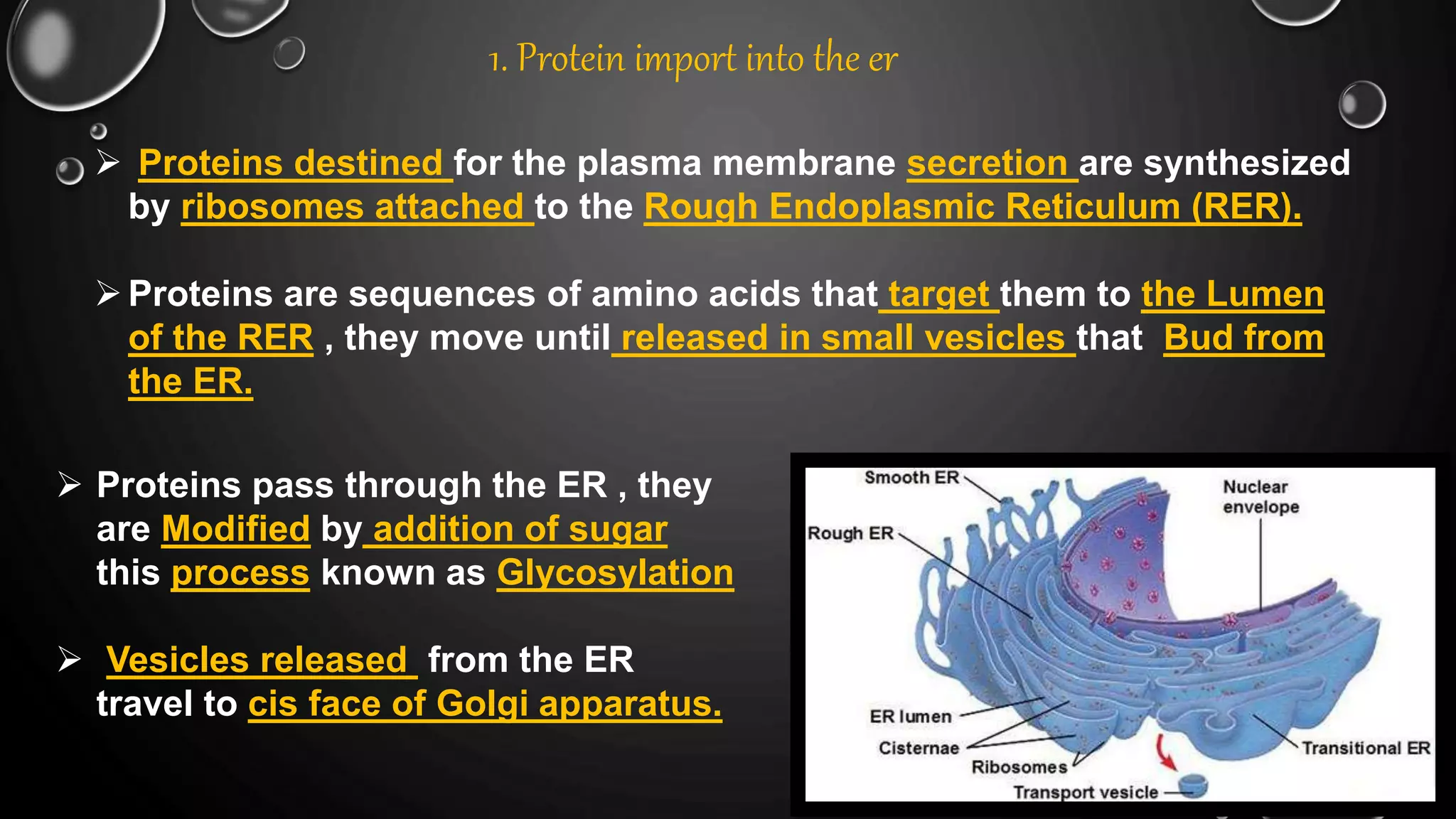
1. Protein import into the er
 Proteins destined for the plasma membrane secretion are synthesized
by ribosomes attached to the Rough Endoplasmic Reticulum (RER).
Proteins are sequences of amino acids that target them to the Lumen
of the RER , they move until released in small vesicles that Bud from
the ER.
 Proteins pass through the ER , they
are Modified by addition of sugar
this process known as Glycosylation
 Vesicles released from the ER
travel to cis face of Golgi apparatus.
2. ER to golgi vesicle transport
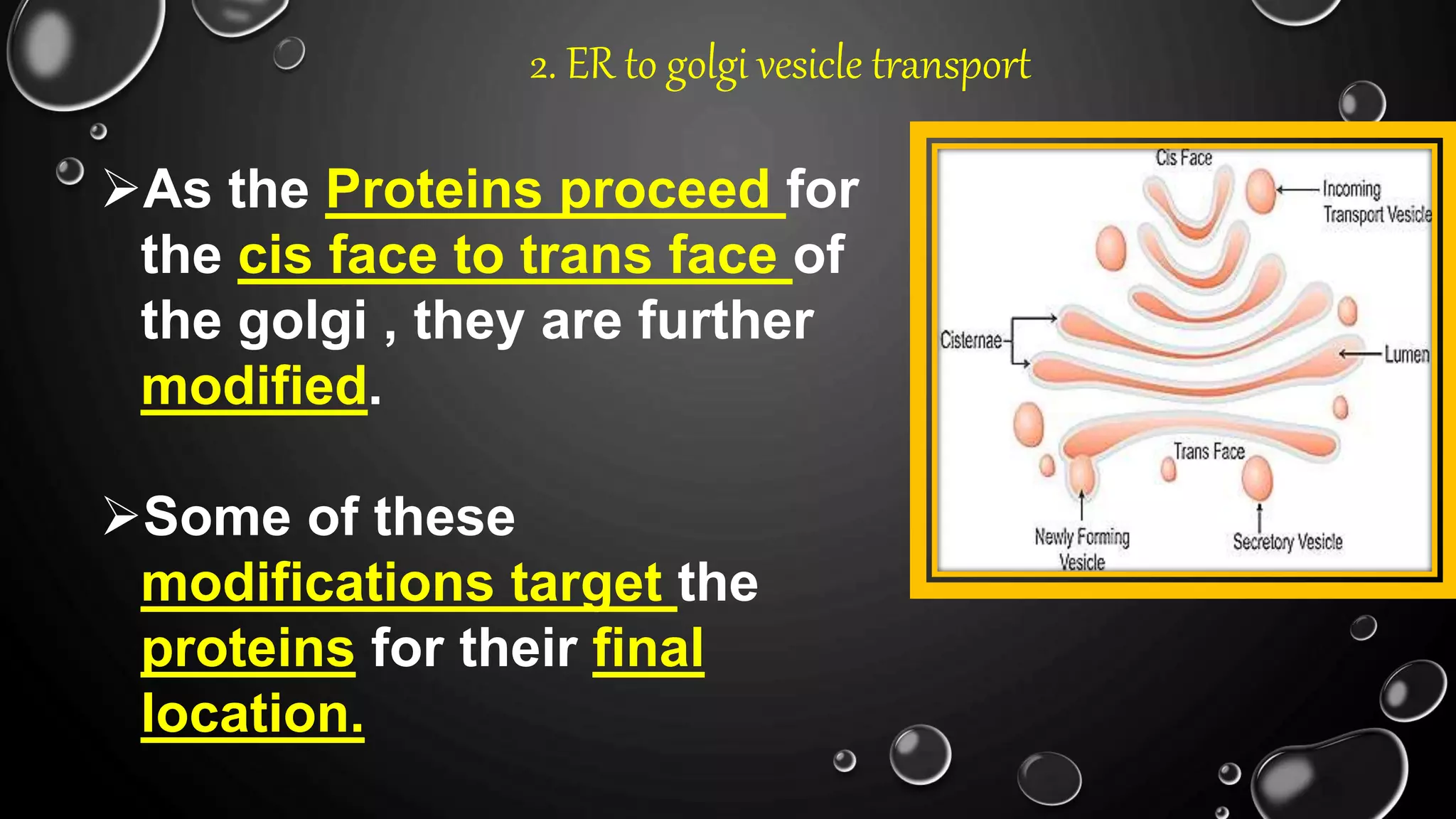
As the Proteins proceed for
the cis face to trans face of
the golgi , they are further
modified.
Some of these
modifications target the
proteins for their final
location.
3. intra-golgi vesicle transport
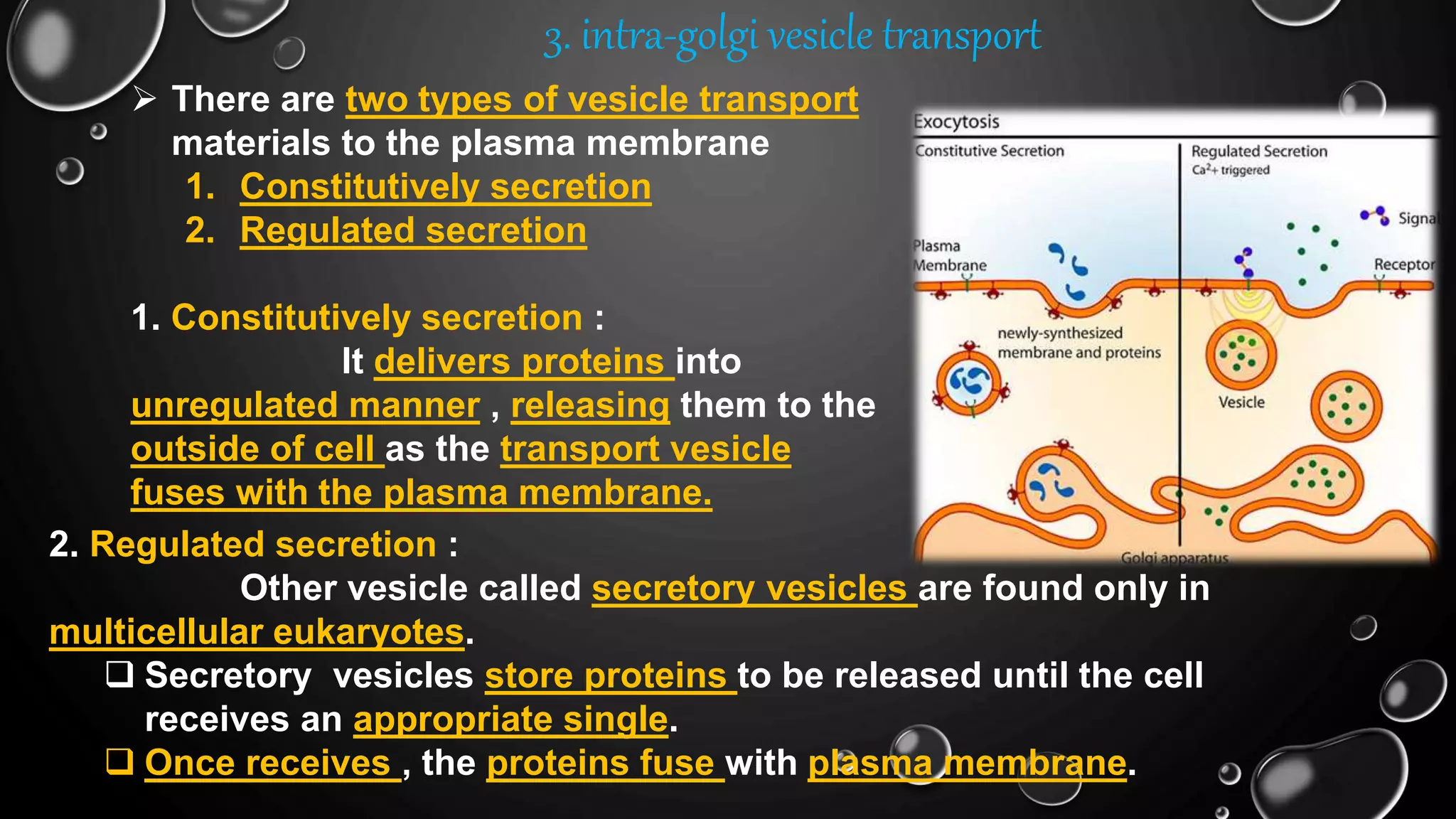
 There are two types of vesicle transport
materials to the plasma membrane
1. Constitutively secretion
2. Regulated secretion
1. Constitutively secretion :
It delivers proteins into
unregulated manner , releasing them to the
outside of cell as the transport vesicle
fuses with the plasma membrane.
2. Regulated secretion :
Other vesicle called secretory vesicles are found only in
multicellular eukaryotes.
 Secretory vesicles store proteins to be released until the cell
receives an appropriate single.
 Once receives , the proteins fuse with plasma membrane.
4. Quality assurance mechanism
Important feature of the
secretory pathway is its quality
assurance mechanism.
Proteins that fail to fold or
have misfolded are not
transported to their intended
destination.
Instead they are released into
the cytosol where they are
targeted for destruction by the
attachment of several small
ubiquitin polypeptides.
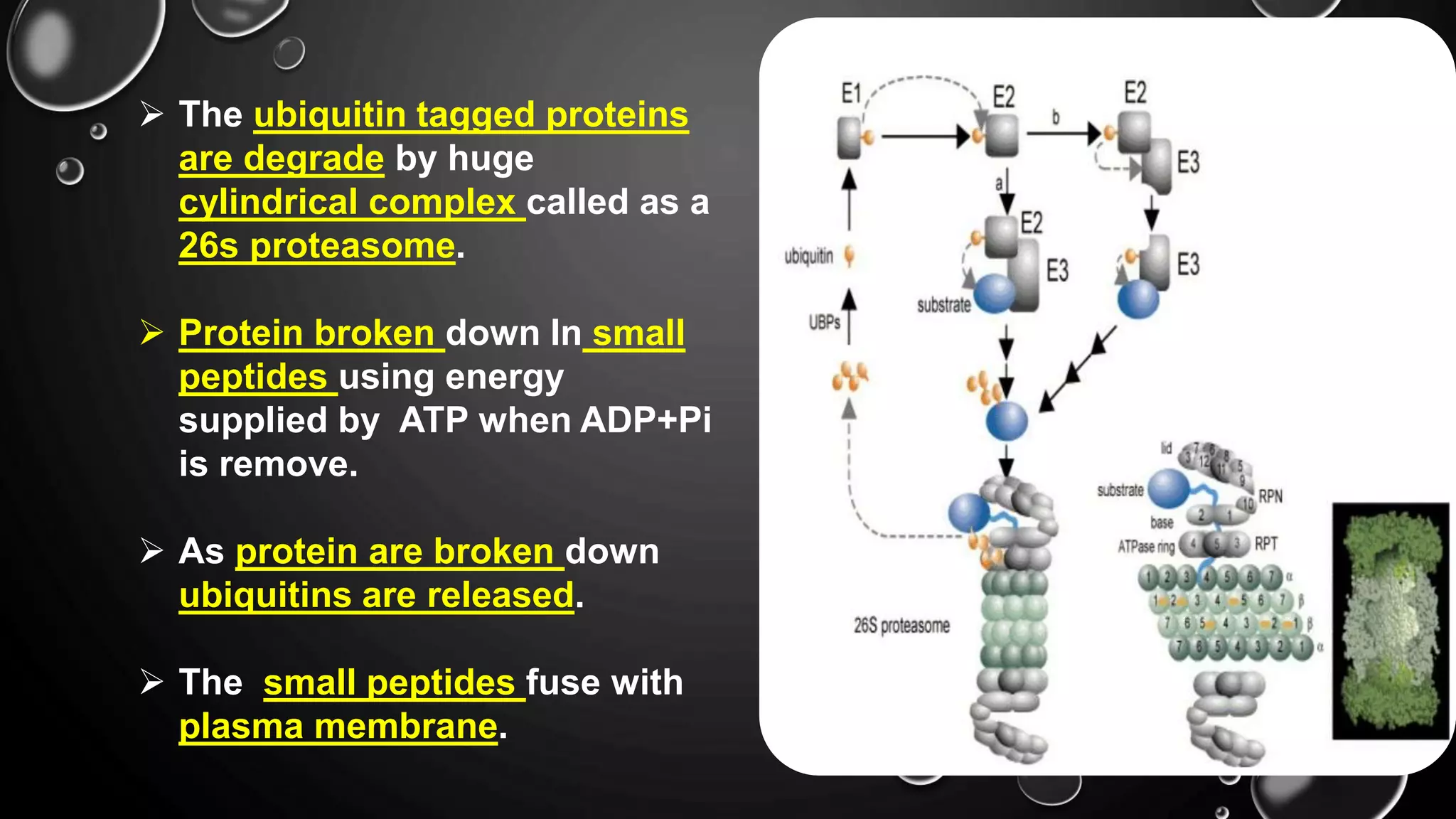
 The ubiquitin tagged proteins
are degrade by huge
cylindrical complex called as a
26s proteasome.
 Protein broken down In small
peptides using energy
supplied by ATP when ADP+Pi
is remove.
 As protein are broken down
ubiquitins are released.
 The small peptides fuse with
plasma membrane.
Thank you

Secretory Pathway.ppt (T.Y. Bsc).pptx

  • 1.
    Presented by :Jinal Mehta T.Y.BSC(microbiology)
  • 2.
     The Cytoplasamof Eukaryotic Cells Is Permeated With An Intricate Complex Of Membranous Organelles & Vesicles That Move Materials Into The Cell Inside To Outside As Well As from Location To Location Within cell Is Known As Secretory Pathway.  It Used To Move Materials To Various Sites Within The Cell , As Well As To Either The Plasma Membrane Or Cell Exterior. What is secretory pathway…?
  • 3.
    The Pathway OfProtein Secretion Cytosol Endoplasmic Reticulum (ER) Golgi Apparatus Lysosome Endosome Cell Surface (Plasma Membrane) Secretory Vesicles Constitutive secretion Regulated secretion
  • 4.
    Endoplasmic reticulum (er)  IrregularNetwork Of Branching & Fusing Membranous Tubules & Flattened Sacs(cisternae).  There Are Two Type : 1. Rough ER 2. Smooth ER 2. Smooth ER : Devoid Of Ribosome ; Synthesis Of Lipids By ER-associated Enzyme. 1. Rough ER : Ribosome Attached ; Synthesis Of Secreted Protein By ER-associated Ribosome.
  • 5.
    Golgi apparatus  MembranousOrganelle Made Of Cisternae Are Stacked On Each Other Forming A Structure Called A Dictyosomes.  They Are Usually Around 4 To 8 Cisternae In a Stack.  Two Face Of Stacked : 1. Cis ; 2. Trans  They Are Differ In Thickness , Enzyme Content & Degree Of Vesical Formation.
  • 6.
    Secretory pathway A seriesof steps a cell uses to move proteins out of the cell ; a process known as secretion . There are 4 step of protein secretion ; 1. Protein import into ER 2. ER to Golgi Vesicle transport 3. Intra-Golgi Vesicle transport 4. Quality Assurance Mechanism
  • 8.
    1. Protein importinto the er  Proteins destined for the plasma membrane secretion are synthesized by ribosomes attached to the Rough Endoplasmic Reticulum (RER). Proteins are sequences of amino acids that target them to the Lumen of the RER , they move until released in small vesicles that Bud from the ER.  Proteins pass through the ER , they are Modified by addition of sugar this process known as Glycosylation  Vesicles released from the ER travel to cis face of Golgi apparatus.
  • 9.
    2. ER togolgi vesicle transport As the Proteins proceed for the cis face to trans face of the golgi , they are further modified. Some of these modifications target the proteins for their final location.
  • 10.
    3. intra-golgi vesicletransport  There are two types of vesicle transport materials to the plasma membrane 1. Constitutively secretion 2. Regulated secretion 1. Constitutively secretion : It delivers proteins into unregulated manner , releasing them to the outside of cell as the transport vesicle fuses with the plasma membrane. 2. Regulated secretion : Other vesicle called secretory vesicles are found only in multicellular eukaryotes.  Secretory vesicles store proteins to be released until the cell receives an appropriate single.  Once receives , the proteins fuse with plasma membrane.
  • 11.
    4. Quality assurancemechanism Important feature of the secretory pathway is its quality assurance mechanism. Proteins that fail to fold or have misfolded are not transported to their intended destination. Instead they are released into the cytosol where they are targeted for destruction by the attachment of several small ubiquitin polypeptides.
  • 12.
     The ubiquitintagged proteins are degrade by huge cylindrical complex called as a 26s proteasome.  Protein broken down In small peptides using energy supplied by ATP when ADP+Pi is remove.  As protein are broken down ubiquitins are released.  The small peptides fuse with plasma membrane.
  • 13.