Motivation
Summary
Strengths/Economic Arguments
Critics
Does Piped Water Reduce Diarrhea for children in
Rural India?
Jyotsna Jalan and Martin Ravallion
Lucie ASSONFACK KANA,TOE Newton and Wilfried
ADOHINZIN
African School Of Economics
Fall 2016
Lucie, Newton and Wilfried Does Piped Water Reduce Diarrhea for children in Rural India?
Motivation
Summary
Strengths/Economic Arguments
Critics
Motivation/Background
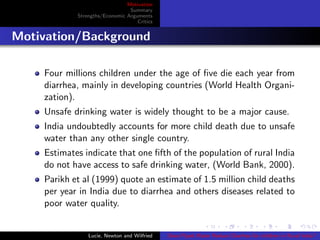
Four millions children under the age of five die each year from
diarrhea, mainly in developing countries (World Health Organi-
zation).
Unsafe drinking water is widely thought to be a major cause.
India undoubtedly accounts for more child death due to unsafe
water than any other single country.
Estimates indicate that one fifth of the population of rural India
do not have access to safe drinking water, (World Bank, 2000).
Parikh et al (1999) quote an estimate of 1.5 million child deaths
per year in India due to diarrhea and others diseases related to
poor water quality.
Lucie, Newton and Wilfried Does Piped Water Reduce Diarrhea for children in Rural India?
Motivation
Summary
Strengths/Economic Arguments
Critics
Research Objectives
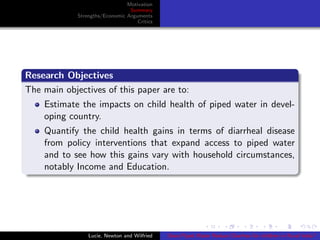
The main objectives of this paper are to:
Estimate the impacts on child health of piped water in devel-
oping country.
Quantify the child health gains in terms of diarrheal disease
from policy interventions that expand access to piped water
and to see how this gains vary with household circumstances,
notably Income and Education.
Lucie, Newton and Wilfried Does Piped Water Reduce Diarrhea for children in Rural India?
Motivation
Summary
Strengths/Economic Arguments
Critics
Research Questions
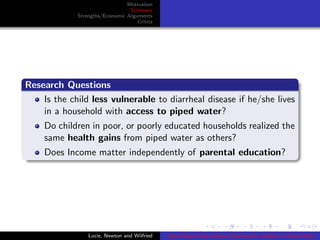
Is the child less vulnerable to diarrheal disease if he/she lives
in a household with access to piped water?
Do children in poor, or poorly educated households realized the
same health gains from piped water as others?
Does Income matter independently of parental education?
Lucie, Newton and Wilfried Does Piped Water Reduce Diarrhea for children in Rural India?
Motivation
Summary
Strengths/Economic Arguments
Critics
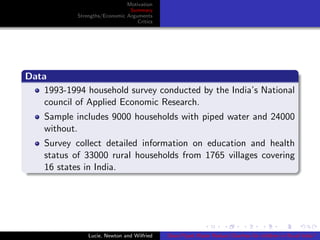
Data
1993-1994 household survey conducted by the India’s National
council of Applied Economic Research.
Sample includes 9000 households with piped water and 24000
without.
Survey collect detailed information on education and health
status of 33000 rural households from 1765 villages covering
16 states in India.
Lucie, Newton and Wilfried Does Piped Water Reduce Diarrhea for children in Rural India?
Motivation
Summary
Strengths/Economic Arguments
Critics
Identification Strategy
Propensity Score Matching
Two groups are identified:
Households with access to piped water(Di = 1) and
Households with no access(Di = 0).
So propensity score for individual i is given by:
P(xi) = Prob(Di = 1|xi), 0 < P(xi) < 1 (1)
Where xi is a vector of pre-exposure control variable.
Nearest neighbor to the i’th treated is defined as the non-treated
that minimizes [P(xi) − P(xj)]2 over all j in the set of non-
participant.
Lucie, Newton and Wilfried Does Piped Water Reduce Diarrhea for children in Rural India?
Motivation
Summary
Strengths/Economic Arguments
Critics
Propensity Score Matching
P(xk) is the predicted odd ratio for observation k ie,
P(xi) =
ˆP(xi)
1 − ˆP(xi)
(2)
Let ∆Hj denote the gain in health status for the j’th child
attributable to access to piped water, the estimator of mean
impact is:
¯∆H =
T
j=1
ωj(hj1 −
C
i=1
Wijhij0) (3)
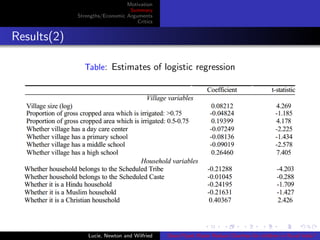
The propensity scores are estimated using a logistic regression.
Lucie, Newton and Wilfried Does Piped Water Reduce Diarrhea for children in Rural India?
Motivation
Summary
Strengths/Economic Arguments
Critics
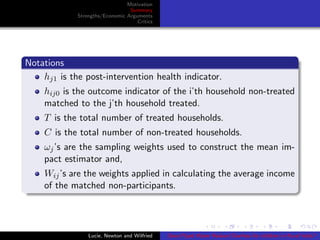
Notations
hj1 is the post-intervention health indicator.
hij0 is the outcome indicator of the i’th household non-treated
matched to the j’th household treated.
T is the total number of treated households.
C is the total number of non-treated households.
ωj’s are the sampling weights used to construct the mean im-
pact estimator and,
Wij’s are the weights applied in calculating the average income
of the matched non-participants.
Lucie, Newton and Wilfried Does Piped Water Reduce Diarrhea for children in Rural India?
Motivation
Summary
Strengths/Economic Arguments
Critics
The Behavioural Model
Level of spending is chosen by parents to maximize
U(y − s, w, x) + h(s, w, x) (4)
U is the utility of the parents and h indicates the child health.
Given the optimal spending by the parents, their maximum util-
ity is given by:
V (w, y, x) ≡ H(w, y, x) + U(y − s(w, y, x), w, x) (5)
Child health when parental inputs are optimal is
H(w, y, x) = h(s(w, y, x), w, x)) (6)
Lucie, Newton and Wilfried Does Piped Water Reduce Diarrhea for children in Rural India?
Motivation
Summary
Strengths/Economic Arguments
Critics
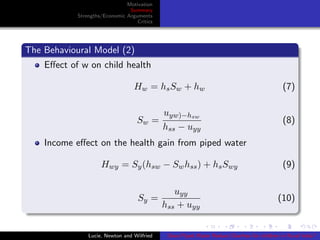
The Behavioural Model (2)
Effect of w on child health
Hw = hsSw + hw (7)
Sw =
uyw)−hsw
hss − uyy
(8)
Income effect on the health gain from piped water
Hwy = Sy(hsw − Swhss) + hsSwy (9)
Sy =
uyy
hss + uyy
(10)
Lucie, Newton and Wilfried Does Piped Water Reduce Diarrhea for children in Rural India?
Motivation
Summary
Strengths/Economic Arguments
Critics
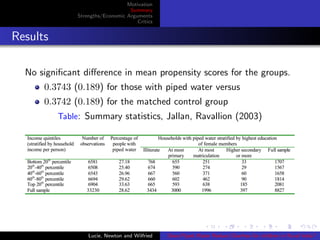
Results
No significant difference in mean propensity scores for the groups.
0.3743 (0.189) for those with piped water versus
0.3742 (0.189) for the matched control group
Table: Summary statistics, Jallan, Ravallion (2003)
Lucie, Newton and Wilfried Does Piped Water Reduce Diarrhea for children in Rural India?
Motivation
Summary
Strengths/Economic Arguments
Critics
Results(2)
Table: Estimates of logistic regression
Lucie, Newton and Wilfried Does Piped Water Reduce Diarrhea for children in Rural India?
Motivation
Summary
Strengths/Economic Arguments
Critics
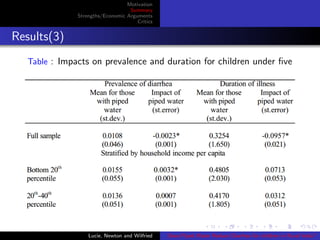
Results(3)
Table : Impacts on prevalence and duration for children under five
Lucie, Newton and Wilfried Does Piped Water Reduce Diarrhea for children in Rural India?
Motivation
Summary
Strengths/Economic Arguments
Critics
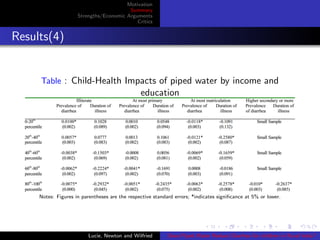
Results(4)
Table : Child-Health Impacts of piped water by income and
education
Notes: Figures in parentheses are the respective standard errors; *indicates significance at 5% or lower.
Lucie, Newton and Wilfried Does Piped Water Reduce Diarrhea for children in Rural India?
Motivation
Summary
Strengths/Economic Arguments
Critics
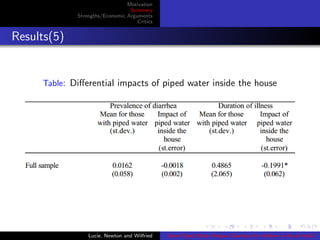
Results(5)
Table: Differential impacts of piped water inside the house
Lucie, Newton and Wilfried Does Piped Water Reduce Diarrhea for children in Rural India?
Motivation
Summary
Strengths/Economic Arguments
Critics
Conclusion
We find significantly lower prevalence and duration of the dis-
ease for children living in households with piped water as com-
pared to a comparison group of households matched on the
basis of their propensity scores. However, matching at village
level instead does not indicate lower diarrhea prevalence or du-
ration.
There are striking differences in child-health gains from piped
water according to family income and adult female education.
Lucie, Newton and Wilfried Does Piped Water Reduce Diarrhea for children in Rural India?
Motivation
Summary
Strengths/Economic Arguments
Critics
Conclusion
Health gains from piped water tend to be lower for children
with less well-educated women in the household.
When we look at only the sub-sample of households with access
to either source of piped water and compare the prevalence and
duration of diarrhea among children under five across house-
holds with access from a tap inside the house versus access via
a public tap we find two striking effects: first the duration of
illness is reduced significantly if households have drinking water
source within the premise.
Second, the impact is greater in household where the female
member is illiterate.
Lucie, Newton and Wilfried Does Piped Water Reduce Diarrhea for children in Rural India?
Motivation
Summary
Strengths/Economic Arguments
Critics
Strengths
This paper explained that combined infrastructure investments
with effective public action to promote health knowledge and
income poverty reduction in order to improve child’s health
while recent study. August Ghooli et al. (2015) did not.
Jalan and Ravallion compares outcome indicators using indi-
vidual PSM versus village PSM jointly, which was not done in
previous studies, Esrey et al., (1991).
With the PSM procedure, only 650 households were lost in the
process over 33000 (about 2%).
Strong external validity as the context in India is very similar
to that of many other countries especially in Africa.
Lucie, Newton and Wilfried Does Piped Water Reduce Diarrhea for children in Rural India?
Motivation
Summary
Strengths/Economic Arguments
Critics
Strengths (2)
This paper uses rich data for analysis which is a key ingredient
to well-written research paper.
Unlike other papers that just measure the impact of pipe water
on health of a child, this paper is the only paper that saw in-
depth relevance and roles mothers play in the health status of
a child.
To reduce morbidity and mortality in developing countries, this
paper is necessary for policy makers to implement particularly
applicable in rural areas.
Lucie, Newton and Wilfried Does Piped Water Reduce Diarrhea for children in Rural India?
Motivation
Summary
Strengths/Economic Arguments
Critics
Some critics/limitations
This study uses only PSM, a non-experimental method to esti-
mate casual effect of treatment on controls which is subject to
two specific critics:
PSM accounts for observed (and observable) covariates, Garido
MM et al. (2014), Shadish, W. R; Cook, T. D. Campebll (2002).
Judea Pearl (2009) argues that bias may rise due to increase in
heterogeneity in unobserved factors.
Diarrhea is mostly a result of malnutrition and infection (World
Health Organization) for children under five years and malnu-
trition is a result of poor diet or unbalanced diet or even food
poison. Important factors might be omitted and end up then
in the error term.
Lucie, Newton and Wilfried Does Piped Water Reduce Diarrhea for children in Rural India?

Second[3]

  • 1.
    Motivation Summary Strengths/Economic Arguments Critics Does PipedWater Reduce Diarrhea for children in Rural India? Jyotsna Jalan and Martin Ravallion Lucie ASSONFACK KANA,TOE Newton and Wilfried ADOHINZIN African School Of Economics Fall 2016 Lucie, Newton and Wilfried Does Piped Water Reduce Diarrhea for children in Rural India?
  • 2.
    Motivation Summary Strengths/Economic Arguments Critics Motivation/Background Four millionschildren under the age of five die each year from diarrhea, mainly in developing countries (World Health Organi- zation). Unsafe drinking water is widely thought to be a major cause. India undoubtedly accounts for more child death due to unsafe water than any other single country. Estimates indicate that one fifth of the population of rural India do not have access to safe drinking water, (World Bank, 2000). Parikh et al (1999) quote an estimate of 1.5 million child deaths per year in India due to diarrhea and others diseases related to poor water quality. Lucie, Newton and Wilfried Does Piped Water Reduce Diarrhea for children in Rural India?
  • 3.
    Motivation Summary Strengths/Economic Arguments Critics Research Objectives Themain objectives of this paper are to: Estimate the impacts on child health of piped water in devel- oping country. Quantify the child health gains in terms of diarrheal disease from policy interventions that expand access to piped water and to see how this gains vary with household circumstances, notably Income and Education. Lucie, Newton and Wilfried Does Piped Water Reduce Diarrhea for children in Rural India?
  • 4.
    Motivation Summary Strengths/Economic Arguments Critics Research Questions Isthe child less vulnerable to diarrheal disease if he/she lives in a household with access to piped water? Do children in poor, or poorly educated households realized the same health gains from piped water as others? Does Income matter independently of parental education? Lucie, Newton and Wilfried Does Piped Water Reduce Diarrhea for children in Rural India?
  • 5.
    Motivation Summary Strengths/Economic Arguments Critics Data 1993-1994 householdsurvey conducted by the India’s National council of Applied Economic Research. Sample includes 9000 households with piped water and 24000 without. Survey collect detailed information on education and health status of 33000 rural households from 1765 villages covering 16 states in India. Lucie, Newton and Wilfried Does Piped Water Reduce Diarrhea for children in Rural India?
  • 6.
    Motivation Summary Strengths/Economic Arguments Critics Identification Strategy PropensityScore Matching Two groups are identified: Households with access to piped water(Di = 1) and Households with no access(Di = 0). So propensity score for individual i is given by: P(xi) = Prob(Di = 1|xi), 0 < P(xi) < 1 (1) Where xi is a vector of pre-exposure control variable. Nearest neighbor to the i’th treated is defined as the non-treated that minimizes [P(xi) − P(xj)]2 over all j in the set of non- participant. Lucie, Newton and Wilfried Does Piped Water Reduce Diarrhea for children in Rural India?
  • 7.
    Motivation Summary Strengths/Economic Arguments Critics Propensity ScoreMatching P(xk) is the predicted odd ratio for observation k ie, P(xi) = ˆP(xi) 1 − ˆP(xi) (2) Let ∆Hj denote the gain in health status for the j’th child attributable to access to piped water, the estimator of mean impact is: ¯∆H = T j=1 ωj(hj1 − C i=1 Wijhij0) (3) The propensity scores are estimated using a logistic regression. Lucie, Newton and Wilfried Does Piped Water Reduce Diarrhea for children in Rural India?
  • 8.
    Motivation Summary Strengths/Economic Arguments Critics Notations hj1 isthe post-intervention health indicator. hij0 is the outcome indicator of the i’th household non-treated matched to the j’th household treated. T is the total number of treated households. C is the total number of non-treated households. ωj’s are the sampling weights used to construct the mean im- pact estimator and, Wij’s are the weights applied in calculating the average income of the matched non-participants. Lucie, Newton and Wilfried Does Piped Water Reduce Diarrhea for children in Rural India?
  • 9.
    Motivation Summary Strengths/Economic Arguments Critics The BehaviouralModel Level of spending is chosen by parents to maximize U(y − s, w, x) + h(s, w, x) (4) U is the utility of the parents and h indicates the child health. Given the optimal spending by the parents, their maximum util- ity is given by: V (w, y, x) ≡ H(w, y, x) + U(y − s(w, y, x), w, x) (5) Child health when parental inputs are optimal is H(w, y, x) = h(s(w, y, x), w, x)) (6) Lucie, Newton and Wilfried Does Piped Water Reduce Diarrhea for children in Rural India?
  • 10.
    Motivation Summary Strengths/Economic Arguments Critics The BehaviouralModel (2) Effect of w on child health Hw = hsSw + hw (7) Sw = uyw)−hsw hss − uyy (8) Income effect on the health gain from piped water Hwy = Sy(hsw − Swhss) + hsSwy (9) Sy = uyy hss + uyy (10) Lucie, Newton and Wilfried Does Piped Water Reduce Diarrhea for children in Rural India?
  • 11.
    Motivation Summary Strengths/Economic Arguments Critics Results No significantdifference in mean propensity scores for the groups. 0.3743 (0.189) for those with piped water versus 0.3742 (0.189) for the matched control group Table: Summary statistics, Jallan, Ravallion (2003) Lucie, Newton and Wilfried Does Piped Water Reduce Diarrhea for children in Rural India?
  • 12.
    Motivation Summary Strengths/Economic Arguments Critics Results(2) Table: Estimatesof logistic regression Lucie, Newton and Wilfried Does Piped Water Reduce Diarrhea for children in Rural India?
  • 13.
    Motivation Summary Strengths/Economic Arguments Critics Results(3) Table :Impacts on prevalence and duration for children under five Lucie, Newton and Wilfried Does Piped Water Reduce Diarrhea for children in Rural India?
  • 14.
    Motivation Summary Strengths/Economic Arguments Critics Results(4) Table :Child-Health Impacts of piped water by income and education Notes: Figures in parentheses are the respective standard errors; *indicates significance at 5% or lower. Lucie, Newton and Wilfried Does Piped Water Reduce Diarrhea for children in Rural India?
  • 15.
    Motivation Summary Strengths/Economic Arguments Critics Results(5) Table: Differentialimpacts of piped water inside the house Lucie, Newton and Wilfried Does Piped Water Reduce Diarrhea for children in Rural India?
  • 16.
    Motivation Summary Strengths/Economic Arguments Critics Conclusion We findsignificantly lower prevalence and duration of the dis- ease for children living in households with piped water as com- pared to a comparison group of households matched on the basis of their propensity scores. However, matching at village level instead does not indicate lower diarrhea prevalence or du- ration. There are striking differences in child-health gains from piped water according to family income and adult female education. Lucie, Newton and Wilfried Does Piped Water Reduce Diarrhea for children in Rural India?
  • 17.
    Motivation Summary Strengths/Economic Arguments Critics Conclusion Health gainsfrom piped water tend to be lower for children with less well-educated women in the household. When we look at only the sub-sample of households with access to either source of piped water and compare the prevalence and duration of diarrhea among children under five across house- holds with access from a tap inside the house versus access via a public tap we find two striking effects: first the duration of illness is reduced significantly if households have drinking water source within the premise. Second, the impact is greater in household where the female member is illiterate. Lucie, Newton and Wilfried Does Piped Water Reduce Diarrhea for children in Rural India?
  • 18.
    Motivation Summary Strengths/Economic Arguments Critics Strengths This paperexplained that combined infrastructure investments with effective public action to promote health knowledge and income poverty reduction in order to improve child’s health while recent study. August Ghooli et al. (2015) did not. Jalan and Ravallion compares outcome indicators using indi- vidual PSM versus village PSM jointly, which was not done in previous studies, Esrey et al., (1991). With the PSM procedure, only 650 households were lost in the process over 33000 (about 2%). Strong external validity as the context in India is very similar to that of many other countries especially in Africa. Lucie, Newton and Wilfried Does Piped Water Reduce Diarrhea for children in Rural India?
  • 19.
    Motivation Summary Strengths/Economic Arguments Critics Strengths (2) Thispaper uses rich data for analysis which is a key ingredient to well-written research paper. Unlike other papers that just measure the impact of pipe water on health of a child, this paper is the only paper that saw in- depth relevance and roles mothers play in the health status of a child. To reduce morbidity and mortality in developing countries, this paper is necessary for policy makers to implement particularly applicable in rural areas. Lucie, Newton and Wilfried Does Piped Water Reduce Diarrhea for children in Rural India?
  • 20.
    Motivation Summary Strengths/Economic Arguments Critics Some critics/limitations Thisstudy uses only PSM, a non-experimental method to esti- mate casual effect of treatment on controls which is subject to two specific critics: PSM accounts for observed (and observable) covariates, Garido MM et al. (2014), Shadish, W. R; Cook, T. D. Campebll (2002). Judea Pearl (2009) argues that bias may rise due to increase in heterogeneity in unobserved factors. Diarrhea is mostly a result of malnutrition and infection (World Health Organization) for children under five years and malnu- trition is a result of poor diet or unbalanced diet or even food poison. Important factors might be omitted and end up then in the error term. Lucie, Newton and Wilfried Does Piped Water Reduce Diarrhea for children in Rural India?